Introduction
Deep vein thrombosis (DVT) remains one of the most
notable perioperative complications in orthopedic trauma, with
reported postoperative DVT incidence ranging from 15-30% among
patients sustaining lower-extremity fractures; its secondary
sequela, pulmonary embolism (PE), stands as a leading cause of
sudden postoperative mortality, with fatal PE occurring in 0.5-2.0%
of high-risk orthopedic-trauma cohorts (1,2).
These conditions, collectively termed venous thromboembolism (VTE),
impose a substantial burden on global healthcare systems (3). Among various orthopedic injuries,
periarticular knee fractures, encompassing distal femoral and
patellar, as well as proximal tibial and fibular fractures,
represent a unique clinical challenge. These fractures are often
induced by high-energy kinetic impacts and characterized by
extensive localized vascular compromise and severe soft-tissue
expansion (4,5). Furthermore, the mandatory rigid
immobilization of the knee joint post-surgery markedly impedes the
‘calf muscle pump’ function, exposing this specific patient
population to an exceptionally elevated risk for DVT (6).
The classic Virchow's Triad of stasis, endothelial
injury and hypercoagulability remains the fundamental framework for
understanding thrombus formation. However, the emerging concept of
‘immunothrombosis’ indicates that systemic inflammation triggered
by skeletal trauma synergistically activates coagulation cascades,
thereby complicating the predictive landscape (7,8).
Despite extensive research and validated risk assessment scales for
elective total joint arthroplasty, their generalizability to acute
knee trauma is still limited (9,10).
Trauma heterogeneity, characterized by variable surgical duration,
intraoperative blood loss and injury-induced physiological stress,
endows patients with knee fractures with a distinct risk profile
that cannot be fully captured by single-parameter indicators, such
as D-dimer or age (11,12).
In the era of precision medicine, clinical focus has
shifted from generalized anticoagulation to individualized risk
stratification. Building on existing clinical research, prediction
models and biomarker-driven risk-stratification tools have been
increasingly adopted across multiple specialties to identify
high-risk subgroups and guide clinical management. For instance,
predictive nomogram models have been constructed to recognize
pathological upgrading risks among patients with low-grade squamous
intraepithelial lesions following cervical conization, facilitating
stratified clinical decision-making for heterogeneous premalignant
lesions (13). Similarly,
prognostic biomarkers and signaling-based prediction foundations
for high-risk type I endometrial cancer have been explored via
mechanistic investigations, confirming the clinical value of
establishing risk-evaluation systems for disease progression
(14). Both aforementioned studies
have demonstrated the merits of integrating multi-dimensional
clinical variables to build visualized nomogram-based
risk-stratification tools. These endeavors inspire the present
study focusing on orthopedic trauma-associated postoperative DVT.
Although those two studies originated from gynecological disease
settings, their individualized risk prediction frameworks are
methodologically generalizable. These findings further support the
necessity of establishing a dedicated nomogram for patients with
periarticular knee fractures in the Southwest Chinese population.
Despite the identification of isolated risk factors in sporadic
studies, there is a conspicuous lack of a robust, integrated and
visualized tool specifically tailored for the Southwest Chinese
population, a demographic with a unique lifestyle and genetic
background (15,16). Accordingly, nomograms, capable of
integrating multiple variables into a simplified numerical
graphical representation to calculate individualized event
probabilities, have emerged as superior clinical decision-support
tools (17,18).
Therefore, the present retrospective study analyzed
clinical data from 319 patients with periarticular knee fractures
treated at the Affiliated Hospital of Southwest Medical University
(Luzhou, China). These efforts aimed to identify independent risk
factors across multiple dimensions, including demographic
characteristics, perioperative clinical features and laboratory
biomarkers. By constructing and validating a visualized nomogram,
supplemented by decision curve analysis (DCA), the study sought to
provide a reliable scientific instrument for the early
identification of high-risk individuals and the optimization of
personalized thromboprophylaxis strategies.
Materials and methods
Patients
The clinical data of 319 patients with periarticular
knee fractures were retrospectively reviewed. These patients
underwent surgery at the Department of Orthopedic Trauma,
Affiliated Hospital of Southwest Medical University, between
January 2020 and December 2022. The patients were divided into two
groups based on postoperative Doppler ultrasound results. The
thrombus group included 83 patients with DVT, whereas the
non-thrombus group comprised 236 DVT-free patients.
Inclusion and exclusion criteria
Patients included in this study were aged ≥18 years
and presented with fresh, closed, single-limb fractures around the
knee (distal femur, patella or proximal tibia/fibula). Two
additional patients aged 14-17 years were identified during
retrospective medical record curation; inclusion of these two
adolescents was specially reviewed and approved by the Clinical
Research Ethics Committee of the Affiliated Hospital of Southwest
Medical University (Luzhou, China). The cutoff age of 14 years was
adopted as adolescent patients ≥14 years exhibit similar trauma
patterns, surgical strategies and VTE risk profiles comparable to
adult orthopedic trauma patients, and this cutoff was consistent
with a previous trauma-related VTE study (19). These fractures occurred within 12 h
prior to admission, with intact soft tissue conditions, and the
interval from injury to surgery was <3 weeks. Additionally, the
admission ultrasound confirmed no pre-existing DVT. Meanwhile, the
exclusion criteria were patients with open injuries, a
pre-operative diagnosis of DVT, or high-risk infectious and severe
metabolic diseases. Ultimately, those with incomplete electronic
medical records or poor in-hospital clinical cooperation (inability
to complete standardized inpatient examinations required for this
retrospective study) were excluded from the analysis.
Observation indicators and data
collection
Clinical data were collected from the electronic
medical record system. Basic information included age (mean ± SD:
55.97±16.61 years; range: 14-91 years), sex (188 men and 131
women), residence, BMI and smoking or drinking history were
extracted; corresponding descriptive statistics are presented in
Table I. Clinical features
included fracture site, American Society of Anesthesiologists (ASA)
grade, comorbidities, Barthel index (self-care-ability scale) and
Braden score (pressure-ulcer-risk assessment scale) (20-22).
Perioperative data included blood loss and blood transfusion, while
laboratory indicators consisted of D-dimer, hemoglobin (Hb),
prealbumin, fibrinogen, blood lipids and lymphocyte count.
Perioperative pharmacological thromboprophylaxis was implemented
according to local institutional guidelines for orthopedic trauma
patients. However, given the retrospective study design,
anticoagulant prophylaxis varied among enrolled patients in terms
of specific type, dosage, initiation time and treatment duration.
Individual regimens were tailored by attending surgeons according
to the bleeding risk, comorbidities and laboratory test results of
each patient.
 | Table IUnivariate analysis of risk factors
for postoperative DVT in patients with fractures around the
knee. |
Table I
Univariate analysis of risk factors
for postoperative DVT in patients with fractures around the
knee.
| Variable | Total patients
(n=319) | Non-DVT
(n=236) | DVT (n=83) | P-value |
|---|
| Sex | | | | 0.160 |
|
Female | 131 (41.1) | 91 (38.6) | 40 (48.2) | |
|
Male | 188 (58.9) | 145 (61.4) | 43 (51.8) | |
| Age, years | 55.97±16.61 | 54.45±16.26 | 60.28±16.92 | 0.006 |
| BMI,
kg/m2 | 22.63±2.79 | 22.76±2.88 | 22.25±2.51 | 0.149 |
| Residence | | | | 0.025 |
|
Rural | 145 (45.5) | 98 (41.5) | 47 (56.6) | |
|
Urban | 174 (54.5) | 138 (58.5) | 36 (43.4) | |
| Fracture site | | | | 0.072 |
|
Distal
femoral fracture | 143 (44.8) | 99 (41.9) | 44 (53.0) | |
|
Patellar
fracture | 44 (13.8) | 38 (16.1) | 6 (7.2) | |
|
Proximal
tibiofibular fracture | 132 (41.4) | 99 (41.9) | 33 (39.8) | |
| Smoking | | | | 0.742 |
|
Non-smoker | 273 (85.6) | 205 (86.9) | 68 (81.9) | |
|
Current
smoker | 46 (14.4) | 31 (13.1) | 15 (18.1) | |
| Alcohol
consumption | | | | 0.800 |
|
Never
drinker | 277 (86.8) | 206 (87.3) | 71 (85.5) | |
|
Current
drinker | 42 (13.2) | 30 (12.7) | 12 (14.5) | |
| Comorbid medical
conditions | | | | 0.479 |
|
Absence of
medical diseases | 220 (69.0) | 167 (70.8) | 53 (63.9) | |
|
Hypertension | 59 (18.5) | 39 (16.5) | 20 (24.1) | |
|
Diabetes
mellitus | 18 (5.6) | 14 (5.9) | 4 (4.8) | |
|
Ischemic
stroke | 22 (6.9) | 16 (6.8) | 6 (7.2) | |
| ASA
classification | | | | <0.001 |
|
I | 243 (76.2) | 197 (83.5) | 46 (55.4) | |
|
II | 56 (17.6) | 26 (11.0) | 30 (36.1) | |
|
III | 20 (6.3) | 13 (5.5) | 7 (8.4) | |
| Intraoperative
blood loss | 235.93±204.02 | 218.19±200.80 | 286.14±205.91 | 0.009 |
| Intraoperative
blood transfusion | 49±15.4 | 27±11.4 | 22±26.5 | 0.002 |
| Tourniquet use | | | | 0.110 |
|
Non-tourniquet
group | 174 (54.5) | 122 (51.7) | 52 (62.7) | |
|
Tourniquet
group | 145 (45.5) | 114 (48.3) | 31 (37.3) | |
| D-dimer | 7.56±11.97 | 6.58±12.28 | 10.28±10.66 | 0.016 |
| Fibrinogen | 3.50±1.59 | 3.45±1.61 | 3.65±1.53 | 0.341 |
| Hemoglobin | 124.79±20.48 | 128.30±19.14 | 114.81±20.98 | <0.001 |
| Prealbumin | 224.12±62.83 | 232.29±61.34 | 200.89±61.55 | <0.001 |
| Cholesterol | 4.29±1.09 | 4.33±1.09 | 4.16±1.10 | 0.216 |
| Triglycerides | 1.66±1.34 | 1.66±1.30 | 1.68±1.46 | 0.902 |
| Lymphocyte
count | 1.33±0.60 | 1.37±0.57 | 1.24±0.68 | 0.082 |
| Osteoporosis (X-ray
or CT diagnosis) | 143±44.8 | 101±42.8 | 42±50.6 | 0.271 |
| Barthel index | 44.87±11.28 | 46.19±11.15 | 41.14±10.89 | <0.001 |
| VTE (risk) | 319±100.0 | 236±100.0 | 83±100.0 | NA |
| Braden score | 16.26±2.14 | 16.53±2.11 | 15.47±2.03 | <0.001 |
Statistical analysis
Data analysis was conducted using IBM SPSS
Statistics (version 26.0; IBM Corp.) and R software (version 4.5.2;
R Core Team). SPSS was applied for descriptive statistics,
univariate hypothesis testing, collinearity diagnostics and
backward stepwise multivariate binary logistic regression. Results
are presented in Tables I and
II. Continuous variables were
expressed as mean ± SD and compared via independent-sample t-tests,
while categorical variables were presented as frequencies and
percentages and compared using the χ2 test or Fisher's
exact test, where appropriate. Variables with P<0.05 in the
univariate analysis were screened as candidate independent
variables. By contrast, those without statistical significance in
univariate analysis were excluded from the multivariate regression
model. Postoperative DVT was set as the dependent variable for
subsequent regression modeling. Prior to constructing the
multivariate logistic regression model, multicollinearity
diagnostics were mandatory for all candidate predictors screened
from univariate analysis (P<0.05). The variance inflation factor
(VIF) and tolerance statistic were calculated for multicollinearity
quantification. A VIF value ≥5 paired with tolerance ≤0.2 was
defined as substantial multicollinearity; variables meeting this
threshold would be excluded or handled via clinical-driven variable
selection or penalized regression. Only candidate variables without
severe multicollinearity (VIF <5) were retained and introduced
into the backward stepwise multivariate binary logistic regression
model to calculate odds ratios (ORs), 95% confidence intervals
(CIs), P-values, and regression coefficients. For continuous
predictors, the OR corresponded to the change in the odds of
postoperative DVT per one-unit increment of the variable. An OR
>1 indicated increased odds of DVT, whereas an OR <1
signified reduced odds of DVT. To facilitate quantitative clinical
interpretation, the percentage change in odds was calculated as
[(OR-1) x100%] for risk-increasing factors and [(1-OR) x100%] for
protective factors. Notably, OR reflected odds rather than absolute
disease probability and should not be directly interpreted as
relative risk.
| Table IIMultivariate logistic regression
analysis of risk factors for thrombosis in patients with knee
fracture. |
Table II
Multivariate logistic regression
analysis of risk factors for thrombosis in patients with knee
fracture.
| Variable | OR | 95% CI | P-value |
|---|
| Age | 1.0228 | 1.0063-1.0396 | 0.0065 |
| Residence | 0.5439 | 0.3281-0.9017 | 0.0182 |
| ASA grade | 2.2764 | 1.5209-3.4070 | 0.0001 |
| Blood loss | 1.0015 | 1.0004-1.0027 | 0.0098 |
| Blood
transfusion | 2.7917 | 1.4853-5.2475 | 0.0014 |
| D-dimer | 1.0251 | 1.0030-1.0507 | 0.0270 |
| Hemoglobin | 0.9674 | 0.9548-0.9802 | 0.0010 |
| Prealbumin | 0.9915 | 0.9871-0.9958 | 0.0001 |
| Barthel index | 0.9577 | 0.9336-0.9809 | 0.0006 |
| Braden score | 0.7819 | 0.6889-0.8875 | 0.0001 |
R software (version 4.5.2) was utilized for
predictive model construction, model-performance assessment and the
generation of all figures in the present study. Regression
coefficients exported from SPSS were imported into R to establish
the nomogram. Model discriminative ability was evaluated using the
receiver operating characteristic (ROC) curve and the area under
the curve (AUC). A calibration curve was used to assess consistency
between predicted and observed DVT risks. DCA was performed to
quantify the clinical net benefit of the prediction model. Core R
packages included ‘rms’ for nomogram and calibration curve analysis
(https://CRAN.R-project.org/package=rms), ‘pROC’ for
ROC-AUC calculation (https://CRAN.R-project.org/package=pROC), ‘rmda’ for
decision curve analysis (https://CRAN.R-project.org/package=rmda) and ‘ggplot2’
for figure visualization (https://CRAN.R-project.org/package=ggplot2). Two-sided
P<0.05 was considered to indicate a statistically significant
difference.
Results
Univariate analysis
The data from a total of 319 patients were analyzed.
Among them, 83 patients developed DVT, yielding an incidence rate
of 26.0%. Univariate analysis showed significant differences
between the DVT and non-DVT groups in several factors (Table I). Patients in the DVT group
exhibited a higher mean age of 60.28±16.92 years compared with
54.45±16.26 years in the non-DVT group. High ASA classification (II
and III), rural residence, greater intraoperative blood loss and
intraoperative blood transfusion were further identified as
associated with DVT. Furthermore, D-dimer concentrations were
significantly elevated in the thrombosis group, whereas Hb and
prealbumin levels were reduced. Finally, lower Barthel index scores
and lower Braden score were also significantly associated with DVT.
Notably, tourniquet use and lymphocyte count, two variables of
particular clinical interest, did not differ significantly between
groups on univariate analysis and were consequently excluded from
the subsequent multivariate logistic regression analysis. Other
non-significant variables in univariate analysis were also excluded
and are listed in Table I.
Multivariate logistic regression
analysis
A multivariate logistic regression analysis was
performed to identify independent risk factors. Before fitting the
multivariate model, multicollinearity assessment was conducted for
all candidate variables retained from univariate screening. The VIF
values of these predictors ranged from 1.05 to 2.38, with
corresponding tolerance statistics varying between 0.420 and 0.952.
All variables satisfied VIF <5 and tolerance >0.2 (mean VIF,
1.46), demonstrating no substantial multicollinearity among the
input predictors. Accordingly, all candidate variables were
considered eligible for inclusion in the multivariate logistic
regression. The percentage change presented below reflected the
relative change in the odds of postoperative DVT rather than
absolute-risk disparities. Multivariate outputs indicated that age
(OR, 1.0228), higher ASA grade (OR, 2.2764), increased
intraoperative blood loss (OR, 1.0015) and blood transfusion (OR,
2.7917) and D-dimer (OR, 1.0251) constituted significant risk
factors for DVT development (Table
II).
Quantitatively, each 1-year increase in age was
associated with a 0.15% increase in the odds of DVT (Table II). Each 1-ml increment in
intraoperative blood loss corresponded to a 0.15% rise in DVT odds
and each one-unit elevation of D-dimer increased the odds of DVT by
2.51%. Intraoperative blood transfusion raised the odds of DVT by
179.17%, and each one-grade elevation in ASA grade yielded a
127.64% increase in DVT odds.
By contrast, urban residence (OR, 0.5439), higher Hb
(OR, 0.9674), increased prealbumin (OR, 0.9915), higher Barthel
index (OR, 0.9577) and Braden score (OR, 0.7819) acted as
protective factors associated with reduced DVT odds. Each 1-g/l
increase in Hb was linked to a 3.26% reduction in DVT odds, while
each one-unit rise in prealbumin decreased DVT odds by 0.85%. Each
one-point increase in the Barthel index lowered DVT odds by 4.23%,
while each one-point elevation in the Braden score corresponded to
a 21.81% drop in DVT odds. Living in urban areas was associated
with a 45.61% reduction in the odds of postoperative DVT.
Construction, visualization and
clinical interpretation of the risk prediction nomogram
To translate the multivariable regression equation
into a practical and intuitive bedside decision-support tool, an
individualized risk prediction nomogram integrating the 10
independent predictors was constructed (Fig. 1). In this nomogram, each clinical
predictor corresponded to an axis with scaled values, and an
individual point was assigned by drawing a vertical line upward
from the patient's value to the topmost ‘Points’ scale (ranging
from 0 to 100 points). The points corresponding to all 10 variables
were summed to obtain an aggregated score on the ‘Total Points’
axis. Finally, a vertical line dropped from this total score to the
‘Risk of Thrombosis’ axis then yielded the patient-specific
predicted probability of postoperative DVT.
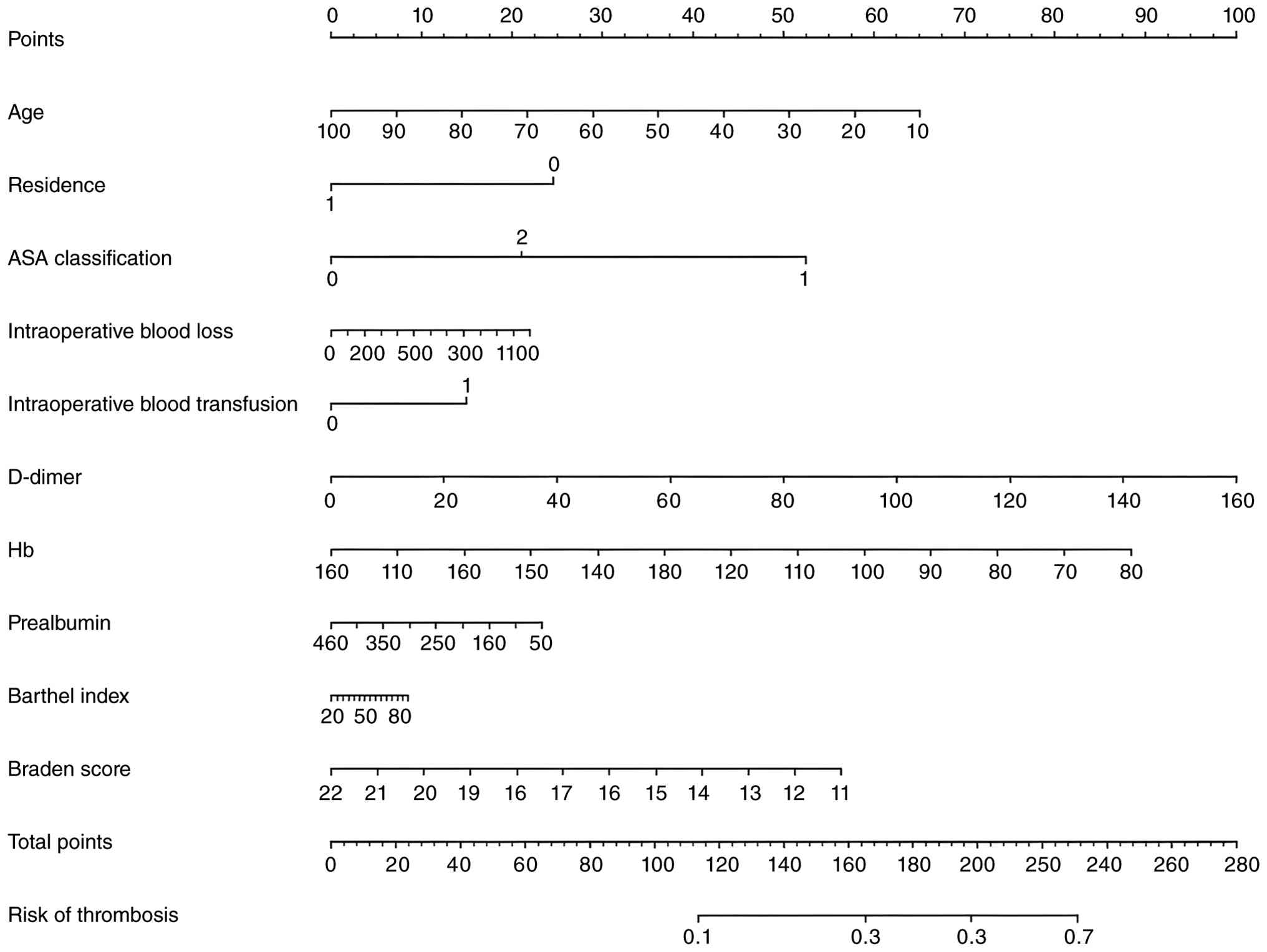 | Figure 1Nomogram for predicting the
individualized risk of postoperative DVT in patients with
periarticular knee fractures. Instructions for clinical workflow
and scoring: Locate the patient's individual clinical parameter
value on each corresponding variable axis (age, residence, ASA
grade, intraoperative blood loss, blood transfusion, D-dimer, Hb,
prealbumin, Barthel index and Braden score). Draw a vertical line
upward from each variable position to the top-most ‘Points’ scale
to determine the specific points assigned to each indicator.
Calculate the sum of points across all 10 indicators to establish
the aggregate score on the Total Points' axis. Draw a vertical line
downward from the identified total points to the bottom ‘Risk of
thrombosis’ axis to read the patient's individualized postoperative
DVT risk percentage, which subsequently guides tri-tier
prophylactic decision-making (low, intermediate or high risk). Hb,
hemoglobin; DVT, deep vein thrombosis; ASA, American Society of
Anesthesiologists. |
Clinical example illustration
A 65-year-old rural resident (ASA grade III;
admission D-dimer, 8.5 mg/l; Hb, 95 g/l; prealbumin, 180 mg/l;
Barthel index, 45; Braden score, 14) was taken as a representative
example. The patient had undergone open reduction and internal
fixation with 350 ml of intraoperative blood loss and received
intraoperative blood transfusion. By mapping each indicator onto
the nomogram, the respective variable scores were obtained and
summed, yielding a total point score of ~178 points. Projecting
this aggregate score downward to the probability axis revealed an
estimated postoperative DVT risk of roughly 68.5%, unambiguously
categorizing this patient into the high-risk cohort warranting
proactive perioperative intervention.
Discriminative performance and ROC/AUC
analysis
Discriminative power of the prediction nomogram was
evaluated using ROC curve analysis (Fig. 2). The AUC reached 0.837 (95% CI,
0.790-0.880; bootstrap-corrected 95% CI, 0.782-0.918), which
validated the robust discriminative capability of the established
multifactorial model in distinguishing periarticular knee fracture
patients who developed postoperative DVT from those who did not,
substantially outperforming single-variable assessments.
Model calibration and
goodness-of-fit
To assess the agreement between predicted
probabilities and actual clinical outcomes, model calibration was
evaluated by plotting a calibration curve with 1,000 bootstrap
resamplings (n=313) (Fig. 3). The
bias-corrected solid line closely mirrored the ideal 45-degree
reference diagonal across the entire range of risk probabilities.
The model achieved a mean absolute error of 0.019, reflecting
favorable goodness-of-fit and negligible overfitting in internal
risk estimation.
DCA and clinical utility
DCA was performed for the nomogram across varying
threshold probabilities (Fig. 4).
Within a broad threshold probability range (0.10-0.60), the
prediction model delivered markedly higher standardized net benefit
than the ‘treat-all’ strategy (universal intensified
thromboprophylaxis) and the ‘treat-none’ strategy (routine
non-intensified management). These findings confirmed the
substantial clinical utility of the nomogram for risk
stratification in routine surgical practice.
Discussion
The present study retrospectively analyzed the
clinical data of 319 patients with periarticular knee fractures,
aiming to construct and internally validate a visual nomogram-based
prediction model. The established nomogram could effectively
predict the risk of postoperative DVT. Results showed a
postoperative DVT incidence of 26.0%, consistent with the high-risk
level reported in recent studies (23-25).
Periarticular knee fractures were mainly caused by high-energy
trauma, which could lead to severe damage of local vascular
endothelium; they may also cause extensive soft-tissue contusion.
Compulsory knee immobilization should be performed after surgery.
This condition impairs the function of the calf muscle pump,
slowing down venous blood flow. All these factors raise the basic
risk of DVT occurrence (26).
Multivariate logistic regression analysis was
conducted in the present study. Ultimately, a total of 10
independent influencing factors were identified. These factors
included age, residential area, ASA physical status classification,
intraoperative blood loss, intraoperative blood transfusion,
D-dimer, Hb, prealbumin, Barthel index and Braden score. The
nomogram model was established based on these variables. The ROC
curve of this model was 0.837 (95% CI, 0.79-0.88). The calibration
curve showed favorable consistency between predicted probability
and actual observed frequency. DCA further confirmed the excellent
net clinical benefits of this model. These findings validated the
discrimination, calibration and clinical value of the established
nomogram model for predicting the postoperative DVT risk in
patients with periarticular knee fractures.
Age was identified as an independent risk factor for
DVT (OR, 1.0228; P=0.0065). The mean age was 60.28±16.92 years in
the thrombosis group. Each one-year increment in age was associated
with a 2.28% increase in the odds of DVT. Aging promotes
prothrombotic alterations in human coagulation function,
accompanied by impaired vascular endothelial function and reduced
fibrinolytic activity. Additionally, elderly patients commonly
present with multiple comorbidities and diminished physical
activity, collectively contributing to a substantially elevated
risk of DVT (27).
ASA classification could evaluate the overall
preoperative health status of patients and demonstrated a strong
link with DVT risk in the present research (OR, 2.2764; P=0.0001).
ASA grade Ⅰ accounted for 55.4% of patients in the DVT group,
whereas an 83.5% proportion was identified in the non-DVT group.
The DVT group comprised more patients with ASA grade II and above.
Each one-grade elevation in ASA grade contributed to a 127.64%
increase in the odds of DVT, with a higher ASA grade indicating
severe underlying diseases or poor general physical condition.
These patients exhibit diminished compensation ability in response
to trauma and surgical stress, accompanied by pronounced
inflammatory responses, which further aggravates the
hypercoagulable state of the blood (28).
D-dimer is a sensitive marker that reflects the
activation of the fibrinolytic system. In the present study, it was
considered an independent risk factor for DVT (OR, 1.0251;
P=0.0270). The D-dimer level was 10.28±10.66 mg/l in the DVT group,
which was significantly higher than the 6.58±12.28 mg/l in the
non-DVT group. Each one-unit increase in D-dimer elevated the odds
of DVT by 2.51%. Increased D-dimer levels indicate active
thrombosis and secondary fibrinolysis in the body. Its dynamic
changes facilitate the identification of early DVT (29).
The present study observed clear associations
between intraoperative blood loss, intraoperative transfusion and
DVT odds. Intraoperative blood loss (OR, 1.0015; P=0.0098 and
intraoperative blood transfusion (OR, 2.7917; P=0.0014) were both
identified as independent risk factors. While each 1-ml increase in
intraoperative blood loss only raised the odds of DVT by 0.15%,
large cumulative blood loss could yield clinically meaningful
elevation in DVT odds. Intraoperative blood transfusion increased
the odds of DVT by 179.17%. Furthermore, massive intraoperative
blood loss triggers the thrombosis-inflammation cascade reaction,
which promotes tissue factor release and platelet activation, while
also activating the human coagulation system (30). Banked blood reduces red blood cell
deformability during transfusion, causing microcirculation
disorders. Transfusion-related immunomodulation releases
pro-inflammatory cytokines, and these substances further accelerate
thrombosis (31). Doctors should
closely monitor DVT risk among patients with substantial
intraoperative blood loss or those receiving intraoperative
transfusion and reinforce perioperative anticoagulation management
for this high-risk patient subgroup (32).
Hb and prealbumin served as independent protective
factors in this present study. The odds of DVT decreased by ~3.26%
with every 1 g/l increase in Hb (OR, 0.9674; P=0.0010), with low Hb
levels suggesting anemia. Anemia could affect tissue oxygen supply,
change blood viscosity and slow blood flow. These effects raise the
risk of venous stasis (33).
Prealbumin could reflect nutritional status and acute phase
reactions and showed a protective effect against DVT in the present
study (OR, 0.9915; P=0.0001). Each one-unit rise in prealbumin
reduced the odds of DVT by 0.85%, with low prealbumin levels
indicating malnutrition or severe stress in patients. These
patients may exhibit poor general conditions and slow postoperative
recovery, necessitating long-term bed rest, which could itself
increase the risk of DVT (34).
Functional assessment indexes demonstrated critical connections
with DVT risk in the present study. The odds of DVT decreased by
~4.23% with every one-point increase in the Barthel index (OR,
0.9577; P=0.0006), with a higher Barthel index indicating enhanced
basic physical activity. These patients could get out of bed early
after surgery. Early ambulation may serve as a key measure to
prevent DVT (35). The Braden
score was also an independent protective factor; each 1-point
higher for the Braden score reduced the odds of DVT by 21.81% (OR,
0.7819; P=0.0001). Patients with low Braden scores often stay in
bed for a long time and have limited physical movement. These
situations slow the venous blood flow of patients while increasing
the risk of thrombosis (36). DVT
prevention should not only rely on drug anticoagulation, and
doctors should also prioritize early rehabilitation training and
standardized nursing care.
Residential area represents a social demographic
factor. Within the present study, it exhibited an independent
association with DVT risk (OR, 0.5439; P=0.0182). Living in urban
areas was associated with a 45.61% reduction in the odds of
postoperative DVT. The DVT incidence was 56.4% in rural patients
and 41.5% in their urban counterparts. This difference relates to
multiple aspects, including timely medical treatment, health
literacy, postoperative rehabilitation conditions and family
nursing support (37). The social
background of patients should also be taken into account when
assessing the DVT risk, and more attention should be given to rural
patients with limited medical resources.
Notably, existing Chinese real-world and cohort
studies have reported inconsistent findings regarding the
correlation between residential location and postoperative venous
thromboembolism risk, especially for populations from Southwest
China (38,39). Some regional orthopedic cohort
studies support the present observation that rural patients exhibit
higher DVT risk after trauma-related surgery, which may be
attributable to disparities in preoperative health-seeking
behavior, access to standardized postoperative rehabilitation
guidance and family-based nursing resources (40). However, several other domestic VTE
epidemiological investigations fail to identify residential area as
an independent risk factor for perioperative DVT after orthopedic
trauma; those studies suggest that urban-rural differences may be
confounded by age, comorbidity burden and surgical characteristics
rather than representing an independent effect (41). The discrepancy across studies may
partly stem from regional socioeconomic variation, differences in
case-mix, single-center sampling features and variable adjustment
sets for confounding variables. In the present study, for the
Southwest Chinese population, residential area remained
statistically significant after adjusting for demographic,
laboratory and peri-operative covariates. This implied that
social-demographic context could not be ignored when performing DVT
risk stratification in this specific population. Nevertheless,
considering conflicting evidence from published cohorts, further
multi-center data should still be acquired for the external
validation of such an association.
The established nomogram model combined the
aforementioned 10 independent factors into a visual scoring tool.
Internal verification confirmed its favorable discrimination, with
an AUC of 0.837. The calibration curve showed high-level
consistency between predicted and actual values, while the DCA
curve confirmed that the model yielded superior net clinical
benefits. Relative to universal intervention and non-intervention
strategies, this predictive model exhibited better clinical
application value and showed enhanced promise for clinical decision
making (42).
A total of two previous studies have demonstrated
the feasibility of developing visualized risk-stratification tools
for gynecological disease cohorts, which provide important
methodological references for our present work. Peng et al
(13) constructed a nomogram model
to predict the risk of pathological upgrading after cervical
conization in patients with low-grade squamous intraepithelial
lesions, confirming the superior predictive performance of a
multi-variable-integrated nomogram over single-indicator assessment
(AUC, 0.744). This gynecological retrospective study shared similar
statistical workflows with the present study, including
univariate-multivariate logistic regression, internal validation
via bootstrap resampling, calibration curve analysis and DCA
evaluation, yet its research object was cervical precancerous
lesion rather than orthopedic trauma-related thrombotic events. He
et al (14) explored the
L1CAM-PTK2-FAK-GRB2-SOS-RAS signaling axis in type I high-risk
endometrial cancer and highlighted the clinical necessity of
building risk-evaluation systems for tumor progression, although
the work focused on molecular experimental mechanisms instead of
clinical retrospective prediction modeling. Compared with these two
gynecological-focused studies, the present nomogram targeted
postoperative DVT among southwest Chinese patients with
periarticular knee fractures. Beyond conventional demographic,
peri-operative and laboratory variables, the study further
incorporated functional status indicators including the Barthel
index and Braden score into risk predictors. Moreover, DCA was
strictly performed to quantify clinical net benefit, which
strengthened the real-world practicability of the model for
trauma-patient risk stratification. Collectively, these published
gynecological studies inspire the methodological design of the
present study; however, the present model expands the application
scenario of visualized nomogram-based risk-prediction from
gynecological oncology to orthopedic trauma venous
thromboembolism.
The present study has several advantages compared
with previous prediction models for lower limb fracture patients
(43). First, the focus was
specifically on patients with periarticular knee fractures, a
subgroup with distinctly elevated DVT risk owing to mandatory
postoperative knee immobilization, whereas most existing nomograms
targeted general lower-limb fractures or hip-fracture populations.
Second, beyond conventional demographic, perioperative and
laboratory biomarkers, the present study incorporated
functional-status indicators, including the Barthel index and
Braden score. This design followed the bio-psycho-social medical
model and integrated physical function and nursing-related risk
into risk stratification. Third, DCA was adopted to quantify net
clinical benefits rather than merely reporting AUC and calibration
performance, providing evidence for real-world clinical
utility.
Direct comparisons with previously published DVT
prediction models for orthopedic trauma revealed pronounced
differences in predictor composition and target population.
Multiple existing nomograms for lower-limb fracture-related DVT
were developed for mixed fracture types or geriatric hip-fracture
cohorts (44,45) and few prediction tools were
tailored exclusively for patients with periarticular knee fractures
(46-48).
Some earlier models relied heavily on laboratory markers such as
D-dimer alone; however, this could be frequently elevated after
trauma regardless of actual thrombus formation. Its standalone
discriminatory power in acutely injured patients is thus severely
limited. Other published prediction tools did not incorporate
functional evaluation indicators, ignoring the contribution of
postoperative mobility and long-term bed-rest risk to
thrombogenesis. However, the present proposed nomogram synthesized
demographic features, perioperative variables, laboratory
biomarkers and functional scales, effectively facilitating more
comprehensive individualized risk assessment.
Most previously established nomograms for DVT
following orthopedic trauma only reported discrimination (AUC) and
calibration performance, while omitting DCA-based net-benefit
evaluation, which restricted judgement on their real-world clinical
value (49,50). Various competing prediction tools
also suffered from limited external validation, as they were built
on single-center datasets without stratified functional-status
indicators (44,51). Notably, the present nomogram was
considered only applicable for adult and adolescent patients ≥14
years with closed periarticular knee fractures admitted to
tertiary-level hospitals in Southwest China. Direct extrapolation
to patients with open fractures, those with pre-existing venous
thrombosis or pediatric populations <14 years is not
recommended.
From a clinical implementation perspective, this
visualized nomogram could facilitate standardized risk-oriented
management for patients with periarticular knee fractures.
To overcome the barrier between statistical modeling
and real-world clinical application, a standardized, step-by-step
clinical workflow was proposed for integrating this nomogram into
routine trauma care pathways: Step 1 consists of multi-dimensional
data collection at admission and surgery. Upon admission and
immediately following definitive surgical fixation, clinicians and
trauma nurses should routinely retrieve the 10 candidate parameters
from the electronic health record (EHR). These include demographic
variables (age and residence), baseline physiological/nursing
scales (ASA classification, admission Barthel index and Braden
score), baseline laboratory indicators (admission D-dimer, Hb and
prealbumin levels) and surgical records (intraoperative blood loss
and blood transfusion status).
Step 2 consists of individualized nomogram point
calculation and risk derivation. During postoperative rounds or
multidisciplinary team trauma meetings, the attending surgeon
should locate each parameter on the nomogram axis, compute the
cumulative point score and project it downward to determine the
exact individualized probability of postoperative DVT. Notably, the
nomogram output yields predictive risk probability rather than
definitive diagnosis. Therefore, nomogram results should not
substitute clinical judgment and auxiliary imaging
examinations.
Step 3 consists of tri-tier risk stratification and
tailored thromboprophylaxis protocols. Based on the derived
probability and DCA-supported threshold windows, patients were
categorized into three risk tiers to guide shared decision-making:
i) Low-risk tier (predicted probability <15%), including
standard baseline mechanical prophylaxis (graduated compression
stockings or early ankle-pump exercises) combined with routine
low-dose pharmacological anticoagulation, thereby minimizing
unnecessary drug escalation and mitigating excessive bleeding
risks; ii) intermediate-risk tier (predicted probability 15-40%),
including standard weight-adjusted pharmacological
thromboprophylaxis (for example, standard-dose low-molecular-weight
heparin or direct oral anticoagulants) combined with continuous
intermittent pneumatic compression devices and nurse-assisted early
bed-side mobilization within 24-48 h postoperatively; and iii)
high-risk tier (predicted probability >40%), including
intensified multimodal prophylaxis, such as enhanced surveillance
via bedside bilateral lower-limb Doppler ultrasound on
postoperative days 3 and 7, early consultation with
hematology/vascular surgery, optimization of nutritional support to
correct hypoprealbuminemia, dynamic Hb monitoring and consideration
of extending pharmacological thromboprophylaxis post-discharge for
14-35 days.
Step 4 consists of continuous evaluation and
transition to digitalized EHR tools. Despite the feasibility of
manual point calculation using the printed nomogram, prospective
clinical implementation would be considerably accelerated by
embedding this mathematical formula as an automated digital
calculator within hospital information systems, allowing
instantaneous automated risk output upon EHR data entry.
Nevertheless, several practical obstacles should be
still noted for onsite deployment. Manual scoring of the
paper-based nomogram remains time-consuming for busy trauma wards,
making digital transformation necessarily important for its
widespread bedside application.
It should also be emphasized that the present model
was built on data from a single tertiary center in Southwest China.
Prior to extensive clinical promotion, external validation across
multi-center cohorts from diverse geographic and medical-level
institutions should be performed to confirm its generalizability.
To validate its superior or comparable discrimination and
calibration performance relative to alternative risk-stratification
tools, direct head-to-head external comparison against existing
published prediction models should be performed in future
prospective studies.
Certain limitations of this study should still be
acknowledged. First, it was a single-center retrospective study
with limited sample source, likely inducing selection bias.
Multi-center prospective studies should be conducted to confirm the
general application of the results. Second, color Doppler
ultrasound with low sensitivity for distal DVT was used for the DVT
diagnosis. Some asymptomatic distal DVT cases might be overlooked,
thereby underestimating the true incidence of venous
thromboembolism. Third, only static biomarkers at admission were
detected, and the dynamic changes of perioperative indexes were not
observed. Dynamic monitoring would improve the accuracy of DVT
prediction. Fourth, some potential confounding factors, including
specific anticoagulation protocols and hereditary thrombophilia
gene mutations, were not fully controlled due to medical record
restrictions. Future studies should focus on dynamic biomarker
detection, and genomics and proteomics data could be integrated.
These methods could facilitate the construction of more accurate
individualized risk prediction models.
Despite the clinical utility and robust performance
of the proposed nomogram, several limitations should be
acknowledged. First, the present single-center retrospective study
was performed at one tertiary medical center in Southwest China,
which introduced inherent selection bias and restricted regional
generalizability. Despite internal validation demonstrating good
discrimination and calibration, external validation in cohorts from
different geographic regions and medical centers is required to
determine broader applicability. Second, the present DVT diagnosis
depended on Doppler ultrasound. While this method is noninvasive
and convenient, its sensitivity for distal or asymptomatic calf
muscular vein thrombosis varies, which may slightly underestimate
the true incidence of subclinical VTE. Third, laboratory biomarkers
including D-dimer, hemoglobin and prealbumin were only measured
once at admission. The present study did not capture perioperative
dynamic changes of these indicators, which may provide further
insight into real-time thrombogenesis. Fourth, a number of granular
clinical variables were missing from the retrospective electronic
medical records, such as the exact intraoperative knee flexion
angle, detailed post-discharge thromboprophylaxis protocols and
inherited thrombophilia status. In addition, perioperative
anticoagulation regimens were individualized by attending surgeons
rather than standardized, an unmeasured confounding factor that may
affect postoperative DVT outcomes.
Future concrete research directions were thus
proposed as follows: i) Conduct multi-center prospective cohorts
from different geographic regions of China for external validation
of this nomogram model; ii) incorporate dynamic peri-operative
laboratory biomarker monitoring to improve risk prediction
performance; iii) integrate clinical data with multi-omics data to
explore novel thrombotic risk markers for patients with knee
periarticular fractures; and iv) develop HER-embedded automated
risk-calculator tools to facilitate real-world clinical application
of this prediction nomogram.
In conclusion, patients with periarticular knee
fractures are at a high risk of postoperative DVT, which arises
from the combined effects of multiple clinical factors. The present
study developed and verified a novel nomogram model that
encompassed clinical features, laboratory indicators and functional
evaluation data. This model could accurately identify high-risk
patients and provide quantitative evidence for the formulation of
individualized prevention plans. Clinicians should adopt active DVT
prevention measures for specific patients, including elderly
individuals and those with high ASA grades, large intraoperative
blood loss, intraoperative transfusion, elevated D-dimer, anemia,
low prealbumin, low Barthel index and low Braden score. Further
multi-center prospective studies should be conducted for constant
optimization, and its practical application in clinical decision
support systems should be continuously explored.
Acknowledgements
Not applicable.
Funding
Funding: No funding was received.
Availability of data and materials
The data generated in the present study may be
requested from the corresponding author.
Authors' contributions
JL and SL contributed equally to the present study.
JL and YY conceived and designed the research protocol and
analytical framework of the present nomogram study. JL, SD and GL
completed systematic literature retrieval, screening and evidence
summary. SL was responsible for clinical case screening, inclusion
and exclusion verification, follow-up data collation and clinical
outcome interpretation of enrolled patients with knee periarticular
fractures. JL completed data sorting, statistical model
construction, predictive performance verification and relevant
result analysis. JL and GL participated in raw data acquisition,
collation and preliminary interpretation of analytical results. JL
drafted the original manuscript. YY performed critical revision and
academic supervision of the manuscript. SD participated in study
design optimization, checked the integrity of clinical data and
revised key intellectual content of the manuscript. All authors
read and approved the final version of the manuscript, participated
in the critical revision of the manuscript and agreed to be
accountable for all aspects of the work to ensure the accuracy and
integrity of the research. JL and SL confirm the authenticity of
all the raw data.
Ethics approval and consent to
participate
The present retrospective study was approved by the
Clinical Research Ethics Committee of the Affiliated Hospital,
Southwest Medical University (approval no. KY2026197; approval
date, 27 March 2026). The study was based on de-identified archived
electronic medical records. Prior to study initiation, the Ethics
Committee granted a waiver of signed informed consent for all
participants in accordance with Article 38 of the ‘Measures for the
Ethical Review of Biomedical Research Involving Human Beings’.
Although the original study protocol intended to enroll patients
aged ≥18 years, two adolescent participants aged 14-17 years were
identified during retrospective data curation. The Ethics Committee
specifically reviewed the cases of these two minor subjects and
approved the waiver of guardian informed consent, considering that
no additional research-related interventions were performed and the
historical patients could not be traced. This research was
performed in accordance with the Declaration of Helsinki.
Patient consent for publication
Not applicable.
Competing interests
The authors declare that they have no competing
interests.
References
|
1
|
Prisco D, Tufano A, Cenci C, Pignatelli P,
Santilli F, Di Minno G and Perticone F: Position paper of the
Italian society of internal medicine (SIMI) on prophylaxis and
treatment of venous thromboembolism in patients with cancer. Intern
Emerg Med. 14:21–38. 2018.PubMed/NCBI View Article : Google Scholar
|
|
2
|
Geerts WH, Pineo GF, Heit JA, Bergqvist D,
Lassen MR, Colwell CW and Ray JG: Prevention of venous
thromboembolism: The Seventh ACCP conference on antithrombotic and
thrombolytic therapy. Chest. 126 (3 Suppl):338S–400S.
2004.PubMed/NCBI View Article : Google Scholar
|
|
3
|
Panchagnula N and Brasher WP:
Hyperglycemia and venous thromboembolism. Diagnostics (Basel).
14(1994)2024.PubMed/NCBI View Article : Google Scholar
|
|
4
|
Desouza C and Antao N: Potpourri-recent
and relevant literature in periprosthetic fractures around the
knee. J Clin Orthopaedics. 9:52–56. 2024.
|
|
5
|
Alcaide D, Litten R, Krout JC, Hawkins G,
Smitherman A, McIlwain R, McGwin G, Spitler C and Johnson J:
Factors influencing patient-reported outcomes in operatively
managed tibial plateau fractures. Eur J Orthop Surg Traumatol.
36(117)2026.PubMed/NCBI View Article : Google Scholar
|
|
6
|
Nam D, Nunley RM, Johnson SR, Keeney JA,
Clohisy JC and Barrack RL: The effectiveness of a risk
stratification protocol for thromboembolism prophylaxis after hip
and knee arthroplasty. J Arthroplasty. 31:1299–1306.
2015.PubMed/NCBI View Article : Google Scholar
|
|
7
|
Lurie JM, Png CYM, Subramaniam S, Chen S,
Chapman E, Aboubakr A, Marin M, Faries P and Ting W: Virchow's
triad in ‘silent’ deep vein thrombosis. J Vasc Surg Venous Lymphat
Disord. 7:640–645. 2019.PubMed/NCBI View Article : Google Scholar
|
|
8
|
Almskog LM and Ågren A:
Thromboinflammation vs. immunothrombosis: Strategies for overcoming
anticoagulant resistance in COVID-19 and other hyperinflammatory
diseases. Is ROTEM helpful or not? Front Immunol.
16(1599639)2025.PubMed/NCBI View Article : Google Scholar
|
|
9
|
Jiang J, Guan ZP and Lü HS: Correlation
between single nucleotide polymorphism of prothrombin gene G20210
and deep vein thrombosis after total joint replacement. Zhonghua Yi
Xue Za Zhi. 89:782–785. 2009.PubMed/NCBI(In Chinese).
|
|
10
|
Reed CR, Curry N, Juffermans NP and Neal
MD: Hemostatic abnormalities after trauma resuscitation: Challenges
and strategies in caring for the critically injured patient. Ann
Intensive Care. 15(163)2025.PubMed/NCBI View Article : Google Scholar
|
|
11
|
Jovanović S, Elek Z, Petrović D,
Igrutinović G, Vićentijević D and Božović A: Significance of
increased D-dimer values in fresh fractures in orthopedics and
correlations with thromboembolic complications. Int J Med Sci Res.
1:17–22. 2022.
|
|
12
|
May JE, Allen AL, Samuelson Bannow BT,
O'Connor C, Sylvester KW and Kaatz S: Safe and effective
anticoagulation use: Case studies in anticoagulation stewardship. J
Thromb Haemost. 23:779–789. 2025.PubMed/NCBI View Article : Google Scholar
|
|
13
|
Peng X, Wan J, Wang Y and Wang L:
Development of a clinical prediction model for pathological
upgrading in low-grade squamous intraepithelial lesions following
cervical conization. Cytojournal. 21(37)2024.PubMed/NCBI View Article : Google Scholar
|
|
14
|
He W, Liu W, Liu X and Tan W: The
mechanism of L1 cell adhesion molecule interacting with protein
tyrosine kinase 2 to regulate the focal adhesion kinase-growth
factor receptor-bound protein 2-son of sevenless-rat sarcoma
pathway in the identification and treatment of type I high-risk
endometrial cancer. Cytojournal. 21(34)2024.PubMed/NCBI View Article : Google Scholar
|
|
15
|
Wang B, Peng C, Zhou MK, Guo J and He L:
Clinical characteristics and prognosis of patients with cerebral
venous sinus thrombosis in southwest China. Sichuan Da Xue Xue Bao
Yi Xue Ban. 45:515–518. 2014.PubMed/NCBI(In Chinese).
|
|
16
|
Wang C, Hang Y, Cao Y, Zhao L, Jiao J, Li
M, Xu X, Lu S, Jiang L, Liu Q, et al: A nomogram for predicting
thrombus composition in stroke patients with large vessel
occlusion: Combination of thrombus density and perviousness with
clinical features. Neuroradiology. 65:371–380. 2022.PubMed/NCBI View Article : Google Scholar
|
|
17
|
Li Z, Liu X, Li L, Cao P, Zhang G, Jiao Z,
Wang F, Hao Q, Li Y and Zhang Y: Development and validation of a
predictive nomogram for lower extremity deep vein thrombosis
dislodgement in orthopedic patients. Front Surg.
10(1148024)2023.PubMed/NCBI View Article : Google Scholar
|
|
18
|
Liu L, Zhao B, Xu G and Zhou J: A nomogram
for individualized prediction of lower extremity deep venous
thrombosis in stroke patients: A retrospective study. Medicine
(Baltimore). 101(e31585)2022.PubMed/NCBI View Article : Google Scholar
|
|
19
|
Greenwald LJ, Yost MT, Sponseller PD,
Abdullah F, Ziegfeld SM and Ain MC: The role of clinically
significant venous thromboembolism and thromboprophylaxis in
pediatric patients with pelvic or femoral fractures. J Pediatr
Orthop. 32:357–3561. 2012.PubMed/NCBI View Article : Google Scholar
|
|
20
|
Saklad M: Grading of patients for surgical
procedures. Anesthesiology. 2:281–284. 1941.
|
|
21
|
Mahoney FI and Barthel DW: Functional
evaluation: The Barthel index. Md State Med J. 14:61–65.
1965.PubMed/NCBI
|
|
22
|
Braden B and Bergstrom N: The braden scale
for predicting pressure sore risk. Nurs Res. 36:205–210.
1987.PubMed/NCBI
|
|
23
|
Yen D and Weiss W: Results of
adjusted-dose heparin for thromboembolism prophylaxis in knee
replacement compared to those found for its use in hip fracture
surgery and elective hip replacement. Iowa Orthop J. 27:47–51.
2007.PubMed/NCBI
|
|
24
|
Zhang Y, Wang H, Li X, Pang P, Luo Z, Cai
W, Li W and Hao J: Incidence and risk factors of admission deep
vein thrombosis in patients with traumatic fracture: A Multicenter
retrospective study. Front Surg. 9(961441)2022.
|
|
25
|
Abelseth G, Buckley RE, Pineo GF, Hull R
and Rose MS: Incidence of deep-vein thrombosis in patients with
fractures of the lower extremity distal to the hip. J Orthop
Trauma. 10:230–235. 1996.PubMed/NCBI View Article : Google Scholar
|
|
26
|
Diamond SL: When flow goes slow, von
willebrand factor can bind red blood cells. Arterioscler Thromb
Vasc Biol. 37(1595)2017.PubMed/NCBI View Article : Google Scholar
|
|
27
|
Kechaou I, Ben Hassine L, Cherif E,
Hassayoun M, Azzabi S, Boukhris I, Kaouech Z, Koôli C and
Khalfallah N: Characteristics of deep vein thrombosis in the
elderly. Tunis Med. 93:38–42. 2015.PubMed/NCBI(In Spanish).
|
|
28
|
Kitachev KV, Khubulava GG, Sazonov AB,
Kozlov KL, Kulaga VA, Iurchenko DL, Luk'ianov NG and Iakovlev NN:
Pathogenesis of chronic ischemia of the lower extremities in
patients of advanced ages. Adv Gerontol. 21:97–99. 2008.PubMed/NCBI(In Russian).
|
|
29
|
Kurklinsky AK, Kalsi H, Wysokinski WE,
Mauck KF, Bhagra A, Havyer RD, Thompson CA, Hayes SN and McBane RD
II: Fibrin d-dimer concentration deep vein thrombosis symptom
duration, and venous thrombus volume. Angiology. 62:253–256.
2010.PubMed/NCBI View Article : Google Scholar
|
|
30
|
Dunjić R, Elezović I and Vukasinović Z:
Haemostatic disorders in orthopaedic surgery: Laboratory diagnosis.
Srp Ark Celok Lek. 137:567–574. 2009.PubMed/NCBI View Article : Google Scholar : (In Serbian).
|
|
31
|
Alexandru N, Popov D and Georgescu A:
Platelet dysfunction in vascular pathologies and how can it be
treated. Thromb Res. 129:116–126. 2011.PubMed/NCBI View Article : Google Scholar
|
|
32
|
Hattori A, Watanabe T and Izumi T:
Scanning electron microscope study on hemostatic reaction. Mural
thrombus after the removal of endothelium, with special references
to platelet behavior, site of fibrin formation and microhemolysis.
Arch Histol Jpn. 41:205–227. 1978.PubMed/NCBI View Article : Google Scholar
|
|
33
|
Muthard R and Diamond S: Blood clots are
rapidly assembled hemodynamic sensors: Flow arrest triggers
intraluminal thrombus contraction. Blood. 120(2164)2012.PubMed/NCBI View Article : Google Scholar
|
|
34
|
Wang J, Zan Q and Xie S: Discussion on
Prevention and Treatment of Lower Extremity Deep Venous Thrombosis
in Orthopedic Perioperative Period from Spleen and Stomach
Meridians. J Clin Nurs Res: 5, 2021
doi:10.26689/jcnr.v5i1.1777.
|
|
35
|
Bah MB, Baldé EY, Camara OM, Keita FB,
Barry IS, Diallo H, Kossa AJ, Koné A and Baldé MD: Deep vein
thrombosis of the lower limbs: Epidemiology and risk factors.
Cardiol Vasc Res. 9:1–5. 2025.
|
|
36
|
Alderden J, Cummins MR, Pepper GA, Whitney
JD, Zhang Y, Butcher R and Thomas D: Midrange Braden subscale
scores are associated with increased risk for pressure injury
development among critical care patients. J Wound Ostomy Continence
Nurs. 44:420–428. 2017.PubMed/NCBI View Article : Google Scholar
|
|
37
|
Ramanathan R, Gu Z, Limkemann AJ,
Chandrasekhar S, Rensing E, Mays C and Duane TM: Association
between interruptions in chemical prophylaxis and VTE formation. Am
Surg. 81:732–737. 2020.PubMed/NCBI
|
|
38
|
Luo Z, Chen W, Li Y, Wang X, Zhang W, Zhu
Y and Zhang F: Incidence of deep venous thrombosis (DVT) of the
lower extremity in patients undergoing surgeries for ankle
fractures. J Orthop Surg Res. 15(294)2020.PubMed/NCBI View Article : Google Scholar
|
|
39
|
Tan Z, Hu H, Wang Z, Wang Y and Zhang Y:
Prevalence and risk factors of preoperative deep venous thrombosis
in closed patella fracture: A prospective cohort study. J Orthop
Surg Res. 16(404)2021.PubMed/NCBI View Article : Google Scholar
|
|
40
|
Wang Z, Lu Y, Wang P, Fei C, Li S, Xue H,
Li Z, Wang Q, Zhang K and Ma T: Suboptimal use of DOACs
Post-discharge for geriatric hip fractures with isolated calf deep
vein thrombosis: Do clinician prescribing preferences and patient
compliance alters clinical outcomes? Clin Interv Aging.
18:1423–1436. 2023.PubMed/NCBI View Article : Google Scholar
|
|
41
|
Yao W, Tang WY, Wang W, Lv QM and Ding WB:
Development and validation of preoperative proximal and distal
lower limb deep vein thrombosis nomograms in geriatric hip fracture
patients. Eur Rev Med Pharmacol Sci. 27:10269–10283.
2023.PubMed/NCBI View Article : Google Scholar
|
|
42
|
Xu Y, Zhang Z, Si D, Zhang Q and Zhang W:
A new nomogram prediction model for left ventricular thrombus in
patients with left ventricular aneurysm after acute myocardial
infarction. Rev Cardiovasc Med. 25(377)2024.PubMed/NCBI View Article : Google Scholar
|
|
43
|
Zheng F, Chen X, Huang J and Lin C: Study
on risk factors of preoperative deep vein thrombosis in patients
with lower limb fractures and construction and validation of risk
prediction nomogram model. BMC Surg. 24(408)2024.PubMed/NCBI View Article : Google Scholar
|
|
44
|
Han S, Bai Y, Jiao K, Qiu Y, Ding J, Zhang
J, Hu J, Song H, Wang J, Li S, et al: Development and validation of
a newly developed nomogram for predicting the risk of deep vein
thrombosis after surgery for lower limb fractures in elderly
patients. Front Surg. 10(1095505)2023.PubMed/NCBI View Article : Google Scholar
|
|
45
|
Lin Z: Nomogram for predicting deep venous
thrombosis in lower extremity fractures. Front Surg.
8(694042)2021.PubMed/NCBI View Article : Google Scholar
|
|
46
|
Ling H, Li W, Deng G, Lao Y, Lu R, Su W
and Huang Z: Development of a nomogram for deep vein thrombosis in
patients with Tibial plateau fractures based on systemic
Immune-inflammation index. Sci Rep. 14(23888)2024.PubMed/NCBI View Article : Google Scholar
|
|
47
|
Wu L and Cheng B: A nomogram to predict
postoperative deep vein thrombosis in patients with femoral
fracture: A retrospective study. J Orthop Surg Res.
18(463)2023.PubMed/NCBI View Article : Google Scholar
|
|
48
|
Yang S, Zhang E, Li Z, Long Y, Li Y, Zhang
J, Wang F, Liu L, Wang T, Guo J and Hou Z: Deep vein thrombosis in
patients with patellar fractures: Assessing incidence rates and
identifying risk factors. PLoS One. 20(e0316628)2025.PubMed/NCBI View Article : Google Scholar
|
|
49
|
Lin Z, Mi B, Liu X, Panayi AC, Xiong Y,
Xue H, Zhou W, Cao F, Liu J, Hu L, et al: Nomogram for predicting
deep venous thrombosis in lower extremity fractures. Biomed Res
Int. 2021(9930524)2021.PubMed/NCBI View Article : Google Scholar
|
|
50
|
Shi H, Zhou Y, Wang Y, et al: Nomogram to
predict preoperative deep vein thrombosis risk in patients with
isolated calcaneal fracture. J Orthop Surg Res.
17(467)2022.PubMed/NCBI View Article : Google Scholar
|
|
51
|
He L, Luo L, Hou X, Liao D, Liu R, Ouyang
C and Wang G: Predicting venous thromboembolism in hospitalized
Trauma patients: A combination of the caprini score and data-driven
machine learning model. BMC Emerg Med. 21(60)2021.PubMed/NCBI View Article : Google Scholar
|