Introduction
Acute ischemic stroke (AIS) is a major cause of
mortality and long-term disability worldwide. The global
age-standardized incidence rate of ischemic stroke is projected to
reach 89.32/100,000 population by 2030(1). Early neurological recovery depends in
part on restoration of cerebral perfusion, limitation of ischemic
injury and prevention of early neurological deterioration (2,3).
Although intravenous thrombolysis and endovascular thrombectomy
have improved outcomes in patients who meet established
time-window, imaging and clinical eligibility criteria, numerous
patients remain ineligible because of delayed presentation,
contraindications to intravenous thrombolysis, absence of a
treatable large-vessel occlusion or unfavorable imaging or clinical
profiles, and some continue to have residual hypoperfusion,
microcirculatory dysfunction or incomplete neurological recovery
despite standard acute management (4,5).
Adjunctive strategies that can be integrated into routine stroke
care and evaluated using accessible physiological markers therefore
remain of clinical interest.
Hyperbaric oxygen therapy (HBOT) increases the
amount of oxygen dissolved in plasma and may enhance oxygen
delivery to ischemic or hypoperfused brain tissue under hyperbaric
conditions (6,7). HBOT is used in some stroke centers
equipped with hyperbaric chambers as an adjunct to standard stroke
care in selected patients with AIS; however, the present study was
not designed to assess efficacy relative to standard care without
HBOT, and the optimal timing of initiation remains uncertain.
Previous studies have focused primarily on associations between
HBOT exposure and neurological or functional outcomes; few have
examined whether the timing of HBOT initiation among treated
patients is associated with early cerebrovascular physiological
responses and subsequent functional outcome (8,9).
Treatment timing is also shaped by access, workflow, baseline
disease severity, clinical stability and feasibility, making
careful consideration of pretreatment clinical, imaging and
hemodynamic factors essential (10).
Transcranial Doppler (TCD) provides a non-invasive,
repeatable method for assessing cerebral hemodynamics in patients
with AIS (11,12). Middle cerebral artery mean flow
velocity (MCA-MFV) reflects flow velocity, whereas the middle
cerebral artery pulsatility index (MCA-PI) provides an index of
downstream vascular resistance; changes in these parameters may
therefore serve as accessible markers of early hemodynamic response
(11,12). Early neurological response assessed
with the National Institutes of Health Stroke Scale (NIHSS)
captures short-term clinical change, whereas the modified Rankin
Scale (mRS) remains the standard measure of 90-day functional
outcome after stroke (13,14). Integrating early TCD and
neurological responses may provide a structured description of
treatment-emergent neurohemodynamic recovery without relying solely
on delayed functional status.
Evidence linking HBOT initiation timing to early
TCD-defined hemodynamic response, neurological recovery and 90-day
functional outcome remains limited among patients with AIS who
receive HBOT in routine clinical care (15,16).
Safety is also relevant when considering earlier treatment,
particularly with respect to symptomatic intracranial hemorrhage,
barotrauma, treatment intolerance, oxygen-toxicity symptoms and
other serious HBOT-related adverse events. The present study will
therefore evaluate the association between the HBOT initiation
window and early neurohemodynamic response, early neurological
response, 90-day functional outcome and safety in a retrospective,
exposure-stratified cohort in which all patients received HBOT. The
present study will compare initiation windows within the
HBOT-treated cohort and was not designed to estimate the efficacy
of HBOT relative to standard care without HBOT.
Materials and methods
Study design and ethics
The present single-center, retrospective,
exposure-stratified observational cohort was performed at Heyou
Hospital (Foshan, China) and included hospitalized patients with
AIS who received HBOT within 72 h of symptom onset. All treatment
decisions, HBOT delivery, imaging, TCD assessments, neurological
evaluations, safety monitoring and follow-up were derived from
routine clinical records. The investigators neither assigned
treatment nor modified clinical care. Consecutive eligible patients
admitted between January 2022 and April 2025 were screened. The
present study examined associations between the actual HBOT
initiation window and early neurohemodynamic response, early
neurological response, 90-day functional outcome and HBOT-related
safety outcomes among patients treated with HBOT. No non-HBOT
comparison group was included. The present study was conducted in
accordance with the Declaration of Helsinki and approved by the
Heyou Hospital Institutional Review Board (approval no.
20250721-EXP1). As the analysis used de-identified retrospective
data and involved no investigator-assigned intervention, the
requirement for written informed consent was waived by the Heyou
Hospital Institutional Review Board.
Study population
Eligible patients were 18-85 years of age, had AIS
confirmed by cranial computed tomography (CT) or magnetic resonance
(MR) imaging (17), were admitted
within 72 h of symptom onset, had an anterior-circulation ischemic
lesion and a baseline NIHSS score of 4-20, and received standard
stroke care plus HBOT during hospitalization. Standard stroke care
comprised routine guideline-based acute stroke management,
including intravenous thrombolysis and/or endovascular thrombectomy
when clinically indicated, as documented in the medical record.
Eligibility also required a documented first HBOT initiation time
within 72 h of symptom onset, baseline TCD before HBOT, repeat TCD
within 72 h after the first HBOT session, baseline imaging
sufficient to determine infarct side, Alberta Stroke Program Early
CT Score (ASPECTS) (18), large
vessel occlusion (LVO), and available 90-day mRS data (19). Exclusion criteria were pre-stroke
mRS ≥3, posterior-circulation stroke, transient ischemic attack
(TIA), intracranial hemorrhage at admission, a neurological
disorder that could interfere with functional assessment, baseline
NIHSS <4 or >20, HBOT initiated >72 h after symptom onset,
unavailable first-HBOT timing, missing baseline or early post-HBOT
TCD data, missing 90-day mRS data, terminal disease with an
expected survival of <3 months or a 90-day functional outcome
primarily determined by a non-stroke condition. Of the 1,627
hospitalized patients with AIS screened, 486 received HBOT within
72 h of symptom onset. A total of 429 patients met all eligibility
criteria, comprising 136 patients in the <24 h window, 161 in
the 24 to <48 h window and 132 in the 48 to 72 h window.
HBOT initiation window and treatment
delivery
The primary exposure was the HBOT initiation window,
defined by the interval from symptom onset to the start of
compression for the first HBOT session. Symptom onset was
determined from emergency records, stroke-pathway records, medical
notes or family-provided history. When a definite symptom-onset
time was documented, that time was used; when onset was unwitnessed
or unknown, the last-known-well time, defined as the last time the
patient was known to be free of symptoms attributable to the index
stroke, was used. The first HBOT time was obtained from the HBOT
treatment system or the first documented compression start time in
the patients' medical records. Patients were classified into three
initiation windows: <24 h, 24 to <48 h and 48-72 h. The 48-72
h window served as the reference in association models because it
represented the latest initiation interval within the prespecified
72-h exposure range, allowing the two earlier windows to be
compared with the latest-treated group. Onset-to-HBOT time was used
to verify exposure separation, and onset-to-admission time was
recorded as a timing-related clinical variable. The number of HBOT
sessions completed within 10 days was used to characterize early
treatment delivery across initiation windows. HBOT followed a
standardized routine clinical protocol for hospitalized patients
with stroke: 2.0 atmospheres absolute (ATA), 100% oxygen for 60 min
at therapeutic pressure once daily and 10-15 min each for
compression and decompression, giving a total chamber time of 80-90
min per session. The planned course was 10 sessions over 10 days.
Fewer sessions could be completed because of treatment
interruption, clinical scheduling, discharge or other routine-care
considerations; the actual number completed was analyzed as
recorded. HBOT records were reviewed for chamber type, treatment
pressure, compression, oxygen-breathing period, air-break
arrangement, decompression, total session duration, daily
frequency, number of sessions within 10 days, premature
interruption and tolerance-related discontinuation. Pre-HBOT safety
screening assessed cardiopulmonary stability, consciousness and
cooperation, ear and sinus tolerance, and documented
contraindications. Treatment interruption or cancellation was
recorded when HBOT was stopped or withheld because of intolerance,
ear or sinus symptoms, claustrophobia, suspected oxygen toxicity or
other safety concerns. The present study compared initiation
windows only among patients who received HBOT and did not compare
HBOT with non-HBOT care.
Baseline clinical, imaging, laboratory
and TCD variables
Baseline data were extracted from electronic medical
records, stroke evaluation records, imaging reports, laboratory
systems, TCD reports, HBOT records, discharge summaries and
follow-up documentation. Demographic and baseline functional
variables included age, sex, body mass index (BMI) and pre-stroke
mRS. Vascular risk factors and prior treatments included
hypertension, diabetes mellitus, atrial fibrillation, dyslipidemia,
coronary heart disease, previous stroke or TIA, current smoking and
pre-stroke antithrombotic use. Acute stroke variables included
baseline NIHSS score, systolic and diastolic blood pressure, Trial
of Org 10172 in Acute Stroke Treatment (TOAST) subtype (20), infarct side, cortical involvement,
baseline ASPECTS, LVO, baseline MCA stenosis or occlusion,
intravenous thrombolysis and endovascular thrombectomy. MCA
stenosis or occlusion was determined from available CT angiography,
MR angiography and TCD records. Admission laboratory measures
included white blood cell count, neutrophil-to-lymphocyte ratio
(NLR), platelet count, glucose, D-dimer, fibrinogen, low-density
lipoprotein cholesterol, serum creatinine, serum albumin and
homocysteine. NLR was calculated from absolute neutrophil and
lymphocyte counts measured in the same blood sample. Baseline TCD
measures included affected side MCA-MFV, MCA-PI, MCA resistance
index and the MCA-MFV asymmetry ratio (21), calculated as affected-side divided
by contralateral MCA-MFV. Early post-HBOT TCD was performed within
72 h after the first HBOT session. Early MCA-MFV change was defined
as the percentage change from baseline, whereas early MCA-PI change
was defined as the absolute post-HBOT minus baseline
difference.
Outcome definitions
The primary outcome was favorable functional status
at 90 days, defined as an mRS score of 0-2. The 90-day mRS was also
analyzed as an ordinal outcome ranging from 0 to 6. Early
neurological response was defined as a decrease of ≥4 NIHSS points
from baseline to day 7 or a day-7 NIHSS score of 0-1. TCD
hemodynamic response was defined as an increase of ≥20% in
affected-side MCA-MFV after HBOT without a concomitant increase in
MCA-PI of ≥0.10. The integrated early neurohemodynamic response
phenotype required both TCD hemodynamic response and early
neurological response. This phenotype was analyzed solely as an
exploratory, post-treatment, treatment-emergent response marker; it
was neither a baseline predictive factor nor a validated surrogate
endpoint and was therefore not included as a covariate in the
primary HBOT timing models. Early neurological deterioration was
defined as an increase of ≥4 NIHSS points within 72 h after
admission. Safety outcomes included symptomatic intracranial
hemorrhage, 90-day mortality, middle ear barotrauma, sinus
barotrauma or pressure symptoms, claustrophobia-related treatment
interruption, oxygen-toxicity symptoms, severe HBOT-related adverse
events and a composite safety endpoint. Symptomatic intracranial
hemorrhage was defined as imaging-confirmed intracranial hemorrhage
within 7 days accompanied by an increase of ≥4 NIHSS points. Middle
ear barotrauma comprised documented ear pain or fullness, hearing
decline, tympanic membrane congestion or retraction, bleeding or
perforation during or after HBOT. Sinus barotrauma or pressure
symptoms comprised documented sinus barotrauma, sinus pain or
pressure symptoms during or after HBOT. Claustrophobia-related
treatment interruption was defined as premature termination or
cancellation of HBOT because of claustrophobia, marked anxiety or
inability to tolerate the chamber. Oxygen-toxicity symptoms
included suspected treatment-emergent manifestations such as
seizure-like symptoms, visual disturbance, marked nausea or
dizziness. A severe HBOT-related adverse event was defined as an
event leading to premature termination of HBOT, specialist
management, prolonged hospitalization or definite organ injury. The
composite safety endpoint comprised symptomatic intracranial
hemorrhage, 90-day mortality, 90-day recurrent stroke, middle ear
barotrauma or a severe HBOT-related adverse event.
Data quality control and missing data
handling
Data were extracted using a predefined case-report
framework. Core exposure variables, HBOT delivery variables, TCD
parameters, reperfusion therapy, NIHSS scores, mRS outcomes and
safety events were cross-checked against source records. Imaging
and TCD variables were reviewed using the prespecified operational
definitions above and, where applicable, established published
criteria for ASPECTS and TCD-based cerebrovascular assessment
(11,12,18);
discrepancies were resolved by re-examining the original records.
Range and logical-consistency checks were applied to timing
variables, clinical scores, laboratory values, TCD parameters,
treatment records, safety records and follow-up outcomes. Values
inconsistent with the expected sequence of symptom onset,
admission, HBOT initiation, TCD assessment and outcome evaluation
were verified against source records. Clinically plausible extreme
values were retained after verification; unverifiable values were
treated as missing. As the present study included all eligible
patients during the present study period, no prospective
sample-size calculation was performed. The final cohort comprised
429 patients. Admission glucose was missing in 4 patients; models
including this variable therefore used complete cases (n=425).
Analyses not involving admission glucose retained the full cohort
when applicable. No imputation was performed.
Statistical analysis
Continuous variables were summarized as mean ± SD or
median (interquartile range), as appropriate, and categorical
variables as n (%). Baseline characteristics and treatment-delivery
variables were compared across HBOT initiation windows using
one-way analysis of variance or the Kruskal-Wallis test for
continuous variables and the χ2 test or Fisher's exact
test for categorical variables. No post hoc pairwise comparisons
were performed for baseline or treatment-delivery variables; the
reported P-values represent overall three-group tests. The primary
association between HBOT initiation window and 90-day favorable
functional outcome was estimated using multivariable logistic
regression with the 48 to 72 h window as the reference. The main
model adjusted for age, sex, pre-stroke mRS, baseline NIHSS score,
hypertension, diabetes mellitus, atrial fibrillation, baseline
ASPECTS, LVO, intravenous thrombolysis, endovascular thrombectomy,
admission glucose, baseline affected-side MCA-MFV and baseline
affected-side MCA-PI. The 90-day mRS shift was analyzed using
ordinal logistic regression with the same covariates; common odds
ratios (ORs) >1 indicate greater odds of a lower, more favorable
mRS category. TCD hemodynamic response and early neurological
response were analyzed using adjusted logistic models incorporating
baseline stroke severity, reperfusion therapy, admission glucose
and baseline TCD status. Due to the limited number of events, early
neurological deterioration was analyzed using an exploratory
parsimonious logistic model adjusted for baseline NIHSS score and
ASPECTS and intravenous thrombolysis. The integrated early
neurohemodynamic response phenotype was examined in an exploratory
multivariable logistic model for 90-day favorable functional
outcome adjusted for HBOT initiation window and baseline clinical
and TCD covariates. Safety outcomes were compared across initiation
windows using the χ2 test or Fisher's exact test, as
appropriate. Robustness analyses for the primary outcome included
inverse probability of treatment weighting (IPTW) with stabilized
multinomial propensity-score weights trimmed at the 1st and 99th
percentiles. Additional analyses adjusted for onset-to-admission
time or MCA-MFV asymmetry ratio excluded patients who underwent
endovascular thrombectomy or received intravenous thrombolysis, and
used mRS 0-1 as an alternative functional outcome. To address
potential survivor/immortal-time-related selection, a 72-h landmark
sensitivity analysis restricted the cohort to patients who were
alive and clinically evaluable at 72 h after symptom onset and
reassessed the primary association using the same covariate
adjustment set. The IPTW model included the covariates used in the
main adjusted model, and post-weighting balance was assessed using
standardized mean differences (SMDs). Baseline covariate balance
before and after weighting is summarized in Table SI. Prespecified exploratory
subgroup analyses assessed the association between initiation at
<24 h and 90-day favorable functional outcome, with
heterogeneity tested using interaction terms. Additional post hoc
subgroup analyses evaluated hypertension, diabetes mellitus and
atrial fibrillation using the same framework. Incremental clinical
utility was explored by comparing the baseline model with a model
that additionally included HBOT timing using the area under the
receiver operating characteristic curve (AUC), integrated
discrimination improvement (IDI) and decision curve analysis (DCA)
(22). This analysis was not
intended to develop a prediction model. Treatment-emergent
variables, including TCD hemodynamic response, early neurological
response and the integrated early neurohemodynamic response
phenotype, were not included as covariates in the main HBOT timing
models. All timing-model estimates were interpreted as associations
rather than causal treatment effects. All tests were two-sided.
Analyses were performed in R version 4.4.2 (Posit Software, PBC).
P<0.05 was considered a statistically significant
difference.
Results
Baseline characteristics across HBOT
initiation windows
In the overall three-group comparison across the
<24 h, 24-<48 h and 48 to 72 h initiation windows, baseline
NIHSS score (P=0.039), admission glucose (P=0.004) and baseline
affected-side MCA-PI (P=0.029) were higher, whereas baseline
ASPECTS (P=0.028), intravenous thrombolysis use (P<0.001),
baseline affected-side MCA-MFV (P=0.044) and MCA-MFV asymmetry
ratio (P=0.034) were lower. NLR indicated a borderline
between-group difference (P=0.050). No statistically significant
differences were observed for age, BMI, sex, pre-stroke mRS,
vascular risk factors, TOAST subtype, infarct side, cortical
involvement, large vessel occlusion, baseline MCA stenosis or
occlusion, endovascular thrombectomy or most laboratory measures
(Table I).
 | Table IBaseline and acute stroke
characteristics according to HBOT initiation window. |
Table I
Baseline and acute stroke
characteristics according to HBOT initiation window.
| Variable | <24 h (n=136) | 24 to <48 h
(n=161) | 48 to 72 h
(n=132) | Statistic | P-value |
|---|
| Age, years | 64 (54, 74) | 66 (56, 76) | 68 (58, 78) | 5.068 | 0.079 |
| BMI,
kg/m2 | 24.6±3.5 | 24.0±3.3 | 23.8±3.3 | 2.087 | 0.125 |
| Sex | | | | 0.205 | 0.902 |
|
Female | 51 (37.5) | 58 (36.0) | 46 (34.8) | | |
|
Male | 85 (62.5) | 103 (64.0) | 86 (65.2) | | |
| Pre-stroke mRS | | | | 3.174 | 0.529 |
|
0 | 73 (53.7) | 87 (54.0) | 68 (51.5) | | |
|
1 | 42 (30.9) | 56 (34.8) | 51 (38.6) | | |
|
2 | 21 (15.4) | 18 (11.2) | 13 (9.8) | | |
| Hypertension | | | | 2.431 | 0.297 |
|
No | 48 (35.3) | 58 (36.0) | 37 (28.0) | | |
|
Yes | 88 (64.7) | 103 (64.0) | 95 (72.0) | | |
| Diabetes
mellitus | | | | 1.861 | 0.394 |
|
No | 101 (74.3) | 113 (70.2) | 88 (66.7) | | |
|
Yes | 35 (25.7) | 48 (29.8) | 44 (33.3) | | |
| Atrial
fibrillation | | | | 1.121 | 0.571 |
|
No | 105 (77.2) | 125 (77.6) | 96 (72.7) | | |
|
Yes | 31 (22.8) | 36 (22.4) | 36 (27.3) | | |
| Dyslipidemia | | | | 0.302 | 0.860 |
|
No | 78 (57.4) | 90 (55.9) | 78 (59.1) | | |
|
Yes | 58 (42.6) | 71 (44.1) | 54 (40.9) | | |
| Coronary heart
disease | | | | 4.212 | 0.122 |
|
No | 105 (77.2) | 135 (83.9) | 114 (86.4) | | |
|
Yes | 31 (22.8) | 26 (16.1) | 18 (13.6) | | |
| Previous stroke or
TIA | | | | 1.366 | 0.505 |
|
No | 116 (85.3) | 129 (80.1) | 109 (82.6) | | |
|
Yes | 20 (14.7) | 32 (19.9) | 23 (17.4) | | |
| Current
smoking | | | | 0.390 | 0.823 |
|
No | 90 (66.2) | 110 (68.3) | 92 (69.7) | | |
|
Yes | 46 (33.8) | 51 (31.7) | 40 (30.3) | | |
| Pre-stroke
antithrombotic use | | | | 4.604 | 0.100 |
|
No | 104 (77.6) | 126 (79.2) | 91 (68.9) | | |
|
Yes | 30 (22.4) | 33 (20.8) | 41 (31.1) | | |
| Baseline NIHSS
score | 10 (7, 12) | 10 (7, 13) | 11 (8, 13) | 6.509 | 0.039 |
| Baseline systolic
blood pressure, mmHg | 149±22 | 152±22 | 155±22 | 1.820 | 0.163 |
| Baseline diastolic
blood pressure, mmHg | 84 (74, 95) | 86 (75, 96) | 88 (77, 99) | 3.922 | 0.141 |
| Baseline
ASPECTS | 8 (7, 9) | 8 (7, 9) | 8 (7, 8) | 7.137 | 0.028 |
| TOAST subtype | | | | 10.687 | 0.220 |
|
Large-artery
atherosclerosis | 55 (40.4) | 75 (46.6) | 57 (43.2) | | |
|
Cardioembolism | 26 (19.1) | 34 (21.1) | 32 (24.2) | | |
|
Small-vessel
occlusion | 34 (25.0) | 26 (16.1) | 17 (12.9) | | |
|
Other
determined etiology | 12 (8.8) | 11 (6.8) | 9 (6.8) | | |
|
Undetermined
etiology | 9 (6.6) | 15 (9.3) | 17 (12.9) | | |
| Infarct side | | | | 6.917 | 0.140 |
|
Left | 72 (52.9) | 68 (42.2) | 65 (49.2) | | |
|
Right | 59 (43.4) | 88 (54.7) | 58 (43.9) | | |
|
Bilateral | 5 (3.7) | 5 (3.1) | 9 (6.8) | | |
| Cortical
involvement | | | | 3.176 | 0.204 |
|
No | 81 (59.6) | 92 (57.1) | 65 (49.2) | | |
|
Yes | 55 (40.4) | 69 (42.9) | 67 (50.8) | | |
| Large vessel
occlusion | | | | 2.806 | 0.246 |
|
No | 106 (77.9) | 119 (73.9) | 91 (68.9) | | |
|
Yes | 30 (22.1) | 42 (26.1) | 41 (31.1) | | |
| Baseline MCA
stenosis or occlusion | | | | 3.429 | 0.180 |
|
No | 97 (71.3) | 106 (65.8) | 80 (60.6) | | |
|
Yes | 39 (28.7) | 55 (34.2) | 52 (39.4) | | |
| Intravenous
thrombolysis | | | | 28.607 | <0.001 |
|
No | 89 (65.4) | 121 (75.2) | 122 (92.4) | | |
|
Yes | 47 (34.6) | 40 (24.8) | 10 (7.6) | | |
| Endovascular
thrombectomy | | | | 0.697 | 0.706 |
|
No | 111 (81.6) | 136 (84.5) | 107 (81.1) | | |
|
Yes | 25 (18.4) | 25 (15.5) | 25 (18.9) | | |
| WBC,
x109/l | 7.9±2.4 | 8.2±2.5 | 8.5±2.5 | 1.685 | 0.187 |
| NLR | 3.17 (1.23,
5.12) | 3.60 (1.66,
5.54) | 4.08 (2.13,
6.02) | 6.001 | 0.050 |
| Platelet count,
x109/l | 222 (156, 310) | 212 (152, 272) | 224 (146, 303) | 1.383 | 0.501 |
| Admission glucose,
mmol/l | 6.9 (4.9, 9.8) | 7.7 (5.8,
10.4) | 8.5 (6.2,
11.2) | 11.204 | 0.004 |
| D-dimer, mg/l | 0.60 (0.16,
1.06) | 0.70 (0.24,
1.15) | 0.80 (0.35,
1.26) | 4.836 | 0.089 |
| Fibrinogen,
g/l | 3.5±1.1 | 3.6±1.1 | 3.7±1.1 | 1.973 | 0.140 |
| LDL-C, mmol/l | 2.68±0.87 | 2.76±0.86 | 2.85±0.85 | 1.271 | 0.282 |
| Serum creatinine,
µmol/l | 73.7 (53.6,
93.8) | 76.6 (56.5,
96.7) | 80.7 (60.6,
100.8) | 3.431 | 0.180 |
| Serum albumin,
g/l | 39.1±5.3 | 38.4±5.3 | 37.6±5.3 | 2.639 | 0.073 |
| Homocysteine,
µmol/l | 13.9 (8.2,
19.6) | 14.9 (9.2,
20.6) | 16.1 (10.4,
21.8) | 3.803 | 0.149 |
| Baseline
affected-side MCA-MFV, cm/s | 47.9±15.3 | 45.2±15.2 | 43.3±15.0 | 3.144 | 0.044 |
| Baseline
affected-side MCA-PI | 1.02 (0.72,
1.31) | 1.09 (0.79,
1.39) | 1.17 (0.87,
1.46) | 7.060 | 0.029 |
| Baseline
affected-side MCA-RI | 0.61 (0.50,
0.72) | 0.63 (0.52,
0.74) | 0.65 (0.54,
0.76) | 5.077 | 0.079 |
| MCA-MFV asymmetry
ratio | 0.81±0.20 | 0.78±0.20 | 0.75±0.20 | 3.416 | 0.034 |
Exposure separation and treatment
delivery across HBOT initiation windows
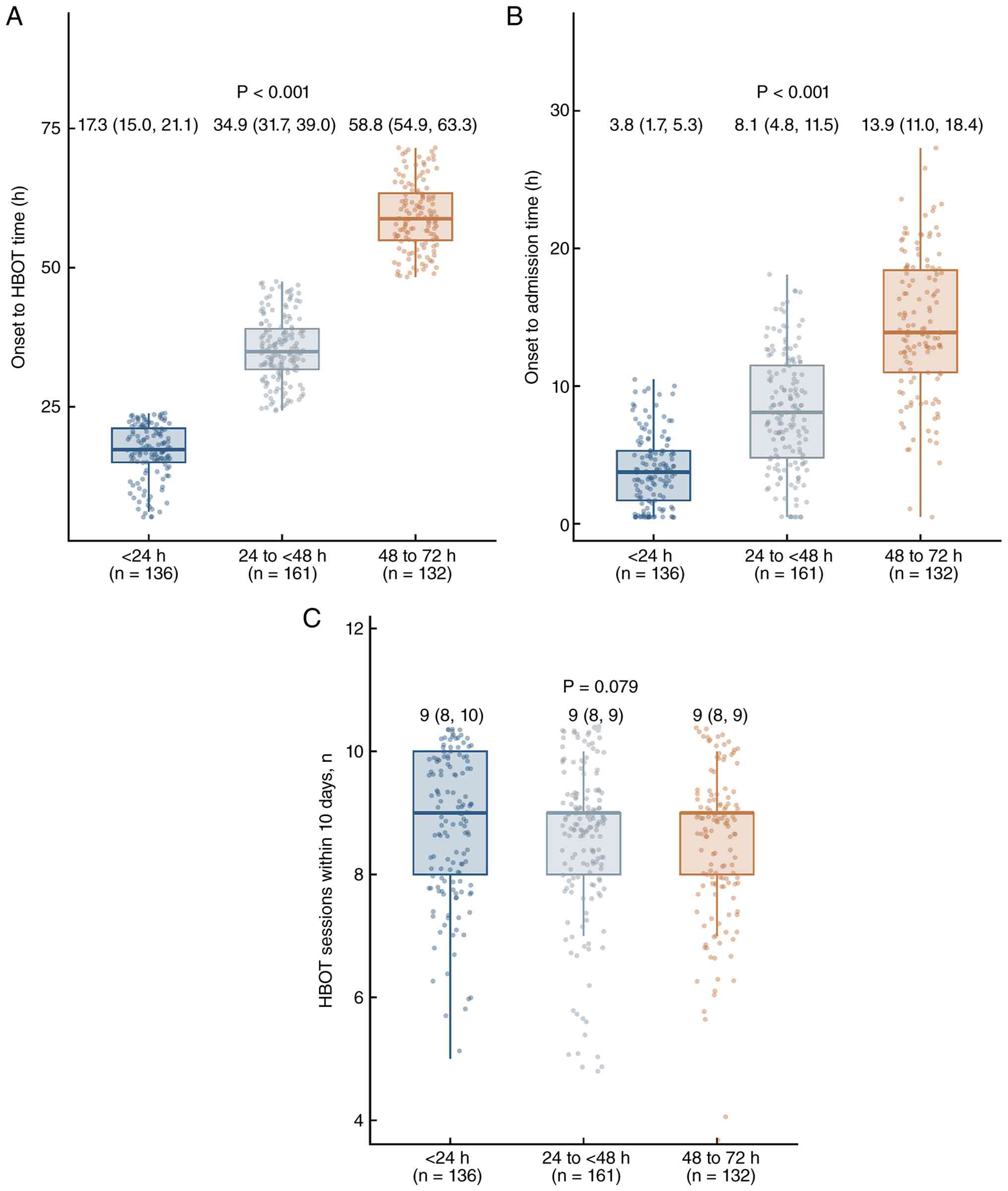
Onset-to-HBOT and onset-to-admission times were
longer across progressively later HBOT initiation windows (both
P<0.001). The number of HBOT sessions completed within 10 days
did not differ significantly across windows (P=0.079; Fig. 1A-C; Table SII): the median numbers were 9
(IQR, 8, 10), 9 (IQR, 8, 9) and 9 (IQR, 8, 9) for the <24 h, 24
to <48 h and 48 to 72 h groups, respectively.
Early neurohemodynamic and
neurological responses across HBOT initiation windows
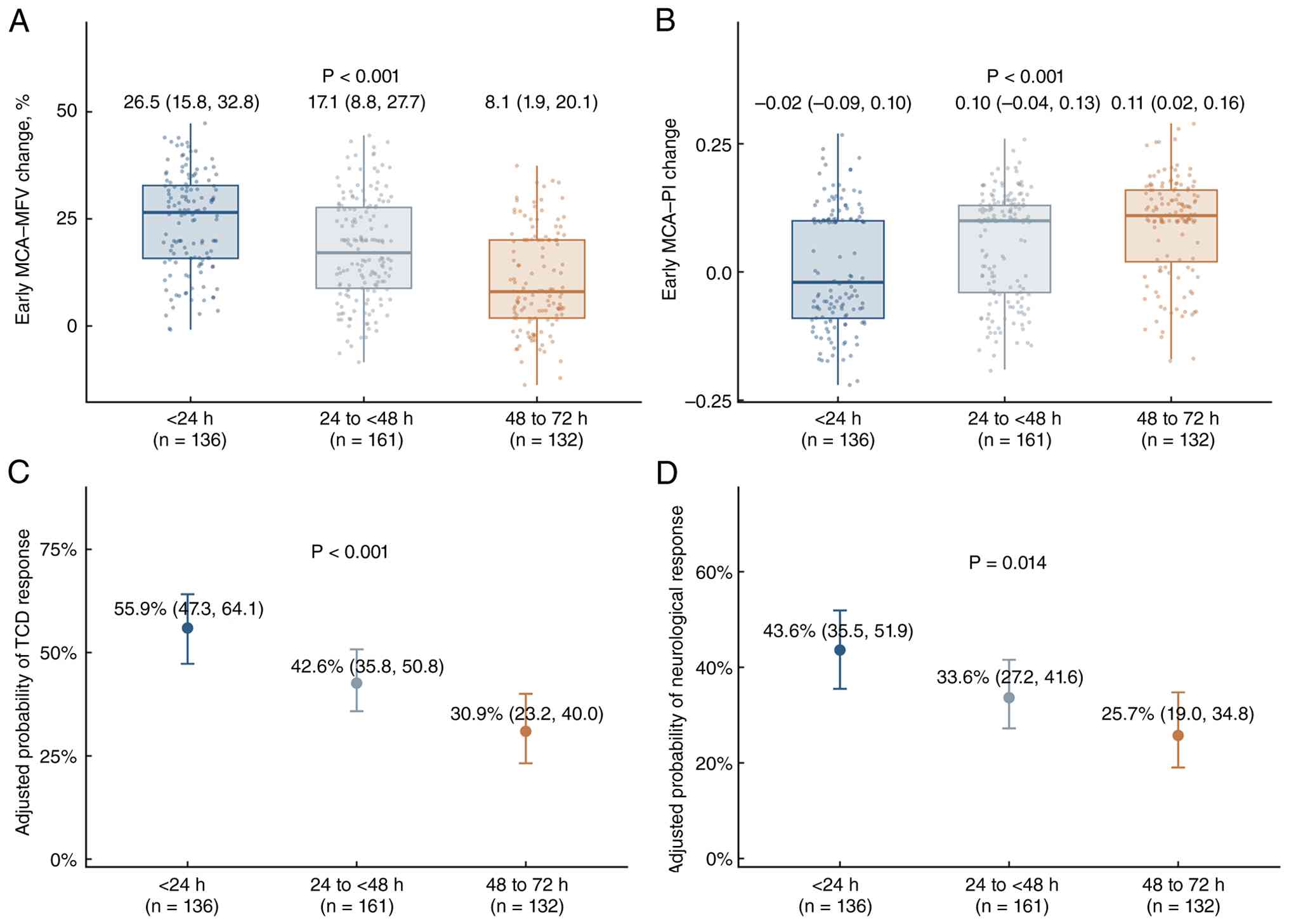
Earlier HBOT initiation was associated with a
greater early increase in MCA-MFV and a smaller early change in
MCA-PI (both P<0.001). Adjusted probabilities of TCD hemodynamic
response (P<0.001) and early neurological response (P=0.014)
were also higher with earlier initiation (Fig. 2).
Functional outcome distribution across
HBOT initiation windows
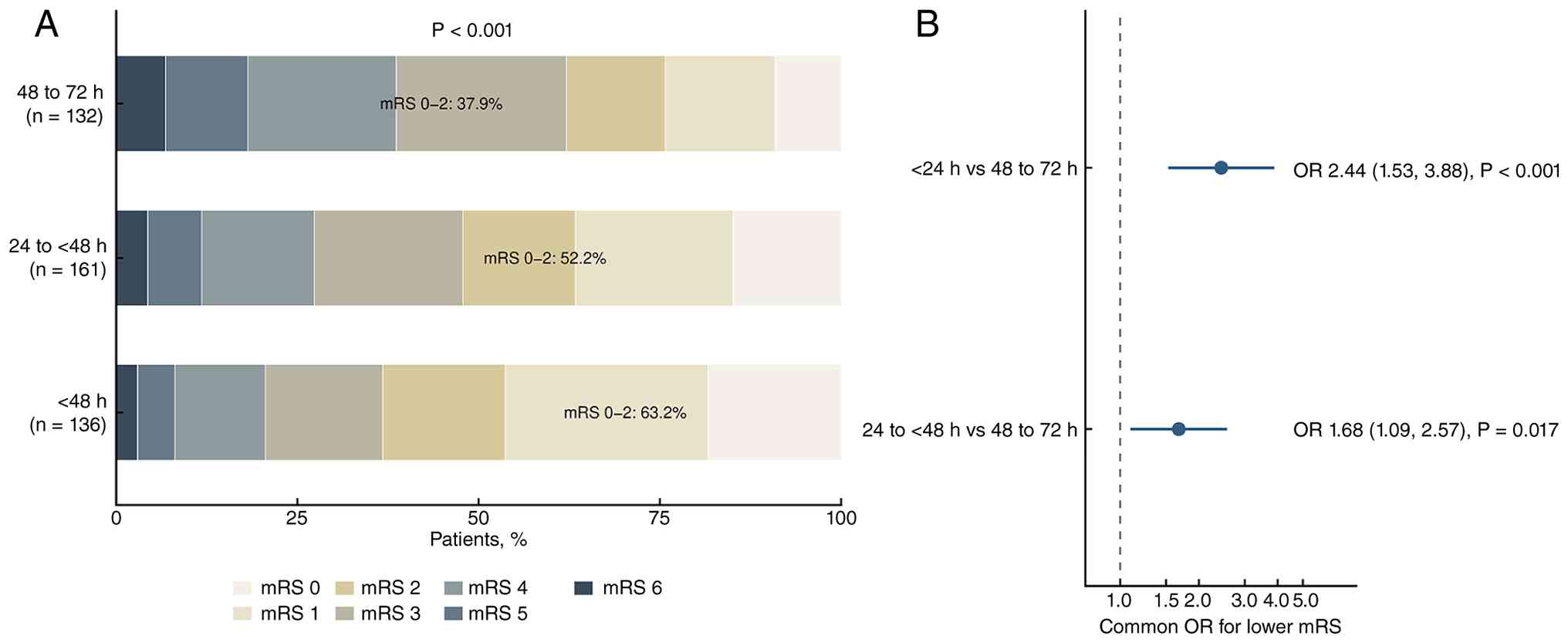
The 90-day mRS distribution shifted toward less
disability with earlier HBOT initiation (P<0.001). Relative to
the 48 to 72 h window, initiation at <24 h was associated with
greater odds of a lower 90-day mRS category (common OR=2.44; 95%
CI, 1.53-3.88; P<0.001), as was initiation at 24 to <48 h
(common OR=1.68; 95% CI, 1.09-2.57, P=0.017) (Fig. 3).
Adjusted associations of HBOT
initiation windows with functional, hemodynamic and neurological
outcomes
In adjusted models using the 48 to 72 h window as
the reference, initiation at <24 h and at 24 to <48 h was
each associated with greater odds of a favorable 90-day functional
outcome (P<0.001 and P=0.033, respectively), a lower 90-day mRS
category (P<0.001 and P=0.017) and TCD hemodynamic response
(P<0.001 and P=0.043). Initiation at <24 h was additionally
associated with greater odds of early neurological response
(P=0.003) and lower odds of early neurological deterioration
(P=0.025). Neither association was significant for the 24 to <48
h window (P=0.136 and P=0.162, respectively; Table II).
| Table IIAdjusted association models for
functional, hemodynamic and neurological outcomes. |
Table II
Adjusted association models for
functional, hemodynamic and neurological outcomes.
| Outcome | Model | Adjustment
strategy | N | Events | Comparison | Effect
estimate | 95% CI | P-value |
|---|
| 90-day favorable
functional outcome | Adjusted logistic
regression | Clinical and
baseline TCD augmented adjustment | 425 | 217 | <24 h vs. 48 to
72 h | 2.68 | 1.55-4.63 | <0.001 |
| 90-day favorable
functional outcome | Adjusted logistic
regression | Clinical and
baseline TCD augmented adjustment | 425 | 217 | 24 to <48 h vs.
48 to 72 h | 1.72 | 1.04-2.82 | 0.033 |
| 90-day mRS
shift | Ordinal logistic
regression | Clinical and
baseline TCD augmented adjustment | 425 | Ordinal
outcome | <24 h vs. 48 to
72 h | 2.44 | 1.53-3.88 | <0.001 |
| 90-day mRS
shift | Ordinal logistic
regression | Clinical and
baseline TCD augmented adjustment | 425 | Ordinal
outcome | 24 to <48 h vs.
48 to 72 h | 1.68 | 1.09-2.57 | 0.017 |
| TCD hemodynamic
response | Adjusted logistic
regression | Baseline severity,
reperfusion, glucose and baseline TCD adjustment | 425 | 184 | <24 h vs. 48 to
72 h | 2.93 | 1.70-5.06 | <0.001 |
| TCD hemodynamic
response | Adjusted logistic
regression | Baseline severity,
reperfusion, glucose and baseline TCD adjustment | 425 | 184 | 24 to <48 h vs.
48 to 72 h | 1.68 | 1.02-2.79 | 0.043 |
| Early neurological
response | Adjusted logistic
regression | Parsimonious
clinical and baseline TCD adjustment | 425 | 147 | <24 h vs. 48 to
72 h | 2.37 | 1.34-4.20 | 0.003 |
| Early neurological
response | Adjusted logistic
regression | Parsimonious
clinical and baseline TCD adjustment | 425 | 147 | 24 to <48 h vs.
48 to 72 h | 1.51 | 0.88-2.60 | 0.136 |
| Early neurological
deterioration | Exploratory
parsimonious logistic regression | Parsimonious
adjustment for baseline severity and thrombolysis | 429 | 46 | <24 h vs. 48 to
72 h | 0.36 | 0.15-0.88 | 0.025 |
| Early neurological
deterioration | Exploratory
parsimonious logistic regression | Parsimonious
adjustment for baseline severity and thrombolysis | 429 | 46 | 24 to <48 h vs.
48 to 72 h | 0.60 | 0.30-1.22 | 0.162 |
Integrated early neurohemodynamic
response phenotype and 90-day functional outcome
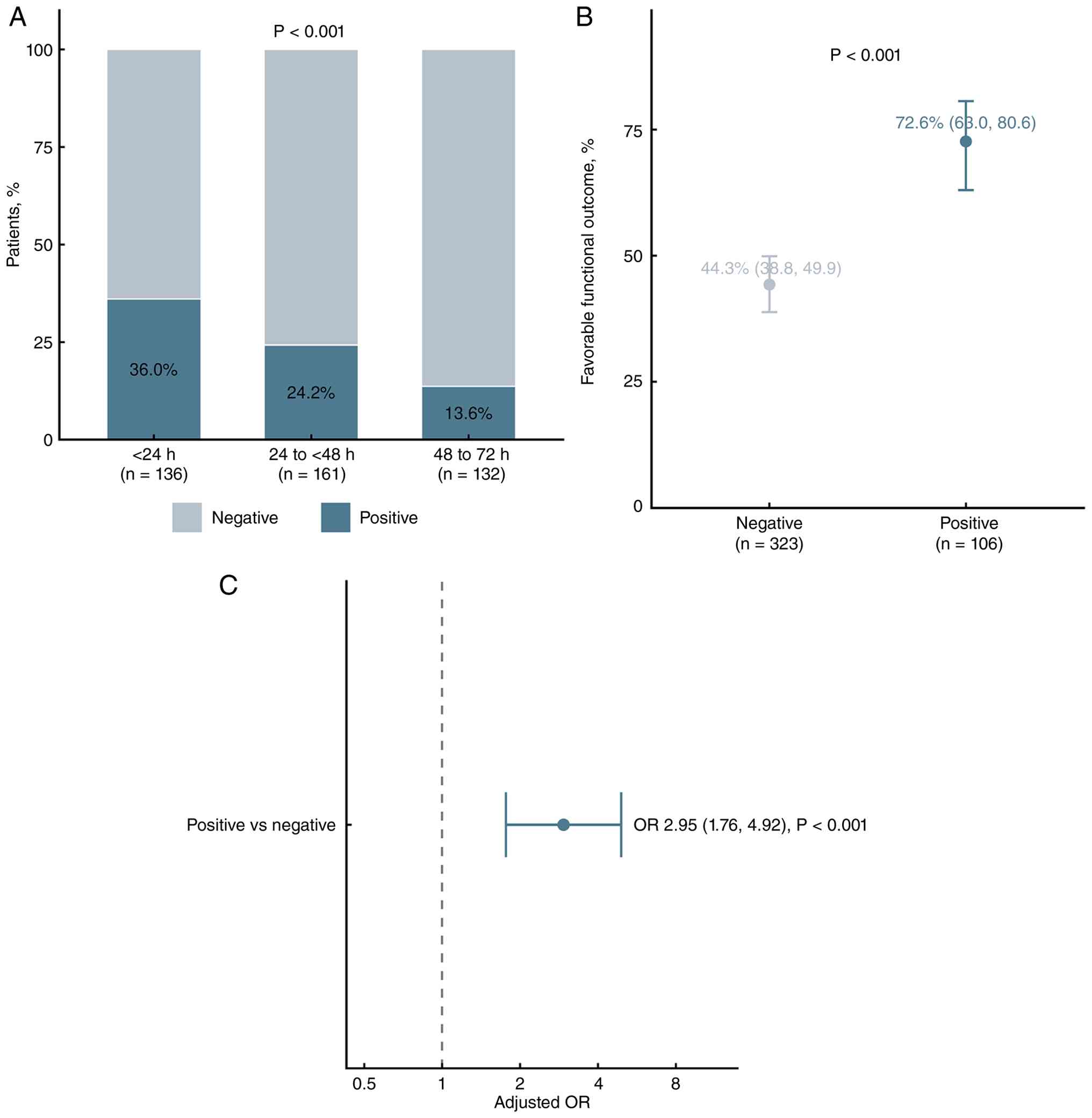
In the present exploratory analysis, the integrated
early neurohemodynamic response phenotype was more frequent with
earlier HBOT initiation (P<0.001). Favorable functional outcome
at 90 days was also more frequent among phenotype-positive than
phenotype-negative patients (P<0.001). After adjustment for HBOT
initiation window and baseline covariates, phenotype positivity
remained associated with greater odds of favorable functional
outcome (OR=2.95; 95% CI, 1.76-4.92; P<0.001) (Fig. 4). This treatment-emergent
association was not interpreted as evidence that the phenotype is a
baseline predictor or a validated surrogate endpoint.
Safety outcomes and robustness
analyses across HBOT initiation windows
Safety outcomes did not differ significantly across
HBOT initiation windows. Relative to the 48 to 72 h group,
associations between earlier initiation and favorable 90-day
functional outcome remained directionally consistent in the
IPTW-weighted analysis, following additional adjustment for
onset-to-admission time or MCA-MFV asymmetry ratio, after exclusion
of patients who underwent endovascular thrombectomy or received
intravenous thrombolysis, and when mRS 0-1 was used as the
alternative outcome; these robustness analyses remained
statistically significant. In the 72-h landmark analysis (n=421;
215 events), both the <24 h window (OR=2.51; 95% CI, 1.44-4.38;
P=0.001) and the 24 to <48 h window (OR=1.76; 95% CI, 1.05-2.94;
P=0.031) remained associated with favorable functional outcome
(Table III).
| Table IIISafety and robustness analyses of
HBOT timing. |
Table III
Safety and robustness analyses of
HBOT timing.
| A, Safety
outcomes |
|---|
| Outcome or
analysis | <24 h | 24-<48 h | 48-72 h | N | Events | Comparison | Statistic/OR |
|---|
| Symptomatic
intracranial hemorrhage | 3 (2.2) | 4 (2.5) | 5 (3.8) | | | | Exact |
| 90-day
mortality | 4 (2.9) | 7 (4.3) | 9 (6.8) | | | | 2.323 |
| Middle ear
barotrauma | 10 (7.4) | 11 (6.8) | 10 (7.6) | | | | 0.065 |
| Sinus barotrauma or
pressure symptoms | 4 (2.9) | 5 (3.1) | 5 (3.8) | | | | Exact |
|
Claustrophobia-related treatment
interruption | 3 (2.2) | 4 (2.5) | 4 (3.0) | | | | Exact |
| Oxygen toxicity
symptoms | 1 (0.7) | 1 (0.6) | 1 (0.8) | | | | Exact |
| Severe HBOT-related
adverse event | 3 (2.2) | 3 (1.9) | 3 (2.3) | | | | Exact |
| Composite safety
endpoint | 17 (12.5) | 22 (13.7) | 21 (15.9) | | | | 0.669 |
| B, Robustness
analyses |
| Outcome or
analysis | <24 h | 24 to <48 h | 48 to 72 h | N | Events | Comparison | Statistic/OR |
| IPTW-weighted
model | | | | 425 | 217 | <24 h vs. 48 to
72 h | 2.87 |
| IPTW-weighted
model | | | | 425 | 217 | 24 to <48 h vs.
48 to 72 h | 2.02 |
| Additional
adjustment for onset-to-admission time | | | | 425 | 217 | <24 h vs. 48 to
72 h | 4.55 |
| Additional
adjustment for onset-to-admission time | | | | 425 | 217 | 24 to <48 h vs.
48 to 72 h | 2.37 |
| Additional
adjustment for MCA-MFV asymmetry ratio | | | | 425 | 217 | <24 h vs. 48 to
72 h | 2.51 |
| Additional
adjustment for MCA-MFV asymmetry ratio | | | | 425 | 217 | 24 to <48 h vs.
48 to 72 h | 1.66 |
| Excluding
endovascular thrombectomy | | | | 350 | 181 | <24 h vs. 48 to
72 h | 3.13 |
| Excluding
endovascular thrombectomy | | | | 350 | 181 | 24 to <48 h vs.
48 to 72 h | 1.89 |
| Excluding
intravenous thrombolysis | | | | 328 | 161 | <24 h vs. 48 to
72 h | 2.57 |
| Excluding
intravenous thrombolysis | | | | 328 | 161 | 24 to <48 h vs.
48 to 72 h | 1.74 |
| 72-h landmark
analysis | | | | 421 | 215 | <24 h vs. 48 to
72 h | 2.51 (1.44-4.38;
P=0.001) |
| 72-h landmark
analysis | | | | 421 | 215 | 24 to <48 h vs.
48 to 72 h | 1.76 (1.05-2.94;
P=0.031) |
| Alternative
outcome: mRS 0-1 | | | | 425 | 153 | <24 h vs. 48 to
72 h | 2.54 |
| Alternative
outcome: mRS 0-1 | | | | 425 | 153 | 24 to <48 h vs.
48 to 72 h | 1.75 |
Supplementary analyses
After IPTW, covariate balance improved across the
prespecified baseline clinical and TCD variables. All weighted
covariates met the predefined balance threshold except baseline
affected-side MCA-PI, for which the weighted SMD was 0.110, close
to the conventional 0.10 threshold (Table SI).
In the prespecified exploratory subgroup analyses,
the association between initiation at <24 h and favorable 90-day
functional outcome was directionally consistent across most
baseline strata. Baseline NIHSS score indicated evidence of
interaction (interaction P<0.001), whereas age, sex, baseline
ASPECTS, LVO, intravenous thrombolysis, endovascular thrombectomy,
admission glucose, baseline affected-side MCA-MFV and baseline
affected-side MCA-PI did not show evidence of interaction (Fig. S1). Additional post hoc analyses
across common comorbidities demonstrated the same overall
direction. For <24 h versus 48 to 72 h, adjusted ORs were 2.71
(95% CI, 1.25-5.88) without hypertension and 2.66 (95% CI,
1.43-4.94) with hypertension; 2.74 (95% CI, 1.48-5.08) without
diabetes mellitus and 2.53 (95% CI, 1.12-5.71) with diabetes
mellitus; and 2.79 (95% CI, 1.51-5.15) without atrial fibrillation
and 2.38 (95% CI, 1.02-5.54) with atrial fibrillation. No
interaction was detected for hypertension (interaction P=0.963),
diabetes mellitus (interaction P=0.861) or atrial fibrillation
(interaction P=0.734; Fig.
S1).
Adding HBOT timing to the baseline model increased
the AUC numerically, although the change was not statistically
significant (P=0.107). IDI was higher after inclusion of HBOT
timing (P<0.001), and DCA suggested greater net benefit across
part of the evaluated threshold-probability range (Fig. S2).
Discussion
In the present single-center retrospective cohort of
HBOT-treated patients with AIS, earlier HBOT initiation was
associated with a more favorable early neurohemodynamic profile, a
higher frequency of early neurological response, lower 90-day
disability and greater odds of favorable functional outcome. These
associations persisted after adjustment for baseline clinical
severity, imaging burden, reperfusion therapy, metabolic status and
TCD measures, and remained directionally consistent across multiple
robustness analyses, including the 72-h landmark analysis. Safety
outcomes did not differ significantly across initiation windows. As
treatment timing was not randomized and the groups differed in
several baseline clinical, reperfusion, metabolic and TCD
characteristics, these findings should be interpreted as
timing-related associations within an HBOT-treated cohort, not as
evidence that HBOT is superior to standard care without HBOT or
that earlier initiation confers a causal benefit.
Recovery after AIS is shaped by residual perfusion,
collateral flow, infarct burden and early change in neurological
status, as reflected by serial NIHSS assessments. Previous studies
have linked restoration or preservation of cerebral perfusion to
subsequent neurological and functional recovery, although outcomes
remain heterogeneous even after standard acute care (23-25).
The present analysis adds a timing-focused perspective by examining
patients who actually received HBOT and relating initiation timing
to early TCD-derived physiological change and 90-day functional
outcome. Notably, the earlier initiation groups had more favorable
baseline profiles, including higher ASPECTS, greater use of
intravenous thrombolysis, lower admission glucose, higher
affected-side MCA-MFV and lower MCA-PI. These differences may
reflect not only stroke biology but also symptom recognition,
admission delay, treatment access, workflow efficiency, clinical
stability and treatment feasibility. Multivariable adjustment,
IPTW, landmark analysis and other sensitivity analyses reduce
measured imbalance and some timing-related bias but cannot
eliminate residual confounding or selection arising from unmeasured
features of the clinical pathway.
The association between earlier HBOT initiation and
a greater early increase in MCA-MFV is biologically plausible but
does not establish a causal treatment effect. By increasing
arterial and plasma oxygen content under pressure, HBOT may enhance
oxygen availability in hypoperfused tissue when macrovascular
reperfusion is incomplete or microcirculatory dysfunction persists
(26,27). Earlier initiation was also
associated with a more favorable TCD response and a smaller change
in MCA-PI. These measures do not directly quantify tissue
oxygenation or penumbral salvage; rather, they provide accessible
physiological indicators that may capture early hemodynamic
differences across initiation windows.
Prior studies of HBOT in ischemic stroke have
yielded mixed findings, in part because of heterogeneity in patient
selection, treatment timing, oxygen protocols, outcome definitions
and study design (28,29). The majority have evaluated HBOT as
a treatment category, whereas relatively few have examined
initiation timing among patients who actually received therapy. The
present study therefore addresses a narrower question: Within a
HBOT-treated cohort, earlier initiation was associated with a more
favorable early neurohemodynamic response following adjustment for
several pretreatment clinical and TCD variables. This association
remains susceptible to treatment-selection and residual confounding
despite a standardized planned HBOT protocol and multiple
sensitivity analyses.
The integrated early neurohemodynamic response
phenotype combined a physiological response signal with short-term
neurological improvement. As it was defined after treatment, it was
only analyzed as an exploratory, treatment-emergent marker. It was
not a baseline predictor, did not determine HBOT timing and should
not be regarded as a validated surrogate endpoint. TCD response
alone may reflect altered flow velocity without corresponding
clinical recovery, whereas NIHSS improvement may be influenced by
baseline deficit pattern, infarct location or spontaneous recovery.
Combining the two responses provides a clinically interpretable
descriptive phenotype while remaining distinct from the delayed
90-day mRS outcome.
Phenotype positivity was more common in earlier
initiation windows and was associated with greater odds of
favorable 90-day functional outcome after adjustment for timing and
baseline covariates. This association does not establish mediation,
baseline prediction or surrogacy for the 90-day outcome. The
phenotype is more appropriately viewed as an exploratory marker of
early treatment-emergent response. This interpretation is
consistent with evidence that early neurological improvement is
associated with later functional status and that physiological
measures can complement clinical scores (30,31).
Its potential value lies in jointly characterizing early TCD and
NIHSS responses in an observational HBOT-treated cohort;
prospective validation is required before any predictive or
surrogate role can be considered.
In the present study, earlier initiation windows
were associated with a shift toward less disability across the full
90-day mRS distribution, consistent with the binary
favorable-outcome analysis. This concordance is informative as
dichotomizing the mRS can obscure clinically meaningful changes
across disability levels. The agreement between ordinal and binary
analyses therefore strengthens the internal consistency of the
observed timing association.
The robustness analyses reduce but do not eliminate
concerns about confounding and timing-related selection. IPTW
substantially improved baseline covariate balance, although the
maximum weighted SMD was 0.110, just above the conventional 0.10
threshold, owing to residual imbalance in baseline MCA-PI. The
association remained directionally consistent after additional
adjustment for onset-to-admission time or MCA-MFV asymmetry ratio,
after exclusion of patients who underwent endovascular thrombectomy
or received intravenous thrombolysis, and with mRS 0-1 as an
alternative outcome. The 72-h landmark analysis produced similar
estimates for both earlier initiation windows, reducing concern
about survivor/immortal-time-related selection but not eliminating
time-dependent selection in a retrospective treated cohort. These
analyses are particularly notable because the timing groups
differed in baseline severity, ASPECTS, reperfusion treatment,
admission glucose and TCD parameters. Nevertheless, observational
timing analyses remain vulnerable to residual confounding by
treatment access, workflow, clinical stability and baseline
severity. Consistency across analytic strategies supports the
robustness of the association but does not imply causality
(10).
Baseline NIHSS score indicated possible effect
modification, although this finding is exploratory and should be
interpreted cautiously because subgroup estimates from a
single-center retrospective cohort can be unstable and multiple
comparisons increase uncertainty. No clear interaction was detected
across most other prespecified baseline variables. Additional post
hoc analyses stratified by hypertension, diabetes mellitus and
atrial fibrillation likewise demonstrated no significant
interaction and preserved the overall direction of association.
Larger multicenter studies with adequately powered, prespecified
subgroup analyses are needed to determine whether timing
associations vary by age, comorbidity burden, stroke severity,
etiologic or vascular characteristics or reperfusion treatment.
Safety is central to the interpretation of earlier
HBOT initiation in AIS, particularly with respect to hemorrhagic
transformation, oxygen toxicity, barotrauma and treatment
intolerance. In the present cohort, symptomatic intracranial
hemorrhage and HBOT-related adverse events did not differ
significantly across initiation windows. Middle ear barotrauma, the
most directly relevant HBOT-specific safety outcome, occurred at
similar frequencies across groups. No timing-related difference was
observed for sinus pressure symptoms, claustrophobia-related
interruption, oxygen-toxicity symptoms, severe HBOT-related adverse
events or the composite safety endpoint.
These findings are broadly consistent with the HBOT
safety literature, in which middle ear barotrauma is among the more
common adverse events and serious oxygen-toxicity events are
uncommon under monitored clinical protocols (32). However, the present data describe
safety only among treated patients. They do not establish whether
earlier HBOT is universally safe for all patients with AIS, because
patients considered unsuitable for HBOT or unable to tolerate
treatment may not have entered the treated cohort. This selection
is key when considering clinical translation.
In the present study, adding HBOT timing to baseline
variables produced a numerically higher AUC, but the increase was
not statistically significant. IDI and DCA suggested some
incremental prognostic utility, although these analyses were
supplementary, were not designed to develop a prediction model and
lacked external validation. The findings should therefore be
interpreted as evidence that timing may add modest prognostic
information beyond baseline factors, rather than as support for a
clinically deployable prediction tool. This cautious interpretation
is consistent with recommendations to consider discrimination,
calibration and clinical utility jointly and to validate
incremental performance metrics before clinical implementation
(33,34).
Several limitations warrant emphasis. First, the
present study was a single-center retrospective observational
cohort in which treatment timing was not randomized. Residual
confounding and treatment-selection bias may therefore persist
despite multivariable adjustment, IPTW, landmark analysis and
sensitivity analyses. Earlier initiation groups had several more
favorable baseline characteristics, and unmeasured differences in
clinical stability, access, workflow or clinician selection may
have influenced both timing and outcome. Second, exposure was
defined by the time of first HBOT; patients in later initiation
windows necessarily had to remain alive and clinically eligible
until treatment began, creating potential
survivor/immortal-time-related selection. The 72-h landmark
analysis reduced, but could not eliminate, this concern. Third,
because all included patients received HBOT within 72 h, the study
cannot determine whether HBOT is superior to standard care without
HBOT. Fourth, although planned HBOT pressure, oxygen concentration,
therapeutic oxygen-breathing time, daily frequency and treatment
course were standardized across groups, actual treatment exposure
could vary because of interruption, scheduling, discharge or
tolerance. The number of sessions completed within 10 days was
similar across windows, but residual variation in delivered
exposure remains possible. Fifth, TCD provides accessible bedside
hemodynamic information but does not directly measure tissue
oxygenation, infarct-core evolution, or penumbral salvage. Sixth,
safety events were identified retrospectively from clinical
records, and mild or transient symptoms may have been
under-recorded. Finally, the integrated response phenotype,
subgroup analyses and incremental utility analyses were exploratory
and should be considered hypothesis-generating.
The findings should therefore be interpreted as
associations among HBOT timing, early neurohemodynamic response and
functional outcome within an HBOT-treated population. Prospective
multicenter studies should use standardized, explicitly reported
HBOT protocols; prespecified timing strategies that account for
stroke severity and relevant clinical characteristics, and
multimodal monitoring that integrates TCD, imaging and serial
clinical assessment. Larger cohorts are also needed for
prespecified subgroup analyses across age, comorbidity and stroke
characteristics and for external validation of the exploratory
integrated response phenotype. If a reproducible timing strategy is
established prospectively, implementation should incorporate
structured staff training to ensure consistent timing criteria,
safety screening, HBOT delivery and multimodal monitoring. Such
evidence is required before causal, protocol-level or
implementation recommendations can be justified.
In the present retrospective, exposure-stratified
cohort of HBOT-treated patients with AIS, earlier HBOT initiation
was associated with more favorable early neurohemodynamic and
neurological responses and improved 90-day functional outcomes. The
exploratory treatment-emergent integrated response phenotype was
also associated with favorable 90-day functional outcome after
adjustment for HBOT timing and baseline covariates. Safety outcomes
did not differ significantly across initiation windows. These
findings do not establish HBOT efficacy relative to standard care
without HBOT, a causal benefit of earlier initiation or a validated
optimal timing strategy. Prospective multicenter studies using
standardized HBOT protocols, multimodal monitoring and prespecified
timing strategies are needed to confirm these observations.
Supplementary Material
Subgroup analyses of the association
between HBOT initiation window and 90-day favorable functional
outcome. NIHSS, National Institutes of Health Stroke Scale;
ASPECTS, Alberta Stroke Program Early CT; MCA-MFV, middle cerebral
artery-mean flow velocity; MCA-PI, middle cerebral artery
pulsatility index; OR, odds ratio.
Incremental discrimination and
decision curve analysis for HBOT timing beyond baseline risk. (A)
Incremental discrimination after adding HBOT timing to the baseline
model. (B) Decision curve analysis comparing the baseline model
with the baseline model plus HBOT timing. AUC, area under the
curve; HBOT, hyperbaric oxygen therapy.
Covariate balance before and after
IPTW.
HBOT protocol and treatment delivery
across initiation windows.
Acknowledgements
Not applicable.
Funding
Funding: The present study was supported by the 2025 Guangdong
Provincial Medical Association Clinical Medicine Fund-Hyperbaric
Oxygen Special Fund (grant no. 2025GY,A1006).
Availability of data and materials
The data generated in the present study may be
requested from the corresponding author.
Authors' contributions
XT, SS and QZ conceived and designed the present
study. XT, SW, YW, GJ and CD collected the clinical data. XT and SS
performed the statistical analysis. XT drafted the manuscript. QZ
supervised the study and critically revised the manuscript. XT and
QZ confirm the authenticity of all the raw data. XT, SS and SW
contributed equally to this work. All authors read and approved the
final version of the manuscript.
Ethical approval and consent to
participate
The present study was approved by the Heyou Hospital
Institutional Review Board (approval no. 20250721-EXP1). The
requirement for written informed consent was waived by the Heyou
Hospital Institutional Review Board as the retrospective study used
de-identified clinical data and did not involve
investigator-assigned intervention.
Patient consent for publication
Not applicable.
Competing interests
The authors declare that they have no competing
interests.
References
|
1
|
Pu L, Wang L, Zhang R, Zhao T, Jiang Y and
Han L: Projected global trends in ischemic stroke incidence, deaths
and disability-adjusted life years from 2020 to 2030. Stroke.
54:1330–1339. 2023.PubMed/NCBI View Article : Google Scholar
|
|
2
|
Premilovac D and Sutherland BA: Acute and
long-term changes in blood flow after ischemic stroke: Challenges
and opportunities. Neural Regen Res. 18:799–800. 2023.PubMed/NCBI View Article : Google Scholar
|
|
3
|
Sharma A, Pandit AK, Mishra B, Srivastava
MVP, Srivastava AK, Vishnu VY and Singh RK: Early neurological
deterioration in acute ischemic stroke. Ir J Med Sci. 193:949–955.
2024.PubMed/NCBI View Article : Google Scholar
|
|
4
|
Kaesmacher J, Cavalcante F, Kappelhof M,
Treurniet KM, Rinkel L, Liu J, Yan B, Zi W, Kimura K, Eker OF, et
al: Time to treatment with intravenous thrombolysis before
thrombectomy and functional outcomes in acute ischemic stroke: A
meta-analysis. JAMA. 331:764–777. 2024.PubMed/NCBI View Article : Google Scholar
|
|
5
|
Winkelmeier L, Kniep H, Faizy T, Heitkamp
C, Holtz L, Meyer L, Flottmann F, Heitkamp A, Schell M, Thomalla G,
et al: Age and functional outcomes in patients with large ischemic
stroke receiving endovascular thrombectomy. JAMA Netw Open.
7(e2426007)2024.PubMed/NCBI View Article : Google Scholar
|
|
6
|
Capó X, Monserrat-Mesquida M,
Quetglas-Llabrés M, Batle JM, Tur JA, Pons A, Sureda A and Tejada
S: Hyperbaric oxygen therapy reduces oxidative stress and
inflammation, and increases growth factors favouring the healing
process of diabetic wounds. Int J Mol Sci. 24(7040)2023.PubMed/NCBI View Article : Google Scholar
|
|
7
|
Yang A, Yang A, Shu J, Wu X and Zhu Z:
Extracellular vesicles combined with hyperbaric oxygen therapy as
new strategies for the treatment of traumatic brain injury: A
narrative review. Adv Technol Neurosci. 2:187–203. 2025.
|
|
8
|
Li X, Lu L, Min Y, Fu X, Guo K, Yang W, Li
H, Xu H, Guo H and Huang Z: Efficacy and safety of hyperbaric
oxygen therapy in acute ischaemic stroke: A systematic review and
meta-analysis. BMC Neurol. 24(55)2024.PubMed/NCBI View Article : Google Scholar
|
|
9
|
Fakkert RA, Karlas N, Schober P, Weber NC,
Preckel B, van Hulst RA and Weenink RP: Early hyperbaric oxygen
therapy is associated with favorable outcome in patients with
iatrogenic cerebral arterial gas embolism: Systematic review and
individual patient data meta-analysis of observational studies.
Crit Care. 27(282)2023.PubMed/NCBI View Article : Google Scholar
|
|
10
|
Kalincik T, Roos I and Sharmin S: .
Observational studies of treatment effectiveness in neurology.
Brain. 146:4799–4808. 2023.PubMed/NCBI View Article : Google Scholar
|
|
11
|
Bankole NDA, Dujardin PA, Bala F, Ehrmann
S, Desplobain K, Patat F and Boulouis G: Transcranial doppler
ultrasound for the diagnosis of large vessel occlusion in patients
with acute ischemic stroke: A systematic review. Clin Neurol
Neurosurg. 245(108506)2024.PubMed/NCBI View Article : Google Scholar
|
|
12
|
Bintan RTSR, Setyowati S and Adrianto Y:
HbA1c and pulsatility index in middle cerebral artery of patients
with acute thrombotic stroke. Folia Med Indones. 60:141–146.
2024.
|
|
13
|
Dusenbury W, Tsivgoulis G, Chang J, Goyal
N, Swatzell V, Alexandrov AV, Lyden P and Alexandrov AW: Validation
of the national institutes of health stroke scale in intracerebral
hemorrhage. Stroke Vasc Interv Neurol. 3(e000834)2023.PubMed/NCBI View Article : Google Scholar
|
|
14
|
Rinkel LA, Ospel JM, Kappelhof M, Sehgal
A, McDonough RV, Tymianski M, Hill MD, Goyal M and Ganesh A:
Comparing early national institutes of health stroke scale versus
90-day modified Rankin Scale outcomes in acute ischemic stroke
trials: A systematic review and analysis. J Am Heart Assoc.
14(e040304)2025.PubMed/NCBI View Article : Google Scholar
|
|
15
|
Zhou M, Chen X, Li D, Luo J, Song S, You
J, Ma H and Huang C: Bibliometric analysis of research trends on
hyperbaric oxygen therapy in stroke from 2000 to 2022. Front Neuro.
16(1455545)2025.PubMed/NCBI View Article : Google Scholar
|
|
16
|
Zhang Y, Zhou Y, Jia Y, Wang T and Meng D:
Adverse effects of hyperbaric oxygen therapy: A systematic review
and meta-analysis. Front Med (Lausanne). 10(1160774)2023.PubMed/NCBI View Article : Google Scholar
|
|
17
|
Maryenko NI: Applications of fractal
analysis techniques in magnetic resonance imaging and computed
tomography for stroke diagnosis and stroke-related brain damage: A
narrative review. Adv Technol Neurosci. 1:105–122. 2024.
|
|
18
|
Fang T, Liu N, Nie S, Jia S and Ye X: A
deep learning and radiomics based Alberta stroke program early CT
score method on CTA to evaluate acute ischemic stroke. J Xray Sci
Technol. 32:17–30. 2024.PubMed/NCBI View Article : Google Scholar
|
|
19
|
Sato H, Mitsui N, Fujikawa S, Kinoshita M,
Hori K, Uebayashi M and Kimura T: Critical evaluation of the
modified Rankin Scale for assessment of the efficacy of mechanical
thrombectomy: A retrospective comparison between the modified
Rankin Scale and functional independence measure. Interv
Neuroradiol. 31:771–777. 2025.PubMed/NCBI View Article : Google Scholar
|
|
20
|
Polak JF: Effect of internal carotid
artery Doppler peak systolic velocity thresholds for classifying
ipsilateral ischemic stroke due to large artery atherosclerosis
according to the trial of org 10172 in acute stroke treatment
(TOAST) system. J Vasc Ultrasound. 47:119–124. 2023.
|
|
21
|
Patel P, Panda S and Tiwari S: Early
hemodynamic changes on transcranial Doppler as a predictor of
functional outcome in acute ischemic stroke: A case series from
India. Egypt J Neurol Psychiatr Neurosurg. 61(58)2025.
|
|
22
|
Zhao L, Leng Y, Hu Y, Xiao J, Li Q, Liu C
and Mao Y: Understanding decision curve analysis in clinical
prediction model research. Postgrad Med J. 100:512–515.
2024.PubMed/NCBI View Article : Google Scholar
|
|
23
|
Fladt J, Benali F, Jaroenngarmsamer T,
Bala F, Singh N, Nogueira RG, McTaggart R, Demchuk A, Poppe A, Buck
BH, et al: Impact of brain frailty on clinical presentation and
neurologic recovery in acute ischemic stroke patients undergoing
thrombectomy. Neurology. 104(e213619)2025.PubMed/NCBI View Article : Google Scholar
|
|
24
|
Mangiardi M, Bonura A, Iaccarino G,
Alessiani M, Bravi MC, Crupi D, Pezzella FR, Fabiano S, Pampana E,
Stilo F, et al: The pathophysiology of collateral circulation in
acute ischemic stroke. Diagnostics (Basel). 13(2425)2023.PubMed/NCBI View Article : Google Scholar
|
|
25
|
Du J, Wang Y, Che B, Miao M, Bao A, Peng
Y, Ju Z, Xu T, He J, Zhang Y and Zhong C: The relationship between
neurological function trajectory, assessed by repeated NIHSS
measurement, and long-term cardiovascular events, recurrent stroke,
and mortality after ischemic stroke. Int J Stroke. 18:1005–1014.
2023.PubMed/NCBI View Article : Google Scholar
|
|
26
|
Cannellotto M, Yasells García A and Landa
MS: Hyperoxia: Effective mechanism of hyperbaric treatment at
mild-pressure. Int J Mol Sci. 25(777)2024.PubMed/NCBI View Article : Google Scholar
|
|
27
|
Wu X, You J, Chen X, Zhou M, Ma H, Zhang T
and Huang C: An overview of hyperbaric oxygen preconditioning
against ischemic stroke. Metab Brain Dis. 38:855–872.
2023.PubMed/NCBI View Article : Google Scholar
|
|
28
|
Wang Q, Zhang X, Suo Y, Chen Z, Wu M, Wen
X, Lai Q, Yin X and Bao B: Normobaric hyperoxia therapy in acute
ischemic stroke: A literature review. Heliyon.
10(e23744)2023.PubMed/NCBI View Article : Google Scholar
|
|
29
|
Nguyen NB, Nguyen Thi HH, Thi HL, Nguyen
ST and Nguyen TV: Results of acute cerebral infarction treatment
with hyperbaric oxygen therapy, 2020-2022. Int Marit Health.
74:265–271. 2023.PubMed/NCBI View Article : Google Scholar
|
|
30
|
Kobeissi H, Ghozy S, Bilgin C, Kadirvel R
and Kallmes DF: Early neurological improvement as a predictor of
outcomes after endovascular thrombectomy for stroke: A systematic
review and meta-analysis. J Neurointerv Surg. 15:547–551.
2023.PubMed/NCBI View Article : Google Scholar
|
|
31
|
Salvalaggio S, Boccuni L and Turolla A:
Patient's assessment and prediction of recovery after stroke: A
roadmap for clinicians. Arch Physiother. 13(13)2023.PubMed/NCBI View Article : Google Scholar
|
|
32
|
Voigt A, Laspro M, Thys E, Jethanamest D
and Chiu ES: Systematic review of otologic adverse events in
hyperbaric oxygen therapy. Undersea Hyperb Med. 52:537–547.
2025.PubMed/NCBI
|
|
33
|
McLernon DJ, Giardiello D, Van Calster B,
Wynants L, van Geloven N, van Smeden M, Therneau T and Steyerberg
EW: topic groups 6 and 8 of the STRATOS Initiative. Assessing
performance and clinical usefulness in prediction models with
survival outcomes: Practical guidance for Cox proportional hazards
models. Ann Intern Med. 176:105–114. 2023.PubMed/NCBI View
Article : Google Scholar
|
|
34
|
Piovani D, Sokou R, Tsantes AG, Vitello AS
and Bonovas S: Optimizing clinical decision making with decision
curve analysis: Insights for clinical investigators. Healthcare
(Basel). 11(2244)2023.PubMed/NCBI View Article : Google Scholar
|