Introduction
Ovarian cancer has a poorer prognosis than other
gynecological cancers because approximately 70% of patients are
diagnosed at an advanced stage (1). Therefore, distinguishing benign
ovarian tumors from ovarian cancer is important for guiding
surgical decision-making and preventing disease progression.
Cancer antigen 125 (CA125), a classical biomarker
for epithelial ovarian cancer (EOC), is frequently elevated in
conditions such as leiomyomas, adenomyosis, infection, liver
cirrhosis, pregnancy, and pelvic endometriosis, resulting in
false-positive results and low specificity (2,3). To
address these limitations, the risk of ovarian malignancy algorithm
(ROMA), a risk stratification tool approved by the U.S. Food and
Drug Administration, was developed to differentiate benign from
malignant ovarian tumors. ROMA integrates serum levels of human
epididymis protein 4 (HE4) and CA125 with menopausal status
(4-6).
HE4 is involved in EOC tumorigenesis and is frequently elevated in
ovarian cancer (7,8). Unlike CA125, HE4 is less influenced
by physiological conditions or endometriosis and has higher
diagnostic specificity (9,10).
However, HE4 levels may also be elevated in
noncancerous conditions, particularly in patients with end-stage
renal disease, diabetic nephropathy, nephrotic syndrome, kidney
cancer, or urosepsis. Such elevations may result from decreased HE4
clearance or increased production in damaged kidneys. HE4 may be
expressed in the distal convoluted tubules of the kidney and
elevated serum HE4 levels may occur with renal cellular injury or
renal fibrosis (11).
Significantly elevated serum HE4 levels have been reported in
patients with chronic kidney disease (CKD), with median levels of
approximately 1,041 pmol/l in women, and a positive correlation
between serum HE4 levels and CKD stage (12,13).
Although elevated HE4 levels have been reported in patients with
CKD without ovarian cancer, no study has investigated whether this
elevation reduces the diagnostic accuracy of ROMA (14). If elevated HE4 levels in patients
with CKD and ovarian tumors reduce the accuracy of ROMA results,
they may lead to unnecessary ovarian surgery in patients with CKD
who are at high surgical risk, resulting in avoidable morbidity and
inefficient use of medical resources.
Therefore, this study aimed to compare the
diagnostic accuracy of ROMA for differentiating ovarian tumors in
patients with and without CKD, using postoperative
histopathological findings as the reference standard among patients
who underwent surgery after ROMA testing.
Materials and methods
Patients
The Institutional Review Board of Gangneung Asan
Hospital determined that this retrospective study was exempt from
IRB review and waived the requirement for informed consent (IRB no.
2025-10-003). The medical records of patients who underwent ROMA
testing for ovarian tumors and subsequently underwent surgery at
Gangneung Asan Hospital between August 2015 and August 2025 were
retrospectively reviewed.
Only patients with histologically confirmed
diagnoses following surgery were included. All types of borderline
tumors were included in the cancer group and analyzed accordingly.
A borderline ovarian tumor is an epithelial neoplasm that sits in
the ‘gray zone’ between benign and invasive malignant tumors. It
shows active cell proliferation and nuclear atypia, but lacks
destructive stromal invasion. Serous borderline tumors share
molecular and genetic alterations with low-grade serous carcinomas
and can present at higher stages with peritoneal implants and/or
lymph node involvement, which validates their borderline malignant
potential (15). Revised Korean
Standard Classification of Diseases-8 (KCD-8) includes borderline
ovarian tumor as general cancer in 2021(16). Patients with ascites or peritoneal
carcinomatosis, which was considered sufficiently predictive of
ovarian cancer based on preoperative imaging, were excluded.
Patients with isolated hydrosalpinx or paratubal cysts, inclusion
cysts resulting from pelvic adhesions, or inflammatory lesions were
also excluded because these conditions can typically be
distinguished from ovarian cancer based on preoperative imaging or
inflammatory testing. Patients were additionally excluded if >3
months had elapsed between ROMA testing and surgery or if they had
been diagnosed with other malignancy within the previous 5
years.
Clinicopathological data, including age, menopausal
status, preoperative CA125 and HE4 levels, ROMA test results, and
histological findings of ovarian tumors, were collected. For
patients with CKD, additional laboratory data, including blood urea
nitrogen (BUN), serum creatinine, and estimated glomerular
filtration rate (eGFR), were obtained. The CKD- Epidemiology
collaboration formula was used to calculate Egfr (17). CKD was defined as a structural or
functional abnormality of the kidney that persists for ≥3 months
and has substantial health implications. CKD was classified into
GFR categories G1-G5 based on Kidney Disease: Improving Global
Outcomes guidelines (18).
Clinicopathological data, including all patients' CKD status and
blood test results, were obtained during the preoperative
examination and testing process and correspond to the time of ROMA
testing.
Methods
Serum HE4 and CA125 levels were determined using the
Roche Elecsys® assay (Roche Diagnostics, Basel,
Switzerland), a one-step sandwich electrochemiluminescence
immunoassay for their quantitative determination. The detection
range for HE4 was 15.0-1,500 pmol/l; samples with values >1,500
pmol/l were diluted 1:20 using Elecsys Diluent.
Patients were stratified into low- or high-risk
groups based on the ROMA score calculated from laboratory
measurements and menopausal status. The predictive index (PI) and
predicted probability (ROMA score) were calculated using the
algorithms proposed by Moore et al (4): Premenopausal, PI=-12.0 + 2.38 x LN
(HE4) + 0.0626 x LN (CA125); postmenopausal, PI=-8.09 + 1.04 x LN
(HE4) + 0.7320 x LN (CA125); ROMA score (%)=exp (PI)/[1 + exp (PI)]
x 100.
The ROMA thresholds for classifying patients as high
risk were ≥11.4% for premenopausal women and ≥29.9% for
postmenopausal women. Postmenopausal status was defined as ≥1 year
after menstrual bleeding cessation. For patients who underwent
hysterectomy before menopause, age ≥50 years was used to define
postmenopausal status.
Statistical analysis
A two-sample t-test or Wilcoxon rank-sum test was
used to compare continuous variables, and Fisher's exact test was
used for categorical variables. P<0.05 was considered to
indicate a statistically significant difference. Box plots were
used to compare serum HE4 levels according to CKD status in the
benign and cancer groups. The diagnostic performance of ROMA
according to CKD status was evaluated by comparing sensitivity,
specificity, positive predictive value (PPV), negative predictive
value (NPV), and accuracy. Wald contrast tests from a logistic
regression model were performed to compare the diagnostic
performance of ROMA according to CKD status. Receiver operating
characteristic (ROC) curves were generated separately for patients
with and without CKD, and AUCs were compared between independent
groups using the unpaired DeLong's test. All statistical analyses
were performed using R statistical software, version 4.4.2 (R
Foundation for Statistical Computing, Vienna, Austria).
Results
Among the 1,816 patients identified in the initial
search, 1,122 patients who met the inclusion criteria were included
in the retrospective analysis. Of these, 928 (82.7%) had benign
ovarian tumors, 194 (17.3%) had ovarian cancer, and 21 had CKD. Of
the total 21 patients with CKD, four were undergoing dialysis
around the time of ROMA testing; blood samples were collected from
all patients 2 h before dialysis. Patient characteristics are
summarized in Table I. Patients
with CKD were older in both the benign and cancer groups and were
more likely to be postmenopausal in the benign group. CA125 levels
did not differ significantly according to CKD status. In contrast,
HE4 levels were significantly higher in patients with CKD in both
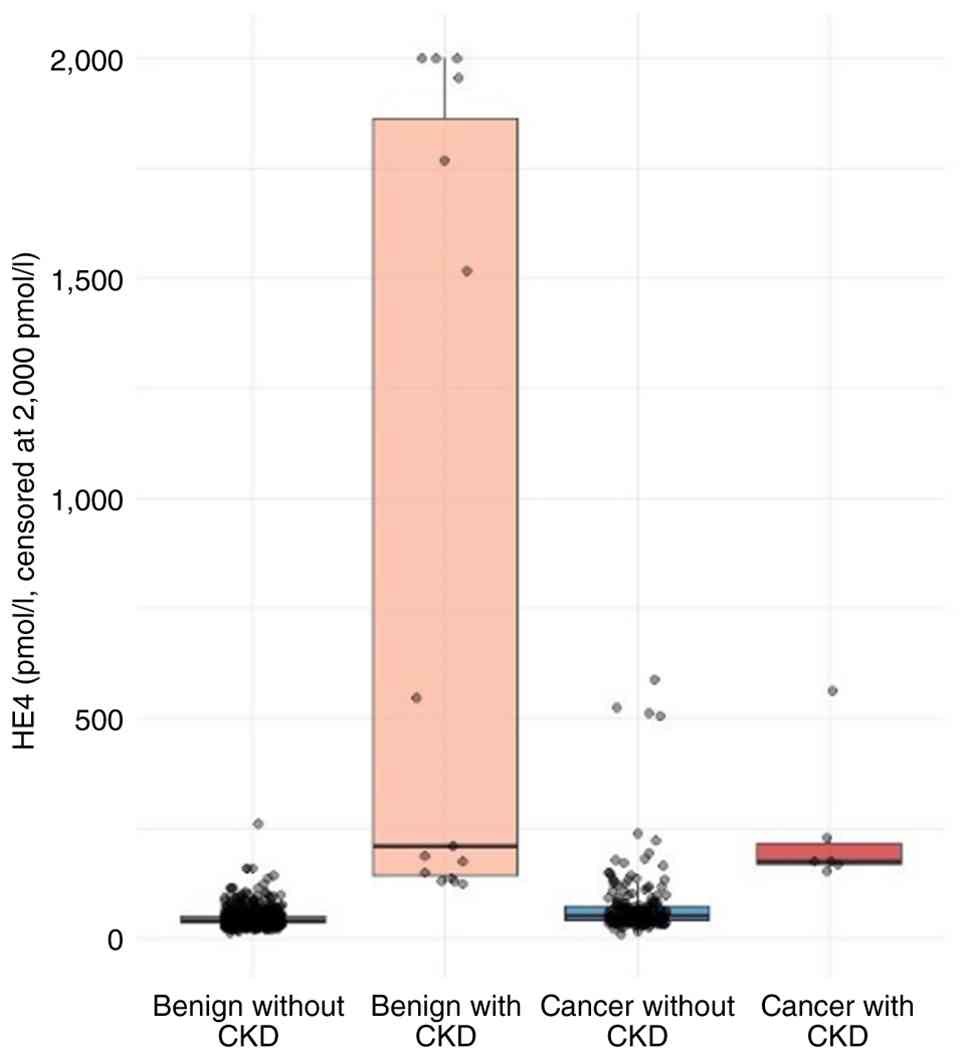
the benign and cancer groups (P<0.001). Among patients with
benign ovarian tumors, the median HE4 level was 210.00 pmol/l in
those with CKD, compared with 41.10 pmol/l in those without CKD.
Among patients with ovarian cancer, the median HE4 level was 175.35
pmol/l in those with CKD, compared with 52.65 pmol/l in those
without CKD. Serum HE4 levels according to CKD status in the benign
and cancer groups are shown as box plots (Fig. 1). For comparison, HE4 levels
>2,000 pmol/l were censored. ROMA scores were significantly
higher in patients with CKD in both the benign and cancer groups,
likely owing to elevated HE4 levels. Consequently, only 20% (3/15)
of patients with benign ovarian tumors and CKD were classified as
low risk.
 | Table ICharacteristics of study
participants. |
Table I
Characteristics of study
participants.
| | Benign | Cancer |
|---|
| Parameter | No CKD (n=913) | CKD (n=15) | P-value | No CKD (n=188) | CKD (n=6) | P-value |
|---|
| Mean age, years
(SD) | 43.00 (14.39) | 63.93 (13.34) | <0.001 | 46.62 (13.76) | 60.00 (17.13) | 0.021 |
| Menopause, n (%) | | | <0.001 | | | 0.238 |
|
Pre | 670 (73.4) | 4 (26.7) | | 111 (59.0) | 2 (33.3) | |
|
Post | 243 (26.6) | 11 (73.3) | | 77 (41.0) | 4 (66.7) | |
| Median CA125, U/ml
(IQR) | 23.00 (13.50,
54.20) | 23.50 (13.25,
30.60) | 0.492 | 46.70 (21.20,
111.67) | 23.05 (18.92,
25.75) | 0.052 |
| Median HE4, pmol/l
(IQR) | 41.10 (34.10,
50.20) | 210.00 (143.30,
1,862.05) | <0.001 | 52.65 (40.27,
74.30) | 175.35 (170.43,
217.25) | <0.001 |
| ROMA risk, n (%) | | | <0.001 | | | 0.03 |
|
Low | 765 (83.8) | 3 (20.0) | | 92 (48.9) | 0 (0.0) | |
|
High | 148 (16.2) | 12 (80.0) | | 96 (51.1) | 6 (100.0) | |
| Median ROMA score
(IQR) | 5.50 (3.50,
9.10) | 58.90 (29.99,
93.00) | <0.001 | 11.60 (5.88,
34.88) | 49.85 (42.33,
59.47) | 0.005 |
The CKD stage, cause of CKD, BUN, creatinine, eGFR,
CA125, HE4, and ROMA scores of patients with CKD are summarized in
Table SI. Patients with CKD stage
5 of unknown etiology were classified as having end-stage renal
disease, defined as kidney function reduced to ≤10%. Among patients
with benign ovarian tumors, HE4 levels increased gradually up to
CKD stage 3, with levels of 123 pmol/l in stage 2, 130.5 pmol/l
(130-131) in stage 3a, and 171.6 pmol/l (137-210) in stage 3b. In
contrast, HE4 levels were markedly elevated in patients with stage
5 CKD, reaching 2729.2 pmol/l (547.1-8204.6). Among patients with
benign ovarian tumors and CKD, the CA125 level was 22.4 U/ml
(5.5-51.8), excluding one outlier (701.2 U/ml), and did not show a
significant increase comparable to that observed for HE4. The mean
ROMA score of patients with benign ovarian tumors increased with
increasing HE4 levels, reaching 40.6 in CKD stage 2, 19.0
(14.4-23.5) in stage 3a, 36.4 (20.6-58.9) in stage 3b, and 92.2
(74-100) in stage 5.
The sensitivity, specificity, PPV, NPV, and accuracy
of ROMA were compared according to CKD status (Table II). ROMA scores were significantly
higher in patients with CKD, likely owing to elevated HE4 levels,
resulting in significantly lower specificity [0.200 (95% CI,
0.066-0.470)] and accuracy [0.429 (95% CI, 0.240-0.640)].
| Table IIDiagnostic performance of ROMA
according to CKD status. |
Table II
Diagnostic performance of ROMA
according to CKD status.
| Parameter | Without CKD
(n=1,101) | With CKD (n=21) | P-value |
|---|
| Sensitivity (95%
CI) | 0.511 (0.439,
0.581) | 1 | 0.968 |
| Specificity (95%
CI) | 0.838 (0.813,
0.860) | 0.200 (0.066,
0.470) | <0.001 |
| PPV (95% CI) | 0.393 (0.334,
0.456) | 0.333 (0.158,
0.571) | 0.615 |
| NPV (95% CI) | 0.893 (0.870,
0.912) | 1 | 0.981 |
| Accuracy (95%
CI) | 0.782 (0.757,
0.805) | 0.429 (0.240,
0.640) | <0.001 |
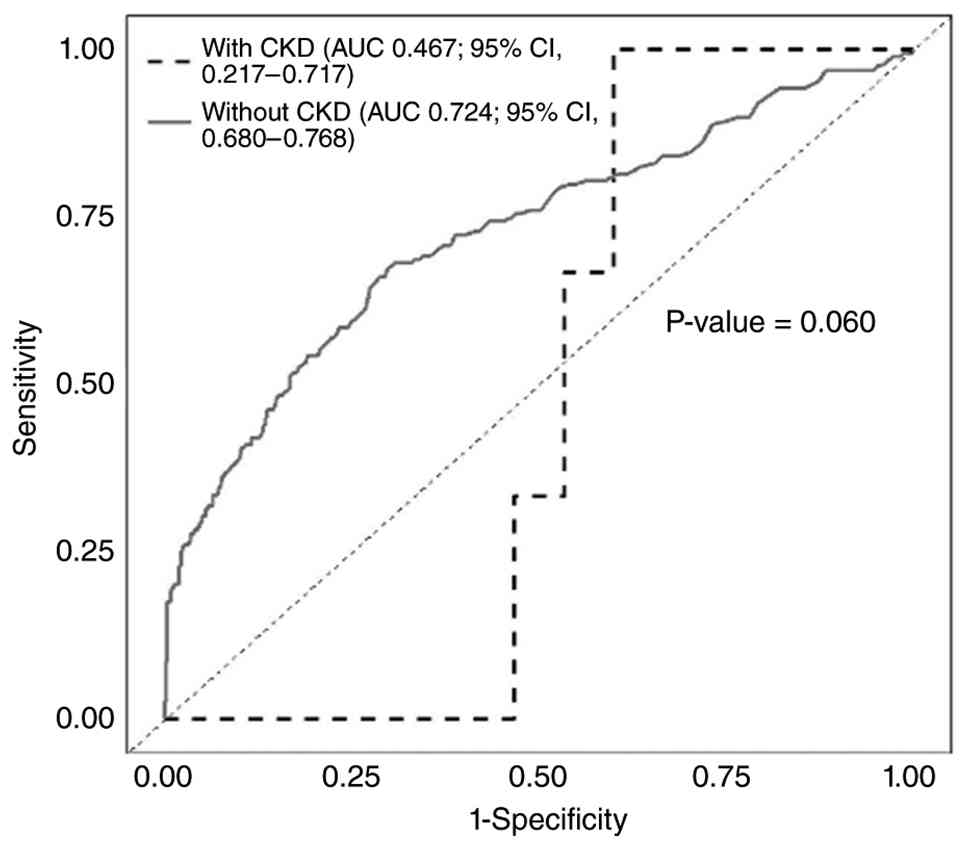
ROC curves for ROMA were generated for patients with
and without CKD (Fig. 2). ROMA
scores were calculated using the appropriate algorithm according to
menopausal status. The diagnostic performance of ROMA was better in
patients without CKD (AUC, 0.724; 95% CI, 0.680-0.768) than in
those with CKD (AUC 0.467; 95% CI, 0.217-0.717).
Discussion
CKD is a major health concern in women, with a
global prevalence of 11.8% among women aged ≥20 years (19). Patients with CKD are more likely to
have an adnexal mass detected incidentally than the general
population because they undergo imaging, such as noncontrast
abdominopelvic computed tomography or abdominal ultrasound, to
evaluate renal status. When an ovarian tumor is identified,
accurate differentiation between benign ovarian tumors and ovarian
cancer is essential for determining the need for surgical
intervention.
In patients with CKD, elevated HE4 levels may result
from decreased HE4 clearance or increased HE4 production associated
with renal dysfunction. Among 913 patients with benign ovarian
tumors without CKD, HE4 levels were all <160 pmol/l. In
contrast, 66.7% (10/15) of patients with CKD and benign ovarian
tumors had HE4 levels >160 pmol/l, with a maximum of 8,205
pmol/l. The markedly elevated HE4 levels in patients with CKD
resulted in substantially higher ROMA scores and poor diagnostic
performance for benign ovarian tumors. Patients with CKD and benign
ovarian tumors had a higher median HE4 level than those without CKD
(1,356.43 vs. 44.85 pmol/l). HE4 levels also increased with CKD
progression, with a particularly marked increase in stage 5. These
findings are consistent with previous studies (14). ROMA scores of patients with benign
ovarian tumors increased with HE4 levels, whereas CA125 levels did
not increase significantly. These findings suggest that ROMA does
not adequately compensate for elevated HE4 levels in patients with
CKD, even when CA125 and menopausal status are incorporated into
the calculation.
Recent studies have suggested that urinary assays
may provide a noninvasive alternative for evaluating HE4 levels.
Urinary HE4 levels are significantly higher in patients with
ovarian cancer than in healthy women or those with benign diseases
(20,21). Unlike serum HE4, urinary HE4 was
reported to be elevated only in patients with ovarian cancer and
not in those with CKD, with no significant difference between
patients with CKD and healthy controls (22). The urinary-to-serum HE4 ratio was
therefore proposed as a potential marker for differentiating
ovarian cancer from CKD. However, given the small number of
participants in the previous study, prospective study with larger
cohorts are needed to validate and standardize this approach before
its implementation in clinical practice.
According to a recent meta-analysis of five previous
studies, ROMA showed a sensitivity of 0.873 (95% CI, 0.752-0.940)
and specificity of 0.855 (95% CI, 0.719-0.932) (23). In the present study, ROMA
sensitivity in patients without CKD was lower (0.511; 95% CI,
0.439-0.581). Several factors may explain this difference. First,
the present study included only patients with histologically
confirmed diagnoses after surgery and excluded advanced ovarian
cancer and hydrosalpinx that could be sufficiently characterized by
preoperative imaging. Exclusion of patients with preoperative
clinical/imaging findings already strongly suggestive of malignancy
may have resulted in a more diagnostically challenging study
population compared with studies including a broader spectrum of
ovarian malignancies, and therefor may have contributed to the
lower observed ROMA sensitivity. Second, a relatively large
proportion of borderline tumors were classified as cancer. Among
188 patients with ovarian cancer without CKD, 94 had malignant
tumors and 94 had borderline tumors. Mucinous borderline tumors
were the most prevalent subtype, and only 15 of the 56 patients
were classified as high risk by ROMA, showing a low sensitivity of
26.8%. The frequency of histological subtypes in patients with
malignant tumors may also be a contributing factor. HE4 expression
in tumors depends on the histological subtype. Drapkin et al
(24) demonstrated that 100% of
endometrioid and 93% of serous EOCs expressed HE4; however, only
50% of clear cell carcinomas and none of the mucinous tumors were
HE4-positive. Previous studies have evaluated the efficacy of ROMA
according to tumor subtype. In ROC curve analysis, the serous type
showed the highest AUC (0.813 in premenopausal and 0.987 in
postmenopausal patients), whereas the mucinous type showed the
lowest AUC (0.545 and 0.656, respectively) (25). In the present study, all 27
patients with high-grade serous adenocarcinoma were classified as
high risk by ROMA, whereas only 8 of the 21 (38.1%) patients with
mucinous adenocarcinoma were classified as high risk.
Dialysis status and/or timing relative to dialysis
may influence serum HE4 levels and consequently ROMA scores. When
blood is drawn after dialysis, serum HE4 levels may be measured
lower than when drawn before dialysis due to dilution by the
dialysate. In this study, blood samples from all patients
undergoing dialysis were collected 2 h before dialysis.
Due to the nature of the disease, patients with CKD
were older especially in the benign tumor group. Since age can
independently influence HE4 and ROMA scores, this may partly
contribute to the higher ROMA values. We reviewed HE4 levels, ROMA
scores, and accuracy of ROMA according to age in a total of 305
benign postmenopausal patients aged 50 years or older without CKD.
In 147 patients aged 50-59 and 99 patients aged 60-69, the mean HE4
levels were 63.8 and 58.3 pmol/l, the mean ROMA scores were 21.5
and 16.6, and the accuracy of ROMA was 0.809 and 0.747,
respectively. However, in 59 patients aged 70 years or older, the
mean HE4 levels were 88.2 pmol/l, the mean ROMA score was 24.3, and
the accuracy of ROMA was 0.797. Since a rapid increase in HE4
levels and a consequent increase in ROMA scores occur in patients
aged 70 years or older, caution is required when using ROMA scores
in this age group, and future studies should use age-matched or
adjusted analyses.
This study has some limitations. First, its
retrospective design precluded assessment of certain clinical
factors that may influence CA125 or HE4 levels, such as
inflammation, smoking, or rheumatoid arthritis, at the time of
testing. Second, the relatively small number of patients with CKD
included in the study limited statistical power. Although
consistently elevated HE4 levels and ROMA scores were observed
among patients with CKD, these findings should be interpreted with
caution as the small number of patients reduces the reliability and
generalizability of the conclusions. Further studies with larger
numbers of patients with CKD are needed to confirm these
findings.
In conclusion, the diagnostic accuracy of ROMA was
compared for differentiating ovarian tumors in patients with and
without CKD. To the best of our knowledge, this is the first study
to analyze the discriminatory performance of ROMA in patients with
CKD who underwent surgery for ovarian tumors. In patients with CKD,
HE4 levels were elevated, with progressively higher levels observed
as CKD advanced. Owing to the elevated HE4 levels in patients with
CKD, ROMA scores were markedly elevated, resulting in poor
diagnostic performance for differentiating benign from malignant
ovarian tumors. The findings demonstrate that ROMA does not
adequately compensate for elevated HE4 levels in patients with CKD,
even when combined with CA125 and menopausal status. When an
ovarian tumor is detected in a patient with CKD, ovarian cancer
risk assessment should therefore consider CA125 and imaging
findings rather than rely on ROMA alone.
Supplementary Material
Data from patients with CKD
Acknowledgements
Not applicable.
Funding
Funding: No funding was received.
Availability of data and materials
The data generated in the present study may be
requested from the corresponding author.
Author's contributions
YJL, DHJ and SSL conceptualized the study and
performed the experiments. SWK, SWY and WSS analyzed the data. YJL
wrote the original draft. YJL and DHJ confirm the authenticity of
all the raw data, reviewed and edited the manuscript and supervised
the study. All authors read and approved the final manuscript, and
agree to be accountable for all aspects of the work.
Ethics approval and consent to
participate
The present study was conducted in accordance with
The Declaration of Helsinki. The Institutional Review Board of
Gangneung Asan Hospital determined that this retrospective study
was exempt from IRB review and waived the requirement for informed
consent (IRB no. 2025-10-003).
Patient consent for publication
Not applicable.
Competing interests
The authors declare that they have no competing
interests.
References
|
1
|
Siegel RL, Miller KD and Jemal A: Cancer
statistics, 2016. CA Cancer J Clin. 66:7–30. 2016.PubMed/NCBI View Article : Google Scholar
|
|
2
|
Sevinc A, Adli M, Kalender ME and Camci C:
Benign causes of increased serum CA-125 concentration. Lancet
Oncol. 8:1054–1055. 2007.PubMed/NCBI View Article : Google Scholar
|
|
3
|
Medeiros LR, Rosa DD, da Rosa MI and
Bozzetti MC: Accuracy of CA 125 in the diagnosis of ovarian tumors:
A quantitative systematic review. Eur J Obstet Gynecol Reprod Biol.
142:99–105. 2009.PubMed/NCBI View Article : Google Scholar
|
|
4
|
Moore RG, McMeekin DS, Brown AK,
DiSilvestro P, Miller MC, Allard WJ, Gajewski W, Kurman R, Bast RC
Jr and Skates SJ: A novel multiple marker bioassay utilizing HE4
and CA125 for the prediction of ovarian cancer in patients with a
pelvic mass. Gynecol Oncol. 112:40–46. 2009.PubMed/NCBI View Article : Google Scholar
|
|
5
|
Moore RG, Miller MC, Disilvestro P,
Landrum LM, Gajewski W, Ball JJ and Skates SJ: Evaluation of the
diagnostic accuracy of the risk of ovarian malignancy algorithm in
women with a pelvic mass. Obstet Gynecol. 118 (2 Pt 1):280–288.
2011.PubMed/NCBI View Article : Google Scholar
|
|
6
|
Chudecka-Głaz AM: ROMA, an algorithm for
ovarian cancer. Clin Chim Acta. 440:143–151. 2015.PubMed/NCBI View Article : Google Scholar
|
|
7
|
Simmons AR, Baggerly K and Bast RC Jr: The
emerging role of HE4 in the evaluation of epithelial ovarian and
endometrial carcinomas. Oncology (Williston Park). 27:548–556.
2013.PubMed/NCBI
|
|
8
|
Lu R, Sun X, Xiao R, Zhou L, Gao X and Guo
L: Human epididymis protein 4 (HE4) plays a key role in ovarian
cancer cell adhesion and motility. Biochem Biophys Res Commun.
419:274–280. 2012.PubMed/NCBI View Article : Google Scholar
|
|
9
|
Hallamaa M, Suvitie P, Huhtinen K,
Matomäki J, Poutanen M and Perheentupa A: Serum HE4 concentration
is not dependent on menstrual cycle or hormonal treatment among
endometriosis patients and healthy premenopausal women. Gynecol
Oncol. 125:667–672. 2012.PubMed/NCBI View Article : Google Scholar
|
|
10
|
Moore RG, Miller MC, Eklund EE, Lu KH,
Bast RC Jr and Lambert-Messerlian G: Serum levels of the ovarian
cancer biomarker HE4 are decreased in pregnancy and increase with
age. Am J Obstet Gynecol. 206:349.e1–e7. 2012.PubMed/NCBI View Article : Google Scholar
|
|
11
|
Yuan T and Li Y: Human epididymis protein
4 as a potential biomarker of chronic kidney disease in female
patients with normal ovarian function. Lab Med. 48:238–243.
2017.PubMed/NCBI View Article : Google Scholar
|
|
12
|
Hertlein L, Stieber P, Kirschenhofer A,
Krocker K, Nagel D, Lenhard M and Burges A: Human epididymis
protein 4 (HE4) in benign and malignant diseases. Clin Chem Lab
Med. 50:2181–2188. 2012.PubMed/NCBI View Article : Google Scholar
|
|
13
|
Nagy B Jr, Krasznai ZT, Balla H, Csobán M,
Antal-Szalmás P, Hernádi Z and Kappelmayer J: Elevated human
epididymis protein 4 concentrations in chronic kidney disease. Ann
Clin Biochem. 49 (Pt 4):377–380. 2012.PubMed/NCBI View Article : Google Scholar
|
|
14
|
Yan S, Lin Y and Tian X: Significantly
elevated serum human epididymis protein-4 in chronic kidney disease
patients without ovarian cancer: A large-scale retrospective study.
J Clin Lab Anal. 37(e24847)2023.PubMed/NCBI View Article : Google Scholar
|
|
15
|
Hauptmann S, Friedrich K, Redline R and
Avril S: Ovarian borderline tumors in the 2014 WHO classification:
Evolving concepts and diagnostic criteria. Virchows Arch.
470:125–142. 2017.PubMed/NCBI View Article : Google Scholar
|
|
16
|
Statistics Korea: Korean Standard
Classification of Diseases and Causes of Death 8th Revision
(KCD-8). Vol 1, 2020.
|
|
17
|
Stevens LA, Schmid CH, Greene T, Zhang YL,
Beck GJ, Froissart M, Hamm LL, Lewis JB, Mauer M, Navis GJ, et al:
Comparative performance of the CKD Epidemiology Collaboration
(CKD-EPI) and the Modification of Diet in Renal Disease (MDRD)
Study equations for estimating GFR levels above 60 ml/min/1.73 m2.
Am J Kidney Dis. 56:486–495. 2010.PubMed/NCBI View Article : Google Scholar
|
|
18
|
Kidney Disease: Improving Global Outcomes
(KDIGO) CKD Work Group: KDIGO 2024 clinical practice guideline for
the evaluation and management of chronic kidney disease. Kidney
Int. 105 (4S):S117–S314. 2024.PubMed/NCBI View Article : Google Scholar
|
|
19
|
Mills KT, Xu Y, Zhang W, Bundy JD, Chen
CS, Kelly TN, Chen J and He J: A systematic analysis of worldwide
population-based data on the global burden of chronic kidney
disease in 2010. Kidney Int. 88:950–957. 2015.PubMed/NCBI View Article : Google Scholar
|
|
20
|
Liao JB, Yip YY, Swisher EM, Agnew K,
Hellstrom KE and Hellstrom I: Detection of the HE4 protein in urine
as a biomarker for ovarian neoplasms: Clinical correlates. Gynecol
Oncol. 137:430–435. 2015.PubMed/NCBI View Article : Google Scholar
|
|
21
|
Hellstrom I, Heagerty PJ, Swisher EM, Liu
P, Jaffar J, Agnew K and Hellstrom KE: Detection of the HE4 protein
in urine as a biomarker for ovarian neoplasms. Cancer Lett.
296:43–48. 2010.PubMed/NCBI View Article : Google Scholar
|
|
22
|
Fan Q, Luo G, Yi T, Wang Q, Wang D, Zhang
G, Jiang X and Guo X: Diagnostic value of urinary-to-serum human
epididymis protein 4 ratio in ovarian cancer. Biomed Rep. 7:67–72.
2017.PubMed/NCBI View Article : Google Scholar
|
|
23
|
Dayyani F, Uhlig S, Colson B, Simon K,
Rolny V, Morgenstern D and Schlumbrecht M: Diagnostic performance
of risk of ovarian malignancy algorithm against CA125 and HE4 in
connection with ovarian cancer: A meta-analysis. Int J Gynecol
Cancer. 26:1586–1593. 2016.PubMed/NCBI View Article : Google Scholar
|
|
24
|
Drapkin R, von Horsten HH, Lin Y, Mok SC,
Crum CP, Welch WR and Hecht JL: Human epididymis protein 4 (HE4) is
a secreted glycoprotein that is overexpressed by serous and
endometrioid ovarian carcinomas. Cancer Res. 65:2162–2169.
2005.PubMed/NCBI View Article : Google Scholar
|
|
25
|
Lee YJ, Kim YM, Kang JS, Nam SH, Kim DY
and Kim YT: Comparison of risk of ovarian malignancy algorithm and
cancer antigen 125 to discriminate between benign ovarian tumor and
early-stage ovarian cancer according to imaging tumor subtypes.
Oncol Lett. 20:931–938. 2020.PubMed/NCBI View Article : Google Scholar
|