Introduction
Cancer is the second leading cause of death
worldwide (1), and its incidence
continues to rise annually (2). It
is estimated that by 2040, there will be ~290,000 new cancer
diagnoses and ~50,000 cancer-related deaths, with >16% of deaths
occurring in low- and middle-income countries (3,4).
Cancer treatment imposes substantial physical and psychological
suffering on patients and places a marked financial burden on them
(5,6). This multifaceted issue expands beyond
individual patients, affecting families, careers and the broader
society (7). Consequently,
numerous studies are actively investigating risk factors associated
with cancer (8). A comprehensive
understanding of cancer etiology, along with effective
interventions, is urgently needed.
Inflammation, particularly chronic inflammation, is
a known contributor to tumor development (9-11).
This association is supported by multiple mechanisms through which
inflammation influences key processes in tumorigenesis, including
genomic instability, DNA damage, oncogene activation and impaired
tumor suppressor activity (12).
Beyond contributing to the early stages of cancer development,
chronic inflammation also serves a pivotal role in cancer
progression (13,14); ~25% of all cancers are associated
with chronic inflammation (15).
Among several peripheral inflammatory markers,
high-sensitivity C reactive protein (hs-CRP) has been extensively
studied due to its long plasma half-life, minimal diurnal variation
and independence from age or sex (16). A previous prospective cohort study
reported a notable association between elevated hs-CRP levels and
cancer risk (17). Moreover, our
previous studies have further supported this association,
demonstrating a link between elevated hs-CRP levels and unfavorable
survival outcomes across multiple cancer types (18,19).
Collectively, these studies indicate a strong association between
hs-CRP and cancer; however, a key limitation is that hs-CRP levels
were measured only once at baseline.
Nonetheless, cancer development is often associated
with the long-term effects of risk factors. As an acute-phase
response protein, hs-CRP is susceptible to fluctuations triggered
by both endogenous and exogenous factors, particularly in the
presence of inflammation, autoimmune disease or cancer (16). Relying solely on baseline hs-CRP
levels as a predictor of cancer development has limitations. By
contrast, serial measurements of hs-CRP over time, capturing both
high and low levels as well as their fluctuations, provide a
comprehensive reflection of peripheral inflammation and the
associated inflammatory response. Variability, defined as the
degree of fluctuation in a biomarker over time, constitutes a
critical metric. Commonly used variability indicators include the
coefficient of variation (CV) and the variation independent of the
mean (VIM). Therefore, the present study aimed to assess changes in
hs-CRP over time, expressing variability using the CV, and
incorporating VIM as a complementary indicator to explore the
association between hs-CRP variability and cancer incidence. The
Kailuan cohort has previously been used to examine CRP trajectories
and cancer risk (20). The present
study uses the same source cohort and the same 2006-2010 CRP
measurement period but addresses a different scientific question.
It focuses on CRP variability rather than trajectory patterns.
Materials and methods
Study design and population
Data for the present study were obtained from the
Kailuan cohort, a prospective cohort located in northern China. In
2006, employees of the Kailuan Group, including retirees, were
invited to participate. A total of 101,510 employees agreed to take
part and provided signed informed consent. Participants underwent
questionnaire interviews, health examinations and laboratory
assessments at Kailuan Hospital (Tangshan, China). Follow-up
medical examinations and questionnaires were administered every 2
years. Participants who underwent <3 medical examinations
between 2006-2010 were excluded. The present analysis was conducted
using the Kailuan cohort, the same source population used in the
previous CRP trajectory study by Liu et al (20). However, since the exposure
definition differed, the inclusion and exclusion criteria and the
final analytical sample were not identical. All personal
information of the participants included in the final analysis was
kept confidential. The study protocol adhered to the guidelines of
the Declaration of Helsinki and was approved by the Ethics
Committee of Kailuan Medical Group, Kailuan Company, which has
direct oversight over Kailuan General Hospital, our participating
clinical site (ChiCTR-TNRC-11001489).
Variable evaluation
Fasting blood samples were collected and analyzed
for glucose, hs-CRP and triglyceride levels using a Hitachi 747
auto-analyzer (Hitachi, Ltd.) at the Kailuan General Hospital
central laboratory. Serum hs-CRP was measured by immunoturbidimetry
(detection limit, 0.1 mg/l) (21).
To ensure data stability and scientific rigor, participants with
hs-CRP levels of >15 mg/l were excluded, as the mean hs-CRP
value is far lower than this threshold, and values above it may
stem from detection errors or special physiological conditions.
Blood measurements were performed using automated analyzers
following standard procedures. Experienced nurses measured the
height and weight of the participants, and the body mass index
(BMI) was calculated as weight (kg) divided by the square of height
(m).
Demographic details included sex, age, educational
level and income. Educational attainment of high school was
classified as ‘high’, while lower levels were categorized as ‘low’.
A monthly family income of >1,000 yuan per capita was classified
as ‘high income’, with lower incomes categorized as ‘low income’.
Lifestyle information, including smoking, alcohol consumption and
physical exercise, was obtained from participant responses to the
lifestyle questionnaire.
The primary outcome of the present study was cancer
incidence, with mortality as the secondary outcome. A prospective
follow-up design was employed, tracking all participants from the
baseline assessment performed in 2010-2011 until the occurrence of
cancer or death. Death data were retrieved from the death
certificates issued by the National Vital Statistics Bureau. The
follow-up period extended from the baseline assessment to 2021,
during which all outcome events were meticulously recorded.
Calculation of hs-CRP variability
hs-CRP was measured during three distinct periods:
2006-2007, 2008-2009 and 2010-2011. To quantify the hs-CRP
variability, the CV was calculated as the standard deviation (SD)
divided by the mean hs-CRP level across the three measurements for
each participant (CV=SD/mean). This measure is widely used to
assess variability independent of the absolute level (22); however, it is acknowledged that CV
may be less stable when mean hs-CRP levels are low or when the
distribution is skewed. Therefore, to enhance the robustness of the
findings, the present study additionally employed the VIM as a
complementary measure. Unlike CV, VIM is designed to be
uncorrelated with the mean and thus provides a more stable estimate
of variability across different mean levels. Both CV and VIM were
categorized into tertiles (low, moderate and high) for analysis:
VIM=k x SD (hs-CRP)/mean (hs-CRP)x; SD (hs-CRP)=constant
x mean (hs-CRP); and k=Mean [Mean(hs-CRP)]x. This
variability measure was then treated as a fixed covariate in the
Cox proportional hazards models to assess its association with the
risk of incident cancer during the subsequent follow-up period.
Statistical analysis
Normally distributed continuous variables were
summarized using the mean and SD and analyzed using unpaired
t-tests. Non-normally distributed continuous variables were
analyzed using the Wilcoxon rank-sum test. Categorical variables
were analyzed using the χ2 test. This approach ensured
the appropriate analysis of different variable types.
Moreover, Cox regression analysis was utilized to
explore the relationship between hs-CRP variability and cancer
risk. Model A was unadjusted, whereas Model B was adjusted for sex,
age, education and income. Besides the adjustments in Model B,
Model C was further adjusted for BMI, smoking, alcohol consumption
and physical exercise. The proportional hazards assumption was
tested using Schoenfeld residuals. The global tests were
non-significant (P>0.05), indicating that the assumption was not
violated. Restricted Cubic Spline (RCS) plots were generated to
visually illustrate the complex relationship between continuous CV
of hs-CRP and cancer risk. Additionally, the model was fitted using
the ‘TRAJ’ program in SAS version 9.4 (SAS Institute, Inc.) to
group individuals with similar patterns of hs-CRP change between
2006-2010. Subsequently, the association between hs-CRP variability
and incident cancer in the overall cohort was examined within
subgroups defined by distinct hs-CRP trajectories. The incidence of
site-specific cancers during follow-up period was estimated and
their association with the CV of hs-CRP was explored. Several
sensitivity analyses were performed to assess the robustness of the
findings and to address potential confounding. To minimize the
influence of preclinical or undiagnosed cancer, participants who
developed cancer within the initial 2-year follow-up period were
excluded. To reduce the impact of acute inflammatory conditions,
participants with hs-CRP levels of >10 mg/l were also excluded.
Given the potential influence of metabolic factors in cancer,
fasting blood glucose and lipid levels were additionally adjusted
for. Moreover, to ensure that the observed association reflected
hs-CRP variability rather than baseline inflammation, baseline
hs-CRP levels were further adjusted for. Aspirin use was also
included as a covariate in additional analyses.
Using VIM as a complementary indicator of
variability, Cox regression analyses and RCS plots were
additionally used to explore the association between VIM of hs-CRP
and cancer incidence. In addition, Cox regression analysis was used
to assess the association between the CV and death, as well as
cancer-specific mortality. The competing risk plots illustrated the
relationships between different levels of hs-CRP variability and
the occurrence of cancer and death.
All statistical tests were two-sided and P<0.05
was considered to indicate a statistically significant difference.
Statistical analysis was performed using SAS (version 9.4; SAS
Institute, Inc.) and R version 4.2.3 (RStudio, Inc.).
Results
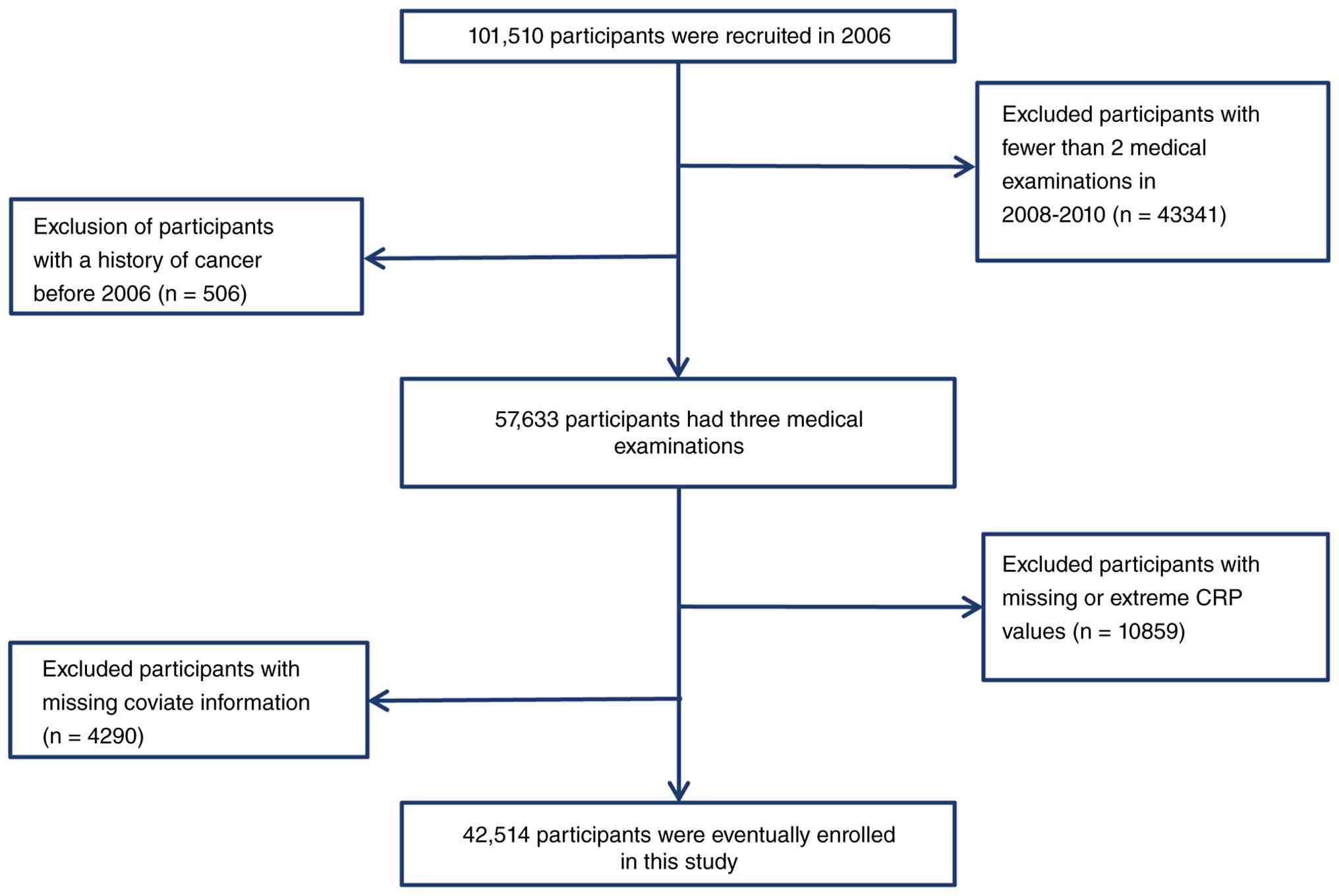
The present study included 42,514 participants from
the Kailuan cohort. The detailed process of participant inclusion
and exclusion is shown in Fig. 1.
Among the included participants, 24% were women and 76% were men,
with an average age of 53.24 (11.69) years and a median follow-up
duration of 10.98 years. Participants with higher hs-CRP
variability tended to be men, younger and have lower BMIs (Table I). Mean hs-CRP was categorized as
high (≥3 mg/l) or low (<3 mg/l) based on clinical experience
(23), and participants were
stratified according to present baseline information. The results
revealed that participants with higher hs-CRP were more likely to
be women, older and have higher BMIs (Table SI).
 | Table IBaseline characteristics of
participants, stratified by the coefficient of variation of hs-CRP
(n=42,514). |
Table I
Baseline characteristics of
participants, stratified by the coefficient of variation of hs-CRP
(n=42,514).
| | CV of hs-CRP |
|---|
| Characteristic | Lowest tertile
(<53.07) | Middle tertile
(53.07~84.05) | Highest tertile
(≥84.05) | P-value |
|---|
| N | 14,173 | 14,172 | 14,169 | |
| Sex, n (%) | | | | |
|
Woman | 3,622 (25.6) | 3,504 (24.7) | 3,093 (21.8) | <0.001 |
|
Man | 10,551 (74.4) | 10,668 (75.3) | 11,076 (78.2) | |
| Age, years | 54.56 (11.82) | 53.55 (11.77) | 51.62 (11.47) | <0.001 |
| Education, n
(%) | | | | <0.001 |
|
Low | 10,336 (72.9) | 11,040 (77.8) | 10,991 (77.6) | |
|
High | 3,837 (27.1) | 3,132 (22.1) | 3,178 (22.4) | |
| Income, n (%) | | | | <0.001 |
|
Low | 12,832 (90.5) | 13,207 (93.2) | 13,355 (94.3) | |
|
High | 13,41 (9.5) | 965 (6.8) | 814 (5.7) | |
| Smoke, n (%) | | | | <0.001 |
|
No | 8,880 (62.7) | 9,223 (65.1) | 9,088 (64.1) | |
|
Current and
past | 5,293 (37.3) | 4,949 (34.9) | 5,081 (35.9) | |
| Alcohol intake, n
(%) | | | | <0.001 |
|
No | 7,951 (56.1) | 8,606 (60.7) | 8,458 (59.7) | |
|
Yes | 62,22 (43.9) | 5,566 (39.3) | 5,711 (40.3) | |
| Physical exercise,
n (%) | | | | <0.001 |
|
No | 1,204 (8.5) | 1,301 (9.2) | 1,465 (10.3) | |
|
Yes | 12,969 (91.5) | 12,871 (90.8) | 12,704 (89.7) | |
| BMI,
kg/m2 | 25.47±3.39 | 25.23±3.38 | 24.79±3.29 | <0.001 |
| FBG, mmol/l | 5.75±1.67 | 5.68±1.76 | 5.58±1.59 | <0.001 |
| TG, mmol/l | 1.36
(0.93,2.06) | 1.28
(0.88,1.91) | 1.26
(0.90,1.85) | <0.001 |
| hs-CRP (2010) | 1.27
(0.70,2.50) | 1.21
(0.68,2.43) | 1.00
(0.50,2.70) | <0.001 |
| hs-CRP (2008) | 1.33
(0.80,2.70) | 1.60
(0.81,3.03) | 1.60
(0.70,3.20) | <0.001 |
| hs-CRP (2006) | 1.10
(0.60,2.30) | 0.70
(0.29,1.80) | 0.33
(0.11,1.08) | <0.001 |
| Mean hs-CRP | 1.30
(0.75,2.52) | 1.40
(0.77,2.50) | 1.57
(0.95,2.60) | <0.001 |
Cox regression analysis was then performed to
evaluate the association between hs-CRP variability and cancer
occurrence. The high hs-CRP group had a ~20% higher risk of cancer
than the low hs-CRP group [hazard ratio (HR), 1.20; 95% confidence
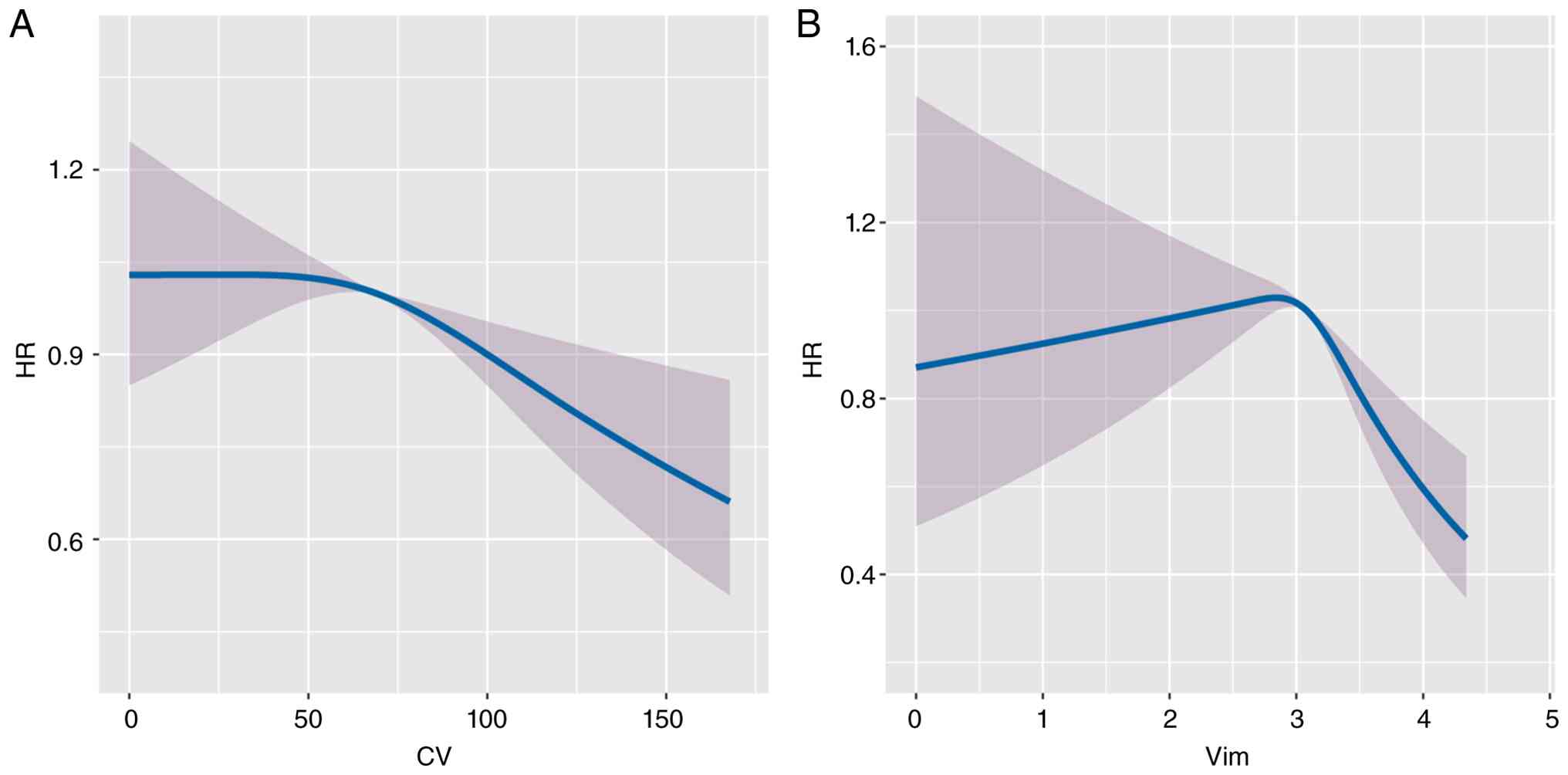
interval (CI), 1.07-1.33; P<0.001]. RCS was then used to observe
the association between continuous CV of hs-CRP and cancer risk,
and the results demonstrated that as CV increased, HR decreased,
suggesting that higher visit-to-visit variability of hs-CRP was
associated with lower cancer risk (Fig. 2A). Subsequently, hs-CRP variability
was stratified into three groups based on the tertile intervals of
CV of hs-CRP: Low, medium and high. Moderate hs-CRP variability did
not show a significant association with cancer risk compared with
low variability (adjusted HR, 0.93; 95% CI, 0.84-1.04; P=0.205),
but high variability exhibited a notable protective effect against
cancer (adjusted HR, 0.84; 95% CI, 0.75-0.94; P=0.003). To further
assess the influence of hs-CRP levels on the relationship between
variability and cancer risk, an additional Cox regression analysis
was performed by cross-classifying hs-CRP levels and variability.
Using individuals with low hs-CRP levels and high variability as
the reference group, all other groups showed elevated cancer risk
compared with the reference (HR >1 for each group), indicating
that the reference group had the lowest cancer risk. Compared with
that of the reference group, the group with low hs-CRP level and
low variability had a ~20% increased risk of cancer (adjusted HR,
1.20; 95% CI, 1.06-1.37; P=0.05), and the group with low hs-CRP
levels and moderate variability did not have a significantly
different cancer risk (adjusted HR, 1.12; 95% CI, 0.99-1.28;
P=0.079). High hs-CRP levels were associated with a higher risk of
cancer occurrence regardless of variability, with the group
exhibiting the lowest variability showing the highest risk
(adjusted HR, 1.42; 95% CI, 1.18-1.70; P<0.001; model C;
Table II).
| Table IIAssociation between serum hs-CRP
levels and variability and cancer incidence. |
Table II
Association between serum hs-CRP
levels and variability and cancer incidence.
| | | Model A | Model B | Model C |
|---|
| Hs-CRP | Case/n | HR (95% CI) | P-value | HR (95% CI) | P-value | HR (95% CI) | P-value |
|---|
| hs-CRP levels | | | | | | | |
|
Low (<3
mg/l) | 1,445/34,118 | ref. | ref. | ref. | ref. | ref. | ref. |
|
High (≥3
mg/l) | 457/8,396 | 1.33
(1.19-1.47) | <0.001 | 1.22
(1.09-1.35) | <0.001 | 1.20
(1.07-1.33) | <0.001 |
| hs-CRP
variability | | | | | | | |
|
Low | 689/14,173 | ref. | ref. | ref. | ref. | ref. | ref. |
|
Moderate | 645/14,172 | 0.93
(0.83-1.03) | 0.181 | 0.93
(0.83-1.04) | 0.183 | 0.93
(0.84-1.04) | 0.205 |
|
High | 568/14,169 | 0.81
(0.72-0.90) | <0.001 | 0.83
(0.75-0.93) | 0.002 | 0.84
(0.75-0.94) | 0.003 |
|
P for
trend | | | <0.001 | | 0.001 | | 0.003 |
| hs-CRP levels and
variability | | | | | | | |
|
Low hs-CRP
with high variability | 428/11,322 | ref. | ref. | ref. | ref. | ref. | ref. |
|
Low hs-CRP
with moderate variability | 497/11,495 | 1.16
(1.02-1.32) | 0.026 | 1.13
(0.99-1.29) | 0.062 | 1.12
(0.99-1.28) | 0.079 |
|
Low hs-CRP
with low variability | 520/11,301 | 1.24
(1.09-1.41) | <0.001 | 1.22
(1.07-1.38) | 0.003 | 1.20
(1.06-1.37) | 0.005 |
|
High hs-CRP
with high variability | 140/2,847 | 1.33
(1.10-1.61) | 0.003 | 1.27
(1.05-1.53) | 0.015 | 1.25
(1.03-1.51) | 0.025 |
|
High hs-CRP
with moderate variability | 148/2,677 | 1.52
(1.26-1.84) | <0.001 | 1.36
(1.13-1.64) | <0.001 | 1.33
(1.10-1.61) | 0.003 |
|
High hs-CRP
with low variability | 169/2,872 | 1.65
(1.38-1.97) | <0.001 | 1.45
(1.21-1.73) | <0.001 | 1.42
(1.18-1.70) | <0.001 |
|
P for
trend | | | <0.001 | | <0.001 | | <0.001 |
Subsequently, participants were categorized into
three distinct long-term hs-CRP change patterns: Stable, increasing
and decreasing (Fig. S1). The
association between hs-CRP variability and cancer risk in
participants with each of these three different patterns was then
assessed. The results indicated that only in the stable group,
hs-CRP variability was significantly associated with the risk of
cancer (high variability in stable-pattern: HR, 0.81; 95% CI,
0.72-0.92; P=0.001; Table
III).
| Table IIIAssociation between hs-CRP
variability and cancer incidence in different hs-CRP trajectories
(2006-2010). |
Table III
Association between hs-CRP
variability and cancer incidence in different hs-CRP trajectories
(2006-2010).
| Comparison | Case/N | HR (95% CI) | P-value |
|---|
| Continuous CV of
hs-CRP (per_SD) | | | |
|
Overall | 1,902/42,514 | 0.95
(0.90-0.99) | 0.013 |
|
Track 1
(stable) | 1,607/36,579 | 0.95
(0.90-1.00) | 0.032 |
|
Track 2
(increase) | 138/2,792 | 0.93
(0.79-1.08) | 0.335 |
|
Track 3
(decrease) | 157/3,143 | 0.89
(0.76-1.03) | 0.122 |
| CV tertile interval
of hs-CRP | | | |
|
Lowest
tertile | 585/12,394 | ref. | |
|
Middle
tertile | 555/12,255 | 0.95
(0.85-1.07) | 0.426 |
|
Highest
tertile | 467/11,930 | 0.81
(0.72-0.92) | 0.001 |
|
Track 1
(stable-pattern) | | | |
|
Lowest
tertile | 585/12394 | ref. | |
|
Middle
tertile | 555/12255 | 0.95
(0.85-1.07) | 0.426 |
|
Highest
tertile | 467/11930 | 0.81
(0.72-0.92) | 0.001 |
| Track 2
(increase-pattern) | | | |
|
Lowest
tertile | 45/701 | ref. | |
|
Middle
tertile | 35/889 | 0.59
(0.38-0.93) | 0.021 |
|
Highest
tertile | 58/1,202 | 0.71
(0.48-1.05) | 0.083 |
| Track 3
(decrease-pattern | | | |
|
Lowest
tertile | 59/1,078 | ref. | |
|
Middle
tertile | 55/1,028 | 0.96
(0.67-1.39) | 0.848 |
|
Highest
tertile | 43/1,037 | 0.74
(0.51-1.09) | 0.127 |
Furthermore, the association between hs-CRP
variability and cancer at different specific sites was evaluated.
The incidence of cancer at several specific sites during the
follow-up period is presented in Table SII. Among all participants, a
total of 502 incident lung cancer cases occurred during the
follow-up period (Table SII).
Table IV indicated a significant
association between CV of hs-CRP and the incidence of lung cancer
(HR, 0.77; 95% CI, 0.63-0.96; P=0.018; Table IV).
| Table IVAssociation between hs-CRP
coefficient of variation and site-specific cancer incidence. |
Table IV
Association between hs-CRP
coefficient of variation and site-specific cancer incidence.
| | | Middle tertile | Highest
tertile |
|---|
| Cancer site | Lowest tertile | HR (95% CI) | P-value | HR (95% CI) | P-value |
|---|
| Head and neck | ref. | 1.68
(1.09-2.59) | 0.018 | 1.32
(0.84-2.08) | 0.236 |
| Esophagus | ref. | 1.98
(1.04-3.77) | 0.037 | 1.30
(0.65-2.60) | 0.463 |
|
Gastrointestinal | ref. | 1.22
(0.82-1.82) | 0.318 | 1.13
(0.75-1.71) | 0.546 |
| Colorectal | ref. | 0.81
(0.61-1.09) | 0.161 | 0.78
(0.58-1.05) | 0.100 |
| Liver and
gallbladder | ref. | 1.36
(0.93-1.96) | 0.109 | 0.81
(0.53-1.24) | 0.328 |
| Pancreatic | ref. | 1.63
(0.67-3.93) | 0.280 | 1.36
(0.72-2.48) | 0.245 |
| Lung | ref. | 0.74
(0.59-0.91) | 0.005 | 0.77
(0.63-0.96) | 0.018 |
| Breast | ref. | 0.90
(0.62-1.32) | 0.587 | 0.71
(0.47-1.09) | 0.117 |
| Uterus and
ovaries | ref. | 1.08
(0.56-2.06) | 0.825 | 1.18
(0.61-2.28) | 0.626 |
| Prostate | ref. | 0.58
(0.32-1.03) | 0.063 | 0.81
(0.47-1.40) | 0.448 |
| Kidney | ref. | 1.14
(0.67-1.95) | 0.631 | 0.78
(0.43-1.42) | 0.422 |
| Urinary
bladder | ref. | 0.97
(0.53-1.80) | 0.935 | 0.79
(0.40-1.54) | 0.488 |
| Hematology | ref. | 0.81
(0.44-1.51) | 0.511 | 0.63
(0.32-1.26) | 0.191 |
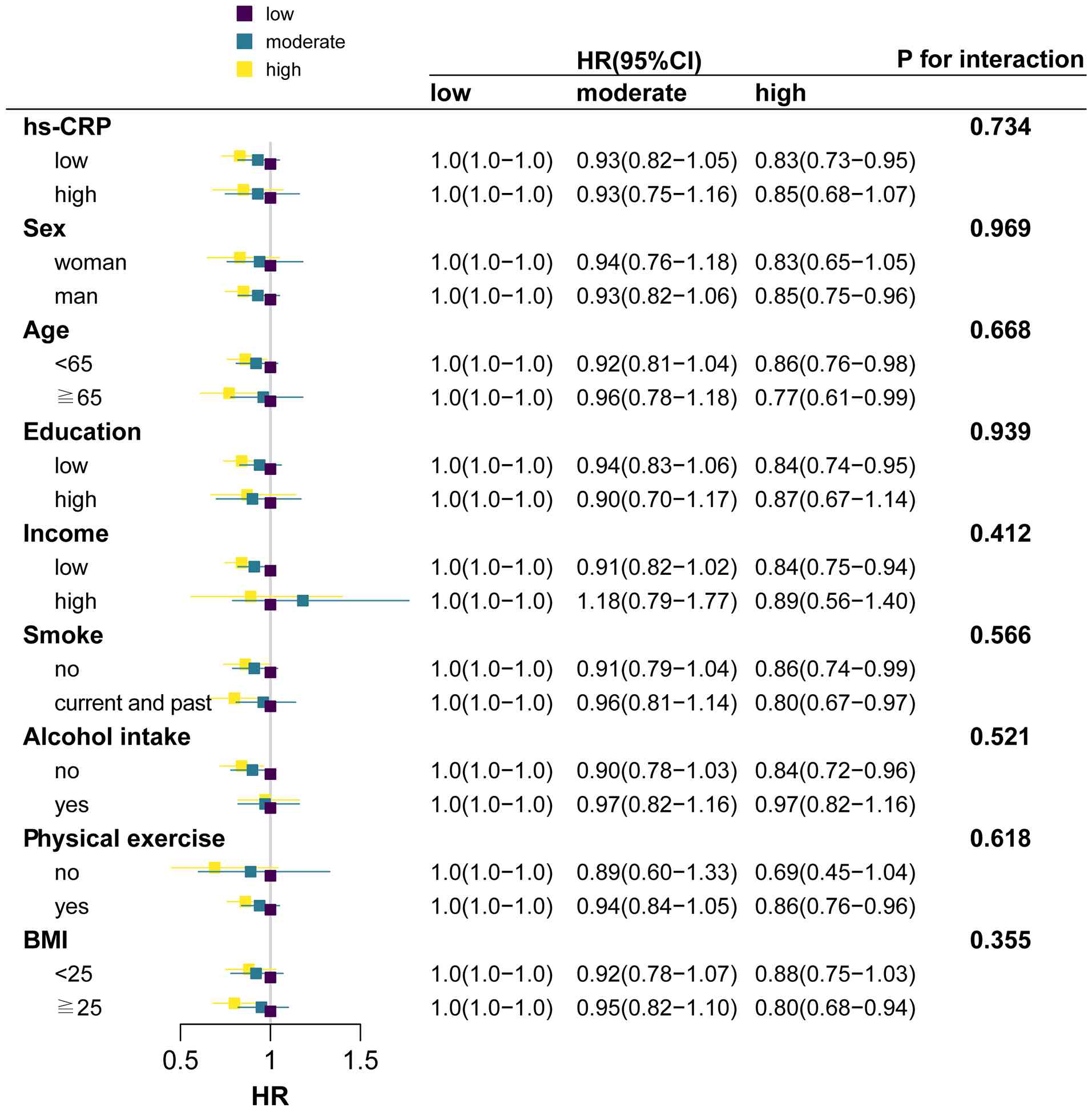
To explore whether the association between hs-CRP
variability and cancer exists in populations with different
characteristics, subgroup analyses were performed. In most
subgroups, high variability was associated with an elevated cancer
risk. However, the P-values for interaction were not significant
(all P>0.05), suggesting no significant heterogeneity across
subgroups. Moreover, high variability was more protective against
cancer than moderate variability (Fig.
3).
Additionally, sensitivity analyses were performed to
ensure the stability of the findings and to rule out other factors.
To minimize the possibility of reverse causation, lag analyses were
performed by excluding participants who developed cancer within the
first 2 years after the exposure assessment period. The results
remained consistent with the main findings. The adjusted HR for the
highest vs. lowest tertile of hs-CRP-CV was 0.84 (95% CI,
0.75-0.94) in the primary analysis and 0.79 (95% CI, 0.70-0.90)
after excluding early cancer cases in the highest tertile group.
Second, participants with markedly large values of hs-CRP were
excluded. In addition, blood glucose and lipids were corrected for
separately from Model C, as well as hs-CRP at baseline and aspirin
use. After these exclusions and additional adjustments, the
association remained significant in the highest tertile of hs-CRP
variability but was attenuated and no longer significant in the
middle tertile, suggesting that the effect was robust in the
highest tertile but not in the middle tertile (Table V).
| Table VSensitivity analyses. |
Table V
Sensitivity analyses.
| CV of hs-CRP | HR (95% CI) | P-value |
|---|
| Exclude cancer
occurrence within first 2 years (n=41,948) | | |
|
Lowest
tertile | ref. | |
|
Middle
tertile | 0.89
(0.80-1.00) | 0.059 |
|
Highest
tertile | 0.79
(0.70-0.90) | <0.001 |
| Exclude hs-CRP
maxima (hs-CRP >10 mg/l) (n=40,412) | | |
|
Lowest
tertile | ref. | |
|
Middle
tertile | 0.94
(0.84-1.05) | 0.283 |
|
Highest
tertile | 0.86
(0.77-0.97) | 0.014 |
| Additionally
adjusted for blood glucose and lipid | | |
|
Lowest
tertile | ref. | |
|
Middle
tertile | 0.93
(0.84-1.04) | 0.201 |
|
Highest
tertile | 0.84
(0.75-0.94) | 0.003 |
| Additionally
adjusted for basic hs-CRP | | |
|
Lowest
tertile | ref. | |
|
Middle
tertile | 0.93
(0.84-1.04) | 0.209 |
|
Highest
tertile | 0.84
(0.75-0.94) | 0.002 |
| Additionally
adjusted for taking aspirin | | |
|
Lowest
tertile | ref. | |
|
Middle
tertile | 0.93
(0.84-1.04) | 0.212 |
|
Highest
tertile | 0.85
(0.76-0.95) | 0.003 |
Moreover, VIM was used as a complementary measure of
variability. The RCS plot showed a decrease in HR for cancer risk
with increasing VIM of hs-CRP (Fig.
2B). Cox regression analysis was used to explore the
association between VIM of hs-CRP and cancer risk. The results
revealed that VIM demonstrated a similar association with cancer as
CV. Furthermore, there was a significant association between higher
VIM of hs-CRP and reduced cancer risk (Fig. S2).
Finally, the association between hs-CRP variability
and the risk of mortality was assessed. In model A, high hs-CRP
variability was significantly associated with an increased risk of
death (HR, 0.81; 95% CI, 0.75-0.88; P<0.001). However, after
adjustment for potential confounders in model C, the association
was attenuated and no longer statistically significant (HR,0.92;
95% CI, 0.85-1.00; P=0.056), suggesting that the association
observed in model A was largely explained by confounding factors
(Table SIII). Nonetheless,
competing risk plots suggest that high hs-CRP variability had a
lower risk of cancer development and death than low variability
(Fig. S3).
Discussion
The findings of the present study indicate a
significant association between high hs-CRP variability and a
reduced cancer risk. Maintaining a low inflammatory state in the
body is of notable importance for cancer prevention. Participants
with high hs-CRP levels coupled with low variability exhibited a
significantly increased risk of developing cancer, in the present
study.
Previous studies have reported that hs-CRP serves
not only as a prognostic factor for patients with cancer, but it is
also associated with an increased risk of future cancer in
seemingly healthy individuals (24). Suthahar et al (17) suggested that baseline hs-CRP was
associated with a ~17% increase in cancer risk, and elevated hs-CRP
over time was associated with an ~8% increase in cancer risk.
Moreover, a study on the trajectory of hs-CRP changes suggested
that maintaining a long-term, stable and low level of hs-CRP is
positively meaningful for cancer prevention (20,25).
The results of the present study are in line with this conclusion.
Participants in a low inflammatory state (hs-CRP of <3 mg/l, or
with a trajectory of low-stable) exhibited a significantly lower
risk of developing cancer compared with that of participants in a
high inflammatory state (hs-CRP of ≥3 mg/l). On the one hand,
chronic hyperinflammatory states leads to cellular damage and DNA
injury; on the other hand, the activation of pro-inflammatory
pathways, such as the NF-κB pathway, may excessively inhibit
surveillance by the immune system and clearance of malignant cells
(26). These factors could
potentially contribute to the eventual presence and growth of
cancer.
Chronic inflammation is the result of incomplete
resolution of acute inflammation and has long been considered one
of the causes of cancer (27).
Chronic inflammation can persist for several years or even
throughout the lifetime of an individual, and in the long term,
non-steroidal anti-inflammatory drugs are ineffective (28). One hypothesis is rooted in the
concept of ‘unalamation’ proposed by Maddipati (29), which posits that inflammation in
the absence of injury may arise from a reduction in
anti-inflammatory mediators rather than an increase in
pro-inflammatory mediators. In the present study, participants with
consistently high hs-CRP levels exhibited the highest risk of
developing cancer. Although the observational data lack direct
immunological measurements to substantiate mechanistic claims, a
notably speculative hypothesis is that a reduction in
anti-inflammatory mediators may induce a state of immune
dysregulation, manifesting as chronically stable, elevated hs-CRP.
Consequently, the observed association should be considered
exploratory, and residual confounding cannot be excluded. Future
research incorporating specific biomarkers of immune function is
essential to elucidate the underlying mechanisms and verify this
speculation.
Previous studies exploring the association between
hs-CRP and cancer have primarily focused on static hs-CRP levels,
often overlooking its longitudinal variability. In response to
inflammation or infection, the immune system activates the liver to
release hs-CRP (30), resulting in
a certain degree of physiological fluctuation, even in relatively
healthy populations. Furthermore, adverse lifestyle factors such as
smoking, obesity and chronic psychological stress are known to
contribute to elevated hs-CRP levels (31,32).
Therefore, predicting future cancer risk based solely on a
single-point hs-CRP measurement is susceptible to confounding. The
present study explored the association between hs-CRP variability
and cancer incidence, and a notable observation was that higher
hs-CRP variability was associated with a reduced risk of cancer. In
an exploratory cross-classification analysis, participants
exhibiting a ‘high’ hs-CRP level and low ‘variability’ profile had
a ~42% higher observed risk of developing cancer compared with
those with a 'low’ hs-CRP level and high ‘variability’ profile.
This phenomenon corroborates previous epidemiological meta-analyses
indicating a notable positive association between chronic
inflammation, as characterized by elevated hs-CRP, and cancer
incidence (33). In exploratory
trajectory-stratified analyses, the inverse association between
high hs-CRP variability and cancer risk was predominantly observed
among individuals with a low-stable hs-CRP pattern. By contrast, no
significant protective effect was detected in populations with
decreasing or increasing hs-CRP trajectories; this may be due to
sample size limitations, as the sample size for decreasing or
increasing hs-CRP patterns were much lower than that of populations
with low stable hs-CRP pattern.
Furthermore, the findings of the present study
revealed a significant association between hs-CRP variability and
the incidence of lung cancer. Compared with that of individuals
with low hs-CRP variability, those with high hs-CRP variability
exhibited a ~23% reduced risk of developing lung cancer. While
elevated hs-CRP levels have been widely recognized as a relevant
prognostic factor in patients with non-small cell lung cancer
(32-34).
In the context of immunotherapy for non-small cell lung cancer,
hs-CRP has been identified as an independent prognostic marker,
with a proposed mechanism involving its association with the
immunosuppressive adenosine signature pathway (34). Furthermore, Feng et al
(35) reported that hs-CRP
inhibited the activation of lung macrophages induced by commensal
bacteria in an FcγR2B-dependent manner, thereby impairing
macrophage-mediated immune surveillance and facilitating the
formation of the pre-metastatic niche in the lungs of tumor-bearing
mice. Peripheral inflammation may influence the prognosis of
patients with cancer by altering and shaping the tumor
microenvironment (36). Hsu et
al (37) reported that hs-CRP
contributes to lung cancer development within the tumor
microenvironment. However, research on the association between
hs-CRP levels and the risk of lung cancer remains limited to date.
The German Randomized Lung Cancer Screening Intervention trial
reported that elevated hs-CRP levels were markedly associated with
an increased risk of developing lung cancer (38). Moreover, the Kailuan Cohort Study
also previously reported a notable association between high
baseline hs-CRP levels and the occurrence of lung cancer (39). The findings of the present study
further identified a significant association between hs-CRP
variability and lung cancer. Additionally, a study assessing
longitudinal changes in hs-CRP reported that participants with
consistently low hs-CRP levels exhibited the lowest risk of
developing cancer, whereas those with consistently high hs-CRP
levels had the highest risk (17).
Regarding potential mechanism underlying the association between
hs-CRP and lung cancer incidence, systemic inflammation-reflected
by elevated hs-CRP levels-may be associated with alterations in
independent differentially methylated CpG loci, potentially
contributing to lung carcinogenesis (40,41).
However, given the observational nature of the present study and
the absence of direct epigenetic or mechanistic measurements, these
interpretations remain speculative. Further mechanistic research is
warranted to substantiate the causal association between hs-CRP and
lung cancer risk.
In subgroup analyses, the present study demonstrated
that the inverse association between high hs-CRP variability and
cancer incidence was more pronounced in older patients compared
with that of middle-aged individuals, in smokers compared with that
of non-smokers and in obese patients compared with that of
non-obese participants. Both smoking and obesity are
well-established inducers of a chronic systemic inflammatory state.
As a marker of chronic inflammation, hs-CRP also reflects the
biological aging status of the organism (42,43).
A previous prospective cohort study reported that biological aging
is frequently accompanied by low-grade inflammation, with aging of
the immune system paralleled by elevated levels of pro-inflammatory
markers such as hs-CRP (44).
Previous reports have also proposed that biomarkers of
immunosenescence may follow different age-related trajectories:
Certain biomarkers increase progressively, while others remain
relatively stable (45,46). hs-CRP is among the most commonly
used markers of immune aging (47). In the present observational study,
we hypothesize that stable hs-CRP levels may represent one
manifestations of immunosenescence, whereas greater hs-CRP
variability might reflect a more dynamic inflammatory state. Given
that cancer is an age-related disease closely associated with
aging, smoking and obesity (48),
and that immunosenescence has been proposed as a key biological
mechanism linking aging to cancer, we further hypothesized that
hs-CRP variability, as a potential indicator of immune aging, may
be associated with cancer risk. The findings of the present study
demonstrated that higher hs-CRP variability was associated with
lower cancer risk within these higher-risk groups; however, this
inverse association should not be interpreted as causal or as
evidence of a protective effect. As no direct measures of
immunosenescence were available in the cohort, further exploration
of whether hs-CRP variability is associated with immune aging was
not possible. Future large-scale prospective studies could examine
the relationships between hs-CRP variability and aging biomarkers
or DNA methylation patterns and assess whether hs-CRP variability
itself could serve as a marker of biological aging.
Furthermore, in the present observational study, an
association between hs-CRP variability and cancer risk was
identified. Although the present research does allow the
elucidation of the biological mechanisms underlying this
association, it may generate hypotheses for future research on
inflammation dynamics and cancer prevention. The findings suggest
that lower mean hs-CRP levels were associated with reduced cancer
risk, which is consistent with prior evidence linking chronic
inflammation to carcinogenesis.
A strength of the present study is the examination
of longitudinal hs-CRP fluctuations in relation to cancer risk, an
aspect that has received limited attention in previous research. To
the best of our knowledge, few studies have directly evaluated the
association between the magnitude of hs-CRP variability and
incident cancer using repeated measurements over time. Treating
variability as a fixed exposure is consistent with the study design
and with previous research examining biomarker variability in
relation to long-term health outcomes. However, the present study
did not formally test whether CRP variability improves risk
prediction beyond mean CRP or CRP trajectories. The
cross-classification and trajectory-stratified analyses were
exploratory and should be considered hypothesis-generating. While a
time-dependent approach could theoretically capture changes in
variability over time, it would require repeated recalculation of
variability within moving time windows throughout the follow-up
period. This approach is methodologically complex and may introduce
instability, particularly when the number of hs-CRP measurements
varies across individuals. Therefore, we consider the
fixed-exposure approach is appropriate and aligns with the present
research question. In addition, multiple potential confounders were
adjusted for, including obesity and lifestyle factors, which
strengthens the internal validity of the observed associations,
although residual confounding cannot be fully excluded.
Nevertheless, the present study has several
limitations. First, the sex distribution in the cohort is
imbalanced, with a higher proportion of men than women. Although
sex-stratified analyses were performed, residual confounding or
selection bias associated with sex cannot be fully excluded. This
concern is, however, partially mitigated by prior studies that did
not observe effect modification by sex in the association between
hs-CRP and cancer risk. Second, cancer development is
multifactorial, and metabolic factors may partly confound the
observed association. Although total cholesterol and triglycerides
were adjusted for in sensitivity analyses, residual confounding by
unmeasured or imperfectly measured metabolic factors remains
possible. Third, inflammatory status may be influenced by
conditions such as in autoimmune diseases. A cohort study on
biological or targeted synthetic antirheumatic drugs and cancer
reported that patients taking such drugs had an increased risk of
developing cancer (49). However,
information on autoimmune diseases was not available in the dataset
used in the present study, precluding adjustment for this potential
confounder. Fourth, as with any coefficient of variation, hs-CRP CV
is mathematically dependent on the mean, which may introduce
coupling between mean hs-CRP and its variability. To address this,
trajectory-stratified analyses were performed and VIM was used, a
variability metric less influenced by the mean. Nevertheless, a
degree of residual dependence may persist, which is a recognized
limitation of CV-based variability measures. Finally, the present
study could not directly assess whether low hs-CRP variability
reflects immunosenescence, as validated biomarkers or diagnostic
criteria for immune aging were not measured in the cohort. As this
was an observational cohort study, causality between hs-CRP
variability and cancer risk cannot be established. Future studies
incorporating biomarkers of immune aging and repeated inflammatory
measures are warranted to clarify the relationships among hs-CRP
variability, immunosenescence and cancer risk.
In conclusion, the present prospective cohort study
demonstrated an inverse association between hs-CRP variability and
the risk of cancer, particularly lung cancer. Participants with
high hs-CRP levels and low variability demonstrated a higher cancer
risk compared with those with low hs-CRP levels and high
variability. However, due to the observational nature of the
present study, causal inferences cannot be drawn. Further studies
are needed to confirm these findings and to explore the underlying
mechanisms.
Supplementary Material
Trajectories of hs-CRP from 2006-2010.
Trajectories were identified using the TRAJ program in SAS version
9.4 (SAS Institute, Inc.). Three distinct hs-CRP trajectory
patterns were identified: Increasing (n=2,792), decreasing
(n=3,143) and stable (n=36,579).
Relationship between coefficient of
variation and independent of the mean and cancer risk. (A) Model A,
unadjusted; (B) Model B, adjusted for sex, age, education, income;
(C) Model C, additionally adjusted for BMI, smoke, alcohol intake,
physical activity based on Model B. HR, hazard ratio; CV,
coefficient of variability; VIM, variation independent of the
mean.
Cumulative incidence of cancer and
death. CIFs were estimated using competing-risk models, in which
death and cancer were treated as competing events. CIF, cumulative
incidence function.
Basic characteristics, stratified by
hs-CRP levels (n=42,514).
Number of cases of cancer during the
follow-up period.
Association between coefficient of
variation of high sensitivity C-reactive protein and death.
Acknowledgements
Not applicable.
Funding
Funding: The present study was supported by Key Project of the
Scientific Research Fund of Aerospace Hospital (grant no. 2022YK05)
and the targeting of the NAT10/XIST/YAP1 signaling axis in gastric
cancer cells promotes tumor vascular normalization and immune
microenvironment reprogramming (grant no. YN202505).
Availability of data and materials
The data generated in the present study may be
requested from the corresponding author.
Authors' contributions
GSX wrote the manuscript. GSX, RJC, YMW, XMM and QSZ
analyzed and interpreted the patient data, JQ and WQL made
substantial contributions to the conception, design and
intellectual content of the studies. WQL and QSZ confirm the
authenticity of all the raw data. All authors have read and
approved the final manuscript.
Ethics approval and consent to
participate
The present study followed the Helsinki declaration.
All participants signed an informed consent form. This study was
approved by the Ethics Committee of Kailuan Medical Group, Kailuan
Company. Trial registration: Kailuan study, ChiCTR-TNRC-11001489
(http://www.chictr.org.cn/showprojen.aspx?proj=8050).
Patient consent for publication
Not applicable.
Competing interests
The authors declare that they have no competing
interests.
References
|
1
|
Ahmed F, Samantasinghar A, Soomro AM, Kim
S and Choi KH: A systematic review of computational approaches to
understand cancer biology for informed drug repurposing. J Biomed
Inform. 142(104373)2023.PubMed/NCBI View Article : Google Scholar
|
|
2
|
Chinnadurai RK, Khan N, Meghwanshi GK,
Ponne S, Althobiti M and Kumar R: Current research status of
anti-cancer peptides: Mechanism of action, production, and clinical
applications. Biomed Pharmacother. 164(114996)2023.PubMed/NCBI View Article : Google Scholar
|
|
3
|
Ranganathan P, Chinnaswamy G, Sengar M,
Gadgil D, Thiagarajan S, Bhargava B, Booth CM, Buyse M, Chopra S,
Frampton C, et al: The international collaboration for research
methods development in oncology (CReDO) workshops: Shaping the
future of global oncology research. Lancet Oncol. 22:e369–e376.
2021.PubMed/NCBI View Article : Google Scholar
|
|
4
|
Sung H, Filho AM, Laversanne M, Ferlay J,
Siegel RL, Soerjomataram I, Jemal A and Bray F: Global cancer
statistics 2024: GLOBOCAN estimates of incidence and mortality
worldwide for 34 cancers in 186 countries. CA Cancer J Clin.
76(e70090)2026.PubMed/NCBI View Article : Google Scholar
|
|
5
|
Wang Y, Yan Q, Fan C, Mo Y, Wang Y, Li X,
Liao Q, Guo C, Li G, Zeng Z, et al: Overview and countermeasures of
cancer burden in China. Sci China Life Sci. 66:2515–2526.
2023.PubMed/NCBI View Article : Google Scholar
|
|
6
|
Xin W, Yang Y and Shi HP: Hunger-free
hospital initiative: Fighting ‘the skeleton in the hospital
closet’. Precis Nutr. 3(e00018)2022.
|
|
7
|
Zamudio-Sánchez A, Camarero-Gómez P,
Rodríguez-Manjón E, Iglesias-Parra MR, Gómez-Salgado J and Romero
A: Needs and expectations of long-term cancer survivors:
Multi-centre study protocol. J Pers Med. 14(64)2024.PubMed/NCBI View Article : Google Scholar
|
|
8
|
Jayakrishnan T and Ng K: Early-onset
gastrointestinal cancers: A review. JAMA. 334:1373–1385.
2025.PubMed/NCBI View Article : Google Scholar
|
|
9
|
Romanos-Nanclares A, Tabung FK, Sinnott
JA, Trabert B, De Vivo I, Playdon MC and Eliassen AH: Inflammatory
and insulinemic dietary patterns and risk of endometrial cancer
among US women. J Natl Cancer Inst. 115:311–321. 2023.PubMed/NCBI View Article : Google Scholar
|
|
10
|
Trabert B, Eldridge RC, Pfeiffer RM,
Shiels MS, Kemp TJ, Guillemette C, Hartge P, Sherman ME, Brinton
LA, Black A, et al: Prediagnostic circulating inflammation markers
and endometrial cancer risk in the prostate, lung, colorectal and
ovarian cancer (PLCO) screening trial. Int J Cancer. 140:600–610.
2017.PubMed/NCBI View Article : Google Scholar
|
|
11
|
Tezcan G, Yakar N, Hasturk H, Van Dyke TE
and Kantarci A: Resolution of chronic inflammation and cancer.
Periodontol 2000. 96:229–249. 2000.PubMed/NCBI View Article : Google Scholar
|
|
12
|
Afshari AR, Sanati M, Mollazadeh H,
Kesharwani P, Johnston TP and Sahebkar A: Nanoparticle-based drug
delivery systems in cancer: A focus on inflammatory pathways. Semin
Cancer Biol. 86:860–672. 2022.PubMed/NCBI View Article : Google Scholar
|
|
13
|
Sohrab SS, Raj R, Nagar A, Hawthorne S,
Paiva-Santos AC, Kamal MA, El-Daly MM, Azhar EI and Sharma A:
Chronic inflammation's transformation to cancer: A nanotherapeutic
paradigm. Molecules. 28(4413)2023.PubMed/NCBI View Article : Google Scholar
|
|
14
|
Ren W, Shen S, Sun Z, Shu P, Shen X, Bu C,
Ai F, Zhang X, Tang A, Tian L, et al: Jak-STAT3 pathway triggers
DICER1 for proteasomal degradation by ubiquitin ligase complex of
CUL4A(DCAF1) to promote colon cancer development. Cancer Lett.
375:209–220. 2016.PubMed/NCBI View Article : Google Scholar
|
|
15
|
Kawanishi S, Ohnishi S, Ma N, Hiraku Y and
Murata M: Crosstalk between DNA damage and inflammation in the
multiple steps of carcinogenesis. Int J Mol Sci.
18(1808)2017.PubMed/NCBI View Article : Google Scholar
|
|
16
|
Podeanu MA, Turcu-Stiolica A, Subțirelu
MS, Stepan MD, Ionele CM, Gheonea DI, Vintilescu BȘ and Sandu RE:
C-reactive protein as a marker of inflammation in children and
adolescents with metabolic syndrome: A systematic review and
meta-analysis. Biomedicines. 11(2961)2023.PubMed/NCBI View Article : Google Scholar
|
|
17
|
Suthahar N, Wang D, Aboumsallem JP, Shi C,
de Wit S, Liu EE, Lau ES, Bakker SJL, Gansevoort RT, van der Vegt
B, et al: Association of initial and longitudinal changes in
C-reactive protein with the risk of cardiovascular disease, cancer,
and mortality. Mayo Clin Proc. 98:549–558. 2023.PubMed/NCBI View Article : Google Scholar
|
|
18
|
Yang M, Lin SQ, Liu XY, Tang M, Hu CL,
Wang ZW, Zhang Q, Zhang X, Song MM, Ruan GT, et al: Association
between C-reactive protein-albumin-lymphocyte (CALLY) index and
overall survival in patients with colorectal cancer: From the
investigation on nutrition status and clinical outcome of common
cancers study. Front Immunol. 14(1131496)2023.PubMed/NCBI View Article : Google Scholar
|
|
19
|
Xie H, Ruan G, Wei L, Deng L, Zhang Q, Ge
Y, Song M, Zhang X, Lin S, Liu X, et al: The inflammatory burden
index is a superior systemic inflammation biomarker for the
prognosis of non-small cell lung cancer. J Cachexia Sarcopenia
Muscle. 14:869–878. 2023.PubMed/NCBI View Article : Google Scholar
|
|
20
|
Liu T, Zhang Q, Song C, Siyin ST, Chen S,
Zhang Q, et al: C-reactive protein trajectories and the risk of all
cancer types: A prospective cohort study. Int J Cancer.
151:297–307. 2022.PubMed/NCBI View Article : Google Scholar
|
|
21
|
Xu W, Wu S, Chen S, Guo Y and Xia Y:
Associations of triglyceride-glucose index and hs-CRP with incident
aortic valve calcification and mortality in Kailuan study
population: A nationwide prospective cohort study. Am J Prev
Cardiol. 26(101401)2026.PubMed/NCBI View Article : Google Scholar
|
|
22
|
Weber EU, Shafir S and Blais AR:
Predicting risk sensitivity in humans and lower animals: Risk as
variance or coefficient of variation. Psychol Rev. 111:430–445.
2004.PubMed/NCBI View Article : Google Scholar
|
|
23
|
Tian Y, Wang Y, Zhao D, Sun H, Wu H, Yang
P, Wu S, Wu Y, Chen S and Li Y: Metabolic syndrome,
high-sensitivity C-reactive protein and the risk of heart failure:
The Kailuan cohort study. Front Endocrinol (Lausanne).
16(1544823)2025.PubMed/NCBI View Article : Google Scholar
|
|
24
|
Allin KH, Bojesen SE and Nordestgaard BG:
Baseline C-reactive protein is associated with incident cancer and
survival in patients with cancer. J Clin Oncol. 27:2217–2224.
2009.PubMed/NCBI View Article : Google Scholar
|
|
25
|
Cui J, Liu Y, Li F, Zhuo W, Huang L, Xu C,
Li W, Qin J, Sun X, Tian H, et al: Evidence-based guideline on
immunonutrition in patients with cancer. Precis Nutr.
2(e00031)2023.
|
|
26
|
Fernandes Q, Inchakalody VP, Bedhiafi T,
Mestiri S, Taib N, Uddin S, Merhi M and Dermime S: Chronic
inflammation and cancer; the two sides of a coin. Life Sci.
338(122390)2024.PubMed/NCBI View Article : Google Scholar
|
|
27
|
Greten FR and Grivennikov SI: Inflammation
and cancer: Triggers, mechanisms, and consequences. Immunity.
51:27–41. 2019.PubMed/NCBI View Article : Google Scholar
|
|
28
|
Furman D, Campisi J, Verdin E,
Carrera-Bastos P, Targ S, Franceschi C, Ferrucci L, Gilroy DW,
Fasano A, Miller GW, et al: Chronic inflammation in the etiology of
disease across the life span. Nat Med. 25:1822–1832.
2019.PubMed/NCBI View Article : Google Scholar
|
|
29
|
Maddipati KR: Distinct etiology of chronic
inflammation-implications on degenerative diseases and cancer
therapy. Front Immunol. 15(1460302)2024.PubMed/NCBI View Article : Google Scholar
|
|
30
|
Olson ME, Hornick MG, Stefanski A, Albanna
HR, Gjoni A, Hall GD, Hart PC, Rajab IM and Potempa LA: A
biofunctional review of C-reactive protein (CRP) as a mediator of
inflammatory and immune responses: Differentiating pentameric and
modified CRP isoform effects. Front Immunol.
14(1264383)2023.PubMed/NCBI View Article : Google Scholar
|
|
31
|
Christofaro DGD, Ritti-Dias RM, Tebar WR,
Werneck AO, Bittencourt MS, Cucato GG and Santos RD: Are C-reactive
protein concentrations affected by smoking status and physical
activity levels? A longitudinal study. PLoS One.
18(e0293453)2023.PubMed/NCBI View Article : Google Scholar
|
|
32
|
Staufenbiel I, Adam K, Hahn A, Kerlikowsky
F, Flohr M, Schlueter N and Vach K: Influence of nutrition and
physical activity on local and systemic inflammatory signs in
experimentally induced gingivitis. Nutrients.
15(3344)2023.PubMed/NCBI View Article : Google Scholar
|
|
33
|
Michels N, van Aart C, Morisse J, Mullee A
and Huybrechts I: Chronic inflammation towards cancer incidence: A
systematic review and meta-analysis of epidemiological studies.
Crit Rev Oncol Hematol. 157(103177)2021.PubMed/NCBI View Article : Google Scholar
|
|
34
|
Naqash AR, McCallen JD, Mi E, Iivanainen
S, Marie MA, Gramenitskaya D, Clark J, Koivunen JP, Macherla S,
Jonnalagadda S, et al: Increased interleukin-6/C-reactive protein
levels are associated with the upregulation of the adenosine
pathway and serve as potential markers of therapeutic resistance to
immune checkpoint inhibitor-based therapies in non-small cell lung
cancer. J Immunother Cancer. 11(e007310)2023.PubMed/NCBI View Article : Google Scholar
|
|
35
|
Feng JR, Li X, Han C, Chang Y, Fu Y, Feng
GC, Lei Y, Li HY, Tang PM, Ji SR, et al: C-reactive protein induces
immunosuppression by activating FcγR2B in pulmonary macrophages to
promote lung metastasis. Cancer Res. 84:4184–4198. 2024.PubMed/NCBI View Article : Google Scholar
|
|
36
|
Alashkar Alhamwe B, Yuskaeva K, Wulf F,
Trinkmann F, Kriegsmann M, Thomas M, Keber CU, Strandmann EPV,
Herth FJ, Kolahian S, et al: Peripheral inflammation featuring
eosinophilia or neutrophilia is associated with the survival and
infiltration of eosinophils within the tumor among various
histological subgroups of patients with NSCLC. Int J Mol Sci.
25(9552)2024.PubMed/NCBI View Article : Google Scholar
|
|
37
|
Hsu WL, Hsieh YT, Chen WM, Chien MH, Luo
WJ, Chang JH, Devlin K and Su KY: High-fat diet induces C-reactive
protein secretion, promoting lung adenocarcinoma via immune
microenvironment modulation. Dis Model Mech.
16(dmm050360)2023.PubMed/NCBI View Article : Google Scholar
|
|
38
|
Cortés-Ibáñez FO, Johnson T, Mascalchi M,
Katzke V, Delorme S and Kaaks R: Serum-based biomarkers associated
with lung cancer risk and cause-specific mortality in the German
randomized lung cancer screening intervention (LUSI) trial. Transl
Lung Cancer Res. 12:2460–2475. 2023.PubMed/NCBI View Article : Google Scholar
|
|
39
|
Yin J, Wang G, Wu Z, Lyu Z, Su K, Li F,
Feng X, Guo LW, Chen Y, Xie S, et al: Association between baseline
c-reactive protein and the risk of lung cancer: A prospective
population-based cohort study. Cancer Prev Res (Phila). 15:747–754.
2022.PubMed/NCBI View Article : Google Scholar
|
|
40
|
Wielscher M, Mandaviya PR, Kuehnel B,
Joehanes R, Mustafa R, Robinson O, Zhang Y, Bodinier B, Walton E,
Mishra PP, et al: DNA methylation signature of chronic low-grade
inflammation and its role in cardio-respiratory diseases. Nat
Commun. 13(2408)2022.PubMed/NCBI View Article : Google Scholar
|
|
41
|
Hillary RF, Ng HK, McCartney DL, Elliott
HR, Walker RM, Campbell A, Huang F, Direk K, Welsh P, Sattar N, et
al: Blood-based epigenome-wide analyses of chronic low-grade
inflammation across diverse population cohorts. Cell Genom.
4(100544)2024.PubMed/NCBI View Article : Google Scholar
|
|
42
|
Zhu M, Ma Z, Zhang X, Hang D, Yin R, Feng
J, Xu L and Shen H: C-reactive protein and cancer risk: A
pan-cancer study of prospective cohort and Mendelian randomization
analysis. BMC Med. 20(301)2022.PubMed/NCBI View Article : Google Scholar
|
|
43
|
Srour B, Kaaks R, Johnson T, Hynes LC,
Kühn T and Katzke VA: Ageing-related markers and risks of cancer
and cardiovascular disease: A prospective study in the
EPIC-Heidelberg cohort. Eur J Epidemiol. 37:49–65. 2022.PubMed/NCBI View Article : Google Scholar
|
|
44
|
van Sleen Y, Shetty SA, van der Heiden M,
Venema MCA, Gutiérrez-Melo N, Toonen EJM, van Beek J, Buisman AM,
van Baarle D and Sauce D: Frailty is related to serum inflammageing
markers: Results from the VITAL study. Immun Ageing.
20(68)2023.PubMed/NCBI View Article : Google Scholar
|
|
45
|
ran Van Hoi E, De Glas NA, Portielje JEA,
Van Heemst D, Van Den Bos F, Jochems SP and Mooijaart SP:
Biomarkers of the ageing immune system and their association with
frailty-A systematic review. Exp Gerontol.
176(112163)2023.PubMed/NCBI View Article : Google Scholar
|
|
46
|
Liu Q, Li J, Sun X, Lin J, Yu Z, Xiao Y,
Li D, Sun B, Bao H and Liu Y: Immunosenescence and cancer:
Molecular hallmarks, tumor microenvironment remodeling, and
age-specific immunotherapy challenges. J Hematol Oncol.
18(81)2025.PubMed/NCBI View Article : Google Scholar
|
|
47
|
Reed RG, Presnell SR, Al-Attar A, Lutz CT
and Segerstrom SC: Life stressors and immune aging: Protective
effects of cognitive reappraisal. Brain Behav Immun. 110:212–221.
2023.PubMed/NCBI View Article : Google Scholar
|
|
48
|
Peduzzi G, Archibugi L, Farinella R, Ponz
de Leon Pisani R, Vodickova L, Vodicka P, Kraja B, Sainz J,
Bars-Cortina D, Daniel N, et al: The exposome and pancreatic
cancer, lifestyle and environmental risk factors for PDAC. Semin
Cancer Biol. 113:100–129. 2025.PubMed/NCBI View Article : Google Scholar
|
|
49
|
Sendaydiego X, Gold LS, Dubreuil M,
Andrews JS, Reid P, Liew DFL, Goulabchand R, Singh AG, Hughes GC,
Pioro M, et al: Use of biologic or targeted synthetic
disease-modifying antirheumatic drugs and cancer risk. JAMA Netw
Open. 7(e2446336)2024.PubMed/NCBI View Article : Google Scholar
|