Introduction
Molybdenum (Mo) is an essential trace element
required in small amounts for normal human metabolism. It is widely
distributed in plant-based foods, such as legumes, cereals and
nuts, and the average dietary intake in the majority of populations
exceeds the recommended dietary allowance of 45 µg/day for adults
(1,2). Consequently, overt molybdenum
deficiency is exceedingly rare in clinical practice, and dietary
adequacy is generally maintained in diverse dietary patterns
(1,2).
Physiologically, molybdenum acts as an indispensable
cofactor for several molybdoenzymes, including xanthine
oxidoreductase, aldehyde oxidase, sulfite oxidase and mitochondrial
amidoxime reducing component (3,4).
These enzymes are involved in purine metabolism, sulfur amino acid
detoxification, redox balance and mitochondrial function. Through
these pathways, molybdenum contributes indirectly to oxidative
stress regulation, endothelial homeostasis and inflammatory
signaling (3,4). From a rheumatology perspective,
oxidative stress, redox imbalance and trace element disturbances
have been consistently discussed as contributors to chronic
inflammation, synovial pathology and systemic complications in
rheumatoid arthritis (RA) and related rheumatic diseases (5,6).
Interest in micronutrients as potential adjunctive
interventions has grown as the nutritional status may modulate
inflammatory burden, antioxidant defenses, and possibly, symptom
trajectories in chronic rheumatic disease. In this context,
molybdenum has occasionally been proposed as a candidate
supplement, largely on biochemical grounds. However, unlike other
trace elements (e.g., zinc and selenium), for which the
rheumatologic literature includes observational signals and some
clinical discussion, the molybdenum-rheumatology interface remains
poorly characterized (5-7).
Therefore, the objective of the present systematic review was to
critically evaluate the clinical evidence (if any) supporting
molybdenum supplementation in rheumatic and autoimmune diseases,
while situating the topic within current knowledge about trace
elements, redox biology and inflammatory mechanisms relevant to
rheumatology.
Biological and clinical rationale for
the use of molybdenum
The putative relevance of molybdenum to rheumatic
disease is primarily extrapolated from its enzymatic and
metal-interaction biology. First, molybdoenzymes participate in
oxidation-reduction pathways that can influence the generation of
reactive oxygen species, detoxification processes and broader redox
homeostasis (3,4). Xanthine oxidoreductase, for example,
is central to purine metabolism and can contribute to oxidative
reactions under certain conditions; this pathway has been
considered therapeutically relevant in inflammatory and vascular
contexts, supporting interest in xanthine oxidase inhibition as a
strategy to modulate oxidative stress (8). While this does not directly imply
that increasing molybdenum intake is beneficial, it illustrates why
molybdenum-dependent enzymes are frequently mentioned when redox
mechanisms are discussed.
Second, sulfite oxidase is required for the
detoxification of sulfite, preventing the accumulation of
potentially harmful intermediates; severe impairment of this
pathway (typically genetic or profound cofactor deficiency states)
can have major clinical consequences, reinforcing the essentiality
of molybdenum biology (3,4). Third, aldehyde oxidase and related
molybdenum enzymes participate in metabolism of various aldehydes
and xenobiotics, adding a conceptual layer related to
detoxification and oxidative pathways (3,4).
Collectively, these mechanisms have been used to justify
speculative hypotheses that molybdenum may indirectly influence
inflammatory signaling, oxidative injury, or mitochondrial function
in chronic inflammatory states. The proposed biological pathways
through which molybdenum may theoretically influence oxidative
stress, inflammatory signaling, mitochondrial function, and
endothelial homeostasis relevant to rheumatic diseases are
summarized in Fig. 1.
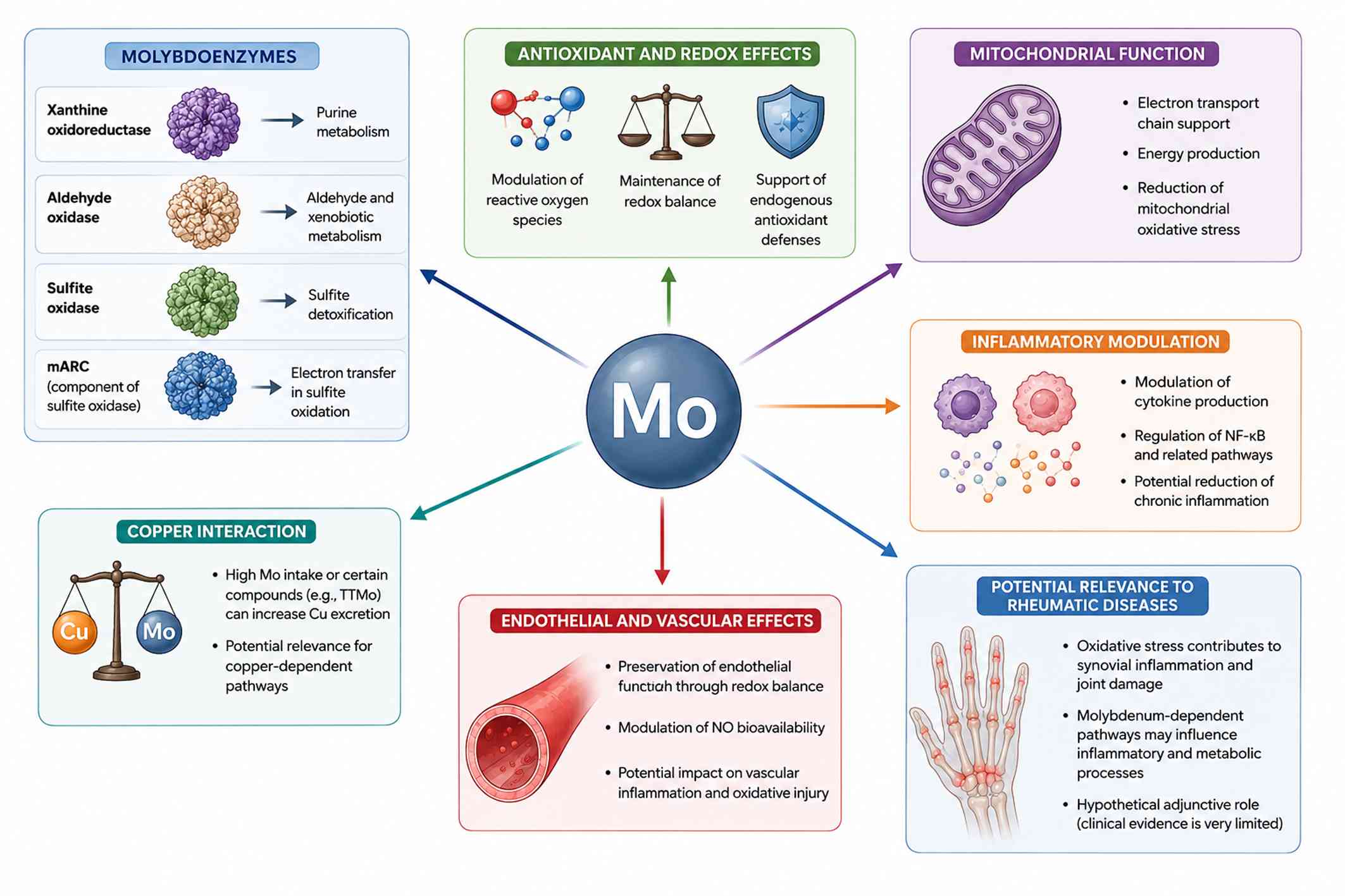 | Figure 1Proposed biological roles of
molybdenum relevant to rheumatic diseases. Molybdenum is an
essential trace element that acts as a cofactor for several
molybdoenzymes involved in purine metabolism, sulfite
detoxification, redox regulation, mitochondrial function, and
endothelial homeostasis. Through these pathways,
molybdenum-dependent enzymes may indirectly influence oxidative
stress, inflammatory signaling, vascular function, and metabolic
processes potentially relevant to rheumatic diseases. However,
despite biochemical plausibility, current clinical evidence
supporting molybdenum supplementation in rheumatology remains
extremely limited. Mo, molybdenum; ROS, reactive oxygen species;
NF-κB, nuclear factor κB; mARC, mitochondrial amidoxime reducing
component; NO, nitric oxide; TTMo, tetrathiomolybdate. |
A more concrete clinical precedent for
molybdenum-based interventions is its interaction with copper
metabolism. Tetrathiomolybdate (and related compounds) plays a
documented role in reducing copper bioavailability, with clinical
use and extensive discussion in Wilson's disease management
(9). Copper control strategies
have also been explored in other settings (including antiangiogenic
concepts in oncology), demonstrating that molybdenum compounds can
have clinically meaningful biological effects, albeit via copper
binding rather than ‘nutritional supplementation’ per se (10). As altered metal homeostasis and
oxidative stress are relevant to rheumatic diseases, findings from
studies evaluating oxidative stress and trace element disturbances
in rheumatoid arthritis have led investigators to speculate that
copper-modulating or redox-related mechanisms could theoretically
intersect with rheumatic pathophysiology (5-7).
However, biochemical plausibility should be
separated from evidence of clinical benefit. Notably, routine
molybdenum intake is usually adequate, and indiscriminate
supplementation could carry theoretical risks, including trace
element imbalances, particularly through copper-related
interactions (2,9). Therefore, any rationale for
supplementation in rheumatology needs to be supported by controlled
human data demonstrating improvements in validated clinical
outcomes or objective inflammatory markers, alongside safety
characterization.
Data and methods
Search strategy
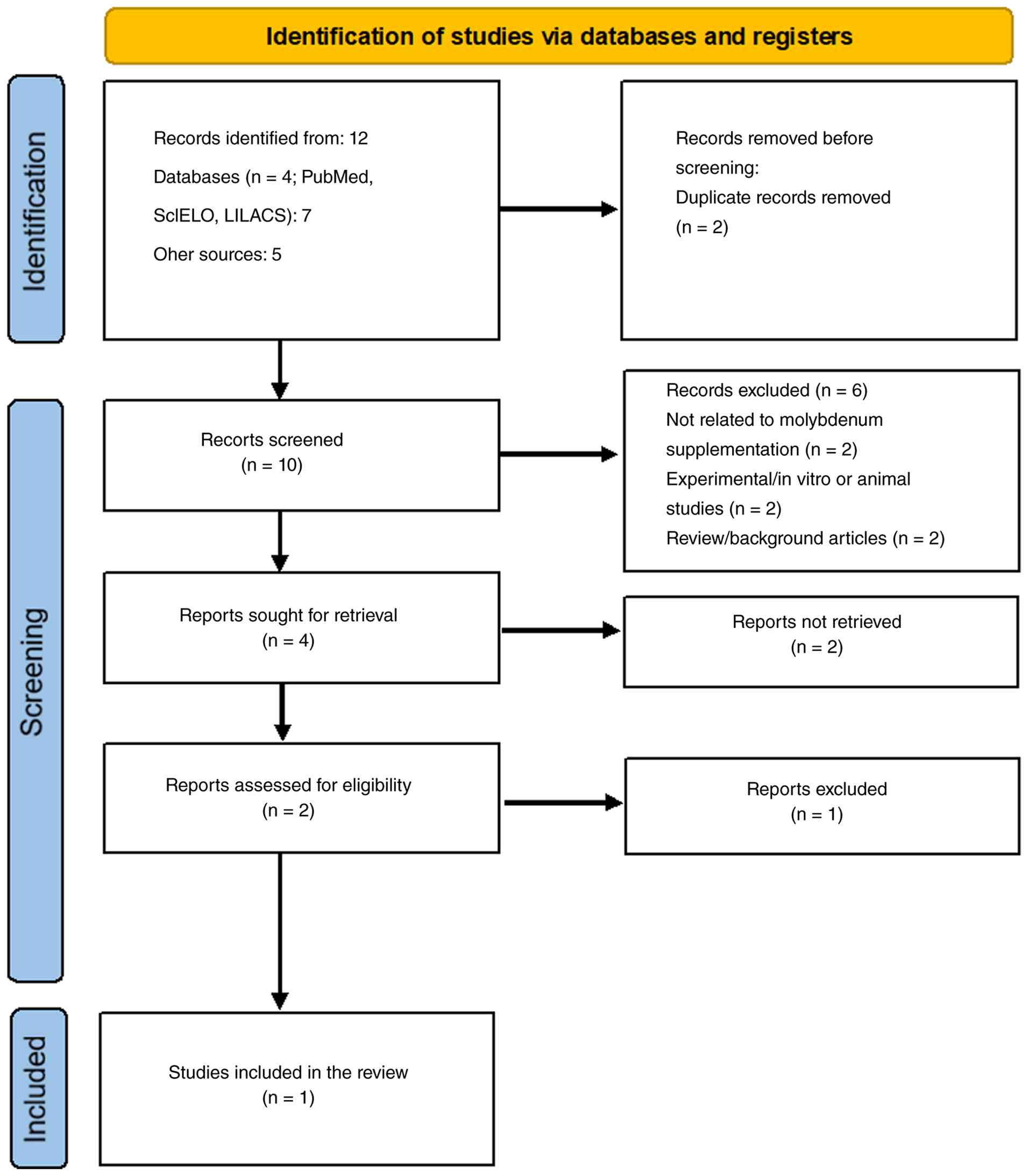
A systematic literature search was conducted on the
PubMed/MEDLINE, SciELO and LILACS databases, covering publications
from 1965 to June, 2024. The search strategy combined controlled
vocabulary terms and free-text keywords using Boolean operators.
The principal search combinations included: (‘molybdenum’ OR ‘trace
elements’) AND (‘arthritis’ OR ‘rheumatoid arthritis’ OR
‘autoimmune diseases’ OR ‘rheumatic diseases’). The reference lists
of relevant articles were also examined to identify additional
clinical studies potentially missed by database indexing. The study
selection process is summarized in Fig. 2.
Eligibility criteria
Eligible studies were original clinical
investigations involving human participants that evaluated
molybdenum supplementation (or molybdenum-containing interventions
presented explicitly as supplementation) in any rheumatic or
autoimmune disease. Review articles, experimental animal studies,
in vitro investigations, case reports, conference abstracts
and non-indexed publications were excluded. No restrictions were
applied regarding language or study design.
Study selection
Duplicate records were manually identified and
removed prior to study screening. Titles and abstracts were
assessed for relevance according to predefined eligibility
criteria, followed by full-text evaluation when appropriate. Given
the anticipated scarcity of clinical trials, the present systematic
review also considered whether molybdenum-related clinical evidence
existed in adjacent immune-inflammatory contexts that could
plausibly inform rheumatology; however, the principal scope
remained supplementation studies in rheumatic and autoimmune
disease populations.
Outcomes of interest
The primary outcomes of interest were validated
measures of pain, disease activity (when applicable), functional
status, patient-reported outcomes, inflammatory biomarkers and
adverse events.
Data synthesis
As only one eligible study was identified, a
meta-analysis could not be performed. Therefore, the results were
summarized using a qualitative descriptive approach.
Results
Study selection
The literature search identified 12 records through
database searching and manual review of reference lists. Following
the removal of duplicates and screening of titles and abstracts,
potentially relevant articles underwent full-text assessment. Only
one study fulfilled the predefined eligibility criteria and was
included in the final review (Fig.
2).
No randomized controlled trials, prospective cohort
studies, or case-control studies specifically evaluating molybdenum
supplementation in rheumatoid arthritis, systemic lupus
erythematosus, spondyloarthritis, vasculitis, or other autoimmune
rheumatic diseases were identified.
Characteristics of included
studies
The only eligible study identified was a pilot
crossover investigation published by Moss in 1995(11). That study enrolled 14 patients with
heterogeneous arthritic conditions who received molybdenum amino
acid chelate supplementation at doses of 200 or 500 µg/day.
That study reported subjective improvements in pain
and general health following supplementation. However, several
critical methodological limitations were identified. The patient
population included mixed arthritic diagnoses without standardized
disease classification, validated outcome measures were not
employed, objective inflammatory biomarkers were not assessed, and
methodological details regarding crossover procedures,
randomization, and statistical analyses were incompletely reported
(11).
In addition, the small sample size and short
treatment duration limited the ability to evaluate efficacy and
safety outcomes reliably. The principal characteristics, findings
and methodological limitations of the included study are summarized
in Table I.
 | Table IAvailable clinical evidence evaluating
molybdenum supplementation in arthritis-related conditions. |
Table I
Available clinical evidence evaluating
molybdenum supplementation in arthritis-related conditions.
| Author, year of
publication |
Population/disease | Sample size | Intervention | Main findings | Major
limitations | (Refs.) |
|---|
| Moss, 1995 | Heterogeneous
arthritis conditions | 14 patients | Molybdenum amino acid
chelate supplementation (200 or 500 µg/day) in a crossover pilot
design | Subjective
improvements in pain and general health were reported by some
participants | Very small sample
size; heterogeneous diagnoses; absence of standardized
rheumatologic classification criteria; lack of validated outcome
instruments; no objective inflammatory biomarkers; limited
methodological transparency regarding randomization and statistical
analysis; short follow-up duration; insufficient safety
evaluation | (11) |
Summary of available evidence
The currently available evidence should not be
interpreted as demonstrating either efficacy or lack of efficacy of
molybdenum supplementation in rheumatic diseases. Rather, it
reflects the remarkable scarcity of adequately designed clinical
investigations in this field.
The available data are insufficient to determine
whether molybdenum supplementation exerts clinically meaningful
effects on pain, disease activity, functional outcomes,
inflammatory biomarkers, or other clinically relevant endpoints in
rheumatic diseases. Furthermore, the heterogeneity of the arthritic
conditions included in the only available study substantially
limits disease-specific interpretation, since pathogenic
mechanisms, clinical manifestations, and treatment responses differ
considerably among rheumatic disorders.
No replication studies, confirmatory trials,
long-term follow-up investigations, or formal safety evaluations in
rheumatic populations were identified. Consequently, the current
clinical evidence base remains limited to a single small pilot
study with substantial methodological limitations, precluding
evidence-based recommendations regarding routine molybdenum
supplementation in rheumatology.
Discussion
The present systematic review highlights a clear
mismatch between biochemical plausibility and clinical evidence for
molybdenum supplementation in rheumatology. Molybdenum is
indisputably essential for human physiology through its
molybdoenzyme cofactor role, with well-described functions in redox
metabolism, detoxification processes, and mitochondrial-related
pathways (3,4). These domains are mechanistically
relevant to chronic inflammatory diseases, including RA, where
oxidative stress, redox dysregulation, immunometabolic alterations,
and metabolic-inflammatory coupling are increasingly recognized as
important contributors (5,6). Nonetheless, the existence of relevant
pathways does not establish that increasing molybdenum exposure
confers benefit, particularly in populations where intake is
already sufficient.
A central issue is that supplementation hypotheses
often assume deficiency or functional insufficiency. Yet, dietary
surveys and nutritional guidance suggest that average molybdenum
intake in a number of settings exceeds recommended intakes, and
frank deficiency is rare (1,2). In
such a context, ‘more’ is not necessarily better; supplementation
may merely increase exposure without addressing a biologically
relevant deficiency. From a clinical standpoint, an intervention is
most plausible when there is evidence that: i) Baseline levels are
low or functionally inadequate in the target population; ii)
repletion changes a relevant biological marker; and iii) such
changes translate into improved clinical outcomes. None of these
steps has been convincingly demonstrated for molybdenum in
rheumatic diseases.
The contrast with other trace elements is
instructive. Zinc and selenium have been discussed in RA and other
inflammatory conditions, with studies reporting associations
between serum levels and disease activity or oxidative stress
parameters, and with some clinical attention to inadequate intake
patterns in chronic disease populations (5-7).
While that literature is not uniformly definitive, it provides a
framework for how micronutrient hypotheses can be explored and
tested. While the literature regarding zinc and selenium status in
rheumatoid arthritis and other inflammatory conditions is not
uniformly definitive (5-7),
it provides a framework for how micronutrient hypotheses can be
explored and tested. This relative lack of research attention may
also reflect the rarity of clinically significant molybdenum
deficiency compared with other trace elements more frequently
implicated in inflammatory and nutritional disorders.
The single pilot study from 1995 reporting
subjective improvements needs to be interpreted cautiously
(11). Subjective symptom changes
can occur due to regression to the mean, placebo effects, natural
disease fluctuation, concurrent treatment changes and measurement
artifacts. Potential placebo and expectancy effects should also be
considered, particularly given the subjective nature of pain
assessment and the absence of validated outcome measures. Without
standardized diagnostic criteria, validated instruments (e.g.,
visual analog scale) anchored to protocol timing, functional
indices) and transparent statistical reporting, it is impossible to
determine whether the observed improvements reflect a true
treatment effect or nonspecific factors (11). Additionally, heterogeneous
‘arthritis’ populations dilute interpretability: Mechanisms and
symptom dynamics differ substantially among RA, osteoarthritis,
crystalline arthropathies and spondyloarthritis; pooling such
conditions obscures disease-specific effects and creates
confounding.
Safety and biological trade-offs also warrant
emphasis. Molybdenum can interact with copper homeostasis,
particularly at higher exposures or in pharmacological formulations
such as tetrathiomolybdate (9).
Although the modulation of copper metabolism may be therapeutically
useful in specific conditions, such as Wilson's disease,
extrapolation of these mechanisms to routine rheumatology
supplementation strategies remains speculative. While nutritional
molybdenum doses are generally considered safe within recommended
upper limits, safety cannot be assumed in all contexts, especially
when supplement formulations vary, doses may exceed dietary norms,
or patients take multiple micronutrients simultaneously (2,9).
Moreover, rheumatology patients frequently have comorbidities
(e.g., renal disease, cardiovascular risk, anemia) and
polypharmacy, factors that can modify trace element handling and
risk-benefit balance.
Notably, the current absence of robust clinical
evidence should not be interpreted as a definitive evidence of lack
of efficacy. Rather, the available literature is insufficient in
quantity and methodological quality to support reliable conclusions
regarding therapeutic benefit, absence of benefit, or long-term
safety. Accordingly, current evidence remains inadequate to support
routine molybdenum supplementation in rheumatic diseases.
From a research standpoint, the appropriate
following steps could include: i) Observational studies assessing
molybdenum status (dietary intake and, where feasible, biomarkers)
in well-defined rheumatic cohorts; ii) mechanistic studies
evaluating whether the molybdenum status correlates with redox
markers, inflammatory pathways, endothelial measures, or
mitochondrial function relevant to rheumatic disease activity; and
iii) only after compelling signals, randomized trials using
standardized outcomes (e.g., pain scales, disease activity indices
where appropriate, functional outcomes and biomarkers), with
careful safety monitoring and consideration of copper status
(1-4,9).
Until such data exist, any clinical use would remain
speculative.
Recent advances in rheumatology research have
further reinforced the importance of oxidative stress, redox
dysregulation and immunometabolic alterations in the pathogenesis
of autoimmune and inflammatory rheumatic diseases. Emerging
evidence suggests that the metabolic reprogramming of immune cells,
mitochondrial dysfunction and reactive oxygen species generation
contribute to chronic inflammation, tissue damage and disease
progression in rheumatoid arthritis, and related disorders.
Furthermore, growing interest in nutritional and
micronutrient-based interventions reflects the recognition that
trace elements and metabolic pathways may influence inflammatory
responses and immune homeostasis. Although no direct evidence
currently supports a therapeutic role for molybdenum
supplementation, these developments provide a contemporary
biological framework for future investigations exploring potential
links between molybdenum-dependent pathways and rheumatic disease
mechanisms (12-15).
In conclusion, at present, there is no robust
clinical evidence available supporting molybdenum supplementation
in rheumatic diseases. Although molybdenum-dependent enzymes
participate in pathways relevant to oxidative metabolism and redox
biology, these mechanisms have not yet translated into demonstrable
clinical benefit in autoimmune or inflammatory rheumatic conditions
(3,4,11).
Current evidence remains insufficient to support
routine molybdenum supplementation in rheumatic diseases,
particularly considering the scarcity of adequately designed
clinical studies and the generally sufficient dietary intake
observed in most populations.
Potential interactions with copper homeostasis and
the absence of long-term safety data further support a cautious
interpretation of the currently available evidence (1,2,9).
Future studies are warranted to prioritize
well-designed observational, mechanistic and translational
investigations in carefully characterized rheumatic cohorts to
determine whether molybdenum status is clinically relevant and
potentially modifiable in ways that influence validated clinical
outcomes. At present, molybdenum supplementation should be
considered investigational in rheumatic diseases and cannot be
recommended for routine clinical use outside research settings.
Acknowledgements
Not applicable.
Funding
Funding: No funding was received.
Availability of data and materials
The data generated in the present study may be
requested from the corresponding author.
Author's contributions
JFDC contributed to the conceptualization of the
study, to the study methodology, investigation, data curation,
writing of the original draft, the critical revision of the
manuscript, and supervision. JFDC confirms the authenticity of all
the raw data. The author has read and approved the final
manuscript.
Ethics approval and consent to
participate
Not applicable.
Patient consent for publication
Not applicable.
Competing interests
The author declares that he has no competing
interests.
References
|
1
|
Institute of Medicine (US): Dietary
Reference Intakes for Vitamin A, Vitamin K, Arsenic, Boron,
Chromium, Copper, Iodine, Iron, Manganese, Molybdenum, Nickel,
Silicon, Vanadium, and Zinc. National Academies Press, Washington,
DC, 2001.
|
|
2
|
NIH Office of Dietary Supplements.
Molybdenum Fact Sheet for Health Professionals. Updated 2023.
https://ods.od.nih.gov/factsheets/Molybdenum-HealthProfessional/.
Accessed......
|
|
3
|
Hille R, Nishino T and Bittner F:
Molybdenum enzymes in higher organisms. Coord Chem Rev.
255:1179–1205. 2011.PubMed/NCBI View Article : Google Scholar
|
|
4
|
Schwarz G and Mendel RR: Molybdenum
cofactor biosynthesis and molybdenum enzymes. Annu Rev Plant Biol.
57:623–647. 2006.PubMed/NCBI View Article : Google Scholar
|
|
5
|
Zoli A, Altomonte L, Caricchio R, Galossi
A, Mirone L, Ruffini MP and Magaró M: Serum zinc and copper in
active rheumatoid arthritis: correlation with interleukin 1 beta
and tumour necrosis factor alpha. Clin Rheumatol. 17:378–382.
1998.PubMed/NCBI View Article : Google Scholar
|
|
6
|
Tarp U, Overvad K, Hansen JC and Thorling
EB: Low selenium level in severe rheumatoid arthritis. Scand J
Rheumatol. 14:97–101. 1985.PubMed/NCBI View Article : Google Scholar
|
|
7
|
Stone J, Doube A, Dudson D and Wallace J:
Inadequate calcium, folic acid, vitamin E, zinc, and selenium
intake in rheumatoid arthritis patients: results of a dietary
survey. Semin Arthritis Rheum. 27:180–185. 1997.PubMed/NCBI View Article : Google Scholar
|
|
8
|
Pacher P, Nivorozhkin A and Szabó C:
Therapeutic effects of xanthine oxidase inhibitors: Renaissance
half a century after the discovery of allopurinol. Pharmacol Rev.
58:87–114. 2006.PubMed/NCBI View Article : Google Scholar
|
|
9
|
Brewer GJ: Tetrathiomolybdate anticopper
therapy for Wilson's disease inhibits angiogenesis, fibrosis and
inflammation. J Cell Mol Med. 7:11–20. 2003.PubMed/NCBI View Article : Google Scholar
|
|
10
|
Brewer GJ: Copper control as an
antiangiogenic anticancer therapy: Lessons from treating Wilson's
disease. Exp Biol Med (Maywood). 226:665–673. 2001.PubMed/NCBI View Article : Google Scholar
|
|
11
|
Moss M: Effects of molybdenum on pain and
general health: A pilot study. J Nutr Environ Med. 5:55–61.
1995.
|
|
12
|
Laniak OT, Winans T, Patel A, Park J and
Perl A: Redox pathogenesis in rheumatic diseases. ACR Open
Rheumatol. 6:334–346. 2024.PubMed/NCBI View Article : Google Scholar
|
|
13
|
Zamudio-Cuevas Y, Martínez-Flores K,
Martínez-Nava GA, Clavijo-Cornejo D, Fernández-Torres J and
Sánchez-Sánchez R: Rheumatoid Arthritis and Oxidative Stress. Cell
Mol Biol (Noisy-le-grand). 68:174–184. 2022.PubMed/NCBI View Article : Google Scholar
|
|
14
|
Islam MT, Sarkar C, Hossain R, Bhuia MS,
Mardare I, Kulbayeva M, Ydyrys A, Calina D, Habtemariam S,
Kieliszek M, et al: Therapeutic strategies for rheumatic diseases
and disorders: Targeting redox imbalance and oxidative stress.
Biomed Pharmacother. 164(114900)2023.PubMed/NCBI View Article : Google Scholar
|
|
15
|
Liu X, Wang J, Lou T, Tang Q, Fang Z,
Zhang W and Hu Y: Immunometabolism in rheumatoid arthritis:
mechanisms, biomarkers, and the path to precision medicine. Front
Immunol. 17(1691946)2026.PubMed/NCBI View Article : Google Scholar
|