Spandidos Publications Logo
  • About
    • About Spandidos
    • Aims and Scopes
    • Abstracting and Indexing
    • Editorial Policies
    • Reprints and Permissions
    • Job Opportunities
    • Terms and Conditions
    • Contact
  • Journals
    • All Journals
    • Oncology Letters
      • Oncology Letters
      • Information for Authors
      • Editorial Policies
      • Editorial Board
      • Aims and Scope
      • Abstracting and Indexing
      • Bibliographic Information
      • Archive
    • International Journal of Oncology
      • International Journal of Oncology
      • Information for Authors
      • Editorial Policies
      • Editorial Board
      • Aims and Scope
      • Abstracting and Indexing
      • Bibliographic Information
      • Archive
    • Molecular and Clinical Oncology
      • Molecular and Clinical Oncology
      • Information for Authors
      • Editorial Policies
      • Editorial Board
      • Aims and Scope
      • Abstracting and Indexing
      • Bibliographic Information
      • Archive
    • Experimental and Therapeutic Medicine
      • Experimental and Therapeutic Medicine
      • Information for Authors
      • Editorial Policies
      • Editorial Board
      • Aims and Scope
      • Abstracting and Indexing
      • Bibliographic Information
      • Archive
    • International Journal of Molecular Medicine
      • International Journal of Molecular Medicine
      • Information for Authors
      • Editorial Policies
      • Editorial Board
      • Aims and Scope
      • Abstracting and Indexing
      • Bibliographic Information
      • Archive
    • Biomedical Reports
      • Biomedical Reports
      • Information for Authors
      • Editorial Policies
      • Editorial Board
      • Aims and Scope
      • Abstracting and Indexing
      • Bibliographic Information
      • Archive
    • Oncology Reports
      • Oncology Reports
      • Information for Authors
      • Editorial Policies
      • Editorial Board
      • Aims and Scope
      • Abstracting and Indexing
      • Bibliographic Information
      • Archive
    • Molecular Medicine Reports
      • Molecular Medicine Reports
      • Information for Authors
      • Editorial Policies
      • Editorial Board
      • Aims and Scope
      • Abstracting and Indexing
      • Bibliographic Information
      • Archive
    • World Academy of Sciences Journal
      • World Academy of Sciences Journal
      • Information for Authors
      • Editorial Policies
      • Editorial Board
      • Aims and Scope
      • Abstracting and Indexing
      • Bibliographic Information
      • Archive
    • International Journal of Functional Nutrition
      • International Journal of Functional Nutrition
      • Information for Authors
      • Editorial Policies
      • Editorial Board
      • Aims and Scope
      • Abstracting and Indexing
      • Bibliographic Information
      • Archive
    • International Journal of Epigenetics
      • International Journal of Epigenetics
      • Information for Authors
      • Editorial Policies
      • Editorial Board
      • Aims and Scope
      • Abstracting and Indexing
      • Bibliographic Information
      • Archive
    • Medicine International
      • Medicine International
      • Information for Authors
      • Editorial Policies
      • Editorial Board
      • Aims and Scope
      • Abstracting and Indexing
      • Bibliographic Information
      • Archive
  • Articles
  • Information
    • Information for Authors
    • Information for Reviewers
    • Information for Librarians
    • Information for Advertisers
    • Conferences
  • Language Editing
Spandidos Publications Logo
  • About
    • About Spandidos
    • Aims and Scopes
    • Abstracting and Indexing
    • Editorial Policies
    • Reprints and Permissions
    • Job Opportunities
    • Terms and Conditions
    • Contact
  • Journals
    • All Journals
    • Biomedical Reports
      • Information for Authors
      • Editorial Policies
      • Editorial Board
      • Aims and Scope
      • Abstracting and Indexing
      • Bibliographic Information
      • Archive
    • Experimental and Therapeutic Medicine
      • Information for Authors
      • Editorial Policies
      • Editorial Board
      • Aims and Scope
      • Abstracting and Indexing
      • Bibliographic Information
      • Archive
    • International Journal of Epigenetics
      • Information for Authors
      • Editorial Policies
      • Editorial Board
      • Aims and Scope
      • Abstracting and Indexing
      • Bibliographic Information
      • Archive
    • International Journal of Functional Nutrition
      • Information for Authors
      • Editorial Policies
      • Editorial Board
      • Aims and Scope
      • Abstracting and Indexing
      • Bibliographic Information
      • Archive
    • International Journal of Molecular Medicine
      • Information for Authors
      • Editorial Policies
      • Editorial Board
      • Aims and Scope
      • Abstracting and Indexing
      • Bibliographic Information
      • Archive
    • International Journal of Oncology
      • Information for Authors
      • Editorial Policies
      • Editorial Board
      • Aims and Scope
      • Abstracting and Indexing
      • Bibliographic Information
      • Archive
    • Medicine International
      • Information for Authors
      • Editorial Policies
      • Editorial Board
      • Aims and Scope
      • Abstracting and Indexing
      • Bibliographic Information
      • Archive
    • Molecular and Clinical Oncology
      • Information for Authors
      • Editorial Policies
      • Editorial Board
      • Aims and Scope
      • Abstracting and Indexing
      • Bibliographic Information
      • Archive
    • Molecular Medicine Reports
      • Information for Authors
      • Editorial Policies
      • Editorial Board
      • Aims and Scope
      • Abstracting and Indexing
      • Bibliographic Information
      • Archive
    • Oncology Letters
      • Information for Authors
      • Editorial Policies
      • Editorial Board
      • Aims and Scope
      • Abstracting and Indexing
      • Bibliographic Information
      • Archive
    • Oncology Reports
      • Information for Authors
      • Editorial Policies
      • Editorial Board
      • Aims and Scope
      • Abstracting and Indexing
      • Bibliographic Information
      • Archive
    • World Academy of Sciences Journal
      • Information for Authors
      • Editorial Policies
      • Editorial Board
      • Aims and Scope
      • Abstracting and Indexing
      • Bibliographic Information
      • Archive
  • Articles
  • Information
    • For Authors
    • For Reviewers
    • For Librarians
    • For Advertisers
    • Conferences
  • Language Editing
Login Register Submit
  • This site uses cookies
  • You can change your cookie settings at any time by following the instructions in our Cookie Policy. To find out more, you may read our Privacy Policy.

    I agree
Search articles by DOI, keyword, author or affiliation
Search
Advanced Search
presentation
International Journal of Molecular Medicine
Join Editorial Board Propose a Special Issue
Print ISSN: 1107-3756 Online ISSN: 1791-244X
Journal Cover
August 2013 Volume 32 Issue 2

Full Size Image

Sign up for eToc alerts
Recommend to Library

Journals

International Journal of Molecular Medicine

International Journal of Molecular Medicine

International Journal of Molecular Medicine is an international journal devoted to molecular mechanisms of human disease.

International Journal of Oncology

International Journal of Oncology

International Journal of Oncology is an international journal devoted to oncology research and cancer treatment.

Molecular Medicine Reports

Molecular Medicine Reports

Covers molecular medicine topics such as pharmacology, pathology, genetics, neuroscience, infectious diseases, molecular cardiology, and molecular surgery.

Oncology Reports

Oncology Reports

Oncology Reports is an international journal devoted to fundamental and applied research in Oncology.

Experimental and Therapeutic Medicine

Experimental and Therapeutic Medicine

Experimental and Therapeutic Medicine is an international journal devoted to laboratory and clinical medicine.

Oncology Letters

Oncology Letters

Oncology Letters is an international journal devoted to Experimental and Clinical Oncology.

Biomedical Reports

Biomedical Reports

Explores a wide range of biological and medical fields, including pharmacology, genetics, microbiology, neuroscience, and molecular cardiology.

Molecular and Clinical Oncology

Molecular and Clinical Oncology

International journal addressing all aspects of oncology research, from tumorigenesis and oncogenes to chemotherapy and metastasis.

World Academy of Sciences Journal

World Academy of Sciences Journal

Multidisciplinary open-access journal spanning biochemistry, genetics, neuroscience, environmental health, and synthetic biology.

International Journal of Functional Nutrition

International Journal of Functional Nutrition

Open-access journal combining biochemistry, pharmacology, immunology, and genetics to advance health through functional nutrition.

International Journal of Epigenetics

International Journal of Epigenetics

Publishes open-access research on using epigenetics to advance understanding and treatment of human disease.

Medicine International

Medicine International

An International Open Access Journal Devoted to General Medicine.

Journal Cover
August 2013 Volume 32 Issue 2

Full Size Image

Sign up for eToc alerts
Recommend to Library

  • Article
  • Citations
    • Cite This Article
    • Download Citation
    • Create Citation Alert
    • Remove Citation Alert
    • Cited By
  • Similar Articles
    • Related Articles (in Spandidos Publications)
    • Similar Articles (Google Scholar)
    • Similar Articles (PubMed)
  • Download PDF
  • Download XML
  • View XML
Article

Hypoxia enhances the induction of human amniotic mesenchymal side population cells into vascular endothelial lineage

  • Authors:
    • Naoko Maruyama
    • Kenichi Kokubo
    • Toshihiro Shinbo
    • Minoru Hirose
    • Mamoru Kobayashi
    • Norio Sakuragawa
    • Hirosuke Kobayashi
  • View Affiliations / Copyright

    Affiliations: Graduate School of Medical Sciences, Kitasato University, Sagamihara, Japan, School of Allied Health Sciences, Kitasato University, Sagamihara, Japan
  • Pages: 315-322
    |
    Published online on: June 10, 2013
       https://doi.org/10.3892/ijmm.2013.1412
  • Expand metrics +
Metrics: Total Views: 0 (Spandidos Publications: | PMC Statistics: )
Metrics: Total PDF Downloads: 0 (Spandidos Publications: | PMC Statistics: )
Cited By (CrossRef): 0 citations Loading Articles...

This article is mentioned in:


Abstract

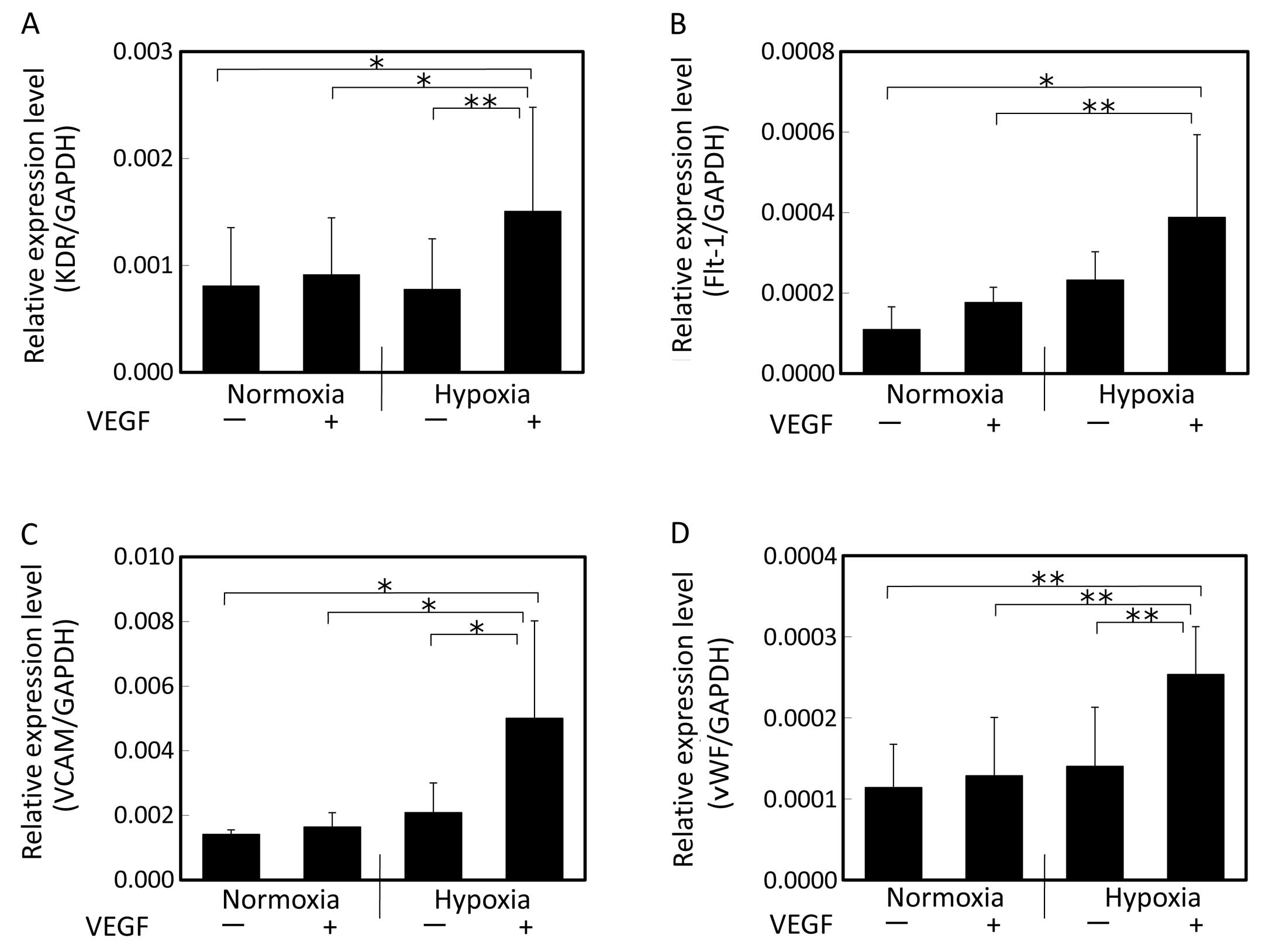
Human amniotic mesenchymal side population (hAM-SP) cells have pluripotency and weak immunogenicity, and have promising roles in the field GAPDH of regenerative medicine. The aim of the present study was to determine whether hypoxic conditions induce the differentiation of hAM-SP cells into the vascular endothelial lineage. Mesenchymal cells were isolated from enzyme-treated amniotic membranes and stained with Hoechst 33342. The hAM-SP cells were negatively sorted by FACS and cultured in induction medium containing vascular endothelial growth factor (VEGF) under normoxic (20% O2) or hypoxic (1% O2) conditions for 1 or 2 weeks. The expression of endothelial markers such as kinase domain region (KDR), fms-like tyrosine kinase (Flt)-1, von Willebrand factor (vWF), vascular endothelial (VE)-cadherin and human vascular cell adhesion molecule (VCAM) at the gene and protein level was evaluated by real-time PCR and fluorescent immunostaining, respectively. The gene expression of KDR, Flt-1, VE-cadherin and vWF peaked after 2 weeks of culture. The protein expression of KDR and VE-cadherin was also enhanced after 2 weeks of culture under hypoxic conditions. To confirm the involvement of hypoxia-inducible factor (HIF) in the induction under hypoxic conditions, the expression of genes which are known to be upregulated by HIF was analyzed by DNA microarray. The expression of these genes increased under hypoxic conditions. hAM-SP cells cultured under hypoxic conditions differentiated into the vascular endothelial lineage, probably due to upregulation of the gene expression associated with angiogenesis through activation of the HIF system.
View Figures

Figure 1

Figure 2

Figure 3

Figure 4

View References

1 

Sakuragawa N, Yoshikawa H and Sasaki M: Amniotic tissue transplantation: clinical and biochemical evaluations for some lysosomal storage diseases. Brain Dev. 14:7–11. 1992. View Article : Google Scholar : PubMed/NCBI

2 

Wolbank S, Peterbauer A, Fahrner M, et al: Dose-dependent immunomodulatory effect of human stem cells from amniotic membrane: a comparison with human mesenchymal stem cells from adipose tissue. Tissue Eng. 13:1173–1183. 2007. View Article : Google Scholar : PubMed/NCBI

3 

Hori J, Wang M, Kamiya K, Takahashi H and Sakuragawa N: Immunological characteristics of amniotic epithelium. Cornea. 25(Suppl 1): S53–S58. 2006. View Article : Google Scholar : PubMed/NCBI

4 

Lefebvre S, Adrian F, Moreau P, et al: Modulation of HLA-G expression in human thymic and amniotic epithelial cells. Hum Immunol. 61:1095–1101. 2000. View Article : Google Scholar : PubMed/NCBI

5 

Sakuragawa N, Kakinuma K, Kikuchi A, et al: Human amnion mesenchyme cells express phenotypes of neuroglial progenitor cells. J Neurosci Res. 78:208–214. 2004. View Article : Google Scholar : PubMed/NCBI

6 

Konig JM, Huppertz B, Desoye G, et al: Amnion-derived mesenchymal stromal cells show angiogenic properties but resist differentiation into mature endothelial cells. Stem Cells Dev. 21:1309–1320. 2012. View Article : Google Scholar

7 

Alviano F, Fossati V, Marchionni C, et al: Term amniotic membrane is a high throughput source for multipotent mesenchymal stem cells with the ability to differentiate into endothelial cells in vitro. BMC Dev Biol. 7:112007.PubMed/NCBI

8 

Zhang P, Baxter J, Vinod K, Tulenko TN and Di Muzio PJ: Endothelial differentiation of amniotic fluid-derived stem cells: synergism of biochemical and shear force stimuli. Stem Cells Dev. 18:1299–1308. 2009. View Article : Google Scholar : PubMed/NCBI

9 

Ashton N, Ward B and Serpell G: Effect of oxygen on developing retinal vessels with particular reference to the problem of retrolental fibroplasia. Br J Ophthalmol. 38:397–432. 1954. View Article : Google Scholar : PubMed/NCBI

10 

Knighton DR, Silver IA and Hunt TK: Regulation of wound-healing angiogenesis-effect of oxygen gradients and inspired oxygen concentration. Surgery. 90:262–270. 1981.PubMed/NCBI

11 

Knighton DR, Hunt TK, Scheuenstuhl H, Halliday BJ, Werb Z and Banda MJ: Oxygen tension regulates the expression of angiogenesis factor by macrophages. Science. 221:1283–1285. 1983. View Article : Google Scholar : PubMed/NCBI

12 

Thomlinson RH and Gray LH: The histological structure of some human lung cancers and the possible implications for radiotherapy. Br J Cancer. 9:539–549. 1955. View Article : Google Scholar : PubMed/NCBI

13 

Folkman J, Merler E, Abernathy C and Williams G: Isolation of a tumor factor responsible for angiogenesis. J Exp Med. 133:275–288. 1971. View Article : Google Scholar : PubMed/NCBI

14 

Liu Y, Cox SR, Morita T and Kourembanas S: Hypoxia regulates vascular endothelial growth factor gene expression in endothelial cells. Identification of a 5′ enhancer. Circ Res. 77:638–643. 1995.

15 

Forsythe JA, Jiang BH, Iyer NV, et al: Activation of vascular endothelial growth factor gene transcription by hypoxia-inducible factor 1. Mol Cell Biol. 16:4604–4613. 1996.PubMed/NCBI

16 

Gerber HP, Condorelli F, Park J and Ferrara N: Differential transcriptional regulation of the two vascular endothelial growth factor receptor genes. Flt-1, but not Flk-1/KDR, is up-regulated by hypoxia. J Biol Chem. 272:23659–23667. 1997. View Article : Google Scholar

17 

Waltenberger J, Mayr U, Pentz S and Hombach V: Functional upregulation of the vascular endothelial growth factor receptor KDR by hypoxia. Circulation. 94:1647–1654. 1996. View Article : Google Scholar : PubMed/NCBI

18 

Goodell MA, Rosenzweig M, Kim H, et al: Dye efflux studies suggest that hematopoietic stem cells expressing low or undetectable levels of CD34 antigen exist in multiple species. Nat Med. 3:1337–1345. 1997. View Article : Google Scholar

19 

Welm BE, Tepera SB, Venezia T, Graubert TA, Rosen JM and Goodell MA: Sca-1(pos) cells in the mouse mammary gland represent an enriched progenitor cell population. Dev Biol. 245:42–56. 2002. View Article : Google Scholar : PubMed/NCBI

20 

Wulf GG, Luo KL, Jackson KA, Brenner MK and Goodell MA: Cells of the hepatic side population contribute to liver regeneration and can be replenished with bone marrow stem cells. Haematologica. 88:368–378. 2003.PubMed/NCBI

21 

Uchida N, Fujisaki T, Eaves AC and Eaves CJ: Transplantable hematopoietic stem cells in human fetal liver have a CD34(+) side population (SP)phenotype. J Clin Invest. 108:1071–1077. 2001.

22 

Gussoni E, Soneoka Y, Strickland CD, et al: Dystrophin expression in the mdx mouse restored by stem cell transplantation. Nature. 401:390–394. 1999. View Article : Google Scholar : PubMed/NCBI

23 

Kobayashi M, Yakuwa T, Sasaki K, et al: Multilineage potential of side population cells from human amnion mesenchymal layer. Cell Transplant. 17:291–301. 2008. View Article : Google Scholar : PubMed/NCBI

24 

Yamaguchi TP, Dumont DJ, Conlon RA, Breitman ML and Rossant J: flk-1, an flt-related receptor tyrosine kinase is an early marker for endothelial cell precursors. Development. 118:489–498. 1993.PubMed/NCBI

25 

Shibuya M, Seetharam L, Ishii Y, et al: Possible involvement of VEGF-FLT tyrosine kinase receptor system in normal and tumor angiogenesis. Princess Takamatsu Symp. 24:162–170. 1994.PubMed/NCBI

26 

Lobb R, Chi-Rosso G, Leone D, et al: Expression and functional characterization of a soluble form of vascular cell adhesion molecule 1. Biochem Biophys Res Commun. 178:1498–1504. 1991. View Article : Google Scholar : PubMed/NCBI

27 

Jones TR, Kao KJ, Pizzo SV and Bigner DD: Endothelial cell surface expression and binding of factor VIII/von Willebrand factor. Am J Pathol. 103:304–308. 1981.PubMed/NCBI

28 

Lampugnani MG, Resnati M, Raiteri M, et al: A novel endothelial-specific membrane protein is a marker of cell-cell contacts. J Cell Biol. 118:1511–1522. 1992. View Article : Google Scholar : PubMed/NCBI

29 

Nichols J, Zevnik B, Anastassiadis K, et al: Formation of pluripotent stem cells in the mammalian embryo depends on the POU transcription factor Oct4. Cell. 95:379–391. 1998. View Article : Google Scholar : PubMed/NCBI

30 

Niwa H, Miyazaki J and Smith AG: Quantitative expression of Oct-3/4 defines differentiation, dedifferentiation or self-renewal of ES cells. Nat Genet. 24:372–376. 2000. View Article : Google Scholar : PubMed/NCBI

31 

Imamura M, Miura K, Iwabuchi K, et al: Transcriptional repression and DNA hypermethylation of a small set of ES cell marker genes in male germline stem cells. BMC Dev Biol. 6:342006. View Article : Google Scholar : PubMed/NCBI

32 

Chambers I, Colby D, Robertson M, et al: Functional expression cloning of Nanog, a pluripotency sustaining factor in embryonic stem cells. Cell. 113:643–655. 2003. View Article : Google Scholar : PubMed/NCBI

33 

Mitsui K, Tokuzawa Y, Itoh H, et al: The homeoprotein Nanog is required for maintenance of pluripotency in mouse epiblast and ES cells. Cell. 113:631–642. 2003. View Article : Google Scholar : PubMed/NCBI

34 

Levine AJ and Brivanlou AH: GDF3, a BMP inhibitor, regulates cell fate in stem cells and early embryos. Development. 133:209–216. 2006. View Article : Google Scholar : PubMed/NCBI

35 

Li Y, McClintick J, Zhong L, Edenberg HJ, Yoder MC and Chan RJ: Murine embryonic stem cell differentiation is promoted by SOCS-3 and inhibited by the zinc finger transcription factor Klf4. Blood. 105:635–637. 2005. View Article : Google Scholar : PubMed/NCBI

36 

Cartwright P, McLean C, Sheppard A, Rivett D, Jones K and Dalton S: LIF/STAT3 controls ES cell self-renewal and pluripotency by a Myc-dependent mechanism. Development. 132:885–896. 2005. View Article : Google Scholar : PubMed/NCBI

37 

Avilion AA, Nicolis SK, Pevny LH, Perez L, Vivian N and Lovell-Badge R: Multipotent cell lineages in early mouse development depend on SOX2 function. Genes Dev. 17:126–140. 2003. View Article : Google Scholar : PubMed/NCBI

38 

Ben-Shushan E, Thompson JR, Gudas LJ and Bergman Y: Rex-1, a gene encoding a transcription factor expressed in the early embryo, is regulated via Oct-3/4 and Oct-6 binding to an octamer site and a novel protein, Rox-1, binding to an adjacent site. Mol Cell Biol. 18:1866–1878. 1998.PubMed/NCBI

39 

Yuan H, Corbi N, Basilico C and Dailey L: Developmental-specific activity of the FGF-4 enhancer requires the synergistic action of Sox2 and Oct-3. Genes Dev. 9:2635–2645. 1995. View Article : Google Scholar : PubMed/NCBI

40 

Yang C, Przyborski S, Cooke MJ, et al: A key role for telomerase reverse transcriptase unit in modulating human embryonic stem cell proliferation, cell cycle dynamics, and in vitro differentiation. Stem Cells. 26:850–863. 2008. View Article : Google Scholar : PubMed/NCBI

41 

Park D, Xiang AP, Mao FF, et al: Nestin is required for the proper self-renewal of neural stem cells. Stem Cells. 28:2162–2171. 2010. View Article : Google Scholar : PubMed/NCBI

42 

Kaneko Y, Sakakibara S, Imai T, et al: Musashi1: an evolutio- nally conserved marker for CNS progenitor cells including neural stem cells. Dev Neurosci. 22:139–153. 2000. View Article : Google Scholar : PubMed/NCBI

43 

Wang GL and Semenza GL: Characterization of hypoxia-inducible factor 1 and regulation of DNA binding activity by hypoxia. J Biol Chem. 268:21513–21518. 1993.PubMed/NCBI

44 

Semenza GL, Roth PH, Fang HM and Wang GL: Transcriptional regulation of genes encoding glycolytic enzymes by hypoxia-inducible factor 1. J Biol Chem. 269:23757–23763. 1994.PubMed/NCBI

45 

Nguyen SV and Claycomb WC: Hypoxia regulates the expression of the adrenomedullin and HIF-1 genes in cultured HL-1 cardiomyocytes. Biochem Biophys Res Commun. 265:382–386. 1999. View Article : Google Scholar : PubMed/NCBI

46 

Pescador N, Cuevas Y, Naranjo S, et al: Identification of a functional hypoxia-responsive element that regulates the expression of the egl nine homologue 3 (egln3/phd3) gene. Biochem J. 390:189–197. 2005. View Article : Google Scholar : PubMed/NCBI

47 

Lennon DP, Edmison JM and Caplan AI: Cultivation of rat marrow-derived mesenchymal stem cells in reduced oxygen tension: Effects on in vitro and in vivo osteochondrogenesis. J Cell Physiol. 187:345–355. 2001. View Article : Google Scholar : PubMed/NCBI

48 

Das R, Jahr H, van Osch GJ and Farrell E: The role of hypoxia in bone marrow-derived mesenchymal stem cells: considerations for regenerative medicine approaches. Tissue Eng Part B Rev. 16:159–168. 2010. View Article : Google Scholar : PubMed/NCBI

49 

Pugh CW and Ratcliffe PJ: Regulation of angiogenesis by hypoxia: role of the HIF system. Nat Med. 9:677–684. 2003. View Article : Google Scholar : PubMed/NCBI

50 

Szablowska-Gadomska I, Zayat V and Buzanska L: Influence of low oxygen tensions on expression of pluripotency genes in stem cells. Acta Neurobiol Exp. 71:86–93. 2011.PubMed/NCBI

Related Articles

  • Abstract
  • View
  • Download
  • Twitter
Copy and paste a formatted citation
Spandidos Publications style
Maruyama N, Kokubo K, Shinbo T, Hirose M, Kobayashi M, Sakuragawa N and Kobayashi H: Hypoxia enhances the induction of human amniotic mesenchymal side population cells into vascular endothelial lineage. Int J Mol Med 32: 315-322, 2013.
APA
Maruyama, N., Kokubo, K., Shinbo, T., Hirose, M., Kobayashi, M., Sakuragawa, N., & Kobayashi, H. (2013). Hypoxia enhances the induction of human amniotic mesenchymal side population cells into vascular endothelial lineage. International Journal of Molecular Medicine, 32, 315-322. https://doi.org/10.3892/ijmm.2013.1412
MLA
Maruyama, N., Kokubo, K., Shinbo, T., Hirose, M., Kobayashi, M., Sakuragawa, N., Kobayashi, H."Hypoxia enhances the induction of human amniotic mesenchymal side population cells into vascular endothelial lineage". International Journal of Molecular Medicine 32.2 (2013): 315-322.
Chicago
Maruyama, N., Kokubo, K., Shinbo, T., Hirose, M., Kobayashi, M., Sakuragawa, N., Kobayashi, H."Hypoxia enhances the induction of human amniotic mesenchymal side population cells into vascular endothelial lineage". International Journal of Molecular Medicine 32, no. 2 (2013): 315-322. https://doi.org/10.3892/ijmm.2013.1412
Copy and paste a formatted citation
x
Spandidos Publications style
Maruyama N, Kokubo K, Shinbo T, Hirose M, Kobayashi M, Sakuragawa N and Kobayashi H: Hypoxia enhances the induction of human amniotic mesenchymal side population cells into vascular endothelial lineage. Int J Mol Med 32: 315-322, 2013.
APA
Maruyama, N., Kokubo, K., Shinbo, T., Hirose, M., Kobayashi, M., Sakuragawa, N., & Kobayashi, H. (2013). Hypoxia enhances the induction of human amniotic mesenchymal side population cells into vascular endothelial lineage. International Journal of Molecular Medicine, 32, 315-322. https://doi.org/10.3892/ijmm.2013.1412
MLA
Maruyama, N., Kokubo, K., Shinbo, T., Hirose, M., Kobayashi, M., Sakuragawa, N., Kobayashi, H."Hypoxia enhances the induction of human amniotic mesenchymal side population cells into vascular endothelial lineage". International Journal of Molecular Medicine 32.2 (2013): 315-322.
Chicago
Maruyama, N., Kokubo, K., Shinbo, T., Hirose, M., Kobayashi, M., Sakuragawa, N., Kobayashi, H."Hypoxia enhances the induction of human amniotic mesenchymal side population cells into vascular endothelial lineage". International Journal of Molecular Medicine 32, no. 2 (2013): 315-322. https://doi.org/10.3892/ijmm.2013.1412
Follow us
  • Twitter
  • LinkedIn
  • Facebook
About
  • Spandidos Publications
  • Careers
  • Cookie Policy
  • Privacy Policy
How can we help?
  • Help
  • Live Chat
  • Contact
  • Email to our Support Team