Spandidos Publications Logo
  • About
    • About Spandidos
    • Aims and Scopes
    • Abstracting and Indexing
    • Editorial Policies
    • Reprints and Permissions
    • Job Opportunities
    • Terms and Conditions
    • Contact
  • Journals
    • All Journals
    • Oncology Letters
      • Oncology Letters
      • Information for Authors
      • Editorial Policies
      • Editorial Board
      • Aims and Scope
      • Abstracting and Indexing
      • Bibliographic Information
      • Archive
    • International Journal of Oncology
      • International Journal of Oncology
      • Information for Authors
      • Editorial Policies
      • Editorial Board
      • Aims and Scope
      • Abstracting and Indexing
      • Bibliographic Information
      • Archive
    • Molecular and Clinical Oncology
      • Molecular and Clinical Oncology
      • Information for Authors
      • Editorial Policies
      • Editorial Board
      • Aims and Scope
      • Abstracting and Indexing
      • Bibliographic Information
      • Archive
    • Experimental and Therapeutic Medicine
      • Experimental and Therapeutic Medicine
      • Information for Authors
      • Editorial Policies
      • Editorial Board
      • Aims and Scope
      • Abstracting and Indexing
      • Bibliographic Information
      • Archive
    • International Journal of Molecular Medicine
      • International Journal of Molecular Medicine
      • Information for Authors
      • Editorial Policies
      • Editorial Board
      • Aims and Scope
      • Abstracting and Indexing
      • Bibliographic Information
      • Archive
    • Biomedical Reports
      • Biomedical Reports
      • Information for Authors
      • Editorial Policies
      • Editorial Board
      • Aims and Scope
      • Abstracting and Indexing
      • Bibliographic Information
      • Archive
    • Oncology Reports
      • Oncology Reports
      • Information for Authors
      • Editorial Policies
      • Editorial Board
      • Aims and Scope
      • Abstracting and Indexing
      • Bibliographic Information
      • Archive
    • Molecular Medicine Reports
      • Molecular Medicine Reports
      • Information for Authors
      • Editorial Policies
      • Editorial Board
      • Aims and Scope
      • Abstracting and Indexing
      • Bibliographic Information
      • Archive
    • World Academy of Sciences Journal
      • World Academy of Sciences Journal
      • Information for Authors
      • Editorial Policies
      • Editorial Board
      • Aims and Scope
      • Abstracting and Indexing
      • Bibliographic Information
      • Archive
    • International Journal of Functional Nutrition
      • International Journal of Functional Nutrition
      • Information for Authors
      • Editorial Policies
      • Editorial Board
      • Aims and Scope
      • Abstracting and Indexing
      • Bibliographic Information
      • Archive
    • International Journal of Epigenetics
      • International Journal of Epigenetics
      • Information for Authors
      • Editorial Policies
      • Editorial Board
      • Aims and Scope
      • Abstracting and Indexing
      • Bibliographic Information
      • Archive
    • Medicine International
      • Medicine International
      • Information for Authors
      • Editorial Policies
      • Editorial Board
      • Aims and Scope
      • Abstracting and Indexing
      • Bibliographic Information
      • Archive
  • Articles
  • Information
    • Information for Authors
    • Information for Reviewers
    • Information for Librarians
    • Information for Advertisers
    • Conferences
  • Language Editing
Spandidos Publications Logo
  • About
    • About Spandidos
    • Aims and Scopes
    • Abstracting and Indexing
    • Editorial Policies
    • Reprints and Permissions
    • Job Opportunities
    • Terms and Conditions
    • Contact
  • Journals
    • All Journals
    • Biomedical Reports
      • Information for Authors
      • Editorial Policies
      • Editorial Board
      • Aims and Scope
      • Abstracting and Indexing
      • Bibliographic Information
      • Archive
    • Experimental and Therapeutic Medicine
      • Information for Authors
      • Editorial Policies
      • Editorial Board
      • Aims and Scope
      • Abstracting and Indexing
      • Bibliographic Information
      • Archive
    • International Journal of Epigenetics
      • Information for Authors
      • Editorial Policies
      • Editorial Board
      • Aims and Scope
      • Abstracting and Indexing
      • Bibliographic Information
      • Archive
    • International Journal of Functional Nutrition
      • Information for Authors
      • Editorial Policies
      • Editorial Board
      • Aims and Scope
      • Abstracting and Indexing
      • Bibliographic Information
      • Archive
    • International Journal of Molecular Medicine
      • Information for Authors
      • Editorial Policies
      • Editorial Board
      • Aims and Scope
      • Abstracting and Indexing
      • Bibliographic Information
      • Archive
    • International Journal of Oncology
      • Information for Authors
      • Editorial Policies
      • Editorial Board
      • Aims and Scope
      • Abstracting and Indexing
      • Bibliographic Information
      • Archive
    • Medicine International
      • Information for Authors
      • Editorial Policies
      • Editorial Board
      • Aims and Scope
      • Abstracting and Indexing
      • Bibliographic Information
      • Archive
    • Molecular and Clinical Oncology
      • Information for Authors
      • Editorial Policies
      • Editorial Board
      • Aims and Scope
      • Abstracting and Indexing
      • Bibliographic Information
      • Archive
    • Molecular Medicine Reports
      • Information for Authors
      • Editorial Policies
      • Editorial Board
      • Aims and Scope
      • Abstracting and Indexing
      • Bibliographic Information
      • Archive
    • Oncology Letters
      • Information for Authors
      • Editorial Policies
      • Editorial Board
      • Aims and Scope
      • Abstracting and Indexing
      • Bibliographic Information
      • Archive
    • Oncology Reports
      • Information for Authors
      • Editorial Policies
      • Editorial Board
      • Aims and Scope
      • Abstracting and Indexing
      • Bibliographic Information
      • Archive
    • World Academy of Sciences Journal
      • Information for Authors
      • Editorial Policies
      • Editorial Board
      • Aims and Scope
      • Abstracting and Indexing
      • Bibliographic Information
      • Archive
  • Articles
  • Information
    • For Authors
    • For Reviewers
    • For Librarians
    • For Advertisers
    • Conferences
  • Language Editing
Login Register Submit
  • This site uses cookies
  • You can change your cookie settings at any time by following the instructions in our Cookie Policy. To find out more, you may read our Privacy Policy.

    I agree
Search articles by DOI, keyword, author or affiliation
Search
Advanced Search
presentation
International Journal of Molecular Medicine
Join Editorial Board Propose a Special Issue
Print ISSN: 1107-3756 Online ISSN: 1791-244X
Journal Cover
November-2022 Volume 50 Issue 5

Full Size Image

Sign up for eToc alerts
Recommend to Library

Journals

International Journal of Molecular Medicine

International Journal of Molecular Medicine

International Journal of Molecular Medicine is an international journal devoted to molecular mechanisms of human disease.

International Journal of Oncology

International Journal of Oncology

International Journal of Oncology is an international journal devoted to oncology research and cancer treatment.

Molecular Medicine Reports

Molecular Medicine Reports

Covers molecular medicine topics such as pharmacology, pathology, genetics, neuroscience, infectious diseases, molecular cardiology, and molecular surgery.

Oncology Reports

Oncology Reports

Oncology Reports is an international journal devoted to fundamental and applied research in Oncology.

Experimental and Therapeutic Medicine

Experimental and Therapeutic Medicine

Experimental and Therapeutic Medicine is an international journal devoted to laboratory and clinical medicine.

Oncology Letters

Oncology Letters

Oncology Letters is an international journal devoted to Experimental and Clinical Oncology.

Biomedical Reports

Biomedical Reports

Explores a wide range of biological and medical fields, including pharmacology, genetics, microbiology, neuroscience, and molecular cardiology.

Molecular and Clinical Oncology

Molecular and Clinical Oncology

International journal addressing all aspects of oncology research, from tumorigenesis and oncogenes to chemotherapy and metastasis.

World Academy of Sciences Journal

World Academy of Sciences Journal

Multidisciplinary open-access journal spanning biochemistry, genetics, neuroscience, environmental health, and synthetic biology.

International Journal of Functional Nutrition

International Journal of Functional Nutrition

Open-access journal combining biochemistry, pharmacology, immunology, and genetics to advance health through functional nutrition.

International Journal of Epigenetics

International Journal of Epigenetics

Publishes open-access research on using epigenetics to advance understanding and treatment of human disease.

Medicine International

Medicine International

An International Open Access Journal Devoted to General Medicine.

Journal Cover
November-2022 Volume 50 Issue 5

Full Size Image

Sign up for eToc alerts
Recommend to Library

  • Article
  • Citations
    • Cite This Article
    • Download Citation
    • Create Citation Alert
    • Remove Citation Alert
    • Cited By
  • Similar Articles
    • Related Articles (in Spandidos Publications)
    • Similar Articles (Google Scholar)
    • Similar Articles (PubMed)
  • Download PDF
  • Download XML
  • View XML
Correction Open Access

[Corrigendum] HSP90 inhibits apoptosis and promotes growth by regulating HIF-1α abundance in hepatocellular carcinoma

  • Authors:
    • Xin Liu
    • Shuda Chen
    • Jianfeng Tu
    • Wenwei Cai
    • Qiuran Xu
  • View Affiliations / Copyright

    Affiliations: Department of Neurosurgery, Zhejiang Provincial People's Hospital, Hangzhou, Zhejiang 310014, P.R. China, Department of Emergency, Zhejiang Provincial People's Hospital, Hangzhou, Zhejiang 310014, P.R. China
    Copyright: © Liu et al. This is an open access article distributed under the terms of Creative Commons Attribution License [CC BY 4.0].
  • Article Number: 137
    |
    Published online on: October 3, 2022
       https://doi.org/10.3892/ijmm.2022.5193
  • Expand metrics +
Metrics: Total Views: 0 (Spandidos Publications: | PMC Statistics: )
Metrics: Total PDF Downloads: 0 (Spandidos Publications: | PMC Statistics: )
Cited By (CrossRef): 0 citations Loading Articles...

This article is mentioned in:


Article

Int J Mol Med 37: [Related article:] 825-835, 2016; DOI: 10.3892/ijmm.2016.2482

Subsequently to the publication of the above paper, the authors contacted the Editorial Office to explain that they had found several mistakes in Figs. 1B, 2B, 6B and 7B in their paper. The PCR results shown in Fig. 1B, the flow cytometric results in Figs. 2B and 6B, and the immunohistochemistry results in Fig. 7B were inadvertently chosen incorrectly when these images were selected from the pool of raw data. However, the authors retained access to their original data, and were able to re-assemble the data in these figures as they had intended.

Figure 1

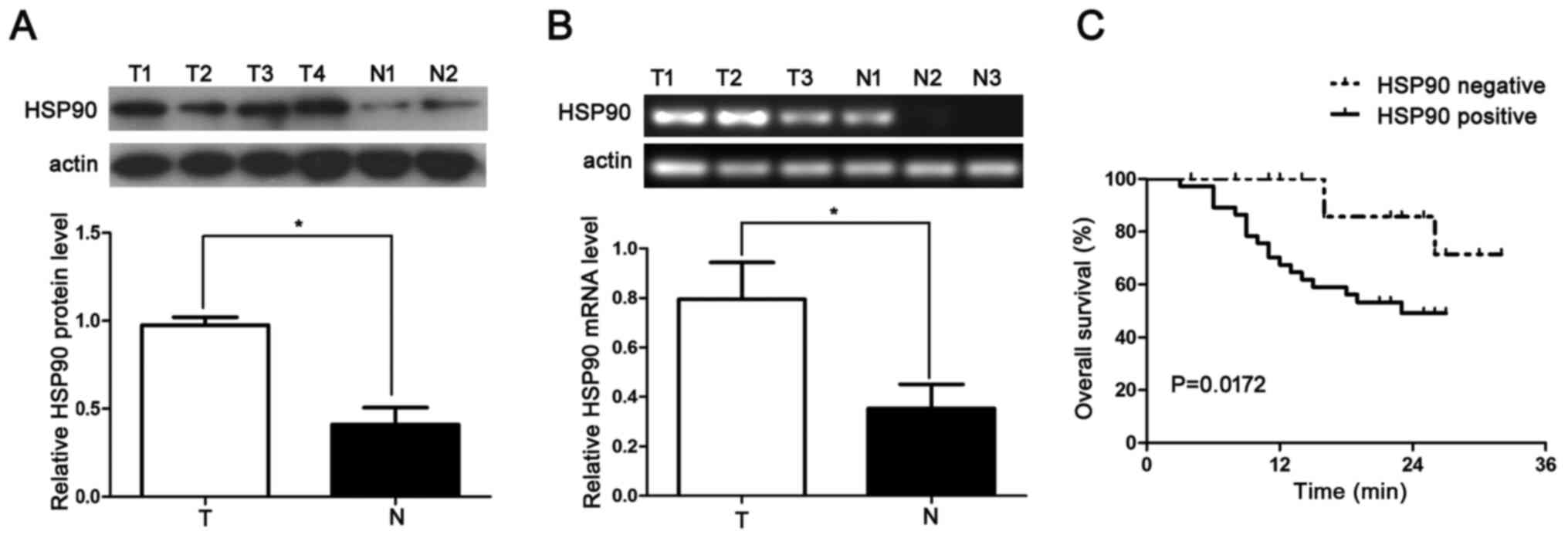
Expression of heat shock protein (HSP)90 and its clinical significance in hepatocellular carcinoma (HCC). (A) Western blot analysis of HSP90 expression in cancer (T) and matched tumor-adjacent tissues (N) is shown. Quantification of the data suggested that HSP90 protein expression in HCC tissues was significantly higher than that in the normal tumor-adjacent tissues. n=20; values are depicted as the means ± SEM; *P<0.05 by t-test. (B) HSP90 mRNA levels in cancer (T) and matched tumor-adjacent tissues (N) were determined by RT-qPCR. Quantification of the data showed that HSP90 mRNA in HCC tis- sues was significantly higher than that in the normal tumor-adjacent tissues. n=20; values are depicted as the means ± SEM; *P<0.05 by t-test. (C) Kaplan-Meier survival curves showing overall 3-year survival for HCC patients in accordance with their HSP90 protein expression. The HSP90-negative expression group (n=40), IHC score of HSP90=0; HSP90-positive expression group (n=20), IHC score of HSP90=1-3; *P<0.05 by log-rank test.

Figure 2

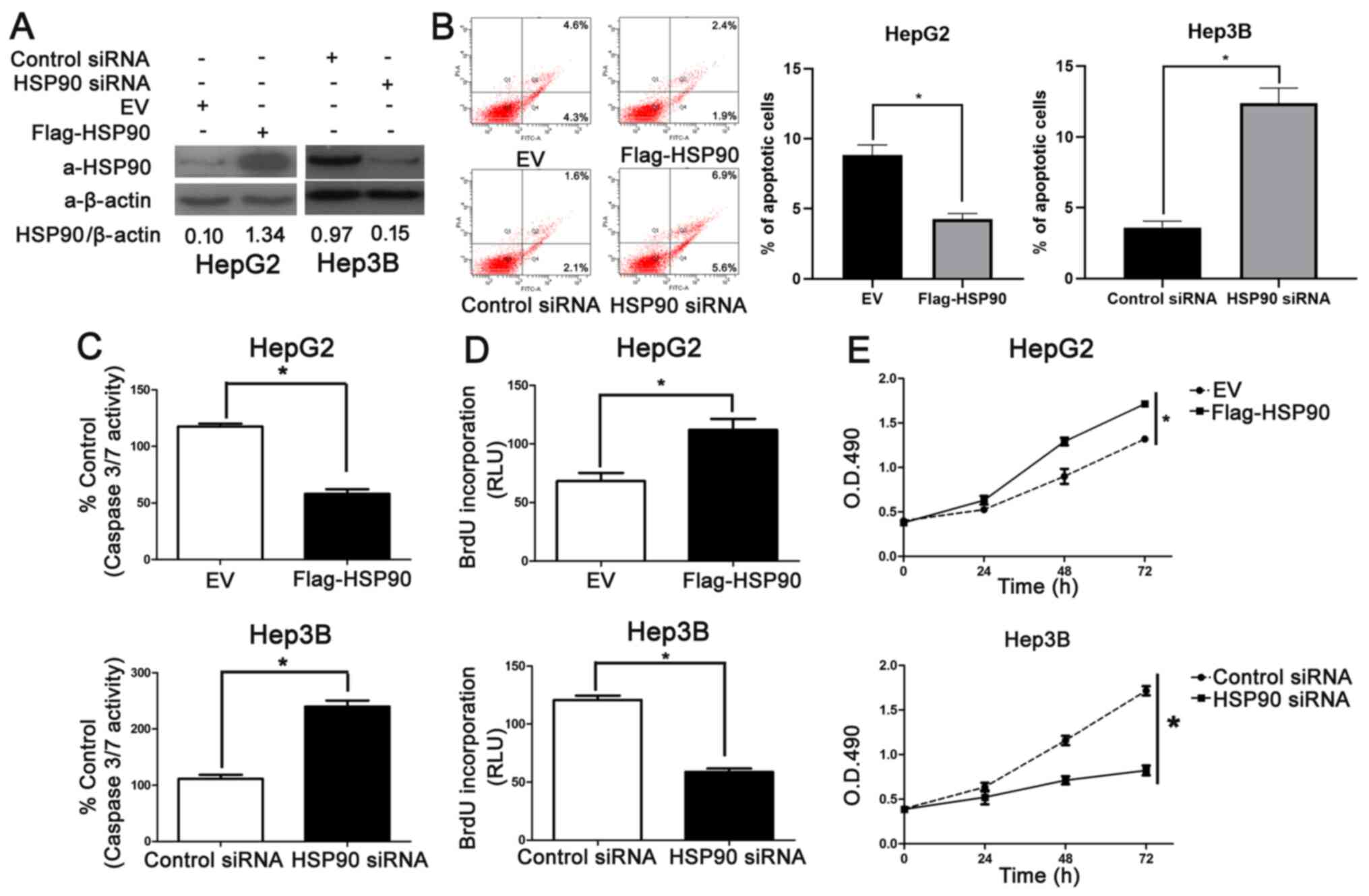
Heat shock protein (HSP90) regulates the proliferation and apoptosis of hepatocellular carcinoma (HCC) cells. (A) Hep3B and HepG2 cells were transfected with HSP90 siRNA and Flag-HSP90, respectively, and then subjected to western blot analysis for HSP90. The data are representative of multiple repeats with similar results. (B) Flow cytometric quantification of the apoptotic cell population. HSP90 knockdown increased the percentage of apoptotic Hep3B cells compared with the control cells, and HSP90-overexpressing HepG2 cells were composed of a smaller subset of apoptotic cells. *P<0.05 by t-test; n=3 repeats with similar results. (C) The activity of caspases-3 and -7 was downregulated following HSP90 overexpression in HepG2 cells and upregulated after HSP90 knockdown in Hep3B cells. *P<0.05 by t-test; n=3 repeats with similar results. (D) Cell proliferation was measured by BrdU assay which was inhibited by HSP90 knockdown in Hep3B cells and promoted by HSP90 overexpression in HepG2 cells. *P<0.05 by t-test; n=3 repeats with similar results. (E) Using MTT assays, the viability of HepG2 cells was enhanced after HSP90 overexpression, and HSP90 knockdown reduced the viability of Hep3B cells. *P<0.05 by two-way ANOVA; n=3 repeats with similar results. Values are depicted as the means ± SEM.

Figure 6

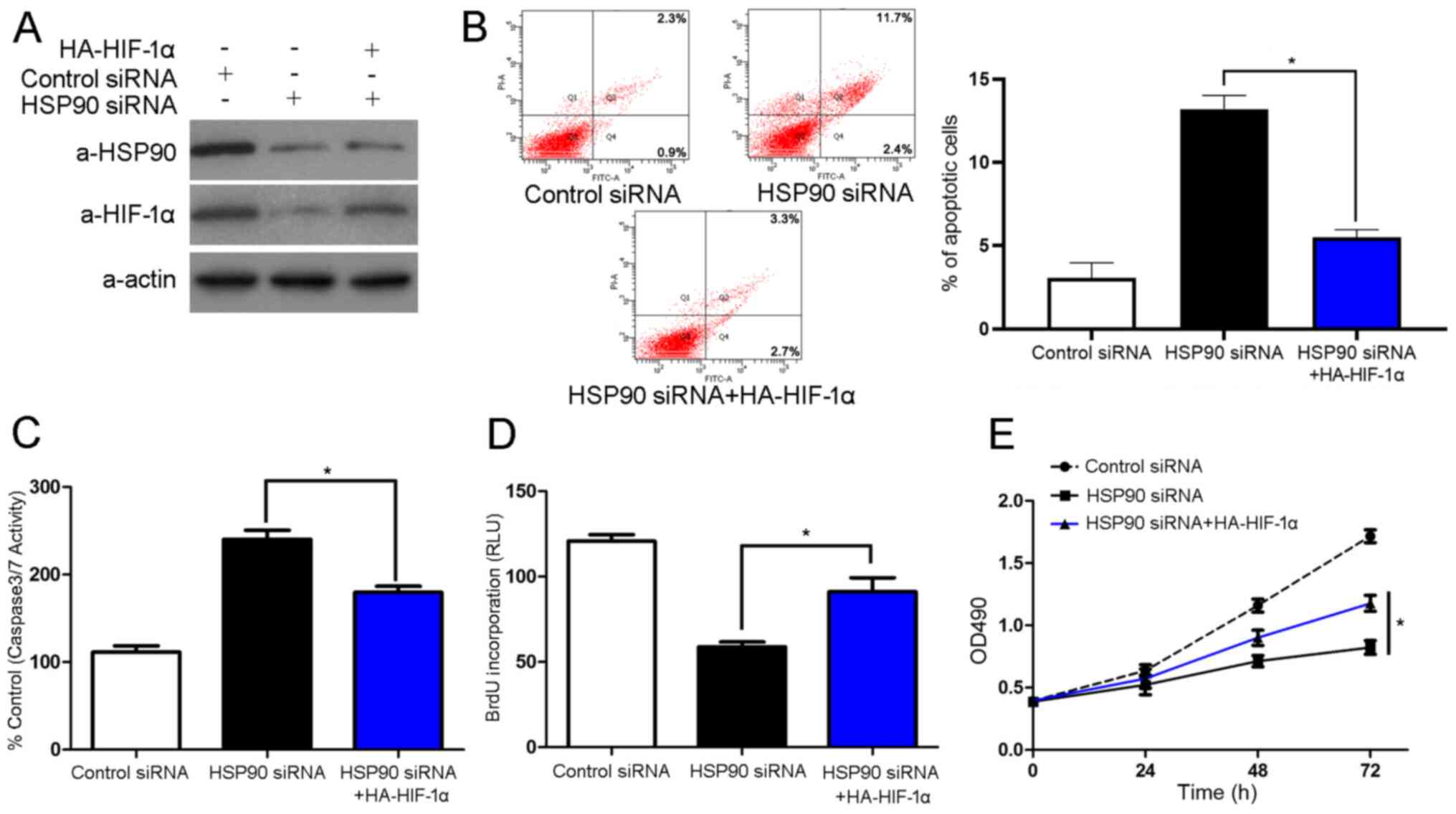
Heat shock protein (HSP)90 siRNA-induced suppression of Hep3B cell growth is partially reversed by hypoxia-inducible factor (HIF)-1α. (A) HSP90 siRNA-transfected Hep3B cells successfully downregulated HSP90 protein expression. HSP90 knockdown in Hep3B cells reduced the levels of HIF-1α. HSP90-knockdown cells which were then transfected with HA-HIF-1α partially rescued the HIF-1α expression. The data are representative of multiple repeats with similar results. (B) Flow cytometry was used to measured apoptotic cells. Restoring HIF-1α expression decreased the number of apoptotic cells in HSP90 siRNA-transfected Hep3B cells. *P<0.05 by one-way ANOVA; n=3 repeats with similar results. (C) In HSP90-knockdown Hep3B cells, the activity of the pro-apoptotic caspases-3 and -7 was decreased after HA-HIF-1α transfection. *P<0.05 by one-way ANOVA; n=3 repeats with similar results. (D) The results of BrdU assay suggested that HIF-1α promoted proliferation in HSP90-knockdown Hep3B cells. *P<0.05 by one-way ANOVA; n=3 repeats with similar results. (E) Performing MTT assays showed that HIF-1α enhanced the viability of HSP90-knockdown Hep3B cells. *P<0.05 by two-way ANOVA; n=3 repeats with similar results. Values are depicted as the means ± SEM.

Figure 7

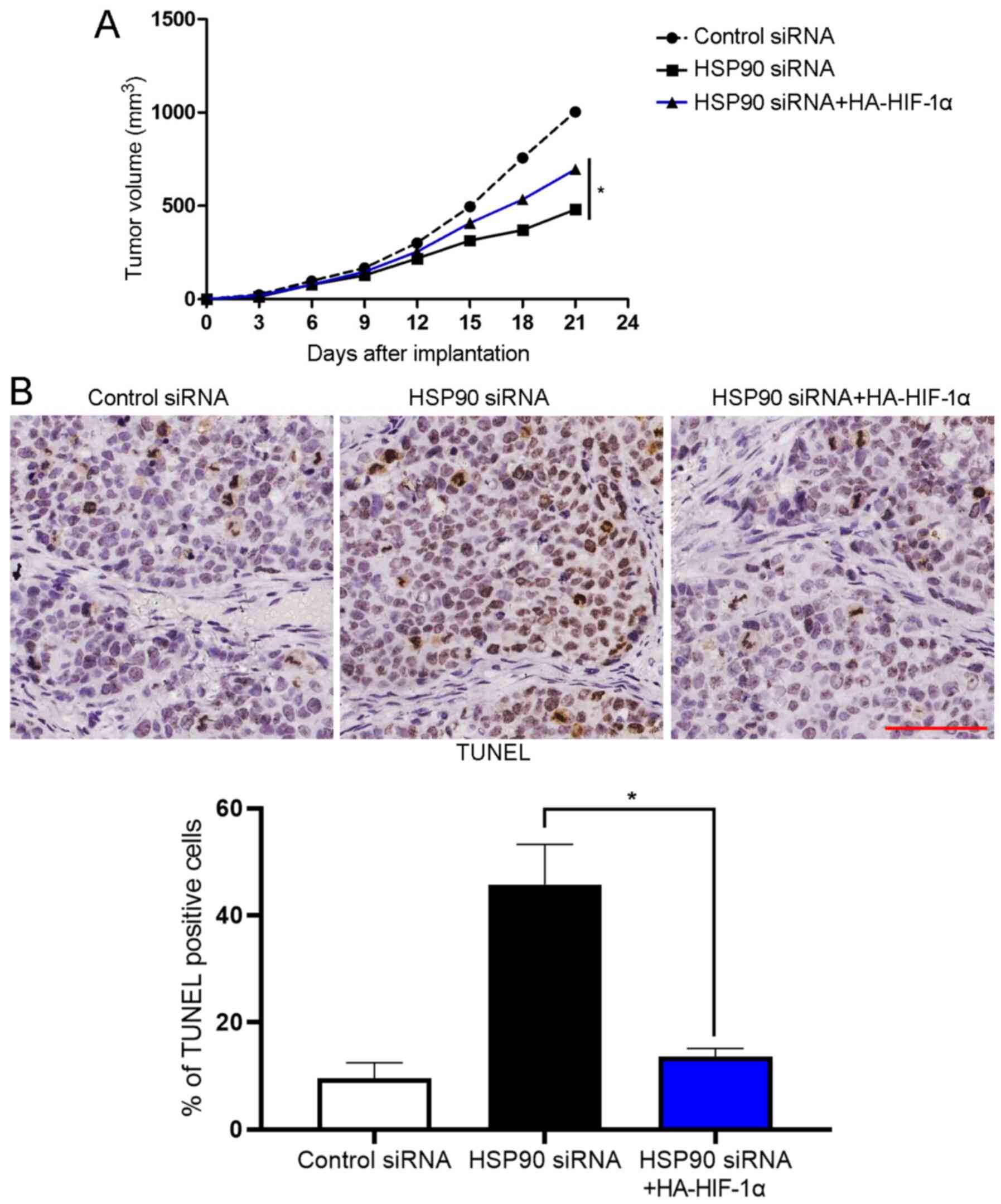
Hypoxia-inducible factor (HIF)-1α partially abolishes heat shock protein (HSP)90 siRNA-induced suppression of tumor growth. (A) Control Hep3B cells (control siRNA, n=6), HSP90-knockdown Hep3B cells (HSP90 siRNA, n=6) and co-expressing Hep3B cells (HSP90 + HA-HIF-1α, n=6), respec- tively, were implanted into nude mice by subcutaneous injection. A caliper was used to measure the tumor nodules at different times after implantation. HSP90-knockdown Hep3B cells exhibited a greater tumor-inhibiting effect than control cells; however, compared with the HSP90 siRNA group, restoring HIF-1α expression promoted tumor growth. *P<0.05 by two-way ANOVA. (B) Tumor nodules were subjected to TUNEL assays and quantitative analysis. TUNEL assays showed that HSP90 knockdown markedly increased the percentage of apoptotic cells. Scale bar, 70 μm; n=6; values are depicted as the means ± SEM; *P<0.05 and by one-way ANOVA.

Consequently, the corrected versions of Figs. 1, 2, 6 and 7, containing the replacement data for Figs. 1B, 2B, 6B, and 7B, are shown below and on the next two pages. It should be emphasized that the errors that were made in assembling Figs. 1B, 2B, 6B and 7B did not have a major effect on either the results reported or the conclusions reached in this article. The authors are grateful to the Editor of International Journal of Molecular Medicine for allowing them the opportunity to publish this Corrigendum, and all of the authors agree to the publication of this Corrigendum. The authors sincerely apologize for their mistakes and regret any inconvenience that these errors may have caused.

Figure 1

Expression of heat shock protein (HSP)90 and its clinical significance in hepatocellular carcinoma (HCC). (A) Western blot analysis of HSP90 expression in cancer (T) and matched tumor-adjacent tissues (N) is shown. Quantification of the data suggested that HSP90 protein expression in HCC tissues was significantly higher than that in the normal tumor-adjacent tissues. n=20; values are depicted as the means ± SEM; *P<0.05 by t-test. (B) HSP90 mRNA levels in cancer (T) and matched tumor-adjacent tissues (N) were determined by RT-qPCR. Quantification of the data showed that HSP90 mRNA in HCC tis- sues was significantly higher than that in the normal tumor-adjacent tissues. n=20; values are depicted as the means ± SEM; *P<0.05 by t-test. (C) Kaplan-Meier survival curves showing overall 3-year survival for HCC patients in accordance with their HSP90 protein expression. The HSP90-negative expression group (n=40), IHC score of HSP90=0; HSP90-positive expression group (n=20), IHC score of HSP90=1-3; *P<0.05 by log-rank test.

Figure 2

Heat shock protein (HSP90) regulates the proliferation and apoptosis of hepatocellular carcinoma (HCC) cells. (A) Hep3B and HepG2 cells were transfected with HSP90 siRNA and Flag-HSP90, respectively, and then subjected to western blot analysis for HSP90. The data are representative of multiple repeats with similar results. (B) Flow cytometric quantification of the apoptotic cell population. HSP90 knockdown increased the percentage of apoptotic Hep3B cells compared with the control cells, and HSP90-overexpressing HepG2 cells were composed of a smaller subset of apoptotic cells. *P<0.05 by t-test; n=3 repeats with similar results. (C) The activity of caspases-3 and -7 was downregulated following HSP90 overexpression in HepG2 cells and upregulated after HSP90 knockdown in Hep3B cells. *P<0.05 by t-test; n=3 repeats with similar results. (D) Cell proliferation was measured by BrdU assay which was inhibited by HSP90 knockdown in Hep3B cells and promoted by HSP90 overexpression in HepG2 cells. *P<0.05 by t-test; n=3 repeats with similar results. (E) Using MTT assays, the viability of HepG2 cells was enhanced after HSP90 overexpression, and HSP90 knockdown reduced the viability of Hep3B cells. *P<0.05 by two-way ANOVA; n=3 repeats with similar results. Values are depicted as the means ± SEM.

Figure 6

Heat shock protein (HSP)90 siRNA-induced suppression of Hep3B cell growth is partially reversed by hypoxia-inducible factor (HIF)-1α. (A) HSP90 siRNA-transfected Hep3B cells successfully downregulated HSP90 protein expression. HSP90 knockdown in Hep3B cells reduced the levels of HIF-1α. HSP90-knockdown cells which were then transfected with HA-HIF-1α partially rescued the HIF-1α expression. The data are representative of multiple repeats with similar results. (B) Flow cytometry was used to measured apoptotic cells. Restoring HIF-1α expression decreased the number of apoptotic cells in HSP90 siRNA-transfected Hep3B cells. *P<0.05 by one-way ANOVA; n=3 repeats with similar results. (C) In HSP90-knockdown Hep3B cells, the activity of the pro-apoptotic caspases-3 and -7 was decreased after HA-HIF-1α transfection. *P<0.05 by one-way ANOVA; n=3 repeats with similar results. (D) The results of BrdU assay suggested that HIF-1α promoted proliferation in HSP90-knockdown Hep3B cells. *P<0.05 by one-way ANOVA; n=3 repeats with similar results. (E) Performing MTT assays showed that HIF-1α enhanced the viability of HSP90-knockdown Hep3B cells. *P<0.05 by two-way ANOVA; n=3 repeats with similar results. Values are depicted as the means ± SEM.

Figure 7

Hypoxia-inducible factor (HIF)-1α partially abolishes heat shock protein (HSP)90 siRNA-induced suppression of tumor growth. (A) Control Hep3B cells (control siRNA, n=6), HSP90-knockdown Hep3B cells (HSP90 siRNA, n=6) and co-expressing Hep3B cells (HSP90 + HA-HIF-1α, n=6), respec- tively, were implanted into nude mice by subcutaneous injection. A caliper was used to measure the tumor nodules at different times after implantation. HSP90-knockdown Hep3B cells exhibited a greater tumor-inhibiting effect than control cells; however, compared with the HSP90 siRNA group, restoring HIF-1α expression promoted tumor growth. *P<0.05 by two-way ANOVA. (B) Tumor nodules were subjected to TUNEL assays and quantitative analysis. TUNEL assays showed that HSP90 knockdown markedly increased the percentage of apoptotic cells. Scale bar, 70 μm; n=6; values are depicted as the means ± SEM; *P<0.05 and by one-way ANOVA.

Related Articles

  • Abstract
  • View
  • Download
  • Twitter
Copy and paste a formatted citation
Spandidos Publications style
Liu X, Chen S, Tu J, Cai W and Xu Q: [Corrigendum] HSP90 inhibits apoptosis and promotes growth by regulating HIF-1α abundance in hepatocellular carcinoma. Int J Mol Med 50: 137, 2022.
APA
Liu, X., Chen, S., Tu, J., Cai, W., & Xu, Q. (2022). [Corrigendum] HSP90 inhibits apoptosis and promotes growth by regulating HIF-1α abundance in hepatocellular carcinoma. International Journal of Molecular Medicine, 50, 137. https://doi.org/10.3892/ijmm.2022.5193
MLA
Liu, X., Chen, S., Tu, J., Cai, W., Xu, Q."[Corrigendum] HSP90 inhibits apoptosis and promotes growth by regulating HIF-1α abundance in hepatocellular carcinoma". International Journal of Molecular Medicine 50.5 (2022): 137.
Chicago
Liu, X., Chen, S., Tu, J., Cai, W., Xu, Q."[Corrigendum] HSP90 inhibits apoptosis and promotes growth by regulating HIF-1α abundance in hepatocellular carcinoma". International Journal of Molecular Medicine 50, no. 5 (2022): 137. https://doi.org/10.3892/ijmm.2022.5193
Copy and paste a formatted citation
x
Spandidos Publications style
Liu X, Chen S, Tu J, Cai W and Xu Q: [Corrigendum] HSP90 inhibits apoptosis and promotes growth by regulating HIF-1α abundance in hepatocellular carcinoma. Int J Mol Med 50: 137, 2022.
APA
Liu, X., Chen, S., Tu, J., Cai, W., & Xu, Q. (2022). [Corrigendum] HSP90 inhibits apoptosis and promotes growth by regulating HIF-1α abundance in hepatocellular carcinoma. International Journal of Molecular Medicine, 50, 137. https://doi.org/10.3892/ijmm.2022.5193
MLA
Liu, X., Chen, S., Tu, J., Cai, W., Xu, Q."[Corrigendum] HSP90 inhibits apoptosis and promotes growth by regulating HIF-1α abundance in hepatocellular carcinoma". International Journal of Molecular Medicine 50.5 (2022): 137.
Chicago
Liu, X., Chen, S., Tu, J., Cai, W., Xu, Q."[Corrigendum] HSP90 inhibits apoptosis and promotes growth by regulating HIF-1α abundance in hepatocellular carcinoma". International Journal of Molecular Medicine 50, no. 5 (2022): 137. https://doi.org/10.3892/ijmm.2022.5193
Follow us
  • Twitter
  • LinkedIn
  • Facebook
About
  • Spandidos Publications
  • Careers
  • Cookie Policy
  • Privacy Policy
How can we help?
  • Help
  • Live Chat
  • Contact
  • Email to our Support Team