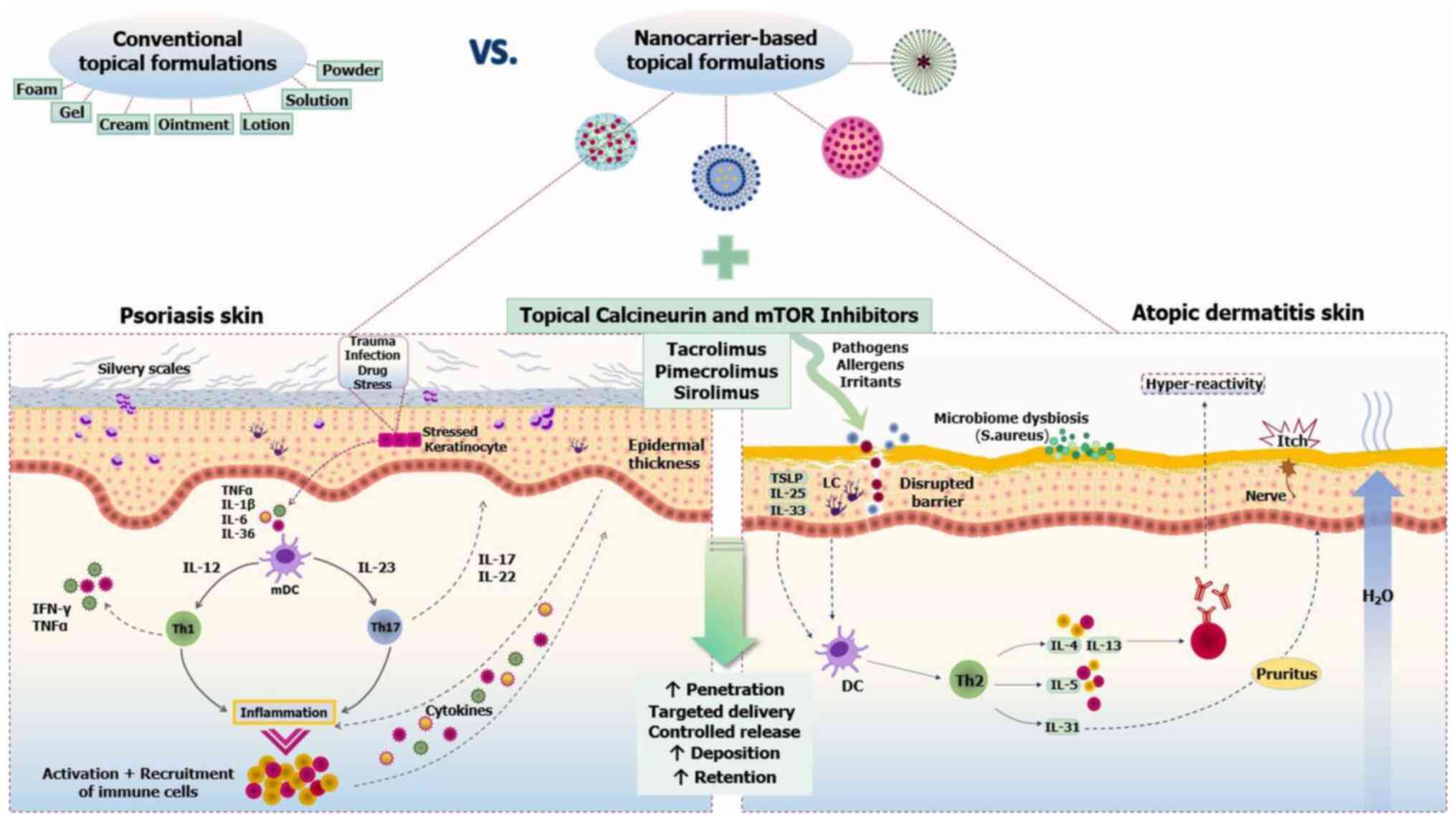
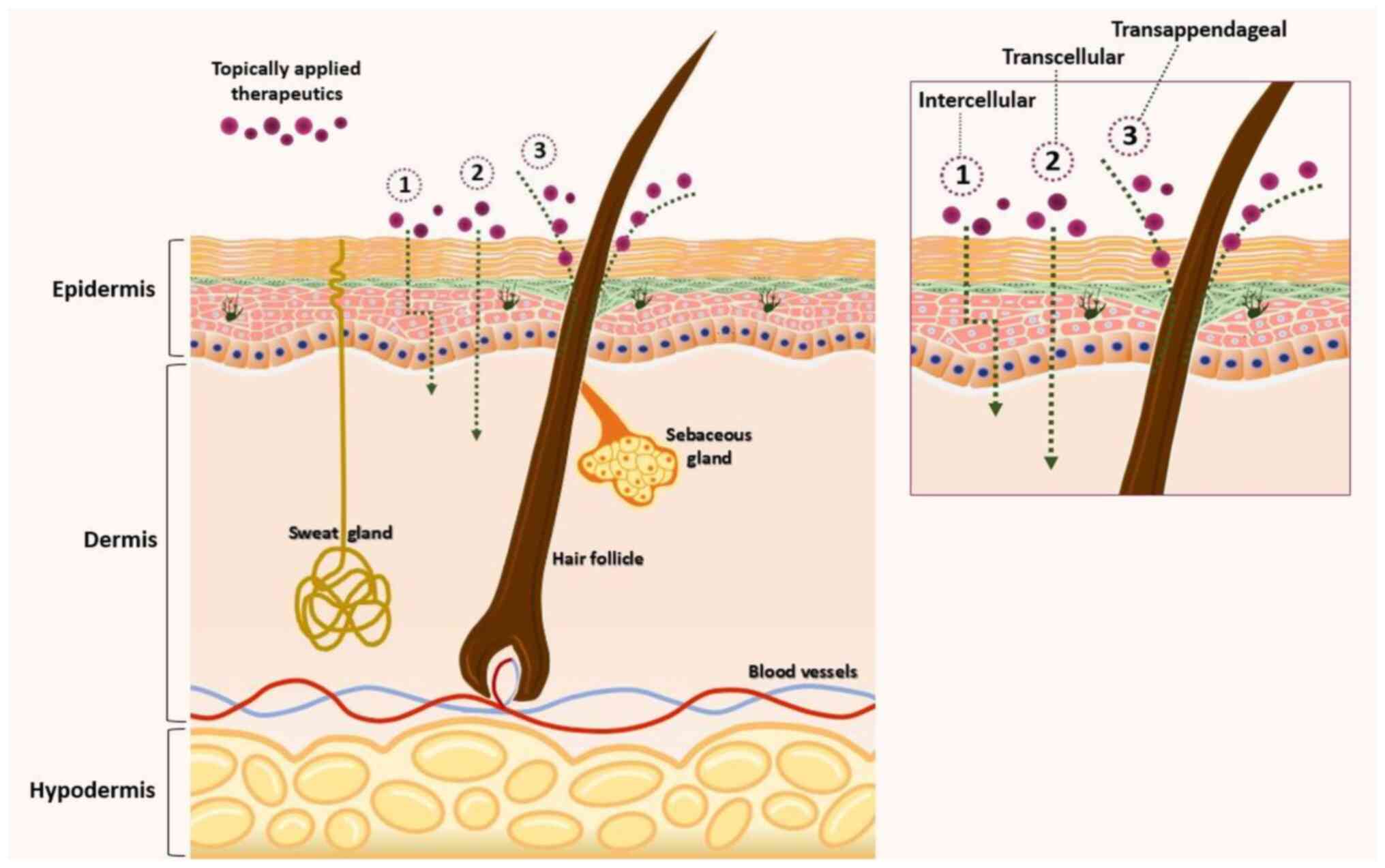
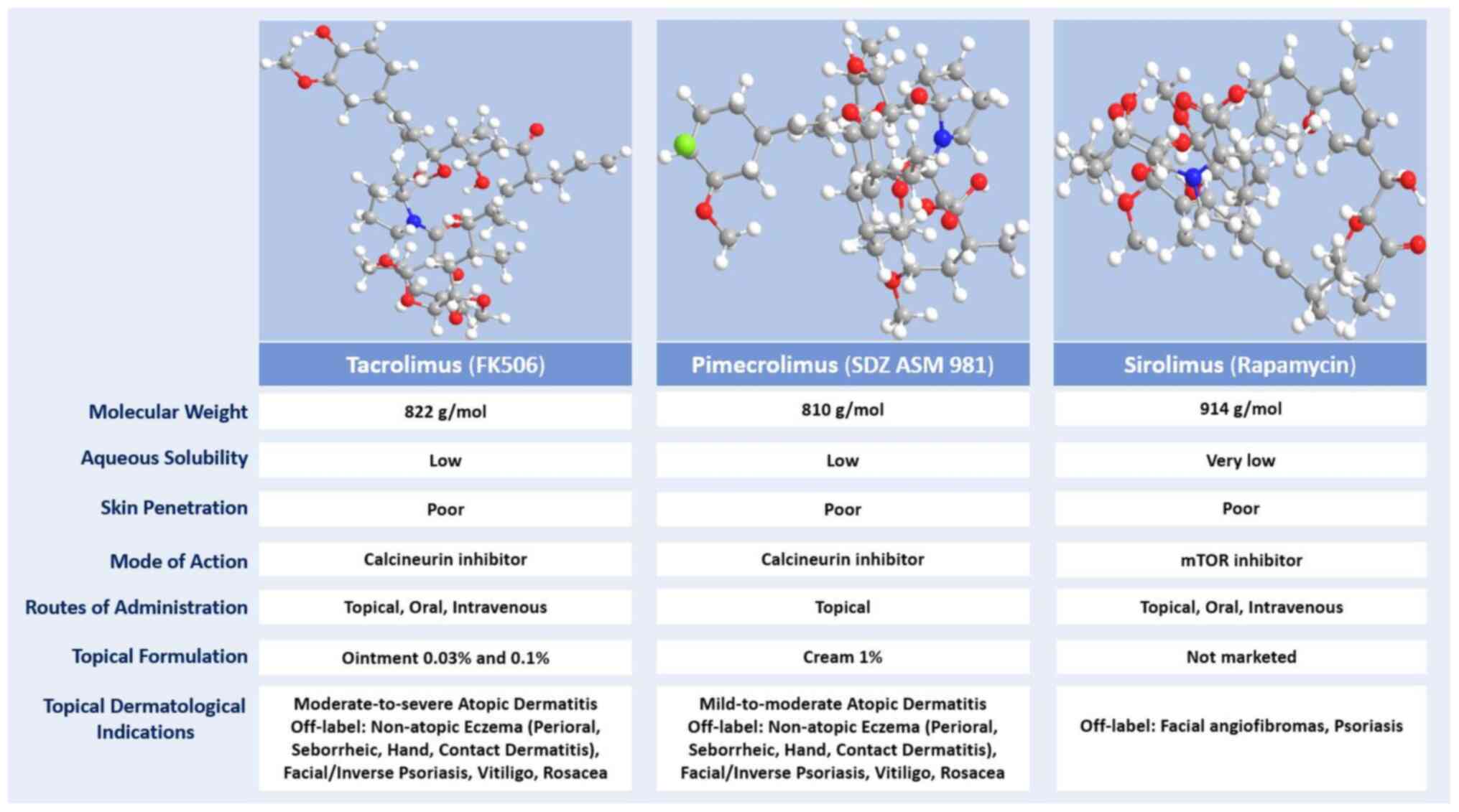
|
1
|
Rodriguez-Cerdeira C, Sanchez-Blanco E and
Molares-Vila A: Clinical application of development of
nonantibiotic macrolides that correct inflammation-driven immune
dysfunction in inflammatory skin diseases. Mediators Inflamm.
2012:5637092012. View Article : Google Scholar : PubMed/NCBI
|
|
2
|
Marsland AM and Griffiths CEM: Therapeutic
potential of macrolide immunosuppressants in dermatology. Expert
Opin Investig Drugs. 13:125–137. 2004. View Article : Google Scholar : PubMed/NCBI
|
|
3
|
Kemény L: The golden ages of inflammatory
skin diseases: Skyrocketing developments in the therapy of
psoriasis and atopic dermatitis. Acad Dermatol Venereol.
35:2239–2240. 2021. View Article : Google Scholar
|
|
4
|
Leducq S, Giraudeau B, Tavernier E and
Maruani A: Topical use of mammalian target of rapamycin inhibitors
in dermatology: A systematic review with meta-analysis. J Am Acad
Dermatol. 80:735–742. 2019. View Article : Google Scholar : PubMed/NCBI
|
|
5
|
Reynolds NJ and Al-Daraji WI: Calcineurin
inhibitors and sirolimus: Mechanisms of action and applications in
dermatology. Clin Exp Dermatol. 27:555–561. 2002. View Article : Google Scholar : PubMed/NCBI
|
|
6
|
Remitz A, De Pità O, Mota A,
Serra-Baldrich E, Vakirlis E and Kapp A: Position statement:
Topical calcineurin inhibitors in atopic dermatitis. J Eur Acad
Dermatol Venereol. 32:2074–2082. 2018. View Article : Google Scholar : PubMed/NCBI
|
|
7
|
Alavi A and Shear NH: New perspectives on
topical calcineurin inhibitors: Role in dermatology today and into
the future. J Cutan Med Surg. 23(4 Suppl): 3S–4S. 2019. View Article : Google Scholar : PubMed/NCBI
|
|
8
|
Buerger C: Epidermal mTORC1 signaling
contributes to the pathogenesis of psoriasis and could serve as a
therapeutic target. Front Immunol. 9:27862018. View Article : Google Scholar : PubMed/NCBI
|
|
9
|
Peramo A and Marcelo CL: Visible effects
of rapamycin (sirolimus) on human skin explants in vitro. Arch
Dermatol Res. 305:163–171. 2013. View Article : Google Scholar
|
|
10
|
Bornhövd E, Burgdorf WH and Wollenberg A:
Macrolactam immunomodulators for topical treatment of inflammatory
skin diseases. J Am Acad Dermatol. 45:736–743. 2001. View Article : Google Scholar : PubMed/NCBI
|
|
11
|
Gutfreund K, Bienias W, Szewczyk A and
Kaszuba A: Topical calcineurin inhibitors in dermatology. Part I:
Properties, method and effectiveness of drug use. Postepy Dermatol
Alergol. 30:165–169. 2013. View Article : Google Scholar : PubMed/NCBI
|
|
12
|
Pinter A, Tsianakas A and Eichner A;
ScaTAC study group: Efficacy and safety of topical tacrolimus
microemulsion applied twice daily in patients with mild to moderate
scalp psoriasis. Dermatol Ther (Heidelb). 14:521–532. 2024.
View Article : Google Scholar : PubMed/NCBI
|
|
13
|
Kirchner GI, Meier-Wiedenbach I and Manns
MP: Clinical pharmacokinetics of everolimus. Clin Pharmacokinet.
43:83–95. 2004. View Article : Google Scholar : PubMed/NCBI
|
|
14
|
Bos JD and Meinardi MM: The 500 Dalton
rule for the skin penetration of chemical compounds and drugs. Exp
Dermatol. 9:165–169. 2000. View Article : Google Scholar : PubMed/NCBI
|
|
15
|
Pariser D: Topical corticosteroids and
topical calcineurin inhibitors in the treatment of atopic
dermatitis: Focus on percutaneous absorption. Am J Ther.
16:264–273. 2009. View Article : Google Scholar : PubMed/NCBI
|
|
16
|
Alomar A, Berth-Jones J, Bos JD, Giannetti
A, Reitamo S, Ruzicka T, Stalder JF and Thestrup-Pedersen K;
European Working Group on Atopic Dermatitis: The role of topical
calcineurin inhibitors in atopic dermatitis. Br J Dermatol.
151(Suppl 70): S3–S27. 2004. View Article : Google Scholar
|
|
17
|
Mao J, Wang H, Xie Y, Fu Y, Li Y, Liu P,
Du H, Zhu J, Dong L, Hussain M, et al: Transdermal delivery of
rapamycin with poor water-solubility by dissolving polymeric
microneedles for anti-angiogenesis. J Mater Chem B. 8:928–934.
2020. View Article : Google Scholar : PubMed/NCBI
|
|
18
|
Kang JH, Chon J, Kim YI, Lee HJ, Oh DW,
Lee HG, Han CS, Kim DW and Park CW: Preparation and evaluation of
tacrolimus-loaded thermosensitive solid lipid nanoparticles for
improved dermal distribution. Int J Nanomedicine. 14:5381–5396.
2019. View Article : Google Scholar : PubMed/NCBI
|
|
19
|
Chen Y, Feng X and Meng S: Site-specific
drug delivery in the skin for the localized treatment of skin
diseases. Expert Opin Drug Deliv. 16:847–867. 2019. View Article : Google Scholar : PubMed/NCBI
|
|
20
|
Pandey P, Satija S, Wadhwa R, Mehta M,
Purohit D, Gupta G, Prasher P, Chellappan DK, Awasthi R, Dureja H
and Dua K: Emerging trends in nanomedicine for topical delivery in
skin disorders: Current and translational approaches. Dermatol
Ther. 33:e132922020. View Article : Google Scholar : PubMed/NCBI
|
|
21
|
Abdel-Mottaleb MM, Try C, Pellequer Y and
Lamprecht A: Nanomedicine strategies for targeting skin
inflammation. Nanomedicine (Lond). 9:1727–1743. 2014. View Article : Google Scholar : PubMed/NCBI
|
|
22
|
Hwa C, Bauer EA and Cohen DE: Skin
biology. Dermatol Ther. 24:464–470. 2011. View Article : Google Scholar
|
|
23
|
Münch S, Wohlrab J and Neubert RHH: Dermal
and transdermal delivery of pharmaceutically relevant
macromolecules. Eur J Pharm Biopharm. 119:235–242. 2017. View Article : Google Scholar : PubMed/NCBI
|
|
24
|
Eyerich S, Eyerich K, Traidl-Hoffmann C
and Biedermann T: Cutaneous barriers and skin immunity:
Differentiating A connected network. Trends Immunol. 39:315–327.
2018. View Article : Google Scholar : PubMed/NCBI
|
|
25
|
Bäsler K, Bergmann S, Heisig M, Naegel A,
Zorn-Kruppa M and Brandner JM: The role of tight junctions in skin
barrier function and dermal absorption. J Control Release.
242:105–118. 2016. View Article : Google Scholar : PubMed/NCBI
|
|
26
|
Andrews SN, Jeong E and Prausnitz MR:
Transdermal delivery of molecules is limited by full epidermis, not
just stratum corneum. Pharm Res. 30:1099–1109. 2013. View Article : Google Scholar :
|
|
27
|
Knudsen NØ and Pedersen GP: pH and drug
delivery. pH of the Skin: Issues and Challenges. 54. Karger
Publishers; Berlin: pp. 143–151. 2018
|
|
28
|
Pyo SM and Maibach HI: Skin metabolism:
Relevance of skin enzymes for rational drug design. Skin Pharmacol
Physiol. 32:283–294. 2019. View Article : Google Scholar : PubMed/NCBI
|
|
29
|
Kubo A, Nagao K, Yokouchi M, Sasaki H and
Amagai M: External antigen uptake by Langerhans cells with
reorganization of epidermal tight junction barriers. J Exp Med.
206:2937–2946. 2009. View Article : Google Scholar : PubMed/NCBI
|
|
30
|
Vogt A, Wischke C, Neffe AT, Ma N, Alexiev
U and Lendlein A: Nanocarriers for drug delivery into and through
the skin-Do existing technologies match clinical challenges? J
Control Release. 242:3–15. 2016. View Article : Google Scholar : PubMed/NCBI
|
|
31
|
Chavira A, Belda-Ferre P, Kosciolek T, Ali
F, Dorrestein PC and Knight R: The microbiome and its potential for
pharmacology. Concepts and Principles of Pharmacology. Handbook of
Experimental Pharmacology. Barrett JE, Page CP and Michel MC: 260.
Springer; Cham: pp. 301–326. 2019, View Article : Google Scholar
|
|
32
|
Savić V, Ilić T, Nikolić I, Marković B,
Čalija B, Cekić N and Savić S: Tacrolimus-loaded lecithin-based
nanostructured lipid carrier and nanoemulsion with propylene glycol
monocaprylate as a liquid lipid: Formulation characterization and
assessment of dermal delivery compared to referent ointment. Int J
Pharm. 569:1186242019. View Article : Google Scholar
|
|
33
|
Raphael AP, Garrastazu G, Sonvico F and
Prow TW: Formulation design for topical drug and nanoparticle
treatment of skin disease. Ther Deliv. 6:197–216. 2015. View Article : Google Scholar : PubMed/NCBI
|
|
34
|
Viegas J, Dias S, Carvalho AM and Sarmento
B: Characterization of a human lesioned-skin model to assess the
influence of skin integrity on drug permeability. Biomed
Pharmacother. 169:1158412023. View Article : Google Scholar : PubMed/NCBI
|
|
35
|
Chiang A, Tudela E and Maibach HI:
Percutaneous absorption in diseased skin: An overview. J Appl
Toxicol. 32:537–563. 2012. View Article : Google Scholar : PubMed/NCBI
|
|
36
|
Jakasa I, De Jongh CM, Verberk MM, Bos JD
and Kežić S: Percutaneous penetration of sodium lauryl sulphate is
increased in uninvolved skin of patients with atopic dermatitis
compared with control subjects. Br J Dermatol. 155:104–109. 2006.
View Article : Google Scholar : PubMed/NCBI
|
|
37
|
Gattu S and Maibach HI: Modest but
increased penetration through damaged skin: An overview of the in
vivo human model. Skin Pharmacol Physiol. 24:2–9. 2011. View Article : Google Scholar
|
|
38
|
Orsmond A, Bereza-Malcolm L, Lynch T,
March L and Xue M: Skin barrier dysregulation in psoriasis. Int J
Mol Sci. 22:108412021. View Article : Google Scholar : PubMed/NCBI
|
|
39
|
Kocsis D, Horváth S, Kemény Á,
Varga-Medveczky Z, Pongor C, Molnár R, Mihály A, Farkas D, Naszlady
BM, Fülöp A, et al: Drug delivery through the psoriatic epidermal
barrier-A 'skin-on-a-chip' permeability study and ex vivo optical
imaging. Int J Mol Sci. 23:42372022. View Article : Google Scholar
|
|
40
|
Zuberbier T, Chong SU, Grunow K, Guhl S,
Welker P, Grassberger M and Henz BM: The ascomycin macrolactam
pimecrolimus (Elidel, SDZ ASM 981) is a potent inhibitor of
mediator release from human dermal mast cells and peripheral blood
basophils. J Allergy Clin Immunol. 108:275–280. 2001. View Article : Google Scholar : PubMed/NCBI
|
|
41
|
Hoetzenecker W, Meingassner JG, Ecker R,
Stingl G, Stuetz A and Elbe-Bürger A: Corticosteroids but not
pimecrolimus affect viability, maturation and immune function of
murine epidermal Langerhans cells. J Invest Dermatol. 122:673–684.
2004. View Article : Google Scholar : PubMed/NCBI
|
|
42
|
Learned C, Alsukait S and Rosmarin D:
Usage of topical calcineurin inhibitors in the medicare population
from 2013 to 2018. J Drugs Dermatol. 21:912–913. 2022. View Article : Google Scholar : PubMed/NCBI
|
|
43
|
Guenther L, Lynde C and Poulin Y:
Off-label use of topical calcineurin inhibitors in dermatologic
disorders. J Cutan Med Surg. 23(4 Suppl): 27S–34S. 2019. View Article : Google Scholar : PubMed/NCBI
|
|
44
|
Wang L, Lu W, Yuan J, Zeng B, Li D, Zhang
F and Li J: Utility of dermoscopy for evaluating the therapeutic
efficacy of tacrolimus ointment plus 308-nm excimer laser
combination therapy in localized vitiligo patients. Exp Ther Med.
15:3981–3988. 2018.PubMed/NCBI
|
|
45
|
Bos JD: Non-steroidal topical
immunomodulators provide skin-selective, self-limiting treatment in
atopic dermatitis. Eur J Dermatol. 13:455–461. 2003.PubMed/NCBI
|
|
46
|
Kumar P, Ashawat MS, Pandit V, Singh Verma
CP, Ankalgi AD and Kumar M: Recent trends in nanocarriers for the
management of atopic dermatitis. Pharm Nanotechnol. 11:397–409.
2023. View Article : Google Scholar : PubMed/NCBI
|
|
47
|
Jain A, Doppalapudi S, Domb AJ and Khan W:
Tacrolimus and curcumin co-loaded liposphere gel: Synergistic
combination towards management of psoriasis. J Control Release.
243:132–145. 2016. View Article : Google Scholar : PubMed/NCBI
|
|
48
|
Pople PV and Singh KK: Targeting
tacrolimus to deeper layers of skin with improved safety for
treatment of atopic dermatitis. Int J Pharm. 398:165–178. 2010.
View Article : Google Scholar : PubMed/NCBI
|
|
49
|
Hanna S, Zip C and Shear NH: What Is the
risk of harm associated with topical calcineurin inhibitors? J
Cutan Med Surg. 23(4 Suppl): 19S–26S. 2019. View Article : Google Scholar : PubMed/NCBI
|
|
50
|
Chat VS, Kearns DG, Uppal SK, Han G and Wu
JJ: Management of psoriasis with topicals: Applying the 2020
AAD-NPF guidelines of care to clinical practice. Cutis. 110(2
Suppl): S8–S14. 2022. View Article : Google Scholar
|
|
51
|
Malecic N and Young H: Tacrolimus for the
management of psoriasis: Clinical utility and place in therapy.
Psoriasis (Auckl). 6:153–163. 2016.PubMed/NCBI
|
|
52
|
Zonneveld IM, Rubins A, Jablonska S,
Dobozy A, Ruzicka T, Kind P, Dubertret L and Bos JD: Topical
tacrolimus is not effective in chronic plaque psoriasis. A pilot
study. Arch Dermatol. 134:1101–1102. 1998. View Article : Google Scholar : PubMed/NCBI
|
|
53
|
Remitz A, Reitamo S, Erkko P, Granlund H
and Lauerma AI: Tacrolimus ointment improves psoriasis in a
microplaque assay. Br J Dermatol. 141:103–107. 1999. View Article : Google Scholar : PubMed/NCBI
|
|
54
|
Quartier J, Lapteva M, Boulaguiem Y,
Guerrier S and Kalia YN: Influence of molecular structure and
physicochemical properties of immunosuppressive drugs on micelle
formulation characteristics and cutaneous delivery. Pharmaceutics.
15:12782023. View Article : Google Scholar : PubMed/NCBI
|
|
55
|
Sehgal VN, Srivastava G and Dogra S:
Tacrolimus in dermatology-pharmacokinetics, mechanism of action,
drug interactions, dosages, and side effects: Part I. Skinmed.
7:27–30. 2008. View Article : Google Scholar : PubMed/NCBI
|
|
56
|
Stuetz A, Grassberger M and Meingassner
JG: Pimecrolimus (Elidel, SDZ ASM 981)-preclinical pharmacologic
profile and skin selectivity. Semin Cutan Med Surg. 20:233–241.
2001. View Article : Google Scholar
|
|
57
|
Stuetz A, Baumann K, Grassberger M, Wolff
K and Meingassner JG: Discovery of topical calcineurin inhibitors
and pharmacological profile of pimecrolimus. Int Arch Allergy
Immunol. 141:199–212. 2006. View Article : Google Scholar : PubMed/NCBI
|
|
58
|
Billich A, Aschauer H, Aszódi A and Stuetz
A: Percutaneous absorption of drugs used in atopic eczema:
Pimecrolimus permeates less through skin than corticosteroids and
tacrolimus. Int J Pharm. 269:29–35. 2004. View Article : Google Scholar
|
|
59
|
Nghiem P, Pearson G and Langley RG:
Tacrolimus and pimecrolimus: From clever prokaryotes to inhibiting
calcineurin and treating atopic dermatitis. J Am Acad Dermatol.
46:228–241. 2002. View Article : Google Scholar : PubMed/NCBI
|
|
60
|
Ruzicka T, Assmann T and Homey B:
Tacrolimus: The drug for the turn of the millennium? Arch Dermatol.
135:574–580. 1999. View Article : Google Scholar : PubMed/NCBI
|
|
61
|
Lauerma AI, Surber C and Maibach HI:
Absorption of topical tacrolimus (FK506) in vitro through human
skin: Comparison with cyclosporin A. Skin Pharmacol Physiol.
10:230–234. 1997. View Article : Google Scholar
|
|
62
|
Lauerma AI, Stein B, Lee HL, Homey B,
Bloom E and Maibach HI: Topical tacrolimus (FK506): Percutaneous
absorption and effect on allergic and irritant contact dermatitis.
J Invest Dermatol. 110:4911993.
|
|
63
|
Undre NA: Pharmacokinetics of tacrolimus
ointment: Clinical relevance. Tacrolimus Ointment. Ruzicka T and
Reitamo S: Springer; Berlin, Heidelberg: pp. 99–110. 2004,
View Article : Google Scholar
|
|
64
|
Meingassner JG, Aschauer H, Stuetz A and
Billich A: Pimecrolimus permeates less than tacrolimus through
normal, inflamed, or corticosteroid-pretreated skin. Exp Dermatol.
14:752–757. 2005. View Article : Google Scholar : PubMed/NCBI
|
|
65
|
Undre NA, Moloney FJ, Ahmadi S, Stevenson
P and Murphy GM: Skin and systemic pharmacokinetics of tacrolimus
following topical application of tacrolimus ointment in adults with
moderate to severe atopic dermatitis. Br J Dermatol. 160:665–669.
2009. View Article : Google Scholar
|
|
66
|
Gschwind HP, Waldmeier F, Zollinger M,
Schweitzer A and Grassberger M: Pimecrolimus: Skin disposition
after topical administration in minipigs in vivo and in human skin
in vitro. Eur J Pharm Sci. 33:9–19. 2008. View Article : Google Scholar
|
|
67
|
Weiss HM, Fresneau M, Moenius T, Stuetz A
and Billich A: Binding of pimecrolimus and tacrolimus to skin and
plasma proteins: Implications for systemic exposure after topical
application. Drug Metab Dispos. 36:1812–1818. 2008. View Article : Google Scholar : PubMed/NCBI
|
|
68
|
Luger T, Boguniewicz M, Carr W, Cork M,
Deleuran M, Eichenfield L, Eigenmann P, Fölster-Holst R, Gelmetti
C, Gollnick H, et al: Pimecrolimus in atopic dermatitis: Consensus
on safety and the need to allow use in infants. Pediatr Allergy
Immunol. 26:306–315. 2015. View Article : Google Scholar : PubMed/NCBI
|
|
69
|
Cury Martins J, Martins C, Aoki V, Gois
AF, Ishii HA and Da Silva EM: Topical tacrolimus for atopic
dermatitis. Cochrane Database Syst Rev.
2015:CD0098642015.PubMed/NCBI
|
|
70
|
Fogel AL, Hill S and Teng JMC: Advances in
the therapeutic use of mammalian target of rapamycin (mTOR)
inhibitors in dermatology. J Am Acad Dermatol. 72:879–889. 2015.
View Article : Google Scholar : PubMed/NCBI
|
|
71
|
Roy T, Boateng ST, Uddin MB, Banang-Mbeumi
S, Yadav RK, Bock CR, Folahan JT, Siwe-Noundou X, Walker AL, King
JA, et al: The PI3K-Akt-mTOR and associated signaling pathways as
molecular drivers of immune-mediated inflammatory skin diseases:
Update on therapeutic strategy using natural and synthetic
compounds. Cells. 12:16712023. View Article : Google Scholar : PubMed/NCBI
|
|
72
|
Wang J, Cui B, Chen Z and Ding X: The
regulation of skin homeostasis, repair and the pathogenesis of skin
diseases by spatiotemporal activation of epidermal mTOR signaling.
Front Cell Dev Biol. 10:9509732022. View Article : Google Scholar : PubMed/NCBI
|
|
73
|
Mercurio L, Albanesi C and Madonna S:
Recent updates on the involvement of PI3K/AKT/mTOR molecular
cascade in the pathogenesis of hyperproliferative skin disorders.
Front Med (Lausanne). 8:6656472021. View Article : Google Scholar : PubMed/NCBI
|
|
74
|
Huang T, Lin X, Meng X and Lin M:
Phosphoinositide-3 kinase/protein kinase-B/mammalian target of
rapamycin pathway in psoriasis pathogenesis. A potential
therapeutic target? Acta Derm Venerol. 94:371–379. 2014. View Article : Google Scholar
|
|
75
|
Chamcheu JC, Chaves-Rodriquez MI, Adhami
VM, Siddiqui IA, Wood GS, Longley BJ and Mukhtar H: Upregulation of
PI3K/AKT/mTOR, FABP5 and PPARβ/δ in human psoriasis and
imiquimod-induced murine psoriasiform dermatitis model. Acta Derm
Venerol. 96:854–856. 2016.
|
|
76
|
Buerger C, Malisiewicz B, Eiser A, Hardt K
and Boehncke WH: Mammalian target of rapamycin and its downstream
signalling components are activated in psoriatic skin. Br J
Dermatol. 169:156–159. 2013. View Article : Google Scholar : PubMed/NCBI
|
|
77
|
Wei KC and Lai PC: Combination of
everolimus and tacrolimus: A potentially effective regimen for
recalcitrant psoriasis. Dermatol Ther. 28:25–27. 2015. View Article : Google Scholar :
|
|
78
|
Frigerio E, Colombo MD, Franchi C,
Altomare A, Garutti C and Altomare GF: Severe psoriasis treated
with a new macrolide: Everolimus. Br J Dermatol. 156:372–374. 2007.
View Article : Google Scholar : PubMed/NCBI
|
|
79
|
Reitamo S, Spuls P, Sassolas B, Lahfa M,
Claudy A and Griffiths CE; Sirolimus European Psoriasis Study
Group: Efficacy of sirolimus (rapamycin) administered concomitantly
with a subtherapeutic dose of cyclosporin in the treatment of
severe psoriasis: A randomized controlled trial. Br J Dermatol.
145:438–445. 2001. View Article : Google Scholar : PubMed/NCBI
|
|
80
|
Van Velsen SGA, Haeck IM and
Bruijnzeel-Koomen CAFM: Severe atopic dermatitis treated with
everolimus. J Dermatolog Treat. 20:365–367. 2009. View Article : Google Scholar : PubMed/NCBI
|
|
81
|
Feldman SR: Adherence must always be
considered: Is everolimus really ineffective as a treatment for
atopic dermatitis? J Dermatolog Treat. 20:317–318. 2009. View Article : Google Scholar : PubMed/NCBI
|
|
82
|
Ormerod AD, Shah SAA, Copeland P, Omar G
and Winfield A: Treatment of psoriasis with topical sirolimus:
Preclinical development and a randomized, double-blind trial. Br J
Dermatol. 152:758–764. 2005. View Article : Google Scholar : PubMed/NCBI
|
|
83
|
Meingassner JG and Stütz A:
Immunosuppressive macrolides of the type FK 506: A novel class of
topical agents for treatment of skin diseases? J Invest Dermatol.
98:851–855. 1992. View Article : Google Scholar : PubMed/NCBI
|
|
84
|
Meingassner JG and Stütz A:
Anti-inflammatory effects of macrophilin-lnteracting drugs in
animal models of irritant and allergic contact dermatitis. Int Arch
Allergy Immunol. 99:486–489. 1992. View Article : Google Scholar : PubMed/NCBI
|
|
85
|
Duncan JI: Differential inhibition of
cutaneous T-cell-mediated reactions and epidermal cell
proliferation by cyclosporin A, FK-506, and rapamycin. J Invest
Dermatol. 102:84–88. 1994. View Article : Google Scholar : PubMed/NCBI
|
|
86
|
Yang F, Tanaka M, Wataya-Kaneda M, Yang L,
Nakamura A, Matsumoto S, Attia M, Murota H and Katayama I: Topical
application of rapamycin ointment ameliorates Dermatophagoides
farina body extract-induced atopic dermatitis in NC/Nga mice. Exp
Dermatol. 23:568–572. 2014. View Article : Google Scholar : PubMed/NCBI
|
|
87
|
Jung KE, Lee YJ, Ryu YH, Kim JE, Kim HS,
Kim BJ, Kang H and Park YM: Effects of topically applied rapamycin
and mycophenolic acid on TNCB-induced atopic dermatitis-like skin
lesions in NC/Nga mice. Int Immunopharmacol. 26:432–438. 2015.
View Article : Google Scholar : PubMed/NCBI
|
|
88
|
Bürger C, Shirsath N, Lang V, Diehl S,
Kaufmann R, Weigert A, Han YY, Ringel C and Wolf P: Blocking mTOR
signalling with rapamycin ameliorates imiquimod-induced psoriasis
in mice. Acta Derm Venerol. 97:1087–1094. 2017. View Article : Google Scholar : PubMed/NCBI
|
|
89
|
Gao M and Si X: Rapamycin ameliorates
psoriasis by regulating the expression and methylation levels of
tropomyosin via ERK1/2 and mTOR pathways in vitro and in vivo. Exp
Dermatol. 27:1112–1119. 2018. View Article : Google Scholar : PubMed/NCBI
|
|
90
|
Kim HR, Kim JC, Kang SY, Kim HO, Park CW
and Chung BY: Rapamycin alleviates
2,3,7,8-tetrachlorodibenzo-p-dioxin-induced aggravated dermatitis
in mice with imiquimod-induced psoriasis-like dermatitis by
inducing autophagy. Int J Mol Sci. 22:39682021. View Article : Google Scholar : PubMed/NCBI
|
|
91
|
Rancan F, Guo X, Rajes K, Sidiropoulou P,
Zabihi F, Hoffmann L, Hadam S, Blume-Peytavi U, Rühl E, Haag R and
Vogt A: Topical delivery of rapamycin by means of
microenvironment-sensitive core-multi-shell nanocarriers:
Assessment of anti-inflammatory activity in an ex vivo Skin/T cell
co-culture model. Int J Nanomedicine. 16:7137–7151. 2021.
View Article : Google Scholar : PubMed/NCBI
|
|
92
|
Rancan F, Rajes K, Sidiropoulou P, Hadam
S, Guo X, Zabihi F, Mirastschijski U, Rühl E, Haag R, Blume-Peytavi
U and Vogt A: Efficacy of topically applied rapamycin-loaded
redox-sensitive nanocarriers in a human skin/T cell co-culture
model. Int Immunopharmacol. 117:1099032023. View Article : Google Scholar : PubMed/NCBI
|
|
93
|
Dong S, Li D and Shi D: Skin
barrier-inflammatory pathway is a driver of the psoriasis-atopic
dermatitis transition. Front Med (Lausanne). 11:13355512024.
View Article : Google Scholar : PubMed/NCBI
|
|
94
|
Furue M and Kadono T: 'Inflammatory skin
march' in atopic dermatitis and psoriasis. Inflamm Res. 66:833–842.
2017. View Article : Google Scholar : PubMed/NCBI
|
|
95
|
Sehgal SN: Sirolimus: its discovery,
biological properties, and mechanism of action. Transplant Proc.
35(3 Suppl): 7S–14S. 2003. View Article : Google Scholar : PubMed/NCBI
|
|
96
|
Haeri A, Osouli M, Bayat F, Alavi S and
Dadashzadeh S: Nanomedicine approaches for sirolimus delivery: A
review of pharmaceutical properties and preclinical studies. Artif
Cells Nanomed Biotechnol. 46(Suppl 1): S1–S14. 2018. View Article : Google Scholar
|
|
97
|
Balestri R, Rizzoli L, Pedrolli A, Urru
SAM, Rech G, Neri I, Girardelli CR and Magnano M: Analysis of
current data on the use of topical mTOR inhibitors in the treatment
of facial angiofibromas in tuberous sclerosis complex-an update.
Eur Acad Dermatol Venereol. 37:474–487. 2023. View Article : Google Scholar
|
|
98
|
Tanaka M, Wataya-Kaneda M, Nakamura A,
Matsumoto S and Katayama I: First left-right comparative study of
topical rapamycin vs vehicle for facial angiofibromas in patients
with tuberous sclerosis complex. Br J Dermatol. 169:1314–1318.
2013. View Article : Google Scholar : PubMed/NCBI
|
|
99
|
Kitayama K, Maeda S, Nakamura A, Katayama
I and Wataya-Kaneda M: Efficiency of sirolimus delivery to the skin
is dependent on administration route and formulation. J Dermatol
Sci. 94:350–353. 2019. View Article : Google Scholar : PubMed/NCBI
|
|
100
|
Le Guyader G, Do B, Vieillard V, Andrieux
K and Paul M: Comparison of the in vitro and ex vivo permeation of
existing topical formulations used in the treatment of facial
angiofibroma and characterization of the variations observed.
Pharmaceutics. 12:10602020. View Article : Google Scholar : PubMed/NCBI
|
|
101
|
Germer G, Ohigashi T, Yuzawa H, Kosugi N,
Flesch R, Rancan F, Vogt A and Rühl E: Improved skin permeability
after topical treatment with serine protease: Probing the
penetration of rapamycin by scanning transmission X-ray microscopy.
ACS Omega. 6:12213–12222. 2021. View Article : Google Scholar : PubMed/NCBI
|
|
102
|
Kovačević AB, Müller RH and Keck CM:
Formulation development of lipid nanoparticles: Improved lipid
screening and development of tacrolimus loaded nanostructured lipid
carriers (NLC). Int J Pharm. 576:1189182020. View Article : Google Scholar
|
|
103
|
Dantas IL, Bastos KTS, Machado M, Galvao
JG, Lima AD, Gonsalves JKMC, Almeida EDP, Araújo AAS, de Meneses
CT, Sarmento VHV, et al: Influence of stearic acid and beeswax as
solid lipid matrix of lipid nanoparticles containing tacrolimus. J
Therm Anal Calorim. 132:1557–1566. 2018. View Article : Google Scholar
|
|
104
|
Wang R, Li L, Wang B, Zhang T and Sun L:
FK506-loaded solid lipid nanoparticles: Preparation,
characterization and in vitro transdermal drug delivery. Afr J
Pharm Pharmacol. 6:904–913. 2012.
|
|
105
|
Khan AS, Shah KU, Mohaini MA, Alsalman AJ,
Hawaj MAA, Alhashem YN, Ghazanfar S, Khan KA, Niazi ZR and Farid A:
Tacrolimus-loaded solid lipid nanoparticle gel: Formulation
development and in vitro assessment for topical applications. Gels.
8:1292022. View Article : Google Scholar : PubMed/NCBI
|
|
106
|
Andrade LM, Silva LAD, Krawczyk-Santos AP,
Amorim ICDSM, Rocha PBRD, Lima EM, Anjos JLV, Alonso A, Marreto RN
and Taveira SF: Improved tacrolimus skin permeation by
co-encapsulation with clobetasol in lipid nanoparticles: Study of
drug effects in lipid matrix by electron paramagnetic resonance.
Eur J Pharm Biopharm. 119:142–149. 2017. View Article : Google Scholar : PubMed/NCBI
|
|
107
|
Fereig SA, El-Zaafarany GM, Arafa MG and
Abdel-Mottaleb MMA: Tacrolimus-loaded chitosan nanoparticles for
enhanced skin deposition and management of plaque psoriasis.
Carbohydr Polym. 268:1182382021. View Article : Google Scholar : PubMed/NCBI
|
|
108
|
Yu K, Wang Y, Wan T, Zhai Y, Cao S, Ruan
W, Wu C and Xu Y: Tacrolimus nanoparticles based on chitosan
combined with nicotinamide: Enhancing percutaneous delivery and
treatment efficacy for atopic dermatitis and reducing dose. Int J
Nanomedicine. 13:129–142. 2017. View Article : Google Scholar
|
|
109
|
Viegas JSR, Praça FG, Caron AL, Suzuki I,
Silvestrini AVP, Medina WSG, Del Ciampo JO, Kravicz M and Bentley
MVLB: Nanostructured lipid carrier co-delivering tacrolimus and
TNF-α siRNA as an innovate approach to psoriasis. Drug Deliv Transl
Res. 10:646–660. 2020. View Article : Google Scholar : PubMed/NCBI
|
|
110
|
Nam SH, Ji XY and Park J: Investigation of
tacrolimus loaded nanostructured lipid carriers for topical drug
delivery. Bull Korean Chem Soc. 32:956–960. 2011. View Article : Google Scholar
|
|
111
|
Erdogan M, Wright JR Jr and McAlister VC:
Liposomal tacrolimus lotion as a novel topical agent for treatment
of immune-mediated skin disorders: Experimental studies in a murine
model. Br J Dermatol. 146:964–967. 2002. View Article : Google Scholar : PubMed/NCBI
|
|
112
|
Patel SS, Patel MS, Salampure S,
Vishwanath B and Patel NM: Development and evaluation of liposomes
for topical delivery of tacrolimus (Fk-506). J Sci Res. 2:585–596.
2010. View Article : Google Scholar
|
|
113
|
Li G, Fan C, Li X, Fan Y, Wang X, Li M and
Liu Y: Preparation and in vitro evaluation of tacrolimus-loaded
ethosomes. Sci World J. 2012:8740532012. View Article : Google Scholar
|
|
114
|
Li G, Fan Y, Fan C, Li X, Wang X, Li M and
Liu Y: Tacrolimus-loaded ethosomes: physicochemical
characterization and in vivo evaluation. Eur J Pharm Biopharm.
82:49–57. 2012. View Article : Google Scholar : PubMed/NCBI
|
|
115
|
Lei W, Yu C, Lin H and Zhou X: Development
of tacrolimus-loaded transfersomes for deeper skin penetration
enhancement and therapeutic effect improvement in vivo. Asian J
Pharm Sci. 8:336–345. 2013. View Article : Google Scholar
|
|
116
|
Parkash V, Maan S, Chaudhary V, Jogpal V,
Mittal G and Jain V: Implementation of design of experiments in
development and optimization of transfersomal carrier system of
tacrolimus for the dermal management of psoriasis in albino wistar
rat. J Bioequiv Availab. 10:98–105. 2018. View Article : Google Scholar
|
|
117
|
Ren J, Liu T, Bi B, Sohail S and Din FU:
Development and evaluation of tacrolimus loaded nano-transferosomes
for skin targeting and dermatitis treatment. J Pharm Sci.
113:471–485. 2024. View Article : Google Scholar
|
|
118
|
Thapa RK, Baskaran R, Madheswaran T, Kim
JO, Yong CS and Yoo BK: Preparation, characterization, and release
study of tacrolimus-loaded liquid crystalline nanoparticles. J
Disper Sci Technol. 34:72–77. 2013. View Article : Google Scholar
|
|
119
|
Thapa RK and Yoo BK: Evaluation of the
effect of tacrolimus-loaded liquid crystalline nanoparticles on
psoriasis-like skin inflammation. J Dermatolog Treat. 25:22–25.
2014. View Article : Google Scholar
|
|
120
|
Jain S, Addan R, Kushwah V, Harde H and
Mahajan RR: Comparative assessment of efficacy and safety potential
of multifarious lipid based Tacrolimus loaded nanoformulations. Int
J Pharm. 562:96–104. 2019. View Article : Google Scholar : PubMed/NCBI
|
|
121
|
Singh KK and Pople P: Safer than safe:
Lipid nanoparticulate encapsulation of tacrolimus with enhanced
targeting and improved safety for atopic dermatitis. J Biomed
Nanotechnol. 7:40–41. 2011. View Article : Google Scholar : PubMed/NCBI
|
|
122
|
Pople PV and Singh KK: Targeting
tacrolimus to deeper layers of skin with improved safety for
treatment of atopic dermatitis-part II: In vivo assessment of
dermatopharmacokinetics, biodistribution and efficacy. Int J Pharm.
434:70–79. 2012. View Article : Google Scholar : PubMed/NCBI
|
|
123
|
Pople PV and Singh KK: Development and
evaluation of colloidal modified nanolipid carrier: Application to
topical delivery of tacrolimus. Eur J Pharm Biopharm. 79:82–94.
2011. View Article : Google Scholar : PubMed/NCBI
|
|
124
|
Pople PV and Singh KK: Development and
evaluation of colloidal modified nanolipid carrier: Application to
topical delivery of tacrolimus, part II-In vivo assessment, drug
targeting, efficacy, and safety in treatment for atopic dermatitis.
Eur J Pharm Biopharm. 84:72–83. 2013. View Article : Google Scholar
|
|
125
|
Müller F, Hönzke S, Luthardt WO, Wong EL,
Unbehauen M, Bauer J, Haag R, Hedtrich S, Rühl E and Rademann J:
Rhamnolipids form drug-loaded nanoparticles for dermal drug
delivery. Eur J Pharm Biopharm. 116:31–37. 2017. View Article : Google Scholar
|
|
126
|
Goebel ASB, Neubert RHH and Wohlrab J:
Dermal targeting of tacrolimus using colloidal carrier systems. Int
J Pharm. 404:159–168. 2011. View Article : Google Scholar
|
|
127
|
Lalan MS, Laddha NC, Lalani J, Imran MJ,
Begum R and Misra A: Suppression of cytokine gene expression and
improved therapeutic efficacy of microemulsion-based tacrolimus
cream for atopic dermatitis. Drug Deliv Transl Res. 2:129–141.
2012. View Article : Google Scholar : PubMed/NCBI
|
|
128
|
Savić V, Todosijević M, Ilić T, Lukić M,
Mitsou E, Papadimitriou V, Avramiotis S, Marković B, Cekić N and
Savić S: Tacrolimus loaded biocompatible lecithin-based
microemulsions with improved skin penetration: Structure
characterization and in vitro/in vivo performances. Int J Pharm.
529:491–505. 2017. View Article : Google Scholar
|
|
129
|
Wang Y, Cao S, Yu K, Yang F, Yu X, Zhai Y,
Wu C and Xu Y: Integrating tacrolimus into eutectic oil-based
microemulsion for atopic dermatitis: Simultaneously enhancing
percutaneous delivery and treatment efficacy with relieving side
effects. Int J Nanomedicine. 14:5849–5863. 2019. View Article : Google Scholar : PubMed/NCBI
|
|
130
|
Sahu S, Katiyar SS, Kushwah V and Jain S:
Active natural oil-based nanoemulsion containing tacrolimus for
synergistic antipsoriatic efficacy. Nanomedicine (Lond).
13:1985–1998. 2018. View Article : Google Scholar : PubMed/NCBI
|
|
131
|
Lapteva M, Mondon K, Möller M, Gurny R and
Kalia YN: Polymeric micelle nanocarriers for the cutaneous delivery
of tacrolimus: A targeted approach for the treatment of psoriasis.
Mol Pharm. 11:2989–3001. 2014. View Article : Google Scholar : PubMed/NCBI
|
|
132
|
Yamamoto K, Klossek A, Fuchs K, Watts B,
Raabe J, Flesch R, Rancan F, Pischon H, Radbruch M, Gruber AD, et
al: Soft X-ray microscopy for probing of topical tacrolimus
delivery via micelles. Eur J Pharm Biopharm. 139:68–75. 2019.
View Article : Google Scholar : PubMed/NCBI
|
|
133
|
Gabriel D, Mugnier T, Courthion H,
Kranidioti K, Karagianni N, Denis MC, Lapteva M, Kalia Y, Möller M
and Gurny R: Improved topical delivery of tacrolimus: A novel
composite hydrogel formulation for the treatment of psoriasis. J
Control Release. 242:16–24. 2016. View Article : Google Scholar : PubMed/NCBI
|
|
134
|
Zabihi F, Graff P, Schumacher F, Kleuser
B, Hedtrich S and Haag R: Synthesis of poly(lactide-co-glycerol) as
a biodegradable and biocompatible polymer with high loading
capacity for dermal drug delivery. Nanoscale. 10:16848–16856. 2018.
View Article : Google Scholar : PubMed/NCBI
|
|
135
|
Zhuo F, Abourehab MAS and Hussain Z:
Hyaluronic acid decorated tacrolimus-loaded nanoparticles:
Efficient approach to maximize dermal targeting and anti-dermatitis
efficacy. Carbohydr Polym. 197:478–489. 2018. View Article : Google Scholar : PubMed/NCBI
|
|
136
|
Pan W, Qin M, Zhang G, Long Y, Ruan W, Pan
J, Wu Z, Wan T, Wu C and Xu Y: Combination of hydrotropic
nicotinamide with nanoparticles for enhancing tacrolimus
percutaneous delivery. Int J Nanomedicine. 11:4037–4050. 2016.
View Article : Google Scholar : PubMed/NCBI
|
|
137
|
Wan T, Pan W, Long Y, Yu K, Liu S, Ruan W,
Pan J, Qin M, Wu C and Xu Y: Effects of nanoparticles with
hydrotropic nicotinamide on tacrolimus: Permeability through
psoriatic skin and antipsoriatic and antiproliferative activities.
Int J Nanomedicine. 12:1485–1497. 2017. View Article : Google Scholar : PubMed/NCBI
|
|
138
|
Radbruch M, Pischon H, Du F, Haag R,
Schumacher F, Kleuser B, Mundhenk L and Gruber AD: Biodegradable
core-multishell nanocarrier: Topical tacrolimus delivery for
treatment of dermatitis. J Control Release. 349:917–928. 2022.
View Article : Google Scholar : PubMed/NCBI
|
|
139
|
Unbehauen ML, Fleige E, Paulus F, Schemmer
B, Mecking S, Moré S and Haag R: Biodegradable core-multishell
nanocarriers: Influence of inner shell structure on the
encapsulation behavior of dexamethasone and tacrolimus. Polymers
(Basel). 9:3162017. View Article : Google Scholar
|
|
140
|
Rancan F, Volkmann H, Giulbudagian M,
Schumacher F, Stanko JI, Kleuser B, Blume-Peytavi U, Calderón M and
Vogt A: Dermal delivery of the high-molecular-weight drug
tacrolimus by means of polyglycerol-based nanogels. Pharmaceutics.
11:3942019. View Article : Google Scholar : PubMed/NCBI
|
|
141
|
Limón D, Talló Domínguez K,
Garduño-Ramírez ML, Andrade B, Calpena AC and Pérez-García L:
Nanostructured supramolecular hydrogels: Towards the topical
treatment of Psoriasis and other skin diseases. Colloids Surf B
Biointerfaces. 181:657–670. 2019. View Article : Google Scholar : PubMed/NCBI
|
|
142
|
Parekh K, Hariharan K, Qu Z, Rewatkar P,
Cao Y, Moniruzzaman M, Pandey P, Popat A and Mehta T: Tacrolimus
encapsulated mesoporous silica nanoparticles embedded hydrogel for
the treatment of atopic dermatitis. Int J Pharm. 608:1210792021.
View Article : Google Scholar : PubMed/NCBI
|
|
143
|
Wan T, Pan J, Long Y, Yu K, Wang Y, Pan W,
Ruan W, Qin M, Wu C and Xu Y: Dual roles of TPGS based
microemulsion for tacrolimus: Enhancing the percutaneous delivery
and anti-psoriatic efficacy. Int J Pharm. 528:511–523. 2017.
View Article : Google Scholar : PubMed/NCBI
|
|
144
|
Shams G, Rad AN, Safdarian M, Rezaie A,
Bavarsad N and Abbaspour M: Self-microemulsification-assisted
incorporation of tacrolimus into hydrophilic nanofibers for
facilitated treatment of 2,4-dinitrochlorobenzene induced atopic
dermatitis like lesions. J Drug Deliv Sci Technol. 62:1023262021.
View Article : Google Scholar
|
|
145
|
Quartier J, Lapteva M, Boulaguiem Y,
Guerrier S and Kalia YN: Polymeric micelle formulations for the
cutaneous delivery of sirolimus: A new approach for the treatment
of facial angiofibromas in tuberous sclerosis complex. Int J Pharm.
604:1207362021. View Article : Google Scholar : PubMed/NCBI
|
|
146
|
Le Guyader G, Do B, Rietveld IB, Coric P,
Bouaziz S, Guigner JM, Secretan PH, Andrieux K and Paul M: Mixed
polymeric micelles for rapamycin skin delivery. Pharmaceutics.
14:5692022. View Article : Google Scholar : PubMed/NCBI
|
|
147
|
Rajes K, Walker KA, Hadam S, Zabihi F,
Rancan F, Vogt A and Haag R: Redox-responsive nanocarrier for
controlled release of drugs in inflammatory skin diseases.
Pharmaceutics. 13:372020. View Article : Google Scholar
|