Spandidos Publications Logo
  • About
    • About Spandidos
    • Aims and Scopes
    • Abstracting and Indexing
    • Editorial Policies
    • Reprints and Permissions
    • Job Opportunities
    • Terms and Conditions
    • Contact
  • Journals
    • All Journals
    • Oncology Letters
      • Oncology Letters
      • Information for Authors
      • Editorial Policies
      • Editorial Board
      • Aims and Scope
      • Abstracting and Indexing
      • Bibliographic Information
      • Archive
    • International Journal of Oncology
      • International Journal of Oncology
      • Information for Authors
      • Editorial Policies
      • Editorial Board
      • Aims and Scope
      • Abstracting and Indexing
      • Bibliographic Information
      • Archive
    • Molecular and Clinical Oncology
      • Molecular and Clinical Oncology
      • Information for Authors
      • Editorial Policies
      • Editorial Board
      • Aims and Scope
      • Abstracting and Indexing
      • Bibliographic Information
      • Archive
    • Experimental and Therapeutic Medicine
      • Experimental and Therapeutic Medicine
      • Information for Authors
      • Editorial Policies
      • Editorial Board
      • Aims and Scope
      • Abstracting and Indexing
      • Bibliographic Information
      • Archive
    • International Journal of Molecular Medicine
      • International Journal of Molecular Medicine
      • Information for Authors
      • Editorial Policies
      • Editorial Board
      • Aims and Scope
      • Abstracting and Indexing
      • Bibliographic Information
      • Archive
    • Biomedical Reports
      • Biomedical Reports
      • Information for Authors
      • Editorial Policies
      • Editorial Board
      • Aims and Scope
      • Abstracting and Indexing
      • Bibliographic Information
      • Archive
    • Oncology Reports
      • Oncology Reports
      • Information for Authors
      • Editorial Policies
      • Editorial Board
      • Aims and Scope
      • Abstracting and Indexing
      • Bibliographic Information
      • Archive
    • Molecular Medicine Reports
      • Molecular Medicine Reports
      • Information for Authors
      • Editorial Policies
      • Editorial Board
      • Aims and Scope
      • Abstracting and Indexing
      • Bibliographic Information
      • Archive
    • World Academy of Sciences Journal
      • World Academy of Sciences Journal
      • Information for Authors
      • Editorial Policies
      • Editorial Board
      • Aims and Scope
      • Abstracting and Indexing
      • Bibliographic Information
      • Archive
    • International Journal of Functional Nutrition
      • International Journal of Functional Nutrition
      • Information for Authors
      • Editorial Policies
      • Editorial Board
      • Aims and Scope
      • Abstracting and Indexing
      • Bibliographic Information
      • Archive
    • International Journal of Epigenetics
      • International Journal of Epigenetics
      • Information for Authors
      • Editorial Policies
      • Editorial Board
      • Aims and Scope
      • Abstracting and Indexing
      • Bibliographic Information
      • Archive
    • Medicine International
      • Medicine International
      • Information for Authors
      • Editorial Policies
      • Editorial Board
      • Aims and Scope
      • Abstracting and Indexing
      • Bibliographic Information
      • Archive
  • Articles
  • Information
    • Information for Authors
    • Information for Reviewers
    • Information for Librarians
    • Information for Advertisers
    • Conferences
  • Language Editing
Spandidos Publications Logo
  • About
    • About Spandidos
    • Aims and Scopes
    • Abstracting and Indexing
    • Editorial Policies
    • Reprints and Permissions
    • Job Opportunities
    • Terms and Conditions
    • Contact
  • Journals
    • All Journals
    • Biomedical Reports
      • Information for Authors
      • Editorial Policies
      • Editorial Board
      • Aims and Scope
      • Abstracting and Indexing
      • Bibliographic Information
      • Archive
    • Experimental and Therapeutic Medicine
      • Information for Authors
      • Editorial Policies
      • Editorial Board
      • Aims and Scope
      • Abstracting and Indexing
      • Bibliographic Information
      • Archive
    • International Journal of Epigenetics
      • Information for Authors
      • Editorial Policies
      • Editorial Board
      • Aims and Scope
      • Abstracting and Indexing
      • Bibliographic Information
      • Archive
    • International Journal of Functional Nutrition
      • Information for Authors
      • Editorial Policies
      • Editorial Board
      • Aims and Scope
      • Abstracting and Indexing
      • Bibliographic Information
      • Archive
    • International Journal of Molecular Medicine
      • Information for Authors
      • Editorial Policies
      • Editorial Board
      • Aims and Scope
      • Abstracting and Indexing
      • Bibliographic Information
      • Archive
    • International Journal of Oncology
      • Information for Authors
      • Editorial Policies
      • Editorial Board
      • Aims and Scope
      • Abstracting and Indexing
      • Bibliographic Information
      • Archive
    • Medicine International
      • Information for Authors
      • Editorial Policies
      • Editorial Board
      • Aims and Scope
      • Abstracting and Indexing
      • Bibliographic Information
      • Archive
    • Molecular and Clinical Oncology
      • Information for Authors
      • Editorial Policies
      • Editorial Board
      • Aims and Scope
      • Abstracting and Indexing
      • Bibliographic Information
      • Archive
    • Molecular Medicine Reports
      • Information for Authors
      • Editorial Policies
      • Editorial Board
      • Aims and Scope
      • Abstracting and Indexing
      • Bibliographic Information
      • Archive
    • Oncology Letters
      • Information for Authors
      • Editorial Policies
      • Editorial Board
      • Aims and Scope
      • Abstracting and Indexing
      • Bibliographic Information
      • Archive
    • Oncology Reports
      • Information for Authors
      • Editorial Policies
      • Editorial Board
      • Aims and Scope
      • Abstracting and Indexing
      • Bibliographic Information
      • Archive
    • World Academy of Sciences Journal
      • Information for Authors
      • Editorial Policies
      • Editorial Board
      • Aims and Scope
      • Abstracting and Indexing
      • Bibliographic Information
      • Archive
  • Articles
  • Information
    • For Authors
    • For Reviewers
    • For Librarians
    • For Advertisers
    • Conferences
  • Language Editing
Login Register Submit
  • This site uses cookies
  • You can change your cookie settings at any time by following the instructions in our Cookie Policy. To find out more, you may read our Privacy Policy.

    I agree
Search articles by DOI, keyword, author or affiliation
Search
Advanced Search
presentation
International Journal of Molecular Medicine
Join Editorial Board Propose a Special Issue
Print ISSN: 1107-3756 Online ISSN: 1791-244X
Journal Cover
June-2026 Volume 57 Issue 6

Full Size Image

Sign up for eToc alerts
Recommend to Library

Journals

International Journal of Molecular Medicine

International Journal of Molecular Medicine

International Journal of Molecular Medicine is an international journal devoted to molecular mechanisms of human disease.

International Journal of Oncology

International Journal of Oncology

International Journal of Oncology is an international journal devoted to oncology research and cancer treatment.

Molecular Medicine Reports

Molecular Medicine Reports

Covers molecular medicine topics such as pharmacology, pathology, genetics, neuroscience, infectious diseases, molecular cardiology, and molecular surgery.

Oncology Reports

Oncology Reports

Oncology Reports is an international journal devoted to fundamental and applied research in Oncology.

Experimental and Therapeutic Medicine

Experimental and Therapeutic Medicine

Experimental and Therapeutic Medicine is an international journal devoted to laboratory and clinical medicine.

Oncology Letters

Oncology Letters

Oncology Letters is an international journal devoted to Experimental and Clinical Oncology.

Biomedical Reports

Biomedical Reports

Explores a wide range of biological and medical fields, including pharmacology, genetics, microbiology, neuroscience, and molecular cardiology.

Molecular and Clinical Oncology

Molecular and Clinical Oncology

International journal addressing all aspects of oncology research, from tumorigenesis and oncogenes to chemotherapy and metastasis.

World Academy of Sciences Journal

World Academy of Sciences Journal

Multidisciplinary open-access journal spanning biochemistry, genetics, neuroscience, environmental health, and synthetic biology.

International Journal of Functional Nutrition

International Journal of Functional Nutrition

Open-access journal combining biochemistry, pharmacology, immunology, and genetics to advance health through functional nutrition.

International Journal of Epigenetics

International Journal of Epigenetics

Publishes open-access research on using epigenetics to advance understanding and treatment of human disease.

Medicine International

Medicine International

An International Open Access Journal Devoted to General Medicine.

Journal Cover
June-2026 Volume 57 Issue 6

Full Size Image

Sign up for eToc alerts
Recommend to Library

  • Article
  • Citations
    • Cite This Article
    • Download Citation
    • Create Citation Alert
    • Remove Citation Alert
    • Cited By
  • Similar Articles
    • Related Articles (in Spandidos Publications)
    • Similar Articles (Google Scholar)
    • Similar Articles (PubMed)
  • Download PDF
  • Download XML
  • View XML

  • Supplementary Files
    • Supplementary_Data1.pdf
    • Supplementary_Data2.pdf
Article Open Access

circOMA1 delivered by exosomes regulates DRD2‑mediated prolactinoma resistance

  • Authors:
    • Qing Rao
    • Dimin Zhu
    • Zongming Wang
    • Shaolin Zhang
    • Xueli Li
    • Shashikiran Tagilapalli
    • Nan Wang
    • Weiyu Hu
    • Wenli Chen
    • Yonghong Zhu
  • View Affiliations / Copyright

    Affiliations: Department of Histology and Embryology, School of Medicine, Sun Yat‑sen University, Shenzhen, Guangdong 518107, P.R. China, Department of Neurosurgery, The Sixth Affiliated Hospital, Sun Yat‑sen University, Guangzhou, Guangdong 510060, P.R. China, Department of Neurosurgery, The Sixth Affiliated Hospital, Sun Yat‑sen University, Guangzhou, Guangdong 510060, P.R. China, Department of Histology and Embryology, School of Medicine, Sun Yat‑sen University, Shenzhen, Guangdong 518107, P.R. China
    Copyright: © Rao et al. This is an open access article distributed under the terms of Creative Commons Attribution License.
  • Article Number: 141
    |
    Published online on: March 26, 2026
       https://doi.org/10.3892/ijmm.2026.5812
  • Expand metrics +
Metrics: Total Views: 0 (Spandidos Publications: | PMC Statistics: )
Metrics: Total PDF Downloads: 0 (Spandidos Publications: | PMC Statistics: )
Cited By (CrossRef): 0 citations Loading Articles...

This article is mentioned in:


Abstract

Among pituitary adenomas, prolactin‑secreting pituitary neuroendocrine tumours (PRL‑PitNETs) are unique in that pharmacotherapy, specifically cabergoline (CAB), can be used as a first‑line treatment, and it is the recommended therapeutic option. However, the mechanisms underlying CAB resistance remain incompletely understood. In the present study, gene microarray analysis and clinical tissue specimens were used to identify circular RNAs (circRNAs) associated with CAB resistance. circOMA1 expression was quantified in PRL‑PitNET tissues and patient plasma using reverse transcription‑quantitative PCR, and its diagnostic potential was evaluated in 219 patients with pituitary adenoma. Gain‑ and loss‑of‑function assays, combined with molecular biology techniques, were used to investigate the biological function of circOMA1 and the underlying molecular mechanism. circOMA1 was identified as a critical circular RNA influencing CAB resistance and prognosis in PRL‑PitNET. Mechanistically, circOMA1 acted as a miR‑145‑5p sponge, leading to upregulation of the E3 ubiquitin ligase Kelch‑repeat and BTB domain‑containing protein 7. This promoted ubiquitination of the CAB‑specific, high‑affinity G‑protein‑coupled receptor dopamine D2 receptor. Consequently, downstream autophagy was attenuated, and AKT pathway inhibition was impaired, which underlied the resistance. Furthermore, in vitro and in vivo studies demonstrated that circOMA1 was transported via exosomes, facilitating the transmission of CAB resistance among PRL‑PitNET cells. Plasma exosomal circOMA1 levels were significantly elevated in PRL‑PitNET patients preoperatively. These findings established circOMA1 as a key mediator of CAB resistance and a potential prognostic indicator in patients with a PRL‑PitNET.
View Figures

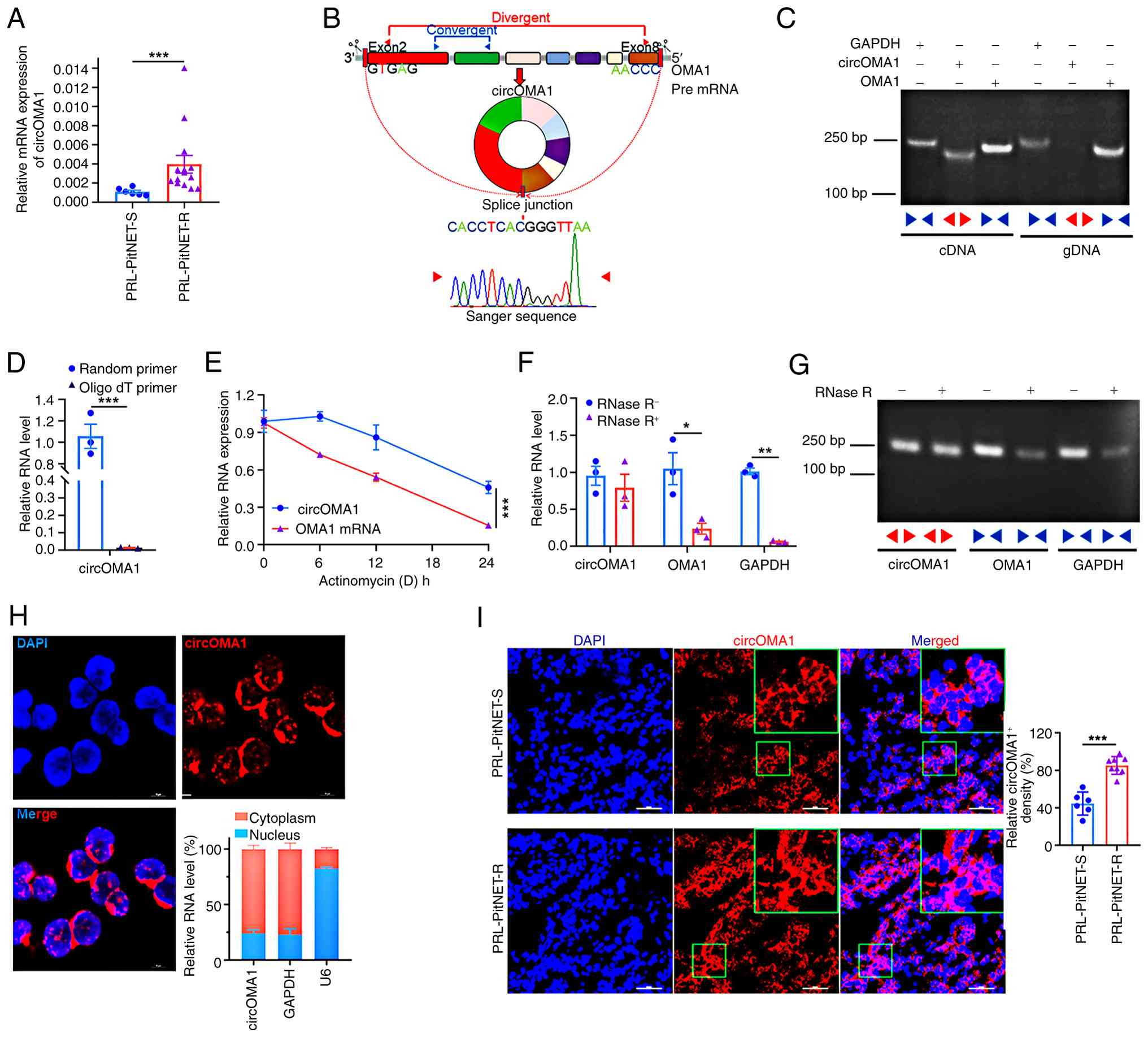
Figure 1

Characteristics and distribution of
circOMA1 in PRL-PitNETs. (A) circOMA1 expression in PRL-PitNET-S
(n=6) and PRL-PitNET-R (n=14) tissues. (B) Illustration of the
annotated genomic region of circOMA1 verified by Sanger sequencing.
(C) Amplification of the linear or back-splicing products was
performed using cDNA and gDNA extracted from circOM-transfected
cells using random primers and detected using agarose gel
electrophoresis. (D) The random primer or Oligo dT primers used to
amplify circOMA1. (E) Linear and circOMA1 expression levels were
measured in circOM cells treated with actinomycin D at different
time points using RT-qPCR. (F and G) RT-qPCR or agarose gel
electrophoresis was used to detect the linear or circOMA1
expression levels of total RNA from circOM cells with or without
RNase R treatment. (H) RNA-FISH and nuclear cytoplasmic separation
were used to detect the distribution and expression of circOMA1 in
circOM cells. Scale bar, 10 μm. (I) Representative image of
the distribution and expression of circOMA1 in PRL-PitNET-S (n=6)
and PRL-PitNET-R (n=8) tissues. Scale bar, 50 μm. Data are
presented as the mean ± SEM. n≥3. Differences between groups were
compared using a unpaired Student's t-test. *P<0.05,
**P<0.01 and ***P<0.001. circ, circular
RNA; PRL-PitNET, prolactin-secreting pituitary neuroendocrine
tumour; PRL-PitNET-S, drug-sensitive PRL-PitNET; PRL-PitNET-R,
drug-resistant PRL-PitNET; gDNA, genomic DNA; RT-qPCR, reverse
transcription-quantitative PCR.

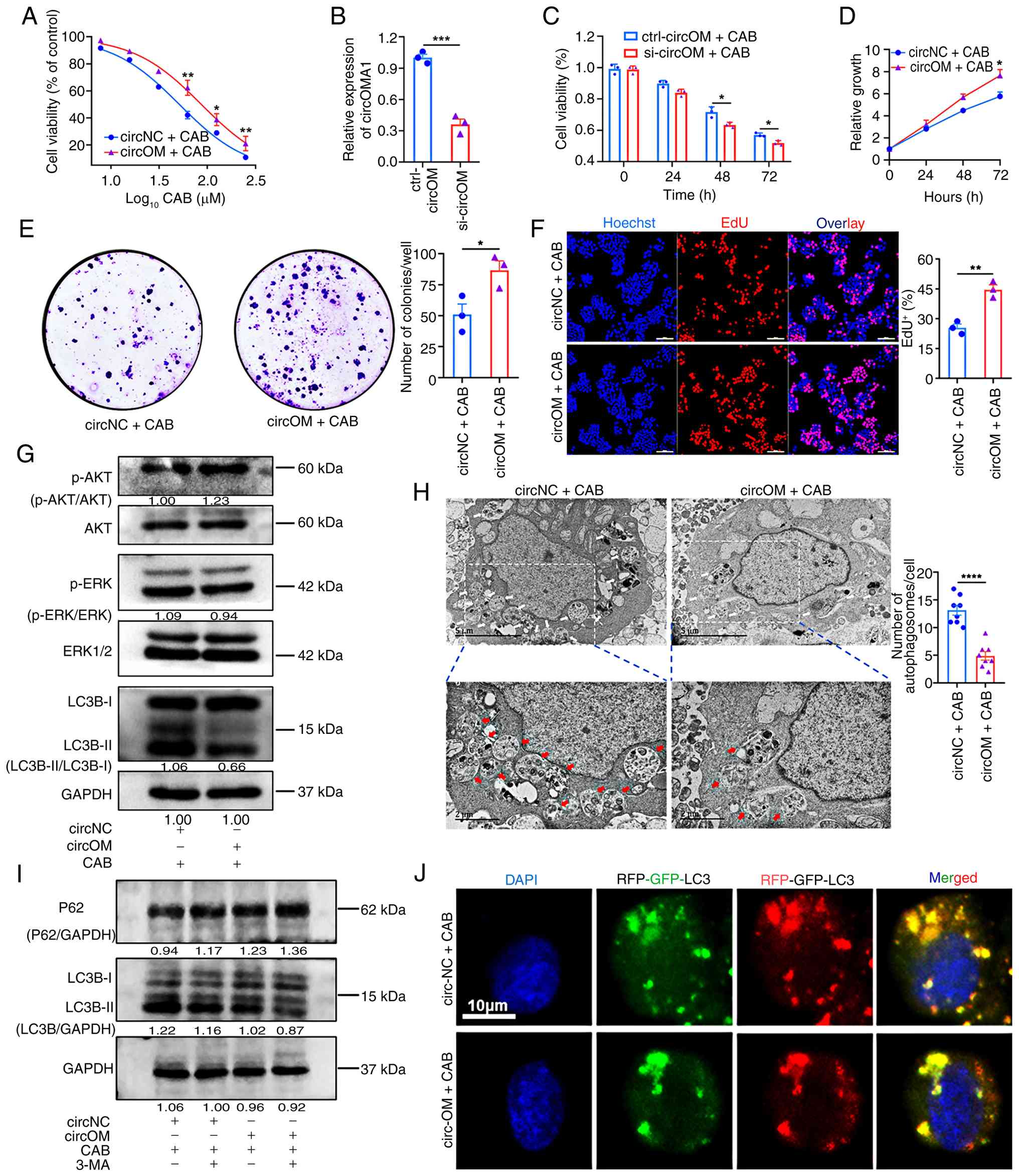
Figure 2

circOMA1promotes CAB resistance in
PRL-PitNET cells through regulation of the autophagy pathway. (A)
CCK-8 determination of IC50 in circOM and circNC cells
after 72 h of treatment with a gradient of CAB concentrations
(R2=0.8611, 0.7030, 0.9248). (B) circOMA1 expression
after 48 h of siRNA targeting. (C) Sensitivity of circOM cells to
50 μM CAB following circOMA1 knockdown
(R2=0.7891, 0.8357). (D-F) Representative images and
quantification (right panels) of CCK-8, colony formation, and EdU
assays used to assess the effect of circNC vs. circOM on CAB
sensitivity. Scale bar, 100 μm. (G) Western blot analysis of
LC3B, p-ERK1/2 and p-AKT in circNC and circOM cells after 72 h of
treatment with 50 μM CAB. (H) Representative transmission
electron microscopy images and quantification of autophagosomes in
circNC (n=8) and circOM (n=8) cells after 72 h of treatment with 50
μM CAB. Scale bars, 5 and 2 μm; arrows indicate
autophagosomes. (I) Western blot analysis of LC3B and p62 in circNC
and circOM cells. (J) Representative confocal images of autophagic
flux in circNC and circOM cells. Scale bar, 10 μm. Data are
presented as the mean ± SEM of at least three repeats. Differences
between groups were compared using an unpaired Student's t-test.
*P<0.05, **P<0.01,
***P<0.001 and ****P<0.0001. CAB,
cabergoline; NC, negative control; circ, circular RNA; PRL-PitNET,
prolactin-secreting pituitary neuroendocrine tumour; siRNA, small
interfering RNA; CCK-8, Cell Counting Kit-8; LC3B,
microtubule-associated protein 1 light chain 3β; p-,
phosphorylated.

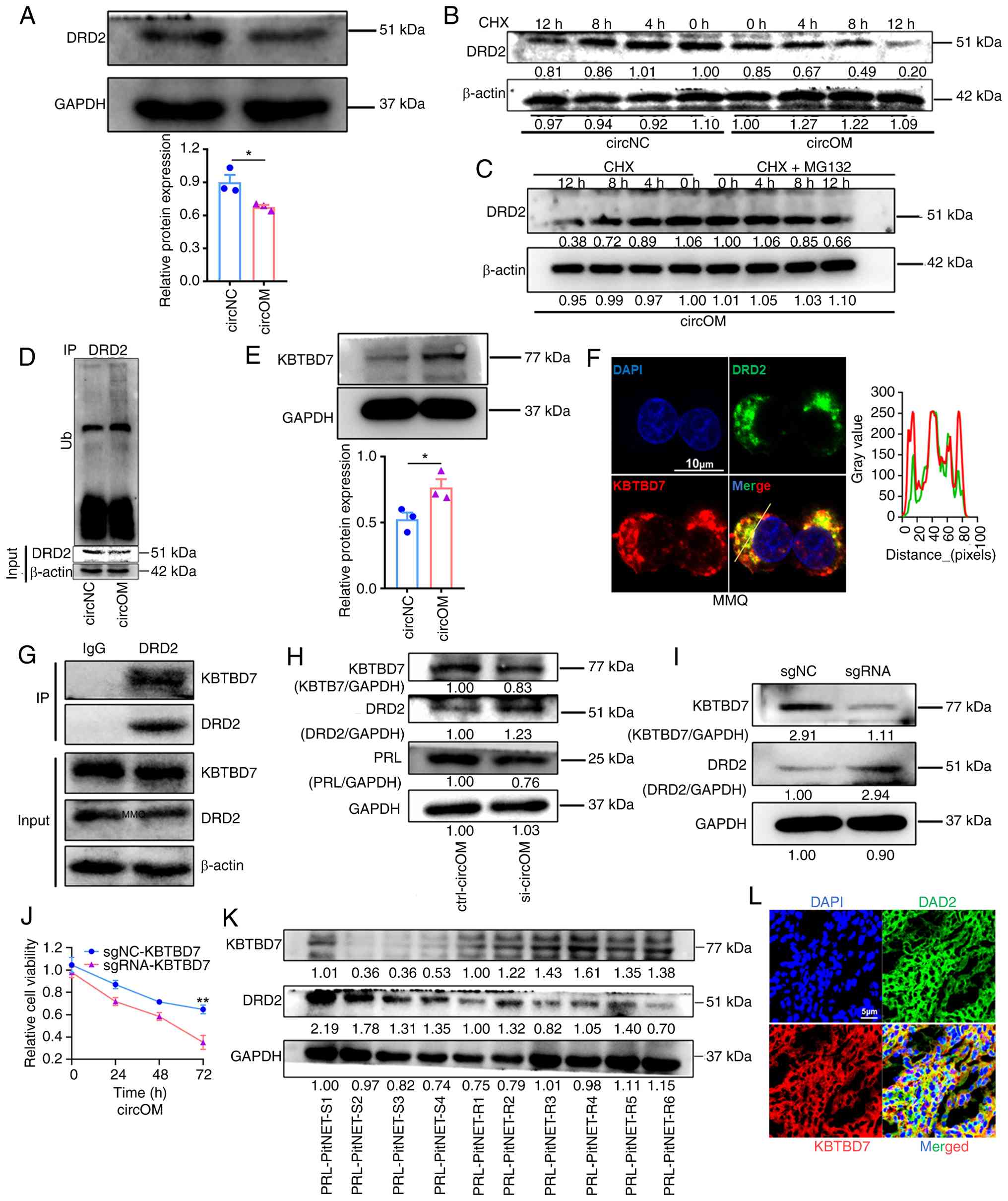
Figure 3

circOMA1 promotes ubiquitin-mediated
degradation of DRD2 and induces CAB resistance in MMQ cells by
upregulating KBTBD7. (A) Western blot detection of DRD2 protein in
circNC and circOM cells (top) with quantification (bottom). (B)
DRD2 protein levels in circNC and circOM cells were measured by
western blotting after treatment with 100 μg/ml CHX for
varying lengths of time. (C) Western blot analysis of DRD2 in
circOM cells at the indicated time points after CHX treatment with
or without treatment with 20 μM MG132. (D) Co-IP analysis of
DRD2 ubiquitination in circNC and circOM cells (green arrow
indicates DRD2). (E) Western blot and densitometric analysis of
KBTBD7 expression in circNC and circOM cells. (F) Representative
immunofluorescence images showing distribution and co-localisation
of DRD2 and KBTBD7 in MMQ cells; the line profile at right
indicates co-localisation. Scale bar, 10 μm. (G) Co-IP
demonstrating the interaction between DRD2 and KBTBD7 in MMQ cells.
(H) Immunoblot analysis of KBTBD7, DRD2 and PRL after circOMA1
knockdown for 72 h in circOM cells. (I) Immunoblot detection of
DRD2 in circOM cells after KBTBD7 knockout by CRISPR/Cas9. (J)
CCK-8 determination of circOM cell sensitivity to CAB after KBTBD7
knockdown (R2=0.9240). (K) Western blot detection of
KBTBD7 and DRD2 in PRL-PitNET-S (n=4) and PRL-PitNET-R (n=6)
tissues. (L) Representative immunofluorescence images showing
distribution and co-localisation of KBTBD7 and DRD2 in PRL-PitNET
tissues. Scale bar, 10 μm. Data are presented as the mean ±
SEM of at least three repeats. Differences between groups were
compared using a unpaired Student's t-test. *P<0.05
and **P<0.01. CAB, cabergoline; NC, negative control;
circ, circular RNA; PRL-PitNET, prolactin-secreting pituitary
neuroendocrine tumour; PRL-PitNET-S, PRL-PitNET-sensitive;
PRL-PitNET-R, PRL-PitNET-resistant; CHX, cycloheximide; MG132,
proteasome inhibitor; CRISPR/Cas9, clustered regularly interspaced
short palindromic repeats/CRISPR-associated protein 9; Co-IP,
co-immunoprecipitation; circ, circular RNA; DRD2, dopamine D2
receptor; KBTBD7, Kelch-repeat and BTB domain-containing protein
7.

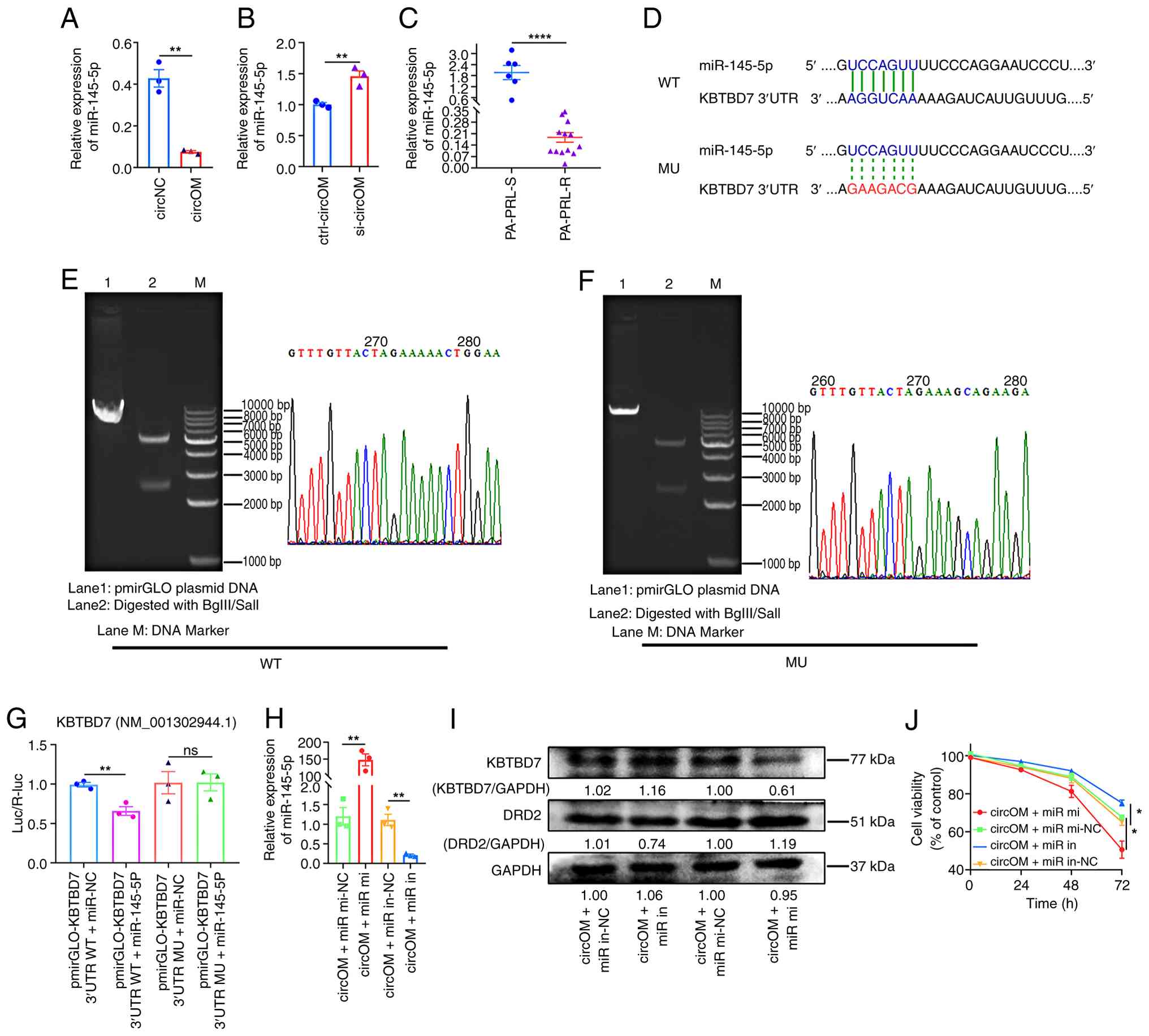
Figure 4

circOMA1 induces CAB resistance in
MMQ cells by regulating DRD2 via a miR-145-5p/KBTBD7 axis. (A)
RT-qPCR measurement of miR-145-5p levels in circNC and circOM
cells. (B) miR-145-5p expression in circOM cells measured using
RT-qPCR 48 h after circOMA1 knockdown. (C) RT-qPCR analysis of
miR-145-5p in PRL-PitNET-S (n=6) and PRL-PitNET-R (n=13) tissues.
(D-F) Bioinformatics prediction of miR-145-5p target sites in
KBTBD7 and schematic of WT and MU dual-luciferase reporter
constructs. (G) Dual-luciferase reporter assay confirming the
miR-145-5p binding site in the KBTBD7 3'-UTR. (H) RT-qPCR of
miR-145-5p in circOM cells 48 h after transfection with miR-145-5p
mimic (miR-mi), mimic negative control (miR-mi-NC), miR-145-5p
inhibitor (miR-in), or inhibitor negative control (miR-in-NC). (I)
Western blot analysis of KBTBD7 and DRD2 protein levels in circOM
cells 72 h after treatment with miR-145-5p mimic or inhibitor. (J)
Cell Counting Kit-8 assay assessing circOM cell sensitivity to 50
μM CAB following treatment with miR-145-5p mimic or
inhibitor (R2=0.8246, 0.8094). Data are presented as the
mean ± SEM of at least three repeats. Differences between groups
were compared using an unpaired Student's t-test.
*P<0.05, **P<0.01 and
****P<0.0001. ns, not significant; CAB, cabergoline;
NC, negative control; circ, circular RNA; PRL-PitNET,
prolactin-secreting pituitary neuroendocrine tumour; PRL-PitNET-S,
PRL-PitNET-sensitive; PRL-PitNET-R, PRL-PitNET-resistant; RT-qPCR,
reverse transcription-quantitative PCR; miR, microRNA; WT,
wild-type; MU, mutant; UTR, untranslated region; KBTBD7,
Kelch-repeat and BTB domain-containing protein 7.

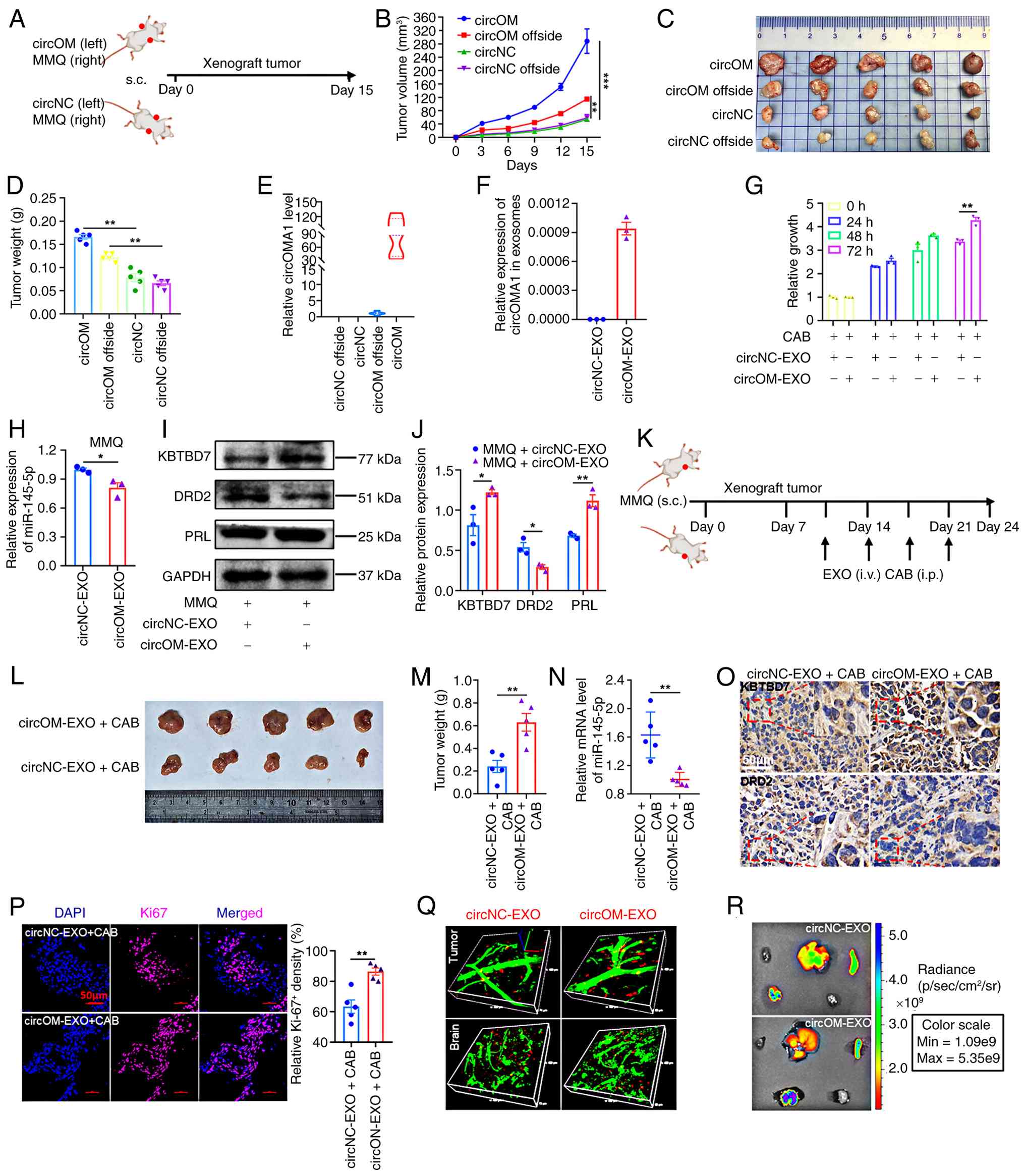
Figure 5

circOMA1 promotes parental cell
proliferation and CAB resistance through exosomes. (A) In
vivo pattern diagram of exosomes promoting parental cell
proliferation. (B) Growth curve of subcutaneous tumours in nude
mice. (C) Excised tumour images (n=5). (D) Mean tumour weight
(n=5). (E) circOMA1 expression in subcutaneous tumours of nude mice
detected using RT-qPCR (n=5). (F) RT-qPCR detection of circOMA1
expression in the exosomes from the supernatant of circNC or circOM
cells. (G) Cell Counting Kit-8 assay of MMQ cell sensitivity to CAB
when co-cultured with circNC-EXO or circOM-EXO (30 μg/ml of
exosomes). (H) RT-qPCR detection of miR-145-5p in MMQ cells after
24 h co-culture with circNC-EXO or circOM-EXO. (I and J) Western
blot detection and densitometric analysis of KBTBD7, DRD2 and PRL
expression in MMQ cells after 72 h co-culture with circNC-EXO or
circOM-EXO. (K) In vivo experimental diagram of exosome
circOMA1-mediated CAB resistance. (L) Excised tumour images (n=5).
(M) Mean tumour weight (n=5). (N) miR-145-5p expression in
subcutaneous tumours of nude mice (n=5). (O) Representative
immunohistochemistry images of KBTBD7 and DRD2 in subcutaneous
tumours of nude mice. Scale bar, 50 μm. (P) Representative
immunofluorescence image and quantification of Ki-67 expression in
the subcutaneous tumours of nude mice. Scale bar, 50 μm. (Q)
Representative microscopic distribution of exosomes in subcutaneous
tumours, and in the brain of nude mice by live imaging assay 24 h
after injection with 100 μg exosomes; green indicates blood
vessels; red indicates exosomes. (R) Representative macroscopic
distribution of exosomes in the heart, liver, spleen, lungs and
kidneys of nude mice by live imaging assay 24 h after injection
with 100 μg exosomes. Data are presented as the mean ± SEM
of at least three repeats. Differences between groups were compared
using an unpaired Student's t-test. *P<0.05,
**P<0.01 and ***P<0.001. CAB,
cabergoline; RT-qPCR, reverse transcription-quantitative PCR; EXO,
exosomes purified from supernatant; KBTBD7, Kelch-repeat and BTB
domain-containing protein 7; DRD2, dopamine receptor D2; PRL,
prolactin.

Figure 6

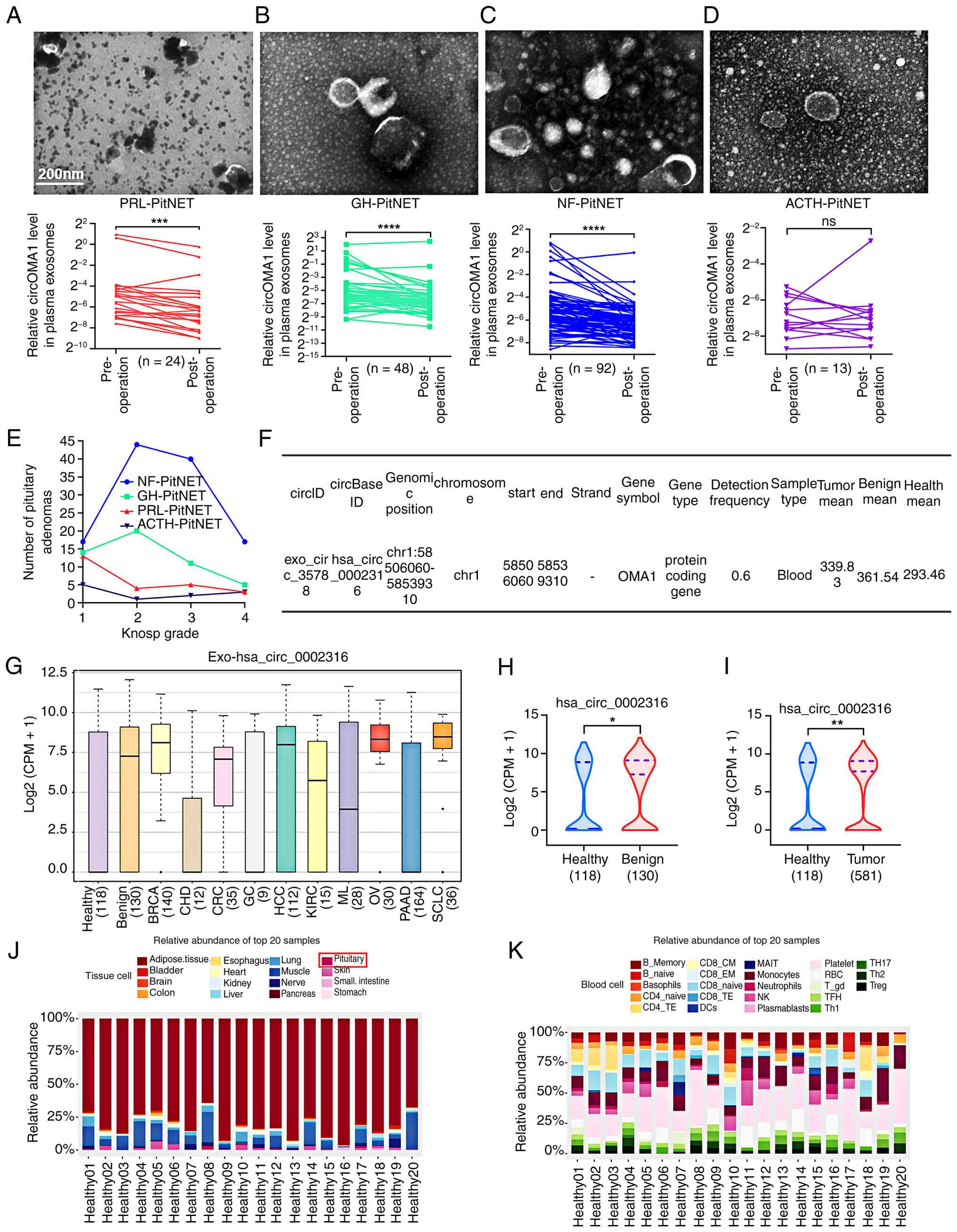
Exosomal circOMA1 can serve as a
potential target for the management and prognosis of PitNETs. (A)
Representative TEM images of plasma exosomes in patients with
PRL-PitNET (top) and preoperative vs. postoperative expression
levels of plasma exosomal circOMA1 (bottom) (n=24). (B)
Representative TEM images of plasma exosomes in patients with
GH-PitNET (top) and preoperative vs. postoperative expression
levels of plasma exosomal circOMA1 (bottom) (n=48). (C)
Representative TEM images of plasma exosomes in patients with
NF-PitNET (top) and preoperative vs. postoperative expression
levels of plasma exosomal circOMA1 (bottom) (n=92). (D)
Representative TEM images of plasma exosomes in patients with
ACTH-PitNET (top) and preoperative vs. postoperative expression
levels of plasma exosomal circOMA1 (bottom) (n=13). (E) Knosp grade
and corresponding number of PitNETs collected. (F) Expression
information of blood exosomal circOMA1 across populations in the
exosome database (http://www.exorbase.org/). (G) Specific expression of
blood exosomal circOMA1 in different population types. (H)
Difference in expression of blood exosomal circOMA1 between healthy
and benign populations. (I) Difference in expression of blood
exosomal circOMA1 between healthy and tumour populations. (J)
Relative expression of circOMA1 in tissue cells of 20 healthy
populations. (K) Relative expression of circOMA1 in blood cells of
20 healthy populations. Data are presented as the mean ± SEM of at
least three repeats. Differences between groups were compared using
a paired Student's t-test (A-D) or unpaired Student's t-test.
*P<0.05, **P<0.01,
***P<0.001 and ****P<0.0001. Scale bar,
200 nm. circRNA, circular RNA; PitNET, pituitary neuroendocrine
tumour; PRL-PitNET, prolactin-secreting PitNET; GH-PitNET, growth
hormone-secreting PitNET; NF-PitNET, nonfunctioning PitNET;
ACTH-PitNET, adrenocorticotropic hormone-secreting PitNET; RT-qPCR,
reverse transcription-quantitative PCR; ns, not significant; TEM,
transmission electron microscopy.

Figure 7

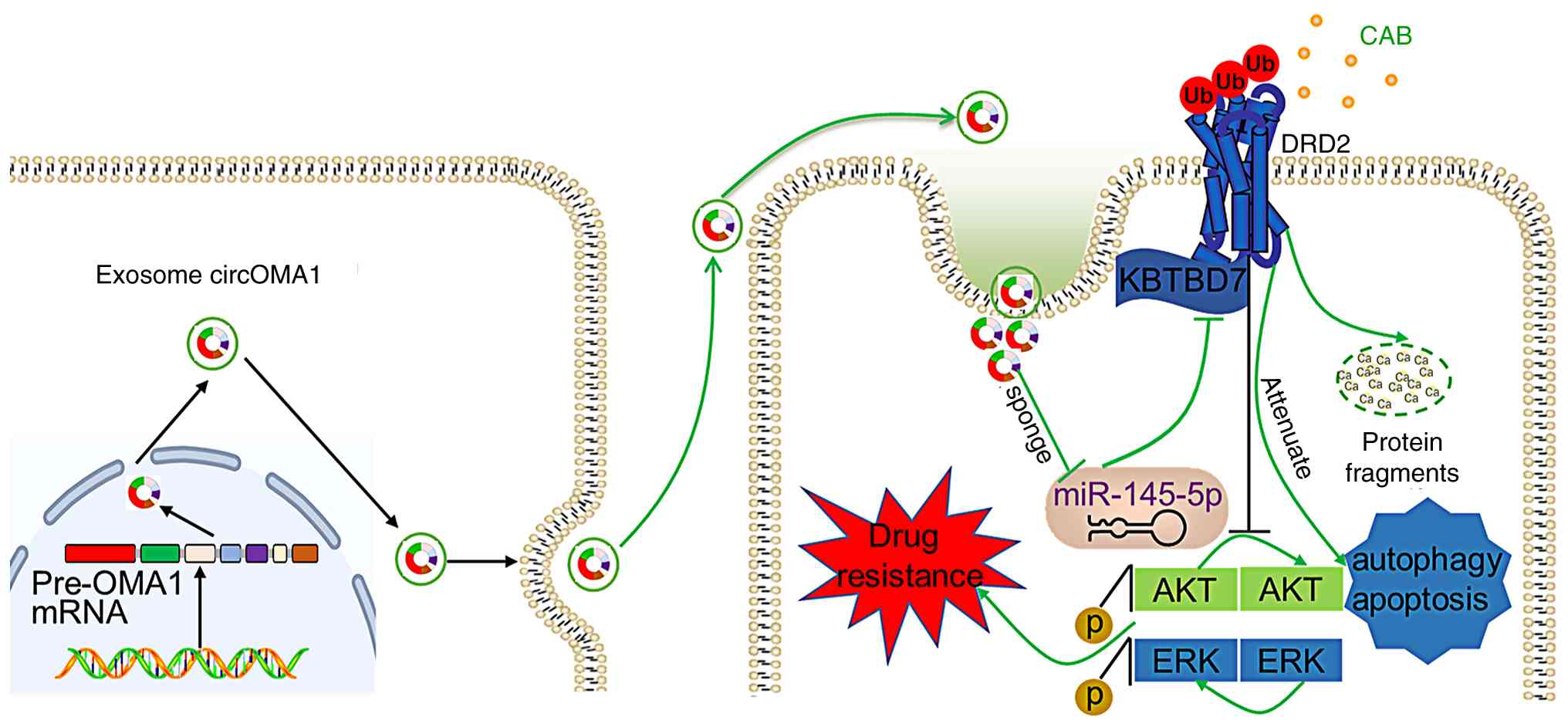
Schematic diagram of circOMA1
regulating the ubiquitination of DRD2 via a miR-145-5p/KBTBD7 axis
to induce resistance in PRL-PitNET and transmit resistance through
exosomes. circRNA, circular RNA; DRD2, dopamine receptor D2; miR,
microRNA; KBTBD7, Kelch-repeat and BTB domain-containing protein 7;
PRL-PitNET, prolactin-secreting pituitary neuroendocrine
tumour.
View References

1 

Tritos NA and Miller KK: Diagnosis and management of pituitary adenomas: A review. JAMA. 329:1386–1398. 2023. View Article : Google Scholar : PubMed/NCBI

2 

Trouillas J, Jaffrain-Rea ML, Vasiljevic A, Raverot G, Roncaroli F and Villa C: How to classify the pituitary neuroendocrine tumors (PitNET)s in 2020. Cancers (Basel). 12. pp. 5142020, View Article : Google Scholar

3 

Villa C, Baussart B, Assié G, Raverot G and Roncaroli F: The World Health Organization classifications of pituitary neuroendocrine tumours: A clinico-pathological appraisal. Endocr Relat Cancer. 30. pp. e2300212023, View Article : Google Scholar

4 

Auriemma RS, Pirchio R, De Alcubierre D, Pivonello R and Colao A: Dopamine agonists: From the 1970s to today. Neuroendocrinology. 109:34–41. 2019. View Article : Google Scholar : PubMed/NCBI

5 

Bevan JS, Webster J, Burke CW and Scanlon MF: Dopamine agonists and pituitary tumor shrinkage. Endocr Rev. 13:220–240. 1992. View Article : Google Scholar : PubMed/NCBI

6 

Molitch ME: Pharmacologic resistance in prolactinoma patients. Pituitary. 8:43–52. 2005. View Article : Google Scholar

7 

Maiter D: Management of dopamine agonist-resistant prolactinoma. Neuroendocrinology. 109:42–50. 2019. View Article : Google Scholar

8 

Wu ZB, Zheng WM, Su ZP, Chen Y, Wu JS, Wang CD, Lin C, Zeng YJ and Zhuge QC: Expression of D2RmRNA isoforms and ERmRNA isoforms in prolactinomas: Correlation with the response to bromocriptine and with tumor biological behavior. J Neurooncol. 99:25–32. 2010. View Article : Google Scholar : PubMed/NCBI

9 

Shimazu S, Shimatsu A, Yamada S, Inoshita N, Nagamura Y, Usui T and Tsukada T: Resistance to dopamine agonists in prolactinoma is correlated with reduction of dopamine D2 receptor long isoform mRNA levels. Eur J Endocrinol. 166:383–390. 2012. View Article : Google Scholar

10 

Bueno C, Trarbach EB, Bronstein MD and Glezer A: Cabergoline and prolactinomas: Lack of association between DRD2 polymorphisms and response to treatment. Pituitary. 20:295–300. 2017. View Article : Google Scholar

11 

Pivonello C, Patalano R, Negri M, Pirchio R, Colao A, Pivonello R and Auriemma RS: Resistance to dopamine agonists in pituitary tumors: Molecular mechanisms. Front Endocrinol (Lausanne). 12:7916332021. View Article : Google Scholar

12 

Song ZJ, Reitman ZJ, Ma ZY, Chen JH, Zhang QL, Shou XF, Huang CX, Wang YF, Li SQ, Mao Y, et al: The genome-wide mutational landscape of pituitary adenomas. Cell Res. 26:1255–1259. 2016. View Article : Google Scholar : PubMed/NCBI

13 

Jiang X and Zhang X: The molecular pathogenesis of pituitary adenomas: An update. Endocrinol Metab (Seoul). 28:245–254. 2013. View Article : Google Scholar

14 

Dance A: Circular logic: Understanding RNA's strangest form yet. Nature. 635:511–513. 2024. View Article : Google Scholar : PubMed/NCBI

15 

Hu K, Liu X, Li Y, Li Q, Xu Y, Zeng W, Zhong G and Yu C: Exosomes Mediated Transfer of Circ_UBE2D2 Enhances the Resistance of Breast Cancer to Tamoxifen by Binding to MiR-200a-3p. Med Sci Monit. 26:e9222532020. View Article : Google Scholar : PubMed/NCBI

16 

Pan Z, Zheng J, Zhang J, Lin J, Lai J, Lyu Z, Feng H, Wang J, Wu D and Li Y: A novel protein encoded by exosomal circATG4B Induces oxaliplatin resistance in colorectal cancer by promoting autophagy. Adv Sci (Weinh). 9:e22045132022. View Article : Google Scholar : PubMed/NCBI

17 

Wang X, Chen T, Li C, Li W, Zhou X, Li Y, Luo D, Zhang N, Chen B, Wang L, et al: CircRNA-CREIT inhibits stress granule assembly and overcomes doxorubicin resistance in TNBC by destabilizing PKR. J Hematol Oncol. 15:1222022. View Article : Google Scholar : PubMed/NCBI

18 

Li L, Li W, Chen N, Zhao H, Xu G, Zhao Y, Pan X, Zhang X, Zhou L, Yu D, et al: FLI1 exonic circular RNAs as a novel oncogenic driver to promote tumor metastasis in small cell lung cancer. Clin Cancer Res. 25:1302–1317. 2019. View Article : Google Scholar

19 

Pan B, Qin J, Liu X, He B, Wang X, Pan Y, Sun H, Xu T, Xu M, Chen X, et al: Identification of serum exosomal hsa-circ-0004771 as a novel diagnostic biomarker of colorectal cancer. Front Genet. 10:10962019. View Article : Google Scholar : PubMed/NCBI

20 

Wen N, Peng D, Xiong X, Liu G, Nie G, Wang Y, Xu J, Wang S, Yang S, Tian Y, et al: Cholangiocarcinoma combined with biliary obstruction: An exosomal circRNA signature for diagnosis and early recurrence monitoring. Signal Transduct Target Ther. 9:1072024. View Article : Google Scholar : PubMed/NCBI

21 

Liu Y, Li Y, Zang J, Zhang T, Li Y, Tan Z, Ma D, Zhang T, Wang S, Zhang Y, et al: CircOGDH is a penumbra biomarker and therapeutic target in acute ischemic stroke. Circ Res. 130:907–924. 2022. View Article : Google Scholar : PubMed/NCBI

22 

Zhang X, Xu Y, Ma L, Yu K, Niu Y, Xu X, Shi Y, Guo S, Xue X, Wang Y, et al: Essential roles of exosome and circRNA_101093 on ferroptosis desensitization in lung adenocarcinoma. Cancer Commun (Lond). 42:287–313. 2022. View Article : Google Scholar : PubMed/NCBI

23 

He YD, Tao W, He T, Wang BY, Tang XM, Zhang LM, Wu ZQ, Deng WM, Zhang LX, Shao CK, et al: A urine extracellular vesicle circRNA classifier for detection of high-grade prostate cancer in patients with prostate-specific antigen 2-10ng/mL at initial biopsy. Mol Cancer. 20:962021. View Article : Google Scholar

24 

Wang J, Zhang Q, Zhou S, Xu H, Wang D, Feng J, Zhao J and Zhong S: Circular RNA expression in exosomes derived from breast cancer cells and patients. Epigenomics. 11:411–421. 2019. View Article : Google Scholar : PubMed/NCBI

25 

Théry C, Ostrowski M and Segura E: Membrane vesicles as conveyors of immune responses. Nat Rev Immunol. 9:581–593. 2009. View Article : Google Scholar : PubMed/NCBI

26 

Liu Y, Ma L, Hua F, Min Z, Zhan Y, Zhang W and Yao J: Exosomal circCARM1 from spheroids reprograms cell metabolism by regulating PFKFB2 in breast cancer. Oncogene. 41:2012–2025. 2022. View Article : Google Scholar : PubMed/NCBI

27 

Zheng R, Zhang K, Tan S, Gao F, Zhang Y, Xu W, Wang H, Gu D, Zhu L, Li S, et al: Exosomal circLPAR1 functions in colorectal cancer diagnosis and tumorigenesis through suppressing BRD4 via METTL3-eIF3h interaction. Mol Cancer. 21:492022. View Article : Google Scholar : PubMed/NCBI

28 

Ding L, Zheng Q, Lin Y, Wang R, Wang H, Luo W, Lu Z, Xie H, Ren L, Lu H, et al: Exosome-derived circTFDP2 promotes prostate cancer progression by preventing PARP1 from caspase-3-dependent cleavage. Clin Transl Med. 13:e11562023. View Article : Google Scholar : PubMed/NCBI

29 

Yao X, Mao Y, Wu D, Zhu Y, Lu J, Huang Y, Guo Y, Wang Z, Zhu S, Li X and Lu Y: Exosomal circ_0030167 derived from BM-MSCs inhibits the invasion, migration, proliferation and stemness of pancreatic cancer cells by sponging miR-338-5p and targeting the Wif1/Wnt8/β-catenin axis. Cancer Lett. 512:38–50. 2021. View Article : Google Scholar : PubMed/NCBI

30 

Xiong Y, Tang Y, Fan F, Zeng Y, Li C, Zhou G, Hu Z, Zhang L and Liu Z: Exosomal hsa-miR-21-5p derived from growth hormone-secreting pituitary adenoma promotes abnormal bone formation in acromegaly. Transl Res. 215:1–16. 2020. View Article : Google Scholar

31 

Zhang Y, Liu YT, Tang H, Xie WQ, Yao H, Gu WT, Zheng YZ, Shang HB, Wang Y, Wei YX, et al: Exosome-Transmitted lncRNA H19 inhibits the growth of pituitary adenoma. J Clin Endocrinol Metab. 104:6345–6356. 2019. View Article : Google Scholar : PubMed/NCBI

32 

Mao ZG, He DS, Zhou J, Yao B, Xiao WW, Chen CH, Zhu YH and Wang HJ: Differential expression of microRNAs in GH-secreting pituitary adenomas. Diagn Pathol. 5:792010. View Article : Google Scholar : PubMed/NCBI

33 

Du Q, Hu B, Feng Y, Wang Z, Wang X, Zhu D, Zhu Y, Jiang X and Wang H: circOMA1-Mediated miR-145-5p suppresses tumor growth of nonfunctioning pituitary adenomas by targeting TPT1. J Clin Endocrinol Metab. 104:2419–2434. 2019. View Article : Google Scholar : PubMed/NCBI

34 

Livak KJ and Schmittgen TD: Analysis of relative gene expression data using real-time quantitative PCR and the 2(-Delta Delta C(T)) Method. Methods. 25:402–408. 2001. View Article : Google Scholar

35 

Jian F, Sun Y, Sun Q, Zhang B and Bian L: NEK2 regulates cellular proliferation and cabergoline sensitivity in pituitary adenomas. J Cancer. 12:2083–2091. 2021. View Article : Google Scholar : PubMed/NCBI

36 

Liu YT, Liu F, Cao L, Xue L, Gu WT, Zheng YZ, Tang H, Wang Y, Yao H, Zhang Y, et al: The KBTBD6/7-DRD2 axis regulates pituitary adenoma sensitivity to dopamine agonist treatment. Acta Neuropathol. 140:377–396. 2020. View Article : Google Scholar : PubMed/NCBI

37 

Wu N, Zhu D, Li J, Li X, Zhu Z, Rao Q, Hu B, Wang H and Zhu Y: CircOMA1 modulates cabergoline resistance by downregulating ferroptosis in prolactinoma. J Endocrinol Invest. 46:1573–1587. 2023. View Article : Google Scholar : PubMed/NCBI

38 

Scully KM, Jacobson EM, Jepsen K, Lunyak V, Viadiu H, Carrière C, Rose DW, Hooshmand F, Aggarwal AK and Rosenfeld MG: Allosteric effects of Pit-1 DNA sites on long-term repression in cell type specification. Science. 290:1127–1131. 2000. View Article : Google Scholar : PubMed/NCBI

39 

Tang C, Sun R, Wen G, Zhong C, Yang J, Zhu J, Cong Z, Luo X and Ma C: Bromocriptine and cabergoline induce cell death in prolactinoma cells via the ERK/EGR1 and AKT/mTOR pathway respectively. Cell Death Dis. 10:3352019. View Article : Google Scholar : PubMed/NCBI

40 

Genau HM, Huber J, Baschieri F, Akutsu M, Dötsch V, Farhan H, Rogov V and Behrends C: CUL3-KBTBD6/KBTBD7 ubiquitin ligase cooperates with GABARAP proteins to spatially restrict TIAM1-RAC1 signaling. Mol Cell. 57:995–1010. 2015. View Article : Google Scholar : PubMed/NCBI

41 

Jian M, Du Q, Zhu D, Mao Z, Wang X, Feng Y, Xiao Z, Wang H and Zhu Y: Tumor suppressor miR-145-5p sensitizes prolactinoma to bromocriptine by downregulating TPT1. J Endocrinol Invest. 42:639–652. 2019. View Article : Google Scholar

42 

Lyu D and Huang S: The emerging role and clinical implication of human exonic circular RNA. RNA Biol. 14:1000–1006. 2017. View Article : Google Scholar :

43 

Lötvall J, Hill AF, Hochberg F, Buzás EI, Di Vizio D, Gardiner C, Gho YS, Kurochkin IV, Mathivanan S, Quesenberry P, et al: Minimal experimental requirements for definition of extracellular vesicles and their functions: A position statement from the International Society for Extracellular Vesicles. J Extracell Vesicles. 3:269132014. View Article : Google Scholar : PubMed/NCBI

44 

Savina A, Vidal M and Colombo MI: The exosome pathway in K562 cells is regulated by Rab11. J Cell Sci. 115(Pt 12): 2505–2515. 2002. View Article : Google Scholar : PubMed/NCBI

45 

Hsu C, Morohashi Y, Yoshimura S, Manrique-Hoyos N, Jung S, Lauterbach MA, Bakhti M, Grønborg M, Möbius W, Rhee J, et al: Regulation of exosome secretion by Rab35 and its GTPase-activating proteins TBC1D10A-C. J Cell Biol. 189:223–232. 2010. View Article : Google Scholar : PubMed/NCBI

46 

Ostrowski M, Carmo NB, Krumeich S, Fanget I, Raposo G, Savina A, Moita CF, Schauer K, Hume AN, Freitas RP, et al: Rab27a and Rab27b control different steps of the exosome secretion pathway. Nat Cell Biol. 12:19–30, sup 1-13. 2010. View Article : Google Scholar

47 

Qi Y, Xu R, Song C, Hao M, Gao Y, Xin M, Liu Q, Chen H, Wu X, Sun R, et al: A comprehensive database of exosome molecular biomarkers and disease-gene associations. Sci Data. 11:2102024. View Article : Google Scholar : PubMed/NCBI

48 

Glezer A and Bronstein MD: Prolactinomas. Endocrinol Metab Clin North Am. 44:71–78. 2015. View Article : Google Scholar : PubMed/NCBI

49 

Curran MP and Perry CM: Cabergoline: A review of its use in the treatment of Parkinson's disease. Drugs. 64:2125–2141. 2004. View Article : Google Scholar

50 

Pisignano G, Michael DC, Visal TH, Pirlog R, Ladomery M and Calin GA: Going circular: History, present, and future of circRNAs in cancer. Oncogene. 42:2783–2800. 2023. View Article : Google Scholar : PubMed/NCBI

51 

Song R, Guo P, Ren X, Zhou L, Li P, Rahman NA, Wołczyński S, Li X, Zhang Y, Liu M, et al: A novel polypeptide CAPG-171aa encoded by circCAPG plays a critical role in triple-negative breast cancer. Mol Cancer. 22:1042023. View Article : Google Scholar : PubMed/NCBI

52 

Huang D, Zhu X, Ye S, Zhang J, Liao J, Zhang N, Zeng X, Wang J, Yang B, Zhang Y, et al: Tumour circular RNAs elicit anti-tumour immunity by encoding cryptic peptides. Nature. 625:593–602. 2024. View Article : Google Scholar

53 

Yim KHW, Krzyzaniak O, Al Hrout A, Peacock B and Chahwan R: Assessing extracellular vesicles in human biofluids using flow-based analyzers. Adv Healthc Mater. 12:e23017062023. View Article : Google Scholar : PubMed/NCBI

Related Articles

  • Abstract
  • View
  • Download
  • Twitter
Copy and paste a formatted citation
Spandidos Publications style
Rao Q, Zhu D, Wang Z, Zhang S, Li X, Tagilapalli S, Wang N, Hu W, Chen W, Zhu Y, Zhu Y, et al: circOMA1 delivered by exosomes regulates DRD2‑mediated prolactinoma resistance. Int J Mol Med 57: 141, 2026.
APA
Rao, Q., Zhu, D., Wang, Z., Zhang, S., Li, X., Tagilapalli, S. ... Zhu, Y. (2026). circOMA1 delivered by exosomes regulates DRD2‑mediated prolactinoma resistance. International Journal of Molecular Medicine, 57, 141. https://doi.org/10.3892/ijmm.2026.5812
MLA
Rao, Q., Zhu, D., Wang, Z., Zhang, S., Li, X., Tagilapalli, S., Wang, N., Hu, W., Chen, W., Zhu, Y."circOMA1 delivered by exosomes regulates DRD2‑mediated prolactinoma resistance". International Journal of Molecular Medicine 57.6 (2026): 141.
Chicago
Rao, Q., Zhu, D., Wang, Z., Zhang, S., Li, X., Tagilapalli, S., Wang, N., Hu, W., Chen, W., Zhu, Y."circOMA1 delivered by exosomes regulates DRD2‑mediated prolactinoma resistance". International Journal of Molecular Medicine 57, no. 6 (2026): 141. https://doi.org/10.3892/ijmm.2026.5812
Copy and paste a formatted citation
x
Spandidos Publications style
Rao Q, Zhu D, Wang Z, Zhang S, Li X, Tagilapalli S, Wang N, Hu W, Chen W, Zhu Y, Zhu Y, et al: circOMA1 delivered by exosomes regulates DRD2‑mediated prolactinoma resistance. Int J Mol Med 57: 141, 2026.
APA
Rao, Q., Zhu, D., Wang, Z., Zhang, S., Li, X., Tagilapalli, S. ... Zhu, Y. (2026). circOMA1 delivered by exosomes regulates DRD2‑mediated prolactinoma resistance. International Journal of Molecular Medicine, 57, 141. https://doi.org/10.3892/ijmm.2026.5812
MLA
Rao, Q., Zhu, D., Wang, Z., Zhang, S., Li, X., Tagilapalli, S., Wang, N., Hu, W., Chen, W., Zhu, Y."circOMA1 delivered by exosomes regulates DRD2‑mediated prolactinoma resistance". International Journal of Molecular Medicine 57.6 (2026): 141.
Chicago
Rao, Q., Zhu, D., Wang, Z., Zhang, S., Li, X., Tagilapalli, S., Wang, N., Hu, W., Chen, W., Zhu, Y."circOMA1 delivered by exosomes regulates DRD2‑mediated prolactinoma resistance". International Journal of Molecular Medicine 57, no. 6 (2026): 141. https://doi.org/10.3892/ijmm.2026.5812
Follow us
  • Twitter
  • LinkedIn
  • Facebook
About
  • Spandidos Publications
  • Careers
  • Cookie Policy
  • Privacy Policy
How can we help?
  • Help
  • Live Chat
  • Contact
  • Email to our Support Team