Int J Mol Med 39: [Related article:] 1580-1588, 2017; DOI:
10.3892/ijmm.2017.2969
Following the publication of the above article, an
interested reader drew to the authors' attention that, concerning
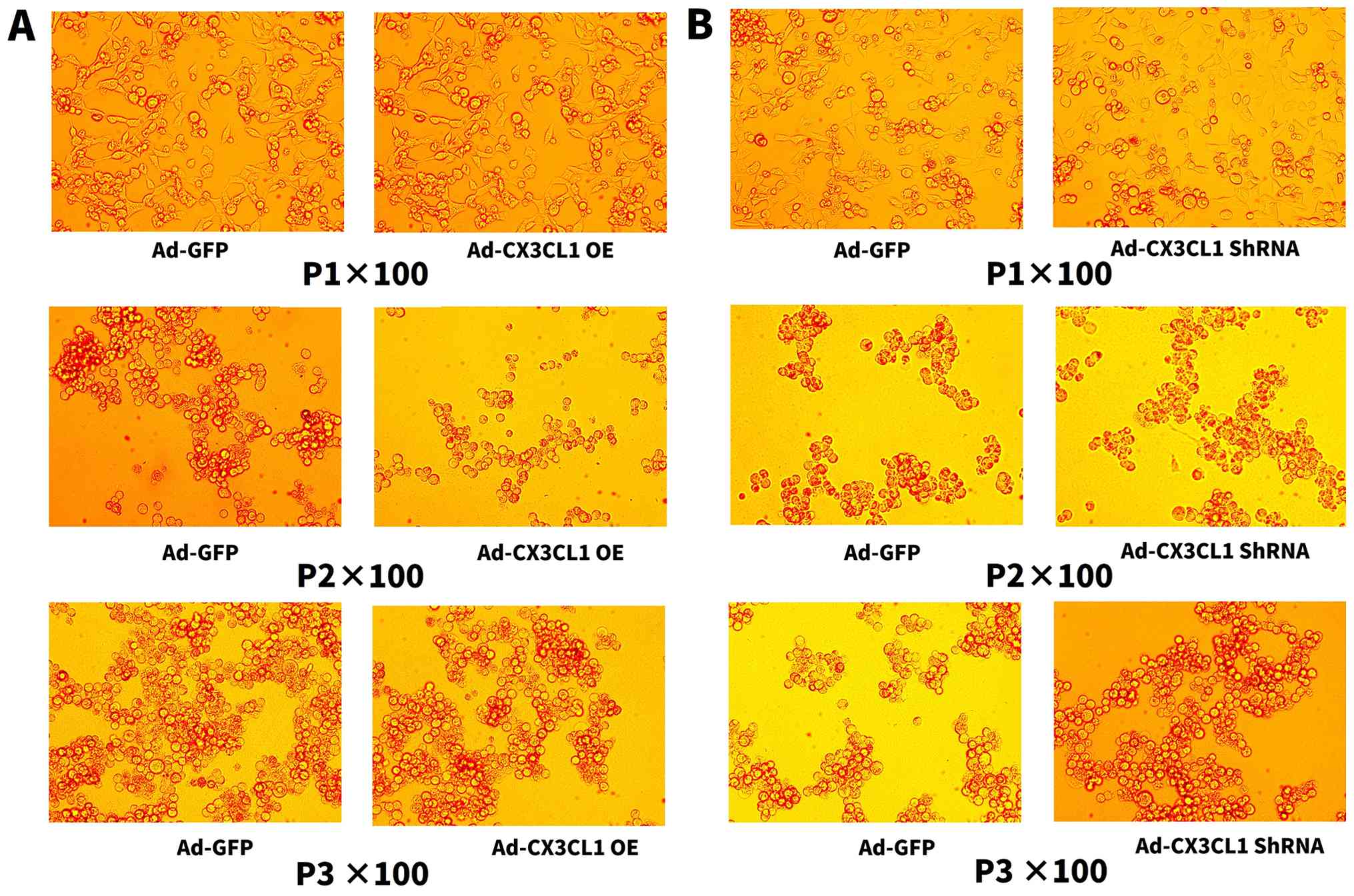
the images showing the construction of the CX3CL1-overexpression
adenovirus and the CX3CL1 short hairpin RNA (shRNA) adenovirus in
Fig. 1 on p. 1581, the 'P3x100,
Ad-CX3CL1 OE' data panel in Fig.
1A contained an overlapping section with the 'P3x100, Ad-CX3CL1
shRNA1' data panel in Fig. 1B,
such that these were apparently derived from the same original
source where different experiment conditions were reported. In
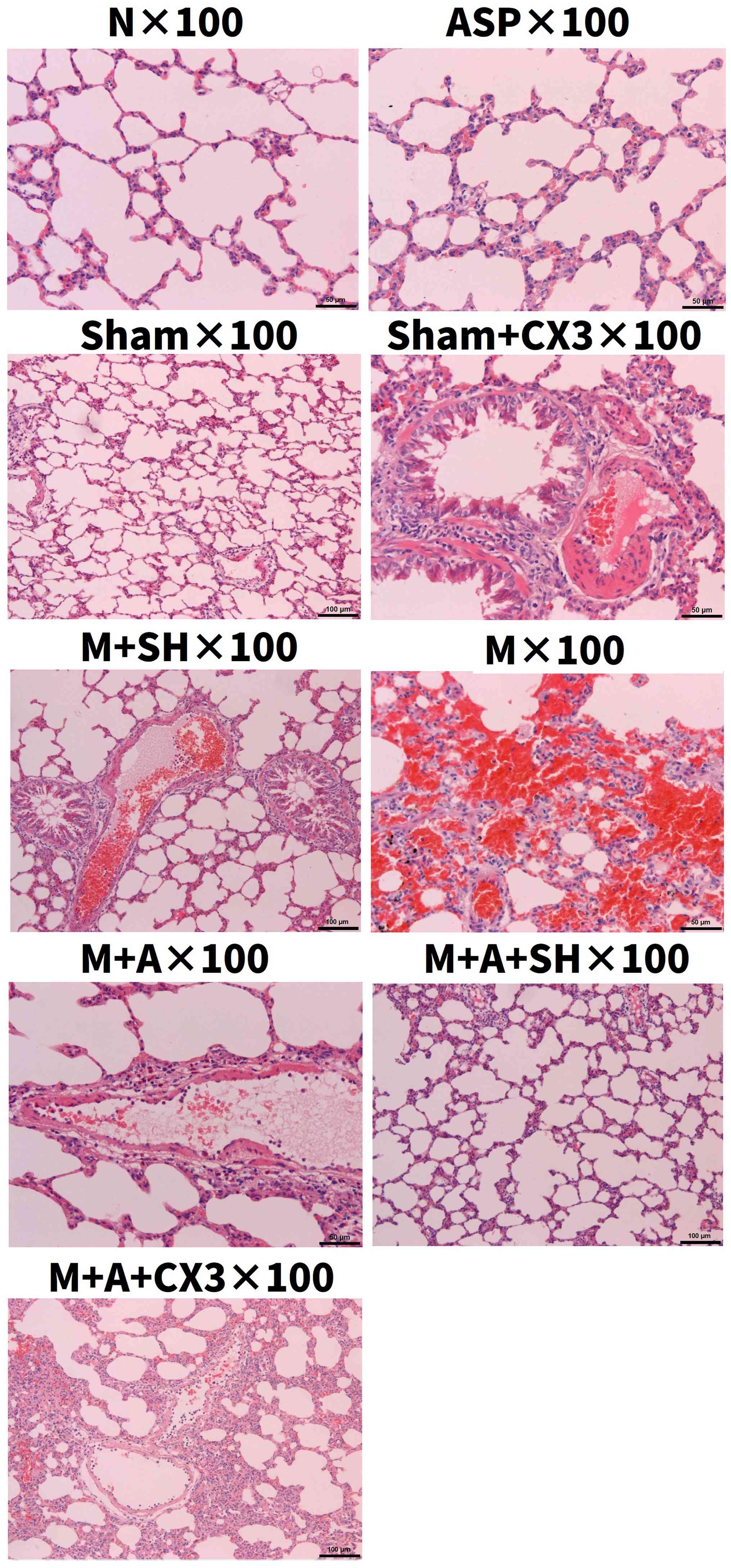
addition, for the lung pathology images shown in Fig. 3 on p. 1584, the images showing
the 'ASPx100' and the 'M+Ax100' experiments were apparently
identical, suggesting that this figure had also been assembled
incorrectly.
After re-examining their original data, the authors
regret that Figs. 1 and 3 did contain errors in terms of their
assembly, as identified by the external reader. Concerning Fig. 1, the authors wish to point out
that these experiments were performed by the virus packaging
company (Hanbio Biotechnology), who acknowledged that they were
responsible for the error that was made in the provision of the
images for this figure. Moreover, this error did not have any real
significance in terms of the reported reports in this study, since
neither shRNA1 nor shRNA2 was ultimately selected as the vector for
the subsequent experiments; shRNA3 was selected as the interference
vector of choice. Therefore, the Editor has approved the inclusion
of a new version of Fig. 1 in
this Corrigendum, comprising only the data for shRNA3 in Fig. 1B. Regarding Fig. 3, the revised version of this is
also shown in the subsequent pages, showing the correct data for
the 'Nx100', 'ASPx100' and 'M+Ax100' panels.
Note that the revisions made to these figures do not
affect the overall conclusions reported in the paper. The authors
express their gratitude to the Editor of International Journal
of Molecular Medicine for allowing them the opportunity to
publish this corrigendum, and apologize to the readership for any
inconvenience caused.