Post-translational modifications (PTMs) encompass a
diverse range of chemical alterations that occur at the side chains
or terminal ends of proteins following translation. According to
data from the SWISS-PROT database, the five most prevalent PTMs are
phosphorylation, acetylation, glycosylation, amidation and
hydroxylation (1). These
modifications play critical roles in the regulation of protein
function, stability and interactions with other biomolecules. In
eukaryotic cells, chromosomes consist of highly compacted DNA and
proteins, and PTMs are indispensable for altering chromatin
structure and function.
In 1964, Vincent Allfrey first identified protein
acetylation in the calf thymus nucleus in vitro and
established the foundation for subsequent research on this
modification (2). Lysine
acetylation is a reversible PTM that profoundly influences diverse
cellular processes, including chromatin remodeling, transcriptional
regulation, DNA damage repair, cellular metabolism, cytoskeletal
organization and apoptosis (3).
Lysine acetylation is primarily controlled by two
key enzyme families: Lysine acetyltransferases (KATs) and lysine
deacetylases (KDACs) (4). KATs
facilitate the addition of acetyl groups from acetyl-CoA to lysine
residues, while KDACs catalyze the removal of these groups, thereby
sustaining the dynamic equilibrium between acetylation and
deacetylation.
Histones are the most frequently acetylated
proteins. They serve as fundamental units for DNA organization,
functioning as the structural core of chromatin. Canonical histones
are modified by various KATs and KDACs (5). The acetylation of histone lysine
residues neutralizes their positive charges, which weakens
electrostatic attractions among nucleosomes, loosens chromatin
structure, and consequently facilitates gene transcription
(6). Proteomics analyses have
demonstrated that numerous non-histone proteins can also be
acetylated. These acetylated non-histone proteins participate in a
wide range of metabolic regulation, RNA maturation, translational
control, protein folding, chromatin remodeling, proteolysis and the
maintenance of cytoskeletal architecture (7).
Lysine acetylation modulates protein function
through altering protein stability, catalytic activity and
intracellular distribution, as well as interacting with other PTMs.
Moreover, this modification regulates both protein-protein and DNA
protein interactions. As a flexible regulatory mechanism, lysine
acetylation provides cells with a refined control over
physiological processes and offers novel insights into disease
pathogenesis. Recently, enzymes involved in acetylation have
emerged as promising targets for drug development.
Protein acetylation was first identified in nuclear
histones in the 1960s and was initially regarded as a regulatory
mechanism predominantly involved in chromatin organization and gene
transcription. Accordingly, early studies referred to this
modification as 'histone acetylation' (8). With the advent of proteomics and
mass spectrometry in the early 21st century, it has become clear
that acetylation is not restricted to histones, but is also
widespread among numerous non-histone proteins in the cytoplasm and
mitochondria. Consequently, the concept has been broadened and is
now more accurately described as 'lysine acetylation', which is
increasingly recognized as a pivotal regulator of diverse
biological processes (9). Mass
spectrometry remains the primary tool for the site-specific
identification and quantitative analysis of protein acetylation.
More recently, the Iseq-Kac (internal standard-assisted
quantification) strategy has been introduced, allowing the
efficient profiling of the acetylome under low-abundance conditions
without enrichment procedures (10) (Fig. 1).
Based on their subcellular localization, KATs can be
broadly classified into two major categories: Type A and Type B.
Type A KATs are mainly localized in the nucleus and regulate
chromatin accessibility, transcriptional activation and chromatin
remodeling by catalyzing histone acetylation. Representative
members include CBP and p300. By contrast, Type B KATs are
predominantly cytoplasmic and are involved in the acetylation of
newly synthesized histones and non-histone proteins, thereby
playing essential roles in protein maturation, nuclear transport,
and post-transcriptional regulation. In addition to their distinct
subcellular localization, KATs exhibit specific substrate
preferences. For example, GCN5 preferentially catalyzes histone
H3K14 acetylation, while exhibiting relatively limited activity
toward global nucleosome acetylation (11).
Furthermore, based on sequence homology and the
characteristics of catalytic domains, eukaryotic KATs are mainly
classified into several families, including the GCN5-related
N-acetyltransferase (GNAT), CBP/p300, MYST, basal transcription
factor, NCoA and other families. The GNAT family mainly consists of
GCN5, PCAF and their associated transcriptional coactivator
complexes such as SAGA, ATAC and TFTC, and has been implicated in
cancer, cardiovascular disorders, inflammatory diseases and genetic
disorders (12-19). The CBP/p300 family primarily
functions as transcriptional coactivators with intrinsic
acetyltransferase activity and plays critical roles in gene
regulation, cellular differentiation and disease development,
including cancer and developmental disorders (20-23). The MYST family comprises TIP60,
MOZ, MORF and HBO1, as well as multiple associated protein
complexes, including NuA4, MSL, NSL and SWR1-like complexes.
Members of this family participate in the immune responses, and
their dysregulation has been shown to be associated with various
pathological conditions, particularly inflammation and malignancies
(24-30). In addition, KATs associated with
basal transcription factors and nuclear receptor coactivators, such
as TFIID, TFIIIC and NCoA complexes, contribute to transcriptional
regulation and have been linked to human diseases (31-33). Other KAT-associated complexes,
such as the HAT1-containing HAT-B complex and HAT4, have also been
implicated in specific pathological conditions, although their
biological functions and disease associations remain less
extensively characterized (34-36). The classification of KAT
families, associated complexes and their disease relevance are
summarized in Table I.
KDACs function together with KATs to maintain
acetylation homeostasis. Based on their catalytic mechanisms, KDACs
can be classified into Zn2+-dependent histone
deacetylases (HDACs) and NAD+-dependent sirtuins
(37).
Class II HDACs consist of two subclasses: Class IIa
(HDAC4, HDAC5, HDAC7, and HDAC9) and Class IIb (HDAC6 and HDAC10).
These enzymes exhibit dynamic shuttling between the nucleus and
cytoplasm (53-55). Among them, HDAC6 mainly targets
non-histone substrates, such as tubulin, and plays important roles
in regulating cell migration and stress responses (56-58). Abnormalities in Class II HDAC
function have been implicated in inflammatory disorders, metabolic
dysfunction, neurological injury and cancer (59-69).
Class III HDACs, also known as the sirtuin family
(SIRT1-SIRT7), play essential regulatory roles in multiple
diseases, regulate metabolism, stress responses, mitochondrial
function and aging processes, and are involved in diverse diseases,
including cancer, cardiovascular disorders and metabolic diseases
(70-88). Class IV HDACs mainly consist of
HDAC11, which has been reported to participate in immune regulation
and pathological processes (89,90). The classification of the
different KDAC families and their associated diseases are
summarized in Table II.
Lysine acetyltransferases and deacetylases play
essential roles in cellular physiology. Their interplay modulates
the acetylation status of lysine residues, thereby regulating
chromatin dynamics and influencing gene expression, cellular
metabolism, and other biological processes.
Lysine acetylation plays a crucial role in
regulating gene transcription by modulating chromatin structure,
transcription factor activity and the assembly of transcriptional
regulatory complexes.
Ada3 is acetylated at lysine residues, together with
its interaction with GCN5 and SPT7, promotes the formation of SAGA
homodimers. This complex exhibits a high nucleosome acetylation
efficiency, thereby enhancing its transcriptional activity. The
findings underscore the essential contribution of acetylation to
transcriptional regulation and the central role of the SAGA complex
in gene expression (91). The
expression of CCND1 results from the HDAC8-mediated deacetylation
of PKM2, which subsequently affects its interaction with β-catenin
(92). Additionally, the
KAT5-mediated N-terminal acetylation of cGAS promotes the
transcription of antiviral genes as part of the innate immune
response (93). HDAC3 activity
has been shown to initiate the transcription of the Ucp1 gene and
enhance the expression of genes involved in mitochondrial oxidative
phosphorylation, which are essential for thermogenesis in brown
adipose tissue (94).
PCAF-mediated acetylation of METTL3 at K177 disrupts its
interaction with translation initiation factor subunit EIF3H,
thereby reducing ribosomal translation efficiency (95). The acetylation of histone3 at K56
functions as a genome-wide transcriptional activator by enhancing
promoter-proximal nucleosome destabilization and reassembly during
the S-phase (96). Additionally,
transcription assays using RNAP-II have revealed that nucleosomes
bearing N-terminally acetylated H3 significantly reduced RNAP-II
pause, resulting in increased transcript abundance (97).
In response to DNA damage, lysine acetylation
regulates genome stability by modulating chromatin remodeling,
facilitating the recruitment of DNA repair factors, and
coordinating DNA repair pathway activation.
The acetylation of TDP-43 at K136 affects RNA
binding and splicing, inducing phase separation and the
accumulation of insoluble aggregates composed of TDP-43 that is
pathologically phosphorylated and ubiquitinated (98). The acetylation and
autophosphorylation of TIP60 initiate DNA damage responses by
activating ataxia-telangiectasia mutated (ATM), while SIRT7
facilitates DNA repair by binding to and removing acetyl groups
from ATM (99). The acetylation
of nuclear lamin B1 (LMNB1) at K134 modulates nuclear peripheral
stability, cell cycle progression, and DNA repair, in part by
impairing 53BP1 recruitment to DNA lesions, thereby inhibiting
non-homologous end joining and delaying the G1/S transition
(100). In response to
poly-ADP-ribosylation, pyruvate dehydrogenase E1α is rapidly
localized to chromatin, where it produces acetyl-CoA at sites of
DNA double-strand breaks, promoting chromatin relaxation and
facilitating repair factor recruitment and genome stability
(101). Upon DNA damage,
acetylation of E2F1 generates a specific recognition motif for the
bromodomains of KAT3A and KAT3B, facilitating their recruitment to
sites of double-strand breaks. This localization promotes further
acetylation processes and the assembly of chromatin-remodeling and
DNA repair complexes, including Tip60, BRG1 and NBS1 (102).
The process of autophagy is fundamental to the
maintenance of intracellular equilibrium, particularly during
nutrient deprivation, by degrading stored energy sources.
Acetyl-CoA, a primary intracellular acetyl donor, promotes mTORC1
activation by enhancing ep300-mediated acetylation of raptor at
K1097, thereby inhibiting autophagy (103,104).
GCN5-mediated acetylation inhibits TFEB
transcriptional activity by preventing its dimerization, owing to a
non-conserved K116 site within the MiT/TFE family, thereby
impairing autophagosome formation (105). SIRT1-deficient embryos and
neonatal mice accumulate mitochondria, and exhibit elevated p62
levels, AMPK activation and lethality. NAD+, essential
for cellular processes and a cofactor for some histone
deacetylases, is critical for autophagy regulation, particularly
under starvation conditions where SIRT1 activity is
NAD+-dependent (106). NAMPT expression is regulated by
the acetylation of upstream enhancers and modulates intracellular
NAD+ levels (107).
The acetylation also affects metabolism-related gene expression,
and metabolic states reciprocally influence acetyltransferase and
deacetylase activities. KAT8 is crucial for metabolic regulation,
and MOF depletion during neuronal development is associated with
the accumulation of stearic acid and long-chain fatty acids
(108). NatB-mediated
N-terminal acetylation of Act1 promotes actin filament assembly,
aiding Atg9 vesicle trafficking and autophagosome formation.
Acetylation of the N-terminus of Vps1 enhances its interaction with
SNARE proteins, facilitating autophagosome-vacuole fusion (109). RB1CC1/FIP200, a key autophagy
regulator, is acetylated at K276 by CREB, which reduces its
ubiquitination and degradation, thereby enhancing autophagic
activity in diseases, such as breast cancer (110).
Lysine acetylation is also a key factor involved in
the dynamic changes in chromatin organization and transcriptional
regulation. Thus, lysine acetylation plays an essential role in
maintaining pluripotency and directing cellular differentiation by
modulating gene expression programs.
KAT5 is essential for embryonic stem cell
development, and its deficiency impairs embryogenesis (111). The proper regulation of KAT
enzymatic function is crucial for sustaining equilibrium between
hematopoietic stem cell self-renewal and lineage commitment. MOF
deficiency impairs erythroid development, likely due to reduced
H4K16ac levels and altered chromatin accessibility (112). Acetyl-CoA influences endodermal
differentiation by promoting the acetylation of Smad3 at lysine 19,
a key transcription factor in endodermal lineage commitment
(113). KAT7 regulates adult
HSCs, and its deletion causes HSC quiescence, hematopoietic
failure, and pancytopenia in mice (114). Histone deacetylase SIRT6
interacts with Pol II to inhibit NELF release and, maintain Pol II
pausing. SIRT6 deficiency or chromatin defects enrich H3K9ac and
H3K56ac under glucose starvation, activating CDK9 phosphorylation
of NELF and Pol II and recruiting MYC, BRD4, PAF1, AFF4 and ELL2,
which enhances transcriptional regulation of genes that participate
in metabolism, protein synthesis and development (115).
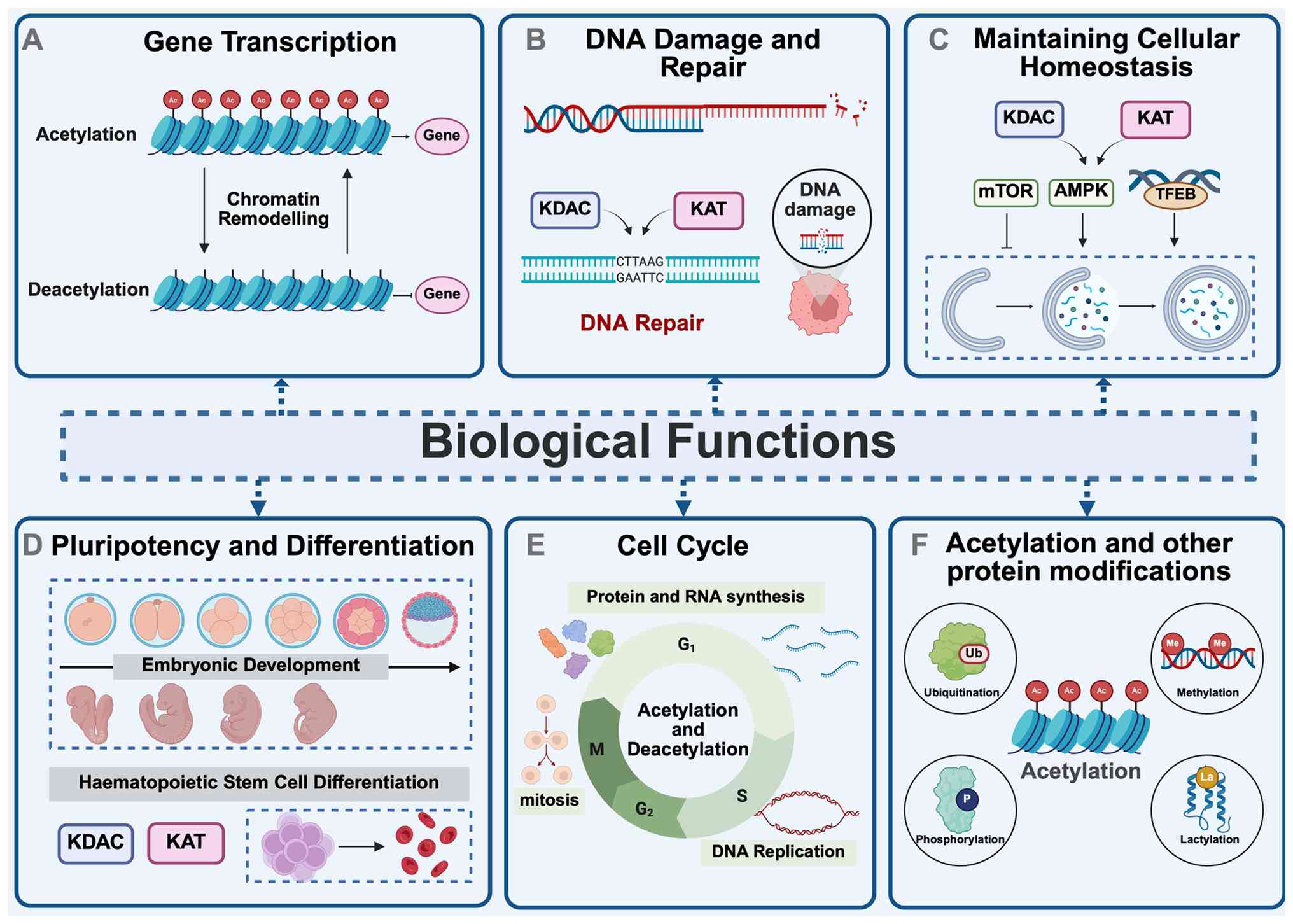
Cell cycle progression requires dynamic regulation
of chromatin structure and gene expression. Lysine acetylation
contributes to this process by controlling histone modification
patterns and regulating the activity of cell cycle-associated
proteins. KATs and KDACs function differently during interphase and
mitosis. KAT5 acetylates multiple lysine residues on H2A, H3 and H4
during interphase. During mitosis, KAT5 acetylates Aurora-B at
residue K215, preventing its dephosphorylation by PP2A and ensuring
an accurate metaphase-to-anaphase transition (116). KAT5 deficiency disrupts
metaphase alignment and inhibits cell growth during mitosis
(117). The inhibition of the
CBP bromodomain by CCS1477 results in cell cycle arrest and
enhances differentiation in a range of tumor (118). Tip60 reverses HDAC8-mediated
deacetylation at K202, limiting HDAC8 activity, enhancing SMC3
acetylation, impairing cohesion and cell cycle progression, and
inducing G2/M arrest (119).
Aberrant CHK2 activation induces cell cycle inhibition and
subsequent cell death, while SIRT1 directly engages CHK2 to mediate
its deacetylation at the K520 site, thereby reducing CHK2
phosphorylation, dimerization, and activation, and maintaining
genome integrity and homeostasis (120). Taken together, these findings
highlight lysine acetylation as a dynamic epigenetic regulatory
layer that integrates transcriptional regulation, genome
maintenance, metabolism, cell fate determination and cell cycle
progression (Fig. 2).
Lysine acetylation does not function independently,
but interacts extensively with other PTMs, including
ubiquitination, phosphorylation, methylation and lactylation. These
interactions regulate protein stability, activity and cellular
signaling. Acetylation protects proteins from ubiquitination by
masking lysine residues, thereby preventing their degradation. For
example, HDAC inhibitors, such as TSA, enhance ENaC acetylation and
abundance, while reducing its ubiquitination. By contrast, HDAC7
promotes ENaC ubiquitination (121). Conversely, acetylation enhances
protein ubiquitination and degradation. PEPCK1 acetylation recruits
the E3 ligase UBR5, which leads to its degradation (122). AMPK phosphorylates ASPP2 in
response to irradiation (IR), promoting apoptosis. BRD4 inhibition
by JQ-1 disrupts histone acetylation and sensitizes AMPK-deficient
cells to IR (123). PGAM5
mediates ME1 dephosphorylation at S336 and promotes ACAT1 at
residue K337 acetylation (124). COP1, an E3 ligase and tumor
suppressor, enhances JNK phosphorylation and c-Jun nuclear
translocation and inhibits HDAC3 expression (125). The acetylation of LHPP inhibits
GSK3B phosphorylation, and modulates HIF1A-driven glycolysis and
metastasis in gastric cancer (126). N-terminal acetyltransferase
modulates H3K4 methylation by blocking Set1-COMPASS acetylation via
Shg1 proline mutation (127).
The MOF-mediated acetylation of UHRF1 at K670 reduced its
recruitment of DNMT1 during replication, thereby lowering DNA
methylation (128). KAT8
acetylates ALKBH5 at residue K235, enhancing its m6A demethylation
activity (129). The
acetylation of the H3 tail facilitates access to other H3K4 methyl
readers (130). SIRT3
downregulation increased PDHA1 acetylation in renal tubular
epithelial cells, leading to lactate overproduction and Fis1 K20
lactylation, thereby promoting mitochondrial fission, ATP
depletion, mtROS generation and apoptosis (131). RBM25 interacts with Acly,
mediating exon 14 skipping to generate the acly isoform, which
promotes K918/995 lactylation and glycolysis-driven acetyl-CoA
production by pro-inflammatory macrophages (132) (Fig. 3).
Lysine acetylation plays a pivotal role in the
pathogenesis of diseases. In cancer, acetylation or deacetylation
tightly regulate gene transcription and host immune response.
Acetylation can exert an inhibitory effect on tumor progression and
promote differentiation by modulating the expression of
cancer-related genes (133). It
also enhances the infiltration and cytotoxicity of innate immune
cells, such as T-cells, while reducing the immunosuppressive
function of Tregs, ultimately leading to cancer cell clearance. In
cardiovascular diseases, the dysregulation of lysine acetylation
has been linked to the onset and progression of hypertension,
atherosclerosis, myocardial infarction and cardiac hypertrophy
(134-137). The modulation of lysine
acetylation also reduces ameliorates pulmonary damage in
inflammation-induced lung injury (138) (Fig. 4).
Acetylation and deacetylation exert profound effects
on cancer initiation and progression. Programmed death-ligand 1
(PD-L1) is commonly found to be highly expressed across some solid
malignancies, such as melanoma, non-small cell lung cancer and
breast carcinoma. Increasing evidence suggests that the inhibition
or downregulation of PD-L1 expression represents a valuable and
promising therapeutic approach for the treatment of these types of
cancer (139). Programmed cell
death protein 1 (PD-1) signaling enhances PD-L1 expression and
reduces the apoptotic susceptibility of tumor cells. Furthermore,
multiple clinical studies have demonstrated that HDAC2 is
significantly overexpressed in tumor tissues from patients with
various malignancies, including colorectal, gastric and breast
cancer. Elevated HDAC2 expression levels are closely associated
with a reduced overall survival (OS), a poor prognosis and advanced
tumor stages, indicating its potential clinical value as a
diagnostic and prognostic biomarker (140). Mechanistically, the deacetylase
HDAC2 in mice has been shown to interacts with PD-L1 and reduces
its acetylation level (141).
In addition, HAT1 expression is increased in clinical pancreatic
cancer samples, and its high expression is closely associated with
a poor prognosis of patients with pancreatic cancer, suggesting the
clinical relevance of HAT1 in pancreatic tumor tissues (142). Further research has revealed
that HAT1 acetylates PD-L1 at H4 at K5 and K12, promoting BRD4
recruitment and increasing PD-L1 transcription in pancreatic
cancer. HAT1 knockdown enhances the infiltration of
CD45+ CD4+ and CD45+ and
CD8+ T-cells, suppresses CD11b+
Gr1+ myeloid infiltration, and reduces tumor growth and
metastasis by downregulating PD-L1 (142). These findings indicate that
acetylation regulation directly controls tumor cell intrinsic
signaling and shapes the tumor immune microenvironment by
modulating of immune checkpoint expression.
A prospective clinical study found that patients
with CBP mutations had a significantly reduced OS, progression-free
survival and event-free survival, suggesting that CBP mutations are
an independent predictor of a poor prognosis in cancer (143). Further investigations
demonstrated that the CBP-mediated acetylation of MOB1 at K11
activates LATS1, which in turn stimulates the Hippo signaling
cascade, restricts YAP/TAZ nuclear localization, and suppresses
tumorigenesis (144).
Similarly, the acetylation of RRM2 by KAT7 at K95 disrupts its
dimerization, functioning as a molecular switch to inhibit dNTP
synthesis, stall DNA replication forks, and suppress tumor cell
proliferation (145). Finally,
WEE1 is a potential target for cancer therapy; SIRT1 interacts with
and deacetylates WEE1 to maintain its inactive state (146). This pathway opens new avenues
for anticancer strategies by elucidating the complex
acetylation/deacetylation regulation in the tumor
microenvironment.
In hypertension research, the inhibition of HDACs
has proven to be effective in preventing hypertension. In
spontaneously hypertensive models, the HDAC inhibitor, valproic
acid, reduces inflammatory responses, myocardial hypertrophy and
oxidative stress indicators (147). Clinical studies have
demonstrated that the acetylation level of the mitochondrial
protein cyclophilin D is markedly increased (by ~280%) in small
arterial tissues from patients with hypertension. This alteration
is accompanied by the decreased expression of SIRT3 and increased
GCN5L1 levels, suggesting that dysregulated mitochondrial protein
acetylation may contribute to hypertension-associated endothelial
dysfunction (148). Mechanistic
analyses have revealed that SIRT3 protects against angiotensin
II-induced hypertension by promoting mitophagy and clearing damaged
mitochondria, thereby reducing production of reactive oxygen
species (149). This mechanism
alleviates vascular injury and myocardial fibrosis, and improves
hypertensive cardiovascular pathology.
In the context of heart failure and pathological
cardiac hypertrophy, the acetyltransferase p300 plays a key
regulatory role. Clinical sample analyses have demonstrated that,
compared with normal cardiac tissues, p300 expression is
significantly increased in left ventricular tissues from patients
with ischemic cardiomyopathy, dilated cardiomyopathy and end-stage
heart failure, suggesting that p300 may contribute to pathological
cardiac remodeling (150). p300
functions as a coactivator of cardiac hypertrophic transcription
factors (151). p300 directly
acetylates GATA4, boosting hypertrophic gene expression during
cardiac remodeling (152). p300
also enhances MEF2 transcriptional activity via acetylation,
further promoting hypertrophy. SIRT1 deacetylates p300, attenuates
acetyltransferase activity, and delays cardiac hypertrophy. SIRT1
knockout mice exhibit increased MEF2 acetylation and dilated
cardiomyopathy, underscoring the protective role of SIRT1 (153). In heart failure, the reduced
expression and activity of SERCA2a are hallmarks. The p300-mediated
acetylation of SERCA2a at K492 impairs its function, whereas SIRT1
restores SERCA2a levels and cardiac function (154). Taken together, these findings
reveal that dysregulated acetylation homeostasis contributes to the
progression of cardiovascular disease by affecting mitochondrial
function, inflammatory responses and cardiac remodeling, suggesting
acetylation regulators as potential therapeutic targets.
Recent evidence has demonstrated that
acetylation-regulating enzymes not only influence the transcription
of inflammation-related genes, but also contribute to disease
progression by modulating immune cell functions, oxidative stress
responses and tissue fibrotic processes.
In chronic obstructive pulmonary disease (COPD),
HDAC3 has been suggested to function as a key regulator of
glucocorticoid [inhaled corticosteroid (ICS)] treatment
responsiveness. Recent clinical research has revealed that HDAC3
expression is elevated in airway smooth muscle cells from patients
with COPD who are unresponsive to ICS therapy, whereas patients who
respond to ICS treatment exhibit relatively lower HDAC3 levels.
These findings suggest that the dysregulated expression of HDAC3
may influence glucocorticoid-mediated anti-inflammatory effects
(155). STAT1 regulates NF-κB
pathway activity. Valproic acid promotes the nuclear translocation
of HDAC3, while inhibiting its activity, which enhances STAT1
expression and increased NF-κB p65 acetylation following spinal
cord injury, thereby mitigating inflammation (156). Simultaneously,
lipopolysaccharide (LPS) stimulation upregulates KAT2B, which
acetylates METTL3 at K14, enhancing METTL3 stability and increasing
Spi2a m6A methylation in macrophages. The methylation of Spi2a
enables its association with IKKβ, which blocks IKK complex
assembly and attenuates NF-κB activation (157).
In diabetic kidney disease, the acetylation
modifications participate in the regulation of inflammatory
responses and renal fibrosis. Clinical data analyses have revealed
that p300 is highly expressed in renal tissues from patients with
diabetic kidney disease and promotes the activation of HIF-related
signaling pathways, thereby exacerbating fibrosis in renal tubular
epithelial cells (158).
p300/CBP-mediated increase in H3K27ac activates
inflammation-related genes, exacerbating the renal inflammatory
microenvironment (159).
Beyond the direct regulation of inflammation-related
gene transcription, cellular metabolic reprogramming has emerged as
another critical mechanism by which acetylation modulates
inflammatory responses. A high-fat diet activates ACLY and promotes
nuclear acetyl-CoA production, thereby activating CBP, which
increases p65 acetylation and heightens inflammation (160). MOF-mediated acetylation of
PRDX1 at K197 maintains redox regulation, while LPS-induced PRDX1
K197ac reduction leads to hydrogen peroxide accumulation, ERK1/2
phosphorylation, glycolysis stimulation, H3S28 phosphorylation and
increased pro-inflammatory cytokine production (161). Collectively, these observations
highlight the significance of lysine acetylation in the chronic
inflammatory diseases through coordinated control of inflammatory
transcription, immune cell function and metabolic
reprogramming.
In AD, reduced global acetylation impairs tau
interaction with chaperones and E3 ligases, hindering
ubiquitin-proteasome system mediated tau clearance and leading to
aggregation. HDAC6 has been also closely associated with amyloid
and tau pathology in AD. Clinical research has revealed that HDAC6
expression is significantly increased in the cerebral cortex of
patients with AD. Mechanistically, HDAC6 may promote Aβ production
by regulating the acetylation status and stability of β-site
amyloid precursor protein cleaving enzyme 1 (BACE1) (168). The HDAC6 inhibitor, CKD-504,
increases protein acetylation, promotes tau-chaperone/E3 binding,
enhances tau degradation and significantly improves cognition in
mouse models of AD (169).
Research indicates that the expression level of HDAC6 is elevated
in patients with AD, which in turn affects the acetylation balance
of α-tubulin and contributes to neuronal dysfunction (170). In another protective mechanism,
deacetylation of NF-κB RelA in response to ischemic stress promotes
pro-apoptotic gene transcription. The HDAC inhibitor, MS-275,
combined with the SIRT1 activator, resveratrol, restores RelA
acetylation in tMCAO and OGD mouse models, providing
neuroprotection (171).
Clinical studies have demonstrated that SIRT1
expression is reduced in adipose tissues from individuals with
obesity and type 2 diabetes mellitus, and decreased SIRT1 levels
are associated with impaired insulin sensitivity. Moreover, adipose
tissue SIRT1 expression exhibits an inverse correlation with the
homeostatic model assessment of insulin resistance index and other
insulin resistance-related parameters, suggesting that
SIRT1-mediated deacetylation regulation may play a critical role in
maintaining glucose homeostasis (172,173). SR18292 selectively inhibits
gluconeogenesis without affecting lipogenesis by increasing PCK1
acetylation and reversing the gluconeogenic pathway, thus showing
anti-diabetic efficacy (174).
Vascular smooth muscle cell (VSMC) dysfunction and hyperacetylation
are exacerbated under type 2 diabetic conditions, thereby promoting
vascular pathology. The inhibition of PCAF reduces the production
of reactive oxygen species in VSMCs under high glucose conditions,
and attenuates vascular injury (175). Clinical research has revealed
that SIRT3 expression is decreased in liver tissues from patients
with metabolic dysfunction-associated steatotic liver disease
(MASLD), accompanied by impaired mitochondrial β-oxidation,
increased reactive oxygen species accumulation and enhanced hepatic
lipid deposition (176).
Further investigations demonstrated that MASLD impairs hepatic
fatty acid metabolism. SIRT3 deacetylates ACSF3, and alleviates
dysregulation of fatty acid metabolism (177).
The US Food and Drug Administration (FDA) has
approved four HDAC inhibitors for clinical use to date. Vorinostat
(SAHA) approved in 2006, is the first HDAC inhibitor introduced
into clinical practice. It is mainly indicated for the treatment of
cutaneous T-cell lymphoma and exerts its pharmacological effects by
inhibiting class I, II and IV histone deacetylases, thereby
enhancing histone acetylation, modulating gene expression, and
ultimately inducing tumor cell differentiation and apoptosis
(178). Romidepsin
(FK228/depsipeptide), which was approved in 2009, is indicated in
patients experiencing recurrence or resistance in cutaneous and
peripheral T-cell lymphomas. Upon entering the cell, romidepsin
enhances acetylation by inhibiting class I HDACs, primarily through
the release of an active moiety (179). Belinostat was approved in 2014
for the treatment of relapsed or refractory peripheral T-cell
lymphoma and functions as a broad HDAC inhibitor (180). Panobinostat (LBH589), a pan
HDAC inhibitor, was approved in 2015 for use in combination
regimens to treat multiple myeloma and mantle cell lymphoma, where
it activates apoptosis-related pathways (181).
Additionally, multiple HDAC inhibitors are under
clinical investigation. Mocetinostat (MGCD0103) is a
benzamide-derived histone deacetylase inhibitor, which specifically
targets HDAC1, HDAC2, HDAC3 and HDAC11; it is currently undergoing
phase I/II clinical evaluation for the treatment of a range of
malignancies, including both Hodgkin's and non-Hodgkin's lymphomas.
Clinical data have demonstrated encouraging efficacy for Hodgkin's
lymphoma (182,183). Pracinostat (SB939) is a
hydroxamate-derived small-molecule inhibitor that acts on class I,
II and IV HDACs. In recognition of its therapeutic potential, FDA
granted it orphan drug designation in 2014 for the treatment of
elderly patients with acute myeloid leukemia and T-cell lymphoma
(184). Resminostat (4SC-201),
an orally available HDAC inhibitor, was evaluated in phase I/II
trials for relapsed or refractory Hodgkin's lymphoma and colorectal
cancer (185). Ricolinostat
(ACY-1215), a selective HDAC6 inhibitor, is currently undergoing
clinical evaluation in combination with bortezomib for myeloma
(186).
Although HDAC inhibitors have demonstrated
therapeutic benefits in the treatment of various types of cancer,
including hematologic malignancies such as T-cell lymphomas and
multiple myeloma, only four have been approved by the FDA, with
indications largely restricted to a limited spectrum of cancers.
Considering the widespread biological functions of acetylation in
diverse pathological contexts, the pace of drug development remains
relatively slow. Notably, the therapeutic exploration of
acetylation-based interventions for non-malignant diseases
continues to represent an unmet need.
The widespread occurrence of lysine acetylation
underscores its critical biological functions. However, current
knowledge of the specific processes and regulatory pathways
associated with lysine acetylation, particularly different cell
types and physiological conditions, remains incomplete. The
detection and quantification methods for lysine acetylation
currently in use are relatively limited, and the specificity and
sensitivity of identifying acetylation sites require further
improvement. Additionally, clinical studies exploring lysine
acetylation as a tool for early disease diagnosis and targeted
therapy are lacking. Future research efforts are warranted to
prioritize investigating the underlying molecular mechanisms that
govern the activity of lysine acetylation enzymes, such as
acetyltransferases and deacetylases, and their regulation in both
normal physiological states and disease-related conditions.
Particular attention needs to be paid to the role and functional
impact of lysine acetylation on specific biological processes,
including development, cellular senescence and tumorigenesis. The
development of more efficient and sensitive analytical techniques
is essential for quantitative and functional studies of lysine
acetylation sites. Additionally, the clinical potential of lysine
acetylation in diagnostics, disease monitoring and therapeutic
applications, particularly in the context of personalized medicine,
warrants further exploration. Investigating the crosstalk of lysine
acetylation with other PTMs can provide valuable information of the
complex regulatory networks controlling cellular signaling.
Strengthening the research in these areas will greatly improve the
understanding of the biological significance of lysine acetylation
and support its application in medical science.
Not applicable.
MZ and YZ conducted the literature review and wrote
the manuscript. HY, JY and YD constructed the figures and were also
involved in the conception of the study. XZ and TC constructed the
tables and were involved in manuscript revision. BL and XG wrote
the manuscript and provided supervision. All authors have read and
approved the final manuscript. Data authentication is not
applicable.
Not applicable.
Not applicable.
The authors declare that they have no competing
interests.
During the preparation of this manuscript,
AI-assisted tools (ChatGPT) was used to enhance the clarity and
readability of the text. The authors subsequently reviewed,
revised, and edited the AI generated content as necessary and take
full responsibility for the final version of the manuscript.
Not applicable.
The present study was supported by the Noncommunicable Chronic
Diseases-National Science and Technology Major Project (grant no.
2024ZD0530702), the Project supported by the National Natural
Science Foundation of China (grant no. 82404968) and the Natural
Science Foundation of Tianjin Municipality (grant no.
23JCQNJC00750).
|
1
|
Pan S and Chen R: Pathological implication
of protein post-translational modifications in cancer. Mol Aspects
Med. 86:1010972022. View Article : Google Scholar : PubMed/NCBI
|
|
2
|
Verdin E and Ott M: 50 years of protein
acetylation: From gene regulation to epigenetics, metabolism and
beyond. Nat Rev Mol Cell Biol. 16:258–264. 2015. View Article : Google Scholar : PubMed/NCBI
|
|
3
|
Agudelo Garcia PA, Nagarajan P and Parthun
MR: Hat1-dependent lysine acetylation targets diverse cellular
functions. J Proteome Res. 19:1663–1673. 2020. View Article : Google Scholar : PubMed/NCBI
|
|
4
|
Tapias A and Wang ZQ: Lysine acetylation
and deacetylation in brain development and neuropathies. Genomics
Proteomics Bioinformatics. 15:19–36. 2017. View Article : Google Scholar : PubMed/NCBI
|
|
5
|
Shvedunova M and Akhtar A: Modulation of
cellular processes by histone and non-histone protein acetylation.
Nat Rev Mol Cell Biol. 23:329–349. 2022. View Article : Google Scholar : PubMed/NCBI
|
|
6
|
Li D, Yang Y, Chen B, Guo X, Gao S, Wang
M, Duan M and Li X: MOF Regulates TNK2 transcription expression to
promote cell proliferation in thyroid cancer. Front Pharmacol.
11:6076052020. View Article : Google Scholar
|
|
7
|
Narita T, Weinert BT and Choudhary C:
Author correction: Functions and mechanisms of non-histone protein
acetylation. Nat Rev Mol Cell Biol. 20:5082019. View Article : Google Scholar : PubMed/NCBI
|
|
8
|
Allfrey VG, Faulkner R and Mirsky AE:
Acetylation and methylation of histones and their possible role in
the regulation of RNA synthesis. Proc Natl Acad Sci USA.
51:786–794. 1964. View Article : Google Scholar : PubMed/NCBI
|
|
9
|
Obrecht A and Paneque M: Unraveling the
role of AtSRT2 in energy metabolism, stress responses, and gene
expression during osmotic stress in arabidopsis thaliana. Plants
(Basel). 13:7112024.PubMed/NCBI
|
|
10
|
Gong Y, Zhan H, Wei N, Liu M, Liu Y, Guan
P, Xie Y, Deng Y, Pu Q, Lou X, et al: Acetylation profiling by
Iseq-Kac reveals insights into HSC aging and lineage decision. Nat
Chem Biol. 21:1675–1687. 2025. View Article : Google Scholar : PubMed/NCBI
|
|
11
|
Balouri C, Poulios S, Tsompani D,
Spyropoulou Z, Ketikoglou MC, Kaldis A, Doonan JH and Vlachonasios
KE: Gibberellin signaling through RGA suppresses GCN5 effects on
arabidopsis developmental stages. Int J Mol Sci. 25:67572024.
View Article : Google Scholar : PubMed/NCBI
|
|
12
|
Zhen J, Sheng X, Chen T and Yu H: Histone
acetyltransferase Kat2a regulates ferroptosis via enhancing Tfrc
and Hmox1 expression in diabetic cardiomyopathy. Cell Death Dis.
15:4062024. View Article : Google Scholar : PubMed/NCBI
|
|
13
|
Guo J, Zhang Y, Du Y, Chen Y, Zhao X, Yu
B, Cui T, Mao H, Lv B, Wang X and Gao X: Perilla frutescens leaf
extracts alleviate acute lung injury in mice by inhibiting KAT2A. J
Ethnopharmacol. 336:1187302025. View Article : Google Scholar
|
|
14
|
Sandoz J, Nagy Z, Catez P, Caliskan G,
Geny S, Renaud JB, Concordet JP, Poterszman A, Tora L, Egly JM, et
al: Functional interplay between TFIIH and KAT2A regulates
higher-order chromatin structure and class II gene expression. Nat
Commun. 10:12882019. View Article : Google Scholar : PubMed/NCBI
|
|
15
|
Li J, Ye F, Xu X, Xu P, Wang P, Zheng G,
Ye G, Yu W, Su Z, Lin J, et al: Targeting macrophage M1
polarization suppression through PCAF inhibition alleviates
autoimmune arthritis via synergistic NF-kappaB and H3K9Ac blockade.
J Nanobiotechnology. 21:2802023. View Article : Google Scholar
|
|
16
|
Pan B, Liu C, Su J and Xia C: Activation
of AMPK inhibits cervical cancer growth by hyperacetylation of H3K9
through PCAF. Cell Commun Signal. 22:3062024. View Article : Google Scholar : PubMed/NCBI
|
|
17
|
Huang C, Ding X, Shao J, Yang M, Du D, Hu
J, Wei Y, Shen Q, Chen Z, Zuo S and Wan C: Aerobic training
attenuates cardiac remodeling in mice post-myocardial infarction by
inhibiting the p300/CBP-associated factor. FASEB J. 38:e237802024.
View Article : Google Scholar : PubMed/NCBI
|
|
18
|
Xu Y, Zhou W, Ji Y, Shen J, Zhu X, Yu H,
Guo J, Pang Z and Wei W: Elongator promotes the migration and
invasion of hepatocellular carcinoma cell by the phosphorylation of
AKT. Int J Biol Sci. 14:518–530. 2018. View Article : Google Scholar : PubMed/NCBI
|
|
19
|
Yoshimoto S, Morita H, Okamura K, Hiraki A
and Hashimoto S: αTAT1-induced tubulin acetylation promotes
ameloblastoma migration and invasion. Lab Invest. 102:80–89. 2022.
View Article : Google Scholar :
|
|
20
|
Ramadan WS, Talaat IM, Hachim MY, Lischka
A, Gemoll T and El-Awady R: The impact of CBP expression in
estrogen receptor-positive breast cancer. Clin Epigenetics.
13:722021. View Article : Google Scholar : PubMed/NCBI
|
|
21
|
Schoof M, Launspach M, Holdhof D, Nguyen
L, Engel V, Filser S, Peters F, Immenschuh J, Hellwig M, Niesen J,
et al: The transcriptional coactivator and histone
acetyltransferase CBP regulates neural precursor cell development
and migration. Acta Neuropathol Commun. 7:1992019. View Article : Google Scholar : PubMed/NCBI
|
|
22
|
Krosel M, Gabathuler M, Maciukiewicz M,
Moser L, Lee GI, Marks M, Tomsic M, Distler O, Ospelt C and Klein
K: Individual functions of the histone acetyl transferases CBP and
p300 in regulating the inflammatory response of synovial
fibroblasts. J Autoimmun. 123:1027092021. View Article : Google Scholar : PubMed/NCBI
|
|
23
|
Hao Y, Ren Z, Yu L, Zhu G, Zhang P, Zhu J
and Cao S: p300 arrests intervertebral disc degeneration by
regulating the FOXO3/Sirt1/Wnt/β-catenin axis. Aging Cell.
21:e136772022. View Article : Google Scholar
|
|
24
|
Su Q, Jing J, Li W, Ma J, Zhang X, Wang Z,
Zhou Z, Dai L and Shao L: Impaired Tip60-mediated Foxp3 acetylation
attenuates regulatory T cell development in rheumatoid arthritis. J
Autoimmun. 100:27–39. 2019. View Article : Google Scholar : PubMed/NCBI
|
|
25
|
Komata Y, Kanai A, Maeda T, Inaba T and
Yokoyama A: MOZ/ENL complex is a recruiting factor of leukemic AF10
fusion proteins. Nat Commun. 14:19792023. View Article : Google Scholar : PubMed/NCBI
|
|
26
|
Gao YY, Ling ZY, Zhu YR, Shi C, Wang Y,
Zhang XY, Zhang ZQ, Jiang Q, Chen MB, Yang S, et al: The histone
acetyltransferase HBO1 functions as a novel oncogenic gene in
osteosarcoma. Theranostics. 11:4599–4615. 2021. View Article : Google Scholar : PubMed/NCBI
|
|
27
|
MacPherson L, Anokye J, Yeung MM, Lam EYN,
Chan YC, Weng CF, Yeh P, Knezevic K, Butler MS, Hoegl A, et al:
HBO1 is required for the maintenance of leukaemia stem cells.
Nature. 577:266–270. 2020. View Article : Google Scholar
|
|
28
|
Qiu B, Li S, Li M, Wang S, Mu G, Chen K,
Wang M, Zhu WG, Wang W, Wang J, et al: KAT8 acetylation-controlled
lipolysis affects the invasive and migratory potential of
colorectal cancer cells. Cell Death Dis. 14:1642023. View Article : Google Scholar : PubMed/NCBI
|
|
29
|
Weng HY, Huang HL, Huang H, Yu ZJ,
Siejka-Zielinska P, Chen ZH, Prince E, Shen C, Li ZJ, Song CX, et
al: TET1 modulates DNA replication in leukemia cells via a
catalytic-independent mechanism through cooperating with KAT8.
Blood. 134:12492019. View Article : Google Scholar
|
|
30
|
Zhao K, Zheng M, Su Z, Ghosh S, Zhang C,
Zhong W, Ho JWK, Jin G and Zhou Z: MOF-mediated acetylation of
SIRT6 disrupts SIRT6-FOXA2 interaction and represses SIRT6
tumor-suppressive function by upregulating ZEB2 in NSCLC. Cell Rep.
42:1129392023. View Article : Google Scholar : PubMed/NCBI
|
|
31
|
Xu Y, Man N, Karl D, Martinez C, Liu F,
Sun J, Martinez CJ, Martin GM, Beckedorff F, Lai F, et al: TAF1
plays a critical role in AML1-ETO driven leukemogenesis. Nat
Commun. 10:49252019. View Article : Google Scholar : PubMed/NCBI
|
|
32
|
Pozojevic J, Algodon SM, Cruz JN, Trinh J,
Bruggemann N, Laß J, Grutz K, Schaake S, Tse R, Yumiceba V, et al:
Transcriptional alterations in X-linked dystonia-parkinsonism
caused by the SVA retrotransposon. Int J Mol Sci. 23:22312022.
View Article : Google Scholar : PubMed/NCBI
|
|
33
|
Zheng X, Jia Y, Qiu L, Zeng X, Xu L, Wei
M, Huang C, Liu C, Chen L and Han J: A potential target for liver
cancer management, lysophosphatidic acid receptor 6 (LPAR6), is
transcriptionally up-regulated by the NCOA3 coactivator. J Biol
Chem. 295:1474–1488. 2020. View Article : Google Scholar : PubMed/NCBI
|
|
34
|
Yang G, Feng J, Liu Y, Zhao M, Yuan Y,
Yuan H, Yun H, Sun M, Bu Y, Liu L, et al: HAT1 signaling confers to
assembly and epigenetic regulation of HBV cccDNA minichromosome.
Theranostics. 9:7345–7358. 2019. View Article : Google Scholar : PubMed/NCBI
|
|
35
|
Demyanenko SV, Dzreyan VA and Uzdensky AB:
The expression and localization of histone acetyltransferases HAT1
and PCAF in neurons and astrocytes of the photothrombotic
stroke-induced penumbra in the rat brain cortex. Mol Neurobiol.
57:3219–3227. 2020. View Article : Google Scholar : PubMed/NCBI
|
|
36
|
Chelban V, Aksnes H, Maroofian R, LaMonica
LC, Seabra L, Siggervag A, Devic P, Shamseldin HE, Vandrovcova J,
Murphy D, et al: Biallelic NAA60 variants with impaired n-terminal
acetylation capacity cause autosomal recessive primary familial
brain calcifications. Nat Commun. 15:22692024. View Article : Google Scholar : PubMed/NCBI
|
|
37
|
Teixeira CSS, Cerqueira NMFSA, Gomes P and
Sousa SF: A molecular perspective on sirtuin activity. Int J Mol
Sci. 21:86092020. View Article : Google Scholar : PubMed/NCBI
|
|
38
|
Pao PC, Patnaik D, Watson LA, Gao F, Pan
L, Wang J, Adaikkan C, Penney J, Cam HP, Huang WC, et al: HDAC1
modulates OGG1-initiated oxidative DNA damage repair in the aging
brain and Alzheimer's disease. Nat Commun. 11:24842020. View Article : Google Scholar : PubMed/NCBI
|
|
39
|
Zhang ZX, Tian Y, Li S, Jing HB, Cai J, Li
M and Xing GG: Involvement of HDAC2-mediated kcnq2/kcnq3 genes
transcription repression activated by EREG/EGFR-ERK-Runx1 signaling
in bone cancer pain. Cell Commun Signal. 22:4162024. View Article : Google Scholar : PubMed/NCBI
|
|
40
|
McGuire CK, Meehan AS, Couser E, Bull L,
Minor AC, Kuhlmann-Hogan A, Kaech SM, Shaw RJ and Eichner LJ:
Transcriptional repression by HDAC3 mediates T cell exclusion from
Kras mutant lung tumors. Proc Natl Acad Sci USA.
121:e23176941212024. View Article : Google Scholar : PubMed/NCBI
|
|
41
|
Fukuda M, Fujita Y, Hino Y, Nakao M,
Shirahige K and Yamashita T: Inhibition of HDAC8 reduces the
proliferation of adult neural stem cells in the subventricular
zone. Int J Mol Sci. 25:25402024. View Article : Google Scholar : PubMed/NCBI
|
|
42
|
Deng X, He Y, Miao X and Yu B:
ATF4-mediated histone deacetylase HDAC1 promotes the progression of
acute pancreatitis. Cell Death Dis. 12:52021. View Article : Google Scholar : PubMed/NCBI
|
|
43
|
Youn EK, Cho HM, Jung JK, Yoon GE, Eto M
and Kim JI: Pathologic HDAC1/c-Myc signaling axis is responsible
for angiotensinogen transcription and hypertension induced by
high-fat diet. Biomed Pharmacother. 164:1149262023. View Article : Google Scholar : PubMed/NCBI
|
|
44
|
Wang R, Wang Z, Sun R, Fu R, Sun Y, Zhu M,
Geng Y, Gao D, Tian X, Zhao Y and Yao J: Activation of TAF9 via
danshensu-induced upregulation of HDAC1 expression alleviates
non-alcoholic fatty liver disease. Front Pharmacol. 12:7755282021.
View Article : Google Scholar : PubMed/NCBI
|
|
45
|
Hu XT, Xing W, Zhao RS, Tan Y, Wu XF, Ao
LQ, Li Z, Yao MW, Yuan M, Guo W, et al: HDAC2 inhibits EMT-mediated
cancer metastasis by downregulating the long noncoding RNA H19 in
colorectal cancer. J Exp Clin Cancer Res. 39:2702020. View Article : Google Scholar : PubMed/NCBI
|
|
46
|
Sun X, Shu Y, Ye G, Wu C, Xu M, Gao R,
Huang D and Zhang J: Histone deacetylase inhibitors inhibit
cervical cancer growth through Parkin acetylation-mediated
mitophagy. Acta Pharm Sin B. 12:838–852. 2022. View Article : Google Scholar : PubMed/NCBI
|
|
47
|
Wang L, Li B, Bo X, Yi X, Xiao X and Zheng
Q: Hypoxia-induced LncRNA DACT3-AS1 upregulates PKM2 to promote
metastasis in hepatocellular carcinoma through the HDAC2/FOXA3
pathway. Exp Mol Med. 54:848–860. 2022. View Article : Google Scholar : PubMed/NCBI
|
|
48
|
Zheng Y, Wu C, Yang J, Zhao Y, Jia H, Xue
M, Xu D, Yang F, Fu D, Wang C, et al: Insulin-like growth factor
1-induced enolase 2 deacetylation by HDAC3 promotes metastasis of
pancreatic cancer. Signal Transduct Target Ther. 5:532020.
View Article : Google Scholar : PubMed/NCBI
|
|
49
|
Ho M, Chen T, Liu J, Dowling P, Hideshima
T, Zhang L, Morelli E, Camci-Unal G, Wu X, Tai YT, et al: Targeting
histone deacetylase 3 (HDAC3) in the bone marrow microenvironment
inhibits multiple myeloma proliferation by modulating exosomes and
IL-6 trans-signaling. Leukemia. 34:196–209. 2020. View Article : Google Scholar
|
|
50
|
Wang YY, Gao B, Yang Y, Jia SB, Ma XP,
Zhang MH, Wang LJ, Ma AQ and Zhang QN: Histone deacetylase 3
suppresses the expression of SHP-1 via deacetylation of DNMT1 to
promote heart failure. Life Sci. 292:1195522022. View Article : Google Scholar
|
|
51
|
Yang W, Feng Y, Zhou J, Cheung OK, Cao J,
Wang J, Tang W, Tu Y, Xu L, Wu F, et al: A selective HDAC8
inhibitor potentiates antitumor immunity and efficacy of immune
checkpoint blockade in hepatocellular carcinoma. Sci Transl Med.
13:eaaz68042021. View Article : Google Scholar : PubMed/NCBI
|
|
52
|
Long J, Jia MY, Fang WY, Chen XJ, Mu LL,
Wang ZY, Shen Y, Xiang RF, Wang LN, Wang L, et al: FLT3 inhibition
upregulates HDAC8 via FOXO to inactivate p53 and promote
maintenance of FLT3-ITD+ acute myeloid leukemia. Blood.
135:1472–1483. 2020. View Article : Google Scholar : PubMed/NCBI
|
|
53
|
Liu YF, Zhang L, Wu Q and Feng LY:
Paeoniflorin ameliorates ischemic injury in rat brain via
inhibiting cytochrome c/caspase3/HDAC4 pathway. Acta Pharmacol Sin.
43:273–284. 2022. View Article : Google Scholar
|
|
54
|
Shi L, Song Z, Li C, Deng F, Xia Y, Huang
J, Wu X and Zhu J: HDAC6 inhibition alleviates ischemia- and
cisplatin-induced acute kidney injury by promoting autophagy.
Cells. 11:39512022. View Article : Google Scholar : PubMed/NCBI
|
|
55
|
Das Gupta K, Ramnath D, von Pein JB,
Curson JEB, Wang Y, Abrol R, Kakkanat A, Moradi SV, Gunther KS,
Murthy AMV, et al: HDAC7 is an immunometabolic switch triaging
danger signals for engagement of antimicrobial versus inflammatory
responses in macrophages. Proc Natl Acad Sci USA.
120:e22128131202023. View Article : Google Scholar : PubMed/NCBI
|
|
56
|
Zundell JA, Fukumoto T, Lin J, Fatkhudinov
N, Nacarelli T, Kossenkov AV, Liu Q, Cassel J, Hu CA, Wu S and
Zhang R: Targeting the IRE1α/XBP1 endoplasmic reticulum stress
response pathway in ARID1A-Mutant ovarian cancers. Cancer Res.
81:5325–5335. 2021. View Article : Google Scholar : PubMed/NCBI
|
|
57
|
Wang L, Moreira EA, Kempf G, Miyake Y,
Oliveira Esteves BI, Fahmi A, Schaefer JV, Dreier B, Yamauchi Y,
Alves MP, et al: Disrupting the HDAC6-ubiquitin interaction impairs
infection by influenza and Zika virus and cellular stress pathways.
Cell Rep. 39:1107362022. View Article : Google Scholar : PubMed/NCBI
|
|
58
|
Pham TQ, Robinson K, Xu L, Pavlova MN,
Skapek SX and Chen EY: HDAC6 promotes growth, migration/invasion,
and self-renewal of rhabdomyosarcoma. Oncogene. 40:578–591. 2021.
View Article : Google Scholar :
|
|
59
|
Wei W, Chen W and He N: HDAC4 induces the
development of asthma by increasing Slug-upregulated CXCL12
expression through KLF5 deacetylation. J Transl Med. 19:2582021.
View Article : Google Scholar : PubMed/NCBI
|
|
60
|
Sun X, Zhang K, Peng X, Zhou P, Qu C, Yang
L and Shen L: HDAC4 mediated LHPP deacetylation enhances its
destabilization and promotes the proliferation and metastasis of
nasopharyngeal carcinoma. Cancer Lett. 562:2161582023. View Article : Google Scholar : PubMed/NCBI
|
|
61
|
Kang H, Lee Y, Kim MB, Hu S, Jang H, Park
YK and Lee JY: The loss of histone deacetylase 4 in macrophages
exacerbates hepatic and adipose tissue inflammation in male but not
in female mice with diet-induced non-alcoholic steatohepatitis. J
Pathol. 255:319–329. 2021. View Article : Google Scholar : PubMed/NCBI
|
|
62
|
Jaguva Vasudevan AA, Hoffmann MJ,
Poschmann G, Petzsch P, Wiek C, Stuhler K, Kohrer K, Schulz WA and
Niegisch G: Proteomic and transcriptomic profiles of human
urothelial cancer cells with histone deacetylase 5 overexpression.
Sci Data. 9:2402022. View Article : Google Scholar : PubMed/NCBI
|
|
63
|
Xu Z, Jia K, Wang H, Gao F, Zhao S, Li F
and Hao J: METTL14-regulated PI3K/Akt signaling pathway via PTEN
affects HDAC5-mediated epithelial-mesenchymal transition of renal
tubular cells in diabetic kidney disease. Cell Death Dis.
12:322021. View Article : Google Scholar : PubMed/NCBI
|
|
64
|
Sang Y, Sun L, Wu Y, Yuan W, Liu Y and Li
SW: Histone deacetylase 7 inhibits plakoglobin expression to
promote lung cancer cell growth and metastasis. Int J Oncol.
54:1112–1122. 2019.PubMed/NCBI
|
|
65
|
Wu F and Li C: KLF2 up-regulates
IRF4/HDAC7 to protect neonatal rats from hypoxic-ischemic brain
damage. Cell Death Discov. 8:412022. View Article : Google Scholar : PubMed/NCBI
|
|
66
|
Lei M, Lin H, Shi D, Hong P, Song H,
Herman B, Liao Z and Yang C: Molecular mechanism and therapeutic
potential of HDAC9 in intervertebral disc degeneration. Cell Mol
Biol Lett. 28:1042023. View Article : Google Scholar : PubMed/NCBI
|
|
67
|
Ge LP, Jin X, Yang YS, Liu XY, Shao ZM, Di
GH and Jiang YZ: Tektin4 loss promotes triple-negative breast
cancer metastasis through HDAC6-mediated tubulin deacetylation and
increases sensitivity to HDAC6 inhibitor. Oncogene. 40:2323–2334.
2021. View Article : Google Scholar : PubMed/NCBI
|
|
68
|
Trzeciakiewicz H, Ajit D, Tseng JH, Chen
Y, Ajit A, Tabassum Z, Lobrovich R, Peterson C, Riddick NV, Itano
MS, et al: An HDAC6-dependent surveillance mechanism suppresses
tau-mediated neurodegeneration and cognitive decline. Nat Commun.
11:55222020. View Article : Google Scholar : PubMed/NCBI
|
|
69
|
Yang M, Qin Z, Lin Y, Ma D, Sun C, Xuan H,
Cui X, Ma W, Zhu X and Han L: HDAC10 switches NLRP3 modification
from acetylation to ubiquitination and attenuates acute
inflammatory diseases. Cell Commun Signal. 22:6152024. View Article : Google Scholar : PubMed/NCBI
|
|
70
|
Deng Z, Sun M, Wu J, Fang H, Cai S, An S,
Huang Q, Chen Z, Wu C, Zhou Z, et al: SIRT1 attenuates
sepsis-induced acute kidney injury via Beclin1
deacetylation-mediated autophagy activation. Cell Death Dis.
12:2172021. View Article : Google Scholar : PubMed/NCBI
|
|
71
|
Kuno A, Hosoda R and Horio Y: SIRT1
protects the heart against doxorubicin-induced cardiotoxicity by
mediating the DNA damage response via deacetylation of histone
H2AX. Eur Heart J. 42:ehab3296–3296. 2021. View Article : Google Scholar
|
|
72
|
Li G, Hu C, Liu Y and Lin H: Ligustilide,
a novel SIRT1 agonist, alleviates lipopolysaccharide-induced acute
lung injury through deacetylation of NICD. Int Immunopharmacol.
121:1104862023. View Article : Google Scholar : PubMed/NCBI
|
|
73
|
Li N, Bai N, Zhao X, Cheng R, Wu X, Jiang
B, Li X, Xue M, Xu H, Guo Q, et al: Cooperative effects of SIRT1
and SIRT2 on APP acetylation. Aging Cell. 22:e139672023. View Article : Google Scholar : PubMed/NCBI
|
|
74
|
Wu M, Zhang JB, Xiong YW, Zhao YX, Zheng
MG, Huang XL, Huang F, Wu XX, Li X, Fan WJ, et al: Promotion of
lung cancer metastasis by SIRT2-mediated extracellular protein
deacetylation. Adv Sci (Weinh). 10:e22054622023. View Article : Google Scholar :
|
|
75
|
Zhao J, Wang G, Han K, Wang Y, Wang L, Gao
J, Zhao S, Wang G, Chen S, Luo A, et al: Mitochondrial PKM2
deacetylation by procyanidin B2-induced SIRT3 upregulation
alleviates lung ischemia/reperfusion injury. Cell Death Dis.
13:5942022. View Article : Google Scholar : PubMed/NCBI
|
|
76
|
Sun M, Li Y, Xu G, Zhu J, Lu R, An S, Zeng
Z, Deng Z, Cheng R, Zhang Q, et al: Sirt3-mediated opa1
deacetylation protects against sepsis-induced acute lung injury by
inhibiting alveolar macrophage pro-inflammatory polarization.
Antioxid Redox Signal. 41:1014–1030. 2024. View Article : Google Scholar : PubMed/NCBI
|
|
77
|
Li C, Chen F, Lin L, Li J, Zheng Y and
Chen Q: CSE triggers ferroptosis via SIRT4-mediated GNPAT
deacetylation in the pathogenesis of COPD. Respir Res. 24:3012023.
View Article : Google Scholar : PubMed/NCBI
|
|
78
|
Gu L, Zhu Y, Lin X, Tan X, Lu B and Li Y:
Stabilization of FASN by ACAT1-mediated GNPAT acetylation promotes
lipid metabolism and hepatocarcinogenesis. Oncogene. 39:2437–2449.
2020. View Article : Google Scholar : PubMed/NCBI
|
|
79
|
Hu T, Shukla SK, Vernucci E, He C, Wang D,
King RJ, Jha K, Siddhanta K, Mullen NJ, Attri KS, et al: Metabolic
rewiring by loss of Sirt5 promotes kras-induced pancreatic cancer
progression. Gastroenterology. 161:1584–1600. 2021. View Article : Google Scholar : PubMed/NCBI
|
|
80
|
Yao P, Chen T, Jiang P, Li L and Du W:
Functional skewing of TRIM21-SIRT5 interplay dictates IL-1β
production in DSS-induced colitis. EMBO Rep. 23:e543912022.
View Article : Google Scholar
|
|
81
|
Xu Y, Su T, Mishra H, Ando R, Furutani Y,
Lu J, Cai M, Suzuki H, Yu W and Qin XY: Corn oligopeptide
alleviates nonalcoholic fatty liver disease by regulating the
sirtuin signaling pathway. J Agric Food Chem. 72:6360–6371. 2024.
View Article : Google Scholar : PubMed/NCBI
|
|
82
|
You Q, Wang J, Yu Y, Li F, Meng L, Chen M,
Yang Q, Xu Z, Sun J, Zhuo W and Chen Z: The histone deacetylase
SIRT6 promotes glycolysis through the HIF-1α/HK2 signaling axis and
induces erlotinib resistance in non-small cell lung cancer.
Apoptosis. 27:883–898. 2022. View Article : Google Scholar : PubMed/NCBI
|
|
83
|
Hou T, Tian Y, Cao Z, Zhang J, Feng T, Tao
W, Sun H, Wen H, Lu X, Zhu Q, et al: Cytoplasmic SIRT6-mediated
ACSL5 deacetylation impedes nonalcoholic fatty liver disease by
facilitating hepatic fatty acid oxidation. Mol Cell. 82:4099–4115
e9. 2022. View Article : Google Scholar : PubMed/NCBI
|
|
84
|
Zhao J, Wozniak A, Adams A, Cox J, Vittal
A, Voss J, Bridges B, Weinman SA and Li Z: SIRT7 regulates
hepatocellular carcinoma response to therapy by altering the
p53-dependent cell death pathway. J Exp Clin Cancer Res.
38:2522019. View Article : Google Scholar : PubMed/NCBI
|
|
85
|
Kim Y, Jung KY, Kim YH, Xu P, Kang BE, Jo
Y, Pandit N, Kwon J, Gariani K, Gariani J, et al: Inhibition of
SIRT7 overcomes sorafenib acquired resistance by suppressing ERK1/2
phosphorylation via the DDX3X-mediated NLRP3 inflammasome in
hepatocellular carcinoma. Drug Resist Updat. 73:1010542024.
View Article : Google Scholar : PubMed/NCBI
|
|
86
|
Hamaidi I, Zhang L, Kim N, Wang MH,
Iclozan C, Fang B, Liu M, Koomen JM, Berglund AE, Yoder SJ, et al:
Sirt2 Inhibition Enhances Metabolic Fitness and Effector Functions
of Tumor-Reactive T Cells. Cell Metab. 32:420–436.e12. 2020.
View Article : Google Scholar : PubMed/NCBI
|
|
87
|
Cui Y, Zhang W, Yang P, Zhu S, Luo S and
Li M: Menaquinone-4 prevents medication-related osteonecrosis of
the jaw through the SIRT1 signaling-mediated inhibition of cellular
metabolic stresses-induced osteoblast apoptosis. Free Radic Biol
Med. 206:33–49. 2023. View Article : Google Scholar : PubMed/NCBI
|
|
88
|
Sriyastava SP, Li J, Takagaki Y, Kitada M,
Goodwin JE, Kanasaki K and Koya D: Endothelial SIRT3 regulates
myofibroblast metabolic shifts in diabetic kidneys. iScience.
24:1023902021. View Article : Google Scholar
|
|
89
|
Heim CE, Bosch ME, Yamada KJ, Aldrich AL,
Chaudhari SS, Klinkebiel D, Gries CM, Alqarzaee AA, Li Y, Thomas
VC, et al: Lactate production by Staphylococcus aureus biofilm
inhibits HDAC11 to reprogramme the host immune response during
persistent infection. Nat Microbiol. 5:1271–1284. 2020. View Article : Google Scholar : PubMed/NCBI
|
|
90
|
Zeng J, Wu Q, Xiong S, Lu C, Zhang Z,
Huang H, Xiong Y and Luo T: Inhibition of EphA2 protects against
atherosclerosis by synergizing with statins to mitigate macrophage
inflammation. Biomed Pharmacother. 169:1158852023. View Article : Google Scholar : PubMed/NCBI
|
|
91
|
Huang J, Dai W, Xiao D, Xiong Q, Liu C, Hu
J, Ge F, Yu X and Li S: Acetylation-dependent SAGA complex
dimerization promotes nucleosome acetylation and gene
transcription. Nat Struct Mol Biol. 29:261–273. 2022. View Article : Google Scholar : PubMed/NCBI
|
|
92
|
Zhang R, Shen M, Wu C, Chen Y, Lu J, Li J,
Zhao L, Meng H, Zhou X, Huang G, et al: HDAC8-dependent
deacetylation of PKM2 directs nuclear localization and glycolysis
to promote proliferation in hepatocellular carcinoma. Cell Death
Dis. 11:10362020. View Article : Google Scholar : PubMed/NCBI
|
|
93
|
Song ZM, Lin H, Yi XM, Guo W, Hu MM and
Shu HB: KAT5 acetylates cGAS to promote innate immune response to
DNA virus. Proc Natl Acad Sci USA. 117:21568–21575. 2020.
View Article : Google Scholar : PubMed/NCBI
|
|
94
|
Emmett MJ, Lim HW, Jager J, Richter HJ,
Adlanmerini M, Peed LC, Briggs ER, Steger DJ, Ma T, Sims CA, et al:
Histone deacetylase 3 prepares brown adipose tissue for acute
thermogenic challenge. Nature. 546:544–548. 2017. View Article : Google Scholar : PubMed/NCBI
|
|
95
|
Liu C, Yu M, Wang M, Yang S, Fu Y, Zhang
L, Zhu C and Zhang H: PCAF-mediated acetylation of METTL3 impairs
mRNA translation efficiency in response to oxidative stress. Sci
China Life Sci. 67:2157–2168. 2024. View Article : Google Scholar : PubMed/NCBI
|
|
96
|
Topal S, Vasseur P, Radman-Livaja M and
Peterson CL: Distinct transcriptional roles for Histone H3-K56
acetylation during the cell cycle in Yeast. Nat Commun.
10:43722019. View Article : Google Scholar : PubMed/NCBI
|
|
97
|
Oishi T, Hatazawa S, Kujirai T, Kato J,
Kobayashi Y, Ogasawara M, Akatsu M, Ehara H, Sekine SI, Hayashi G,
et al: Contributions of histone tail clipping and acetylation in
nucleosome transcription by RNA polymerase II. Nucleic Acids Res.
51:10364–10374. 2023. View Article : Google Scholar : PubMed/NCBI
|
|
98
|
Garcia Morato J, Hans F, von Zweydorf F,
Feederle R, Elsasser SJ, Skodras AA, Gloeckner CJ, Buratti E,
Neumann M and Kahle PJ: Sirtuin-1 sensitive lysine-136 acetylation
drives phase separation and pathological aggregation of TDP-43. Nat
Commun. 13:12232022. View Article : Google Scholar : PubMed/NCBI
|
|
99
|
Tang M, Li Z, Zhang C, Lu X, Tu B, Cao Z,
Li Y, Chen Y, Jiang L, Wang H, et al: SIRT7-mediated ATM
deacetylation is essential for its deactivation and DNA damage
repair. Sci Adv. 5:eaav11182019. View Article : Google Scholar : PubMed/NCBI
|
|
100
|
Murray-Nerger LA, Justice JL, Rekapalli P,
Hutton JE and Cristea IM: Lamin B1 acetylation slows the G1 to S
cell cycle transition through inhibition of DNA repair. Nucleic
Acids Res. 49:2044–2064. 2021. View Article : Google Scholar : PubMed/NCBI
|
|
101
|
Zhang J, Chen F, Tian Y, Xu W, Zhu Q, Li
Z, Qiu L, Lu X, Peng B, Liu X, et al: PARylated PDHE1alpha
generates acetyl-CoA for local chromatin acetylation and DNA damage
repair. Nat Struct Mol Biol. 30:1719–1734. 2023. View Article : Google Scholar : PubMed/NCBI
|
|
102
|
Manickavinayaham S, Velez-Cruz R, Biswas
AK, Bedford E, Klein BJ, Kutateladze TG, Liu B, Bedford MT and
Johnson DG: E2F1 acetylation directs p300/CBP-mediated histone
acetylation at DNA double-strand breaks to facilitate repair. Nat
Commun. 10:49512019. View Article : Google Scholar : PubMed/NCBI
|
|
103
|
Son SM, Park SJ, Stamatakou E, Vicinanza
M, Menzies FM and Rubinsztein DC: Leucine regulates autophagy via
acetylation of the mTORC1 component raptor. Nat Commun.
11:31482020. View Article : Google Scholar : PubMed/NCBI
|
|
104
|
Son SM, Park SJ, Lee H, Siddiqi F, Lee JE,
Menzies FM and Rubinsztein DC: Leucine signals to mTORC1 via its
metabolite acetyl-coenzyme A. Cell Metab. 29:192–201 e7. 2019.
View Article : Google Scholar :
|
|
105
|
Wang Y, Huang Y, Liu J, Zhang J, Xu M, You
Z, Peng C, Gong Z and Liu W: Acetyltransferase GCN5 regulates
autophagy and lysosome biogenesis by targeting TFEB. EMBO Rep.
21:e483352020. View Article : Google Scholar :
|
|
106
|
Lee IH, Cao L, Mostoslavsky R, Lombard DB,
Liu J, Bruns NE, Tsokos M, Alt FW and Finkel T: A role for the
NAD-dependent deacetylase Sirt1 in the regulation of autophagy.
Proc Natl Acad Sci USA. 105:3374–3379. 2008. View Article : Google Scholar : PubMed/NCBI
|
|
107
|
Zhong L, D'Urso A, Toiber D, Sebastian C,
Henry RE, Vadysirisack DD, Guimaraes A, Marinelli B, Wikstrom JD,
Nir T, et al: The histone deacetylase Sirt6 regulates glucose
homeostasis via Hif1alpha. Cell. 140:280–293. 2010. View Article : Google Scholar : PubMed/NCBI
|
|
108
|
Hirsch CL, Wrana JL and Dent SYR:
KATapulting toward pluripotency and cancer. J Mol Biol.
429:1958–1977. 2017. View Article : Google Scholar
|
|
109
|
Jiang L, Shen T, Wang X, Dai L, Lu K and
Li H: N-terminal acetylation regulates autophagy. Autophagy.
18:700–702. 2022. View Article : Google Scholar : PubMed/NCBI
|
|
110
|
Yi F, Cai C, Ruan B, Hao M, Yeo SK, Haas
M, Yang F, Zhang X and Guan JL: Regulation of RB1CC1/FIP200
stability and autophagy function by CREBBP-mediated acetylation in
an intrinsically disordered region. Autophagy. 19:1662–1677. 2023.
View Article : Google Scholar :
|
|
111
|
Acharya D, Hainer SJ, Yoon Y, Wang F, Bach
I, Rivera-Perez JA and Fazzio TG: KAT-independent gene regulation
by Tip60 promotes ESC self-renewal but not pluripotency. Cell Rep.
19:671–679. 2017. View Article : Google Scholar : PubMed/NCBI
|
|
112
|
Pessoa Rodrigues C, Herman JS, Herquel B,
Valsecchi CIK, Stehle T, Grun D and Akhtar A: Temporal expression
of MOF acetyltransferase primes transcription factor networks for
erythroid fate. Sci Adv. 6:eaaz48152020. View Article : Google Scholar : PubMed/NCBI
|
|
113
|
Yi Y, Lan X, Li Y, Yan C, Lv J, Zhang T
and Jiang W: Fatty acid synthesis and oxidation regulate human
endoderm differentiation by mediating SMAD3 nuclear localization
via acetylation. Dev Cell. 58:1670–1687 e4. 2023. View Article : Google Scholar : PubMed/NCBI
|
|
114
|
Yang Y, Kueh AJ, Grant ZL, Abeysekera W,
Garnham AL, Wilcox S, Hyland CD, Di Rago L, Metcalf D, Alexander
WS, et al: The histone lysine acetyltransferase HBO1 (KAT7)
regulates hematopoietic stem cell quiescence and self-renewal.
Blood. 139:845–858. 2022. View Article : Google Scholar
|
|
115
|
Etchegaray JP, Zhong L, Li C, Henriques T,
Ablondi E, Nakadai T, Van Rechem C, Ferrer C, Ross KN, Choi JE, et
al: The histone deacetylase SIRT6 restrains transcription
elongation via promoter-proximal pausing. Mol Cell. 75:683–699 e7.
2019. View Article : Google Scholar : PubMed/NCBI
|
|
116
|
Mo F, Zhuang X, Liu X, Yao PY, Qin B, Su
Z, Zang J, Wang Z, Zhang J, Dou Z, et al: Acetylation of Aurora B
by TIP60 ensures accurate chromosomal segregation. Nat Chem Biol.
12:226–232. 2016. View Article : Google Scholar : PubMed/NCBI
|
|
117
|
Wichmann J, Pitt C, Eccles S, Garnham AL,
Li-Wai-Suen CSN, May R, Allan E, Wilcox S, Herold MJ, Smyth GK, et
al: Loss of TIP60 (KAT5) abolishes H2AZ lysine 7 acetylation and
causes p53, INK4A, and ARF-independent cell cycle arrest. Cell
Death Dis. 13:6272022. View Article : Google Scholar :
|
|
118
|
Nicosia L, Spencer GJ, Brooks N, Amaral
FMR, Basma NJ, Chadwick JA, Revell B, Wingelhofer B, Maiques-Diaz
A, Sinclair O, et al: Therapeutic targeting of EP300/CBP by
bromodomain inhibition in hematologic malignancies. Cancer Cell.
41:2136–2153 e13. 2023. View Article : Google Scholar : PubMed/NCBI
|
|
119
|
Dasgupta T, Antony J, Braithwaite AW and
Horsfield JA: HDAC8 inhibition blocks SMC3 deacetylation and delays
cell cycle progression without affecting cohesin-dependent
transcription in MCF7 cancer cells. J Biol Chem. 291:12761–12770.
2016. View Article : Google Scholar : PubMed/NCBI
|
|
120
|
Zhang W, Feng Y, Guo Q, Guo W, Xu H, Li X,
Yi F, Guan Y, Geng N, Wang P, et al: SIRT1 modulates cell cycle
progression by regulating CHK2 acetylation-phosphorylation. Cell
Death Differ. 27:482–496. 2020. View Article : Google Scholar :
|
|
121
|
Butler PL, Staruschenko A and Snyder PM:
Acetylation stimulates the epithelial sodium channel by reducing
its ubiquitination and degradation. J Biol Chem. 290:12497–12503.
2015. View Article : Google Scholar : PubMed/NCBI
|
|
122
|
Jiang W, Wang S, Xiao M, Lin Y, Zhou L,
Lei Q, Xiong Y, Guan KL and Zhao S: Acetylation regulates
gluconeogenesis by promoting PEPCK1 degradation via recruiting the
UBR5 ubiquitin ligase. Mol Cell. 43:33–44. 2011. View Article : Google Scholar : PubMed/NCBI
|
|
123
|
Jiang Y, Cong X, Jiang S, Dong Y, Zhao L,
Zang Y, Tan M and Li J: Phosphoproteomics reveals the AMPK
substrate network in response to DNA damage and histone
acetylation. Genomics Proteomics Bioinformatics. 20:597–613. 2022.
View Article : Google Scholar
|
|
124
|
Zhu Y, Gu L, Lin X, Liu C, Lu B, Cui K,
Zhou F, Zhao Q, Prochownik EV, Fan C and Li Y: Dynamic Regulation
of ME1 Phosphorylation and Acetylation Affects Lipid Metabolism and
Colorectal Tumorigenesis. Mol Cell. 77:138–149 e135. 2020.
View Article : Google Scholar
|
|
125
|
Migliorini D, Bogaerts S, Defever D, Vyas
R, Denecker G, Radaelli E, Zwolinska A, Depaepe V, Hochepied T,
Skarnes WC and Marine JC: Cop1 constitutively regulates c-Jun
protein stability and functions as a tumor suppressor in mice. J
Clin Invest. 121:1329–1343. 2011. View Article : Google Scholar : PubMed/NCBI
|
|
126
|
Lin JX, Lian NZ, Gao YX, Zheng QL, Yang
YH, Ma YB, Xiu ZS, Qiu QZ, Wang HG, Zheng CH, et al: m6A
methylation mediates LHPP acetylation as a tumour aerobic
glycolysis suppressor to improve the prognosis of gastric cancer.
Cell Death Dis. 13:4632022. View Article : Google Scholar : PubMed/NCBI
|
|
127
|
Woo H, Oh J, Cho YJ, Oh GT, Kim SY, Dan K,
Han D, Lee JS and Kim T: N-terminal acetylation of Set1-COMPASS
fine-tunes H3K4 methylation patterns. Sci Adv. 10:eadl62802024.
View Article : Google Scholar : PubMed/NCBI
|
|
128
|
Wang L, Yang X, Zhao K, Huang S, Qin Y,
Chen Z, Hu X, Jin G and Zhou Z: MOF-mediated acetylation of UHRF1
enhances UHRF1 E3 ligase activity to facilitate DNA methylation
maintenance. Cell Rep. 43:1139082024. View Article : Google Scholar : PubMed/NCBI
|
|
129
|
Zhang XL, Chen XH, Xu B, Chen M, Zhu S,
Meng N, Wang JZ, Zhu H, Chen D, Liu JB and Yan GR: K235 acetylation
couples with PSPC1 to regulate the m(6)A demethylation activity of
ALKBH5 and tumorigenesis. Nat Commun. 14:38152023. View Article : Google Scholar : PubMed/NCBI
|
|
130
|
Jain K, Marunde MR, Burg JM, Gloor SL,
Joseph FM, Poncha KF, Gillespie ZB, Rodriguez KL, Popova IK, Hall
NW, et al: An acetylation-mediated chromatin switch governs H3K4
methylation read-write capability. Elife. 12:e825962023. View Article : Google Scholar : PubMed/NCBI
|
|
131
|
An S, Yao Y, Hu H, Wu J, Li J, Li L, Wu J,
Sun M, Deng Z, Zhang Y, et al: PDHA1 hyperacetylation-mediated
lactate overproduction promotes sepsis-induced acute kidney injury
via Fis1 lactylation. Cell Death Dis. 14:4572023. View Article : Google Scholar : PubMed/NCBI
|
|
132
|
Zhang Y, Gao Y, Wang Y, Jiang Y, Xiang Y,
Wang X, Wang Z, Ding Y, Chen H, Rui B, et al: RBM25 is required to
restrain inflammation via ACLY RNA splicing-dependent metabolism
rewiring. Cell Mol Immunol. 21:1231–1250. 2024. View Article : Google Scholar : PubMed/NCBI
|
|
133
|
Inoue F, Sone K, Toyohara Y, Takahashi Y,
Kukita A, Hara A, Taguchi A, Tanikawa M, Tsuruga T and Osuga Y:
Targeting epigenetic regulators for endometrial cancer therapy: Its
molecular biology and potential clinical applications. Int J Mol
Sci. 22:23052021. View Article : Google Scholar : PubMed/NCBI
|
|
134
|
Seok YM, Lee HA, Park KM, Hwangbo MH and
Kim IK: Lysine deacetylase inhibition attenuates hypertension and
is accompanied by acetylation of mineralocorticoid receptor instead
of histone acetylation in spontaneously hypertensive rats. Naunyn
Schmiedebergs Arch Pharmacol. 389:799–808. 2016. View Article : Google Scholar : PubMed/NCBI
|
|
135
|
Xu S, Jiang B, Hou X, Shi C, Bachschmid
MM, Zang M, Verbeuren TJ and Cohen RA: High-fat diet increases and
the polyphenol, S17834, decreases acetylation of the
sirtuin-1-dependent lysine-382 on p53 and apoptotic signaling in
atherosclerotic lesion-prone aortic endothelium of normal mice. J
Cardiovasc Pharmacol. 58:263–271. 2011. View Article : Google Scholar : PubMed/NCBI
|
|
136
|
Lan C, Chen C, Qu S, Cao N, Luo H, Yu C,
Wang N, Xue Y, Xia X, Fan C, et al: Inhibition of DYRK1A, via
histone modification, promotes cardiomyocyte cell cycle activation
and cardiac repair after myocardial infarction. EBioMedicine.
82:1041392022. View Article : Google Scholar : PubMed/NCBI
|
|
137
|
Tang X, Chen XF, Wang NY, Wang XM, Liang
ST, Zheng W, Lu YB, Zhao X, Hao DL, Zhang ZQ, et al: SIRT2 Acts as
a cardioprotective deacetylase in pathological cardiac hypertrophy.
Circulation. 136:2051–2067. 2017. View Article : Google Scholar : PubMed/NCBI
|
|
138
|
Lv B, Guo J, Du Y, Chen Y, Zhao X, Yu B,
Liu J, Cui T, Mao H, Wang X and Gao X: Chlorogenic acid reduces
inflammation by inhibiting the elevated expression of KAT2A to
ameliorate lipopolysaccharide-induced acute lung injury. Br J
Pharmacol. 180:2156–2171. 2023. View Article : Google Scholar : PubMed/NCBI
|
|
139
|
Cha JH, Chan LC, Li CW, Hsu JL and Hung
MC: Mechanisms controlling PD-L1 expression in cancer. Mol Cell.
76:359–370. 2019. View Article : Google Scholar : PubMed/NCBI
|
|
140
|
Weichert W, Roske A, Niesporek S, Noske A,
Buckendahl AC, Dietel M, Gekeler V, Boehm M, Beckers T and Denkert
C: Class I histone deacetylase expression has independent
prognostic impact in human colorectal cancer: specific role of
class I histone deacetylases in vitro and in vivo. Clin Cancer Res.
14:1669–1677. 2008. View Article : Google Scholar : PubMed/NCBI
|
|
141
|
Gao Y, Nihira NT, Bu X, Chu C, Zhang J,
Kolodziejczyk A, Fan Y, Chan NT, Ma L, Liu J, et al:
Acetylation-dependent regulation of PD-L1 nuclear translocation
dictates the efficacy of anti-PD-1 immunotherapy. Nat Cell Biol.
22:1064–1075. 2020. View Article : Google Scholar : PubMed/NCBI
|
|
142
|
Fan P, Zhao J, Meng Z, Wu H, Wang B, Wu H
and Jin X: Overexpressed histone acetyltransferase 1 regulates
cancer immunity by increasing programmed death-ligand 1 expression
in pancreatic cancer. J Exp Clin Cancer Res. 38:472019. View Article : Google Scholar : PubMed/NCBI
|
|
143
|
Juskevicius D, Jucker D, Klingbiel D,
Mamot C, Dirnhofer S and Tzankov A: Mutations of CREBBP and SOCS1
are independent prognostic factors in diffuse large B cell
lymphoma: Mutational analysis of the SAKK 38/07 prospective
clinical trial cohort. J Hematol Oncol. 10:702017. View Article : Google Scholar : PubMed/NCBI
|
|
144
|
Jin J, Zhang L, Li X, Xu W, Yang S, Song
J, Zhang W, Zhan J, Luo J and Zhang H: Oxidative stress-CBP axis
modulates MOB1 acetylation and activates the Hippo signaling
pathway. Nucleic Acids Res. 50:3817–3834. 2022. View Article : Google Scholar : PubMed/NCBI
|
|
145
|
Chen G, Luo Y, Warncke K, Sun Y, Yu DS, Fu
H, Behera M, Ramalingam SS, Doetsch PW, Duong DM, et al:
Acetylation regulates ribonucleotide reductase activity and cancer
cell growth. Nat Commun. 10:32132019. View Article : Google Scholar : PubMed/NCBI
|
|
146
|
Zhu X, Su Q, Xie H, Song L, Yang F, Zhang
D, Wang B, Lin S, Huang J, Wu M and Liu T: SIRT1 deacetylates WEE1
and sensitizes cancer cells to WEE1 inhibition. Nat Chem Biol.
19:585–595. 2023. View Article : Google Scholar : PubMed/NCBI
|
|
147
|
Cardinale JP, Sriramula S, Pariaut R,
Guggilam A, Mariappan N, Elks CM and Francis J: HDAC inhibition
attenuates inflammatory, hypertrophic, and hypertensive responses
in spontaneously hypertensive rats. Hypertension. 56:437–444. 2010.
View Article : Google Scholar : PubMed/NCBI
|
|
148
|
Dikalova A, Fehrenbach D, Mayorov V, Panov
A, Ao M, Lantier L, Amarnath V, Lopez MG, Billings FT IV, Sack MN
and Dikalov S: Mitochondrial CypD acetylation promotes endothelial
dysfunction and hypertension. Circ Res. 134:1451–1464. 2024.
View Article : Google Scholar : PubMed/NCBI
|
|
149
|
Wei T, Huang G, Gao J, Huang C, Sun M, Wu
J, Bu J and Shen W: Sirtuin 3 deficiency accelerates hypertensive
cardiac remodeling by impairing angiogenesis. J Am Heart Assoc.
6:e0061142017. View Article : Google Scholar : PubMed/NCBI
|
|
150
|
Wei JQ, Shehadeh LA, Mitrani JM, Pessanha
M, Slepak TI, Webster KA and Bishopric NH: Quantitative control of
adaptive cardiac hypertrophy by acetyltransferase p300.
Circulation. 118:934–946. 2008. View Article : Google Scholar
|
|
151
|
Kawase Y, Sunagawa Y, Shimizu K, Funamoto
M, Hamabe-Horiike T, Katanasaka Y, Shimizu S, Hawke P, Mori K,
Komiyama M, et al: 6-Shogaol, an active component of ginger,
inhibits p300 histone acetyltransferase activity and attenuates the
development of pressure-overload-induced heart failure. Nutrients.
15:22322023. View Article : Google Scholar : PubMed/NCBI
|
|
152
|
Shimizu S, Sunagawa Y, Hajika N, Yorimitsu
N, Katanasaka Y, Funamoto M, Miyazaki Y, Sari N, Shimizu K,
Hasegawa K and Morimoto T: Multimerization of the GATA4
transcription factor regulates transcriptional activity and
cardiomyocyte hypertrophic response. Int J Biol Sci. 18:1079–1095.
2022. View Article : Google Scholar : PubMed/NCBI
|
|
153
|
Planavila A, Dominguez E, Navarro M,
Vinciguerra M, Iglesias R, Giralt M, Lope-Piedrafita S, Ruberte J
and Villarroya F: Dilated cardiomyopathy and mitochondrial
dysfunction in Sirt1-deficient mice: A role for Sirt1-Mef2 in adult
heart. J Mol Cell Cardiol. 53:521–531. 2012. View Article : Google Scholar : PubMed/NCBI
|
|
154
|
Gorski PA, Jang SP, Jeong D, Lee A, Lee P,
Oh JG, Chepurko V, Yang DK, Kwak TH, Eom SH, et al: Role of SIRT1
in modulating acetylation of the sarco-endoplasmic reticulum
Ca(2+)-ATPase in heart failure. Circ Res. 124:e63–e80. 2019.
View Article : Google Scholar : PubMed/NCBI
|
|
155
|
Zhou L, Roth M, Papakonstantinou E, Tamm M
and Stolz D: Expression of glucocorticoid receptor and HDACs in
airway smooth muscle cells is associated with response to steroids
in COPD. Respir Res. 25:2272024. View Article : Google Scholar : PubMed/NCBI
|
|
156
|
Chen S, Ye J, Chen X, Shi J, Wu W, Lin W,
Lin W, Li Y, Fu H and Li S: Valproic acid attenuates traumatic
spinal cord injury-induced inflammation via STAT1 and NF-ĸB pathway
dependent of HDAC3. J Neuroinflammation. 15:1502018. View Article : Google Scholar
|
|
157
|
Wang X, Ding Y, Li R, Zhang R, Ge X, Gao
R, Wang M, Huang Y, Zhang F, Zhao B, et al: N(6)-methyladenosine of
Spi2a attenuates inflammation and sepsis-associated myocardial
dysfunction in mice. Nat Commun. 14:11852023. View Article : Google Scholar :
|
|
158
|
Gong Y, Dou Y, Wang L, Wang X and Zhao Z:
EP300 promotes renal tubular epithelial cell fibrosis by increasing
HIF2α expression in diabetic nephropathy. Cell Signal.
98:1104072022. View Article : Google Scholar
|
|
159
|
Lazar AG, Vlad ML, Manea A, Simionescu M
and Manea SA: Activated histone acetyltransferase p300/CBP-related
signalling pathways mediate up-regulation of NADPH oxidase,
inflammation, and fibrosis in diabetic kidney. Antioxidants
(Basel). 10:13562021. View Article : Google Scholar : PubMed/NCBI
|
|
160
|
Chen Q, Du J, Cui K, Fang W, Zhao Z, Chen
Q, Mai K and Ai Q: Acetyl-CoA derived from hepatic mitochondrial
fatty acid beta-oxidation aggravates inflammation by enhancing p65
acetylation. iScience. 24:1032442021. View Article : Google Scholar
|
|
161
|
Chen HR, Sun Y, Mittler G, Rumpf T,
Shvedunova M, Grosschedl R and Akhtar A: MOF-mediated PRDX1
acetylation regulates inflammatory macrophage activation. Cell Rep.
43:1146822024. View Article : Google Scholar : PubMed/NCBI
|
|
162
|
Verdin E: NAD(+) in aging, metabolism, and
neurodegeneration. Science. 350:1208–1213. 2015. View Article : Google Scholar
|
|
163
|
Bagga P, Hariharan H, Wilson NE, Beer JC,
Shinohara RT, Elliott MA, Baur JA, Marincola FM, Witschey WR, Haris
M, et al: Single-Voxel (1) H MR spectroscopy of cerebral
nicotinamide adenine dinucleotide (NAD(+)) in humans at 7T using a
32-channel volume coil. Magn Reson Med. 83:806–814. 2020.
View Article : Google Scholar
|
|
164
|
Hadar A, Milanesi E, Walczak M,
Puzianowska-Kuznicka M, Kuznicki J, Squassina A, Niola P, Chillotti
C, Attems J, Gozes I and Gurwitz D: SIRT1, miR-132 and miR-212 link
human longevity to Alzheimer's disease. Sci Rep. 8:84652018.
View Article : Google Scholar : PubMed/NCBI
|
|
165
|
Liu L, Su X, Quinn WJ III, Hui S,
Krukenberg K, Frederick DW, Redpath P, Zhan L, Chellappa K, White
E, et al: Quantitative analysis of NAD synthesis-breakdown fluxes.
Cell Metab. 27:1067–1080 e5. 2018. View Article : Google Scholar : PubMed/NCBI
|
|
166
|
Cheng A, Wang J, Ghena N, Zhao Q, Perone
I, King TM, Veech RL, Gorospe M, Wan R and Mattson MP: SIRT3
haploinsufficiency aggravates loss of GABAergic interneurons and
neuronal network hyperexcitability in an Alzheimer's disease model.
J Neurosci. 40:694–709. 2020. View Article : Google Scholar :
|
|
167
|
Bai N, Li N, Cheng R, Guan Y, Zhao X, Song
Z, Xu H, Yi F, Jiang B, Li X, et al: Inhibition of SIRT2 promotes
APP acetylation and ameliorates cognitive impairment in APP/PS1
transgenic mice. Cell Rep. 40:1110622022. View Article : Google Scholar : PubMed/NCBI
|
|
168
|
Lee J, Cho Y, Choi BY, Kim HK, Lee Y, Kim
E, Han J, Sul JH, Kim JS, Baek SH, et al: HDAC6 regulates BACE1
stability and NLRP3 inflammasome activation in Alzheimer's disease.
Brain. Mar 6–2026.Epub ahead of print. View Article : Google Scholar
|
|
169
|
Choi H, Kim HJ, Yang J, Chae S, Lee W,
Chung S, Kim J, Choi H, Song H, Lee CK, et al: Acetylation changes
tau interactome to degrade tau in Alzheimer's disease animal and
organoid models. Aging Cell. 19:e130812020. View Article : Google Scholar :
|
|
170
|
Bai P, Mondal P, Bagdasarian FA, Rani N,
Liu Y, Gomm A, Tocci DR, Choi SH, Wey HY, Tanzi RE, et al:
Development of a potential PET probe for HDAC6 imaging in
Alzheimer's disease. Acta Pharm Sin B. 12:3891–3904. 2022.
View Article : Google Scholar : PubMed/NCBI
|
|
171
|
Mota M, Porrini V, Parrella E, Benarese M,
Bellucci A, Rhein S, Schwaninger M and Pizzi M: Neuroprotective
epi-drugs quench the inflammatory response and
microglial/macrophage activation in a mouse model of permanent
brain ischemia. J Neuroinflammation. 17:3612020. View Article : Google Scholar :
|
|
172
|
Stefanowicz M, Nikolajuk A, Matulewicz N
and Karczewska-Kupczewska M: Adipose tissue, but not skeletal
muscle, sirtuin 1 expression is decreased in obesity and related to
insulin sensitivity. Endocrine. 60:263–271. 2018. View Article : Google Scholar : PubMed/NCBI
|
|
173
|
Song YS, Lee SK, Jang YJ, Park HS, Kim JH,
Lee YJ and Heo YS: Association between low SIRT1 expression in
visceral and subcutaneous adipose tissues and metabolic
abnormalities in women with obesity and type 2 diabetes. Diabetes
Res Clin Pract. 101:341–348. 2013. View Article : Google Scholar : PubMed/NCBI
|
|
174
|
Mutlu B, Sharabi K, Sohn JH, Yuan B,
Latorre-Muro P, Qin X, Yook JS, Lin H, Yu D, Camporez JPG, et al:
Small molecules targeting selective PCK1 and PGC-1α lysine
acetylation cause anti-diabetic action through increased lactate
oxidation. Cell Chem Biol. 31:1772–1786 e5. 2024. View Article : Google Scholar
|
|
175
|
Carrillo-Sepulveda MA, Maddie N, Johnson
CM, Burke C, Lutz O, Yakoub B, Kramer B and Persand D: Vascular
hyperacetylation is associated with vascular smooth muscle
dysfunction in a rat model of non-obese type 2 diabetes. Mol Med.
28:302022. View Article : Google Scholar : PubMed/NCBI
|
|
176
|
Nassir F: NAFLD: Mechanisms, treatments,
and biomarkers. Biomolecules. 12:8242022. View Article : Google Scholar : PubMed/NCBI
|
|
177
|
Sun R, Kang X, Zhao Y, Wang Z, Wang R, Fu
R, Li Y, Hu Y, Wang Z, Shan W, et al: Sirtuin 3-mediated
deacetylation of acyl-CoA synthetase family member 3 by
protocatechuic acid attenuates non-alcoholic fatty liver disease.
Br J Pharmacol. 177:4166–4180. 2020. View Article : Google Scholar : PubMed/NCBI
|
|
178
|
Mann BS, Johnson JR, Cohen MH, Justice R
and Pazdur R: FDA approval summary: Vorinostat for treatment of
advanced primary cutaneous T-cell lymphoma. Oncologist.
12:1247–1252. 2007. View Article : Google Scholar : PubMed/NCBI
|
|
179
|
Piekarz RL, Frye R, Turner M, Wright JJ,
Allen SL, Kirschbaum MH, Zain J, Prince HM, Leonard JP, Geskin LJ,
et al: Phase II multi-institutional trial of the histone
deacetylase inhibitor romidepsin as monotherapy for patients with
cutaneous T-cell lymphoma. J Clin Oncol. 27:5410–5417. 2009.
View Article : Google Scholar : PubMed/NCBI
|
|
180
|
Lee HZ, Kwitkowski VE, Del Valle PL, Ricci
MS, Saber H, Habtemariam BA, Bullock J, Bloomquist E, Li Shen Y,
Chen XH, et al: FDA Approval: Belinostat for the treatment of
patients with relapsed or refractory peripheral T-cell lymphoma.
Clin Cancer Res. 21:2666–2670. 2015. View Article : Google Scholar : PubMed/NCBI
|
|
181
|
San-Miguel JF, Hungria VT, Yoon SS, Beksac
M, Dimopoulos MA, Elghandour A, Jedrzejczak WW, Gunther A, Nakorn
TN, Siritanaratkul N, et al: Panobinostat plus bortezomib and
dexamethasone versus placebo plus bortezomib and dexamethasone in
patients with relapsed or relapsed and refractory multiple myeloma:
A multicentre, randomised, double-blind phase 3 trial. Lancet
Oncol. 15:1195–1206. 2014. View Article : Google Scholar : PubMed/NCBI
|
|
182
|
Younes A, Oki Y, Bociek RG, Kuruvilla J,
Fanale M, Neelapu S, Copeland A, Buglio D, Galal A, Besterman J, et
al: Mocetinostat for relapsed classical Hodgkin's lymphoma: an
open-label, single-arm, phase 2 trial. Lancet Oncol. 12:1222–1228.
2011. View Article : Google Scholar : PubMed/NCBI
|
|
183
|
Garcia-Manero G, Assouline S, Cortes J,
Estrov Z, Kantarjian H, Yang H, Newsome WM, Miller WH Jr, Rousseau
C, Kalita A, et al: Phase 1 study of the oral isotype specific
histone deacetylase inhibitor MGCD0103 in leukemia. Blood.
112:981–989. 2008. View Article : Google Scholar : PubMed/NCBI
|
|
184
|
Mensah AA, Spriano F, Sartori G, Priebe V,
Cascione L, Gaudio E, Tarantelli C, Civanelli E, Aresu L, Rinaldi
A, et al: Study of the antilymphoma activity of pracinostat reveals
different sensitivities of DLBCL cells to HDAC inhibitors. Blood
Adv. 5:2467–2480. 2021. View Article : Google Scholar : PubMed/NCBI
|
|
185
|
Walewski J, Paszkiewicz-Kozik E, Borsaru
G, Hellmann A, Janikova A, Warszewska A, Mais A, Ammendola A, Herz
T, Krauss B and Henning SW: Resminostat in patients with relapsed
or refractory Hodgkin lymphoma: results of the phase II SAPHIRE
study. Leuk Lymphoma. 60:675–684. 2019. View Article : Google Scholar
|
|
186
|
Vogl DT, Raje N, Jagannath S, Richardson
P, Hari P, Orlowski R, Supko JG, Tamang D, Yang M, Jones SS, et al:
Ricolinostat, the first selective histone deacetylase 6 inhibitor,
in combination with bortezomib and dexamethasone for relapsed or
refractory multiple myeloma. Clin Cancer Res. 23:3307–3315. 2017.
View Article : Google Scholar : PubMed/NCBI
|