Immune checkpoint inhibitors (ICIs) directed against
programmed cell death protein 1 (PD-1) or cytotoxic
T-lymphocyte-associated protein 4 (CTLA-4) can produce durable
responses in several cancers, although numerous patients do not
respond (1,2). T-cell dysfunction and exclusion
describe distinct immune states associated with treatment response,
while the distribution of PD-1, programmed death ligand 1 (PD-L1)
and immune cells within tumors further separates responsive from
resistant lesions (3,4). These states arise within a
multicellular system in which cytotoxic lymphocytes encounter
suppressive signals from myeloid and stromal cells. Extracellular
vesicle (EV)-mediated communication provides one route by which
these signals move between cellular compartments. Early experiments
showed that EV preparations transfer functional mRNA and microRNA
(miRNA or miR) between cells (5). Tumor EVs can also suppress T cells
through CD39 and CD73, and tumor-macrophage communication can
amplify adenosine production during PD-1 blockade (6,7).
Serum EV-associated CD73 has likewise been linked to lymphocyte
suppression and anti-PD-1 outcomes in melanoma (8).
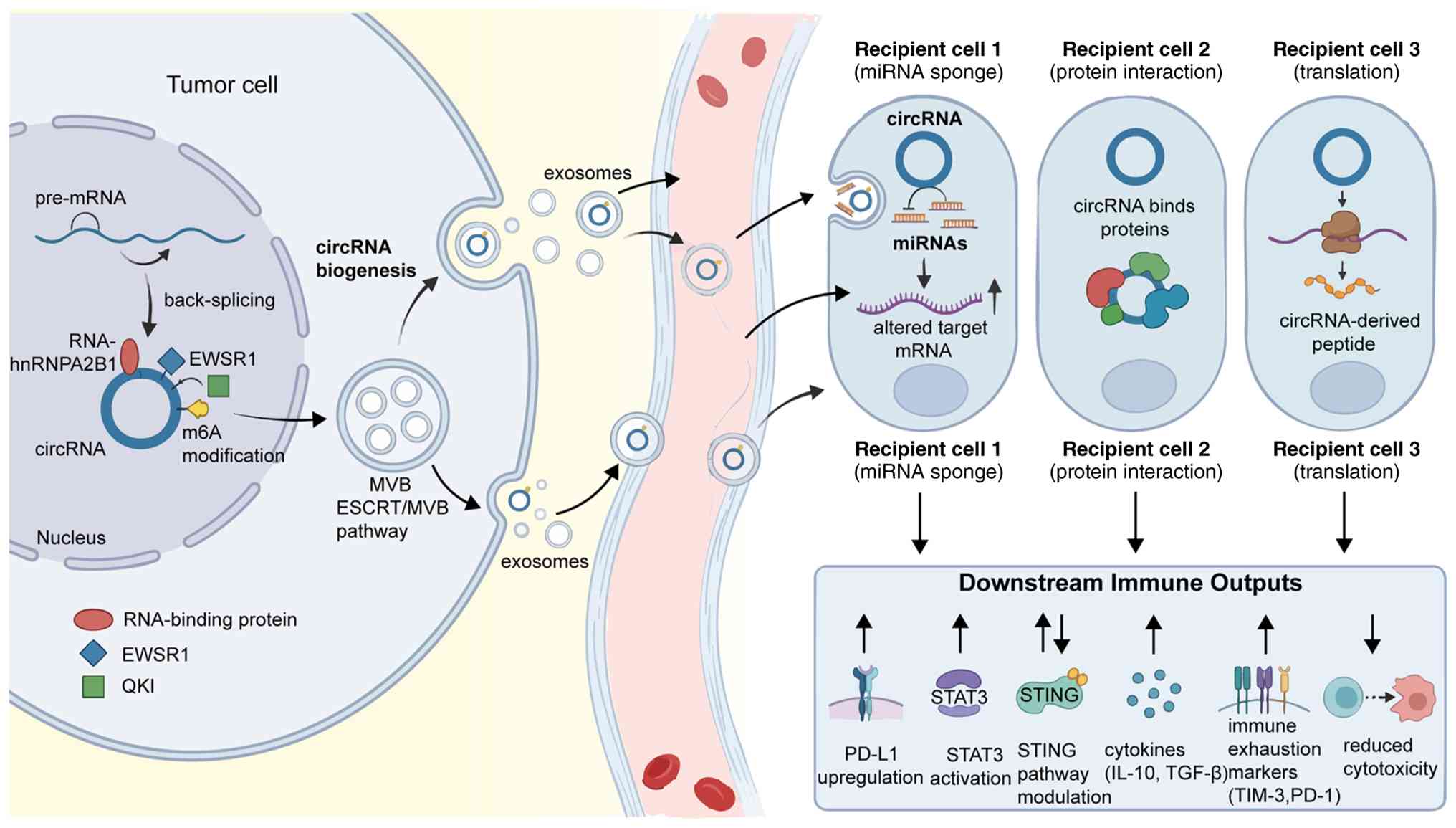
Circular RNAs (circRNAs) arise through back-splicing
and form covalently closed molecules that often resist exonuclease
degradation (9,10). N6-methyladenosine
(m6A) can alter their recognition by innate immune
sensors, which links RNA modification to the immune response
elicited by endogenous and engineered circRNAs (11). CircRNAs are enriched and stable
in some EV preparations, two properties relevant to intercellular
signaling and circulating biomarker development (12). A complete transfer process begins
with circRNA production in a donor cell. It then requires entry
into a defined EV population, protection outside the cell, uptake
by a specified recipient and delivery of enough intact RNA to the
intracellular site where the proposed molecular event occurs.
Detection in an EV preparation establishes association with that
preparation. Selective entry, recipient specificity and
intracellular activity require separate measurements. Within this
sequence, transfer into defined immune recipient cells has been
measured in several tumor systems. In hepatocellular carcinoma
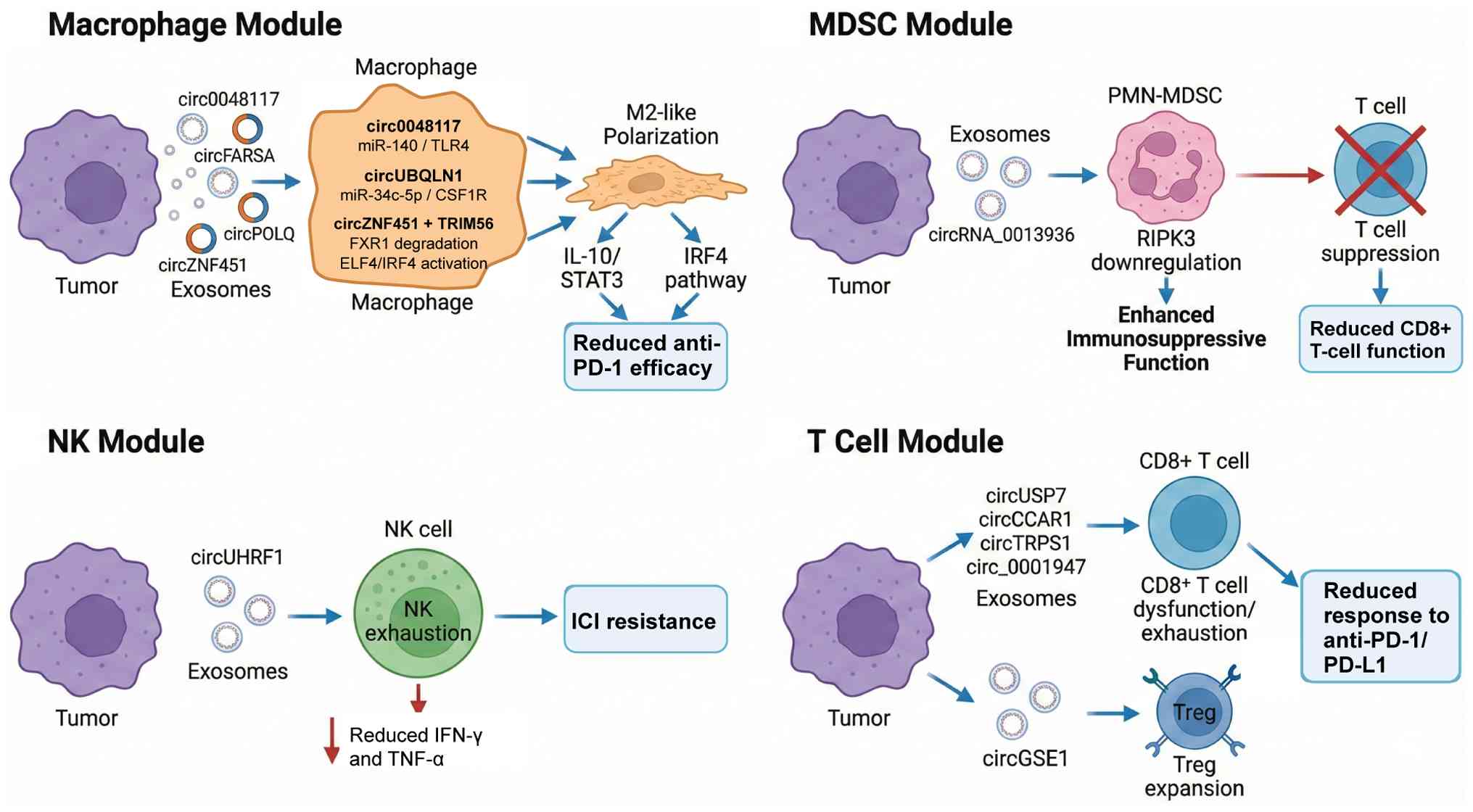
(HCC), EV-associated circUHRF1 entered natural killer (NK) cells
and was linked to reduced effector function and lower anti-PD-1
activity, while EV-associated circCCAR1 entered CD8+ T
cells and prolonged PD-1 protein stability (13,14). In non-small cell lung cancer
(NSCLC), EV-associated circUSP7 reduced CD8+ T-cell
function, and bladder cancer-derived EV-associated circTRPS1 was
linked to T-cell exhaustion and tumor-cell glutamine metabolism
(15,16). In lung adenocarcinoma (LUAD),
EV-associated circZNF451 acted in macrophages through a TRIM56-FXR1
complex and reduced the response to PD-1 blockade in mice (17). These mechanisms occur in
different recipient cells and do not share a single intracellular
route (Table SI).
Tumor-intrinsic circRNAs address a related
biological question because they can change checkpoint abundance or
chemokine signaling without being transferred. In colorectal cancer
(CRC), hsa_circ_0020397 increased TERT and PD-L1 (18). CircMET was linked to
immunosuppression and anti-PD-1 resistance in HCC, whereas
circ_0020710 increased CXCL12-dependent immune escape in melanoma
(19,20). Stromal context adds another
route. Pancreatic cancer-associated fibroblasts (CAFs) include
inflammatory and myofibroblastic populations, and single-cell
analysis has also identified antigen-presenting CAF states
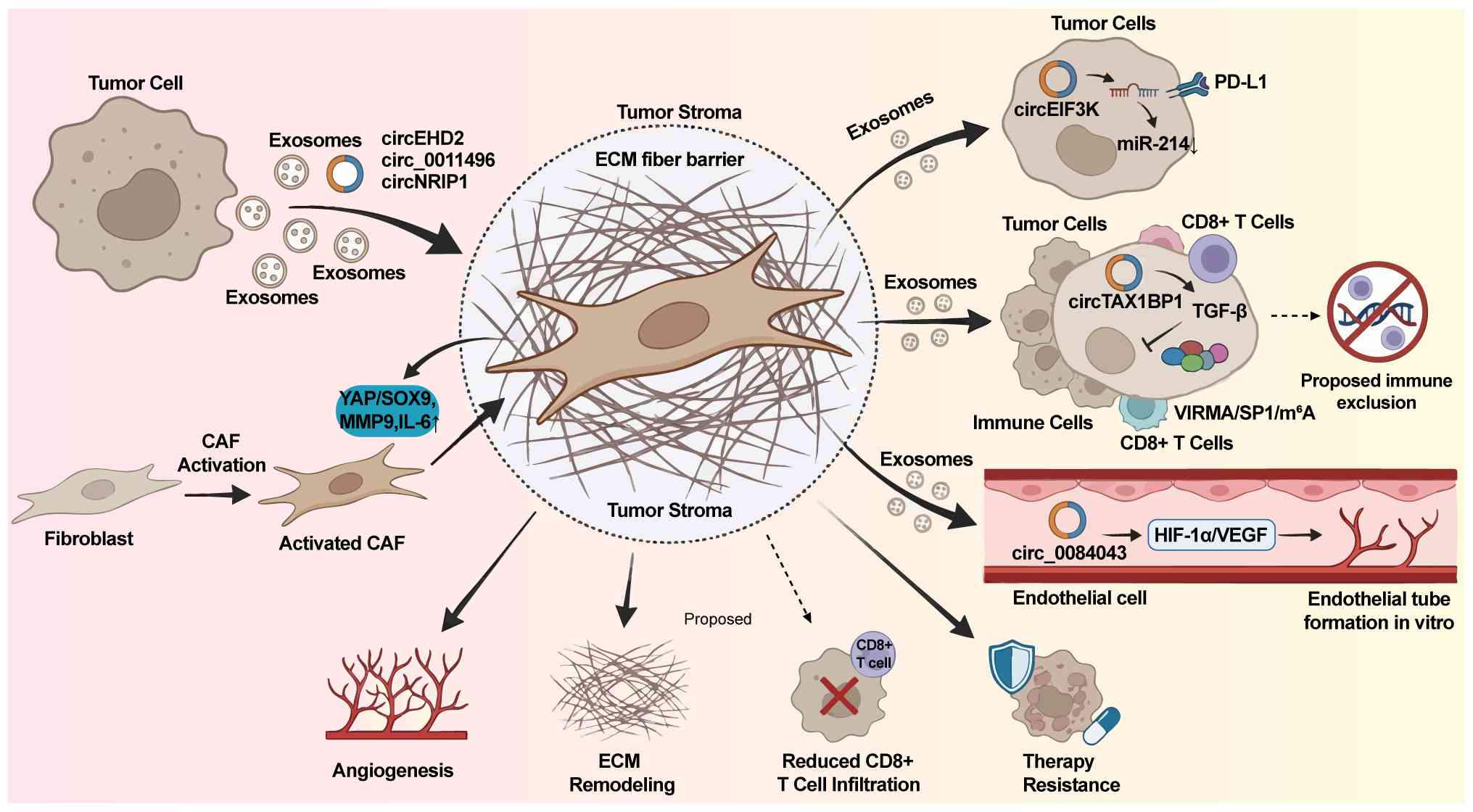
(21,22). EV-associated circEHD2 activated
fibroblasts in renal cell carcinoma (RCC), while CAF-derived
EV-associated circEIF3K altered CRC-cell PD-L1 and endothelial
behavior (23,24). A circRNA-induced stromal state
may therefore lie one step upstream of immune-cell access when that
stromal state is independently known to restrict infiltration
(25). Direct immune regulation
requires the circRNA, stromal change and immune-cell distribution
to be measured in the same model.
Four levels describe the biological support for each
reported process. E0 denotes biological background and adjacent
engineered platforms. E1 denotes an association or a transfer
process with one or more untested steps. E2 requires a defined
donor, an EV population, a recipient and a mechanistic cellular
endpoint. E3 adds circRNA-specific perturbation, rescue, an immune
function, in vivo validation and a treatment endpoint. EV
methods are evaluated independently because source handling,
separation and co-isolated material affect interpretation at every
biological level. Minimal Information for studies of extracellular
vesicles 2023 (MISEV2023) guides terminology and experimental
reporting (26). The terms EV or
small EV (sEV), rather than exosome, are therefore used when
endosomal origin has not been established.
The activity of an EV-associated circRNA depends on
sequential events that can vary independently. Donor-cell
expression can rise without preferential entry into EVs, and an
increased signal in an EV preparation can reflect greater particle
release or RNA outside vesicles. In glioma, EWSR1 increased
circNEIL3 in donor cells and EVs, while hnRNPA2B1 supported EV
association and transfer to macrophages (27). hnRNPA2B1 can recognize RNA motifs
during miRNA sorting, and small molecules that interrupt
hnRNPA2B1-RNA interactions alter defined subsets of EV RNA
(28,29). For an individual circRNA,
selective entry therefore requires direct RNA-binding protein (RBP)
binding, donor-cell perturbation, normalization to particle number
and exclusion of changes in cell viability or total EV release.
Selective entry also requires the identity of the transferred RNA
to be established beyond its back-splice junction. Long-read
sequencing has shown that one junction can represent several
full-length circRNA isoforms with different internal exons,
RBP-binding regions and open reading frames (30). In Schizosaccharomyces
pombe, circRNA biogenesis proceeded through an exon-containing
lariat precursor, providing an alternative route to circularization
(31). Divergent primers,
junction sequencing and RNase R treatment establish circularity,
while long-read or targeted full-length sequencing identifies the
transferred isoform. These steps become necessary when the proposed
mechanism depends on an internal binding site or a translated
sequence (Fig. 1).
Delivery depends on EV properties and conditions in
the recipient tissue. Tumor EV integrins can influence organ
distribution, while paracrine adhesion signaling can increase sEV
uptake by selected cells (32,33). Neither process shows that a named
circRNA determines recipient specificity. Fluorescent membrane
signals can also persist in endosomes or arise from dye particles.
Functional delivery therefore requires RNA protection before
uptake, an increase in intact circRNA within the recipient, access
to the relevant intracellular compartment and loss of activity when
uptake or intracellular release is blocked. MISEV2023 places these
controls alongside source definition, separation, particle
characterization and analysis of non-vesicular material (26). Even after uptake is established,
bulk EV measurements obscure particle-to-particle variation and the
dose received by individual cells. Single-EV transcriptomic
analysis detected transcripts from 6 to 148 genes per EV, with a
mean of 52, but did not measure copies of a specific circRNA in
each vesicle (34). SVAtlas
integrates single-EV protein, RNA, DNA, lipid and metabolite
datasets and permits comparison of EV subpopulations across tissues
and diseases (35). These
resources establish heterogeneity without supplying a universal
circRNA copy number. Dose analysis should instead report particles
per recipient cell, the fraction of particles containing the
circRNA, copies per positive particle, cytosolic delivery
efficiency and target abundance.
miRNA regulation depends on the same quantitative
constraints. Experiments in hepatocytes found threshold-like
release of miRNA repression only after a large increase in
target-site abundance (36).
Measurements of endogenous miRNA and target pools further showed
that competition varies with their relative abundance and binding
affinity (37). Binding,
reporter activity and target rescue do not by themselves establish
competition at physiological concentrations (38). An EV-associated competing
endogenous RNA model should include the amount of circRNA
delivered, Argonaute 2 occupancy, miRNA abundance and the available
cellular target pool. These quantitative constraints apply directly
to transferred circRNAs linked to miRNA-dependent changes, although
molecular ratios remain unresolved. In gastric cancer (GC),
sEV-associated circ_0001947 entered CD8+ T cells and
regulated miR-661, miR-671-5p and CD39 during anti-PD-1 treatment
(39). EV-associated circPACRGL
acted through miR-142-3p, miR-506-3p and transforming growth
factor-β1 in CRC cells (40).
Transfer was linked to specific miRNAs and downstream proteins.
Competition at the delivered dose still depends on absolute
abundance and target-site occupancy.
Mechanisms that do not depend on miRNA competition
require a different set of tests. In pancreatic ductal
adenocarcinoma (PDAC), m6A-modified circMYO1C was linked
to PD-L1 regulation, while circ_0074158 interacted with QKI6 and
altered PD-L1 ubiquitination in NSCLC (41,42). A peptide encoded by circHNRNPU
changed alternative splicing and the bone-marrow environment in
multiple myeloma (43). Tumor
circRNAs can also generate cryptic peptides that enter
antigen-presentation pathways and elicit antitumor T-cell responses
(44). Each route requires a
different perturbation. Protein-complex models require mapped
binding sites and rescue. Translation requires full-length sequence
definition, disruption of the open reading frame, peptide detection
and restoration by the peptide product. The same separation between
route and endpoint applies when EV-associated circRNAs act through
tumor or vascular cells rather than immune cells. Exosomal
hsa_circ_0051443 transferred from normal liver cells to HCC cells
and suppressed tumor-cell growth, whereas HCC-derived EV-associated
circRNA-100338 increased invasion and angiogenesis (45,46). Microglia-derived EV-associated
circKIF18A increased glioblastoma angiogenesis through FOXC2
(47). EV-associated circRNAs
can therefore change vascular or tumor features in the immune-cell
environment. Immune cells were not the recipients in these models.
Testing their immune relevance requires measurement of the affected
vascular or tumor state together with immune-cell position and
function.
TAM states vary with tissue of origin, tumor stage,
local signals and treatment. M1 and M2 describe two ends of a
broader functional range and cannot be assigned from one marker.
EV-associated circRNAs can alter macrophage signaling, metabolism
and cytokine production, after which macrophages can change tumor
invasion, distant colonization or lymphocyte function. A transfer
experiment therefore needs a donor cell, an EV preparation,
recipient macrophages, an intracellular circRNA change and a
macrophage-dependent endpoint. Within this functional range,
tumor-derived EV-associated circRNAs often shift macrophages toward
states linked to invasion or metastasis. In NSCLC, circFARSA acted
through PTEN-PI3K-AKT signaling, while circATP9A combined HuR
binding in tumor cells with EV-mediated macrophage regulation
(48,49). Hypoxia increased EV-associated
circ0048117 in esophageal squamous cell carcinoma (ESCC), linking
donor oxygen status to macrophage exposure (50). In epithelial ovarian cancer,
EV-associated circATP2B4 regulated miR-532-3p, SREBF1 and PI3K-AKT
signaling in macrophages (51).
In HCC, reduced hsa_circ_0074854 altered HuR-associated tumor
behavior and macrophage polarization through EVs (52). The donor state and molecular
route therefore differ even when the recipient phenotype shares
CD163 or CD206 expression.
Some circRNAs change the molecular contents of EVs
without being transferred themselves. In CRC cells, circASPH
stabilized IGF2BP2 and increased m6A-modified STING RNA,
which raised EV-associated STING and altered macrophages (53). In the aforementioned study, STING
was transferred and circASPH remained tumor intrinsic. Direct
circRNA transfer was shown for several other models. CircPOLQ
activated IL-10-STAT3 signaling in CRC macrophages, and circUBQLN1
regulated the miR-34c-5p-CSF1R pathway (54,55). Breast cancer (BC) EV-associated
circ-0100519 acted through USP7 and NRF2, while glioma
EV-associated circ-001422 increased macrophage polarization
associated with tumor growth (56,57). GC EV-associated hsa_circ_0017252
produced the opposite direction and reduced macrophage CD163 and
CD206 features together with tumor growth (58).
Communication also proceeds in the opposite
direction, with macrophages providing EV-associated circRNAs to
tumor cells. M2 macrophage-derived sEV-associated circFTO increased
NSCLC malignancy through miR-148a-3p and PDK4, while macrophage
EV-associated circRNA_CCDC66 increased CRC immune escape through
miR-342-3p and metadherin (59,60). In cholangiocarcinoma (CCA),
TAM-derived EV-associated circ_0020256 promoted tumor progression
(61). TAM-derived
hsa_circ_0001610 reduced endometrial cancer radiosensitivity, which
places its endpoint in treatment tolerance rather than ICI response
(62). In HCC, M1
macrophage-derived EV-associated miR-628-5p reduced m6A
modification of tumor-cell circFUT8 and suppressed progression
(63). The transferred molecule
in this last model was a miRNA, while the circRNA changed within
the recipient tumor cell. Macrophage states can also change without
circRNA transfer through tumor-intrinsic circRNAs that regulate
recruitment or activation. hsa_circ_0110102 reduced macrophage
activation through PPARα and CCL2 in HCC, whereas circHSPB6
increased CCL2-associated macrophage infiltration in LUAD (64,65). CircSMARCC1 regulated a
miR-1322-CCL20-CCR6 interaction between prostate cancer cells and
TAMs (66). KRAS-associated
circHIPK3-PTK2 signaling was linked to macrophage infiltration in
lung tumors, while circITGB6 shifted macrophage polarization during
cisplatin resistance in ovarian cancer (67,68). Smoking-induced macrophage
EV-associated circEML4 acted in NSCLC cells through
ALKBH5-dependent m6A regulation of SOCS2 (69). These processes differ in where
the circRNA acts and should remain separate from
donor-to-macrophage circRNA transfer.
Interventions in the tumor-macrophage interaction
have been assessed against tumor growth, metastasis or checkpoint
response. Nanoparticle delivery of si-cSERPINE2 reduced breast
tumor growth and macrophage-associated suppression (70). In CRC, depletion of EV-associated
circ-0034880 reduced SPP1+CD206+ macrophages
and liver premetastatic niche formation (71). In HCC, EV-associated
hsa_circ_0057320 regulated miR-28-5p and E2F6 during macrophage
metabolic reprogramming, angiogenesis and metastasis (72). In glioblastoma, spatial and
single-cell analyses identified circSDHAF2, ITGA5 and
SPP1+ monocyte-derived macrophages in anti-PD-1
resistance, while ITGA5 blockade restored treatment activity in
mice (73). Growth, angiogenesis
and metastasis were the HCC endpoints. By contrast, the
glioblastoma model included checkpoint treatment and measured
macrophage remodeling together with ICI response. Among these
routes, EV-associated circZNF451 directly connects macrophage
reprogramming with impaired T-cell function. LUAD-derived
circZNF451 entered macrophages, assembled with TRIM56 and FXR1,
promoted FXR1 degradation and increased ELF4-IRF4 signaling. The
resulting macrophages impaired CD8+ T-cell proliferation
and effector function, and macrophage-specific ELF4 deletion
restored anti-PD-1 activity in mice (17). Metastatic growth, macrophage
markers, T-cell suppression and ICI response remain distinct
endpoints unless each is measured in the same model.
Myeloid-derived suppressor cells (MDSCs),
neutrophils and dendritic cells (DCs) arise within the myeloid
compartment, although circRNAs act through different routes in
these cells. A tumor-derived EV-associated circRNA can enter a
myeloid cell. Myeloid EVs can also transfer another molecule that
changes a circRNA in tumor cells. Tumor-intrinsic circRNAs can
alter myeloid recruitment without EV transfer. These routes should
be identified before their effects on T cells are connected.
MDSC-associated models include both transferred circRNAs and
tumor-cell circRNAs induced by another transferred molecule. In
castration-resistant prostate cancer, MDSC-derived EVs transferred
S100A9 to tumor cells. S100A9 reduced DHX9, increased tumor-cell
circMID1 and activated a circMID1-miR-506-3p-MID1 pathway (74). The transferred molecule was
S100A9. In bladder cancer, tumor-derived EV-associated
circRNA_0013936 entered polymorphonuclear MDSCs, increased fatty
acid transport protein 2, reduced receptor-interacting protein
kinase 3 and suppressed CD8+ T-cell activity (75). BC Circ-E-cadherin encoded
C-E-cad, which increased MDSC recruitment and function without an
EV-circRNA transfer experiment (76). In CRC, tumor-intrinsic circNCOA3
was linked to MDSC accumulation and anti-PD-1 resistance (77).
Neutrophil-associated findings remain closer to
circulating association or tissue state than to direct transfer.
Plasma EV-associated circ-PTPN22 and circ-ADAMTS6 were identified
in an intrahepatic CCA (iCCA) cohort with transcriptomic features
linked to T-cell exhaustion and neutrophil extracellular traps
(78). Only six patients
provided plasma EV samples, and no donor-to-neutrophil transfer was
tested. CircRERE-PMN was identified in premetastatic lungs and
linked to neutrophil-associated changes before metastatic growth
(79). Neutrophil
membrane-coated nanoparticles carrying circRNA provide a
therapeutic delivery system for HER2-positive BC brain metastasis,
but they do not model natural EV transfer (80).
In DCs, circRNAs act through endogenous regulation,
tumor-cell programs or engineered delivery. CircSnx5 acted within
DCs through miR-544, SOCS1 and PU.1 and changed their immunogenic
activity (81). Tumor-intrinsic
cEMSY induced immunogenic cell death and increased immunotherapy
activity in LUAD (82).
HCC-derived EV-associated circTMEM56 was linked to miR-136-5p,
STING and radiotherapy response (83). Nanochannel electro-injection can
introduce RNA or DNA into DCs, although this platform does not
reproduce EV loading, release or uptake (84).
The myeloid routes therefore begin at experimentally
separate points. CircRNA_0013936 follows tumor cell to EV to MDSC
and then reaches a T-cell endpoint. CircMID1 rises in tumor cells
after MDSC EV transfer of S100A9. Circ-PTPN22 and circ-ADAMTS6
remain circulating associations. CircSnx5 and cEMSY act inside the
cells in which they were manipulated. This separation preserves the
direction of communication and prevents an association with a
myeloid state from being presented as transferred circRNA
activity.
NK-cell activity depends on activating ligands on
tumor cells, inhibitory receptors on NK cells and the metabolic
state of both cells during contact. EV-associated circRNAs can act
inside NK cells, while tumor-intrinsic circRNAs can change the
surface recognized by NK cells. These routes meet at the tumor-NK
interface but begin in different cells. In HCC, EV-associated
circUHRF1 entered NK cells, reduced miR-449c-5p, increased TIM-3
and lowered IFN-γ and TNF-α secretion. CircUHRF1 was also higher in
a small retrospective cohort with progressive disease during
anti-PD-1 treatment, and donor-cell depletion restored NK-cell
activity in preclinical models (13). The patient cohort does not
constitute prospective biomarker validation, and the EV dose did
not include the absolute number of circUHRF1 molecules delivered to
each NK cell.
A second transferred circRNA reaches NK cells
through metabolic injury rather than inhibitory-receptor signaling.
CircPDSS1 regulated miR-142-3p and ACSL4, increased lipid
peroxidation and ferrous iron and promoted ferroptosis in NK-92
cells. Donor-cell depletion reduced NK-cell death and restored
cytokine secretion in coculture and humanized mouse models
(85). This process differs from
checkpoint-dependent exhaustion because it reduces viable NK cells
through iron-dependent lipid damage.
By comparison, tumor-intrinsic circRNAs alter the
tumor-cell side of NK-cell contact. In HCC cells, androgen
receptor-suppressed CircARSP91 increased UL16-binding protein 1 and
enhanced NK-cell cytotoxicity (86). hsa_ circ_0007456 increased
intercellular adhesion molecule 1 through miR-6852-3p and
strengthened NK-cell elimination of HCC cells (87). In bladder cancer, androgen
receptor and ADAR2 regulated circ_0001005 and PD-L1, thereby
changing NK-cell activity (88).
CircARAP2 regulated soluble MICA-associated NK-cell desensitization
through RAB5A and endosomal signaling (89). These tumor-cell mechanisms
influence ligand availability or inhibitory signaling without EV
transfer to NK cells.
Beyond surface ligands, tumor-cell metabolic and
interferon programs also change susceptibility to NK-cell attack.
CircSpdyA encoded a 127-amino-acid peptide that increased
fatty-acid synthesis and reduced NK-cell activity in BC (90). CircFOXO3 was associated with
clear-cell RCC proliferation and NK-cell cytotoxicity through
miR-29a-3p and miR-122-5p (91).
CircRNF10 regulated PTEN-PI3K-AKT signaling and NK-cell-mediated
elimination in BC cells (92).
In sarcoma, circCsnk1g3 and circAnkib1 altered interferon responses
and the immune environment (93). These tumor-cell states can
increase or reduce NK-cell function. Direct transfer into NK cells
was shown for circUHRF1 and circPDSS1, while the other circRNAs
were manipulated within tumor cells (Fig. 2).
CAFs can receive tumor-derived EVs and release EVs
to tumor, endothelial and immune cells. Their response depends on
tissue site and cellular state. In pancreatic cancer, inflammatory,
myofibroblastic and antigen-presenting CAF populations occupy
different transcriptional states (21,22). Across other tumors, CAF-derived
signals induced PD-L1-positive neutrophils or increased PD-L1 in
tumor cells (94,95). CAFs increased PD-L1 in CRC cells
through AKT phosphorylation, while PD-L1-positive CAFs were
associated with immune suppression in esophageal cancer (96,97). Fibroblast state can therefore
precede immune-cell access or checkpoint exposure, although these
processes do not identify an EV-associated circRNA by themselves.
One direction of EV communication runs from tumor cells to
fibroblasts. In RCC, hnRNPA2B1 supported circEHD2 entry into tumor
EVs, and fibroblast uptake increased α-smooth muscle actin,
fibroblast activation protein and tumor-supporting activity
(23). Benzo[a]pyrene exposure
induced an HCC EV-associated circRNA program that activated lung
fibroblasts before organotropic metastasis (98). Hypoxic ESCC cells released
EV-associated circNRIP1, which activated fibroblasts and increased
tumor-cell migration and invasion (99). EV communication moves in both
directions between malignant and stromal cells. Each circRNA
nevertheless requires donor- and recipient-specific controls
(Fig. 3 and Table SII).
Stromal conversion can expand the population that
releases fibroblast-derived EVs, establishing the reverse direction
of communication. In GC, sEV-associated circ6718 regulated
miR-561-3p, SAAL1, PRRX1 and TGF-β1 and promoted conversion of
tumor-derived mesenchymal stem cells into CAFs (100). In high-grade serous ovarian
cancer, CAF EV-associated circMPP6 was loaded through hnRNPA2B1 and
regulated ADAM22 in tumor cells through nuclear SFPQ-NONO binding
and cytoplasmic EEF1A2 binding (101). ADAM22 then activated TGF-β-Smad
signaling and metastatic behavior. Both routes end in a defined
tumor-cell program without measurements of immune-cell
infiltration. Numerous CAF-to-tumor routes then use miRNA-dependent
regulation. CircN4BP2L2 increased CRC proliferation and metastasis
through miR-664b-3p and HMGB3, while CAF EVs increased tumor-cell
circ_0067557 and Lin28 during CRC growth and chemoresistance
(102,103). Circ_0084043 increased
endothelial tube formation in vitro through miR-140-3p,
HIF-1α and VEGF (104). The
endpoint was an in vitro vascular assay. Therefore,
immune-cell access and in vivo angiogenesis were not
measured. In hypoxic BC, CAF EV-associated circHIF1A increased
tumor-cell stemness through miR-580-5p and CD44 (105). Hypoxic CAF EV-associated
circSTAT3 and circFOXO1 increased triple-negative BC (TNBC)
stemness or radioresistance through NOTCH1 and BNIP3, respectively
(106,107). The same direction of
communication occurs in ESCC, BC and pituitary adenoma.
Circ_0076535 increased ESCC progression, and circTBPL1 supported BC
growth through intercellular transfer (108,109). Pituitary tumor-associated
fibroblast EV-associated circDennd1b regulated miR-145-5p, ONECUT2
and MAPK signaling (110). The
measured endpoints were tumor-cell proliferation, invasion or
treatment response. They should not be extended to T-cell exclusion
without measurements of lymphocyte position or function.
Other CAF-derived circRNAs act through protein
binding, translation or stromal feedback rather than miRNA
competition. In PDAC, CAF EV-associated circBIRC6 bound XRCC4,
increased XRCC4 SUMOylation at K115 and supported non-homologous
end joining during oxaliplatin treatment (111). Mutation of XRCC4 K115 and
circBIRC6 depletion reduced repair, and combined circBIRC6
inhibition with olaparib suppressed resistant models. In TNBC, CAF
EV-associated circMIB1 entered tumor cells and produced MIB1-223aa
after uptake. The peptide stabilized MIB1, activated DLL4-Notch
signaling and increased metastasis and stemness (112). The peptide was not detected in
EVs, which locates translation inside the recipient tumor cell. CRC
provides a reciprocal CAF-tumor process. ITGA11-positive
myofibroblastic CAFs released EV-associated circTAX1BP1 to tumor
cells. CircTAX1BP1 recruited AARS2, increased VIRMA lactylation,
stabilized SP1 messenger RNA through m6A and raised
tumor-cell TGF-β secretion. TGF-β then maintained the
ITGA11-positive CAF state and further EV-associated circTAX1BP1
release (113).
TGF-β-responsive fibroblast programs in other tumor models restrict
T-cell entry and reduce PD-L1 blockade activity (25). In this CRC system, however,
CD8+ T-cell position and ICI response were not measured.
CircTAX1BP1 may therefore sit upstream of a stromal condition that
restricts T-cell access, with the immune step remaining to be
tested in the same model.
Interventions at the fibroblast source or the
delivered RNA act at several points in this communication. Matrine
reduced CAF EV-associated circSLC7A6 through CXCR5 and lowered
CRC-cell migration and invasion (114). Asparagine-glycine-arginine
(NGR)-modified CAF-derived EVs targeted tumor vasculature, induced
ferroptosis and reduced osteosarcoma chemoresistance, although the
therapeutic material was engineered and was not a naturally
transferred circRNA (115). In
HCC, CAF EV-associated circZFR activated STAT3-NF-κB signaling
during cisplatin resistance, while hepatic stellate cell
EV-associated circWDR25 regulated ALOX15 and epithelial-mesenchymal
transition (116,117). These endpoints concern
chemotherapy response and tumor behavior. Their connection to ICI
activity requires combination experiments in immunocompetent
models. For circEIF3K, the measured endpoints were CRC-cell PD-L1
and endothelial tube formation through miR-214, without T-cell
entry or ICI response (24).
Fibroblast remodeling can therefore precede immune exclusion, yet
proximity alone does not establish transfer or lymphocyte
suppression. A direct test would locate the circRNA-producing cell,
the receiving CAF or tumor cell and CD8+ T cells in the
same tissue, then perturb the circRNA while measuring matrix
organization, T-cell access and treatment response.
T-cell dysfunction can arise through direct RNA
transfer into T cells, checkpoint regulation within tumor cells,
reduced lymphocyte infiltration or expansion of suppressive T
cells. These outcomes originate in different cells and are defined
by different experimental endpoints. Exhaustion requires loss of
proliferation, cytokine production or cytotoxicity together with
sustained inhibitory receptors. Reduced T-cell abundance describes
infiltration and does not establish delivery to T cells. Direct
transfer into T cells has been measured in several tumor models.
NSCLC-derived EV-associated circUSP7 entered CD8+ T
cells and regulated miR-934 and SHP2, reducing cytokine secretion,
perforin, granzyme B and anti-PD-1 activity (15). HCC-derived EV-associated
circCCAR1 entered activated CD8+ T cells, bound PD-1
protein, reduced its ubiquitination and prolonged its half-life
(14). Bladder cancer-derived
EV-associated circTRPS1 was linked to miR-141-3p, GLS1, redox
regulation and T-cell exhaustion, although several metabolic steps
were measured within tumor cells (16). In GC, EV-associated circFXR1
entered tumor cells and CD8+ T cells, increased PD-L1
and mTOR signaling and reduced T-cell effector function during
anti-PD-1 treatment (118). By
comparison, other EV-associated circRNAs alter tumor or myeloid
cells upstream of T-cell infiltration. In PDAC, circGANAB moved
among tumor cells, reduced the stability of interacting RNAs and
reduced CD4+ and CD8+ T-cell infiltration
during anti-PD-L1 treatment (119). T-cell uptake was not measured.
In acute myeloid leukemia, EV-associated circRNA-001264 induced
M2-like macrophages and increased PD-L1, linking a myeloid
recipient to checkpoint expression (120). These processes can reduce
T-cell access or function without direct circRNA activity inside T
cells.
Tumor-intrinsic circRNAs regulate PD-L1 through
recurring miRNA-dependent routes. In NSCLC, circ_0001006 acted
through miR-320a and PD-L1, while circRNA-002178 increased PD-L1 in
LUAD cells and PD-1 in cocultured T cells (121,122). CircCHST15 regulated miR-155-5p,
miR-194-5p and PD-L1, whereas circ_0101675 acted through miR-607
and PD-L1 (123,124). hsa_circ_0000190 increased
soluble PD-L1, and circ_0010235 acted through miR-636 and PD-L1 in
lung cancer (125,126). All routes reach a checkpoint
endpoint but differ in the circRNA, miRNA and form of PD-L1
measured. Within tumor cells, treatment context further changes the
route to checkpoint expression. Circ_0014235 regulated miR-146b-5p,
YAP and PD-L1 during gefitinib resistance, while circ_0068252
regulated miR-1304-5p and PD-L1 during cisplatin resistance in
NSCLC (127,128). CircCORO1C increased PD-L1
through NF-κB in HCC, and circ_001678 linked miR-326 and ZEB1 with
the PD-1/PD-L1 pathway in NSCLC (129,130). These tumor-cell processes do
not by themselves show T-cell uptake or resistance to an ICI.
Checkpoint regulation can be connected to T-cell function only when
coculture or treatment experiments are included. A comparable
tumor-cell route occurs in PDAC, where circ_0046523 regulated
miR-148a-3p and PD-L1 within tumor cells (131). This finding concerns checkpoint
regulation in the producing cell and does not establish EV-mediated
transfer or direct activity in T cells.
miRNA-dependent routes account for only part of
tumor-cell checkpoint regulation. In BC, hsa_circ_0067842 regulated
HuR, CMTM6 and PD-L1 stability, while circGSK3β linked miR-338-3p,
PRMT5 and H3K4 trimethylation to PD-L1 transcription (132,133). CircNF1 regulated PD-L1 through
two routes in ESCC, and m6A-modified circ-SLCO1B3
regulated HOXC8 and PD-L1 in iCCA (134,135). CircRHBDD1 increased PD-L1
through IGF2BP2 in GC, while circ_0136666 regulated PRKDC and PD-L1
phosphorylation through miR-375 (136,137). These mechanisms place the
checkpoint change inside tumor cells and should remain distinct
from direct T-cell reprogramming. The direction of checkpoint
regulation also differs among circRNAs. In GC, circ_0000372
increased PD-L1 through miR-488-3p, whereas circ_0000372 depletion
reduced PD-L1, cell viability and immune escape (138). In CRC, circ_0007422 depletion
reduced PD-L1 through miR-1256, while hsa_circ_0004872 reduced
PD-L1 and immune escape in meningioma cells (139,140). CircPCBP2 increased stemness,
chemoresistance and PD-L1 through miR-33a and miR-33b in diffuse
large B-cell lymphoma (141).
Epstein-Barr virus circBART2.2 increased PD-L1 in nasopharyngeal
carcinoma, while circularized E7 RNA was assessed with GLUT1 and
PD-L1 in anal squamous cell carcinoma (142,143). Direction and cellular setting
must therefore be stated for each checkpoint-associated circRNA.
Beyond checkpoint abundance, tumor-intrinsic circRNAs can change
CD8+ T-cell infiltration or response to checkpoint
treatment. In bladder cancer, a circMGA-HNRNPL complex regulated
CD8+ T-cell infiltration and immunotherapy response
(144). CircZMIZ1 depletion
increased CD8+ T-cell activity in HCC, while circATAD2
regulated IGF2BP3, m6A and PD-L1 during immune escape in
BC (145,146). CircAATF was linked to
anti-PD-L1 treatment in gallbladder carcinoma, and
m6A-modified circIGF2BP3 reduced CD8+ T-cell
responses by promoting PD-L1 deubiquitination in NSCLC (147,148). Hypoxia-associated circPRDM4
increased HIF-1α and PD-L1 in HCC, while circ-Keratin 6c acted
through miR-485-3p and PD-L1 in CRC (149,150).
Reduced effector immunity can also follow expansion
of suppressive T cells. HCC-derived EV-associated circGSE1 entered
T cells and activated a miR-324-5p-TGFBR1-Smad3 process that
increased FOXP3+ regulatory T cells (Tregs) and
metastasis (151). In CRC,
hsa_circ_0136666 regulated miR-497 and PD-L1 during Treg-mediated
immune escape (152).
hsa_circ_0069313 acted through miR-325-3p and FOXP3 in oral
squamous cell carcinoma cells and Tregs (153). m6A-modified
circQSOX1 increased glycolysis and intratumoral Tregs and reduced
anti-CTLA-4 activity in CRC (154). In the aforementioned study, the
treatment endpoint was CTLA-4 blockade. Therefore, it should not be
generalized to PD-1 therapy. Other tumor-cell circRNAs alter immune
escape without direct transfer into T cells. CircNDUFB2 promoted
IGF2BP protein degradation and activated antitumor immunity in
NSCLC, while circFAM13B reduced glycolysis through IGF2BP1 and PKM2
and increased bladder cancer sensitivity to immunotherapy (155,156). In HCC, circSOD2 acted through
miR-497-5p and ANXA11 during tumor progression and anti-PD-1
resistance (157). In iCCA,
circHMGCS1-016 regulated CD73 and galectin-8 through miR-1236-3p
(158). These pathways affect
tumor metabolism, RNA stability or extracellular suppression and
can converge on T-cell activity without using the same molecular
route. The remaining EV-associated circRNAs link tumor metabolism
or growth to treatment response without a direct lymphocyte
endpoint. NSCLC EV-associated circSHKBP1 increased PKM2-dependent
glycolysis, while macrophage EV-associated hsa_circ_0004658 reduced
HCC progression through miR-499b-5p and JAM3 (159,160). CircSCUBE3 reduced anti-PD-L1
activity in GC, and circFAT1 increased stemness and immune escape
through STAT3 (161,162). CircHMGB2 and circCELF1 promoted
immunosuppression and anti-PD-1 resistance in lung cancer through
CARM1 and EGFR-related routes (163,164). Circ-HSP90A increased stemness
and checkpoint signaling in NSCLC, while another NSCLC circRNA
increased anti-PD-1 resistance through miR-30a-5p and SOX4
(165,166). Tumor-cell state was linked to
treatment response, whereas direct transfer to T cells was not
established.
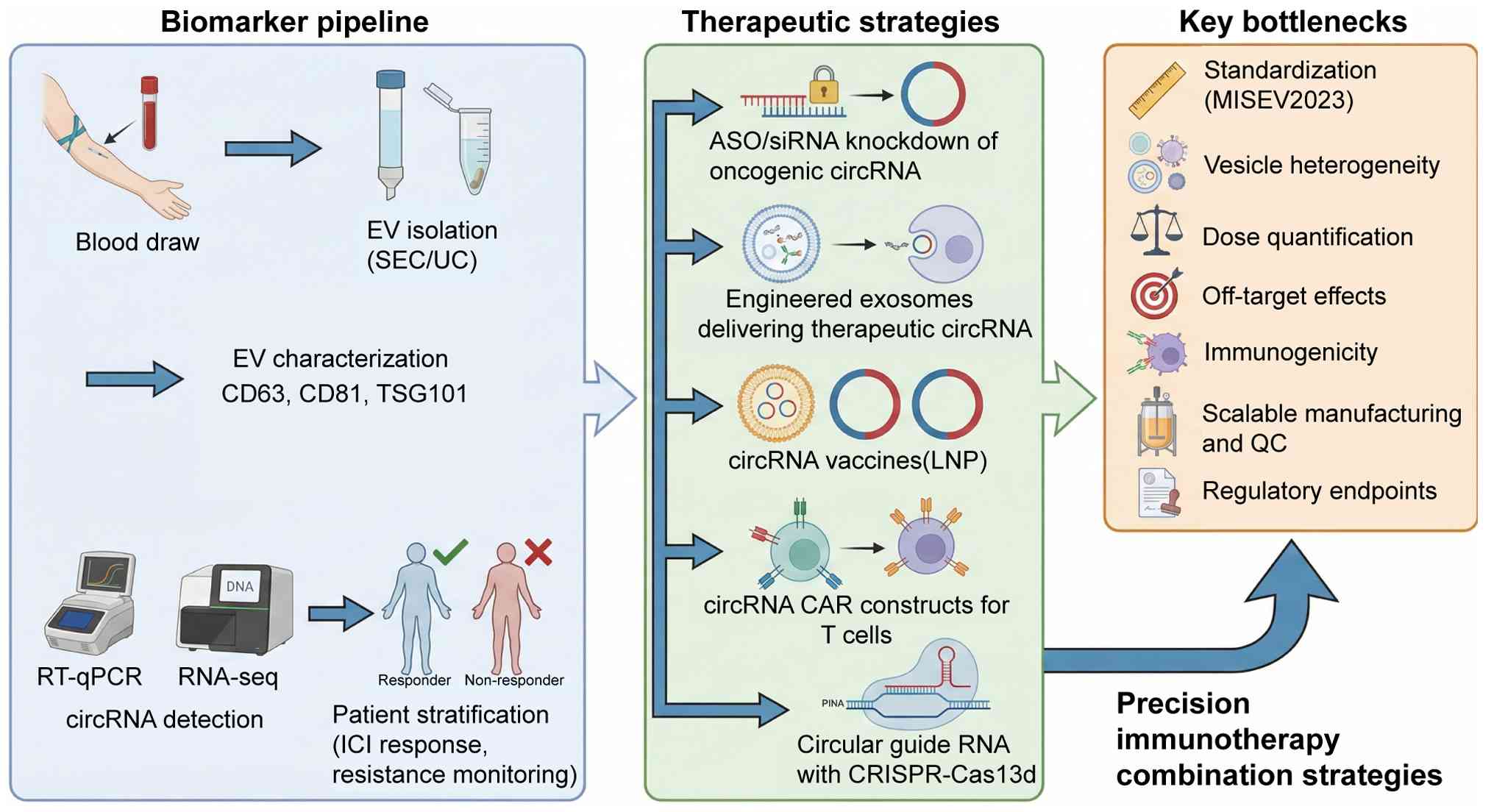
Circulating assays, endogenous inhibition and
engineered delivery begin with different measurable entities. A
biomarker assay relates RNA abundance to a defined clinical state.
Sequence-specific inhibition tests whether lowering a circRNA
changes a tumor or immune phenotype. An engineered product delivers
a controlled RNA sequence to a selected tissue or cell. One route
does not establish the others. Among these paths, biomarker
development begins with variation across biofluids and cancer
types. Plasma EV profiling identified circRNA patterns in GC, while
an exosomal circRNA-miRNA-messenger RNA network was assembled in BC
(167,168). A cross-biofluid analysis
further mapped circRNA patterns across EV populations (169). Two international melanoma
cohorts identified a five-circRNA signature associated with overall
survival and progression-free survival among patients receiving
anti-PD-1 monotherapy (170).
These profiles can define candidates, whereas clinical prediction
requires pretreatment sampling, a fixed assay, a prespecified
threshold and a treatment-specific endpoint in an independent
prospective cohort. Total particle concentration and circRNA
abundance per particle should be measured separately.
Therapeutic manipulation then divides into RNA
delivery and sequence-directed inhibition. Naturally secreted EVs
can be engineered for treatment. EV-mediated circDIDO1 delivery
reduced GC growth through miR-1307-3p and SOCS2 (171). A gelatin methacryloyl (GelMA)
hydrogel carrying circNEFM-engineered EVs reduced glioma growth,
while circPRKD3-loaded EVs altered glioblastoma growth and the
local environment through STAT3 signaling (172,173). These systems require control of
particle composition, loading distribution, tissue localization,
batch potency and repeated-dose toxicity. Their performance does
not determine the physiological dose of the corresponding
endogenous EV-associated circRNA. By contrast, sequence-directed
inhibition uses a different product and target. pH-responsive
niobium carbide nanosheets delivered circPUM1 small interfering RNA
(siRNA) in ovarian cancer, and nanoparticles targeting circTNK2
restored tamoxifen sensitivity and increased NK-cell activity in
estrogen receptor-positive BC (174,175). Back-splice-junction antisense
oligonucleotides or siRNAs should be tested against the linear host
transcript, other circular isoforms and normal tissues. Target
engagement should be measured in the tumor and the recipient cell
implicated by the biological model.
CircRNA vaccines form a third path because circular
topology extends antigen or therapeutic protein expression.
Circular RNA vaccines produced antitumor activity in resistant
tumor models and induced potent T-cell responses (176,177). A circular RNA neoantigen
vaccine was developed for HCC, while lipid nanoparticle composition
altered vaccine delivery and the T-cell response (178,179). A DC vaccine carrying circRNA
increased antitumor immunity when combined with low-dose
gemcitabine in pancreatic cancer (180). Local circILNb expression
delivered IL-15 and an anti-PD-L1 nanobody in cold tumors (181). These platforms concern antigen
or protein expression and remain separate from natural EV-mediated
circRNA transfer. Within vaccine platforms, neoantigen selection
and RNA manufacture determine activity. Circular RNAs can serve as
a source of neoantigens, and artificial circRNAs have been used as
miRNA-binding constructs and anti-PD-1 single-chain variable
fragment expression platforms (182,183). An enhanced permuted intron-exon
system improved production of therapeutic circRNAs (184). In 2026, a multi-neoantigen
circRNA vaccine altered melanoma immune-cell composition and
increased checkpoint-blockade activity (185). A lipid nanoparticle circRNA
vaccine encoding NY-ESO-1 induced antigen-specific immunity and
enhanced checkpoint-blockade activity in lung cancer models
(186). These products require
full sequence definition, removal of linear and double-stranded
RNA, expression kinetics and innate immune testing. Circular RNA
manufacture also supports transient programming of immune cells.
Scarless circular mRNA produced chimeric antigen receptor T cells,
while a circRNA platform generated DLL3-targeted chimeric antigen
receptor T cells for small-cell lung cancer (187,188). A 2026 platform combined rapid
receptor screening with circRNA-driven chimeric antigen receptor NK
cells and IL-21 to resist antigen shedding in pancreatic cancer
models (189). These approaches
address receptor expression, cell manufacture and persistence. They
do not model the uptake of a naturally secreted EV-associated
circRNA (Table SIII).
Across these translational paths, methodological
control determines whether a result can be assigned to a
vesicle-associated RNA. Blood collection tubes, processing delay,
centrifugation and storage can change particle and RNA
measurements. EV preparations should be assessed for morphology,
size, particle concentration, EV-enriched proteins, negative
markers and co-isolated material. RNase treatment with and without
membrane disruption distinguishes protected RNA from externally
associated RNA. Donor-cell depletion, particle-normalized exposure,
increased intact circRNA in the recipient and reversal of the
recipient phenotype connect the measured response to EV-mediated
transfer. Absolute dose, tissue distribution and recipient-cell
delivery then determine whether the experimental exposure can occur
in vivo (Fig. 4 and
Table SIV).
EV-associated circRNAs can reduce cytotoxic
immunity through direct activity in NK cells and CD8+ T
cells, through macrophages that subsequently suppress T cells and
through tumor or stromal states that restrict immune-cell access.
These routes converge on reduced effector function or treatment
response, yet the point at which the circRNA acts differs. A
transferred RNA inside an immune cell supports a different
conclusion from a tumor-intrinsic circRNA that changes PD-L1 or an
EV-associated circRNA that remodels fibroblasts. Keeping the donor,
EV population, recipient and intracellular process explicit
prevents these processes from being merged into one mechanism. This
separation also explains why the direction of regulation changes
with donor state, recipient identity and tissue site. Hypoxia
changes circRNA production in tumor cells and CAFs.
Macrophage-derived EVs can return circRNAs or other RNAs to tumor
cells. Tumor-intrinsic circRNAs can either increase or reduce
NK-cell recognition. These differences do not represent a uniform
dual effect of circRNAs. They arise because distinct molecules act
in different cells and alter different molecular targets. The same
immune lineage can therefore acquire different states under
different exposure and treatment conditions.
A one-step connection may nevertheless link
circRNA-dependent stromal remodeling to immune-cell access. A
circRNA that maintains a TGF-β-dependent myofibroblastic CAF state
may reduce T-cell entry when that fibroblast state is already known
to form a matrix associated with T-cell exclusion. This connection
remains a hypothesis until circRNA transfer, fibroblast state and
T-cell position are measured together. A further connection to ICI
response requires treatment in the same model. The same boundary
applies when macrophage polarization is linked to metastatic growth
or when tumor-cell PD-L1 is linked to T-cell exhaustion. miRNA
regulation remains common, although binding assays and reporter
rescue establish compatibility rather than quantitative
competition. The delivered circRNA must reach the same
intracellular compartment as the miRNA and contribute enough
binding sites relative to the full target pool. RBP complexes,
protein modification, RNA destabilization and translation avoid
this particular constraint but introduce others. They require
mapped interaction sites, full-length isoform identification,
site-specific perturbation or peptide rescue. A back-splice
junction alone cannot distinguish molecules with different internal
sequences and functions.
EV heterogeneity alters the exposure that precedes
every intracellular mechanism. Bulk measurements can combine
particles with different surface proteins, tissue distributions and
RNA contents. They can also include material outside EVs. Single-EV
methods now resolve molecular variation across particles, but
current datasets do not provide a general copy number for
individual cancer-associated circRNAs. Quantitative transfer
experiments should therefore measure the fraction of positive
particles, copies per positive particle, particles encountered by
each recipient cell and cytosolic delivery efficiency. These values
can determine whether an observed phenotype is compatible with
exposure in tissue.
Clinical development should proceed along three
separate paths. Biomarker development needs treatment-specific
cohorts, fixed assays and independent prospective validation.
Endogenous inhibition needs sequence specificity, recipient-cell
rescue and combination testing with the intended therapy.
Engineered circRNA or EV products need controlled composition,
tissue distribution, target engagement, potency and repeated-dose
safety. A result that reduces tumor growth or metastasis does not
establish ICI sensitization until both treatments are tested
together in an immunocompetent model. Across all three paths, the
next experiments should place molecular transfer within tissue
structure. Spatial RNA detection can identify circRNA-producing
cells, recipient macrophages or CAFs and nearby CD8+ T
cells in the same specimen. Perturbation can then test whether
circRNA loss changes the recipient state and T-cell position.
Serial samples from ICI-treated patients can determine whether
circulating EV-associated circRNAs precede response, follow tumor
burden or reflect immune-cell composition. Combined with absolute
measurement and full-length sequencing, these measurements can
distinguish a circulating marker from a transferred regulator and a
transferred regulator from a treatment target.
Not applicable.
WZ, BZ and SZ conceptualized the study. NC, LG, YD,
HS, XL, JS, LL, ZJ, LW and XH conducted investigation. WZ, YD, HS
and XL performed visualization (figures and tables). WZ, NC and LG
wrote the original draft. BZ, SZ and WZ wrote, reviewed and edited
the manuscript. BZ and SZ supervised the study and acquired
funding. All authors read and approved the final version of the
manuscript. Data authentication is not applicable.
Not applicable.
Not applicable.
The authors declare that they have no competing
interests.
During the preparation of this work, artificial
intelligence tools were used to improve the readability and
language of the manuscript or to generate images, and subsequently,
the authors revised and edited the content produced by the
artificial intelligence tools as necessary, taking full
responsibility for the ultimate content of the present
manuscript.
Not applicable.
The present study was supported by the National Key Research and
Development Program of China (grant no. 2023YFF1204600), the
National Natural Science Foundation of China (grant no. 82227802),
the Science and Technology Projects in Guangzhou (grant nos.
202201020022, 2023A03J1036 and 2025A04J7006) and the Outstanding
Young Talents of Guangdong Special Support Program (grant no.
0720240213).
|
1
|
Topalian SL, Hodi FS, Brahmer JR,
Gettinger SN, Smith DC, McDermott DF, Powderly JD, Carvajal RD,
Sosman JA, Atkins MB, et al: Safety, activity, and immune
correlates of anti-PD-1 antibody in cancer. N Engl J Med.
366:2443–2454. 2012. View Article : Google Scholar : PubMed/NCBI
|
|
2
|
Postow MA, Chesney J, Pavlick AC, Robert
C, Grossmann K, McDermott D, Linette GP, Meyer N, Giguere JK,
Agarwala SS, et al: Nivolumab and ipilimumab versus ipilimumab in
untreated melanoma. N Engl J Med. 372:2006–2017. 2015. View Article : Google Scholar : PubMed/NCBI
|
|
3
|
Jiang P, Gu S, Pan D, Fu J, Sahu A, Hu X,
Li Z, Traugh N, Bu X, Li B, et al: Signatures of T cell dysfunction
and exclusion predict cancer immunotherapy response. Nat Med.
24:1550–1558. 2018. View Article : Google Scholar : PubMed/NCBI
|
|
4
|
Taube JM, Klein A, Brahmer JR, Xu H, Pan
X, Kim JH, Chen L, Pardoll DM, Topalian SL and Anders RA:
Association of PD-1, PD-1 ligands, and other features of the tumor
immune microenvironment with response to anti-PD-1 therapy. Clin
Cancer Res. 20:5064–5074. 2014. View Article : Google Scholar : PubMed/NCBI
|
|
5
|
Valadi H, Ekström K, Bossios A, Sjöstrand
M, Lee JJ and Lötvall JO: Exosome-mediated transfer of mRNAs and
microRNAs is a novel mechanism of genetic exchange between cells.
Nat Cell Biol. 9:654–659. 2007. View Article : Google Scholar : PubMed/NCBI
|
|
6
|
Clayton A, Al-Taei S, Webber J, Mason MD
and Tabi Z: Cancer exosomes express CD39 and CD73, which suppress T
cells through adenosine production. J Immunol. 187:676–683. 2011.
View Article : Google Scholar : PubMed/NCBI
|
|
7
|
Lu JC, Zhang PF, Huang XY, Guo XJ, Gao C,
Zeng HY, Zheng YM, Wang SW, Cai JB, Sun QM, et al: Amplification of
spatially isolated adenosine pathway by tumor-macrophage
interaction induces anti-PD1 resistance in hepatocellular
carcinoma. J Hematol Oncol. 14:2002021. View Article : Google Scholar : PubMed/NCBI
|
|
8
|
Turiello R, Capone M, Morretta E, Monti
MC, Madonna G, Azzaro R, Del Gaudio P, Simeone E, Sorrentino A,
Ascierto PA and Morello S: Exosomal CD73 from serum of patients
with melanoma suppresses lymphocyte functions and is associated
with therapy resistance to anti-PD-1 agents. J Immunother Cancer.
10:e0040432022. View Article : Google Scholar : PubMed/NCBI
|
|
9
|
Jeck WR, Sorrentino JA, Wang K, Slevin MK,
Burd CE, Liu J, Marzluff WF and Sharpless NE: Circular RNAs are
abundant, conserved, and associated with ALU repeats. RNA.
19:141–157. 2013. View Article : Google Scholar :
|
|
10
|
Memczak S, Jens M, Elefsinioti A, Torti F,
Krueger J, Rybak A, Maier L, Mackowiak SD, Gregersen LH, Munschauer
M, et al: Circular RNAs are a large class of animal RNAs with
regulatory potency. Nature. 495:333–338. 2013. View Article : Google Scholar : PubMed/NCBI
|
|
11
|
Chen YG, Chen R, Ahmad S, Verma R, Kasturi
SP, Amaya L, Broughton JP, Kim J, Cadena C, Pulendran B, et al:
N6-methyladenosine modification controls circular RNA immunity. Mol
Cell. 76:96–109.e9. 2019. View Article : Google Scholar : PubMed/NCBI
|
|
12
|
Li Y, Zheng Q, Bao C, Li S, Guo W, Zhao J,
Chen D, Gu J, He X and Huang S: Circular RNA is enriched and stable
in exosomes: A promising biomarker for cancer diagnosis. Cell Res.
25:981–984. 2015. View Article : Google Scholar : PubMed/NCBI
|
|
13
|
Zhang PF, Gao C, Huang XY, Lu JC, Guo XJ,
Shi GM, Cai JB and Ke AW: Cancer cell-derived exosomal circUHRF1
induces natural killer cell exhaustion and may cause resistance to
anti-PD1 therapy in hepatocellular carcinoma. Mol Cancer.
19:1102020. View Article : Google Scholar : PubMed/NCBI
|
|
14
|
Hu Z, Chen G, Zhao Y, Gao H, Li L, Yin Y,
Jiang J, Wang L, Mang Y, Gao Y, et al: Exosome-derived circCCAR1
promotes CD8 + T-cell dysfunction and anti-PD1 resistance in
hepatocellular carcinoma. Mol Cancer. 22:552023. View Article : Google Scholar
|
|
15
|
Chen SW, Zhu SQ, Pei X, Qiu BQ, Xiong D,
Long X, Lin K, Lu F, Xu JJ and Wu YB: Cancer cell-derived exosomal
circUSP7 induces CD8+ T cell dysfunction and anti-PD1 resistance by
regulating the miR-934/SHP2 axis in NSCLC. Mol Cancer. 20:1442021.
View Article : Google Scholar
|
|
16
|
Yang C, Wu S, Mou Z, Zhou Q, Dai X, Ou Y,
Chen X, Chen Y, Xu C, Hu Y, et al: Exosome-derived circTRPS1
promotes malignant phenotype and CD8+ T cell exhaustion in bladder
cancer microenvironments. Mol Ther. 30:1054–1070. 2022. View Article : Google Scholar : PubMed/NCBI
|
|
17
|
Gao J, Ao YQ, Zhang LX, Deng J, Wang S,
Wang HK, Jiang JH and Ding JY: Exosomal circZNF451 restrains
anti-PD1 treatment in lung adenocarcinoma via polarizing
macrophages by complexing with TRIM56 and FXR1. J Exp Clin Cancer
Res. 41:2952022. View Article : Google Scholar : PubMed/NCBI
|
|
18
|
Zhang XL, Xu LL and Wang F:
Hsa_circ_0020397 regulates colorectal cancer cell viability,
apoptosis and invasion by promoting the expression of the miR-138
targets TERT and PD-L1. Cell Biol Int. 41:1056–1064. 2017.
View Article : Google Scholar : PubMed/NCBI
|
|
19
|
Huang XY, Zhang PF, Wei CY, Peng R, Lu JC,
Gao C, Cai JB, Yang X, Fan J, Ke AW, et al: Circular RNA circMET
drives immunosuppression and anti-PD1 therapy resistance in
hepatocellular carcinoma via the miR-30-5p/snail/DPP4 axis. Mol
Cancer. 19:922020. View Article : Google Scholar : PubMed/NCBI
|
|
20
|
Wei CY, Zhu MX, Lu NH, Liu JQ, Yang YW,
Zhang Y, Shi YD, Feng ZH, Li JX, Qi FZ and Gu JY: Circular RNA
circ_0020710 drives tumor progression and immune evasion by
regulating the miR-370-3p/CXCL12 axis in melanoma. Mol Cancer.
19:842020. View Article : Google Scholar : PubMed/NCBI
|
|
21
|
Öhlund D, Handly-Santana A, Biffi G,
Elyada E, Almeida AS, Ponz-Sarvise M, Corbo V, Oni TE, Hearn SA,
Lee EJ, et al: Distinct populations of inflammatory fibroblasts and
myofibroblasts in pancreatic cancer. J Exp Med. 214:579–596. 2017.
View Article : Google Scholar : PubMed/NCBI
|
|
22
|
Elyada E, Bolisetty M, Laise P, Flynn WF,
Courtois ET, Burkhart RA, Teinor JA, Belleau P, Biffi G, Lucito MS,
et al: Cross-species single-cell analysis of pancreatic ductal
adenocarcinoma reveals antigen-presenting cancer-associated
fibroblasts. Cancer Discov. 9:1102–1123. 2019. View Article : Google Scholar : PubMed/NCBI
|
|
23
|
He T, Zhang Q, Xu P, Tao W, Lin F, Liu R,
Li M, Duan X, Cai C, Gu D, et al: Extracellular vesicle-circEHD2
promotes the progression of renal cell carcinoma by activating
cancerassociated fibroblasts. Mol Cancer. 22:1172023. View Article : Google Scholar
|
|
24
|
Yang K, Zhang J and Bao C: Exosomal
circEIF3K from cancer-associated fibroblast promotes colorectal
cancer (CRC) progression via miR-214/PD-L1 axis. BMC Cancer.
21:9332021. View Article : Google Scholar : PubMed/NCBI
|
|
25
|
Mariathasan S, Turley SJ, Nickles D,
Castiglioni A, Yuen K, Wang Y, Kadel EE III, Koeppen H, Astarita
JL, Cubas R, et al: TGFβ attenuates tumour response to PD-L1
blockade by contributing to exclusion of T cells. Nature.
554:544–548. 2018. View Article : Google Scholar : PubMed/NCBI
|
|
26
|
Welsh JA, Goberdhan DCI, O'Driscoll L,
Buzas EI, Blenkiron C, Bussolati B, Cai H, Di Vizio D, Driedonks
TAP, Erdbrügger U, et al: Minimal information for studies of
extracellular vesicles (MISEV2023): From basic to advanced
approaches. J Extracell Vesicles. 13:e124042024. View Article : Google Scholar : PubMed/NCBI
|
|
27
|
Pan Z, Zhao R, Li B, Qi Y, Qiu W, Guo Q,
Zhang S, Zhao S, Xu H, Li M, et al: EWSR1-induced circNEIL3
promotes glioma progression and exosome-mediated macrophage
immunosuppressive polarization via stabilizing IGF2BP3. Mol Cancer.
21:162022. View Article : Google Scholar : PubMed/NCBI
|
|
28
|
Villarroya-Beltri C, Gutiérrez-Vázquez C,
Sánchez-Cabo F, Pérez-Hernández D, Vázquez J, Martin-Cofreces N,
Martinez-Herrera DJ, Pascual-Montano A, Mittelbrunn M and
Sánchez-Madrid F: Sumoylated hnRNPA2B1 controls the sorting of
miRNAs into exosomes through binding to specific motifs. Nat
Commun. 4:29802013. View Article : Google Scholar : PubMed/NCBI
|
|
29
|
Corsi J, Semnani PS, Peroni D, Belli R,
Morelli A, Lassandro M, Sidarovich V, Adami V, Valentini C,
Cavallerio P, et al: Small molecule inhibitors of hnRNPA2B1-RNA
interactions reveal a predictable sorting of RNA subsets into
extracellular vesicles. Nucleic Acids Res. 53:gkaf1762025.
View Article : Google Scholar : PubMed/NCBI
|
|
30
|
Xin R, Gao Y, Gao Y, Wang R,
Kadash-Edmondson KE, Liu B, Wang Y, Lin L and Xing Y: isoCirc
catalogs full-length circular RNA isoforms in human transcriptomes.
Nat Commun. 12:2662021. View Article : Google Scholar : PubMed/NCBI
|
|
31
|
Barrett SP, Wang PL and Salzman J:
Circular RNA biogenesis can proceed through an exon-containing
lariat precursor. Elife. 4:e075402015. View Article : Google Scholar : PubMed/NCBI
|
|
32
|
Hoshino A, Costa-Silva B, Shen TL,
Rodrigues G, Hashimoto A, Tesic Mark M, Molina H, Kohsaka S, Di
Giannatale A, Ceder S, et al: Tumour exosome integrins determine
organotropic metastasis. Nature. 527:329–335. 2015. View Article : Google Scholar : PubMed/NCBI
|
|
33
|
Hirosawa KM, Sato Y, Kasai RS, Yamaguchi
E, Komura N, Ando H, Hoshino A, Yokota Y and Suzuki KGN: Uptake of
small extracellular vesicles by recipient cells is facilitated by
paracrine adhesion signaling. Nat Commun. 16:24192025. View Article : Google Scholar : PubMed/NCBI
|
|
34
|
Luo T, Chen SY, Qiu ZX, Miao YR, Ding Y,
Pan XY, Li Y, Lei Q and Guo AY: Transcriptomic features in a single
extracellular vesicle via single-cell RNA sequencing. Small
Methods. 6:e22008812022. View Article : Google Scholar : PubMed/NCBI
|
|
35
|
Wei Z, Zhou N, Jing M, Cai Y, Zhang Y,
Wang X, Wang L, Wu D, Xue F and Hou Q: SVAtlas: A comprehensive
single extracellular vesicle omics resource. Nucleic Acids Res.
54:D1807–D1816. 2026. View Article : Google Scholar :
|
|
36
|
Denzler R, Agarwal V, Stefano J, Bartel DP
and Stoffel M: Assessing the ceRNA hypothesis with quantitative
measurements of miRNA and target abundance. Mol Cell. 54:766–776.
2014. View Article : Google Scholar : PubMed/NCBI
|
|
37
|
Bosson AD, Zamudio JR and Sharp PA:
Endogenous miRNA and target concentrations determine susceptibility
to potential ceRNA competition. Mol Cell. 56:347–359. 2014.
View Article : Google Scholar : PubMed/NCBI
|
|
38
|
Thomson DW and Dinger ME: Endogenous
microRNA sponges: Evidence and controversy. Nat Rev Genet.
17:272–283. 2016. View Article : Google Scholar : PubMed/NCBI
|
|
39
|
Wang B, Liu W, Zhang M, Li Y, Tang H, Wang
Y, Song C, Song B and Tan B: Circ_0001947 encapsulated by small
extracellular vesicles promotes gastric cancer progression and
anti-PD-1 resistance by modulating CD8+ T cell
exhaustion. J Nanobiotechnology. 22:5632024. View Article : Google Scholar
|
|
40
|
Shang A, Gu C, Wang W, Wang X, Sun J, Zeng
B, Chen C, Chang W, Ping Y, Ji P, et al: Exosomal circPACRGL
promotes progression of colorectal cancer via the
miR-142-3p/miR-506-3p-TGF-β1 axis. Mol Cancer. 19:1172020.
View Article : Google Scholar
|
|
41
|
Guan H, Tian K, Luo W and Li M:
m6A-modified circRNA MYO1C participates in the tumor
immune surveillance of pancreatic ductal adenocarcinoma through
m6A/PD-L1 manner. Cell Death Dis. 14:1202023. View Article : Google Scholar
|
|
42
|
Zhang H, Liu X, Lei J, Tian F, Liu X, Lv
F, Kang S, Lan K, Wang J, Yan X and Ni Y: Circ_0074158 and QKI6: A
regulatory axis for PD-L1 ubiquitination and immune evasion in
NSCLC. Cancer Immunol Immunother. 74:3002025. View Article : Google Scholar : PubMed/NCBI
|
|
43
|
Tang X, Deng Z, Ding P, Qiang W, Lu Y, Gao
S, Hu Y, Yang Y, Du J and Gu C: A novel protein encoded by
circHNRNPU promotes multiple myeloma progression by regulating the
bone marrow microenvironment and alternative splicing. J Exp Clin
Cancer Res. 41:852022. View Article : Google Scholar : PubMed/NCBI
|
|
44
|
Huang D, Zhu X, Ye S, Zhang J, Liao J,
Zhang N, Zeng X, Wang J, Yang B, Zhang Y, et al: Tumour circular
RNAs elicit anti-tumour immunity by encoding cryptic peptides.
Nature. 625:593–602. 2024. View Article : Google Scholar
|
|
45
|
Chen W, Quan Y, Fan S, Wang H, Liang J,
Huang L, Chen L, Liu Q, He P and Ye Y: Exosome-transmitted circular
RNA hsa_circ_0051443 suppresses hepatocellular carcinoma
progression. Cancer Lett. 475:119–128. 2020. View Article : Google Scholar : PubMed/NCBI
|
|
46
|
Huang XY, Huang ZL, Huang J, Xu B, Huang
XY, Xu YH, Zhou J and Tang ZY: Exosomal circRNA-100338 promotes
hepatocellular carcinoma metastasis via enhancing invasiveness and
angiogenesis. J Exp Clin Cancer Res. 39:202020. View Article : Google Scholar : PubMed/NCBI
|
|
47
|
Jiang Y, Zhao J, Xu J, Zhang H, Zhou J, Li
H, Zhang G, Xu K and Jing Z: Glioblastoma-associated
microglia-derived exosomal circKIF18A promotes angiogenesis by
targeting FOXC2. Oncogene. 41:3461–3473. 2022. View Article : Google Scholar : PubMed/NCBI
|
|
48
|
Chen T, Liu Y, Li C, Xu C, Ding C, Chen J
and Zhao J: Tumor-derived exosomal circFARSA mediates M2 macrophage
polarization via the PTEN/PI3K/AKT pathway to promote non-small
cell lung cancer metastasis. Cancer Treat Res Commun.
28:1004122021.PubMed/NCBI
|
|
49
|
Yao Y, Chen C, Wang J, Xuan H, Chen X, Li
Z, Yang F, Wang B, Lin S, Li S, et al: Circular RNA circATP9A
promotes non-small cell lung cancer progression by interacting with
HuR and by promoting extracellular vesicles-mediated macrophage M2
polarization. J Exp Clin Cancer Res. 42:3302023. View Article : Google Scholar : PubMed/NCBI
|
|
50
|
Lu Q, Wang X, Zhu J, Fei X, Chen H and Li
C: Hypoxic tumor-derived exosomal Circ0048117 facilitates M2
macrophage polarization acting as miR-140 sponge in esophageal
squamous cell carcinoma. Onco Targets Ther. 13:11883–11897. 2020.
View Article : Google Scholar : PubMed/NCBI
|
|
51
|
Wang F, Niu Y, Chen K, Yuan X, Qin Y,
Zheng F, Cui Z, Lu W, Wu Y and Xia D: Extracellular
vesicle-packaged circATP2B4 mediates M2 macrophage polarization via
miR-532-3p/SREBF1 axis to promote epithelial ovarian cancer
metastasis. Cancer Immunol Res. 11:199–216. 2023. View Article : Google Scholar :
|
|
52
|
Wang Y, Gao R, Li J, Tang S and Li S, Tong
Q and Li S: Downregulation of hsa_circ_0074854 suppresses the
migration and invasion in hepatocellular carcinoma via interacting
with HuR and via suppressing exosomes-mediated macrophage M2
polarization. Int J Nanomedicine. 16:2803–2818. 2021. View Article : Google Scholar : PubMed/NCBI
|
|
53
|
Zhang Y, Guo J, Zhang L, Li Y, Sheng K,
Zhang Y, Liu L, Gong W and Guo K: CircASPH enhances exosomal STING
to facilitate M2 macrophage polarization in colorectal cancer.
Inflamm Bowel Dis. 29:1941–1956. 2023. View Article : Google Scholar : PubMed/NCBI
|
|
54
|
Sun Z, Xu Y, Shao B, Dang P, Hu S, Sun H,
Chen C, Wang C, Liu J, Liu Y and Hu J: Exosomal circPOLQ promotes
macrophage M2 polarization via activating IL-10/STAT3 axis in a
colorectal cancer model. J Immunother Cancer. 12:e0084912024.
View Article : Google Scholar : PubMed/NCBI
|
|
55
|
Wang W, Ren X, Chu Q, Wang W, Quan Y,
Zhang L and Zhang X: Exosomal circUBQLN1 facilitates M2
polarization of macrophages and enhances colorectal cancer
progression by modulating the miR-34c-5p/CSF1R axis. Pathol Res
Pract. 272:1560492025. View Article : Google Scholar : PubMed/NCBI
|
|
56
|
Zhuang M, Zhang X, Ji J, Zhang H, Shen L,
Zhu Y and Liu X: Exosomal circ-0100519 promotes breast cancer
progression via inducing M2 macrophage polarisation by USP7/NRF2
axis. Clin Transl Med. 14:e17632024. View Article : Google Scholar : PubMed/NCBI
|
|
57
|
Cao W, Zeng Z, Sun J, Chen Y, Kuang F, Luo
S, Lan J and Lei S: Exosome-derived circ-001422 promotes
tumor-associated macrophage M2 polarization to accelerate the
progression of glioma. Commun Biol. 7:15042024. View Article : Google Scholar : PubMed/NCBI
|
|
58
|
Song J, Xu X, He S, Wang N, Bai Y, Li B
and Zhang S: Exosomal hsa_circ_0017252 attenuates the development
of gastric cancer via inhibiting macrophage M2 polarization. Hum
Cell. 35:1499–1511. 2022. View Article : Google Scholar : PubMed/NCBI
|
|
59
|
Liu Q, Xu P, Jin M, Wang L, Hu F, Yang Q,
Bi R, Xiao H, Jiang L and Ding F: circFTO from M2
macrophage-derived small extracellular vesicles (sEV) enhances
NSCLC malignancy by regulation miR-148a-3pPDK4 axis. Cancer Immunol
Immunother. 73:912024. View Article : Google Scholar : PubMed/NCBI
|
|
60
|
Fan L, Xu G and Zeng X: M2
macrophage-derived extracellular vesicles augment immune evasion
and development of colorectal cancer via a
circRNA_CCDC66/microRNA-342-3p/metadherin axis. Cytotechnology.
75:293–308. 2023. View Article : Google Scholar : PubMed/NCBI
|
|
61
|
Chen S, Chen Z, Li Z, Li S, Wen Z, Cao L,
Chen Y, Xue P, Li H and Zhang D: Tumor-associated macrophages
promote cholangiocarcinoma progression via exosomal Circ_0020256.
Cell Death Dis. 13:942022. View Article : Google Scholar : PubMed/NCBI
|
|
62
|
Gu X, Shi Y, Dong M, Jiang L, Yang J and
Liu Z: Exosomal transfer of tumor-associated macrophage-derived
hsa_ circ_0001610 reduces radiosensitivity in endometrial cancer.
Cell Death Dis. 12:8182021. View Article : Google Scholar
|
|
63
|
Wang L, Yi X, Xiao X, Zheng Q, Ma L and Li
B: Exosomal miR-628-5p from M1 polarized macrophages hinders m6A
modification of circFUT8 to suppress hepatocellular carcinoma
progression. Cell Mol Biol Lett. 27:1062022. View Article : Google Scholar : PubMed/NCBI
|
|
64
|
Wang X, Sheng W, Xu T, Xu J, Gao R and
Zhang Z: CircRNA hsa_circ_0110102 inhibited macrophage activation
and hepatocellular carcinoma progression via miR-580-5p/PPARα/CCL2
pathway. Aging (Albany NY). 13:11969–11987. 2021. View Article : Google Scholar : PubMed/NCBI
|
|
65
|
Li D, Du F, Jiao H, Zhang F, Wang X and
Zhang S: CircHSPB6 promotes tumor-associated macrophages M2
polarization and infiltration to accelerate cell malignant
properties in lung adenocarcinoma by CCL2. Biochem Genet.
62:1379–1395. 2024. View Article : Google Scholar
|
|
66
|
Xie T, Fu DJ, Li ZM, Lv DJ, Song XL, Yu
YZ, Wang C, Li KJ, Zhai B, Wu J, et al: CircSMARCC1 facilitates
tumor progression by disrupting the crosstalk between prostate
cancer cells and tumor-associated macrophages via
miR-1322/CCL20/CCR6 signaling. Mol Cancer. 21:1732022. View Article : Google Scholar : PubMed/NCBI
|
|
67
|
Katopodi T, Petanidis S, Domvri K,
Zarogoulidis P, Anestakis D, Charalampidis C, Tsavlis D, Bai C,
Huang H, Freitag L, et al: Kras-driven intratumoral heterogeneity
triggers infiltration of M2 polarized macrophages via the
circHIPK3/PTK2 immunosuppressive circuit. Sci Rep. 11:154552021.
View Article : Google Scholar : PubMed/NCBI
|
|
68
|
Li H, Luo F, Jiang X, Zhang W, Xiang T,
Pan Q, Cai L, Zhao J, Weng D, Li Y, et al: CircITGB6 promotes
ovarian cancer cisplatin resistance by resetting tumor-associated
macrophage polarization toward the M2 phenotype. J Immunother
Cancer. 10:e0040292022. View Article : Google Scholar : PubMed/NCBI
|
|
69
|
Cheng C, Wang P, Yang Y, Du X, Xia H, Liu
J, Lu L, Wu H and Liu Q: Smoking-induced M2-TAMs, via circEML4 in
EVs, promote the progression of NSCLC through ALKBH5-regulated m6A
modification of SOCS2 in NSCLC cells. Adv Sci (Weinh).
10:e23009532023. View Article : Google Scholar : PubMed/NCBI
|
|
70
|
Zhou B, Mo Z, Lai G, Chen X, Li R, Wu R,
Zhu J and Zheng F: Targeting tumor exosomal circular RNA cSERPINE2
suppresses breast cancer progression by modulating MALT1-NF-κB-IL-6
axis of tumor-associated macrophages. J Exp Clin Cancer Res.
42:482023. View Article : Google Scholar
|
|
71
|
Zhou J, Song Q, Li H, Han Y, Pu Y, Li L,
Rong W, Liu X, Wang Z, Sun J, et al: Targeting
circ-0034880-enriched tumor extracellular vesicles to impede
SPP1highCD206+ pro-tumor macrophages mediated
pre-metastatic niche formation in colorectal cancer liver
metastasis. Mol Cancer. 23:1682024. View Article : Google Scholar
|
|
72
|
Wang L, Qiao C, Wang Z, Wang X, Cao L, Shi
H and Li L: Exosome-mediated hepatocellular carcinoma progression
by modulating macrophage metabolic reprogramming and macrophage M2
polarization via exosome-derived hsa_ circ_0057320-miR-28-5p/E2F6
axis. J Transl Med. Jul 15–2026.Epub ahead of print.
|
|
73
|
Zhao R, Pan Z, Qiu J, Li B, Qi Y, Gao Z,
Qiu W, Tang W, Guo X, Deng L, et al: Blocking ITGA5 potentiates the
efficacy of anti-PD-1 therapy on glioblastoma by remodeling
tumor-associated macrophages. Cancer Commun (Lond). 45:677–701.
2025. View Article : Google Scholar : PubMed/NCBI
|
|
74
|
Gao F, Xu Q, Tang Z, Zhang N, Huang Y, Li
Z, Dai Y, Yu Q and Zhu J: Exosomes derived from myeloid-derived
suppressor cells facilitate castration-resistant prostate cancer
progression via S100A9/circMID1/miR-506-3p/MID1. J Transl Med.
20:3462022. View Article : Google Scholar : PubMed/NCBI
|
|
75
|
Shi X, Pang S, Zhou J, Yan G, Gao R, Wu H,
Wang Z, Wei Y, Liu X and Tan W: Bladder-cancer-derived exosomal
circRNA_0013936 promotes suppressive immunity by up-regulating
fatty acid transporter protein 2 and down-regulating
receptor-interacting protein kinase 3 in PMN-MDSCs. Mol Cancer.
23:522024. View Article : Google Scholar : PubMed/NCBI
|
|
76
|
Zhou J, Xu H, Li X, Liu H, Sun Z, Li J,
Tang Y, Gao H, Zhao K, Ding C and Gao X: Targeting tumorous
Circ-E-Cadherinencoded C-E-Cad inhibits the recruitment and
function of breast cancer-associated myeloid-derived suppressor
cells. Pharmacol Res. 204:1072042024. View Article : Google Scholar : PubMed/NCBI
|
|
77
|
Chen DL, Chen N, Sheng H and Zhang DS:
Circular RNA circNCOA3 promotes tumor progression and anti-PD-1
resistance in colorectal cancer. Cancer Drug Resist.
7:92024.PubMed/NCBI
|
|
78
|
Wang X, Wang G, Wu Z, Dong Y, Shi Y, Yang
F, Chen X, Wang J, Du S, Xu H and Zheng Y: Exosomal circ-PTPN22 and
circ-ADAMTS6 mark T cell exhaustion and neutrophil extracellular
traps in Asian intrahepatic cholangiocarcinoma. Mol Ther Nucleic
Acids. 31:151–163. 2023. View Article : Google Scholar : PubMed/NCBI
|
|
79
|
Shi H, Wang Y, Chen L, Li Y, Qin Y and Lv
J: CircRNAs expression profile and potential roles of circRERE-PMN
in pre-metastatic lungs. Front Immunol. 15:14556032024. View Article : Google Scholar : PubMed/NCBI
|
|
80
|
Liu Y, He W, Li X, Lu X, Wu C, Gao Y, Fan
D, Dong C and Zhao H: Neutrophil membrane-coated circular RNA
nanoparticles for targeted immunotherapy in HER2-positive breast
cancer brain metastasis. Cell Commun Signal. 23:3332025. View Article : Google Scholar : PubMed/NCBI
|
|
81
|
Chen Q, Mang G, Wu J, Sun P, Li T, Zhang
H, Wang N, Tong Z, Wang W, Zheng Y, et al: Circular RNA circSnx5
controls immunogenicity of dendritic cells through the
miR-544/SOCS1 axis and PU.1 activity regulation. Mol Ther.
28:2503–2518. 2020. View Article : Google Scholar : PubMed/NCBI
|
|
82
|
Zhang Y, Song X, Feng Y, Qian Y, Chen B,
Zhang T, Wang H, Chen Y, Yu X, Ding H, et al: The circRNA cEMSY
induces immunogenic cell death and boosts immunotherapy efficacy in
lung adenocarcinoma. Cancer Res. 85:497–514. 2025. View Article : Google Scholar :
|
|
83
|
Yuan L, Wang Y, Cheng J, Lin S, Ma A, Li
K, Zheng Y, Zeng Z, Ke A, Gao C and Du S: Cancer-derived exosomal
circTMEM56 enhances the efficacy of HCC radiotherapy through the
miR-136-5p/STING axis. Cancer Biol Med. 22:396–411. 2025.PubMed/NCBI
|
|
84
|
Liu J, Jiang J, Deng C, Huang X, Huang S,
Liu Z, Yang J, Mo J, Chen HJ, Wang J and Xie X: Nanochannel
electro-injection as a versatile platform for efficient RNA/DNA
programming on dendritic cells. Small. 19:e23030882023. View Article : Google Scholar : PubMed/NCBI
|
|
85
|
Li Y, Ouyang Y, Zhu Y, Hou D, Li X, Guo X,
Sheng P, Wu H, Liao Y, Gong K and Li L: Exosomal circPDSS1 derived
from gastric cancer cells promotes natural killer cell ferroptosis
by regulating the miR-142-3p/ACSL4 molecular axis. Appl Biochem
Biotechnol. Jun 20–2026.Epub ahead of print. View Article : Google Scholar
|
|
86
|
Ma Y, Zhang C, Zhang B, Yu H and Yu Q:
circRNA of AR-suppressed PABPC1 91 bp enhances the cytotoxicity of
natural killer cells against hepatocellular carcinoma via
upregulating UL16 binding protein 1. Oncol Lett. 17:388–397.
2019.PubMed/NCBI
|
|
87
|
Shi M, Li ZY, Zhang LM, Wu XY, Xiang SH,
Wang YG and Zhang YQ: Hsa_circ_0007456 regulates the natural killer
cell-mediated cytotoxicity toward hepatocellular carcinoma via the
miR-6852-3p/ICAM-1 axis. Cell Death Dis. 12:942021. View Article : Google Scholar : PubMed/NCBI
|
|
88
|
Liu Q, You B, Meng J, Huang CP, Dong G,
Wang R, Chou F, Gao S, Chang C, Yeh S and Xu W: Targeting the
androgen receptor to enhance NK cell killing efficacy in bladder
cancer by modulating ADAR2/circ_0001005/PD-L1 signaling. Cancer
Gene Ther. 29:1988–2000. 2022. View Article : Google Scholar : PubMed/NCBI
|
|
89
|
Guo F, Du N, Wen X, Li Z, Guo Y, Zhou L,
Hoffman AR, Li L, Hu JF and Cui J: CircARAP2 controls sMICA-induced
NK cell desensitization by erasing CTCF/PRC2-induced suppression in
early endosome marker RAB5A. Cell Mol Life Sci. 81:3072024.
View Article : Google Scholar : PubMed/NCBI
|
|
90
|
Gao X, Sun Z, Liu X, Luo J, Liang X, Wang
H, Zhou J, Yang C, Wang T and Li J: 127aa encoded by circSpdyA
promotes FA synthesis and NK cell repression in breast cancers.
Cell Death Differ. 32:416–433. 2025. View Article : Google Scholar :
|
|
91
|
Yang F, Chen Y, Luo L, Nong S and Li T:
circFOXO3 induced by KLF16 modulates clear cell renal cell
carcinoma growth and natural killer cell cytotoxic activity through
sponging miR-29a-3p and miR-122-5p. Dis Markers. 2022:60622362022.
View Article : Google Scholar : PubMed/NCBI
|
|
92
|
Liu F, Sang Y, Zheng Y, Gu L, Meng L, Li
Z, Dong Y, Wei Z, Geng C and Sang M: circRNF10 regulates
tumorigenic properties and natural killer cell-mediated
cytotoxicity against breast cancer through the
miR-934/PTEN/PI3k-Akt axis. Cancers (Basel). 14:58622022.
View Article : Google Scholar : PubMed/NCBI
|
|
93
|
Piras R, Ko EY, Barrett C, De Simone M,
Lin X, Broz MT, Tessaro FHG, Castillo-Martin M, Cordon-Cardo C,
Goodridge HS, et al: circCsnk1g3- and circAnkib1-regulated
interferon responses in sarcoma promote tumorigenesis by shaping
the immune microenvironment. Nat Commun. 13:72432022. View Article : Google Scholar : PubMed/NCBI
|
|
94
|
Cheng Y, Li H, Deng Y, Tai Y, Zeng K,
Zhang Y, Liu W, Zhang Q and Yang Y: Cancer-associated fibroblasts
induce PDL1+ neutrophils through the IL6-STAT3 pathway that foster
immune suppression in hepatocellular carcinoma. Cell Death Dis.
9:4222018. View Article : Google Scholar : PubMed/NCBI
|
|
95
|
Li Z, Zhou J, Zhang J, Li S, Wang H and Du
J: Cancer-associated fibroblasts promote PD-L1 expression in mice
cancer cells via secreting CXCL5. Int J Cancer. 145:1946–1957.
2019. View Article : Google Scholar : PubMed/NCBI
|
|
96
|
Gao Y, Sun Z, Gu J, Li Z, Xu X, Xue C, Li
X, Zhao L, Zhou J, Bai C, et al: Cancer-associated fibroblasts
promote the upregulation of PD-L1 expression through Akt
phosphorylation in colorectal cancer. Front Oncol. 11:7484652021.
View Article : Google Scholar : PubMed/NCBI
|
|
97
|
Kawasaki K, Noma K, Kato T, Ohara T,
Tanabe S, Takeda Y, Matsumoto H, Nishimura S, Kunitomo T, Akai M,
et al: PD-L1-expressing cancer-associated fibroblasts induce tumor
immunosuppression and contribute to poor clinical outcome in
esophageal cancer. Cancer Immunol Immunother. 72:3787–3802. 2023.
View Article : Google Scholar : PubMed/NCBI
|
|
98
|
Mu W, Gu P, Li H, Zhou J, Jian Y, Jia W
and Ge Y: Exposure of benzo[a]pyrene induces HCC exosome-circular
RNA to activate lung fibroblasts and trigger organotropic
metastasis. Cancer Commun (Lond). 44:718–738. 2024. View Article : Google Scholar : PubMed/NCBI
|
|
99
|
Qiao G, Li C, Wang M, Zhang W, Shi J, Meng
B, Zhang L, Zhang R, Qi H and Xin S: Hypoxia-induced exosomal
circ-NRIP1 activates cancer-associated fibroblasts to promote
esophageal squamous cell carcinoma migration and invasion. BMC
Gastroenterol. 25:6052025. View Article : Google Scholar
|
|
100
|
Zhang F, Zang X, Wang D, Li R, Qian H, Xu
W, Jiang J and Yan Y: Small extracellular vesicles-derived Circ6718
unlocks stromal remodeling and serves as a biomarker in gastric
cancer. Adv Sci (Weinh). 13:e213342026. View Article : Google Scholar : PubMed/NCBI
|
|
101
|
Wei X, Chen X, Ren Y, Tu M, Wu S, Guo T,
Xiang S, Lu W and Xu J: CAF-derived exosomal circMPP6 drives
ovarian cancer metastasis by coordinating nuclear and cytoplasmic
regulation of ADAM22 to activate TGF-β/Smad signaling. Int J Biol
Sci. 22:3969–3989. 2026. View Article : Google Scholar
|
|
102
|
Yang K, Zhang F, Luo B and Qu Z:
CAFs-derived small extracellular vesicles circN4BP2L2 promotes
proliferation and metastasis of colorectal cancer via
miR-664b-3p/HMGB3 pathway. Cancer Biol Ther. 23:404–416. 2022.
View Article : Google Scholar : PubMed/NCBI
|
|
103
|
Yang C, Zhang Y, Yan M, Wang J, Wang J,
Wang M, Xuan Y, Cheng H, Ma J, Chai C, et al: Exosomes derived from
cancer-associated fibroblasts promote tumorigenesis, metastasis and
chemoresistance of colorectal cancer by upregulating circ_0067557
to target Lin28. BMC Cancer. 24:642024. View Article : Google Scholar : PubMed/NCBI
|
|
104
|
Payervand N, Pakravan K, Razmara E, Vinu
KK, Ghodsi S, Heshmati M and Babashah S: Exosomal circ_0084043
derived from colorectal cancer-associated fibroblasts promotes in
vitro endothelial cell angiogenesis by regulating the
miR-140-3p/HIF-1α/VEGF signaling axis. Heliyon. 10:e315842024.
View Article : Google Scholar
|
|
105
|
Zhan Y, Du J, Min Z, Ma L, Zhang W, Zhu W
and Liu Y: Carcinoma-associated fibroblasts derived exosomes
modulate breast cancer cell stemness through exonic circHIF1A by
miR-580-5p in hypoxic stress. Cell Death Discov. 7:1412021.
View Article : Google Scholar : PubMed/NCBI
|
|
106
|
Yang L, Zhao S, Liu X, Zhang Y, Zhao S,
Fang X and Zhang J: Hypoxic cancer-associated fibroblast exosomal
circSTAT3 drives triple negative breast cancer stemness via
miR-671-5p/NOTCH1 signaling. J Transl Med. 23:8142025. View Article : Google Scholar
|
|
107
|
Xun X, Hu H, Liu Q, Su R and Ai J: CAFs
exosomal circFOXO1 promotes TNBC autophagy and radioresistance via
miR-27a-3p/BNIP3 axis. Sci Rep. 15:292732025. View Article : Google Scholar : PubMed/NCBI
|
|
108
|
Kang N, Ge W, Hu J, Zhao Y, Zheng H and Lu
X: Cancer-associated fibroblasts derived-exosomal circ_0076535
promotes esophageal squamous cell carcinoma progression. Technol
Health Care. 33:1088–1098. 2025. View Article : Google Scholar : PubMed/NCBI
|
|
109
|
Ye F, Liang Y, Wang Y, Le Yang R, Luo D,
Li Y, Jin Y, Han D, Chen B, Zhao W, et al: Cancer-associated
fibroblasts facilitate breast cancer progression through exosomal
circTBPL1-mediated intercellular communication. Cell Death Dis.
14:4712023. View Article : Google Scholar : PubMed/NCBI
|
|
110
|
Jiang Q, Lei Z, Wang Z, Wang Q, Zhang Z,
Liu X, Xing B, Li S, Guo X, Liu Y, et al: Tumor-associated
fibroblast-derived exosomal circDennd1b promotes pituitary adenoma
progression by modulating the miR-145-5p/ONECUT2 axis and
activating the MAPK pathway. Cancers (Basel). 15:33752023.
View Article : Google Scholar : PubMed/NCBI
|
|
111
|
Zheng S, Tian Q, Yuan Y, Sun S, Li T, Xia
R, He R, Luo Y, Lin Q, Fu Z, et al: Extracellular vesicle-packaged
circBIRC6 from cancer-associated fibroblasts induce platinum
resistance via SUMOylation modulation in pancreatic cancer. J Exp
Clin Cancer Res. 42:3242023. View Article : Google Scholar : PubMed/NCBI
|
|
112
|
Ye F, Liang Y, Wang J, Song J, Jin Y, Wang
L, Luo D, Li X, Li Y, Han D, et al: A novel peptide MIB1-223aa
encoded by exosomal circMIB1 from cancer-associated fibroblasts
drives triple-negative breast cancer metastasis and stemness via
stabilizing MIB1 to activate Notch signaling. J Adv Res.
81:329–348. 2026. View Article : Google Scholar :
|
|
113
|
Tan JN, Yu JH, Hou D, Xie YQ, Lai DM,
Zheng F, Yang B, Zeng JT, Chen Y, Lu SH, et al: Extracellular
vesicle-packaged circTAX1BP1 from cancer-associated fibroblasts
regulates RNA m6A modification through lactylation of VIRMA in
colorectal cancer cells. Adv Sci (Weinh). 12:e140082025. View Article : Google Scholar : PubMed/NCBI
|
|
114
|
Gu C, Lu H and Qian Z: Matrine reduces the
secretion of exosomal circSLC7A6 from cancer-associated fibroblast
to inhibit tumorigenesis of colorectal cancer by regulating CXCR5.
Biochem Biophys Res Commun. 527:638–645. 2020. View Article : Google Scholar : PubMed/NCBI
|
|
115
|
Du J, Meng X, Yang M, Chen G, Li J, Zhu Z,
Wu X, Hu W, Tian M, Li T, et al: NGR-modified CAF-derived exos
targeting tumor vasculature to induce ferroptosis and overcome
chemoresistance in osteosarcoma. Adv Sci (Weinh). 12:e24109182025.
View Article : Google Scholar : PubMed/NCBI
|
|
116
|
Zhou Y, Tang W, Zhuo H, Zhu D, Rong D, Sun
J and Song J: Cancer-associated fibroblast exosomes promote
chemoresistance to cisplatin in hepatocellular carcinoma through
circZFR targeting signal transducers and activators of
transcription (STAT3)/nuclear factor-kappa B (NF-κB) pathway.
Bioengineered. 13:4786–4797. 2022. View Article : Google Scholar : PubMed/NCBI
|
|
117
|
Liu L, Liao R, Wu Z, Du C, You Y, Que K,
Duan Y, Yin K and Ye W: Hepatic stellate cell exosome-derived
circWDR25 promotes the progression of hepatocellular carcinoma via
the miRNA-4474-3P-ALOX-15 and EMT axes. Biosci Trends. 16:267–281.
2022. View Article : Google Scholar : PubMed/NCBI
|
|
118
|
Chu H, Liu X, Zhuang X, Wang F, Evans IM,
Shi Y, Wang C, Guo J, Li H, Zhou Z, et al: Exosomal circFXR1 drives
immune evasion and tumor progression through dual regulation of
PD-L1 and mTOR signaling in gastric cancer. Cancer Lett.
655:2186252026. View Article : Google Scholar : PubMed/NCBI
|
|
119
|
Wong CH, Peña-Paladines JJ, Luo Z, Ma CY,
Lee YL, Lin ZX, Xian YF, Hollingsworth MA, To KF and Chen Y:
Exosomal CircGANAB promotes cancer progression and immunotherapy
resistance by degrading interacting RNAs and limiting T cell
infiltration in pancreatic ductal adenocarcinoma. Drug Resist
Updat. 87:1014162026. View Article : Google Scholar : PubMed/NCBI
|
|
120
|
Du A, Yang Q, Sun X and Zhao Q: Exosomal
circRNA-001264 promotes AML immunosuppression through induction of
M2-like macrophages and PD-L1 overexpression. Int Immunopharmacol.
124:1108682023. View Article : Google Scholar : PubMed/NCBI
|
|
121
|
Geng Z and Zhang G: circ_0001006 promotes
immune escape in non-small cell lung cancer by regulating the
miR-320a/PD-L1 axis. Iran J Immunol. 22:58–69. 2025.PubMed/NCBI
|
|
122
|
Wang J, Zhao X, Wang Y, Ren F, Sun D, Yan
Y, Kong X, Bu J, Liu M and Xu S: circRNA-002178 act as a ceRNA to
promote PDL1/PD1 expression in lung adenocarcinoma. Cell Death Dis.
11:322020. View Article : Google Scholar : PubMed/NCBI
|
|
123
|
Yang J, Jia Y, Wang B, Yang S, Du K, Luo
Y, Li Y and Zhu B: Circular RNA CHST15 sponges miR-155-5p and
miR-194-5p to promote the immune escape of lung cancer cells
mediated by PD-L1. Front Oncol. 11:5956092021. View Article : Google Scholar : PubMed/NCBI
|
|
124
|
Lu W, Li L, Li L, Guo N and Ma X: Circular
RNA circ_0101675 promotes NSCLC cell proliferation, migration,
invasion, angiogenesis and immune evasion by sponging miR-607/PDL1
axis. Biochem Genet. 62:1539–1555. 2024. View Article : Google Scholar
|
|
125
|
Luo YH, Yang YP, Chien CS, Yarmishyn AA,
Adekunle Ishola A, Chien Y, Chen YM, Tsai PH, Lin TW, Wang ML and
Chiou SH: Circular RNA hsa_circ_0000190 facilitates the
tumorigenesis and immune evasion by upregulating the expression of
soluble PD-L1 in non-small-cell lung cancer. Int J Mol Sci.
23:642021. View Article : Google Scholar
|
|
126
|
Zhao J, Yan W, Huang W and Li Y:
Circ_0010235 facilitates lung cancer development and immune escape
by regulating miR-636/PDL1 axis. Thorac Cancer. 13:965–976. 2022.
View Article : Google Scholar : PubMed/NCBI
|
|
127
|
Niu R, Li D, Chen J and Zhao W:
Circ_0014235 confers Gefitinib resistance and malignant behaviors
in non-small cell lung cancer resistant to Gefitinib by governing
the miR-146b-5p/YAP/PD-L1 pathway. Cell Cycle. 21:86–100. 2022.
View Article : Google Scholar :
|
|
128
|
Li J, Xu J, Wu G, Ren Y, Wang X and Zhang
Q: Circular RNA hsa_circ_0068252 functions in cisplatin resistance
and immune response via miR-1304-5p/PD-L1 axis in non-small cell
lung cancer. Chemotherapy. 67:223–233. 2022. View Article : Google Scholar : PubMed/NCBI
|
|
129
|
Wu F, Sun G, Zheng W, Tang W, Cheng Y, Wu
L, Li X, Tao J, Ma S and Cao H: circCORO1C promotes the
proliferation and metastasis of hepatocellular carcinoma by
enhancing the expression of PD-L1 through NF-κB pathway. J Clin Lab
Anal. 35:e240032021. View Article : Google Scholar
|
|
130
|
Tian Q, Wu T, Zhang X, Xu K, Yin X, Wang
X, Shi S, Wang P, Gao L, Xu S and Liu X: Immunomodulatory functions
of the circ_001678/miRNA-326/ZEB1 axis in non-small cell lung
cancer via the regulation of PD-1/PD-L1 pathway. Hum Mol Genet.
31:4094–4106. 2022. View Article : Google Scholar : PubMed/NCBI
|
|
131
|
Fu X, Sun G, Tu S, Fang K, Xiong Y, Tu Y,
Zha M, Xiao T and Xiao W: Hsa_circ_0046523 mediates an
immunosuppressive tumor microenvironment by regulating
MiR-148a-3p/PD-L1 axis in pancreatic cancer. Front Oncol.
12:8773762022. View Article : Google Scholar : PubMed/NCBI
|
|
132
|
Li J, Dong X, Kong X, Wang Y, Li Y, Tong
Y, Zhao W, Duan W, Li P, Wang Y and Wang C: Circular RNA
hsa_circ_0067842 facilitates tumor metastasis and immune escape in
breast cancer through HuR/CMTM6/PD-L1 axis. Biol Direct. 18:482023.
View Article : Google Scholar : PubMed/NCBI
|
|
133
|
Liang L, Gao M, Li W, Tang J, He Q, Zeng
F, Cao J, Liu S, Chen Y, Li X and Zhou Y: CircGSK3β mediates PD-L1
transcription through miR-338-3p/PRMT5/H3K4me3 to promote breast
cancer cell immune evasion and tumor progression. Cell Death
Discov. 10:4262024. View Article : Google Scholar
|
|
134
|
Wang C, Ju C, Du D, Zhu P, Yin J, Jia J,
Wang X, Xu X, Zhao L, Wan J, et al: CircNF1 modulates the
progression and immune evasion of esophageal squamous cell
carcinoma through dual regulation of PD-L1. Cell Mol Biol Lett.
30:372025. View Article : Google Scholar : PubMed/NCBI
|
|
135
|
Li J, Xu X, Xu K, Zhou X, Wu K, Yao Y, Liu
Z, Chen C, Wang L, Sun Z, et al: N6-methyladenosine-modified
circSLCO1B3 promotes intrahepatic cholangiocarcinoma progression
via regulating HOXC8 and PD-L1. J Exp Clin Cancer Res. 43:1192024.
View Article : Google Scholar : PubMed/NCBI
|
|
136
|
Li Y, Wang Z, Gao P, Cao D, Dong R, Zhu M,
Fei Y, Zuo X and Cai J: CircRHBDD1 promotes immune escape via
IGF2BP2/PD-L1 signaling and acts as a nanotherapeutic target in
gastric cancer. J Transl Med. 22:7042024. View Article : Google Scholar : PubMed/NCBI
|
|
137
|
Miao Z, Li J, Wang Y, Shi M, Gu X, Zhang
X, Wei F, Tang X, Zheng L and Xing Y: Hsa_circ_0136666 stimulates
gastric cancer progression and tumor immune escape by regulating
the miR-375/PRKDC axis and PD-L1 phosphorylation. Mol Cancer.
22:2052023. View Article : Google Scholar : PubMed/NCBI
|
|
138
|
Shen C, Li W, Shi J, Wu Y and Yan Y:
Knockdown of circ_0000372 elevates PD-L1 level through sponging
miR-488-3p to restrain cell viability, motility and immune escape
in gastric cancer. J Mol Histol. 56:3122025. View Article : Google Scholar : PubMed/NCBI
|
|
139
|
Yin D, Yang L, Feng X, Zhai X, Hua M, Liu
J and Chen Y: Circ_0007422 knockdown inhibits tumor property and
immune escape of colorectal cancer by decreasing PDL1 expression in
a miR-1256-dependent manner. Mol Biotechnol. 66:2606–2619. 2024.
View Article : Google Scholar : PubMed/NCBI
|
|
140
|
Chen K, Huang Z, Liu C, Ouyang Q, Yan Q,
Zheng W and Huang Y: Hsa_circ_0004872 mitigates proliferation,
metastasis and immune escape of meningioma cells by suppressing
PD-L1. Metab Brain Dis. 39:895–907. 2024. View Article : Google Scholar : PubMed/NCBI
|
|
141
|
Dong L, Huang J, Gao X, Du J, Wang Y and
Zhao L: CircPCBP2 promotes the stemness and chemoresistance of
DLBCL via targeting miR-33a/b to disinhibit PD-L1. Cancer Sci.
113:2888–2903. 2022. View Article : Google Scholar : PubMed/NCBI
|
|
142
|
Ge J, Wang J, Xiong F, Jiang X, Zhu K,
Wang Y, Mo Y, Gong Z, Zhang S, He Y, et al: Epstein-Barr
virus-encoded circular RNA CircBART2.2 promotes immune escape of
nasopharyngeal carcinoma by regulating PD-L1. Cancer Res.
81:5074–5088. 2021. View Article : Google Scholar : PubMed/NCBI
|
|
143
|
Chamseddin BH, Lee EE, Kim J, Zhan X, Yang
R, Murphy KM, Lewis C, Hosler GA, Hammer ST and Wang RC: Assessment
of circularized E7 RNA, GLUT1, and PD-L1 in anal squamous cell
carcinoma. Oncotarget. 10:5958–5969. 2019. View Article : Google Scholar : PubMed/NCBI
|
|
144
|
Sun J, Zhang H, Wei W, Xiao X, Huang C,
Wang L, Zhong H, Jiang Y, Zheng F, Yang H, et al: Regulation of
CD8+ T cells infiltration and immunotherapy by
circMGA/HNRNPL complex in bladder cancer. Oncogene. 42:1247–1262.
2023. View Article : Google Scholar : PubMed/NCBI
|
|
145
|
Li X, Wu A, Wang Y, Li D and Wu M:
Knockdown of circZMIZ1 enhances the anti-tumor activity of
CD8+ T cells to alleviate hepatocellular carcinoma.
Funct Integr Genomics. 24:272024. View Article : Google Scholar
|
|
146
|
Zhang Z, Huo W and Li J: circATAD2
mitigates CD8+ T cells antitumor immune surveillance in
breast cancer via IGF2BP3/m6A/PD-L1 manner. Cancer
Immunol Immunother. 73:1302024. View Article : Google Scholar
|
|
147
|
Wang Y, Li S, Bo X, Li Y, Wang C, Nan L,
Zhang D, Liu H and Zhang J: CircRNome-wide characterisation reveals
the promoting role of circAATF in anti-PD-L1 immunotherapy of
gallbladder carcinoma. Clin Transl Med. 14:e700602024. View Article : Google Scholar : PubMed/NCBI
|
|
148
|
Liu Z, Wang T, She Y, Wu K, Gu S, Li L,
Dong C, Chen C and Zhou Y: N6-methyladenosine-modified
circIGF2BP3 inhibits CD8+ T-cell responses to facilitate
tumor immune evasion by promoting the deubiquitination of PD-L1 in
non-small cell lung cancer. Mol Cancer. 20:1052021. View Article : Google Scholar
|
|
149
|
Chen ZQ, Zuo XL, Cai J, Zhang Y, Han GY,
Zhang L, Ding WZ, Wu JD and Wang XH: Hypoxia-associated circPRDM4
promotes immune escape via HIF-1α regulation of PD-L1 in
hepatocellular carcinoma. Exp Hematol Oncol. 12:172023. View Article : Google Scholar
|
|
150
|
Jiang Z, Hou Z, Liu W, Yu Z, Liang Z and
Chen S: circ-Keratin 6c promotes malignant progression and immune
evasion of colorectal cancer through microRNA-485-3p/programmed
cell death receptor ligand 1 axis. J Pharmacol Exp Ther.
377:358–367. 2021. View Article : Google Scholar : PubMed/NCBI
|
|
151
|
Huang M, Huang X and Huang N: Exosomal
circGSE1 promotes immune escape of hepatocellular carcinoma by
inducing the expansion of regulatory T cells. Cancer Sci.
113:1968–1983. 2022. View Article : Google Scholar : PubMed/NCBI
|
|
152
|
Xu YJ, Zhao JM, Gao C, Ni XF, Wang W, Hu
WW and Wu CP: Hsa_circ_0136666 activates Treg-mediated immune
escape of colorectal cancer via miR-497/PD-L1 pathway. Cell Signal.
86:1100952021. View Article : Google Scholar : PubMed/NCBI
|
|
153
|
Chen Y, Li Z, Liang J, Liu J, Hao J, Wan
Q, Liu J, Luo C and Lu Z: CircRNA has_circ_0069313 induced OSCC
immunity escape by miR-325-3p-Foxp3 axes in both OSCC cells and
Treg cells. Aging (Albany NY). 14:4376–4389. 2022. View Article : Google Scholar : PubMed/NCBI
|
|
154
|
Liu Z, Zheng N, Li J, Li C, Zheng D, Jiang
X, Ge X, Liu M, Liu L, Song Z, et al: N6-methyladenosine-modified
circular RNA QSOX1 promotes colorectal cancer resistance to
anti-CTLA-4 therapy through induction of intratumoral regulatory T
cells. Drug Resist Updat. 65:1008862022. View Article : Google Scholar : PubMed/NCBI
|
|
155
|
Li B, Zhu L, Lu C, Wang C, Wang H, Jin H,
Ma X, Cheng Z, Yu C, Wang S, et al: circNDUFB2 inhibits non-small
cell lung cancer progression via destabilizing IGF2BPs and
activating anti-tumor immunity. Nat Commun. 12:2952021. View Article : Google Scholar : PubMed/NCBI
|
|
156
|
Lv J, Li K, Yu H, Han J, Zhuang J, Yu R,
Cheng Y, Song Q, Bai K, Cao Q, et al: HNRNPL induced circFAM13B
increased bladder cancer immunotherapy sensitivity via inhibiting
glycolysis through IGF2BP1/PKM2 pathway. J Exp Clin Cancer Res.
42:412023. View Article : Google Scholar : PubMed/NCBI
|
|
157
|
Ye R, Lu X, Liu J, Duan Q, Xiao J, Duan X,
Yue Z and Liu F: CircSOD2 contributes to tumor progression, immune
evasion and anti-PD-1 resistance in hepatocellular carcinoma by
targeting miR-497-5p/ANXA11 axis. Biochem Genet. 61:597–614. 2023.
View Article : Google Scholar
|
|
158
|
Xu YP, Dong ZN, Wang SW, Zheng YM, Zhang
C, Zhou YQ, Zhao YJ, Zhao Y, Wang F, Peng R, et al: circHMGCS1-016
reshapes immune environment by sponging miR-1236-3p to regulate
CD73 and GAL-8 expression in intrahepatic cholangiocarcinoma. J Exp
Clin Cancer Res. 40:2902021. View Article : Google Scholar : PubMed/NCBI
|
|
159
|
Chen W, Tang D, Lin J, Huang X, Lin S,
Shen G and Dai Y: Exosomal circSHKBP1 participates in non-small
cell lung cancer progression through PKM2-mediated glycolysis. Mol
Ther Oncolytics. 24:470–485. 2022. View Article : Google Scholar : PubMed/NCBI
|
|
160
|
Zhang L, Zhang J, Li P, Li T, Zhou Z and
Wu H: Exosomal hsa_circ_0004658 derived from RBPJ
overexpressed-macrophages inhibits hepatocellular carcinoma
progression via miR-499b-5p/JAM3. Cell Death Dis. 13:322022.
View Article : Google Scholar : PubMed/NCBI
|
|
161
|
Shan H, Zhang X, Zhang X, Wei Y, Meng L,
Li J, Zhang Z, Ma L and Xiao Y: CircSCUBE3 reduces the anti-gastric
cancer activity of anti-PD-L1. Mol Biotechnol. 66:123–137. 2024.
View Article : Google Scholar
|
|
162
|
Jia L, Wang Y and Wang CY: circFAT1
promotes cancer stemness and immune evasion by promoting STAT3
activation. Adv Sci (Weinh). 8:20033762021. View Article : Google Scholar : PubMed/NCBI
|
|
163
|
Zhang LX, Gao J, Long X, Zhang PF, Yang X,
Zhu SQ, Pei X, Qiu BQ, Chen SW, Lu F, et al: The circular RNA
circHMGB2 drives immunosuppression and anti-PD-1 resistance in lung
adenocarcinomas and squamous cell carcinomas via the
miR-181a-5p/CARM1 axis. Mol Cancer. 21:1102022. View Article : Google Scholar : PubMed/NCBI
|
|
164
|
Ge W, Chi H, Tang H, Xu J, Wang J, Cai W
and Ma H: Circular RNA CELF1 drives immunosuppression and anti-PD1
therapy resistance in non-small cell lung cancer via the
miR-491-5p/EGFR axis. Aging (Albany NY). 13:24560–24579. 2021.
View Article : Google Scholar : PubMed/NCBI
|
|
165
|
Lei J, Zhu J, Hui B, Jia C, Yan X, Jiang T
and Wang X: Circ-HSP90A expedites cell growth, stemness, and immune
evasion in non-small cell lung cancer by regulating STAT3 signaling
and PD-1/PD-L1 checkpoint. Cancer Immunol Immunother. 72:101–124.
2023. View Article : Google Scholar
|
|
166
|
Wu J, Zhu MX, Li KS, Peng L and Zhang PF:
Circular RNA drives resistance to anti-PD-1 immunotherapy by
regulating the miR-30a-5p/SOX4 axis in non-small cell lung cancer.
Cancer Drug Resist. 5:261–270. 2022.PubMed/NCBI
|
|
167
|
Rao M, Zhu Y, Qi L, Hu F and Gao P:
Circular RNA profiling in plasma exosomes from patients with
gastric cancer. Oncol Lett. 20:2199–2208. 2020. View Article : Google Scholar : PubMed/NCBI
|
|
168
|
Mao S, Cheng Y, Huang Y, Xiong H and Gong
C: Comprehensive analysis of the exosomal circRNA-miRNA-mRNA
network in breast cancer. J Gene Med. 25:e35002023. View Article : Google Scholar : PubMed/NCBI
|
|
169
|
Zhao J, Li Q, Hu J, Yu H, Shen Y, Lai H,
Li Q, Zhang H, Li Y, Fang Z and Huang S: Circular RNA landscape in
extracellular vesicles from human biofluids. Genome Med.
16:1262024. View Article : Google Scholar : PubMed/NCBI
|
|
170
|
Zhou JG, Liang R, Wang HT, Jin SH, Hu W,
Frey B, Fietkau R, Hecht M, Ma H and Gaipl US: Identification and
characterization of circular RNAs as novel putative biomarkers to
predict anti-PD-1 monotherapy response in metastatic melanoma
patients-knowledge from two independent international studies.
Neoplasia. 37:1008772023. View Article : Google Scholar
|
|
171
|
Guo Z, Zhang Y, Xu W, Zhang X and Jiang J:
Engineered exosome-mediated delivery of circDIDO1 inhibits gastric
cancer progression via regulation of MiR-1307-3p/SOCS2 axis. J
Transl Med. 20:3262022. View Article : Google Scholar : PubMed/NCBI
|
|
172
|
Fu S, Tian Z, Liu L, Zhou Z, Liu T, Yang Q
and Wang Y: GelMA hydrogel loading circNEFM-engineered exosomes
inhibits glioma growth. ACS Biomater Sci Eng. 11:6671–6683. 2025.
View Article : Google Scholar : PubMed/NCBI
|
|
173
|
Zhang X, Jiang M, Niu W, Xu B, Zhang C,
Yang M, Hu S and Niu C: CircPRKD3-loaded exosomes concomitantly
elicit tumor growth inhibition and glioblastoma microenvironment
remodeling via inhibiting STAT3 signaling. Neuro Oncol.
27:1987–2005. 2025. View Article : Google Scholar : PubMed/NCBI
|
|
174
|
Guan X, Wang LL, Yang Z, Wang Y, Zhao Y
and Wang D: pH-responsive 2D niobium carbide nanosheets for
targeted circPUM1 siRNA delivery in ovarian cancer therapy. Mater
Today Bio. 35:1023142025. View Article : Google Scholar : PubMed/NCBI
|
|
175
|
Wu R, Yu S, Bi A, Li Y, Tiek D, Yu K,
Xiong H, Shi Q, Mo Z, Yu X, et al: Therapeutic targeting of
circTNK2 with nanoparticles restores tamoxifen sensitivity and
enhances NK cell-mediated immunity in ER-positive breast cancer.
Cancer Lett. 627:2178232025. View Article : Google Scholar : PubMed/NCBI
|
|
176
|
Li H, Peng K, Yang K, Ma W, Qi S, Yu X, He
J, Lin X and Yu G: Circular RNA cancer vaccines drive immunity in
hard-to-treat malignancies. Theranostics. 12:6422–6436. 2022.
View Article : Google Scholar : PubMed/NCBI
|
|
177
|
Amaya L, Grigoryan L, Li Z, Lee A, Wender
PA, Pulendran B and Chang HY: Circular RNA vaccine induces potent T
cell responses. Proc Natl Acad Sci USA. 120:e23021911202023.
View Article : Google Scholar : PubMed/NCBI
|
|
178
|
Wang F, Cai G, Wang Y, Zhuang Q, Cai Z, Li
Y, Gao S, Li F, Zhang C, Zhao B and Liu X: Circular RNA-based
neoantigen vaccine for hepatocellular carcinoma immunotherapy.
MedComm (2020). 5:e6672024. View Article : Google Scholar : PubMed/NCBI
|
|
179
|
Alshehry Y, Liu X, Zhang Y and Zhu G:
Investigation of the impact of lipid nanoparticle compositions on
the delivery and T cell response of circRNA vaccine. J Control
Release. 381:1136172025. View Article : Google Scholar : PubMed/NCBI
|
|
180
|
Cai Z, Wuri Q, Song Y, Qu X, Hu H, Cao S,
Wu H, Wu J, Wang C, Yu X, et al: CircRNA-loaded DC vaccine in
combination with low-dose gemcitabine induced potent anti-tumor
immunity in pancreatic cancer model. Cancer Immunol Immunother.
74:682025. View Article : Google Scholar : PubMed/NCBI
|
|
181
|
Niu D, Ma X, Zhu J, Sun L, Zhang S, Wu Y,
Shan M, Dai X, Liao Y, Liu D, et al: Local delivery of IL-15 and
anti-PD-L1 nanobody by in vitro-transcribed circILNb elicits
superior antitumor immunity in cold tumors. Cell Rep Med.
6:1024132025. View Article : Google Scholar : PubMed/NCBI
|
|
182
|
Ren Y, Manoharan T, Liu B, Cheng CZM, En
Siew B, Cheong WK, Lee KY, Tan IJ, Lieske B, Tan KK and Chia G:
Circular RNA as a source of neoantigens for cancer vaccines. J
Immunother Cancer. 12:e0084022024. View Article : Google Scholar : PubMed/NCBI
|
|
183
|
Lai Y, Wang F, Cai G, Li Y, Weng J, Cai F,
Cai L, Cheng N, Zhao B and Zeng Y: Utilization of artificial
circular RNAs as miRNA sponges and anti-PD-1 scFv expression
platforms to suppress hepatocellular carcinoma progression. Front
Immunol. 16:16091652025. View Article : Google Scholar : PubMed/NCBI
|
|
184
|
Wang L, Dong C, Zhang W, Ma X, Rou W, Yang
K, Cui T, Qi S, Yang L, Xie J, et al: Developing an enhanced
chimeric permuted intron-exon system for circular RNA therapeutics.
Theranostics. 14:5869–5882. 2024. View Article : Google Scholar : PubMed/NCBI
|
|
185
|
Wu P, Ge J, Hou X, Qu H, Ouyang J, Wang D,
Tong T, Meng Y, Yan Q, Shi L, et al: A circRNA neoantigen vaccine
elicits potent antitumor immunity and synergizes with checkpoint
blockade in melanoma. Cancer Lett. 648:2184592026. View Article : Google Scholar : PubMed/NCBI
|
|
186
|
Chen S, Weng L, Liu X, Sun Z, Bai J, Wang
J, Chen K and Qiu M: Circular RNA-based therapeutic vaccine elicits
potent antigen-specific antitumor immunity and remodels tumor
microenvironment in lung cancer. Cancer Lett. 658:2187432026.
View Article : Google Scholar : PubMed/NCBI
|
|
187
|
Hu Q, Zhao H, Zhou K, Tian X, Wang Q, Hua
X and Zhang X: Scarless circular mRNA-based CAR-T cell therapy
elicits superior antitumor efficacy. Signal Transduct Target Ther.
10:4112025. View Article : Google Scholar : PubMed/NCBI
|
|
188
|
Cai J, Liu Z, Chen S, Zhang J, Li H, Wang
X, Yang F, Wang S, Li X, Li Y, et al: Engineered circular RNA-based
DLL3-targeted CAR-T therapy for small cell lung cancer. Exp Hematol
Oncol. 14:352025. View Article : Google Scholar : PubMed/NCBI
|
|
189
|
Chung JY, Hong J, Yee SM, Lim HW, Lee D,
Yoon S, Lee SH, Jung Y, Shin SH, Kim SC, et al: Rapid CAR screening
and circRNA-driven CAR-NK cells for persistent shed-resistant
immunotherapy. Signal Transduct Target Ther. 11:1292026. View Article : Google Scholar : PubMed/NCBI
|