Int J Mol Med 44: [Related article:] 313-323, 2019; DOI:
10.3892/ijmm.2019.4198
Following the publication of the above article, a
concerned author drew to the authors' attention that they had
apparently used an inappropriate antibody in their study: In the
Materials and methods section, the authors had reported the use of
Abcam's recombinant antibody against plant homeodomain (PHD) finger
protein 1 (a.k.a. PHF1; cat. no. ab184951) to probe for the
unrelated protein, tau paired helical filaments (PHFs). Based on
their search of previous literature, the authors acknowledged that
they had made a methodological error in selecting the incorrect
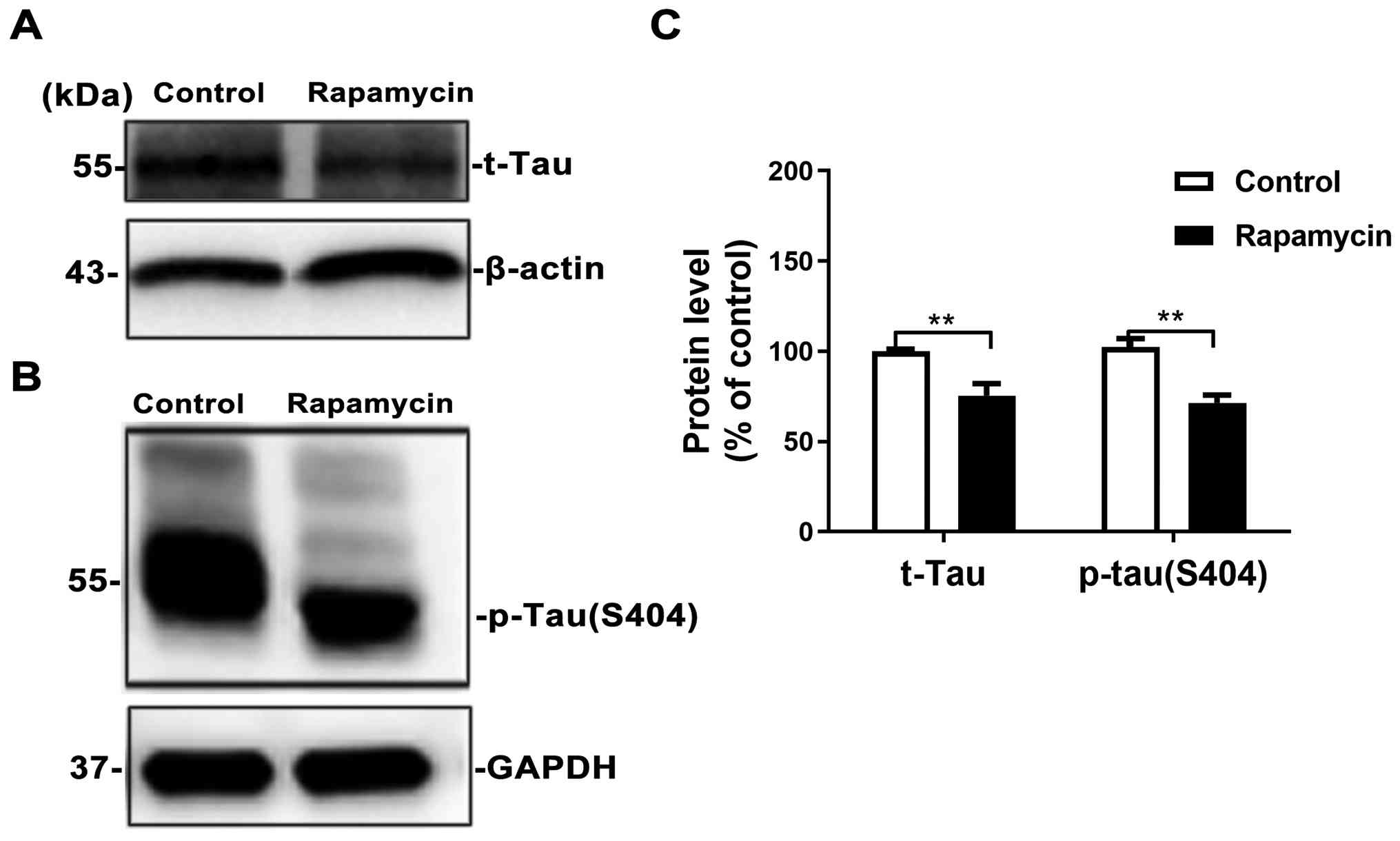
antibody; therefore, the western blot assay results shown in
Fig. 4A on p. 317 for protein
PHF1 should be considered to be invalid.
Given that this issue has come to light, the authors
have now purchased the correct and specific antibody targeting
phosphorylated tau (p-tau-S404) from ABclonal Viotech Co., Ltd
(cat. no. AP1378) and completely repeated the relevant experiments,
in strict accordance with the original experimental protocols and
conditions. In addition, the authors provided the Editorial Office
with the raw data from the repeated experiments, and also proof of
purchase of the correct antibody. The corrected version of Fig. 4, now showing the revised data for
the PHF1 blots in Fig. 4A
together with re-quantified bar charts for these data shown in
Fig. 4B, is featured on the next
page. Additional changes to the text should also be noted: The text
in the Materials and methods section, 'Western blot
analysis' subsection, on p. 315 (left-hand column, lines
14-15), should read as follows (changes highlighted in
bold): '…rabbit anti insulin degrading enzyme (IDE) antibody
(ab133561), rabbit anti-PHF-1 antibody (ab184951), mouse
anti-GSK3β antibody (ab93926)…'. In addition, revisions have also
been made to the legend for Fig.
4. The authors confirm that the error made in performing these
experiments has not had a significant impact on either the results
or the conclusions reported in this study, and all the authors
agree with the publication of this Corrigendum. The authors are
grateful to the Editor of International Journal of Molecular
Medicine for allowing them the opportunity to publish this
Corrigendum; furthermore, they apologize to the readership of the
Journal for any inconvenience caused.