Introduction
Surgical resection remains a cornerstone of curative
treatment for numerous solid tumors (1,2).
Surgery, however, also creates a brief physiological disturbance
marked by tissue injury, neuroendocrine activation, inflammation
and altered immune function (3,4).
Tumor manipulation and wound healing further reshape local and
systemic signaling during this interval (5,6).
Residual malignant cells and occult micrometastases may
consequently encounter a host environment that differs
substantially from the preoperative state. This temporal window
provides a biologically plausible basis for asking whether
perioperative interventions can influence tumor behavior, but
plausibility alone does not show that anesthetic choice alters
recurrence or long-term survival.
Previous reviews have generally organized the field
by anesthetic technique, drug class, tumor type or immune mechanism
(7-12). In the present review, the
evidence is instead structured around the intervention that was
actually delivered and the inference that each study design can
reasonably support. Cellular and animal studies are considered in
terms of target engagement, causal pathway evidence, exposure
realism and context dependence; human biomarker studies are treated
as pharmacodynamic evidence; and observational studies are kept
distinct from randomized trials when clinical outcomes are
discussed. This exposure-defined, inference-aware framework allows
mechanistic and clinical findings to be considered together without
obscuring important differences in route, model or endpoint. The
abundance of mechanistic data has not been matched by consistent
improvement in oncological outcomes. A randomized breast cancer
trial found no reduction in recurrence with paravertebral-regional
anesthesia plus propofol compared with sevoflurane-based general
anesthesia and opioids (13).
Randomized comparisons of propofol- and sevoflurane-based
anesthesia, including long-term follow-up and General Anesthetics
in Cancer Resection (GA-CARES), likewise found no overall- or
disease-free-survival advantage for propofol (14,15). These findings define an important
clinical boundary for interpreting favorable mechanistic
observations.
A clearer interpretation also requires separation of
three clinical contexts. Routine anesthetic care includes regional
blockade, hypnotic selection, multimodal analgesia and
opioid-sparing strategies chosen for established perioperative
indications. Perioperative pharmacological modulation, by contrast,
tests a defined agent, route and short exposure against a
prespecified tumor- or host-response hypothesis. Cancer-directed
repurposing is different again: It entails developing an
anesthetic-related drug for an oncological indication, with an
appropriate exposure strategy and evidence of clinical benefit.
Because these settings differ in pharmacology, purpose and
evidentiary threshold, each drug should be judged within the
context in which it was actually studied.
The perioperative window: Biological
plausibility and pharmacological distinctions
Cancer surgery generates a transient but complex
physiological disturbance. Tissue injury, tumor manipulation, blood
loss and pain activate sympathetic and
hypothalamic-pituitary-adrenal signaling, accompanied by
inflammatory and wound-healing responses (1,2,4,6,16). During the same period,
experimental and translational studies have described reduced
natural killer (NK)-cell activity, altered T-cell function and
myeloid-mediated immunosuppression (3-6,16). These interacting perioperative
influences are summarized in Fig.
1. Together, they may create a more permissive environment for
residual or disseminated tumor cells. The premise is biologically
credible; what remains uncertain is whether a perturbation lasting
hours to days can materially affect recurrence or survival months
or years later.
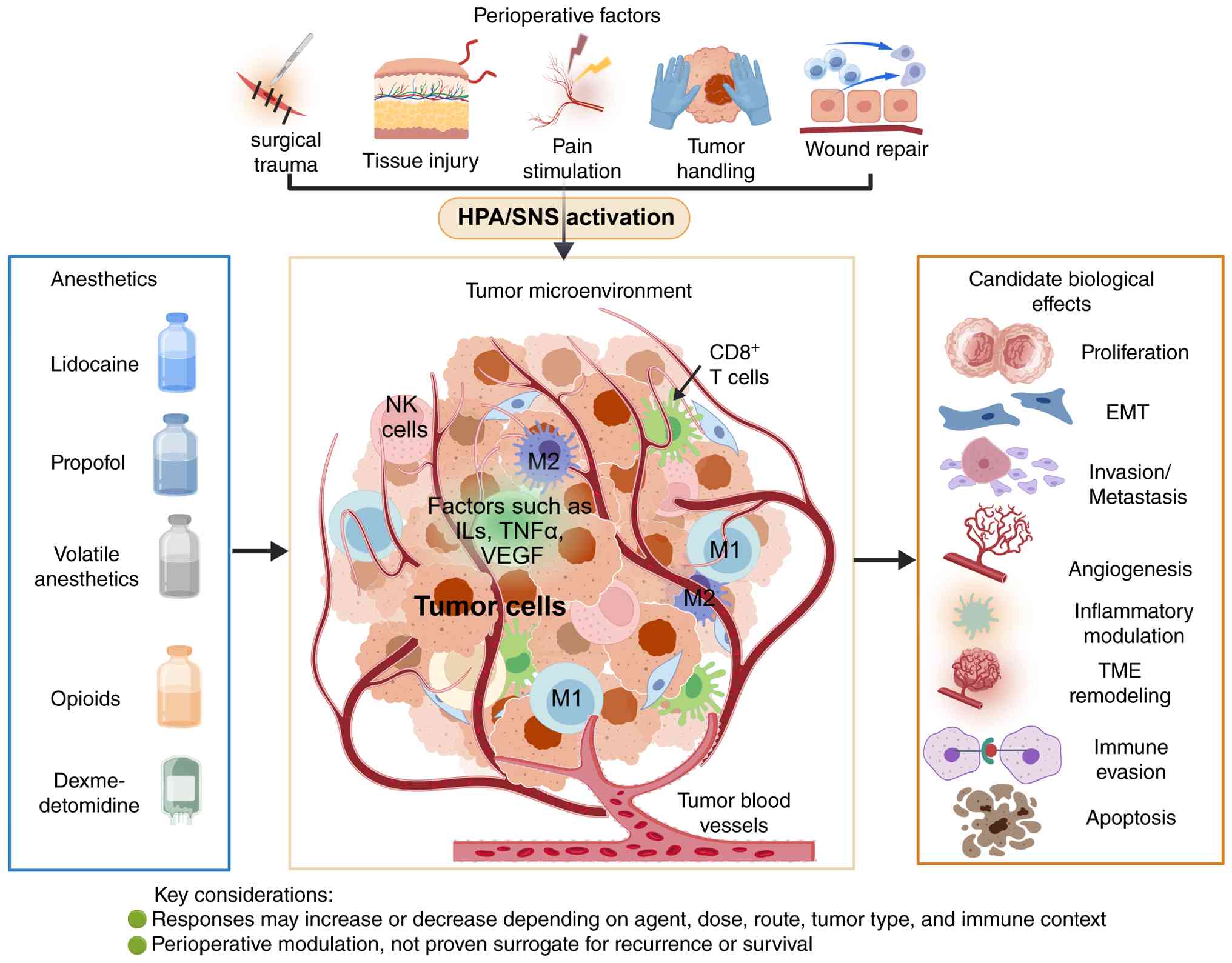 | Figure 1Perioperative interface between
anesthetic-related interventions and cancer biology. Surgical
stress and related perioperative factors activate the HPA axis and
SNS and reshape the TME. Anesthetic-related agents may influence
tumor cells, immune cells, inflammatory and angiogenic mediators,
and tumor vasculature, with potential effects on proliferation,
EMT, invasion/metastasis, angiogenesis, inflammation, immune
evasion and apoptosis. These responses are context-dependent and
are not validated surrogates for cancer recurrence or survival.
EMT, epithelial-mesenchymal transition; HPA,
hypothalamic-pituitary-adrenal axis; ILs, interleukins; M1/M2,
macrophage polarization states; NK, natural killer; SNS,
sympathetic nervous system; TME, tumor microenvironment; TNF-α,
tumor necrosis factor-α; VEGF, vascular endothelial growth
factor. |
Perioperative interventions also create very
different pharmacological exposures. Regional blockade and local
infiltration act mainly at or near the source of nociceptive input
and may attenuate the systemic stress response (17,18). Intravenous lidocaine, in
contrast, produces a systemic exposure determined by bolus dose,
infusion rate and duration (19). Propofol and volatile anesthetics
are short-acting hypnotics whose exposure is largely restricted to
the intraoperative period (20).
Opioid-sparing strategies change the overall composition of
perioperative analgesia rather than generating one discrete drug
exposure, whereas experimental combination regimens introduce
additional pharmacological interactions. Meaningful translation
therefore requires explicit definition of route, duration and the
biologically relevant exposure.
Technique-level comparisons complicate causal
attribution because several components of care often change
together. Regional vs. general anesthesia, or propofol-based total
intravenous anesthesia vs. volatile maintenance, may simultaneously
alter local-anesthetic exposure, opioid use, hypnotic selection,
hemodynamic management and postoperative analgesia (21,22). An oncological effect therefore
cannot readily be assigned to the anesthetic technique as a single
entity. Individual agents are more informatively evaluated in
relation to route, achievable exposure, relevant cellular
compartment and observed phenotype.
Tumor-cell-intrinsic effects of
anesthetic-related drugs
Within this perioperative setting, a large body of
experimental work has examined whether anesthetic-related drugs act
directly on malignant cells. Reported phenotypes include changes in
proliferation, cell-cycle progression, apoptosis, autophagy,
pyroptosis, epithelial-mesenchymal transition (EMT), invasion and
stem-like behavior (23-26). These findings do not all carry
the same weight. Much of the evidence derives from isolated cell
lines or xenografts, with fewer studies performed in
immune-competent systems, and experimental concentrations or
exposure periods often differ from those encountered in
perioperative care (27,28). A signaling change after drug
exposure may reflect direct target engagement, a downstream
pharmacodynamic response or a phenotype associated with some other
initiating event. Dose, duration, tumor lineage and model system
are therefore central to interpretation; selected pathway-level
associations are summarized in Fig.
2.
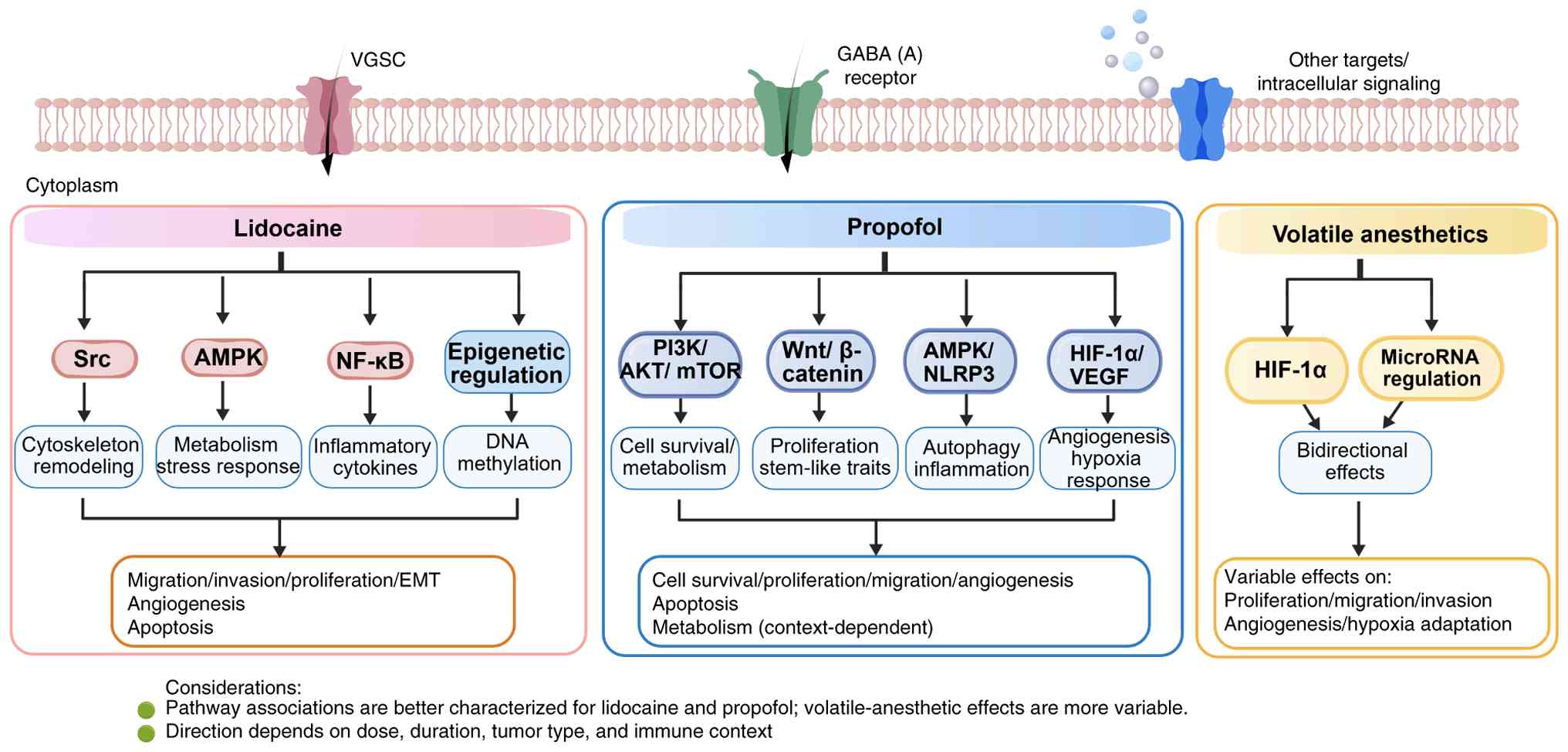 | Figure 2Selected molecular pathways
associated with anesthetic-related agents in cancer models. The
schematic summarizes reported signaling and phenotypic responses to
lidocaine, propofol and volatile anesthetics, including VGSC-,
PI3K/AKT/mTOR-, Wnt/β-catenin-, AMPK-, NLRP3-, HIF-1α/VEGF- and
microRNA-associated pathways. Arrows indicate reported associations
rather than uniformly established direct drug-target interactions;
notably, the NLRP3 response reflects an immune-cell mechanism.
Effects vary with exposure and biological context. AKT, protein
kinase B; AMPK, AMP-activated protein kinase; EMT,
epithelial-mesenchymal transition; GABA(A), γ-aminobutyric acid
type A receptor; HIF-1α, hypoxia-inducible factor-1α; mTOR,
mechanistic target of rapamycin; NF-κB, nuclear factor-κB; NLRP3,
NLR family pyrin domain containing 3; PI3K, phosphoinositide
3-kinase; VEGF, vascular endothelial growth factor; VGSC,
voltage-gated sodium channel. |
Lidocaine
Among local anesthetics, lidocaine has generated the
largest experimental literature in cancer biology. In breast cancer
models, lidocaine exposure has been associated with reduced
cytoskeletal remodeling and migration, with transient receptor
potential melastatin 7 implicated in selected cell lines (29,30). In ovarian cancer, attenuation of
metastatic phenotypes accompanied inhibition of NaV1.5-associated
EMT and focal adhesion kinase (FAK)/Paxillin signaling (31). Prostate cancer models have
likewise linked lidocaine to altered voltage-gated sodium channel
(VGSC) expression and reduced invasiveness (32). Ion-channel signaling is therefore
a plausible contributor to lidocaine activity, although it is
unlikely to operate uniformly because VGSC expression and
functional dependence vary across carcinomas (33).
A separate group of studies points to pathways
governing adhesion and motility. Piegeler et al (23) reported that clinically relevant
concentrations of lidocaine and ropivacaine suppressed tumor
necrosis factor-α-induced invasion of lung adenocarcinoma cells,
accompanied by reduced AKT and FAK activation. Lidocaine has also
been tested together with Src inhibition in a murine model of
breast cancer surgery (34), an
observation of interest because Src is well established in
focal-adhesion turnover, EMT, invasion and metastatic behavior
(35). Under defined conditions,
Akt, FAK and Src may therefore contribute to lidocaine-associated
changes in cell motility. These experiments, however, do not
establish any of these signaling proteins as direct molecular
binding targets of lidocaine.
Epigenetic regulation has also been proposed as part
of the response to lidocaine. In breast cancer cell lines,
lidocaine induced DNA demethylation in a time- and dose-dependent
manner (36). In a separate
study, lidocaine enhanced cisplatin cytotoxicity while promoting
demethylation and re-expression of retinoic acid receptor β2 and
Ras association domain family member 1A (37). Such findings raise the
possibility that epigenetic regulation contributes to
lidocaine-associated cellular effects. Whether a comparable process
occurs in human tumors during perioperative exposure remains
unknown, particularly because the experimental concentrations and
treatment periods have not been shown to reproduce clinically
relevant changes in tumor DNA methylation.
Importantly, even within a single tumor lineage, the
direction of response is not fixed. In A549 non-small cell lung
cancer cells, Hsieh et al (38) observed EMT-associated changes and
more aggressive behavior after lidocaine exposure, whereas another
A549 study reported reduced migration through C-X-C chemokine
receptor type 4-related regulation (39). Differences in concentration,
exposure duration, inflammatory background, assay design or
cellular state could account for the discrepancy. The most
defensible interpretation is therefore that lidocaine acts as a
context-dependent modulator of tumor-cell behavior rather than as a
uniformly antitumor agent (40).
Propofol
Propofol presents a different translational
challenge. Clinically, it is a short-acting intravenous hypnotic
that produces a relatively brief, safety-limited systemic exposure,
unlike local anesthetics that can be infiltrated into tissue or
infused for longer periods. Experimental studies have associated
propofol with changes in mitochondrial function, cellular
metabolism, inflammatory signaling and non-coding RNA (ncRNA)
networks (41). Human
perioperative studies have also reported differences in circulating
extracellular-vesicle micro (mi)RNAs between propofol and
sevoflurane anesthesia (42).
These findings are biologically informative but are best
interpreted as mechanistic or pharmacodynamic evidence rather than
evidence of durable oncological benefit.
PI3K/AKT/mTOR signaling recurs prominently in the
experimental literature. In liver and colorectal cancer (CRC)
models, propofol has been associated with reduced AKT/mTOR
activity, altered autophagy and attenuation of proliferation,
invasion or stem-like phenotypes (43,44). Wnt/β-catenin signaling has also
been implicated in CRC, particularly in relation to EMT and cancer
stem-like properties (44). The
repeated appearance of these pathways does not imply a common
upstream target. Rather, the initiating events appear to vary
across experimental systems, and no single molecular target
currently accounts for the range of responses reported across tumor
types.
Interpretation becomes more complicated when the
relevant signaling event occurs outside the malignant cell.
Propofol activated adenosine monophosphate-activated protein kinase
(AMPK) and suppressed HepG2 growth in an in vitro/xenograft
study (45). By contrast, the
widely cited NLR family pyrin domain containing 3 (NLRP3) study
localized caspase-1-dependent pyroptosis to macrophages, making
this an immune-cell rather than tumor-cell-intrinsic observation
(46). Hypoxia-inducible
factor-1 alpha (HIF-1α)-associated responses have been described in
selected lung cancer and angiogenesis models (47,48), with direction and magnitude
influenced by hypoxia, inflammatory stimulation, drug concentration
and tumor type (49). Unless
direct target engagement and causal dependence are demonstrated
separately, AMPK, NLRP3 and HIF-1α are better interpreted as
components of reported pharmacodynamic responses than as
established direct targets.
ncRNA studies add yet another layer of tumor
specificity. Propofol has been linked to circular RNA/miRNA and
long ncRNA regulatory networks in ovarian and esophageal cancer
models (50-52), extending proposed mechanisms
beyond canonical kinase signaling. Not all observations, however,
point toward tumor suppression. In glioma, propofol enhanced
stem-like properties through a γ-aminobutyric acid type A
receptor-dependent SRC proto-oncogene, non-receptor tyrosine kinase
(Src)/zDHHC palmitoyltransferase 5 (ZDHHC5)-enhancer of zeste 2
polycomb repressive complex 2 subunit (EZH2) pathway (53). The propofol literature is
therefore more accurately interpreted as a set of lineage- and
context-dependent responses than as evidence for a broadly
conserved anticancer program.
Volatile anesthetics, opioids and
dexmedetomidine
The experimental literature is even more
heterogeneous for volatile anesthetics. Isoflurane enhanced
malignant phenotypes in renal cancer cells through HIF-1α-related
signaling in vitro (54),
and modulation of the same pathway has been reported in prostate
cancer models (55). In other
systems, inhalational anesthetics suppressed proliferation or
migration through specific miRNA-associated mechanisms, including
studies in neuroglioma and glioma cells (56,57). These experiments differ
substantially in agent, concentration, oxygen tension, tumor
lineage and exposure duration. Volatile anesthetics therefore
cannot be assigned a single oncological effect as a class.
Opioid-related tumor biology must be considered in
light of the drugs' primary clinical role: Analgesia. Poorly
controlled perioperative pain can amplify sympathetic and
neuroendocrine activation, while experimental studies have linked
μ-opioid receptor signaling, immune modulation and
angiogenic pathways to tumor-associated phenotypes (58-61). The direction and magnitude of
these effects vary with the opioid, dose, receptor expression and
cancer context. Current evidence supports judicious opioid use
within effective multimodal analgesia; broad opioid restriction
intended specifically to improve oncological outcomes is not
supported by clinical data (62).
Dexmedetomidine is similarly difficult to interpret
as a purely tumor-cell-directed agent. Through α2-adrenergic
agonism, it produces sympatholysis and modifies inflammatory and
immune responses (63,64). In a surgically oriented A549
xenograft model, prolonged dexmedetomidine exposure was associated
with slower tumor growth, reduced inflammasome-related signaling
and greater NK-cell activity (65). Clinical findings are less
coherent. A recent meta-analysis found no overall-survival benefit
in randomized studies, a recurrence-free-survival signal within
those trials, and less favorable associations in retrospective
cohorts (66). At present, these
data do not support a defined cancer-directed therapeutic role for
dexmedetomidine.
From molecular associations to
translational interpretation
Table I maps
representative studies by model, evidence type and inferential
level. Direct molecular interaction, causal pathway dependence
demonstrated by perturbation, downstream pharmacodynamic change and
phenotype association support progressively different strengths of
claim. A change in AKT phosphorylation, HIF-1α abundance, miRNA
expression or cell migration can establish that a system responded
to exposure without identifying the molecular event through which
the drug initially acted. Mechanistic interpretation should
therefore consider the intervention, concentration, duration and
model together with the experimental evidence for causal
dependence.
 | Table IRepresentative evidence by study type
and inferential level. |
Table I
Representative evidence by study type
and inferential level.
| Authors, year |
Agent/intervention | Evidence type and
model | Principal
observation | Interpretation and
source | (Refs.) |
|---|
| Piegeler et
al, 2015 | Lidocaine | In vitro;
NCI-H838 lung adenocarcinoma | Lidocaine (1-100
μM) reduced TNF-α-induced invasion and Akt/FAK
activation. | Pathway-linked
pharmacodynamic evidence; direct binding was not demonstrated. | (23) |
| Lirk et al,
2012; Li et al, 2014 | Lidocaine | In vitro;
breast cancer cell lines | Time- and
dose-dependent DNA demethylation; re-expression of RARβ2 and
RASSF1A was reported in a cisplatin study. | Epigenetic
pharmacodynamic evidence; confirmation in human tumors is
lacking. | (36,37) |
| Hsieh et al,
2023; Xing et al, 2022 | Lidocaine | In vitro;
A549 NSCLC cells | EMT-associated
aggressive behavior was reported in one study, whereas another
found reduced CXCR4-related migration. | Divergent phenotype
evidence within the same cell lineage; assay and exposure context
are critical. | (38,39) |
| Bezu et al,
2022 | Local
anesthetics | Immune-competent
mouse and cellular models | Anticancer activity
depended on an intact immune response. | Preclinical
host-mechanism evidence; route and exposure remain
model-specific. | (69) |
| Ramirez et
al, 2015; Cata et al, 2017 | Lidocaine | Human NK-cell in
vitro/ex vivo studies | Clinically
therapeutic plasma concentrations preserved or increased NK-cell
cytotoxicity. | Human
pharmacodynamic evidence; NK-cell activity is not a validated
surrogate for recurrence. | (70,71) |
| Badwe et al,
2023 | Peritumoral
lidocaine | Open-label
multicenter RCT; early breast cancer | Five-year DFS, 86.6
vs. 82.6% (HR 0.74); OS, 90.1 vs. 86.4% (HR 0.71). | Route-specific
clinical efficacy signal; the unblinded design, single disease
setting and lack of independent confirmation limit
extrapolation. | (85) |
| Chang et al,
2022; Wang et al, 2023; Wang et al, 2020 | Propofol | In vitro and
xenograft; liver/colorectal cancer | Reduced AKT/mTOR
activity, altered autophagy and attenuation of proliferative or
stem-like phenotypes. | Pathway and
phenotype evidence with model- and exposure-dependent
relevance. | (43-45) |
| Sun et al,
2019 | Propofol | In vitro;
macrophages | Activated NLRP3-ASC
signaling and caspase-1-dependent pyroptosis. | Mechanistically
supported immune-cell effect; not a tumor-cell-intrinsic anticancer
mechanism. | (46) |
| Fan et al,
2022 | Propofol | In vitro and
xenograft; glioma | Enhanced stem-like
traits through a GABA(A)R-Src-ZDHHC5-EZH2 pathway. | Causal,
counter-directional preclinical evidence in a lineage-specific
setting. | (53) |
| Buschmann et
al, 2020; Lim et al, 2018; Apisutimaitri et al,
2024; Wang et al, 2023 | Propofol vs.
volatile anesthesia | Human perioperative
biomarker studies | Differences were
reported in extracellular-vesicle microRNAs, immune-cell assays and
inflammatory transcriptomes. | Human
pharmacodynamic evidence; links to recurrence or survival remain
unvalidated. | (42,73,75,89) |
| Cao et al,
2023; Bennett-Guerrero et al, 2026 | Propofol vs.
volatile anesthesia | Randomized clinical
outcome trials | No improvement in
OS or DFS with propofol-based anesthesia. | Current outcome
evidence does not support routine anesthetic selection for
oncological benefit. | (14,15) |
| Benzonana et
al, 2013; Huang et al, 2014; Ishikawa et al,
2021; Zhao et al, 2020 | Volatile
anesthetics | In vitro;
renal, prostate and glioma models | HIF-1α-related
malignant phenotypes increased in some models, whereas
microRNA-linked migration decreased in others. | Bidirectional,
model-dependent phenotype evidence. | (54-57) |
| Sessler et
al, 2019 | Regional vs.
general anesthesia | Randomized clinical
outcome trial; breast cancer |
Paravertebral-propofol anesthesia did not
reduce recurrence (HR 0.97, 95% CI 0.74-1.28). | Bundled
perioperative technique with no demonstrated recurrence
advantage. | (13) |
Clinical studies address a complementary set of
questions. A mechanism demonstrated at one concentration, by one
route or in one tumor lineage may have limited relevance to a
different exposure or disease setting. Conversely, a randomized
trial can determine whether a defined perioperative intervention
changes recurrence or survival even when the underlying molecular
events are incompletely resolved. For this reason, direct
interaction, causal pathway evidence, human pharmacodynamic
activity and clinical efficacy are treated as distinct evidence
categories throughout this review.
Tumor microenvironment and systemic host
responses
Direct effects on malignant cells represent only one
part of the anesthesia-cancer interface. During cancer surgery,
tumor cells are embedded within a rapidly changing microenvironment
shaped by immune surveillance, macrophage states, vascular
signaling, neural input and stromal-tumor interactions (22,67,68). At the same time, wound healing,
inflammation and neuroendocrine activation alter the systemic host
milieu. These processes may influence the survival or behavior of
residual and disseminated tumor cells, but their clinical
significance cannot be inferred from biomarker shifts alone. A
perioperative change in an immune or inflammatory marker can
demonstrate biological activity without predicting a durable effect
on recurrence or survival.
Immune-cell function and macrophage
polarization
Immune modulation has been studied most extensively
with local anesthetics, particularly lidocaine. In preclinical
models, Bezu et al (69)
showed that the anticancer effects of local anesthetics could
depend on an intact antitumor immune response. At clinically
relevant concentrations, lidocaine enhanced NK-cell cytotoxicity
in vitro, and related work reported increased NK-cell
activity in cells obtained from patients undergoing cancer surgery
(70,71). More recent experiments using
tumor-infiltrating immune cells from gastric cancer extended these
observations to cytokine regulation, M1-like macrophage
polarization and NF-κB-associated enhancement of CD8+
T-cell activity (72). Together,
these data indicate that lidocaine can influence several components
of antitumor immunity. Whether such immune changes contribute to
clinical benefit remains uncertain, especially because intravenous,
regional and peritumoral administration generate markedly different
local and systemic exposures.
Propofol has also been associated with perioperative
or ex vivo changes in NK-cell activity, cytotoxic T-cell
function and inflammatory profiles (73-75). These studies demonstrate that
anesthetic exposure can modify perioperative immune biology, but
none of these readouts has been validated as a surrogate for
recurrence or survival. Perioperative immune modulation and durable
oncological benefit should therefore be considered separate
outcomes unless a prospective link is established.
Inflammatory, angiogenic and neuro-tumor
signaling
Inflammatory and vascular pathways provide another
point of contact between anesthetic-related drugs and the tumor
microenvironment. Lidocaine has suppressed vascular endothelial
growth factor (VEGF)/VEGF receptor 2-associated angiogenic
signaling in selected experimental models (76), whereas propofol has been linked
to changes in VEGF-, mTOR- and HIF-1α-related signaling in specific
tumor systems (47,48). Volatile anesthetics have yielded
less uniform effects, particularly in studies of hypoxia signaling
and angiogenesis (54,55). Because the direction of response
varies by agent, tumor model and experimental condition, these
observations do not support a common anti-inflammatory or
anti-angiogenic property of anesthetic drugs as a class.
Neural regulation intersects with both inflammatory
and vascular mechanisms. In preclinical cancer models, β-adrenergic
signaling can promote angiogenesis, immune suppression and
metastatic behavior (77-79),
prompting perioperative studies that target stress-related pathways
rather than anesthesia alone. Small randomized trials combining
β-adrenergic and cyclooxygenase-2 blockade in colorectal and breast
cancer reported changes in biomarkers related to metastasis,
inflammation, immunity and tumor proliferation (80-82). These studies show that the
perioperative host environment is pharmacologically responsive.
Whether such short-term modulation ultimately alters recurrence or
survival remains unresolved.
Integrated regulation of the
perioperative host response
The perioperative host response cannot be reduced to
a single anesthetic exposure. Surgical injury, analgesia,
transfusion, temperature, hemodynamic changes and inflammatory
signaling occur concurrently and interact throughout the
perioperative period (10,62,83). This biological and clinical
overlap makes it difficult to attribute a change in immunity or
tumor-related signaling to one component of anesthetic management
in isolation. Regional anesthesia and opioid-sparing approaches
remain valuable for analgesia, recovery and perioperative care, but
evidence that they alter cancer outcomes is inconsistent (13,84). A perioperative biomarker response
alone does not establish disease modification. Translational
relevance therefore requires a pharmacologically defined exposure,
a reproducible biological response and clinically meaningful
outcome data.
Drug-specific translational appraisal
The qualitative appraisal used here considers six
linked features: Reproducibility across models, mechanistic depth,
compatibility with clinically achievable exposure, evidence of
human pharmacodynamic activity, randomized oncological outcomes and
feasibility of the proposed route and schedule. This framework is
deliberately exposure-specific and is not intended as a
standardized evidence grade. The six features may point in
different directions. A drug can have an extensive mechanistic
literature yet little evidence of long-term clinical benefit;
conversely, a favorable outcome obtained with one highly specific
route may provide little information about other modes of
administration. This distinction is especially important when local
anesthetics are compared with propofol, volatile anesthetics,
opioids and dexmedetomidine.
Local anesthetics
Among the agents considered, lidocaine is notable
for a positive randomized clinical signal, although that signal is
tightly linked to the route that was tested. In the multicenter
open-label trial by Badwe et al (85), women with early breast cancer
undergoing upfront surgery received peritumoral 0.5% lidocaine 7-10
min before tumor resection or no lidocaine. After a median
follow-up of 68 months, 5-year disease-free survival was 86.6% in
the lidocaine group and 82.6% in the control group [hazard ratio
(HR) 0.74, 95% CI 0.58-0.95; P=0.017]. Furthermore, 5-year overall
survival was 90.1 and 86.4%, respectively (HR 0.71, 95% CI
0.53-0.94; P=0.019) (85). The
difference is clinically important, but its interpretation remains
bounded by the open-label design, the selected early breast cancer
population, the immediate preoperative peritumoral route and the
absence of independent replication with survival endpoints. Whether
intravenous lidocaine or regional anesthesia can reproduce this
result remains elusive.
Other local anesthetics illustrate how readily
experimental responses can vary by compound and model. Ropivacaine
has inhibited invasion or tumor growth in selected lung
adenocarcinoma and melanoma systems, whereas bupivacaine has shown
activity in ovarian and prostate cancer models but not in the
melanoma model in which lidocaine and ropivacaine were effective
(23,86-88). Broad class-wide extrapolation is
therefore difficult. For any individual agent, translational
potential will depend on whether an active exposure is achievable
through a feasible clinical route, whether that exposure elicits a
measurable biological response in patients and whether the response
is linked to a meaningful oncological outcome without unacceptable
toxicity.
Propofol
Propofol presents a contrasting translational
profile, with an extensive experimental literature but largely
neutral randomized evidence for long-term cancer outcomes. In the
multicenter follow-up reported by Cao et al (14), 1,195 patients were included in
the modified intention-to-treat analysis. Overall survival did not
differ between propofol-based anesthesia and sevoflurane (adjusted
HR 1.02, 95% CI 0.83-1.26; P=0.834), and recurrence-free survival
was also comparable (adjusted HR 1.07, 95% CI 0.89-1.30; P=0.465)
(14). GA-CARES produced a
similar overall result: Propofol was not associated with improved
overall survival in the intention-to-treat population (HR 1.16, 95%
CI 0.96-1.41; P=0.115), and disease-free survival was likewise not
improved (HR 1.10, 95% CI 0.90-1.36; P=0.428) (15). Human mechanistic studies may
still inform future hypothesis development. Propofol exposure has
been associated with differences in immune function, circulating
extracellular-vesicle miRNAs and perioperative transcriptomic
responses (42,73,89). These studies are useful for
defining candidate pharmacodynamic readouts, but cancer-directed
use would require a distinct indication and exposure strategy
supported by clinical evidence.
Volatile anesthetics, opioids and
dexmedetomidine
Volatile anesthetics have produced bidirectional,
model-dependent preclinical findings, including HIF-1α- and
miRNA-associated effects (54-57). This heterogeneity, together with
the absence of a clear clinical outcome signal, provides no
oncological basis for their routine avoidance or preferential
selection. Opioid-related findings remain difficult to separate
from analgesic indication, dose, μ-opioid receptor biology,
tumor context and the consequences of inadequate pain control
(59,62,90). Current cancer-outcome data do not
support broad opioid restriction; effective multimodal analgesia
and avoidance of unnecessary exposure remain appropriate.
Dexmedetomidine is best viewed as a host-response modifier used for
established perioperative indications. Although preclinical studies
suggest effects on tumor growth and antitumor immunity (65), clinical outcome data remain
inconsistent (66) and do not
establish a cancer-directed role.
Translational positioning across
agents
Translational positioning is exposure-specific. The
randomized lidocaine signal is confined to preoperative peritumoral
use in early breast cancer and remains unconfirmed (85), whereas randomized propofol trials
have shown no oncological advantage over volatile anesthesia
(14,15). Evidence for volatile anesthetics,
opioids and dexmedetomidine remains mainly context dependent or
clinically inconsistent. Route, duration, achievable concentration,
tumor setting and endpoint therefore determine what can be inferred
from each intervention; findings from one exposure should not be
generalized to another.
Why preclinical signals have not translated
consistently
Preclinical-clinical discordance often reflects
differences in exposure, model biology and clinical context rather
than a simple contradiction. Experimental effects may require
concentrations, durations or routes not achieved perioperatively,
while tumor genotype and host immunity can modify the response. In
patients, any anesthetic effect is superimposed on surgery, disease
stage, resection quality, perioperative care and subsequent
oncological treatment; even genuine biological modulation may be
too small or transient to alter long-term outcomes.
Exposure, route and duration
Pharmacological exposure is among the most immediate
sources of mismatch between experimental systems and perioperative
practice. Lidocaine illustrates the problem well. Tumescent
administration has absorption kinetics that differ substantially
from those of intravenous infusion (91). In the LOLIPOP breast cancer pilot
trial, lidocaine was given as a 1.5 mg/kg intravenous bolus
followed by a 2 mg/kg/h intraoperative infusion and then a 1.33
mg/kg/h subcutaneous infusion for up to 12 h; serum concentrations
changed across these phases of administration (92,93). Marked interindividual variability
has also been documented during intravenous lidocaine infusion in
colorectal surgery (94).
Nominal concentration values are meaningful only within their
pharmacological setting. The concentration of an infiltration
solution, a measured plasma concentration, the unbound plasma
concentration and the nominal concentration applied to cultured
cells are not interchangeable quantities. Propofol adds the
constraints of brief clinical administration and extensive protein
binding, so total experimental concentrations may poorly represent
the free drug available for tissue distribution in vivo
(20,95,96).
Table II places
representative exposure values alongside their route, duration and
model. Peritumoral 0.5% lidocaine, for example, was injected around
the tumor 7-10 min before surgery, yet the corresponding
intratumoral and systemic drug concentrations were not established
(85). The clinical result
should therefore be interpreted as evidence for that specific
local, short-duration intervention. Numerical overlap between
experimental and clinical reports becomes informative only when
route, time course, relevant tissue exposure and free-drug fraction
are sufficiently comparable.
| Table IIRepresentative exposure examples
illustrating the limits of cross-setting concentration
comparisons. |
Table II
Representative exposure examples
illustrating the limits of cross-setting concentration
comparisons.
| Authors, year | Agent | Setting/model | Nominal
exposure | Route/duration | Interpretation and
source | (Refs.) |
|---|
| Piegeler et
al, 2015 | Lidocaine | NCI-H838 cells | 1-100
μM | Nominal culture
concentration | Assay-specific
cellular exposure; not directly equivalent to plasma or tissue
exposure. | (23) |
| Toner et al,
2021; Toner et al, 2023 | Lidocaine | LOLIPOP breast
cancer trial | 1.5 mg/kg bolus; 2
mg/kg/h IV; then 1.33 mg/kg/h SC | Perioperative
infusion; SC phase up to 12 h | Serum
concentrations changed by administration phase and showed
interpatient variability. | (92,93) |
| Greenwood et
al, 2019 | Lidocaine | Colorectal
surgery | Mean plasma 3.2 vs.
4.6 μg/ml | Lower-vs.
higher-dose IV regimens | Measured clinical
plasma exposure varied with regimen and patient factors. | (94) |
| Badwe et al,
2023 | Lidocaine | Early breast cancer
RCT | 0.5% infiltration
solution | Peritumoral
injection 7-10 min before surgery | Local solution
concentration; tumor-tissue and systemic concentrations were not
established. | (85) |
| Chhabra et
al, 2022 | Propofol | Target-controlled
sedation | Mean target
1.13±0.17 μg/ml; 85% at ≤1.2 μg/ml | Clinical
plasma-target concentration | A sedation target
under neuraxial anesthesia; it does not define tumor exposure
during general anesthesia. | (95) |
| Mazoit et
al, 1999 | Propofol | Whole-blood binding
study | Total 0.5-32
μg/ml; free fraction 1.2-1.7% |
Concentration-dependent binding
assessment | Total concentration
substantially exceeds the unbound drug available for
distribution. | (96) |
| Benzonana et
al, 2013 | Isoflurane | Renal cancer
cells | 0.5-2% | 2h in vitro
gas exposure | Delivered gas
percentage is not interchangeable with a tissue or plasma
concentration. | (54) |
Model and tumor-context limitations
Exposure mismatch is only one part of the problem.
Conventional two-dimensional cell lines and immunodeficient
xenografts remain useful for identifying candidate pathways, but
they reproduce only a fraction of human tumor biology. Tumor
architecture, stromal gradients, vascular organization, intact
immunity and the physiological disturbance produced by surgery are
incompletely represented in these systems (97-99). This limitation becomes
particularly important when the proposed mechanism depends on
macrophages, NK cells, T cells, vascular cells or neural signaling
(67,68). A tumor-cell response observed in
isolation may change substantially once immune and stromal
compartments are restored. Tumor lineage, molecular subtype, driver
genotype, oxygen tension and baseline inflammatory state can
likewise alter both the magnitude and the direction of a drug
response.
Greater biological realism does not require
abandoning reductionist models; it requires matching each model to
the question it can answer (97-99). Dose-response and time-course
experiments are well suited to defining exposure dependence,
whereas immune-competent systems and patient-derived models become
more informative when host-tumor interactions are central to the
proposed mechanism (36,98,99). In anesthesia-cancer research,
these variables are not minor experimental details. They may
determine whether a reported phenotype is reproducible at all
(38,39).
Clinical heterogeneity, confounding and
endpoint selection
Clinical studies introduce a different layer of
heterogeneity. Patients undergoing cancer surgery differ in tumor
stage and subtype, surgical extent, regional analgesia, opioid and
corticosteroid exposure, transfusion requirements, hemodynamic
management and postoperative anticancer treatment (21,28,100). Many of these factors can
influence inflammatory and immune responses independently of the
anesthetic agent under study (16,21,28). Technique-level comparisons are
especially difficult to interpret because several elements of
perioperative care often change together. Switching from volatile
anesthesia to propofol-based total intravenous anesthesia, or from
general anesthesia alone to a regional technique, may
simultaneously alter opioid consumption, local-anesthetic exposure,
postoperative analgesia and hemodynamic management (8,13,21,28). Any cancer-related signal is
therefore superimposed on a broader perioperative treatment
package, limiting attribution to a single exposure (8,16).
Recurrence and overall survival remain the outcomes
of greatest clinical importance, but neither is determined by
perioperative biology alone (28,100). Surgical completeness, tumor
aggressiveness, systemic therapy, radiotherapy and subsequent
disease management exert major and more sustained effects on
long-term outcome (16,21,28,100). Early clinical studies can still
use prespecified pharmacodynamic endpoints to determine whether an
intervention engages the intended biological process (28). Such endpoints are valuable for
demonstrating activity; they do not replace recurrence or survival
when the clinical question is durable cancer control.
Context dependence and bidirectional
effects
A further challenge is that anesthetic-related
effects are not consistently unidirectional. Lidocaine has been
associated with reduced invasion in certain lung cancer
experiments, yet EMT-associated and more aggressive phenotypes have
been reported under different conditions (23,38,39). Propofol has produced numerous
tumor-suppressive phenotypes in cell models, while a
mechanistically detailed glioma study showed enhanced stem-like
properties through a γ-aminobutyric acid type A
receptor/Src/ZDHHC5-EZH2 pathway (53). Volatile anesthetics show a
similar pattern: HIF-1α-related adaptation may be enhanced in one
system, whereas migration is suppressed through miRNA-dependent
mechanisms in another (54,56). Representative counter-directional
and host-level responses are summarized in Fig. 3.
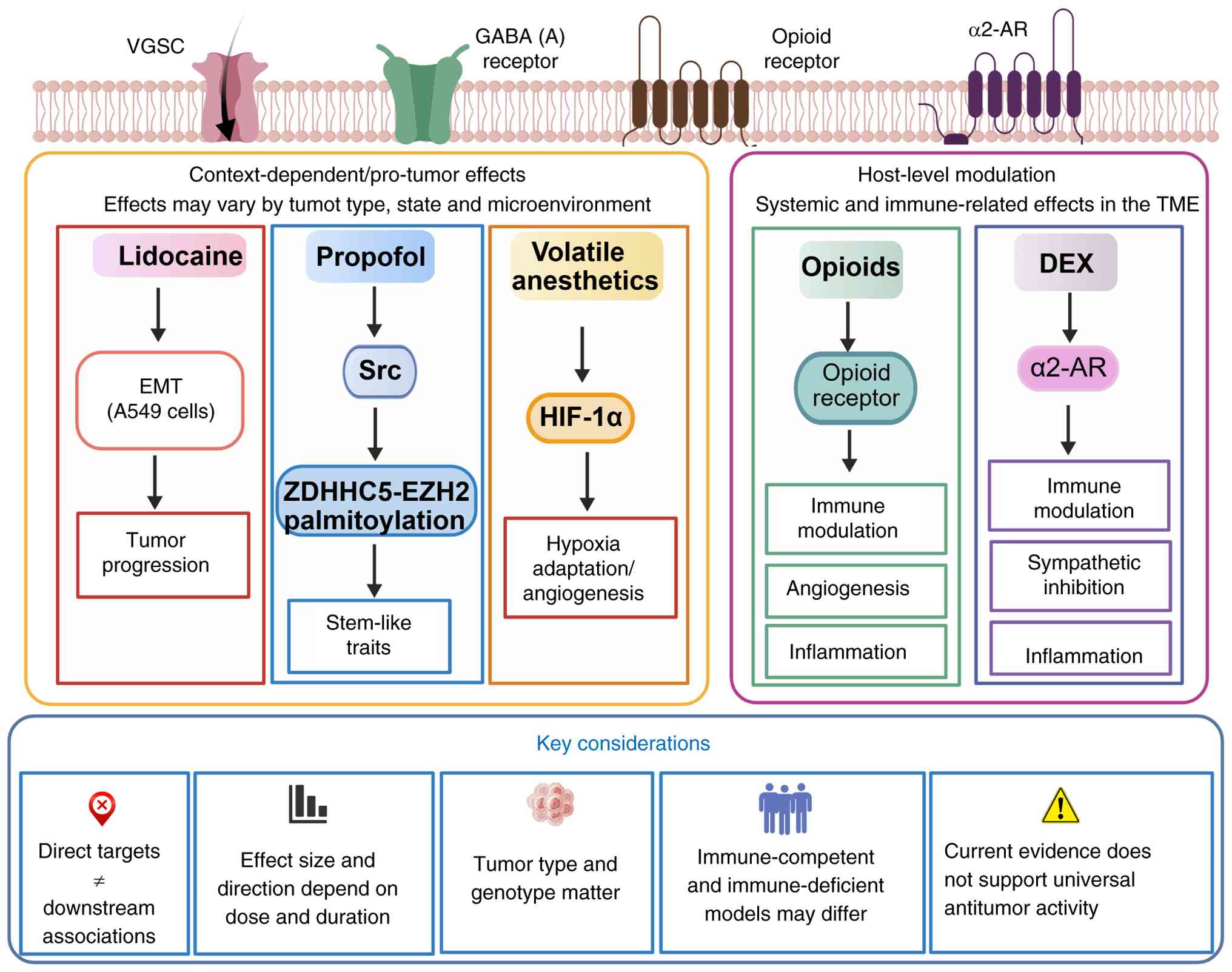 | Figure 3Context-dependent and host-mediated
responses to anesthetic-related drugs. Representative
context-dependent findings include lidocaine-associated EMT in A549
cells, propofol-associated Src/ZDHHC5-EZH2 signaling and stem-like
traits in glioma and HIF-1α-associated responses to volatile
anesthetics. Opioids and dexmedetomidine additionally modulate
immune, inflammatory, angiogenic and sympathetic pathways at the
host level. Downstream associations should not be interpreted as
direct molecular targets and the direction of response varies with
exposure, tumor and immune context. α2-AR, α2-adrenergic receptor;
DEX, dexmedetomidine; EMT, epithelial-mesenchymal transition; EZH2,
enhancer of zeste homolog 2; GABA(A), γ-aminobutyric acid type A
receptor; HIF-1α, hypoxia-inducible factor-1α; VGSC, voltage-gated
sodium channel; ZDHHC5, zinc finger DHHC-type palmitoyltransferase
5. |
These apparent contradictions are informative rather
than simply inconsistent. Drug concentration, exposure duration,
tumor lineage, genotype, inflammatory state, oxygen tension and
immune context can shift the same signaling network toward
different phenotypic outcomes. Reducing a finding to a binary
'pro-' or 'anti-tumor' label obscures the experimental conditions
most likely to determine its translational relevance. Host-directed
effects introduce an additional layer of complexity. Opioid-related
immunomodulation remains biologically plausible, but inadequate
analgesia can itself intensify sympathetic and neuroendocrine
stress, and observational associations are vulnerable to
confounding by indication and disease severity (62,90). Similar concerns arise whenever
perioperative drugs are studied outside the clinical context in
which they are ordinarily used. For a preclinical signal to acquire
translational significance, it should persist at a safely
achievable exposure, remain reproducible in an appropriate tumor
and host context, and be detectable in humans through a relevant
pharmacodynamic response. Whether that response materially
contributes to recurrence or survival is a separate question.
Bridging this gap requires experimental systems that preserve
mechanistic resolution while more closely reproducing human tumor
biology and clinically realistic drug exposure.
Experimental platforms for
mechanism-informed translation
Patient-derived organoids (PDOs), immune cocultures,
tumor-on-chip platforms and multi-omics technologies can place a
defined drug exposure within a more representative cellular,
spatial and pharmacological context (101-103). Each addresses a different
limitation of conventional models. Organoids retain selected
patient-specific tumor features; immune cocultures permit direct
interrogation of host-tumor interactions; and microphysiological
systems can reproduce gradients, perfusion and tissue interfaces.
Their utility depends on matching the platform to the proposed
mechanism, route and clinically plausible exposure. These systems
serve as intermediate tools for mechanistic validation, not as
evidence of clinical efficacy in their own right (104-106).
Organoids, immune cocultures and
tumor-on-chip models
PDOs preserve important genomic features of the
original tumor and part of its intratumoral heterogeneity (99,101-103). Immune cocultures can
incorporate immune and stromal components, whereas tumor-on-chip
systems can reproduce perfusion and spatial gradients that are
largely absent from conventional two-dimensional culture (104,105). These platforms are particularly
relevant to anesthesia-cancer research, where drug effects may
depend on transient exposure, tissue distribution, immune-cell
interactions or local microenvironmental conditions. They can
reproduce clinically realistic exposure schedules while allowing
target engagement, pathway activity and tumor-host interactions to
be examined within a single framework, and can test whether a
response observed in a homogeneous cell line persists across
patient-derived tumors or is restricted to a particular molecular
background. Even so, activity in an organoid or microfluidic system
does not establish therapeutic efficacy; translational relevance
depends on clinically achievable exposure and a measurable human
correlate.
Single-cell, spatial and microbiome
approaches
Single-cell and spatial profiling offer a different
advantage: They can identify the cellular compartment in which a
drug-associated response occurs (106). A change attributed broadly to
'tumor tissue' may originate from malignant cells, macrophages,
endothelial cells, neural elements, fibroblasts or other stromal
populations, and these technologies can distinguish among them
(107-109). This level of resolution is
especially useful when the same anesthetic-related drug produces
apparently divergent effects across tumor models or when a
host-mediated mechanism is suspected. Microbiome research remains
at an earlier stage. The gut microbiota is increasingly recognized
as a determinant of response to cancer immunotherapy (110), and perioperative management may
alter microbial composition and function (111). Reproducible pharmacodynamic
relationships between specific anesthetic agents and
microbiome-mediated cancer outcomes, however, have not been
established. For now, microbiome, single-cell and spatial
approaches are most useful for locating responsive biological
compartments, refining mechanistic hypotheses and defining patient
subgroups in which an effect may be more likely to emerge. Their
contribution to anesthetic drug repurposing will depend on linking
these molecular patterns to a specific exposure and, ultimately, to
clinical outcomes.
Designing the next generation of clinical
studies
Clinical development should begin with a
pharmacologically defined exposure and evidence of target
engagement or a proximal biological response. Fig. 4 separates perioperative
modulation from cancer-directed repurposing within this staged
framework. Because many perioperative changes are transient,
protocols should prospectively align the drug, route, dose,
duration, biological hypothesis, sampling schedule and endpoint.
Biomarkers should be prespecified as pharmacodynamic, prognostic,
predictive or surrogate measures; their use as surrogates requires
independent validation.
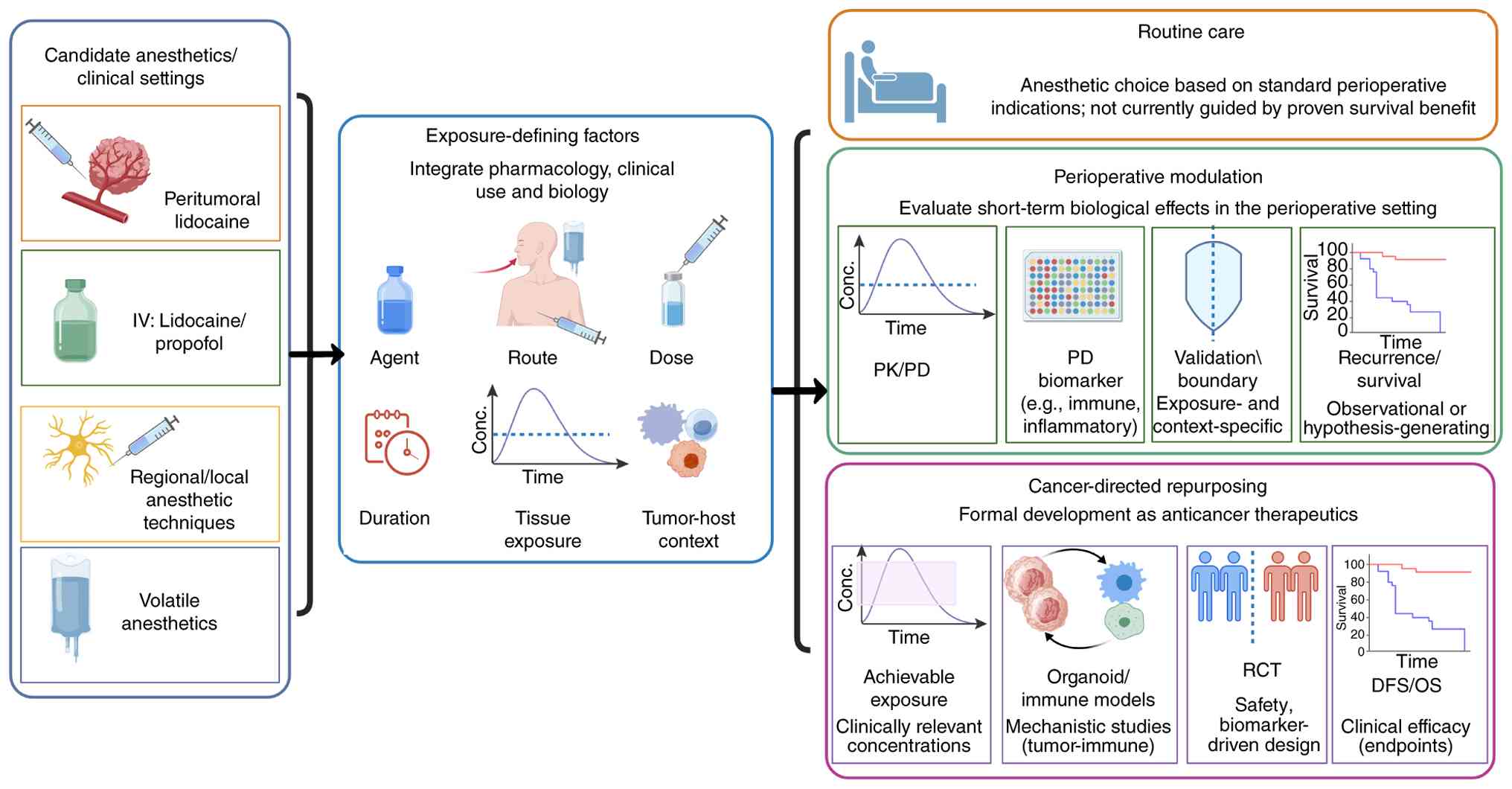 | Figure 4Translational framework for
anesthetic-related biological observations in clinical oncology.
The framework distinguishes routine anesthetic care, perioperative
pharmacological modulation and cancer-directed repurposing
according to agent, route, dose, duration, tissue exposure and
tumor-host context. Perioperative modulation relies on PK/PD
assessment and pharmacodynamic biomarkers, which are not validated
surrogates for recurrence or survival. Cancer-directed repurposing
additionally requires clinically achievable exposure, mechanistic
support, safety evaluation and randomized assessment using
clinically meaningful endpoints. DFS, disease-free survival; IV,
intravenous; OS, overall survival; PD, pharmacodynamic; PK,
pharmacokinetic; RCT, randomized controlled trial. |
Mechanism-based and exposure-defined
trials
Lidocaine provides a clear example of why route
should not be treated as a minor design variable. Peritumoral
injection, intravenous infusion, regional blockade and local
infiltration produce markedly different tissue and systemic
exposures. Trials prompted by the findings of Badwe et al
(85) are most informative when
they reproduce the peritumoral regimen or deliberately test how
changes in dose, route or timing alter the biological and clinical
effect. Evidence generated with intravenous lidocaine should not be
assumed to represent the same intervention.
The same distinction applies to propofol. Routine
intraoperative maintenance creates a short, safety-limited exposure
and should be conceptually separated from any strategy that
develops propofol as a cancer-directed pharmacological
intervention. Existing randomized trials have not demonstrated a
survival advantage for conventional propofol-based anesthesia
(14,15), which places clear boundaries
around hypotheses derived from preclinical studies. If
cancer-specific applications are pursued, both the exposure
strategy and the biological rationale will need to extend beyond a
simple comparison of standard maintenance anesthetics (15,28). Major perioperative covariates
should also be characterized prospectively (16,112). Opioid exposure, regional
techniques, transfusion, corticosteroid use, hemodynamic
management, surgical complexity and subsequent oncological therapy
can all influence inflammatory or immune biology and may modify
long-term cancer outcomes (16,21,28). Capturing these variables in
advance allows any pharmacodynamic or clinical signal to be
interpreted within the perioperative context in which it emerged
(112).
Biomarkers, sampling windows and patient
stratification
Biomarker interpretation depends as much on timing
and biological purpose as on the marker itself. Pathway-specific
tissue responses, immune-cell phenotyping and cytokine profiles can
indicate whether an intervention has engaged the intended
biological process. Circulating tumor DNA (ctDNA) and circulating
tumor cells provide information more closely related to tumor
burden and minimal residual disease, but neither is inherently
specific to anesthetic pharmacology (113-115). Timing is particularly important
for ctDNA. Surgical trauma can substantially increase non-tumor
cell-free DNA, temporarily reducing the analytical sensitivity of
ctDNA detection (116). Samples
collected before surgery, immediately after resection, during early
recovery and later in the minimal-residual-disease period therefore
address different biological questions. A single postoperative
measurement can be difficult to interpret without this temporal
context.
Patient stratification may be equally important. If
anesthetic-related effects depend on tumor genotype, immune state,
receptor expression, hypoxia or other microenvironmental features,
a modest population-level signal could conceal a larger effect
within a biologically defined subgroup. In this setting, biomarkers
are most useful when they demonstrate pharmacodynamic activity or
enrich for responsive biology. Their use as substitutes for
recurrence or survival requires prospective validation for the
specific intervention being studied.
Combination strategies
Combination strategies are most defensible when a
perioperative agent enhances a defined, established anticancer
mechanism at a feasible exposure. Preclinical evidence that local
anesthetics can interact with antitumor immunity provides a
rationale for studying combinations with immune-checkpoint blockade
or targeted delivery approaches (69,117). The critical question is not
whether an interaction can be produced in vitro, but whether
it persists in immune-competent systems and can be demonstrated in
patients using the intended route and schedule. Clinical
development of a combination requires evidence of the intended
biological interaction at an achievable exposure, acceptable safety
and a patient population in which the mechanism is relevant. The
same standard should apply when cancer-related endpoints are
incorporated into studies of multimodal analgesia, attenuation of
surgical stress or transfusion optimization. These interventions
retain their established perioperative indications; any additional
cancer-related benefit must be demonstrated prospectively.
Conclusions
Anesthetic-related drugs can modulate tumor-cell
and host biology, but the direction and clinical relevance of these
effects depend strongly on the agent, route, exposure, tumor type
and biological context. Mechanistic and perioperative biomarker
findings should therefore not be equated with durable oncological
benefit. Current randomized evidence does not support selecting
anesthetic techniques solely to improve cancer outcomes. The
favorable survival signal observed with preoperative peritumoral
lidocaine remains intervention-specific and requires independent
confirmation, whereas propofol-based anesthesia has not
demonstrated a long-term advantage over volatile anesthesia.
Routine anesthetic management should thus remain guided by
established perioperative indications. Future translation should
focus on clinically achievable exposures linked to defined tumor-
or host-specific mechanisms, biologically relevant patient
populations and prospectively specified pharmacodynamic and
oncological endpoints. Adequately powered randomized trials are
required to establish whether selected anesthetic-related agents
can serve as reproducible anticancer adjuncts.
Availability of data and materials
Not applicable.
Authors' contributions
TY and JT conceived the review and prepared the
initial draft of the manuscript, including the figures and tables.
MSM and HH assisted with literature retrieval and manuscript
revision. CP and QF provided overall supervision and critically
reviewed and edited the manuscript. CP acquired funding and
contributed to figure and table editing. Data authentication is not
applicable. All authors read and approved the final version of the
manuscript.
Ethics approval and consent to
participate
Not applicable.
Patient consent for publication
Not applicable.
Competing interests
The authors declare that they have no competing
interests.
Acknowledgements
All figures in this article were created using
BioGDP.com.
Funding
This work was supported by the Medical Science and Technology
Program of the Sichuan Provincial Health Commission (grant no.
24QNMP009), the Sichuan Medical Association Oncology
(Hengrui-Yihang) Special Scientific Research Project (grant no.
2024HR38), the Third People's Hospital of Chengdu Scientific
Research Project (grant no. 2023PI25) and the Clinical Research
Program (grant no. CSY-YN-03-2024-016).
References
|
1
|
Horowitz M, Neeman E, Sharon E and
Ben-Eliyahu S: Exploiting the critical perioperative period to
improve long-term cancer outcomes. Nat Rev Clin Oncol. 12:213–226.
2015. View Article : Google Scholar : PubMed/NCBI
|
|
2
|
Cheng X, Zhang H, Hamad A, Huang H and
Tsung A: Surgery-mediated tumor-promoting effects on the immune
microenvironment. Semin Cancer Biol. 86:408–419. 2022. View Article : Google Scholar : PubMed/NCBI
|
|
3
|
Bezu L, Akçal Öksüz D, Bell M, Buggy D,
Diaz-Cambronero O, Enlund M, Forget P, Gupta A, Hollmann MW,
Ionescu D, et al: Perioperative immunosuppressive factors during
cancer surgery: An updated review. Cancers (Basel). 16:23042024.
View Article : Google Scholar : PubMed/NCBI
|
|
4
|
Yang F, Hua Q, Zhu X and Xu P: Surgical
stress induced tumor immune suppressive environment.
Carcinogenesis. 45:185–198. 2024. View Article : Google Scholar : PubMed/NCBI
|
|
5
|
Kim R: Effects of surgery and anesthetic
choice on immunosuppression and cancer recurrence. J Transl Med.
16:82018. View Article : Google Scholar : PubMed/NCBI
|
|
6
|
Onuma AE, Zhang H, Gil L, Huang H and
Tsung A: Surgical stress promotes tumor progression: A focus on the
impact of the immune response. J Clin Med. 9:40962020. View Article : Google Scholar : PubMed/NCBI
|
|
7
|
Ramly MS and Buggy DJ: Anesthetic
techniques and cancer outcomes: what is the current evidence?
Anesth Analg. 140:768–777. 2025. View Article : Google Scholar
|
|
8
|
Brogi E and Forfori F: Anesthesia and
cancer recurrence: An overview. J Anesth Analg Crit Care. 2:332022.
View Article : Google Scholar
|
|
9
|
Xia SH, Zhou D, Ge F, Sun M, Chen X, Zhang
H and Miao C: Influence of perioperative anesthesia on cancer
recurrence: from basic science to clinical practice. Curr Oncol
Rep. 25:63–81. 2023. View Article : Google Scholar
|
|
10
|
Choi H and Hwang W: Anesthetic approaches
and their impact on cancer recurrence and metastasis: A
comprehensive review. Cancers (Basel). 16:42692024. View Article : Google Scholar
|
|
11
|
Santander Ballestín S, Lanuza Bardaji A,
Marco Continente C and Luesma Bartolomé MJ: Antitumor anesthetic
strategy in the perioperatory period of the oncological patient: A
review. Front Med (Lausanne). 9:7993552022. View Article : Google Scholar : PubMed/NCBI
|
|
12
|
Wu J, Yang J and Duan J: Anesthetic agents
as therapeutic tools in breast cancer: Insights into cancer
progression and recurrence. Clin Breast Cancer. 25:e561–e576. 2025.
View Article : Google Scholar : PubMed/NCBI
|
|
13
|
Sessler DI, Pei L, Huang Y, Fleischmann E,
Marhofer P, Kurz A, Mayers DB, Meyer-Treschan TA, Grady M, Tan EY,
et al: Recurrence of breast cancer after regional or general
anaesthesia: A randomised controlled trial. Lancet. 394:1807–1815.
2019. View Article : Google Scholar : PubMed/NCBI
|
|
14
|
Cao SJ, Zhang Y, Zhang YX, Zhao W, Pan LH,
Sun XD, Jia Z, Ouyang W, Ye QS, Zhang FX, et al: Long-term survival
in older patients given propofol or sevoflurane anaesthesia for
major cancer surgery: Follow-up of a multicentre randomised trial.
Br J Anaesth. 131:266–275. 2023. View Article : Google Scholar
|
|
15
|
Bennett-Guerrero E, Romeiser JL, DeMaria
S, Nadler JW, Quinn TD, Ponnappan SK, Wang R, Gloff MS, Lee KJ,
Levin MA, et al: Anesthesia type during cancer surgery: Results of
the GA-CARES randomized, multicenter trial. Anesthesiology.
144:51–62. 2026. View Article : Google Scholar
|
|
16
|
Hiller JG, Perry NJ, Poulogiannis G,
Riedel B and Sloan EK: Perioperative events influence cancer
recurrence risk after surgery. Nat Rev Clin Oncol. 15:205–218.
2018. View Article : Google Scholar
|
|
17
|
Reysner T and Reysner M: Regional
anesthesia and the perioperative inflammatory window in cancer
surgery: From surgical stress to immunometabolic reprogramming.
Cancers (Basel). 18:11582026. View Article : Google Scholar : PubMed/NCBI
|
|
18
|
Reysner T, Wieczorowska-Tobis K, Kowalski
G, Grochowicka M, Pyszczorska M, Mularski A and Reysner M: The
influence of regional anesthesia on the systemic stress response.
Reports. 7:892024. View Article : Google Scholar
|
|
19
|
Wall TP and Buggy DJ: Perioperative
intravenous lidocaine and metastatic cancer recurrence-A narrative
review. Front Oncol. 11:6888962021. View Article : Google Scholar
|
|
20
|
Sahinovic MM, Struys MMRF and Absalom AR:
Clinical pharmacokinetics and pharmacodynamics of propofol. Clin
Pharmacokinet. 57:1539–1558. 2018. View Article : Google Scholar
|
|
21
|
Sekandarzad MW, van Zundert AAJ, Lirk PB,
Doornebal CW and Hollmann MW: Perioperative anesthesia care and
tumor progression. Anesth Analg. 124:1697–1708. 2017. View Article : Google Scholar
|
|
22
|
Zhou X, Shao Y, Li S, Zhang S, Ding C,
Zhuang L and Sun J: An intravenous anesthetic drug-propofol,
influences the biological characteristics of malignant tumors and
reshapes the tumor microenvironment: A narrative literature review.
Front Pharmacol. 13:10575712022. View Article : Google Scholar :
|
|
23
|
Piegeler T, Schläpfer M, Dull RO, Schwartz
DE, Borgeat A, Minshall RD and Beck-Schimmer B: Clinically relevant
concentrations of lidocaine and ropivacaine inhibit TNFα-induced
invasion of lung adenocarcinoma cells in vitro by blocking the
activation of Akt and focal adhesion kinase. Br J Anaesth.
115:784–791. 2015. View Article : Google Scholar
|
|
24
|
Chamaraux-Tran TN, Mathelin C, Aprahamian
M, Joshi GP, Tomasetto C, Diemunsch P and Akladios C: Antitumor
effects of lidocaine on human breast cancer cells: An in vitro and
in vivo experimental trial. Anticancer Res. 38:95–105. 2018.
|
|
25
|
Zhou R, Konishi Y, Zhang A and Nishiwaki
K: Propofol elicits apoptosis and attenuates cell growth in
esophageal cancer cell lines. Nagoya J Med Sci. 85:579–591.
2023.PubMed/NCBI
|
|
26
|
Lai RC, Shan WR, Zhou D, Zeng XQ, Zuo K,
Pan DF, Zeng WA and Zuo ZY: Sevoflurane promotes migration,
invasion, and colony-forming ability of human glioblastoma cells
possibly via increasing the expression of cell surface protein 44.
Acta Pharmacol Sin. 40:1424–1435. 2019. View Article : Google Scholar : PubMed/NCBI
|
|
27
|
Chamaraux-Tran TN and Piegeler T: The
amide local anesthetic lidocaine in cancer surgery-potential
antimetastatic effects and preservation of immune cell function? A
narrative review. Front Med (Lausanne). 4:2352017. View Article : Google Scholar
|
|
28
|
Murphy L, Shaker J and Buggy DJ:
Anaesthetic techniques and strategies: Do they influence
oncological outcomes? Curr Oncol. 30:5309–5321. 2023. View Article : Google Scholar :
|
|
29
|
D'Agostino G, Saporito A, Cecchinato V,
Silvestri Y, Borgeat A, Anselmi L and Uguccioni M: Lidocaine
inhibits cytoskeletal remodelling and human breast cancer cell
migration. Br J Anaesth. 121:962–968. 2018. View Article : Google Scholar : PubMed/NCBI
|
|
30
|
Liu H, Dilger JP and Lin J: Lidocaine
suppresses viability and migration of human breast cancer cells:
TRPM7 as a target for some breast cancer cell lines. Cancers
(Basel). 13:2342021. View Article : Google Scholar
|
|
31
|
Liu C, Yu M, Li Y, Wang H, Xu C, Zhang X,
Li M, Guo H, Ma D and Guo X: Lidocaine inhibits the metastatic
potential of ovarian cancer by blocking NaV 1.5-mediated
EMT and FAK/Paxillin signaling pathway. Cancer Med. 10:337–349.
2021. View Article : Google Scholar :
|
|
32
|
Rizaner N, Fraser SP, Gul IB, Purut E,
Djamgoz MBA and Altun S: Lidocaine inhibits rat prostate cancer
cell invasiveness and voltage-gated sodium channel expression in
plasma membrane. J Membr Biol. 257:17–24. 2024. View Article : Google Scholar
|
|
33
|
Djamgoz MBA, Fraser SP and Brackenbury WJ:
In vivo evidence for voltage-gated sodium channel expression in
carcinomas and potentiation of metastasis. Cancers (Basel).
11:16752019. View Article : Google Scholar : PubMed/NCBI
|
|
34
|
Wall TP, Crowley PD, Sherwin A, Foley AG
and Buggy DJ: Effects of lidocaine and Src inhibition on metastasis
in a murine model of breast cancer surgery. Cancers (Basel).
11:14142019. View Article : Google Scholar : PubMed/NCBI
|
|
35
|
Patel A, Sabbineni H, Clarke A and
Somanath PR: Novel roles of Src in cancer cell
epithelial-to-mesenchymal transition, vascular permeability,
microinvasion and metastasis. Life Sci. 157:52–61. 2016. View Article : Google Scholar : PubMed/NCBI
|
|
36
|
Lirk P, Berger R, Hollmann MW and Fiegl H:
Lidocaine time- and dose-dependently demethylates deoxyribonucleic
acid in breast cancer cell lines in vitro. Br J Anaesth.
109:200–207. 2012. View Article : Google Scholar
|
|
37
|
Li K, Yang J and Han X: Lidocaine
sensitizes the cytotoxicity of cisplatin in breast cancer cells via
up-regulation of RARβ2 and RASSF1A demethylation. Int J Mol Sci.
15:23519–23536. 2014. View Article : Google Scholar
|
|
38
|
Hsieh WH, Liao SW, Chan SM, Hou JD, Wu SY,
Ho BY, Chen KY, Tai YT, Fang HW, Fang CY, et al: Lidocaine induces
epithelial-mesenchymal transition and aggravates cancer behaviors
in non-small cell lung cancer A549 cells. Oncol Lett. 26:3462023.
View Article : Google Scholar
|
|
39
|
Xing B, Yang L and Cui Y: Lidocaine
inhibited migration of NSCLCA549 cells via the CXCR4 regulation.
Cancer Biomark. 33:317–330. 2022. View Article : Google Scholar
|
|
40
|
Li R, Xiao C, Liu H, Huang Y, Dilger JP
and Lin J: Effects of local anesthetics on breast cancer cell
viability and migration. BMC Cancer. 18:6662018. View Article : Google Scholar
|
|
41
|
Jiang S, Liu Y, Huang L, Zhang F and Kang
R: Effects of propofol on cancer development and chemotherapy:
Potential mechanisms. Eur J Pharmacol. 831:46–51. 2018. View Article : Google Scholar : PubMed/NCBI
|
|
42
|
Buschmann D, Brandes F, Lindemann A,
Maerte M, Ganschow P, Chouker A, Schelling G, Pfaffl MW and
Reithmair M: Propofol and sevoflurane differentially impact
MicroRNAs in circulating extracellular vesicles during colorectal
cancer resection: A pilot study. Anesthesiology. 132:107–120. 2020.
View Article : Google Scholar
|
|
43
|
Chang Q, Wu J, An Y, Liu H and Sun Y:
Propofol suppresses proliferation, migration, invasion, and tumor
growth of liver cancer cells via suppressing cancer susceptibility
candidate 9/phosphatase and tensin homolog/AKT serine/threonine
kinase/mechanistic target of rapamycin kinase axis. Hum Exp
Toxicol. 41:96032712110659722022. View Article : Google Scholar : PubMed/NCBI
|
|
44
|
Wang R, Li S, Hou Q, Zhang B, Chu H, Hou
Y, Ni C, Sun L, Ran Y and Zheng H: Propofol inhibits colon cancer
cell stemness and epithelial-mesenchymal transition by regulating
SIRT1, Wnt/β-catenin and PI3K/AKT/mTOR signaling pathways. Discov
Oncol. 14:1372023. View Article : Google Scholar
|
|
45
|
Wang Y, Xu B, Zhou J and Wu X: Propofol
activates AMPK to inhibit the growth of HepG2 cells in vitro and
hepatocarcinogenesis in xenograft mouse tumor models by inducing
autophagy. J Gastrointest Oncol. 11:1322–1332. 2020. View Article : Google Scholar
|
|
46
|
Sun L, Ma W, Gao W, Xing Y, Chen L, Xia Z,
Zhang Z and Dai Z: Propofol directly induces caspase-1-dependent
macrophage pyroptosis through the NLRP3-ASC inflammasome. Cell
Death Dis. 10:5422019. View Article : Google Scholar : PubMed/NCBI
|
|
47
|
Wang Z, Cao B, Ji P and Yao F: Propofol
inhibits tumor angiogenesis through targeting VEGF/VEGFR and
mTOR/eIF4E signaling. Biochem Biophys Res Commun. 555:13–18. 2021.
View Article : Google Scholar
|
|
48
|
Yang N, Liang Y, Yang P and Ji F: Propofol
suppresses LPS-induced nuclear accumulation of HIF-1α and tumor
aggressiveness in non-small cell lung cancer. Oncol Rep.
37:2611–2619. 2017. View Article : Google Scholar
|
|
49
|
Schito L and Semenza GL: Hypoxia-inducible
factors: Master regulators of cancer progression. Trends Cancer.
2:758–770. 2016. View Article : Google Scholar
|
|
50
|
Lu H, Zheng G, Gao X, Chen C, Zhou M and
Zhang L: Propofol suppresses cell viability, cell cycle progression
and motility and induces cell apoptosis of ovarian cancer cells
through suppressing MEK/ERK signaling via targeting
circVPS13C/miR-145 axis. J Ovarian Res. 14:302021. View Article : Google Scholar
|
|
51
|
Shen X, Wang D, Chen X and Peng J:
Propofol inhibits proliferation, migration, invasion and promotes
apoptosis by regulating HOST2/JAK2/STAT3 signaling pathway in
ovarian cancer cells. Cytotechnology. 73:243–252. 2021. View Article : Google Scholar
|
|
52
|
Gao M, Guo R, Lu X, Xu G and Luo S:
Propofol suppresses hypoxia-induced esophageal cancer cell
migration, invasion, and EMT through regulating lncRNA
TMPO-AS1/miR-498 axis. Thorac Cancer. 11:2398–2405. 2020.
View Article : Google Scholar
|
|
53
|
Fan X, Gong M, Yu H, Yang H, Wang S and
Wang R: Propofol enhances stem-like properties of glioma via
GABAAR-dependent Src modulation of ZDHHC5-EZH2
palmitoylation mechanism. Stem Cell Res Ther. 13:3982022.
View Article : Google Scholar
|
|
54
|
Benzonana LL, Perry NJS, Watts HR, Yang B,
Perry IA, Coombes C, Takata M and Ma D: Isoflurane, a commonly used
volatile anesthetic, enhances renal cancer growth and malignant
potential via the hypoxia-inducible factor cellular signaling
pathway in vitro. Anesthesiology. 119:593–605. 2013. View Article : Google Scholar : PubMed/NCBI
|
|
55
|
Huang H, Benzonana LL, Zhao H, Watts HR,
Perry NJ, Bevan C, Brown R and Ma D: Prostate cancer cell
malignancy via modulation of HIF-1α pathway with isoflurane and
propofol alone and in combination. Br J Cancer. 111:1338–1349.
2014. View Article : Google Scholar
|
|
56
|
Ishikawa M, Iwasaki M, Zhao H, Saito J, Hu
C, Sun Q, Sakamoto A and Ma D: Inhalational anesthetics inhibit
neuroglioma cell proliferation and migration via miR-138, -210 and
-335. Int J Mol Sci. 22:43552021. View Article : Google Scholar : PubMed/NCBI
|
|
57
|
Zhao H, Xing F, Yuan J, Li Z and Zhang W:
Sevoflurane inhibits migration and invasion of glioma cells via
regulating miR-34a-5p/MMP-2 axis. Life Sci. 256:1178972020.
View Article : Google Scholar
|
|
58
|
Scroope CA, Singleton Z, Hollmann MW and
Parat MO: Opioid receptor-mediated and non-opioid receptor-mediated
roles of opioids in tumour growth and metastasis. Front Oncol.
11:7922902021. View Article : Google Scholar
|
|
59
|
Zhou Y, Li W, Chen Y, Hu X and Miao C:
Research progress on the impact of opioids on the tumor immune
microenvironment (review). Mol Clin Oncol. 22:532025. View Article : Google Scholar
|
|
60
|
Wang Z, Jiang L, Wang J, Chai Z and Xiong
W: Morphine promotes angiogenesis by activating PI3K/Akt/HIF-1α
pathway and upregulating VEGF in hepatocellular carcinoma. J
Gastrointest Oncol. 12:1761–1772. 2021. View Article : Google Scholar
|
|
61
|
Zhang H, Zhou D, Gu J, Qu M, Guo K, Chen W
and Miao C: Targeting the mu-opioid receptor for cancer treatment.
Curr Oncol Rep. 23:1112021. View Article : Google Scholar : PubMed/NCBI
|
|
62
|
Ramirez MF, Strang A, Roland G, Lasala J
and Owusu-Agyemang P: Perioperative pain management and cancer
outcomes: A narrative review. J Pain Res. 16:4181–4189. 2023.
View Article : Google Scholar : PubMed/NCBI
|
|
63
|
Wang K, Wu M, Xu J, Wu C, Zhang B, Wang G
and Ma D: Effects of dexmedetomidine on perioperative stress,
inflammation, and immune function: Systematic review and
meta-analysis. Br J Anaesth. 123:777–794. 2019. View Article : Google Scholar : PubMed/NCBI
|
|
64
|
Yuki K: The immunomodulatory mechanism of
dexmedetomidine. Int Immunopharmacol. 97:1077092021. View Article : Google Scholar : PubMed/NCBI
|
|
65
|
Jun JH, Shim JK, Oh JE, Kim KS, Kwak YL
and Soh S: Effects of dexmedetomidine on A549 non-small cell lung
cancer growth in a clinically relevant surgical xenograft model.
Sci Rep. 13:124712023. View Article : Google Scholar : PubMed/NCBI
|
|
66
|
Zhang C, Qu Y, Cao Q, Tao Y, Huai X, Xuan
W, Pan Z, Wang X and Tian J: Effect of intraoperative
dexmedetomidine on prognosis in patients with cancer undergoing
surgical procedures: A systematic review and meta-analysis. Br J
Anaesth. 135:89–98. 2025. View Article : Google Scholar
|
|
67
|
Bied M, Ho WW, Ginhoux F and Blériot C:
Roles of macrophages in tumor development: A spatiotemporal
perspective. Cell Mol Immunol. 20:983–992. 2023. View Article : Google Scholar :
|
|
68
|
Yaniv D, Mattson B, Talbot S, Gleber-Netto
FO and Amit M: Targeting the peripheral neural-tumour
microenvironment for cancer therapy. Nat Rev Drug Discov.
23:780–796. 2024. View Article : Google Scholar
|
|
69
|
Bezu L, Wu Chuang A, Sauvat A, Humeau J,
Xie W, Cerrato G, Liu P, Zhao L, Zhang S, Le Naour J, et al: Local
anesthetics elicit immune-dependent anticancer effects. J
Immunother Cancer. 10:e0041512022. View Article : Google Scholar :
|
|
70
|
Ramirez MF, Tran P and Cata JP: The effect
of clinically therapeutic plasma concentrations of lidocaine on
natural killer cell cytotoxicity. Reg Anesth Pain Med. 40:43–48.
2015. View Article : Google Scholar
|
|
71
|
Cata JP, Ramirez MF, Velasquez JF, Di AI,
Popat KU, Gottumukkala V, Black DM, Lewis VO and Vauthey JN:
Lidocaine stimulates the function of natural killer cells in
different experimental settings. Anticancer Res. 37:4727–4732.
2017.
|
|
72
|
Wu YY, Chen MS, Chen IC, Wu FH, Liao TL,
Wen HW, Nielsen BL and Liu HJ: Lidocaine modulates cytokine
production and reprograms the tumor immune microenvironment to
enhance anti-tumor immune responses in gastric cancer. Int J Mol
Sci. 26:32362025. View Article : Google Scholar : PubMed/NCBI
|
|
73
|
Lim JA, Oh CS, Yoon TG, Lee JY, Lee SH,
Yoo YB, Yang JH and Kim SH: The effect of propofol and sevoflurane
on cancer cell, natural killer cell, and cytotoxic T lymphocyte
function in patients undergoing breast cancer surgery: An in vitro
analysis. BMC Cancer. 18:1592018. View Article : Google Scholar : PubMed/NCBI
|
|
74
|
Buckley A, McQuaid S, Johnson P and Buggy
DJ: Effect of anaesthetic technique on the natural killer cell
anti-tumour activity of serum from women undergoing breast cancer
surgery: A pilot study. Br J Anaesth. 113(Suppl 1): i56–i62. 2014.
View Article : Google Scholar : PubMed/NCBI
|
|
75
|
Apisutimaitri K, Saeyup P, Suppipat K,
Sirichindakul P, Wanasrisant N, Nonsri C and Lertprapai P: Effects
of propofol-based total intravenous anesthesia versus desflurane
anesthesia on natural killer cell cytotoxicity after hepatocellular
carcinoma resection. J Anaesthesiol Clin Pharmacol. 40:395–402.
2024. View Article : Google Scholar
|
|
76
|
Gao J, Hu H and Wang X: Clinically
relevant concentrations of lidocaine inhibit tumor angiogenesis
through suppressing VEGF/VEGFR2 signaling. Cancer Chemother
Pharmacol. 83:1007–1015. 2019. View Article : Google Scholar
|
|
77
|
Cole SW and Sood AK: Molecular pathways:
Beta-adrenergic signaling in cancer. Clin Cancer Res. 18:1201–1206.
2012. View Article : Google Scholar
|
|
78
|
Thaker PH, Han LY, Kamat AA, Arevalo JM,
Takahashi R, Lu C, Jennings NB, Armaiz-Pena G, Bankson JA, Ravoori
M, et al: Chronic stress promotes tumor growth and angiogenesis in
a mouse model of ovarian carcinoma. Nat Med. 12:939–944. 2006.
View Article : Google Scholar
|
|
79
|
Sloan EK, Priceman SJ, Cox BF, Yu S,
Pimentel MA, Tangkanangnukul V, Arevalo JM, Morizono K, Karanikolas
BD, Wu L, et al: The sympathetic nervous system induces a
metastatic switch in primary breast cancer. Cancer Res.
70:7042–7052. 2010. View Article : Google Scholar : PubMed/NCBI
|
|
80
|
Haldar R, Ricon-Becker I, Radin A, Gutman
M, Cole SW, Zmora O and Ben-Eliyahu S: Perioperative COX2 and
β-adrenergic blockade improves biomarkers of tumor metastasis,
immunity, and inflammation in colorectal cancer: A randomized
controlled trial. Cancer. 126:3991–4001. 2020. View Article : Google Scholar
|
|
81
|
Shaashua L, Shabat-Simon M, Haldar R,
Matzner P, Zmora O, Shabtai M, Sharon E, Allweis T, Barshack I,
Hayman L, et al: Perioperative COX-2 and β-adrenergic blockade
improves metastatic biomarkers in breast cancer patients in a
phase-II randomized trial. Clin Cancer Res. 23:4651–4661. 2017.
View Article : Google Scholar
|
|
82
|
Haldar R, Shaashua L, Lavon H, Lyons YA,
Zmora O, Sharon E, Birnbaum Y, Allweis T, Sood AK, Barshack I, et
al: Perioperative inhibition of β-adrenergic and COX2 signaling in
a clinical trial in breast cancer patients improves tumor Ki-67
expression, serum cytokine levels, and PBMCs transcriptome. Brain
Behav Immun. 73:294–309. 2018. View Article : Google Scholar : PubMed/NCBI
|
|
83
|
Ripollés-Melchor J, Abad-Motos A and
Zorrilla-Vaca A: Enhanced recovery after surgery (ERAS) in surgical
oncology. Curr Oncol Rep. 24:1177–1187. 2022. View Article : Google Scholar
|
|
84
|
Lee ZX, Ng KT, Ang E, Wang CY and Binti
Shariffuddin IIB: Effect of perioperative regional anesthesia on
cancer recurrence: A meta-analysis of randomized controlled trials.
Int J Surg. 82:192–199. 2020. View Article : Google Scholar
|
|
85
|
Badwe RA, Parmar V, Nair N, Joshi S,
Hawaldar R, Pawar S, Kadayaprath G, Borthakur BB, Rao Thammineedi
S, Pandya S, et al: Effect of peritumoral infiltration of local
anesthetic before surgery on survival in early breast cancer. J
Clin Oncol. 41:3318–3328. 2023. View Article : Google Scholar
|
|
86
|
Zheng Q, Peng X and Zhang Y: Cytotoxicity
of amide-linked local anesthetics on melanoma cells via inhibition
of Ras and RhoA signaling independent of sodium channel blockade.
BMC Anesthesiol. 20:432020. View Article : Google Scholar :
|
|
87
|
Xu P, Zhang S, Tan L, Wang L, Yang Z and
Li J: Local anesthetic ropivacaine exhibits therapeutic effects in
cancers. Front Oncol. 12:8368822022. View Article : Google Scholar : PubMed/NCBI
|
|
88
|
Xuan W, Zhao H, Hankin J, Chen L, Yao S
and Ma D: Local anesthetic bupivacaine induced ovarian and prostate
cancer apoptotic cell death and underlying mechanisms in vitro. Sci
Rep. 6:262772016. View Article : Google Scholar : PubMed/NCBI
|
|
89
|
Wang S, Li M, Cai S and Zhang W:
Transcriptome analysis reveals the differential inflammatory
effects between propofol and sevoflurane during lung cancer
resection: A randomized pilot study. World J Surg Oncol. 21:82023.
View Article : Google Scholar : PubMed/NCBI
|
|
90
|
Li Y, Sun L, Zhou Q, Lee AJ, Wang L, Zhang
R and Wang S: Effects of opioid drugs on immune function in cancer
patients. Biomed Pharmacother. 175:1166652024. View Article : Google Scholar
|
|
91
|
Klein JA and Jeske DR: Estimated maximal
safe dosages of tumescent lidocaine. Anesth Analg. 122:1350–1359.
2016. View Article : Google Scholar : PubMed/NCBI
|
|
92
|
Toner AJ, Bailey MA, Schug SA and Corcoran
TB: A pilot multicentre randomised controlled trial of lidocaine
infusion in women undergoing breast cancer surgery. Anaesthesia.
76:1326–1341. 2021. View Article : Google Scholar
|
|
93
|
Toner AJ, Bailey MA, Schug SA, Phillips M,
Ungerer JPJ, Somogyi AA and Corcoran TB: Serum lidocaine
(lignocaine) concentrations during prolonged perioperative infusion
in patients undergoing breast cancer surgery: A secondary analysis
of a randomised controlled trial. Anaesth Intensive Care.
51:422–431. 2023. View Article : Google Scholar
|
|
94
|
Greenwood E, Nimmo S, Paterson H, Homer N
and Foo I: Intravenous lidocaine infusion as a component of
multimodal analgesia for colorectal surgery-measurement of plasma
levels. Perioper Med (Lond). 8:12019. View Article : Google Scholar
|
|
95
|
Chhabra D, Bhatia P, Sethi P, Kaloria N,
Kumar M and Kaur M: To ascertain the plasma concentration of
propofol to achieve bispectral index-guided sedation using a
target-controlled infusion in patients undergoing elective
surgeries under neuraxial anaesthesia. Indian J Anaesth.
66:832–836. 2022. View Article : Google Scholar
|
|
96
|
Mazoit JX and Samii K: Binding of propofol
to blood components: Implications for pharmacokinetics and for
pharmacodynamics. Br J Clin Pharmacol. 47:35–42. 1999. View Article : Google Scholar
|
|
97
|
Colonna G: Overcoming barriers in cancer
biology research: Current limitations and solutions. Cancers
(Basel). 17:21022025. View Article : Google Scholar :
|
|
98
|
Olson B, Li Y, Lin Y, Liu ET and Patnaik
A: Mouse models for cancer immunotherapy research. Cancer Discov.
8:1358–1365. 2018. View Article : Google Scholar
|
|
99
|
Yang Y, Cui J, Kong Y, Hou Y and Ma C:
Organoids: New frontiers in tumor immune microenvironment research.
Front Immunol. 15:14220312024. View Article : Google Scholar : PubMed/NCBI
|
|
100
|
Tang Y, Tang L, Yao Y, Huang H and Chen B:
Effects of anesthesia on long-term survival in cancer surgery: A
systematic review and meta-analysis. Heliyon. 10:e247912024.
View Article : Google Scholar
|
|
101
|
Polak R, Zhang ET and Kuo CJ: Cancer
organoids 2.0: Modelling the complexity of the tumour immune
microenvironment. Nat Rev Cancer. 24:523–539. 2024. View Article : Google Scholar
|
|
102
|
Yang R and Yu Y: Patient-derived organoids
in translational oncology and drug screening. Cancer Lett.
562:2161802023. View Article : Google Scholar
|
|
103
|
Wang D, Villenave R, Stokar-Regenscheit N
and Clevers H: Human organoids as 3D in vitro platforms for drug
discovery: Opportunities and challenges. Nat Rev Drug Discov.
25:204–226. 2026. View Article : Google Scholar
|
|
104
|
Liu X, Fang J, Huang S, Wu X, Xie X, Wang
J, Liu F, Zhang M, Peng Z and Hu N: Tumor-on-a-chip: From
bioinspired design to biomedical application. Microsyst Nanoeng.
7:502021. View Article : Google Scholar : PubMed/NCBI
|
|
105
|
Ayuso JM, Rehman S, Virumbrales-Munoz M,
McMinn PH, Geiger P, Fitzgerald C, Heaster T, Skala MC and Beebe
DJ: Microfluidic tumor-on-a-chip model to evaluate the role of
tumor environmental stress on NK cell exhaustion. Sci Adv.
7:eabc23312021. View Article : Google Scholar :
|
|
106
|
Xiao J, Yu X, Meng F, Zhang Y, Zhou W, Ren
Y, Li J, Sun Y, Sun H, Chen G, et al: Integrating spatial and
single-cell transcriptomics reveals tumor heterogeneity and
intercellular networks in colorectal cancer. Cell Death Dis.
15:3262024. View Article : Google Scholar : PubMed/NCBI
|
|
107
|
Jin Y, Zuo Y, Li G, Liu W, Pan Y, Fan T,
Fu X, Yao X and Peng Y: Advances in spatial transcriptomics and its
applications in cancer research. Mol Cancer. 23:1292024. View Article : Google Scholar :
|
|
108
|
Janesick A, Shelansky R, Gottscho AD,
Wagner F, Williams SR, Rouault M, Beliakoff G, Morrison CA,
Oliveira MF, Sicherman JT, et al: High resolution mapping of the
tumor microenvironment using integrated single-cell, spatial and in
situ analysis. Nat Commun. 14:83532023. View Article : Google Scholar : PubMed/NCBI
|
|
109
|
Du Y, Shi J, Wang J, Xun Z, Yu Z, Sun H,
Bao R, Zheng J, Li Z and Ye Y: Integration of pan-cancer
single-cell and spatial transcriptomics reveals stromal cell
features and therapeutic targets in tumor microenvironment. Cancer
Res. 84:192–210. 2024. View Article : Google Scholar : PubMed/NCBI
|
|
110
|
Lei W, Zhou K, Lei Y, Li Q and Zhu H: Gut
microbiota shapes cancer immunotherapy responses. NPJ Biofilms
Microbiomes. 11:1432025. View Article : Google Scholar
|
|
111
|
Jiang N, Wang L, Chen X and Yu C:
Interactions between perioperative anesthesia management and gut
microbiota: Current research advances. Cell Mol Neurobiol.
46:672026. View Article : Google Scholar
|
|
112
|
Bell M, Buggy DJ, Brattström D, Buchli C,
Debouche S, Granath F, Riedel B and Gupta A: The effects of
anaesthesia and analgesia on short- and long-term outcomes
following colorectal cancer surgery: Protocol for an international,
pragmatic, cohort study (ENCORE). Eur J Anaesthesiol Intensive
Care. 3:e00512024. View Article : Google Scholar
|
|
113
|
Huang Q, Zhou R, Hao X, Zhang W, Chen G
and Zhu T: Circulating biomarkers in perioperative management of
cancer patients. Precis Clin Med. 6:pbad0182023. View Article : Google Scholar : PubMed/NCBI
|
|
114
|
Efthymiou V, Queenan N, Haas M, Naegele S,
Goss D and Faden DL: Circulating tumor DNA in the immediate
postoperative setting. Ann Surg Oncol. 31:2319–2325. 2024.
View Article : Google Scholar : PubMed/NCBI
|
|
115
|
Dai CS, Mishra A, Edd J, Toner M,
Maheswaran S and Haber DA: Circulating tumor cells: Blood-based
detection, molecular biology, and clinical applications. Cancer
Cell. 43:1399–1422. 2025. View Article : Google Scholar
|
|
116
|
Henriksen TV, Reinert T, Christensen E,
Sethi H, Birkenkamp-Demtröder K, Gögenur M, Gögenur I, Zimmermann
BG; IMPROVE Study Group; Dyrskjøt L and Andersen CL: The effect of
surgical trauma on circulating free DNA levels in cancer
patients-implications for studies of circulating tumor DNA. Mol
Oncol. 14:1670–1679. 2020. View Article : Google Scholar : PubMed/NCBI
|
|
117
|
Bezu L, Kepp O and Kroemer G: Local
anesthetics and immunotherapy: A novel combination to fight cancer.
Semin Immunopathol. 45:265–272. 2023. View Article : Google Scholar
|