Introduction
Vestibular disorders represent a heterogeneous group
of conditions characterized by dizziness, vertigo and postural
instability, which collectively impose a substantial burden on
healthcare systems and quality of life. Donovan et al
(1) conducted a systematic
review and meta-analysis demonstrating that vestibular dysfunction
affects 30-50% of older adults who experience falls, underscoring
the high prevalence and clinical significance of these conditions.
In addition to physical disability, Borsetto et al (2) reported that dizziness frequently
coexists with psychological disorders and cognitive decline,
suggesting that vestibular symptoms extend far beyond mere balance
disturbances to encompass broader neuropsychological consequences.
These observations point to a critical gap: Conventional models do
not adequately explain the episodic nature, trigger sensitivity and
inter-individual variability that characterize many vestibular
disorders.
Traditional understanding of vestibular
pathophysiology has focused primarily on peripheral structural
abnormalities, endolymphatic hydrops and vascular mechanisms.
Lopez-Escamez and Perez-Carpena (3) provided an updated overview of MD,
emphasizing that while endolymphatic hydrops represents a
histological hallmark, its correlation with clinical symptoms
remains imperfect, indicating the involvement of additional
pathogenic factors. Similarly, Villar-Martinez and Goadsby
(4) reviewed VM and reported
that although trigeminovascular activation and central
sensitization contribute to symptomatology, the precise molecular
links between migraine pathways and vestibular dysfunction are yet
to be fully elucidated. These observations highlight a critical
gap: Conventional models do not adequately explain the episodic
nature, trigger sensitivity and interindividual variability that
characterize many vestibular disorders.
Emerging evidence has positioned neuroimmune
crosstalk as a unifying framework that may answer these unresolved
questions. The vestibular system possesses a specialized
neuroimmune architecture, including resident macrophages, mast
cells and cytokine signaling networks that interface with neural
circuits. Patel et al (5)
reviewed the distribution of calcitonin gene-related peptide (CGRP)
in the audiovestibular system; detailed mechanistic and therapeutic
evidence is synthesized in the CGRP in vestibular migraine
section. Parallel advances have been made in understanding
histaminergic regulation: Tighilet et al (6) systematically characterized the
histaminergic system's involvement in both normal and pathological
vestibular function, demonstrating that histamine receptors 1-4
(H1, H2, H3 and H4) modulate not only neuronal excitability but
also immune cell activity and vascular permeability. These findings
collectively suggest that neuroimmune interactions are not
epiphenomenona but active drivers of vestibular
pathophysiology.
The involvement of inflammatory and immune signaling
in vestibular disorders has been supported by clinical and
translational evidence. Patel et al (5) characterized the distribution of
CGRP in the audiovestibular system, identifying this neuropeptide
as a key mediator linking neural activity to neurogenic
inflammation. Systemically, autoimmune mechanisms can directly
target vestibular structures: Betancourt et al (7) reported two cases of anti-Kelchlike
protein 11 antibody-associated encephalitis presenting with
prominent vertigo, illustrating how autoantibodies may disrupt
vestibular circuits. In the context of viral infection, Chen et
al (8) systematically
reviewed audiovestibular dysfunction related to long coronavirus
disease 2019 (COVID-19) syndrome, concluding that persistent
vertigo and imbalance in a subset of patients likely reflect
immune-mediated injury rather than direct viral invasion.
Despite these advances, important knowledge gaps
remain. The relative contributions of distinct neuroimmune
pathways, namely CGRP-driven vs. histamine-driven vs.
cytokine-mediated, across different vestibular disorders have not
been directly compared, nor has it been established whether
neuroinflammatory signatures can serve as reliable diagnostic
biomarkers or predict treatment response. The optimal therapeutic
strategies targeting neuroimmune crosstalk, including anti-CGRP
monoclonal antibodies, histaminergic agents and immunomodulators,
require systematic evaluation in vestibular-specific populations
rather than extrapolation from other neurological conditions. The
present review synthesized current evidence on neuroimmune
mechanisms in vestibular disorders, focusing on inflammatory
signaling, neuropeptide networks, glial involvement and systemic
immune influences. By integrating findings from clinical,
translational and epidemiological studies, the present review
provided a cohesive framework linking inflammation with neural
circuit dysfunction in vestibular disorders.
The present review was based on a comprehensive
literature search of the PubMed database (https://pubmed.ncbi.nlm.nih.gov/) covering
publications between January 2016 and December 2026. The search
strategy employed combinations of the following keywords and MeSH
terms: ('vestibular disorders' OR 'Meniere's disease' OR
'vestibular migraine' OR 'vestibular neuritis') AND ('neuroimmune'
OR 'neuroinflammation' OR 'cytokine' OR 'microglia' OR 'astrocyte'
OR 'CGRP' OR 'histamine' OR 'vestibular compensation' OR 'gut-brain
axis'). Additional relevant studies were identified through manual
screening of reference lists of retrieved articles and previous
reviews. The following inclusion criteria were applied:
English-language original research articles, systematic reviews,
meta-analyses, clinical trials, guidelines and selected case
reports/series with direct relevance to neuroimmune mechanisms in
vestibular disorders or related models and with data from human
tissues, clinical cohorts, or experimentally validated animal
models. The exclusion criteria were as follows: Non-English
publications; conference abstracts, editorials, commentaries,
letters and non-peer-reviewed reports; studies lacking direct
vestibular or neuroimmune relevance; and duplicate or
insufficiently detailed reports. Narrative reviews were used only
for background or reference screening, not as sole evidence for
disease-specific mechanisms. Priority was given to original
research articles, systematic reviews, meta-analyses and clinical
trials that directly addressed neuroimmune mechanisms in vestibular
disorders or related models. Studies were selected based on
relevance to the thematic sections of the present review, with
particular attention to evidence from human tissues, clinical
cohorts and experimentally validated animal models. The reference
lists of included articles were further screened to identify
additional pertinent publications. This search strategy was
designed to ensure comprehensive coverage of the major topics
addressed in the present review, including inflammatory cytokine
networks, neuropeptide signaling, glial responses, systemic immune
influences and vestibular compensation.
Neuroimmune architecture of the vestibular
system
The vestibular system possesses a specialized
neuroimmune architecture that integrates peripheral sensory
epithelia, afferent neurons and central nuclei with immune
surveillance mechanisms. Anatomical and molecular substrates
enabling neuroimmune crosstalk include innervation patterns,
barrier interfaces, resident immune cells and signaling molecules.
Fig. 1 summarized the key
components of this vestibular neuroimmune architecture.
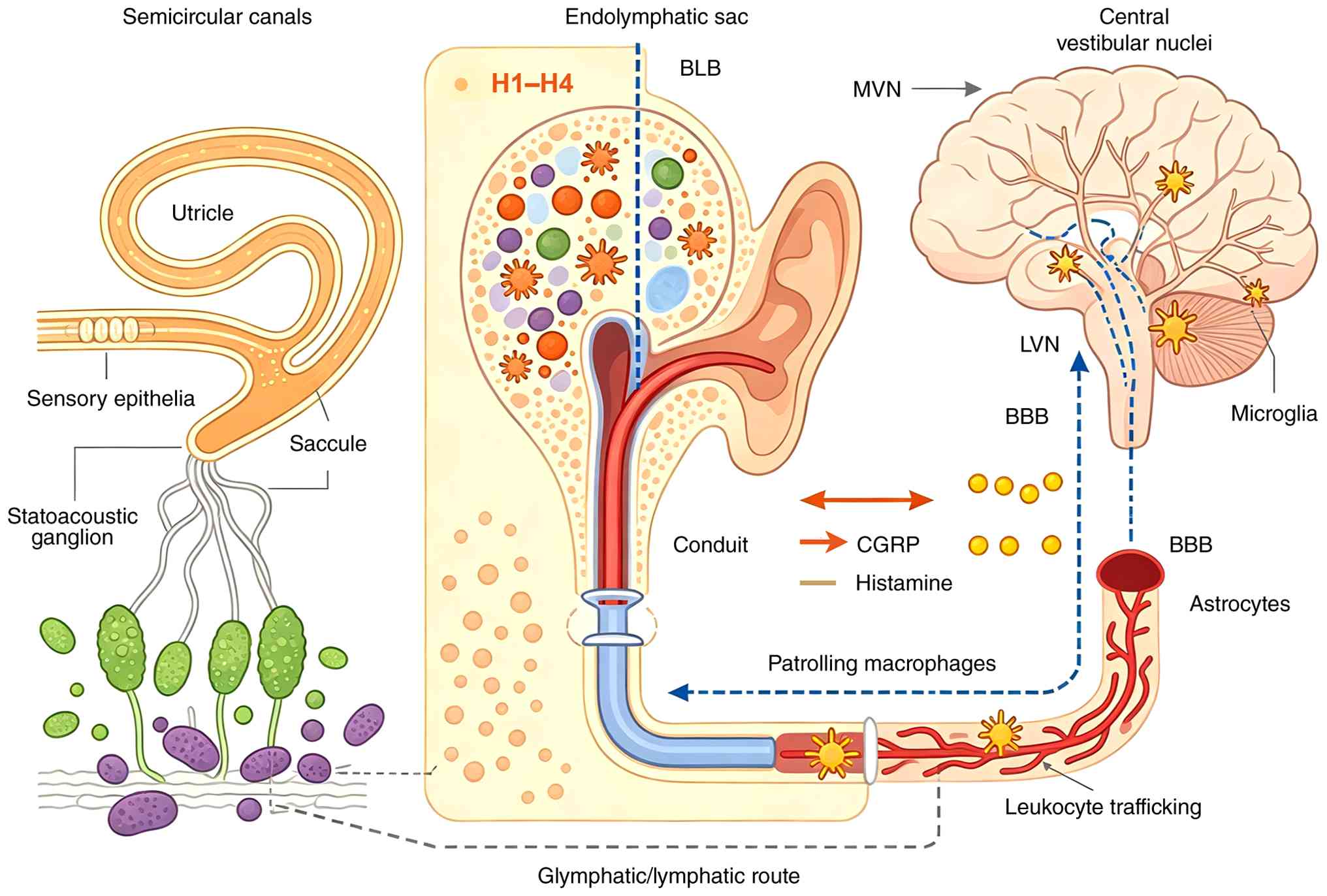 | Figure 1Neuroimmune architecture of the
vestibular system. Peripheral vestibular organs (semicircular
canals, utricle, saccule) are innervated by the SAG and contain
resident macrophages and mast cells. The ES and RD express
histamine receptors (H1-H4). The BLB and BBB regulate immune
trafficking. TBM connects to the inner ear. Central vestibular
nuclei (MVN, LVN) harbor microglia and astrocytes. Neuroimmune
crosstalk involves CGRP, HA and the glymphatic system. Notably, the
glymphatic/meningeal lymphatic routes within the vestibular
periphery remain largely hypothetical and lack direct in
vivo human validation, as indicated by the dashed graphic
representation. SAG, statoacoustic ganglion; ES, endolymphatic sac;
RD, reuniting duct; H1-H4, histamine receptors 1-4; BLB,
blood-labyrinth barrier; BBB, blood-brain barrier; TBM, temporal
bone marrow; MVN, medial vestibular nucleus; LVN, lateral
vestibular nucleus; CGRP, calcitonin gene-related peptide; HA,
histamine. |
Peripheral vestibular innervation and
immune surveillance
The peripheral vestibular apparatus receives dense
innervation from the statoacoustic ganglion, whose neurons project
to sensory epithelia of the utricle, saccule and semicircular
canals. Eberhard et al (9) characterized neurotransmitter and
receptor expression in the human saccule, revealing a complex
molecular landscape that supports bidirectional neuroimmune
signaling. Immune surveillance of these peripheral structures
involves resident macrophages that respond rapidly to hair cell
injury. Kaur et al (10)
demonstrated that macrophage recruitment to the mouse utricle
following hair cell damage occurs within hours and precedes
epithelial repair, suggesting an early immune component in
vestibular tissue maintenance. Complementing these findings, Hirose
et al (11) identified
two distinct cell populations participating in damaged hair cell
clearance from sensory epithelia, indicating redundant immune
mechanisms for maintaining epithelial integrity. A critical aspect
requiring further investigation is whether human vestibular end
organs exhibit similar or distinct immune cell dynamics compared to
rodent models.
Vestibular nuclei and barrier interfaces
as neuroimmune hubs
The vestibular nuclei within the brainstem serve as
central integration sites where peripheral afferent signals
converge with descending modulatory inputs. These nuclei are
positioned behind the blood-brain barrier, yet they remain
accessible to circulating immune mediators under pathological
conditions. Nordström et al (12) demonstrated that the human
endolymphatic sac contains abundant macrophages and expresses
multiple immune-related molecules, establishing this structure as a
potential neuroimmune interface. Using super-resolution
immunohistochemistry, Liu et al (13) further characterized immune
activity within the human inner ear, identifying regional
heterogeneity in immune cell distribution and activation states.
The blood-labyrinth barrier, analogous to the blood-brain barrier,
regulates exchange between the systemic circulation and inner ear
fluids. Disruption of these barriers during inflammation may permit
entry of immune cells and cytokines into vestibular compartments,
although the temporal dynamics and functional consequences of
barrier breakdown remain incompletely understood.
Resident immune cells in the vestibular
system
Resident immune cells populate both peripheral and
central vestibular structures, providing first-line defense and
tissue surveillance. Keithley (14) comprehensively reviewed inner ear
immunity, emphasizing that macrophages represent the predominant
resident immune population, with additional contributions from mast
cells and perivascular macrophages. Histamine receptor subtypes
H1-H4 are expressed in rodent and human vestibular tissues
(15,16); their functional and therapeutic
roles are detailed in the Histaminergic regulation of
neuroinflammation and vestibular compensation section. Notably,
the density and phenotype of resident microglia within vestibular
nuclei differ from those in adjacent brainstem regions, as recently
shown by Zhai et al (17), who identified transient receptor
potential vanilloid 2 (TRPV2)-mediated inflammasome activation in
deafferented vestibular nuclei. These regional specializations may
underlie differential vulnerability of vestibular circuits to
neuroinflammatory insults.
Conduits for neuroimmune
communication
Several anatomical pathways facilitate communication
between the vestibular system and peripheral immune organs. Perin
et al (18) recently
characterized temporal bone marrow in the rat and its connections
to the inner ear, identifying a direct anatomical conduit for
leukocyte trafficking. Using iDISCO+ tissue clearing and micro
computed tomography, Cossellu et al (19) generated a volumetric atlas of the
rat inner ear, revealing spatial relationships between vestibular
structures and adjacent immune compartments. Additionally, Vivado
et al (20) localized
macrophages within the reuniting duct and endolymphatic duct,
proposing that these cells patrol endolymphatic spaces and respond
to local disturbances. The glymphatic pathway and meningeal
lymphatics, although well-characterized in the brain, remain
underexplored in the context of vestibular neuroimmune
communication. Whether similar clearance systems operate in the
vestibular periphery represents an important unanswered
question.
Neuroimmune signaling molecules in
vestibular tissues
A diverse array of signaling molecules mediates
neuroimmune interactions within the vestibular system. In human
vestibular tissues, Eberhard et al (9) documented expression of multiple
neurotransmitters and their receptors, establishing molecular
substrates for neuromodulation of immune responses. CGRP and
histaminergic signaling are key neuroimmune molecules in vestibular
tissues. CGRP facilitates sensitization of the vestibular nucleus
in chronic migraine models (21)
and anti-CGRP monoclonal antibodies have shown clinical benefit in
VM (22). Histamine H1-H4
receptors modulate neuronal excitability and immune function
(15,16). Disease-specific evidence and
therapeutic implications are discussed in sections CGRP in
vestibular migraine and Histaminergic regulation of
neuroinflammation and vestibular compensation. A working
hypothesis, derived from separate literatures rather than
head-to-head studies, is that CGRP signaling may be more prominent
in migraine-related vestibular dysfunction, whereas histamine
pathways may be more central in MD; this remains testable (16,21,22).
Inflammatory cytokines and immune signaling
in vestibular disorders
Dysregulated cytokine networks and inflammatory
signaling pathways contribute to the pathogenesis of diverse
vestibular disorders. Pro-inflammatory signatures, T helper type 1
(Th1)/Th2 imbalances, monocyte-related chemokines, emerging
cytokine profiles and inflammasome activation each play distinct
roles, revealing both shared and divergent immunological mechanisms
across MD, VM and vestibular neuritis (Fig. 2). However, it should be noted
that direct comparative studies between MD and VM remain limited
and many of the observed differences are derived from independent
cohort studies rather than head-to-head comparisons. To
appropriately evaluate the strength of evidence supporting
neuroimmune mechanisms in vestibular disorders, this section
distinguishes between clinical association studies demonstrating
correlations between inflammatory mediators and disease phenotypes,
mechanistic evidence from experimental models elucidating
biological pathways, causality-supporting evidence from genetic and
Mendelian randomization studies and therapeutic evidence from
clinical intervention studies. This hierarchical framework
acknowledges that different study designs provide complementary but
non-equivalent support for causal relationships.
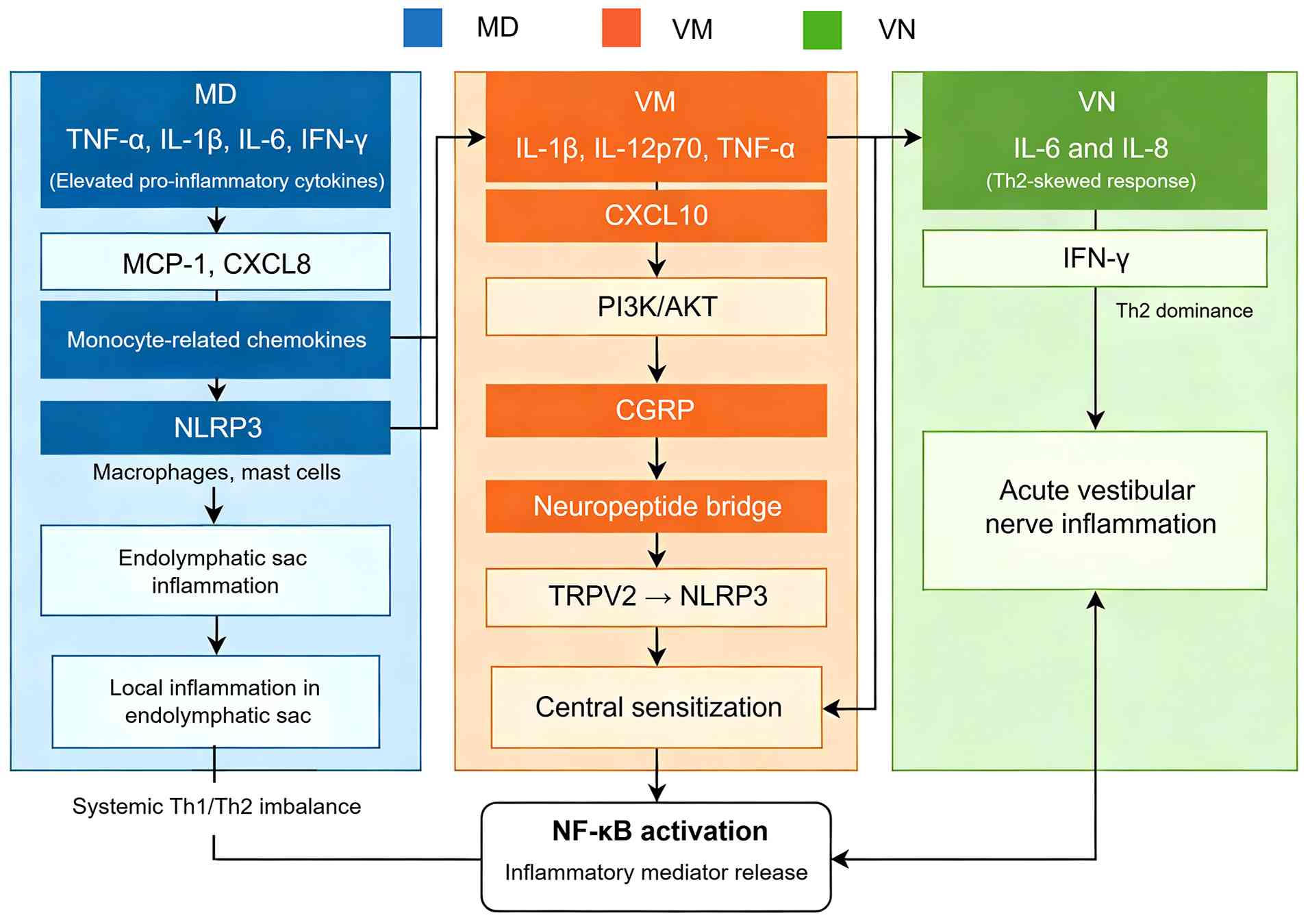 | Figure 2Overview of inflammatory and immune
signaling mechanisms in MD, VM and VN. Disease-specific cascades
illustrated here represent working mechanistic hypotheses; direct
head-to-head comparative human studies across MD, VM and VN remain
scarce and some cytokine findings show inter-study heterogeneity.
MD, Menière's disease; VM, vestibular migraine; VN, vestibular
neuritis; TNF-α, tumor necrosis factor α; IL, interleukin; IFN-γ,
interferon γ; MCP-1, monocyte chemoattractant protein-1; CXCL8,
C-X-C motif chemokine ligand 8; PI3K, phosphoinositide 3-kinase;
AKT, protein kinase B; CGRP, calcitonin gene-related peptide;
TRPV2, transient receptor potential vanilloid 2; NLRP3, NOD-like
receptor family pyrin domain containing 3; NF-κB, nuclear factor
κ-light-chain-enhancer of activated B cells; Th1, T helper type
1. |
Pro-inflammatory cytokine signatures in
MD
Elevated levels of classical pro-inflammatory
cytokines have been consistently documented in patients with MD.
Frejo et al (23)
demonstrated that peripheral blood mononuclear cells from MD
patients produced markedly higher amounts of tumor necrosis
factor-alpha (TNF-α), IL-1β and IL-6 following mold antigen
stimulation compared to controls. Huang et al (24) extended these findings by showing
upregulated expression of interferon-gamma (IFN-γ), IL-6 and TNF-α
within the endolymphatic sac of MD patients, providing direct
tissue-level evidence for local inflammation. A critical appraisal
of the literature reveals some heterogeneity in cytokine profiles
across studies. While Frejo et al (23) reported undetectable baseline IL-6
in unstimulated mononuclear cells, Huang et al (24) found elevated IL-6 in
endolymphatic sac tissue, suggesting that cytokine expression may
be compartment-specific and activation-dependent. Xie et al
(25) employed Mendelian
randomization to demonstrate causal relationships between
genetically predicted IL-1 receptor antagonist, monocyte
chemoattractant protein-1 (MCP-1) and macrophage inflammatory
protein-1 beta levels and MD risk, moving beyond association to
suggest causality. Collectively, MD is associated with a
multifaceted pro-inflammatory state involving TNF-α, IL-1β, IL-6
and IFN-γ pathways (23,24), with Mendelian randomization
supporting causal roles for IL-1 receptor antagonist and MCP-1
(25).
Th1/Th2 balance and cytokine disturbances
in vestibular neuritis (VN)
VN presents a distinct immunological profile
characterized by alterations in T-helper cell polarity. Zhou et
al (26) conducted a
prospective study measuring peripheral cytokine levels in patients
with acute VN, revealing significant elevations of IL-6 and IL-8
alongside reduced IFN-γ levels compared to healthy controls. This
pattern suggests a predominant Th2-skewed response, though this
interpretation derives from peripheral cytokine associations and
awaits confirmation through tissue-level mechanistic studies. By
contrast, a Th1-dominant profile has been described in experimental
autoimmune inner ear disease (AIED) models, where the evidence
derives from adoptive-transfer studies in mice rather than from
human tissue analyses. Solares et al (27) demonstrated that inner ear
peptide-specific CD4+ T cells with a Th1-like phenotype
induce hearing loss upon transfer to naïve recipients. Zhou et
al (28) further showed that
β-tubulin-reactive, IFN-γ-producing CD4+ T cells are
necessary and sufficient to transfer experimental autoimmune
hearing loss. Thus, the Th1-dominant profile in autoimmune inner
ear conditions is supported by preclinical mechanistic evidence,
whereas direct human tissue-level evidence for this profile has not
been described in the human studies cited in the present review.
Notably, the investigators also documented negative correlations
between IL-6 levels and canal paresis severity, raising the
possibility that the inflammatory response may exert both
deleterious and protective effects during acute vestibular nerve
injury. When comparing VN with MD, a key distinction emerges: MD
patients typically exhibit elevations in both Th1- and
Th2-associated cytokines (29),
whereas VN appears characterized by a more restricted Th2-favored
signature. This dichotomy may reflect differences in the underlying
triggers, specifically viral vs. autoimmune or idiopathic and
warrants further investigation through direct comparative cohort
studies.
Monocyte-related cytokines and chemokines
across vestibular disorders
Chemokines of the monocyte-related family have
emerged as important mediators across multiple vestibular
conditions. In MD patients, Iinuma et al (30) reported elevated serum MCP-1
levels that correlated with progressive hearing impairment and
bilateral disease involvement, suggesting that MCP-1 may serve as a
biomarker for disease severity. Expanding upon this, Zou et
al (31) identified markedly
increased granulocyte colony-stimulating factor, IL-8 and
hepatocyte growth factor in definite MD patients, proposing that
neutrophil extracellular trap formation may drive autoinflammatory
cascades. A particularly noteworthy recent contribution comes from
Peng et al (32), who
demonstrated that macrophage-derived CXCL8 acts as a mediator of
inflammatory attacks in MD, with elevated levels coinciding with
acute vertiginous episodes. In the context of VM, Song et al
(33) identified CXCL10 as a key
player acting through the PI3K/AKT signaling pathway, providing
mechanistic insight into how chemokine signaling may contribute to
central vestibular hyperexcitability. The CXCL8-predominant profile
in MD vs. CXCL10 involvement in VM suggests pathway-specific
chemokine signatures that may aid differential diagnosis if
validated prospectively.
Cytokine networks in VM: Overlapping yet
distinct profiles
VM exhibits a cytokine profile that partially
overlaps with MD while maintaining distinguishing features. Flook
et al (34) performed a
comprehensive comparison, revealing that VM patients display
elevated IL-1β, IL-12p70 and TNF-α but, unlike MD, do not show
significant alterations in IL-2 or IL-6. Contrasting findings have
emerged regarding C-reactive protein and other acute-phase
mediators: Karaaslan et al (35) found no significant differences in
plasma levels of IL-1β, IL-6, TNF-α, or high-sensitivity C-reactive
protein between VM patients and controls, although methodological
differences in sampling timing (interictal vs. peri-ictal) may
account for this discrepancy. More recent multiomic profiling by
Cruz-Granados et al (36)
demonstrated that VM shares some inflammatory features with
migraine without aura but exhibits unique transcriptomic signatures
in circulating immune cells. A critical unresolved question
concerns whether the observed cytokine elevations in VM represent
cause or consequence of trigeminovascular activation. Monaghan
et al (37) directly
compared pro-inflammatory profiles in MD and VM, finding that while
both disorders display evidence of systemic inflammation, only MD
showed significant elevations of IL-1β and IL-12p70, suggesting
potentially immunologically distinct profiles despite their
overlapping clinical presentations. However, this pilot study had a
limited sample size and replication in larger cohorts is
required.
Inflammasome activation in vestibular
pathology
The NOD-like receptor family pyrin domain containing
3 (NLRP3) inflammasome activation has been established as a
molecular link between innate immune sensing and vestibular injury.
NLRP3 mutations cause deafness, autosomal dominant 34 (DFNA34), an
autosomal dominant hearing loss syndrome with vestibular symptoms
that responds to anakinra therapy (38,39). Preclinically, anakinra protects
against endolymphatic hydrops and preserves vestibular function in
murine models (40). Gregory
et al (41)
comprehensively reviewed the rationale for NLRP3 inhibition in
sensorineural hearing loss, emphasizing the therapeutic potential
of small-molecule inflammasome inhibitors. Extending these concepts
to VM, Zhai et al (17)
identified TRPV2-mediated inflammasome activation in deafferented
vestibular nuclei. Translational implications are promising:
Anakinra shows efficacy in DFNA34 patients with NLRP3 mutations
(42) and protects against
endolymphatic hydrops in murine models (40), but randomized controlled trials
in MD and VM are lacking and whether inflammasome activation is a
primary driver or epiphenomenon remains unresolved. Future research
must determine whether inflammasome activation represents a primary
pathological driver or an epiphenomenon of other inflammatory
processes and whether therapeutic benefits vary according to
specific genetic backgrounds.
Methodological heterogeneity and
implications for generalizability
Interpretation of cytokine and immune profiling
studies in vestibular disorders is constrained by substantial
methodological heterogeneity. First, sample sizes are often modest,
with several cohort studies including fewer than 30 patients per
group (35,37); such underpowered designs increase
the risk of false-positive findings and limit the ability to detect
modest but biologically meaningful differences. Monaghan et
al (37) explicitly
acknowledged that their pilot study required replication in larger
cohorts and Karaaslan et al (35) noted that their negative findings
could not be considered definitive due to limited sample size.
Second, sampling timing varies widely (interictal, peri-ictal, or
unspecified), which may explain discrepant findings for IL-6 and
other acute-phase mediators (23,24); the absence of standardized timing
relative to vertigo attacks precludes reliable assessment of
cytokine dynamics and hampers comparability across studies. Third,
outcome measures for vertigo severity and disease burden are not
harmonized, with diverse instruments such as the Dizziness Handicap
Inventory, Vertigo Severity Score and visual analog scales used
interchangeably (43-47); this variability complicates
direct comparisons of treatment effects and limits the robustness
of meta-analytic syntheses. Fourth, patient populations differ in
disease duration, comorbidity profiles (e.g., concomitant migraine,
anxiety, allergic conditions) and prior treatments, all of which
may influence immune parameters. Detailed phenotyping
distinguishing definite from probable MD or VM with vs. without
concomitant migraine remains exceptional (36), further increasing
heterogeneity.
These limitations collectively hinder cross-study
comparisons, meta-analysis and clinical translation. Most findings
remain correlational and cross-sectional, precluding distinction
between trait and state biomarkers. The predominance of
single-center studies with non-standardized protocols also raises
concerns about external validity and replicability. Future research
should prioritize large, well-phenotyped, multi-center cohorts with
standardized sampling protocols and harmonized outcome measures to
enable robust biomarker validation and facilitate the development
of clinically actionable signatures.
Neuroglial mechanisms in vestibular
pathophysiology
Glial cells, including microglia, astrocytes and
oligodendrocytes, have emerged as key regulators of vestibular
pathophysiology, orchestrating inflammatory responses, synaptic
remodeling and tissue repair following peripheral or central
vestibular injury. Emerging evidence indicates that glial dynamics
are not merely reactive but actively shape the trajectory of
vestibular compensation and maladaptive plasticity. It is essential
to distinguish between two conceptually distinct contexts in which
neuroglial mechanisms operate. The first involves central
compensatory plasticity following acute peripheral vestibular
injury, as modeled by unilateral vestibular neurectomy,
labyrinthectomy, or vestibular deafferentation. These surgical
lesion models provide crucial insights into how the central nervous
system restores balance and gaze stability after sudden unilateral
peripheral loss. The second involves neuroinflammatory processes
that may contribute to the pathogenesis or maintenance of primary
vestibular disorders such as MD and VM, where inflammation may be
integral to disease initiation or chronification rather than merely
a consequence of deafferentation. Findings derived from
deafferentation models should not be directly generalized to MD or
VM pathogenesis without explicit acknowledgment of this
distinction, as these models simulate post-lesional plasticity
rather than the etiological mechanisms of these disorders. Current
knowledge on neuroglial mechanisms in vestibular disorders
highlights regional heterogeneity, polarization states and the dual
potential of neuroinflammation to either support recovery or drive
chronic dysfunction (Fig. 3).
The evidence reviewed in this section is graded by study type: most
mechanistic findings derive from preclinical rodent deafferentation
models, whereas human tissue and clinical data remain limited;
disease-related neuroinflammatory findings are distinguished from
post-lesional compensatory plasticity whenever possible (48-52).
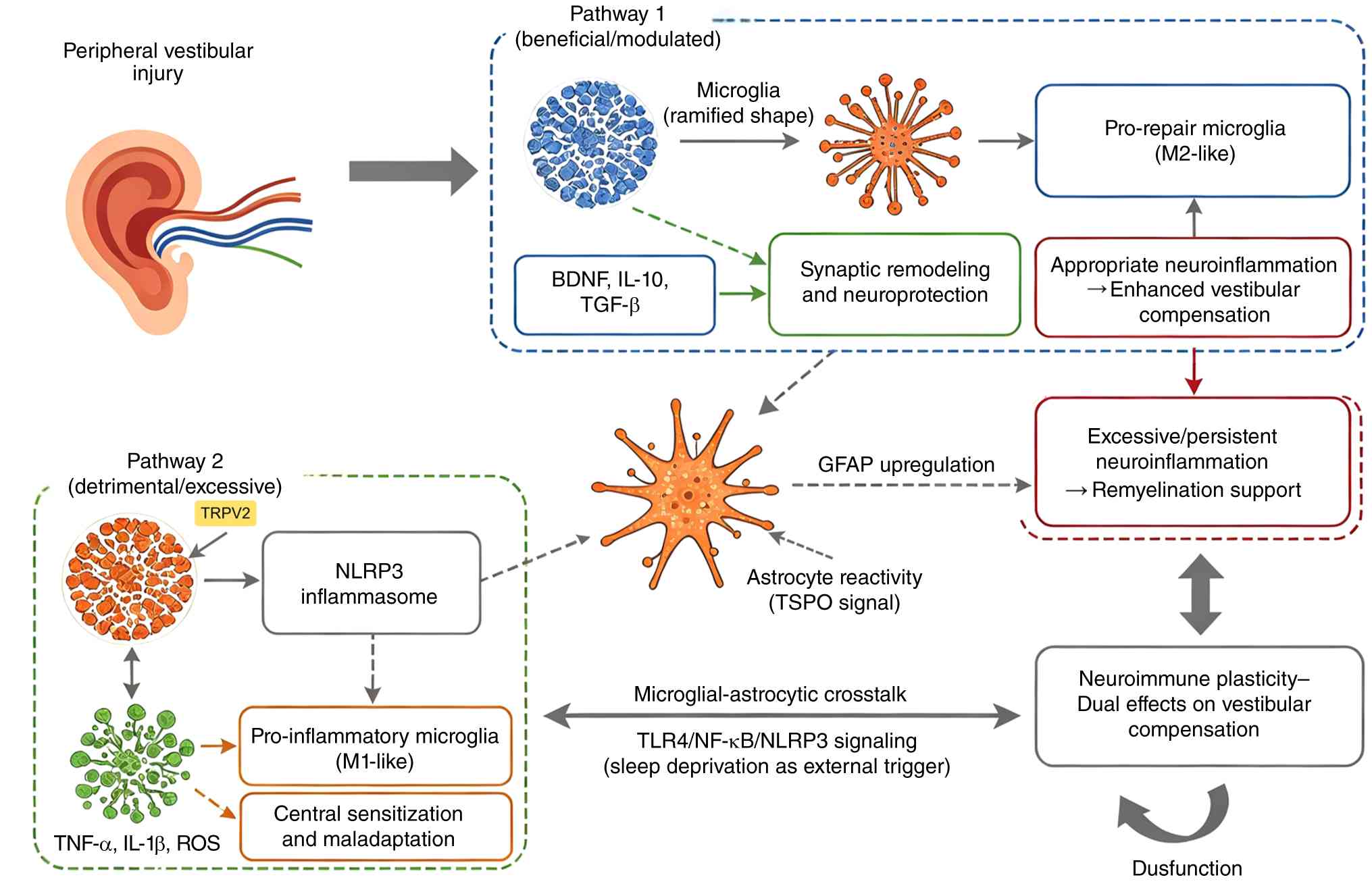 | Figure 3Neuroglial mechanisms in vestibular
pathophysiology. Following peripheral vestibular injury, microglia
and astrocytes respond in a biphasic manner. Appropriately
calibrated neuroinflammation promotes repair via BDNF and
anti-inflammatory signals, supporting vestibular compensation.
Excessive or persistent neuroinflammation drives pro-inflammatory
microglia, NLRP3 inflammasome activation and central sensitization,
impairing compensation. Astrocyte reactivity (GFAP+,
TSPO+) and OPCs also contribute. Bidirectional glial
crosstalk involves TLR4/NF-κB/NLRP3 signaling. Most mechanistic
evidence for neuroinflammatory regulation of vestibular
compensation is derived from rodent experimental vestibular
deafferentation (unilateral vestibular neurectomy/labyrinthectomy)
models; these findings cannot be directly extrapolated to the
primary pathogenesis of spontaneous clinical vestibular disorders
such as Menière's disease or vestibular migraine without further
validation. BDNF, brain-derived neurotrophic factor; GFAP, glial
fibrillary acidic protein; IL, interleukin; NLRP3, NOD-like
receptor family pyrin domain containing 3; NF-κB, nuclear factor
κB; OPCs, oligodendrocyte precursor cells; ROS, reactive oxygen
species; TGF-β, transforming growth factor β; TLR4, Toll-like
receptor 4; TNF-α, tumor necrosis factor α; TRPV2, transient
receptor potential vanilloid 2; TSPO, translocator protein. |
Microglial dynamics and inf lammasome
activation
In post-lesional compensation models, unilateral
vestibular neurectomy triggers a biphasic microglial response,
characterized by early proliferation followed by sustained
morphological activation and pharmacological modulation of
microglial dynamics directly influences compensation outcomes
(48). Microgliogenesis begins
as early as 24 h post-lesion, preceding astrocytic responses
(49). These findings in
surgical deafferentation models provide direct evidence for
microglial involvement in post-lesional vestibular compensation.
Conversely, Mikheeva et al (50) reported that vestibular
stimulation alone, without surgical lesion, also induces microglial
activation in the lateral vestibular nucleus, suggesting that even
physiological challenges engage glial surveillance mechanisms.
By contrast, in the context of disease-related
neuroinflammation, a critical molecular pathway linking microglial
activation to central sensitization involves TRPV2-mediated
inflammasome signaling. As introduced in the Inflammasome
activation in vestibular pathology section, NLRP3 inflammasome
activation links innate immune sensing to vestibular injury. In
disease-related neuroinflammation, microglial TRPV2 activation
promotes NLRP3 assembly and pro-inflammatory polarization in a VM
model (51), a mechanism
distinct from neuroprotective microglial states during successful
compensation (48). The
functional divergence of microglial phenotypes, which ranges from
neurosupportive to neurotoxic, likely depends on lesion chronicity,
comorbid factors and genetic background. Importantly, Li et
al (52) showed that sleep
deprivation disrupts vestibular compensation in UVN models by
activating Toll-like receptor 4 (TLR4)/NF-κB/NLRP3 signaling in
deafferented vestibular nuclei, providing mechanistic insight into
how systemic disturbances adversely affect glial-mediated recovery.
This finding pertains to modulation of post-lesional compensation
rather than to primary MD or VM pathogenesis. Collectively, these
findings establish that microglial dynamics are not uniformly
beneficial or detrimental; rather, their temporal profile and
polarization state critically determine vestibular outcomes.
Astrocyte reactivity in vestibular
nuclei
In post-lesional compensation models, astrocytes
undergo profound phenotypic and functional changes following
vestibular injury, contributing to both structural remodeling and
neuroinflammatory regulation. Unilateral labyrinthectomy induces
redistribution of astrocyte phenotypes from quiescent to reactive
states, with altered glial fibrillary acidic protein (GFAP)
expression and regional heterogeneity across vestibular nuclei
subregions (53). These reactive
astrocytes exhibited regional heterogeneity, with subregions of the
vestibular nuclei displaying differential susceptibility to
activation (53). Using
longitudinal [18F]GE180-positron emission tomography imaging,
Zwergal et al (54)
demonstrated that translocator protein (TSPO) signal, a marker of
glial activation, increases progressively in the ipsilateral
vestibular nuclei following unilateral labyrinthectomy, with
activation persisting for weeks in addition to the acute injury
phase. These findings describe glial dynamics during central
compensation following acute peripheral vestibular loss and do not
directly model the neuroinflammatory processes underlying MD or VM
pathogenesis.
Contrasting findings have emerged regarding the
relationship between astrocytic and microglial activation kinetics.
While some studies suggest that microglial responses precede
astrocytic activation (48,49), Wu et al (55) observed concurrent glial
proliferation involving both cell types following early
rehabilitation intervention, indicating that experience-dependent
plasticity engages both glial populations synergistically. Mikheeva
et al (50) further noted
that vestibular stimulation alone induces astrocytic morphological
changes without accompanying microglial proliferation, suggesting
context-dependent activation thresholds. A notable unresolved
question concerns whether astrocyte reactivity represents a primary
driver of vestibular dysfunction or an epiphenomenon secondary to
neuronal injury. The demonstration that astrocyte phenotype
redistribution correlates with compensation outcomes (53) supports a functionally significant
role, though causality remains to be established through selective
astrocyte manipulation studies.
Glial support of vestibular nerve
integrity
Oligodendrocytes and Schwann cells maintain axonal
integrity and facilitate repair processes within the vestibular
nerve and its central projections. Dutheil et al (56) demonstrated that brain-derived
neurotrophic factor (BDNF) signaling promotes vestibular
compensation not only through direct neuronal effects but also by
remodeling the expression of potassium-chloride cotransporter
potassium-chloride cotransporter 2 (KCC2) and gamma-aminobutyric
acid type A (GABAA) receptors, processes that likely involve
oligodendrocyte-mediated support of axonal conduction properties.
Rastoldo et al (57)
extended these observations by documenting adult neurogenesis
within the vestibular nuclei after unilateral vestibular
neurectomy, with newly generated cells including oligodendrocyte
precursors that may contribute to remyelination of deafferented
pathways. The functional importance of glial support is further
underscored by findings that L-thyroxine administration improves
vestibular compensation while simultaneously enhancing glial
proliferation and survival (58).
In contrast to the relatively robust literature on
microglia and astrocytes, the specific contributions of Schwann
cells to vestibular nerve pathology remain underexplored. Available
evidence suggests that Schwann cell responses to vestibular nerve
injury mirror those observed in other peripheral neuropathies,
though systematic investigations in isolated vestibular disorders
are lacking. A critical gap exists regarding whether primary
demyelinating processes contribute to conditions such as vestibular
paroxysmia or superior canal dehiscence syndrome, representing an
important direction for future inquiry.
Dual roles of neuroinflammation in
compensation
The dual effects of neuroinflammation are most
clearly illustrated in the context of vestibular compensation
following acute peripheral injury (UVN models). Neuroinflammatory
signaling following vestibular injury exerts both protective and
detrimental effects, depending on timing, intensity and molecular
context. Dexamethasone administered immediately after unilateral
vestibular neurectomy paradoxically impairs long-term compensation
and suppresses endogenous plasticity, indicating that appropriately
calibrated inflammation is necessary for optimal neuroplasticity
(59). Supporting this
interpretation, Mao et al (60) demonstrated that BDNF/tropomyosin
receptor kinase B (TrkB) signaling, which can be modulated by
inflammatory cytokines, promotes vestibular compensation in
deafferentation models by enhancing synaptic plasticity and
neuronal survival. These findings pertain exclusively to
post-lesional adaptive plasticity and should not be generalized to
primary disease pathogenesis.
The concept of neurohormesis, wherein moderate
inflammatory challenge confers resilience, appears applicable to
vestibular pathophysiology. Salinaro et al (61) proposed that low-grade
neuroinflammation can precondition neural tissues against
subsequent injury, though direct evidence in the vestibular system
remains preliminary. It is important to emphasize that these
protective effects pertain to post-lesional adaptive plasticity and
should not be conflated with neuroinflammatory processes driving
primary disease pathogenesis. In the context of primary vestibular
disorders such as VM, persistent or excessive neuroinflammation
drives maladaptive plasticity. Zhai et al (51) showed in a VM mouse model that
sustained microglial TRPV2-mediated inflammasome activation
promotes central sensitization in VM, transforming an acute
protective mechanism into a chronic pain-like state. This finding
describes a disease-specific neuroinflammatory mechanism in VM
pathogenesis, distinct from the protective inflammation observed
during post-lesional compensation in UVN models. Thus, the
beneficial vs. detrimental dichotomy depends critically on whether
the inflammatory response subserves adaptive post-lesional repair
or disease-related central sensitization. The dual nature of
neuroinflammation carries direct therapeutic implications:
interventions that completely suppress glial activation may hinder
compensation (59), while those
that modulate rather than eliminate inflammatory signaling, such as
pro-histaminergic drugs (62) or
early rehabilitation (55), may
optimize outcomes. Future research must establish biomarkers to
distinguish protective from pathologic neuroinflammation in
individual patients, enabling precision targeting of neuroglial
pathways.
Neuropeptides and the vestibular neuroimmune
network
Neuropeptides serve as critical molecular bridges
linking neuronal activity with immune cell function within the
vestibular system. Current evidence indicates that CGRP, substance
P, pituitary adenylate cyclase-activating polypeptide (PACAP) and
histamine modulate neuroinflammatory cascades and contribute to
vestibular disorder pathophysiology (Table I). The evidence base in this
section is heterogeneous: CGRP and histamine findings include human
tissue, clinical cohort, case report and preclinical model data,
whereas PACAP and substance P evidence is derived mainly from human
challenge studies and preclinical models; the relevant study type
is specified in each subsection (5,16,22,62-66).
 | Table IOriginal studies investigating
neuropeptide-mediated neuroimmune mechanisms in vestibular
disorders and related models. |
Table I
Original studies investigating
neuropeptide-mediated neuroimmune mechanisms in vestibular
disorders and related models.
| Author/s, year |
Neuropeptide/pathway | Level of
evidence/study design | Key findings |
Clinical/mechanistic significance | (Refs.) |
|---|
| Møller et
al, 2016 | Histamine (H1-H4
receptors) | Clinical tissue
expression study | All four histamine
receptor subtypes are expressed in the human endolymphatic sac,
providing a molecular rationale for betahistine use in Menière's
disease. | Directly links
histamine receptor expression in the human inner ear immune
compartment to the pharmacology of betahistine. | (16) |
| Inui et al,
2025 | CGRP
(erenumab) | Clinical case
report | Erenumab treatment
led to complete or near-complete resolution of vertiginous episodes
with concurrent headache improvement. | Demonstrates
durable vertigo control with anti-CGRP monotherapy in a VM patient,
although controlled trials are lacking. | (22) |
| Trico et al,
2025 | Histamine
(pro-histaminergic drug) | Preclinical animal
model | Pro-histaminergic
drug restores balance, promotes microgliogenesis and shifts
microglial polarization toward a pro-repair phenotype, thereby
facilitating vestibular compensation. | Demonstrates that
histamine signaling actively shapes the neuroimmune environment and
promotes functional recovery In addition to neuronal
modulation. | (62) |
| Russo et al,
2023 | CGRP (anti-CGRP
mAbs) | Clinical cohort
study | Anti-CGRP mAbs
markedly reduced vertigo days (mean reduction 9.5 days/month),
headache days (13.8) and MIDAS scores (36.1); 78% achieved ≥50%
reduction in all three parameters at 12 months. | First real-world
evidence that CGRP blockade specifically reduces vertigo burden in
vestibular migraine, supporting a causative role for CGRP. | (63) |
| Nelson-Maney,
2024 | CGRP (meningeal
lymphatic) | Preclinical animal
model | Meningeal lymphatic
CGRP signaling governs cerebrospinal fluid efflux and
neuroinflammation; pathway disruption drives migraine-like pain
behaviors. | Identifies a novel
clearance mechanism by which CGRP modulates pain via lymphatic
function and neuroinflammation. | (70) |
| Dux et al,
2025 | Substance P vs.
CGRP | Preclinical ex
vivo model | Substance P release
from cranial dura mater is inversely correlated with CGRP release;
increased CGRP appears to inhibit SP-dependent plasma
extravasation. | Challenges the
assumption of coordinated SP/CGRP release in neurogenic
inflammation, implying pathway-specific regulation. | (72) |
| Guo et al,
2017 | PACAP-38 | Clinical human
challenge study | PACAP-38 infusion
induces prolonged headache and vasodilation through mechanisms
partially independent of CGRP signaling. | Differentiates
PACAP from CGRP in migraine pathogenesis, suggesting parallel
peptidergic pathways may also contribute to vestibular
symptoms. | (64) |
| Rahman, 2025 | PACAP vs. CGRP | Preclinical animal
model | Systemic PACAP
produces more pronounced vestibular disturbances (nausea,
imbalance) than equimolar CGRP, suggesting a unique contribution of
PACAP to vestibular-specific symptoms. | First direct
comparative evidence that PACAP may be a more potent mediator of
vestibular dysfunction than CGRP, guiding future VM therapies. | (65) |
| Lund et al,
2022 | PACAP / VIP | Clinical tissue
localization study | PACAP, VIP and
their receptors are localized in basal brain blood vessels and
trigeminal ganglion, providing anatomical substrate for
PACAP-mediated neuroimmune modulation. | Establishes the
structural framework for PACAP signaling in the trigeminovascular
system, supporting its role as a candidate mediator in VM. | (66) |
| Göbel et al,
2022 | CGRP
(erenumab) | Clinical case
report (safety) | First report of
SDRIFE after erenumab application for migraine prevention. | Documents a novel
cutaneous hypersensitivity reaction to anti-CGRP therapy,
highlighting immunogenicity concerns. | (82) |
| Pico, 2024 | CGRP
(galcanezumab) | Clinical case
report (safety) | Systemic allergic
reaction (hypersensitivity) to galcanezumab in a migraine
patient. | Further evidence of
immunogenicity and allergic potential of CGRP-targeting mAbs,
relevant for safety monitoring. | (83) |
| Chu et al,
2026 | CGRP (rimegepant;
gepant class) | Clinical study | Rimegepant
demonstrated efficacy for acute treatment of VM, suggesting that
small-molecule CGRP receptor antagonists may be suitable for
on-demand therapy. | Supports the use of
gepants as an alternative to monoclonal antibodies in VM patients
requiring episodic rather than continuous prophylaxis. | (85) |
CGRP in VM
CGRP has emerged as a master regulator of neurogenic
inflammation within the trigeminovascular system, with accumulating
evidence implicating this pathway in VM pathogenesis. Iyengar et
al (67) comprehensively
reviewed CGRP's dual role in peripheral and central pain
mechanisms, demonstrating that CGRP released from trigeminal
afferents promotes vasodilation, mast cell degranulation and
neuronal sensitization. Messlinger (68) further characterized the sources,
sinks and signaling sites of CGRP within the trigeminovascular
system, establishing that meningeal CGRP release represents a key
event in migraine initiation. In the context of vestibular
disorders, Russo et al (63) conducted a prospective
observational cohort study demonstrating that anti-CGRP monoclonal
antibodies markedly reduced vertigo attack frequency and severity
in VM patients, providing clinical validation for CGRP pathway
targeting. More recently, Inui et al (22) reported successful treatment of a
VM case with erenumab, with documented improvements in both vertigo
and headache outcomes. The mechanistic underpinnings of CGRP
actions involve direct modulation of immune cells: Balcziak and
Russo (69) demonstrated that
dural immune cells, particularly mast cells and macrophages,
respond to CGRP stimulation by releasing pro-inflammatory mediators
that sustain trigeminal sensitization. A critical distinction must
be drawn between CGRP's acute protective roles and its chronic
pathological effects. While physiological CGRP signaling supports
vasoregulation and tissue repair, persistent CGRP elevation drives
maladaptive neuroimmune plasticity. Nelson-Maney et al
(70) recently established that
meningeal lymphatic CGRP signaling governs pain behaviors through
modulation of cerebrospinal fluid efflux and neuroinflammation,
identifying a previously unrecognized clearance mechanism. Despite
these advances, whether CGRP acts as a primary driver or an
amplifying mediator in VM remains incompletely resolved and the
relative contributions of peripheral vs. central CGRP sources
require further delineation through compartment-specific
intervention studies.
Substance P, PACAP and other
immunomodulatory neuropeptides
In addition to CGRP, additional neuropeptides
contribute to vestibular neuroimmune networks through distinct yet
overlapping mechanisms. Substance P, a classic mediator of
neurogenic inflammation, has been implicated in nociceptive
transmission within vestibular pathways. Durham (71) reviewed the diverse physiological
roles of CGRP in migraine pathology while acknowledging that
substance P acts synergistically with CGRP to promote plasma
extravasation and immune cell recruitment. However, Dux and
Messlinger (72) recently
reported an inverse correlation between substance P and CGRP
release from rat dura mater following glyceryl trinitrate
stimulation, suggesting that these two neuropeptides may be
differentially regulated rather than co-released uniformly. This
finding challenges the long-held assumption of coordinated
neuropeptide release and implies pathway-specific regulatory
mechanisms.
Pituitary adenylate cyclase-activating polypeptide
has received increasing attention as a migraine mediator distinct
from CGRP. Guo et al (64) demonstrated that PACAP-38 infusion
in migraine patients induces prolonged headache and vasodilation
through mechanisms partially independent of CGRP signaling. Kuburas
and Russo (73) comprehensively
compared shared and independent roles of CGRP and PACAP in migraine
pathophysiology, noting that while both neuropeptides activate
similar downstream effectors, their receptor distributions and
temporal profiles differ substantially. In the vestibular context,
Rahman et al (65)
directly compared the effect of systemic PACAP vs. CGRP
administration on motion-induced nausea and balance behaviors in
mice, revealing that PACAP produces more pronounced vestibular
disturbances, suggesting a potentially unique contribution of PACAP
to vestibular-specific symptoms. Lund and Hannibal (66) localized PACAP, vasoactive
intestinal peptide and their receptors in basal brain blood vessels
and trigeminal ganglion, establishing the anatomical substrate for
PACAP-mediated neuroimmune modulation. Collectively, these findings
indicate that multiple neuropeptide systems operate in parallel and
vestibular disorder phenotypes may reflect the integrated output of
several peptidergic pathways rather than a single dominant
mediator. The therapeutic implications are substantial: Targeting
CGRP alone may prove insufficient for patients whose
pathophysiology is driven predominantly by PACAP or substance P
signaling.
Histaminergic regulation of
neuroinflammation and vestibular compensation
The histaminergic system occupies a unique position
within vestibular neuroimmune networks, simultaneously modulating
neuronal excitability, immune cell function and glial responses.
Møller et al (16)
provided foundational evidence by demonstrating expression of
histamine H1-H4 receptors in the human endolymphatic sac,
establishing the molecular rationale for betahistine use in MD.
These findings have been substantially extended by Tighilet et
al (6), who comprehensively
reviewed histaminergic system involvement in both normal and
pathological vestibular function.
H4 receptors are predominantly expressed on
hematopoietic and immune cells, including microglia, mast cells,
eosinophils, dendritic cells and T lymphocytes and are also present
on rodent vestibular primary neurons and hair cells (5). Unlike H1 receptors, which couple to
Gαq, H4 receptors are coupled to pertussis toxin-sensitive Gαi/o
proteins, leading to inhibition of adenylyl cyclase and reduced
cAMP production (5). H4 receptor
activation also mobilizes intracellular calcium via Gαi/o-dependent
phospholipase C activation and promotes ERK1/2 and p38 MAPK
phosphorylation, thereby linking H4 signaling to actin
polymerization, cytoskeletal rearrangement and directed cell
migration (74). This
calcium-MAPK axis underlies the chemotactic response of mast cells,
eosinophils and dendritic cells to histamine gradients, positioning
H4 receptors as principal mediators of histamine-driven leukocyte
recruitment to sites of inflammation.
In neuroinflammation, H4 receptor signaling exerts
context-dependent effects on microglial function. Activation of
microglial H4 receptors drives polarization toward a
pro-inflammatory phenotype and stimulates release of TNF-α, IL-6
and IL-12 through NF-κB and MAPK signaling pathways (74). Conversely, H4R stimulation can
induce persistent ERK1/2 phosphorylation that leads to pNF-κB
downregulation and reduced NOX2 expression, dampening
pro-inflammatory responses (75). H4 receptors also modulate
adaptive immunity: H4R signaling regulates T regulatory cell
frequency and chemotaxis within the central nervous system and H4R
deficiency leads to impaired anti-inflammatory responses due to
fewer T regulatory cells and an increased proportion of Th17 cells
(76). These findings indicate
that H4 receptors shape the balance between pro-inflammatory and
regulatory immune responses through both innate and adaptive
mechanisms.
The relevance of H4 receptors to vestibular
pathophysiology is supported by pharmacological and genetic
evidence. H4 receptor mRNA and protein are expressed in Scarpa's
ganglion and rat vestibular primary neurons and selective H4R
antagonists inhibit vestibular neuron excitability in vitro
and reduce vestibular deficits in animal models (74). In a phase 1 randomized controlled
trial involving 100 healthy subjects, the selective H4R antagonist
SENS-111 markedly improved latency of vertigo
appearance/disappearance, duration and European Evaluation of
Vertigo questionnaire parameters vs. baseline, without markedly
affecting nystagmus (75).
Furthermore, the HRH4 rs77485247 polymorphism has been associated
with increased risk of MD, with the A allele linked to vertigo
attack frequency and basal IL-1β and TNF-α levels (76). Because microglia are the
principal H4R-expressing cells in the central nervous system and
undergo robust activation in vestibular nuclei following peripheral
vestibular loss, H4R antagonism may represent a strategy to
attenuate the neuroinflammatory component of vestibular pathology
while preserving compensatory plasticity.
H3 receptors function mainly as presynaptic
Gi/o-coupled autoreceptors that suppress histamine synthesis and
release; H3 antagonism by betahistine therefore enhances histamine
release. In deafferented vestibular nuclei, pro-histaminergic
treatment promotes microgliogenesis and shifts microglia toward a
pro-repair phenotype while modulating neuroinflammation, thereby
accelerating vestibular compensation (62). Functional specialization among
histamine receptor subtypes further refines this mechanistic
understanding: H4 receptors, as aforementioned, are predominantly
expressed on immune cells and mediate chemotaxis, cytokine release
and immunomodulation, whereas H3 receptors function primarily as
presynaptic autoreceptors that regulate histamine release and
synthesis via negative feedback and also serve as heteroreceptors
modulating the release of other neurotransmitters (5). Complementing these findings, Yuan
and Silberstein (77) reviewed
histamine's role in migraine, noting that histamine exerts complex,
concentration-dependent effects on trigeminal nociception with low
doses promoting sensitization and high doses inducing
desensitization through H3 receptor-mediated feedback inhibition. A
critical unresolved question concerns whether betahistine's
therapeutic effects in MD derive primarily from vascular, neuronal,
or immunomodulatory actions and whether these mechanisms differ
between acute vertigo attacks and interictal prophylaxis.
Therapeutic implications of targeting
neuropeptide pathways
The success of CGRP-targeting monoclonal antibodies
in migraine has spurred investigation of these agents for VM and
related disorders. Yuan et al (78) provided comprehensive rationales
for CGRP monoclonal antibody development, establishing that
ligand-neutralizing and receptor-blocking approaches yield
comparable efficacy with favorable safety profiles. Cohen and Yuan
et al (79)
systematically reviewed current evidence for CGRP-targeted
monoclonal antibodies and antagonists, noting that these agents
represent the first pathophysiology-driven preventive therapies for
migraine. In the vestibular domain, Russo et al (63) demonstrated that anti-CGRP
monoclonal antibodies reduce vertigo burden and Frosolini and
Lovato (80) conducted a rapid
systematic review and meta-analysis confirming that CGRP monoclonal
antibodies show promise for VM treatment, though randomized
controlled trials remain lacking.
The clinical experience with anti-CGRP agents has
also revealed important limitations. Several groups (81-83) have documented immunogenicity and
hypersensitivity reactions, including a case of symmetrical
drug-related intertriginous and flexural exanthema following
erenumab administration reported by Göbel et al (82). More concerning, Straburzyński
et al (84) performed a
meta-analysis demonstrating increased infection risk in patients
receiving preventive CGRP-targeting therapies, raising questions
about the physiological role of CGRP in immune surveillance.
Complementary to antibody-based approaches, the gepant class of
small-molecule CGRP receptor antagonists offers oral administration
and shorter half-lives. Cohen and Yuan (79) reviewed atogepant's role in
episodic migraine treatment and Chu et al (85) recently reported rimegepant
efficacy for acute treatment of VM, suggesting that this class may
be suitable for VM patients requiring on-demand therapy rather than
continuous prophylaxis.
For histaminergic pathways, betahistine remains the
primary therapeutic agent despite heterogeneous evidence. Møller
et al (16) proposed that
endolymphatic sac H2 receptor stimulation may modulate local immune
activity, while Trico et al (62) provided preclinical
proof-of-concept that pro-histaminergic drugs promote
microgliogenesis and compensation, suggesting that optimization of
histaminergic signaling, rather than simple receptor blockade, may
represent a more effective therapeutic strategy. Comparison of CGRP
and histamine targeting reveals a pattern that is consistent with
the hypothesis that these pathways may differentially contribute to
VM and MD pathophysiology: anti-CGRP therapies have shown efficacy
in VM (22,63), whereas histamine modulation has
demonstrated greater utility in MD (16,62). However, this dichotomy should be
interpreted with caution, as head-to-head comparative studies
directly evaluating pathway-specific contributions across both
conditions are lacking. If this hypothesis is validated by future
comparative investigations, it would underscore the necessity for
diagnostic biomarkers that can stratify patients according to
dominant neuropeptide signatures, enabling precision targeting of
vestibular neuroimmune networks rather than empirical
trial-and-error prescribing.
Systemic immune influences and the
gut-vestibular axis
The vestibular system integrates signals from
systemic immune compartments, including circulating cytokines,
autoantibodies and inflammatory mediators. A growing but still
preliminary body of evidence suggests that gut-derived metabolites
may also influence vestibular function, although this
gut-vestibular interaction remains an emerging hypothesis requiring
further validation. Systemic autoimmune conditions, immune
checkpoint inhibitors, atopic tendencies, viral infections and gut
dysbiosis can each modulate vestibular function through distinct
but overlapping pathways (Table
II).
| Table IISummary of original studies
investigating systemic immune influences on vestibular
function. |
Table II
Summary of original studies
investigating systemic immune influences on vestibular
function.
| Authors, year | Level of
evidence/study design | Immune domain | Vestibular
population | Key findings | Conclusion | (Refs.) |
|---|
| Ralli et al,
2018 | Systematic
review | Autoimmunity | Patients with SLE,
Sjögren's, APS, Cogan's, RP | Audiovestibular
symptoms occur at notable frequency across systemic autoimmune
diseases, with vertigo and imbalance commonly reported. | Systemic autoimmune
disorders frequently involve the vestibular apparatus and warrant
routine audiovestibular evaluation. | (86) |
| Girasoli et
al, 2018 | Systematic
review | Autoimmunity | Patients with
autoimmune vertigo | Vestibulopathy may
precede the diagnosis of underlying systemic autoimmune disease in
a substantial proportion of patients. | Early recognition
of autoimmune vertigo requires comprehensive diagnostic work-up
including serologies and vestibular testing. | (87) |
| Breslin et
al, 2020 | Systematic
review | Autoimmunity | AIED patients | Corticosteroids
remain first-line therapy for AIED; evidence for steroid-sparing
agents and biologics remains limited. | Controlled trials
are urgently needed to establish optimal management protocols for
autoimmune inner ear disease. | (88) |
| Balouch et
al, 2022 | Systematic
review | Autoimmunity | Refractory AIED
patients | TNF-α inhibitors
and anti-CD20 monoclonal antibodies may provide benefit in
refractory AIED cases. | Biologic therapies
show promise but randomized controlled trials are conspicuously
absent. | (89) |
| Arnaud et
al, 2025 | Consensus
guideline | Autoimmunity | Cogan's syndrome
patients | Refined diagnostic
criteria and treatment algorithms distinguish typical from atypical
Cogan's syndrome presentations. | Standardized
protocols enable earlier diagnosis and more consistent management
of this prototypic autoimmune vestibulopathy. | (91) |
| Tian et al,
2020 | Systematic
review | ICI-related | Cancer patients on
PD-1/PD-L1 inhibitors | Vestibular symptoms
identified as a rare but increasingly recognized immune-related
adverse event of ICIs. | Clinicians should
maintain awareness of vestibular toxicity in patients receiving
checkpoint inhibitor therapy. | (93) |
| Guven et al,
2023 | Systematic
review | ICI-related | Cancer patients
with ICI-related hearing loss | Concurrent
vestibular involvement occurs in ~one-third of patients with
ICI-related hearing loss. | Vestibular
assessment should be included in the monitoring of patients
receiving ICIs. | (94) |
| Boyer et al,
2026 | Clinical case
report (safety) | ICI-related | Melanoma patient on
ipilimumab + nivolumab | Severe
immuno-induced rhinosinusitis with deafness occurred following
combination ICI therapy, indicating vestibular involvement may be
part of broader head and neck irAE spectrum. | Vestibular symptoms
should prompt evaluation for other head and neck immune-related
adverse events. | (96) |
| Qi et al,
2020 | Randomized
controlled trial | Gut-vestibular
axis | 204 VM patients
(aged 12-70) | Probiotic
Lactobacillus casei Shirota markedly attenuated vertigo
attack frequency, DHI and VSS scores and improved
anxiety/depression scores at 4 months vs. placebo. | Gut
microbiome-targeted therapy shows promise for vestibular migraine
management and warrants larger confirmatory studies. | (43) |
| Ghavami et
al, 2021 | Randomized
controlled trial | Gut-vestibular
axis | Women with
migraine | Synbiotic
supplementation markedly reduced hs-CRP and TNF-α alongside
improved clinical outcomes. | Anti-inflammatory
effects of gut microbiome modulation extend to cranial and
vestibular compartments. | (99) |
| Naghibi et
al, 2019 | Systematic
review | Gut-vestibular
axis | Migraine patients
on probiotics | Meta-analysis shows
modest benefit of probiotics for migraine prophylaxis; substantial
heterogeneity in strains, doses and outcome measures precludes
definitive recommendations. | Rigorous RCTs with
vestibular-specific outcomes are needed before microbiome-based
therapies can be recommended. | (101) |
| Xu et al,
2023 | Systematic
review | Allergy/atopy | MD patients with
allergic sensitization | Prevalence of
allergic sensitization in MD patients ranges 30-60% across studies,
substantially higher than in the general population. | Allergy may
contribute to MD pathogenesis in a subset of patients-through
immune-mediated mechanisms. | (103) |
| Zeng et al,
2024 | Systematic
review | Allergy/atopy | Patients with MD,
ISSHL, ALHL | Cross-sectional
studies consistently show positive associations between type I
hypersensitivity and inner ear disorders; prospective studies with
objective vestibular measures lacking. | Causal relationship
between allergy and vertigo remains unproven despite strong
epidemiologic associations. | (104) |
| Simard et
al, 2024 | Randomized pilot
trial | Allergy/atopy | Patients undergoing
allergy immunotherapy tablet administration | Local vestibular
reactions to allergy immunotherapy tablets are rare and generally
self-limited. | Vestibular allergy
immunotherapy tablet administration is tolerable but further safety
studies are needed. | (107) |
| Almufarrij et
al, 2021 | Systematic
review | Post-viral
(COVID-19) | SARS-CoV-2 infected
individuals | Dizziness and
vertigo occur in ~15-20% of infected individuals during acute
phase; smaller subset develop persistent symptoms as part of long
COVID. | Post-COVID
vestibular symptoms represent an emerging clinical challenge
requiring systematic characterization. | (109) |
| Korres et
al, 2022 | Systematic
review | Post-viral
(COVID-19) | COVID-19 patients
with dizziness/vertigo | Vestibular symptoms
often co-occur with other neurological manifestations including
headache, anosmia and dysgeusia. | Dizziness and
vertigo are common but under-recognized manifestations of COVID-19
requiring routine assessment. | (110) |
| Jafari et
al, 2022 | Meta-analysis | Post-viral
(COVID-19) | COVID-19 patients
with audiovestibular symptoms | Pooled prevalence
of vertigo ~7%, with higher rates in hospitalized and severe
COVID-19 cases. | Post-viral
vestibular disorders following COVID-19 share clinical features
with vestibular neuritis and vestibular migraine. | (111) |
Autoimmune-mediated vestibular
dysfunction
Systemic autoimmune disorders frequently involve
the vestibular apparatus, either as a primary manifestation or as
part of a broader immune-mediated syndrome. Ralli et al
(86) provided a comprehensive
characterization of audiovestibular symptoms across systemic
autoimmune diseases, documenting that vertigo and imbalance occur
with notable frequency in conditions such as systemic lupus
erythematosus, Sjögren's syndrome and antiphospholipid syndrome.
Expanding these observations, Girasoli et al (87) systematically reviewed the
diagnostic approach to autoimmune vertigo, emphasizing that
vestibulopathy may precede the diagnosis of the underlying systemic
disease in a substantial proportion of patients. AIED represents a
distinct clinical entity where the inner ear is the primary or sole
target of immune attack. Breslin et al (88) conducted a systematic review of
AIED management, concluding that while corticosteroids remain
first-line therapy, evidence for steroid-sparing agents and
biologics remains limited. Balouch et al (89) evaluated biologic therapies for
AIED, reporting that TNF-α inhibitors and anti-CD20 monoclonal
antibodies may provide benefit in refractory cases, although
randomized controlled trials are conspicuously absent.
Cogan's syndrome exemplifies a prototypic
autoimmune disorder with prominent audiovestibular involvement.
D'Aguanno et al (90)
outlined optimal multidisciplinary management of Cogan's syndrome,
noting that early immunosuppression is critical for preserving
vestibular and auditory function. The 2025 French protocol by
Arnaud et al (91)
further refined diagnostic criteria and treatment algorithms,
distinguishing typical from atypical presentations. A critical
appraisal of the literature reveals substantial heterogeneity in
outcome measures across studies, making cross-trial comparisons
difficult. Moreover, whether vestibular dysfunction in systemic
autoimmunity arises from direct immune attack on inner ear
antigens, immune-complex deposition, or secondary vascular
compromise remains incompletely resolved. Amor -Dorado and
González-Gay (92) recently
performed a GRADE-based systematic review, concluding that while
the association between systemic autoimmune diseases and vestibular
impairment is well established, causality has been definitively
proven only for a subset of conditions including Cogan's syndrome
and Susac's syndrome. This causal evidence rests on direct
immunopathological findings (cell-mediated inner ear antigen
reactivity in Cogan's syndrome and anti-endothelial cell antibodies
with CD8+ T-cell endothelial targeting in Susac
syndrome), as detailed in the GRADE-based review by Amor-Dorado and
González-Gay (92). These
observations collectively indicate that systemic autoimmunity is
associated with vestibular morbidity (86-88,90). However, evidence for causality is
strongest for Cogan's syndrome and Susac's syndrome (92), whereas for conditions such as SLE
and Sjögren's syndrome, vestibular involvement remains primarily
documented through clinical association studies. The mechanistic
pathways, whether direct immune attack, immune-complex deposition,
or secondary vascular compromise, remain incompletely resolved.
Immune checkpoint inhibitors and
iatrogenic vestibular syndromes
The expanding use of immune checkpoint inhibitors
(ICIs) in oncology has unveiled novel iatrogenic vestibular
syndromes mediated by unleashed immune responses. Tian et al
(93) conducted a systematic
review and meta-analysis of immune-related neurological toxicities
of programmed cell death protein 1 (PD-1)/programmed death-ligand 1
(PD-L1) inhibitors, identifying vestibular symptoms as a rare but
increasingly recognized adverse event. Complementing this, Guven
et al (94) performed a
systematic analysis of individual patient data on ICI-related
hearing loss, documenting that concurrent vestibular involvement
occurs in ~one-third of affected patients. The pathogenesis of
ICI-induced vestibulopathy remains incompletely understood, but
proposed mechanisms include T-cell and macrophage infiltration of
the inner ear, autoantibody production against inner ear antigens
and cytokine-mediated disruption of the blood-labyrinth barrier.
Sunyur et al (95)
reviewed ophthalmic and otologic events associated with ICIs,
noting that vestibular symptoms often present as acute, bilateral
and rapidly progressive, features that distinguish ICI-related
vestibulopathy from most idiopathic peripheral vestibular
disorders. Importantly, Boyer et al (96) recently reported a case of severe
immuno-induced rhinosinusitis with deafness following ipilimumab
and nivolumab combination therapy, underscoring that vestibular
involvement may occur as part of a broader head and neck
immune-related adverse event spectrum.
From a clinical management perspective, Wierzbicka
et al (97) proposed that
high-dose corticosteroids represent first-line treatment, although
ICI discontinuation is often necessary for severe or refractory
cases. A notable unresolved question concerns whether pre-existing
subclinical autoimmune inner ear inflammation predisposes patients
to ICI-induced vestibulopathy. Furthermore, the optimal monitoring
strategy for early detection of vestibular toxicity in patients
receiving ICIs has not been established. The emergence of
ICI-related vestibular syndromes provides a human model of acute
immune-mediated vestibular injury and suggests that therapeutic
strategies aimed at re-establishing immune tolerance may have
broader applicability to autoimmune vestibular disorders.
Gut-microbiota-immune-brain axis in
VM
The concept of a gut-vestibular axis remains an
emerging and hypothetical framework rather than an established
biological pathway. The following discussion distinguishes between
direct evidence obtained from vestibular disorder patients and
evidence extrapolated from the broader migraine and gut-brain axis
literature. Emerging evidence suggests that the
gut-microbiota-immune-brain axis may modulate VM pathophysiology,
although direct evidence in vestibular disorder populations remains
limited (98). Evidence
extrapolated from the broader migraine literature suggests that
alterations in microbial composition, increased intestinal
permeability and systemic low-grade inflammation collectively
contribute to trigeminovascular sensitization (98). However, whether these mechanisms
directly translate to VM pathophysiology remains to be established,
as most studies have been conducted in migraine populations without
vestibular phenotyping.
By contrast, direct evidence obtained specifically
in vestibular disorder patients is limited but emerging. Qi et
al (43) conducted a
randomized placebo-controlled double-blind clinical trial
demonstrating that the probiotic Lactobacillus casei Shirota
attenuates vertigo attack frequency and severity in VM patients,
providing the first direct clinical evidence for
microbiome-targeted therapy in a vestibular disorder. This
represents a notable exception in an otherwise predominantly
extrapolated literature. The mechanistic underpinnings of this
effect remain to be fully elucidated, but proposed pathways include
modulation of systemic cytokine profiles, regulation of tryptophan
metabolism and alteration of short-chain fatty acid production that
influences blood-brain barrier integrity. Although conducted in
migraine patients without vestibular phenotyping, Ghavami et
al (99) reported that
synbiotic supplementation reduced inflammatory biomarkers alongside
improved clinical outcomes, suggesting potential anti-inflammatory
effects that may be relevant to vestibular compartments. However,
extrapolation of these findings to VM requires confirmation in
vestibular-specific populations.
Zhou et al (100) delineated the cellular and
molecular roles of immune cells in the gut-brain axis in migraine,
demonstrating that gut-derived immune signals prime meningeal
macrophages and promote dural mast cell degranulation. Whether this
peripheral immune priming similarly lowers the threshold for
vestibular nuclear sensitization remains hypothetical and awaits
direct investigation in VM models. A systematic review of
probiotics for migraine prophylaxis concluded that while
meta-analysis shows modest benefit, substantial heterogeneity in
strains, doses and outcome measures precludes definitive
recommendations (101). Dietary
interventions such as elimination diets, ketogenic diets and
low-fermentable oligosaccharides, disaccharides, monosaccharides
and polyols diets may modulate VM through distinct mechanisms
(102), although these
observations derive primarily from migraine studies rather than
vestibular-specific populations. Collectively, these findings
suggest that the gut-vestibular axis represents a promising but
unproven therapeutic target. Rigorous randomized controlled trials
with vestibular-specific outcomes are urgently needed before
microbiome-based therapies can be recommended in clinical
practice.
Allergy, atopy and vestibular
dysfunction
Allergic and atopic conditions have long been
suspected to influence vestibular function, yet the precise
mechanisms linking type I hypersensitivity to vertigo remain
incompletely defined. Xu et al (103) systematically reviewed the
epidemiology, pathogenesis and therapy of MD in relation to
allergy, documenting that the prevalence of allergic sensitization
in MD patients ranges from 30-60% across studies, substantially
higher than in the general population. Zeng et al (104) performed a systematic review of
the clinical evidence for an association between type I
hypersensitivity and inner ear disorders, concluding that while
cross-sectional studies consistently show positive associations,
prospective studies with objective vestibular outcome measures are
lacking. The proposed mechanisms include immune-complex deposition
in the endolymphatic sac, mast cell degranulation with release of
histamine and leukotrienes that alter endolymph homeostasis and
cytokine-mediated disruption of tight junctions in the stria
vascularis. Derebery and Christopher (105) reviewed allergy, immunotherapy
and alternative treatments for dizziness, noting that approximately
one-third of patients with refractory MD experience symptom
improvement following allergy management, although placebo effects
cannot be excluded.
The histaminergic system represents a critical
molecular bridge between allergic inflammation and vestibular
dysfunction. Møller et al (16) demonstrated expression of
histamine H1-H4 receptors in the human endolymphatic sac and Di
Mauro et al (106)
reviewed the roles of histamine and its receptors in central
nervous system disorders associated with systemic mastocytosis,
raising the possibility that mast cell activation syndromes may
contribute to otherwise unexplained episodic vertigo. A critical
appraisal of the literature reveals substantial confounding by
comorbidity: patients with allergic rhinitis also have higher rates
of migraine, anxiety and autonomic dysfunction, each of which can
independently produce vestibular symptoms. Simard et al
(107) recently conducted a
randomized pilot study comparing sublingual vs. vestibular allergy
immunotherapy tablet administration, reporting that local
vestibular reactions are rare and generally self-limited. From a
therapeutic perspective, Fein et al (108) emphasized that second-generation
H1-antihistamines are safer and should be first-line for allergic
rhinitis, but whether these agents confer benefit specifically for
vestibular symptoms in atopic patients independent of their effect
on nasal congestion remains unproven. Future research must employ
rigorous vestibular phenotyping and control for migraine
comorbidity to determine whether allergy-vestibular associations
reflect causal pathways or shared epidemiological risk factors.
Severe acute respiratory syndrome
coronavirus 2 (SARS-CoV-2), neuroinflammation and post-viral
vestibular disorders
The COVID-19 pandemic has provided an unprecedented
opportunity to examine how systemic viral infection and its
associated inflammatory response affect vestibular function.
Systematic reviews and meta-analyses consistently report that
dizziness and vertigo occur in 15-20% of SARS-CoV-2-infected
individuals during the acute phase, with a pooled vertigo
prevalence of ~7% and higher rates in hospitalized or severe cases
(109-111). These vestibular symptoms often
co-occur with headache, anosmia and dysgeusia (110). Importantly, post-viral
vestibular disorders following COVID-19 share clinical features
with vestibular neuritis and VM, making differential diagnosis
challenging in the absence of objective vestibular testing.
Fancello et al (112)
reviewed audio-vestibular disorders in SARS-CoV-2 infection,
emphasizing that while most acute vestibular symptoms resolve
spontaneously, a subset of patients develop persistent
postural-perceptual dizziness or chronic subjective dizziness. The
long-term trajectory of post-COVID vestibular symptoms was examined
by Chen et al (8), who
systematically characterized audiovestibular dysfunction related to
long COVID-19 syndrome, identifying that vestibular symptoms
persist In addition to six months in 5-10% of affected individuals.
A critical unresolved question concerns whether SARS-CoV-2
infection triggers de novo AIED in susceptible individuals
through molecular mimicry or epitope spreading. The observation
that post-COVID vestibular symptoms occasionally respond to
immunomodulatory therapy supports this hypothesis, although
controlled trials have not been conducted. Collectively, the
COVID-19 experience has reinvigorated interest in post-viral
vestibular disorders and established that systemic viral infection,
through both direct and immune-mediated pathways, represents a
significant cause of acute and chronic vestibular morbidity.
Vestibular compensation and neuroimmune
plasticity
Vestibular compensation represents a unique model
of lesion-induced neuroplasticity, wherein the central nervous
system partially restores balance and gaze stability following
peripheral vestibular injury. This process involves coordinated
cellular and molecular events, including synaptic remodeling,
neurogenesis and glial activation. Emerging evidence indicates that
neuroimmune signaling, ranging from microglial dynamics to cytokine
networks and histaminergic modulation, critically shapes both the
rate and quality of functional recovery (Table III). The neuroimmune mechanisms
discussed in this section are specifically related to post-lesional
central compensation following acute peripheral vestibular injury,
as modeled by surgical deafferentation or labyrinthectomy. These
findings should not be interpreted as directly modeling the primary
pathogenesis of MD or VM, but rather as illustrating how
neuroimmune signaling modulates adaptive plasticity after injury, a
conceptually distinct process from the neuroinflammatory drivers of
disease initiation or chronification. The evidence in this section
is predominantly preclinical, derived from rodent unilateral
vestibular neurectomy or labyrinthectomy models. Clinical data are
mainly observational, diagnostic, or rehabilitation studies and are
identified as such. These findings pertain to post-lesional
compensation rather than primary MD or VM pathogenesis (44-47,55,56,59,60,113-123).
| Table IIIKey experimental and clinical studies
on vestibular compensation and neuroimmune plasticity. |
Table III
Key experimental and clinical studies
on vestibular compensation and neuroimmune plasticity.
| Authors, year | Level of
evidence/study design | Key focus area | Main findings | (Refs.) |
|---|
| El Mahmoudi et
al, 2022 | Preclinical animal
model | Microglial dynamics
in compensation | UVN induced
biphasic M1/M2 microglial phenotypes in deafferented VNs.
LPS-induced M1 predominance impaired plasticity and delayed
functional recovery. | (48) |
| Trico et al,
2026 | Preclinical animal
model | Early
microgliogenesis | Microgliogenesis
began 24 h post-UVN, preceding astrocytic responses, establishing
microglia as first responders to vestibular injury. | (49) |
| Li et al,
2025 | Preclinical animal
model | Sleep deprivation
and compensation | Sleep deprivation
impaired compensation via TLR4/NF-κB/NLRP3 activation in VNs,
causing microglial overactivation. TLR4 inhibition or minocycline
partially rescued the delay. | (52) |
| Wu et al,
2025 | Preclinical animal
model | Early
rehabilitation efficacy | Early
rehabilitation enhanced compensation by promoting cellular
proliferation and concurrent glial proliferation (microglia and
astrocytes). | (55) |
| Dutheil et
al, 2016 | Preclinical animal
model | BDNF signaling in
vestibular compensation | BDNF infusion
accelerated vestibular recovery and neurogenesis; TrkB antagonist
blocked this effect. BDNF remodeled KCC2 and GABAA receptor, making
GABA transiently depolarizing during early compensation. | (56) |
| El Mahmoudi et
al, 2021 | Preclinical animal
model | Acute
anti-inflammatory treatment | Acute
methylprednisolone reduced glial reaction, cell proliferation and
altered excitability, worsening vestibular syndrome and delaying
compensation. | (59) |
| Mao et al,
2021 | Preclinical animal
model | BDNF/TrkB
signaling | BDNF/TrkB signaling
promoted compensation by increasing new cells and astrocytes and
rebalancing GABA ergic neurons and GABAA receptor in bilateral
medial vestibular nuclei. | (60) |
| Trico et al,
2025 | Preclinical animal
model | Pro-histaminergic
drug (betahistine) | Betahistine reduced
astrocyte and microglial numbers after UVN, promoted microglial
differentiation and accelerated compensation via H3 autoreceptor
antagonism. | (62) |
| Chen et al,
2019 | Preclinical animal
model | Histamine H1
receptor in compensation | H1 receptor
expression increased in ipsilesional GABAergic neurons of MVN after
labyrinthectomy; H1-mediated excitation rebalanced bilateral
vestibular tone. H1 blockade or knockout delayed recovery and
reduced betahistine effects. | (113) |
| Marouane et
al, 2021 | Preclinical animal
model | Sensorimotor
rehabilitation | Rehabilitation
accelerated posturo-locomotor recovery, decreased neurogenesis but
increased microgliogenesis in deafferented medial vestibular
nucleus. | (114) |
| Grosch et
al, 2021 | Preclinical animal
model | Whole-brain
metabolic connectivity | Dynamic metabolic
connectivity changes occurred after labyrinthectomy, peaking at day
3 and declining by day 15; brainstem-cerebellar and thalamocortical
networks reorganized during compensation. | (115) |
| Sjögren et
al, 2018 | Clinical diagnostic
study | Functional head
impulse testing | Active
head-impulses toward the lesioned side gave improved visual acuity
and shorter latencies than passive impulses; HITD-FT may assess
compensation. | (44) |
| Trinidad-Ruiz et
al, 2018 | Clinical diagnostic
study | Saccadic strategies
in unilateral loss | Patients developed
saccadic strategies reducing retinal smear; covert saccades
increased and overt saccade latency decreased after vestibular
rehabilitation. | (45) |
| Cerchiai et
al, 2018 | Clinical prognostic
study | Prognostic value of
VOR gain and saccades | Lower high-velocity
VOR gain and high prevalence of overt saccades at 4-8 weeks
predicted worse prognosis after acute unilateral
vestibulopathy. | (46) |
| Casani et
al, 2021 | Clinical diagnostic
study | SHIMP | SHIMP identified
vestibular damage abler than HIMP and provided additional
prognostic information after acute unilateral vestibulopathy. | (47) |
| Tighilet et
al, 2019 | Preclinical animal
model | Apamin (SK channel
blocker) | UVN up-regulated SK
channels bilaterally; apamin given acutely reduced static and
dynamic deficits (nystagmus, balance, gaze tabilization). | (121) |
| Shaabani et
al, 2016 | Preclinical animal
model | GVS | Short-term GVS
accelerated static and dynamic compensation, associated with cell
proliferation in ipsilesional MVN. | (122) |
| Koganemaru et
al, 2017 | Exploratory
clinical study | tcDCS plus
vestibular rehabilitation | tcDCS combined with
vestibular rehabilitation improved clinical outcomes in chronic
dizziness, possibly by inducing cerebellar plasticity. | (123) |
Cellular and molecular substrates of
compensation
Vestibular compensation engages multiple cellular
and molecular mechanisms that collectively restore symmetric
resting activity within the deafferented vestibular nuclei. BDNF
signaling promotes vestibular compensation by increasing
neurogenesis and remodeling KCC2 and GABAA receptor expression in
vestibular nuclei (56).
BDNF/TrkB signaling enhances synaptic plasticity and neuronal
survival, with pharmacological modulation producing measurable
effects on behavioral recovery (60).
In addition to neurotrophic mechanisms,
histaminergic signaling has emerged as a key regulator of
compensation. Chen et al (113) provided direct evidence that the
histamine H1 receptor contributes to vestibular compensation, with
H1 receptor knockout mice exhibiting delayed recovery of balance
function after unilateral labyrinthectomy. This finding aligns with
clinical observations that betahistine, a histamine analogue,
improves vertigo symptoms in patients with uncompensated
vestibulopathy (124). Of note,
while Parfenov et al (125) reported that high-dose
betahistine (48 mg/day) effectively reduces vertigo frequency in
routine clinical practice, contrasting evidence from Fukuda et
al (126) suggested that
betahistine effects on compensation in animal models may be more
pronounced during early rather than late recovery phases.
Collectively, these observations establish that both BDNF and
histamine pathways operate in parallel to support compensation,
though their relative contributions may vary according to lesion
chronicity and etiology.
Neuroinflammatory modulation of
vestibular recovery
As detailed in the Microglial dynamics and
inflammasome activation section, the microglial response to
deafferentation is biphasic (48,49); pharmacological modulation of this
response alters compensation outcomes (48). The functional significance of
this early response was further underscored by Marouane et
al (114), who showed that
sensorimotor rehabilitation promotes vestibular compensation by
enhancing microgliogenesis in deafferented vestibular nuclei.
A critical insight emerged from a study challenging
the conventional view that acute anti-inflammatory treatment
uniformly benefits recovery. El Mahmoudi et al (59) reported that dexamethasone
administration immediately after unilateral vestibular neurectomy
paradoxically impaired long-term vestibular compensation and
suppressed endogenous plasticity mechanisms. This finding
specifically addresses the role of inflammation in post-lesional
compensatory plasticity and does not imply that anti-inflammatory
interventions are detrimental in MD or VM, where neuroinflammation
may play a distinct pathogenic role. By contrast, excessive or
persistent neuroinflammation exerts detrimental effects. Li et
al (52) recently
demonstrated that sleep deprivation disrupts vestibular
compensation by activating TLR4/NF-κB/NLRP3 signaling in the
deafferented vestibular nuclei, providing mechanistic insight into
how systemic disturbances adversely affect glial-mediated recovery
in post-lesional models. Collectively, these findings indicate that
the relationship between neuroinflammation and compensation follows
an inverted U-shaped curve: Either insufficient or excessive
inflammation impairs recovery, whereas appropriately regulated
inflammation supports adaptive plasticity. This inverted U-shaped
model applies specifically to post-lesional compensation and should
not be extrapolated to the role of neuroinflammation in MD or VM,
where the pathogenic context differs fundamentally.
Synaptic and network plasticity in
compensation
Compensation involves not only cellular changes but
also large-scale reorganization of vestibular network connectivity.
Using dynamic whole-brain metabolic connectivity mapping, Grosch
et al (115) revealed
that unilateral labyrinthectomy induces time-dependent
reorganization of metabolic networks involving the vestibular
nuclei, cerebellum and thalamus, with normalization of connectivity
patterns correlating with behavioral recovery. This systems-level
perspective complements molecular studies by demonstrating that
compensation engages distributed circuits rather than isolated
nuclei. At the synaptic level, Dutheil et al (56) demonstrated remodeling of KCC2 and
GABAA receptors in the vestibular nuclei following vestibular
injury. This finding was subsequently extended by Mao et al
(60), who revealed that such
plasticity-related changes exhibit regional heterogeneity, with
differential profiles observed between the medial and lateral
subregions of the vestibular nuclei.
From a functional perspective, compensatory
strategies include adaptive changes in saccadic eye movements and
vestibulo-ocular reflex gain. Sjögren et al (44) demonstrated that functional head
impulse testing parameters correlate with compensation status,
suggesting that objective oculomotor measures can serve as
biomarkers of recovery. Expanding upon this, Trinidad-Ruiz et
al (45) showed that
patients with unilateral vestibular loss develop characteristic
saccadic strategies that support visual performance during head
movements, with the efficiency of these strategies improving
progressively during compensation. Notably, the degree of saccadic
compensation varies substantially across individuals. Cerchiai
et al (46) identified
that catch-up saccade characteristics predict recovery outcomes
after acute unilateral vestibulopathy, whereas Casani et al
(47) demonstrated that the
suppression head impulse paradigm provides additional prognostic
information In addition to standard video head impulse testing.
These observations collectively indicate that while synaptic and
network plasticity mechanisms follow predictable temporal
sequences, their expression exhibits inter-individual variability
that may reflect differences in baseline neuroimmune status or
genetic background.
Therapeutic strategies targeting
neuroimmune pathways
The aforementioned mechanistic insights have
inspired multiple therapeutic approaches aimed at enhancing
vestibular compensation through neuroimmune modulation.
Exercise-based vestibular rehabilitation remains the cornerstone of
therapy, with Kundakci et al (116) conducting a systematic review
confirming its effectiveness in chronic dizziness. More recent
randomized controlled trials have refined this approach: Ding et
al (117) demonstrated that
short-term personalized home-based rehabilitation guided by
professional therapists produces superior outcomes compared to
generic exercise programs, whereas Wang et al (118) established specific clinical
indicators for evaluating rehabilitation efficacy in patients with
benign recurrent vestibular vertigo. Of note, Liu et al
(119) used resting-state
functional MRI to show that vestibular rehabilitation normalizes
spontaneous brain activity in VM patients, providing neuroimaging
evidence for therapy-induced plasticity.
Pharmacological augmentation of compensation has
yielded mixed but promising results. Trico et al (62) recently demonstrated that a
pro-histaminergic drug restores balance function, promotes
microgliogenesis and modulates neuroinflammation after vestibular
injury in a rodent deafferentation model. This preclinical finding
pertains to enhancement of post-lesional vestibular compensation.
This finding aligns with clinical evidence that betahistine,
particularly at higher doses, benefits patients with uncompensated
vestibulopathy (124). Van de
Heyning et al (120)
conducted a double-blind, randomized, placebo-controlled phase 2
study of intranasal betahistine for surgery-induced acute
vestibular syndrome, reporting significant improvements in balance
function with a favorable safety profile. These clinical findings
also address vestibular compensation after acute peripheral injury
rather than MD or VM pathogenesis. In addition to histaminergic
agents, apamin (a small-conductance calcium-activated potassium
channel blocker) has been shown to accelerate equilibrium recovery
and gaze stabilization in vestibular neurectomized animals
(121). Complementary
approaches include galvanic vestibular stimulation: Shaabani et
al (122) demonstrated that
short-term galvanic stimulation promotes functional recovery and
neurogenesis in labyrinthectomized rats, while Koganemaru et
al (123) reported that
transcranial cerebellar direct current stimulation combined with
vestibular rehabilitation improves outcomes in chronic dizziness
patients.
A critical appraisal of the literature reveals
several unresolved questions. First, the optimal timing and
duration of interventions remain poorly defined; early
rehabilitation promotes glial proliferation and enhances
compensation (55), but acute
anti-inflammatory treatment impairs recovery (59), suggesting that interventions must
be carefully timed relative to the injury phase. Second, whether
pharmacological and rehabilitation approaches exert synergistic
effects has not been rigorously tested. Third, most studies have
employed short-term outcome measures, whereas compensation
continues for months to years, raising questions about the
durability of intervention effects. Future research should
prioritize head-to-head comparisons of different therapeutic
modalities and identify biomarkers that predict individual
treatment responses, enabling precision targeting of neuroimmune
pathways based on patient-specific inflammatory profiles.
Future perspectives
The mechanistic insights summarized in the present
review carry several potential clinical implications, though most
remain investigational. First, differential cytokine and chemokine
signatures (elevated IL-1β and CXCL8 in MD vs. CXCL10 in VM) raise
the possibility of using peripheral blood immune profiling for
challenging differential diagnoses, but the limited sample sizes
and inter-study heterogeneity preclude current clinical
application, requiring prospective validation (32-34). Second, anti-CGRP monoclonal
antibodies have demonstrated efficacy in reducing vertigo burden in
VM, suggesting consideration for refractory cases, although
dedicated RCTs are lacking (22,63,80); gepants may offer on-demand
flexibility for episodic prophylaxis (85). Third, preliminary evidence that
probiotic supplementation attenuates vertigo attacks and that gut
microbial composition correlates with severity suggests that
microbiota profiling and modulation could become adjunctive tools,
but given the heterogeneity and extrapolated data, these approaches
remain experimental (43,101).
Fourth, the dual role of neuroinflammation in vestibular
compensation, where complete suppression impairs recovery whereas
excessive inflammation drives maladaptive plasticity, implies that
immunomodulatory interventions should be carefully timed, with
modulation rather than elimination appearing more beneficial
(51,59,62). Overall, while these avenues are
promising, most require prospective validation and current practice
should continue to rely on established diagnostic criteria and
guideline-based therapies.
A cohesive understanding of neuroimmune crosstalk
in vestibular disorders now requires translation of mechanistic
insights into diagnostic and therapeutic applications. A critical
unresolved question requiring priority investigation is whether the
apparent CGRP-VM and histamine-MD associations reflect true
pathway-specific disease mechanisms or are merely epiphenomena of
broader neuroimmune activation. Direct comparative studies
examining CGRP and histamine pathway activity in well-phenotyped VM
and MD cohorts are needed to validate or refute this working model.
Notably, the strong female predominance observed in VM and MD
raises the possibility of sex-dependent neuroimmune mechanisms. Lin
et al (127) reported a
female-to-male ratio of ~3.3:1 among VM patients in a tertiary
referral center and Bruderer et al (128) conducted a population-based
study in the United Kingdom on 5,508 patients with MD, finding that
65.4% of cases occurred in women. These epidemiological
observations yet direct evidence on sex differences in microglial
responses, CGRP signaling, or other neuroimmune pathways within the
vestibular system remains scarce. Future investigations should
incorporate sex as a biological variable to address this critical
knowledge gap (127,129). The emerging picture is that VM
and MD, despite overlapping clinical presentations, may possess
distinct immunological profiles that could inform patient
stratification pending further validation (130,131).
Diagnostic biomarker development has progressed
substantially, yet several challenges remain. Klokman et al
(132) systematically evaluated
blood biomarkers for peripheral vestibular syndromes, concluding
that while numerous candidates have been proposed, none have
achieved clinical validation due to heterogeneous study designs and
lack of replication cohorts. A particularly promising direction
involves multiomic profiling at single cell resolution. Li et
al (133) established a
framework identifying immune cell drivers of migraine through
integrated single cell multi omics, an approach that could be
extended to vestibular disorders. Similarly, Pan et al
(134) constructed a single
cell atlas of peripheral immune and metabolic dysregulation across
migraine, MD and VM, revealing cell type specific signatures that
may enable precise disease subtyping. However, critical appraisal
indicates that most biomarker studies remain cross sectional and
whether identified signatures fluctuate with disease activity or
represent stable traits has not been determined.
Therapeutic frontiers are expanding rapidly,
particularly for CGRP targeting interventions. Romozzi et al
(135) developed and validated
a nomogram (the CGRP score) for predicting response to anti CGRP
monoclonal antibodies in migraine patients, an approach that could
be adapted for VM. Vasireddy et al (136) performed a network meta-analysis
of preventive treatments for VM, providing comparative
effectiveness estimates that can guide clinical decision making,
though they noted that most studies have short follow up durations.
Nevertheless, Bai et al (137) reported that interictal plasma
and salivary CGRP levels do not differ between VM patients and
controls, raising questions about whether peripheral CGRP
measurements can serve as reliable biomarkers or whether
compartment specific sources predominate. In addition to CGRP
targeting, histaminergic modulation remains relevant for MD. Yuan
et al (138)
comprehensively reviewed immunological mechanisms in MD,
emphasizing that inflammasome activation and autoinflammatory
pathways represent druggable targets. A critical unresolved issue
concerns whether combination therapies targeting parallel
neuroimmune pathways would produce synergistic benefits or increase
adverse event risks.
Neuromodulation and rehabilitation approaches are
gaining evidence but require optimization. El Ahdab et al
(139) conducted a systematic
review and meta-analysis demonstrating that vestibular
rehabilitation effectively reduces vertigo frequency and improves
balance in VM, though effect sizes vary substantially across
studies. Sfakianaki et al (140) confirmed these findings, noting
that rehabilitation outcomes correlate with baseline inflammatory
profiles, suggesting that patients with predominant
neuroinflammatory contributions may respond differently than those
with primarily structural pathology. Non-invasive neuromodulation
techniques, including transcranial magnetic stimulation and
galvanic vestibular stimulation, have shown preliminary efficacy
but remain limited by small sample sizes and inconsistent
stimulation parameters.
Perhaps the most transformative future direction
involves the gut vestibular axis. Hu et al (141) employed causal cross trait
mapping at single cell resolution to identify shared immunogenetic
drivers of migraine and MD, revealing T cell regulatory networks
that link peripheral and central compartments. Yu et al
(142) characterized gut
microbiota alterations and metabolomic profiles in VM patients,
demonstrating that microbial composition correlates with vertigo
attack frequency. These findings raise the possibility that
microbiome targeted interventions, including probiotics and dietary
modifications, could modulate vestibular neuroimmune networks.
However, as Cantillo-Martínez et al (143) noted, the heterogeneity of study
designs and outcome measures currently precludes definitive
clinical recommendations. A critical limitation of the current
literature is the predominance of clinical association studies over
mechanistic investigations. While these associations generate
important hypotheses, establishing causality requires integration
of experimental models, genetic evidence and therapeutic
validation. Future research should prioritize prospective
longitudinal studies with repeated inflammatory profiling to
distinguish trait from state biomarkers and randomized controlled
trials to validate therapeutic targets identified through
mechanistic studies.
Several unanswered questions warrant priority in
future research. First, whether neuroimmune signatures can predict
treatment response to specific agents (anti CGRP antibodies,
histaminergic drugs, or immunomodulators) requires prospective
validation. Second, the optimal timing and duration of
interventions relative to disease phase (acute vertigo attacks vs.
interictal prophylaxis) remain undefined. Third, most mechanistic
studies have been conducted in animal models and whether human
vestibular tissues exhibit similar immune dynamics needs
confirmation through post mortem and surgical specimen analyses.
Fourth, the role of the glymphatic system and meningeal lymphatics
in vestibular neuroimmune communication remains almost entirely
unexplored. Addressing these questions will require
multidisciplinary collaboration, standardized outcome measures and
integration of advanced technologies including single cell
genomics, spatial transcriptomics and explainable artificial
intelligence models that can handle the complexity of neuroimmune
interactions while remaining interpretable for clinicians.
Conclusions
Neuroimmune crosstalk fundamentally links
inflammation with neural circuit dysfunction in vestibular
disorders. Emerging evidence suggests potentially distinct
immunological profiles differentiate MD from VM, although direct
comparative studies are limited and findings require replication.
This observation nonetheless supports the concept of
mechanism-based subtyping as a promising direction for future
research. Targeting neuropeptide pathways, inflammasomes and glial
dynamics offers therapeutic promise. The gut-vestibular axis
represents an emerging and hypothetical framework rather than an
established pathway; direct evidence in vestibular disorder
populations remains limited, with most supporting data extrapolated
from the broader migraine and gut-brain axis literature. Future
priorities include validating diagnostic biomarkers and translating
neuroimmune insights into personalized treatments for vestibular
patients.
Availability of data and materials
Not applicable.
Authors' contributions
XP and JF conceptualized the review framework,
conducted the literature search and data synthesis and drafted the
initial manuscript. ZYa, ZYi and ZL performed critical analysis and
interpretation of the cited literature, particularly regarding
inflammatory cytokine networks, neuroglial mechanisms and systemic
immune influences. ZR and HZ contributed to the design of figures
and tables and revised sections on neuropeptide signaling and the
gut-vestibular axis. YL and HZ supervised the overall project,
provided senior intellectual input on the pathophysiological and
therapeutic implications and critically revised the manuscript for
important intellectual content. All authors read and approved the
final manuscript. Data authentication is not applicable.
Ethics approval and consent to
participate
Not applicable.
Patient consent for publication
Not applicable.
Competing interests
The authors declare that they have no competing
interests.
Abbreviations:
|
AIED
|
autoimmune inner ear disease
|
|
BDNF
|
brain-derived neurotrophic factor
|
|
CGRP
|
calcitonin gene-related peptide
|
|
COVID-19
|
coronavirus disease 2019
|
|
CXCL8
|
C-X-C motif chemokine ligand 8
|
|
DFNA34
|
deafness, autosomal dominant 34
|
|
GABAA
|
gamma-aminobutyric acid type A
|
|
GFAP
|
glial fibrillary acidic protein
|
|
H1
|
H2, H3, H4, histamine receptors
1-4
|
|
ICI
|
immune checkpoint inhibitor
|
|
KCC2
|
potassium-chloride cotransporter
2
|
|
MD
|
Menière's disease
|
|
NLRP3
|
NOD-like receptor family pyrin domain
containing 3
|
|
PACAP
|
pituitary adenylate
cyclase-activating polypeptide
|
|
PD-1
|
programmed cell death protein 1
|
|
PD-L1
|
programmed death-ligand 1
|
|
PI3K
|
phosphoinositide 3-kinase
|
|
SARS-CoV-2
|
severe acute respiratory syndrome
coronavirus 2
|
|
Th1
|
T helper type 1
|
|
TLR4
|
Toll-like receptor 4
|
|
TNF-α
|
tumor necrosis factor α
|
|
TrkB
|
tropomyosin receptor kinase B
|
|
TRPV2
|
transient receptor potential
vanilloid 2
|
|
TSPO
|
translocator protein
|
|
VM
|
vestibular migraine
|
|
VN
|
vestibular neuritis
|
Acknowledgements
Not applicable.
Funding
No funding was received.
References
|
1
|
Donovan J, De Silva L, Cox H, Palmer G and
Semciw AI: Vestibular dysfunction in people who fall: A systematic
review and meta-analysis of prevalence and associated factors. Clin
Rehabil. 37:1229–1247. 2023. View Article : Google Scholar
|
|
2
|
Borsetto D, Corazzi V, Obholzer R,
Bianchini C, Pelucchi S, Solmi M, Jiang D, Amin N, Pai I and Ciorba
A: Dizziness, psychological disorders and cognitive decline.
Panminerva Med. 65:84–90. 2023. View Article : Google Scholar
|
|
3
|
Lopez-Escamez JA and Perez-Carpena P:
Update on the pathophysiology, diagnosis and management of
Ménière's disease. Curr Opin Otolaryngol Head Neck Surg.
32:306–312. 2024. View Article : Google Scholar : PubMed/NCBI
|
|
4
|
Villar-Martinez MD and Goadsby PJ:
Vestibular migraine: An update. Curr Opin Neurol. 37:252–263. 2024.
View Article : Google Scholar : PubMed/NCBI
|
|
5
|
Patel EJ, Sharon JD, Levin M and Luebke
AE: Calcitonin gene-related peptide in the audiovestibular system.
Headache. 66:278–285. 2026. View Article : Google Scholar
|
|
6
|
Tighilet B, Trico J, Marouane E, Zwergal A
and Chabbert C: Histaminergic system and vestibular function in
normal and pathological conditions. Curr Neuropharmacol.
22:1826–1845. 2024. View Article : Google Scholar :
|
|
7
|
León Betancourt A, Schwarzwald A, Millonig
A, Oberholzer M, Sabater L, Hammer H, Kamber N, Diem L, Chan A,
Hoepner R, et al: Anti-kelchlike protein 11 antibody-associated
encephalitis: Two case reports and review of the literature. Eur J
Neurol. 30:1801–1814. 2023. View Article : Google Scholar : PubMed/NCBI
|
|
8
|
Chen JJ, Hsu CW, Wang HY, Stubbs B, Chen
TY, Liang CS, Chen YW, Zeng BS and Tseng PT: Audiovestibular
dysfunction related to long COVID-19 syndrome: A systematic review
of characteristics, pathophysiology, diagnosis, and management. Int
J Mol Sci. 27:14172026. View Article : Google Scholar : PubMed/NCBI
|
|
9
|
Eberhard KE, Kirkeby S, Hansen LJ and
Cayé-Thomasen P: Neurotransmitter and neurotransmitter receptor
expression in the saccule of the human vestibular system. Prog
Neurobiol. 212:1022382022. View Article : Google Scholar
|
|
10
|
Kaur T, Hirose K, Rubel EW and Warchol ME:
Macrophage recruitment and epithelial repair following hair cell
injury in the mouse utricle. Front Cell Neurosci. 9:1502015.
View Article : Google Scholar
|
|
11
|
Hirose K, Rutherford MA and Warchol ME:
Two cell populations participate in clearance of damaged hair cells
from the sensory epithelia of the inner ear. Hear Res. 352:70–81.
2017. View Article : Google Scholar : PubMed/NCBI
|
|
12
|
Kämpfe Nordström C, Danckwardt-Lillieström
N, Laurell G, Liu W and Rask-Andersen H: The human endolymphatic
sac and inner ear immunity: Macrophage interaction and molecular
expression. Front Immunol. 9:31812019. View Article : Google Scholar :
|
|
13
|
Liu W, Kämpfe Nordström C,
Danckwardt-Lillieström N and Rask-Andersen H: Human inner ear
immune activity: A super-resolution immunohistochemistry study.
Front Neurol. 10:7282019. View Article : Google Scholar :
|
|
14
|
Keithley EM: Inner ear immunity. Hear Res.
419:1085182022. View Article : Google Scholar : PubMed/NCBI
|
|
15
|
Takumida M, Takumida H and Anniko M:
Localization of histamine (H1, H2, H3 and H4) receptors in mouse
inner ear. Acta Otolaryngol. 136:537–544. 2016. View Article : Google Scholar
|
|
16
|
Møller MN, Kirkeby S, Vikeså J, Nielsen FC
and Caye-Thomasen P: Expression of histamine receptors in the human
endolymphatic sac: The molecular rationale for betahistine use in
Menieres disease. Eur Arch Otorhinolaryngol. 273:1705–1710. 2016.
View Article : Google Scholar
|
|
17
|
Zhai Q, Chen Q, Zhang N, Li H, Yu Q and
Pan Y: Exploring vestibulocerebellum-vestibular nuclei-spinal
trigeminal nucleus causals communication and TRPV2 ion channel in a
mouse model of vestibular migraine. J Headache Pain. 26:472025.
View Article : Google Scholar
|
|
18
|
Perin P, Cossellu D, Vivado E, Batti L,
Gantar I, Voigt FF and Pizzala R: Temporal bone marrow of the rat
and its connections to the inner ear. Front Neurol. 15:13866542024.
View Article : Google Scholar : PubMed/NCBI
|
|
19
|
Cossellu D, Vivado E, Batti L, Gantar I,
Pizzala R and Perin P: Volumetric atlas of the rat inner ear from
microCT and iDISCO+ cleared temporal bones. PeerJ. 13:e195122025.
View Article : Google Scholar : PubMed/NCBI
|
|
20
|
Vivado E, Cossellu D and Perin P:
Reuniting and endolymphatic duct macrophages: Localization and
possible roles. Audiol Res. 15:1602025. View Article : Google Scholar : PubMed/NCBI
|
|
21
|
Zhang Y, Zhang Y, Tian K, Wang Y, Fan X,
Pan Q, Qin G, Zhang D, Chen L and Zhou J: Calcitonin gene-related
peptide facilitates sensitization of the vestibular nucleus in a
rat model of chronic migraine. J Headache Pain. 21:722020.
View Article : Google Scholar
|
|
22
|
Inui T, Kimura F, Moriyama K, Kuriyama T,
Shirai T, Ayani Y, Inaka Y, Yuki M, Haginomori SI and Kawata R:
Evaluation of vestibular functions in a case of vestibular migraine
with successful treatment with erenumab. Ear Nose Throat J. 104(2
Suppl): 359S–363S. 2025. View Article : Google Scholar
|
|
23
|
Frejo L, Gallego-Martinez A, Requena T,
Martin-Sanz E, Amor-Dorado JC, Soto-Varela A, Santos-Perez S,
Espinosa-Sanchez JM, Batuecas-Caletrio A, Aran I, et al:
Proinflammatory cytokines and response to molds in mononuclear
cells of patients with Meniere disease. Sci Rep. 8:59742018.
View Article : Google Scholar :
|
|
24
|
Huang C, Wang Q, Pan X, Li W, Liu W, Jiang
W, Huang L, Peng A and Zhang Z: Up-regulated expression of
interferon-gamma, interleukin-6 and tumor necrosis factor-alpha in
the endolymphatic sac of meniere's disease suggesting the local
inflammatory response underlies the mechanism of this disease.
Front Neurol. 13:7810312022. View Article : Google Scholar
|
|
25
|
Xie S, Zhang R, Tang Y and Dai Q:
Exploring causal correlations between inflammatory cytokines and
Ménière's disease: A Mendelian randomization. Front Immunol.
15:13737232024. View Article : Google Scholar
|
|
26
|
Zhou M, Wu Y, Fan Z, Li L and Fan W:
Peripheral cytokines disturbance in patients with vestibular
neuritis. Acta Otolaryngol. 146:72–75. 2026. View Article : Google Scholar
|
|
27
|
Solares CA, Edling AE, Johnson JM, Baek
MJ, Hirose K, Hughes GB and Tuohy VK: Murine autoimmune hearing
loss mediated by CD4+ T cells specific for inner ear peptides. J
Clin Invest. 113:1210–1217. 2004. View Article : Google Scholar : PubMed/NCBI
|
|
28
|
Zhou B, Kermany MH, Glickstein J, Cai Q,
Cai C, Zhou Y, Nair U, Kim JW, Kim P, Liu W, et al: Murine
autoimmune hearing loss mediated by CD4+ T cells specific for
β-tubulin. Clin Immunol. 138:222–230. 2011. View Article : Google Scholar
|
|
29
|
Frejo L and Lopez-Escamez JA: Cytokines
and inflammation in meniere disease. Clin Exp Otorhinolaryngol.
15:49–59. 2022. View Article : Google Scholar : PubMed/NCBI
|
|
30
|
Iinuma R, Okuda H, Obara N, Matsubara Y,
Aoki M and Ogawa T: Increased monocyte chemotactic protein-1
accompanying pro-inflammatory processes are associated with
progressive hearing impairment and bilateral disability of
Meniere's disease. Audiol Neurootol. 27:208–216. 2022. View Article : Google Scholar
|
|
31
|
Zou J, Zhao Z, Song X, Zhang G, Li H,
Zhang Q and Pyykkö I: Elevated G-CSF, IL8, and HGF in patients with
definite Meniere's disease may indicate the role of NET formation
in triggering autoimmunity and autoinflammation. Sci Rep.
12:163092022. View Article : Google Scholar
|
|
32
|
Peng L, Zhu B, Li Y, Lan Y, Zhan X, Pan X,
Li S and Yin S: Macrophage-derived CXCL8 as a mediator of
inflammatory attacks in Meniere's disease. Front Immunol.
17:16838792026. View Article : Google Scholar
|
|
33
|
Song MM, Chen TY, Song SN, Gao YJ, Li CX
and Xu SY: CXCL10 involvement in vestibular migraine via the
PI3K/AKT signaling pathway. CNS Neurosci Ther. 31:e706552025.
View Article : Google Scholar
|
|
34
|
Flook M, Frejo L, Gallego-Martinez A,
Martin-Sanz E, Rossi-Izquierdo M, Amor-Dorado JC, Soto-Varela A,
Santos-Perez S, Batuecas-Caletrio A, Espinosa-Sanchez JM, et al:
Differential proinflammatory signature in vestibular migraine and
meniere disease. Front Immunol. 10:12292019. View Article : Google Scholar
|
|
35
|
Karaaslan Z, Özçelik P, Ulukan Ç, Ulusoy
C, Orhan KS, Orhan EK, Küçükali Cİ, Tüzün E, Baykan B and Akdal G:
Plasma levels of inflammatory mediators in vestibular migraine. Int
J Neurosci. 130:330–335. 2020. View Article : Google Scholar
|
|
36
|
Cruz-Granados P, Frejo L, Perez-Carpena P,
Amor-Dorado JC, Dominguez-Duran E, Fernandez-Nava MJ,
Batuecas-Caletrio A, Haro-Hernandez E, Martinez-Martinez M and
Lopez-Escamez JA: Multiomic-based immune response profiling in
migraine, vestibular migraine and Meniere's disease. Immunology.
173:768–779. 2024. View Article : Google Scholar
|
|
37
|
Monaghan NP, Shah S, Keith BA, Nguyen SA,
Newton DA, Baatz JE, Wagner CL and Rizk HG: Proinflammatory
cytokine profiles in Menière's disease and vestibular migraine.
Otol Neurotol. 46:88–95. 2025. View Article : Google Scholar
|
|
38
|
Nakanishi H, Kawashima Y, Kurima K, Chae
JJ, Ross AM, Pinto-Patarroyo G, Patel SK, Muskett JA, Ratay JS,
Chattaraj P, et al: NLRP3 mutation and cochlear autoinflammation
cause syndromic and nonsyndromic hearing loss DFNA34 responsive to
anakinra therapy. Proc Natl Acad Sci USA. 114:E7766–E7775. 2017.
View Article : Google Scholar
|
|
39
|
Nakanishi H, Prakash P, Ito T, Kim HJ,
Brewer CC, Harrow D, Roux I, Hosokawa S and Griffith AJ: Genetic
hearing loss associated with autoinflammation. Front Neurol.
11:1412020. View Article : Google Scholar
|
|
40
|
Zhang N, Li N, Wang S, Xu W, Liu J, Lyu Y,
Li X, Song Y, Kong L, Liu Y, et al: Protective effect of anakinra
on audiovestibular function in a murine model of endolymphatic
hydrops. Front Cell Neurosci. 16:10880992022. View Article : Google Scholar
|
|
41
|
Gregory GE, Munro KJ, Couper KN,
Pathmanaban ON and Brough D: The NLRP3 inflammasome as a target for
sensorineural hearing loss. Clin Immunol. 249:1092872023.
View Article : Google Scholar : PubMed/NCBI
|
|
42
|
Kim BJ, Kim YH, Han JH, Lee SY, Carandang
M, Lee DH, Lee S and Choi BY: Outcome of cochlear implantation in
NLRP3-related autoinflammatory inner ear disorders. Otol Neurotol.
42:e168–e171. 2021. View Article : Google Scholar
|
|
43
|
Qi X, Fan G and Jia H: The probiotic
Lactobacillus casei Shirota attenuates symptoms of vestibular
migraine: A randomised placebo-controlled double-blind clinical
trial. Benef Microbes. 11:469–476. 2020. View Article : Google Scholar
|
|
44
|
Sjögren J, Fransson PA, Karlberg M,
Magnusson M and Tjernström F: Functional head impulse testing might
be useful for assessing vestibular compensation after unilateral
vestibular loss. Front Neurol. 9:9792018. View Article : Google Scholar
|
|
45
|
Trinidad-Ruiz G, Rey-Martinez J,
Batuecas-Caletrio A, Matiño-Soler E and Perez-Fernandez N: Visual
performance and perception as a target of saccadic strategies in
patients with unilateral vestibular loss. Ear Hear. 39:1176–1186.
2018. View Article : Google Scholar : PubMed/NCBI
|
|
46
|
Cerchiai N, Navari E, Sellari-Franceschini
S, Re C and Casani AP: Predicting the outcome after acute
unilateral vestibulopathy: analysis of vestibulo-ocular reflex gain
and catch-up saccades. Otolaryngol Head Neck Surg. 158:527–533.
2018. View Article : Google Scholar
|
|
47
|
Casani AP, Canelli R, Lazzerini F and
Navari E: Prognosis after acute unilateral vestibulopathy:
Usefulness of the suppression head impulse paradigm (SHIMP). J
Vestib Res. 31:531–540. 2021. View Article : Google Scholar
|
|
48
|
El Mahmoudi N, Marouane E, Rastoldo G,
Pericat D, Watabe I, Lapotre A, Tonetto A, Chabbert C and Tighilet
B: Microglial dynamics modulate vestibular compensation in a rodent
model of vestibulopathy and condition the expression of plasticity
mechanisms in the deafferented vestibular nuclei. Cells.
11:26932022. View Article : Google Scholar : PubMed/NCBI
|
|
49
|
Trico J, Marouane E, Tonetto A, Watabe I,
Lapotre A and Tighilet B: A pilot study on early microgliogenesis
following unilateral vestibular neurectomy: A key player in
vestibular compensation? PLoS One. 21:e03397672026. View Article : Google Scholar : PubMed/NCBI
|
|
50
|
Mikheeva IB, Zhuikova NS, Fedorov DA,
Antonova OY, Pavlik LL and Arkhipov VI: Microglia and astrocytes in
the lateral vestibular nuclei of mice after vestibular stimulation.
Acta Naturae. 18:72–78. 2026. View Article : Google Scholar
|
|
51
|
Zhai Q, Li H, Chen Q, Zhang N, Huang Y and
Pan Y: Microglial TRPV2-mediated neuroinflammation promotes central
sensitization through microglial polarization in a vestibular
migraine mouse model. Cephalalgia. 45:33310242513647532025.
View Article : Google Scholar
|
|
52
|
Li Z, Lai J, Li Y, Dong L, Li J, Zhou T,
Shen H, Zhu H, Yu D, Wang P and Shi H: Sleep deprivation disrupts
vestibular compensation by activating TLR4/NF-κB/NLRP3 signalling
in the deafferented vestibular nuclei. Brain Res Bull.
231:1115502025. View Article : Google Scholar
|
|
53
|
Li J, Wang P, Wang LY, Wu Y, Wang J, Yu D,
Chen Z, Shi H and Yin S: Redistribution of the astrocyte phenotypes
in the medial vestibular nuclei after unilateral labyrinthectomy.
Front Neurosci. 17:11461472023. View Article : Google Scholar :
|
|
54
|
Zwergal A, Günther L, Brendel M, Beck R,
Lindner S, Xiong G, Eilles E, Unterrainer M, Albert NL,
Becker-Bense S, et al: In vivo imaging of glial activation after
unilateral labyrinthectomy in the rat: A [18F]GE180-PET
study. Front Neurol. 8:6652017. View Article : Google Scholar
|
|
55
|
Wu J, Lu G, Zheng Z, Deng Z, Guo J, Li M,
Zhou D, Qi W, Zhang S, Qiu Y, et al: The efficacy of early
rehabilitation in enhancing vestibular compensation in mice with
unilateral vestibular neurectomy by promoting cellular
proliferation and glial reaction. Neuroscience. 567:182–194. 2025.
View Article : Google Scholar
|
|
56
|
Dutheil S, Watabe I, Sadlaoud K, Tonetto A
and Tighilet B: BDNF signaling promotes vestibular compensation by
increasing neurogenesis and remodeling the expression of
potassium-chloride cotransporter KCC2 and GABAA receptor in the
vestibular nuclei. J Neurosci. 36:6199–6212. 2016. View Article : Google Scholar : PubMed/NCBI
|
|
57
|
Rastoldo G, El Mahmoudi N, Marouane E,
Pericat D, Watabe I, Toneto A, López-Juárez A, Chabbert C and
Tighilet B: Adult and endemic neurogenesis in the vestibular nuclei
after unilateral vestibular neurectomy. Prog Neurobiol.
196:1018992021. View Article : Google Scholar
|
|
58
|
Rastoldo G, Marouane E, El-Mahmoudi N,
Péricat D, Watabe I, Lapotre A, Tonetto A, López-Juárez A,
El-Ahmadi A, Caron P, et al: L-thyroxine improves vestibular
compensation in a rat model of acute peripheral vestibulopathy:
Cellular and behavioral aspects. Cells. 11:6842022. View Article : Google Scholar :
|
|
59
|
El Mahmoudi N, Rastoldo G, Marouane E,
Péricat D, Watabe I, Tonetto A, Hautefort C, Chabbert C, Sargolini
F and Tighilet B: Breaking a dogma: Acute anti-inflammatory
treatment alters both post-lesional functional recovery and
endogenous adaptive plasticity mechanisms in a rodent model of
acute peripheral vestibulopathy. J Neuroinflammation. 18:1832021.
View Article : Google Scholar :
|
|
60
|
Mao D, He Z, Xuan W, Deng J, Li W, Fang X,
Li L and Zhang F: Effect and mechanism of BDNF/TrkB signaling on
vestibular compensation. Bioengineered. 12:11823–11836. 2021.
View Article : Google Scholar
|
|
61
|
Trovato Salinaro A, Pennisi M, Di Paola R,
Scuto M, Crupi R, Cambria MT, Ontario ML, Tomasello M, Uva M,
Maiolino L, et al: Neuroinflammation and neurohormesis in the
pathogenesis of Alzheimer's disease and Alzheimer-linked
pathologies: Modulation by nutritional mushrooms. Immun Ageing.
15:82018. View Article : Google Scholar
|
|
62
|
Trico J, Marouane E, Watabe I, Lapotre A,
Tonetto A, Zwergal A, Chabbert C and Tighilet B: Pro-histaminergic
drug restores balance, promotes microgliogenesis and modulates
neuroinflammation after vestibular injury. Eur J Pharmacol.
998:1776002025. View Article : Google Scholar
|
|
63
|
Russo CV, Saccà F, Braca S, Sansone M,
Miele A, Stornaiuolo A and De Simone R: Anti-calcitonin
gene-related peptide monoclonal antibodies for the treatment of
vestibular migraine: A prospective observational cohort study.
Cephalalgia. 43:33310242311618092023. View Article : Google Scholar
|
|
64
|
Guo S, Vollesen AL, Hansen YB, Frandsen E,
Andersen MR, Amin FM, Fahrenkrug J, Olesen J and Ashina M: Part II:
Biochemical changes after pituitary adenylate cyclase-activating
polypeptide-38 infusion in migraine patients. Cephalalgia.
37:136–147. 2017. View Article : Google Scholar
|
|
65
|
Rahman SM, Dweh A and Luebke AE: Comparing
the impact of systemic pituitary adenylate-cyclase-activating
polypeptide (PACAP) and calcitonin gene-related peptide (CGRP) on
motion-induced nausea and balance behaviors in mice. PLoS One.
20:e03344442025. View Article : Google Scholar : PubMed/NCBI
|
|
66
|
Lund AM and Hannibal J: Localization of
the neuropeptides pituitary adenylate cyclase-activating
polypeptide, vasoactive intestinal peptide, and their receptors in
the basal brain blood vessels and trigeminal ganglion of the mouse
CNS; an immunohistochemical study. Front Neuroanat. 16:9914032022.
View Article : Google Scholar : PubMed/NCBI
|
|
67
|
Iyengar S, Ossipov MH and Johnson KW: The
role of calcitonin gene-related peptide in peripheral and central
pain mechanisms including migraine. Pain. 158:543–559. 2017.
View Article : Google Scholar : PubMed/NCBI
|
|
68
|
Messlinger K: The big CGRP flood-sources,
sinks and signalling sites in the trigeminovascular system. J
Headache Pain. 19:222018. View Article : Google Scholar
|
|
69
|
Balcziak LK and Russo AF: Dural immune
cells, CGRP, and migraine. Front Neurol. 13:8741932022. View Article : Google Scholar :
|
|
70
|
Nelson-Maney NP, Bálint L, Beeson AL,
Serafin DS, Kistner BM, Douglas ES, Siddiqui AH, Tauro AM and Caron
KM: Meningeal lymphatic CGRP signaling governs pain via
cerebrospinal fluid efflux and neuroinflammation in migraine
models. J Clin Invest. 134:e1756162024. View Article : Google Scholar :
|
|
71
|
Durham PL: Diverse physiological roles of
calcitonin gene-related peptide in migraine pathology: Modulation
of neuronal-glial-immune cells to promote peripheral and central
sensitization. Curr Pain Headache Rep. 20:482016. View Article : Google Scholar
|
|
72
|
Dux M and Messlinger K: Substance P
release from rat dura mater is inversely correlated with CGRP
release-experiments using glycerol trinitrate and anti-CGRP
antibodies. J Headache Pain. 26:1192025. View Article : Google Scholar
|
|
73
|
Kuburas A and Russo AF: Shared and
independent roles of CGRP and PACAP in migraine pathophysiology. J
Headache Pain. 24:342023. View Article : Google Scholar
|
|
74
|
Wersinger E, Gaboyard-Niay S, Travo C,
Soto E, Baez A, Vega R, Brugeaud A and Chabbert C: Symptomatic
treatment of vestibular deficits: Therapeutic potential of
histamine H4 receptors. J Vestib Res. 23:153–159. 2013. View Article : Google Scholar
|
|
75
|
Venail F, Attali P, Wersinger E, Gomeni R,
Poli S and Schmerber S: Safety, tolerability, pharmacokinetics and
pharmacokinetic-pharmacodynamic modelling of the novel
H4 receptor inhibitor SENS-111 using a modified caloric
test in healthy subjects. Br J Clin Pharmacol. 84:2836–2848. 2018.
View Article : Google Scholar : PubMed/NCBI
|
|
76
|
Qin D, Zhang H, Wang J and Hong Z:
Histamine H4 receptor gene polymorphisms: A potential contributor
to Meniere disease. BMC Med Genomics. 12:712019. View Article : Google Scholar
|
|
77
|
Yuan H and Silberstein SD: Histamine and
migraine. Headache. 58:184–193. 2018. View Article : Google Scholar
|
|
78
|
Yuan H, Lauritsen CG, Kaiser EA and
Silberstein SD: CGRP monoclonal antibodies for migraine: Rationale
and progress. BioDrugs. 31:487–501. 2017. View Article : Google Scholar : PubMed/NCBI
|
|
79
|
Cohen F and Yuan H: Role of atogepant in
the treatment of episodic migraines: Clinical perspectives and
considerations. Ther Clin Risk Manag. 18:447–456. 2022. View Article : Google Scholar
|
|
80
|
Frosolini A and Lovato A: Monoclonal
antibodies targeting CGRP to treat vestibular migraine: A rapid
systematic review and meta-analysis. Indian J Otolaryngol Head Neck
Surg. 76:3737–3744. 2024. View Article : Google Scholar : PubMed/NCBI
|
|
81
|
Cohen JM, Ning X, Kessler Y, Rasamoelisolo
M, Campos VR, Seminerio MJ, Krasenbaum LJ, Shen H and Stratton J:
Immunogenicity of biologic therapies for migraine: A review of
current evidence. J Headache Pain. 22:32021. View Article : Google Scholar
|
|
82
|
Göbel CH, Heinze A, Karstedt S, Cirkel A,
Münte TF and Göbel H: First report of symmetrical drug-related
intertriginous and flexural exanthema (SDRIFE or baboon syndrome)
after erenumab application for migraine prevention. Pain Ther.
11:1483–1491. 2022. View Article : Google Scholar :
|
|
83
|
Pico MJ, Badri M, Michalak N and
Siefferman JW: Systemic allergic reaction to galcanezumab
(emgality): A case report. Cephalalgia. 44:33310242312229142024.
View Article : Google Scholar
|
|
84
|
Straburzyński M, Kopyt D, Marschollek K,
Błaszczyk B, Kuca-Warnawin E, Kurowska W, Misiak B, Peng KP,
Waliszewska-Prosół M and May A: Increased infection risk in
patients on preventive CGRP-targeting therapies-a meta-analysis and
clinical effect assessment. J Headache Pain. 26:882025. View Article : Google Scholar
|
|
85
|
Chu H, Pan J and Huang C: The efficacy of
rimegepant for the acute treatment of vestibular migraine. Sci Rep.
16:92472026. View Article : Google Scholar : PubMed/NCBI
|
|
86
|
Ralli M, D'Aguanno V, Di Stadio A, De
Virgilio A, Croce A, Longo L, Greco A and de Vincentiis M:
Audiovestibular symptoms in systemic autoimmune diseases. J Immunol
Res. 2018:57981032018. View Article : Google Scholar :
|
|
87
|
Girasoli L, Cazzador D, Padoan R, Nardello
E, Felicetti M, Zanoletti E, Schiavon F and Bovo R: Update on
vertigo in autoimmune disorders, from diagnosis to treatment. J
Immunol Res. 2018:50725822018. View Article : Google Scholar
|
|
88
|
Breslin NK, Varadarajan VV, Sobel ES and
Haberman RS: Autoimmune inner ear disease: A systematic review of
management. Laryngoscope Investig Otolaryngol. 5:1217–1226. 2020.
View Article : Google Scholar :
|
|
89
|
Balouch B, Meehan R, Suresh A, Zaheer HA,
Jabir AR, Qatanani AM, Suresh V, Kaleem SZ and McKinnon BJ: Use of
biologics for treatment of autoimmune inner ear disease. Am J
Otolaryngol. 43:1035762022. View Article : Google Scholar : PubMed/NCBI
|
|
90
|
D'Aguanno V, Ralli M, de Vincentiis M and
Greco A: Optimal management of Cogan's syndrome: A
multidisciplinary approach. J Multidiscip Healthc. 11:1–11. 2017.
View Article : Google Scholar
|
|
91
|
Arnaud L, Audemard-Verger A, Belot A,
Bienvenu B, Burillon C, Chasset F, Chaudot F, Darbon R, Delmotte A,
Ebbo M, et al: French protocol for diagnosis and management of
Cogan's syndrome. Rev Med Interne. 46:74–88. 2025. View Article : Google Scholar
|
|
92
|
Amor-Dorado JC and González-Gay MA:
Vestibular involvement in systemic autoimmune and rheumatologic
diseases: A systematic review and GRADE-based assessment. J Clin
Med. 15:28412026. View Article : Google Scholar : PubMed/NCBI
|
|
93
|
Tian Y, Gao A, Wen Q, Wang S, Zhang S,
Yang X, Su G and Sun Y: Immune-related neurological toxicities of
PD-1/PD-L1 inhibitors in cancer patients: A systematic review and
meta-analysis. Front Immunol. 11:5956552020. View Article : Google Scholar
|
|
94
|
Guven DC, Erul E, Kaygusuz Y, Akagunduz B,
Kilickap S, De Luca R and Rizzo A: Immune checkpoint
inhibitor-related hearing loss: A systematic review and analysis of
individual patient data. Support Care Cancer. 31:6242023.
|
|
95
|
Sunyur AM, Alkhayat D, Mohammad HA,
Alahmadi HA, Alharbi LA, Khawaji ZY and Badawi AS: Clinical
patterns and factors contributing to ophthalmic and otologic events
associated with immune checkpoint inhibitors: A narrative review.
Cureus. 16:e666112024.
|
|
96
|
Boyer M, Kerimian M, Ribadeau Dumas A,
Korbi S, Dutriaux C, Bouquerel M, Guicheney M and Prey S: Brief
communication: Severe immuno-induced rhinosinusitis with deafness
after ipilimumab and nivolumab combination for melanoma, and review
of the literature. J Immunother. 49:173–177. 2026. View Article : Google Scholar
|
|
97
|
Wierzbicka M, Mielnik J, Kołodziejska E,
Klimza H, Szyfter W and Radomska K: Ototoxicity in immune
checkpoint inhibitors therapy. Otolaryngol Pol. 78:1–5. 2024.
View Article : Google Scholar
|
|
98
|
Arzani M, Jahromi SR, Ghorbani Z,
Vahabizad F, Martelletti P, Ghaemi A, Sacco S and Togha M; School
of Advanced Studies of the European Headache Federation (EHF-SAS):
Gut-brain axis and migraine headache: A comprehensive review. J
Headache Pain. 21:152020. View Article : Google Scholar
|
|
99
|
Ghavami A, Khorvash F, Heidari Z, Khalesi
S and Askari G: Effect of synbiotic supplementation on migraine
characteristics and inflammatory biomarkers in women with migraine:
Results of a randomized controlled trial. Pharmacol Res.
169:1056682021. View Article : Google Scholar
|
|
100
|
Zhou Y, Pang M, Ma Y, Lu L, Zhang J, Wang
P, Li Q and Yang F: Cellular and molecular roles of immune cells in
the gut-brain axis in migraine. Mol Neurobiol. 61:1202–1220. 2024.
View Article : Google Scholar
|
|
101
|
Naghibi MM, Day R, Stone S and Harper A:
Probiotics for the prophylaxis of migraine: A systematic review of
randomized placebo controlled trials. J Clin Med. 8:14412019.
View Article : Google Scholar : PubMed/NCBI
|
|
102
|
Spekker E and Nagy-Grócz G: All roads lead
to the gut: The importance of the microbiota and diet in migraine.
Neurol Int. 15:1174–1190. 2023. View Article : Google Scholar :
|
|
103
|
Xu W, Li X, Song Y, Kong L, Zhang N, Liu
J, Li G, Fan Z, Lyu Y, Zhang D, et al: Ménière's disease and
allergy: Epidemiology, pathogenesis, and therapy. Clin Exp Med.
23:3361–3371. 2023. View Article : Google Scholar
|
|
104
|
Zeng B, Domarecka E, Kong L, Olze H,
Scheffel J, Moñino-Romero S, Siebenhaar F and Szczepek AJ: A
systematic review of the clinical evidence for an association
between type I hypersensitivity and inner ear disorders. Front
Neurol. 15:13782762024. View Article : Google Scholar :
|
|
105
|
Derebery MJ and Christopher L: Allergy,
immunotherapy, and alternative treatments for dizziness.
Otolaryngol Clin North Am. 54:1057–1068. 2021. View Article : Google Scholar
|
|
106
|
Di Mauro P, Anzivino R, Distefano M and
Borzì DD: Systemic mastocytosis: The roles of histamine and its
receptors in the central nervous system disorders. J Neurol Sci.
427:1175412021. View Article : Google Scholar : PubMed/NCBI
|
|
107
|
Simard ML, Novak N, Drolet JP, Joly MC,
Nolte H, Wuestenberg E and Gagnon R: Tolerability of sublingual
versus vestibular allergy immunotherapy tablet administration: A
randomized pilot study. Clin Exp Allergy. 54:120–129. 2024.
View Article : Google Scholar
|
|
108
|
Fein MN, Fischer DA, O'Keefe AW and
Sussman GL: CSACI position statement: Newer generation
H1-antihistamines are safer than first-generation
H1-antihistamines and should be the first-line
antihistamines for the treatment of allergic rhinitis and
urticaria. Allergy Asthma Clin Immunol. 15:612019. View Article : Google Scholar
|
|
109
|
Almufarrij I and Munro KJ: One year on: An
updated systematic review of SARS-CoV-2, COVID-19 and
audio-vestibular symptoms. Int J Audiol. 60:935–945. 2021.
View Article : Google Scholar
|
|
110
|
Korres G, Kitsos DK, Kaski D, Tsogka A,
Giannopoulos S, Giannopapas V, Sideris G, Tyrellis G and
Voumvourakis K: The prevalence of dizziness and vertigo in COVID-19
patients: A systematic review. Brain Sci. 12:9482022. View Article : Google Scholar :
|
|
111
|
Jafari Z, Kolb BE and Mohajerani MH:
Hearing loss, tinnitus, and dizziness in COVID-19: A systematic
review and meta-analysis. Can J Neurol Sci. 49:184–195. 2022.
View Article : Google Scholar
|
|
112
|
Fancello V, Hatzopoulos S, Corazzi V,
Bianchini C, Skarżyńska MB, Pelucchi S, Skarżyński PH and Ciorba A:
SARS-CoV-2, COVID-19) and audio-vestibular disorders. Int J
Immunopathol Pharmacol. 35:205873842110273732021. View Article : Google Scholar
|
|
113
|
Chen ZP, Zhang XY, Peng SY, Yang ZQ, Wang
YB, Zhang YX, Chen X, Wang JJ and Zhu JN: Histamine H1 receptor
contributes to vestibular compensation. J Neurosci. 39:420–433.
2019. View Article : Google Scholar :
|
|
114
|
Marouane E, El Mahmoudi N, Rastoldo G,
Péricat D, Watabe I, Lapôtre A, Tonetto A, Xavier F, Dumas O,
Chabbert C, et al: Sensorimotor rehabilitation promotes vestibular
compensation in a rodent model of acute peripheral vestibulopathy
by promoting microgliogenesis in the deafferented vestibular
nuclei. Cells. 10:33772021. View Article : Google Scholar :
|
|
115
|
Grosch M, Lindner M, Bartenstein P, Brandt
T, Dieterich M, Ziegler S and Zwergal A: Dynamic whole-brain
metabolic connectivity during vestibular compensation in the rat.
Neuroimage. 226:1175882021. View Article : Google Scholar
|
|
116
|
Kundakci B, Sultana A, Taylor AJ and
Alshehri MA: The effectiveness of exercise-based vestibular
rehabilitation in adult patients with chronic dizziness: A
systematic review. F1000Res. 7:2762018. View Article : Google Scholar
|
|
117
|
Ding CR, Gao YQ, Zhou YJ, Gu J and Wang J:
Advantages of short-term personalized vestibular rehabilitation at
home guided by professional therapist for treatment of
decompensated vestibular vertigo. Curr Med Sci. 41:687–694. 2021.
View Article : Google Scholar : PubMed/NCBI
|
|
118
|
Wang J, Lei Y, Tian L, Zuo J, Shen Y and
Wang J: Application of clinical indicators in evaluating vestibular
compensation efficacy in benign recurrent vestibular vertigo
patients with short-term personalized vestibular rehabilitation.
Eur Arch Otorhinolaryngol. 281:3509–3520. 2024. View Article : Google Scholar :
|
|
119
|
Liu L, Hu X, Zhang Y, Pan Q, Zhan Q, Tan
G, Wang K and Zhou J: Effect of vestibular rehabilitation on
spontaneous brain activity in patients with vestibular migraine: A
resting-state functional magnetic resonance imaging study. Front
Hum Neurosci. 14:2272020. View Article : Google Scholar
|
|
120
|
Van de Heyning P, Betka J, Chovanec M,
Devèze A, Giannuzzi AL, Krempaská S, Przewoźny T, Scheich M, Strupp
M, Van Rompaey V and Meyer T: Efficacy and safety of intranasal
betahistine in the treatment of surgery-induced acute vestibular
syndrome: A double-blind, randomized, placebo-controlled phase 2
study. Otol Neurotol. 44:493–501. 2023. View Article : Google Scholar : PubMed/NCBI
|
|
121
|
Tighilet B, Leonard J, Mourre C and
Chabbert C: Apamin treatment accelerates equilibrium recovery and
gaze stabilization in unilateral vestibular neurectomized cats:
Cellular and behavioral aspects. Neuropharmacology. 144:133–142.
2019. View Article : Google Scholar
|
|
122
|
Shaabani M, Lotfi Y, Karimian SM, Rahgozar
M and Hooshmandi M: Short-term galvanic vestibular stimulation
promotes functional recovery and neurogenesis in unilaterally
labyrinthectomized rats. Brain Res. 1648:152–162. 2016. View Article : Google Scholar
|
|
123
|
Koganemaru S, Goto F, Arai M, Toshikuni K,
Hosoya M, Wakabayashi T, Yamamoto N, Minami S, Ikeda S, Ikoma K and
Mima T: Effects of vestibular rehabilitation combined with
transcranial cerebellar direct current stimulation in patients with
chronic dizziness: An exploratory study. Brain Stimul. 10:576–578.
2017. View Article : Google Scholar
|
|
124
|
Takeda N, Sato G, Matsuda K, Ito J, Omori
K, Ito Y, Kitahara T, Koizuka I, Shojaku H, Suzuki M, et al:
Effects of high-dose betahistine on intractable dizziness in
patients with uncompensated unilateral vestibulopathy. Auris Nasus
Larynx. 51:401–405. 2024. View Article : Google Scholar
|
|
125
|
Parfenov VA, Golyk VA, Matsnev EI,
Morozova SV, Melnikov OA, Antonenko LM, Sigaleva EE, Situkho MI,
Asaulenko OI, Popovych VI and Zamergrad MV: Effectiveness of
betahistine (48 mg/day) in patients with vestibular vertigo during
routine practice: The VIRTUOSO study. PLoS One. 12:e01741142017.
View Article : Google Scholar : PubMed/NCBI
|
|
126
|
Fukuda J, Matsuda K, Sato G, Kitahara T,
Matsuoka M, Azuma T, Kitamura Y, Tomita K and Takeda N: Effects of
betahistine on the development of vestibular compensation after
unilateral labyrinthectomy in rats. Brain Sci. 11:3602021.
View Article : Google Scholar
|
|
127
|
Lin KY and Rauch SD: Current demography
and treatment strategy of vestibular migraine in neurotologic
perspective. Otolaryngol Head Neck Surg. 171:1842–1849. 2024.
View Article : Google Scholar : PubMed/NCBI
|
|
128
|
Bruderer SG, Bodmer D, Stohler NA, Jick SS
and Meier CR: Population-based study on the epidemiology of
Ménière's disease. Audiol Neurootol. 22:74–82. 2017. View Article : Google Scholar
|
|
129
|
Franz L, Frosolini A, Parrino D, Badin G,
Pavone C, Cenedese R, Vitturi A, Terenzani M, Babb CN, de Filippis
C, et al: Sex and gender aspects in vestibular disorders: Current
knowledge and emerging perspectives-a systematic review.
Diagnostics (Basel). 16:1972026. View Article : Google Scholar :
|
|
130
|
An N, Zhang Y, Rang X, Chai T, Nie Y and
Fu J: Vestibular migraine vs. migraine only: Integrated
transcriptome-clinical profiling reveals shared inflammation and
divergent metabolic pathways for targeted therapy. Eur J Med Res.
31:762025. View Article : Google Scholar : PubMed/NCBI
|
|
131
|
Du Y, Liu X, Ren L, Wang Y and Wu Z:
Multidimensional feature analysis of Meniere's disease and
vestibular migraine: Insights from machine learning and vestibular
testing. J Assoc Res Otolaryngol. 26:287–300. 2025. View Article : Google Scholar : PubMed/NCBI
|
|
132
|
Klokman VW, Verhagen MJJ, Sanders MS,
Jellema K, de Kleijn DPV and Jie KE: Blood biomarkers for the
diagnosis of peripheral causes of vestibular syndrome: A systematic
review and meta-analysis. Otol Neurotol. 46:e359–e369. 2025.
View Article : Google Scholar : PubMed/NCBI
|
|
133
|
Li DP, Feng CB, Wang L, Tao Y and Han YX:
A single-cell multi-omics framework identifies immune cell drivers
of migraine and repurposable therapeutics. J Headache Pain.
26:2552025. View Article : Google Scholar :
|
|
134
|
Pan M, Lu L, Song W, Xie Y, Liang G, Wei
Q, Huang Q, Zeng J, Lan Y, Zou C, et al: Peripheral immune and
metabolic dysregulation in migraine, Ménière's disease, and
vestibular migraine: A single-cell atlas study. Hum Mutat.
2026:24264142026. View Article : Google Scholar
|
|
135
|
Romozzi M, Lokhandwala A, Vollono C,
García-Azorín D, Vigani G, De Cesaris F, Altamura C, Vernieri F,
Calabresi P, Di Tella S and Iannone LF: A nomogram for the
prediction of response to anti-CGRP mAbs: the CGRP score. J
Headache Pain. 26:1902025. View Article : Google Scholar :
|
|
136
|
Vasireddy S, Biswas S, Kollu R, Krishnan
E, Khan MS, C F, Jayakumar A and Acharya R: Comparative
effectiveness and safety of preventive treatments for vestibular
migraine: A systematic review and network meta-analysis. BMC
Neurol. 25:5132025. View Article : Google Scholar : PubMed/NCBI
|
|
137
|
Bai Y, Chu MK, Kang JJ, Chae J, Dieterich
M and Oh SY: No change in interictal plasma and salivary CGRP
levels in individuals with vestibular migraine corresponding to
episodic migraine. Cephalalgia. 45:33310242513224182025. View Article : Google Scholar
|
|
138
|
Yuan VG, Xia A and Santa Maria PL:
Immunological mechanisms in Meniere's disease. Front Immunol.
16:16399162025. View Article : Google Scholar : PubMed/NCBI
|
|
139
|
El Ahdab J, Vilardo M, Ong B, Thompson NR,
Nero N, Günkan A, Cherian N and Bucklan J: The effect of vestibular
rehabilitation in the management of vestibular migraine in adults:
A systematic review and meta-analysis. Headache. 66:77–87. 2026.
View Article : Google Scholar
|
|
140
|
Sfakianaki I, Nikitas C and Kikidis D: The
effectiveness of vestibular rehabilitation in vestibular migraine:
A systematic review. J Assoc Res Otolaryngol. 27:137–166. 2026.
View Article : Google Scholar : PubMed/NCBI
|
|
141
|
Hu X, Wang Y, Yu SJ, Pan CY, Liang BY,
Jiang SS, Chen SW and Han YX: Causal cross-trait mapping at
single-cell resolution identifies shared immunogenetic drivers of
migraine and Meniere's disease. J Headache Pain. 27:1122026.
View Article : Google Scholar : PubMed/NCBI
|
|
142
|
Yu Q, Huang Y, Ren Y, Zhang C, Lin J, Chen
S, Li H, Ying C, Zhu Z, Zhai Q, et al: Gut microbiota 16S rRNA
profiling with plasma and urine metabolomics in vestibular
migraine. Front Neurol. 17:17222202026. View Article : Google Scholar : PubMed/NCBI
|
|
143
|
Cantillo-Martínez M, Lorente-Piera J,
Manrique-Huarte R, Sánchez-Del-Río M, Pérez-Fernández N, Chico-Vila
C, Moreno-Ajona D and Irimia P: Insights into vestibular migraine:
diagnostic challenges, differential spectrum and therapeutic
horizons. J Clin Med. 14:48282025. View Article : Google Scholar : PubMed/NCBI
|