Introduction
Centrosomal Protein 55 (CEP55) was first reported by
Martinez-Garay et al (1)
in 2006. This gene is located at the q23.33 locus on human
chromosome 10 and encodes a 464-amino-acid protein with a molecular
mass of 55 kDa; it was previously designated c10orf3 and FLJ10540
(1,2). CEP55 was initially recognized as a
core molecule governing cytokinesis at the terminal stage of cell
division, mainly mediating the physical separation of daughter
cells to guarantee accurate completion of cell division. Alongside
advances in molecular biology techniques and deeper investigations
into CEP55, its versatile functions have been progressively
uncovered. CEP55 does not merely function as a pivotal hub gene for
cytokinesis at the end of mitosis. Importantly, it participates
broadly in a wide range of physiological and pathological
processes, including cell-cycle regulation, maintenance of genomic
stability, immune microenvironment remodeling, and embryonic
development. Aberrant expression and dysfunction of CEP55 act as a
core trigger for the onset of numerous diseases, including
tumorigenesis, developmental malformations, immune dysregulation
and reproductive disorders. Drawing on recent domestic and
international studies, the present study systematically reviews the
biological characteristics, disease expression features, and
clinical-translation potential of CEP55. The present review aims to
provide a reference for subsequent basic research and clinical
applications.
Biological characteristics of CEP55
Molecular structure and core
functions
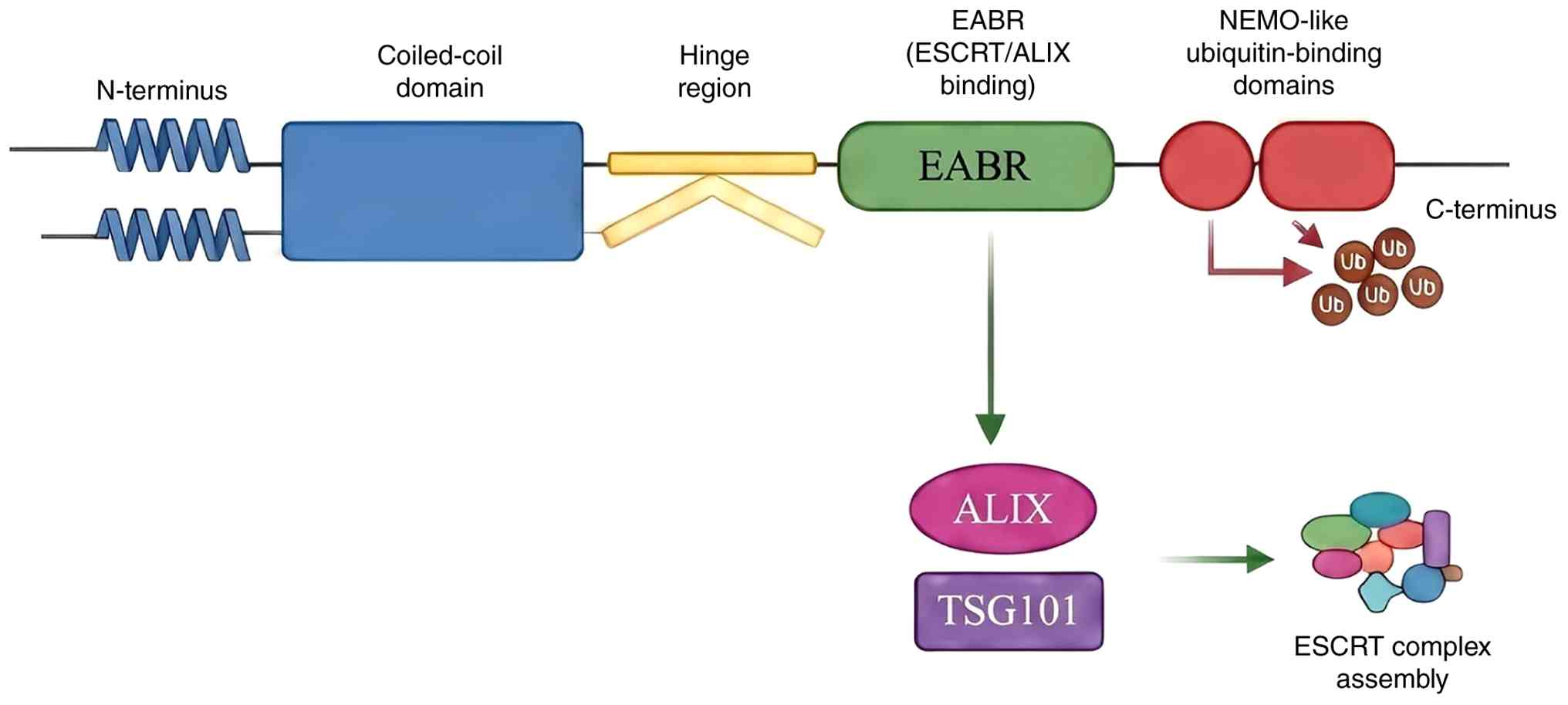
CEP55 contains highly conserved characteristic
domains, which form the structural basis underlying its
multifunctional properties. Its N-terminus harbors a coiled-coil
region that mediates protein self-homodimerization and provides
structural support for protein-protein interactions (PPIs). The
central region acts as a hinge domain that regulates protein
conformational changes and subcellular localization. The C-terminal
ESCRT- and ALIX-binding region (EABR region) specifically recruits
core components of the endosomal sorting complex required for
transport (ESCRT), such as ALIX and TSG101. It serves as a key
structure for proper cytokinesis execution (3,4).
In addition, CEP55 possesses two NEMO-like ubiquitin-binding
domains that sense and transmit ubiquitination signals. Thus, CEP55
participates in a broad range of physiological processes, including
cell-cycle progression and the regulation of protein homeostasis
(5,6). Existing studies have confirmed that
CEP55 is a mammal-specific functional protein. In invertebrates
such as Drosophila, loss of CEP55 can be compensated for by
other homologous proteins to complete cytokinesis, highlighting the
specialized role of CEP55 in regulating mammalian cell division
(7).
The core physiological function of CEP55 is the
precise regulation of cytokinesis at the end of mitosis. During
interphase, CEP55 localizes to the centrosome; at the end of
mitosis, it specifically accumulates at the midbody and directly
binds ALIX and TSG101 via its EABR domain to recruit the ESCRT-I
complex to the intercellular bridge. Supported by the synergistic
stabilizing effect of UMAD1 protein, CEP55 further recruits the
ESCRT-III complex and triggers its polymerization. This process
ultimately mediates midbody abscission and daughter-cell separation
to guarantee the accuracy and integrity of cell division (8,9).
In addition to its classical cytokinesis function, CEP55
contributes to autophagic degradation of centrosome remnants. It
mediates degradation of midbody derivatives by binding the
autophagy receptor NBR1 and modulates stem-cell differentiation,
cell reprogramming and tumorigenesis, thereby maintaining cellular
homeostasis (10,11).
Meanwhile, CEP55 is also extensively involved in the
physiological regulatory processes of multiple systems. In the
reproductive system, CEP55 can regulate spermatogonia proliferation
and sperm maturation, mediate oocyte meiotic spindle assembly and
orderly cell cycle progression and maintain the developmental
homeostasis of germ cells (12-14). During embryonic development,
CEP55 participates in key processes such as embryonic brain
development and ciliogenesis by regulating the cytokinesis and
apoptosis of neural stem cells, rendering it an essential molecule
for the normal development of mammalian embryos (15). In addition, as a crucial adaptor
molecule in the ubiquitin signaling pathway, CEP55 can modulate
ESCRT functions via a non-degradative ubiquitin signaling pathway,
thereby mediating the regulation of various physiological processes
(5). Notably, CEP55 is a typical
cancer-testis antigen. It is lowly expressed only in testis and
thymus tissues under normal physiological conditions, barely
expressed in other normal tissues, but highly expressed in various
pathological tissues, which renders it a promising potential target
for tumor-targeted diagnosis and therapy (16,17). The molecular structure of CEP55
is illustrated in Fig. 1.
Molecular regulatory mechanisms and
signaling pathways
At the level of cell division regulation, the
subcellular localization and functional activation of CEP55 rely on
precise phosphorylation modifications. Erk2/Cdk mediates the
phosphorylation of CEP55 at the Ser425 and Ser428 sites, promoting
its dissociation from the centriole, and subsequently interacts
with Plk1 to induce phosphorylation at the Ser436 site, driving the
targeted localization of CEP55 to the midbody to precisely regulate
cytokinesis; abnormalities in this phosphorylation program lead to
cell division failure and genomic instability (18). In addition, functional
abnormalities of molecules including LNX2, NEURL and UCHL1 hinder
the localization of CEP55 to the midbody, resulting in residual
midbody accumulation, abnormal intercellular bridge structures, and
the formation of multinucleated cells, thereby disrupting the
progression of cell division (19).
The steady-state expression of CEP55 is precisely
regulated at multiple levels, forming a complex and orderly
molecular regulatory network. At the transcriptional level, E2F7,
FOXM1 and SPI1 positively activate CEP55 expression, whereas FOXP2
and p53 exert negative inhibitory effects, jointly maintaining its
moderate expression in normal cells (20-22). At the post-translational
modification (PTM) level, Pin1 promotes Plk1-mediated
phosphorylation of CEP55 to sustain its function. USP8 and USP9X
inhibit CEP55 degradation through deubiquitination, whereas TSG101
mediates its degradation via the lysosomal pathway, collectively
constructing a dynamic 'stability-degradation' balance system for
the CEP55 protein (23-26). At the protein interaction level,
CEP55 interacts with centrosome- and spindle-associated proteins as
well as CBX2, participating in core processes such as spindle
regulation and signal transduction, which further expands its
biological functional network (27,28).
In tumor pathological regulation, CEP55 plays a core
pro-oncogenic role via multiple pathways and mechanisms. First,
CEP55 activates the PI3K/AKT/mTOR pathway, regulating downstream
effector molecules (for example, pGsk3β/β-Catenin/Myc and mTOR) to
drive tumor cell proliferation, migration and invasion. This
mechanism has been validated in tumors [for example, lung
adenocarcinoma (LUAD), renal cell carcinoma (RCC) and gastric
cancer (GC)] (29-31). Second, CEP55 disrupts the
Chk1-dependent S-phase checkpoint and disorganizes microtubule
structures, inducing DNA damage and genomic instability, which
drives the occurrence of spontaneous tumor malignancy (29). Third, CEP55 participates in tumor
progression through competing endogenous RNA (ceRNA)-mediated
post-transcriptional regulation. In bladder cancer, the 3'-UTR of
CEP55 competitively adsorbs microRNA (miR)-497-5p and
simultaneously inhibits the transcription of miR-497-5p by
activating the NF-κB pathway. As a result, the targeted inhibition
of PTHLH and HMGA2 is relieved. Accordingly, the P38MAPK/ERK1/2
pro-oncogenic pathway is activated, accelerating malignant tumor
progression (32). Fourth, CEP55
is involved in remodeling the tumor immune microenvironment (TIME).
By reducing T-cell infiltration within the tumor microenvironment
(TME), inducing tumor immune exclusion, and reinforcing the local
immunosuppressive state, CEP55 mediates resistance to immune
checkpoint inhibitors (ICIs). This renders CEP55 a key regulatory
molecule in tumor immune escape (33). Fifth, aberrant overexpression or
functional dysregulation of CEP55 disrupts the precise
spatiotemporal regulation of cytokinesis, leading to failed
abscission, persistent midbody remnants and the formation of
binucleated or multinucleated cells (8,9,18,19), thereby participating in
tumorigenesis. These cytokinesis defects directly induce
chromosomal instability and aneuploidy, both well-established
drivers of tumor initiation and progression, as evidenced by the
emergence of genomic instability and spontaneous tumor formation in
Cep55 overexpressing mice (29)
and by CEP55 mediated control of chromosomal instability through
the regulation of microtubule dynamics (34). In addition, accumulated midbody
remnants can further activate pro-survival signaling pathways and
drive cellular reprogramming toward a stem-like, tumorigenic state
(29,35). As a well-recognized driver of
tumorigenesis, genomic instability in turn activates multiple
oncogenic signaling pathways, including PI3K/AKT/mTOR and NF-κB,
collectively promoting malignant transformation and driving tumor
proliferation, invasion and metastasis (29-31). Collectively, CEP55-mediated
cytokinesis dysfunction acts as an upstream initiating event that
amplifies a cellular-level defect in cytokinesis into the
macroscopic pathological process of tumor initiation and
progression, through both the induction of genomic instability and
the activation of downstream oncogenic signaling. The expression
and function of CEP55 are coordinately regulated by PTMs,
protein–protein interactions and multiple signaling pathways,
thereby forming a precise and multifunctional network centered on
cell-cycle regulation, tumor malignant phenotypes and immune
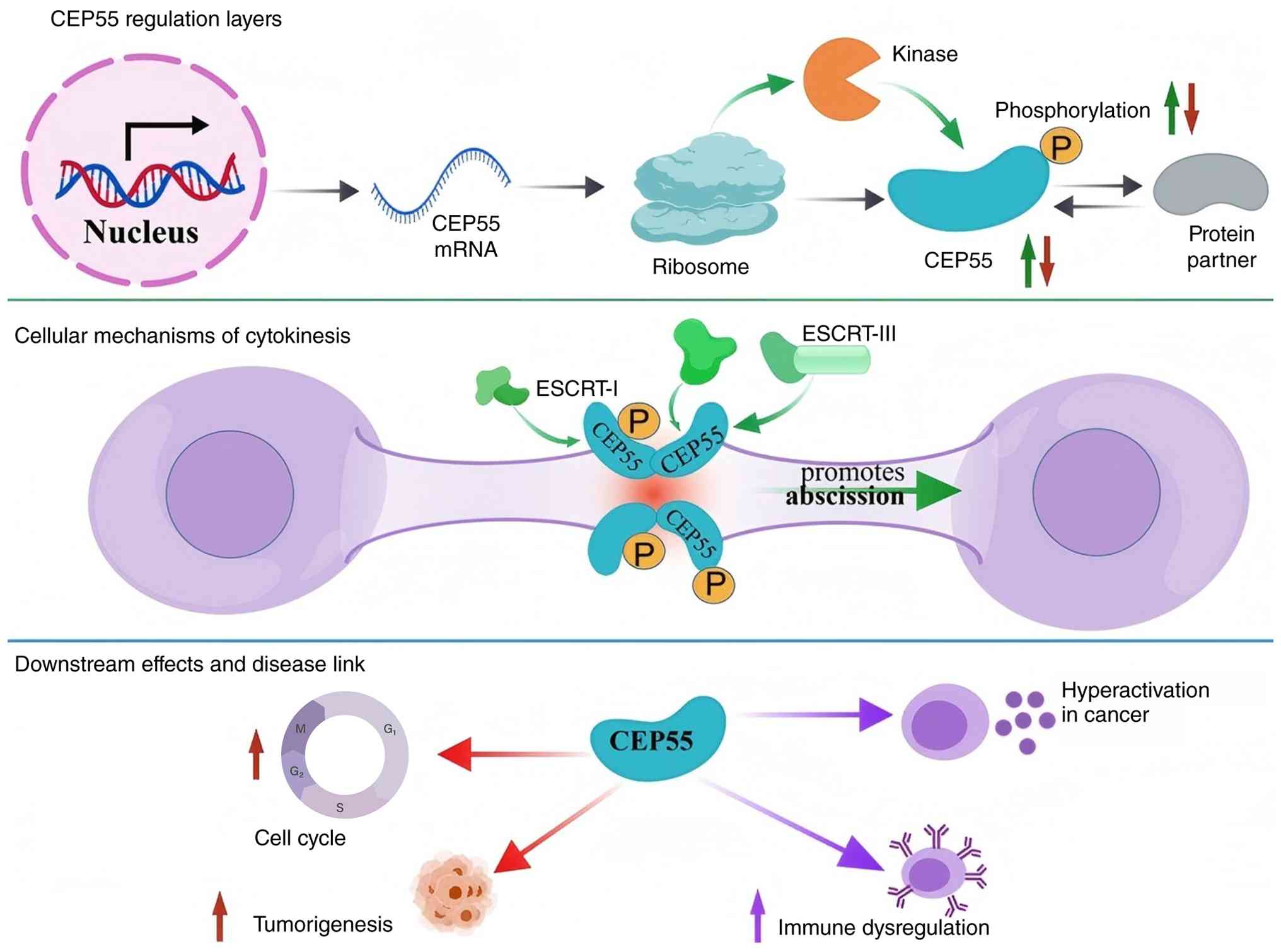
dysregulation. The biological characteristics and mechanism of
action of CEP55 are depicted in Fig.
2.
Expression and mechanism of action of CEP55
in diseases
Expression and mechanism of action in
tumors
Extensive pan-cancer studies and clinical cohort
analyses have confirmed that CEP55 is significantly overexpressed
in a variety of malignant tumors. Its expression level is closely
correlated with tumor pathological grade, TNM stage, invasion and
metastasis, recurrence risk, and poor patient prognosis. Thus,
CEP55 can act as a core oncogene with broad-spectrum and
tumor-specific characteristics (36,37). A pan-cancer study based on 15,823
multicenter clinical samples demonstrated that CEP55 is
significantly upregulated in 20 out of 33 tumor types. Its mRNA
expression level effectively distinguishes 21 tumor types from
normal tissues (AUC=0.97). Moreover, CEP55 expression is
significantly correlated with tumor mutation burden, microsatellite
instability, and immune microenvironment status, marking it a core
target for tumor prognosis evaluation and targeted intervention
(36). Meanwhile, CEP55
regulates tumor immune infiltration patterns and chemotherapy
responses, thereby modulating the sensitivity of tumor cells to
multiple antitumor drugs. These findings indicate that CEP55 serves
as a novel biomarker for tumor prognosis prediction and a potential
target for antitumor targeted therapy, with promising translational
value in precision tumor diagnosis and treatment (37).
Digestive system tumors
CEP55 is abnormally overexpressed in digestive
system tumors, including GC, liver cancer, colorectal cancer (CRC),
pancreatic cancer and esophageal squamous cell carcinoma (ESCC). By
regulating the cell cycle, pro-oncogenic signaling pathways, and
the immune microenvironment, CEP55 drives the malignant progression
of these tumors and provides a potential target for the precision
diagnosis and treatment of digestive system malignancies.
GC: GC is a malignant digestive-tract tumor
characterized by insidious early symptoms, high malignancy, strong
invasive and metastatic potential, and overall poor prognosis.
Previous studies have verified that dysregulated cell-cycle
control, aberrant activation of signaling pathways, and imbalanced
ceRNA-mediated post-transcriptional regulation represent the major
pathological mechanisms underlying GC initiation and progression.
In addition, multiple studies have confirmed that CEP55 is
specifically overexpressed in GC tissues and exerts a critical
regulatory role in GC malignant progression. The underlying
mechanisms are summarized as follows. CEP55 activates the AKT
signaling pathway to inhibit p21 activity. Accordingly, the cell
cycle can be arrested at the G2/M phase, and GC cell proliferation
and in vivo tumorigenesis can be promoted (31). At the post-transcriptional
regulatory level, LINC00662 competitively adsorbs miR-195-5p. Thus,
the targeted inhibitory effect of miR-195-5p on CEP55 can be
alleviated. This process forms the oncogenic
LINC00662/miR-195-5p/CEP55 axis and accelerates the invasion and
metastasis of GC cells (38).
Clinical validation results show that the AUC value of CEP55 for GC
diagnosis exceeds 0.9, demonstrating its excellent performance for
early screening and differential diagnosis between benign and
malignant tumors. Furthermore, high CEP55 expression indicates poor
patient prognosis and acts as an independent prognostic marker for
GC (39).
Liver cancer: Liver cancer is a highly malignant,
rapidly progressing digestive system cancer characterized by a high
recurrence rate and poor prognosis. Uncontrolled cell cycle
progression, abnormal activation of pro-oncogenic signaling
pathways, dysregulation of the ceRNA regulatory network, and
imbalance of the TIME are the core pathological mechanisms driving
the occurrence and progression of liver cancer. CEP55 is
significantly upregulated in liver cancer tissues, and its
expression level is closely associated with tumor grade, clinical
stage and poor patient prognosis (40,41). Mechanistic studies have shown
that DNA hypomethylation serves as a critical epigenetic mechanism
mediating the abnormal upregulation of CEP55 in liver cancer.
Highly expressed CEP55 can activate classic pro-oncogenic pathways,
including the cell cycle, mTOR and VEGF pathways, thereby
continuously driving the malignant progression of liver cancer
(40). At the level of
phosphorylation signal regulation, CEP55 can directly bind to JAK2
and promote JAK2 phosphorylation, activate the JAK2-STAT3 pathway,
and upregulate the expression of downstream MMP2 and MMP9, thereby
facilitating the migration and invasion of liver cancer cells.
Targeted intervention of this pathway can effectively reverse the
oncogenic effect of CEP55 (42).
Meanwhile, CEP55 can interact with sperm antigen 5 (SPAG5) at the
protein level, induce AKT phosphorylation at the Ser473 site, and
activate the PI3K/AKT pathway, which accelerates the proliferation,
invasion and metastasis of liver cancer cells (43). At the post-transcriptional
regulatory level, multiple ceRNA axes modulate the abnormal
expression of CEP55 and participate in the malignant progression of
liver cancer. Specifically, the imbalance of the
CTBP1-AS2/miR-19-5p/CEP55 and miR-363-3p/SPAG5/CEP55 regulatory
axes markedly promotes liver cancer progression, and lncRNA BPESC1
positively regulates CEP55 expression via miR-424, thereby
participating in the occurrence and development of early-stage
liver cancer (44,45). At the immune regulatory level,
CEP55 is critically involved in the remodeling of the liver cancer
immune microenvironment. It can regulate the infiltration patterns
of various immune cells, upregulate the expression of immune
checkpoint molecules, and mediate tumor immune escape. Furthermore,
CEP55 is specifically highly expressed in liver cancer subtypes
with an immunosuppressive phenotype and can effectively predict
immunotherapy efficacy for patients with liver cancer (46,47). In terms of clinical translation,
CEP55 can be combined with multiple genes to construct a multi-gene
prognostic risk score model. This model is not only applicable to
the precise survival prognosis stratification of patients with
different liver cancer subtypes, including hepatitis B-related
liver cancer and early-stage liver cancer, but also can evaluate
tumor sensitivity to radiotherapy, chemotherapy and targeted drugs,
thereby guiding individualized clinical medication (48,49).
CRC: CRC is a highly prevalent, aggressive malignant
tumor of the digestive system with poor late-stage prognosis and
high susceptibility to immunotherapy resistance. Existing studies
show that core pathological mechanisms mediating the occurrence,
invasion and recurrence of CRC encompass cell-cycle dysregulation,
aberrant activation of signaling pathways, imbalanced ceRNA
regulation, and suppression of the immune microenvironment. In
addition, CEP55 is commonly abnormally overexpressed in CRC tissues
and has been repeatedly identified as a hub gene in bioinformatics
screening (50). Promoter DNA
hypomethylation of CEP55 represents a characteristic molecular
event in early-stage CRC, and this alteration can be utilized for
early non-invasive screening (51). High CEP55 expression is closely
associated with high histological grade, advanced TNM stage and
KRAS mutation in CRC. It significantly lowers survival rates among
patients with advanced lymph-node metastasis and serves as an
independent poor-prognosis marker for CRC (52,53). At the molecular-mechanism level,
CEP55 regulates the cell cycle by activating the PI3K/AKT and
p53/p21 pathways. Thus, tumor proliferation and invasion can be
promoted (53,54). At the post-transcriptional level,
lncRNA NEAT1 relieves the targeted inhibition of CEP55 by
sequestering miR-195-5p. This process forms the
NEAT1/miR-195-5p/CEP55 pro-oncogenic regulatory axis, inhibits
tumor-cell apoptosis, and accelerates malignant progression
(55). At the immune-regulation
level, CEP55 reduces intratumoral CD8+ T-cell
infiltration and mediates resistance to ICIs. Targeted silencing of
CEP55 can reshape the anti-TIME and reverse immune resistance
(33). Meanwhile, acting as a
tumor-specific antigen, CEP55-derived antigen peptides can activate
specific cytotoxic T lymphocytes to precisely eliminate CRC stem
cells and induce a potent antitumor response via the development of
mixed peptide vaccines. They provide a novel direction for the
research and development of CRC vaccines (56,57).
Pancreatic cancer: Pancreatic cancer is a highly
malignant tumor of the digestive system characterized by rapid
disease progression, difficulty in early diagnosis, high mortality
and extremely poor prognosis. Previous studies have found that the
abnormal activation of signaling pathways, the imbalance of
centrosome homeostasis, and the disruption of the TIME are the core
pathogenic mechanisms of pancreatic cancer. In addition, existing
studies have reported that CEP55 is significantly overexpressed in
pancreatic adenocarcinoma, and its expression level is correlated
with the clinical characteristics and prognosis of patients
(58,59). The underlying mechanism is that
CEP55 activates the PI3K/AKT/mTOR pathway by binding to PI3K-p110
and simultaneously activates the NFκB/IκBα pathway to upregulate
the expression of cyclin D1, MMP2 and MMP9, thereby driving tumor
proliferation, invasion and tumorigenesis; moreover, mTOR
inhibitors can effectively reverse the pro-oncogenic effects of
CEP55 (60,61). Furthermore, CEP55 induces the
imbalance of centrosome homeostasis and genomic instability, thus
participating in the early malignant transformation of pancreatic
cancer (62). In terms of
clinical translation, CEP55 has been incorporated into a multi-gene
prognostic model for pancreatic cancer, and the risk score
constructed based on CEP55 combined with multiple indicators can
accurately achieve prognostic stratification and guide
individualized postoperative treatment for patients (63,64).
ESCC is a common malignant tumor of the digestive
system characterized by a high recurrence rate and poor prognosis.
Previous studies have suggested that persistent activation of
pro-oncogenic signaling pathways, dysregulation of the ceRNA
regulatory network, and imbalance of the TIME constitute important
pathological bases for its malignant progression. In addition,
multiple studies have confirmed that CEP55 is significantly
overexpressed in ESCC tissues; this overexpression is closely
associated with poor tumor differentiation, depth of invasion,
lymph node metastasis, and postoperative recurrence, and acts as an
independent poor-prognosis risk factor, including in the N0 stage
(65,66). The underlying mechanism may
involve CEP55 regulating programs governing the malignant phenotype
of tumors by activating multiple pathways such as Src/FAK/ERK and
PI3K/AKT, thereby promoting tumor cell proliferation, migration,
invasion and epithelial-mesenchymal transition (EMT) (66,67). At the transcriptional regulatory
level, miR-148a-3p can specifically target and repress CEP55
expression. The imbalanced expression pattern of low miR-148a-3p
and high CEP55 is commonly observed in esophageal cancer tissues.
miR-148a-3p upregulation can effectively inhibit malignant tumor
progression (68). In terms of
immune regulation, CEP55 participates in immune microenvironment
remodeling in ESCC. As a core molecule within the
miR-378-5p-APOC1/CEP55 immune regulatory pathway, its aberrant
expression correlates strongly with activation of tumor immune
regulatory pathways and dysregulated immune-cell infiltration, and
it can modulate tumor progression and influence immunotherapy
responses (69). In summary,
CEP55 has multifaceted value for prognostic stratification,
malignant-progression regulation and immune-intervention guidance
in ESCC, making it a credible potential target for prognostic
assessment and combined targeted and immune therapy for this
disease.
Respiratory system tumors
Lung cancer is a malignant tumor of the respiratory
system with extremely high clinical incidence and mortality rates,
as well as substantial heterogeneity, with non-small cell lung
cancer (NSCLC) being its predominant pathological type. Cell cycle
dysregulation, abnormal epigenetic modifications, imbalance of the
ceRNA regulatory network, and tumor immune dysregulation are the
core pathological mechanisms driving the occurrence, proliferation,
invasion, metastasis and drug resistance of lung cancer. In
addition, CEP55 is significantly overexpressed in NSCLC, and its
prognostic value is subtype-specific, serving as an independent
poor prognostic factor only for the overall survival (OS) and
recurrence-free survival of patients with LUAD, with no significant
prognostic implication for squamous cell carcinoma (70). High expression of CEP55 is
closely associated with advanced tumor stage, pleural invasion,
poor differentiation and postoperative recurrence in LUAD, and it
exhibits prognostic stratification value in early-stage and
smoking-type LUAD populations (71,72). At the epigenetic level, DNA
hypomethylation contributes to the abnormal upregulation of CEP55,
which, as a downstream gene can mediate the pro-oncogenic processes
of tumors (73).
Mechanistically, CEP55 inhibits tumor cell apoptosis by regulating
the p53, Myc and G2M checkpoint pathways, thereby promoting lung
cancer invasion and metastasis (74,75). At the post-transcriptional
regulatory level, multiple ceRNA regulatory axes can modulate CEP55
expression and mediate the malignant progression of lung cancer.
Among these axes, microRNAs including miR-195-5p, miR-144-3p,
miR-514a-3p and miR-148b-3p can directly target and inhibit CEP55,
whereas non-coding RNAs such as LINC01087, TYMSOS, TMPO-AS1 and
circ_0120376 can alleviate this inhibitory effect through
endogenous competition, thereby forming multiple pro-oncogenic
pathways. Meanwhile, CEP55 overexpression can mediate gemcitabine
chemotherapy resistance in LUAD, and downregulating CEP55 can
effectively reverse the drug-resistant phenotype (20,76-78). In terms of immune regulation,
CEP55 can regulate interferon-related signaling and the PD-1/PD-L1
immune checkpoint pathway, participating in the remodeling of the
TIME, and the multi-gene immune prognostic model incorporating
CEP55 can accurately predict patient prognosis and immunotherapy
response (79). In clinical
translation, CEP55 can be combined with genes including APOBEC3B,
CDC6 and TYMS to construct a multi-dimensional prognostic and
metastasis assessment model, which can predict immunotherapy
efficacy. Additionally, CEP55 can serve as an ALK fusion partner
gene affecting targeted therapy response, providing an important
basis for the precision diagnosis and treatment of lung cancer
(79,80).
Reproductive system tumors
CEP55 is abnormally overexpressed in reproductive
system tumors including breast cancer (BC), ovarian cancer (OC),
cervical cancer (CC) and prostate cancer (PCa). It participates in
the regulation of tumor malignant progression. It is closely
correlated with patient prognosis. Furthermore, it provides a novel
direction for the precision diagnosis and treatment of reproductive
system tumors.
BC: BC is a neoplastic disease characterized by
complex subtyping, strong invasiveness and significant prognostic
differences in various subtypes. Previous studies have demonstrated
disordered cell mitosis, abnormal activation of signaling pathways,
and TME remodeling as the major pathological mechanisms of BC.
CEP55 is a microtubule-bundling protein. It participates in the
regulation of cell mitosis and genomic stability. Moreover, it is
markedly overexpressed in BC tissues. Its expression is modulated
by multiple mechanisms, including DNA hypomethylation, SPI1
transcriptional activation, USP8-mediated deubiquitination and
stabilization, and negative regulation by miR-144 (81,82). At the molecular-mechanism level,
CEP55 may promote tumor proliferation and glucose metabolic
reprogramming, suppress cell apoptosis and ferroptosis, and
concurrently induce type 2 macrophage polarization to remodel the
immunosuppressive microenvironment by activating the PI3K/AKT and
MEK1/2-MYC pathways (22,24).
Furthermore, as a cancer-testis antigen, CEP55 can be processed
into specific antigenic peptides to trigger antitumor immune
responses, making it suitable for immune intervention in
drug-resistant BC. CEP55 deficiency can increase the sensitivity of
triple-negative BC (TNBC) to mitotic drugs (17,83). In clinical translation, CEP55 can
accurately assess the prognosis of different BC subtypes and
predict bone-metastasis risk. Its specific inhibitor CD-437 and
corresponding peptide vaccines provide novel strategies for
targeted therapy and immunotherapy of BC (84-86).
OC: OC is a neoplastic disease characterized by
strong occultness, high metastatic and recurrent potential, diverse
pathological subtypes and poor prognosis. Previous studies have
identified that microtubule dynamic imbalance, activation of
pro-oncogenic signaling pathways, and abnormal epigenetic
regulation constitute the major pathological mechanisms of OC. In
addition, CEP55 is significantly overexpressed in epithelial OC and
high-grade serous OC. Its overexpression is closely correlated with
tumor stage, metastasis and recurrence, and adverse prognosis, and
acts as an independent prognostic risk factor (87). Mechanistically, ALKBH5 degrades
FOXP2 mRNA through m6A demethylation, thereby relieving
transcriptional inhibition of CEP55. Upregulated CEP55 promotes EMT
in OC cells, inhibits cell-cycle arrest, and facilitates malignant
tumor progression (88).
Meanwhile, CEP55 maintains microtubule stability, modulates the
dynamic balance of spindle microtubules, promotes microtubule
polymerization while inhibiting microtubule depolymerization,
induces chromosomal instability, and exacerbates malignant tumor
progression (34). In clinical
translation, CEP55 can function as a high-quality biomarker for OC,
especially for high-grade primary OC and high-grade serous OC, and
serves as a reliable indicator for early diagnosis, disease
assessment and prognostic evaluation (89).
CC: CC is a neoplastic disease characterized by
strong occultism, a high tendency for metastasis, insidious
progression, and distinct prognostic heterogeneity. Previous
studies have demonstrated that imbalanced regulation of non-coding
RNAs, HPV-mediated transcriptional abnormalities, and dysregulated
inflammatory signaling pathways constitute the primary pathological
mechanisms of CC. Furthermore, CEP55 is persistently overexpressed
in CC tissues, and its expression level increases gradually during
the malignant transformation from cervical intraepithelial
neoplasia to invasive carcinoma. This aberrant expression is
closely correlated with advanced tumor stage, lymph node
metastasis, and reduced patient survival rates (90,91). CEP55 is negatively regulated by
miR-144-3p and the miR-497/195 gene cluster. Moreover, miR-144-3p
delivered by exosomes derived from bone marrow mesenchymal stem
cells can effectively downregulate CEP55 expression and thereby
inhibit cervical tumor progression (92,93). Mechanistically, CEP55 drives
malignant tumor phenotypes by promoting the proliferation, invasion
and EMT of CC cells and suppressing cellular apoptosis. Meanwhile,
CEP55 participates in the modulation of inflammatory pathways and
HPV-mediated tumor transcriptional regulation (90,94). Clinically, CEP55 can act as a
specific diagnostic and prognostic assessment marker for CC. High
CEP55 expression indicates a poor prognosis in patients and aids in
predicting the risk of metastasis (90). Additionally, CEP55 has been
integrated into the precision prognostic assessment model for CC,
providing a molecular basis for the formulation of clinical
diagnosis and therapeutic strategies for advanced CC (95).
Urinary system tumors
Among urological tumors, CEP55 is significantly
overexpressed in renal cancer, bladder cancer and other urological
malignancies. It participates in regulating malignant tumor
progression and possesses potential clinical application value.
Renal cancer: RCC [including clear-cell RCC (ccRCC)]
and adrenocortical carcinoma are common, highly aggressive,
metastatic neoplastic diseases of the urinary and endocrine systems
with markedly heterogeneous prognoses. Previous studies have found
that activation of pro-oncogenic signaling pathways such as
PI3K/AKT/mTOR, dysregulation of the ceRNA network, and disruption
of the TIME constitute the major pathological mechanisms underlying
the development of these tumors. In addition, CEP55 is
significantly overexpressed in ccRCC and adrenocortical carcinoma;
this overexpression correlates with tumor stage, invasion,
metastasis and poor prognosis, indicating its favorable diagnostic
and prognostic evaluation value (96,97). Mechanistically, CEP55 induces EMT
by activating the PI3K/AKT/mTOR pathway, thereby promoting
cancer-cell proliferation and invasion (30). Its expression is regulated by
multiple ceRNA axes: circ_001287 targets and sponges miR-144 to
relieve inhibitory effects on CEP55, whereas lncRNA-SNHG12 binds
E2F1 to upregulate CEP55 at the transcriptional level, jointly
facilitating the malignant progression of renal cancer (98,99). Furthermore, CEP55 can also
modulate the TIME, alter immune-checkpoint expression, and mediate
resistance to targeted immunotherapy (97,100,101). In terms of clinical
translation, CEP55 can be used for the diagnosis and prognostic
assessment of renal cancer and adrenocortical carcinoma. The
multi-gene model constructed based on CEP55 can accurately stratify
patient prognosis, and CEP55 is also a key gene and potential
small-molecule drug target for renal cancer identified through
bioinformatics screening (102).
Bladder cancer: Bladder cancer is a neoplastic
disease of the urinary system characterized by a high incidence
rate, diverse pathological subtypes, a tendency to recur, and
substantial difficulty in early diagnosis. Previous studies have
found that the imbalance of ceRNA network regulation, activation of
pro-oncogenic signaling pathways, and cellular dysregulation are
the primary pathological mechanisms underlying bladder cancer.
Furthermore, as a typical cancer-testis antigen, CEP55 is
specifically highly expressed in bladder cancer tissues, barely
expressed in adjacent normal tissues, and presents even higher
expression levels in muscle-invasive bladder cancer (16). Specific upregulation of CEP55
mRNA can be detected in the urine of patients with
non-muscle-invasive bladder cancer, serving as a novel biomarker
for non-invasive screening, differentiation of benign and malignant
hematuria, and postoperative recurrence monitoring (16,103). Mechanistically, CEP55 acts as a
ceRNA via its 3'-UTR to silence miR-497-5p, thereby relieving the
inhibitory effects on PTHLH and HMGA2. Meanwhile, it downregulates
the transcription of miR-497-5p through the NF-κB pathway and
activates the P38MAPK and ERK1/2 pathways to promote tumor EMT and
cisplatin resistance (32).
Additionally, CEP55 participates in the regulation of the cell
cycle and cytokinesis in bladder cancer cells; mulberry fruit water
extract combined with ionizing radiation inhibits Aurora B activity
and induces mitotic catastrophe, accompanied by altered CEP55
expression, thereby enhancing radiosensitivity and providing an
experimental basis for radiosensitization and chemo-sensitization
therapy for bladder cancer (104). In clinical translation, CEP55
can serve as a specific diagnostic biomarker for bladder cancer,
applicable to early non-invasive screening and differentiation of
benign and malignant hematuria, and its combination with other
genetic tests can improve diagnostic efficacy; meanwhile, as a core
immune-related biomarker, it provides a basis for immune-targeted
therapy and tumor vaccine development (16,105).
PCa
PCa is one of the most common malignancies of the
male reproductive system, whose malignant progression typically
proceeds from a hormone-sensitive state to castration-resistant PCa
(CRPC) and further to the more aggressive neuroendocrine (NE)
subtype. Previous studies have established that genetic and
molecular mechanisms, including cell-cycle dysregulation and
aberrant chromosome segregation and mitosis, act as important
drivers of PCa initiation and progression, and the role of tumor
mutational burden (TMB)-related genes in evaluating tumor
malignancy and prognosis has attracted increasing attention.
Transcriptome profiling has demonstrated that CEP55 is highly
expressed in PCa and progressively upregulated alongside malignant
progression, with the highest expression levels observed in NE PCa
(106). Mechanistically, CEP55
is a direct target gene of the tumor-suppressor miR-144-3p;
downregulation of miR-144-3p in PCa and CRPC alleviates its
targeted repression of CEP55, thereby facilitating tumor-cell
proliferation, migration and invasion, abrogating G1/S cell-cycle
arrest, and inhibiting apoptosis (107,108). Furthermore, CEP55 modulates
tumor-cell plasticity, upregulates NE tumor markers, and mediates
cisplatin chemoresistance via CDK1 phosphorylation at Tyr15, thus
driving the phenotypic transition of tumors from the
hormone-sensitive state to castration-resistant and NE subtypes
(106). In addition, as a core
TMB-related hub gene, CEP55 participates in cell-cycle progression,
chromosome segregation and mitosis, correlates with patient
disease-free survival (DFS) and OS, and can be combined with TMB to
assess PCa malignancy, prognosis and immunotherapy efficacy
(109).
Thyroid cancer (TC)
TC is a common endocrine malignancy encompassing
papillary (PTC), follicular (FTC), medullary (MTC) and anaplastic
(ATC) subtypes that exhibit marked differences in biological
behavior and prognosis. Among these subtypes, ATC features
extremely high malignancy together with potent invasive and
metastatic potential, resulting in generally poor prognosis for
affected patients. Previous studies have shown that aberrant
regulation of cell-cycle pathways constitutes a key mechanism
underlying TC initiation and malignant progression, and relevant
core differentially expressed genes may provide a potential
molecular basis for disease screening and pathological
classification (110).
Furthermore, integrated bioinformatics analyses have revealed that
CEP55 is highly expressed in TC, with particularly prominent
expression in ATC; its high expression is closely linked to tumor
metastasis and represents an independent adverse prognostic factor
that shortens OS in these patients. Mechanistically, CEP55
activates the PI3K/AKT signaling pathway and, by enhancing
phosphorylation of pathway-associated proteins, promotes TC cell
proliferation and metastasis and fuels malignant progression; by
contrast, CEP55 downregulation reduces such phosphorylation and
consequently halts the malignant progression of TC. Accordingly,
CEP55 may function as a prognostic biomarker and a candidate
therapeutic target for ATC (111).
Besides the aforementioned tumors, CEP55 is also
aberrantly overexpressed in endometrial cancer (112) and osteosarcoma (113), wherein it drives malignant
progression via regulating cell proliferation and invasion.
However, available studies of these tumors are restricted to
small-sample basic validations and bioinformatics predictions, with
a lack of evidence from multicenter clinical cohorts. Their precise
regulatory mechanisms and clinical translational value still
warrant further in-depth investigation.
Among the above malignant tumors, the tumorigenic
mechanism driven by dysregulated CEP55 expression are illustrated
in Fig. 3. The tumor-specific
expression profile, regulatory pathways and mechanisms of CEP55 are
summarized in Table I.
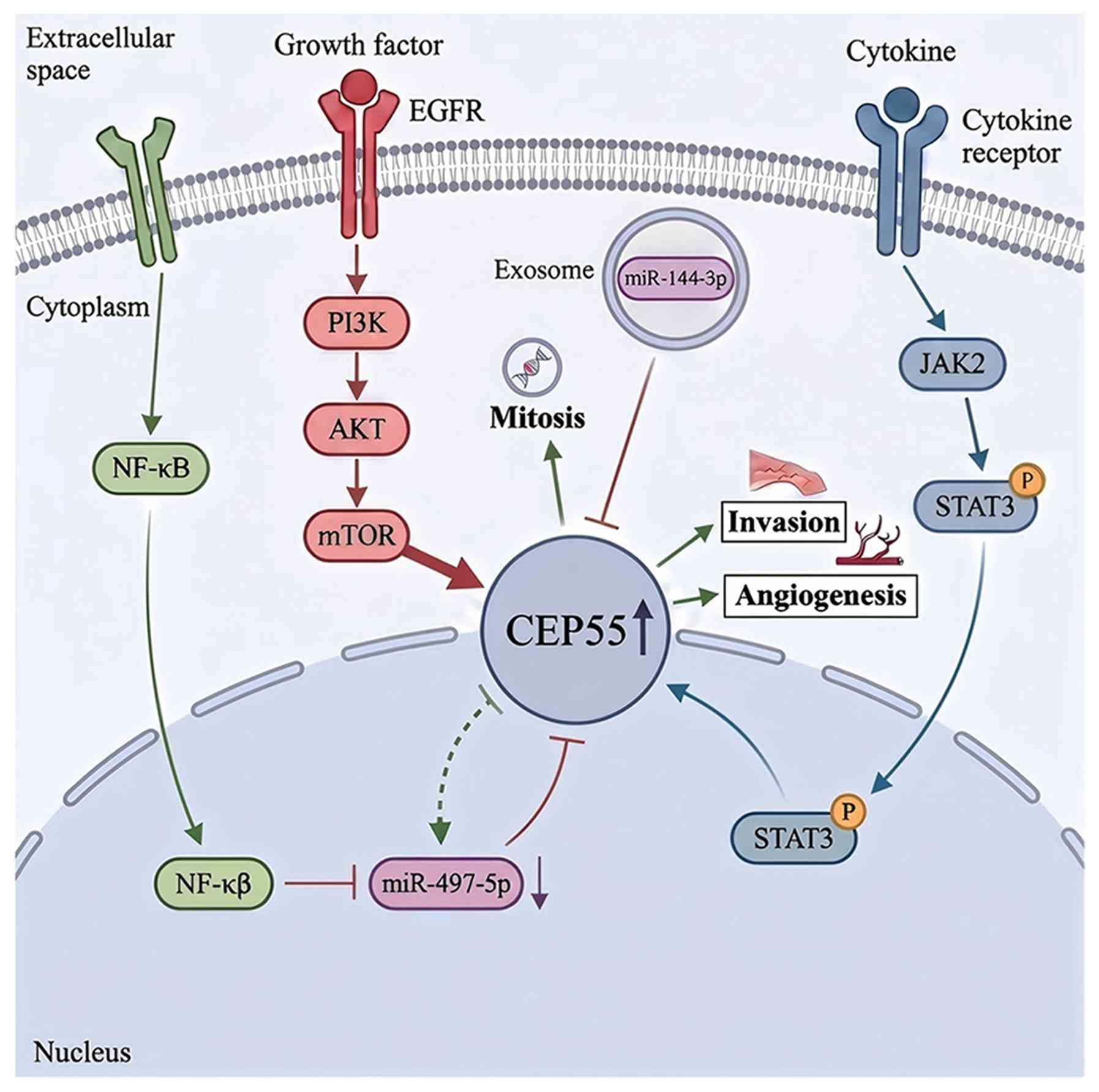 | Figure 3Dysregulated CEP55 expression
mediates tumorigenesis. Growth factors and cytokines within the
tumor microenvironment activate the PI3K/AKT/mTOR pathway and
JAK2/STAT3 pathway, respectively, alongside intracellular NF-κB
pathway activation, which collaboratively upregulate CEP55
expression. Exosome-carried miR-144-3p directly suppresses CEP55
expression, whereas the NF-κB pathway downregulates the
tumor-suppressive miR-497-5p, relieving the post-transcriptional
inhibitory effect of miR-497-5p on CEP55 and further sustaining
high CEP55 levels. Collectively, multiple signalling pathways
synergistically elevate CEP55. Upregulated CEP55 facilitates
mitotic progression to accelerate tumor cell proliferation, and
simultaneously drives tumor invasion and angiogenesis to amplify
malignant phenotypes, ultimately mediating tumor initiation and
progression. CEP55, Centrosomal protein 55; miR, microRNA. |
 | Table ISummary of CEP55 expression in
neoplastic diseases. |
Table I
Summary of CEP55 expression in
neoplastic diseases.
| Disease | Pathway | Mechanism | Clinical sample
validation or not | Cytology or animal
experiments | (Refs.) |
|---|
| Gastric cancer | PI3K/AKT | Activated PI3K/AKT
signaling suppresses p21 expression, thereby inducing G2/M phase
arrest | No | Cell line | (31,38,39) |
| Hepatocellular
carcinoma | JAK2-STAT3,
PI3K/AKT | It interacts with
JAK2/SPAG5 to activate JAK2-STAT3 and PI3K/AKT signaling, thereby
upregulating CEP55 expression | Yes, n=846 | Cell line | (40-45) |
| Colorectal
cancer | PI3K/AKT,
p53/p21 | CEP55 regulates the
cell cycle by activating the PI3K/AKT and p53/p21 pathways, thereby
promoting tumor proliferation and invasion | Yes, n=169 | Cell line | (50-55) |
| Pancreatic
cancer | PI3K/AKT/mTOR,
NF-κB/IκBα | Combined PI3K
signaling activates PI3K/AKT/mTOR; NF-κB/IκBα activation
upregulates MMP2/MMP9 | Yes, n=1163 | Cell line,
both | (58-64) |
| Esophageal
cancer | Src/FAK/ERK,
PI3K/Akt | Activation of
Src/FAK/ERK and PI3K/Akt pathways promotes proliferation, invasion
and EMT | Yes, n=322 | Cell line,
both | (65-69) |
| Lung cancer | PI3K/AKT,
RhoA/ROCK1 | Activates the
PI3K/AKT and RhoA/ROCK1 pathways; Exosomal transport of CEP55
activates mTOR to promote angiogenesis | Yes, n=157 | Cell line | (70-79) |
| Breast cancer | MEK1/2-MYC,
PI3K/AKT | Downstream effector
of MEK1/2-MYC; promotes CHMP6 expression to inhibit ferroptosis and
induce M2 macrophage polarization; transcriptionally activated by
SPI1/FOXM1 and stabilized via USP8-mediated deubiquitination | Yes, n=596 | Cell line,
both | (17,20,22,24,81-86) |
| Ovarian cancer | EMT | ALKBH5
downregulates FOXP2 to upregulate CEP55, thereby modulating cell
cycle and EMT | Yes, n=333 | Cell line | (34,87-89) |
| Cervical
cancer |
miR-144-3p/CEP55 | Exosomes derived
from hBMSCs deliver miR-144-3p to downregulate CEP55 | Yes, n=480 | Cell line | (90-95) |
| Renal cell
carcinoma | PI3K/AKT/mTOR | Activation of the
PI3K/AKT/mTOR pathway induces EMT | Yes, n=1009 | Cell line,
both | (30,96-102) |
| Bladder cancer |
NF-κB/P38MAPK/ERK1/2 | Sponges miR-497-5p
via the 3'untranslated region and activates NF-κB, which
downregulates miR-497-5p, upregulates PTHLH/HMGA2, triggers p38
MAPK/ERK1/2 signaling and induces EMT | Yes, n=433 | Cell line | (16,32) |
Expression and mechanism of action in
non-neoplastic diseases
Beyond neoplastic diseases, accumulating evidence
suggests that CEP55 is also involved in the development and
progression of certain genetic disorders, inflammatory and
immune-mediated diseases, and chronic non-communicable diseases,
predominantly through modulation of the cell cycle, inflammatory
activation, and embryonic development. Since the present review
focuses on the oncogenic functions of CEP55, this section briefly
outlines key findings regarding non-neoplastic diseases.
Immune and inflammatory diseases
CEP55 contributes to autoimmune and inflammatory
diseases through its functions in cell-cycle regulation,
inflammatory activation and immune-cell differentiation and
migration (114-116); its dysregulated expression
mediates functional imbalances in keratinocytes, lymphocytes and
macrophages, rendering CEP55 a candidate biomarker for multiple
autoimmune diseases. Among autoimmune skin disorders, CEP55 has
been reported as a dysregulated core gene in psoriasis and atopic
dermatitis. In psoriasis, CEP55 participates in cell-cycle
progression, mitosis and cytoskeletal remodeling and may act as a
potential biomarker (115). It
also functions as a shared mediator in psoriasis comorbid with
Crohn's disease, and its targeted inhibition represses the release
of inflammatory cytokines (117). In atopic dermatitis, CEP55 is
overexpressed in lesional keratinocytes and can be integrated into
machine-learning-based diagnostic models (114,116). For systemic autoimmune
diseases, CEP55 exhibits high expression in peripheral blood and
lesional tissues from patients with systemic lupus erythematosus
(SLE), where it is enriched within plasmacytoid cells and
CD4+ T lymphocytes; by disrupting oxidative
phosphorylation and cell-cycle programs, it participates in SLE
pathogenesis and may represent an auxiliary diagnostic target
(118). In ulcerative colitis
(UC), CEP55 expression fluctuates in activated macrophages and
colonic lesional tissues, promotes chronic intestinal inflammation,
and offers a candidate non-invasive biomarker (119). In primary Sjögren's syndrome,
chronic pulmonary inflammation upregulates CEP55 through the
JAK2/STAT3 axis, which may mediate malignant transformation into
LUAD (120).
From an evidence-grading perspective, the
aforementioned findings are heterogeneous in their level of
support. The psoriasis, atopic dermatitis, SLE and UC studies are
predominantly computational: CEP55 was identified by
differential-expression analysis, immune-infiltration analysis,
weighted gene co-expression network analysis or machine-learning
modelling of public transcriptomic datasets, without independent
patient-cohort validation (114-116,118,119). By contrast, the shared
psoriasis-Crohn's disease biomarker study and the primary Sjögren's
syndrome study combined bioinformatics with experimental
verification, thereby providing wet-lab support for the predicted
pathogenic mechanisms (117,120). Overall, however, independent
multicenter clinical cohort validation of CEP55 in immune and
inflammatory diseases is still lacking, and its diagnostic and
therapeutic value in this setting remains to be established.
Reproductive and hereditary diseases
CEP55 regulates fertilized egg cleavage, neural stem
cell proliferation, and multi-organ differentiation via its
ubiquitin-binding domain, centrosome-localization domain, and
multiple signaling pathways including PI3K/AKT, p53 and Hippo.
Pathogenic mutations in CEP55 cause a spectrum of congenital
genetic diseases, and its dysregulation also contributes to
reproductive disorders and pregnancy-related complications.
In reproductive system diseases, CEP55 participates
in meiosis, cytokinesis and gamete maturation. Its expression
imbalance contributes to azoospermia, oocyte developmental arrest
and impaired endometrial receptivity. In male reproduction, CEP55
functions together with TEX14 and MKLP1 to maintain intercellular
bridges in germ cells. In transgenic mouse models, its
overexpression persistently activates the PI3K/Akt/FoxO1 pathway,
blocks spermatogonial differentiation and causes male infertility
(121). By contrast, clinical
sample analysis shows that CEP55 is significantly downregulated in
the testicular tissues of patients with non-obstructive azoospermia
(NOA), and it may serve as a non-invasive diagnostic marker
(122). In female reproduction,
CEP55 localizes to the oocyte spindle and midbody; its deficiency
disrupts spindle assembly and arrests meiosis, leading to
chromosomal abnormalities and aneuploid gametes (14,123). In addition, CEP55 is involved
in regulating the proliferation of endometrial epithelial cells and
may also participate in the modulation of endometrial receptivity,
which warrants further investigation (124).
During embryonic development, CEP55 is essential for
sustaining fertilized egg meiosis, early embryonic cleavage,
blastocyst formation and tissue differentiation. It modulates
cytoskeletal and mitochondrial homeostasis and may cooperate with
the p53 and Hippo pathways to govern symmetric/asymmetric cell
division (125). CEP55
deficiency accelerates proteasomal degradation of Akt protein,
which induces cell-cycle disorders, apoptosis and embryonic
developmental arrest (126). In
neural development, CEP55 interacts with the ESCRT complex to
guarantee proper neural stem cell abscission. CEP55 knockout
activates the p53 pathway, resulting in widespread brain apoptosis,
microcephaly, and neonatal death in mice (15).
At the hereditary disease level, CEP55 mutation
subtypes directly determine the severity of congenital
malformations and survival prognosis. Homozygous nonsense and
frameshift mutations usually lead to perinatal-lethal syndromes,
including MARCH syndrome and Meckel-Gruber syndrome, which are
characterized by multisystem malformations such as hydrocephalus,
polycystic kidney disease and cerebellar malformation (127-131). Compound heterozygous missense
mutations located at critical C-terminal sites also give rise to
severe MARCH syndrome (132).
By contrast, common missense variants, compound heterozygous
variants within non-critical regions, and terminal splice-site
variants produce milder, viable phenotypes such as developmental
delay, syndactyly and limb malformations (133). The genotype-phenotype
correlations of CEP55 mutations are summarized in Table II.
| Table IIGenotype-phenotype correlations of
CEP55 pathogenic mutations. |
Table II
Genotype-phenotype correlations of
CEP55 pathogenic mutations.
| Authors, year | Mutation type | Specific
variant | Protein
consequence | Clinical
phenotype | Survival | (Refs.) |
|---|
| Bondenson et
al, 2017 | Homozygous
non-sense | c.256C>T
(p.Arg86*) | Truncated protein,
complete loss of function | Meckel-Gruber
syndrome, Potter sequence, cystic renal dysplasia,
hydranencephaly | Perinatal
lethal | (130) |
| Frosk et al,
2017; Rawlins et al, 2019 | Homozygous
frameshift | Various truncating
variants | Loss of CEP55
protein function | MARCH syndrome:
hydrocephalus, polycystic kidney disease, renal dysplasia,
cerebellar malformation, oligohydramnios | Perinatal
lethal | (129,131) |
| Fu et al,
2025 | Compound
heterozygous missense (C-terminal critical sites) | Biallelic missense
in EABR/ubiquitin-binding domains | Impaired midbody
localization and ESCRT recruitment | Severe prenatal
MARCH syndrome with multisystem malformations | Perinatal
lethal | (132) |
| Barrie et
al, 2020 | Missense/compound
heterozygous (non-critical regions) | Various missense
variants outside critical domains | Partial protein
function retained | Developmental
delay, anencephaly, syndactyly, limb malformations | Viable | (133) |
| Barrie et
al, 2020 | Terminal splice
site variants | Splice-site
variants at gene termini | Altered splicing
with residual function | Mild to moderate
congenital malformations | Viable | (133) |
With respect to evidence grading, this section is
comparatively well supported by wet-lab data: The reproductive and
developmental functions of CEP55 were established in
Cep55-overexpressing and Cep55-knockout mouse models, in zebrafish
and porcine embryo models, and in oocyte, spermatogonial and
endometrial epithelial cell systems (121-126), whereas the congenital
malformation spectrum rests on case-based genetic analyses of
affected families (127-133).
Independent clinical cohort validation nevertheless remains scarce.
To date, only the NOA study incorporated an independent patient
cohort, in which CEP55 downregulation was verified by reverse
transcription-quantitative PCR (RT-qPCR) and western blotting in a
small series of testicular specimens (n=6) and its diagnostic value
was assessed by ROC analysis (121); most other reproductive findings
still await confirmation in larger, multicenter patient
cohorts.
Other diseases
CEP55 also exhibits aberrant expression in several
non-cancerous diseases, including diabetic cardiomyopathy, chronic
kidney disease (CKD), pulmonary arterial hypertension, acute spinal
cord injury (SCI), interstitial cystitis and post-COVID-19 syndrome
(134-139).
Diabetic cardiomyopathy: In a rat model of diabetic
cardiomyopathy combined with high-glucose-treated H9C2
cardiomyoblasts, CEP55 was shown to bind β-hydroxy-butyrylated
ANXA11 and to co-regulate centrosome amplification (γ-tubulin and
PLK4) and mitochondrial dysfunction (134).
CKD: Bioinformatic re-analysis of public datasets
(GSE66494 and GSE80247) identified CEP55 as one of seven hub mRNAs
within the LINC01094/miR-513b-5p/MELK ceRNA module; its underlying
mechanism, however, remains unclear and warrants further
investigation (135).
Pulmonary hypertension: Bioinformatics analysis of
the GSE144274 dataset (idiopathic pulmonary arterial hypertension
vs. healthy controls), combined with functional enrichment and PPI
analyses, identified CEP55 as one of six core hub genes; its
mechanistic role, however, remains unclear and warrants further
investigation (136).
Acute SCI: Reanalysis of the public blood
transcriptome dataset GSE151371 and the spinal cord dataset
GSE45376 identified CEP55 as one of the top 15 hub genes,
suggesting its involvement in the pathogenesis of acute SCI; the
underlying mechanism remains unclear and warrants further
investigation (137).
Interstitial cystitis: Integrated GEO-based
differential-expression and immune-infiltration analyses identified
CEP55 as one of 10 immune-related hub genes, and its diagnostic
performance was evaluated using ROC curves; its mechanistic role,
however, remains unclear (138).
Long COVID: Machine-learning-based screening of GEO
transcriptomic datasets identified a four-gene signature comprising
CEP55, CDCA2, MELK and DEPDC1B, which yielded a combined ROC value
of 0.876 for the diagnosis of COVID-19 infection; the mechanistic
basis of CEP55 in this setting remains unclear and warrants further
investigation (139).
In summary, the aforementioned findings are largely
derived from bioinformatic screening of public transcriptomic
datasets or from small-sample assays, and only a few have been
further confirmed by cellular experiments; independent, large-scale
clinical cohort validation is still lacking for most of these
conditions. Nevertheless, CEP55 not only plays a pivotal role in
tumor-related and immune-related diseases, but also exhibits
significant importance in other conditions, including CKD,
pulmonary arterial hypertension, acute SCI and interstitial
cystitis. Further exploration of its potential regulatory molecular
mechanisms may enhance the translational potential and clinical
application of CEP55. The expression profiles and action mechanisms
of CEP55 in non-tumor diseases are summarized in Fig. 4 and Table III.
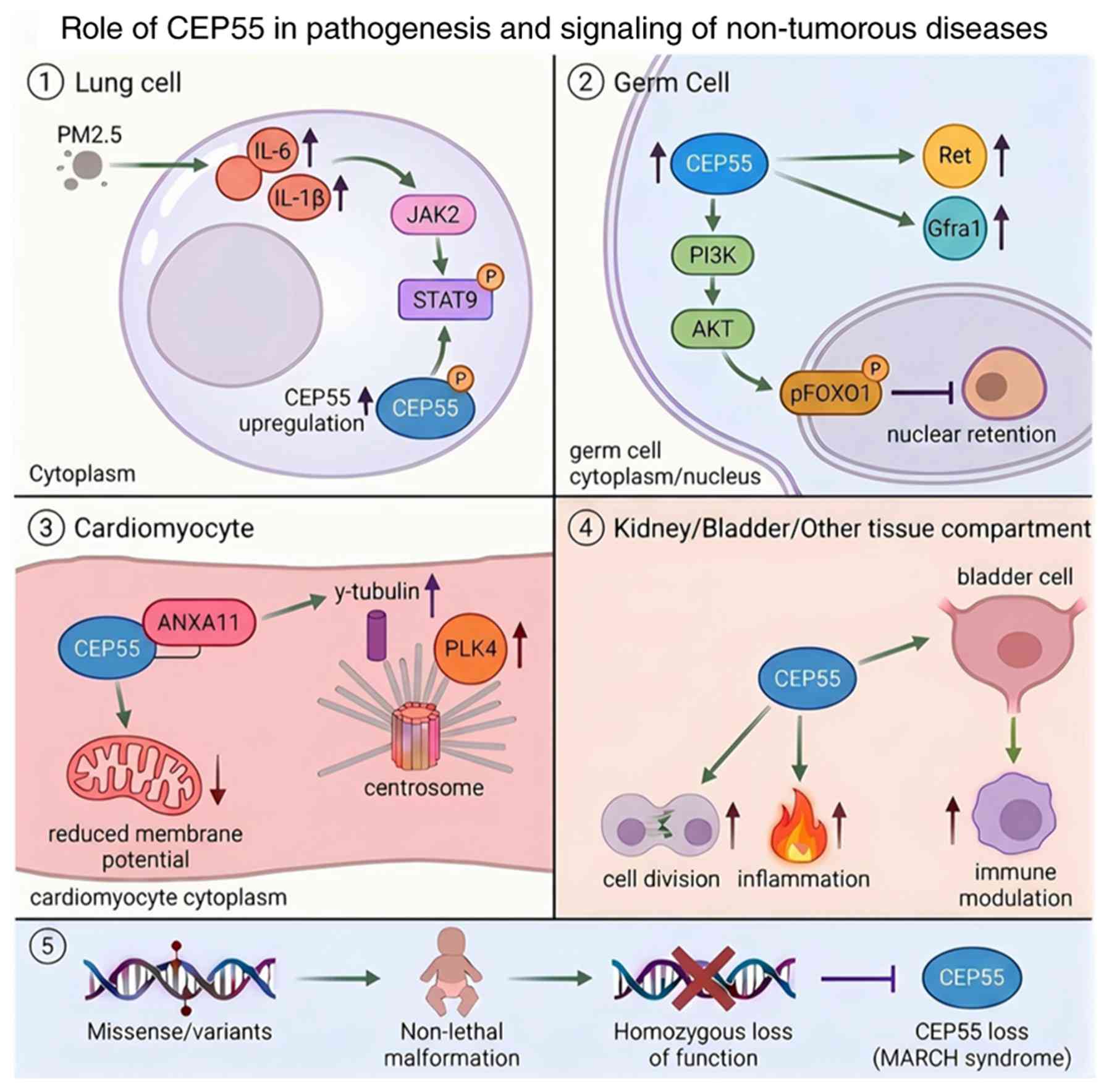 | Figure 4Pathogenic mechanism of CEP55 in
non-tumorous diseases. Panel 1: Chronic pulmonary inflammation
induces the secretion of pro-inflammatory cytokines IL-6 and IL-1β
in lung cells to activate JAK2/STAT3 signaling, ultimately
triggering cytoplasmic upregulation of CEP55; Panel 2: Elevated
CEP55 increases Ret and Gfra1 expression via activating the
PI3K/Akt cascade, which phosphorylates FOXO1 and blocks FOXO1
nuclear retention in germ cells; Panel 3: CEP55 binds ANXA11 in
cardiomyocytes to upregulate γ-tubulin and PLK4 for centrosome
overexpansion while simultaneously reducing cellular membrane
potential, driving dilated cardiomyopathy progression; Panel 4:
Overexpressed CEP55 facilitates aberrant cell division, aggravates
inflammatory response, and mediates immune modulation in bladder
and renal tissue compartments; Panel 5: CEP55 missense variants
lead to non-lethal developmental malformations, whereas homozygous
loss-of-function mutations result in complete CEP55 depletion and
the onset of MARCH syndrome. Collectively, aberrant CEP55
expression driven by environmental stimuli, signalling cascades,
protein interactions and genetic variants mediates inflammatory,
developmental, cardiac, reproductive and renal pathological
processes to initiate a spectrum of non-tumor diseases. CEP55,
Centrosomal protein 55. |
| Table IIISummary of CEP55 expression in
non-tumor diseases. |
Table III
Summary of CEP55 expression in
non-tumor diseases.
| Authors, year | Disease | Pathway | Mechanism | Whether clinical
sample validation (and sample size) | Cytology or animal
experiments | (Refs.) |
|---|
| Yue et al,
2022; Li et al, 2025 | Psoriasis | / | Hub genes derived
from psoriasis-related differentially expressed genes | NO | Cell line | (115,117) |
| Li et al,
2025; Wu et al, 2023 | Atopic
dermatitis | / | Significantly
expressed in key keratinocytes | NO | Cell line | (114,116) |
| Wang et al,
2025 | Systemic lupus
erythematosus | / | Imbalance of
oxidative phosphorylation; oxidative phosphorylation imbalance | NO | Both | (118) |
| Li et al,
2024 | Primary Sjögren's
syndrome | JAK2/STAT3 | Chronic pulmonary
inflammation upregulates CEP55 through the JAK2/STAT3 axis, which
may mediate malignant transformation into lung adenocarcinoma | NO | Both | (120) |
| Sinha et al,
2018; Shen et al, 2022 | Male infertility
(azoospermia) | PI3K/AKT | CEP55
overexpression activates PI3K/Akt to elevate FOXO1 phosphorylation
and inhibit its nuclear retention | Yes, number of
samples (n=6) | Both | (121,122) |
| Liu et al,
2018; Amanda et al, 2024 | Endometriosis | p53 | Regulates the
proliferation of endometrial epithelial cells; its possible role in
modulating endometrial receptivity remains to be clarified | NO | Cell line | (124,143) |
| Barrie et
al, 2020 | Viable congenital
malformation | / | Missense/compound
heterozygous/specific splice site variants can lead to non-lethal
phenotypes | NO | Both | (133) |
| Wang et al,
2023; Yanagi et al, 2019; Frosk et al, 2017; Bondeson
et al, 2017; Rawlins et al, 2019 | MARCH syndrome | / | Homozygous
nonsense/frameshift loss-of-function mutations lead to loss of
CEP55 protein function | NO | Both | (127-131) |
| Liu et al,
2025 | Diabetic
cardiomyopathy | / | It binds to ANXA11
to upregulate γ-tubulin and PLK4, driving abnormal centrosome
expansion and participating in the pathological progression of
DCM | NO | Cell line | (134) |
| Zhang et al,
2025 | Chronic kidney
disease | / | It is a core gene
of the lncRNA-miRNA-mRNA ceRNA network | NO | Cell line | (135) |
| Li et al,
2023 | Pulmonary
hypertension | / | Participate in cell
division, inflammatory response, and the regulation of pathways
such as IL-17, mediating the pathological process of PAH | NO | Cell line | (136) |
| Lv et al,
2026 | Interstitial
cystitis | / | Participate in
immune regulation and inflammatory response, and mediate chronic
bladder inflammation | NO | Cell line | (138) |
| Chen et al,
2023 | Acute spinal cord
injury | / | Identified as one
of the top 15 hub genes by reanalysis of the public blood
transcriptome dataset GSE151371 and the spinal cord dataset
GSE45376 | NO | Cell line | (137) |
| Hou et al,
2025 | Long COVID | / |
Machine-learning-based screening of GEO
transcriptomic datasets identified a four-gene signature comprising
CEP55, CDCA2, MELK and DEPDC1B (combined ROC=0.876) | NO | Cell line | (139) |
Clinical translational application of
CEP55
Diagnostic and prognostic evaluation
value
CEP55, as a typical cancer-testis antigen, is
characterized by highly restricted expression in normal tissues and
specific abnormal expression in diseased tissues. It is lowly
expressed only in normal human testis and thymus tissues and almost
undetectable in other normal tissues, while its expression is
significantly elevated under various pathological conditions,
including tumors, autoimmune diseases and genetic diseases
(16,17). Its unique expression
characteristics effectively compensate for the limitations of
traditional tumor markers, such as insufficient tissue specificity,
high false-positive rates, and limited diagnostic efficacy. CEP55
is expected to become a novel non-invasive molecular marker for
diagnosis and prognosis with high translational value across
multiple disease areas. It can be widely applied in various
clinical scenarios, including early disease screening,
differentiation between benign and malignant lesions, dynamic
monitoring of disease progression, prognostic risk stratification,
and prediction of therapeutic efficacy, thereby demonstrating
excellent translational application potential.
In terms of tumor diagnosis, multiple pan-cancer
large-sample bioinformatics analyses combined with clinical cohort
validation have confirmed that CEP55 can serve as a broad-spectrum
specific diagnostic marker for malignancies across multiple systems
with favorable diagnostic accuracy. A pan-cancer study based on
15,823 multicenter samples covering 33 types of human malignant
tumors showed that the abnormal expression characteristics of CEP55
mRNA could effectively distinguish 21 types of tumor tissues from
their matched normal tissues, with an overall area under the
receiver operating characteristic (AUC) value of up to 0.97
(sensitivity 0.91, specificity 0.93) (36). For specific cancer subtypes, the
diagnostic AUC of CEP55 expression detection in GC tissues is
higher than 0.9, which can effectively distinguish benign gastric
hyperplasia, gastric inflammation and gastric malignant lesions,
providing a reliable basis for early non-invasive auxiliary
diagnosis of GC (39). Regarding
the malignant progression of liver cancer and CRC, hypomethylation
of the CEP55 promoter DNA is a characteristic molecular event
occurring in the early stage of tumorigenesis. This molecular
alteration can capture malignant transformation signals and be
applied to the screening of occult early tumors (40,51). In gastrointestinal cancers, the
multi-gene diagnostic model constructed based on CEP55, AURKA, DTL
and TTK achieves an AUC of 0.80. This model can accurately identify
early micro-lesions and precancerous lesions that are difficult to
detect via imaging examination, thereby effectively reducing the
risk of missed diagnosis (140).
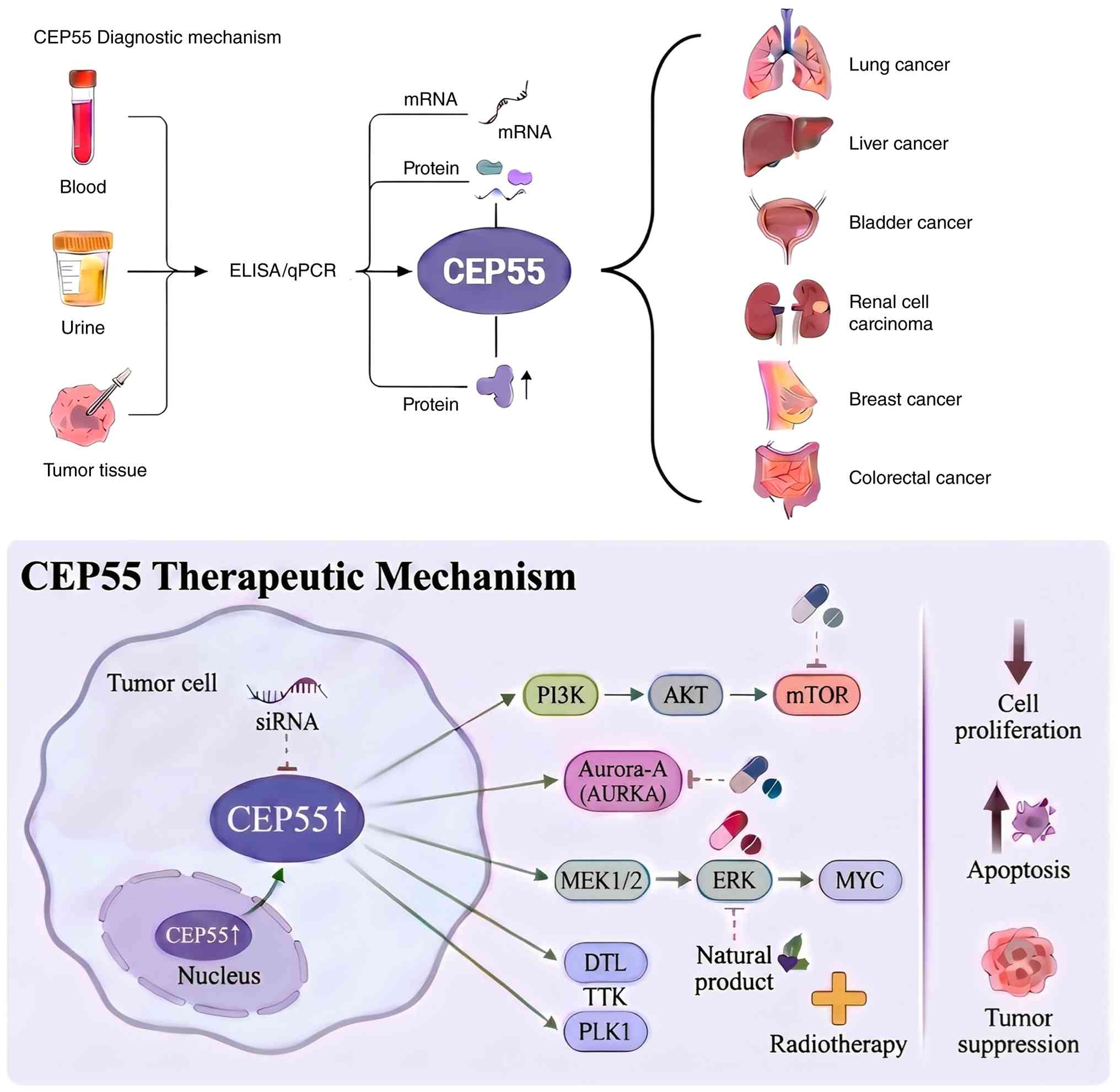
The non-invasive detection using body fluid
specimens represents the core translational value of CEP55 that
distinguishes it from traditional tumor markers, overcoming the
clinical limitations of invasive tissue biopsy, complex procedures,
and difficulties in dynamic follow-up. In urological tumors, CEP55
mRNA is significantly upregulated in bladder cancer tissues, with
higher levels in muscle-invasive than in non-muscle-invasive
lesions, and its expression abundance is positively correlated with
invasion depth (16); meanwhile,
specific upregulation of CEP55 mRNA can also be detected in the
urine of patients with non-muscle-invasive bladder cancer, which
can serve as a non-invasive urinary diagnostic marker for early
screening, differentiation of benign and malignant hematuria, and
postoperative recurrence monitoring, and is applicable to
large-scale population screening (103). Compared with invasive
examinations such as cystoscopy, urinary CEP55 detection has the
advantages of non-invasiveness, convenience, and repeatability,
which can effectively improve the current status of bladder cancer
diagnosis. Other studies have also identified abnormal CEP55
expression in the peripheral blood of patients with lung cancer and
BC, providing a new direction for the establishment of a
non-invasive peripheral blood diagnostic platform for multiple
tumors (37).
Although CEP55 shows favorable diagnostic
performance across diverse sample types, uniform cut-off values
have not yet been established, largely owing to several confounding
factors that can be documented directly in the published CEP55
literature. The key factors, together with the supporting evidence,
are as follows:
Sample-source heterogeneity. CEP55 abundance differs
systematically among specimen types, therefore a single reference
interval cannot be applied across matrices. In bladder cancer,
tissue-based and urine-based assays interrogate different analyte
pools: CEP55 mRNA and protein were quantified in surgically
resected tumor tissues, whereas urinary CEP55 mRNA reflects shed
tumor cells and is additionally influenced by urinary dilution,
hematuria and urinary tract infection (16,103). At the pan-cancer level, the
diagnostic AUC of 0.97 was estimated from tissue transcriptomes,
whereas blood transcriptomic profiling identified CEP55 only as one
hub gene within a multi-gene panel, yielding different absolute
levels and different optimal cut-points (36,137). Tissue-, urine- and
blood-derived values are therefore not interchangeable.
Detection-platform variability. Differences in
analyte (mRNA vs. protein), methodology and normalization generate
non-comparable results. A representative example comes from bladder
cancer, where RT-qPCR quantification of CEP55 mRNA discriminated
muscle-invasive from non-muscle-invasive disease (relative fold
expression 7.88±3.88 vs. 4.75±2.30, P=0.01), whereas
immunohistochemical evaluation of CEP55 protein in the same cohort
showed no significant difference (72.2% vs. 69.0%, P=0.774)
(16). Likewise, RT-qPCR with
different reference genes, semiquantitative immunohistochemical
scoring, ELISA and RNA-seq/microarray-based quantification each
produce distinct dynamic ranges, thus a cut-off derived on one
platform cannot be transferred to another (16,30,35,36,103).
Patient-background heterogeneity. Effect sizes, and
even the direction of the association, vary with patient
background. In NSCLC, CEP55 is an independent adverse prognostic
factor for LUAD but not for squamous cell carcinoma (70); in CRC, the five-year survival
rate was similarly significantly reduced among patients with
lymph-node involvement and high CEP55 expression (52), which is consistent with its
adverse prognostic role reported in unselected cohorts and in
data-mining studies with experimental validation (53). Prognostic performance is further
modified by disease stage, smoking status, viral etiology and
molecular subtype, as shown for stage I LUAD, smokers with LUAD,
hepatitis B-related hepatocellular carcinoma (HCC) and TNBC
(22,48,71,72), and prior treatment reshapes CEP55
expression through gemcitabine- and cisplatin-resistant phenotypes
(20,32). In non-neoplastic settings, blood
transcriptomic comparisons show a similarly strong context
dependence, with CEP55 differing between acute SCI and trauma
controls and between patients with and without progression to long
COVID (137,139). Age, sex and comorbidities add
further variability.
Pre-analytical variables. No study has yet
systematically evaluated pre-analytical variables for CEP55 itself,
but the specimen types on which CEP55 assays depend are highly
susceptible to such effects. For urinary RNA biomarkers, storage
temperature and isolation workflow significantly alter transcript
recovery: kidney-derived mRNAs decreased after urine storage at
−20°C compared with 80°C, and different isolation workflows
captured transcripts with different efficiencies (141). For blood RNA assays, delayed
processing and collection into EDTA tubes cause substantial ex
vivo transcript degradation and gene induction, whereas
RNA-stabilizing collection tubes markedly reduce these changes
(142). Because collection
timing, storage conditions, freeze-thaw cycles and
nucleic-acid/protein extraction methods are not harmonized across
published CEP55 studies, this variability is superimposed on the
biological variation.
Collectively, these sample, platform, patient and
pre-analytics related factors prevent the formulation of
standardized diagnostic thresholds for CEP55. Largescale,
multicenter prospective studies using harmonized preanalytical and
analytical protocols, with specimen-specific and platform-specific
cut-off determination, are required before CEP55 can be adopted as
a quantitative clinical biomarker.
In terms of tumor prognosis assessment and
treatment efficacy prediction, CEP55 has been proven to be an
independent adverse prognostic marker for a variety of malignant
tumors. Its expression level is closely associated with tumor
pathological grade, TNM stage, lymph node metastasis, distant
metastasis, recurrence risk, and long-term survival status of
patients (36,37). Studies have shown that in
malignant tumors including LUAD, HCC, CRC, BC and OC, patients with
high CEP55 expression exhibit significantly reduced OS and DFS, and
this prognostic efficacy remains stable in early lesions and
various tumor molecular subtypes (40,52,70,84,87). Further subtype analysis revealed
that CEP55 can effectively identify the prognostic risk of
high-risk subtypes, including hepatitis B-related HCC, TNBC and
smoking-related LUAD (22,48,72). A multi-gene prognostic risk model
constructed with CEP55 as the core can achieve precise
stratification of tumor patients, providing key molecular support
for the formulation of postoperative adjuvant therapy regimens and
the optimization of follow-up cycles (49,64,72). In addition, CEP55 can predict
tumor treatment response and drug-resistant phenotypes: Aberrantly
high expression of this gene induces gemcitabine chemotherapy
resistance in LUAD, cisplatin chemotherapy resistance in bladder
cancer, and resistance to HER2-targeted therapy and endocrine
therapy in BC, respectively. It can be used as a clinical indicator
for drug resistance monitoring, facilitating the formulation of
individualized treatment plans and reducing the incidence of
ineffective treatment (20,32,83).
Beyond the field of oncology, CEP55 is also of
great significance in various non-oncological diseases and
possesses application value for dynamic disease diagnosis and
monitoring. In autoimmune diseases, CEP55 has been reported as a
core differentially expressed gene in diseases (for example,
psoriasis, SLE and UC). Its abundance shows a significant positive
correlation with systemic inflammatory burden, disease activity
index, and the extent of immune cell infiltration within lesions.
It can dynamically monitor disease progression and evaluate
clinical drug response, serving as a potential novel biomarker for
monitoring the activity status of autoimmune diseases (115,118,119). In reproductive and genetic
disorders, imbalances in the CEP55 gene and its expression
contribute to the onset and progression of male azoospermia,
endometriosis and fetal congenital malformations (122,133,143). Its expression profiles can be
leveraged to support etiological classification of reproductive
system diseases, whereas detection of gene-locus mutations can be
implemented for prenatal risk screening of congenital malformations
including MARCH syndrome, fetal hydrocephalus and renal dysplasia
(127,129,131). Other studies demonstrate that
CEP55 displays distinct aberrant expression in chronic illnesses
such as diabetic cardiomyopathy, CKD and pulmonary hypertension,
participates in core pathological cascades of these ailments, and
offers novel molecular targets and research directions for
mechanistic investigation, early warning, and disease monitoring of
the aforementioned conditions (134-136).
Potential for targeted therapy
As a key hub molecule, CEP55 is extensively
involved in maintaining cell cycle homeostasis, activating
signaling pathways, remodeling the TIME, and regulating
inflammatory responses. Its aberrant activation is a key driver of
the proliferation, invasion and metastasis of malignant tumors,
immune escape, treatment resistance, as well as inflammatory
disorders in non-tumor diseases and abnormal embryonic and tissue
development (29,33). Compared with traditional
therapeutic targets, CEP55 presents tissue specificity
characterized by high expression in lesion tissues and low
expression in normal tissues, which can effectively reduce the
toxic and side effects caused by clinical intervention. This target
is applicable to multiple therapeutic modalities including small
molecule drug therapy, gene silencing, immune targeting and
multi-pathway combination therapy, holding broad clinical
translation prospects in the precision treatment of multi-system
diseases.
In the field of small-molecule targeted drug
research and development for tumors, abundant basic research
findings focusing on specific drugs and CEP55-targeted pathways
have been accumulated, laying a theoretical and experimental
foundation for the precise intervention of drug-resistant tumors.
The small-molecule inhibitor CD-437 specifically binds to CEP55
protein, blocks downstream cell cycle proliferation signaling, and
effectively inhibits the proliferation and migration of BC cells.
It is also expected to reverse cellular resistance to targeted
drugs and endocrine therapy, rendering it a promising candidate
drug for the treatment of refractory BC (86). The PI3K/AKT/mTOR axis serves as
the core CEP55-mediated pathway in tumorigenesis, and the
application of mTOR inhibitors can effectively suppress the
proliferation, EMT, as well as invasive and metastatic capacities
of pancreatic NE tumors and RCC. This combined targeted
intervention model has shown favorable effects in preclinical
models (30,60). In terms of combined intervention
with natural drugs, mulberry fruit aqueous extract combined with
ionizing radiation can induce mitotic catastrophe by inhibiting
Aurora B activity, accompanied by downregulated CEP55 expression,
thereby enhancing the radiosensitivity of bladder cancer cells and
providing an experimental basis for the development of low-toxicity
and high-efficiency comprehensive treatment regimens for bladder
cancer (104).
Gene-targeted silencing technology provides a
precise and efficient intervention approach for the clinical
translation of CEP55 research. Small interfering RNA (siRNA)- and
short hairpin RNA-mediated CEP55 knockdown can inhibit CEP55
expression at the transcriptional level, exerting prominent
tumor-suppressive and drug-resistance-reversing effects in a
variety of tumors. In LUAD, CEP55-siRNA can effectively
downregulate target-gene expression, arrest the tumor-cell cycle at
the G2/M phase, suppress cell proliferation and invasive capacity,
and reverse gemcitabine chemotherapy resistance, thereby restoring
tumor-cell responsiveness to chemotherapeutic agents (78). In CRC, targeted silencing of
CEP55 can remodel the tumor immunosuppressive microenvironment,
markedly increase intratumoral infiltration of CD8+
cytotoxic T cells, impair tumor immune-escape capacity, and
consequently improve the therapeutic efficacy of anti-PD1 ICIs,
offering a feasible strategy to overcome immunotherapy resistance
in CRC (33). In gallbladder
cancer, esophageal cancer and other tumor types, siRNA-mediated
downregulation of CEP55 expression can inhibit activation of
pro-oncogenic pathways including AKT/ERK and Src/FAK/ERK, block
EMT, and restrain malignant tumor progression (66,144). Furthermore, combined
application of Aurora-A inhibitors and CEP55-targeted drugs can
target the Aurora-A-CEP55-PI3K signaling axis, block oncogenic
signal transduction at multiple nodes, and synergistically inhibit
proliferation of head-and-neck squamous-cell carcinoma cells,
opening a new direction for tumor targeted-combination therapy
(145).
Tumor immune-targeted therapy represents a highly
innovative clinical-translation direction for CEP55. As a classic
cancer-testis antigen, CEP55 exhibits favorable tumor-targeting
specificity and can precisely mediate antitumor immune responses.
This protein can be enzymatically cleaved into specific restricted
antigen peptides inside tumor cells. These peptides activate
adaptive immunity via the host antigen-presentation system, induce
the generation and activation of tumor-specific cytotoxic T
lymphocytes, and thereby precisely target and eliminate tumor stem
cells and malignantly proliferating tumor cells. Currently, the
CEP55 peptide tumor vaccine remains at the
basic-research-and-development stage, and its potent antitumor
immune-activating effect has been fully validated in CRC and BC
research models (17,57). Within combination-therapy
regimens, synergistic use of the CEP55 peptide vaccine with
PD-1/PD-L1 immune inhibitors can effectively relieve the
immunosuppressive state of the TME, reverse tumor immune
resistance, and substantially amplify the host's systemic antitumor
immune response, providing novel target support and a theoretical
basis for optimizing and constructing a pan-cancer
immune-combination-therapy system (33). Other studies have demonstrated
that downregulating CEP55 can inhibit activation of the MEK1/2-MYC
pro-oncogenic pathway and enhance the response of TNBC to
mitosis-targeting drugs, offering a feasible strategy for
combination chemotherapy for this high-risk BC subtype (22,83).
In the field of precision treatment for non-tumor
diseases, CEP55-targeted intervention can effectively regulate
inflammatory disorders and repair developmental abnormalities,
demonstrating broad application prospects. In autoimmune diseases,
CEP55 mediates the massive secretion of inflammatory cytokines such
as IL-6 and IL-1β by activating the NF-κB and PI3K/AKT/mTOR
inflammatory signaling pathways, thereby driving chronic
inflammation and immune dysfunction in the human body (117-119). Targeted inhibition of CEP55 can
effectively block downstream inflammatory amplification reactions,
alleviate tissue inflammatory damage in SLE, psoriasis and UC, and
provide a novel molecular target for the precision
anti-inflammatory treatment of autoimmune diseases (116-118). In reproductive system diseases,
targeted regulation of the CEP55-mediated PI3K/AKT signaling
pathway can ameliorate abnormal spermatogonial cell development,
repair spermatogenesis disorders, and alleviate the infertility
phenotype of male azoospermia (121,122); meanwhile, CEP55 participates in
the regulation of the oocyte meiosis process and endometrial
receptivity, providing new research insights for the auxiliary
treatment of reproductive disorders such as endometriosis (123,124). In neurological diseases, CEP55
is involved in neural stem cell proliferation and differentiation
as well as embryonic brain development. Precise regulation of its
expression helps promote neural injury repair, offering a new
direction for targeted intervention of neurological developmental
abnormalities and traumatic neurological diseases (15,137). In addition, CEP55 participates
in the regulation of centrosome homeostasis and mitochondrial
function remodeling. Targeted intervention of CEP55 can ameliorate
pathological damage associated with metabolic disorders, providing
a potential novel target for the precision treatment of metabolic
diseases such as diabetic cardiomyopathy and CKD (134,135). The clinical translational
applications of CEP55 are summarized in Fig. 5 and Table IV.
| Table IVSummary of clinical translational
applications of CEP55. |
Table IV
Summary of clinical translational
applications of CEP55.
| Authors, year | Classification | Disease | Mechanism | Method | Clinical trial | (Refs.) |
|---|
| Fu et al,
2020 | Diagnosis | Lung cancer | - | Tissue expression
detection | CEP55 protein/mRNA
detection | (70) |
| Xu et al,
2023; Deng et al, 2025 | | Hepatocellular
carcinoma | - | Tissue expression
AFP combined detection | CEP55
(AUC>0.9) | (48,49) |
| Singh et al,
2015; | | Bladder cancer | - | Tissue urine mRNA
detection | CEP55 mRNA
(non-invasive urine test) | (16,103) |
| Huang et al,
2021 | | Gastric cancer | - | Tissue expression
detection | CEP55 (meet the
clinical diagnostic criteria) | (39) |
| Hajibabaie et
al, 2025 | | Gastrointestinal
cancer | - | Multigene panel
testing | CEP55 + AURKA + DTL
+ TTK | (140) |
| Inoda et al,
2009; Kalimutho et al, 2018 | | Breast cancer | - | HLA-A24 peptide
immunoassay | CEP55 restrictive
peptide | (17,83) |
| Wangmo et
al, 2024 | | Colorectal
cancer | - | Tumor
microenvironment detection | CEP55 expression
level | (33) |
| Xu et al,
2025; Peng et al, 2017 | Treatment | Pancreatic
neuroendocrine tumor | PI3K/AKT/mTOR | Small molecule
targeted inhibition | mTOR inhibitor | (60,61) |
| Wolter et
al, 2017 | | Triple-negative
breast cancer | MEK1/2-MYC | Downregulation of
pathway targets | MEK1/2-PLK1 pathway
drugs | (21) |
| Su et al,
2019 | | Bladder cancer | - | Natural extracts
combined with radiotherapy | Mulberry fruit
water extract ion radiation | (104) |
| Sinha et al,
2018; Shen et al, 2022 | | Male
azoospermia | PI3K/AKT | Targeted
downregulation | CEP55 expression
level | (121,122) |
| Huang et al,
2023 | | Gallbladder
cancer | AKT/ERK | RNA
interference | CEP55 knockdown
(siRNA) | (144) |
| Chen et al,
2015 | | Head and neck
cancer |
Aurora-A-CEP55-PI3K | Combined
targeting | Aurora-A inhibitor
CEP55 targeted drug | (145) |
Summary and outlook
As a mammal-specific core centrosomal protein that
regulates cytokinesis, CEP55, with its conserved structural
features, participates in diverse physiological processes including
embryonic development, germ cell differentiation, and immune
homeostasis by precisely regulating cytokinesis at the end of cell
division, centrosome homeostasis, and genomic stability. As
research advances, the biological functions of CEP55 have
transcended the single category of traditional cell-cycle
regulation. Through multiple mechanisms such as PTM, ceRNA
regulation and PPI, CEP55 modulates core pathways including
PI3K/AKT, NF-κB, JAK/STAT and MEK1/2-MYC, broadly mediating the
onset and progression of multi-system diseases, including malignant
tumor progression, immune-inflammatory disorders,
reproductive-developmental malformations and chronic metabolic
diseases. It serves as a key hub molecule connecting cell-cycle
dysregulation to pathological processes across multiple diseases.
Existing studies have fully demonstrated that CEP55 possesses
multiple values in disease diagnosis, prognostic stratification,
therapeutic prediction and targeted intervention. It represents a
high-quality biomarker and therapeutic target for both oncological
and non-oncological conditions. Moreover, it shows substantial
basic-research value and clinical-translational potential.
Currently, basic research on CEP55 has formed a
relatively complete theoretical system. Its molecular structure,
core signaling pathways, regulatory mechanisms and expression
characteristics in multiple diseases have been gradually clarified.
Non-invasive detection models, multi-dimensional prognostic scoring
systems, and various targeted intervention strategies have been
validated by basic experiments, laying a theoretical foundation for
clinical translation. However, existing research still presents
obvious shortcomings, and a substantial gap remains before
standardized clinical application can be realized. First, current
studies are mainly based on basic experiments, small-sample
single-center clinical observations, and bioinformatics analysis.
Large-sample, multi-center, prospective clinical cohort studies are
lacking. In addition, the diagnostic cut-off values, prognostic
evaluation standards, and positive determination systems for CEP55
across different diseases and detection samples have not been
unified, which fails to support standardized clinical detection and
application. Second, the targeted therapy system for CEP55 remains
immature. At present, the types of specific CEP55 small-molecule
inhibitors are limited, and their targeting precision requires
further optimization. Novel agents including siRNA and peptide
vaccines face multiple problems such as low delivery efficiency,
poor stability and undefined off-target toxicity, and no
mature-targeted drugs are available for routine clinical
application. Third, an obvious imbalance exists in the research
scope. Existing studies are highly concentrated on tumors, whereas
research on CEP55 in non-tumor diseases, including autoimmune
diseases, reproductive genetic diseases, and chronic metabolic
diseases, remains insufficient. The specific molecular regulatory
mechanisms, clinical intervention targets, and therapeutic windows
of CEP55 in these diseases have not yet been clarified, and the
cross-correlation mechanisms of regulatory networks among different
diseases lack systematic elaboration. Fourth, the clinical
application system is imperfect. The combined medication regimens,
optimal dosing strategies, indication screening criteria, long-term
drug resistance mechanisms, and safety evaluation systems for CEP55
targeted therapy have not been established, restricting its
clinical promotion and application. In addition, research samples
of CEP55 in rare tumors and rare genetic diseases are scarce, and
the underlying mechanisms remain unclear. These issues require
further supplementation and improvement in future studies.
Based on the current research status and existing
shortcomings, future clinical translation can be advanced from four
dimensions: Deepening basic mechanisms, expanding clinical
research, optimizing targeting systems, and broadening application
scenarios. First, researchers should carry out large-sample,
multi-center prospective studies to unify CEP55 detection
thresholds and evaluation criteria, optimize non-invasive detection
protocols, and construct standardized precision diagnosis and
treatment models. Second, advance the research and development of
targeted drugs, optimize delivery systems for small-molecule
inhibitors, siRNA, and peptides, explore optimal regimens for
targeted combinations with radiotherapy, chemotherapy, and
immunotherapy, and address clinical drug-resistance issues. Third,
deepen mechanistic research on non-tumor diseases and the
multi-disease regulatory network of CEP55, and broaden its clinical
application boundaries. Fourth, strengthen basic-mechanism
research. This work should focus on dynamic regulatory patterns of
CEP55 involving PTM, RNA-based regulation, and PPI, analyze its
functional differences and dynamic regulatory mechanisms across
different disease pathological stages, and elucidate
disease-specific functional characteristics to provide theoretical
support for individualized precision diagnosis and treatment.
In summary, CEP55 overcomes the application
limitations of traditional single biomarkers and single therapeutic
targets. It enables comprehensive coverage for the diagnosis and
treatment of multisystem diseases under both tumor and non-tumor
conditions, and shows prominent advantages in early-disease
screening, precise subtyping, prognostic prediction,
drug-resistance reversal, and targeted therapy. As the relevant
research system continues to improve, CEP55 is expected to become a
core molecular target for precision medicine and individualized
diagnosis and treatment of multisystem diseases. It provides new
ideas and a theoretical basis for mechanistic exploration of
intractable clinical diseases and the development of novel
therapeutic strategies.
Availability of data and materials
Not applicable.
Authors' contributions
SN put forward ideas, designed the framework of the
article, initiated discussions, and was responsible for the
revision of the article. QH participated in the discussion,
collected information, and was responsible for the preparation of
the article. KH and XL participated in the discussion of the
article. YH and WZ were committed to providing theoretical
knowledge related to clinical medicine and clinical trials. WH and
ZL were responsible for reviewing the article and providing
funding. All authors read and approved the final version of the
manuscript. Data authentication is not applicable.
Ethics approval and consent to
participate
Not applicable.
Patient consent for publication
Not applicable.
Competing interests
The authors declare that they have no competing
interests.
Acknowledgements
Not applicable.
Funding
No funding was received.
References
|
1
|
Martinez-Garay I, Rustom A, Gerdes HH and
Kutsche K: The novel centrosomal associated protein CEP55 is
present in the spindle midzone and the midbody. Genomics.
87:243–253. 2006. View Article : Google Scholar : PubMed/NCBI
|
|
2
|
Tandon D and Banerjee M: Centrosomal
protein 55: A new paradigm in tumorigenesis. Eur J Cell Biol.
99:1510862020. View Article : Google Scholar : PubMed/NCBI
|
|
3
|
Lee HH, Elia N, Ghirlando R,
Lippincott-Schwartz J and Hurley JH: Midbody targeting of the ESCRT
machinery by a noncanonical coiled coil in CEP55. Science.
322:576–580. 2008. View Article : Google Scholar
|
|
4
|
Morita E, Sandrin V, Chung HY, Morham SG,
Gygi SP, Rodesch CK and Sundquist WI: Human ESCRT and ALIX proteins
interact with proteins of the midbody and function in cytokinesis.
EMBO J. 26:4215–4227. 2007. View Article : Google Scholar
|
|
5
|
Said Halidi KN, Fontan E, Boucharlat A,
Davignon L, Charpentier M, Boullé M, Weil R, Israël A, Laplantine E
and Agou F: Two NEMO-like ubiquitin-binding domains in CEP55
differently regulate cytokinesis. iScience. 20:292–309. 2019.
View Article : Google Scholar
|
|
6
|
Wu CJ: NEMO family of proteins as
polyubiquitin receptors: Illustrating non-degradative
polyubiquitination's roles in health and disease. Cells.
14:3042025. View Article : Google Scholar :
|
|
7
|
Lie-Jensen A, Ivanauskiene K, Malerød L,
Jain A, Tan KW, Laerdahl JK, Liestøl K, Stenmark H and Haglund K:
Centralspindlin recruits ALIX to the midbody during cytokinetic
abscission in drosophila via a mechanism analogous to virus
budding. Curr Biol. 29:3538–3548.e7. 2019. View Article : Google Scholar : PubMed/NCBI
|
|
8
|
Glover J, Scourfield EJ, Ventimiglia LN,
Yang X, Lynham S, Agromayor M and Martin-Serrano J: UMAD1
contributes to ESCRT-III dynamic subunit turnover during
cytokinetic abscission. J Cell Sci. 136:jcs2610972023. View Article : Google Scholar : PubMed/NCBI
|
|
9
|
Carlton JG and Martin-Serrano J: Parallels
between cytokinesis and retroviral budding: A role for the ESCRT
machinery. Science. 316:1908–1912. 2007. View Article : Google Scholar
|
|
10
|
Sardina F, Monteonofrio L, Ferrara M, Magi
F, Soddu S and Rinaldo C: HIPK2 is required for midbody remnant
removal through autophagy-mediated degradation. Front Cell Dev
Biol. 8:5720942020. View Article : Google Scholar : PubMed/NCBI
|
|
11
|
Kuo TC, Chen CT, Baron D, Onder TT, Loewer
S, Almeida S, Weismann CM, Xu P, Houghton JM, Gao FB, et al:
Midbody accumulation through evasion of autophagy contributes to
cellular reprogramming and tumorigenicity. Nat Cell Biol.
13:1214–1223. 2011. View Article : Google Scholar : PubMed/NCBI
|
|
12
|
Iwamori T, Iwamori N, Ma L, Edson MA,
Greenbaum MP and Matzuk MM: TEX14 interacts with CEP55 to block
cell abscission. Mol Cell Biol. 30:2280–2292. 2010. View Article : Google Scholar : PubMed/NCBI
|
|
13
|
Chang YC, Chen YJ, Wu CH, Wu YC, Yen TC
and Ouyang P: Characterization of centrosomal proteins Cep55 and
pericentrin in intercellular bridges of mouse testes. J Cell
Biochem. 109:1274–1285. 2010. View Article : Google Scholar
|
|
14
|
Xu ZY, Ma XS, Qi ST, Wang ZB, Guo L,
Schatten H, Sun QY and Sun YP: Cep55 regulates spindle organization
and cell cycle progression in meiotic oocyte. Sci Rep. 5:169782015.
View Article : Google Scholar :
|
|
15
|
Little JN, McNeely KC, Michel N, Bott CJ,
Lettieri KS, Hecht MR, Martin SA and Dwyer ND: Loss of coiled-coil
protein Cep55 impairs neural stem cell abscission and results in
p53-dependent apoptosis in developing cortex. J Neurosci.
41:3344–3365. 2021. View Article : Google Scholar :
|
|
16
|
Singh PK, Srivastava AK, Rath SK, Dalela
D, Goel MM and Bhatt ML: Expression and clinical significance of
Centrosomal protein 55 (CEP55) in human urinary bladder
transitional cell carcinoma. Immunobiology. 220:103–108. 2015.
View Article : Google Scholar
|
|
17
|
Inoda S, Hirohashi Y, Torigoe T,
Nakatsugawa M, Kiriyama K, Nakazawa E, Harada K, Takasu H, Tamura
Y, Kamiguchi K, et al: Cep55/c10orf3, a tumor antigen derived from
a centrosome residing protein in breast carcinoma. J Immunother.
32:474–485. 2009. View Article : Google Scholar
|
|
18
|
Fabbro M, Zhou BB, Takahashi M, Sarcevic
B, Lal P, Graham ME, Gabrielli BG, Robinson PJ, Nigg EA, Ono Y and
Khanna KK: Cdk1/Erk2- and Plk1-dependent phosphorylation of a
centrosome protein, Cep55, is required for its recruitment to
midbody and cytokinesis. Dev Cell. 9:477–488. 2005. View Article : Google Scholar : PubMed/NCBI
|
|
19
|
Boullé M, Davignon L, Nabhane Saïd Halidi
K, Guez S, Giraud E, Hollenstein M and Agou F: High-Content RNAi
phenotypic screening unveils the involvement of human
ubiquitin-related enzymes in late cytokinesis. Cells. 11:38622022.
View Article : Google Scholar : PubMed/NCBI
|
|
20
|
Fu L, Li Z, Wu Y, Zhu T, Ma Z, Dong L,
Ding J, Zhang C and Yu G: Hsa-miR-195-5p inhibits autophagy and
gemcitabine resistance of lung adenocarcinoma cells via E2F7/CEP55.
Biochem Genet. 61:1528–1547. 2023. View Article : Google Scholar
|
|
21
|
Wolter P, Hanselmann S, Pattschull G,
Schruf E and Gaubatz S: Central spindle proteins and mitotic
kinesins are direct transcriptional targets of MuvB, B-MYB and
FOXM1 in breast cancer cell lines and are potential targets for
therapy. Oncotarget. 8:11160–11172. 2017. View Article : Google Scholar :
|
|
22
|
Liu Y, Dong M, Jia Y, Yang D, Hui Y and
Yang X: SPI1-mediated transcriptional activation of CEP55 promotes
the malignant growth of triple-negative breast cancer and M2
macrophage polarization. Pathol Res Pract. 262:1555442024.
View Article : Google Scholar
|
|
23
|
van der Horst A, Simmons J and Khanna KK:
Cep55 stabilization is required for normal execution of
cytokinesis. Cell Cycle. 8:3742–3749. 2009. View Article : Google Scholar : PubMed/NCBI
|
|
24
|
Wang L, Wang Y, Liu C and Zhao Y: The
USP8/CEP55/CHMP6 axis orchestrates triple-negative breast cancer
progression by regulating ferroptosis and macrophage M2
polarization. Clin Breast Cancer. 26:317–329.e1. 2026. View Article : Google Scholar
|
|
25
|
Wang Q, Tang Y, Xu Y, Xu S, Jiang Y, Dong
Q, Zhou Y and Ge W: The X-linked deubiquitinase USP9X is an
integral component of centrosome. J Biol Chem. 292:12874–12884.
2017. View Article : Google Scholar : PubMed/NCBI
|
|
26
|
Lin YM, Chu PH and Ouyang P: Depletion of
UXT, a novel TSG101 interaction protein, leads to enhanced CEP55
attenuation through lysosome degradation. Biochem Biophys Res
Commun. 542:59–64. 2021. View Article : Google Scholar
|
|
27
|
Petsalaki E and Zachos G: An
ATM-Chk2-INCENP pathway activates the abscission checkpoint. J Cell
Biol. 220:e2020080292021. View Article : Google Scholar :
|
|
28
|
Ma S, Wang Z, Li C, Liu Z and Zhang X:
CBX2 promoted oral squamous cell carcinoma via increasing
CEP55/NF-κB/METTL3/SHP2 signaling induced metastasis/proliferation
and angiogenesis. Sci Rep. 16:18582025. View Article : Google Scholar
|
|
29
|
Sinha D, Nag P, Nanayakkara D, Duijf PHG,
Burgess A, Raninga P, Smits VAJ, Bain AL, Subramanian G, Wall M, et
al: Cep55 overexpression promotes genomic instability and
tumorigenesis in mice. Commun Biol. 3:5932020. View Article : Google Scholar : PubMed/NCBI
|
|
30
|
Chen H, Zhu D, Zheng Z, Cai Y, Chen Z and
Xie W: CEP55 promotes epithelial-mesenchymal transition in renal
cell carcinoma through PI3K/AKT/mTOR pathway. Clin Transl Oncol.
21:939–949. 2019. View Article : Google Scholar
|
|
31
|
Tao J, Zhi X, Tian Y, Li Z, Zhu Y, Wang W,
Xie K, Tang J, Zhang X, Wang L and Xu Z: CEP55 contributes to human
gastric carcinoma by regulating cell proliferation. Tumour Biol.
35:4389–4399. 2014. View Article : Google Scholar : PubMed/NCBI
|
|
32
|
Yang C, Yang Y, Wang W, Zhou W, Zhang X,
Xiao Y and Zhang H: CEP55 3'-UTR promotes epithelial-mesenchymal
transition and enhances tumorigenicity of bladder cancer cells by
acting as a ceRNA regulating miR-497-5p. Cell Oncol (Dordr).
45:1217–1236. 2022. View Article : Google Scholar : PubMed/NCBI
|
|
33
|
Wangmo D, Gates TJ, Zhao X, Sun R and
Subramanian S: Centrosomal protein 55 (CEP55) drives immune
exclusion and resistance to immune checkpoint inhibitors in
colorectal cancer. Vaccines (Basel). 12:632024. View Article : Google Scholar : PubMed/NCBI
|
|
34
|
Muhs S, Paraschiakos T, Schäfer P, Joosse
SA and Windhorst S: Centrosomal protein 55 regulates chromosomal
instability in cancer cells by controlling microtubule dynamics.
Cells. 13:13822024. View Article : Google Scholar :
|
|
35
|
Tang Y, Thiess L, Weiler SME, Tóth M, Rose
F, Merker S, Ruppert T, Schirmacher P and Breuhahn K: α-catenin
interaction with YAP/FoxM1/TEAD-induced CEP55 supports liver cancer
cell migration. Cell Commun Signal. 21:1622023. View Article : Google Scholar
|
|
36
|
Li GS, Zhang W, Huang WY, He RQ, Huang ZG,
Gan XY, Yang Z, Dang YW, Kong JL, Zhou HF and Chen G: CEP55: an
immune-related predictive and prognostic molecular biomarker for
multiple cancers. BMC Pulm Med. 23:1662023. View Article : Google Scholar
|
|
37
|
Zaki MSA, Eldeen MA, Abdulsahib WK, Shati
AA, Alqahtani YA, Al-Qahtani SM, Otifi HM, Asiri A, Hassan HM, Emam
Mohammed Ahmed H, et al: A comprehensive pan-cancer analysis
identifies CEP55 as a potential oncogene and novel therapeutic
target. Diagnostics (Basel). 13:16132023. View Article : Google Scholar : PubMed/NCBI
|
|
38
|
Tao F, Qi L and Liu G: Long intergenic
non-protein coding RNA 662 accelerates the progression of gastric
cancer through up-regulating centrosomal protein 55 by sponging
microRNA-195-5p. Bioengineered. 13:3007–3018. 2022. View Article : Google Scholar
|
|
39
|
Huang S, Ma L, Lan B, Liu N, Nong W and
Huang Z: Comprehensive analysis of prognostic genes in gastric
cancer. Aging (Albany NY). 13:23637–23651. 2021. View Article : Google Scholar : PubMed/NCBI
|
|
40
|
Yang L, He Y, Zhang Z and Wang W:
Upregulation of CEP55 predicts dismal prognosis in patients with
liver cancer. Biomed Res Int. 12:41393202020. View Article : Google Scholar
|
|
41
|
Wang Y, Zhang L, Tian J, Luo B, Yao J and
Yang Y: CEP55: Implications for immunotherapy and survival in
hepatocellular carcinoma. Comb Chem High Throughput Screen.
28:1345–1362. 2025. View Article : Google Scholar
|
|
42
|
Li M, Gao J, Li D and Yin Y: CEP55
promotes cell motility via JAK2-STAT3-MMPs cascade in
hepatocellular carcinoma. Cells. 7:992018. View Article : Google Scholar
|
|
43
|
Yang YF, Zhang MF, Tian QH, Fu J, Yang X,
Zhang CZ and Yang H: SPAG5 interacts with CEP55 and exerts
oncogenic activities via PI3K/AKT pathway in hepatocellular
carcinoma. Mol Cancer. 17:1172018. View Article : Google Scholar
|
|
44
|
Liu LX, Liu B, Yu J, Zhang DY, Shi JH and
Liang P: SP1-induced upregulation of lncRNA CTBP1-AS2 accelerates
the hepatocellular carcinoma tumorigenesis through targeting CEP55
via sponging miR-195-5p. Biochem Biophys Res Commun. 533:779–785.
2020. View Article : Google Scholar
|
|
45
|
Gu X, Li H, Sha L and Zhao W: Construction
and comprehensive analyses of a competing endogenous RNA network in
tumor-node-metastasis stage I hepatocellular carcinoma. Biomed Res
Int. 2020:58310642020. View Article : Google Scholar :
|
|
46
|
Wang J, Chen X, Wu D, Jia C, Lian Q, Pan Y
and Yang J: Single-cell and machine learning approaches uncover
intrinsic immune-evasion genes in the prognosis of hepatocellular
carcinoma. Liver Res. 8:282–294. 2024. View Article : Google Scholar
|
|
47
|
Wang Z, Zhou G, Cao R, Zhang G, Zhang Y,
Xiao M, Liu L and Zhang X: Harnessing multi-omics and artificial
intelligence: Revolutionizing prognosis and treatment in
hepatocellular carcinoma. Front Immunol. 16:15922592025. View Article : Google Scholar
|
|
48
|
Xu Y, Xu X, Ni X, Pan J, Chen M, Lin Y,
Zhao Z, Zhang L, Ge N, Song G and Zhang J: Gene-based cancer-testis
antigens as prognostic indicators in hepatocellular carcinoma.
Heliyon. 9:e132692023. View Article : Google Scholar :
|
|
49
|
Deng H, Wang X, Jiang ZA, Xu J, Zhang Y,
Zhou Y, Gong J, Lu XY, Hou YF and Zhang H: Clinical potential and
experimental validation of prognostic genes in hepatocellular
carcinoma revealed by risk modeling utilizing single cell and
transcriptome constructs. Front Immunol. 16:15412522025. View Article : Google Scholar :
|
|
50
|
Yun ZJ, Wang HJ, Yu YX, Sun ZY and Yao SK:
Screening of differentially expressed genes for colorectal cancer
and prediction of potential traditional Chinese medicine: Based on
bioinformatics. Zhongguo Zhong Yao Za Zhi. 47:1666–1676. 2022.In
Chinese.
|
|
51
|
Hauptman N, Jevšinek Skok D, Spasovska E,
Boštjančič E and Glavač D: Genes CEP55, FOXD3, FOXF2, GNAO1, GRIA4,
and KCNA5 as potential diagnostic biomarkers in colorectal cancer.
BMC Med Genomics. 12:542019. View Article : Google Scholar :
|
|
52
|
Huang RH, Yang WK, Wu CM, Yeh CM and Sung
WW: Over-expression of CEP55 predicts favorable prognosis in
colorectal cancer patients with lymph node involvement. Anticancer
Res. 41:543–547. 2021. View Article : Google Scholar
|
|
53
|
Lin K, Zhu X, Luo C, Bu F, Zhu J and Zhu
Z: Data mining combined with experiments to validate CEP55 as a
prognostic biomarker in colorectal cancer. Immun Inflamm Dis.
9:167–182. 2021. View Article : Google Scholar :
|
|
54
|
Li C, Cao S, Guo M, Guo A and Sun X:
Identification of potential key genes for colorectal cancer based
on bioinformatics analysis. Medicine (Baltimore). 102:e366152023.
View Article : Google Scholar :
|
|
55
|
Cheng H and Malhotra A: Evaluation of
potential of long noncoding RNA NEAT1 in colorectal cancer. J
Environ Pathol Toxicol Oncol. 39:101–111. 2020. View Article : Google Scholar
|
|
56
|
Inoda S, Morita R, Hirohashi Y, Torigoe T,
Asanuma H, Nakazawa E, Nakatsugawa M, Tamura Y, Kamiguchi K,
Tsuruma T, et al: The feasibility of Cep55/c10orf3 derived peptide
vaccine therapy for colorectal carcinoma. Exp Mol Pathol. 90:55–60.
2011. View Article : Google Scholar
|
|
57
|
Inoda S, Hirohashi Y, Torigoe T, Morita R,
Takahashi A, Asanuma H, Nakatsugawa M, Nishizawa S, Tamura Y,
Tsuruma T, et al: Cytotoxic T lymphocytes efficiently recognize
human colon cancer stem-like cells. Am J Pathol. 178:1805–1813.
2011. View Article : Google Scholar : PubMed/NCBI
|
|
58
|
Zhang R, Xu Z, Zhuang Y, Shi Y, Guo Z and
Chen C: Cuproptosis-related gene CEP55 as a biomarker of pancreatic
adenocarcinoma via multi-omics techniques and experimental
validation. Radiol Oncol. 59:368–382. 2025. View Article : Google Scholar
|
|
59
|
Shi H, Xu H, Chai C, Qin Z and Zhou W:
Integrated bioinformatics analysis of potential biomarkers for
pancreatic cancer. J Clin Lab Anal. 36:e243812022. View Article : Google Scholar : PubMed/NCBI
|
|
60
|
Xu Y, Ye M, Yu P, Hu P, Xue B, He N, Ding
Y, Yan L, Bai J and Tang Q: CEP55, a promising prognostic biomarker
for pancreatic neuroendocrine neoplasms, promotes tumor progression
through activation of PI3K/AKT/mTOR Pathway. FASEB J.
39:e705352025. View Article : Google Scholar
|
|
61
|
Peng T, Zhou W, Guo F, Wu HS, Wang CY,
Wang L and Yang ZY: Centrosomal protein 55 activates NF-κB
signalling and promotes pancreatic cancer cells aggressiveness. Sci
Rep. 7:59252017. View Article : Google Scholar
|
|
62
|
Ansari D, Del Pino Bellido C, Bauden M and
Andersson R: Centrosomal abnormalities in pancreatic cancer:
Molecular mechanisms and clinical implications. Anticancer Res.
38:1241–1245. 2018.
|
|
63
|
Wu M, Li X, Zhang T, Liu Z and Zhao Y:
Identification of a nine-gene signature and establishment of a
prognostic nomogram predicting overall survival of pancreatic
cancer. Front Oncol. 9:9962019. View Article : Google Scholar :
|
|
64
|
Lu Y, Zhou T and Lu M: A prognostic binary
classifier comprised of five critical mRNAs stratified pancreatic
cancer patients following resection. Heliyon. 10:e313022024.
View Article : Google Scholar :
|
|
65
|
Jiang W, Wang Z and Jia Y: CEP55
overexpression predicts poor prognosis in patients with locally
advanced esophageal squamous cell carcinoma. Oncol Lett.
13:236–242. 2017. View Article : Google Scholar :
|
|
66
|
Yan SM, Liu L, Gu WY, Huang LY, Yang Y,
Huang YH and Luo RZ: CEP55 positively affects tumorigenesis of
esophageal squamous cell carcinoma and is correlated with poor
prognosis. J Oncol. 18:88907152021.
|
|
67
|
Jia Y, Xiao Z, Gongsun X, Xin Z, Shang B,
Chen G, Wang Z and Jiang W: CEP55 promotes the proliferation,
migration and invasion of esophageal squamous cell carcinoma via
the PI3K/Akt pathway. Onco Targets Ther. 11:4221–4232. 2018.
View Article : Google Scholar
|
|
68
|
Lin Y, Chen Y, Shen R, Chen D and Lin Y:
MicroRNA-148a-3p suppresses cell proliferation and migration of
esophageal carcinoma by targeting CEP55. Cell Mol Biol Lett.
26:542021. View Article : Google Scholar : PubMed/NCBI
|
|
69
|
Pengjie Y, Rong J and Pengfei N:
miR-378a-5p exerts tumor-suppressive effects on esophageal squamous
cell carcinoma after neoadjuvant immunotherapy by downregulating
APOC1/CEP55. Sci Rep. 14:3052024. View Article : Google Scholar :
|
|
70
|
Fu L, Wang H, Wei D, Wang B, Zhang C, Zhu
T, Ma Z, Li Z, Wu Y and Yu G: The value of CEP55 gene as a
diagnostic biomarker and independent prognostic factor in LUAD and
LUSC. PLoS One. 15:e02332832020. View Article : Google Scholar :
|
|
71
|
Jiang W, Wang Z, Chen G and Jia Y:
Prognostic significance of centrosomal protein 55 in stage I
pulmonary adenocarcinoma after radical resection. Thorac Cancer.
7:316–322. 2016. View Article : Google Scholar :
|
|
72
|
Vats P, Nirmal S, Bamrah G, Srivastava S
and Nema R: In-silico analysis of CEP55/E2F1/hsa-let-7b-5p/TMPO-AS1
axis-based ceRNA network promoting poor prognosis in lung
adenocarcinoma smokers. Bioimpacts. 15:305852025. View Article : Google Scholar :
|
|
73
|
Wu S, Wu D, Pan Y, Liu H, Shao Z and Wang
M: Correlation between EZH2 and CEP55 and lung adenocarcinoma
prognosis. Pathol Res Pract. 215:292–301. 2019. View Article : Google Scholar
|
|
74
|
Ma XP, Zhang W, Wu BQ and Qin J:
Correlations between mRNA levels of centrosomal protein 55 (CEP55)
and clinical features of patients with lung cancer. Med Sci Monit.
24:3093–3097. 2018. View Article : Google Scholar : PubMed/NCBI
|
|
75
|
Tomioka Y, Seki N, Mizuno K, Suetsugu T,
Tsuruzono K, Hagihara Y, Kato M, Minemura C, Yonezawa H, Tanaka K
and Inoue H: MicroRNA signatures in lung adenocarcinoma metastases:
Exploring the oncogenic targets of tumor-suppressive miR-195-5p and
miR-195-3p. Cancers (Basel). 17:23482025. View Article : Google Scholar
|
|
76
|
Li M, Liu Y, Jiang X, Hang Y, Wang H, Liu
H, Chen Z and Xiao Y: Inhibition of miR-144-3p exacerbates
non-small cell lung cancer progression by targeting CEP55. Acta
Biochim Biophys Sin (Shanghai). 53:1398–1407. 2021. View Article : Google Scholar : PubMed/NCBI
|
|
77
|
Zhang X, Wang DJ, Jia L and Zhang W:
N6-methyladenosine-mediated LINC01087 promotes lung adenocarcinoma
progression by regulating miR-514a-3p to upregulate centrosome
protein 55. Kaohsiung J Med Sci. 40:801–818. 2024. View Article : Google Scholar : PubMed/NCBI
|
|
78
|
Ji L, Yang T, Liu M, Li J, Si Q, Wang Y,
Liu J and Dai L: Construction of lncRNA TYMSOS/hsa-miR-101-3p/CEP55
and TYMSOS/hsa-miR-195-5p/CHEK1 axis in non-small cell lung cancer.
Biochem Genet. 61:995–1014. 2023. View Article : Google Scholar
|
|
79
|
Jia HR, Li WC and Wu L: The prognostic
value of immune escape-related genes in lung adenocarcinoma. Transl
Cancer Res. 13:2647–2661. 2024. View Article : Google Scholar :
|
|
80
|
Couëtoux du Tertre M, Marques M, Tremblay
L, Bouchard N, Diaconescu R, Blais N, Couture C, Pelsser V, Wang H,
Higenell V, et al: Analysis of the genomic landscape in ALK+ NSCLC
patients identifies novel aberrations associated with clinical
outcomes. Mol Cancer Ther. 18:1628–1636. 2019. View Article : Google Scholar
|
|
81
|
Gadwal A, Purohit P, Khokhar M, Vishnoi
JR, Pareek P, Choudhary R, Elhence P, Banerjee M and Sharma P: In
silico analysis of differentially expressed-aberrantly methylated
genes in breast cancer for prognostic and therapeutic targets. Clin
Exp Med. 23:3847–3866. 2023. View Article : Google Scholar
|
|
82
|
Yin Y, Cai J, Meng F, Sui C and Jiang Y:
MiR-144 suppresses proliferation, invasion, and migration of breast
cancer cells through inhibiting CEP55. Cancer Biol Ther.
19:306–315. 2018. View Article : Google Scholar : PubMed/NCBI
|
|
83
|
Kalimutho M, Sinha D, Jeffery J, Nones K,
Srihari S, Fernando WC, Duijf PH, Vennin C, Raninga P, Nanayakkara
D, et al: CEP55 is a determinant of cell fate during perturbed
mitosis in breast cancer. EMBO Mol Med. 10:e85662018. View Article : Google Scholar
|
|
84
|
Saddiqa A, Zakir M, Sheikh M, Muneer Z,
Hassan A, Ali I, Haq IU, Khan AA, Malik A and Siddiqi AR: On
discovery of novel hub genes for ER+ and TN breast cancer types
through RNA seq data analyses and classification models. Sci Rep.
14:208402024. View Article : Google Scholar
|
|
85
|
He Y, Cao Y, Wang X, Jisiguleng W, Tao M,
Liu J, Wang F, Chao L, Wang W, Li P, et al: Identification of hub
genes to regulate breast cancer spinal metastases by bioinformatics
analyses. Comput Math Methods Med. 2021:55489182021. View Article : Google Scholar
|
|
86
|
Wang G, Chen B, Su Y, Qu N, Zhou D and
Zhou W: CEP55 as a promising immune intervention marker to regulate
tumor progression: A pan-cancer analysis with experimental
verification. Cells. 12:24572023. View Article : Google Scholar : PubMed/NCBI
|
|
87
|
Zhang W, Niu C, He W, Hou T, Sun X, Xu L
and Zhang Y: Upregulation of centrosomal protein 55 is associated
with unfavorable prognosis and tumor invasion in epithelial ovarian
carcinoma. Tumour Biol. 37:6239–6254. 2016. View Article : Google Scholar
|
|
88
|
Yu J, Chen X, Ding X, Lin K, Zhang T and
Wang K: ALKBH5 activates CEP55 transcription through m6A
demethylation in FOXP2 mRNA and expedites cell cycle entry and EMT
in ovarian cancer. Biol Direct. 19:1052024. View Article : Google Scholar : PubMed/NCBI
|
|
89
|
Honar YS, Javaher S, Soleimani M,
Zarebkohan A, Farhadihosseinabadi B, Tohidfar M and
Abdollahpour-Alitappeh M: Advanced stage, high-grade primary tumor
ovarian cancer: A multi-omics dissection and biomarker prediction
process. Sci Rep. 13:172652023. View Article : Google Scholar :
|
|
90
|
Qi J, Liu G and Wang F: High levels of
centrosomal protein 55 expression is associated with poor clinical
prognosis in patients with cervical cancer. Oncol Lett.
15:9347–9352. 2018.
|
|
91
|
Zhang J, Meng S, Wang X, Wang J, Fan X,
Sun H, Ning R, Xiao B, Li X, Jia Y, et al: Sequential gene
expression analysis of cervical malignant transformation identifies
RFC4 as a novel diagnostic and prognostic biomarker. BMC Med.
20:4372022. View Article : Google Scholar : PubMed/NCBI
|
|
92
|
Meng Q, Zhang B, Zhang Y, Wang S and Zhu
X: Human bone marrow mesenchymal stem cell-derived extracellular
vesicles impede the progression of cervical cancer via the
miR-144-3p/CEP55 pathway. J Cell Mol Med. 25:1867–1883. 2021.
View Article : Google Scholar :
|
|
93
|
Karunakara SH, Eswaran S, Mallya S, Suresh
PS, Chakrabarty S and Kabekkodu SP: Analysis of miR-497/195 cluster
identifies new therapeutic targets in cervical cancer. BMC Res
Notes. 17:2172024. View Article : Google Scholar
|
|
94
|
Zhu G, Xiong Z, Chen W, Zhu Z and Wang W:
Identification of key biomarkers and related immune cell
infiltration in cervical cancer tissue based on bioinformatics
analysis. Sci Rep. 13:101212023. View Article : Google Scholar :
|
|
95
|
Zou D, Wu X, Xin X and Xu T: Construction
and validation of a novel prognostic model based on cervical
cancer-related genes. Reprod Sci. 32:3316–3335. 2025. View Article : Google Scholar
|
|
96
|
Zhou L, Liu S, Li X, Yin M, Li S and Long
H: Diagnostic and prognostic value of CEP55 in clear cell renal
cell carcinoma as determined by bioinformatics analysis. Mol Med
Rep. 19:3485–3496. 2019.PubMed/NCBI
|
|
97
|
Zhou L, Zhu Y, Guo F, Long H and Yin M:
Pan-cancer analysis of oncogenic role of CEP55 and experiment
validation in clear cell renal cell carcinoma. Sci Rep.
14:282792024. View Article : Google Scholar
|
|
98
|
Feng J, Guo Y, Li Y, Zeng J, Wang Y, Yang
Y, Xie G and Feng Q: Tumor promoting effects of circRNA_001287 on
renal cell carcinoma through miR-144-targeted CEP55. J Exp Clin
Cancer Res. 39:2692020. View Article : Google Scholar :
|
|
99
|
Feng JF, Wang J, Xie G, Wang YD, Li XH,
Yang WY, Yang YW and Zhang B: KMT2B promotes the growth of renal
cell carcinoma via upregulation of SNHG12 expression and promotion
of CEP55 transcription. Cancer Cell Int. 22:1972022. View Article : Google Scholar :
|
|
100
|
Wu X, Zhao Z, Khan A, Cai C, Lv D, Gu D
and Liu Y: Identification of a novel signature and construction of
a nomogram predicting overall survival in clear cell renal cell
carcinoma. Front Genet. 11:10172020. View Article : Google Scholar :
|
|
101
|
Ye B, Ji H, Zhu M, Wang A, Tang J, Liang Y
and Zhang Q: Single-cell sequencing reveals novel proliferative
cell type: A key player in renal cell carcinoma prognosis and
therapeutic response. Clin Exp Med. 24:1672024. View Article : Google Scholar :
|
|
102
|
Luo Y, Shen D, Chen L, Wang G, Liu X, Qian
K, Xiao Y, Wang X and Ju L: Identification of 9 key genes and small
molecule drugs in clear cell renal cell carcinoma. Aging (Albany
NY). 11:6029–6052. 2019. View Article : Google Scholar : PubMed/NCBI
|
|
103
|
Abazari O, Shahidi M, Dayati P, Valizadeh
S, Vahidi S, Tafti MA and Zavarreza J: Study of urine-based mRNA
biomarkers for early detection of nonmuscle invasive bladder cancer
(NMIBC). Urol Oncol. 43:393.e9–393.e17. 2025. View Article : Google Scholar : PubMed/NCBI
|
|
104
|
Su CC, Chen NC, Chyau CC, Tseng HC and
Chou FP: Induction of mitotic catastrophe via inhibition of aurora
B by ionizing radiation with additive of mulberry water extract in
human bladder cancer cells. Integr Cancer Ther.
2019.18:15347354188085862019. View Article : Google Scholar
|
|
105
|
Zhang J, Jiang Z, Jin J, Kadeerhan G, Guo
H and Wang D: Investigating the genetic links between immune cell
profiles and bladder cancer: A multidisciplinary bioinformatics
approach. Biomedicines. 13:12032025. View Article : Google Scholar :
|
|
106
|
Lai Z, Hu C, Jie J, Xiao Y, Zhu Y, Guo X,
Liu Y, Wang Y, Pang S, Zeng X, et al: Neuroendocrine prostate
cancer (NEPC)-associated CEP55 promotes cisplatin resistance in
prostate cancer by regulating CDK1 phosphorylation. Cancer Pathog
Ther. 4:51–63. 2025. View Article : Google Scholar : PubMed/NCBI
|
|
107
|
Zheng H, Guo Z, Zheng X, Cheng W and Huang
X: MicroRNA-144-3p inhibits cell proliferation and induces cell
apoptosis in prostate cancer by targeting CEP55. Am J Transl Res.
10:2457–2468. 2018.
|
|
108
|
You B and Zhang KC: MicroRNA-144-3p
inhibits cell proliferation and promotes apoptosis in
castration-resistant prostate cancer by targeting CEP55. Eur Rev
Med Pharmacol Sci. 22:7660–7670. 2018.PubMed/NCBI
|
|
109
|
Wang L, Pan S, Zhu B, Yu Z and Wang W:
Comprehensive analysis of tumour mutational burden and its clinical
significance in prostate cancer. BMC Urol. 21:292021. View Article : Google Scholar : PubMed/NCBI
|
|
110
|
Zhou J, Dong S and Shi C: Identification
of key pathways and biomarkers in anaplastic thyroid cancer using
an integrated analysis. J Buon. 25:2690–2699. 2020.
|
|
111
|
Li YH, Xu KC, Huang GM and Zang HL: The
function and molecular mechanism of CEP55 in anaplastic thyroid
cancer. Eur Rev Med Pharmacol Sci. 24:9549–9555. 2020.PubMed/NCBI
|
|
112
|
Zhang X, Xu Q, Li E, Shi T and Chen H:
CEP55 predicts the poor prognosis and promotes tumorigenesis in
endometrial cancer by regulating the Foxo1 signaling. Mol Cell
Biochem. 478:1561–1571. 2023. View Article : Google Scholar
|
|
113
|
Yan Y, He J and Cheng W: CEP55, serving as
a diagnostic marker gene for osteosarcoma, triggers the
JAK2-STAT3-MMPs axis. Ann Med Surg (Lond). 86:190–198. 2023.
View Article : Google Scholar
|
|
114
|
Li Y, Ouyang XY and Wen WB: Identification
of biomarkers and exploration of mechanisms for atopic dermatitis
based on transcriptome and scRNA-seq data analysis. Medicine
(Baltimore). 104:e422912025. View Article : Google Scholar :
|
|
115
|
Yue Q, Li Z, Zhang Q, Jin Q, Zhang X and
Jin G: Identification of novel hub genes associated with psoriasis
using integrated bioinformatics analysis. Int J Mol Sci.
23:152862022. View Article : Google Scholar :
|
|
116
|
Wu S, Lei L, Hu Y, Jiang L, Fu C, Zhang Y,
Zhu L, Huang J, Chen J and Zeng Q: Machine learning-based
prediction models for atopic dermatitis diagnosis and evaluation.
Fundam Res. 5:1313–1322. 2023. View Article : Google Scholar
|
|
117
|
Li X, Cao H, Niu M, Liu Q, Liang B, Hou J,
Tu J and Gao J: Identification and validation of shared biomarkers
and drug repurposing in psoriasis and Crohn's disease: Integrating
bioinformatics, machine learning, and experimental approaches.
Front Immunol. 16:15877052025. View Article : Google Scholar : PubMed/NCBI
|
|
118
|
Wang S, Hu H, Chen J and Li C:
Identification of key oxidative phosphorylation-related genes in
systemic lupus erythematosus based on transcriptomics and
bioinformatics analysis. J Transl Autoimmun. 11:1003272025.
View Article : Google Scholar :
|
|
119
|
He T and Wang K, Zhao P, Zhu G, Yin X,
Zhang Y, Zhang Z, Zhao K, Wang Z and Wang K: Integrative
computational approach identifies immune-relevant biomarkers in
ulcerative colitis. FEBS Open Bio. 12:500–515. 2022. View Article : Google Scholar
|
|
120
|
Li Y, Chu XL, Xue P, Wang P, Zhou TT and
Zhu SJ: Primary Sjogren's Syndrome Associated with lung
adenocarcinoma: Probing the potential common pathogenic mechanisms
and experimental verification. J Vis Exp. 2024.
|
|
121
|
Sinha D, Kalimutho M, Bowles J, Chan AL,
Merriner DJ, Bain AL, Simmons JL, Freire R, Lopez JA, Hobbs RM, et
al: Cep55 overexpression causes male-specific sterility in mice by
suppressing Foxo1 nuclear retention through sustained activation of
PI3K/Akt signaling. FASEB J. 32:4984–4999. 2018. View Article : Google Scholar : PubMed/NCBI
|
|
122
|
Shen Y, Wu X, Li Q, Huang X, Wang J, Zhao
L, Zhang T and Xuan X: Identification and potential value of
candidate genes in patients with non-obstructive azoospermia.
Urology. 164:133–139. 2022. View Article : Google Scholar : PubMed/NCBI
|
|
123
|
Zhou C, Hancock JL, Khanna KK and Homer
HA: First meiotic anaphase requires Cep55-dependent inhibitory
cyclin-dependent kinase 1 phosphorylation. J Cell Sci.
132:jcs2333792019. View Article : Google Scholar : PubMed/NCBI
|
|
124
|
Liu X, Zhang L, Liu Y, Cui J, Che S, An X,
Song Y and Cao B: Circ-8073 regulates CEP55 by sponging miR-449a to
promote caprine endometrial epithelial cells proliferation via the
PI3K/AKT/mTOR pathway. Biochim Biophys Acta Mol Cell Res.
1865:1130–1147. 2018. View Article : Google Scholar : PubMed/NCBI
|
|
125
|
Yang T, Yuan X, Xue Q, Sun L, Xu T, Chen
Y, Shi D and Li X: Comparison of symmetrical and asymmetrical
cleavage 2-cell embryos of porcine by Smart-seq2. Theriogenology.
210:221–226. 2023. View Article : Google Scholar : PubMed/NCBI
|
|
126
|
Jeffery J, Neyt C, Moore W, Paterson S,
Bower NI, Chenevix-Trench G, Verkade H, Hogan BM and Khanna KK:
Cep55 regulates embryonic growth and development by promoting Akt
stability in zebrafish. FASEB J. 29:1999–2009. 2015. View Article : Google Scholar : PubMed/NCBI
|
|
127
|
Wang Y, Sheng F, Ying L, Lou Q, Yu Z, Wang
K and Wang H: CEP55-associated lethal fetal syndrome: A case report
of a Chinese family. Front Genet. 14:12672412023. View Article : Google Scholar : PubMed/NCBI
|
|
128
|
Yanagi K, Sone R, Ohga R and Kawahara A:
Involvement of the centrosomal protein 55 (cep55) gene in zebrafish
head formation. Genes Cells. 24:642–649. 2019. View Article : Google Scholar : PubMed/NCBI
|
|
129
|
Frosk P, Arts HH, Philippe J, Gunn CS,
Brown EL, Chodirker B, Simard L, Majewski J, Fahiminiya S, Russell
C, et al: A truncating mutation in CEP55 is the likely cause of
MARCH, a novel syndrome affecting neuronal mitosis. J Med Genet.
54:490–501. 2017. View Article : Google Scholar : PubMed/NCBI
|
|
130
|
Bondeson ML, Ericson K, Gudmundsson S,
Ameur A, Pontén F, Wesström J, Frykholm C and Wilbe M: A nonsense
mutation in CEP55 defines a new locus for a meckel-like syndrome,
an autosomal recessive lethal fetal ciliopathy. Clin Genet.
92:510–516. 2017. View Article : Google Scholar : PubMed/NCBI
|
|
131
|
Rawlins LE, Jones H, Wenger O, Aye M,
Fasham J, Harlalka GV, Chioza BA, Miron A, Ellard S, Wakeling M, et
al: An Amish founder variant consolidates disruption of CEP55 as a
cause of hydranencephaly and renal dysplasia. Eur J Hum Genet.
27:657–662. 2019. View Article : Google Scholar : PubMed/NCBI
|
|
132
|
Fu L, Yamamoto Y, Seyama R, Matsuzawa N,
Nagaoka M, Yao T, Hamada K, Ogata K, Suzuki T, Tsuchida N, et al:
Biallelic missense CEP55 variants cause prenatal MARCH syndrome. J
Hum Genet. 70:63–66. 2025. View Article : Google Scholar
|
|
133
|
Barrie ES, Overwater E, van Haelst MM,
Motazacker MM, Truxal KV, Crist E, Mostafavi R, Pivnick EK,
Choudhri AF, Narumanchi T, et al: Expanding the spectrum of
CEP55-associated disease to viable phenotypes. Am J Med Genet A.
182:1201–1208. 2020. View Article : Google Scholar : PubMed/NCBI
|
|
134
|
Liu J, Wu B, Nian X and Huang S, Song Y,
Guan Y, Sun F, Meng X and Huang S: B-Hydroxybutyrate inhibits
centriole duplication and mitochondrial dysfunction through
β-hydroxybutyrylation of ANXA11 in diabetic cardiomyopathy rats.
Cell Signal. 136:1120862025. View Article : Google Scholar
|
|
135
|
Zhang X, Jia B, Zhang Y and Zhang S:
LINCRNA01094 promotes renal interstitial fibrosis via the
Mir-513b-5p/MELK/Smad3 axis. Endocr Metab Immune Disord Drug
Targets. 25:879–895. 2025. View Article : Google Scholar
|
|
136
|
Li L, Xue Q, Zhang M, Yang Z, Wang D, Yan
G, Qiao Y, Tang C and Zhang R: Upregulation of the key biomarker
kinesin family member 20A (KIF20A) is associated with pulmonary
artery hypertension. Genomics. 115:1107052023. View Article : Google Scholar
|
|
137
|
Chen Q, Wang L, Wu H, Ye C, Xie D, Zhao Q,
Zhu Q, Xu C and Yang L: Specific Blood RNA profiles in individuals
with acute spinal cord injury as compared with trauma controls.
Oxid Med Cell Longev. 2023:14851352023. View Article : Google Scholar : PubMed/NCBI
|
|
138
|
Lv L, Yu Y, Wei J, Wang H, Wang J and Li
L: Inflammation-associated immune-related genes as potential
biomarkers for the diagnosis of interstitial cystitis. Clin Exp
Med. 26:642026. View Article : Google Scholar : PubMed/NCBI
|
|
139
|
Hou Z, Ming Y, Liu J and Wang Z: Potential
biomarkers for predicting the risk of developing into long COVID
after COVID-19 infection. Immun Inflamm Dis. 13:e701372025.
View Article : Google Scholar : PubMed/NCBI
|
|
140
|
Hajibabaie F, Mohamadynejad P, Shariati L,
Safavi K and Abedpoor N: Identification of novel molecular panel as
potential biomarkers of PAN-Gastrointestinal cancer screening:
Bioinformatics and experimental analysis. Biology (Basel).
14:8032025.PubMed/NCBI
|
|
141
|
Barreiro K, Dwivedi OP, Rannikko A,
Holthöfer H, Tuomi T, Groop PH and Puhka M: Capturing the kidney
transcriptome by urinary extracellular vesicles-from pre-analytical
obstacles to biomarker research. Genes (Basel). 14:14152023.
View Article : Google Scholar : PubMed/NCBI
|
|
142
|
Rainen L, Oelmueller U, Jurgensen S,
Wyrich R, Ballas C, Schram J, Herdman C, Bankaitis-Davis D,
Nicholls N, Trollinger D and Tryon V: Stabilization of mRNA
expression in whole blood samples. Clin Chem. 48:1883–1890. 2002.
View Article : Google Scholar : PubMed/NCBI
|
|
143
|
Amanda CR, Fadilah, Hestiantoro A, Muharam
R, Suryandari DA, Tulandi T and Asmarinah: Integrated bioinformatic
analysis reveals the gene signatures, epigenetic roles, and
regulatory networks in endometriosis. Eur J Obstet Gynecol Reprod
Biol. 302:216–224. 2024. View Article : Google Scholar
|
|
144
|
Huang M, Zhong F, Chen M, Hong L, Chen W,
Abudukeremu X, She F and Chen Y: CEP55 as a promising biomarker and
therapeutic target on gallbladder cancer. Front Oncol.
13:11561772023. View Article : Google Scholar : PubMed/NCBI
|
|
145
|
Chen CH, Chang AY, Li SH, Tsai HT, Shiu
LY, Su LJ, Wang WL, Chiu TJ, Luo SD, Huang TL and Chien CY:
Suppression of Aurora-A-FLJ10540 signaling axis prohibits the
malignant state of head and neck cancer. Mol Cancer. 14:832015.
View Article : Google Scholar : PubMed/NCBI
|