Introduction
Atherosclerosis, characterized by the formation of
lipid-rich fibrous plaques within the arterial intima, is the
underlying pathological basis of cardiovascular and cerebrovascular
diseases and is accompanied by inflammation throughout its
development, from disease initiation and plaque progression to
adverse clinical events (1,2).
Previous studies have thoroughly characterized the core
pathological cascade, including endothelial dysfunction, oxidative
modification of low-density lipoprotein (LDL), monocyte
recruitment, foam cell formation, and vascular smooth muscle
cell-mediated intimal remodeling (3-9).
Antineutrophil cytoplasmic antibodies (ANCAs),
predominantly of the IgG isotype, are autoantibodies directed
against lysosomal granule components of neutrophils and monocytes.
Proteinase 3 (PR3)-ANCAs and myeloperoxidase (MPO)-ANCAs are the
two main pathogenic subtypes closely linked to small-vessel
vasculitis. ANCAs promote vascular injury by inducing excessive
neutrophil activation, triggering the release of inflammatory
mediators and lytic enzymes, and stimulating neutrophil
extracellular trap (NET) formation, thereby establishing a
self-amplifying inflammatory cascade (10).
Although the full mechanistic link between ANCAs and
atherosclerosis remains unclear, convergent clinical and
preclinical data have validated a significant association between
the two (11-13). In patients with ANCA-associated
vasculitis (AAV), chronic ANCA-mediated immune activation has been
shown to drive mononuclear phagocyte system hyperactivity,
endothelial damage, and platelet dysfunction, collectively
accelerating atherogenesis and increasing cardiovascular risk
(14-18). Compared with the general
population, patients with AAV exhibit a higher burden of
subclinical atherosclerosis and an increased incidence of adverse
cardiovascular events, which cannot be fully explained by
traditional cardiovascular risk factors (19-22).
The present review systematically examined the
inflammatory regulatory mechanisms of ANCAs in atherosclerosis and
summarized the clinical evidence of their association with
cardiovascular risk, as well as targeted therapeutic strategies, to
provide a theoretical reference for cardiovascular risk screening
and precision interventions in high-risk populations (Fig. 1).
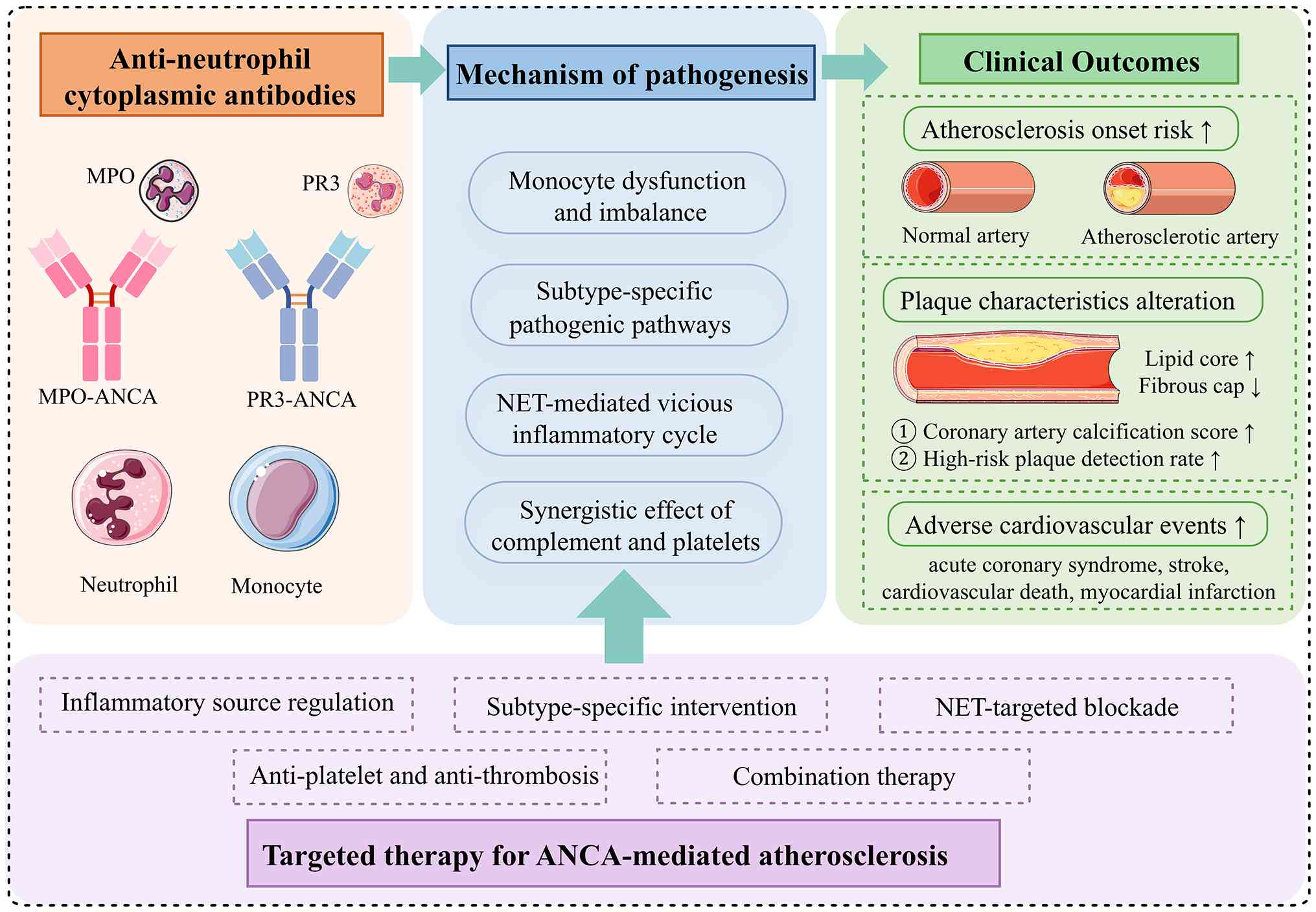 | Figure 1Inflammatory mechanisms, clinical
consequences, and therapeutic strategies in ANCA-mediated
atherosclerosis. This image illustrates ANCA-driven pathogenic
mechanisms, clinical outcomes, and targeted interventions in
atherosclerosis. ANCA (MPO-ANCA and PR3-ANCA) trigger monocyte
dysfunction, NET-mediated inflammatory cycles, and
complement-platelet synergistic activation. These pathways promote
accelerated atherosclerosis, characterized by an increased lipid
core, a reduced fibrous cap, elevated coronary calcification, and
high-risk plaques, ultimately leading to acute coronary syndrome,
stroke, or cardiovascular death. The lower panel highlights
intervention strategies: Inflammatory source regulation,
antiplatelet/antithrombotic therapies, subtype-specific approaches
(MPO-ANCA vs. PR3-ANCA), and combination regimens, aiming for
precision treatment of ANCA-associated atherosclerotic risk. ANCA,
antineutrophil cytoplasmic antibody; MPO, myeloperoxidase; PR3,
proteinase 3; NET; neutrophil extracellular trap. |
The novelty of this review is threefold. First, it
considers ANCA as a central pathogenic effector and systematically
dissects the inflammatory regulatory network underlying
ANCA-mediated atherosclerosis, with a detailed comparison of the
distinct pathogenic pathways associated with MPO-ANCA and PR3-ANCA.
Second, it integrates clinical evidence on plaque phenotypic
characteristics and dynamic biomarker monitoring, thereby
strengthening the translational clinical value of the review.
Third, it provides a comprehensive overview of mechanism-targeted
therapeutic strategies and proposes a subtype-oriented
investigational framework, offering a research roadmap for
precision intervention in ANCA-positive atherosclerosis.
Core inflammatory regulatory mechanisms of
ANCA-mediated atherosclerosis
This section first systematically summarizes the
main effector cells, key regulatory pathways, and
proatherosclerotic effects of ANCA-mediated atherosclerosis
(Table I) to provide an overall
framework for the subsequent detailed elaboration of molecular
mechanisms.
 | Table IANCA-mediated atherosclerosis:
Integrated framework of effector cells, molecular mechanisms, and
subtype-specific pathogenic pathways. |
Table I
ANCA-mediated atherosclerosis:
Integrated framework of effector cells, molecular mechanisms, and
subtype-specific pathogenic pathways.
| Effector cell | Key regulatory
pathway | Pro-atherosclerotic
effects | MPO-ANCA
specificity | PR3-ANCA
specificity | (Refs.) |
|---|
| Monocytes | i) NR4A1 signaling
inhibition-mediated subset remodeling; ii) CCR2/CCR5 chemokine
receptor axis; iii) pro-inflammatory cytokine secretion (IL-1β,
TNF-α, and IL-6) | i) Induces immune
imbalance with elevated CM (91.0%) and decreased NCM (5.8%); ii)
enhances chemotaxis and recruitment to arterial intima; iii)
promotes macrophage differentiation and foam cell formation; and
iv) amplifies local vascular inflammatory microenvironment | ↑ Lipid
metabolism-related genes; ↑ sustained inflammation in
remission | ↑ CCR2/CCR5
expression; ↑ chemotaxis and transendothelial migration | (14,23-28,33-38) |
| Neutrophils | i) NADPH
oxidase-ROS-PAD4 axis-mediated NETosis; ii) FcγR-mediated cell
over-activation; and iii) MPO/PR3 antigen exposure and release | i) Releases NETs to
form vicious inflammatory cycle and promote autoantibody
production; ii) secretes ROS and lytic enzymes to damage vascular
endothelium; iii) provides autoantigens to sustain autoimmune
response; and iv) induces platelet activation and thrombosis | MPO-containing
NETs; ↑ oxidative stress | PR3-containing
NETs; ↑ autoantigen presentation | (10,56-67) |
| Platelets | i) Thrombin-PAR
pathway; and ii) P-selectin/PSGL-1-mediated PMC formation | i) Forms PMCs to
induce monocyte pro-inflammatory/procoagulant phenotypic switch;
ii) acts as a physical scaffold to promote plateletadhesion and
aggregation; iii) releases pro-inflammatory factors to amplify
vascular inflammation; and iv) activates the alternative complement
pathway to form an inflammatory amplification loop | ↑ Chronic platelet
activation; ↑ VTE risk | ↑ Acute platelet
activation; ↑ ACS events | (52,72,74-76) |
| Vascular
endothelial cells | i) NF-κB
pathway-mediated inflammatory activation; and ii) complement
C5a/C5aR axis activation | i) Impairs
endothelial barrier integrity and induces apoptosis; ii)
upregulates adhesion molecule expression to promote inflammatory
cell recruitment; and iii) triggers initiation of the
atherosclerotic inflammatory cycle | ↑ Chronic
endothelial injury via MPO-mediated oxidative stress | ↑ Acute endohelial
injury via tTNF-α mediated NF-κB activation | (49,69-73) |
Central role of monocyte dysfunction in
ANCA-promoted atherosclerosis
Monocytes are the core effector cells through which
ANCAs regulate atherosclerosis onset and progression.
Bioinformatics analysis has also confirmed that monocytes are the
most abundant activated inflammatory cell population in
ANCA-related inflammatory responses (23), and their dysfunction drives the
development and progression of atherosclerotic plaques by
regulating multiple core links, including vascular inflammation and
lipid deposition. According to the differential expression of the
CD14 pattern recognition receptor and CD16 Fcγ receptor on the cell
surface, human peripheral blood monocytes can be divided into three
subsets: Classical monocytes [(CM),
CD14++CD16−], intermediate monocytes [(IM),
CD14++CD16+], and nonclassical monocytes
[(NCM), CD14+CD16++]. Among them, CM highly
expresses markers related to phagocytosis, inflammation, and cell
movement, IM is mainly involved in cytokine secretion and antigen
presentation, and NCM is characterized by vascular patrolling and
nucleic acid and virus recognition (24-26). ANCAs can induce characteristic
remodeling of monocyte subsets by inhibiting the signaling pathway
mediated by the transcription factor nuclear receptor subfamily 4
group A member 1 (NR4A1), hindering the conversion of CM to NCM,
and ultimately resulting in an immune imbalance state with an
increased proportion of CM, but a decreased proportion of NCM
(27). In patients with active
AAV, the median proportion of CM in the peripheral blood was shown
to be significantly elevated to 91.0% (vs. 82.7% in healthy
controls, P=0.0013), whereas NCM were markedly decreased to 5.8%
(vs. 14.1% in healthy controls, P=0.0005), with IM at 3.5% (vs.
6.9% in healthy controls, P=0.061) (28), providing direct clinical evidence
for ANCA-mediated monocyte subset disturbance.
The nuclear receptor subfamily 4 group A (NR4A)
family is widely expressed in vascular smooth muscle cells and
macrophages in atherosclerotic plaques, where it negatively
regulates macrophage-mediated inflammatory response (29,30). Animal studies have shown that
whole-body deletion of NR4A3 can significantly reduce the
atherosclerotic plaque burden in apolipoprotein E-deficient mice
(31), whereas NR4A1 deficiency
can significantly increase the expression of inflammatory cytokines
and hypoxia-inducible factor 1α in atherosclerotic lesions of
Ldlr−/− mice (32). These findings suggest that ANCAs
block the conversion of monocyte subsets by inhibiting the NR4A1
pathway, one of the core mechanisms by which it drives vascular
inflammation and atherosclerosis progression. Targeted restoration
of NR4A1 activity has also become a potential direction for the
management of ANCA-positive atherosclerosis. In addition to
inducing monocyte subtype imbalance, ANCAs can directly activate
the inflammatory activation program of monocytes, promote the
secretion of various proinflammatory cytokines such as interleukin
(IL)-1β, tumor necrosis factor (TNF)-α, and IL-6, and amplify the
local vascular inflammatory microenvironment (33-36). Under the action of ANCAs,
neutrophils can recruit monocytes into the vascular wall tissue
through chemotaxis, further inducing the release of proinflammatory
mediators, reactive oxygen species (ROS), and lytic enzymes and
aggravating the inflammatory cascade and vascular endothelial
injury (37). Even in the
remission phase, the sustained activation of monocytes mediated by
ANCAs can maintain a subclinical chronic inflammatory state, which
becomes an important trigger for atherosclerosis onset and
progression (14,38).
Abnormal monocyte recruitment into the arterial
intima is the key event in the initiation and maintenance of the
inflammatory cycle underlying atherosclerosis. ANCAs can enhance
the chemotaxis and transendothelial migration ability of monocytes
by upregulating the expression of chemokine receptors, such as C-C
chemokine receptor type 2 (CCR2) and C-C chemokine receptor type 5
(CCR5), on the surface of monocytes, promoting their infiltration
into the arterial intima and then participating in plaque
development and progression (39). A systematic review and
meta-analysis revealed that gene knockout or pharmacological
blockade of the CCR2/CCR5 signaling pathway can significantly
reduce macrophage infiltration in plaques and lower plaque burden,
among which CCR2 plays a more critical and stable role in
regulating monocyte recruitment (40). Phenotypic analysis of monocytes
from patients with AAV showed that monocytes from patients with
PR3-ANCA-positive disease expressed higher levels of CCR2 and CCR5,
resulting in significantly enhanced chemotactic and migratory
abilities. By contrast, monocytes from patients with
MPO-ANCA-positive disease were enriched with genes associated with
inflammation, coagulation, and interferon signaling. The two
chemokine receptors could jointly drive vascular inflammation and
accelerated progression of atherosclerosis through different
pathways (28), suggesting that
CCR2/CCR5 is an important molecular link between ANCA-mediated
autoimmune inflammation and cardiovascular complications of
atherosclerosis. ANCAs can also directly participate in the
pathogenesis of atherosclerosis by regulating the lipid metabolism
of monocytes. ANCAs can significantly enhance the lipid uptake
capacity of monocytes, accelerate foam cell formation after the
differentiation of monocytes into macrophages, and promote the
expansion of the plaque lipid core, an effect independent of
traditional cardiovascular risk factors (41,42). Monocyte phenotypic analysis
revealed significant upregulation of the expression of lipid
metabolism-related genes in monocytes of patients with active AAV,
among which lipid metabolism disorder was more prevalent in
patients positive for MPO-ANCAs, a finding consistent with their
higher risk of cardiovascular events (28). In addition, ANCA-mediated
abnormal recruitment of monocytes can lead to impaired
efferocytosis of macrophages and disorderly clearance of apoptotic
cells, further promoting the release of proinflammatory factors and
migration of LDL-cholesterol into the arterial intima, aggravating
plaque progression (14,42).
Subtype-specific pathogenic pathways of
atherosclerosis mediated by MPO-ANCAs and PR3-ANCAs
MPO-ANCAs and PR3-ANCAs promote atherosclerosis
progression through distinct subtype-specific pathogenic pathways,
resulting in heterogeneous clinical cardiovascular manifestations.
The two ANCA subtypes were systematically compared with respect to
their pathogenic mechanisms, plaque characteristics, and clinical
phenotypes.
MPO-ANCAs participate in atherosclerosis development
and progression mainly through an oxidative stress-driven pathway,
with MPO as its core effector molecule. MPO can catalyze the
production of hypochlorous acid (HOCl), a strong oxidizing
substance, which directly induces the oxidative modification of LDL
to form oxidized LDL (ox-LDL), disrupt the structural integrity and
barrier function of vascular endothelial cells, and creates
conditions for inflammatory cell infiltration (43). HOCl can generate
3-chlorotyrosine, a specific MPO marker, by chlorinating lysine and
tyrosine residues of apolipoprotein B-100, with significantly
elevated expression in atherosclerotic lesions and positively
correlated with ox-LDL levels (44,45). Mass spectrometry and
immunohistochemical studies have confirmed that HOCl-mediated
protein oxidation products are abundantly enriched in the aortic
intima of human atherosclerotic lesions and in LDL recovered from
human atherosclerotic plaques (46,47). HOCl-modified LDL can also
aggregate and transform into a form with high uptake by
macrophages, accelerating foam cell formation (48). In addition to mediating
endothelial injury, ox-LDL can directly weaken the stability of
atherosclerotic plaques and increase the risk of plaque rupture and
acute cardiovascular events (43,46). Furthermore, MPO can catalyze the
production of hypothiocyanous acid, which oxidizes tryptophan
residues of apolipoprotein A-I, leading to high-density lipoprotein
dysfunction and weakening its antiatherosclerotic effect. MPO can
also aggravate vascular endothelial dysfunction by consuming nitric
oxide and inhibiting nitric oxide synthase activity, further
amplifying oxidative stress damage (47).
PR3-ANCAs contribute to atherosclerosis primarily by
amplifying the inflammatory cascade in the vascular wall through
the nuclear factor-κB (NF-κB) signaling pathway. Rather than
directly activating the NF-κB pathway, PR3-ANCAs initiate a
signaling cascade through intercellular communication. Following
the activation of primed neutrophils, soluble mediators such as
TNF-α, are released and activate the NF-κB in the form of p50/p65
heterodimer in glomerular endothelial cells in the absence of
direct cell contact. This activation upregulates the expression of
proinflammatory factors, such as IL-8, and enhances the adhesion of
neutrophils, monocytes, and endothelial cells to promote the
infiltration of inflammatory cells into the vascular wall (49). Mechanistically, TNF-α released
from ANCA-activated neutrophils binds to TNF receptor 1 on
endothelial cells, recruiting the adaptor proteins TNFRSF1A
associated via death domain (TRADD) and TNF receptor-associated
factor 2 (TRAF2) and activating the kinase transforming growth
factor-β-activated kinase 1 (TAK1), which subsequently
phosphorylates the IκB kinase (IKK)β subunit of the IKK complex;
this leads to inhibitor of κBα (IκBα) phosphorylation and
proteasomal degradation, allowing nuclear translocation of the
p50/p65 NF-κB heterodimer and transcription of proinflammatory
target genes such as IL-8 (49). Conversely, abnormal activation of
the NF-κB pathway can synergistically promote B-cell proliferation,
plasma cell differentiation, and PR3 autoantibody production, and
the generated autoantibodies can further activate the NF-κB pathway
in neutrophils and endothelial cells, forming a vicious cycle of
inflammation amplification (50). In addition, NF-κB activation in
monocytes can regulate the expression of B-cell activating factor
and a proliferation-inducing ligand, maintain the activation of
autoreactive B cells and continuous production of ANCAs, and
indirectly enhance monocyte-endothelial cell adhesion and vascular
inflammatory infiltration (51).
Targeting key molecules of the NF-κB pathway can block signal
transduction at multiple targets, providing a potential
intervention direction for populations at high risk of
atherosclerosis with positive PR3-ANCAs.
MPO-ANCAs and PR3-ANCAs lead to significant subtype
heterogeneity in atherosclerosis-related cardiovascular risk
through differentiated pathogenic pathways. MPO-ANCAs are
associated with persistent inflammation and platelet activation.
They can activate neutrophils to release inflammatory mediators and
promote platelet activation and formation of neutrophil-platelet
complexes. These complexes continuously adhere to the vascular
endothelium, aggravating chronic endothelial injury and promoting
the progression of chronic stable atherosclerosis and directly
increasing the risk of thrombosis (52). A clinical cohort study confirmed
that the incidence of major adverse cardiovascular events in
patients with MPO-ANCA-positive disease was significantly higher
than those with PR3-ANCA-positive disease, and MPO-ANCAs remained a
potential risk factor for adverse cardiovascular outcomes after
adjustment for traditional cardiovascular risk factors (53).
By contrast, PR3-ANCAs are mainly associated with
acute inflammatory episodes and enhanced monocyte chemotaxis. They
can upregulate the expression of chemokine receptors, Toll-like
receptor (TLR)2/4, and integrins on the surface of monocytes and
enhance their chemotactic and transendothelial migration ability
and recruitment to the vascular wall to trigger acute inflammatory
outbreaks. PR3-ANCA-mediated acute inflammatory endothelial injury
and plaque instability were revealed to be important aspects of
acute cardiovascular events, such as acute coronary syndrome
(54). In vitro
experiments have shown that PR3-ANCAs can significantly promote the
release of proinflammatory factors such as IL-6, IL-8, monocyte
chemoattractant protein-1 (MCP-1), and TNF-α from peripheral blood
mononuclear cells, whereas MPO-ANCAs can exert an inhibitory effect
on the TLR4 signaling pathway and cytokine secretion of monocytes,
with significant differences in their cellular regulatory effects
(14,36). The above subtype-specific
pathological characteristics and clinical risk differences provide
a basis for risk stratification, precise screening, and
individualized intervention of populations at high risk of
atherosclerosis.
Although the aforementioned findings focused on
MPO-ANCAs and PR3-ANCAs as distinct serotypes, a subset of patients
exhibit dual positivity for both antibodies (DP-ANCAs). A
comprehensive analysis of 103 DP-ANCA cases identified four
distinct phenotypic profiles (55): i) Idiopathic AAV (~30%); ii)
drug-induced AAV (~25%), mainly related to propylthiouracil or
cocaine/levamisole; iii) autoimmune diseases with low vasculitis
risk (~20%); and iv) immune-disrupting comorbidities such as
infections or malignancies without AAV (~25%). In idiopathic
DP-ANCAs, MPO-AAV appears to represent the 'dominant' phenotype.
Compared with the single-positive group, the DP-ANCA group exhibits
considerably more kidney dysfunction than the PR3-ANCA group and
greater upper airway involvement than the MPO-ANCA group. The
poorest remission rate among patients with AAV was observed in the
DP-ANCA group (55).
Mechanistically, the simultaneous presence of both autoantibody
specificities may reflect broader immune dysregulation with
overlapping activation of oxidative stress pathways (MPO-mediated)
and NF-κB-driven inflammatory cascades (PR3-mediated), potentially
amplifying endothelial injury. However, to the best of our
knowledge, no studies have examined cardiovascular risk and plaque
characteristics specifically in patients with DP-ANCA-positive
disease.
Role of the NET-mediated vicious
inflammatory cycle in atherosclerosis progression
Abnormal NET formation is a key pathological link in
the ANCA-mediated progression of atherosclerosis, and ANCAs can
drive NETosis in neutrophils by activating the NADPH oxidase
(NOX)-ROS-peptidylarginine deiminase 4 (PAD4) axis. After priming
with TNF-α, IL-8, or complement C5a, ANCA target antigens,
particularly PR3, are translocated from intracellular granules to
the neutrophil surface. Mechanistically, C5a binding to its
high-affinity G protein-coupled receptor C5aR (CD88) on neutrophils
activates p38 mitogen-activated protein kinase (p38MAPK),
extracellular signal-regulated kinase (ERK), and phosphoinositide
3-kinase (PI3K) signaling pathways. Pharmacological inhibition of
these kinases was shown to significantly reduce C5a-induced surface
expression of PR3, as demonstrated by flow cytometry (56), indicating that these pathways are
critically involved in PR3 membrane exposure. Notably, the same
study showed that C5a does not significantly increase
membrane-bound MPO, suggesting that PR3 and MPO follow distinct
mobilization routes (56). Thus,
the kinase-inhibitor experiments specifically support the role of
p38MAPK, ERK and PI3K in PR3 surface translocation, rather than a
generalized mechanism governing the release of all azurophilic
granule contents. Complement C5a can synergistically enhance the
activation efficiency of neutrophils with ANCA downstream signals,
and in the active phase of the disease, high-affinity MPO-ANCAs can
further improve the activation sensitivity of neutrophils (10,56). ANCAs initiate dual-signal
activation by binding to target antigens on the membrane surface
via the fragment antigen-binding (Fab) segment and cross-linking
fragment crystallizable γ receptor (FcγR)IIa/FcγRIIIb via the Fc
segment, activating the spleen tyrosine kinase (Syk)-PI3K-protein
kinase B (Akt) and Raf kinase (Raf)-mitogen-activated protein
kinase kinase (MEK)-ERK pathways and promoting the assembly of NOX2
subunits into an active complex, laying a molecular foundation for
the initiation of NETosis (57).
Activated NOX catalyzes ROS production, which forms HOCl through a
cascade reaction to amplify the oxidative stress effect. As the
core messenger driving NETosis, ROS directly damage the nuclear
membrane and plasma membrane of neutrophils and activates PAD4 and
promotes its nuclear translocation, catalyzing the citrullination
of histones H3 and H4 to trigger chromatin decondensation (58). In addition, neutrophil elastase
released from azurophilic granules enters the nucleus to degrade
the nuclear structure and synergizes with PAD4 to hasten nuclear
envelope rupture, ultimately prompting neutrophils to undergo
NETosis and release NETs containing proinflammatory components such
as MPO, PR3, and neutrophil elastase (57,58).
NETs participate in the pathogenesis of
atherosclerosis by promoting endothelial dysfunction, platelet
aggregation, and inflammatory response (59). Ox-LDL can activate NOX2 in
neutrophils through a signaling pathway similar to that of ANCAs to
drive abnormal NETosis, whereas ROS released by NETs can further
oxidize LDL to generate ox-LDL, which reversely induces more
NETosis. Moreover, NETs can cross-link with plaque components to
promote foam cell aggregation, accelerating the formation and
destabilization of atherosclerotic plaques (58).
NETs participate in ANCA-mediated atherosclerosis
progression through multiple pathological mechanisms, forming a
cascade-amplified vicious inflammatory cycle. Specifically, the
surface of NETs is enriched with ANCA target antigens such as PR3
and MPO, which can be uptaken and presented by dendritic cells as
an 'autoantigen library', thereby activating T/B cell-mediated
autoimmune responses and inducing continuous ANCA production. The
generated ANCAs can further activate neutrophils to release more
NETs, forming a positive feedback loop of 'ANCA-NETs-ANCA'
(58). Animal experiments have
confirmed that the injection of NET-loaded dendritic cells into
mice can directly induce ANCA production and related vascular
pathological changes, whereas deoxyribonuclease I (DNase I)-induced
degradation of NETs can block this process. Conversely, histones
released by NETs can directly destroy the integrity of the vascular
endothelial cell membrane and induce apoptosis and necrosis of
endothelial cells. Proteases such as neutrophil elastase and PR3
can degrade the endothelial basement membrane and extracellular
matrix, and MPO can further aggravate endothelial injury and
dysfunction by triggering oxidative stress and activating the
alternative complement pathway, with endothelial injury as the
initiating link of atherosclerosis (60,61). In addition, the DNA skeleton of
NETs can serve as a physical scaffold to promote the adhesion and
aggregation of platelets and red blood cells, and histone contents
can directly activate the coagulation cascade to promote
thrombosis. Furthermore, activated platelets can further stimulate
neutrophils to release NETs through molecules such as P-selectin
and high mobility group box 1, forming an amplification loop of
thrombosis and inflammation and increasing the risk of acute
cardiovascular events after atherosclerotic plaque rupture
(60,62,63).
Impaired NET clearance is an important amplification
mechanism for ANCA-mediated vascular inflammation and
atherosclerosis progression. In patients with AAV, clinical studies
have confirmed significant reduction in the serum DNase I activity
in these patients, resulting in continuous NET accumulation that
cannot be effectively degraded, thereby aggravating vascular
inflammation and pathogenesis of atherosclerosis through multiple
pathways (64).
Specifically, continuous accumulation of NETs can
sustain activation of the autoimmune response through PR3 and MPO
enriched on their surfaces and promote ANCA production. In
drug-induced AAV, propylthiouracil can induce the formation of
DNase I-resistant NETs and modify the structure of MPO. These NETs
can directly promote MPO-ANCA production in vivo, further
confirming the driving effect of NET accumulation on ANCA
autoimmune response (65).
Moreover, accumulated NETs can continuously damage the vascular
endothelium by releasing histones, proteases, and MPO, and can act
as a scaffold for activating the alternative complement pathway,
further amplifying endothelial injury and inflammatory cell
infiltration (65,66). In addition, persistent NETs can
continuously promote platelet adhesion and aggregation through
their DNA scaffold, while their externalized tissue factor can
activate the coagulation cascade, thereby exacerbating local
vascular inflammation and thrombosis and accelerating
atherosclerosis progression and destabilization (67).
Synergistic pathogenic effect of the
complement system and platelets
Abnormal activation of the complement system is a
key bridge for the inflammatory cascade in ANCA-mediated
atherosclerosis. The complex formed by ANCAs and neutrophils
specifically activates the alternative complement pathway and
sequentially forms C3 convertase (C3bBb) and C5 convertase
(C3bBbC3b), with the involvement of factor B, factor D, and
properdin, thereby cleaving C5 to produce the core inflammatory
mediator C5a (68-70). Activated neutrophils can also
release key complement components, such as properdin and factor B,
further strengthening the complement activation signal and forming
an inflammation amplification loop (71,72). C5a exerts multiple
proinflammatory effects by binding to C5aR on the surface of
neutrophils and monocytes. It cannot only chemotactically recruit
inflammatory cells to the site of vascular injury but also
upregulate the expression of ANCA target antigens, such as MPO and
PR3, on the surface of neutrophils, promote ROS production,
protease release, and NET formation (10,64). In addition, it induces monocytes
to secrete proinflammatory factors, such as IL-6 and IL-17,
aggravating vascular endothelial injury and local inflammatory
infiltration and directly participating in atherosclerosis
development and progression. Clinical studies have confirmed that
the serum C5a level in patients with AAV is positively correlated
with disease activity, and the C5a-mediated inflammation
amplification effect is an important driving factor for vascular
injury (73). The C5a receptor
antagonist avacopan can effectively block this inflammatory loop,
providing an important direction for the precise intervention in
patients with ANCA-positive atherosclerosis (70,73).
Platelet-monocyte complexes (PMCs) are the core hub
for the cross-regulation of ANCA-mediated inflammatory response and
thrombosis, and their abnormal formation can synergistically
accelerate atherosclerosis progression and significantly increase
thrombotic risk (74,75). ANCAs induce platelet activation
mainly by activating neutrophils to release NETs (section, 'Role
of the NET-mediated vicious inflammatory cycle in atherosclerosis
progression' for detailed mechanisms of NET formation and their
effects on endothelial injury and coagulation activation), which in
turn triggers platelet activation through the
thrombin-protease-activated receptor signaling pathway and
upregulates the expression of activation markers such as P-selectin
on its surface (71,72). Clinical tests have shown that the
levels of CD62P-positive platelets and PMCs in the peripheral blood
of patients with active AAV are significantly higher than those in
patients with disease remission and healthy individuals, and are
positively correlated with disease activity (71,76). Activated platelets form stable
PMCs through the specific binding of surface P-selectin to
P-selectin glycoprotein ligand-1 on the surface of monocytes
(75). This process not only
upregulates the expression of adhesion molecules, such as
CD11b/CD18, thereby enhancing the adhesion and transendothelial
migration ability of monocytes, but also induces monocytes to
differentiate into proinflammatory and procoagulant phenotypes
through platelet-derived granular contents, such as CXCL4 and
TNF-α. These activated monocytes secrete numerous proinflammatory
factors and activate the alternative complement pathway, amplifying
local inflammatory response and inducing a vicious inflammatory
cycle (75). PMCs can drive
atherosclerosis progression from multiple links. After migrating to
the vascular intima, phenotypically transformed monocytes readily
differentiate into pro-atherogenic macrophages, with significantly
enhanced lipid uptake capacity and accelerated foam cell formation.
In addition, they secrete matrix metalloproteinases to degrade the
extracellular matrix, resulting in fibrous cap thinning and
decreased plaque stability (72). The tissue factor highly expressed
on the surface of PMCs can directly activate the coagulation
cascade, and PMCs can act as a physical scaffold to promote
platelet adhesion and aggregation, which doubly aggravates the
local coagulation activation state of blood vessels (72). Clinical cohort studies have
confirmed that the risk of arterial and venous thrombosis in
patients with AAV is 2 to 3 times higher than that in healthy
people, and the PMC level in the peripheral blood is positively
correlated with thrombosis (74). This finding suggests that
targeted blocking of PMC formation or phenotypic transformation of
monocytes mediated by them is a potential novel direction to reduce
the risk of atherosclerotic cardiovascular complications in
patients with ANCA-positive disease (Fig. 2).
Clinical correlation evidence between ANCAs
and atherosclerosis
Epidemiological and cohort studies have confirmed
the close correlation between ANCA positivity and the onset,
progression, and adverse prognosis of atherosclerosis. To
facilitate rigorous interpretation of the clinical evidence, the
included studies have been graded according to an adapted clinical
epidemiology evidence hierarchy: Levels I, systematic
reviews/meta-analyses of prospective cohorts; II, large prospective
cohort studies; III, retrospective cohort or case-control studies;
IV, cross-sectional studies or small case series; and V, case
reports/expert opinions. Cross-sectional studies (Level IV) can
identify associations but cannot establish temporal relationships
or causality, whereas retrospective studies (Level III) are at risk
of selection bias, confounding, and incomplete data. The evidence
for the association between ANCA positivity and cardiovascular
outcomes is derived predominantly from Level II-IV studies, with no
randomized controlled trials available to date. The key clinical
evidence supporting this correlation is systematically graded in
Table II.
| Table IIClinical evidence of the association
between ANCA positivity and atherosclerosis onset and
prognosis. |
Table II
Clinical evidence of the association
between ANCA positivity and atherosclerosis onset and
prognosis.
| Study type | Study
population | Core findings | Evidence level | (Refs.) |
|---|
| Nationwide nested
case-control | Danish nationwide
population with incident AAV | MACE risk
significantly increased 12 months before AAV diagnosis, peaking at
1 month before diagnosis; ANCA positivity remained an independent
risk factor for cardiovascular events after adjusting for
traditional risk factors | III | (79) |
| Case-control | Swedish
pre-symptomatic AAV population | PR3-ANCA and
MPO-ANCA detectable years before AAV symptom onset; median lead
time 2.0 years (MPO-ANCA) and up to 2.7 years (PR3-ANCA)
MPO-ANCA+ pre-AAV individuals had elevated
pro-inflammatory factors (CSF-1, TNFSF14, MCP-1) promoting monocyte
recruitment and atherosclerosis progression | III | (78) |
| Cross-sectional
proteomic analysis | Pre-symptomatic
individuals with AAV | IV | (77) |
|
Cross-sectional | Takayasu arteritis
patients (non-AAV) | 6.6%
MPO-ANCA+; significantly increased risk of advanced
coronary artery occlusive disease | IV | (80) |
|
Cross-sectional | AAV patients with
coronary artery calcification assessment | 73% MPO-ANCA+; 39%
had CAC score ≥100; median CAC score significantly higher in
MPO-ANCA+ vs. PR3-ANCA+ patients | IV | (81) |
| Retrospective
cohort | Patients with
AAV | MACE incidence
significantly higher in MPO-ANCA-positive vs. PR3-ANCA-positive
group; PR3-ANCA-positive events dominated by acute MI, synchronized
with peak of acute inflammation | III | (53) |
Epidemiological association between ANCA
positivity and the risk of atherosclerosis
The persistent inflammatory effect of ANCAs can
progressively impair vascular endothelial function and accelerate
atherosclerotic plaque formation and destabilization. A proteomic
analysis of presymptomatic individuals with AAV, which isolated
MPO-ANCAs and PR3-ANCAs, revealed that individuals with
MPO-ANCA-positive disease among the pre-AAV population had
significantly elevated levels of proinflammatory factors, such as
colony-stimulating factor 1, TNF superfamily member 14, and MCP-1
(77). These factors can further
enhance monocyte recruitment and activation, thereby exacerbating
vascular inflammation and the progression of atherosclerosis.
ANCA positivity can provide early risk warning for
cardiovascular events before the onset of clinical symptoms of
related diseases. A Swedish case-control study revealed that
PR3-ANCAs and MPO-ANCAs can be detected years before the onset of
AAV symptoms, with a median lead time of 2.0 (0.9-3.5) years for
MPO-ANCAs and up to 2.7 (0.3-7.7) years for PR3-ANCAs, which can be
detected as early as 9.7 years before symptom onset (78). A nationwide nested case-control
study conducted in Denmark further confirmed that ANCA-related
cardiovascular risk has been initiated before the diagnosis of AAV:
The risk of major adverse cardiovascular events (including
myocardial infarction and stroke) was significantly increased 12
months before diagnosis and peaked 1 month before diagnosis
(79). This 'pre-diagnostic
high-risk window' indicates that ANCA-related inflammation is
initiated at the early stage of vascular injury rather than being a
secondary consequence after disease progression, providing key
evidence for ANCAs as predictors of cardiovascular risk in non-AAV
populations.
In addition, a study on patients with Takayasu
arteritis (a non-AAV condition) revealed that 6.6% of the patients
with MPO-ANCA-positive disease had a significantly increased risk
of advanced coronary artery occlusive disease (80). This finding suggests that the
risk predictive value of ANCAs is not limited to the AAV population
but can be extended to a broader range of non-AAV
autoimmune-related groups, indicating that ANCA positivity may be
an independent biomarker of cardiovascular risk rather than a
disease-specific accompanying phenomenon of AAV.
The effect of ANCAs on cardiovascular risk is
independent of traditional risk factors. After adjusting for
confounding factors, including age, sex, chronic kidney disease,
hypertension, and diabetes, the Danish study still found a
significantly high risk of cardiovascular events in the
ANCA-positive population (79).
This finding reconfirms that ANCAs are not a 'surrogate marker' of
traditional risk factors but an independent risk driver with a
sustained risk effect. Even in the absence of overt autoimmune
disease, ANCAs can chronically increase the risk of coronary heart
disease and stroke through persistent activation of inflammatory
pathways and impairment of the vascular endothelium.
Effects of ANCA positivity on
atherosclerotic plaque characteristics and lesion progression
Calcification score, as a key quantitative indicator
for evaluating the severity of atherosclerosis, is significantly
and positively correlated with ANCA positivity. A study on the
burden of coronary artery calcification in patients with AAV showed
that 73% of the patients had MPO-ANCA-positive disease, and 39% of
the cohort had a coronary artery calcification score ≥100,
indicating a significant atherosclerotic plaque burden (81). Furthermore, the median coronary
artery calcification score of the MPO-ANCA-positive group was
significantly higher than that of the PR3-ANCA-positive group, as
was the age-, sex-, and race-standardized percentile of the
coronary artery calcification score (81). During the follow-up of patients
with AAV, the risk of major adverse cardiovascular events showed an
increasing trend in those with a coronary artery calcification
score ≥100 (81).
The detection rate of high-risk plaques (including
low-density plaques and napkin-ring sign) in the ANCA-positive
group, especially those positive for MPO-ANCAs, was shown to be
significantly higher than that in the PR3-ANCA-positive group
(81). A long-term follow-up
study (with a mean follow-up of 7.5 years) revealed that the
incidence of major adverse cardiovascular events (including
myocardial infarction, stroke, and all-cause mortality) in the
MPO-ANCA-positive group was significantly higher than that in the
PR3-ANCA-positive group (53).
Imaging studies based on coronary computed tomography (CT)
angiography have confirmed that high-risk features such as
low-density plaques and napkin-ring sign are significantly
associated with the risk of acute coronary events (82). However, current CT-based plaque
attenuation measurement cannot fully capture the differences in
MPO-mediated plaque instability. For example, some plaques with
elevated MPO activity do not show typical high-risk features on CT,
suggesting the more complex risk characteristics of high-risk
plaques associated with ANCAs (83).
Specific association between ANCA
subtypes and atherosclerotic clinical phenotypes as well as
cardiovascular events
Distinct subtype specificity exists among different
ANCA subtypes in mediating atherosclerosis-related cardiovascular
injury: MPO-ANCAs are more associated with chronic and stable
atherosclerosis, whereas PR3-ANCAs are more likely to be linked to
acute cardiovascular events such as acute coronary syndrome, with
significant differences between in inflammatory patterns, lesion
characteristics, and event types. These characteristics are
consistent with the pathogenic mechanisms of MPO-ANCAs and
PR3-ANCAs (22,81).
A previous clinical study showed that the
MPO-ANCA-positive group had a significantly higher coronary artery
calcification score and heavier calcification burden than the
PR3-ANCA-positive group (81).
The lesions of the MPO-ANCA-positive group were characterized by a
progressive increase in plaque burden, and cardiovascular events
were mainly manifested as stable ischemic symptoms, with an overall
slow progression course that was highly consistent with the onset
and development of chronic atherosclerosis (81). In addition, MPO-ANCA-mediated
chronic inflammation can also promote chronic sclerotic lesions in
sites such as the aortic valve, further supporting its association
with systemic chronic stable atherosclerosis (84).
Large-sample follow-up studies have indicated that
cardiovascular events in the PR3-ANCA-positive group are dominated
by acute myocardial infarction (28), which mostly occurs in the early
stage of disease activity and is highly synchronized with the peak
of acute inflammation (53). It
has been shown that compared with MPO-ANCAs, PR3-ANCAs are more
likely to trigger acute plaque rupture and thrombosis, with
clinical manifestations more consistent with the pathogenic
characteristics of acute coronary syndrome (22). These subtype-specific clinical
differences can provide an important basis for clinical risk
stratification and serve as early warning of cardiovascular
events.
Clinical evidence linking
C5a-platelet-monocyte pathways to atherosclerotic phenotypes and
cardiovascular events
The separate mechanistic components of the
hypothetical C5a-platelet-monocyte-NET axis described in
'Synergistic pathogenic effect of the complement system and
platelets' are each supported by discrete clinical observations
in patients with AAV. Plasma C5a concentrations were found to be
significantly higher in patients with active AAV than in those in
remission, and MPO-positive microparticle-bound C5a levels were
reported to be positively associated with Birmingham Vasculitis
Activity Score (BVAS) (73,85). Elevated C5a levels have been
associated with increased carotid intima-media thickness (cIMT) in
other autoimmune conditions, and patients with AAV are known to
have increased cIMT compared with healthy controls (69,86,87), suggesting that complement
activation may contribute to early vascular remodeling. In
parallel, circulating PMC proportions have been found to be
elevated during active AAV vs. disease remission (75,85). From a clinical-outcome
perspective, patients with AAV demonstrate a substantially elevated
risk of venous thromboembolism, and platelet activation together
with PMC formation have been implicated in this hypercoagulable
state (88-90). Collectively, these independent
mechanistic and clinical findings generate a testable hypothesis
that an integrated C5a-PMC-NET axis may contribute to subclinical
atherosclerosis burden and thrombotic event risk in AAV, although
this complete causal cascade has not yet been formally established
in human studies. Furthermore, given the established role of NETs
in promoting atherosclerosis and plaque destabilization (58), it is biologically plausible that
C5a-driven NETosis contributes to the development of high-risk
plaque features, such as low-attenuation plaques and positive
remodeling, in patients with systemic vasculitis. However, direct
evidence from coronary CT angiography studies examining these
specific plaque phenotypes in AAV cohorts is currently lacking.
Dynamic monitoring value of ANCAs
combined with NET-related biomarkers
Beyond static serological status, serial monitoring
of ANCA titer dynamics, combined with NET-related biomarkers,
provides incremental value for atherosclerotic risk stratification
and disease follow-up (91,92). Persistent elevation or
progressive increase in ANCA titer reflects sustained neutrophil
activation and chronic vascular inflammation, which has been
associated with progression of subclinical atherosclerosis as
measured by cIMT in patients with systemic inflammatory conditions
(86,93). In AAV, rising or persistently
positive ANCA titers precede disease flares and are linked to
ongoing endothelial injury, a key initiating driver of early
atherogenesis (73,78).
When combined with circulating citrullinated histone
H3 (CitH3), a core marker of NET formation, and serum DNase I
activity, the composite biomarker panel can better reflect NET
clearance imbalance and inflammatory amplification in vivo
(94,95). Elevated circulating CitH3 has
been linked to increased necrotic core size and thinner fibrous
caps in human atherosclerotic plaques, as well as a higher risk of
acute coronary syndromes, supporting its role as a surrogate marker
of plaque instability (96-98). Reduced serum DNase I activity,
which impairs NET degradation and promotes sustained NET
accumulation, has been documented in active AAV and associated with
disease activity and vascular damage (99,100).
Based on these findings, it is proposed that
elevated CitH3 and decreased DNase I activity, together with rising
ANCA titers, may indicate enhanced intraplaque NET deposition and
increased plaque instability, and could serve as an early warning
signature for high-risk plaques and acute cardiovascular events
(41,101). Such a combined detection
strategy may help to dynamically evaluate residual inflammatory
risk of atherosclerosis and guide the timing and intensity of
anti-inflammatory intervention. It is acknowledged that this
integrated monitoring framework remains hypothesis-generating at
present; dedicated prospective cohort studies are required to
confirm whether the ANCA-CitH3-DNase I composite panel adds
incremental prognostic value beyond traditional risk factors for
atherosclerotic cardiovascular events.
Therapeutic strategies for atherosclerosis
targeting ANCA-related pathways
Based on the aforementioned pathogenic mechanisms,
multiple targeted therapeutic strategies for ANCA-mediated
atherosclerosis have been explored in preclinical and clinical
studies. The detailed information on these strategies, including
core targets, representative agents, mechanisms of action, and
research stage, is comprehensively listed in Table III and Fig. 3.
| Table IIITherapeutic strategies targeting
ANCA-related pathways for atherosclerosis: Key agents and clinical
development status. |
Table III
Therapeutic strategies targeting
ANCA-related pathways for atherosclerosis: Key agents and clinical
development status.
| Therapeutic
target | Drug category | Representative
agents | Mechanism of
action | Overall clinical
development status (with trial identifiers) | Evidence level for
ANCA-atherosclerosis | (Refs.) |
|---|
| ANCA activation
upstream signaling | Syk inhibitor | Fostamatinib | Blocks
Syk-dependent Fc receptor signal transduction; inhibits
ANCA-mediated inflammatory cell activation | Preclinical in AAV
animal models; Phase II completed in IgA nephropathy (NCT02112838);
no clinical trials in AAV | Mechanistic
(patient-derived cells) + preclinical (AAV animal models); not
evaluated in ANCA-atherosclerosis | (102-104) |
| ANCA activation
upstream signaling | Multi-target
agent | Sodium tanshinone
IIA sulfonate | Modulates SYK-NLRP3
inflammasome-MMP2/9 pathway as one of multiple downstream targets;
exerts anti-inflammatory, antioxidative, and vasodilatory effects;
direct SYK binding or inhibition has not been demonstrated | Preclinical (animal
models of atherosclerosis) | Preclinical
(general atherosclerosis models); not evaluated in
ANCA-atherosclerosis | (105) |
| Complement-ANCA
synergistic activation loop | C5a receptor
antagonist | Avacopan | Selectively blocks
C5aR-mediated neutrophil chemotaxis and activation; inhibits
inflammatory amplification loop; reduces glucocorticoid
exposure | Approved for AAV by
FDA and EMA (ADVOCATE Phase III trial, NCT02994927); no dedicated
CVD trials in ANCA-atherosclerosis | Approved for AAV;
mechanistic rationale for atherosclerosis; hypothetical for
ANCA-atherosclerosis without dedicated CVD trials | (106-109) |
| Inflammatory cell
recruitment | CCR2/CCR5
antagonist | CCR2 mAb, CCR5
inhibitors | Blocks monocyte
chemotactic recruitment to arterial intima; reduces macrophage
infiltration and plaque burden | Preclinical only
(animal models of atherosclerosis) | Preclinical
(general atherosclerosis animal models); not evaluated in
ANCA-atherosclerosis | (40, 114) |
| Inflammatory
cascade amplification | Inflammasome
inhibitor | Low-dose
colchicine | Inhibits
inflammasome activation; reduces circulating CCL2 levels; lowers
recurrent cardiovascular event risk | Approved by FDA for
secondary prevention of cardiovascular events in established
atherosclerotic cardiovascular disease (COLCOT: NCT02551692,
post-myocardial infarction; LoDoCo2: NCT02916446, chronic coronary
disease) | Approved for
general ASCVD secondary prevention; not specifically evaluated in
ANCA-atherosclerosis | (111-113) |
| MPO-ANCA mediated
oxidative stress | MPO inhibitor | AZM198, SNT-8370,
ABAH | Inhibits MPO
catalytic activity; reduces HOCl production and ox-LDL formation;
prevents unstable plaque formation; stabilizes atherosclerotic
lesions | Preclinical only
(animal models of atherosclerosis) | Preclinical
(general atherosclerosis animal models); not evaluated in
ANCA-atherosclerosis | (118-120) |
| PR3-ANCA mediated
inflammatory activation | Cathepsin C
inhibitor | GSK2793660 | Downregulates PR3
antigen expression and membrane exposure on neutrophils; suppresses
PR3-ANCA-mediated neutrophil activation | Phase I in healthy
volunteers (NCT02058407); no clinical trials in AAV or
atherosclerosis | Preclinical (in
vitro and ex vivo AAV models); hypothetical for
ANCA-atherosclerosis | (121-125) |
| PR3-ANCA mediated
inflammatory activation | Anti-PR3 monoclonal
antibody | 4C3 mAb | Competitively
blocks pathogenic PR3-ANCA binding to neutrophils; inhibits
neutrophil autoimmune activation | Preclinical only
(in vitro) | Preclinical (in
vitro); hypothetical for ANCA-atherosclerosis | (122-125, 127, 128) |
Targeted regulation of the source of
ANCA-mediated inflammatory response
Precision targeted intervention is an important
direction for the clinical treatment and risk management of
patients with atherosclerosis, aiming at the core pathological
links of ANCA-mediated disease, including inflammatory cascade,
endothelial injury, and thrombosis. The regulation of inflammatory
sources is the core strategy to block the proatherosclerotic effect
of ANCAs, which mainly includes two categories: ANCA activation
pathway inhibitors and inflammatory cell function regulators. Syk
is a key signaling molecule in neutrophil activation mediated by
ANCA-IgG, and its direct and selective inhibitor fostamatinib can
inhibit ANCA-mediated inflammatory cell activation by interfering
with Syk-dependent Fc receptor signal transduction (102-104). These effects are supported by
mechanistic studies using patient-derived cells and preclinical
animal models of AAV (102-104); no clinical trials of
fostamatinib in AAV or ANCA-associated atherosclerosis have been
completed to date.
By contrast, sodium tanshinone IIA sulfonate has
been shown to suppress SYK phosphorylation and modulate the SYK-NLR
family pyrin domain-containing 3 (NLRP3) inflammasome-matrix
metalloproteinase (MMP)2/9 pathway, thereby exerting
anti-inflammatory, antioxidative, and vasodilatory effects and
protecting vascular diastolic function from hyperlipidemia-induced
injury (105). However, direct
binding of sodium tanshinone IIA sulfonate to SYK or direct
inhibition of SYK enzymatic activity was not demonstrated in this
aforementioned study, and the observed suppression of SYK
phosphorylation may occur through indirect mechanisms. Avacopan, an
oral small-molecule complement C5a receptor antagonist, has been
shown to selectively block C5a receptor-mediated chemotaxis and
neutrophil activation and inhibit the inflammatory amplification
loop of complement-ANCA synergistic activation (106). The Phase III ADVOCATE trial
demonstrated that avacopan effectively modulates ANCA-related
inflammation while reducing glucocorticoid exposure in patients
with AAV (107,108). Given the key role of C5a in
ANCA-mediated vascular inflammation and atherosclerosis, avacopan
has emerged as a potential therapeutic strategy for ANCA-positive
atherosclerosis. However, no clinical trials have evaluated its
effects on atherosclerotic cardiovascular outcomes. Therefore,
evidence supporting its potential antiatherosclerotic effect
remains indirect and is primarily extrapolated from its efficacy in
AAV and mechanistic studies (107-109).
For the regulation of inflammatory cell recruitment
and activation, low-dose colchicine, the first anti-inflammatory
drug approved by the US Food and Drug Administration for the
secondary prevention of cardiovascular events in patients with
established atherosclerotic disease, can reduce the level of C-C
motif chemokine ligand 2 in coronary circulation by inhibiting
inflammasome activation. Two large-scale clinical trials, COLCOT
and LoDoCo2, demonstrated that colchicine significantly reduces the
risk of recurrent cardiovascular events in patients with coronary
artery disease (110-113). However, these trials were
conducted in general atherosclerotic populations, and the efficacy
of colchicine in patients with ANCA-positive atherosclerosis has
not been prospectively evaluated. CCR2/CCR5 antagonists can block
the chemotactic recruitment of monocytes into the arterial intima;
a preclinical meta-analysis of animal models has demonstrated that
these agents exert arterial protective effects in atherosclerosis,
and combination with traditional lipid-lowering drugs may help
manage residual inflammatory risk (40,114). In addition, novel strategies
such as macrophage-targeted nanotherapy and 4-phenylbutyric
acid-reprogrammed monocytes can target and regulate the
inflammatory microenvironment in plaques and reduce plaque burden,
providing novel research directions for treatment (115,116).
Precision targeted intervention based on
ANCA subtype differences
From a translational research perspective, the
distinct pathogenic mechanisms of MPO-ANCAs and PR3-ANCAs in
atherosclerosis provide a mechanistic rationale for
subtype-oriented investigational strategies, framed here as a
hypothetical framework for future research. For the
MPO-ANCA-mediated oxidative stress and lipid modification pathway,
MPO inhibitors suppress HOCl production and ox-LDL formation by
inhibiting the catalytic activity of MPO, thereby mitigating
endothelial injury and plaque instability (117). Multiple candidate agents,
including ABAH, INV-315, and AZM198, have shown promising activity
in preclinical studies. In animal models, the selective MPO
inhibitor AZM198 effectively prevented unstable plaque formation
and promoted stability of vulnerable atherosclerotic lesions
without impairing circulating immune cell function or causing
detectable adverse reactions (118-120). The dual inhibitor SNT-8370,
targeting both vascular adhesion protein-1 and MPO, has
demonstrated greater anti-inflammatory and vascular protective
effects than monotherapy in models of acute inflammation and
myocardial ischemia-reperfusion injury (121), supporting its preclinical
potential for MPO-ANCA-associated atherosclerosis. For the
PR3-ANCA-mediated inflammatory cascade, cathepsin C (CatC)
inhibitors have been shown to downregulate PR3 antigen expression
and membrane exposure on the neutrophil surface (122,123), suppress PR3-ANCA-mediated
neutrophil activation, and attenuate microvascular endothelial
injury (124-126). Furthermore, the non-pathogenic
anti-PR3 monoclonal antibody 4C3 was found to competitively inhibit
the binding of pathogenic PR3-ANCAs to neutrophils and effectively
block PR3-ANCA-mediated neutrophil autoimmune activation (122-125,127,128). Similarly, CCR2/CCR5 antagonists
have shown atheroprotective effects in preclinical meta-analyses of
animal models (40,114), but their efficacy specifically
in ANCA-positive atherosclerosis remains to be established in human
studies.
Collectively, while these subtype-specific
approaches are mechanistically attractive, all remain at
preclinical or early developmental stages. None are currently
approved or established for the treatment of ANCA-associated
atherosclerosis, and their clinical utility awaits rigorous
evaluation in dedicated clinical trials. Notably, current clinical
management of patients with AAV and elevated cardiovascular risk
must follow established, evidence-based AAV treatment guidelines
and standard cardiovascular risk reduction guidelines, irrespective
of ANCA serotype (MPO vs. PR3) (129,130). The subtype-targeted
investigational approaches outlined above are presented solely as a
hypothetical framework for future research and are not intended to
guide routine clinical practice at this time.
Targeted blockade strategies for
NET-mediated pathological circuits
Intervention strategies targeting NETs (whose
pathogenic mechanisms are detailed in 'Role of the NET-mediated
vicious inflammatory cycle in atherosclerosis progression')
mainly fall into two directions: NET clearance and inhibition of
NET formation. In terms of NET clearance, recombinant DNase I can
specifically degrade the nucleic acid backbone of NETs, reducing
autoantigen exposure and persistent vascular wall damage. Animal
experiments have confirmed that exogenous supplementation with
DNase I significantly reduces the NET content within
atherosclerotic plaques, decreases necrotic core area, increases
collagen content, and improves plaque remodeling (131-133), while also accelerating
thrombolysis and reducing the risk of thrombotic events (134). CD47 monoclonal antibody can
block signals on the NET surface, enhance macrophage phagocytic
clearance of NETs, and reduce their persistent accumulation in the
vasculature (135). PERK
inhibitors have been shown to alleviate endoplasmic reticulum
stress-mediated impairment of macrophage DNase secretion, enhance
endogenous NET clearance, and significantly improve plaque
stability and reduce pro-inflammatory cytokine expression in mouse
models of atherosclerosis (136). Regarding inhibition of NET
formation, PAD4 inhibitors were found to suppress the NETosis
process by blocking histone citrullination. Myeloid PAD4-deficient
Apoe−/− mice exhibited significantly reduced
atherosclerotic burden and markedly attenuated aortic inflammation
(137). Among these, Cl-amidine
and other inhibitors have been demonstrated to effectively reduce
NET formation and alleviate vascular inflammation in vasculitis
models (138,139). In addition, NADPH oxidase
inhibitors, ROS scavengers, alpha-1 antitrypsin, etc., can inhibit
aberrant NET formation through different pathways, providing
multi-target intervention options for the treatment of
ANCA-associated atherosclerosis (136,140).
Multi-pathway synergistic intervention
and combination therapy regimens
Given the intersecting pathological mechanisms of
ANCA-mediated inflammation, lipid metabolism abnormalities, and
thrombosis, coordinated multi-pathway intervention represents a key
strategy for the clinical management of ANCA-positive
atherosclerosis patients. In terms of antiplatelet therapy, the
risk of arteriovenous thrombotic events is significantly elevated
in ANCA-positive patients (141,142). Antiplatelet regimens centered
on P2Y12 receptor antagonists can effectively inhibit ANCA-induced
platelet activation and platelet-monocyte complex (PMC) formation,
thereby blocking the synergistic amplification between inflammation
and thrombosis. Among these, clopidogrel and prasugrel are prodrugs
that irreversibly inhibit ADP-induced platelet aggregation after
metabolic activation (143,144). Notably, prasugrel differs from
clopidogrel in its metabolic activation pathway. Esterases
hydrolyze prasugrel as the first step of its activation pathway,
whereas the same enzymes shunt the majority (~85%) of clopidogrel
into an inactive dead-end metabolite. Furthermore, prasugrel
requires only one CYP-dependent oxidative step to generate its
active metabolite, whereas clopidogrel requires two separate
CYP-dependent oxidative steps, primarily involving CYP2C19
(143). This more efficient
activation pathway, which lacks a significant inactive shunt,
results in more rapid, consistent, and higher systemic exposure to
the active metabolite with prasugrel, leading to faster onset and
more predictable platelet inhibition compared with clopidogrel
(143,144). This rapid and stable efficacy
profile is similar to that of ticagrelor, which does not require
metabolic activation and directly and reversibly inhibits the P2Y12
receptor. Ticagrelor, as a reversible P2Y12 receptor antagonist,
exerts rapid antiplatelet effects without requiring metabolic
activation, while also conferring anti-inflammatory and
cardioprotective benefits, making it a preferred option for
patients at high ischemic risk (145,146). Dipyridamole, on the other hand,
elevates intracellular cAMP levels and promotes PGI2
release, thereby exerting antiplatelet and vascular endothelial
protective effects (147,148). Clinically, individualized
antiplatelet regimens can be tailored based on the balance between
ischemic and bleeding risks in each patient.
In terms of combined anti-inflammatory and
lipid-lowering therapy, the combination of statins with agents
targeting inflammatory pathways is a core strategy for managing
residual cardiovascular risk in atherosclerosis. The CANTOS trial
demonstrated that canakinumab, a monoclonal antibody targeting
IL-1β, significantly reduces the risk of major adverse
cardiovascular events in patients with high inflammatory status
without affecting lipid levels, directly validating the clinical
value of targeted anti-inflammatory therapy in atherosclerosis
(149). A 2025 network
meta-analysis showed that adding low-dose colchicine to statin
therapy was superior to intensive lipid-lowering regimens such as
ezetimibe or PCSK9 inhibitors in reducing the risk of major adverse
cardiovascular events, stroke, and coronary revascularization
(150). Mechanistic studies
have confirmed that IL-1β inhibitors can enhance plaque stability
by promoting extracellular matrix deposition and thickening the
fibrous cap, making them particularly suitable for patients with
high inflammatory states such as AAV. However, IL-1β blockade
exhibits stage-dependent effects; monotherapy during the plaque
regression phase may increase plaque vulnerability, and is
accompanied by an elevated risk of infections. Therefore, strict
patient selection and individualized combination regimens are
required in clinical practice (151,152).
Despite the therapeutic promise of ANCA-targeted
strategies, their clinical translation faces substantial safety and
practical challenges. C5a receptor antagonists, exemplified by
avacopan, have demonstrated a favorable overall safety profile in
clinical trials, with fewer infections and adverse events than
glucocorticoid-based regimens (153,154). However, post-marketing
pharmacovigilance has identified hepatobiliary disorders as a
significant concern, with drug-induced liver injury occurring in
~40% of patients in some cohorts and vanishing bile duct syndrome
reported in rare but fatal cases (155-157). Elderly patients, those with low
body weight, and concomitant use of rituximab or proton-pump
inhibitors appear to be at increased risk (155-158). Real-world data also suggest
age- and sex-dependent differences in adverse event patterns, with
hepatobiliary events more frequent among geriatric and female
patients (134). MPO inhibitors
remain largely in preclinical or early-phase clinical development;
while agents such as mitiperstat (AZD4831) are generally well
tolerated in healthy volunteers, their efficacy and long-term
safety in atherosclerotic populations have not been established
(159). NET-targeted therapies,
including PAD4 inhibitors and DNase-based approaches, face
additional biological risks: PAD4 inhibition extends beyond
suppressing NETosis to affect citrullination of non-histone
substrates, with consequences for antigen presentation, cytokine
function, and adaptive immunity (160). Therapeutic targeting of NETs
may increase microbial load in infections, impair peripheral
tolerance in autoimmunity, and reduce adaptive immunity in cancer
(161). Beyond safety concerns,
practical barriers further limit clinical adoption: Most candidates
remain in preclinical stages; the high cost of biologic agents and
small-molecule inhibitors poses significant economic burdens; and
the lack of validated biomarkers to identify patients most likely
to benefit hampers personalized application. These obstacles
underscore the need for continued pharmacovigilance, biomarker
development, and cost-effectiveness evaluations to facilitate the
safe and equitable translation of these novel therapies into
clinical practice.
Research challenges and future
perspectives
Current research on ANCA-related mechanisms and
atherosclerosis faces several key limitations that constrain
mechanistic understanding and clinical translation.
First, there is substantial heterogeneity across
clinical studies, and study design alone does not determine overall
study quality. The evidence hierarchy applied in this review
(adapted from the Oxford Centre for Evidence-Based Medicine 2011
prognostic framework) (162)
classifies studies by design to reflect relative evidentiary
strength for causal inference, but it is not a substitute for
formal risk-of-bias assessment. Individual studies within the same
design grade can vary widely in methodological quality, risk of
selection bias, confounding control, and outcome ascertainment.
ANCA detection methods remain incompletely standardized, and
enrolled populations differ markedly in baseline characteristics,
including underlying autoimmune disease activity, medication
history, and comorbidities, which limits direct comparisons and
complicates the integration of findings. Moreover, causal inference
is hampered by the inherent constraints of observational designs,
including pervasive confounding and competing risks. While chronic
atherosclerotic inflammation alone is insufficient to induce
pathogenic ANCA production (41,163), persistent low-grade systemic
inflammation and neutrophil activation in advanced atherosclerosis
may facilitate NET release and exposure of MPO/PR3 autoantigens,
potentially giving rise to low-titer non-pathogenic ANCA positivity
and thereby biasing cross-sectional association estimates (164,165). This reverse causality
hypothesis remains biologically plausible but has not been directly
validated in population-based studies.
Beyond reverse causality, several additional
factors may confound the relationship between ANCA status and
atherosclerotic lesions. First, disease activity, although not
consistently associated with cardiovascular events in prospective
cohorts as measured by BVAS, may still influence cardiovascular
risk through related mechanisms, such as chronic inflammation and
cumulative steroid exposure (166); notably, AAV itself is
associated with a 65% higher risk of cardiovascular events relative
to the general population (167). Second, treatment exposure
warrants consideration: Long-term glucocorticoid therapy
exacerbates metabolic and hemodynamic profiles (such as
hyperglycemia, hypertension, and adverse lipid patterns) and is
associated with dose-dependent increases in cardiovascular events,
potentially confounding the attribution of lesion progression
solely to vasculitis-driven inflammation (41,89). Indeed, a substantial proportion
of patients with AAV develop hypertension, diabetes mellitus, and
hypercholesterolaemia, whether as consequences of immunosuppressive
therapy or as manifestations of the underlying disease (141). Third, kidney involvement is
independently associated with cardiovascular events (hazard ratio
3.02) (168), and it functions
as both a mediator and a confounder in the association between ANCA
and cardiovascular risk. As a mediator, renal dysfunction is a
direct end-organ consequence of ANCA-mediated small-vessel injury,
lying on the causal pathway between vasculitis activity and adverse
cardiovascular outcomes. As a confounder, renal impairment
independently increases cardiovascular risk through mechanisms
including volume overload, uremic toxin accumulation, anemia, and
mineral bone disorders; it also is associated with more severe
vasculitis and greater cumulative glucocorticoid exposure, which
may distort estimates of the independent cardiovascular effect of
ANCA itself. Fourth, competing risks must be acknowledged:
Premature non-cardiovascular death, particularly from infections,
malignancies, and end-stage renal disease, can substantially
distort cardiovascular event estimates in AAV cohorts (169,170). Major causes of death in AAV
include cardiovascular disease, infections, and neoplasms;
treatment-related immunosuppression further heightens
susceptibility to serious infections, which may lead to
non-cardiovascular death and thus compete with cardiovascular
outcomes (171). Failure to
account for such competing risks may result in overestimation of
event rates in conventional Kaplan-Meier analyses; accordingly,
future studies should employ appropriate methods, such as Fine-Gray
competing-risk regression, to obtain more accurate cumulative
incidence estimates.
Although most cohort studies have adjusted for at
least some of these covariates, residual confounding persists,
limiting precise interpretation of the contribution of ANCAs to
atherosclerotic risk. Consequently, large-scale prospective cohorts
with rigorous confounder adjustment, alongside targeted
interventional trials, are needed to establish a causal
relationship.
Second, mechanistic studies are constrained by
model limitations. Existing in vitro models are challenging
to use to simulate the complex cell-cell interactions and
pathological microenvironment of the vascular wall in vivo,
and no specific animal models can accurately simulate ANCA-mediated
inflammation driving atherosclerosis. Conventional AAV animal
models, particularly the passive anti-MPO antibody transfer model,
induce acute necrotizing glomerulonephritis and pulmonary
capillaritis within days but cannot capture the chronic,
progressive course of human atherosclerosis, which develops over
decades (172,173). These short-term models cannot
capture the slow atherogenic process, and atherosclerosis-relevant
endpoints (plaque burden, fibrous cap thickness, and necrotic core
size) are not assessable in such short-term experiments. Notably,
depending on the source of antibodies used in each experiment,
passively transferred exogenous ANCAs may exhibit potential
model-dependent limitations when compared with endogenous
pathogenic human ANCAs, including possible divergences in affinity
maturation, epitope recognition profiles, and Fc-region
glycosylation features (173).
Of note, direct head-to-head experimental studies simultaneously
validating these three molecular discrepancies between
patient-derived endogenous ANCAs and immunization-derived exogenous
antibodies are currently lacking. Individual existing reports
provide fragmented evidence: Bruner et al (174) characterized human
immunodominant MPO-ANCA epitopes, whereas Yoshida et al
(175) demonstrated that
antibody affinity of human MPO-ANCAs is associated with
NET-associated renal vasculitis activity; however, neither work
constitutes a complete cross-species comparative analysis. The lack
of a reliable PR3-ANCA model, owing to species-specific differences
in PR3 expression and the involvement of the neutrophil-specific
CD177 receptor in PR3 surface presentation, further limits
generalizability (12,176). Existing in vitro
systems, typically using isolated neutrophils or monocytes
co-cultured with endothelial monolayers under static conditions,
cannot reproduce the complex three-dimensional vascular
microenvironment, dynamic cell interactions, or hemodynamic shear
stress that profoundly influences leukocyte adhesion and
transmigration (177,178). These model limitations
collectively limit our ability to examine the chronic effects of
ANCAs on atherogenesis, evaluate long-term drug efficacy, and
translate preclinical findings to clinical applications.
Third, the clinical and mechanistic significance of
DP-ANCAs represents a major knowledge gap. Although recent studies
have characterized the phenotypic and prognostic features of
patients with DP-ANCAs, virtually no data exist regarding their
cardiovascular risk profile, atherosclerotic plaque
characteristics, or response to targeted anti-inflammatory or
antiplatelet therapies. Whether patients with DP-ANCA experience
additive or synergistic cardiovascular risk, combining the chronic
oxidative stress burden of MPO-ANCA with the acute inflammatory
flare propensity of PR3-ANCAs remains unknown. Furthermore, the
temporal stability of dual positivity is poorly understood; some
cases may convert to single positivity or negativity over time,
raising questions about whether DP-ANCA represents a distinct
disease entity, a transitional state, or an assay-related
phenomenon. Future investigations should assess cardiovascular
outcomes in DP-ANCA cohorts and investigate the molecular
mechanisms by which concurrent MPO and PR3 autoimmunity modulates
vascular inflammation.
Future research should focus on four priority
areas. First, molecular mechanistic research should encompass the
epigenetic regulatory network of ANCA-mediated monocyte phenotypic
transformation and clarify the cross-nodes and specific effects of
downstream signaling pathways of MPO-ANCAs and PR3-ANCAs to provide
a theoretical basis for precision targeting. Second, clinical
translational research should include randomized controlled trials
based on subtype stratification in ANCA-positive atherosclerosis
populations, clarify the differential efficacy of targeted
anti-inflammatory and lipid-lowering combination regimens, and
establish evidence-based intervention pathways. Third, risk
prediction biomarkers must be optimized using composite biomarker
panels combining ANCA titers with NET-related markers (such as
CitH3, cell-free DNA, and DNase I activity) to improve the accuracy
of predicting atherosclerosis onset and progression. Fourth,
precision medicine practice should be further advanced by
developing individualized treatment strategies based on ANCA
subtypes, inflammatory phenotypes, and treatment response
characteristics and exploring targeted alternative regimens for
patients with glucocorticoid insensitivity to achieve safer and
more effective individualized management.
Conclusion
In summary, ANCAs can act as a key effector
molecule in the inflammatory regulatory network of atherosclerosis
by mediating excessive monocyte activation, NET formation, and an
abnormal synergistic effect of the complement system and platelets,
with clear subtype-specific pathogenic characteristics between
MPO-ANCAs and PR3-ANCAs. Clinically, ANCAs not only serve as novel
biomarkers for risk screening and stratification of populations at
high risk of atherosclerosis but also mediate key inflammatory
pathways that represent promising therapeutic targets, such as
statins combined with targeted anti-inflammatory therapy targeting
the IL-1β/NLRP3 axis, laying a theoretical foundation for the
precise management of residual inflammatory risk in
atherosclerosis.
Availability of data and materials
Not applicable.
Authors' contributions
QC and LA conceived and designed the review. JC and
QC wrote the manuscript. JD and LS contributed to the revision and
language polishing of the manuscript. XL and WC helped search and
organize the literature. All authors contributed to the article and
approved the submitted version. All authors read and approved the
final manuscript. Data authentication is not applicable.
Ethics approval and consent to
participate
Not applicable.
Patient consent for publication
Not applicable.
Competing interests
The authors declare that they have no competing
interests.
Acknowledgements
Not applicable.
Funding
This work was supported by grants from the Medical Science
Research Project of Hebei (grant nos. 20251034 and 20261420) and
the project funded by the S&T Program of Baoding (grant no.
2341ZF237).
References
|
1
|
Ajoolabady A, Pratico D, Lin L, Mantzoros
CS, Bahijri S, Tuomilehto J and Ren J: Inflammation in
atherosclerosis: Pathophysiology and mechanisms. Cell Death Dis.
15:8172024. View Article : Google Scholar : PubMed/NCBI
|
|
2
|
Roy P, Orecchioni M and Ley K: How the
immune system shapes atherosclerosis: Roles of innate and adaptive
immunity. Nat Rev Immunol. 22:251–265. 2022. View Article : Google Scholar
|
|
3
|
Panasenko OM, Torkhovskaya TI, Gorudko IV
and Sokolov AV: The role of halogenative stress in atherogenic
modification of Low-density lipoproteins. Biochemistry (Mosc).
85(Suppl 1): S34–S55. 2020. View Article : Google Scholar : PubMed/NCBI
|
|
4
|
Weber C and Noels H: Atherosclerosis:
Current pathogenesis and therapeutic options. Nat Med.
17:1410–1422. 2011. View Article : Google Scholar : PubMed/NCBI
|
|
5
|
Gimbrone MA Jr and García-Cardeña G:
Endothelial cell dysfunction and the pathobiology of
atherosclerosis. Circ Res. 118:620–636. 2016. View Article : Google Scholar : PubMed/NCBI
|
|
6
|
Hou P, Fang J, Liu Z, Shi Y, Agostini M,
Bernassola F, Bove P, Candi E, Rovella V, Sica G, et al: Macrophage
polarization and metabolism in atherosclerosis. Cell Death Dis.
14:6912023. View Article : Google Scholar : PubMed/NCBI
|
|
7
|
Chistiakov DA, Melnichenko AA, Myasoedova
VA, Grechko AV and Orekhov AN: Mechanisms of foam cell formation in
atherosclerosis. J Mol Med (Berl). 95:1153–1165. 2017. View Article : Google Scholar : PubMed/NCBI
|
|
8
|
Zhang F, Guo X, Xia Y and Mao L: An update
on the phenotypic switching of vascular smooth muscle cells in the
pathogenesis of atherosclerosis. Cell Mol Life Sci. 79:62021.
View Article : Google Scholar : PubMed/NCBI
|
|
9
|
Puylaert P, Zurek M, Rayner KJ, De Meyer
GRY and Martinet W: Regulated necrosis in atherosclerosis.
Arterioscler Thromb Vasc Biol. 42:1283–1306. 2022. View Article : Google Scholar : PubMed/NCBI
|
|
10
|
Shiratori-Aso S and Nakazawa D: The
involvement of NETs in ANCA-associated vasculitis. Front Immunol.
14:12611512023. View Article : Google Scholar : PubMed/NCBI
|
|
11
|
Wilde B, Slot M, Van Paassen P, Theunissen
R, Kemna M, Witzke O and Cohen Tervaert JW: Phosphorylcholine
antibodies are diminished in ANCA-associated vasculitis. Eur J Clin
Invest. 45:686–691. 2015. View Article : Google Scholar : PubMed/NCBI
|
|
12
|
González-Suárez I, Ríos-Blanco JJ and Arpa
J: Accelerated atherosclerosis in ANCA-associated vasculitis. Acta
Neurol Scand. 136:688–693. 2017. View Article : Google Scholar : PubMed/NCBI
|
|
13
|
Hendrickson MJ and Wallace ZS: Mechanisms
and screening for atherosclerosis in adults with vasculitis.
Arterioscler Thromb Vasc Biol. 45:3–10. 2025. View Article : Google Scholar
|
|
14
|
Vegting Y, Vogt L, Anders HJ, de Winther
MPJ, Bemelman FJ and Hilhorst ML: Monocytes and macrophages in
ANCA-associated vasculitis. Autoimmun Rev. 20:1029112021.
View Article : Google Scholar : PubMed/NCBI
|
|
15
|
Uribe Ruíz NA, Villa MP, Gutiérrez AÁ,
Saldarriaga Giraldo CI and Thorrens Ríos JG: Accelerated
atherosclerosis in Anti-Neutrophil Cytoplasmic Antibody-Associated
Vasculitis: Case report. Arch Peru Cardiol Cir Cardiovasc. 5:40–44.
2024.PubMed/NCBI
|
|
16
|
Borowiec A, Hadzik-Błaszczyk M, Kowalik I,
Rusinowicz T, Krupa R, Jankowski J, Kandyba P, Józefik E,
Gawałkiewicz A and Życińska K: High incidence of venous
thromboembolism but not of coronary artery disease in
granulomatosis with polyangiitis in first years after diagnosis.
Sarcoidosis Vasc Diffuse Lung Dis. 36:202–208. 2019.
|
|
17
|
Massicotte-Azarniouch D, Petrcich W, Walsh
M, Canney M, Hundemer GL, Milman N, Hladunewich MA, Fairhead T and
Sood MM: Association of anti-neutrophil cytoplasmic
antibody-associated vasculitis and cardiovascular events: A
population-based cohort study. Clin Kidney J. 15:681–692. 2022.
View Article : Google Scholar : PubMed/NCBI
|
|
18
|
Bello F, Bettiol A, Silvestri E, Mattioli
I, Urban ML, Palermo A, Mazzetti M, Malandrino D, Calcaterra I,
Vaglio A, et al: Evidence of subclinical atherosclerosis in
eosinophilic granulomatosis with polyangiitis. Rheumatology
(Oxford). 62:835–840. 2023. View Article : Google Scholar
|
|
19
|
Napiórkowska-Baran K, Schmidt O, Szymczak
B, Lubański J, Doligalska A and Bartuzi Z: Molecular linkage
between immune system disorders and atherosclerosis. Curr Issues
Mol Biol. 45:8780–8815. 2023. View Article : Google Scholar : PubMed/NCBI
|
|
20
|
Hu J, Huang Z, Yu M, Zhang P, Xia Z and
Gao C: Caspase-8 activation in neutrophils facilitates autoimmune
kidney vasculitis through regulating CD4+ effector memory T cells.
Front Immunol. 13:10381342022. View Article : Google Scholar
|
|
21
|
Swets BP, Brouwer DA and Tervaert JW:
Patients with systemic vasculitis have increased levels of
autoantibodies against oxidized LDL. Clin Exp Immunol. 124:163–167.
2001. View Article : Google Scholar : PubMed/NCBI
|
|
22
|
Floyd L, Morris AD, Woywodt A and Dhaygude
A: Cardiovascular disease and ANCA-associated vasculitis: Are we
missing a beat? Clin Kidney J. 15:618–623. 2022. View Article : Google Scholar : PubMed/NCBI
|
|
23
|
Hu X, Xu Lou I and Chen Q: Integrated
bioinformatic analysis of the shared molecular mechanisms between
ANCA-associated vasculitis and atherosclerosis. Arthritis Res Ther.
26:2232024. View Article : Google Scholar : PubMed/NCBI
|
|
24
|
Gren ST, Rasmussen TB, Janciauskiene S,
Håkansson K, Gerwien JG and Grip O: A Single-cell gene-expression
profile reveals Inter-cellular heterogeneity within human monocyte
subsets. PLoS One. 10:e01443512015. View Article : Google Scholar : PubMed/NCBI
|
|
25
|
Kapellos TS, Bonaguro L, Gemünd I, Reusch
N, Saglam A, Hinkley ER and Schultze JL: Human monocyte subsets and
phenotypes in major chronic inflammatory diseases. Front Immunol.
10:20352019. View Article : Google Scholar : PubMed/NCBI
|
|
26
|
Wong KL, Tai JJ, Wong WC, Han H, Sem X,
Yeap WH, Kourilsky P and Wong SC: Gene expression profiling reveals
the defining features of the classical, intermediate, and
nonclassical human monocyte subsets. Blood. 118:e16–e31. 2011.
View Article : Google Scholar : PubMed/NCBI
|
|
27
|
Hanna RN, Carlin LM, Hubbeling HG,
Nackiewicz D, Green AM, Punt JA, Geissmann F and Hedrick CC: The
transcription factor NR4A1 (Nur77) controls bone marrow
differentiation and the survival of Ly6C-monocytes. Nat Immunol.
12:778–785. 2011. View Article : Google Scholar : PubMed/NCBI
|
|
28
|
Vegting Y, Hanford KM, Jongejan A, Gajadin
GR, Versloot M, van der Bom-Baylon ND, Dekker T, Penne EL, van der
Heijden JW, Houben E, et al: Cardiovascular risk in ANCA-associated
vasculitis: Monocyte phenotyping reveals distinctive signatures
between serological subsets. Atherosclerosis. 397:1185592024.
View Article : Google Scholar : PubMed/NCBI
|
|
29
|
Boulet S, Le Corre L, Odagiu L and
Labrecque N: Role of NR4A family members in myeloid cells and
leukemia. Curr Res Immunol. 3:23–36. 2022. View Article : Google Scholar : PubMed/NCBI
|
|
30
|
Kleberg J, Nataraj A, Xiao Y, Podder BR,
Jin Z, Tithi TI, Zheng G, Smalley KSM, Moser EK, Safe S, et al:
Targeting Lineage-specific functions of NR4A1 for cancer
immunotherapy. Int J Mol Sci. 26:52662025. View Article : Google Scholar : PubMed/NCBI
|
|
31
|
Zhao Y, Howatt DA, Gizard F, Nomiyama T,
Findeisen HM, Heywood EB, Jones KL, Conneely OM, Daugherty A and
Bruemmer D: Deficiency of the NR4A orphan nuclear receptor NOR1
decreases monocyte adhesion and atherosclerosis. Circ Res.
107:501–511. 2010. View Article : Google Scholar : PubMed/NCBI
|
|
32
|
Koenis DS, Medzikovic L, Van Loenen PB,
van Weeghel M, Huveneers S, Vos M, Evers-van Gogh IJ, Van den
Bossche J, Speijer D, Kim Y, et al: Nuclear receptor Nur77 limits
the macrophage inflammatory response through transcriptional
reprogramming of mitochondrial metabolism. Cell Rep.
24:2127–2140.e7. 2018. View Article : Google Scholar : PubMed/NCBI
|
|
33
|
O'brien EC, White CA, Wyse J, Leacy E,
Porter RK, Little MA and Hickey FB: Pro-inflammatory stimulation of
monocytes by ANCA is linked to changes in cellular metabolism.
Front Med (Lausanne). 7:5532020. View Article : Google Scholar : PubMed/NCBI
|
|
34
|
O'brien EC, Abdulahad WH, Rutgers A,
Huitema MG, O'Reilly VP, Coughlan AM, Harrington M, Heeringa P,
Little MA and Hickey FB: Intermediate monocytes in ANCA vasculitis:
Increased surface expression of ANCA autoantigens and IL-1β
secretion in response to anti-MPO antibodies. Sci Rep. 5:118882015.
View Article : Google Scholar
|
|
35
|
Rousselle A, Kettritz R and Schreiber A:
Monocytes promote crescent formation in Anti-myeloperoxidase
Antibody-induced glomerulonephritis. Am J Pathol. 187:1908–1915.
2017. View Article : Google Scholar : PubMed/NCBI
|
|
36
|
Popat RJ, Hakki S, Thakker A, Coughlan AM,
Watson J, Little MA, Spickett CM, Lavender P, Afzali B, Kemper C
and Robson MG: Anti-myeloperoxidase antibodies attenuate the
monocyte response to LPS and shape macrophage development. JCI
Insight. 2:e873792017. View Article : Google Scholar : PubMed/NCBI
|
|
37
|
Kitching AR, Anders HJ, Basu N, Brouwer E,
Gordon J, Jayne DR, Kullman J, Lyons PA, Merkel PA, Savage COS, et
al: ANCA-associated vasculitis. Nat Rev Dis Primers. 6:712020.
View Article : Google Scholar : PubMed/NCBI
|
|
38
|
Cagnina A, Chabot O, Davin L, Lempereur M,
Maréchal P, Oury C and Lancellotti P: Atherosclerosis, an
inflammatory disease. Rev Med Liege. 77:302–309. 2022.PubMed/NCBI
|
|
39
|
Zhao Y, Luo Q, Ren P, Zhang R, Wen Y, Lai
H, Fan Y, Liu X, Zhou J and Wu X: Inflammation-induced impairment
of synaptic plasticity accelerates atherosclerosis co-depression
disease: Insights from bioinformatics analysis and transcriptomics.
Cell Biosci. 16:252026. View Article : Google Scholar : PubMed/NCBI
|
|
40
|
Shoaran M, Caiazzo E, Morsy MI, Gurgone D,
MacRitchie N, Bruzzese D, Ialenti A, Guzik TJ, Graham GJ and Maffia
P: Pharmacological and genetic targeting of inflammatory chemokine
receptors CCR1, CCR2, and CCR5 in Atherosclerosis: A systematic
review and Meta-analysis of preclinical studies. J Am Heart Assoc.
15:e0419832026. View Article : Google Scholar
|
|
41
|
Sayer M, Chapman GB, Thomas M and Dhaun N:
Cardiovascular disease in Anti-neutrophil Cytoplasm
Antibody-Associated vasculitis. Curr Rheumatol Rep. 26:12–23. 2024.
View Article : Google Scholar :
|
|
42
|
Libby P, Buring JE, Badimon L, Hansson GK,
Deanfield J, Bittencourt MS, Tokgözoğlu L and Lewis EF:
Atherosclerosis. Nat Rev Dis Primers. 5:562019. View Article : Google Scholar : PubMed/NCBI
|
|
43
|
Frangie C and Daher J: Role of
myeloperoxidase in inflammation and atherosclerosis (review).
Biomed Rep. 16:532022. View Article : Google Scholar : PubMed/NCBI
|
|
44
|
Hazen SL and Heinecke JW:
3-Chlorotyrosine, a specific marker of myeloperoxidase-catalyzed
oxidation, is markedly elevated in low density lipoprotein isolated
from human atherosclerotic intima. J Clin Invest. 99:2075–2081.
1997. View Article : Google Scholar : PubMed/NCBI
|
|
45
|
Zheng L, Nukuna B, Brennan ML, Sun M,
Goormastic M, Settle M, Schmitt D, Fu X, Thomson L, Fox PL, et al:
Apolipoprotein A-I is a selective target for
myeloperoxidase-catalyzed oxidation and functional impairment in
subjects with cardiovascular disease. J Clin Invest. 114:529–541.
2004. View Article : Google Scholar : PubMed/NCBI
|
|
46
|
Podrez EA, Schmitt D, Hoff HF and Hazen
SL: Myeloperoxidase-generated reactive nitrogen species convert LDL
into an atherogenic form in vitro. J Clin Invest. 103:1547–1560.
1999. View Article : Google Scholar : PubMed/NCBI
|
|
47
|
Hadfield KA, Pattison DI, Brown BE, Hou L,
Rye KA, Davies MJ and Hawkins CL: Myeloperoxidase-derived oxidants
modify apolipoprotein A-I and generate dysfunctional high-density
lipoproteins: Comparison of hypothiocyanous acid (HOSCN) with
hypochlorous acid (HOCl). Biochem J. 449:531–542. 2013. View Article : Google Scholar
|
|
48
|
Panasenko OM, Briviba K, Klotz LO and Sies
H: Oxidative modification and nitration of human low-density
lipoproteins by the reaction of hypochlorous acid with nitrite.
Arch Biochem Biophys. 343:254–259. 1997. View Article : Google Scholar : PubMed/NCBI
|
|
49
|
Choi M, Schreiber A, Eulenberg-Gustavus C,
Scheidereit C, Kamps J and Kettritz R: Endothelial NF-κB blockade
abrogates ANCA-Induced GN. J Am Soc Nephrol. 28:3191–3204. 2017.
View Article : Google Scholar : PubMed/NCBI
|
|
50
|
Merino-Vico A, Van Hamburg JP, Tuijnenburg
P, Frazzei G, Al-Soudi A, Bonasia CG, Helder B, Rutgers A,
Abdulahad WH, Stegeman CA, et al: Targeting NF-κB signaling in B
cells as a potential new treatment modality for ANCA-associated
vasculitis. J Autoimmun. 142:1031332024. View Article : Google Scholar
|
|
51
|
Shimojima Y, Kishida D, Ichikawa T and
Sekijima Y: Impact of NF-κB and reactive oxygen species on
intracellular BAFF/APRIL expression in ANCA-associated vasculitis:
Focusing on the effect of resveratrol. Front Immunol.
16:15861582025. View Article : Google Scholar
|
|
52
|
Drynda A, Surmiak M, Bazan-Socha S,
Wawrzycka-Adamczyk K, Korkosz M, Musiał J and Wójcik K: Neutrophils
and platelets as key players in the pathogenesis of ANCA-Associated
vasculitis and potential sources of disease activity biomarkers.
Diagnostics (Basel). 15:19052025. View Article : Google Scholar : PubMed/NCBI
|
|
53
|
Idoate Lacasia J, Mourguet M, Villeneuve
T, Cassard A, Alric L, De Almeida Chaves S, Moulis G, Piel-Julian
M, Sailler L, Chauveau D, et al: Impact of ANCA specificity on risk
of cardiovascular events and death in ANCA-associated vasculitis.
RMD Open. 12:e0060852026. View Article : Google Scholar : PubMed/NCBI
|
|
54
|
Casal Moura M, Merkel PA, Jayne D, Cid MC,
Basu N, Hellmich B, Terrier B, Rutgers A, Gordon J, Verhoeven P, et
al: Challenges in the diagnosis, classification and prognosis of
ANCA-associated vasculitis. Nat Rev Rheumatol. 21:719–736. 2025.
View Article : Google Scholar : PubMed/NCBI
|
|
55
|
Bettacchioli E, Foulquier JB, Chevet B,
Cornec-Le Gall E, Hanrotel C, Lanfranco L, de Moreuil C, Lambert Y,
Dueymes M, Foulquier N and Cornec D: Dual MPO/PR3 ANCA positivity
and vasculitis: Insights from a 7-cases study and an AI-powered
literature review. Rheumatology (Oxford). 63:2557–2568. 2024.
View Article : Google Scholar : PubMed/NCBI
|
|
56
|
Hao J, Meng LQ, Xu PC, Chen M and Zhao MH:
p38MAPK, ERK and PI3K signaling pathways are involved in C5a-primed
neutrophils for ANCA-mediated activation. PLoS One. 7:e383172012.
View Article : Google Scholar : PubMed/NCBI
|
|
57
|
Söderberg D and Segelmark M: Neutrophil
extracellular traps in ANCA-Associated vasculitis. Front Immunol.
7:2562016. View Article : Google Scholar : PubMed/NCBI
|
|
58
|
Shahzad A, Ni Y, Yang Y, Liu W, Teng Z,
Bai H, Liu X, Sun Y, Xia J, Cui K, et al: Neutrophil extracellular
traps (NETs) in health and disease. Mol Biomed. 6:1302025.
View Article : Google Scholar : PubMed/NCBI
|
|
59
|
Warnatsch A, Ioannou M, Wang Q and
Papayannopoulos V: Inflammation. Neutrophil extracellular traps
license macrophages for cytokine production in atherosclerosis.
Science. 349:316–320. 2015. View Article : Google Scholar : PubMed/NCBI
|
|
60
|
Mutua V and Gershwin LJ: A review of
neutrophil extracellular traps (NETs) in disease: Potential
Anti-NETs therapeutics. Clin Rev Allergy Immunol. 61:194–211. 2021.
View Article : Google Scholar
|
|
61
|
Hidalgo A, Libby P, Soehnlein O, Aramburu
IV, Papayannopoulos V and Silvestre-Roig C: Neutrophil
extracellular traps: From physiology to pathology. Cardiovasc Res.
118:2737–2753. 2022. View Article : Google Scholar :
|
|
62
|
Etulain J, Martinod K, Wong SL, Cifuni SM,
Schattner M and Wagner DD: P-selectin promotes neutrophil
extracellular trap formation in mice. Blood. 126:242–246. 2015.
View Article : Google Scholar : PubMed/NCBI
|
|
63
|
Maugeri N, Campana L, Gavina M, Covino C,
De Metrio M, Panciroli C, Maiuri L, Maseri A, D'Angelo A, Bianchi
ME, et al: Activated platelets present high mobility group box 1 to
neutrophils, inducing autophagy and promoting the extrusion of
neutrophil extracellular traps. J Thromb Haemost. 12:2074–2088.
2014. View Article : Google Scholar : PubMed/NCBI
|
|
64
|
Hu J, Gao C, Zhang P and Xia Z:
Pathogenesis and therapeutic interventions for antineutrophilic
cytoplasmic antibody-associated vasculitis. Chin J Nephrol.
36:412–416. 2020.In Chinese. View Article : Google Scholar
|
|
65
|
Misra DP, Thomas KN, Gasparyan AY and
Zimba O: Mechanisms of thrombosis in ANCA-associated vasculitis.
Clin Rheumatol. 40:4807–4815. 2021. View Article : Google Scholar : PubMed/NCBI
|
|
66
|
Schreiber A, Rousselle A, Becker JU, von
Mässenhausen A, Linkermann A and Kettritz R: Necroptosis controls
NET generation and mediates complement activation, endothelial
damage, and autoimmune vasculitis. Proc Natl Acad Sci USA.
114:E9618–E9625. 2017. View Article : Google Scholar : PubMed/NCBI
|
|
67
|
Tsukui D, Kimura Y and Kono H:
Pathogenesis and pathology of anti-neutrophil cytoplasmic antibody
(ANCA)-associated vasculitis. J Transl Autoimmun. 4:1000942021.
View Article : Google Scholar
|
|
68
|
Rymarz A, Mosakowska M and Niemczyk S: The
significance of metalloproteinase 3 (MMP-3), chemokine CXC ligand
13 (CXCL-13) and complement component C5a in different stages of
ANCA associated vasculitis. Sci Rep. 11:51322021. View Article : Google Scholar : PubMed/NCBI
|
|
69
|
Hernández-Díaz M, Rodríguez-González D,
Heras-Recuero E, Gómez-Bernal F, Quevedo-Abeledo JC,
González-Rivero AF, González-López E, Ocejo-Vinyals JG,
Jimenez-Sosa A, González-Gay MÁ and Ferraz-Amaro I: The
Relationship between the complement system and subclinical carotid
atherosclerosis in patients with rheumatoid arthritis. Arthritis
Res Ther. 26:1272024. View Article : Google Scholar : PubMed/NCBI
|
|
70
|
Su QY and Li Y: Research progress on the
role of complement C5a in anti-neutrophil cytoplasmic
antibody-associated vasculitis. Guangxi Med J. 47:279–283.
2025.
|
|
71
|
Paroli M, Gioia C and Accapezzato D: New
insights into pathogenesis and treatment of ANCA-Associated
vasculitis: Autoantibodies and beyond. Antibodies (Basel).
12:252023. View Article : Google Scholar : PubMed/NCBI
|
|
72
|
Shen X and Qiao YF: Latest progress on the
immune mechanism and potential therapeutic targets of
anti-neutrophil cytoplasmic antibody-associated vasculitis. J Clini
Nephrol. 25:697–704. 2025.
|
|
73
|
Alba MA, Jennette JC and Falk RJ:
Pathogenesis of ANCA-associated pulmonary vasculitis. Semin Respir
Crit Care Med. 39:413–424. 2018. View Article : Google Scholar : PubMed/NCBI
|
|
74
|
Remez-Gabay L, Vdovich O, Akria L and
Kruzel-Davila E: Case report: Anti-platelet factor 4-mediated
immunothrombosis in a patient with ANCA vasculitis-a shared
mechanism of NETosis. Front Immunol. 16:15679992025. View Article : Google Scholar
|
|
75
|
Miao D, Li DY, Chen M and Zhao MH:
Platelets are activated in ANCA-associated vasculitis via
thrombin-PARs pathway and can activate the alternative complement
pathway. Arthritis Res Ther. 19:2522017. View Article : Google Scholar : PubMed/NCBI
|
|
76
|
Xu PC, Lin S, Yang XW, Gu DM, Yan TK, Wei
L and Wang BL: C-reactive protein enhances activation of
coagulation system and inflammatory response through dissociating
into monomeric form in antineutrophil cytoplasmic
antibody-associated vasculitis. BMC Immunol. 16:102015. View Article : Google Scholar : PubMed/NCBI
|
|
77
|
Brink M, Berglin E, Mohammad AJ, Lundquist
A, Gjertsson I, Alexeyenko A, Lejon K and Rantapää-Dahlqvist S:
Protein profiling in presymptomatic individuals separates
Myeloperoxidase-antineutrophil cytoplasmic antibody and proteinase
3-Antineutrophil cytoplasmic antibody vasculitides. Arthritis
Rheumatol. 75:996–1006. 2023. View Article : Google Scholar
|
|
78
|
Berglin E, Mohammad AJ, Dahlqvist J,
Johansson L, Eriksson C, Sjöwall J and Rantapää-Dahlqvist S:
Anti-neutrophil cytoplasmic antibodies predate symptom onset of
ANCA-associated vasculitis. A case-control study. J Autoimmun.
117:1025792021. View Article : Google Scholar
|
|
79
|
Nygaard L, Polcwiartek C,
Nelveg-Kristensen KE, Carlson N, Kristensen S, Torp-Pedersen C;
DANVAS Investigators; Gregersen JW: Increased risk of
cardiovascular disease preceding diagnosis of incident
ANCA-associated vasculitis: A Danish nationwide study. Rheumatology
(Oxford). 63:1313–1321. 2024. View Article : Google Scholar
|
|
80
|
Choi H, Kwon HC, Song JJ, Park YB and Lee
SW: Association between the antineutrophil cytoplasmic antibody and
late coronary arterial occlusive disease in patients with Takayasu
arteritis. J Cardiol. 76:407–412. 2020. View Article : Google Scholar : PubMed/NCBI
|
|
81
|
Hendrickson M, Parakh A, Weber B, Cook C,
Ahola C, Hedgire S, Lu M and Wallace ZS: Burden of coronary artery
calcification in ANCA-associated vasculitis. RMD Open.
11:e0047742025. View Article : Google Scholar : PubMed/NCBI
|
|
82
|
Van Rosendael AR, Al'aref SJ, Dwivedi A,
Kim TS, Peña JM, Dunham PC, Kim YJ, Chinnaiyan K, Feuchtner G,
Plank F, et al: Quantitative evaluation of High-risk coronary
plaque by coronary CTA and subsequent acute coronary events. JACC
Cardiovasc Imaging. 12:1568–1571. 2019. View Article : Google Scholar : PubMed/NCBI
|
|
83
|
Nadel J, Tumanov S, Kong SMY, Chen W,
Giannotti N, Sivasubramaniam V, Rashid I, Ugander M, Jabbour A and
Stocker R: Intraplaque myeloperoxidase activity as biomarker of
unstable atheroma and adverse clinical outcomes in human
atherosclerosis. JACC Adv. 2:1003102023. View Article : Google Scholar
|
|
84
|
Hasegawa M, Iwasaki J, Sugiyama S,
Ishihara T, Yamamoto Y, Asada H, Koide S, Hayashi H, Takahashi K,
Inaguma D, et al: Development of aortic valve stenosis in
myeloperoxidase antineutrophil cytoplasmic antibody-associated
vasculitis with renal involvement. PLoS One. 16:e02458692021.
View Article : Google Scholar : PubMed/NCBI
|
|
85
|
Antovic A, Mobarrez F, Manojlovic M,
Soutari N, De Porta Baggemar V, Nordin A, Bruchfeld A, Vojinovic J
and Gunnarsson I: Microparticles expressing myeloperoxidase and
complement C3a and C5a as markers of renal involvement in
antineutrophil cytoplasmic antibody-associated vasculitis. J
Rheumatol. 47:714–721. 2020. View Article : Google Scholar
|
|
86
|
Yadav R, Mishra A, Mandal P, Karki S,
Pokhrel S and Neupane NP: Evaluating subclinical atherosclerosis,
arterial stiffness, and lipid profile in patients with anti
neutrophilic cytoplasmic antibodies associated vasculitis: A
systematic review and meta-analysis. Ann Med Surg (Lond).
87:2868–2879. 2025. View Article : Google Scholar : PubMed/NCBI
|
|
87
|
Chen M, Jayne DRW and Zhao MH: Complement
in ANCA-associated vasculitis: Mechanisms and implications for
management. Nat Rev Nephrol. 13:359–367. 2017. View Article : Google Scholar : PubMed/NCBI
|
|
88
|
Hansrivijit P, Trongtorsak A, Gadhiya KP,
Lnu K, Dimech CT, Thongprayoon C, Cheungpasitporn W and Lecker SH:
Incidence and risk factors of venous thromboembolism in
ANCA-associated vasculitis: A metaanalysis and metaregression. Clin
Rheumatol. 40:2843–2853. 2021. View Article : Google Scholar : PubMed/NCBI
|
|
89
|
Goyal A, Abbasi HQ, Mashkoor Y, Khan AM,
Sulaiman SA, Daoud M and Bansal K: Assessment of cardiovascular
risk in patients with ANCA-associated vasculitis: A systematic
review and meta-analysis. Int J Cardiol Cardiovasc Risk Prev.
23:2003342024.PubMed/NCBI
|
|
90
|
Miao D: 031. Platelets amplify
inflammation in ANCA-associated vasculitis via microparticles
production and high-expressed bioactive molecules. Rheumatology.
58(Suppl_2): kez057.0302019. View Article : Google Scholar
|
|
91
|
Tomasson G, Grayson PC, Mahr AD, Lavalley
M and Merkel PA: Value of ANCA measurements during remission to
predict a relapse of ANCA-associated vasculitis-a meta-analysis.
Rheumatology (Oxford). 51:100–109. 2012. View Article : Google Scholar
|
|
92
|
Döring Y, Weber C and Soehnlein O:
Footprints of neutrophil extracellular traps as predictors of
cardiovascular risk. Arterioscler Thromb Vasc Biol. 33:1735–1736.
2013. View Article : Google Scholar : PubMed/NCBI
|
|
93
|
King C, Druce KL, Nightingale P, Kay E,
Basu N, Salama AD and Harper L: Predicting relapse in
anti-neutrophil cytoplasmic antibody-associated vasculitis: A
Systematic review and meta-analysis. Rheumatol Adv Pract.
5:rkab0182021. View Article : Google Scholar : PubMed/NCBI
|
|
94
|
Herranz R, Oto J, Hueso M, Plana E, Cana
F, Castaño M, Cordón L, Ramos-Soler D, Bonanad S, Vera-Donoso CD,
et al: Bladder cancer patients have increased NETosis and impaired
DNaseI-mediated NET degradation that can be therapeutically
restored in vitro. Front Immunol. 14:11710652023. View Article : Google Scholar : PubMed/NCBI
|
|
95
|
Demkow U: Molecular mechanisms of
neutrophil extracellular trap (NETs) degradation. Int J Mol Sci.
24:48962023. View Article : Google Scholar : PubMed/NCBI
|
|
96
|
Klopf J, Brostjan C, Eilenberg W and
Neumayer C: Neutrophil extracellular traps and their implications
in cardiovascular and inflammatory disease. Int J Mol Sci.
22:5592021. View Article : Google Scholar : PubMed/NCBI
|
|
97
|
Borissoff JI, Joosen IA, Versteylen MO,
Brill A, Fuchs TA, Savchenko AS, Gallant M, Martinod K, Ten Cate H,
Hofstra L, et al: Elevated levels of circulating DNA and chromatin
are independently associated with severe coronary atherosclerosis
and a prothrombotic state. Arterioscler Thromb Vasc Biol.
33:2032–2040. 2013. View Article : Google Scholar : PubMed/NCBI
|
|
98
|
Quillard T, Araújo HA, Franck G, Shvartz
E, Sukhova G and Libby P: TLR2 and neutrophils potentiate
endothelial stress, apoptosis and detachment: Implications for
superficial erosion. Eur Heart J. 36:1394–1404. 2015. View Article : Google Scholar : PubMed/NCBI
|
|
99
|
Nakazawa D, Shida H, Tomaru U, Yoshida M,
Nishio S, Atsumi T and Ishizu A: Enhanced formation and disordered
regulation of NETs in myeloperoxidase-ANCA-associated microscopic
polyangiitis. J Am Soc Nephrol. 25:990–997. 2014. View Article : Google Scholar : PubMed/NCBI
|
|
100
|
Li SS, Wang SL, Zhang HJ, He SH, Liang X
and Li TF: The pathogenesis and treatment in antineutrophil
cytoplasmic antibody associated vasculitis. Am J Transl Res.
12:4094–4107. 2020.PubMed/NCBI
|
|
101
|
Mangold A, Alias S, Scherz T, Hofbauer M,
Jakowitsch J, Panzenböck A, Simon D, Laimer D, Bangert C,
Kammerlander A, et al: Coronary neutrophil extracellular trap
burden and deoxyribonuclease activity in ST-Elevation acute
coronary syndrome are predictors of ST-Segment resolution and
infarct size. Circ Res. 116:1182–1192. PubMed/NCBI
|
|
102
|
Prendecki M, Gulati K, Pisacano N,
Pinheiro D, Bhatt T, Mawhin MA, Toulza F, Masuda ES, Cowburn A,
Lodge KM, et al: Syk activation in circulating and tissue innate
immune cells in antineutrophil cytoplasmic Antibody-associated
vasculitis. Arthritis Rheumatol. 75:84–97. 2023. View Article : Google Scholar :
|
|
103
|
Mcadoo SP, Prendecki M, Tanna A, Bhatt T,
Bhangal G, McDaid J, Masuda ES, Cook HT, Tam FWK and Pusey CD:
Spleen tyrosine kinase inhibition is an effective treatment for
established vasculitis in a pre-clinical model. Kidney Int.
97:1196–1207. 2020. View Article : Google Scholar : PubMed/NCBI
|
|
104
|
Tam FWK, Tumlin J, Barratt J, Rovin BH,
Roberts ISD, Roufosse C, Cook HT, Bhangal G, Brown AL, Busch M, et
al: Randomized trial on the effect of an oral spleen tyrosine
kinase inhibitor in the treatment of IgA nephropathy. Kidney Int
Rep. 8:2546–2556. 2023. View Article : Google Scholar : PubMed/NCBI
|
|
105
|
Liu HH, Wei W, Wu FF, Cao L, Yang BJ, Fu
JN, Li JX, Liang XY, Dong HY, Heng YY and Zhang PF: Sodium
tanshinone IIA sulfonate protects vascular relaxation in
ApoE-knockout mice by inhibiting the SYK-NLRP3 inflammasome-MMP2/9
pathway. BMC Cardiovasc Disord. 24:3542024. View Article : Google Scholar : PubMed/NCBI
|
|
106
|
Wu EY, Massicotte-Azarniouch D, Bunch DO,
Chen DP, Jennette JC and Falk RJ: Novel treatment paradigms:
Complement inhibition in antineutrophil cytoplasmic autoantibody
vasculitis. Kidney Int Rep. 10:3747–3756. 2025. View Article : Google Scholar : PubMed/NCBI
|
|
107
|
Jayne DRW, Bruchfeld AN, Harper L, Schaier
M, Venning MC, Hamilton P, Burst V, Grundmann F, Jadoul M, Szombati
I, et al: Randomized trial of C5a receptor inhibitor avacopan in
ANCA-associated Vasculitis. J Am Soc Nephrol. 28:2756–2767. 2017.
View Article : Google Scholar : PubMed/NCBI
|
|
108
|
Geetha D, Pagnoux C, Sattui SE, Merkel PA,
Weiner M, Draibe J, Faguer S, Bray S, Gurlin RE, Balcells-Oliver M,
et al: Efficacy and safety of avacopan in patients aged 65 years
and older with ANCA-associated vasculitis: A post hoc analysis of
data from the ADVOCATE trial. Rheumatology (Oxford). 64:3863–3871.
2025. View Article : Google Scholar : PubMed/NCBI
|
|
109
|
Gao Y and Yan J: C5aR inhibitors: New dawn
and challenges from pathophysiological mechanisms to clinical
treatment. Innovation Med. 4:1001812026. View Article : Google Scholar
|
|
110
|
Tucker B, Kurup R, Barraclough J,
Henriquez R, Cartland S, Arnott C, Misra A, Martínez G, Kavurma M
and Patel S: Colchicine as a novel therapy for suppressing
chemokine production in patients with an acute coronary syndrome: A
pilot study. Clin Ther. 41:2172–2181. 2019. View Article : Google Scholar : PubMed/NCBI
|
|
111
|
Tardif JC, Kouz S, Waters DD, Bertrand OF,
Diaz R, Maggioni AP, Pinto FJ, Ibrahim R, Gamra H, Kiwan GS, et al:
Efficacy and safety of low-dose colchicine after myocardial
infarction. N Engl J Med. 381:2497–2505. 2019. View Article : Google Scholar : PubMed/NCBI
|
|
112
|
Nidorf SM, Fiolet ATL, Mosterd A,
Eikelboom JW, Schut A, Opstal TSJ, The SHK, Xu XF, Ireland MA,
Lenderink T, et al: Colchicine in patients with chronic coronary
disease. N Engl J Med. 383:1838–1847. 2020. View Article : Google Scholar : PubMed/NCBI
|
|
113
|
Nelson K, Fuster V and Ridker PM: Low-dose
colchicine for secondary prevention of coronary artery disease:
JACC review topic of the week. J Am Coll Cardiol. 82:648–660. 2023.
View Article : Google Scholar : PubMed/NCBI
|
|
114
|
Živković L, Asare Y, Bernhagen J, Dichgans
M and Georgakis MK: Pharmacological targeting of the CCL2/CCR2 axis
for Atheroprotection: A meta-analysis of preclinical studies.
Arterioscler Thromb Vasc Biol. 42:e131–e144. 2022. View Article : Google Scholar : PubMed/NCBI
|
|
115
|
Geng S, Lu R, Zhang Y, Wu Y, Xie L,
Caldwell BA, Pradhan K, Yi Z, Hou J, Xu F, et al: Monocytes
reprogrammed by 4-PBA potently contribute to the resolution of
inflammation and atherosclerosis. Circ Res. 135:856–872. 2024.
View Article : Google Scholar : PubMed/NCBI
|
|
116
|
Xu Y, Zhang Y and Yu W: Nano-therapeutics
targeting the macrophage-based microenvironment in the treatment of
atherosclerosis. J Transl Med. 23:11712025. View Article : Google Scholar : PubMed/NCBI
|
|
117
|
Roth Flach RJ, Su C, Bollinger E, Cortes
C, Robertson AW, Opsahl AC, Coskran TM, Maresca KP, Keliher EJ,
Yates PD, et al: Myeloperoxidase inhibition in mice alters
atherosclerotic lesion composition. PLoS One. 14:e02141502019.
View Article : Google Scholar : PubMed/NCBI
|
|
118
|
Chaikijurajai T and Tang WHW:
Myeloperoxidase: A potential therapeutic target for coronary artery
disease. Expert Opin Ther Targets. 24:695–705. 2020. View Article : Google Scholar : PubMed/NCBI
|
|
119
|
Rashid I, Maghzal GJ, Chen YC, Cheng D,
Talib J, Newington D, Ren M, Vajandar SK, Searle A, Maluenda A, et
al: Myeloperoxidase is a potential molecular imaging and
therapeutic target for the identification and stabilization of
high-risk atherosclerotic plaque. Eur Heart J. 39:3301–3310. 2018.
View Article : Google Scholar : PubMed/NCBI
|
|
120
|
Chen W, Tumanov S, Kong SMY, Cheng D,
Michaëlsson E, Bongers A, Power C, Ayer A and Stocker R:
Therapeutic inhibition of MPO stabilizes pre-existing high risk
atherosclerotic plaque. Redox Biol. 58:1025322022. View Article : Google Scholar : PubMed/NCBI
|
|
121
|
Glaros E, Foot J, Rayner B, Schilter H,
Zhang Y, Paumann-Page M, Teixeira MM, Jarolimek W and Thomas SR:
Targeting vascular adhesion protein-1 and myeloperoxidase with a
dual inhibitor SNT-8370 in preclinical models of inflammatory
disease. Nat Commun. 16:34302025. View Article : Google Scholar : PubMed/NCBI
|
|
122
|
Guarino C, Hamon Y, Croix C, Lamort AS,
Dallet-Choisy S, Marchand-Adam S, Lesner A, Baranek T,
Viaud-Massuard MC, Lauritzen C, et al: Prolonged pharmacological
inhibition of cathepsin C results in elimination of neutrophil
serine proteases. Biochem Pharmacol. 131:52–67. 2017. View Article : Google Scholar : PubMed/NCBI
|
|
123
|
Seren S, Rashed Abouzaid M,
Eulenberg-Gustavus C, Hirschfeld J, Nasr Soliman H, Jerke U,
N'Guessan K, Dallet-Choisy S, Lesner A, Lauritzen C, et al:
Consequences of cathepsin C inactivation for membrane exposure of
proteinase 3, the target antigen in autoimmune vasculitis. J Biol
Chem. 293:12415–12428. 2018. View Article : Google Scholar : PubMed/NCBI
|
|
124
|
Korkmaz B, Caughey GH, Chapple I, Gauthier
F, Hirschfeld J, Jenne DE, Kettritz R, Lalmanach G, Lamort AS,
Lauritzen C, et al: Therapeutic targeting of cathepsin C: From
pathophysiology to treatment. Pharmacol Ther. 190:202–236. 2018.
View Article : Google Scholar : PubMed/NCBI
|
|
125
|
Jerke U, Eulenberg-Gustavus C, Rousselle
A, Nicklin P, Kreideweiss S, Grundl MA, Eickholz P, Nickles K,
Schreiber A, Korkmaz B, et al: Targeting cathepsin C in PR3-ANCA
Vasculitis. J Am Soc Nephrol. 33:936–947. 2022. View Article : Google Scholar : PubMed/NCBI
|
|
126
|
Miller BE, Mayer RJ, Goyal N, Bal J,
Dallow N, Boyce M, Carpenter D, Churchill A, Heslop T and Lazaar
AL: Epithelial desquamation observed in a phase I study of an oral
cathepsin C inhibitor (GSK2793660). Br J Clin Pharmacol.
83:2813–2820. 2017. View Article : Google Scholar : PubMed/NCBI
|
|
127
|
Granel J, Lemoine R, Morello E, Gallais Y,
Mariot J, Drapeau M, Musnier A, Poupon A, Pugnière M, Seren S, et
al: 4C3 human monoclonal antibody: A proof of concept for
non-pathogenic proteinase 3 Anti-neutrophil cytoplasmic antibodies
in granulomatosis with polyangiitis. Front Immunol. 11:5730402020.
View Article : Google Scholar : PubMed/NCBI
|
|
128
|
Granel J, Korkmaz B, Nouar D, Weiss SAI,
Jenne DE, Lemoine R and Hoarau C: Pathogenicity of proteinase
3-Anti-neutrophil cytoplasmic antibody in Granulomatosis with
polyangiitis: Implications as biomarker and future therapies. Front
Immunol. 12:5719332021. View Article : Google Scholar : PubMed/NCBI
|
|
129
|
Hellmich B, Sanchez-Alamo B, Schirmer JH,
Berti A, Blockmans D, Cid MC, Holle JU, Hollinger N, Karadag O,
Kronbichler A, et al: EULAR recommendations for the management of
ANCA-associated vasculitis: 2022 update. Ann Rheum Dis. 83:30–47.
2024. View Article : Google Scholar
|
|
130
|
Chalkia A and Jayne D: ANCA-associated
vasculitis-treatment standard. Nephrol Dial Transplant. 39:944–955.
2024. View Article : Google Scholar :
|
|
131
|
Dhawan UK, Bhattacharya P, Narayanan S,
Manickam V, Aggarwal A and Subramanian M: Hypercholesterolemia
impairs clearance of neutrophil extracellular traps and promotes
inflammation and atherosclerotic plaque progression. Arterioscler
Thromb Vasc Biol. 41:2598–2615. 2021. View Article : Google Scholar : PubMed/NCBI
|
|
132
|
Chen XQ, Tu L, Tang Q, Zou JS, Yun X and
Qin YH: DNase I targeted degradation of neutrophil extracellular
traps to reduce the damage on IgAV rat. PLoS One. 18:e02915922023.
View Article : Google Scholar : PubMed/NCBI
|
|
133
|
Nazari IS, Thorp EB and Feinstein MJ:
Ensnarement of stressed macrophages by NETs in atherosclerosis.
Circ Res. 137:1276–1278. 2025. View Article : Google Scholar : PubMed/NCBI
|
|
134
|
Ducroux C, Di Meglio L, Loyau S, Delbosc
S, Boisseau W, Deschildre C, Ben Maacha M, Blanc R, Redjem H,
Ciccio G, et al: Thrombus neutrophil extracellular traps content
impair tPA-induced thrombolysis in acute ischemic stroke. Stroke.
49:754–757. 2018. View Article : Google Scholar : PubMed/NCBI
|
|
135
|
Shiratori-Aso S, Nakazawa D, Kudo T, Kanda
M, Ueda Y, Watanabe-Kusunoki K, Nishio S, Iwasaki S, Tsuji T,
Masuda S, et al: CD47 blockade ameliorates autoimmune vasculitis
via efferocytosis of neutrophil extracellular traps. JCI Insight.
8:e1674862023. View Article : Google Scholar : PubMed/NCBI
|
|
136
|
Dhawan UK, Vartak T, Englert H, Russo S,
Vasconcellos LRC, Singhal A, Chakraborty R, Bhagat KK, McDonnell C,
Connolly M, et al: Macrophage DNases limit neutrophil extracellular
trap-mediated defective efferocytosis in atherosclerosis. Circ Res.
137:1255–1275. 2025. View Article : Google Scholar : PubMed/NCBI
|
|
137
|
Liu Y, Carmona-Rivera C, Moore E, Seto NL,
Knight JS, Pryor M, Yang ZH, Hemmers S, Remaley AT, Mowen KA and
Kaplan MJ: Myeloid-specific deletion of Peptidylarginine deiminase
4 mitigates atherosclerosis. Front Immunol. 9:16802018. View Article : Google Scholar : PubMed/NCBI
|
|
138
|
Novotny J, Chandraratne S, Weinberger T,
Philippi V, Stark K, Ehrlich A, Pircher J, Konrad I, Oberdieck P,
Titova A, et al: Histological comparison of arterial thrombi in
mice and men and the influence of Cl-amidine on thrombus formation.
PLoS One. 13:e01907282018. View Article : Google Scholar : PubMed/NCBI
|
|
139
|
Arneth B and Arneth R: Neutrophil
extracellular traps (NETs) and Vasculitis. Int J Med Sci.
18:1532–1540. 2021. View Article : Google Scholar : PubMed/NCBI
|
|
140
|
Cai M, Deng J, Wu S, Cao Y, Chen H, Tang
H, Zou C, Zhu H and Qi L: Alpha-1 antitrypsin targeted neutrophil
elastase protects against sepsis-induced inflammation and
coagulation in mice via inhibiting neutrophil extracellular trap
formation. Life Sci. 353:1229232024. View Article : Google Scholar : PubMed/NCBI
|
|
141
|
Kronbichler A, Leierer J, Gauckler P and
Shin JI: Comorbidities in ANCA-associated vasculitis. Rheumatology
(Oxford). 59(Suppl 3): iii79–iii83. 2020. View Article : Google Scholar : PubMed/NCBI
|
|
142
|
Sun G, Yafasova A, Baslund B, Faurschou M,
Schou M, Shams-Eldin AN, Kristensen SL, Weeke PE, Torp-Pedersen C,
Fosbøl EL, et al: Long-term risk of heart failure and other adverse
cardiovascular outcomes in granulomatosis with polyangiitis: A
nationwide cohort study. J Rheumatol. 49:291–298. 2022. View Article : Google Scholar
|
|
143
|
Mega JL, Close SL, Wiviott SD, Shen L,
Hockett RD, Brandt JT, Walker JR, Antman EM, Macias WL, Braunwald E
and Sabatine MS: Cytochrome P450 genetic polymorphisms and the
response to prasugrel: Relationship to pharmacokinetic,
pharmacodynamic, and clinical outcomes. Circulation. 119:2553–2560.
2009. View Article : Google Scholar : PubMed/NCBI
|
|
144
|
Brandt JT, Payne CD, Wiviott SD,
Weerakkody G, Farid NA, Small DS, Jakubowski JA, Naganuma H and
Winters KJ: A comparison of prasugrel and clopidogrel loading doses
on platelet function: Magnitude of platelet inhibition is related
to active metabolite formation. Am Heart J. 153:66.e69–e16. 2007.
View Article : Google Scholar
|
|
145
|
Rollini F, Franchi F and Angiolillo DJ:
Switching P2Y12-receptor inhibitors in patients with coronary
artery disease. Nat Rev Cardiol. 13:11–27. 2016. View Article : Google Scholar
|
|
146
|
Wei P, Wang X, Fu Q and Cao B: Progress in
the clinical effects and adverse reactions of ticagrelor. Thromb J.
22:82024. View Article : Google Scholar : PubMed/NCBI
|
|
147
|
Lenz T and Wilson A: Clinical
pharmacokinetics of antiplatelet agents used in the secondary
prevention of stroke. Clin Pharmacokinet. 42:909–920. 2003.
View Article : Google Scholar : PubMed/NCBI
|
|
148
|
Gresele P, Momi S and Falcinelli E:
Anti-platelet therapy: Phosphodiesterase inhibitors. Br J Clin
Pharmacol. 72:634–646. 2011. View Article : Google Scholar : PubMed/NCBI
|
|
149
|
Ridker PM, Everett BM, Thuren T, MacFadyen
JG, Chang WH, Ballantyne C, Fonseca F, Nicolau J, Koenig W, Anker
SD, et al: Antiinflammatory therapy with canakinumab for
atherosclerotic disease. N Engl J Med. 377:1119–1131. 2017.
View Article : Google Scholar : PubMed/NCBI
|
|
150
|
Ou Z, Wang F, Chen Y, Liu X, Ran B, Yin Y
and Cui K: Comparative efficacy of colchicine and intensive
low-density lipoprotein cholesterol lowering in patients with
atherosclerotic diseases receiving statins: A network meta-analysis
of randomized controlled trials. Cardiovasc Drugs Ther. 39:811–822.
2025. View Article : Google Scholar
|
|
151
|
Macritchie N and Maffia P: Blocking
Interleukin-1β: A double-edged sword in experimental
atherosclerosis. Arterioscler Thromb Vasc Biol. 44:1537–1539. 2024.
View Article : Google Scholar : PubMed/NCBI
|
|
152
|
Xu H and Sluimer J: IL-1β inhibition in
stabilizing atherosclerotic plaques: The critical role of
fibroblast-like cells. Vascul Pharmacol. 159:1074932025. View Article : Google Scholar
|
|
153
|
Merkel PA, George MD, Yue H, Popov T,
Kronbichler A, Little MA and Jayne DRW: Safety of avacopan for the
treatment of antineutrophil cytoplasmic antibody-associated
vasculitis: Combined data from three clinical trials. ACR Open
Rheumatol. 7:e700012025. View Article : Google Scholar : PubMed/NCBI
|
|
154
|
Qu H, Jia Y, Liu Z, Li Z, Zhao X, Wu Z,
Fan G and Lou Y: A pharmacovigilance study of Bruton's tyrosine
kinase inhibitors: A multidimensional analysis based on FAERS and
VigiBase. Front Immunol. 16:16366572025. View Article : Google Scholar : PubMed/NCBI
|
|
155
|
Mori K, Shirai T, Mutoh T, Inoue J,
Fujishima F, Kubo S, Watanabe H, Sato S, Narita M, Hoshi Y, et al:
Drug-induced liver injury related to avacopan therapy. Rheumatology
(Oxford). 64:2533–2540. 2025. View Article : Google Scholar
|
|
156
|
Han XY, Li ZY, Chen SF, Zhao MH, Little MA
and Chen M: Real-world safety assessment of avacopan in patients
with antineutrophil cytoplasmic antibody-associated vasculitis. RMD
Open. 12:e0064392026. View Article : Google Scholar : PubMed/NCBI
|
|
157
|
Herrera-Jiménez LG, Arguedas-Chacón S,
Mora-Jiménez J and Zavaleta-Monestel E: Avacopan-associated
hepatotoxicity: Clinical signal, liver injury patterns, and
plausible mechanisms. Cureus. 18:e1096742026.PubMed/NCBI
|
|
158
|
Yang Z, Wang C, Wei S, Liu Y, He M, Zheng
C, Li W, Li D and Liu P: Post-marketing safety profile and clinical
prioritization of adverse events with avacopan in ANCA-associated
vasculitis: A FAERS pharmacovigilance analysis. Ren Fail.
47:25689712025. View Article : Google Scholar : PubMed/NCBI
|
|
159
|
Sunnåker M, Bhattacharya C, Nelander K,
Aurell M, Heijer M, Collén A, Han D, Holden J, Trebski M, Garkaviy
P and Ericsson H: Pharmacokinetics and tolerability of the novel
myeloperoxidase inhibitor Mitiperstat in healthy Japanese and
Chinese volunteers. Clin Drug Investig. 44:863–874. 2024.
View Article : Google Scholar : PubMed/NCBI
|
|
160
|
Santos Bonilha C and Protasio Veras F:
Mapping benefit, risk, and opportunity in PAD4 inhibition. Front
Immunol. 17:17694212026. View Article : Google Scholar : PubMed/NCBI
|
|
161
|
Bonilha CS, Veras FP and De Queiroz Cunha
F: NET-targeted therapy: Effects, limitations, and potential
strategies to enhance treatment efficacy. Trends Pharmacol Sci.
44:622–634. 2023. View Article : Google Scholar : PubMed/NCBI
|
|
162
|
Howick J, Chalmers I, Glasziou P,
Greenhalgh T, Heneghan C, Liberati A, Moschetti I, Phillips B and
Thornton H: The 2011 Oxford CEBM Levels of Evidence (Introductory
Document). Oxford Centre for Evidence-Based Medicine; 2011,
https://www.cebm.ox.ac.uk/resources/levels-of-evidence/ocebm-levels-of-evidence.
Accessed October 8, 2026
|
|
163
|
Pagnoux C, Chironi G, Simon A and
Guillevin L: Atherosclerosis in ANCA-Associated Vasculitides. Ann N
Y Acad Sci. 1107:11–21. 2007. View Article : Google Scholar : PubMed/NCBI
|
|
164
|
Du Y, Zhang L, Cheng Y, Lu S, Ou R and
Deng X: Neutrophil extracellular traps and pyroptosis: A molecular
nexus linking systemic autoimmune diseases to atherosclerosis.
Front Immunol. 17:17968272026. View Article : Google Scholar : PubMed/NCBI
|
|
165
|
Wang Y, Wang C and Li J: Neutrophil
extracellular traps: A catalyst for atherosclerosis. Mol Cell
Biochem. 479:3213–3227. 2024. View Article : Google Scholar : PubMed/NCBI
|
|
166
|
Vegting Y, Penne EL, Hilhorst ML, Hoekstra
T, Bemelman FJ, Vogt L, Voskuyl AE, Pagnoux C and Houben E:
Traditional and disease-related cardiovascular risk factors in
ANCA-associated vasculitis: A prospective, two-centre cohort study.
Joint Bone Spine. 90:1055402023. View Article : Google Scholar : PubMed/NCBI
|
|
167
|
Sarmad A, Gholizadeh Ghozloujeh Z, Hanna
PE, Kronbichler A, Geetha D, Heidari-Bateni G, Mathew R, Ahmad M,
Mohammed A, Siddiqui S, et al: Cardiovascular involvement in
ANCA-associated vasculitis. Nephrol Dial Transplant. 40:2256–2267.
2025. View Article : Google Scholar : PubMed/NCBI
|
|
168
|
Moiseev S, Bulanov N, Crnogorac M,
Direskeneli H, Galesic K, Gazel U, Geetha D, Guillevin L, Hrušková
Z, Little MA, et al: Traditional and disease-specific risk factors
for cardiovascular events in antineutrophil cytoplasmic
antibody-associated vasculitis: A multinational retrospective
study. J Rheumatol. 50:1145–1151. 2023. View Article : Google Scholar : PubMed/NCBI
|
|
169
|
Fanaroff AC, Roe MT, Clare RM, Lokhnygina
Y, Navar AM, Giugliano RP, Wiviott SD, Tershakovec AM, Braunwald E
and Blazing MA: Competing risks of cardiovascular versus
noncardiovascular death during long-term follow-up after acute
coronary syndromes. J Am Heart Assoc. 6:e0058402017. View Article : Google Scholar : PubMed/NCBI
|
|
170
|
Lee YH and Song GG: Meta-analysis of
mortality patterns in ANCA-associated vasculitis across regions,
sex, and subtypes. Aktuelle Rheumatologie. 51:106–115. 2025.
|
|
171
|
Lu G, Wang X, Wang X, Zhuang H and Zhao G:
Case report: Rapid progression of inflammation-driven coronary
artery lesions in a normolipidemic patient with ANCA-associated
vasculitis complicated by Stanford type A aortic dissection. Front
Immunol. 17:17368952026. View Article : Google Scholar : PubMed/NCBI
|
|
172
|
Xiao H, Heeringa P, Hu P, Liu Z, Zhao M,
Aratani Y, Maeda N, Falk RJ and Jennette JC: Antineutrophil
cytoplasmic autoantibodies specific for myeloperoxidase cause
glomerulonephritis and vasculitis in mice. J Clin Invest.
110:955–963. 2002. View Article : Google Scholar : PubMed/NCBI
|
|
173
|
Huang F, Lv Y, Liu S, Wu H and Liu Q:
Animal models for anti-neutrophil cytoplasmic antibody-associated
vasculitis: Are current models good enough? Animal Model Exp Med.
6:452–463. 2023. View Article : Google Scholar : PubMed/NCBI
|
|
174
|
Bruner BF, Vista ES, Wynn DM and James JA:
Epitope specificity of myeloperoxidase antibodies: Identification
of candidate human immunodominant epitopes. Clin Exp Immunol.
164:330–336. 2011. View Article : Google Scholar : PubMed/NCBI
|
|
175
|
Yoshida M and Yamada M, Sudo Y, Kojima T,
Tomiyasu T, Yoshikawa N, Oda T and Yamada M: Myeloperoxidase
anti-neutrophil cytoplasmic antibody affinity is associated with
the formation of neutrophil extracellular traps in the kidney and
vasculitis activity in myeloperoxidase anti-neutrophil cytoplasmic
antibody-associated microscopic polyangiitis. Nephrology (Carlton).
21:624–629. 2016. View Article : Google Scholar : PubMed/NCBI
|
|
176
|
Schreiber A, Eulenberg-Gustavus C,
Bergmann A, Jerke U and Kettritz R: Lessons from a
double-transgenic neutrophil approach to induce antiproteinase 3
antibody-mediated vasculitis in mice. J Leukoc Biol. 100:1443–1452.
2016. View Article : Google Scholar : PubMed/NCBI
|
|
177
|
Miyamoto AT, Kumanogoh A and Nishide M:
Current overview of Multi-omics analyses in microscopic
polyangiitis and granulomatosis with polyangiitis. Intern Med.
65:226–232. 2026. View Article : Google Scholar :
|
|
178
|
Ignes-Romeu A and Hind LE: Innate immune
cross-talk: The central role of neutrophils and macrophages in
ANCA-associated vasculitis. Mol Biol Cell. 36:re52025. View Article : Google Scholar : PubMed/NCBI
|