Spandidos Publications Logo
  • About
    • About Spandidos
    • Aims and Scopes
    • Abstracting and Indexing
    • Editorial Policies
    • Reprints and Permissions
    • Job Opportunities
    • Terms and Conditions
    • Contact
  • Journals
    • All Journals
    • Oncology Letters
      • Oncology Letters
      • Information for Authors
      • Editorial Policies
      • Editorial Board
      • Aims and Scope
      • Abstracting and Indexing
      • Bibliographic Information
      • Archive
    • International Journal of Oncology
      • International Journal of Oncology
      • Information for Authors
      • Editorial Policies
      • Editorial Board
      • Aims and Scope
      • Abstracting and Indexing
      • Bibliographic Information
      • Archive
    • Molecular and Clinical Oncology
      • Molecular and Clinical Oncology
      • Information for Authors
      • Editorial Policies
      • Editorial Board
      • Aims and Scope
      • Abstracting and Indexing
      • Bibliographic Information
      • Archive
    • Experimental and Therapeutic Medicine
      • Experimental and Therapeutic Medicine
      • Information for Authors
      • Editorial Policies
      • Editorial Board
      • Aims and Scope
      • Abstracting and Indexing
      • Bibliographic Information
      • Archive
    • International Journal of Molecular Medicine
      • International Journal of Molecular Medicine
      • Information for Authors
      • Editorial Policies
      • Editorial Board
      • Aims and Scope
      • Abstracting and Indexing
      • Bibliographic Information
      • Archive
    • Biomedical Reports
      • Biomedical Reports
      • Information for Authors
      • Editorial Policies
      • Editorial Board
      • Aims and Scope
      • Abstracting and Indexing
      • Bibliographic Information
      • Archive
    • Oncology Reports
      • Oncology Reports
      • Information for Authors
      • Editorial Policies
      • Editorial Board
      • Aims and Scope
      • Abstracting and Indexing
      • Bibliographic Information
      • Archive
    • Molecular Medicine Reports
      • Molecular Medicine Reports
      • Information for Authors
      • Editorial Policies
      • Editorial Board
      • Aims and Scope
      • Abstracting and Indexing
      • Bibliographic Information
      • Archive
    • World Academy of Sciences Journal
      • World Academy of Sciences Journal
      • Information for Authors
      • Editorial Policies
      • Editorial Board
      • Aims and Scope
      • Abstracting and Indexing
      • Bibliographic Information
      • Archive
    • International Journal of Functional Nutrition
      • International Journal of Functional Nutrition
      • Information for Authors
      • Editorial Policies
      • Editorial Board
      • Aims and Scope
      • Abstracting and Indexing
      • Bibliographic Information
      • Archive
    • International Journal of Epigenetics
      • International Journal of Epigenetics
      • Information for Authors
      • Editorial Policies
      • Editorial Board
      • Aims and Scope
      • Abstracting and Indexing
      • Bibliographic Information
      • Archive
    • Medicine International
      • Medicine International
      • Information for Authors
      • Editorial Policies
      • Editorial Board
      • Aims and Scope
      • Abstracting and Indexing
      • Bibliographic Information
      • Archive
  • Articles
  • Information
    • Information for Authors
    • Information for Reviewers
    • Information for Librarians
    • Information for Advertisers
    • Conferences
  • Language Editing
Spandidos Publications Logo
  • About
    • About Spandidos
    • Aims and Scopes
    • Abstracting and Indexing
    • Editorial Policies
    • Reprints and Permissions
    • Job Opportunities
    • Terms and Conditions
    • Contact
  • Journals
    • All Journals
    • Biomedical Reports
      • Information for Authors
      • Editorial Policies
      • Editorial Board
      • Aims and Scope
      • Abstracting and Indexing
      • Bibliographic Information
      • Archive
    • Experimental and Therapeutic Medicine
      • Information for Authors
      • Editorial Policies
      • Editorial Board
      • Aims and Scope
      • Abstracting and Indexing
      • Bibliographic Information
      • Archive
    • International Journal of Epigenetics
      • Information for Authors
      • Editorial Policies
      • Editorial Board
      • Aims and Scope
      • Abstracting and Indexing
      • Bibliographic Information
      • Archive
    • International Journal of Functional Nutrition
      • Information for Authors
      • Editorial Policies
      • Editorial Board
      • Aims and Scope
      • Abstracting and Indexing
      • Bibliographic Information
      • Archive
    • International Journal of Molecular Medicine
      • Information for Authors
      • Editorial Policies
      • Editorial Board
      • Aims and Scope
      • Abstracting and Indexing
      • Bibliographic Information
      • Archive
    • International Journal of Oncology
      • Information for Authors
      • Editorial Policies
      • Editorial Board
      • Aims and Scope
      • Abstracting and Indexing
      • Bibliographic Information
      • Archive
    • Medicine International
      • Information for Authors
      • Editorial Policies
      • Editorial Board
      • Aims and Scope
      • Abstracting and Indexing
      • Bibliographic Information
      • Archive
    • Molecular and Clinical Oncology
      • Information for Authors
      • Editorial Policies
      • Editorial Board
      • Aims and Scope
      • Abstracting and Indexing
      • Bibliographic Information
      • Archive
    • Molecular Medicine Reports
      • Information for Authors
      • Editorial Policies
      • Editorial Board
      • Aims and Scope
      • Abstracting and Indexing
      • Bibliographic Information
      • Archive
    • Oncology Letters
      • Information for Authors
      • Editorial Policies
      • Editorial Board
      • Aims and Scope
      • Abstracting and Indexing
      • Bibliographic Information
      • Archive
    • Oncology Reports
      • Information for Authors
      • Editorial Policies
      • Editorial Board
      • Aims and Scope
      • Abstracting and Indexing
      • Bibliographic Information
      • Archive
    • World Academy of Sciences Journal
      • Information for Authors
      • Editorial Policies
      • Editorial Board
      • Aims and Scope
      • Abstracting and Indexing
      • Bibliographic Information
      • Archive
  • Articles
  • Information
    • For Authors
    • For Reviewers
    • For Librarians
    • For Advertisers
    • Conferences
  • Language Editing
Login Register Submit
  • This site uses cookies
  • You can change your cookie settings at any time by following the instructions in our Cookie Policy. To find out more, you may read our Privacy Policy.

    I agree
Search articles by DOI, keyword, author or affiliation
Search
Advanced Search
presentation
International Journal of Oncology
Join Editorial Board Propose a Special Issue
Print ISSN: 1019-6439 Online ISSN: 1791-2423
Journal Cover
August 2013 Volume 43 Issue 2

Full Size Image

Cover Legend PDF

Sign up for eToc alerts
Recommend to Library

Journals

International Journal of Molecular Medicine

International Journal of Molecular Medicine

International Journal of Molecular Medicine is an international journal devoted to molecular mechanisms of human disease.

International Journal of Oncology

International Journal of Oncology

International Journal of Oncology is an international journal devoted to oncology research and cancer treatment.

Molecular Medicine Reports

Molecular Medicine Reports

Covers molecular medicine topics such as pharmacology, pathology, genetics, neuroscience, infectious diseases, molecular cardiology, and molecular surgery.

Oncology Reports

Oncology Reports

Oncology Reports is an international journal devoted to fundamental and applied research in Oncology.

Experimental and Therapeutic Medicine

Experimental and Therapeutic Medicine

Experimental and Therapeutic Medicine is an international journal devoted to laboratory and clinical medicine.

Oncology Letters

Oncology Letters

Oncology Letters is an international journal devoted to Experimental and Clinical Oncology.

Biomedical Reports

Biomedical Reports

Explores a wide range of biological and medical fields, including pharmacology, genetics, microbiology, neuroscience, and molecular cardiology.

Molecular and Clinical Oncology

Molecular and Clinical Oncology

International journal addressing all aspects of oncology research, from tumorigenesis and oncogenes to chemotherapy and metastasis.

World Academy of Sciences Journal

World Academy of Sciences Journal

Multidisciplinary open-access journal spanning biochemistry, genetics, neuroscience, environmental health, and synthetic biology.

International Journal of Functional Nutrition

International Journal of Functional Nutrition

Open-access journal combining biochemistry, pharmacology, immunology, and genetics to advance health through functional nutrition.

International Journal of Epigenetics

International Journal of Epigenetics

Publishes open-access research on using epigenetics to advance understanding and treatment of human disease.

Medicine International

Medicine International

An International Open Access Journal Devoted to General Medicine.

Journal Cover
August 2013 Volume 43 Issue 2

Full Size Image

Cover Legend PDF

Sign up for eToc alerts
Recommend to Library

  • Article
  • Citations
    • Cite This Article
    • Download Citation
    • Create Citation Alert
    • Remove Citation Alert
    • Cited By
  • Similar Articles
    • Related Articles (in Spandidos Publications)
    • Similar Articles (Google Scholar)
    • Similar Articles (PubMed)
  • Download PDF
  • Download XML
  • View XML
Article

A formulated red ginseng extract upregulates CHOP and increases TRAIL-mediated cytotoxicity in human hepatocellular carcinoma cells

  • Authors:
    • Yun-Sun Lee
    • Da-Gyum Lee
    • Ju-Yeon Lee
    • Tae Ryong Kim
    • Soon-Sun Hong
    • Sung Won Kwon
    • You-Sun Kim
  • View Affiliations / Copyright

    Affiliations: Institute for Medical Sciences, Ajou University School of Medicine, Suwon 443-749, Republic of Korea, College of Pharmacy and Research Institute of Pharmaceutical Sciences, Seoul National University, Seoul 151-742, Republic of Korea, Department of Biomedical Sciences, College of Medicine, Inha University, Incheon 400-712, Republic of Korea
  • Pages: 591-599
    |
    Published online on: May 27, 2013
       https://doi.org/10.3892/ijo.2013.1964
  • Expand metrics +
Metrics: Total Views: 0 (Spandidos Publications: | PMC Statistics: )
Metrics: Total PDF Downloads: 0 (Spandidos Publications: | PMC Statistics: )
Cited By (CrossRef): 0 citations Loading Articles...

This article is mentioned in:


Abstract

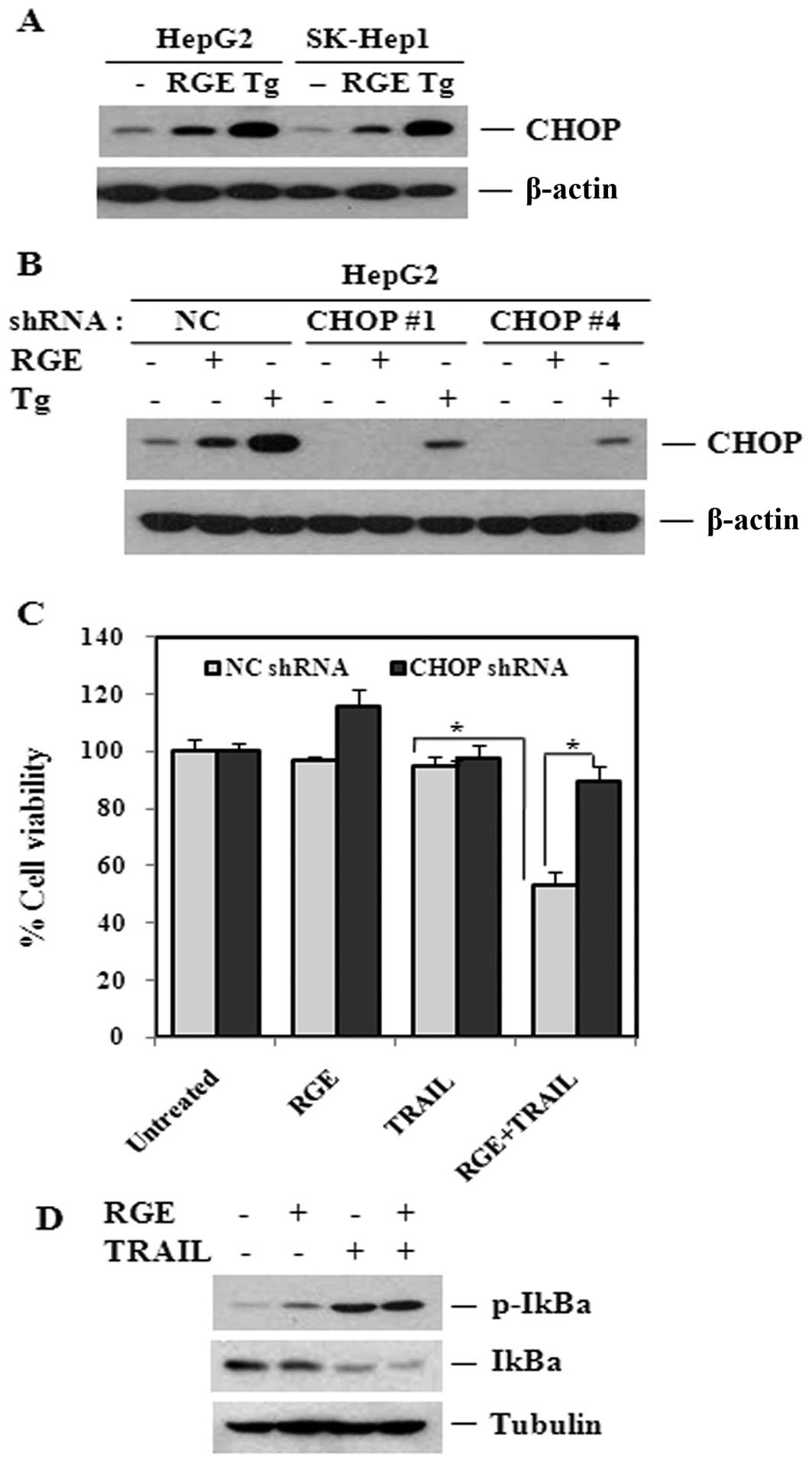
Tumor necrosis factor-related apoptosis-inducing ligand (TRAIL) is a promising anticancer agent because its cytotoxicity is selective for tumor cells. Despite promising outcomes in clinical trials using this ligand, sustained clinical responses have been impeded because cancer cells acquire resistance to TRAIL-based therapies. Ginseng, a well-known food product consumed globally, has been reported to reduce fatigue and possess antioxidant and antitumor activities. We explored the sensitizing influence of a formulated red ginseng extract (RGE) on TRAIL-derived cell death in hepatocellular carcinoma (HCC) cell lines and the underlying molecular mechanisms responsible for TRAIL sensitization. We found that the RGE promoted TRAIL-derived apoptosis in HepG2, Huh-7 and Hep3B cell lines. We also found that death receptor 5 expression was induced by the RGE and mediated by C/EBP homologous protein (CHOP). shRNA-induced downregulation of CHOP expression effectively suppressed cell death induced by combined treatment with the RGE and TRAIL in the HepG2 cell line, indicating that RGE-related upregulation of the CHOP protein plays an important role in sensitizing TRAIL-derived apoptosis. In summary, we showed that the RGE sensitized human HCC cell lines to TRAIL-derived cell death and could be utilized as a dietary supplement in combination with cancer treatment.
View Figures

Figure 1

Figure 2

Figure 3

Figure 4

Figure 5

Figure 6

Figure 7

View References

1. 

Kischkel FC, Lawrence DA, Chuntharapai A, Schow P, Kim KJ and Ashkenazi A: Apo2L/TRAIL-dependent recruitment of endogenous FADD and caspase-8 to death receptors 4 and 5. Immunity. 12:611–620. 2000. View Article : Google Scholar : PubMed/NCBI

2. 

Deveraux QL, Roy N, Stennicke HR, et al: IAPs block apoptotic events induced by caspase-8 and cytochrome c by direct inhibition of distinct caspases. EMBO J. 17:2215–2223. 1998. View Article : Google Scholar : PubMed/NCBI

3. 

Hu W, Johnson H and Shu H: Tumor necrosis factor-related apoptosis-inducing ligand receptors signal NF-κB and JNK activation and apoptosis through distinct pathways. J Biol Chem. 274:306031999.

4. 

Lin B, Williams-Skipp C, Tao Y, et al: NF-κB functions as both a proapoptotic and antiapoptotic regulatory factor within a single cell type. Cell Death Differ. 6:570–582. 1999.

5. 

Son YG, Kim EH, Kim JY, et al: Silibinin sensitizes human glioma cells to TRAIL-mediated apoptosis via DR5 up-regulation and down-regulation of c-FLIP and survivin. Cancer Res. 67:8274–8284. 2007. View Article : Google Scholar : PubMed/NCBI

6. 

Ding L, Yuan C, Wei F, et al: Cisplatin restores TRAIL apoptotic pathway in glioblastoma-derived stem cells through up-regulation of DR5 and down-regulation of c-FLIP. Cancer Invest. 29:511–520. 2011. View Article : Google Scholar : PubMed/NCBI

7. 

Park SJ, Bijangi-Vishehsaraei K and Safa AR: Selective TRAIL-triggered apoptosis due to overexpression of TRAIL death receptor 5 (DR5) in P-glycoprotein-bearing multidrug resistant CEM/VBL1000 human leukemia cells. Int J Biochem Mol Biol. 1:90–100. 2010.

8. 

Fossati S, Ghiso J and Rostagno A: TRAIL death receptors DR4 and DR5 mediate cerebral microvascular endothelial cell apoptosis induced by oligomeric Alzheimer’s Aβ. Cell Death Dis. 3:e3212012.PubMed/NCBI

9. 

Griffith TS, Fialkov JM, Scott DL, et al: Induction and regulation of tumor necrosis factor-related apoptosis–inducing ligand/Apo-2 ligand-mediated apoptosis in renal cell carcinoma. Cancer Res. 62:3093–3099. 2002.

10. 

Kim JY, Lee JY, Kim DG, Koo GB, Yu JW and Kim YS: TRADD is critical for resistance to TRAIL-induced cell death through NF-κB activation. FEBS Lett. 585:2144–2150. 2011.

11. 

Tian X, Ye J, Alonso-Basanta M, Hahn SM, Koumenis C and Dorsey JF: Modulation of CCAAT/enhancer binding protein homologous protein (CHOP)-dependent DR5 expression by nelfinavir sensitizes glioblastoma multiforme cells to tumor necrosis factor-related apoptosis-inducing ligand (TRAIL). J Biol Chem. 286:29408–29416. 2011. View Article : Google Scholar

12. 

Carr BI: Hepatocellular carcinoma: current management and future trends. Gastroenterology. 127:S218–S224. 2004. View Article : Google Scholar : PubMed/NCBI

13. 

Yang JF, Cao JG, Tian L and Liu F: 5,7-Dimethoxyflavone sensitizes TRAIL-induced apoptosis through DR5 upregulation in hepatocellular carcinoma cells. Cancer Chemother Pharmacol. 69:195–206. 2012. View Article : Google Scholar : PubMed/NCBI

14. 

Zhang B, Shan H, Li D, et al: Cisplatin sensitizes human hepatocellular carcinoma cells, but not hepatocytes and mesenchymal stem cells, to TRAIL within a therapeutic window partially depending on the upregulation of DR5. Oncol Rep. 25:461–468. 2011.

15. 

Lee SA, Jo HK, Im BO, Kim SU, Whang WK and Ko SK: Changes in the Contents of Prosapogenin in the Red Ginseng (Panax ginseng) Depending on Steaming Batches. J Ginseng Res. 36:102–106. 2012. View Article : Google Scholar : PubMed/NCBI

16. 

In G, Ahn NG, Bae BS, Han ST, Noh KB and Kim CS: New method for simultaneous quantification of 12 ginsenosides in red ginseng powder and extract: in-house method validation. J Ginseng Res. 36:205–210. 2012. View Article : Google Scholar : PubMed/NCBI

17. 

Sun S, Qi LW, Du GJ, Mehendale SR, Wang CZ and Yuan CS: Red notoginseng: higher ginsenoside content and stronger anti-cancer potential than Asian and American ginseng. Food Chem. 125:1299–1305. 2011. View Article : Google Scholar : PubMed/NCBI

18. 

Keum YS, Park KK, Lee JM, et al: Antioxidant and anti-tumor promoting activities of the methanol extract of heat-processed ginseng. Cancer Lett. 150:41–48. 2000. View Article : Google Scholar : PubMed/NCBI

19. 

Li J, Huang M, Teoh H and Man RY: Panax quinquefolium saponins protects low density lipoproteins from oxidation. Life Sci. 64:53–62. 1999. View Article : Google Scholar : PubMed/NCBI

20. 

Chang MS, Lee SG and Rho HM: Transcriptional activation of Cu/Zn superoxide dismutase and catalase genes by panaxadiol ginsenosides extracted from Panax ginseng. Phytother Res. 13:641–644. 1999. View Article : Google Scholar

21. 

Ji HY, Lee HW, Kim HK, et al: Simultaneous determination of ginsenoside Rb(1) and Rg(1) in human plasma by liquid chromatography-mass spectrometry. J Pharm Biomed Anal. 35:207–212. 2004. View Article : Google Scholar : PubMed/NCBI

22. 

Cai F, Sun L, Gao S, Yang Y, Yang Q and Chen W: A rapid and sensitive liquid chromatography-tandem mass spectrometric method for the determination of timosaponin B-II in blood plasma and a study of the pharmacokinetics of saponin in the rat. J Pharm Biomed Anal. 48:1411–1416. 2008. View Article : Google Scholar : PubMed/NCBI

23. 

Woo SS, Song JS, Lee JY, et al: Selection of high ginsenoside producing ginseng hairy root lines using targeted metabolic analysis. Phytochemistry. 65:2751–2761. 2004. View Article : Google Scholar : PubMed/NCBI

24. 

Park JD, Rhee DK and Lee YH: Biological activities and chemistry of saponins from Panax ginseng CA Meyer. Phytochem Rev. 4:159–175. 2005. View Article : Google Scholar

25. 

Lee DCW and Lau ASY: Effects of Panax ginseng on tumor necrosis factor-α-mediated inflammation: a mini-review. Molecules. 16:2802–2816. 2011.

26. 

Sayers TJ: Targeting the extrinsic apoptosis signaling pathway for cancer therapy. Cancer Immunology, Immunotherapy. 1–8. 2011.

27. 

Ravi R, Bedi GC, Engstrom LW, et al: Regulation of death receptor expression and TRAIL/Apo2L-induced apoptosis by NF-κB. Nat Cell Biol. 3:409–416. 2001.

28. 

Ganten TM, Koschny R, Sykora J, et al: Preclinical differentiation between apparently safe and potentially hepatotoxic applications of TRAIL either alone or in combination with chemotherapeutic drugs. Clin Cancer Res. 12:2640–2646. 2006. View Article : Google Scholar

29. 

Baritaki S, Huerta-Yepez S, Sakai T, Spandidos DA and Bonavida B: Chemotherapeutic drugs sensitize cancer cells to TRAIL-mediated apoptosis: up-regulation of DR5 and inhibition of Yin Yang 1. Mol Cancer Ther. 6:1387–1399. 2007. View Article : Google Scholar : PubMed/NCBI

30. 

Mellier G, Huang S, Shenoy K and Pervaiz S: TRAILing death in cancer. Mol Aspects Med. 31:93–112. 2010. View Article : Google Scholar

31. 

Kouhara J, Yoshida T, Nakata S, et al: Fenretinide upregulates DR5/TRAIL-R2 expression via the induction of the transcription factor CHOP and combined treatment with fenretinide and TRAIL induces synergistic apoptosis in colon cancer cell lines. Int J Oncol. 30:679–687. 2007.

32. 

Bertram H, Nerlich A, Omlor G, Geiger F, Zimmermann G and Fellenberg J: Expression of TRAIL and the death receptors DR4 and DR5 correlates with progression of degeneration in human intervertebral disks. Mod Pathol. 22:895–905. 2009. View Article : Google Scholar : PubMed/NCBI

33. 

Xiaowen H and Yi S: Triptolide sensitizes TRAIL-induced apoptosis in prostate cancer cells via p53-mediated DR5 up-regulation. Mol Biol Rep. 39:8763–8770. 2012. View Article : Google Scholar : PubMed/NCBI

34. 

Lin FL, Hsu JL, Chou CH, Wu WJ, Chang CI and Liu HJ: Activation of p38 MAPK by damnacanthal mediates apoptosis in SKHep 1 cells through the DR5/TRAIL and TNFR1/TNF-α and p53 pathways. Eur J Pharmacol. 650:120–129. 2011.PubMed/NCBI

35. 

Deng Z, Yan H, Hu J, et al: Hepatitis C virus sensitizes host cells to TRAIL-induced apoptosis by up-regulating DR4 and DR5 via a MEK1-dependent pathway. PloS One. 7:e377002012. View Article : Google Scholar : PubMed/NCBI

36. 

Shiraishi T, Yoshida T, Nakata S, et al: Tunicamycin enhances tumor necrosis factor-related apoptosis-inducing ligand-induced apoptosis in human prostate cancer cells. Cancer Res. 65:6364–6370. 2005. View Article : Google Scholar

37. 

Chen CY, Yiin SJ, Hsu JL, Wang WC, Lin SC and Chern CL: Isoobtusilactone A sensitizes human hepatoma Hep G2 cells to TRAIL-induced apoptosis via ROS and CHOP-mediated up-regulation of DR5. J Agric Food Chem. 60:3533–3539. 2012. View Article : Google Scholar : PubMed/NCBI

38. 

Oyadomari S and Mori M: Roles of CHOP/GADD153 in endoplasmic reticulum stress. Cell Death Differ. 11:381–389. 2003. View Article : Google Scholar : PubMed/NCBI

39. 

Bin L, Thorburn J, Thomas LR, Clark PE, Humphreys R and Thorburn A: Tumor-derived mutations in the TRAIL receptor DR5 inhibit TRAIL signaling through the DR4 receptor by competing for ligand binding. J Biol Chem. 282:28189–28194. 2007. View Article : Google Scholar : PubMed/NCBI

40. 

Sheridan JP, Marsters SA, Pitti RM, et al: Control of TRAIL-induced apoptosis by a family of signaling and decoy receptors. Science. 277:818–821. 1997. View Article : Google Scholar : PubMed/NCBI

41. 

Seol DW: p53-Independent up-regulation of a TRAIL receptor DR5 by proteasome inhibitors: a mechanism for proteasome inhibitor-enhanced TRAIL-induced apoptosis. Biochem Biophys Res Commun. 416:222–225. 2011. View Article : Google Scholar : PubMed/NCBI

42. 

Sung B, Ravindran J, Prasad S, Pandey MK and Aggarwal BB: Gossypol induces death receptor-5 through activation of the ROS-ERK-CHOP pathway and sensitizes colon cancer cells to TRAIL. J Biol Chem. 285:35418–35427. 2010. View Article : Google Scholar : PubMed/NCBI

43. 

Zinszner H, Kuroda M, Wang X, et al: CHOP is implicated in programmed cell death in response to impaired function of the endoplasmic reticulum. Genes Dev. 12:982–995. 1998. View Article : Google Scholar : PubMed/NCBI

44. 

Zou W, Yue P, Khuri F and Sun S: Coupling of endoplasmic reticulum stress to CDDO-Me-induced up-regulation of death receptor 5 via a CHOP-dependent mechanism involving JNK activation. Cancer Res. 68:7484–7492. 2008. View Article : Google Scholar : PubMed/NCBI

Related Articles

  • Abstract
  • View
  • Download
  • Twitter
Copy and paste a formatted citation
Spandidos Publications style
Lee Y, Lee D, Lee J, Kim TR, Hong S, Kwon SW and Kim Y: A formulated red ginseng extract upregulates CHOP and increases TRAIL-mediated cytotoxicity in human hepatocellular carcinoma cells. Int J Oncol 43: 591-599, 2013.
APA
Lee, Y., Lee, D., Lee, J., Kim, T.R., Hong, S., Kwon, S.W., & Kim, Y. (2013). A formulated red ginseng extract upregulates CHOP and increases TRAIL-mediated cytotoxicity in human hepatocellular carcinoma cells. International Journal of Oncology, 43, 591-599. https://doi.org/10.3892/ijo.2013.1964
MLA
Lee, Y., Lee, D., Lee, J., Kim, T. R., Hong, S., Kwon, S. W., Kim, Y."A formulated red ginseng extract upregulates CHOP and increases TRAIL-mediated cytotoxicity in human hepatocellular carcinoma cells". International Journal of Oncology 43.2 (2013): 591-599.
Chicago
Lee, Y., Lee, D., Lee, J., Kim, T. R., Hong, S., Kwon, S. W., Kim, Y."A formulated red ginseng extract upregulates CHOP and increases TRAIL-mediated cytotoxicity in human hepatocellular carcinoma cells". International Journal of Oncology 43, no. 2 (2013): 591-599. https://doi.org/10.3892/ijo.2013.1964
Copy and paste a formatted citation
x
Spandidos Publications style
Lee Y, Lee D, Lee J, Kim TR, Hong S, Kwon SW and Kim Y: A formulated red ginseng extract upregulates CHOP and increases TRAIL-mediated cytotoxicity in human hepatocellular carcinoma cells. Int J Oncol 43: 591-599, 2013.
APA
Lee, Y., Lee, D., Lee, J., Kim, T.R., Hong, S., Kwon, S.W., & Kim, Y. (2013). A formulated red ginseng extract upregulates CHOP and increases TRAIL-mediated cytotoxicity in human hepatocellular carcinoma cells. International Journal of Oncology, 43, 591-599. https://doi.org/10.3892/ijo.2013.1964
MLA
Lee, Y., Lee, D., Lee, J., Kim, T. R., Hong, S., Kwon, S. W., Kim, Y."A formulated red ginseng extract upregulates CHOP and increases TRAIL-mediated cytotoxicity in human hepatocellular carcinoma cells". International Journal of Oncology 43.2 (2013): 591-599.
Chicago
Lee, Y., Lee, D., Lee, J., Kim, T. R., Hong, S., Kwon, S. W., Kim, Y."A formulated red ginseng extract upregulates CHOP and increases TRAIL-mediated cytotoxicity in human hepatocellular carcinoma cells". International Journal of Oncology 43, no. 2 (2013): 591-599. https://doi.org/10.3892/ijo.2013.1964
Follow us
  • Twitter
  • LinkedIn
  • Facebook
About
  • Spandidos Publications
  • Careers
  • Cookie Policy
  • Privacy Policy
How can we help?
  • Help
  • Live Chat
  • Contact
  • Email to our Support Team