Spandidos Publications Logo
  • About
    • About Spandidos
    • Aims and Scopes
    • Abstracting and Indexing
    • Editorial Policies
    • Reprints and Permissions
    • Job Opportunities
    • Terms and Conditions
    • Contact
  • Journals
    • All Journals
    • Oncology Letters
      • Oncology Letters
      • Information for Authors
      • Editorial Policies
      • Editorial Board
      • Aims and Scope
      • Abstracting and Indexing
      • Bibliographic Information
      • Archive
    • International Journal of Oncology
      • International Journal of Oncology
      • Information for Authors
      • Editorial Policies
      • Editorial Board
      • Aims and Scope
      • Abstracting and Indexing
      • Bibliographic Information
      • Archive
    • Molecular and Clinical Oncology
      • Molecular and Clinical Oncology
      • Information for Authors
      • Editorial Policies
      • Editorial Board
      • Aims and Scope
      • Abstracting and Indexing
      • Bibliographic Information
      • Archive
    • Experimental and Therapeutic Medicine
      • Experimental and Therapeutic Medicine
      • Information for Authors
      • Editorial Policies
      • Editorial Board
      • Aims and Scope
      • Abstracting and Indexing
      • Bibliographic Information
      • Archive
    • International Journal of Molecular Medicine
      • International Journal of Molecular Medicine
      • Information for Authors
      • Editorial Policies
      • Editorial Board
      • Aims and Scope
      • Abstracting and Indexing
      • Bibliographic Information
      • Archive
    • Biomedical Reports
      • Biomedical Reports
      • Information for Authors
      • Editorial Policies
      • Editorial Board
      • Aims and Scope
      • Abstracting and Indexing
      • Bibliographic Information
      • Archive
    • Oncology Reports
      • Oncology Reports
      • Information for Authors
      • Editorial Policies
      • Editorial Board
      • Aims and Scope
      • Abstracting and Indexing
      • Bibliographic Information
      • Archive
    • Molecular Medicine Reports
      • Molecular Medicine Reports
      • Information for Authors
      • Editorial Policies
      • Editorial Board
      • Aims and Scope
      • Abstracting and Indexing
      • Bibliographic Information
      • Archive
    • World Academy of Sciences Journal
      • World Academy of Sciences Journal
      • Information for Authors
      • Editorial Policies
      • Editorial Board
      • Aims and Scope
      • Abstracting and Indexing
      • Bibliographic Information
      • Archive
    • International Journal of Functional Nutrition
      • International Journal of Functional Nutrition
      • Information for Authors
      • Editorial Policies
      • Editorial Board
      • Aims and Scope
      • Abstracting and Indexing
      • Bibliographic Information
      • Archive
    • International Journal of Epigenetics
      • International Journal of Epigenetics
      • Information for Authors
      • Editorial Policies
      • Editorial Board
      • Aims and Scope
      • Abstracting and Indexing
      • Bibliographic Information
      • Archive
    • Medicine International
      • Medicine International
      • Information for Authors
      • Editorial Policies
      • Editorial Board
      • Aims and Scope
      • Abstracting and Indexing
      • Bibliographic Information
      • Archive
  • Articles
  • Information
    • Information for Authors
    • Information for Reviewers
    • Information for Librarians
    • Information for Advertisers
    • Conferences
  • Language Editing
Spandidos Publications Logo
  • About
    • About Spandidos
    • Aims and Scopes
    • Abstracting and Indexing
    • Editorial Policies
    • Reprints and Permissions
    • Job Opportunities
    • Terms and Conditions
    • Contact
  • Journals
    • All Journals
    • Biomedical Reports
      • Information for Authors
      • Editorial Policies
      • Editorial Board
      • Aims and Scope
      • Abstracting and Indexing
      • Bibliographic Information
      • Archive
    • Experimental and Therapeutic Medicine
      • Information for Authors
      • Editorial Policies
      • Editorial Board
      • Aims and Scope
      • Abstracting and Indexing
      • Bibliographic Information
      • Archive
    • International Journal of Epigenetics
      • Information for Authors
      • Editorial Policies
      • Editorial Board
      • Aims and Scope
      • Abstracting and Indexing
      • Bibliographic Information
      • Archive
    • International Journal of Functional Nutrition
      • Information for Authors
      • Editorial Policies
      • Editorial Board
      • Aims and Scope
      • Abstracting and Indexing
      • Bibliographic Information
      • Archive
    • International Journal of Molecular Medicine
      • Information for Authors
      • Editorial Policies
      • Editorial Board
      • Aims and Scope
      • Abstracting and Indexing
      • Bibliographic Information
      • Archive
    • International Journal of Oncology
      • Information for Authors
      • Editorial Policies
      • Editorial Board
      • Aims and Scope
      • Abstracting and Indexing
      • Bibliographic Information
      • Archive
    • Medicine International
      • Information for Authors
      • Editorial Policies
      • Editorial Board
      • Aims and Scope
      • Abstracting and Indexing
      • Bibliographic Information
      • Archive
    • Molecular and Clinical Oncology
      • Information for Authors
      • Editorial Policies
      • Editorial Board
      • Aims and Scope
      • Abstracting and Indexing
      • Bibliographic Information
      • Archive
    • Molecular Medicine Reports
      • Information for Authors
      • Editorial Policies
      • Editorial Board
      • Aims and Scope
      • Abstracting and Indexing
      • Bibliographic Information
      • Archive
    • Oncology Letters
      • Information for Authors
      • Editorial Policies
      • Editorial Board
      • Aims and Scope
      • Abstracting and Indexing
      • Bibliographic Information
      • Archive
    • Oncology Reports
      • Information for Authors
      • Editorial Policies
      • Editorial Board
      • Aims and Scope
      • Abstracting and Indexing
      • Bibliographic Information
      • Archive
    • World Academy of Sciences Journal
      • Information for Authors
      • Editorial Policies
      • Editorial Board
      • Aims and Scope
      • Abstracting and Indexing
      • Bibliographic Information
      • Archive
  • Articles
  • Information
    • For Authors
    • For Reviewers
    • For Librarians
    • For Advertisers
    • Conferences
  • Language Editing
Login Register Submit
  • This site uses cookies
  • You can change your cookie settings at any time by following the instructions in our Cookie Policy. To find out more, you may read our Privacy Policy.

    I agree
Search articles by DOI, keyword, author or affiliation
Search
Advanced Search
presentation
International Journal of Oncology
Join Editorial Board Propose a Special Issue
Print ISSN: 1019-6439 Online ISSN: 1791-2423
Journal Cover
March-2016 Volume 48 Issue 3

Full Size Image

Cover Legend PDF

Sign up for eToc alerts
Recommend to Library

Journals

International Journal of Molecular Medicine

International Journal of Molecular Medicine

International Journal of Molecular Medicine is an international journal devoted to molecular mechanisms of human disease.

International Journal of Oncology

International Journal of Oncology

International Journal of Oncology is an international journal devoted to oncology research and cancer treatment.

Molecular Medicine Reports

Molecular Medicine Reports

Covers molecular medicine topics such as pharmacology, pathology, genetics, neuroscience, infectious diseases, molecular cardiology, and molecular surgery.

Oncology Reports

Oncology Reports

Oncology Reports is an international journal devoted to fundamental and applied research in Oncology.

Experimental and Therapeutic Medicine

Experimental and Therapeutic Medicine

Experimental and Therapeutic Medicine is an international journal devoted to laboratory and clinical medicine.

Oncology Letters

Oncology Letters

Oncology Letters is an international journal devoted to Experimental and Clinical Oncology.

Biomedical Reports

Biomedical Reports

Explores a wide range of biological and medical fields, including pharmacology, genetics, microbiology, neuroscience, and molecular cardiology.

Molecular and Clinical Oncology

Molecular and Clinical Oncology

International journal addressing all aspects of oncology research, from tumorigenesis and oncogenes to chemotherapy and metastasis.

World Academy of Sciences Journal

World Academy of Sciences Journal

Multidisciplinary open-access journal spanning biochemistry, genetics, neuroscience, environmental health, and synthetic biology.

International Journal of Functional Nutrition

International Journal of Functional Nutrition

Open-access journal combining biochemistry, pharmacology, immunology, and genetics to advance health through functional nutrition.

International Journal of Epigenetics

International Journal of Epigenetics

Publishes open-access research on using epigenetics to advance understanding and treatment of human disease.

Medicine International

Medicine International

An International Open Access Journal Devoted to General Medicine.

Journal Cover
March-2016 Volume 48 Issue 3

Full Size Image

Cover Legend PDF

Sign up for eToc alerts
Recommend to Library

  • Article
  • Citations
    • Cite This Article
    • Download Citation
    • Create Citation Alert
    • Remove Citation Alert
    • Cited By
  • Similar Articles
    • Related Articles (in Spandidos Publications)
    • Similar Articles (Google Scholar)
    • Similar Articles (PubMed)
  • Download PDF
  • Download XML
  • View XML
Article

ATP-site binding inhibitor effectively targets mTORC1 and mTORC2 complexes in glioblastoma

  • Authors:
    • Jayson Neil
    • Craig Shannon
    • Avinash Mohan
    • Dimitri Laurent
    • Raj Murali
    • Meena Jhanwar-Uniyal
  • View Affiliations / Copyright

    Affiliations: Department of Neurosurgery, New York Medical College, Valhalla, NY 10595, USA
  • Pages: 1045-1052
    |
    Published online on: December 28, 2015
       https://doi.org/10.3892/ijo.2015.3311
  • Expand metrics +
Metrics: Total Views: 0 (Spandidos Publications: | PMC Statistics: )
Metrics: Total PDF Downloads: 0 (Spandidos Publications: | PMC Statistics: )
Cited By (CrossRef): 0 citations Loading Articles...

This article is mentioned in:


Abstract

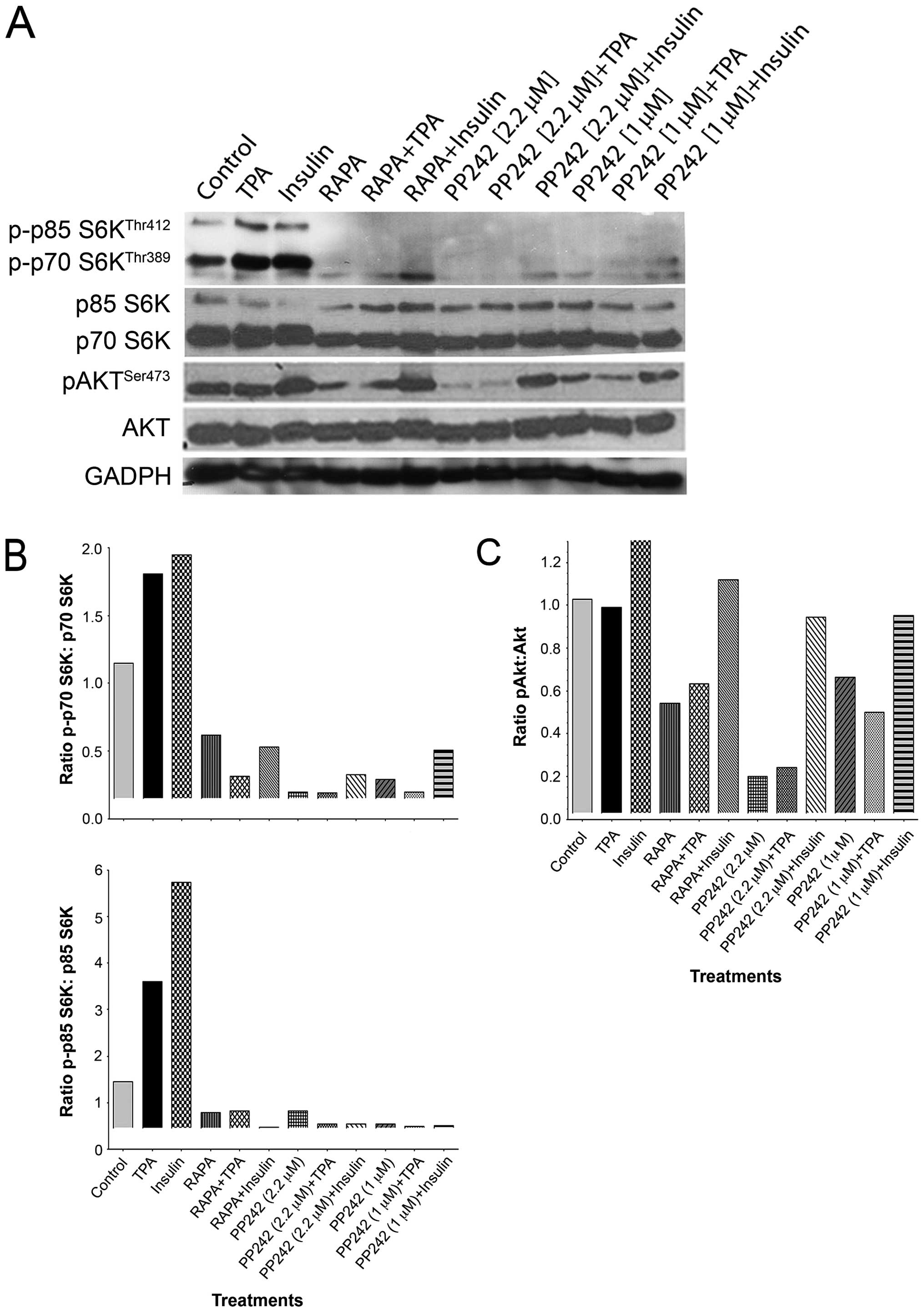
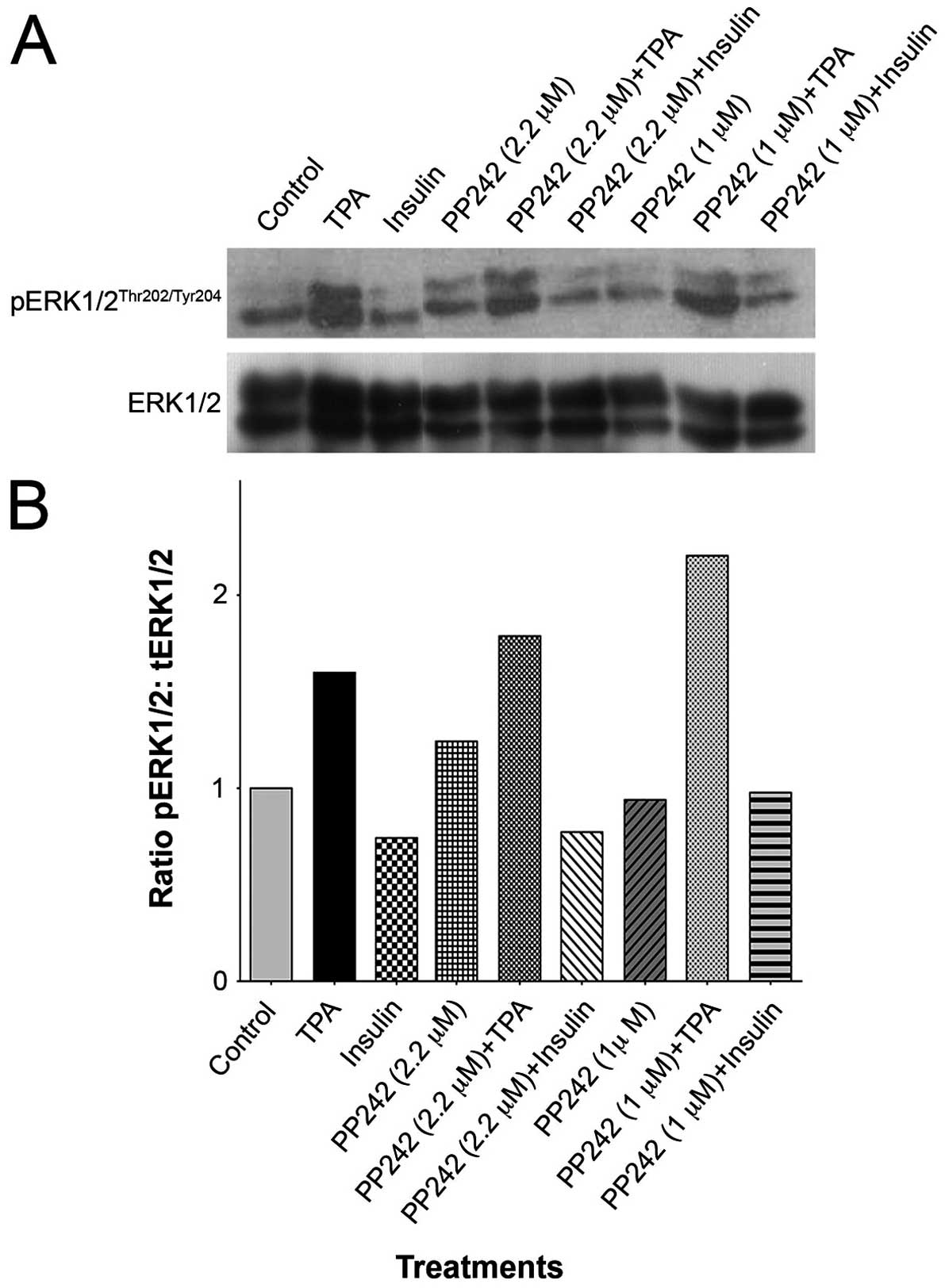
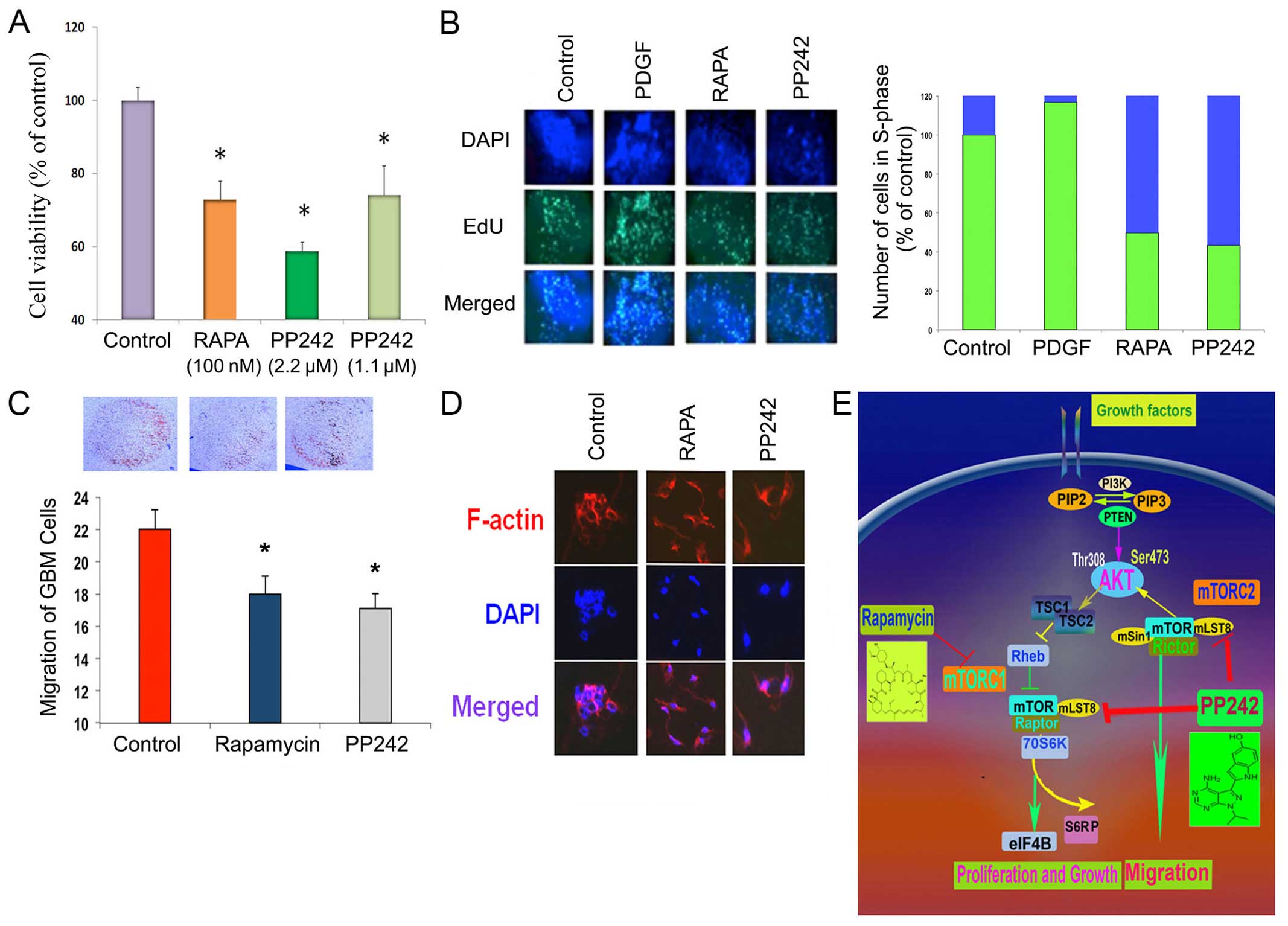
The PI3K-AKT-mTOR signaling axis is central to the transformed phenotype of glioblastoma (GBM) cells, due to frequent loss of tumor suppressor PTEN (phosphatase and tensin homolog deleted on chromosome 10). The mechanistic target of rapamycin (mTOR) kinase is present in two cellular multi-protein complexes, mTORC1 and mTORC2, which have distinct subunit composition, substrates and mechanisms of action. Targeting the mTOR protein is a promising strategy for GBM therapy. However, neither of these complexes is fully inhibited by the allosteric inhibitor of mTOR, rapamycin or its analogs. Herein, we provide evidence that the combined inhibition of mTORC1/2, using the ATP-competitive binding inhibitor PP242, would effectively suppress GBM growth and dissemination as compared to an allosteric binding inhibitor of mTOR. GBM cells treated with PP242 demonstrated significantly decreased activation of mTORC1 and mTORC2, as shown by reduced phosphorylation of their substrate levels, p70 S6KThr389 and AKTSer473, respectively, in a dose-dependent manner. Furthermore, insulin induced activation of these kinases was abrogated by pretreatment with PP242 as compared with rapamycin. Unlike rapamycin, PP242 modestly activates extracellular regulated kinase (ERK1/2), as shown by expression of pERKThr202/Tyr204. Cell proliferation and S-phase entry of GBM cells was significantly suppressed by PP242, which was more pronounced compared to rapamycin treatment. Lastly, PP242 significantly suppressed the migration of GBM cells, which was associated with a change in cellular behavior rather than cytoskeleton loss. In conclusion, these results underscore the potential therapeutic use of the PP242, a novel ATP-competitive binding inhibitor of mTORC1/2 kinase, in suppression of GBM growth and dissemination.
View Figures

Figure 1

Figure 2

Figure 3

View References

1 

Stupp R, Mason WP, van den Bent MJ, Weller M, Fisher B, Taphoorn MJ, Belanger K, Brandes AA, Marosi C, Bogdahn U, et al; European Organisation for Research and Treatment of Cancer Brain Tumor and Radiotherapy Groups; National Cancer Institute of Canada Clinical Trials Group. Radiotherapy plus concomitant and adjuvant temozolomide for glioblastoma. N Engl J Med. 352:987–996. 2005. View Article : Google Scholar : PubMed/NCBI

2 

Ohgaki H and Kleihues P: Genetic pathways to primary and secondary glioblastoma. Am J Pathol. 170:1445–1453. 2007. View Article : Google Scholar : PubMed/NCBI

3 

Verhaak RG, Hoadley KA, Purdom E, Wang V, Qi Y, Wilkerson MD, Miller CR, Ding L, Golub T, Mesirov JP, et al; Cancer Genome Atlas Research Network. Integrated genomic analysis identifies clinically relevant subtypes of glioblastoma characterized by abnormalities in PDGFRA, IDH1, EGFR, and NF1. Cancer Cell. 17:98–110. 2010. View Article : Google Scholar : PubMed/NCBI

4 

Phillips HS, Kharbanda S, Chen R, Forrest WF, Soriano RH, Wu TD, Misra A, Nigro JM, Colman H, Soroceanu L, et al: Molecular subclasses of high-grade glioma predict prognosis, delineate a pattern of disease progression, and resemble stages in neurogenesis. Cancer Cell. 9:157–173. 2006. View Article : Google Scholar : PubMed/NCBI

5 

Hu X, Pandolfi PP, Li Y, Koutcher JA, Rosenblum M and Holland EC: mTOR promotes survival and astrocytic characteristics induced by Pten/AKT signaling in glioblastoma. Neoplasia. 7:356–368. 2005. View Article : Google Scholar : PubMed/NCBI

6 

Nutt C and Louis D: Cancer of the Nervous System. 2nd edition. McGraw-Hill; New York: 2005

7 

Berger AH and Pandolfi PP: Haplo-insufficiency: A driving force in cancer. J Pathol. 223:137–146. 2011. View Article : Google Scholar

8 

Di Cristofano A, Pesce B, Cordon-Cardo C and Pandolfi PP: Pten is essential for embryonic development and tumour suppression. Nat Genet. 19:348–355. 1998. View Article : Google Scholar : PubMed/NCBI

9 

Carracedo A and Pandolfi PP: The PTEN-PI3K pathway: Of feedbacks and cross-talks. Oncogene. 27:5527–5541. 2008. View Article : Google Scholar : PubMed/NCBI

10 

Groszer M, Erickson R, Scripture-Adams DD, Dougherty JD, Le Belle J, Zack JA, Geschwind DH, Liu X, Kornblum HI and Wu H: PTEN negatively regulates neural stem cell self-renewal by modulating G0–G1 cell cycle entry. Proc Natl Acad Sci USA. 103:111–116. 2006. View Article : Google Scholar

11 

Hay N and Sonenberg N: Upstream and downstream of mTOR. Genes Dev. 18:1926–1945. 2004. View Article : Google Scholar : PubMed/NCBI

12 

Holland EC: Gliomagenesis: Genetic alterations and mouse models. Nat Rev Genet. 2:120–129. 2001. View Article : Google Scholar : PubMed/NCBI

13 

Guertin DA and Sabatini DM: Defining the role of mTOR in cancer. Cancer Cell. 12:9–22. 2007. View Article : Google Scholar : PubMed/NCBI

14 

Jacinto E and Hall MN: Tor signalling in bugs, brain and brawn. Nat Rev Mol Cell Biol. 4:117–126. 2003. View Article : Google Scholar : PubMed/NCBI

15 

Sabatini DM: mTOR and cancer: Insights into a complex relationship. Nat Rev Cancer. 6:729–734. 2006. View Article : Google Scholar : PubMed/NCBI

16 

Ruggero D, Montanaro L, Ma L, Xu W, Londei P, Cordon-Cardo C and Pandolfi PP: The translation factor eIF-4E promotes tumor formation and cooperates with c-Myc in lymphomagenesis. Nat Med. 10:484–486. 2004. View Article : Google Scholar : PubMed/NCBI

17 

Hara K, Maruki Y, Long X, Yoshino K, Oshiro N, Hidayat S, Tokunaga C, Avruch J and Yonezawa K: Raptor, a binding partner of target of rapamycin (TOR), mediates TOR action. Cell. 110:177–189. 2002. View Article : Google Scholar : PubMed/NCBI

18 

Jacinto E, Loewith R, Schmidt A, Lin S, Rüegg MA, Hall A and Hall MN: Mammalian TOR complex 2 controls the actin cytoskeleton and is rapamycin insensitive. Nat Cell Biol. 6:1122–1128. 2004. View Article : Google Scholar : PubMed/NCBI

19 

Kim DH, Sarbassov DD, Ali SM, King JE, Latek RR, Erdjument-Bromage H, Tempst P and Sabatini DM: mTOR interacts with raptor to form a nutrient-sensitive complex that signals to the cell growth machinery. Cell. 110:163–175. 2002. View Article : Google Scholar : PubMed/NCBI

20 

Sarbassov DD, Ali SM, Kim DH, Guertin DA, Latek RR, Erdjument-Bromage H, Tempst P and Sabatini DM: Rictor, a novel binding partner of mTOR, defines a rapamycin-insensitive and raptor-independent pathway that regulates the cytoskeleton. Curr Biol. 14:1296–1302. 2004. View Article : Google Scholar : PubMed/NCBI

21 

Brown EJ, Beal PA, Keith CT, Chen J, Shin TB and Schreiber SL: Control of p70 s6 kinase by kinase activity of FRAP in vivo. Nature. 377:441–446. 1995. View Article : Google Scholar : PubMed/NCBI

22 

Gingras AC, Kennedy SG, O'Leary MA, Sonenberg N and Hay N: 4E-BP1, a repressor of mRNA translation, is phosphorylated and inactivated by the Akt(PKB) signaling pathway. Genes Dev. 12:502–513. 1998. View Article : Google Scholar : PubMed/NCBI

23 

Ruvinsky I and Meyuhas O: Ribosomal protein S6 phosphorylation: From protein synthesis to cell size. Trends Biochem Sci. 31:342–348. 2006. View Article : Google Scholar : PubMed/NCBI

24 

García-Martínez JM and Alessi DR: mTOR complex 2 (mTORC2) controls hydrophobic motif phosphorylation and activation of serum- and glucocorticoid-induced protein kinase 1 (SGK1). Biochem J. 416:375–385. 2008. View Article : Google Scholar : PubMed/NCBI

25 

Sarbassov DD, Guertin DA, Ali SM and Sabatini DM: Phosphorylation and regulation of Akt/PKB by the rictor-mTOR complex. Science. 307:1098–1101. 2005. View Article : Google Scholar : PubMed/NCBI

26 

Han EK, Leverson JD, McGonigal T, Shah OJ, Woods KW, Hunter T, Giranda VL and Luo Y: Akt inhibitor A-443654 induces rapid Akt Ser-473 phosphorylation independent of mTORC1 inhibition. Oncogene. 26:5655–5661. 2007. View Article : Google Scholar : PubMed/NCBI

27 

Cloughesy TF, Yoshimoto K, Nghiemphu P, Brown K, Dang J, Zhu S, Hsueh T, Chen Y, Wang W, Youngkin D, et al: Antitumor activity of rapamycin in a Phase I trial for patients with recurrent PTEN-deficient glioblastoma. PLoS Med. 5:e82008. View Article : Google Scholar : PubMed/NCBI

28 

Albert L, Karsy M, Murali R and Jhanwar-Uniyal M: Inhibition of mTOR activates the MAPK pathway in glioblastoma multiforme. Cancer Genomics Proteomics. 6:255–261. 2009.PubMed/NCBI

29 

Guertin DA, Stevens DM, Thoreen CC, Burds AA, Kalaany NY, Moffat J, Brown M, Fitzgerald KJ and Sabatini DM: Ablation in mice of the mTORC components raptor, rictor, or mLST8 reveals that mTORC2 is required for signaling to Akt-FOXO and PKCalpha, but not S6K1. Dev Cell. 11:859–871. 2006. View Article : Google Scholar : PubMed/NCBI

30 

Gulati N, Karsy M, Albert L, Murali R and Jhanwar-Uniyal M: Involvement of mTORC1 and mTORC2 in regulation of glioblastoma multiforme growth and motility. Int J Oncol. 35:731–740. 2009.PubMed/NCBI

31 

Jacinto E, Facchinetti V, Liu D, Soto N, Wei S, Jung SY, Huang Q, Qin J and Su B: SIN1/MIP1 maintains rictor-mTOR complex integrity and regulates Akt phosphorylation and substrate specificity. Cell. 127:125–137. 2006. View Article : Google Scholar : PubMed/NCBI

32 

Sarbassov DD, Ali SM, Sengupta S, Sheen JH, Hsu PP, Bagley AF, Markhard AL and Sabatini DM: Prolonged rapamycin treatment inhibits mTORC2 assembly and Akt/PKB. Mol Cell. 22:159–168. 2006. View Article : Google Scholar : PubMed/NCBI

33 

Feldman ME, Apsel B, Uotila A, Loewith R, Knight ZA, Ruggero D and Shokat KM: Active-site inhibitors of mTOR target rapamycin-resistant outputs of mTORC1 and mTORC2. PLoS Biol. 7:e382009. View Article : Google Scholar : PubMed/NCBI

34 

Chang SM, Wen P, Cloughesy T, Greenberg H, Schiff D, Conrad C, Fink K, Robins HI, De Angelis L, Raizer J, et al; North American Brain Tumor Consortium and the National Cancer Institute. Phase II study of CCI-779 in patients with recurrent glioblastoma multiforme. Invest New Drugs. 23:357–361. 2005. View Article : Google Scholar : PubMed/NCBI

35 

Eshleman JS, Carlson BL, Mladek AC, Kastner BD, Shide KL and Sarkaria JN: Inhibition of the mammalian target of rapamycin sensitizes U87 xenografts to fractionated radiation therapy. Cancer Res. 62:7291–7297. 2002.PubMed/NCBI

36 

Gulati P and Thomas G: Nutrient sensing in the mTOR/S6K1 signalling pathway. Biochem Soc Trans. 35:236–238. 2007. View Article : Google Scholar : PubMed/NCBI

37 

Cancer Genome Atlas Research Network. Comprehensive genomic characterization defines human glioblastoma genes and core pathways. Nature. 455:1061–1068. 2008. View Article : Google Scholar : PubMed/NCBI

38 

Parsons DW, Jones S, Zhang X, Lin JC, Leary RJ, Angenendt P, Mankoo P, Carter H, Siu IM, Gallia GL, et al: An integrated genomic analysis of human glioblastoma multiforme. Science. 321:1807–1812. 2008. View Article : Google Scholar : PubMed/NCBI

39 

Kim DH, Sarbassov DD, Ali SM, Latek RR, Guntur KV, Erdjument-Bromage H, Tempst P and Sabatini DM: GbetaL, a positive regulator of the rapamycin-sensitive pathway required for the nutrient-sensitive interaction between raptor and mTOR. Mol Cell. 11:895–904. 2003. View Article : Google Scholar : PubMed/NCBI

40 

Zeng Z, Sarbassov D, Samudio IJ, Yee KW, Munsell MF, Ellen Jackson C, Giles FJ, Sabatini DM, Andreeff M and Konopleva M: Rapamycin derivatives reduce mTORC2 signaling and inhibit AKT activation in AML. Blood. 109:3509–3512. 2007. View Article : Google Scholar

41 

Knight ZA, Gonzalez B, Feldman ME, Zunder ER, Goldenberg DD, Williams O, Loewith R, Stokoe D, Balla A, Toth B, et al: A pharmacological map of the PI3-K family defines a role for p110alpha in insulin signaling. Cell. 125:733–747. 2006. View Article : Google Scholar : PubMed/NCBI

42 

Jhanwar-Uniyal M, Albert L, McKenna E, Karsy M, Rajdev P, Braun A and Murali R: Deciphering the signaling pathways of cancer stem cells of glioblastoma multiforme: Role of Akt/mTOR and MAPK pathways. Adv Enzyme Regul. 51:164–170. 2011. View Article : Google Scholar

43 

Jhanwar-Uniyal M, Jeevan D, Neil J, Shannon C, Albert L and Murali R: Deconstructing mTOR complexes in regulation of Glioblastoma Multiforme and its stem cells. Adv Biol Regul. 53:202–210. 2013. View Article : Google Scholar

44 

Jhanwar-Uniyal M, Labagnara M, Friedman M, Kwasnicki A and Murali R: Glioblastoma: Molecular pathways, stem cells and therapeutic targets. Cancers (Basel). 7:538–555. 2015. View Article : Google Scholar

45 

Jhanwar-Uniyal M, Gillick JL, Neil J, Tobias M, Thwing ZE and Murali R: Distinct signaling mechanisms of mTORC1 and mTORC2 in glioblastoma multiforme: A tale of two complexes. Adv Biol Regul. 57:64–74. 2015. View Article : Google Scholar

46 

McCubrey JA, Abrams SL, Fitzgerald TL, Cocco L, Martelli AM, Montalto G, Cervello M, Scalisi A, Candido S, Libra M, et al: Roles of signaling pathways in drug resistance, cancer initiating cells and cancer progression and metastasis. Adv Biol Regul. 57:75–101. 2015. View Article : Google Scholar

Related Articles

  • Abstract
  • View
  • Download
  • Twitter
Copy and paste a formatted citation
Spandidos Publications style
Neil J, Shannon C, Mohan A, Laurent D, Murali R and Jhanwar-Uniyal M: ATP-site binding inhibitor effectively targets mTORC1 and mTORC2 complexes in glioblastoma. Int J Oncol 48: 1045-1052, 2016.
APA
Neil, J., Shannon, C., Mohan, A., Laurent, D., Murali, R., & Jhanwar-Uniyal, M. (2016). ATP-site binding inhibitor effectively targets mTORC1 and mTORC2 complexes in glioblastoma. International Journal of Oncology, 48, 1045-1052. https://doi.org/10.3892/ijo.2015.3311
MLA
Neil, J., Shannon, C., Mohan, A., Laurent, D., Murali, R., Jhanwar-Uniyal, M."ATP-site binding inhibitor effectively targets mTORC1 and mTORC2 complexes in glioblastoma". International Journal of Oncology 48.3 (2016): 1045-1052.
Chicago
Neil, J., Shannon, C., Mohan, A., Laurent, D., Murali, R., Jhanwar-Uniyal, M."ATP-site binding inhibitor effectively targets mTORC1 and mTORC2 complexes in glioblastoma". International Journal of Oncology 48, no. 3 (2016): 1045-1052. https://doi.org/10.3892/ijo.2015.3311
Copy and paste a formatted citation
x
Spandidos Publications style
Neil J, Shannon C, Mohan A, Laurent D, Murali R and Jhanwar-Uniyal M: ATP-site binding inhibitor effectively targets mTORC1 and mTORC2 complexes in glioblastoma. Int J Oncol 48: 1045-1052, 2016.
APA
Neil, J., Shannon, C., Mohan, A., Laurent, D., Murali, R., & Jhanwar-Uniyal, M. (2016). ATP-site binding inhibitor effectively targets mTORC1 and mTORC2 complexes in glioblastoma. International Journal of Oncology, 48, 1045-1052. https://doi.org/10.3892/ijo.2015.3311
MLA
Neil, J., Shannon, C., Mohan, A., Laurent, D., Murali, R., Jhanwar-Uniyal, M."ATP-site binding inhibitor effectively targets mTORC1 and mTORC2 complexes in glioblastoma". International Journal of Oncology 48.3 (2016): 1045-1052.
Chicago
Neil, J., Shannon, C., Mohan, A., Laurent, D., Murali, R., Jhanwar-Uniyal, M."ATP-site binding inhibitor effectively targets mTORC1 and mTORC2 complexes in glioblastoma". International Journal of Oncology 48, no. 3 (2016): 1045-1052. https://doi.org/10.3892/ijo.2015.3311
Follow us
  • Twitter
  • LinkedIn
  • Facebook
About
  • Spandidos Publications
  • Careers
  • Cookie Policy
  • Privacy Policy
How can we help?
  • Help
  • Live Chat
  • Contact
  • Email to our Support Team