International Journal of Molecular Medicine is an international journal devoted to molecular mechanisms of human disease.
International Journal of Oncology is an international journal devoted to oncology research and cancer treatment.
Covers molecular medicine topics such as pharmacology, pathology, genetics, neuroscience, infectious diseases, molecular cardiology, and molecular surgery.
Oncology Reports is an international journal devoted to fundamental and applied research in Oncology.
Experimental and Therapeutic Medicine is an international journal devoted to laboratory and clinical medicine.
Oncology Letters is an international journal devoted to Experimental and Clinical Oncology.
Explores a wide range of biological and medical fields, including pharmacology, genetics, microbiology, neuroscience, and molecular cardiology.
International journal addressing all aspects of oncology research, from tumorigenesis and oncogenes to chemotherapy and metastasis.
Multidisciplinary open-access journal spanning biochemistry, genetics, neuroscience, environmental health, and synthetic biology.
Open-access journal combining biochemistry, pharmacology, immunology, and genetics to advance health through functional nutrition.
Publishes open-access research on using epigenetics to advance understanding and treatment of human disease.
An International Open Access Journal Devoted to General Medicine.
Preventive effect of caffeine and curcumin on hepato-carcinogenesis in diethylnitrosamine-induced rats
YUKI FUJISE, JUN-ICHI OKANO, TAKAKAZU NAGAHARA, RYO ABE, RYU IMAMOTO and YOSHIKAZU MURAWAKI
[Related article:] Int J Oncol 40: 1779β1788, 2012; DOI: 10.3892/ijo.2012.1343
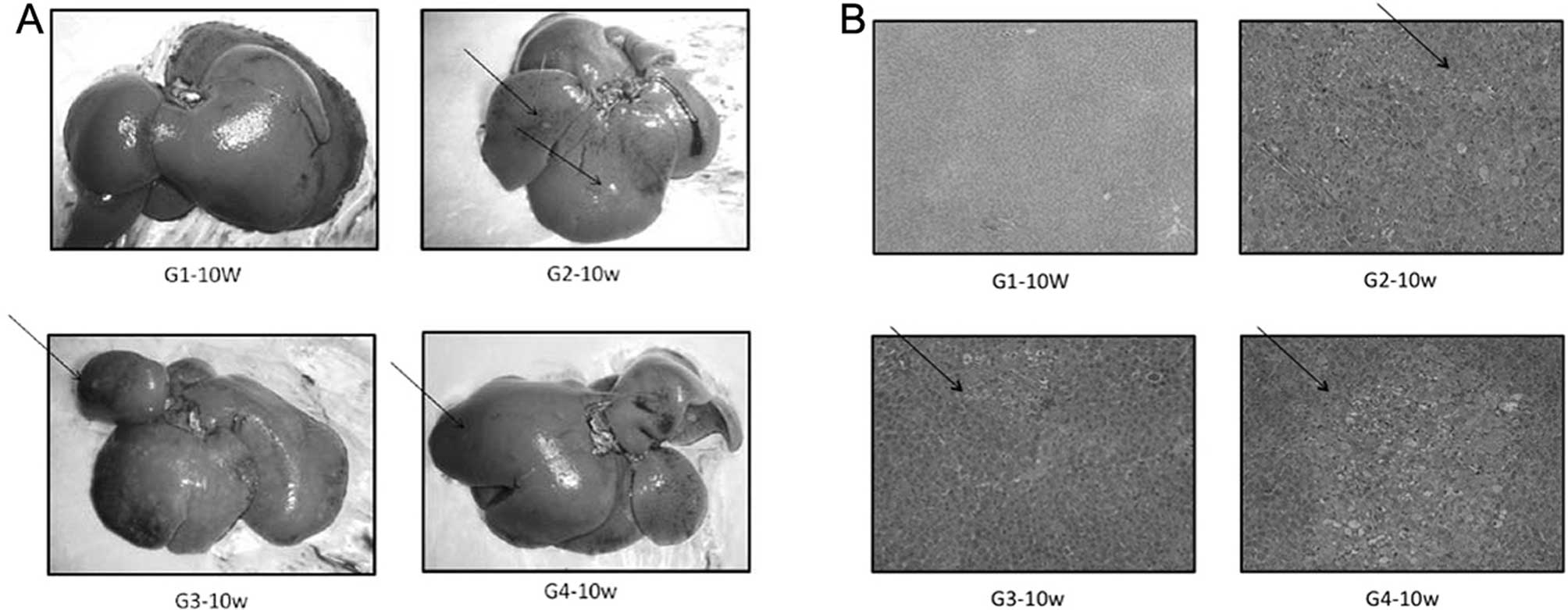
Following the publication of this article, an interested reader drew to our attention an anomaly associated with the presentation of Figs. 3 and 4; essentially, there was the direct duplication of a panel between Fig. 3B, upper left-hand panel (the G1β10W data) and Fig. 4B, also the upper left-hand panel (the G1β14W data).
In the upper-left panels of Fig. 3B and 4B, we wanted to demonstrate microscopic features of the control liver at 10 weeks and 14 weeks, respectively. After having re-examined our original data, we note that we inadvertently duplicated the picture of the control liver at 14 weeks in the upper-left panel of Fig. 3B. A corrected version of Fig. 3 is presented below, in which the G1β10W data in Fig. 3B are now correctly shown. Since G1β10W and G1β14W are control images of the liver, exhibiting a normal appearance, this error did not affect the findings in the study. We sincerely apologize for this mistake, and thank the reader of our article who drew this matter to our attention. Furthermore, we regret any inconvenience this mistake has caused.