Spandidos Publications Logo
  • About
    • About Spandidos
    • Aims and Scopes
    • Abstracting and Indexing
    • Editorial Policies
    • Reprints and Permissions
    • Job Opportunities
    • Terms and Conditions
    • Contact
  • Journals
    • All Journals
    • Oncology Letters
      • Oncology Letters
      • Information for Authors
      • Editorial Policies
      • Editorial Board
      • Aims and Scope
      • Abstracting and Indexing
      • Bibliographic Information
      • Archive
    • International Journal of Oncology
      • International Journal of Oncology
      • Information for Authors
      • Editorial Policies
      • Editorial Board
      • Aims and Scope
      • Abstracting and Indexing
      • Bibliographic Information
      • Archive
    • Molecular and Clinical Oncology
      • Molecular and Clinical Oncology
      • Information for Authors
      • Editorial Policies
      • Editorial Board
      • Aims and Scope
      • Abstracting and Indexing
      • Bibliographic Information
      • Archive
    • Experimental and Therapeutic Medicine
      • Experimental and Therapeutic Medicine
      • Information for Authors
      • Editorial Policies
      • Editorial Board
      • Aims and Scope
      • Abstracting and Indexing
      • Bibliographic Information
      • Archive
    • International Journal of Molecular Medicine
      • International Journal of Molecular Medicine
      • Information for Authors
      • Editorial Policies
      • Editorial Board
      • Aims and Scope
      • Abstracting and Indexing
      • Bibliographic Information
      • Archive
    • Biomedical Reports
      • Biomedical Reports
      • Information for Authors
      • Editorial Policies
      • Editorial Board
      • Aims and Scope
      • Abstracting and Indexing
      • Bibliographic Information
      • Archive
    • Oncology Reports
      • Oncology Reports
      • Information for Authors
      • Editorial Policies
      • Editorial Board
      • Aims and Scope
      • Abstracting and Indexing
      • Bibliographic Information
      • Archive
    • Molecular Medicine Reports
      • Molecular Medicine Reports
      • Information for Authors
      • Editorial Policies
      • Editorial Board
      • Aims and Scope
      • Abstracting and Indexing
      • Bibliographic Information
      • Archive
    • World Academy of Sciences Journal
      • World Academy of Sciences Journal
      • Information for Authors
      • Editorial Policies
      • Editorial Board
      • Aims and Scope
      • Abstracting and Indexing
      • Bibliographic Information
      • Archive
    • International Journal of Functional Nutrition
      • International Journal of Functional Nutrition
      • Information for Authors
      • Editorial Policies
      • Editorial Board
      • Aims and Scope
      • Abstracting and Indexing
      • Bibliographic Information
      • Archive
    • International Journal of Epigenetics
      • International Journal of Epigenetics
      • Information for Authors
      • Editorial Policies
      • Editorial Board
      • Aims and Scope
      • Abstracting and Indexing
      • Bibliographic Information
      • Archive
    • Medicine International
      • Medicine International
      • Information for Authors
      • Editorial Policies
      • Editorial Board
      • Aims and Scope
      • Abstracting and Indexing
      • Bibliographic Information
      • Archive
  • Articles
  • Information
    • Information for Authors
    • Information for Reviewers
    • Information for Librarians
    • Information for Advertisers
    • Conferences
  • Language Editing
Spandidos Publications Logo
  • About
    • About Spandidos
    • Aims and Scopes
    • Abstracting and Indexing
    • Editorial Policies
    • Reprints and Permissions
    • Job Opportunities
    • Terms and Conditions
    • Contact
  • Journals
    • All Journals
    • Biomedical Reports
      • Information for Authors
      • Editorial Policies
      • Editorial Board
      • Aims and Scope
      • Abstracting and Indexing
      • Bibliographic Information
      • Archive
    • Experimental and Therapeutic Medicine
      • Information for Authors
      • Editorial Policies
      • Editorial Board
      • Aims and Scope
      • Abstracting and Indexing
      • Bibliographic Information
      • Archive
    • International Journal of Epigenetics
      • Information for Authors
      • Editorial Policies
      • Editorial Board
      • Aims and Scope
      • Abstracting and Indexing
      • Bibliographic Information
      • Archive
    • International Journal of Functional Nutrition
      • Information for Authors
      • Editorial Policies
      • Editorial Board
      • Aims and Scope
      • Abstracting and Indexing
      • Bibliographic Information
      • Archive
    • International Journal of Molecular Medicine
      • Information for Authors
      • Editorial Policies
      • Editorial Board
      • Aims and Scope
      • Abstracting and Indexing
      • Bibliographic Information
      • Archive
    • International Journal of Oncology
      • Information for Authors
      • Editorial Policies
      • Editorial Board
      • Aims and Scope
      • Abstracting and Indexing
      • Bibliographic Information
      • Archive
    • Medicine International
      • Information for Authors
      • Editorial Policies
      • Editorial Board
      • Aims and Scope
      • Abstracting and Indexing
      • Bibliographic Information
      • Archive
    • Molecular and Clinical Oncology
      • Information for Authors
      • Editorial Policies
      • Editorial Board
      • Aims and Scope
      • Abstracting and Indexing
      • Bibliographic Information
      • Archive
    • Molecular Medicine Reports
      • Information for Authors
      • Editorial Policies
      • Editorial Board
      • Aims and Scope
      • Abstracting and Indexing
      • Bibliographic Information
      • Archive
    • Oncology Letters
      • Information for Authors
      • Editorial Policies
      • Editorial Board
      • Aims and Scope
      • Abstracting and Indexing
      • Bibliographic Information
      • Archive
    • Oncology Reports
      • Information for Authors
      • Editorial Policies
      • Editorial Board
      • Aims and Scope
      • Abstracting and Indexing
      • Bibliographic Information
      • Archive
    • World Academy of Sciences Journal
      • Information for Authors
      • Editorial Policies
      • Editorial Board
      • Aims and Scope
      • Abstracting and Indexing
      • Bibliographic Information
      • Archive
  • Articles
  • Information
    • For Authors
    • For Reviewers
    • For Librarians
    • For Advertisers
    • Conferences
  • Language Editing
Login Register Submit
  • This site uses cookies
  • You can change your cookie settings at any time by following the instructions in our Cookie Policy. To find out more, you may read our Privacy Policy.

    I agree
Search articles by DOI, keyword, author or affiliation
Search
Advanced Search
presentation
International Journal of Oncology
Join Editorial Board Propose a Special Issue
Print ISSN: 1019-6439 Online ISSN: 1791-2423
Journal Cover
February-2018 Volume 52 Issue 2

Full Size Image

Cover Legend PDF

Sign up for eToc alerts
Recommend to Library

Journals

International Journal of Molecular Medicine

International Journal of Molecular Medicine

International Journal of Molecular Medicine is an international journal devoted to molecular mechanisms of human disease.

International Journal of Oncology

International Journal of Oncology

International Journal of Oncology is an international journal devoted to oncology research and cancer treatment.

Molecular Medicine Reports

Molecular Medicine Reports

Covers molecular medicine topics such as pharmacology, pathology, genetics, neuroscience, infectious diseases, molecular cardiology, and molecular surgery.

Oncology Reports

Oncology Reports

Oncology Reports is an international journal devoted to fundamental and applied research in Oncology.

Experimental and Therapeutic Medicine

Experimental and Therapeutic Medicine

Experimental and Therapeutic Medicine is an international journal devoted to laboratory and clinical medicine.

Oncology Letters

Oncology Letters

Oncology Letters is an international journal devoted to Experimental and Clinical Oncology.

Biomedical Reports

Biomedical Reports

Explores a wide range of biological and medical fields, including pharmacology, genetics, microbiology, neuroscience, and molecular cardiology.

Molecular and Clinical Oncology

Molecular and Clinical Oncology

International journal addressing all aspects of oncology research, from tumorigenesis and oncogenes to chemotherapy and metastasis.

World Academy of Sciences Journal

World Academy of Sciences Journal

Multidisciplinary open-access journal spanning biochemistry, genetics, neuroscience, environmental health, and synthetic biology.

International Journal of Functional Nutrition

International Journal of Functional Nutrition

Open-access journal combining biochemistry, pharmacology, immunology, and genetics to advance health through functional nutrition.

International Journal of Epigenetics

International Journal of Epigenetics

Publishes open-access research on using epigenetics to advance understanding and treatment of human disease.

Medicine International

Medicine International

An International Open Access Journal Devoted to General Medicine.

Journal Cover
February-2018 Volume 52 Issue 2

Full Size Image

Cover Legend PDF

Sign up for eToc alerts
Recommend to Library

  • Article
  • Citations
    • Cite This Article
    • Download Citation
    • Create Citation Alert
    • Remove Citation Alert
    • Cited By
  • Similar Articles
    • Related Articles (in Spandidos Publications)
    • Similar Articles (Google Scholar)
    • Similar Articles (PubMed)
  • Download PDF
  • Download XML
  • View XML
Article Open Access

PRL‑3 increases the aggressive phenotype of prostate cancer cells in vitro and its expression correlates with high-grade prostate tumors in patients

  • Authors:
    • Donna R. Edwards
    • Krzysztof Moroz
    • Haitao Zhang
    • David Mulholland
    • Asim B. Abdel-Mageed
    • Debasis Mondal
  • View Affiliations / Copyright

    Affiliations: Department of Pharmacology, Tulane University School of Medicine, New Orleans, LA 70112, USA, Department of Pathology, Tulane University School of Medicine, New Orleans, LA 70112, USA, Tisch Cancer Institute, Icahn School of Medicine at Mount Sinai, New York, NY 10029, USA, Department of Urology, Tulane University School of Medicine, New Orleans, LA 70112, USA
    Copyright: © Edwards et al. This is an open access article distributed under the terms of Creative Commons Attribution License.
  • Pages: 402-412
    |
    Published online on: November 20, 2017
       https://doi.org/10.3892/ijo.2017.4208
  • Expand metrics +
Metrics: Total Views: 0 (Spandidos Publications: | PMC Statistics: )
Metrics: Total PDF Downloads: 0 (Spandidos Publications: | PMC Statistics: )
Cited By (CrossRef): 0 citations Loading Articles...

This article is mentioned in:


Abstract

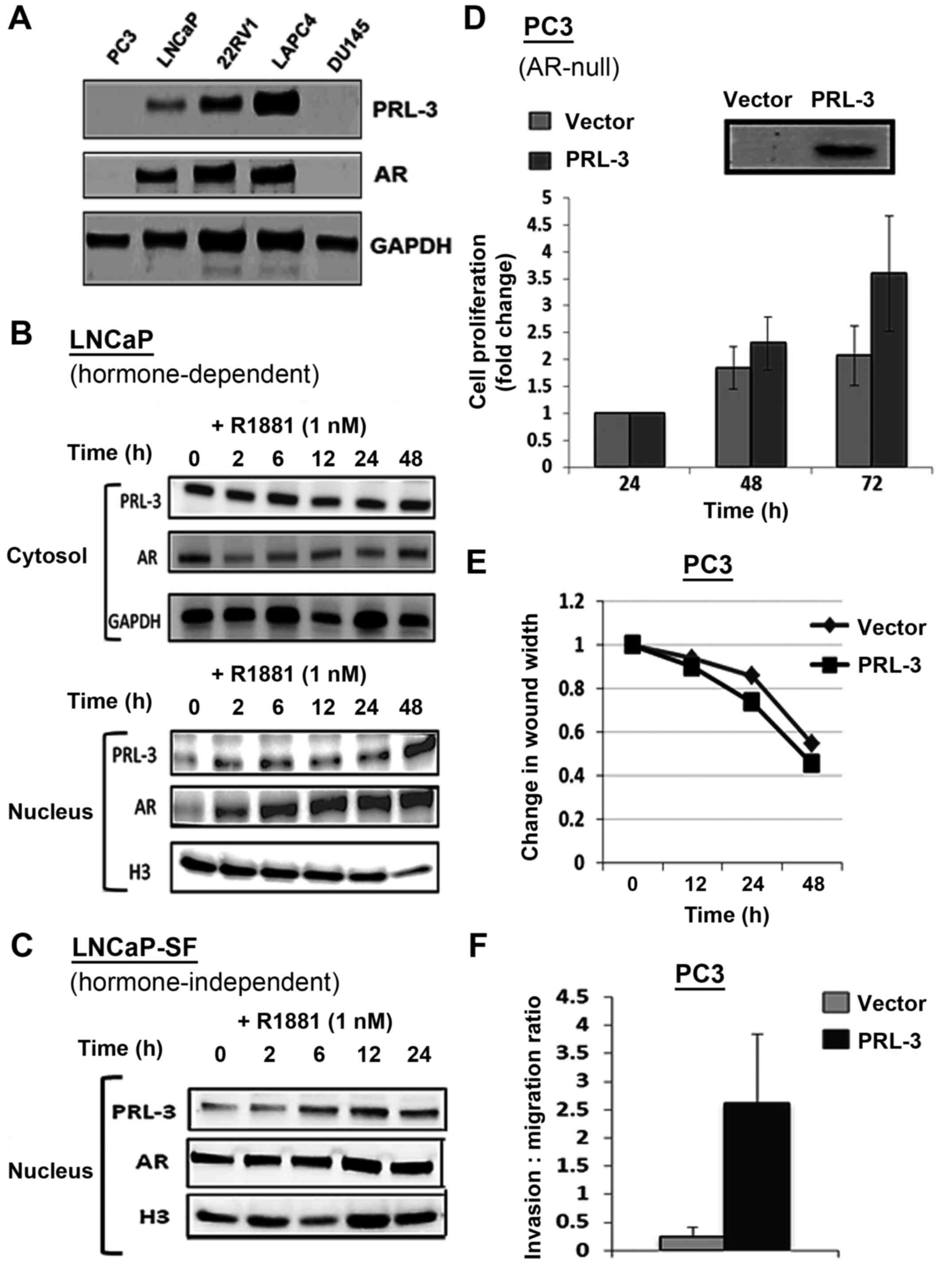
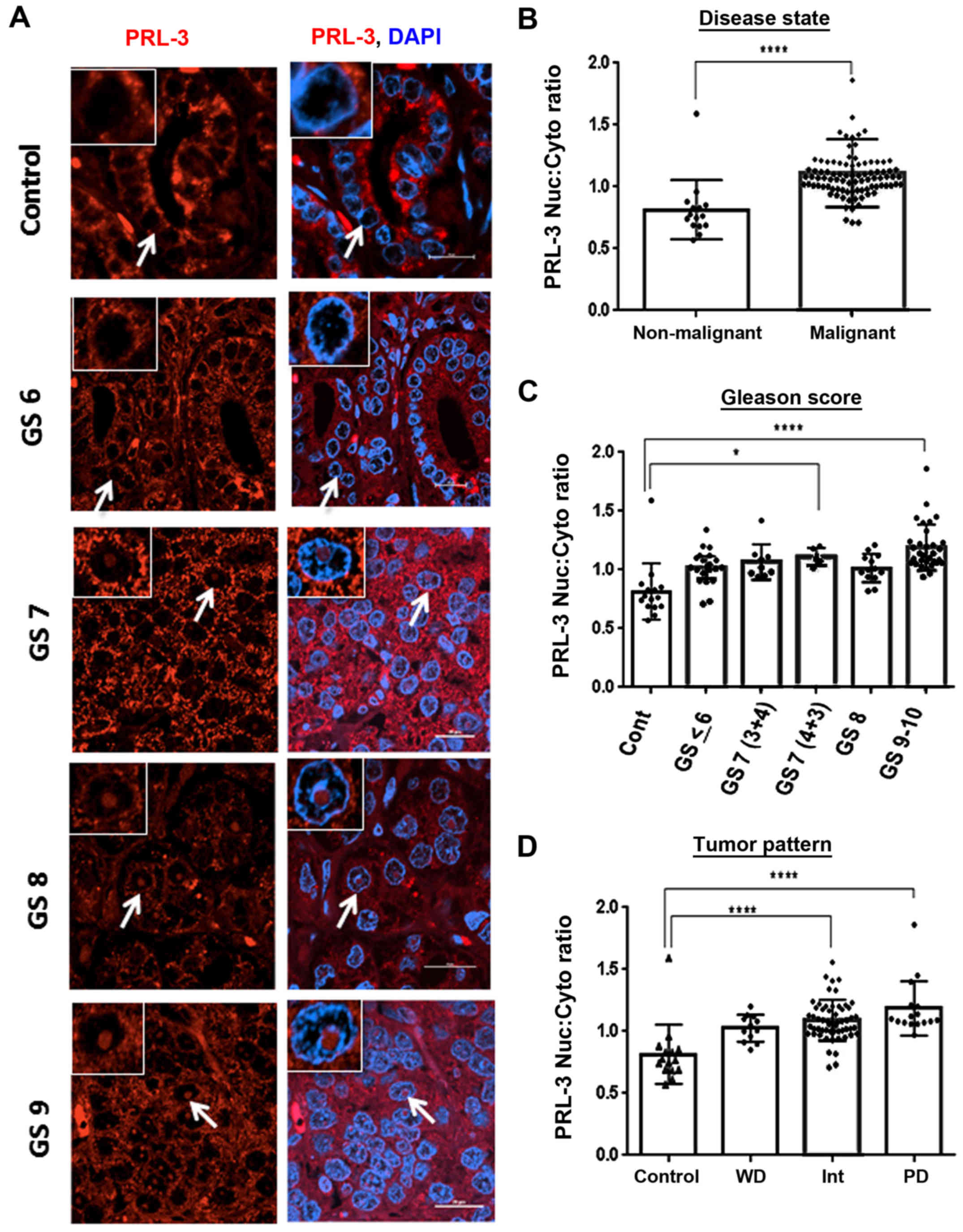
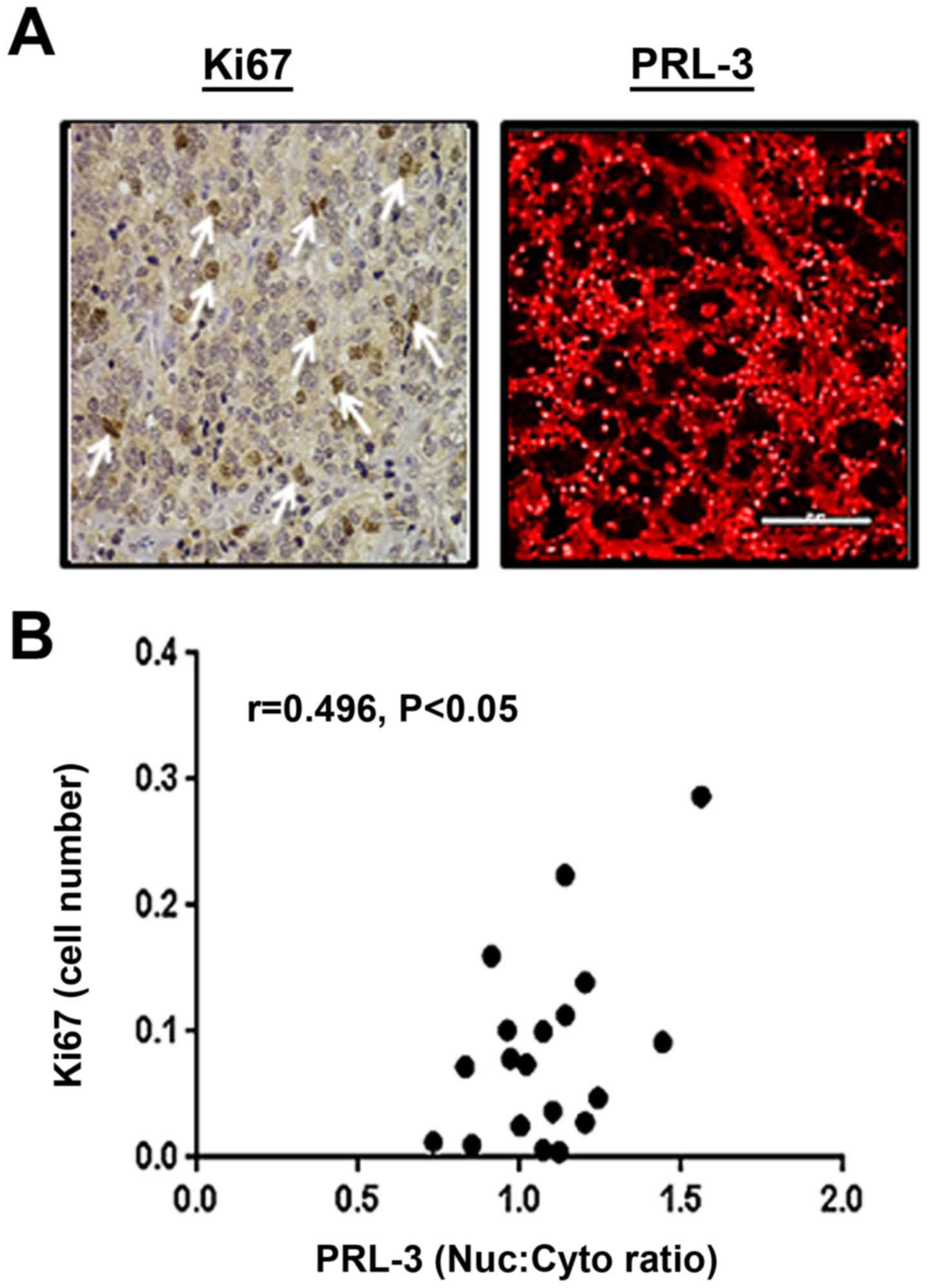
The increased expression of phosphatase of regenerating liver-3 (PRL‑3) has been shown to be associated with the aggressive and metastatic phenotype of different solid tumors. However, it is not known whether PRL‑3 plays a similar role in the progression of prostate cancer (PCa). In this study, immunoblot analysis of androgen receptor (AR)-positive PCa lines (LNCaP and LNCaP‑SF) revealed the constitutive cytoplasmic expression of PRL‑3, and stimulation with R1881 (AR agonist) rapidly increased the nuclear translocation of PRL‑3. The AR-negative cell lines exhibited negligible PRL‑3 expression, and the ectopic overexpression of PRL‑3 increased both the proliferative and invasive potential of PC3 and DU145 cells. In addition, we measured PRL‑3 protein expression in human prostate tumor sections. A high-density prostate tumor microarray (TMA) was immunostained to assess whether PRL‑3 expression and its subcellular localization (cytoplasmic and nuclear levels) is associated with the Gleason score (GS), Gleason grade (GG) and tumor stage (T-stage). Digital image analysis (DIA) revealed that PRL‑3 expression was significantly higher in the malignant cores, as compared to the non‑malignant areas. Increases in both total and nuclear PRL‑3 levels were also associated with a higher GS and GG. Metastatic tumors (T4‑stage) had lower cytoplasmic, but higher nuclear PRL‑3 levels. Furthermore, the nuclear/cytoplasmic ratio for PRL‑3 in the tumors graded as GS7 could effectively distinguish between indolent (3+4) and aggressive (4+3) disease. Thus, our experiments using PCa lines suggested that PRL‑3 is an AR-regulated gene and its androgen-induced nuclear localization may increase the aggressive behavior of PCa cells. Furthermore, the digital analysis of immunostained tumor sections suggested that PRL‑3 may be an effective biomarker of high-grade PCa, and its nuclear/cytoplasmic ratio may be used to distinguish between indolent vs. aggressive tumors.
View Figures

Figure 1

Figure 2

Figure 3

Figure 4

Figure 5

Figure 6

Figure 7

View References

1 

Howlader N, Noone AM, Krapcho M, Garshell J, Miller D, Altekruse SF, Kosary CL, Yu M, Ruhl J, Tatalovich Z, Mariotto A, Lewis DR, Chen HS, Feuer EJ and Cronin KA: SEER Cancer Statistics Review 1975–2011. National Cancer Institute; Bethesda, MD: https://seer.cancer.gov/archive/csr/1975_2011/. Accessed December 17, 2014.

2 

Hayes JH and Barry MJ: Screening for prostate cancer with the prostate-specific antigen test: A review of current evidence. JAMA. 311:1143–1149. 2014. View Article : Google Scholar : PubMed/NCBI

3 

Bussemakers MJ, van Bokhoven A, Verhaegh GW, Smit FP, Karthaus HF, Schalken JA, Debruyne FM, Ru N and Isaacs WB: DD3: A new prostate-specific gene, highly overexpressed in prostate cancer. Cancer Res. 59:5975–5979. 1999.PubMed/NCBI

4 

Tomlins SA, Laxman B, Varambally S, Cao X, Yu J, Helgeson BE, Cao Q, Prensner JR, Rubin MA, Shah RB, et al: Role of the TMPRSS2-ERG gene fusion in prostate cancer. Neoplasia. 10:177–188. 2008. View Article : Google Scholar : PubMed/NCBI

5 

Font-Tello A, Juanpere N, de Muga S, Lorenzo M, Lorente JA, Fumado L, Serrano L, Serrano S, Lloreta J and Hernández S: Association of ERG and TMPRSS2-ERG with grade, stage, and prognosis of prostate cancer is dependent on their expression levels. Prostate. 75:1216–1226. 2015. View Article : Google Scholar : PubMed/NCBI

6 

Penney KL, Pettersson A, Shui IM, Graff RE, Kraft P, Lis RT, Sesso HD, Loda M and Mucci LA: Association of prostate cancer risk variants with TMPRSS2:ERG status: Evidence for distinct molecular subtypes. Cancer Epidemiol Biomarkers Prev. 25:745–749. 2016. View Article : Google Scholar : PubMed/NCBI

7 

Al-Aidaroos AQ and Zeng Q: PRL-3 phosphatase and cancer metastasis. J Cell Biochem. 111:1087–1098. 2010. View Article : Google Scholar : PubMed/NCBI

8 

Liu Y, Zhou J, Chen J, Gao W, Le Y, Ding Y and Li J: PRL-3 promotes epithelial mesenchymal transition by regulating cadherin directly. Cancer Biol Ther. 8:1352–1359. 2009. View Article : Google Scholar : PubMed/NCBI

9 

Basak S, Jacobs SB, Krieg AJ, Pathak N, Zeng Q, Kaldis P, Giaccia AJ and Attardi LD: The metastasis-associated gene Prl-3 is a p53 target involved in cell-cycle regulation. Mol Cell. 30:303–314. 2008. View Article : Google Scholar : PubMed/NCBI

10 

Min SH, Kim DM, Heo YS, Kim HM, Kim IC and Yoo OJ: Downregulation of p53 by phosphatase of regenerating liver 3 is mediated by MDM2 and IRH2. Life Sci. 86:66–72. 2010. View Article : Google Scholar

11 

Wang H, Quah SY, Dong JM, Manser E, Tang JP and Zeng Q: PRL-3 down-regulates PTEN expression and signals through PI3K to promote epithelial-mesenchymal transition. Cancer Res. 67:2922–2926. 2007. View Article : Google Scholar : PubMed/NCBI

12 

den Hollander P, Rawls K, Tsimelzon A, Shepherd J, Mazumdar A, Hill J, Fuqua SA, Chang JC, Osborne CK, Hilsenbeck SG, et al: Phosphatase PTP4A3 promotes triple-negative breast cancer growth and predicts poor patient survival. Cancer Res. 76:1942–1953. 2016. View Article : Google Scholar : PubMed/NCBI

13 

Xu H, Zeng Y, Liu L, Gao Q, Jin S, Lan Q, Lai W, Luo X, Wu H, Huang Y, et al: PRL-3 improves colorectal cancer cell proliferation and invasion through IL-8 mediated glycolysis metabolism. Int J Oncol. 51:1271–1279. 2017.PubMed/NCBI

14 

Jiang Y, Liu XQ, Rajput A, Geng L, Ongchin M, Zeng Q, Taylor GS and Wang J: Phosphatase PRL-3 is a direct regulatory target of TGFbeta in colon cancer metastasis. Cancer Res. 71:234–244. 2011. View Article : Google Scholar

15 

Iwasa Y, Mizokami A, Miwa S, Koshida K and Namiki M: Establishment and characterization of androgen-independent human prostate cancer cell lines, LN-REC4 and LNCaP-SF, from LNCaP. Int J Urol. 14:233–239. 2007. View Article : Google Scholar : PubMed/NCBI

16 

van Bokhoven A, Varella-Garcia M, Korch C, Johannes WU, Smith EE, Miller HL, Nordeen SK, Miller GJ and Lucia MS: Molecular characterization of human prostate carcinoma cell lines. Prostate. 57:205–225. 2003. View Article : Google Scholar : PubMed/NCBI

17 

Noursadeghi M, Tsang J, Haustein T, Miller RF, Chain BM and Katz DR: Quantitative imaging assay for NF-kappaB nuclear translocation in primary human macrophages. J Immunol Methods. 329:194–200. 2008. View Article : Google Scholar :

18 

Rubin MA, Mucci NR, Figurski J, Fecko A, Pienta KJ and Day ML: E-cadherin expression in prostate cancer: A broad survey using high-density tissue microarray technology. Hum Pathol. 32:690–697. 2001. View Article : Google Scholar : PubMed/NCBI

19 

McMenamin ME, Soung P, Perera S, Kaplan I, Loda M and Sellers WR: Loss of PTEN expression in paraffin-embedded primary prostate cancer correlates with high Gleason score and advanced stage. Cancer Res. 59:4291–4296. 1999.PubMed/NCBI

20 

Rhodes DR, Yu J, Shanker K, Deshpande N, Varambally R, Ghosh D, Barrette T, Pandey A and Chinnaiyan AM: ONCOMINE: A cancer microarray database and integrated data-mining platform. Neoplasia. 6:1–6. 2004. View Article : Google Scholar : PubMed/NCBI

21 

Liu P, Ramachandran S, Ali Seyed M, Scharer CD, Laycock N, Dalton WB, Williams H, Karanam S, Datta MW, Jaye DL, et al: Sex-determining region Y box 4 is a transforming oncogene in human prostate cancer cells. Cancer Res. 66:4011–4019. 2006. View Article : Google Scholar : PubMed/NCBI

22 

Wallace TA, Prueitt RL, Yi M, Howe TM, Gillespie JW, Yfantis HG, Stephens RM, Caporaso NE, Loffredo CA and Ambs S: Tumor immunobiological differences in prostate cancer between African-American and European-American men. Cancer Res. 68:927–936. 2008. View Article : Google Scholar : PubMed/NCBI

23 

Taylor BS, Schultz N, Hieronymus H, Gopalan A, Xiao Y, Carver BS, Arora VK, Kaushik P, Cerami E, Reva B, et al: Integrative genomic profiling of human prostate cancer. Cancer Cell. 18:11–22. 2010. View Article : Google Scholar : PubMed/NCBI

24 

Grasso CS, Wu YM, Robinson DR, Cao X, Dhanasekaran SM, Khan AP, Quist MJ, Jing X, Lonigro RJ, Brenner JC, et al: The mutational landscape of lethal castration-resistant prostate cancer. Nature. 487:239–243. 2012. View Article : Google Scholar : PubMed/NCBI

25 

Chong PS, Zhou J, Cheong LL, Liu SC, Qian J, Guo T, Sze SK, Zeng Q and Chng WJ: LEO1 is regulated by PRL-3 and mediates its oncogenic properties in acute myelogenous leukemia. Cancer Res. 74:3043–3053. 2014. View Article : Google Scholar : PubMed/NCBI

26 

Liu Y, Zheng P, Liu Y, Ji T, Liu X, Yao S, Cheng X, Li Y, Chen L, Xiao Z, et al: An epigenetic role for PRL-3 as a regulator of H3K9 methylation in colorectal cancer. Gut. 62:571–581. 2013. View Article : Google Scholar

27 

van Oort IM, Witjes JA, Kok DE, Kiemeney LA and Hulsbergen-Van De Kaa CA: The prognostic role of the pathological T2 subclassification for prostate cancer in the 2002 Tumour-Nodes-Metastasis staging system. BJU Int. 102:438–441. 2008. View Article : Google Scholar : PubMed/NCBI

28 

Caso JR, Tsivian M, Mouraviev V, Polascik TJ and Moul JW: Pathological T2 sub-divisions as a prognostic factor in the biochemical recurrence of prostate cancer. BJU Int. 106:1623–1627. 2010. View Article : Google Scholar : PubMed/NCBI

29 

Wang L, Peng L, Dong B, Kong L, Meng L, Yan L, Xie Y and Shou C: Overexpression of phosphatase of regenerating liver-3 in breast cancer: Association with a poor clinical outcome. Ann Oncol. 17:1517–1522. 2006. View Article : Google Scholar : PubMed/NCBI

30 

Ooki A, Yamashita K, Kikuchi S, Sakuramoto S, Katada N, Waraya M, Kawamata H, Nishimiya H, Nakamura K and Watanabe M: Therapeutic potential of PRL-3 targeting and clinical significance of PRL-3 genomic amplification in gastric cancer. BMC Cancer. 11:1222011. View Article : Google Scholar : PubMed/NCBI

31 

Xing X, Lian S, Hu Y, Li Z, Zhang L, Wen X, Du H, Jia Y, Zheng Z, Meng L, et al: Phosphatase of regenerating liver-3 (PRL-3) is associated with metastasis and poor prognosis in gastric carcinoma. J Transl Med. 11:3092013. View Article : Google Scholar : PubMed/NCBI

32 

Polato F, Codegoni A, Fruscio R, Perego P, Mangioni C, Saha S, Bardelli A and Broggini M: PRL-3 phosphatase is implicated in ovarian cancer growth. Clin Cancer Res. 11:6835–6839. 2005. View Article : Google Scholar : PubMed/NCBI

33 

Liang F, Liang J, Wang WQ, Sun JP, Udho E and Zhang ZY: PRL3 promotes cell invasion and proliferation by down-regulation of Csk leading to Src activation. J Biol Chem. 282:5413–5419. 2007. View Article : Google Scholar

34 

Ming J, Liu N, Gu Y, Qiu X and Wang EH: PRL-3 facilitates angiogenesis and metastasis by increasing ERK phosphorylation and up-regulating the levels and activities of Rho-A/C in lung cancer. Pathology. 41:118–126. 2009. View Article : Google Scholar : PubMed/NCBI

35 

Vandsemb EN, Bertilsson H, Abdollahi P, Størkersen Ø, Våtsveen TK, Rye MB, Rø TB, Børset M and Slørdahl TS: Phosphatase of regenerating liver 3 (PRL-3) is overexpressed in human prostate cancer tissue and promotes growth and migration. J Transl Med. 14:712016. View Article : Google Scholar : PubMed/NCBI

36 

Burk U, Selter H, Zwergel T, Wullich B, Montenarh M and Unteregger G: Different subnuclear localization of wild-type and mutant p53 in human prostate-cancer cells. Int J Oncol. 7:1355–1360. 1995.PubMed/NCBI

37 

Vlatković N, Boyd MT and Rubbi CP: Nucleolar control of p53: A cellular Achilles' heel and a target for cancer therapy. Cell Mol Life Sci. 71:771–791. 2014. View Article : Google Scholar

38 

Fagerli UM, Holt RU, Holien T, Vaatsveen TK, Zhan F, Egeberg KW, Barlogie B, Waage A, Aarset H, Dai HY, et al: Overexpression and involvement in migration by the metastasis-associated phosphatase PRL-3 in human myeloma cells. Blood. 111:806–815. 2008. View Article : Google Scholar

39 

Hein N, Hannan KM, George AJ, Sanij E and Hannan RD: The nucleolus: An emerging target for cancer therapy. Trends Mol Med. 19:643–654. 2013. View Article : Google Scholar : PubMed/NCBI

40 

Romero Otero J, Garcia Gomez B, Campos Juanatey F and Touijer KA: Prostate cancer biomarkers: An update. Urol Oncol. 32:252–260. 2014. View Article : Google Scholar : PubMed/NCBI

41 

Donovan MJ and Cordon-Cardo C: Predicting high-risk disease using tissue biomarkers. Curr Opin Urol. 23:245–251. 2013.PubMed/NCBI

42 

Stålhammar G, Fuentes Martinez N, Lippert M, Tobin NP, Mølholm I, Kis L, Rosin G, Rantalainen M, Pedersen L, Bergh J, et al: Digital image analysis outperforms manual biomarker assessment in breast cancer. Mod Pathol. 29:318–329. 2016. View Article : Google Scholar : PubMed/NCBI

43 

Khurana N, Talwar S, Chandra PK, Sharma P, Abdel-Mageed AB, Mondal D and Sikka SC: Sulforaphane increases the efficacy of anti-androgens by rapidly decreasing androgen receptor levels in prostate cancer cells. Int J Oncol. 49:1609–1619. 2016. View Article : Google Scholar : PubMed/NCBI

44 

Khurana N, Kim H, Chandra PK, Talwar S, Sharma P, Abdel-Mageed AB, Sikka SC and Mondal D: Multimodal actions of the phytochemical sulforaphane suppress both AR and AR-V7 in 22Rv1 cells: Advocating a potent pharmaceutical combination against castration-resistant prostate cancer. Oncol Rep. 38:2774–2786. 2017.PubMed/NCBI

Related Articles

  • Abstract
  • View
  • Download
  • Twitter
Copy and paste a formatted citation
Spandidos Publications style
Edwards DR, Moroz K, Zhang H, Mulholland D, Abdel-Mageed AB and Mondal D: PRL‑3 increases the aggressive phenotype of prostate cancer cells in vitro and its expression correlates with high-grade prostate tumors in patients. Int J Oncol 52: 402-412, 2018.
APA
Edwards, D.R., Moroz, K., Zhang, H., Mulholland, D., Abdel-Mageed, A.B., & Mondal, D. (2018). PRL‑3 increases the aggressive phenotype of prostate cancer cells in vitro and its expression correlates with high-grade prostate tumors in patients. International Journal of Oncology, 52, 402-412. https://doi.org/10.3892/ijo.2017.4208
MLA
Edwards, D. R., Moroz, K., Zhang, H., Mulholland, D., Abdel-Mageed, A. B., Mondal, D."PRL‑3 increases the aggressive phenotype of prostate cancer cells in vitro and its expression correlates with high-grade prostate tumors in patients". International Journal of Oncology 52.2 (2018): 402-412.
Chicago
Edwards, D. R., Moroz, K., Zhang, H., Mulholland, D., Abdel-Mageed, A. B., Mondal, D."PRL‑3 increases the aggressive phenotype of prostate cancer cells in vitro and its expression correlates with high-grade prostate tumors in patients". International Journal of Oncology 52, no. 2 (2018): 402-412. https://doi.org/10.3892/ijo.2017.4208
Copy and paste a formatted citation
x
Spandidos Publications style
Edwards DR, Moroz K, Zhang H, Mulholland D, Abdel-Mageed AB and Mondal D: PRL‑3 increases the aggressive phenotype of prostate cancer cells in vitro and its expression correlates with high-grade prostate tumors in patients. Int J Oncol 52: 402-412, 2018.
APA
Edwards, D.R., Moroz, K., Zhang, H., Mulholland, D., Abdel-Mageed, A.B., & Mondal, D. (2018). PRL‑3 increases the aggressive phenotype of prostate cancer cells in vitro and its expression correlates with high-grade prostate tumors in patients. International Journal of Oncology, 52, 402-412. https://doi.org/10.3892/ijo.2017.4208
MLA
Edwards, D. R., Moroz, K., Zhang, H., Mulholland, D., Abdel-Mageed, A. B., Mondal, D."PRL‑3 increases the aggressive phenotype of prostate cancer cells in vitro and its expression correlates with high-grade prostate tumors in patients". International Journal of Oncology 52.2 (2018): 402-412.
Chicago
Edwards, D. R., Moroz, K., Zhang, H., Mulholland, D., Abdel-Mageed, A. B., Mondal, D."PRL‑3 increases the aggressive phenotype of prostate cancer cells in vitro and its expression correlates with high-grade prostate tumors in patients". International Journal of Oncology 52, no. 2 (2018): 402-412. https://doi.org/10.3892/ijo.2017.4208
Follow us
  • Twitter
  • LinkedIn
  • Facebook
About
  • Spandidos Publications
  • Careers
  • Cookie Policy
  • Privacy Policy
How can we help?
  • Help
  • Live Chat
  • Contact
  • Email to our Support Team