International Journal of Molecular Medicine is an international journal devoted to molecular mechanisms of human disease.
International Journal of Oncology is an international journal devoted to oncology research and cancer treatment.
Covers molecular medicine topics such as pharmacology, pathology, genetics, neuroscience, infectious diseases, molecular cardiology, and molecular surgery.
Oncology Reports is an international journal devoted to fundamental and applied research in Oncology.
Experimental and Therapeutic Medicine is an international journal devoted to laboratory and clinical medicine.
Oncology Letters is an international journal devoted to Experimental and Clinical Oncology.
Explores a wide range of biological and medical fields, including pharmacology, genetics, microbiology, neuroscience, and molecular cardiology.
International journal addressing all aspects of oncology research, from tumorigenesis and oncogenes to chemotherapy and metastasis.
Multidisciplinary open-access journal spanning biochemistry, genetics, neuroscience, environmental health, and synthetic biology.
Open-access journal combining biochemistry, pharmacology, immunology, and genetics to advance health through functional nutrition.
Publishes open-access research on using epigenetics to advance understanding and treatment of human disease.
An International Open Access Journal Devoted to General Medicine.
Int J Oncol 53: [Related article:] 2789–2799, 2018; DOI: 10.3892/ijo.2018.4562
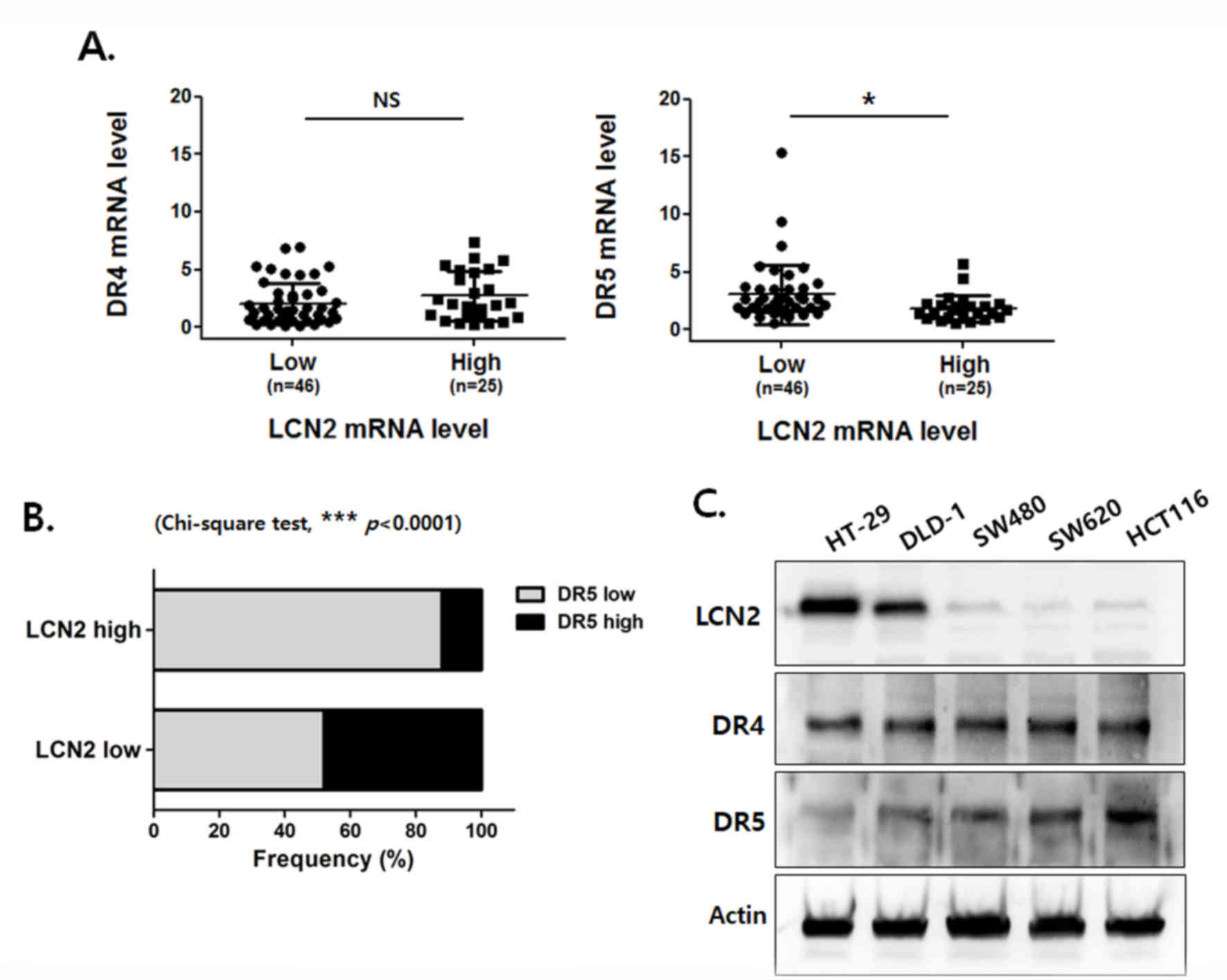
Following the publication of this article, an interested reader drew to our attention that Fig. 1C contained an important flaw. The Figure shows a western blot for LCN2, DR4, DR5, and actin, and it was noted that the identical bands shown for actin were also featured in a paper by the same authors published in 2017 [Lipocalin 2 negatively regulates cell proliferation and epithelial to mesenchymal transition through changing metabolic gene expression in colorectal cancer. Kim SL, Lee ST, Min IS, Park YR, Lee JH, Kim DG and Kim SW: Cancer Sci 108: 2176-2186, 2017], except that the lanes for the cell lines HCT116 and SW620 were depicted the other way around in the International Journal of Oncology article.
Upon investigating the matter with the authors, they were able to confirm that the lanes were labelled incorrectly in the Figure itself; moreover, the incorrect control bands were included with the Figure. The corrected version of Fig. 1 is shown opposite, including the correct control data for Fig. 1C. This error did not have an impact on the overall meaning of the paper, or on the reported conclusions of this study. The authors regret that this error was introduced into the printed version of the paper, and apologize to the readership for any inconvenience caused.