Spandidos Publications Logo
  • About
    • About Spandidos
    • Aims and Scopes
    • Abstracting and Indexing
    • Editorial Policies
    • Reprints and Permissions
    • Job Opportunities
    • Terms and Conditions
    • Contact
  • Journals
    • All Journals
    • Oncology Letters
      • Oncology Letters
      • Information for Authors
      • Editorial Policies
      • Editorial Board
      • Aims and Scope
      • Abstracting and Indexing
      • Bibliographic Information
      • Archive
    • International Journal of Oncology
      • International Journal of Oncology
      • Information for Authors
      • Editorial Policies
      • Editorial Board
      • Aims and Scope
      • Abstracting and Indexing
      • Bibliographic Information
      • Archive
    • Molecular and Clinical Oncology
      • Molecular and Clinical Oncology
      • Information for Authors
      • Editorial Policies
      • Editorial Board
      • Aims and Scope
      • Abstracting and Indexing
      • Bibliographic Information
      • Archive
    • Experimental and Therapeutic Medicine
      • Experimental and Therapeutic Medicine
      • Information for Authors
      • Editorial Policies
      • Editorial Board
      • Aims and Scope
      • Abstracting and Indexing
      • Bibliographic Information
      • Archive
    • International Journal of Molecular Medicine
      • International Journal of Molecular Medicine
      • Information for Authors
      • Editorial Policies
      • Editorial Board
      • Aims and Scope
      • Abstracting and Indexing
      • Bibliographic Information
      • Archive
    • Biomedical Reports
      • Biomedical Reports
      • Information for Authors
      • Editorial Policies
      • Editorial Board
      • Aims and Scope
      • Abstracting and Indexing
      • Bibliographic Information
      • Archive
    • Oncology Reports
      • Oncology Reports
      • Information for Authors
      • Editorial Policies
      • Editorial Board
      • Aims and Scope
      • Abstracting and Indexing
      • Bibliographic Information
      • Archive
    • Molecular Medicine Reports
      • Molecular Medicine Reports
      • Information for Authors
      • Editorial Policies
      • Editorial Board
      • Aims and Scope
      • Abstracting and Indexing
      • Bibliographic Information
      • Archive
    • World Academy of Sciences Journal
      • World Academy of Sciences Journal
      • Information for Authors
      • Editorial Policies
      • Editorial Board
      • Aims and Scope
      • Abstracting and Indexing
      • Bibliographic Information
      • Archive
    • International Journal of Functional Nutrition
      • International Journal of Functional Nutrition
      • Information for Authors
      • Editorial Policies
      • Editorial Board
      • Aims and Scope
      • Abstracting and Indexing
      • Bibliographic Information
      • Archive
    • International Journal of Epigenetics
      • International Journal of Epigenetics
      • Information for Authors
      • Editorial Policies
      • Editorial Board
      • Aims and Scope
      • Abstracting and Indexing
      • Bibliographic Information
      • Archive
    • Medicine International
      • Medicine International
      • Information for Authors
      • Editorial Policies
      • Editorial Board
      • Aims and Scope
      • Abstracting and Indexing
      • Bibliographic Information
      • Archive
  • Articles
  • Information
    • Information for Authors
    • Information for Reviewers
    • Information for Librarians
    • Information for Advertisers
    • Conferences
  • Language Editing
Spandidos Publications Logo
  • About
    • About Spandidos
    • Aims and Scopes
    • Abstracting and Indexing
    • Editorial Policies
    • Reprints and Permissions
    • Job Opportunities
    • Terms and Conditions
    • Contact
  • Journals
    • All Journals
    • Biomedical Reports
      • Information for Authors
      • Editorial Policies
      • Editorial Board
      • Aims and Scope
      • Abstracting and Indexing
      • Bibliographic Information
      • Archive
    • Experimental and Therapeutic Medicine
      • Information for Authors
      • Editorial Policies
      • Editorial Board
      • Aims and Scope
      • Abstracting and Indexing
      • Bibliographic Information
      • Archive
    • International Journal of Epigenetics
      • Information for Authors
      • Editorial Policies
      • Editorial Board
      • Aims and Scope
      • Abstracting and Indexing
      • Bibliographic Information
      • Archive
    • International Journal of Functional Nutrition
      • Information for Authors
      • Editorial Policies
      • Editorial Board
      • Aims and Scope
      • Abstracting and Indexing
      • Bibliographic Information
      • Archive
    • International Journal of Molecular Medicine
      • Information for Authors
      • Editorial Policies
      • Editorial Board
      • Aims and Scope
      • Abstracting and Indexing
      • Bibliographic Information
      • Archive
    • International Journal of Oncology
      • Information for Authors
      • Editorial Policies
      • Editorial Board
      • Aims and Scope
      • Abstracting and Indexing
      • Bibliographic Information
      • Archive
    • Medicine International
      • Information for Authors
      • Editorial Policies
      • Editorial Board
      • Aims and Scope
      • Abstracting and Indexing
      • Bibliographic Information
      • Archive
    • Molecular and Clinical Oncology
      • Information for Authors
      • Editorial Policies
      • Editorial Board
      • Aims and Scope
      • Abstracting and Indexing
      • Bibliographic Information
      • Archive
    • Molecular Medicine Reports
      • Information for Authors
      • Editorial Policies
      • Editorial Board
      • Aims and Scope
      • Abstracting and Indexing
      • Bibliographic Information
      • Archive
    • Oncology Letters
      • Information for Authors
      • Editorial Policies
      • Editorial Board
      • Aims and Scope
      • Abstracting and Indexing
      • Bibliographic Information
      • Archive
    • Oncology Reports
      • Information for Authors
      • Editorial Policies
      • Editorial Board
      • Aims and Scope
      • Abstracting and Indexing
      • Bibliographic Information
      • Archive
    • World Academy of Sciences Journal
      • Information for Authors
      • Editorial Policies
      • Editorial Board
      • Aims and Scope
      • Abstracting and Indexing
      • Bibliographic Information
      • Archive
  • Articles
  • Information
    • For Authors
    • For Reviewers
    • For Librarians
    • For Advertisers
    • Conferences
  • Language Editing
Login Register Submit
  • This site uses cookies
  • You can change your cookie settings at any time by following the instructions in our Cookie Policy. To find out more, you may read our Privacy Policy.

    I agree
Search articles by DOI, keyword, author or affiliation
Search
Advanced Search
presentation
International Journal of Oncology
Join Editorial Board Propose a Special Issue
Print ISSN: 1019-6439 Online ISSN: 1791-2423
Journal Cover
April-2021 Volume 58 Issue 4

Full Size Image

Cover Legend PDF

Sign up for eToc alerts
Recommend to Library

Journals

International Journal of Molecular Medicine

International Journal of Molecular Medicine

International Journal of Molecular Medicine is an international journal devoted to molecular mechanisms of human disease.

International Journal of Oncology

International Journal of Oncology

International Journal of Oncology is an international journal devoted to oncology research and cancer treatment.

Molecular Medicine Reports

Molecular Medicine Reports

Covers molecular medicine topics such as pharmacology, pathology, genetics, neuroscience, infectious diseases, molecular cardiology, and molecular surgery.

Oncology Reports

Oncology Reports

Oncology Reports is an international journal devoted to fundamental and applied research in Oncology.

Experimental and Therapeutic Medicine

Experimental and Therapeutic Medicine

Experimental and Therapeutic Medicine is an international journal devoted to laboratory and clinical medicine.

Oncology Letters

Oncology Letters

Oncology Letters is an international journal devoted to Experimental and Clinical Oncology.

Biomedical Reports

Biomedical Reports

Explores a wide range of biological and medical fields, including pharmacology, genetics, microbiology, neuroscience, and molecular cardiology.

Molecular and Clinical Oncology

Molecular and Clinical Oncology

International journal addressing all aspects of oncology research, from tumorigenesis and oncogenes to chemotherapy and metastasis.

World Academy of Sciences Journal

World Academy of Sciences Journal

Multidisciplinary open-access journal spanning biochemistry, genetics, neuroscience, environmental health, and synthetic biology.

International Journal of Functional Nutrition

International Journal of Functional Nutrition

Open-access journal combining biochemistry, pharmacology, immunology, and genetics to advance health through functional nutrition.

International Journal of Epigenetics

International Journal of Epigenetics

Publishes open-access research on using epigenetics to advance understanding and treatment of human disease.

Medicine International

Medicine International

An International Open Access Journal Devoted to General Medicine.

Journal Cover
April-2021 Volume 58 Issue 4

Full Size Image

Cover Legend PDF

Sign up for eToc alerts
Recommend to Library

  • Article
  • Citations
    • Cite This Article
    • Download Citation
    • Create Citation Alert
    • Remove Citation Alert
    • Cited By
  • Similar Articles
    • Related Articles (in Spandidos Publications)
    • Similar Articles (Google Scholar)
    • Similar Articles (PubMed)
  • Download PDF
  • Download XML
  • View XML
Article Open Access

Ingredients such as trehalose and hesperidin taken as supplements or foods reverse alterations in human T cells, reducing asbestos exposure-induced antitumor immunity

  • Authors:
    • Shoko Yamamoto
    • Suni Lee
    • Toshio Ariyasu
    • Shin Endo
    • Satomi Miyata
    • Akiko Yasuda
    • Akira Harashima
    • Tsunetaka Ohta
    • Naoko Kumagai-Τakei
    • Tatsuo Ito
    • Yurika Shimizu
    • Bandaru Srinivas
    • Nagisa Sada
    • Yasumitsu Nishimura
    • Takemi Otsuki
  • View Affiliations / Copyright

    Affiliations: Department of Hygiene, Kawasaki Medical School, Kurashiki, Okayama 701-0192, Japan, R&D Division, Hayashibara Co., Ltd., Naka-ku, Okayama 702-8006, Japan, Department of Pathophysiology-Periodontal Science, Okayama University Graduate School of Medicine, Dentistry and Pharmaceutical Sciences, Kita-ku, Okayama 700-0867, Japan
    Copyright: © Yamamoto et al. This is an open access article distributed under the terms of Creative Commons Attribution License.
  • Article Number: 2
    |
    Published online on: February 2, 2021
       https://doi.org/10.3892/ijo.2021.5182
  • Expand metrics +
Metrics: Total Views: 0 (Spandidos Publications: | PMC Statistics: )
Metrics: Total PDF Downloads: 0 (Spandidos Publications: | PMC Statistics: )
Cited By (CrossRef): 0 citations Loading Articles...

This article is mentioned in:


Abstract

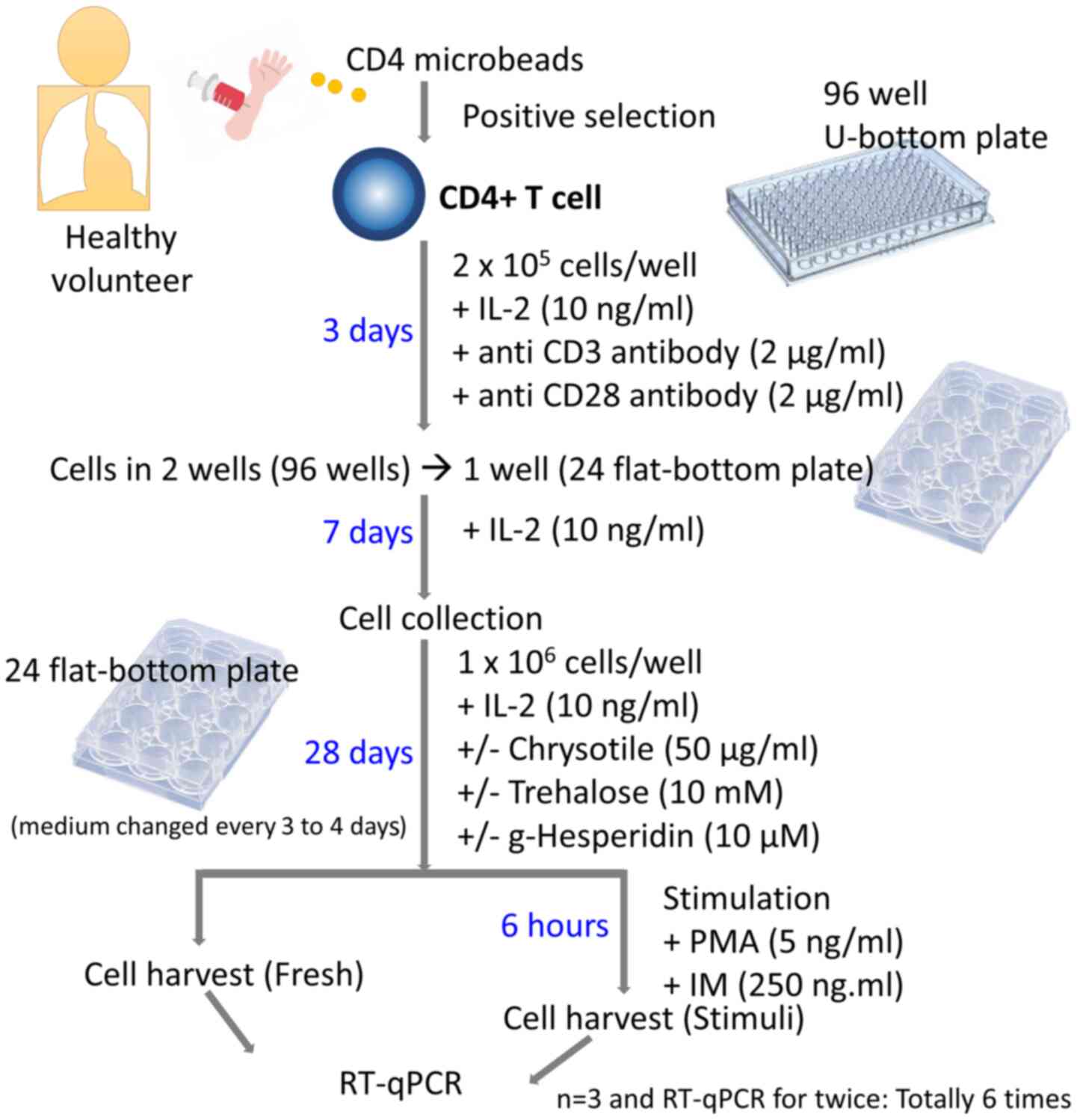
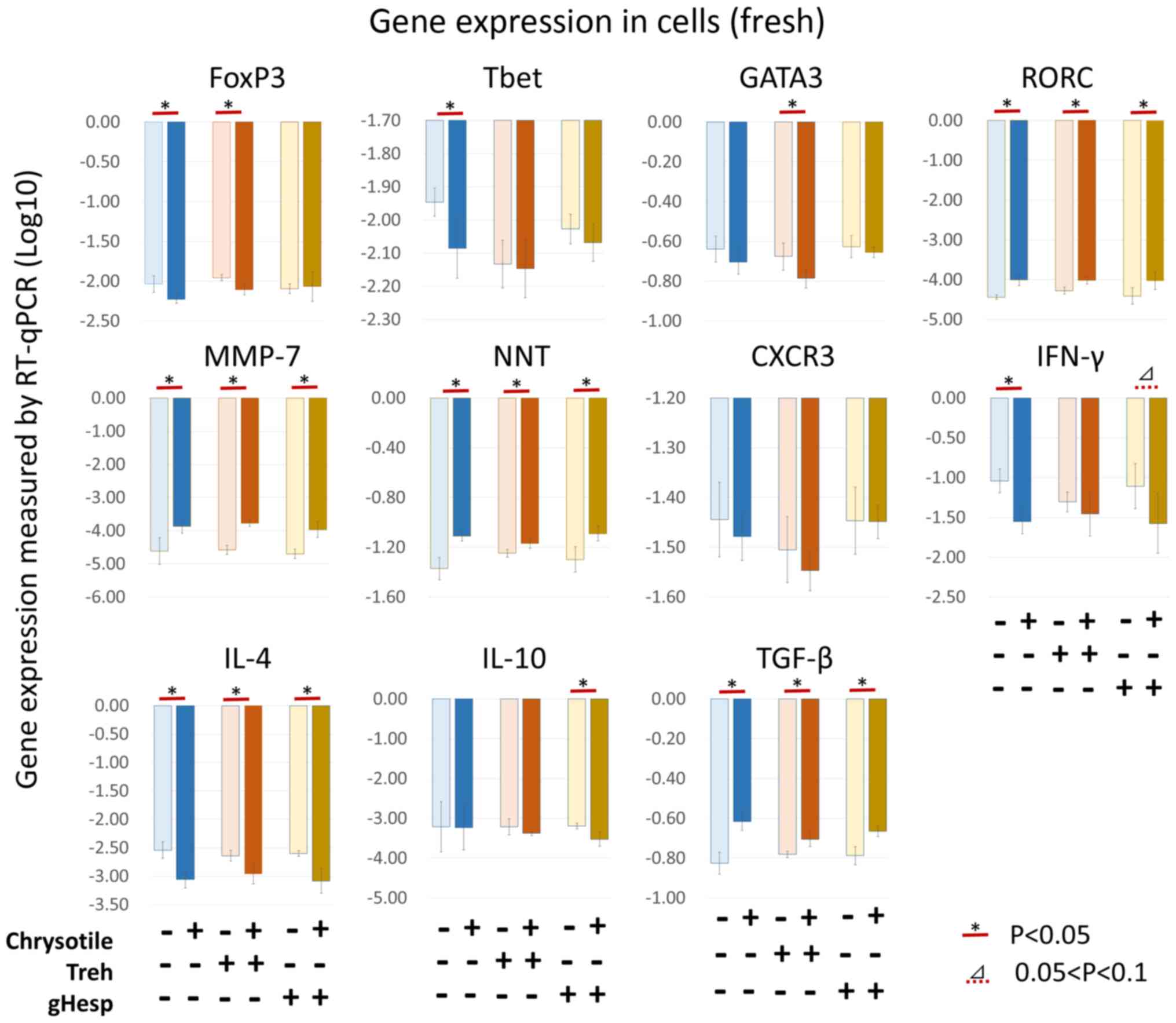
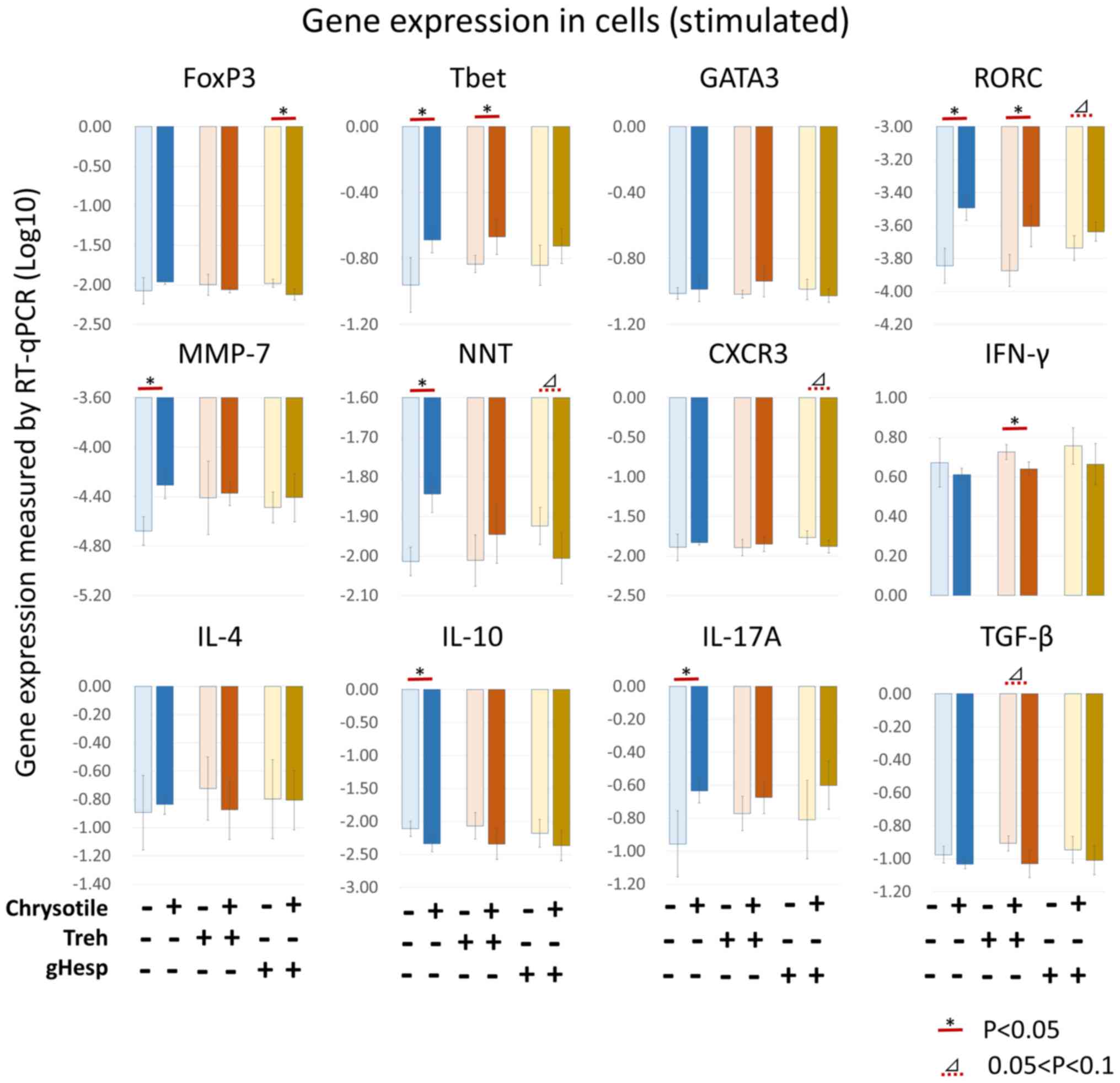
Exposure of human immune cells to asbestos causes a reduction in antitumor immunity. The present study aimed to investigate the recovery of reduced antitumor immunity by several ingredients taken as supplements or foods, including trehalose (Treh) and glycosylated hesperidin (gHesp). Peripheral blood CD4+ cells were stimulated with IL‑2, anti‑CD3 and anti‑CD28 antibodies for 3 days, followed by further stimulation with IL‑2 for 7 days. Subsequently, cells were stimulated with IL‑2 for an additional 28 days. During the 28 days, cells were cultured in the absence or presence of 50 µg/ml chrysotile asbestos fibers. In addition, cells were treated with 10 mM Treh or 10 µM gHesp. Following culture for 28 days, reverse transcription‑quantitative PCR was performed to assess the expression levels of transcription factors, cytokines and specific genes, including matrix metalloproteinase‑7 (MMP‑7), nicotinamide nucleotide transhydrogenase (NNT) and C‑X‑C motif chemokine receptor 3, in unstimulated cells (fresh) and cells stimulated with PMA and ionomycin (stimuli). The results demonstrated that compared with the control group, chrysotile‑exposure induced alterations in MMP‑7, NNT and IL‑17A expression levels were not observed in the ‘Treh’ and ‘gHesp’ groups in stimulated cells. The results suggested that Treh and gHesp may reverse asbestos exposure‑induced reduced antitumor immunity in T helper cells. However, further investigation is required to confirm the efficacy of future trials involving the use of these compounds with high‑risk human populations exposed to asbestos, such as workers involved in asbestos‑handling activities.
View Figures

Figure 1

Figure 2

Figure 3

Figure 4

View References

1 

Gruber UF: Asbestos-related benign disease and cancer: Symptoms and treatment. Anticancer Drugs. 1:187–197. 1990. View Article : Google Scholar : PubMed/NCBI

2 

Jamrozik E, de Klerk N and Musk AW: Asbestos-related disease. Intern Med J. 41:372–380. 2011. View Article : Google Scholar : PubMed/NCBI

3 

Lazarus A, Massoumi A, Hostler J and Hostler DC: Asbestos-related pleuropulmonary diseases: Benign and malignant. Postgrad Med. 124:116–130. 2012. View Article : Google Scholar : PubMed/NCBI

4 

Myers R: Asbestos-related pleural disease. Curr Opin Pulm Med. 18:377–381. 2012. View Article : Google Scholar : PubMed/NCBI

5 

Bibby AC and Maskell NA: Current treatments and trials in malignant pleural mesothelioma. Clin Respir J. 12:2161–2169. 2018. View Article : Google Scholar : PubMed/NCBI

6 

Carbone M, Adusumilli PS, Alexander HR Jr, Baas P, Bardelli F, Bononi A, Bueno R, Felley-Bosco E, Galateau-Salle F, Jablons D, et al: Mesothelioma: Scientific clues for prevention, diagnosis, and therapy. CA Cancer J Clin. 69:402–429. 2019. View Article : Google Scholar : PubMed/NCBI

7 

Sayan M, Eren MF, Gupta A, Ohri N, Kotek A, Babalioglu I, Oskeroglu Kaplan S, Duran O, Derinalp Or O, Cukurcayir F, et al: Current treatment strategies in malignant pleural mesothelioma with a treatment algorithm. Adv Respir Med. 87:289–297. 2019. View Article : Google Scholar

8 

Gray SG and Mutti L: Immunotherapy for mesothelioma: A critical review of current clinical trials and future perspectives. Transl Lung Cancer Res. 9(Suppl 1): S100–S119. 2020. View Article : Google Scholar : PubMed/NCBI

9 

de Gooijer CJ, Borm FJ, Scherpereel A and Baas P: Immunotherapy in malignant pleural mesothelioma. Front Oncol. 10:1872020. View Article : Google Scholar : PubMed/NCBI

10 

Hotta K and Fujimoto N: Current evidence and future perspectives of immune-checkpoint inhibitors in unresectable malignant pleural mesothelioma. J Immunother Cancer. 8:e0004612020. View Article : Google Scholar : PubMed/NCBI

11 

Hotta K, Fujimoto N, Kozuki T, Aoe K and Kiura K: Nivolumab for the treatment of unresectable pleural mesothelioma. Expert Opin Biol Ther. 20:109–114. 2020. View Article : Google Scholar

12 

Kumagai-Takei N, Yamamoto S, Lee S, Maeda M, Masuzzaki H, Sada N, Yu M, Yoshitome K, Nishimura Y and Otsuki T: Inflammatory alteration of human T cells exposed continuously to asbestos. Int J Mol Sci. 19:5042018. View Article : Google Scholar :

13 

Matsuzaki H, Maeda M, Lee S, Nishimura Y, Kumagai-Takei N, Hayashi H, Yamamoto S, Hatayama T, Kojima Y, Tabata R, et al: Asbestos-induced cellular and molecular alteration of immunocompetent cells and their relationship with chronic inflammation and carcinogenesis. J Biomed Biotechnol. 2012:4926082012. View Article : Google Scholar : PubMed/NCBI

14 

Nishimura Y, Kumagai-Takei N, Matsuzaki H, Lee S, Maeda M, Kishimoto T, Fukuoka K, Nakano T and Otsuki T: Functional alteration of natural killer cells and cytotoxic T lymphocytes upon asbestos exposure and in malignant mesothelioma patients. BioMed Res Int. 2015:2384312015. View Article : Google Scholar : PubMed/NCBI

15 

Nishimura Y, Maeda M, Kumagai-Takei N, Lee S, Matsuzaki H, Wada Y, Nishiike-Wada T, Iguchi H and Otsuki T: Altered functions of alveolar macrophages and NK cells involved in asbestos-related diseases. Environ Health Prev Med. 18:198–204. 2013. View Article : Google Scholar : PubMed/NCBI

16 

Kumagai-Takei N, Lee S, Srinivas B, Shimizu Y, Sada N, Yoshitome K, Ito T, Nishimura Y and Otsuki T: The Effects of Asbestos Fibers on Human T Cells. Int J Mol Sci. 21:69872020. View Article : Google Scholar :

17 

Maeda M, Nishimura Y, Hayashi H, Kumagai N, Chen Y, Murakami S, Miura Y, Hiratsuka J, Kishimoto T and Otsuki T: Decreased CXCR3 expression in CD4+ T cells exposed to asbestos or derived from asbestos-exposed patients. Am J Respir Cell Mol Biol. 45:795–803. 2011. View Article : Google Scholar : PubMed/NCBI

18 

Ying C, Maeda M, Nishimura Y, Kumagai-Takei N, Hayashi H, Matsuzaki H, Lee S, Yoshitome K, Yamamoto S, Hatayama T, et al: Enhancement of regulatory T cell-like suppressive function in MT-2 by long-term and low-dose exposure to asbestos. Toxicology. 338:86–94. 2015. View Article : Google Scholar : PubMed/NCBI

19 

Hyodoh F, Takata-Tomokuni A, Miura Y, Sakaguchi H, Hatayama T, Hatada S, Katsuyama H, Matsuo Y and Otsuki T: Inhibitory effects of anti-oxidants on apoptosis of a human polyclonal T-cell line, MT-2, induced by an asbestos, chrysotile-A. Scand J Immunol. 61:442–448. 2005. View Article : Google Scholar : PubMed/NCBI

20 

Miura Y, Nishimura Y, Katsuyama H, Maeda M, Hayashi H, Dong M, Hyodoh F, Tomita M, Matsuo Y, Uesaka A, et al: Involvement of IL-10 and Bcl-2 in resistance against an asbestos-induced apoptosis of T cells. Apoptosis. 11:1825–1835. 2006. View Article : Google Scholar : PubMed/NCBI

21 

Miyoshi I, Kubonishi I, Yoshimoto S and Shiraishi Y: A T-cell line derived from normal human cord leukocytes by co-culturing with human leukemic T-cells. Gan. 72:978–981. 1981.PubMed/NCBI

22 

Miyoshi I, Kubonishi I, Yoshimoto S, Akagi T, Ohtsuki Y, Shiraishi Y, Nagata K and Hinuma Y: Type C virus particles in a cord T-cell line derived by co-cultivating normal human cord leukocytes and human leukaemic T cells. Nature. 294:770–771. 1981. View Article : Google Scholar : PubMed/NCBI

23 

Hamano R, Wu X, Wang Y, Oppenheim JJ and Chen X: Characterization of MT-2 cells as a human regulatory T cell-like cell line. Cell Mol Immunol. 12:780–782. 2015. View Article : Google Scholar

24 

Chen S, Ishii N, Ine S, Ikeda S, Fujimura T, Ndhlovu LC, Soroosh P, Tada K, Harigae H, Kameoka J, et al: Regulatory T cell-like activity of Foxp3+ adult T cell leukemia cells. Int Immunol. 18:269–277. 2006. View Article : Google Scholar

25 

Yamamoto S, Lee S, Matsuzaki H, Kumagai-Takei N, Yoshitome K, Sada N, Shimizu Y, Ito T, Nishimura Y and Otsuki T: Enhanced expression of nicotinamide nucleotide transhydrogenase (NNT) and its role in a human T cell line continuously exposed to asbestos. Environ Int. 138:1056542020. View Article : Google Scholar : PubMed/NCBI

26 

Maeda M, Nishimura Y, Hayashi H, Kumagai N, Chen Y, Murakami S, Miura Y, Hiratsuka J, Kishimoto T and Otsuki T: Reduction of CXC chemokine receptor 3 in an in vitro model of continuous exposure to asbestos in a human T-cell line, MT-2. Am J Respir Cell Mol Biol. 45:470–479. 2011. View Article : Google Scholar

27 

Maeda M, Chen Y, Lee S, Kumagai-Takei N, Yoshitome K, Matsuzaki H, Yamamoto S, Hatayama T, Ikeda M, Nishimura Y, et al: Induction of IL-17 production from human peripheral blood CD4+ cells by asbestos exposure. Int J Oncol. 50:2024–2032. 2017. View Article : Google Scholar : PubMed/NCBI

28 

Maeda M, Miura Y, Nishimura Y, Murakami S, Hayashi H, Kumagai N, Hatayama T, Katoh M, Miyahara N, Yamamoto S, et al: Immunological changes in mesothelioma patients and their experimental detection. Clin Med Circ Respirat Pulm Med. 2:11–17. 2008.PubMed/NCBI

29 

Pass HI, Alimi M, Carbone M, Yang H and Goparaju CM: Mesothelioma biomarkers: Discovery in search of validation. Thorac Surg Clin. 30:395–423. 2020. View Article : Google Scholar : PubMed/NCBI

30 

Furuya S, Chimed-Ochir O, Takahashi K, David A and Takala J: Global asbestos disaster. Int J Environ Res Public Health. 15:10002018. View Article : Google Scholar :

31 

Richards AB, Krakowka S, Dexter LB, Schmid H, Wolterbeek AP, Waalkens-Berendsen DH, Shigoyuki A and Kurimoto M: Trehalose: A review of properties, history of use and human tolerance, and results of multiple safety studies. Food Chem Toxicol. 40:871–898. 2002. View Article : Google Scholar : PubMed/NCBI

32 

Teramoto N, Sachinvala ND and Shibata M: Trehalose and trehalose-based polymers for environmentally benign, biocompatible and bioactive materials. Molecules. 13:1773–1816. 2008. View Article : Google Scholar : PubMed/NCBI

33 

Roohbakhsh A, Parhiz H, Soltani F, Rezaee R and Iranshahi M: Neuropharmacological properties and pharmacokinetics of the citrus flavonoids hesperidin and hesperetin - a mini-review. Life Sci. 113:1–6. 2014. View Article : Google Scholar : PubMed/NCBI

34 

Parhiz H, Roohbakhsh A, Soltani F, Rezaee R and Iranshahi M: Antioxidant and anti-inflammatory properties of the citrus flavonoids hesperidin and hesperetin: An updated review of their molecular mechanisms and experimental models. Phytother Res. 29:323–331. 2015. View Article : Google Scholar

35 

Higashiyama T: Novel functions and applications of trehalose. Pure Appl Chem. 74:1263–1269. 2002. View Article : Google Scholar

36 

Lee HJ, Yoon YS and Lee SJ: Mechanism of neuroprotection by trehalose: Controversy surrounding autophagy induction. Cell Death Dis. 9:7122018. View Article : Google Scholar : PubMed/NCBI

37 

Khalifeh M, Barreto GE and Sahebkar A: Trehalose as a promising therapeutic candidate for the treatment of Parkinson' s disease. Br J Pharmacol. 176:1173–1189. 2019. View Article : Google Scholar : PubMed/NCBI

38 

Zhang Y and DeBosch BJ: Using trehalose to prevent and treat metabolic function: Effectiveness and mechanisms. Curr Opin Clin Nutr Metab Care. 22:303–310. 2019. View Article : Google Scholar : PubMed/NCBI

39 

Iranshahi M, Rezaee R, Parhiz H, Roohbakhsh A and Soltani F: Protective effects of flavonoids against microbes and toxins: The cases of hesperidin and hesperetin. Life Sci. 137:125–132. 2015. View Article : Google Scholar : PubMed/NCBI

40 

Tejada S, Pinya S, Martorell M, Capó X, Tur JA, Pons A and Sureda A: Potential anti-inflammatory effects of hesperidin from the genus citrus. Curr Med Chem. 25:4929–4945. 2018. View Article : Google Scholar

41 

Chikara S, Nagaprashantha LD, Singhal J, Horne D, Awasthi S and Singhal SS: Oxidative stress and dietary phytochemicals: Role in cancer chemoprevention and treatment. Cancer Lett. 413:122–134. 2018. View Article : Google Scholar

42 

Miwa Y, Yamada M, Sunayama T, Mitsuzumi H, Tsuzaki Y, Chaen H, Mishima Y and Kibata M: Effects of glucosyl hesperidin on serum lipids in hyperlipidemic subjects: Preferential reduction in elevated serum triglyceride level. J Nutr Sci Vitaminol (Tokyo). 50:211–218. 2004. View Article : Google Scholar

43 

Yamada M, Tanabe F, Arai N, Mitsuzumi H, Miwa Y, Kubota M, Chaen H and Kibata M: Bioavailability of glucosyl hesperidin in rats. Biosci Biotechnol Biochem. 70:1386–1394. 2006. View Article : Google Scholar : PubMed/NCBI

44 

Livak KJ and Schmittgen TD: Analysis of relative gene expression data using real-time quantitative PCR and the 2(-ΔΔC(T)) method. Methods. 25:402–408. 2001. View Article : Google Scholar

45 

Wong WF, Kohu K, Chiba T, Sato T and Satake M: Interplay of transcription factors in T-cell differentiation and function: The role of Runx. Immunology. 132:157–164. 2011. View Article : Google Scholar :

46 

Kufer P, Zettl F, Borschert K, Lutterbüse R, Kischel R and Riethmüller G: Minimal costimulatory requirements for T cell priming and TH1 differentiation: Activation of naive human T lymphocytes by tumor cells armed with bifunctional antibody constructs. Cancer Immun. 1:102001.

47 

Rabinovich GA, Gabrilovich D and Sotomayor EM: Immunosuppressive strategies that are mediated by tumor cells. Annu Rev Immunol. 25:267–296. 2007. View Article : Google Scholar

48 

Byun S, Lee E and Lee KW: Therapeutic implications of autophagy inducers in immunological disorders, infection, and cancer. Int J Mol Sci. 18:19592017. View Article : Google Scholar :

49 

Casarejos MJ, Solano RM, Gómez A, Perucho J, de Yébenes JG and Mena MA: The accumulation of neurotoxic proteins, induced by proteasome inhibition, is reverted by trehalose, an enhancer of autophagy, in human neuroblastoma cells. Neurochem Int. 58:512–520. 2011. View Article : Google Scholar : PubMed/NCBI

50 

Wang Q and Ren J: mTOR-Independent autophagy inducer trehalose rescues against insulin resistance-induced myocardial contractile anomalies: Role of p38 MAPK and Foxo1. Pharmacol Res. 111:357–373. 2016. View Article : Google Scholar : PubMed/NCBI

51 

Belzile JP, Sabalza M, Craig M, Clark AE, Morello CS and Spector DH: Trehalose, an mTOR-independent inducer of autophagy, inhibits human cytomegalovirus infection in multiple cell types. J Virol. 90:1259–1277. 2015. View Article : Google Scholar : PubMed/NCBI

52 

Wu Q, Jiang D, Huang C, van Dyk LF, Li L and Chu HW: Trehalose-mediated autophagy impairs the anti-viral function of human primary airway epithelial cells. PLoS One. 10:e01245242015. View Article : Google Scholar : PubMed/NCBI

53 

Monforte MT, Trovato A, Kirjavainen S, Forestieri AM, Galati EM and Lo Curto RB: Biological effects of hesperidin, a Citrus flavonoid. (note II): Hypolipidemic activity on experimental hypercholesterolemia in rat. Farmaco. 50:595–599. 1995.PubMed/NCBI

54 

Yamamoto M, Suzuki A, Jokura H, Yamamoto N and Hase T: Glucosyl hesperidin prevents endothelial dysfunction and oxidative stress in spontaneously hypertensive rats. Nutrition. 24:470–476. 2008. View Article : Google Scholar : PubMed/NCBI

55 

Martínez MC, Fernandez SP, Loscalzo LM, Wasowski C, Paladini AC, Marder M, Medina JH and Viola H: Hesperidin, a flavonoid glycoside with sedative effect, decreases brain pERK1/2 levels in mice. Pharmacol Biochem Behav. 92:291–296. 2009. View Article : Google Scholar : PubMed/NCBI

56 

Loscalzo LM, Wasowski C, Paladini AC and Marder M: Opioid receptors are involved in the sedative and antinociceptive effects of hesperidin as well as in its potentiation with benzodiazepines. Eur J Pharmacol. 580:306–313. 2008. View Article : Google Scholar

57 

Bellavite P and Donzelli A: Hesperidin and SARS-CoV-2: New light on the healthy function of citrus fruits. Antioxidants. 9:7422020. View Article : Google Scholar :

58 

Ding Z, Sun G and Zhu Z: Hesperidin attenuates influenza A virus (H1N1) induced lung injury in rats through its anti-inflammatory effect. Antivir Ther. 23:611–615. 2018. View Article : Google Scholar : PubMed/NCBI

59 

Maeda M, Chen Y, Hayashi H, Kumagai-Takei N, Matsuzaki H, Lee S, Nishimura Y and Otsuki T: Chronic exposure to asbestos enhances TGF-β1 production in the human adult T cell leukemia virus-immortalized T cell line MT-2. Int J Oncol. 45:2522–2532. 2014. View Article : Google Scholar : PubMed/NCBI

60 

Maeda M, Matsuzaki H, Yamamoto S, Lee S, Kumagai-Takei N, Yoshitome K, Min Y, Sada N, Nishimura Y and Otsuki T: Aberrant expression of FoxP3 in a human T cell line possessing regulatory T cell like function and exposed continuously to asbestos fibers. Oncol Rep. 40:748–758. 2018.PubMed/NCBI

Related Articles

  • Abstract
  • View
  • Download
  • Twitter
Copy and paste a formatted citation
Spandidos Publications style
Yamamoto S, Lee S, Ariyasu T, Endo S, Miyata S, Yasuda A, Harashima A, Ohta T, Kumagai-Τakei N, Ito T, Ito T, et al: Ingredients such as trehalose and hesperidin taken as supplements or foods reverse alterations in human T cells, reducing asbestos exposure-induced antitumor immunity. Int J Oncol 58: 2, 2021.
APA
Yamamoto, S., Lee, S., Ariyasu, T., Endo, S., Miyata, S., Yasuda, A. ... Otsuki, T. (2021). Ingredients such as trehalose and hesperidin taken as supplements or foods reverse alterations in human T cells, reducing asbestos exposure-induced antitumor immunity. International Journal of Oncology, 58, 2. https://doi.org/10.3892/ijo.2021.5182
MLA
Yamamoto, S., Lee, S., Ariyasu, T., Endo, S., Miyata, S., Yasuda, A., Harashima, A., Ohta, T., Kumagai-Τakei, N., Ito, T., Shimizu, Y., Srinivas, B., Sada, N., Nishimura, Y., Otsuki, T."Ingredients such as trehalose and hesperidin taken as supplements or foods reverse alterations in human T cells, reducing asbestos exposure-induced antitumor immunity". International Journal of Oncology 58.4 (2021): 2.
Chicago
Yamamoto, S., Lee, S., Ariyasu, T., Endo, S., Miyata, S., Yasuda, A., Harashima, A., Ohta, T., Kumagai-Τakei, N., Ito, T., Shimizu, Y., Srinivas, B., Sada, N., Nishimura, Y., Otsuki, T."Ingredients such as trehalose and hesperidin taken as supplements or foods reverse alterations in human T cells, reducing asbestos exposure-induced antitumor immunity". International Journal of Oncology 58, no. 4 (2021): 2. https://doi.org/10.3892/ijo.2021.5182
Copy and paste a formatted citation
x
Spandidos Publications style
Yamamoto S, Lee S, Ariyasu T, Endo S, Miyata S, Yasuda A, Harashima A, Ohta T, Kumagai-Τakei N, Ito T, Ito T, et al: Ingredients such as trehalose and hesperidin taken as supplements or foods reverse alterations in human T cells, reducing asbestos exposure-induced antitumor immunity. Int J Oncol 58: 2, 2021.
APA
Yamamoto, S., Lee, S., Ariyasu, T., Endo, S., Miyata, S., Yasuda, A. ... Otsuki, T. (2021). Ingredients such as trehalose and hesperidin taken as supplements or foods reverse alterations in human T cells, reducing asbestos exposure-induced antitumor immunity. International Journal of Oncology, 58, 2. https://doi.org/10.3892/ijo.2021.5182
MLA
Yamamoto, S., Lee, S., Ariyasu, T., Endo, S., Miyata, S., Yasuda, A., Harashima, A., Ohta, T., Kumagai-Τakei, N., Ito, T., Shimizu, Y., Srinivas, B., Sada, N., Nishimura, Y., Otsuki, T."Ingredients such as trehalose and hesperidin taken as supplements or foods reverse alterations in human T cells, reducing asbestos exposure-induced antitumor immunity". International Journal of Oncology 58.4 (2021): 2.
Chicago
Yamamoto, S., Lee, S., Ariyasu, T., Endo, S., Miyata, S., Yasuda, A., Harashima, A., Ohta, T., Kumagai-Τakei, N., Ito, T., Shimizu, Y., Srinivas, B., Sada, N., Nishimura, Y., Otsuki, T."Ingredients such as trehalose and hesperidin taken as supplements or foods reverse alterations in human T cells, reducing asbestos exposure-induced antitumor immunity". International Journal of Oncology 58, no. 4 (2021): 2. https://doi.org/10.3892/ijo.2021.5182
Follow us
  • Twitter
  • LinkedIn
  • Facebook
About
  • Spandidos Publications
  • Careers
  • Cookie Policy
  • Privacy Policy
How can we help?
  • Help
  • Live Chat
  • Contact
  • Email to our Support Team