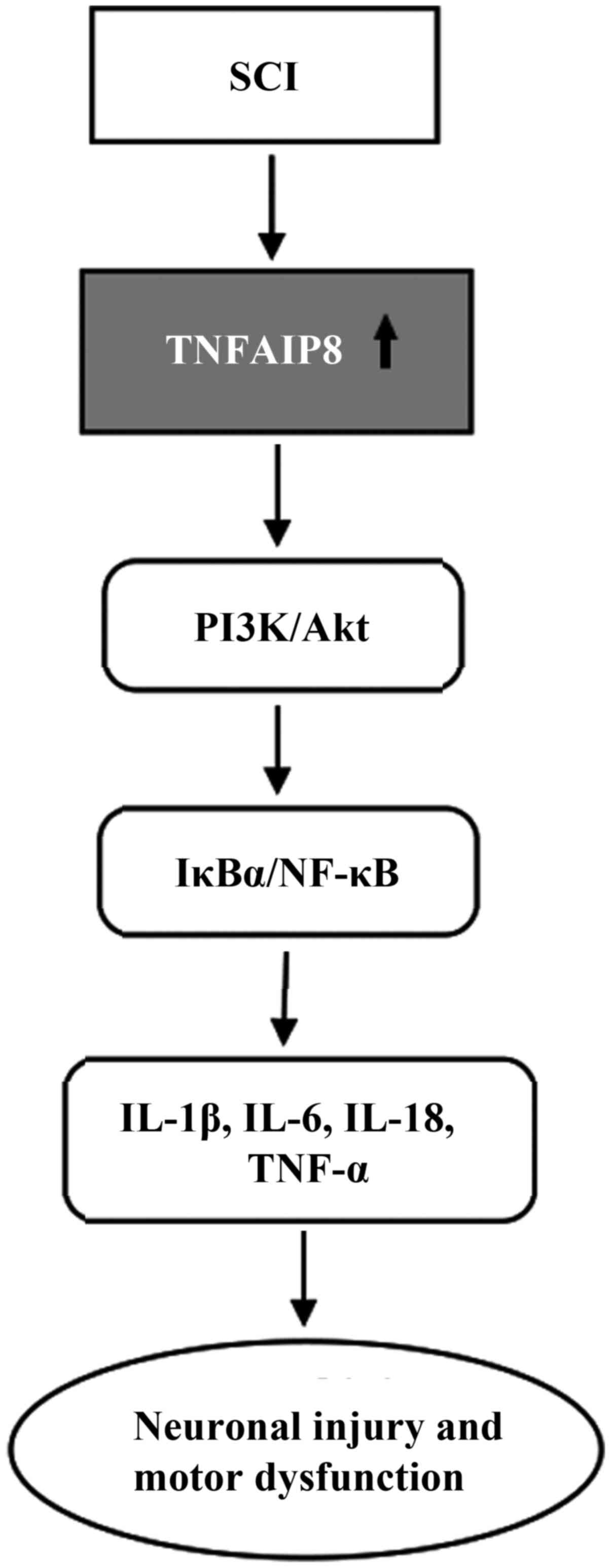
|
1
|
Niture S, Moore J and Kumar D: TNFAIP8:
Inflammation, immunity and human diseases. J Cell Immunol. 1:29–34.
2019.PubMed/NCBI
|
|
2
|
You Z, Ouyang H, Lopatin D, Polver PJ and
Wang CY: Nuclear factor-kappa B-inducible death effector
domain-containing protein suppresses tumor necrosis factor-mediated
apoptosis by inhibiting caspase-8 activity. J Biol Chem.
276:26398–26404. 2001. View Article : Google Scholar : PubMed/NCBI
|
|
3
|
Gu Z, Cui X, Sun P and Wang X: Regulatory
roles of tumor necrosis factor-α-induced protein 8 like-protein 2
in inflammation, immunity and cancers: A review. Cancer Manag Res.
12:12735–12746. 2020. View Article : Google Scholar :
|
|
4
|
Patel S, Wang FH, Whiteside TL and Kasid
U: Identification of seven differentially displayed transcripts in
human primary and matched metastatic head and neck squamous cell
carcinoma cell lines: Implications in metastasis and/or radiation
response. Oral Oncol. 33:197–203. 1997. View Article : Google Scholar : PubMed/NCBI
|
|
5
|
Kumar D, Whiteside TL and Kasid U:
Identification of a novel tumor necrosis factor-alpha-inducible
gene, SCC-S2, containing the consensus sequence of a death effector
domain of fas-associated death domain-like
interleukin-1beta-converting enzyme-inhibitory protein. J Biol
Chem. 275:2973–2978. 2000. View Article : Google Scholar : PubMed/NCBI
|
|
6
|
Zhang X, Wang J, Fan C, Li H, Sun H, Gong
S, Chen YH and Shi Y: Crystal structure of TIPE2 provides insights
into immune homeostasis. Nat Struct Mol Biol. 16:89–90. 2009.
View Article : Google Scholar
|
|
7
|
Fayngerts SA, Wu J, Oxley CL, Liu X,
Vourekas A, Cathopoulis T, Wang Z, Cui J, Liu S, Sun H, et al:
TIPE3 is the transfer protein of lipid second messengers that
promote cancer. Cancer Cell. 26:465–478. 2014. View Article : Google Scholar : PubMed/NCBI
|
|
8
|
Kim JS, Park J, Kim MS, Ha JY, Jang YW,
Shin DH and Son JH: The Tnfaip8-PE complex is a novel upstream
effector in the anti-autophagic action of insulin. Sci Rep.
7:62482017. View Article : Google Scholar : PubMed/NCBI
|
|
9
|
Antony P, Baby B and Vijayan R: Molecular
insights into the binding of phosphoinositides to the TH domain
region of TIPE proteins. J Mol Model. 22:2722016. View Article : Google Scholar : PubMed/NCBI
|
|
10
|
Sun H, Lin M, Zamani A, Goldsmith JR,
Boggs AE, Li M, Lee CN, Chen X, Li X, Li T, et al: The TIPE
molecular pilot that directs lymphocyte migration in health and
inflammation. Sci Rep. 10:66172020. View Article : Google Scholar : PubMed/NCBI
|
|
11
|
Lowe JM, Nguyen TA, Grimm SA, Gabor KA,
Peddada SD, Li L, Anderson CW, Resnick MA, Menendez D and Fessler
MB: The novel p53 target TNFAIP8 variant 2 is increased in cancer
and offsets p53-dependent tumor suppression. Cell Death Differ.
24:181–191. 2017. View Article : Google Scholar :
|
|
12
|
Zhang LJ, Liu X, Gafken PR, Kioussi C and
Leid M: A chicken ovalbumin upstream promoter transcription factor
I (COUP-TFI) complex represses expression of the gene encoding
tumor necrosis factor alpha-induced protein 8 (TNFAIP8). J Biol
Chem. 284:6156–6168. 2009. View Article : Google Scholar :
|
|
13
|
Day TF, Mewani RR, Starr J, Li X,
Chakravarty D, Ressom H, Zou X, Eidelman O, Pollard HB, Srivastava
M and Kasid UN: Transcriptome and proteome analyses of TNFAIP8
knockdown cancer cells reveal new insights into molecular
determinants of cell survival and tumor progression. Methods Mol
Biol. 1513:83–100. 2017. View Article : Google Scholar
|
|
14
|
Zhang C, Kallakury BV, Ross JS, Mewani RR,
Sheehan CE, Sakabe I, Luta G, Kumar D, Yadavalli S, Starr J, et al:
The significance of TNFAIP8 in prostate cancer response to
radiation and docetaxel and disease recurrence. Int J Cancer.
133:31–42. 2013. View Article : Google Scholar : PubMed/NCBI
|
|
15
|
Cheng Y, Yu P, Duan X, Liu C, Xu S, Chen
Y, Tan Y, Qiang Y, Shen J and Tao Z: Genome-wide analysis of
androgen receptor binding sites in prostate cancer cells. Exp Ther
Med. 9:2319–2324. 2015. View Article : Google Scholar : PubMed/NCBI
|
|
16
|
Wang Y, Yu Q, Cho AH, Rondeau G, Welsh J,
Adamson E, Mercola D and McClelland M: Survey of differentially
methylated promoters in prostate cancer cell lines. Neoplasia.
7:748–760. 2005. View Article : Google Scholar : PubMed/NCBI
|
|
17
|
Gao HY, Huo FC, Wang HY and Pei DS:
MicroRNA-9 inhibits the gastric cancer cell proliferation by
targeting TNFAIP8. Cell Prolif. 50:e123312017. View Article : Google Scholar
|
|
18
|
Zhou Z, Li Z, Shen Y and Chen T:
MicroRNA-138 directly targets TNFAIP8 and acts as a tumor
suppressor in osteosarcoma. Exp Ther Med. 14:3665–3673. 2017.
View Article : Google Scholar : PubMed/NCBI
|
|
19
|
Xing B and Ren C: Tumor-suppressive
miR-99a inhibits cell proliferation via targeting of TNFAIP8 in
osteosarcoma cells. Am J Transl Res. 8:1082–1090. 2016.PubMed/NCBI
|
|
20
|
Zhang L, Liu R, Luan YY and Yao YM: Tumor
necrosis factor-α induced protein 8: Pathophysiology, clinical
significance, and regulatory mechanism. Int J Biol Sci. 14:398–405.
2018. View Article : Google Scholar :
|
|
21
|
Padmavathi G, Banik K, Monisha J, Bordoloi
D, Shabnam B, Arfuso F, Sethi G, Fan L and Kunnumakkara AB: Novel
tumor necrosis factor-α induced protein eight (TNFAIP8/TIPE)
family: Functions and downstream targets involved in cancer
progression. Cancer Lett. 432:260–271. 2018. View Article : Google Scholar : PubMed/NCBI
|
|
22
|
Niture S, Dong X, Arthur E, Chimeh U,
Niture SS, Zheng W and Kumar D: Oncogenic role of tumor necrosis
factor α-induced protein 8 (TNFAIP8). Cells. 8:92018. View Article : Google Scholar
|
|
23
|
Goldsmith JR, Fayngerts S and Chen YH:
Regulation of inflammation and tumorigenesis by the TIPE family of
phospholipid transfer proteins. Cell Mol Immunol. 14:482–487. 2017.
View Article : Google Scholar : PubMed/NCBI
|
|
24
|
DiDonato JA, Mercurio F and Karin M: NF-κB
and the link between inflammation and cancer. Immunol Rev.
246:379–400. 2012. View Article : Google Scholar : PubMed/NCBI
|
|
25
|
Vogt PK and Hart JR: PI3K and STAT3: A new
alliance. Cancer Discov. 1:481–486. 2011. View Article : Google Scholar
|
|
26
|
Grivennikov S, Karin E, Terzic J, Mucida
D, Yu GY, Vallabhapurapu S, Scheller J, Rose-John S, Cheroutre H,
Eckmann L and Karin M: IL-6 and Stat3 are required for survival of
intestinal epithelial cells and development of colitis-associated
cancer. Cancer Cell. 15:103–113. 2009. View Article : Google Scholar : PubMed/NCBI
|
|
27
|
Sasaki AT, Chun C, Takeda K and Firtel RA:
Localized Ras signaling at the leading edge regulates PI3K, cell
polarity, and directional cell movement. J Cell Biol. 167:505–518.
2004. View Article : Google Scholar : PubMed/NCBI
|
|
28
|
Servant G, Weiner OD, Herzmark P, Balla T,
Sedat JW and Bourne HR: Polarization of chemoattractant receptor
signaling during neutrophil chemotaxis. Science. 287:1037–1040.
2000. View Article : Google Scholar : PubMed/NCBI
|
|
29
|
Wang L, Song Y and Men X: Variance of
TNFAIP8 expression between tumor tissues and tumor-infiltrating
CD4+ and CD8+ T cells in non-small cell lung
cancer. Tumour Biol. 35:2319–2325. 2014. View Article : Google Scholar
|
|
30
|
Duan D, Zhu YQ, Guan LL and Wang J:
Upregulation of SCC-S2 in immune cells and tumor tissues of
papillary thyroid carcinoma. Tumour Biol. 35:4331–4337. 2014.
View Article : Google Scholar : PubMed/NCBI
|
|
31
|
Dong QZ, Zhao Y, Liu Y, Wang Y, Zhang PX,
Jiang GY, Dong XJ, Cui QZ and Wang EH: Overexpression of SCC-S2
correlates with lymph node metastasis and poor prognosis in
patients with non-small-cell lung cancer. Cancer Sci.
101:1562–1569. 2010. View Article : Google Scholar : PubMed/NCBI
|
|
32
|
Miao Z, Zhao T, Wang Z, Xu Y, Song Y, Wu J
and Xu H: SCC-S2 is overexpressed in colon cancers and regulates
cell proliferation. Tumour Biol. 33:2099–2106. 2012. View Article : Google Scholar : PubMed/NCBI
|
|
33
|
Li Y, Jing C, Chen Y, Wang J, Zhou M, Liu
X, Sun D, Mu L, Li L and Guo X: Expression of tumor necrosis factor
α-induced protein 8 is upregulated in human gastric cancer and
regulates cell proliferation, invasion and migration. Mol Med Rep.
12:2636–2642. 2015. View Article : Google Scholar : PubMed/NCBI
|
|
34
|
Liu T, Gao H, Chen X, Lou G, Gu L, Yang M,
Xia B and Yin H: TNFAIP8 as a predictor of metastasis and a novel
prognostic biomarker in patients with epithelial ovarian cancer. Br
J Cancer. 109:1685–1692. 2013. View Article : Google Scholar : PubMed/NCBI
|
|
35
|
Liu T, Gao H, Yang M, Zhao T, Liu Y and
Lou G: Correlation of TNFAIP8 overexpression with the
proliferation, metastasis, and disease-free survival in endometrial
cancer. Tumour Biol. 35:5805–5814. 2014. View Article : Google Scholar : PubMed/NCBI
|
|
36
|
Xiao M, Xu Q, Lou C, Qin Y, Ning X, Liu T,
Zhao X, Jia S and Huang Y: Overexpression of TNFAIP8 is associated
with tumor aggressiveness and poor prognosis in patients with
invasive ductal breast carcinoma. Hum Pathol. 62:40–49. 2017.
View Article : Google Scholar : PubMed/NCBI
|
|
37
|
Hadisaputri YE, Miyazaki T, Suzuki S,
Yokobori T, Kobayashi T, Tanaka N, Inose T, Sohda M and Kuwano H:
TNFAIP8 overexpression: Clinical relevance to esophageal squamous
cell carcinoma. Ann Surg Oncol. 19(Suppl 3): S589–S596. 2012.
View Article : Google Scholar
|
|
38
|
Sun Z, Liu X, Song JH, Cheng Y, Liu Y, Jia
Y, Meltzer SJ and Wang Z: TNFAIP8 overexpression: A potential
predictor of lymphatic metastatic recurrence in pN0 esophageal
squamous cell carcinoma after Ivor Lewis esophagectomy. Tumour
Biol. 37:10923–10934. 2016. View Article : Google Scholar : PubMed/NCBI
|
|
39
|
Dong Q, Fu L, Zhao Y, Xie C, Li Q and Wang
E: TNFAIP8 interacts with LATS1 and promotes aggressiveness through
regulation of hippo pathway in hepatocellular carcinoma.
Oncotarget. 8:15689–15703. 2017. View Article : Google Scholar : PubMed/NCBI
|
|
40
|
Carreras J, Hamoudi R and Nakamura N:
Artificial intelligence analysis of gene expression data predicted
the prognosis of patients with diffuse large B-cell lymphoma. Tokai
J Exp Clin Med. 45:37–48. 2020.PubMed/NCBI
|
|
41
|
Zhong M, Zhu M, Liu Y, Lin Y, Wang L, Ye
Y, Chen H, Yang Y, Zhuang G and Huang J: TNFAIP8 promotes the
migration of clear cell renal cell carcinoma by regulating the EMT.
J Cancer. 11:3061–3071. 2020. View Article : Google Scholar : PubMed/NCBI
|
|
42
|
Liu K, Qin CK, Wang ZY, Liu SX, Cui XP and
Zhang DY: Expression of tumor necrosis factor-alpha-induced protein
8 in pancreas tissues and its correlation with epithelial growth
factor receptor levels. Asian Pac J Cancer Prev. 13:847–850. 2012.
View Article : Google Scholar : PubMed/NCBI
|
|
43
|
Yang M, Zhao Q, Wang X, Liu T, Yao G, Lou
C and Zhang Y: TNFAIP8 overexpression is associated with lymph node
metastasis and poor prognosis in intestinal-type gastric
adenocarcinoma. Histopathology. 65:517–526. 2014. View Article : Google Scholar : PubMed/NCBI
|
|
44
|
Chen L, Yang X, Yang X, Fan K, Xiao P,
Zhang J and Wang X: Association between the expression levels of
tumor necrosis factor-α-induced protein 8 and the prognosis of
patients with gastric adenocarcinoma. Exp Ther Med. 12:238–244.
2016. View Article : Google Scholar : PubMed/NCBI
|
|
45
|
Shi TY, Cheng X, Yu KD, Sun MH, Shao ZM,
Wang MY, Zhu ML, He J, Li QX, Chen XJ, et al: Functional variants
in TNFAIP8 associated with cervical cancer susceptibility and
clinical outcomes. Carcinogenesis. 34:770–778. 2013. View Article : Google Scholar : PubMed/NCBI
|
|
46
|
Liu T, Jiang L, Yu L, Ge T, Wang J and Gao
H: Association of TNFAIP8 gene polymorphisms with endometrial
cancer in northern Chinese women. Cancer Cell Int. 19:1052019.
View Article : Google Scholar : PubMed/NCBI
|
|
47
|
Zhang Y, Chen MB, Zhou XY and Hong XN:
Lymphotoxin alpha (LTA) polymorphism is associated with prognosis
of non-Hodgkin's lymphoma in a Chinese population. PLoS One.
8:e664112013. View Article : Google Scholar : PubMed/NCBI
|
|
48
|
Deeb SJ, Tyanova S, Hummel M,
Schmidt-Supprian M, Cox J and Mann M: Machine learning-based
classification of diffuse large B-cell lymphoma patients by their
protein expression profiles. Mol Cell Proteomics. 14:2947–2960.
2015. View Article : Google Scholar : PubMed/NCBI
|
|
49
|
Eisele L, Klein-Hitpass L, Chatzimanolis
N, Opalka B, Boes T, Seeber S, Moritz T and Flasshove M:
Differential expression of drug-resistance-related genes between
sensitive and resistant blasts in acute myeloid leukemia. Acta
Haematol. 117:8–15. 2007. View Article : Google Scholar
|
|
50
|
Kumar D, Gokhale P, Broustas C,
Chakravarty D, Ahmad I and Kasid U: Expression of SCC-S2, an
antiapoptotic molecule, correlates with enhanced proliferation and
tumorigenicity of MDA-MB 435 cells. Oncogene. 23:612–616. 2004.
View Article : Google Scholar : PubMed/NCBI
|
|
51
|
Hu R, Qiu X, Hong S, Meng L, Hong X, Qiu
J, Yang J, Zhuang G and Liu Z: Clinical significance of TIPE
expression in gastric carcinoma. Onco Targets Ther. 9:4473–4481.
2016. View Article : Google Scholar : PubMed/NCBI
|
|
52
|
Monteith JA, Mellert H, Sammons MA,
Kuswanto LA, Sykes SM, Resnick-Silverman L, Manfredi JJ, Berger SL
and McMahon SB: A rare DNA contact mutation in cancer confers p53
gain-of-function and tumor cell survival via TNFAIP8 induction. Mol
Oncol. 10:1207–1220. 2016. View Article : Google Scholar : PubMed/NCBI
|
|
53
|
Laliberté B, Wilson AM, Nafisi H, Mao H,
Zhou YY, Daigle M and Albert PR: TNFAIP8: A new effector for
Galpha(i) coupling to reduce cell death and induce cell
transformation. J Cell Physiol. 225:865–874. 2010. View Article : Google Scholar : PubMed/NCBI
|
|
54
|
Han Y, Tang Z, Zhao Y, Li Q and Wang E:
TNFAIP8 regulates Hippo pathway through interacting with LATS1 to
promote cell proliferation and invasion in lung cancer. Mol
Carcinog. 57:159–166. 2018. View Article : Google Scholar
|
|
55
|
Xie Y, Zhou F and Zhao X: TNFAIP8 promotes
cell growth by regulating the Hippo pathway in epithelial ovarian
cancer. Exp Ther Med. 16:4975–4982. 2018.PubMed/NCBI
|
|
56
|
Yang C, Xu W, Meng X, Zhou S, Zhang M and
Cui D: SCC-S2 facilitates tumor proliferation and invasion via
activating wnt signaling and depressing hippo signaling in
colorectal cancer cells and predicts poor prognosis of patients. J
Histochem Cytochem. 67:65–75. 2019. View Article : Google Scholar :
|
|
57
|
Liu T, Xia B, Lu Y, Xu Y and Lou G:
TNFAIP8 overexpression is associated with platinum resistance in
epithelial ovarian cancers with optimal cytoreduction. Hum Pathol.
45:1251–1257. 2014. View Article : Google Scholar : PubMed/NCBI
|
|
58
|
Zhang DL and Yang N: TNFAIP8 regulates
cisplatin resistance through TAF-Iα and promotes malignant
progression of esophageal cancer. Eur Rev Med Pharmacol Sci.
24:4775–4784. 2020.PubMed/NCBI
|
|
59
|
Xing Y, Liu Y, Liu T, Meng Q, Lu H, Liu W,
Hu J, Li C, Cao M, Yan S, et al: TNFAIP8 promotes the proliferation
and cisplatin chemoresistance of non-small cell lung cancer through
MDM2/p53 pathway. Cell Commun Signal. 16:432018. View Article : Google Scholar : PubMed/NCBI
|
|
60
|
Wu S, Li W, Wu Z, Cheng T, Wang P, Li N,
Liang X, Chi M, Zhang S, Ma Y, et al: TNFAIP8 promotes cisplatin
resistance in cervical carcinoma cells by inhibiting cellular
apoptosis. Oncol Lett. 17:4667–4674. 2019.PubMed/NCBI
|
|
61
|
Liu Y, Ni XY, Chen RL, Li J and Gao FG:
TIPE attenuates the apoptotic effect of radiation and cisplatin and
promotes tumor growth via JNK and p38 activation in Raw264.7 and
EL4 cells. Oncol Rep. 39:2688–2694. 2018.PubMed/NCBI
|
|
62
|
Wang J, Gao H, Liu G, Gu L, Yang C, Zhang
F and Liu T: Tumor necrosis factor α-induced protein 8 expression
as a predictor of prognosis and resistance in patients with
advanced ovarian cancer treated with neoadjuvant chemotherapy. Hum
Pathol. 82:239–248. 2018. View Article : Google Scholar : PubMed/NCBI
|
|
63
|
Niture S, Ramalinga M, Kedir H, Patacsil
D, Niture SS, Li J, Mani H, Suy S, Collins S and Kumar D: TNFAIP8
promotes prostate cancer cell survival by inducing autophagy.
Oncotarget. 9:26884–26899. 2018. View Article : Google Scholar : PubMed/NCBI
|
|
64
|
Niture S, Gyamfi MA, Lin M, Chimeh U, Dong
X, Zheng W, Moore J and Kumar D: TNFAIP8 regulates autophagy, cell
steatosis, and promotes hepatocellular carcinoma cell
proliferation. Cell Death Dis. 11:1782020. View Article : Google Scholar : PubMed/NCBI
|
|
65
|
Rastgoo N, Wu J, Liu M, Pourabdollah M,
Atenafu EG, Reece D, Chen W and Chang H: Targeting CD47/TNFAIP8 by
miR-155 overcomes drug resistance and inhibits tumor growth through
induction of phagocytosis and apoptosis in multiple myeloma.
Haematologica. 105:2813–2823. 2020. View Article : Google Scholar : PubMed/NCBI
|
|
66
|
Woodward MJ, de Boer J, Heidorn S, Hubank
M, Kioussis D, Williams O and Brady HJ: Tnfaip8 is an essential
gene for the regulation of glucocorticoid-mediated apoptosis of
thymocytes. Cell Death Differ. 17:316–323. 2010. View Article : Google Scholar
|
|
67
|
Zhang C, Chakravarty D, Sakabe I, Mewani
RR, Boudreau HE, Kumar D, Ahmad I and Kasid UN: Role of SCC-S2 in
experimental metastasis and modulation of VEGFR-2, MMP-1, and MMP-9
expression. Mol Ther. 13:947–955. 2006. View Article : Google Scholar : PubMed/NCBI
|
|
68
|
Day TF, Kallakury BVS, Ross JS, Voronel O,
Vaidya S, Sheehan CE and Kasid UN: Dual targeting of EGFR and IGF1R
in the TNFAIP8 knockdown non-small cell lung cancer cells. Mol
Cancer Res. 17:1207–1219. 2019. View Article : Google Scholar : PubMed/NCBI
|
|
69
|
Zhong M, Li N, Qiu X, Ye Y, Chen H, Hua J,
Yin P and Zhuang G: TIPE regulates VEGFR2 expression and promotes
angiogenesis in colorectal cancer. Int J Biol Sci. 16:272–283.
2020. View Article : Google Scholar : PubMed/NCBI
|
|
70
|
Ahn SH, Deshmukh H, Johnson N, Cowell LG,
Rude TH, Scott WK, Nelson CL, Zaas AK, Marchuk DA, Keum S, et al:
Two genes on A/J chromosome 18 are associated with susceptibility
to Staphylococcus aureus infection by combined microarray and QTL
analyses. PLoS Pathog. 6:e10010882010. View Article : Google Scholar : PubMed/NCBI
|
|
71
|
Porturas TP, Sun H, Buchlis G, Lou Y,
Liang X, Cathopoulis T, Fayngerts S, Johnson DS, Wang Z and Chen
YH: Crucial roles of TNFAIP8 protein in regulating apoptosis and
Listeria infection. J Immunol. 194:5743–5750. 2015. View Article : Google Scholar : PubMed/NCBI
|
|
72
|
Sun H, Lou Y, Porturas T, Morrissey S, Luo
G, Qi J, Ruan Q, Shi S and Chen YH: Exacerbated experimental
colitis in TNFAIP8-deficient mice. J Immunol. 194:5736–5742. 2015.
View Article : Google Scholar : PubMed/NCBI
|
|
73
|
Bordoloi D, Banik K, Shabnam B, Padmavathi
G, Monisha J, Arfuso F, Dharmarajan A, Mao X, Lim LHK, Wang L, et
al: TIPE family of proteins and its implications in different
chronic diseases. Int J Mol Sci. 19:29742018. View Article : Google Scholar :
|
|
74
|
Goldsmith JR, Spitofsky N, Zamani A, Hood
R, Boggs A, Li X, Li M, Reiner E, Ayyaz A, Etwebi Z, et al: TNFAIP8
controls murine intestinal stem cell homeostasis and regeneration
by regulating microbiome-induced Akt signaling. Nat Commun.
11:25912020. View Article : Google Scholar : PubMed/NCBI
|
|
75
|
Kim SK, Ioannidis JPA, Ahmed MA, Avins AL,
Kleimeyer JP, Fredericson M and Dragoo JL: Two genetic variants
associated with plantar fascial disorders. Int J Sports Med.
39:314–321. 2018. View Article : Google Scholar : PubMed/NCBI
|
|
76
|
Govoni M, Bassi M, Vezzoli S, Lucci G,
Emirova A, Nandeuil MA, Petruzzelli S, Jellema GL, Afolabi EK,
Colgan B, et al: Sputum and blood transcriptomics characterisation
of the inhaled PDE4 inhibitor CHF6001 on top of triple therapy in
patients with chronic bronchitis. Respir Res. 21:722020. View Article : Google Scholar : PubMed/NCBI
|
|
77
|
Zhang HG, Hyde K, Page GP, Brand JP, Zhou
J, Yu S, Allison DB, Hsu HC and Mountz JD: Novel tumor necrosis
factor alpha-regulated genes in rheumatoid arthritis. Arthritis
Rheum. 50:420–431. 2004. View Article : Google Scholar : PubMed/NCBI
|
|
78
|
Xue W, Tan W, Dong L, Tang Q, Yang F, Shi
X, Jiang D and Qian Y: TNFAIP8 influences the motor function in
mice after spinal cord injury (SCI) through meditating inflammation
dependent on AKT. Biochem Biophys Res Commun. 528:234–241. 2020.
View Article : Google Scholar : PubMed/NCBI
|
|
79
|
Grigoryev DN, Dalal J, Becker ML and Ye
SQ: Combined meta-analysis of systemic effects of allogeneic stem
cell transplantation and systemic sclerosis. BMC Hematol. 14:72014.
View Article : Google Scholar : PubMed/NCBI
|
|
80
|
Kumari R, Palaniyandi S, Strattan E, Huang
T, Kohler K, Jabbour N, Dalland J, Du J, Kesler MV, Chen YH and
Hildebrandt GC: TNFAIP8 deficiency exacerbates acute graft versus
host disease in a murine model of allogeneic hematopoietic cell
transplantation. Transplantation. 104:500–510. 2020. View Article : Google Scholar
|
|
81
|
Zhang X, Wang X, Khurm M, Zhan G, Zhang H,
Ito Y and Guo Z: Alterations of brain quantitative proteomics
profiling revealed the molecular mechanisms of diosgenin against
cerebral ischemia reperfusion effects. J Proteome Res.
19:1154–1168. 2020. View Article : Google Scholar : PubMed/NCBI
|