|
1
|
Sun Z, Jiang Q, Li J and Guo J: The potent
roles of salt-inducible kinases (SIKs) in metabolic homeostasis and
tumorigenesis. Signal Transduct Target Ther. 5:1502020. View Article : Google Scholar : PubMed/NCBI
|
|
2
|
Wang Z, Takemori H, Halder SK, Nonaka Y
and Okamoto M: Cloning of a novel kinase (SIK) of the SNF1/AMPK
family from high salt diet-treated rat adrenal. FEBS Lett.
453:135–1339. 1999. View Article : Google Scholar : PubMed/NCBI
|
|
3
|
Lin X, Takemori H, Katoh Y, Doi J, Horike
N, Makino A, Nonaka Y and Okamoto M: Salt-inducible kinase is
involved in the ACTH/cAMP-dependent protein kinase signaling in Y1
mouse adrenocortical tumor cells. Mol Endocrinol. 15:1264–1276.
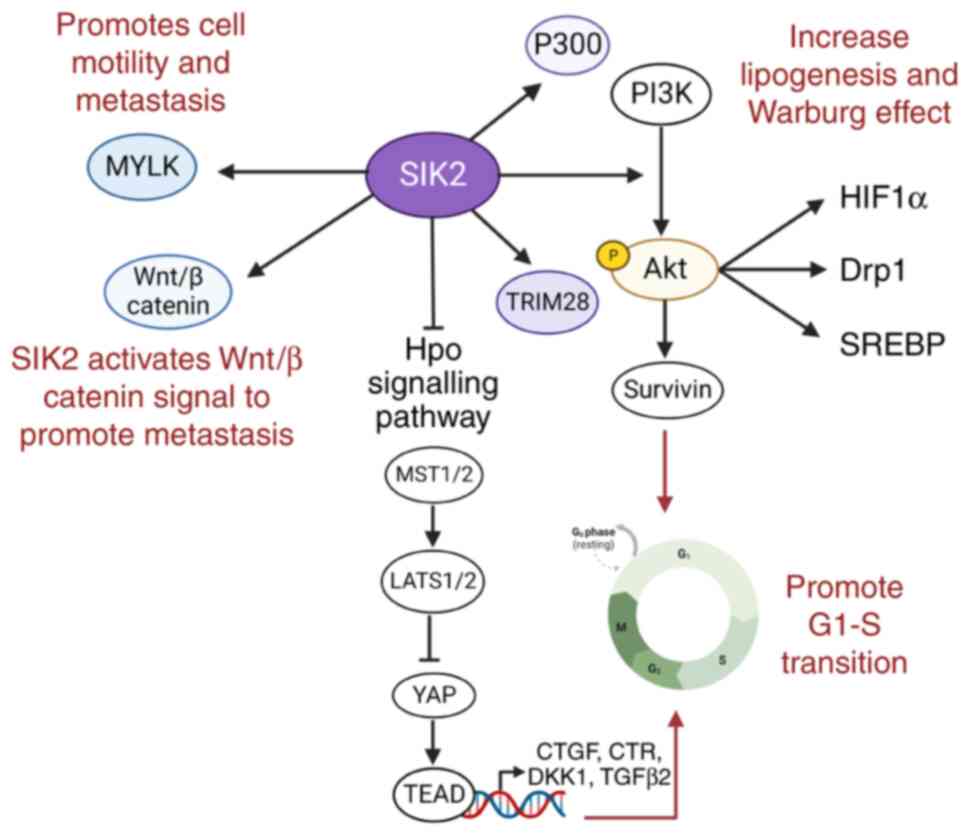
2001. View Article : Google Scholar : PubMed/NCBI
|
|
4
|
Horike N, Takemori H, Katoh Y, Doi J, Min
L, Asano T, Sun XJ, Yamamoto H, Kasayama S, Muraoka M, et al:
Adipose-specific expression, phosphorylation of Ser794 in insulin
receptor substrate-1, and activation in diabetic animals of
salt-inducible kinase-2. J Biol Chem. 278:18440–1847. 2003.
View Article : Google Scholar : PubMed/NCBI
|
|
5
|
Katoh Y, Takemori H, Horike N, Doi J,
Muraoka M, Min L and Okamoto M: Salt-inducible kinase (SIK)
isoforms: Their involvement in steroidogenesis and adipogenesis.
Mol Cell Endocrinol. 217:109–112. 2004. View Article : Google Scholar : PubMed/NCBI
|
|
6
|
Chen F, Chen L, Qin Q and Sun X:
Salt-inducible Kinase 2: An oncogenic signal transmitter and
potential target for cancer therapy. Front Oncol. 9:182019.
View Article : Google Scholar : PubMed/NCBI
|
|
7
|
Feldman JD, Vician L, Crispino M, Hoe W,
Baudry M and Herschman HR: The salt-inducible kinase, SIK, is
induced by depolarization in brain. J Neurochem. 74:2227–2238.
2000. View Article : Google Scholar : PubMed/NCBI
|
|
8
|
Küser-Abali G, Ozcan F, Ugurlu A, Uysal A,
Fuss SH and Bugra-Bilge K: SIK2 is involved in the negative
modulation of insulin-dependent muller cell survival and implicated
in hyperglycemia-induced cell death. Invest Ophthalmol Vis Sci.
54:3526–3537. 2013. View Article : Google Scholar : PubMed/NCBI
|
|
9
|
Bricambert J, Miranda J, Benhamed F,
Girard J, Postic C and Dentin R: Salt-inducible kinase 2 links
transcriptional coactivator p300 phosphorylation to the prevention
of ChREBP-dependent hepatic steatosis in mice. J Clin Invest.
120:4316–4331. 2010. View Article : Google Scholar : PubMed/NCBI
|
|
10
|
Wein MN, Foretz M, Fisher DE, Xavier RJ
and Kronenberg HM: Salt-inducible kinases: Physiology, regulation
by cAMP, and therapeutic potential. Trends Endocrinol Metab.
29:723–735. 2018. View Article : Google Scholar : PubMed/NCBI
|
|
11
|
Berggreen C, Henriksson E, Jones HA,
Morrice N and Göransson O: cAMP-elevation mediated by β-adrenergic
stimulation inhibits salt-inducible kinase (SIK) 3 activity in
adipocytes. Cell Signal. 24:1863–1871. 2012. View Article : Google Scholar : PubMed/NCBI
|
|
12
|
Itoh Y, Sanosaka M, Fuchino H, Yahara Y,
Kumagai A, Takemoto D, Kagawa M, Doi J, Ohta M, Tsumaki N, et al:
Salt-inducible Kinase 3 signaling is important for the
gluconeogenic programs in mouse hepatocytes. J Biol Chem.
290:17879–1793. 2015. View Article : Google Scholar : PubMed/NCBI
|
|
13
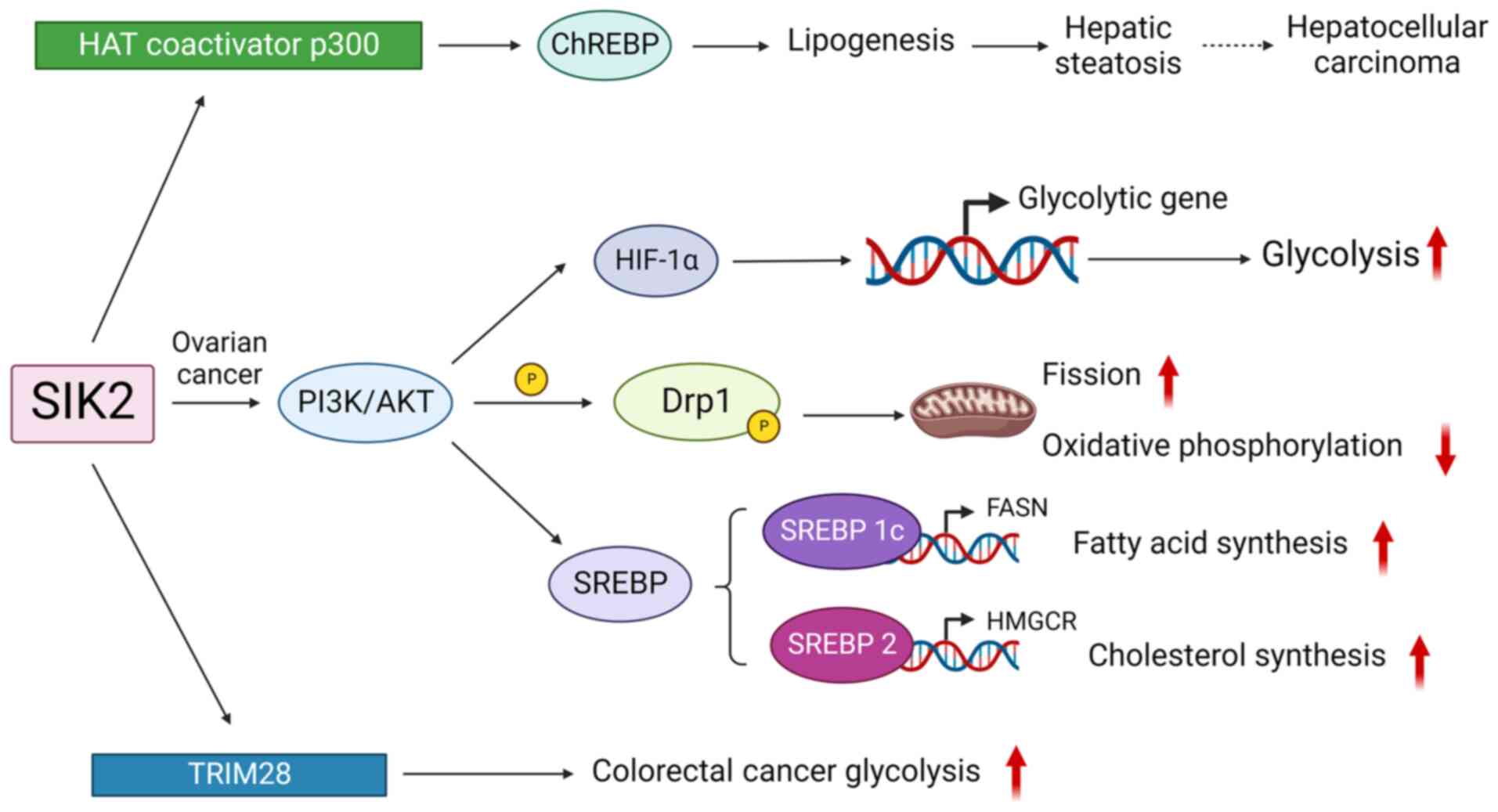
|
Amara S, Majors C, Roy B, Hill S, Rose KL,
Myles EL and Tiriveedhi V: Critical role of SIK3 in mediating high
salt and IL-17 synergy leading to breast cancer cell proliferation.
PLoS One. 12:e01800972017. View Article : Google Scholar : PubMed/NCBI
|
|
14
|
Li Y, Yu J, Jia M, Ma P and Dong C:
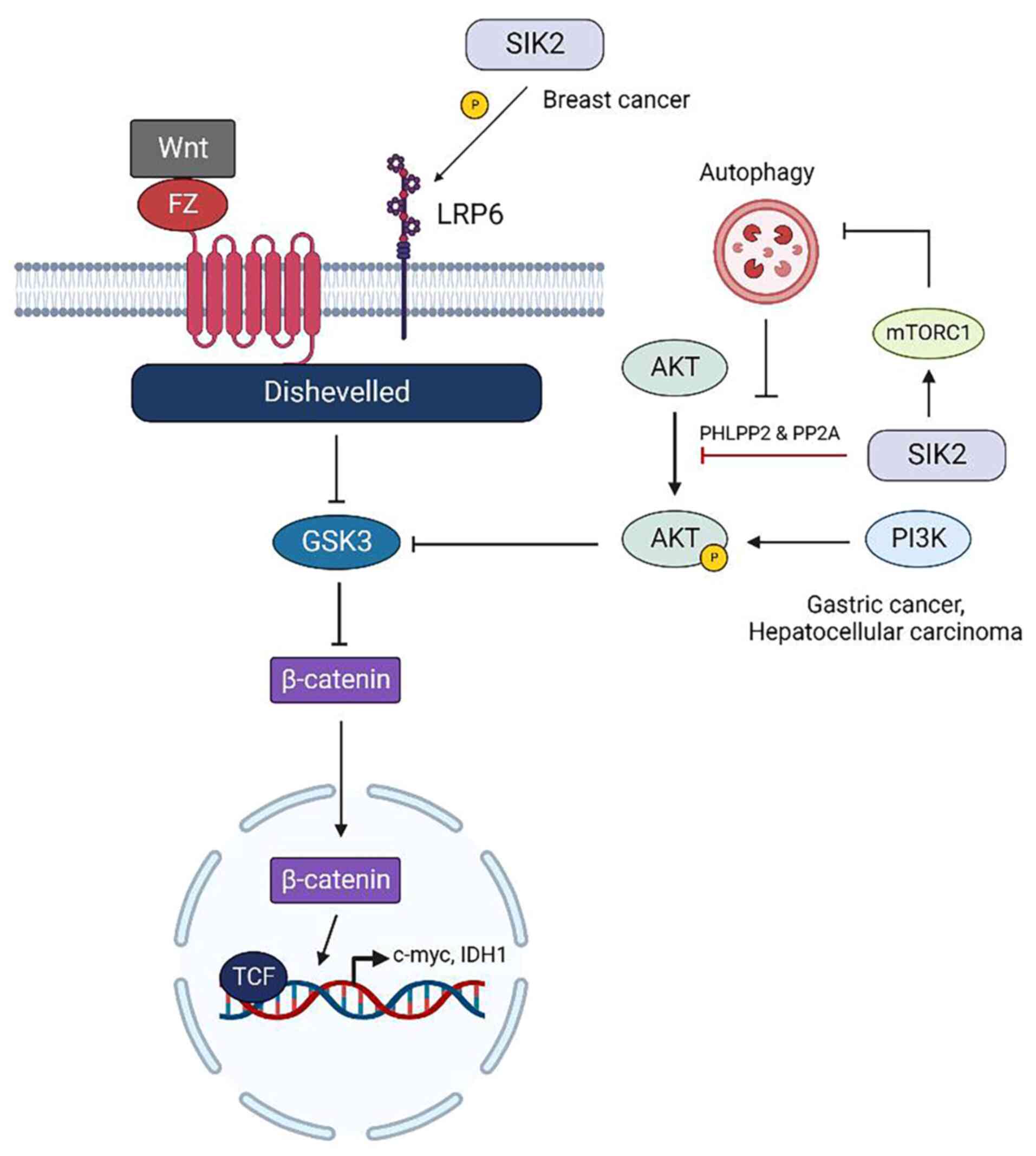
Salt-inducible kinase 2 functions as a tumor suppressor in
hepatocellular carcinoma. Environ Toxicol. 36:2530–2540. 2021.
View Article : Google Scholar : PubMed/NCBI
|
|
15
|
Charoenfuprasert S, Yang YY, Lee YC, Chao
KC, Chu PY, Lai CR, Hsu KF, Chang KC, Chen YC, Chen LT, et al:
Identification of salt-inducible kinase 3 as a novel tumor antigen
associated with tumorigenesis of ovarian cancer. Oncogene.
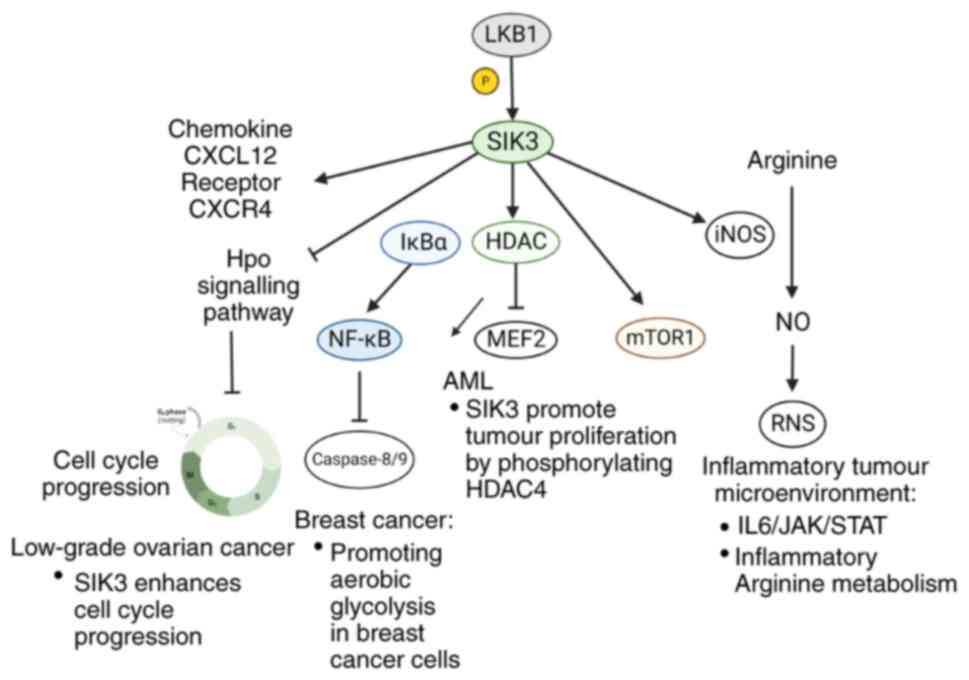
30:3570–3584. 2011. View Article : Google Scholar : PubMed/NCBI
|
|
16
|
Xin L, Liu C, Liu Y, Mansel RE, Ruge F,
Davies E, Jiang WG and Martin TA: SIKs suppress tumor function and
regulate drug resistance in breast cancer. Am J Cancer Res.
11:3537–3557. 2021.PubMed/NCBI
|
|
17
|
Hollstein PE, Eichner LJ, Brun SN,
Kamireddy A, Svensson RU, Vera LI, Ross DS, Rymoff TJ, Hutchins A,
Galvez HM, et al: The AMPK-related Kinases SIK1 and SIK3 mediate
key tumor-suppressive effects of LKB1 in NSCLC. Cancer Discov.
9:1606–1627. 2019. View Article : Google Scholar : PubMed/NCBI
|
|
18
|
Hong B, Zhang J and Yang W: Activation of
the LKB1-SIK1 signaling pathway inhibits the TGF-β-mediated
epithelial-mesenchymal transition and apoptosis resistance of
ovarian carcinoma cells. Mol Med Rep. 17:2837–2844. 2018.
|
|
19
|
Cheng H, Liu P, Wang ZC, Zou L, Santiago
S, Garbitt V, Gjoerup OV, Iglehart JD, Miron A, Richardson AL, et
al: SIK1 couples LKB1 to p53-dependent anoikis and suppresses
metastasis. Sci Signal. 2:ra352009. View Article : Google Scholar : PubMed/NCBI
|
|
20
|
Yang L, Xie N, Huang J, Huang H, Xu S,
Wang Z and Cai J: SIK1-LNC represses the proliferative, migrative,
and invasive abilities of lung cancer cells. Onco Targets Ther.
11:4197–4206. 2018. View Article : Google Scholar : PubMed/NCBI
|
|
21
|
Selvik LK, Rao S, Steigedal TS, Haltbakk
I, Misund K, Bruland T, Prestvik WS, Lægreid A and Thommesen L:
Salt-inducible kinase 1 (SIK1) is induced by gastrin and inhibits
migration of gastric adenocarcinoma cells. PLoS One. 9:e1124852014.
View Article : Google Scholar : PubMed/NCBI
|
|
22
|
Shi X, Yu X, Wang J, Bian S, Li Q, Fu F,
Zou X, Zhang L, Bast RC Jr, Lu Z, et al: SIK2 promotes ovarian
cancer cell motility and metastasis by phosphorylating MYLK. Mol
Oncol. 16:2558–2574. 2022. View Article : Google Scholar :
|
|
23
|
Sorrentino A, Menevse AN, Michels T,
Volpin V, Durst FC, Sax J, Xydia M, Hussein A, Stamova S, Spoerl S,
et al: Salt-inducible kinase 3 protects tumor cells from cytotoxic
T-cell attack by promoting TNF-induced NF-κB activation. J
Immunother Cancer. 10:e0042582022. View Article : Google Scholar
|
|
24
|
Taub M, Springate JE and Cutuli F:
Targeting of renal proximal tubule Na,K-ATPase by salt-inducible
kinase. Biochem Biophys Res Commun. 393:339–344. 2010. View Article : Google Scholar : PubMed/NCBI
|
|
25
|
Darling NJ and Cohen P: Nuts and bolts of
the salt-inducible kinases (SIKs). Biochem J. 478:1377–1397. 2021.
View Article : Google Scholar : PubMed/NCBI
|
|
26
|
Sakamoto K, Bultot L and Göransson O: The
Salt-inducible kinases: Emerging metabolic regulators. Trends
Endocrinol Metab. 29:827–840. 2018. View Article : Google Scholar : PubMed/NCBI
|
|
27
|
Lizcano JM, Göransson O, Toth R, Deak M,
Morrice NA, Boudeau J, Hawley SA, Udd L, Mäkelä TP, Hardie DG and
Alessi DR: LKB1 is a master kinase that activates 13 kinases of the
AMPK subfamily, including MARK/PAR-1. EMBO J. 23:833–843. 2004.
View Article : Google Scholar : PubMed/NCBI
|
|
28
|
Takemori H, Katoh Y, Horike N, Doi J and
Okamoto M: ACTH-induced nucleocytoplasmic translocation of
salt-inducible kinase. Implication in the protein kinase
A-activated gene transcription in mouse adrenocortical tumor cells.
J Biol Chem. 277:42334–42343. 2002. View Article : Google Scholar : PubMed/NCBI
|
|
29
|
Patel K, Foretz M, Marion A, Campbell DG,
Gourlay R, Boudaba N, Tournier E, Titchenell P, Peggie M, Deak M,
et al: The LKB1-salt-inducible kinase pathway functions as a key
gluconeogenic suppressor in the liver. Nat Commu. 5:45352014.
View Article : Google Scholar
|
|
30
|
MacKenzie KF, Clark K, Naqvi S, McGuire
VA, Nöehren G, Kristariyanto Y, van den Bosch M, Mudaliar M,
McCarthy PC, Pattison MJ, et al: PGE(2) induces macrophage IL-10
production and a regulatory-like phenotype via a protein kinase
A-SIK-CRTC3 pathway. J Immunol. 190:565–577. 2013. View Article : Google Scholar :
|
|
31
|
Sonntag T, Vaughan JM and Montminy M:
14-3-3 proteins mediate inhibitory effects of cAMP on
salt-inducible kinases (SIKs). FEBS J. 285:467–480. 2018.
View Article : Google Scholar :
|
|
32
|
Berdeaux R, Goebel N, Banaszynski L,
Takemori H, Wandless T, Shelton GD and Montminy M: SIK1 is a class
II HDAC kinase that promotes survival of skeletal myocytes. Nat
Med. 13:597–603. 2007. View
Article : Google Scholar : PubMed/NCBI
|
|
33
|
Jaleel M, Villa F, Deak M, Toth R,
Prescott AR, Van Aalten DM and Alessi DR: The ubiquitin-associated
domain of AMPK-related kinases regulates conformation and
LKB1-mediated phosphorylation and activation. Biochem J.
394:545–555. 2006. View Article : Google Scholar :
|
|
34
|
Al-Hakim AK, Göransson O, Deak M, Toth R,
Campbell DG, Morrice NA, Prescott AR and Alessi DR: 14-3-3
cooperates with LKB1 to regulate the activity and localization of
QSK and SIK. J Cell Sci. 118:5661–5673. 2005. View Article : Google Scholar : PubMed/NCBI
|
|
35
|
Bertorello AM and Zhu JK: SIK1/SOS2
networks: Decoding sodium signals via calcium-responsive protein
kinase pathways. Pflugers Arch. 458:613–619. 2009. View Article : Google Scholar : PubMed/NCBI
|
|
36
|
Sasaki T, Takemori H, Yagita Y, Terasaki
Y, Uebi T, Horike N, Takagi H, Susumu T, Teraoka H, Kusano K, et
al: SIK2 is a key regulator for neuronal survival after ischemia
via TORC1-CREB. Neuron. 69:106–119. 2011. View Article : Google Scholar : PubMed/NCBI
|
|
37
|
Hashimoto YK, Satoh T, Okamoto M and
Takemori H: Importance of autophosphorylation at Ser186 in the
A-loop of salt inducible kinase 1 for its sustained kinase
activity. J Cell Biochem. 104:1724–1739. 2008. View Article : Google Scholar : PubMed/NCBI
|
|
38
|
Fiol CJ, Mahrenholz AM, Wang Y, Roeske RW
and Roach PJ: Formation of protein kinase recognition sites by
covalent modification of the substrate. Molecular mechanism for the
synergistic action of casein Kinase II and glycogen synthase kinase
3. J Biol Chem. 262:14042–14048. 1987. View Article : Google Scholar : PubMed/NCBI
|
|
39
|
Koo SH, Flechner L, Qi L, Zhang X,
Screaton RA, Jeffries S, Hedrick S, Xu W, Boussouar F, Brindle P,
et al: The CREB coactivator TORC2 is a key regulator of fasting
glucose metabolism. Nature. 437:1109–1111. 2005. View Article : Google Scholar
|
|
40
|
Liu W, Feldman JD, Machado HB, Vician LJ
and Herschman HR: Expression of depolarization-induced immediate
early gene proteins in PC12 cells. J Eur Res. 72:670–678. 2003.
|
|
41
|
Jagannath A, Butler R, Godinho SIH, Couch
Y, Brown LA, Vasudevan SR, Flanagan KC, Anthony D, Churchill GC,
Wood MJA, et al: The CRTC1-SIK1 pathway regulates entrainment of
the circadian clock. Cell. 154:1100–1111. 2013. View Article : Google Scholar : PubMed/NCBI
|
|
42
|
Alotaibi D, Amara S, Johnson TL and
Tiriveedhi V: Potential anticancer effect of prostratin through
SIK3 inhibition. Oncol Lett. 15:3252–3258. 2018.PubMed/NCBI
|
|
43
|
Panni S, Lovering RC, Porras P and Orchard
S: Non-coding RNA regulatory networks. Biochim Biophys Acta Gene
Regul Mech. 1863:1944172020. View Article : Google Scholar
|
|
44
|
Huang C, Liu J, Xu L, Hu W, Wang J, Wang M
and Yao X: MicroRNA-17 promotes cell proliferation and migration in
human colorectal cancer by downregulating SIK1. Cancer Manag Res.
11:3521–3534. 2019. View Article : Google Scholar : PubMed/NCBI
|
|
45
|
Ren ZG, Dong SX, Han P and Qi J: miR-203
promotes proliferation, migration and invasion by degrading SIK1 in
pancreatic cancer. Oncol Rep. 35:1365–1374. 2016. View Article : Google Scholar : PubMed/NCBI
|
|
46
|
Chen JL, Chen F, Zhang TT and Liu NF:
Suppression of SIK1 by miR-141 in human ovarian cancer cell lines
and tissues. Int J Mol Med. 37:1601–1610. 2016. View Article : Google Scholar : PubMed/NCBI
|
|
47
|
Bai X, Yang M and Xu Y: MicroRNA-373
promotes cell migration via targeting salt-inducible kinase 1
expression in melanoma. Exp Ther Med. 16:4759–4764. 2018.PubMed/NCBI
|
|
48
|
Huang S, Xue P, Han X, Zhang C, Yang L,
Liu L, Wang X, Li H, Fu J and Zhou Y: Exosomal miR-130b-3p targets
SIK1 to inhibit medulloblastoma tumorigenesis. Cell Death Dis.
11:4082020. View Article : Google Scholar : PubMed/NCBI
|
|
49
|
Wei S, Qi L and Wang L: Overexpression of
circ_CELSR1 facilitates paclitaxel resistance of ovarian cancer by
regulating miR-149-5p/SIK2 axis. Anticancer Drugs. 32:496–507.
2021. View Article : Google Scholar : PubMed/NCBI
|
|
50
|
Sun Z, Niu S, Xu F, Zhao W, Ma R and Chen
M: CircAMOTL1 promotes tumorigenesis through miR-526b/SIK2 axis in
cervical cancer. Front Cell Dev Biol. 8:5681902020. View Article : Google Scholar :
|
|
51
|
Liu Y, Gao S, Chen X, Liu M, Mao C and
Fang X: Overexpression of miR-203 sensitizes paclitaxel
(Taxol)-resistant colorectal cancer cells through targeting the
salt-inducible kinase 2 (SIK2). Tumor Biol. 37:12231–12239. 2016.
View Article : Google Scholar
|
|
52
|
Xia B, Lin M, Dong W, Chen H, Li B, Zhang
X, Hou Y and Lou G: Upregulation of miR-874-3p and miR-874-5p
inhibits epithelial ovarian cancer malignancy via SIK2. J Biochem
Mol Toxicol. 32:e221682018. View Article : Google Scholar : PubMed/NCBI
|
|
53
|
Li ZY, Wang XL, Dang Y, Zhu XZ, Zhang YH,
Cai BX and Zheng L: Long non-coding RNA UCA1 promotes the
progression of paclitaxel resistance in ovarian cancer by
regulating the miR-654-5p/SIK2 axis. Eur Rev Med Pharmacol Sci.
24:591–603. 2020.PubMed/NCBI
|
|
54
|
Peng J, Hou F, Zhu W, Li J and Teng Z:
lncRNA NR2F1-AS1 Regulates miR-17/SIK1 axis to suppress the
invasion and migration of cervical squamous cell carcinoma cells.
Reprod Sci. 27:1534–1539. 2020. View Article : Google Scholar : PubMed/NCBI
|
|
55
|
Bawa P, Zackaria S, Verma M, Gupta S,
Srivatsan R, Chaudhary B and Srinivasan S: Integrative analysis of
normal long intergenic Non-Coding RNAs in prostate cancer. PLoS
One. 10:e01221432015. View Article : Google Scholar : PubMed/NCBI
|
|
56
|
Huang J, Lin F, Xu C and Xu Y: LINC00662
facilitates osteosarcoma progression via sponging miR-103a-3p and
regulating SIK2 expression. J Tissue Eng Regen Med. 15:1082–1091.
2021. View Article : Google Scholar : PubMed/NCBI
|
|
57
|
Zhou WY, Cai ZR, Liu J, Wang DS, Ju HQ and
Xu RH: Circular RNA: Metabolism, functions and interactions with
proteins. Mol Cancer. 19:1722020. View Article : Google Scholar : PubMed/NCBI
|
|
58
|
Jin Y and Wang H: Circ_0078607 inhibits
the progression of ovarian cancer via regulating the miR-32-5p/SIK1
network. J Ovarian Res. 15:32022. View Article : Google Scholar : PubMed/NCBI
|
|
59
|
Zang X, Jiang J, Gu J, Chen Y, Wang M,
Zhang Y, Fu M, Shi H, Cai H, Qian H, et al: Circular RNA EIF4G3
suppresses gastric cancer progression through inhibition of
β-catenin by promoting δ-catenin ubiquitin degradation and
upregulating SIK1. Mol Cancer. 21:1412022. View Article : Google Scholar
|
|
60
|
Clark K, MacKenzie KF, Petkevicius K,
Kristariyanto Y, Zhang J, Choi HG, Peggie M, Plater L, Pedrioli PG,
McIver E, et al: Phosphorylation of CRTC3 by the salt-inducible
kinases controls the interconversion of classically activated and
regulatory macrophages. Proc Natl Acad Sci USA. 109:16986–16991.
2012. View Article : Google Scholar : PubMed/NCBI
|
|
61
|
Screaton RA, Conkright MD, Katoh Y, Best
JL, Canettieri G, Jeffries S, Guzman E, Niessen S, Yates JR III,
Takemori H, et al: The CREB coactivator TORC2 functions as a
calcium- and cAMP-sensitive coincidence detector. Cell. 119:61–74.
2004. View Article : Google Scholar : PubMed/NCBI
|
|
62
|
Altarejos JY and Montminy M: CREB and the
CRTC co-activators: Sensors for hormonal and metabolic signals.
Natu Rev Mol Cell Biol. 12:141–151. 2011. View Article : Google Scholar
|
|
63
|
Henriksson E, Jones HA, Patel K, Peggie M,
Morrice N, Sakamoto K and Göransson O: The AMPK-related kinase SIK2
is regulated by cAMP via phosphorylation at Ser358 in adipocytes.
Biochemical J. 444:503–514. 2012. View Article : Google Scholar
|
|
64
|
Luo Q, Viste K, Urday-Zaa JC, Senthil
Kumar G, Tsai WW, Talai A, Mayo KE, Montminy M and Radhakrishnan I:
Mechanism of CREB recognition and coactivation by the
CREB-regulated transcriptional coactivator CRTC2. Proc Natl Acad
Sci USA. 109:20865–20870. 2012. View Article : Google Scholar : PubMed/NCBI
|
|
65
|
van der Linden AM, Nolan KM and Sengupta
P: KIN-29 SIK regulates chemoreceptor gene expression via an MEF2
transcription factor and a class II HDAC. EMBO J. 26:358–370. 2007.
View Article : Google Scholar
|
|
66
|
Chan JK, Sun L, Yang XJ, Zhu G and Wu Z:
Functional characterization of an amino-terminal region of HDAC4
that possesses MEF2 binding and transcriptional repressive
activity. J Biol Chem. 278:23515–23521. 2003. View Article : Google Scholar : PubMed/NCBI
|
|
67
|
Alessi DR, Sakamoto K and Bayascas JR:
LKB1-dependent signaling pathways. Ann Rev Biochemistry.
75:137–163. 2006. View Article : Google Scholar
|
|
68
|
Ponnusamy L and Manoharan R: Distinctive
role of SIK1 and SIK3 isoforms in aerobic glycolysis and cell
growth of breast cancer through the regulation of p53 and mTOR
signaling pathways. Biochim Biophys Acta Mol Cell Res.
1868:1189752021. View Article : Google Scholar : PubMed/NCBI
|
|
69
|
Schwartzenberg-Bar-Yoseph F, Armoni M and
Karnieli E: The tumor suppressor p53 down-regulates glucose
transporters GLUT1 and GLUT4 gene expression. Cancer Res.
64:2627–2633. 2004. View Article : Google Scholar : PubMed/NCBI
|
|
70
|
Kowanetz M, Lönn P, Vanlandewijck M,
Kowanetz K, Heldin CH and Moustakas A: TGFbeta induces SIK to
negatively regulate type I receptor kinase signaling. J Cell Biol.
182:655–662. 2008. View Article : Google Scholar : PubMed/NCBI
|
|
71
|
Yao YH, Cui Y, Qiu XN, Zhang LZ, Zhang W,
Li H and Yu JM: Attenuated LKB1-SIK1 signaling promotes
epithelial-mesenchymal transition and radioresistance of non-small
cell lung cancer cells. Chin J Cancer. 35:502016. View Article : Google Scholar : PubMed/NCBI
|
|
72
|
Sánchez-Tilló E, Siles L, de Barrios O,
Cuatrecasas M, Vaquero EC, Castells A and Postigo A: Expanding
roles of ZEB factors in tumorigenesis and tumor progression. Am J
Cancer Res. 1:897–912. 2011.PubMed/NCBI
|
|
73
|
Zhang P, Sun Y and Ma L: ZEB1: At the
crossroads of epithelial-mesenchymal transition, metastasis and
therapy resistance. Cell Cycle. 14:481–487. 2015. View Article : Google Scholar : PubMed/NCBI
|
|
74
|
Gradek F, Lopez-Charcas O, Chadet S,
Poisson L, Ouldamer L, Goupille C, Jourdan ML, Chevalier S,
Moussata D, Besson P and Roger S: Sodium channel Nav1.5
controls epithelial-to-mesenchymal transition and invasiveness in
breast cancer cells through its regulation by the Salt-inducible
Kinase-1. Sci Rep. 9:186522019. View Article : Google Scholar
|
|
75
|
Cameron IL, Smith NK, Pool TB and Sparks
RL: Intracellular concentration of sodium and other elements as
related to mitogenesis and oncogenesis in vivo. Cancer Res.
40:1493–1500. 1980.PubMed/NCBI
|
|
76
|
Yang M, Kozminski DJ, Wold LA, Modak R,
Calhoun JD, Isom LL and Brackenbury WJ: Therapeutic potential for
phenytoin: Targeting Na(v)1.5 sodium channels to reduce migration
and invasion in metastatic breast cancer. Breast Cancer Res Treat.
134:603–615. 2012. View Article : Google Scholar : PubMed/NCBI
|
|
77
|
Fraser SP, Diss JK, Chioni AM, Mycielska
ME, Pan H, Yamaci RF, Pani F, Siwy Z, Krasowska M, Grzywna Z, et
al: Voltage-gated sodium channel expression and potentiation of
human breast cancer metastasis. Clin Cancer Res. 11:5381–5389.
2005. View Article : Google Scholar : PubMed/NCBI
|
|
78
|
Nelson M, Yang M, Millican-Slater R and
Brackenbury WJ: Nav1.5 regulates breast tumor growth and metastatic
dissemination in vivo. Oncotarget. 6:32914–32929. 2015. View Article : Google Scholar : PubMed/NCBI
|
|
79
|
Lei Y, Chen L, Zhang G, Shan A, Ye C,
Liang B, Sun J, Liao X, Zhu C, Chen Y, et al: MicroRNAs target the
Wnt/β-catenin signaling pathway to regulate epithelial-mesenchymal
transition in cancer (Review). Oncol Rep. 44:1299–1313.
2020.PubMed/NCBI
|
|
80
|
Chen L, Mai W, Chen M, Hu J, Zhuo Z, Lei
X, Deng L, Liu J, Yao N, Huang M, et al: Arenobufagin inhibits
prostate cancer epithelial-mesenchymal transition and metastasis by
down-regulating β-catenin. Pharmacol Res. 123:130–142. 2017.
View Article : Google Scholar : PubMed/NCBI
|
|
81
|
Qu C, He D, Lu X, Dong L, Zhu Y, Zhao Q,
Jiang X, Chang P, Jiang X, Wang L, et al: Salt-inducible Kinase
(SIK1) regulates HCC progression and WNT/beta-catenin activation. J
Hepatol. 64:1076–1089. 2016. View Article : Google Scholar : PubMed/NCBI
|
|
82
|
Qu C and Qu Y: Down-regulation of
salt-inducible kinase 1 (SIK1) is mediated by RNF2 in
hepatocarcinogenesis. Oncotarget. 8:3144–3155. 2017. View Article : Google Scholar :
|
|
83
|
Gajula RP, Chettiar ST, Williams RD,
Thiyagarajan S, Kato Y, Aziz K, Wang R, Gandhi N, Wild AT, Vesuna
F, et al: The twist box domain is required for Twist1-induced
prostate cancer metastasis. Mol Cancer Res. 11:1387–1400. 2013.
View Article : Google Scholar : PubMed/NCBI
|
|
84
|
Zhu QQ, Ma C, Wang Q, Song Y and Lv T: The
role of TWIST1 in epithelial-mesenchymal transition and cancers.
Tumor Biol. 37:185–197. 2016. View Article : Google Scholar
|
|
85
|
Du WQ, Zheng JN and Pei DS: The diverse
oncogenic and tumor suppressor roles of salt-inducible kinase (SIK)
in cancer. Expert Opin Ther Targets. 20:477–485. 2016. View Article : Google Scholar
|
|
86
|
Fu X, Tang Y, Wu W, Ouyang Y, Tan D and
Huang Y: Exosomal microRNA-25 released from cancer cells targets
SIK1 to promote hepatocellular carcinoma tumorigenesis. Dig Liver
Dis. 54:954–963. 2022. View Article : Google Scholar
|
|
87
|
Hartono AB, Kang HJ, Shi L, Phipps W,
Ungerleider N, Giardina A, Chen W, Spraggon L, Somwar R, Moroz K,
et al: Salt-Inducible Kinase 1 is a potential therapeutic target in
desmoplastic small round cell tumor. Oncogenesis. 11:182022.
View Article : Google Scholar : PubMed/NCBI
|
|
88
|
Joshi K, Shah VJ and Maddika S: GINS
complex protein Sld5 recruits SIK1 to activate MCM helicase during
DNA replication. Cell Signal. 28:1852–1862. 2016. View Article : Google Scholar : PubMed/NCBI
|
|
89
|
Ahmed AA, Lu Z, Jennings NB,
Etemadmoghadam D, Capalbo L, Jacamo RO, Barbosa-Morais N, Le XF;
Australian Ovarian Cancer Study Group; Vivas-Mejia P, et al: SIK2
is a centrosome kinase required for bipolar mitotic spindle
formation that provides a potential target for therapy in ovarian
cancer. Cancer Cell. 18:109–121. 2010. View Article : Google Scholar : PubMed/NCBI
|
|
90
|
Raab M, Rak M, Tesch R, Gasimli K, Becker
S, Knapp S, Strebhardt K and Sanhaji M: The small-molecule
inhibitor MRIA9 reveals novel insights into the cell cycle roles of
SIK2 in ovarian cancer cells. Cancers (Basel). 13:36582021.
View Article : Google Scholar : PubMed/NCBI
|
|
91
|
Sun XP, Dong X, Lin L, Jiang X, Wei Z,
Zhai B, Sun B, Zhang Q, Wang X, Jiang H, et al: Up-regulation of
survivin by AKT and hypoxia-inducible factor 1α contributes to
cisplatin resistance in gastric cancer. FEBS J. 281:115–128. 2014.
View Article : Google Scholar
|
|
92
|
Giodini A, Kallio MJ, Wall NR, Gorbsky GJ,
Tognin S, Marchisio PC, Symons M and Altieri DC: Regulation of
microtubule stability and mitotic progression by survivin. Cancer
Res. 62:2462–2467. 2002.PubMed/NCBI
|
|
93
|
Shojaei F, Yazdani-Nafchi F,
Banitalebi-Dehkordi M, Chehelgerdi M and Khorramian-Ghahfarokhi M:
Trace of survivin in cancer. Eur J Cancer Prevention. 28:365–372.
2019. View Article : Google Scholar
|
|
94
|
Vader G, Kauw JJ, Medema RH and Lens SM:
Survivin mediates targeting of the chromosomal passenger complex to
the centromere and midbody. EMBO Rep. 7:85–92. 2006. View Article : Google Scholar
|
|
95
|
Ryan BM, O'Donovan N and Duffy MJ:
Survivin: A new target for anti-cancer therapy. Cancer Treatment
Rev. 35:553–562. 2009. View Article : Google Scholar
|
|
96
|
Bon H, Wadhwa K, Schreiner A, Osborne M,
Carroll T, Ramos-Montoya A, Ross-Adams H, Visser M, Hoffmann R,
Ahmed AA, et al: Salt-inducible kinase 2 regulates mitotic
progression and transcription in prostate cancer. Mol Cancer Res.
13:620–635. 2015. View Article : Google Scholar :
|
|
97
|
Nagel S, Leich E, Quentmeier H, Meyer C,
Kaufmann M, Zaborski M, Rosenwald A, Drexler HG and Macleod RA:
Amplification at 11q23 targets protein kinase SIK2 in diffuse large
B-cell lymphoma. Leuk Lymphoma. 51:881–891. 2010. View Article : Google Scholar : PubMed/NCBI
|
|
98
|
Lu F, Zheng Y, Donkor PO, Zou P and Mu P:
Downregulation of CREB promotes cell proliferation by mediating
G1/S phase transition in hodgkin lymphoma. Oncol Res. 24:171–179.
2016. View Article : Google Scholar : PubMed/NCBI
|
|
99
|
Melnikova VO, Dobroff AS, Zigler M,
Villares GJ, Braeuer RR, Wang H, Huang L and Bar-Eli M: CREB
inhibits AP-2alpha expression to regulate the malignant phenotype
of melanoma. PLoS One. 5:e124522010. View Article : Google Scholar : PubMed/NCBI
|
|
100
|
Wehr MC, Holder MV, Gailite I, Saunders
RE, Maile TM, Ciirdaeva E, Instrell R, Jiang M, Howell M, Rossner
MJ and Tapon N: Salt-inducible kinases regulate growth through the
Hippo signaling pathway in Drosophila. Nat Cell Biol. 15:61–71.
2013. View Article : Google Scholar :
|
|
101
|
Overholtzer M, Zhang J, Smolen GA, Muir B,
Li W, Sgroi DC, Brugge JS and Haber DA: Transforming properties of
YAP, a candidate oncogene on the chromosome 11q22 amplicon. Proc
Natl Acad Sci USA. 103:12405–12410. 2006. View Article : Google Scholar : PubMed/NCBI
|
|
102
|
Fukushi A, Kim HD, Chang YC and Kim CH:
Revisited metabolic control and reprogramming cancers by means of
the warburg effect in tumor cells. Int J Mol Sci. 23:100372022.
View Article : Google Scholar : PubMed/NCBI
|
|
103
|
Gao T, Zhang X, Zhao J, Zhou F, Wang Y,
Zhao Z, Xing J, Chen B, Li J and Liu S: SIK2 promotes reprogramming
of glucose metabolism through PI3K/AKT/HIF-1alpha pathway and
Drp1-mediated mitochondrial fission in ovarian cancer. Cancer Lett.
469:89–101. 2020. View Article : Google Scholar
|
|
104
|
Röhrig F and Schulze A: The multifaceted
roles of fatty acid synthesis in cancer. Nat Rev Cancer.
16:732–749. 2016. View Article : Google Scholar : PubMed/NCBI
|
|
105
|
Corbet C and Feron O: Emerging roles of
lipid metabolism in cancer progression. Curr Opin Clin Nutr Metab
Care. 20:254–260. 2017. View Article : Google Scholar : PubMed/NCBI
|
|
106
|
Ni X, Feng Y and Fu X: Role of
saltinducible kinase 2 in the malignant behavior and glycolysis of
colorectal cancer cells. Mol Med Rep. 24:8222021. View Article : Google Scholar
|
|
107
|
Qi ZX, Cai JJ, Chen LC, Yue Q, Gong Y, Yao
Y and Mao Y: TRIM28 as an independent prognostic marker plays
critical roles in glioma progression. J Neurooncol. 126:19–26.
2016. View Article : Google Scholar
|
|
108
|
Miranda F, Mannion D, Liu S, Zheng Y,
Mangala LS, Redondo C, Herrero-Gonzalez S, Xu R, Taylor C, Chedom
DF, et al: Salt-inducible kinase 2 couples ovarian cancer cell
metabolism with survival at the adipocyte-rich metastatic niche.
Cancer Cell. 30:273–289. 2016. View Article : Google Scholar : PubMed/NCBI
|
|
109
|
Zhao J, Zhang X, Gao T, Wang S, Hou Y,
Yuan P, Yang Y, Yang T, Xing J, Li J and Liu S: SIK2 enhances
synthesis of fatty acid and cholesterol in ovarian cancer cells and
tumor growth through PI3K/Akt signaling pathway. Cell Death Dis.
11:252020. View Article : Google Scholar : PubMed/NCBI
|
|
110
|
Martinez Calejman C, Trefely S, Entwisle
SW, Luciano A, Jung SM, Hsiao W, Torres A, Hung CM, Li H, Snyder
NW, et al: mTORC2-AKT signaling to ATP-citrate lyase drives brown
adipogenesis and de novo lipogenesis. Nat Commun. 11:5752020.
View Article : Google Scholar :
|
|
111
|
Zhang MX, Wang H and Sun GP:
Tumor-suppressor Fbxw7 targets SIK2 for degradation to interfere
with TORC2-AKT signaling in pancreatic cancer. Cell Biol Int.
44:1900–1910. 2020. View Article : Google Scholar : PubMed/NCBI
|
|
112
|
Airley RE, McHugh P, Evans AR, Harris B,
Winchester L, Buffa FM, Al-Tameemi W, Leek R and Harris AL: Role of
carbohydrate response element-binding protein (ChREBP) in
generating an aerobic metabolic phenotype and in breast cancer
progression. Br J Cancer. 110:715–723. 2014. View Article : Google Scholar :
|
|
113
|
Dai XM, Zhang YH, Lin XH, Huang XX, Zhang
Y, Xue CR, Chen WN, Ye JX, Lin XJ and Lin X: SIK2 represses
AKT/GSK3β/β-catenin signaling and suppresses gastric cancer by
inhibiting autophagic degradation of protein phosphatases. Mol
Oncol. 15:228–245. 2021. View Article : Google Scholar
|
|
114
|
Rong Z, Zhang L, Li Z, Xiao Z, Duan Y, Ren
X, Zi Y, Gao J, Mu Y, Guan Y, et al: SIK2 maintains breast cancer
stemness by phosphorylating LRP6 and activating Wnt/β-catenin
signaling. Oncogene. 41:2390–2403. 2022. View Article : Google Scholar
|
|
115
|
Dittmer J: Breast cancer stem cells:
Features, key drivers and treatment options. Semin Cancer Biol.
53:59–74. 2018. View Article : Google Scholar : PubMed/NCBI
|
|
116
|
Raisch J, Côté-Biron A and Rivard N: A
Role for the WNT Co-receptor LRP6 in pathogenesis and therapy of
epithelial cancers. Cancers (Basel). 11:11622019. View Article : Google Scholar : PubMed/NCBI
|
|
117
|
Al-Hajj M, Wicha MS, Benito-Hernandez A,
Morrison SJ and Clarke MF: Prospective identification of
tumorigenic breast cancer cells. Proc Natl Acad Sci USA.
100:3983–3988. 2003. View Article : Google Scholar : PubMed/NCBI
|
|
118
|
Jackson HW, Fischer JR, Zanotelli VRT, Ali
HR, Mechera R, Soysal SD, Moch H, Muenst S, Varga Z, Weber WP and
Bodenmiller B: The single-cell pathology landscape of breast
cancer. Nature. 578:615–620. 2020. View Article : Google Scholar
|
|
119
|
Maxfield KE, Macion J, Vankayalapati H and
Whitehurst AW: SIK2 Restricts autophagic flux to support
triple-negative breast cancer survival. Mol Cell Biol.
36:3048–3057. 2016. View Article : Google Scholar : PubMed/NCBI
|
|
120
|
Pradeep S, Kim SW, Wu SY, Nishimura M,
Chaluvally-Raghavan P, Miyake T, Pecot CV, Kim SJ, Choi HJ,
Bischoff FZ, et al: Hematogenous metastasis of ovarian cancer:
Rethinking mode of spread. Cancer Cell. 26:77–91. 2014. View Article : Google Scholar :
|
|
121
|
Yeung TL, Leung CS, Yip KP, Au Yeung CL,
Wong ST and Mok SC: Cellular and molecular processes in ovarian
cancer metastasis. A review in the Theme: Cell and molecular
processes in cancer metastasis. Am J Physiol Cell Physiol.
309:C444–C456. 2015. View Article : Google Scholar : PubMed/NCBI
|
|
122
|
Zhou Q, Gensch C and Liao JK:
Rho-associated coiled-coil-forming kinases (ROCKs): Potential
targets for the treatment of atherosclerosis and vascular disease.
Trends Pharmacol Sci. 32:167–173. 2011. View Article : Google Scholar : PubMed/NCBI
|
|
123
|
Madsen CD, Hooper S, Tozluoglu M,
Bruckbauer A, Fletcher G, Erler JT, Bates PA, Thompson B and Sahai
E: STRIPAK components determine mode of cancer cell migration and
metastasis. Nat Cell Biol. 17:68–80. 2015. View Article : Google Scholar
|
|
124
|
Ponnusamy L, Kothandan G and Manoharan R:
Berberine and Emodin abrogates breast cancer growth and facilitates
apoptosis through inactivation of SIK3-induced mTOR and Akt
signaling pathway. Biochim Biophys Acta Mol Basis Dis.
1866:1658972020. View Article : Google Scholar : PubMed/NCBI
|
|
125
|
Deng C, Zhang P, Harper JW, Elledge SJ and
Leder P: Mice lacking p21CIP1/WAF1 undergo normal development, but
are defective in G1 checkpoint control. Cell. 82:675–684. 1995.
View Article : Google Scholar : PubMed/NCBI
|
|
126
|
Woo YM, Shin Y, Lee EJ, Lee S, Jeong SH,
Kong HK, Park EY, Kim HK, Han J, Chang M and Park JH: Inhibition of
aerobic glycolysis represses Akt/mTOR/HIF-1α axis and restores
tamoxifen sensitivity in antiestrogen-resistant breast cancer
cells. PLoS One. 10:e01322852015. View Article : Google Scholar
|
|
127
|
Tarumoto Y, Lu B, Somerville TDD, Huang
YH, Milazzo JP, Wu XS, Klingbeil O, El Demerdash O, Shi J and Vakoc
CR: LKB1, Salt-inducible kinases, and MEF2C are linked dependencies
in acute myeloid leukemia. Mol Cell. 69:1017–1027.e6. 2018.
View Article : Google Scholar :
|
|
128
|
Tarumoto Y, Lin S, Wang J, Milazzo JP, Xu
Y, Lu B, Yang Z, Wei Y, Polyanskaya S, Wunderlich M, et al:
Salt-inducible kinase inhibition suppresses acute myeloid leukemia
progression in vivo. Blood. 135:56–70. 2020. View Article : Google Scholar :
|
|
129
|
Crusz SM and Balkwill FR: Inflammation and
cancer: Advances and new agents. Nat Rev Clin Oncol. 12:584–596.
2015. View Article : Google Scholar : PubMed/NCBI
|
|
130
|
Hanahan D and Weinberg RA: Hallmarks of
cancer: The next generation. Cell. 144:646–674. 2011. View Article : Google Scholar : PubMed/NCBI
|
|
131
|
Stubbins RJ, Platzbecker U and Karsan A:
Inflammation and myeloid malignancy: Quenching the flame. Blood.
140:1067–1074. 2022. View Article : Google Scholar : PubMed/NCBI
|
|
132
|
Diakos CI, Charles KA, McMillan DC and
Clarke SJ: Cancer-related inflammation and treatment effectiveness.
Lancet Oncol. 15:e493–e503. 2014. View Article : Google Scholar : PubMed/NCBI
|
|
133
|
Candido J and Hagemann T: Cancer-related
inflammation. J Clin Immunol. 33(Suppl 1): S79–S84. 2013.
View Article : Google Scholar
|
|
134
|
Mantovani A, Allavena P, Sica A and
Balkwill F: Cancer-related inflammation. Nature. 454:436–444. 2008.
View Article : Google Scholar : PubMed/NCBI
|
|
135
|
Sun Y, Mao X, Fan C, Liu C, Guo A, Guan S,
Jin Q, Li B, Yao F and Jin F: CXCL12-CXCR4 axis promotes the
natural selection of breast cancer cell metastasis. Tumor Biol.
35:7765–7773. 2014. View Article : Google Scholar
|
|
136
|
Yong Kim S, Jeong S, Chah KH, Jung E, Baek
KH, Kim ST, Shim JH, Chun E and Lee KY: Salt-inducible kinases 1
and 3 negatively regulate Toll-like receptor 4-mediated signal. Mol
Endocrinol. 27:1958–1968. 2013. View Article : Google Scholar : PubMed/NCBI
|
|
137
|
Janssens S and Beyaert R: Role of
Toll-like receptors in pathogen recognition. Clin Microbiol Rev.
16:637–646. 2003. View Article : Google Scholar :
|
|
138
|
Kim SY, Jeong S, Jung E, Baik KH, Chang
MH, Kim SA, Shim JH, Chun E and Lee KY: AMP-activated protein
kinase-α1 as an activating kinase of TGF-β-activated kinase 1 has a
key role in inflammatory signals. Cell Death Dis. 3:e3572012.
View Article : Google Scholar
|
|
139
|
West AP, Koblansky AA and Ghosh S:
Recognition and signaling by toll-like receptors. Ann Rev Cell Dev
Biol. 22:409–437. 2006. View Article : Google Scholar
|
|
140
|
Kumari N, Dwarakanath BS, Das A and Bhatt
AN: Role of interleukin-6 in cancer progression and therapeutic
resistance. Tumor Biol. 37:11553–11572. 2016. View Article : Google Scholar
|
|
141
|
Mannino MH, Zhu Z, Xiao H, Bai Q,
Wakefield MR and Fang Y: The paradoxical role of IL-10 in immunity
and cancer. Cancer Lett. 367:103–107. 2015. View Article : Google Scholar
|
|
142
|
Sall J, Pettersson AM, Bjork C, Henriksson
E, Wasserstrom S, Linder W, Zhou Y, Hansson O, Andersson DP,
Ekelund M, et al: Salt-inducible kinase 2 and -3 are downregulated
in adipose tissue from obese or insulin-resistant individuals:
Implications for insulin signaling and glucose uptake in human
adipocytes. Diabetologia. 60:314–323. 2017. View Article : Google Scholar
|
|
143
|
Thommen DS and Schumacher TN: T cell
dysfunction in cancer. Cancer Cell. 33:547–562. 2018. View Article : Google Scholar : PubMed/NCBI
|
|
144
|
Nefla M, Darling NJ, van Gijsel Bonnello
M, Cohen P and Arthur JSC: Salt inducible kinases 2 and 3 are
required for thymic T cell development. Sci Rep. 11:215502021.
View Article : Google Scholar : PubMed/NCBI
|
|
145
|
Yunna C, Mengru H, Lei W and Weidong C:
Macrophage M1/M2 polarization. Eur J Pharmacol. 877:1730902020.
View Article : Google Scholar
|
|
146
|
Darling NJ, Toth R, Arthur JS and Clark K:
Inhibition of SIK2 and SIK3 during differentiation enhances the
anti-inflammatory phenotype of macrophages. Biochem J. 474:521–537.
2017. View Article : Google Scholar
|
|
147
|
Di Giorgio E and Brancolini C: Regulation
of class IIa HDAC activities: It is not only matter of subcellular
localization. Epigenomics. 8:251–269. 2016. View Article : Google Scholar
|
|
148
|
Tesch R, Rak M, Raab M, Berger LM,
Kronenberger T, Joerger AC, Berger BT, Abdi I, Hanke T, Poso A, et
al: Structure-based design of selective salt-inducible kinase
inhibitors. J Med Chem. 64:8142–8160. 2021. View Article : Google Scholar
|
|
149
|
Zhou J, Alfraidi A, Zhang S,
Santiago-O'Farrill JM, Yerramreddy Reddy VK, Alsaadi A, Ahmed AA,
Yang H, Liu J, Mao W, et al: A novel compound ARN-3236 inhibits
salt-inducible Kinase 2 and sensitizes ovarian cancer cell lines
and xenografts to paclitaxel. Clin Cancer Res. 23:1945–1954. 2017.
View Article : Google Scholar
|
|
150
|
Fan D, Yang H, Mao W, Rask PJ, Pang L, Xu
C, Vankayalapat H, Ahmed AA, Bast RC Jr and Lu Z: A novel salt
inducible kinase 2 inhibitor, ARN-3261, sensitizes ovarian cancer
cell lines and xenografts to carboplatin. Cancers (Basel).
13:4462021. View Article : Google Scholar : PubMed/NCBI
|
|
151
|
Hua Y, Yin H, Liu X, Xie J, Zhan W, Liang
G and Shen Y: Salt-inducible kinase 2-triggered release of its
inhibitor from hydrogel to suppress ovarian cancer metastasis. Adv
Sci (Weinh). 9:e22022602022. View Article : Google Scholar : PubMed/NCBI
|
|
152
|
Dungl DA, Maginn EN and Stronach EA:
Preventing damage limitation: Targeting DNA-PKcs and DNA
double-strand break repair pathways for ovarian cancer therapy.
Front Oncol. 5:2402015. View Article : Google Scholar : PubMed/NCBI
|
|
153
|
Green3Bio I: First-in-Human Evaluation of
GRN-300 in Subjects With Recurrent Ovarian, Primary Peritoneal, and
Fallopian Tube Cancers. Available from: https://clinicaltrials.gov/study/NCT04711161.
|
|
154
|
Lu Z, Mao W, Yang H, Santiago-O'Farrill
JM, Rask PJ, Mondal J, Chen H, Ivan C, Liu X, Liu CG, et al: SIK2
inhibition enhances PARP inhibitor activity synergistically in
ovarian and triple-negative breast cancers. J Clin Invest.
132:e1464712022. View Article : Google Scholar : PubMed/NCBI
|
|
155
|
Xu C, Zhao H, Chen H and Yao Q: CXCR4 in
breast cancer: Oncogenic role and therapeutic targeting. Drug
Design Dev Ther. 9:4953–4964. 2015.
|
|
156
|
Ponnusamy L, Natarajan SR, Thangaraj K and
Manoharan R: Therapeutic aspects of AMPK in breast cancer:
Progress, challenges, and future directions. Biochim Biophys Acta
Rev Cancer. 1874:1883792020. View Article : Google Scholar : PubMed/NCBI
|
|
157
|
Hartl C, Maser IP, Michels T, Milde R,
Klein V, Beckhove P, Khandelwal N, Loferer H and Bissinger S:
Abstract 3708: OMX-0407, a highly potent SIK3 inhibitor, sensitizes
tumor cells to cell death and eradicates tumors in combination with
PD-1 inhibition. Cancer Res. 82(12_Suppl): S37082022. View Article : Google Scholar
|
|
158
|
Michels T, Bissinger S, Sennhenn P,
Loferer H, Freire CM, Reidell O, Meier-Ewert S, Papadimitriou A,
Beckhove P and Khandelwal N: Abstract 6698: A first-in-class SIK3
inhibitor, OMX-0370, effectively inhibits tumor growth in syngeneic
tumor models, as single agent, by abolishing tumor resistance to
immune-derived TNF. Cancer Res. 80(16_Suppl): S66982020. View Article : Google Scholar
|
|
159
|
AG iT: A Study of OMX-0407 in patients
with Previously Treated Solid Tumors That Can't be Removed
Surgically. Available from: https://clinicaltrials.gov/study/NCT05826600.
|
|
160
|
Sundberg TB, Liang Y, Wu H, Choi HG, Kim
ND, Sim T, Johannessen L, Petrone A, Khor B, Graham DB, et al:
Development of chemical probes for investigation of salt-inducible
kinase function in vivo. ACS Chem Biol. 11:2105–2111. 2016.
View Article : Google Scholar : PubMed/NCBI
|
|
161
|
Chen H, Huang S, Han X, Zhang J, Shan C,
Tsang YH, Ma HT and Poon RY: Salt-inducible kinase 3 is a novel
mitotic regulator and a target for enhancing antimitotic
therapeutic-mediated cell death. Cell Death Dis. 5:e11772014.
View Article : Google Scholar : PubMed/NCBI
|
|
162
|
Liang YL, Wu CH, Kang CY, Lin CN, Shih NY,
Lin SH, Chen YC and Hsu KF: Downregulated Salt-inducible Kinase 3
expression promotes chemoresistance in serous ovarian cancer via
the ATP-binding cassette protein ABCG2. J Cancer. 10:6025–6036.
2019. View Article : Google Scholar : PubMed/NCBI
|
|
163
|
Shackelford DB and Shaw RJ: The LKB1-AMPK
pathway: Metabolism and growth control in tumor suppression. Nat
Rev Cancer. 9:563–575. 2009. View Article : Google Scholar : PubMed/NCBI
|
|
164
|
Cai LY, Chen SJ, Xiao SH, Sun QJ, Ding CH,
Zheng BN, Zhu XY, Liu SQ, Yang F, Yang YX, et al: Targeting
p300/CBP attenuates hepatocellular carcinoma progression through
epigenetic regulation of metabolism. Cancer Res. 81:860–872. 2021.
View Article : Google Scholar
|
|
165
|
Ono H, Basson MD and Ito H: P300
inhibition enhances gemcitabine-induced apoptosis of pancreatic
cancer. Oncotarget. 7:51301–51310. 2016. View Article : Google Scholar : PubMed/NCBI
|