Int J Oncol 48: [Related article:] 2310-2320, 2016; DOI:
10.3892/ijo.2016.3445
Following the publication of the above paper, it was
drawn to the Editor's attention by a concerned reader that, for the
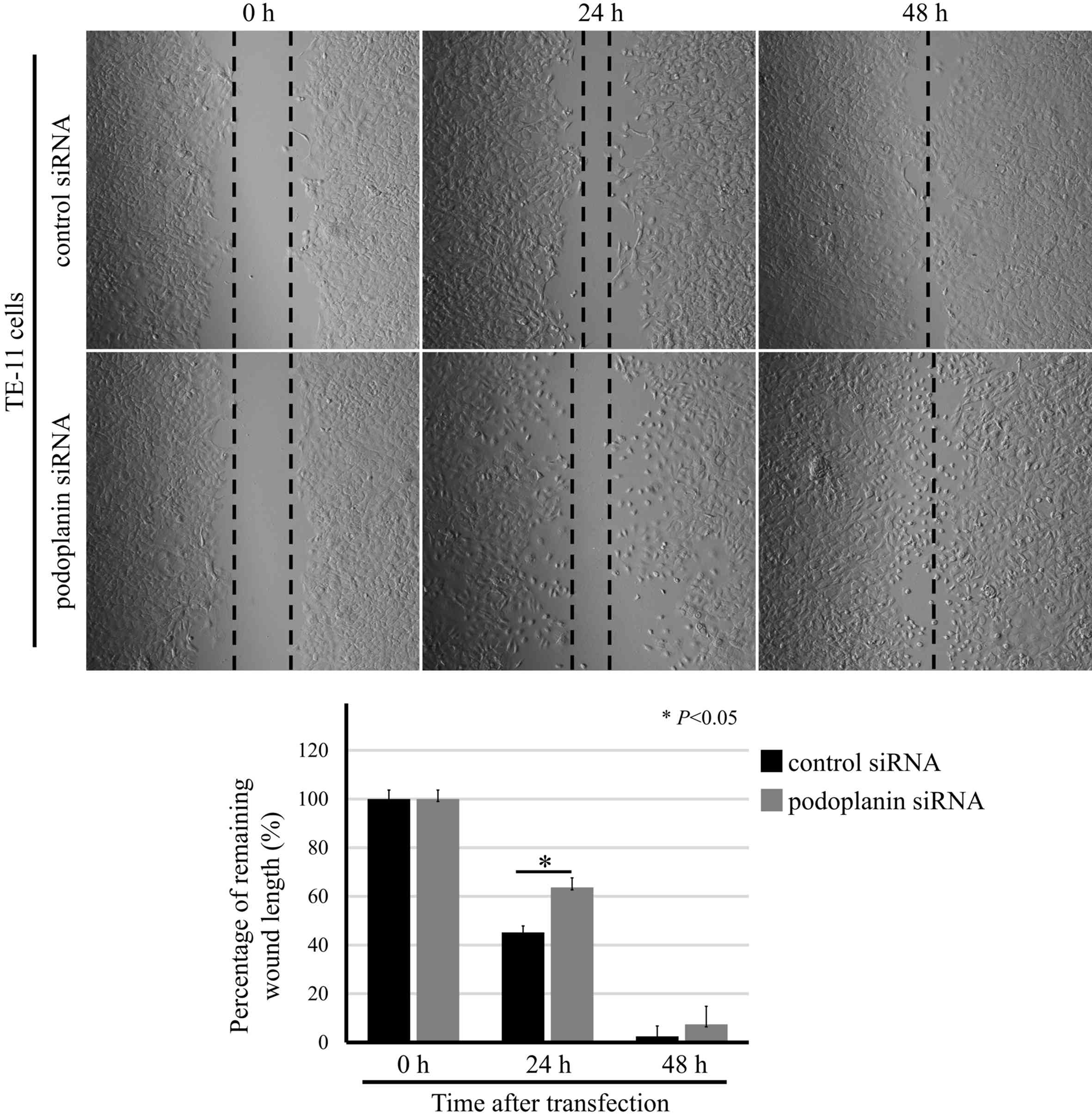
scratch-wound assay experiments shown in Fig. 8 on p. 2318, the 'control-siRNA/24
h' and 'podoplanin-siRNA/48 h' panels contained an overlapping
section of data; such that these data, which were intended to show
the results from differently performed experiments, appeared to
have been derived from the same original source. Upon analyzing the
data independently in the Editorial Office, it came to light that,
in addition to control blots, the podoplanin blots were duplicated
in Fig. 2A and B, and also in Fig. 3A and B, although it wasn't
clear whether this was simply the way in which the authors had
chosen to arrange the data in these figures, as the reported
experimental conditions were the same in the respective figure
parts (note that an Expression of Concern statement was also
published for this paper: doi.org/10.3892/ijo.2025.5805).
Upon contacting the authors, they confirmed that the
data had been included in Figs. 2 and 3 as intended, although they
realized that an error had been made during the assembly of the
scratch-wound assay images shown in Fig. 8. However, the authors had retained
their original data, and the data for the podoplanin-siRNA/48 h'
panel was shown incorrectly in this Figure. In the first instance,
the authors wish to propose the following wording for the figure
legend for Fig. 3, to clarify that the same podoplanin and β-actin
bands were intended to have been shown in Figs. 2 and 3 (the added
text is highlighted in bold): 'Figure 3. The protein expression of
podoplanin and EMT-related markers was regulated by TGF-β. TE-11
cells were treated as indicated in Fig. 2. These cells were then
lysed, and the lysates were subjected to western blot analyses of
pSmad2, Smad2/3, Slug, podoplanin, vimentin, N-cadherin,
E-cadherin, Claudin-4, DEC1, DEC2, and β-actin. The data of
podoplanin and β-actin used in (A) were shown again in (B) as
necessary. Two representative results of at least four
independent experiments with similar outcomes are shown'.
Textual corrections should also be noted in this
Corrigendum: First, in the figure legend for Fig. 8, the P-value for significance
should have been written as '*P<0.05', not as
'*P<0.001'. Secondly, in the Results section, the
'Podoplanin was closely involved in the invasion and migration
in TE-11 cells' subsection on p. 2314, sentences 5−7 in this
paragraph should have been written as follows ('at 24 h' should
have been included in the sixth sentence): 'In order to evaluate
the ability of migration, wound-healing assay was introduced in
podoplanin siRNA-transfected cells. Remaining wound length was
measured after 0, 24 and 48 h of podoplanin siRNA transfection, and
a significant difference between the control siRNA-transfected
group and the podoplanin siRNA-transfected group at 24 h was
attained (Fig. 8).
Morphologically, a small amount of the TE-11 cells in the middle of
the chamber was dead in the podoplanin-siRNA transfected group,
especially at the 24-h time-point'.
The revised version of Fig. 8, now showing the correct data for
the 'podoplanin-siRNA/48 h' experiment, is shown on the next page.
The authors confirm that the error made in assembling Fig. 8 did not have a major impact on the
conclusions reported in the above article, and they thank the
Editor of International Journal of Oncology for allowing
them the opportunity to publish a Corrigendum. Furthermore, all the
authors agree to the publication of this Corrigendum, and apologize
to the readers for any inconvenience caused.