Spandidos Publications Logo
  • About
    • About Spandidos
    • Aims and Scopes
    • Abstracting and Indexing
    • Editorial Policies
    • Reprints and Permissions
    • Job Opportunities
    • Terms and Conditions
    • Contact
  • Journals
    • All Journals
    • Oncology Letters
      • Oncology Letters
      • Information for Authors
      • Editorial Policies
      • Editorial Board
      • Aims and Scope
      • Abstracting and Indexing
      • Bibliographic Information
      • Archive
    • International Journal of Oncology
      • International Journal of Oncology
      • Information for Authors
      • Editorial Policies
      • Editorial Board
      • Aims and Scope
      • Abstracting and Indexing
      • Bibliographic Information
      • Archive
    • Molecular and Clinical Oncology
      • Molecular and Clinical Oncology
      • Information for Authors
      • Editorial Policies
      • Editorial Board
      • Aims and Scope
      • Abstracting and Indexing
      • Bibliographic Information
      • Archive
    • Experimental and Therapeutic Medicine
      • Experimental and Therapeutic Medicine
      • Information for Authors
      • Editorial Policies
      • Editorial Board
      • Aims and Scope
      • Abstracting and Indexing
      • Bibliographic Information
      • Archive
    • International Journal of Molecular Medicine
      • International Journal of Molecular Medicine
      • Information for Authors
      • Editorial Policies
      • Editorial Board
      • Aims and Scope
      • Abstracting and Indexing
      • Bibliographic Information
      • Archive
    • Biomedical Reports
      • Biomedical Reports
      • Information for Authors
      • Editorial Policies
      • Editorial Board
      • Aims and Scope
      • Abstracting and Indexing
      • Bibliographic Information
      • Archive
    • Oncology Reports
      • Oncology Reports
      • Information for Authors
      • Editorial Policies
      • Editorial Board
      • Aims and Scope
      • Abstracting and Indexing
      • Bibliographic Information
      • Archive
    • Molecular Medicine Reports
      • Molecular Medicine Reports
      • Information for Authors
      • Editorial Policies
      • Editorial Board
      • Aims and Scope
      • Abstracting and Indexing
      • Bibliographic Information
      • Archive
    • World Academy of Sciences Journal
      • World Academy of Sciences Journal
      • Information for Authors
      • Editorial Policies
      • Editorial Board
      • Aims and Scope
      • Abstracting and Indexing
      • Bibliographic Information
      • Archive
    • International Journal of Functional Nutrition
      • International Journal of Functional Nutrition
      • Information for Authors
      • Editorial Policies
      • Editorial Board
      • Aims and Scope
      • Abstracting and Indexing
      • Bibliographic Information
      • Archive
    • International Journal of Epigenetics
      • International Journal of Epigenetics
      • Information for Authors
      • Editorial Policies
      • Editorial Board
      • Aims and Scope
      • Abstracting and Indexing
      • Bibliographic Information
      • Archive
    • Medicine International
      • Medicine International
      • Information for Authors
      • Editorial Policies
      • Editorial Board
      • Aims and Scope
      • Abstracting and Indexing
      • Bibliographic Information
      • Archive
  • Articles
  • Information
    • Information for Authors
    • Information for Reviewers
    • Information for Librarians
    • Information for Advertisers
    • Conferences
  • Language Editing
Spandidos Publications Logo
  • About
    • About Spandidos
    • Aims and Scopes
    • Abstracting and Indexing
    • Editorial Policies
    • Reprints and Permissions
    • Job Opportunities
    • Terms and Conditions
    • Contact
  • Journals
    • All Journals
    • Biomedical Reports
      • Information for Authors
      • Editorial Policies
      • Editorial Board
      • Aims and Scope
      • Abstracting and Indexing
      • Bibliographic Information
      • Archive
    • Experimental and Therapeutic Medicine
      • Information for Authors
      • Editorial Policies
      • Editorial Board
      • Aims and Scope
      • Abstracting and Indexing
      • Bibliographic Information
      • Archive
    • International Journal of Epigenetics
      • Information for Authors
      • Editorial Policies
      • Editorial Board
      • Aims and Scope
      • Abstracting and Indexing
      • Bibliographic Information
      • Archive
    • International Journal of Functional Nutrition
      • Information for Authors
      • Editorial Policies
      • Editorial Board
      • Aims and Scope
      • Abstracting and Indexing
      • Bibliographic Information
      • Archive
    • International Journal of Molecular Medicine
      • Information for Authors
      • Editorial Policies
      • Editorial Board
      • Aims and Scope
      • Abstracting and Indexing
      • Bibliographic Information
      • Archive
    • International Journal of Oncology
      • Information for Authors
      • Editorial Policies
      • Editorial Board
      • Aims and Scope
      • Abstracting and Indexing
      • Bibliographic Information
      • Archive
    • Medicine International
      • Information for Authors
      • Editorial Policies
      • Editorial Board
      • Aims and Scope
      • Abstracting and Indexing
      • Bibliographic Information
      • Archive
    • Molecular and Clinical Oncology
      • Information for Authors
      • Editorial Policies
      • Editorial Board
      • Aims and Scope
      • Abstracting and Indexing
      • Bibliographic Information
      • Archive
    • Molecular Medicine Reports
      • Information for Authors
      • Editorial Policies
      • Editorial Board
      • Aims and Scope
      • Abstracting and Indexing
      • Bibliographic Information
      • Archive
    • Oncology Letters
      • Information for Authors
      • Editorial Policies
      • Editorial Board
      • Aims and Scope
      • Abstracting and Indexing
      • Bibliographic Information
      • Archive
    • Oncology Reports
      • Information for Authors
      • Editorial Policies
      • Editorial Board
      • Aims and Scope
      • Abstracting and Indexing
      • Bibliographic Information
      • Archive
    • World Academy of Sciences Journal
      • Information for Authors
      • Editorial Policies
      • Editorial Board
      • Aims and Scope
      • Abstracting and Indexing
      • Bibliographic Information
      • Archive
  • Articles
  • Information
    • For Authors
    • For Reviewers
    • For Librarians
    • For Advertisers
    • Conferences
  • Language Editing
Login Register Submit
  • This site uses cookies
  • You can change your cookie settings at any time by following the instructions in our Cookie Policy. To find out more, you may read our Privacy Policy.

    I agree
Search articles by DOI, keyword, author or affiliation
Search
Advanced Search
presentation
International Journal of Oncology
Join Editorial Board Propose a Special Issue
Print ISSN: 1019-6439 Online ISSN: 1791-2423
Journal Cover
July-2026 Volume 69 Issue 1

Full Size Image

Cover Legend PDF

Sign up for eToc alerts
Recommend to Library

Journals

International Journal of Molecular Medicine

International Journal of Molecular Medicine

International Journal of Molecular Medicine is an international journal devoted to molecular mechanisms of human disease.

International Journal of Oncology

International Journal of Oncology

International Journal of Oncology is an international journal devoted to oncology research and cancer treatment.

Molecular Medicine Reports

Molecular Medicine Reports

Covers molecular medicine topics such as pharmacology, pathology, genetics, neuroscience, infectious diseases, molecular cardiology, and molecular surgery.

Oncology Reports

Oncology Reports

Oncology Reports is an international journal devoted to fundamental and applied research in Oncology.

Experimental and Therapeutic Medicine

Experimental and Therapeutic Medicine

Experimental and Therapeutic Medicine is an international journal devoted to laboratory and clinical medicine.

Oncology Letters

Oncology Letters

Oncology Letters is an international journal devoted to Experimental and Clinical Oncology.

Biomedical Reports

Biomedical Reports

Explores a wide range of biological and medical fields, including pharmacology, genetics, microbiology, neuroscience, and molecular cardiology.

Molecular and Clinical Oncology

Molecular and Clinical Oncology

International journal addressing all aspects of oncology research, from tumorigenesis and oncogenes to chemotherapy and metastasis.

World Academy of Sciences Journal

World Academy of Sciences Journal

Multidisciplinary open-access journal spanning biochemistry, genetics, neuroscience, environmental health, and synthetic biology.

International Journal of Functional Nutrition

International Journal of Functional Nutrition

Open-access journal combining biochemistry, pharmacology, immunology, and genetics to advance health through functional nutrition.

International Journal of Epigenetics

International Journal of Epigenetics

Publishes open-access research on using epigenetics to advance understanding and treatment of human disease.

Medicine International

Medicine International

An International Open Access Journal Devoted to General Medicine.

Journal Cover
July-2026 Volume 69 Issue 1

Full Size Image

Cover Legend PDF

Sign up for eToc alerts
Recommend to Library

  • Article
  • Citations
    • Cite This Article
    • Download Citation
    • Create Citation Alert
    • Remove Citation Alert
    • Cited By
  • Similar Articles
    • Related Articles (in Spandidos Publications)
    • Similar Articles (Google Scholar)
    • Similar Articles (PubMed)
  • Download PDF
  • Download XML
  • View XML
Correction Open Access

[Corrigendum] Tumor necrosis factor‑α triggers opposing signals in head and neck squamous cell carcinoma and induces apoptosis via mitochondrial‑ and non‑mitochondrial‑dependent pathways

  • Authors:
    • Denis Selimovic
    • Renate   U. Wahl
    • Emmanuelle Ruiz
    • Rizwan Aslam
    • Thomas   W. Flanagan
    • Sofie-Yasmin Hassan
    • Simeon Santourlidis
    • Youssef Haikel
    • Paul Friedlander
    • Mosaad Megahed
    • Emad Kandil
    • Mohamed Hassan
  • View Affiliations / Copyright

    Affiliations: NSERM UMR 1121, University of Strasbourg, 67000 Strasbourg, France, Clinic of Dermatology, University Hospital οf Aachen, 52074 Aachen, Germany, Department of Surgery, Tulane University School of Medicine, New Orleans, LA 70112, USA, Department of Otolaryngology, Tulane University School of Medicine, New Orleans, LA 70112, USA, Department of Pharmacology and Experimental Therapeutics, LSU Health Sciences Center, New Orleans, LA 70112, USA, Epigenetics Core Laboratory, Institute of Transplantation Diagnostics and Cell Therapeutics, University Hospital of Düsseldorf, Heinrich-Heine-University of Düsseldorf, 40225 Düsseldorf, Germany
    Copyright: © Selimovic et al. This is an open access article distributed under the terms of Creative Commons Attribution License [CC BY 4.0].
  • Article Number: 75
    |
    Published online on: April 27, 2026
       https://doi.org/10.3892/ijo.2026.5888
  • Expand metrics +
Metrics: Total Views: 0 (Spandidos Publications: | PMC Statistics: )
Metrics: Total PDF Downloads: 0 (Spandidos Publications: | PMC Statistics: )
Cited By (CrossRef): 0 citations Loading Articles...

This article is mentioned in:


Article

Int J Oncol 55: [Related article:] 1324-1338, 2019; DOI: 10.3892/ijo.2019.4900

Following the publication of the above article, an interested reader drew to the Editor's attention that a number of western blots in the paper appeared to contain incorrectly assembled data. First, comparing the F. Length (full-length) Caspase 3 blots in Fig. 1F with the p-ASK1 blots in Fig. 2C revealed that they were remarkably similar after horizontally flipping one set of the bands. In addition, the cytochrome c (Cyt. C) bands in Fig. 1F were similarly found to be remarkably similar to the IκBα blots in Fig. 2A, again after horizontal flipping of one set of the bands. Finally, it was noted that the β-actin bands in Fig. 5C were very similar to the blots included in Fig. 3B to show the Tom20 data.

(A) Time course-dependent inhibition
of the growth rate of head and neck squamous cell carcinoma (HNSCC)
cells in response to exposure to TNF-α. Relative cell number (%)
assessed by MTT assay following the exposure of the HNSCC cell
lines, CLS-345 and RPMI2650, to TNF-α (10 ng/ml) for regulated time
intervals up to 72 h. Data are presented as the means ± SD (n=4).
*P<0.05, significantly different from the control as
shown by ANOVA and Dunnett's test. (B) Flow cytometric analysis
using Annexin V/propidium iodide (PI) staining demonstrating the
TNF-α-induced apoptosis of the HNSCC cell lines, CLS-345 and
RPMI2650. (C) Data of of Annexin V/PI are presented as the means ±
SD (n=3). *P<0.05, significantly different from the
control as shown by ANOVA and Dunnett's test. (D) Flow cytometric
analysis using JC-1 staining demonstrating the loss of
mitochondrial membrane potential (Δψm) in TNF-α-treated cells. (E)
Data of JC-1 staining are presented as the means ± SD (n=3). In
each treatment group, the first one of the two bars represents the
portion of the cells that do not show loss of mitochondrial
membrane potential, while the second bar represents the portion of
cells that show the loss of mitochondrial membrane potential.
*P<0.05, significantly different from the control as
shown by ANOVA and Dunnett's test. (F) Western blot analysis
demonstrating the induction of Noxa expression, the release of
cytochrome c (Cyt c), and the cleavage of caspase-9,
caspase-3 and PARP in response to the treatment of the HNSCC cell
lines, CLS-345 and RPMI2650, with TNF-α for 48 h. Actin was used as
an internal control for loading and transfer. (G) Analyses of band
intensity on films are presented as the relative ratio of Noxa to
actin, released Cyt c to actin, cleaved caspase-9 (Cl.Casp.9) to
actin, cleaved caspase-3 (Cl.casp.3) to actin and cleaved PARP
(Cl.PARP) to actin. Bars represent the means ± SD (n=3).
*P<0.05 vs. control.

Figure 1

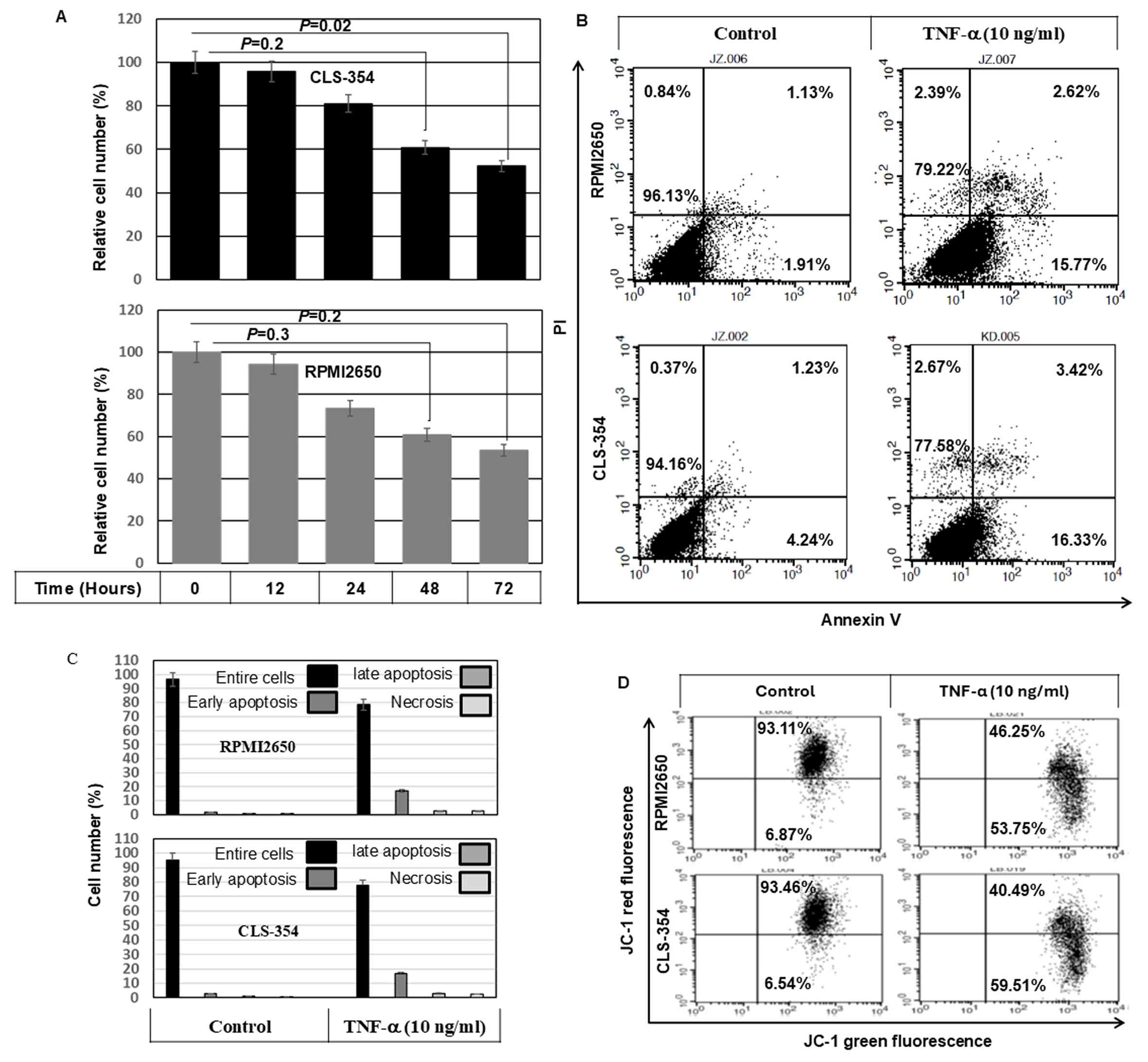
(A) Time course-dependent inhibition of the growth rate of head and neck squamous cell carcinoma (HNSCC) cells in response to exposure to TNF-α. Relative cell number (%) assessed by MTT assay following the exposure of the HNSCC cell lines, CLS-345 and RPMI2650, to TNF-α (10 ng/ml) for regulated time intervals up to 72 h. Data are presented as the means ± SD (n=4). *P<0.05, significantly different from the control as shown by ANOVA and Dunnett's test. (B) Flow cytometric analysis using Annexin V/propidium iodide (PI) staining demonstrating the TNF-α-induced apoptosis of the HNSCC cell lines, CLS-345 and RPMI2650. (C) Data of of Annexin V/PI are presented as the means ± SD (n=3). *P<0.05, significantly different from the control as shown by ANOVA and Dunnett's test. (D) Flow cytometric analysis using JC-1 staining demonstrating the loss of mitochondrial membrane potential (Δψm) in TNF-α-treated cells. (E) Data of JC-1 staining are presented as the means ± SD (n=3). In each treatment group, the first one of the two bars represents the portion of the cells that do not show loss of mitochondrial membrane potential, while the second bar represents the portion of cells that show the loss of mitochondrial membrane potential. *P<0.05, significantly different from the control as shown by ANOVA and Dunnett's test. (F) Western blot analysis demonstrating the induction of Noxa expression, the release of cytochrome c (Cyt c), and the cleavage of caspase-9, caspase-3 and PARP in response to the treatment of the HNSCC cell lines, CLS-345 and RPMI2650, with TNF-α for 48 h. Actin was used as an internal control for loading and transfer. (G) Analyses of band intensity on films are presented as the relative ratio of Noxa to actin, released Cyt c to actin, cleaved caspase-9 (Cl.Casp.9) to actin, cleaved caspase-3 (Cl.casp.3) to actin and cleaved PARP (Cl.PARP) to actin. Bars represent the means ± SD (n=3). *P<0.05 vs. control.

(A) Western blot analysis
demonstrating the phosphorylation of FADD and TRAF2 proteins, and
the degradation of IκBα and the cleavage of caspase-8 in response
to the exposure of head and neck squamous cell carcinoma (HNSCC)
cell lines, CLS-345 and RPMI2650, to TNF-α. Actin was used as an
internal control for loading and transfer. (B) Analyses of band
intensity on films are presented as the relative ratio of p-FADD to
actin, p-TRAF2 to actin, IκBα to actin and cleaved caspase-8/p18
(Cl.casp.8/p18) to actin. Bars represent the means ± SD (n=3).
*P<0.05 vs. control. (C) Western blot analysis
demonstrating the phosphorylation of ASK1, JNK and p38 kinase in
response to the exposure of the HNSCC cell lines, CLS-345 and
RPMI2650, to TNF-α. Actin was used as an internal control for
loading and transfer. (D) Analyses of band intensity on films are
presented as the relative ratio of p-ASK1 to actin, p-JNK to actin
and p-p38 to actin. Bars represent the means ± SD (n=3). *P<0.05
vs. control. EMSA demonstrates the enhancement of the DNA-binding
activity of the transcription factor, (E) AP-1. EMSA demonstrates
the enhancement of the DNA-binding activity of the transcription
factors, (F) ATF-2, (G) p53 and (H) NF-κB in response to the
treatment of the HNSCC cell lines, CLS-345 and RPMI2650, with
TNF-α. Data are representative of 3 independent experiments.

Figure 2

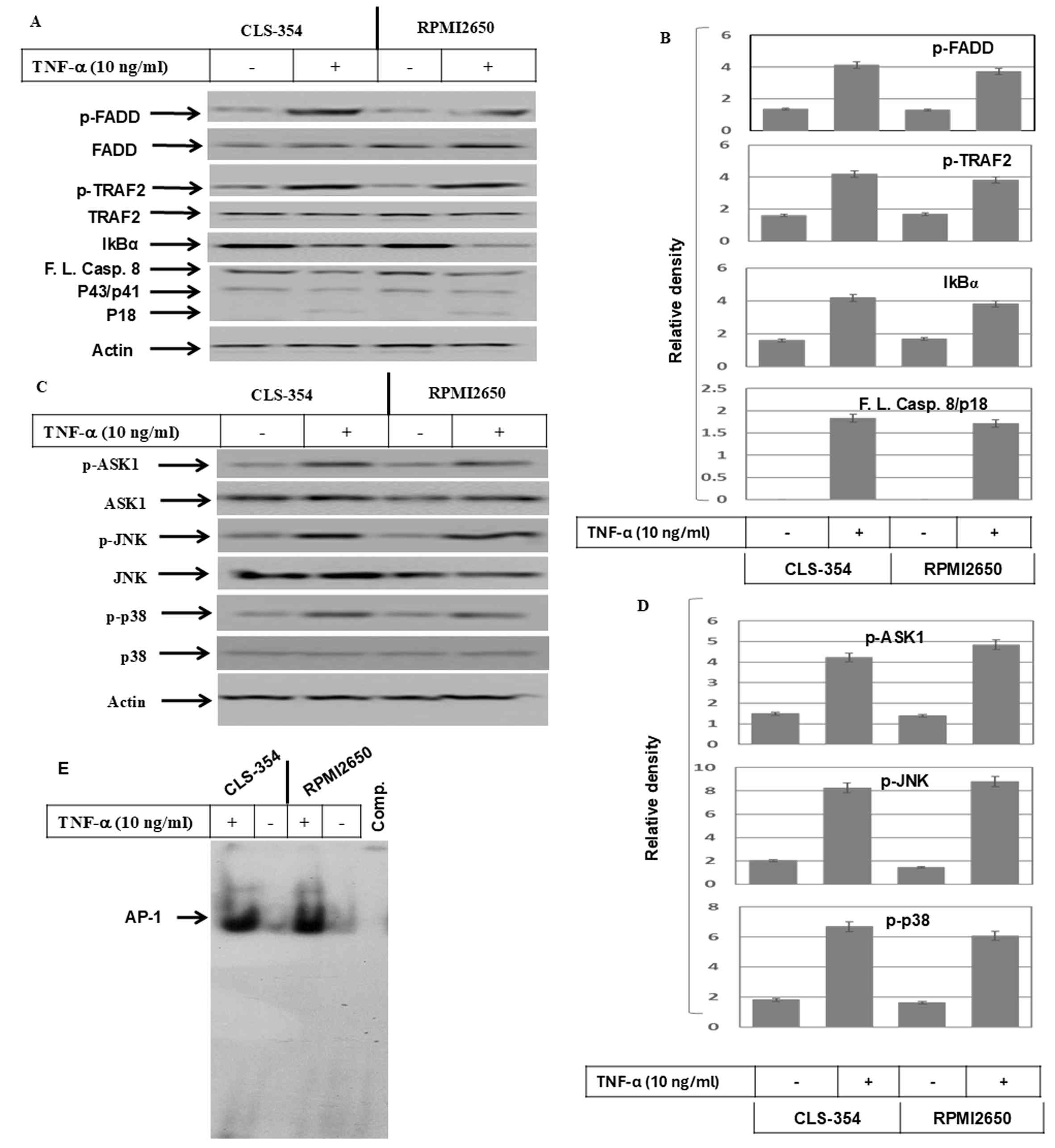
(A) Western blot analysis demonstrating the phosphorylation of FADD and TRAF2 proteins, and the degradation of IκBα and the cleavage of caspase-8 in response to the exposure of head and neck squamous cell carcinoma (HNSCC) cell lines, CLS-345 and RPMI2650, to TNF-α. Actin was used as an internal control for loading and transfer. (B) Analyses of band intensity on films are presented as the relative ratio of p-FADD to actin, p-TRAF2 to actin, IκBα to actin and cleaved caspase-8/p18 (Cl.casp.8/p18) to actin. Bars represent the means ± SD (n=3). *P<0.05 vs. control. (C) Western blot analysis demonstrating the phosphorylation of ASK1, JNK and p38 kinase in response to the exposure of the HNSCC cell lines, CLS-345 and RPMI2650, to TNF-α. Actin was used as an internal control for loading and transfer. (D) Analyses of band intensity on films are presented as the relative ratio of p-ASK1 to actin, p-JNK to actin and p-p38 to actin. Bars represent the means ± SD (n=3). *P<0.05 vs. control. EMSA demonstrates the enhancement of the DNA-binding activity of the transcription factor, (E) AP-1. EMSA demonstrates the enhancement of the DNA-binding activity of the transcription factors, (F) ATF-2, (G) p53 and (H) NF-κB in response to the treatment of the HNSCC cell lines, CLS-345 and RPMI2650, with TNF-α. Data are representative of 3 independent experiments.

(A) Western blot analysis
demonstrating the knockdown of Noxa protein by its specific siRNA
(si/Noxa) in CLS-354 and RPMI2650 cells treated with TNF-α (10
ng/ml). (B) Analyses of band intensity on films are presented as
the relative ratio of reduced Noxa to actin. Bars represent the
means ± SD (n=3). *P<0.05 vs. control. (C) Western
blot analysis demonstrating the knockdown of PERK protein by its
specific siRNA (si/PERK). Actin was used as an internal control for
loading and transfer. (D) Analyses of band intensity on films are
presented as the relative ratio of reduced PERK expression to
actin. Bars represent the means ± SD (n=3). *P<0.05
vs. control. (E) MTT assay demonstrating the inhibition of
TNF-α-induced cell death of RPMI2650 (upper panel) and CLS-345
(lower panel) via inhibitors of caspase-8 (I.Casp.8, 20 μM),
ASK1 (thioredoxin, 1 nM), JNK (SP600125, 10 μM), IRE1α
(Irestatin, 25 μM), or by the knockdown of PERK by its
specific siRNA (si/PERK). The complete abrogation of the
TNF-α-induced cell death of head and neck squamous cell carcinoma
(HNSCC) cell lines was noted by the knockdown of Noxa by its
specific siRNA (si/Noxa) or the combination of ASK1 and caspase-8
inhibitors. Pretreatment of the cells with NF-κB inhibitor
(Bay11-7982, 5 μM) promoted TNF-α-induced cell death as
evidenced by MTT assay. Data are presented as the means ± SD (n=3)
performed in quadruplicate.

Figure 5

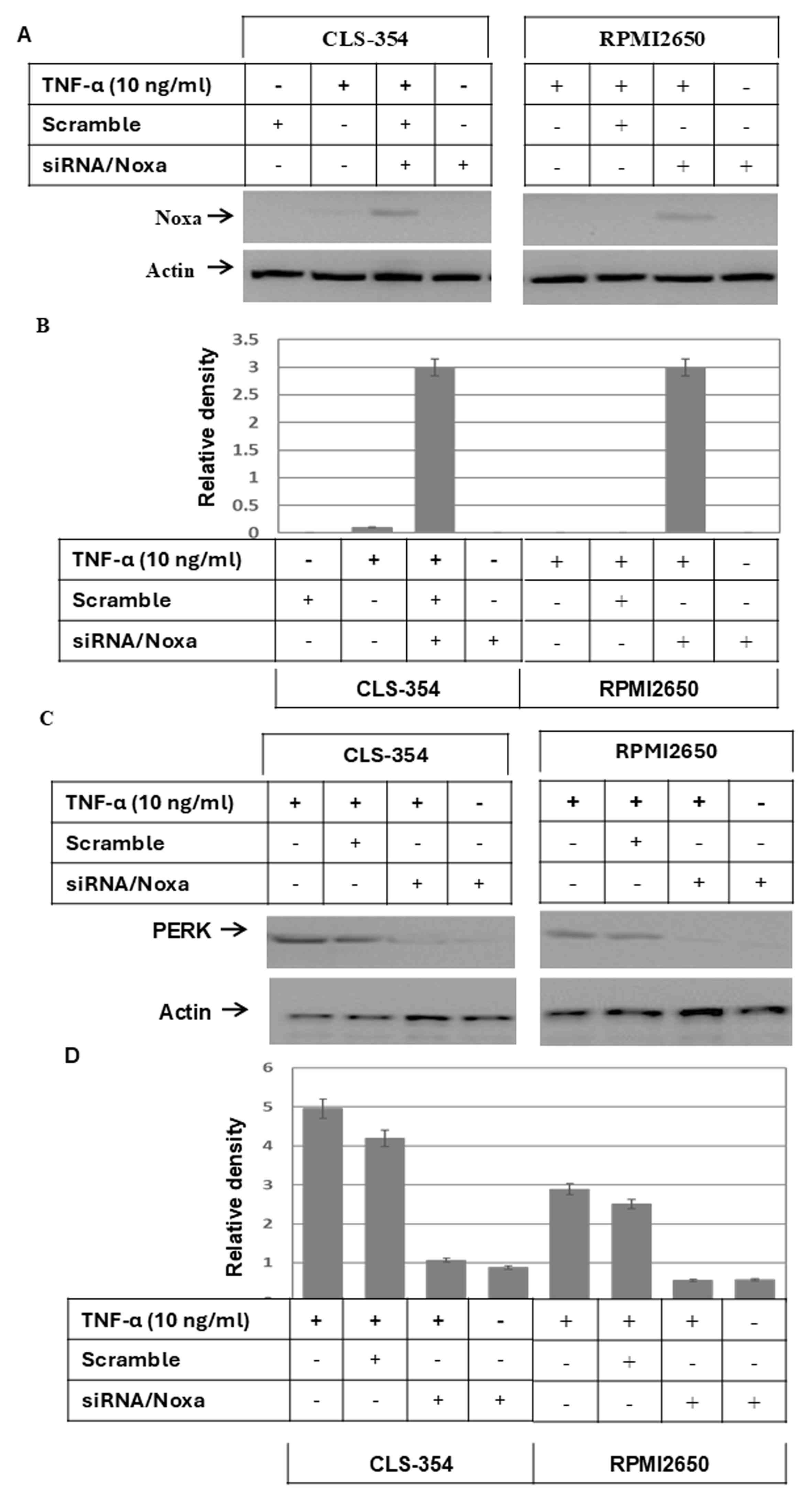
(A) Western blot analysis demonstrating the knockdown of Noxa protein by its specific siRNA (si/Noxa) in CLS-354 and RPMI2650 cells treated with TNF-α (10 ng/ml). (B) Analyses of band intensity on films are presented as the relative ratio of reduced Noxa to actin. Bars represent the means ± SD (n=3). *P<0.05 vs. control. (C) Western blot analysis demonstrating the knockdown of PERK protein by its specific siRNA (si/PERK). Actin was used as an internal control for loading and transfer. (D) Analyses of band intensity on films are presented as the relative ratio of reduced PERK expression to actin. Bars represent the means ± SD (n=3). *P<0.05 vs. control. (E) MTT assay demonstrating the inhibition of TNF-α-induced cell death of RPMI2650 (upper panel) and CLS-345 (lower panel) via inhibitors of caspase-8 (I.Casp.8, 20 μM), ASK1 (thioredoxin, 1 nM), JNK (SP600125, 10 μM), IRE1α (Irestatin, 25 μM), or by the knockdown of PERK by its specific siRNA (si/PERK). The complete abrogation of the TNF-α-induced cell death of head and neck squamous cell carcinoma (HNSCC) cell lines was noted by the knockdown of Noxa by its specific siRNA (si/Noxa) or the combination of ASK1 and caspase-8 inhibitors. Pretreatment of the cells with NF-κB inhibitor (Bay11-7982, 5 μM) promoted TNF-α-induced cell death as evidenced by MTT assay. Data are presented as the means ± SD (n=3) performed in quadruplicate.

Subcellular localization of Noxa
protein to both the mitochondria and endoplasmic reticulum (ER) in
TNF-α-treated and control RPMI2650 cells. (A) Immunofluorescence
(IF) staining: RPMI2650 cells were treated with TNF-α for 48 h
prior to staining with anti-Noxa, Tom20 (mitochondrial marker) and
Bap31 (ER marker). The subcellular localization of Noxa (green) to
mitochondria (red) and the overlay of Noxa with Tom20 staining
demonstrates the localization of Noxa to the mitochondria (yellow),
when compared with control cells. The localization of Noxa (green)
to ER (blue) and the overlay of Noxa with Bap31 staining
demonstrates the localization of Noxa to ER (turquoise), when
compared with control cells. (B) Western blot analysis using the
mitochondrial fraction (Mit.fraction) and ER fraction from both the
CLS-354 and RPMI2650 cells following treatment with TNF-α for 48 h.
The detection of Noxa in the mitochondrial and ER fractions of the
CLS-354 and RPMI2650 cells following treatment with TNF-α was used
to confirm the localization of Noxa protein to both the
mitochondria and ER. The purity of both the mitochondrial and ER
fractions was verified by the detection of the mitochondrial
protein, Tom20, in the mitochondrial fraction and the detection of
Bap31 in the ER fraction. (C) Analyses of band intensity on films
are presented as the relative ratio of Noxa to Tom20 in the
mitochondrial fraction and Noxa to Bap31 in the ER fraction. Bars
represent the means ± SD (n=3); *P<0.05 vs.
control.

Figure 3

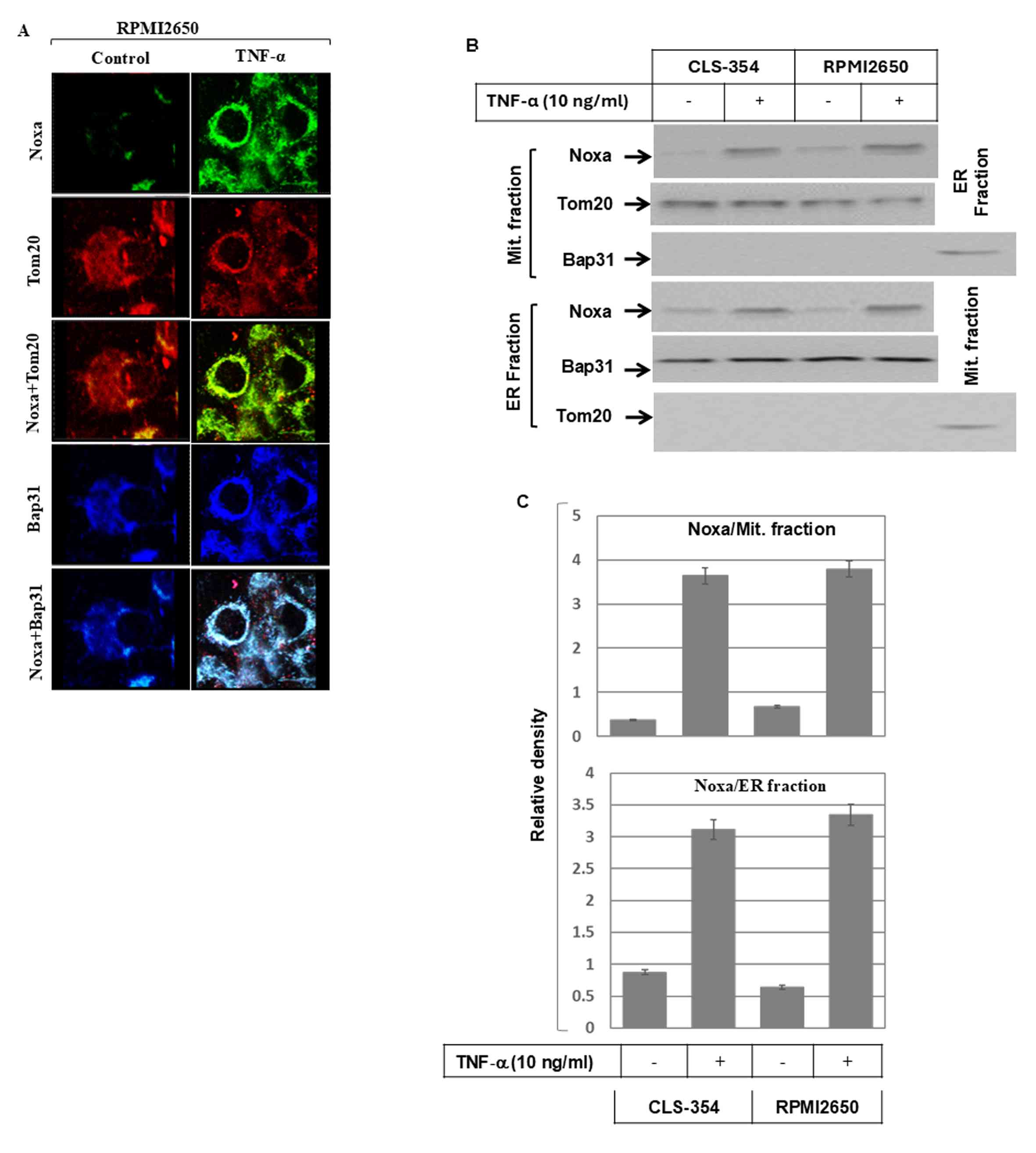
Subcellular localization of Noxa protein to both the mitochondria and endoplasmic reticulum (ER) in TNF-α-treated and control RPMI2650 cells. (A) Immunofluorescence (IF) staining: RPMI2650 cells were treated with TNF-α for 48 h prior to staining with anti-Noxa, Tom20 (mitochondrial marker) and Bap31 (ER marker). The subcellular localization of Noxa (green) to mitochondria (red) and the overlay of Noxa with Tom20 staining demonstrates the localization of Noxa to the mitochondria (yellow), when compared with control cells. The localization of Noxa (green) to ER (blue) and the overlay of Noxa with Bap31 staining demonstrates the localization of Noxa to ER (turquoise), when compared with control cells. (B) Western blot analysis using the mitochondrial fraction (Mit.fraction) and ER fraction from both the CLS-354 and RPMI2650 cells following treatment with TNF-α for 48 h. The detection of Noxa in the mitochondrial and ER fractions of the CLS-354 and RPMI2650 cells following treatment with TNF-α was used to confirm the localization of Noxa protein to both the mitochondria and ER. The purity of both the mitochondrial and ER fractions was verified by the detection of the mitochondrial protein, Tom20, in the mitochondrial fraction and the detection of Bap31 in the ER fraction. (C) Analyses of band intensity on films are presented as the relative ratio of Noxa to Tom20 in the mitochondrial fraction and Noxa to Bap31 in the ER fraction. Bars represent the means ± SD (n=3); *P<0.05 vs. control.

After having examined the raw data underling these figures (which were also presented to the Editorial Office for our inspection), the authors realized that data in Figs. 1, 2, 3 and 5 were inadvertently assembled incorrectly in these figures. The revised versions of Figs. 1, 2, 3 and 5 are shown on the subsequent six pages. Specifically, in Fig. 1F, the blot for Cyt. C was incorrectly chosen; in Fig. 2A, the blot for IkBα was incorrectly chosen; in Fig. 3B, the blot for Tom20 was incorrectly chosen; and in Fig. 5C, the β-actin blots shown to represent the gels for both the treated and control CLS-354 and RPMI 2650 cells were incorrectly placed in this figure. These data have all been replaced with the correct data in the figures shown subsequently in this Corrigendum.

The authors regret that the errors in Figs. 1F, 2A, 2C, 3B and 5C went unnoticed in the published versions of these figures in this paper, although note that these errors did not influence either the validity of the published data or the conclusions described in the article. The authors are grateful to the Editor of International Journal of Oncology for allowing them the opportunity to publish this Corrigendum. All the authors agree with the publication of this Corrigendum, and apologize to the readership for any inconvenience caused.

Related Articles

  • Abstract
  • View
  • Download
  • Twitter
Copy and paste a formatted citation
Spandidos Publications style
Selimovic D, Wahl RU, Ruiz E, Aslam R, Flanagan TW, Hassan S, Santourlidis S, Haikel Y, Friedlander P, Megahed M, Megahed M, et al: [Corrigendum] Tumor necrosis factor‑α triggers opposing signals in head and neck squamous cell carcinoma and induces apoptosis via mitochondrial‑ and non‑mitochondrial‑dependent pathways. Int J Oncol 69: 75, 2026.
APA
Selimovic, D., Wahl, R.U., Ruiz, E., Aslam, R., Flanagan, T.W., Hassan, S. ... Hassan, M. (2026). [Corrigendum] Tumor necrosis factor‑α triggers opposing signals in head and neck squamous cell carcinoma and induces apoptosis via mitochondrial‑ and non‑mitochondrial‑dependent pathways. International Journal of Oncology, 69, 75. https://doi.org/10.3892/ijo.2026.5888
MLA
Selimovic, D., Wahl, R. U., Ruiz, E., Aslam, R., Flanagan, T. W., Hassan, S., Santourlidis, S., Haikel, Y., Friedlander, P., Megahed, M., Kandil, E., Hassan, M."[Corrigendum] Tumor necrosis factor‑α triggers opposing signals in head and neck squamous cell carcinoma and induces apoptosis via mitochondrial‑ and non‑mitochondrial‑dependent pathways". International Journal of Oncology 69.1 (2026): 75.
Chicago
Selimovic, D., Wahl, R. U., Ruiz, E., Aslam, R., Flanagan, T. W., Hassan, S., Santourlidis, S., Haikel, Y., Friedlander, P., Megahed, M., Kandil, E., Hassan, M."[Corrigendum] Tumor necrosis factor‑α triggers opposing signals in head and neck squamous cell carcinoma and induces apoptosis via mitochondrial‑ and non‑mitochondrial‑dependent pathways". International Journal of Oncology 69, no. 1 (2026): 75. https://doi.org/10.3892/ijo.2026.5888

Copy and paste a formatted citation
x
Spandidos Publications style
Selimovic D, Wahl RU, Ruiz E, Aslam R, Flanagan TW, Hassan S, Santourlidis S, Haikel Y, Friedlander P, Megahed M, Megahed M, et al: [Corrigendum] Tumor necrosis factor‑α triggers opposing signals in head and neck squamous cell carcinoma and induces apoptosis via mitochondrial‑ and non‑mitochondrial‑dependent pathways. Int J Oncol 69: 75, 2026.
APA
Selimovic, D., Wahl, R.U., Ruiz, E., Aslam, R., Flanagan, T.W., Hassan, S. ... Hassan, M. (2026). [Corrigendum] Tumor necrosis factor‑α triggers opposing signals in head and neck squamous cell carcinoma and induces apoptosis via mitochondrial‑ and non‑mitochondrial‑dependent pathways. International Journal of Oncology, 69, 75. https://doi.org/10.3892/ijo.2026.5888
MLA
Selimovic, D., Wahl, R. U., Ruiz, E., Aslam, R., Flanagan, T. W., Hassan, S., Santourlidis, S., Haikel, Y., Friedlander, P., Megahed, M., Kandil, E., Hassan, M."[Corrigendum] Tumor necrosis factor‑α triggers opposing signals in head and neck squamous cell carcinoma and induces apoptosis via mitochondrial‑ and non‑mitochondrial‑dependent pathways". International Journal of Oncology 69.1 (2026): 75.
Chicago
Selimovic, D., Wahl, R. U., Ruiz, E., Aslam, R., Flanagan, T. W., Hassan, S., Santourlidis, S., Haikel, Y., Friedlander, P., Megahed, M., Kandil, E., Hassan, M."[Corrigendum] Tumor necrosis factor‑α triggers opposing signals in head and neck squamous cell carcinoma and induces apoptosis via mitochondrial‑ and non‑mitochondrial‑dependent pathways". International Journal of Oncology 69, no. 1 (2026): 75. https://doi.org/10.3892/ijo.2026.5888
Follow us
  • Twitter
  • LinkedIn
  • Facebook
About
  • Spandidos Publications
  • Careers
  • Cookie Policy
  • Privacy Policy
How can we help?
  • Help
  • Live Chat
  • Contact
  • Email to our Support Team