Upon identifying cytosolic DNA, cyclic GMP-AMP
synthase (cGAS) catalyzes the synthesis of cyclic GMP-AMP (cGAMP),
which then initiates stimulator of interferon genes (STING)-related
downstream signaling cascades to drive the production of type I
interferons (IFNs) and pro-inflammatory mediators (1,2).
Therefore, the cGAS-STING pathway mediates antiviral and antitumor
immune responses (3,4). However, tumor cells often employ
multiple mechanisms to inactivate this pathway to evade immune
elimination (5,6).
Notably, cGAS and STING are also expressed in
intratumoral immune and stromal cells, where they may exert cell
type-specific effects (11-13). Therefore, the role of this pathway
in digestive tract cancer cannot be inferred from tumor
cell-intrinsic signaling alone, and requires further understanding
in these tumors (14). This
limitation restricts the application of this pathway in cancer
therapy. Further investigation may reveal novel therapeutic
opportunities to regulate this pathway in digestive cancer.
In the present review, the molecular fundamentals of
the cGAS-STING pathway are first briefly summarized. Secondly, the
molecular mechanisms by which cancer cells regulate this pathway in
oral cavity, esophageal, gastric, hepatobiliary, pancreatic and
colorectal cancer are explored. Next, the impact of this pathway on
the immune landscapes of these cancer types is explored. Finally,
the possible therapeutic strategies and future research directions
for utilizing this pathway against digestive cancer are discussed
and predicted.
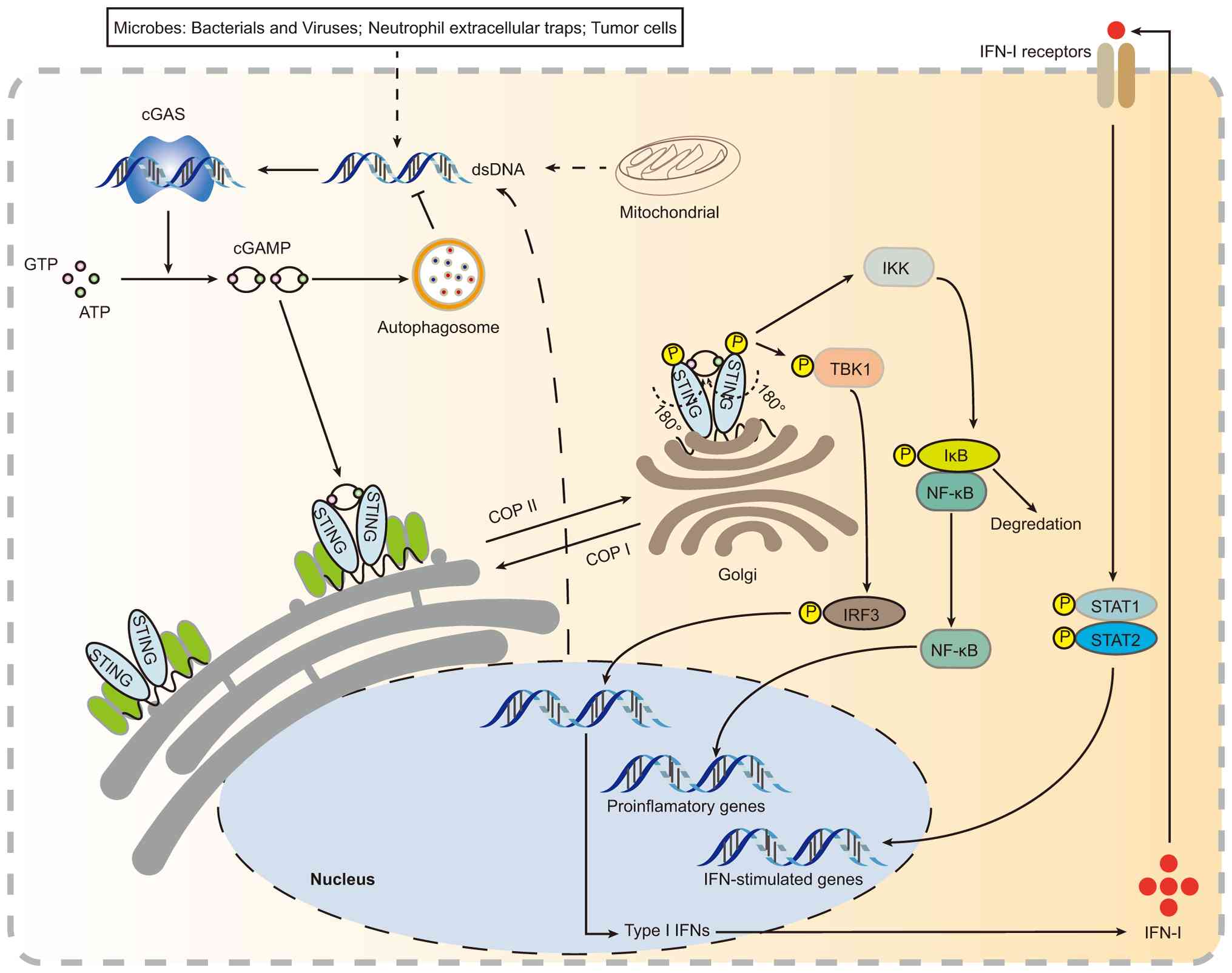
Acting as a pattern recognition receptor system, the
cGAS-STING pathway is initiated by recognizing cytosolic DNA
(15,16). As illustrated in Fig. 1. upon binding to cytosolic DNA,
cGAS can catalyze the synthesis of the second messenger cGAMP from
ATP and GTP (17). Subsequently,
the STING-cGAMP complex traffics to the Golgi apparatus from the
endoplasmic reticulum via coat protein complex II. Upon
translocation, STING undergoes a critical conformational shift that
enables it to activate TANK-binding kinase 1 (TBK1) and the
inhibitor of κB kinase complex. Activated TBK1 phosphorylates IFN
regulatory factor 3 (IRF3), driving the expression of type I IFNs,
while also facilitating NF-κB nuclear translocation to promote the
production of pro-inflammatory cytokines (2). Secreted type I IFNs can further
induce the expression of IFN-stimulated genes, such as bone marrow
stromal antigen 2 and 2'-5'-oligoadenylate synthase 1. The products
triggered by this pathway ultimately influence the innate and
adaptive immune responses (18).
Moreover, cGAMP can induce LC3 lipidation to promote cellular
autophagy, which helps clear cytosolic DNA and viral particles
(19). This autophagy-mediated
response may establish a negative feedback loop to prevent
excessive STING signaling.
It has been confirmed that the cGAS-STING pathway
can be activated by aberrant cytosolic DNA accumulation derived
from intracellular nuclear and mitochondrial DNA, as well as
internalized extracellular DNA (20). While the molecular cascade of this
pathway is well-defined, the origin of exogenous DNA in the TME is
still unclear. Neutrophils, macrophages and eosinophils in the TME
can release extracellular traps containing DNA components to
influence tumor progression (21,22). Neutrophil extracellular traps
(NETs) have been found to activate STING signaling to induce
intestinal barrier dysfunction (23) and promote acute lung injury
(24,25). Similar to NETs, macrophage
extracellular traps and eosinophil extracellular traps also contain
DNA components (26,27). These findings indicate that this
pathway may be triggered by extracellular DNA released from these
immune cells. Further investigation is necessary to determine
whether extracellular trap-related DNA in the TME affects tumor
progression by activating this pathway.
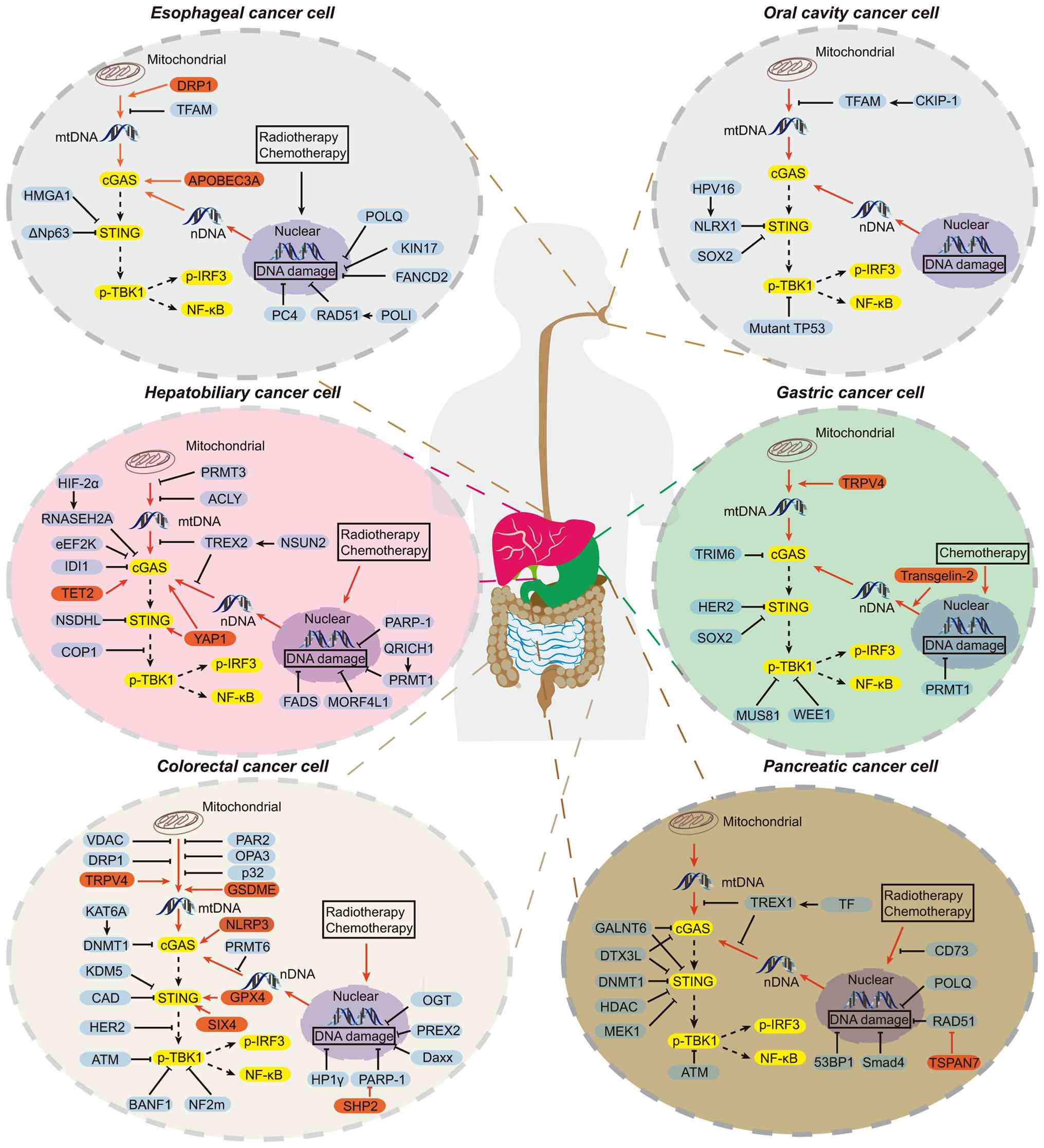
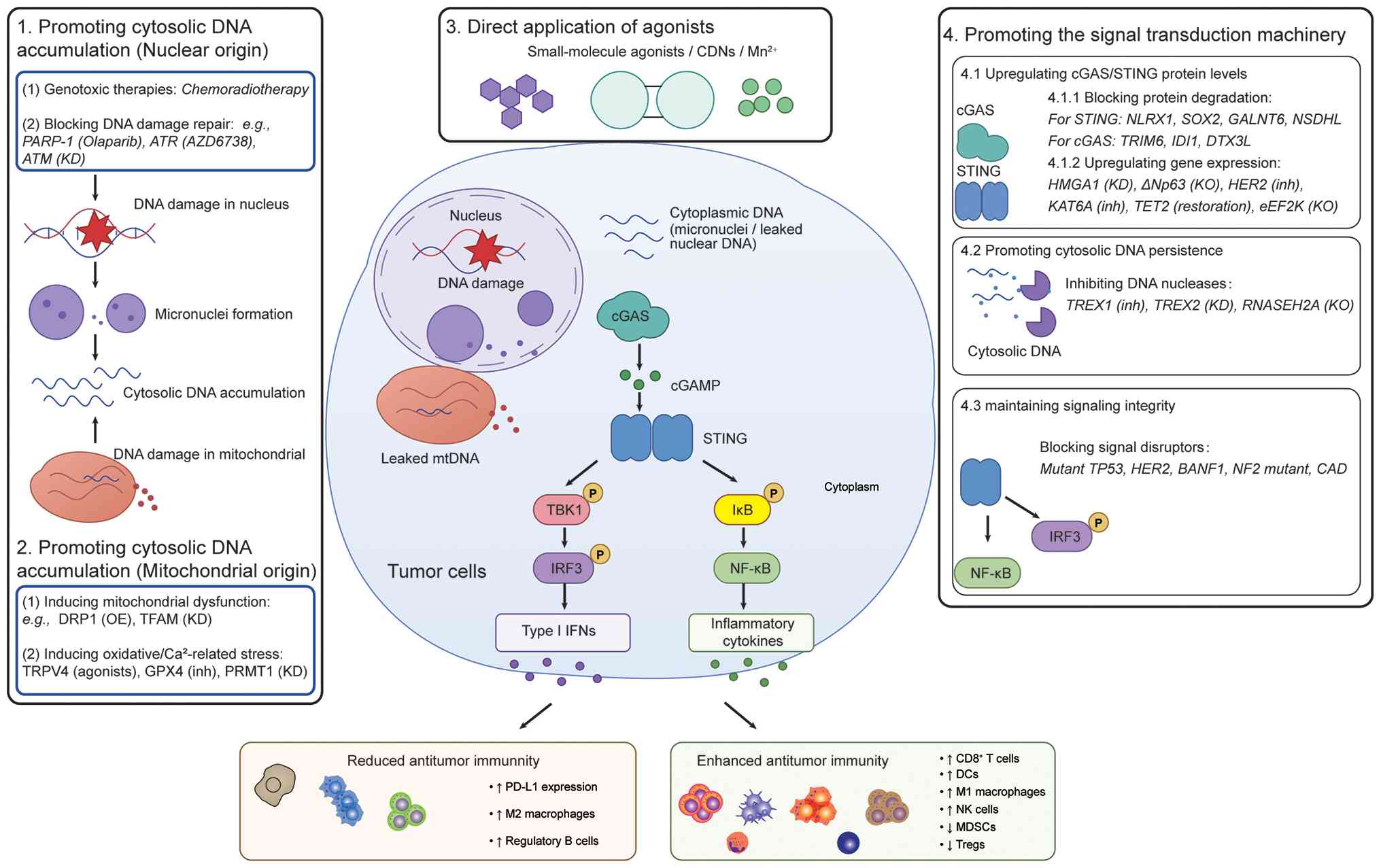
The activity of the tumor cell-intrinsic cGAS-STING
pathway can be regulated by diverse factors, such as radiotherapy,
chemotherapy and cell-intrinsic molecules. This complex regulatory
network is summarized in Fig. 2.
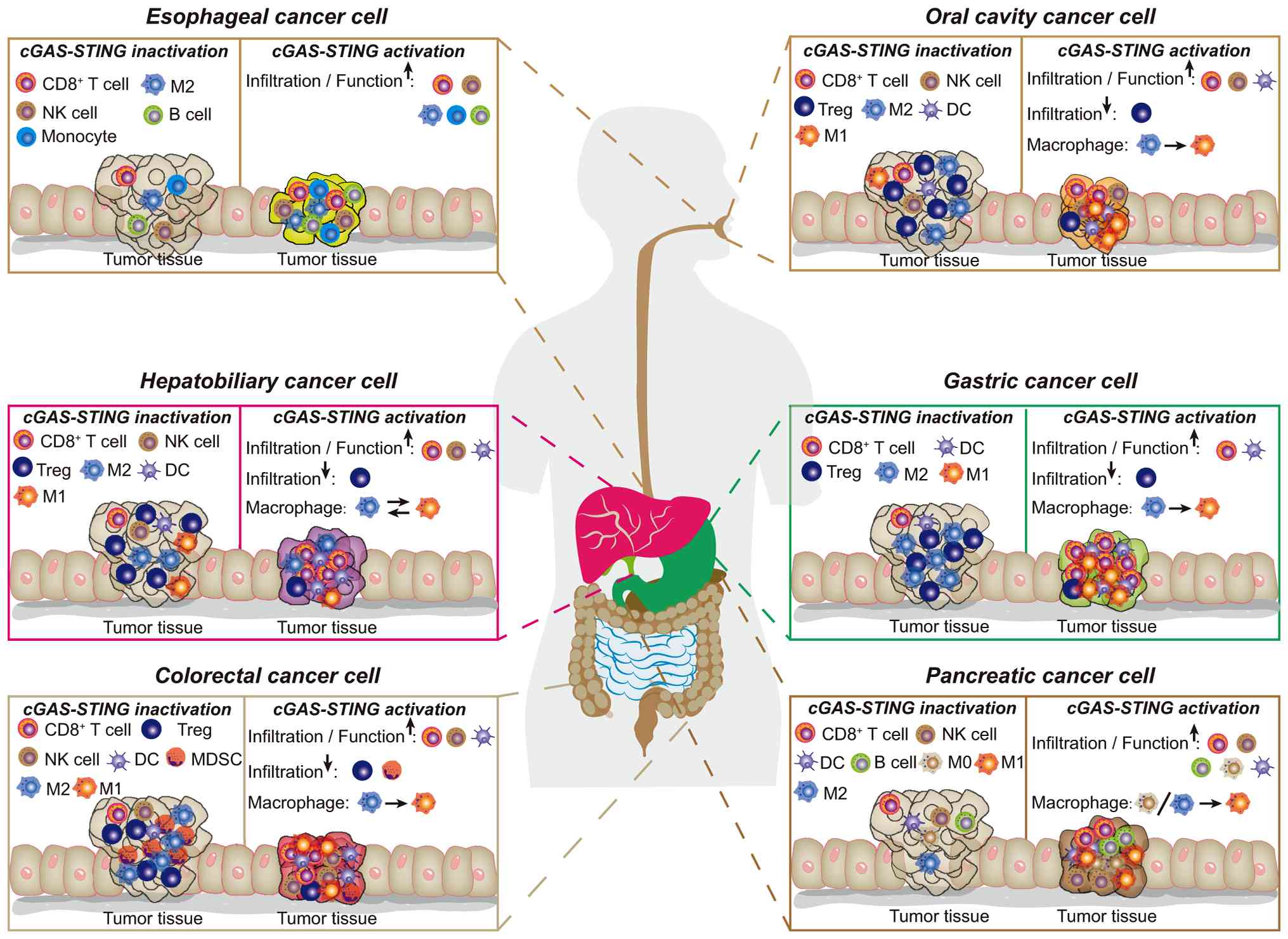
Upon activation, the cGAS-STING pathway modulates the recruitment
and function of immune cells within the TME to alter the
equilibrium between antitumor and protumor immune responses,
ultimately influencing tumor progression (Fig. 3).
Oral squamous cell carcinoma (OSCC) is one of the
most diagnosed oral malignancies. Clinically, patients in the
cGAS-STING high cluster have a more optimal prognosis than those in
the cGAS-STING low cluster (28).
Human papillomavirus (HPV) infection is an important driver
of the oncogenesis of OSCC. Evidence demonstrates that cGAS-STING
pathway activity in OSCC is influenced by HPV infection. In
HPV+ OSCC, HPV16 promotes tumor immune escape via NLR
family member X1-mediated STING degradation (29). Therefore, STING expression in
HPV16+ OSCC is associated with improved disease free
survival in these patients (30).
These studies indicate that attenuating HPV16-mediated STING
degradation or activating this pathway may effectively control the
development of HPV16+ OSCC. Beyond HPV infection, the
out-membrane vesicles derived from Porphyromonas gingivalis
also inactivate the tumor cell-intrinsic cGAS-STING pathway to
promote the immune escape of OSCC by decreasing IL-1β secretion and
limiting the infiltration of natural killer (NK) cells and
dendritic cells (DCs) (31).
Tumor cells employ multiple mechanisms to inhibit
the cGAS-STING pathway to promote OSCC progression. Firstly, STING
levels are reduced in OSCC. Sex-determining region Y box2 (SOX2)
promotes the autophagy-associated degradation of STING in OSCC
cells, thereby reducing the type I IFN signaling pathway and
inducing the formation of an immunosuppressive TME (32). Secondly, interfering with signal
transduction can also inhibit the activity of the cGAS-STING
pathway in OSCC. For instance, mutant TP53 contributes to an
immunosuppressive TME in OSCC through inhibiting this pathway
(33) and can bind to TBK1 to
disrupt the transduction of cGAS-STING signaling in precancerous
epithelial cells, resulting in increased regulatory T cell (Treg)
infiltration and the tumorigenesis of OSCC (34). Additionally, by maintaining
mitochondrial homeostasis, casein kinase 2 interacting protein 1,
upregulated in OSCC, can upregulate the expression of mitochondrial
transcription factor A (TFAM) to inhibit the cGAS-STING pathway to
fuel tumor development (35).
These results reveal that there are multiple regulatory factors in
OSCC cells that limit cGAS-STING expression to promote tumor
progression.
Activation of the cGAS-STING pathway mediates the
secretion of IFN-β and chemokines, reshaping the immune landscapes
within the TME. In OSCC, tumor cell-intrinsic cGAS-STING pathway
activation promotes the infiltration and function of both
CD8+ T cells and DCs (36), induces macrophage polarization
into M1 (37) and reduces Treg
infiltration (34). In
HPV+ OSCC, STING activation also potentiates
cetuximab-mediate NK cell cytotoxicity and DC maturation (38). Additionally, type I IFN can induce
ferroptosis in OSCC cells through a mechanism involving the
downregulation of glutathione peroxidase 4 (GPX4) by phosphorylated
FOXO1 (39). Apoptotic OSCC cells
dampen the cGAS-STING pathway in cancer associated fibroblasts
(CAFs), reducing type I IFN secretion, which promotes the
proliferation of tumor cells (40). These reports highlight that
cGAS-STING mediates the regression of OSCC by enhancing antitumor
immunity and inhibiting tumor cell proliferation.
As aforementioned, most studies indicate that
cGAS-STING pathway activation in tumor cells drives antitumor
immunity and may represent a promising strategy for OSCC treatment.
However, Li et al (41)
found that cGAS expression is also associated with the recurrence
and metastasis of OSCC. Mechanistically, physical matrix stiffness
induces DNA damage and non-canonical cGAS-STING activation within
tumor cells, directly driving epithelial-mesenchymal transition
(EMT) and invasiveness (41).
This finding highlights the complex role of the cGAS-STING pathway
in OSCC. This complexity may stem from its involvement in both
regulating the malignant phenotype of tumor cells and shaping the
TME. The biological consequences of cGAS-STING activity in OSCC
reflect the interactions between viral status, tumor cell- or
immune cell-intrinsic signaling, immune composition and physical
matrix stiffness. Therefore, therapeutic strategies targeting this
pathway should be context-stratified to maximize antitumor efficacy
while minimizing potential pro-metastasis risk. However, most
studies have shown that activation of this pathway can drive
antitumor immunity and may represent a promising strategy for OSCC
treatment.
Esophageal squamous cell carcinoma (ESCC) accounts
for the majority of esophageal cancer cases (42). Compared with the adjacent normal
tissue, STING is lowly expressed in ESCC and suppresses tumor
progression by inhibiting fatty acid β-oxidation (43). However, in patients with ESCC and
intratumoral Fusobacterium nucleatum infection, STING
expression is negatively associated with a favorable prognosis
(44). Li et al (45,46) found that dynamin-related protein 1
(DRP1) overexpression or TFAM knockdown can disrupt mitochondrial
function of ESCC cells, which then activates the cGAS-STING pathway
to promote autophagy-mediated tumor growth. These findings may
indicate the complexity of this pathway in ESCC.
Currently, most studies demonstrate that the tumor
cell-intrinsic cGAS-STING pathway functions as a tumor suppressor
in ESCC. Tumor cells utilize multiple mechanisms to restrain this
pathway for ESCC progression. For instance, high mobility group A1
and tumor protein p63 isoform inhibit STING expression to promote
tumor progression (47,48). As a DNA damage sensor, the
cGAS-STING pathway can be inhibited by maintaining DNA stability.
By mediating DNA damage repair via interacting with DExH-box
helicase 9, DNA/RNA-binding protein KIN17 fuels ESCC progression by
dampening STING activation (49).
Knockout of DNA polymerase θ (POLQ) and/or fanconi
anemia group D2 protein markedly increases genomic instability in
ESCC cells, which elevates cGAS expression and activates the
cGAS-STING pathway, ultimately promoting tumor regression (50). Moreover, following DNA damage,
apolipoprotein B mRNA editing enzyme catalytic polypeptide 3A
induces cGAS-STING signaling activation and increases immunotherapy
efficacy by promoting cytosolic DNA accumulation in ESCC (51). Collectively, upregulation of
cGAS-STING expression or induction of DNA damage can activate the
tumor cell-intrinsic cGAS-STING pathway, resulting in ESCC
regression.
As the common therapeutic strategies for ESCC,
radiotherapy and chemotherapy are powerful inducers of DNA damage.
Studies have demonstrated that radiotherapy with different doses
[24 Gy/3 fractions (F) or 30 Gy/10 F] can effectively trigger the
cGAS-STING pathway in tumor cells by inducing DNA damage (52,53). Meanwhile, promoting DNA damage
repair acts to inhibit radiotherapy-induced activation of this
pathway. DNA polymerase ι stabilizes DNA repair protein RAD51 by
suppressing the activity of E3 ubiquitin-protein ligase XIAP, which
in turn inhibits the cGAS-STING pathway and promotes radiotherapy
resistance (54). Thus, the
radiosensitivity of ESCC is tightly associated with cGAS-STING
pathway activity (55). Besides
radiotherapy, chemotherapy drugs, such as 5-fluorouracil (5-FU) and
cisplatin, have also been found to activate this pathway by DNA
damage (56). These reports
demonstrate the positive effect of chemoradiotherapy on cGAS-STING
pathway activation.
Tumor cell-intrinsic cGAS-STING pathway activation
also affects the immune landscape in ESCC. Pathway activation
induced by radiotherapy can increase the infiltration of
CD8+ T cells and CD163+ M2 macrophages
(52) as well as promote the
recruitment of circulating monocytes into the tumor
microenvironment to enhance antitumor immunity (53). Positive cofactor 4, promoter of
DNA repair, can inhibit the cGAS-STING pathway triggered by
radiotherapy, reducing the numbers of CD8+
tumor-infiltrating lymphocytes (TILs) and GZMB+
CD8+ TILs in ESCC (57). Additionally, chemotherapy-mediated
activation of the cGAS-STING pathway can promote the secretion of
interferon β1 (IFNB1), C-X-C motif ligand 10 (CXCL10) and chemokine
(C-C motif) ligand 5 (CCL5) from ESCC cells and facilitate the
infiltration of CD8+ T cells and CD163+ M2
macrophages (56). Overall,
traditional therapeutic strategies, such as radiotherapy and
chemotherapy, can stimulate cGAS-STING signaling in malignant cells
to reshape the TME of ESCC.
Triggering the cGAS-STING pathway in tumor cells
increases the infiltration of monocytes and CD8+ T
cells, which enhances the immune-mediated tumor control.
Paradoxically, the same activation also enhances the infiltration
of CD163+ M2 macrophage to counteract anticancer
immunity (52,56). Hence, the net effect of the tumor
cell-intrinsic cGAS-STING pathway on ESCC progression is variable
and largely dictated by the immunological composition of the TME.
Therefore, inhibiting immunosuppressive cells may enhance the
therapeutic efficacy of activating this pathway in ESCC treatment.
Notably, regarding the role of the cGAS-STING pathway in esophageal
cancer, current evidence primarily focuses on OSCC. Whether these
conclusions can be generalized to esophageal adenocarcinoma remains
uncertain and is an important direction for future research.
cGAS protein is highly expressed in GC tissues
compared with normal adjacent tissues (58), and a prognostic model based on the
cGAS-STING pathway-related genes has been developed in GC (59). However, the cGAS-STING pathway
exhibits notable heterogeneity in GC, likely related to different
molecular subtypes. In human epidermal growth factor receptor 2
positive (HER2+) GC, HER2 can mediate low STING
expression via AKT signaling, which is associated with low
infiltration of CD8+ T cells (60). Moreover, HER2 upregulation
promotes the migration of GC cells by suppressing the cGAS-STING
pathway (61). These findings
suggest that the functional status of the cGAS-STING pathway may
differ across clinically relevant molecular subtypes of GC.
Notably, dMMR tumors often exhibit a stronger cGAS-STING activity,
while HER2 tends to inhibit this pathway in GC and limit antitumor
immune responses.
Beyond these subtype-associated differences,
accumulating evidence indicates that the tumor cell-intrinsic
cGAS-STING pathway generally functions against GC and tumor cells
develop multiple mechanisms to modulate this pathway. In addition
to HER2, tripartite motif containing (TRIM) 6 directly inhibits
STING expression and mediates cGAS degradation (60,62). SOX2 also deactivates this pathway
by promoting AKT phosphorylation to promote GC development
(63).
Furthermore, cytoplasmic accumulation of dsDNA can
also activate this pathway. In GC, the cGAS-STING pathway is
triggered by transient receptor potential vanilloid 4-induced
cytoplasmic Ca2+-related oxidized mtDNA (64), protein arginine
N-methyltransferase 1 knockdown-mediated dsDNA accumulation
(65) and transgelin-2-related
cytosolic ssDNA accumulation (66). Moreover, oxaliplatin can activate
this pathway to combat GC through inducing DNA damage (67). These reports demonstrate that GC
cells employ multiple endogenous molecules to govern cGAS-STING
signaling. Cytosolic DNA accumulation represents an important
inducer for this signaling activation.
Tumor cell-intrinsic cGAS-STING pathway activation
can reshape the TME of GC by inducing the secretion of multiple
inflammatory cytokines and chemokines. As aforementioned, HER2
expression results in decreased CD8+ T cell infiltration
in GC by inhibiting this pathway and reducing the secretion of type
I IFNs and T cell chemokines (60). Conversely, wee1-like protein
kinase inhibition combined with methyl methanesulfonate and
ultraviolet-sensitive gene 81 knockdown promotes the accumulation
of cytosolic double-stranded DNA to activate the cGAS-STING
pathway, leading to TBK1 phosphorylation and the secretion of
proinflammatory cytokines (CCL20, CXCL10 and IFNB1) from MFC cells,
which then effectively enhance CD8+ T cell infiltration
and anti-programmed death ligand 1 (PD-L1) efficacy (68). Additionally, cGAS-STING pathway
activation in tumor cells can promote DC maturation, M1 macrophage
polarization (64) and enhance
the function of DCs and CD8+ T cells to promote
antitumor immune responses (69).
Collectively, these reports reveal that activation of the
cGAS-STING pathway in tumor cells promotes the antitumor immunity
in GC by TME remodeling.
However, the contribution of cGAS-STING signaling in
GC is not restricted to tumor cells. In a study of 154 newly
diagnosed GC cases, STING expression in non-tumor cells was also
positively correlated with the infiltration of antitumor immune
cells (70). Therefore, the
therapeutic potential of cGAS-STING activation may extend beyond
tumor cells to encompass immune cells. In macrophages, Dickkopf-1
knockdown facilitates the M1 polarization of macrophages and then
enhances the antitumor immune response in GC (71). Engineered low-pathogenic
Helicobacter pylori can also initiate the cGAS-STING pathway
to repolarize macrophages into an antitumor M1 phenotype (72). These observations further indicate
that this pathway in tumor and immune cells may cooperatively
induce an immune-active TME in GC.
The relationship between cGAS-STING activation and
antitumor immunity is not entirely linear. A critical caveat is
that activation of this pathway also upregulates PD-L1 expression
in GC cells (66), suggesting
that cGAS-STING-driven immune activation may simultaneously induce
compensatory immune checkpoint response. Therefore, synergistic
combination of activating this pathway with PD-1 or PD-L1 blockade
holds promise for suppressing the immune evasion of GC. Taken
together, these findings suggest that the value of activating
cGAS-STING in GC treatment may depend on molecular subtypes,
cellular compartments and accompanying innate and adaptive immune
responses.
In HCC, the cGAS-STING pathway exhibits dual or
paradoxical roles. The biological consequence of this pathway may
depend on tumor type, cellular compartment, disease stage and the
context in which the pathway is activated. For example, cGAS and
STING can exert tumor-suppressive effects in established HCC, as
cGAS inhibits AKT-mTORC1 signaling and STING deficiency is
associated with increased tumor burden at late stages (73,74), whereas STING signaling can
exacerbate immune-mediated damage and facilitate tumor initiation
in the chronic liver disease model (Mcl1Δhep mice),
illustrating a pro-tumorigenic role in specific settings (75). In addition, macrophage-intrinsic
STING signaling can either promote chronic inflammation and
carcinogenesis or enhance antitumor T-cell responses (11,76). Moreover, the context of pathway
activation is important. For instance, radiotherapy-induced
cGAS-STING pathway activation can promote antitumor immune
remodeling (77), while also
contributing to compensatory PD-L1 upregulation in tumor cells
(78). Taken together, these
reports suggest that the effect of STING signaling in HCC may
differ between established tumors and chronic inflammatory
conditions preceding tumor development, emphasizing the importance
of disease stage and inflammatory context.
HCC cells have evolved diverse mechanisms to
suppress the cGAS-STING pathway. One major strategy by which tumor
cells restrict this pathway is to prevent the accumulation of
cytosolic DNA. NOP2/Sun RNA methyltransferase family member 2 can
stabilize the expression of three prime repair exonuclease 2, which
then inactivates this pathway by degrading cytosolic DNA to induce
both tumorigenesis and anti-PD-L1 therapy resistance in HCC
(79). Hypoxia-induced
hypoxia-inducible factor 2α expression upregulates ribonuclease H2
subunit A to dampen DNA-mediated activation of the cGAS-STING
pathway in HCC (80). Following
anti-PD1 therapy, effector T cell-derived IFN-γ can upregulate the
expression of arginine methyltransferase (PRMT) 3 in tumor cells,
which mediates HSP60 arginine methylation to inhibit mitochondrial
DNA leakage and then inactivate the cGAS-STING pathway (81). Other molecules, including flavin
adenine dinucleotide synthase, adenosine 5'-triphosphate citrate
lyase, glutamine-rich protein 1 and mortality factor 4-like 1
(MORF4L1) also attenuate activation of this pathway by reducing
reactive oxygen species-induced DNA damage, mitochondrial damage or
promoting DNA damage repair (82-85). Collectively, these findings
demonstrate that HCC cells employ multiple endogenous molecules to
suppress tumor cell-intrinsic STING signaling by preventing
cytosolic DNA accumulation.
Another mechanism is to regulate the expression of
cGAS and STING. Isopentenyl-diphosphate delta-isomerase 1 recruits
the E3 ligase TRIM41 to promote cGAS ubiquitination and
degradation, thereby inhibiting the cGAS-STING pathway and
promoting HCC progression (86).
Methylcytosine dioxygenase teneleven translocation-2, which is
lowly expressed in HCC, can upregulate cGAS expression in tumor
cells by promoting cGAS demethylation (13). Additionally, knockout of
eukaryotic elongation factor 2 kinase (eEF2K) has been shown to
restore the activity of this pathway by upregulating the expression
of cGAS and STING in HCC cells (87). Together with the mechanisms that
limit cytosolic DNA accumulation, these findings indicate that HCC
cells suppress cGAS-STING signaling at multiple levels, ranging
from the generation of stimulatory DNA to the expression of core
pathway components.
Genotoxic therapies, such as chemotherapy or
radiotherapy, activate the tumor cell-intrinsic cGAS-STING pathway,
leading to the secretion of proinflammatory cytokines and TME
remodeling (77,88,89). Following activation of this
pathway, changes in the immune landscape of the TME involve DC
activation, increased infiltration of neutrophil, CD4+ T
and CD8+ T cells, enhanced NK cell activity and reduced
Treg infiltration (77,79,90-92). Notably, while cisplatin can
upregulate the expression of cGAS and STING by enhancing
Yes-associated protein 1 expression in HCC, cGAS-STING pathway
activation also induces hepatotoxicity (93,94). Furthermore, abnormal activation of
this pathway also increases PD-L1 expression in tumor cells, which
may restrict the function of CD8+ T cells (78,95). Therefore, although tumor
cell-intrinsic cGAS-STING pathway activation generally promotes
antitumor immunity in HCC, available evidence also indicates that,
under certain conditions, this pathway may be associated with
hepatotoxicity and increased PD-L1 expression. These findings
further indicate that the biological outcomes of pathway activation
depend not only on whether cGAS-STING is activated, but also on the
pathological context of its activation.
Beyond tumor cells, cGAS-STING signaling in immune
and stromal cells also critically influences HCC progression. In
macrophages, this pathway can exert opposing effects. Tumor
cell-derived extracellular vesicles containing mtDNA, can
facilitate M2 polarization to dampen antitumor immunity (96). Similarly, following uptake of
dsDNA, macrophage-intrinsic cGAS-STING activation can induce liver
chronic inflammation, mediating liver damage and carcinogenesis
(11). Conversely,
macrophage-intrinsic cGAS-STING activation can promote the
infiltration of CD8+ T cells to kill senescent cancer
cells (97) and enhance type I
IFN-triggered antitumor immunity in HCC (76). Thus, macrophage-intrinsic
cGAS-STING activation leads to either protumor or antitumor
outcomes in HCC. A possible explanation for these opposing outcomes
is that the effects of macrophage-intrinsic cGAS-STING signaling on
HCC may depend on the type of stimuli, the state of macrophages and
the cross-talk with other cells in the TME. Therefore, its role in
HCC is highly context-dependent.
In contrast to the context-dependent effects
observed in macrophages, cGAS-STING activation in DCs more
consistently supports antitumor immunity in HCC (98,99). Tumor cell-derived signals,
including exosome-related circular RNA TMEM56 and DNA released from
HCC cells after sorafenib treatment, can potentiate endogenous
STING signaling in DCs to mediate type I IFN secretion and increase
the antitumor effects of CD8+ T and NK cells (100,101). This response can also be
enhanced by targeting CD47, which facilitates the uptake of
tumor-associated DNA by CD103+ DCs to activate the
cGAS-STING pathway and then induces the secretion of IL-12 and
CXCL9 from DCs to recruit NK cells into HCC (102). Furthermore, cGAS-STING activity
in DCs is positively associated with radiotherapy sensitivity in
HCC (103,104). Notably, tumor-derived cGAMP can
trigger STING signaling in endothelial cells to normalize abnormal
tumor vasculature, which facilitates CD8+ T cell
infiltration into HCC (13).
Taken together, existing evidence more consistently supports an
antitumor role of DC- and endothelial cell-intrinsic cGAS-STING
signaling in HCC.
Multiple strategies have been demonstrated to
activate the cGAS-STING pathway in tumor cells. Firstly,
traditional chemotherapy and radiotherapy can induce DNA damage to
mediate the activation of this pathway in HCC (92,105). Olaparib, a poly (ADP-ribose)
polymerase 1 inhibitor, can enhance radiotherapy-mediated
cGAS-STING activation by inhibiting DNA damage repair in HCC
(106). In turn, activation of
this pathway in tumor cells can amplify the efficacy of
radiotherapy in HCC (107). Both
Mn2+ and hyperbaric oxygen treatment also potentiate
chemotherapy-induced activation of the cGAS-STING pathway in HCC
(88). Additionally, targeting
upstream negative regulators, such as genetic depletion of PRMT3,
MORF4L1 or eEF2K, represents another effective strategy to relieve
the intrinsic inhibition of the cGAS-STING pathway by tumor cells
and restore or enhance tumor sensitivity to radiotherapy,
chemotherapy and immunotherapy (81,85,87). Precise delivery of cGAS-STING
activators is another important direction. For instance, delivering
STING agonist specifically to DCs can trigger this pathway to
enhance antitumor immunity (98).
Given the context-dependent effects of this pathway, therapeutic
activation may be most beneficial when it targets favorable
compartments, particularly tumor cells and DCs, for minimizing
hepatotoxicity, chronic inflammation or immunosuppressive
macrophage response.
Compared with HCC, available evidence regarding the
effect of cGAS-STING signaling in ICC remains limited. In ICC, the
type I IFN induced by this pathway can fuel tumor growth by
activating Janus kinase 2 (JAK2)/STAT5 signaling (108). However, cGAS-STING activation
can also be associated with enhanced antitumor immunity in specific
molecular contexts. Compared with Epstein-Barr virus
(EBV)− patients, EBV+ patients are more
likely to benefit from anti-PD1 therapy (109). Mechanistic analysis reveals that
EBV+ ICC cells exhibit enhanced cGAS-STING pathway
activity, which promotes the secretion of IFNA, IFNB1,
interferon-stimulated gene 15, IL6 and CXCL10 as well as increases
CD8+ T cell infiltration (109). Coat protein complex I inhibition
suppresses the progression of ICC by activating the cGAS-STING
pathway (110). Moreover,
3-hydroxysteroid dehydrogenase can facilitate the degradation of
STING to inhibit the cGAS-STING pathway, resulting in the reduced
infiltration of NK cells, activated CD4+ T cells and
neutrophils (111). However,
tumor-derived mtDNA activates this pathway to polarize macrophages
toward an M1 phenotype, thereby enhancing the antitumor immune
response (112). These
observations indicate ICC cells employ diverse mechanisms against
the cGAS-STING pathway, and the biological consequence of
cGAS-STING signaling in ICC may depend on both the cellular
compartment and tumor-associated characteristics such as EBV
status.
Evidence discussing the role of the cGAS-STING
signaling pathway in gallbladder cancer is more limited. Activation
of the cGAS-STING pathway in gallbladder cancer cells can enhance
NK cell-mediated antitumor immune response (113). Although this observation
supports the role of this pathway in suppressing gallbladder
cancer, the evidence is limited and needs further exploration in
future studies.
Taken together, cGAS-STING signaling plays complex
and context-dependent roles in hepatobiliary cancer. In HCC, its
effects are shaped by disease stage, inflammatory context,
tumor-intrinsic suppressive mechanisms and immune or stromal cell
compartments. While several reports suggest that the tumor
cell-intrinsic cGAS-STING pathway promotes tumor progression, most
studies demonstrate that activation of this pathway can boost
antitumor immunity and mediate tumor regression in HCC. In ICC, the
effects of cGAS-STING signaling appear to depend on both the
molecular context, such as EBV status, and the cellular
compartment. Although pathway activation may promote tumor growth
through type I IFN-JAK2-STAT5 signaling in some settings, it can
enhance antitumor immunity in EBV+ tumors and in
macrophages by increasing CD8+ T-cell infiltration or
promoting M1 polarization. In gallbladder cancer, limited evidence
suggests that tumor cell-intrinsic cGAS-STING activation can
enhance NK cell-mediated antitumor responses; however, its
underlying mechanisms and potential effects in other immune or
stromal compartments remain largely unclear.
In summary, these reports suggest that cGAS and
STING play complex roles in the development of hepatobiliary
cancer. The conflicting functions of this pathway are likely due to
biological differences among tumors, rather than simply
contradictory experimental results.
Only half of pancreatic ductal adenocarcinoma (PDAC)
tissues collected from patients express cGAS protein (114). Elevated expression of cGAS and
STING in patients with PDAC is associated with improved clinical
outcomes (115), indicating that
the cGAS-STING pathway may function against PDAC. Indeed, the
activation of this pathway in tumor cells promotes the expression
of IFN-β, CCL5 and CXCL10, which subsequently facilitates the
infiltration of effector immune cells and inhibits PDAC immune
escape (116). However, some
studies also indicate that activation of this pathway in PDAC cells
contributes to tumor progression by inducing dual oxidase 2
expression (117) and
chemotherapy resistance (118)
as well as increasing tumor stemness and metastasis (119,120). These contradictory findings
indicate that the effect of cGAS-STING pathway activation in PDAC
is context-dependent rather than simply an antitumor or protumor
effect. However, most current studies support that activation of
the tumor cell-intrinsic cGAS-STING pathway has a tumor suppressive
role through the production of inflammatory mediators and TME
remodeling.
In PDAC cells, the cGAS-STING pathway is mainly
activated by cytoplasmic DNA accumulation resulting from genomic
instability or impaired DNA damage repair. Several mechanisms can
promote this process. For instance, tetraspanin 7 promotes DNA
damage by downregulating the expression of RAD51-associated protein
1, thereby inhibiting RAD51-associated protein 1-mediated DNA
repair and then activates the cGAS-STING pathway to foster
antitumor immunity (121).
Depletion of TP53-binding protein 1 or inhibition of POLQ can
activate the cGAS-STING pathway by increasing micronuclei or
double-stranded DNA (122,123). Similarly, inhibition of tissue
factor promotes the proteasome degradation of three-prime repair
exonuclease 1 (TREX1), leading to intracellular micronuclei
accumulation and cGAS-STING pathway activation (124). Traditional chemotherapy and
radiotherapy also trigger the activation of this pathway in tumor
cells by inducing DNA damage (118,125). Thus, the amount and persistence
of cytosolic DNA appear to be important factors for cGAS-STING
pathway activation in PDAC cells.
PDAC cells employ multiple strategies to suppress
cGAS-STING pathway activation. For example, CD73 and Smad4
attenuate chemoradiotherapy-induced DNA damage and the spontaneous
DNA damage of tumor cells, respectively, resulting in limited
cGAS-STING signaling in PDAC (126,127). Additionally, polypeptide
N-acetylgalactosaminyltransferase 6 and the E3 ligase DTX3L
promote the degradation of STING and cGAS, respectively (114,116), while DNA
(cytosine-5)-methyltransferase 1 (DNMT1) and histone deacetylase
can suppress STING expression by epigenetic mechanisms (128,129). Furthermore, other signals also
influence the activity of the cGAS-STING pathway. MEK inhibition
alone or combined with autophagy blockade can effectively activate
the STING signaling and enhance STING-dependent type I IFN
production (130,131). Inhibiting ataxia-telangiectasia
mutated (ATM) activates TBK1 by SRC phosphorylation in a
cGAS-independent pathway (132).
Moreover, by inhibiting AKT phosphorylation, metformin activates
the cGAS-STING pathway to facilitate T cell infiltration into PDAC
(133). Thus, tumor
cell-intrinsic cGAS-STING signaling is controlled by the balance
between cytosolic DNA accumulation and other suppressive signals in
PDAC.
Beyond tumor cells, the cGAS-STING pathway in
immune and stromal cells also influences the progression of PDAC.
On the one hand, STING signaling in macrophages has been associated
with pancreatic tumorigenesis and CD8+ T cell exhaustion
(134,135). On the other hand, PKR-like ER
kinase deletion in myeloid cells (via Lyz2Cre) or
annexin A1 inhibition in macrophages enhances the STING-dependent
type I IFN response and promotes antitumor immunity in PDAC models
(136-138). These reports reveal that
macrophage-intrinsic STING signaling can induce either
immunosuppressive or antitumor effects, depending on the activation
state and surrounding microenvironment.
In B cells, STING activation can promote IL35
expression in an IRF3-dependent manner, while IL35+
regulatory B cells subsequently suppress NK cell function (12). In addition, activation of this
pathway in PDAC has been found to be associated with the
characteristics of CAFs (115).
These studies indicate that this pathway functions differently
across various immune cells and stromal cells in PDAC. Therefore,
the effects of cGAS-STING signaling in PDAC should be considered
from multiple levels.
Currently, increasing evidence indicates that tumor
cell-intrinsic cGAS-STING pathway activation boosts the immune
response against PDAC. Chemokines (CXCL9, CXCL10 and CCL5) and type
I IFN, generated by activation of this pathway, can effectively
recruit and activate CD8+ T cells, NK cells and DCs
(122,124,139), while promoting the formation of
M1 macrophage (137,138). Consistent with this
immunostimulatory function, the STING agonist D166 remodels the
tumor immune microenvironment and improves the antitumor immune
response in PDAC (140). This
signaling activation also enhances the efficacy of various
treatments, including chemotherapy (139,141), radiotherapy (125), immunotherapies [ICIs (142) and CAR-NK therapy (143)] and irreversible electroporation
therapy (144). In
apoptosis-resistance PDAC cells, smac mimetic BV6 can synergize
with STING to induce the necroptosis of tumor cells (145).
Taken together, tumor cell-intrinsic cGAS-STING
pathway activation frequently enhances inflammatory chemokine
production and immune-cell recruitment, whereas particular
signaling contexts may promote chemotherapy resistance, tumor
stemness or metastasis. Macrophage intrinsic STING signaling can
support either immunosuppressive or antitumor responses and
activation of this signaling pathway in IL35+ regulatory
B cells functions against NK cell function. Thus, activating the
cGAS-STING pathway in PDAC treatment should maximize antitumor
immunity while minimizing potentially tumor-promoting effects in
specific immune or malignant-cell states.
Compared with adjacent normal tissues, the
expression of cGAS, phosphorylated (p-)STING, p-TBK1 and p-IRF3 is
significantly reduced in CRC (146). Furthermore, low expression of
cGAS and STING is tightly associated with radiotherapy resistance,
metastasis and immune escape in CRC (147-149). However, the activity of the
cGAS-STING pathway may vary substantially across different
molecular subtypes. Based on microsatellite instability (MSI)
status, MSI-type CRC comprises two subtypes: dMMR/MSI high(-H) and
pMMR/MSI low(-L) (150). In a
study, among 243 patients with CRC and pMMR/MSI-L, 76.1% of
patients lacked the cGAS protein and 70.8% did not express the
STING protein; patients expressing both proteins had a higher
5-year recurrence-free survival rate, indicating cGAS/STING
expression benefits pMMR patient survival (151). By contrast, dMMR cases show
upregulated cGAS/STING expression associated with enhanced
CD8+ T cell infiltration (9,152). Compared with pMMR CRC, dMMR CRC
exhibits higher tumor mutational burden, with an improved
therapeutic response of ICIs (153,154). Therefore, the differential
expression of cGAS and STING between pMMR and dMMR CRC may
partially account for their distinct responses to ICI therapy.
Most experimental evidence supports a
tumor-suppressive role of the tumor cell-intrinsic cGAS-STING
pathway in CRC. Genetic deletion of cGAS or STING accelerates
inflammation-associated tumorigenesis and CRC progression (155,156), indicating that this pathway may
inhibit the development of early CRC. When combined with STING
agonists, oxaliplatin liposomes significantly activate the STING
signaling in tumor cells, which then facilitates the infiltration
of CD8+ T cells and M1 polarization and restricts Tregs
recruitment (157). Similarly,
cytotoxic 5-FU also activates tumor cell-intrinsic cGAS-STING
signaling to drive IFN-β production, which then induces M1
polarization (158). In CT26 and
MC38 preclinical models, activating this pathway in tumor cells
could improve the cytotoxicity of CD8+ T and NK cells
(5,159). In addition, the increased
infiltration of cytotoxic CD8+ T cells and DCs, induced
by administering STING agonists, also prevents postoperative CRC
recurrence (160). These
findings demonstrate that the cGAS-STING pathway in tumor cells
serves as a tumor suppressor in CRC. Collectively, these findings
indicate that activation of cGAS-STING signaling in CRC cells
enhances tumor immunogenicity and supports antitumor immunity.
Consistent with this tumor suppressive function,
CRC cells have developed multiple mechanisms to attenuate the
activity of this pathway. A primary strategy, by which tumor cells
inhibit cGAS-STING signaling, is directly disrupting this signaling
cascade in CRC. Lysine acetyltransferase 6A (KAT6A) can directly
inhibit cGAS expression by upregulating DNMT1 (161). DNA fragmentation factor subunit
β impairs STING dimerization and inhibits STING binding to cGAMP,
thereby suppressing radiotherapy-induced STING signaling (162). Furthermore, HER2 interferes with
STING-TBK1 binding by promoting AKT1-mediated TBK1 phosphorylation
to suppress this signaling (163,164). By downregulating p-TBK1 and
p-IRF3, barrier-to-autointegration factor 1 antagonizes this
signaling to fuel MC38 progression (165). In addition, mutant NF2 protein
can inhibit TBK1 activation by forming condensates with IRF3 and
TBK1 (166). Collectively, these
studies show that CRC cells utilize multiple mechanisms to impair
the STING signaling cascade.
Another major strategy is to prevent aberrant
cytosolic DNA accumulation, by which CRC cells restrict cGAS-STING
pathway. The epigenetic regulator heterochromatin protein 1γ
inhibits nuclear DNA leakage into the cytoplasm, resulting in
cGAS-STING pathway inactivation in murine colon adenocarcinoma TC7
cells (167). Similarly,
protease-activated receptor 2 prevents mtDNA translocation into the
cytoplasm by maintaining mitochondrial membrane stability, thereby
suppressing this pathway and counteracting anticancer immunity
(168). O-linked
β-N-acetylglucosamine (GlcNAc) transferase-mediated protein
O-GlcNAcylation can inactivate the cGAS-STING pathway in
tumor cells by maintaining genomic stability, which then restricts
CD8+ T cell recruitment to fuel CRC (169). Furthermore, TREX1 can inhibit
tumor cell-intrinsic STING signaling to suppress CRC progression by
degrading cytosolic DNA and alleviating mtDNA stress (170). Meanwhile, PRMT6 restricts this
pathway in tumor cells by reducing cytosolic DNA accumulation in
CRC, resulting in resistance to ICI therapy (171). By restricting mtDNA leakage,
optic atrophy 3, voltage-dependent anion channel, DRP1 and
mitochondrial p32 have been found to inhibit the cGAS-STING pathway
in tumor cells, leading to the progression and radiotherapy
resistance of CRC (172-175). Additionally, by facilitating DNA
damage repair, phosphatidylinositol-3,4,5-triphosphatedependent Rac
exchange factor 2 and death domain-associated protein can
effectively suppress this pathway to contribute to the
chemoradiotherapy resistance of CRC (176,177). Therefore, CRC cells can also
attenuate the cGAS-STING pathway by decreasing the cytosolic DNA
accumulation. Beyond the aforementioned inhibitory mechanisms, ATM
expression also suppresses tumor cell-intrinsic STING signaling to
mediate radiation resistance in CT26 and HCT116 models (178). Similarly, lysine-specific
demethylase 5 has been demonstrated to dampen this pathway to fuel
CRC progression (5).
Collectively, these findings suggest that targeting such
suppressors (such as HER2, KAT6A and TREX1) may reactivate
cGAS-STING signaling to counteract CRC progression.
Recent studies have also identified several
endogenous proteins that can potentiate the cGAS-STING pathway in
tumor cells. By enhancing cytosolic mtDNA translocation,
gasdermin-E upregulation triggers this pathway activation in CRC
cells, which drives IFNβ-dependent kinase cascade and potentiates
the efficacy of ICIs (179).
Additionally, GPX4 sustains redox homeostasis by suppressing lipid
peroxidation, amplifying cGAS-STING to drive type I IFN production
and antitumor immunity in CRC (180). By promoting STING expression in
CRC, sine oculis homeobox 4 can amplify STING-TBK1-IFNβ signaling
to exert antitumor effects (181). Similarly, NACHT, LRR and PYD
domains-containing protein 3 activation also promote the cGAS-STING
pathway to improve antitumor immunity in CRC cells (182). Collectively, these findings
indicate that tumor cell-intrinsic cGAS-STING activity in CRC is
governed by a dynamic balance between DNA damage generation,
cytosolic DNA clearance, direct pathway inhibition and endogenous
pathway activation.
The cGAS-STING pathway within immune and stromal
cells also critically influences CRC progression. In T cells,
low-dose STING agonist can sustain the durable tumor-eliminating
capacity of CD8+ T cells in a CT26 tumor model (183). By contrast, tumor cell-derived
cGAMP has also been shown to mediate T-cell death; STING-deficient
T cells more effectively suppress tumor growth in Rag1-knockout
mice bearing B16F10 or MC38 cells compared with wild-type T cells
(184). These apparently
opposing observations suggest that the effect of this pathway on T
cells may depend on the cause and duration of STING activation,
such as whether STING is activated pharmacologically or by
tumor-derived cGAMP.
A similarly context-dependent result is observed in
myeloid cells. Knockout of myeloid STING can inhibit macrophage
maturation and DC activation (185), indicating that STING signaling
may play an immunomodulatory role in myeloid cells. STING
activation in macrophages induces a pro-inflammatory M1 phenotype
(186), enhances NK cell
function (187) and improves the
antitumor immunity in a MC38 mouse model (188). However, activation of this
pathway in macrophages can also induce the secretion of IL-6, which
may promote the EMT process of CRC to fuel tumor progression
(189). Therefore, the effect of
macrophage-mediated STING signaling on CRC may depend on downstream
inflammatory processes and the surrounding TME.
In DCs, CT26 cell-derived microparticles transfer
DNA to DCs, which triggers the cGAS-STING pathway to induce type I
IFN secretion and subsequent DC maturation (99). Similarly, the cGAS-STING pathway
in DCs can be activated by the complex of oxidized low-density
lipoprotein, high mobility group box-1 and genomic DNA released
from CRC cells (190,191). Furthermore, STING agonists such
as Mn2+ also facilitate the maturation of DCs in a MC38
mouse model (192). Stromal
cells provide an additional level of complexity. Although CAFs can
downregulate the expression of cGAS and STING in CRC cells
(193), STING activation in CAFs
promotes CCL4 and CCL5 expression to enhance neoadjuvant
radiotherapy response in CRC by facilitating the infiltration of
DCs and CD8+ T cells (194). Collectively, these reports
highlight the complex and heterogeneous effects of the STING
signaling across different immune and stromal cells in CRC.
Inducing DNA damage and cytosolic DNA accumulation
can directly activate the cGAS-STING pathway in CRC (195). Following treatment with CPT-11,
5-FU and oxaliplatin, Src homology-2 domain-containing protein
tyrosine phosphatase-2 can inhibit DNA repair by dephosphorylating
poly (ADP-ribose) polymerase (PARP)-1, which induces cytosolic
dsDNA accumulation and then triggers this pathway in CRC (196). Specific compounds, including
G-quadruplex ligand TMPyP4, lovastatin and riluzole, also drive the
cGAS-STING pathway by inducing DNA damage, leading to CRC
regression (197-199). Similarly, radiotherapy-caused
DNA damage triggers cGAS-STING activation within malignant cells,
enhancing the antitumor immune response in CRC (200). Supporting this,
radiotherapy-sensitive regions in MC38 models exhibit significantly
higher type I IFNs compared with the treatment-resistant or
untreated areas (201).
Therefore, activating the cGAS-STING pathway effectively improves
radiotherapeutic efficacy in CRC (202,203). Notably, serine/methionine
restriction has been shown to activate tumor cell-intrinsic
cGAS-STING signaling, hindering CRC development (204,205), indicating that amino acid
metabolism may also be involved in the regulation of cGAS-STING
activity in CRC.
Currently, most evidence preliminarily supports an
antitumor effect of the tumor cell-intrinsic cGAS-STING pathway in
CRC. Therefore, activating tumor cell-intrinsic STING signaling
holds promise for the treatment of this disease. Accordingly, two
major therapeutic strategies can be used to activate this pathway
in CRC: Reversing intrinsic suppression, such as targeting
inhibitory factors (including HER2, KAT6A and TREX1), and
extrinsically activating the pathway via DNA-damaging therapies.
Combination therapy may be particularly effective since it couples
activation of this pathway with enhanced antigen release, immune
cell recruitment or checkpoint blockade. For example, the
combination of oxaliplatin with curcumin, chemotherapy with DNA
repair inhibitors and radiotherapy with CD73 blockade can
strengthen cGAS-STING signaling and improve antitumor immunity
(159,206,207). Other compounds, including
nilotinib and the G-quadruplex stabilizer CX-5461, have also been
reported to inhibit CRC through this pathway (208,209).
Nevertheless, these therapeutic implications should
be interpreted in the context of the aforementioned cellular
heterogeneity. Although restoring tumor cell-intrinsic cGAS-STING
signaling may transform immune-cold CRC into a more
immune-responsive state and enhance the sensitivity to ICIs, the
non-selective or persistent activation of STING may have different
effects on T cells, macrophages and stromal cells. Therefore,
cGAS-STING-targeted therapies for CRC may need to consider tumor
molecular subtypes, cellular compartments, the source and intensity
of activation signals and the TME.
Several early-phase clinical trials have evaluated
or are evaluating activation of the cGAS-STING pathway for cancer
treatment. The Phase I trial of ulevostinag (NCT03010176) in
patients with advanced solid tumors or lymphomas has been completed
(213). Ulevostinag demonstrated
STING activation and a general safety profile, although its
antitumor activity was limited (213). The Phase I trial of ADU-S100
(NCT02675439) in advanced solid tumors or lymphomas was terminated
since no substantial antitumor activity was observed, with only 1
confirmed partial response among 47 patients (214). The Phase I/II trial of IMSA101
(NCT04020185) in advanced solid tumors has also been completed. No
objective responses were observed with IMSA101 monotherapy, while
limited activity was observed in combination with ICIs (215). Other studies include the ongoing
Phase I trial of CRD3874-SI (NCT06021626), the completed Phase I
trials of SB 11285 (NCT04096638) and BMS-986301 (NCT03956680) and
the terminated Phase I trial of SNX281 (NCT04609579). The SNX281
trial was terminated due to a sponsor decision unrelated to safety
concerns.
In gastrointestinal cancer types, several clinical
trials have been performed to investigate the possibility of
activating the cGAS-STING pathway to treat tumors. NCT06824064 is
an ongoing Phase II study of RBS2418 in patients with advanced CRC.
RBS2418 inhibits ectonucleotide pyrophosphatase/phosphodiesterase 1
and prevents the degradation of extracellular 2'3'-cGAMP, thereby
enhancing STING signaling (216). NCT04420884 is a completed Phase
I/II study of dazostinag (TAK-676) alone or in combination with
pembrolizumab in advanced solid tumors, including CRC. Dazostinag
plus pembrolizumab showed preliminary antitumor activity in
recurrent/metastatic squamous cell carcinoma of the head and neck,
although CRC-specific efficacy data remain limited (217). The Phase I study of E7766
(NCT04144140) in advanced solid tumors or lymphomas was terminated
due to a sponsor business decision unrelated to safety or clinical
activity. Among 24 treated patients, 8 achieved stable disease, but
no objective responses were observed (218). The Phase I/II study of TAK-500
(NCT05070247) was terminated after the clinical futility criterion
was met, and the planned dose-expansion phase was not initiated.
Overall, these studies suggest that activation of the cGAS-STING
pathway remains at an early stage of clinical development. Although
pharmacological activation of this pathway has shown target
engagement and generally acceptable safety profiles, clinical
antitumor responses remain limited. Detailed information on the
study phase, clinical status, tumor types and key clinical findings
is summarized in Table I.
Notably, the cGAS-STING pathway is not restricted
to tumor cells, and alterations in STING activity have distinct
consequences in normal tissues. Loss of STING impairs cytosolic DNA
sensing and type I IFN responses, thereby compromising
antimicrobial host defense and increasing susceptibility to
infection. In the STING-associated vasculopathy with onset in
infancy, gain-of-function mutations in STING1 can cause serious
systemic inflammation, skin vasculopathy and interstitial lung
diseases (219,220). Systemic administration of STING
agonists may also affect normal tissues and cause excessive
inflammatory responses, including acute inflammation and cytokine
storm (221). Therefore,
systemic administration of cGAS/STING agonists to patients with
cancer may have some side effects. Finding a balance between
dosage, efficacy and side effects is crucial for the clinical
application of STING agonists in cancer treatment. As
aforementioned, specifically activating the cGAS-STING signaling
pathway in tumor cells or antitumor immune cells may maximize their
antitumor effects while minimizing adverse reactions.
Current strategies to activate the intrinsic STING
signaling in tumor cells center on a few core principles (Fig. 4). Firstly, the most classic
approach involves using traditional chemoradiotherapy to induce DNA
damage and cytoplasmic DNA accumulation (such as micronuclei and
mtDNA), thereby activating related pathways and triggering the
release of type I IFNs and inflammatory cytokines to reshape the
TME (53,56). Furthermore, inhibiting DNA damage
repair can enhance radiotherapy-induced activation of the
cGAS-STING pathway (106).
Secondly, the direct application of cGAS-STING pathway agonists,
such as small-molecule compounds or metal ions (including
Mn2+), provides a method for directly activating this
pathway (88,140,157). Thirdly, developing targeted
strategies to address the intrinsic mechanisms by which tumor cells
suppress the cGAS-STING pathway may be key to restoring its
sensitivity, such as targeting inhibitory factors that promote
cGAS/STING protein degradation, blocking nucleases that clear
cytosolic DNA and regulating key points in signal transduction
(60,79,86,124,161). The main goal of these strategies
is to remove the tumor cells' own restrictions on this pathway.
Notably, although inhibition of DNA damage response
pathways, such as PARP and ataxia telangiectasia and Rad3-related
protein (ATR), may increase DNA damage and promote cGAS-STING
activation in tumor cells, this strategy may also affect normal
tissues. These pathways are important for DNA repair in normal
cells, and their inhibition may increase normal-tissue toxicity,
especially when combined with radiotherapy or other DNA-damaging
treatments. Early clinical studies show that combining PARP or ATR
inhibitors with radiotherapy has obvious hematologic and
site-specific normal-tissue toxicities (222,223). Therefore, these strategies
should comprehensively consider the balance between the efficacy
and side effects.
Developing a tumor-targeted or cell-specific
delivery platform may improve therapeutic precision and reduce
systemic toxicity. Several strategies, such as nanoparticle carrier
systems and cyclic dinucleotide-manganese particles, may enhance
the targeting and local dosage of cGAS/STING agonists, thereby
improving efficacy and reducing side effects (224,225). However, most of these approaches
are still in the preclinical stage and further work is needed to
improve tumor delivery, cellular targeting and safety. The
development of these strategies will contribute to the clinical
application of cGAS/STING agonists in cancer treatment.
In addition, designing combination strategies may
effectively enhance the efficacy of cGAS-STING pathway activation
by overcoming the immunosuppressive TME, such as pairing STING
agonists with ICIs, targeted metabolic drugs or other
immunomodulators (68,130,207). Several studies have demonstrated
that activating tumor cell-intrinsic cGAS-STING signaling can
enhance the efficacy of ICIs in digestive system cancer types
(68,142,171,179,206). A study has also shown that cGAS
expression in tumor cells is essential for an effective response to
PD-L1 blockade (226). By
contrast, the loss of either cGAS or STING in tumor cells or
inhibiting that activation of this pathway can lead to resistance
to ICIs (79,81,227). These reports suggest that
impaired cGAS-STING signaling may represent an important mechanism
of ICI resistance in cancer treatment.
However, the relationship between cGAS-STING
activity and immunotherapy efficacy is not simply a positive
correlation. STING activation can promote antitumor immunity but
also induce compensatory PD-L1 expression. This resistance may be
partly overcome by combining STING agonists with PD-1/PD-L1
blockade (66,228). Beyond PD-L1, radiation-induced
DNA damage also upregulates the expression of CD73 in tumor cells.
CD73 promotes the production of extracellular adenosine, which
suppresses the activity of CD8+ T cells and NK cells
(229). Thus, CD73 may act as a
negative feedback mechanism that limits cGAS-STING-mediated
antitumor immunity (77,126). These findings provide a
rationale for combining STING agonists with ICIs, CD73 blockade or
other strategies targeting immunosuppressive feedback pathways.
cGAS-STING activation can promote the production of
multiple chemokines, which then facilitate the infiltration of
immune cells. Adoptive cell therapies, such as chimeric antigen
receptor (CAR)-T and CAR-NK cells, have shown potent activity in
digestive system cancer types (230,231). However, limited intratumoral
infiltration of CAR-T and CAR-NK cells has always been a factor
restricting their efficacy. Preclinical studies demonstrate that
cGAS-STING activation can potentiate the efficacy of CAR-T cells
against multiple solid tumors, including lung, renal and cervical
cancer (232-234). STING activation can also enhance
CAR-T function through cytokine signals such as IL-18 (235). Similarly, cGAMP administration
improves the function of CAR-NK cells in the treatment of
pancreatic cancer (143).
Although STING activation in tumor cells or some
cell components in the TME may enhance the recruitment of immune
cells and antitumor immunity, directly activating STING in T cells
may have unfavorable effects. Previous studies have shown that
STING activation in T cells could inhibit the proliferation of T
cells and induce the metabolic dysfunction of T cells (236,237). More notably, a recent study
showed that although pharmacological STING activation in the tumor
enhances antitumor immunity, STING signaling in CAR-T cells limits
their therapeutic efficacy (238). Combining STING-deficient CAR-T
cells with the STING agonist diABZI can more effectively control
tumor progression (238). These
findings suggest that STING activation at the tumor site may
promote the infiltration of antitumor immune cells and improve the
efficacy of cell-based therapy. However, excessive STING activation
in T cells or CAR-T cells may impair their function and contribute
to treatment resistance.
Notably, the cGAS-STING pathway functions
differently across various immune cells. Given the cell type
specificity of this pathway, precise targeting is required to
maximize therapeutic efficacy and minimize side effects. It may be
more effective for tumor control to activate STING in tumor cells
or in selected cell types of the TME, while avoiding excessive
activation in effector T cells. Single-cell sequencing technology
provides a unique perspective for exploring the tumor immune
microenvironment (239), which
may help identify the cell populations that should be targeted or
protected after cGAS-STING activation. For tumors with low or
defective cGAS-STING activity, restoration or activation of this
pathway may improve sensitivity to immunotherapy. By contrast,
tumors with persistent or chronic STING activation may require
biomarker-guided therapeutic approaches rather than further pathway
activation.
Overall, future studies should focus on more
precise activation of the cGAS-STING pathway in specific cell
types. More optimal delivery strategies and rational combination
therapies may help improve antitumor efficacy of cGAS-STING
activation. Notably, achieving a balance between therapeutic
efficacy and toxicity will be essential for the clinical
application of cGAS-STING-based therapies.
Activating the cGAS-STING pathway in tumor cells,
DCs and NK cells can promote antitumor immunity. However, the
available evidence also demonstrates the protumor effects of this
pathway in specific cellular and disease contexts, such as
promoting tumor cell metastasis and inducing M2 macrophages and
regulatory B cells. Further investigation into the underlying
causes of these heterogeneities will enhance our understanding of
the cGAS-STING signaling pathway in digestive system cancer types,
ultimately enabling more effective harnessing of its functions
against cancer.
On the one hand, cGAS-STING pathway activation in
tumor cells may enhance the malignant phenotypes of tumor cells,
such as promoting EMT and stemness. In tumor cells with high
chromosomal instability (CIN), the cGAS-STING pathway is
constitutively activated as a result of ongoing chromosomal
segregation errors and compromised nuclear integrity (240,241). CIN-driven chronic STING
activation can lead to STING-specific type I IFN tachyphylaxis,
alongside a signaling switch toward the non-canonical NF-κB pathway
and the induction of endoplasmic reticulum stress (241,242). RelB/p52-dependent non-canonical
NF-κB signaling has been shown to promote EMT, invasion and
metastasis in tumor cells (241). Meanwhile, CIN-triggered
cGAS-STING pathway activation also promotes tumor cell survival
through the IL-6-STAT3 pathway (243). STAT3 activation can maintain
cancer stemness (119). Chronic
STING-dependent endoplasmic reticulum stress has been shown to
promote the expression of CCL2, CXCL1 and IL-11 in tumor cells to
mediate a pro-metastatic TME enriched with immunosuppressive
myeloid cells (242). Tumor cell
autonomous processes (including EMT, stress adaptation and stem
cell-like phenotypes) and non-cellular autonomous mechanisms
mediated by STING-dependent secretion and TME remodeling can
synergistically enhance the invasiveness and metastatic ability of
tumor cells, ultimately promoting metastasis.
On the other hand, tumor cell-intrinsic pathway
activation induces the expression of type I IFNs and
pro-inflammatory mediators, which facilitates the infiltration of
multiple immune cells and remodels the TME. Among these immune
cells, cGAS-STING activation can promote the infiltration and
function of CD8+ T cells, NK cells and DCs, and reduce
the activity of Tregs, thereby suppressing the progression of
tumors. However, the effect of this pathway in macrophages remains
unclear. The cGAS-STING pathway is activated in both M1-like
pro-inflammatory macrophages and M2-like immunosuppressive
macrophages. For macrophage polarization, this pathway may not be a
switch that determines the polarization direction of macrophages,
but rather a signaling hub that transmits diverse signals that
affect the polarization state of macrophages. Enhanced
TBK1-IRF3type I IFN signaling and the cGAS-STING-TBK1-STAT6 pathway
can drive macrophage polarization toward the M1 and M2 phenotypes,
respectively (244,245). Therefore, macrophage
polarization is not dictated by STING activation itself, but rather
by STING-related downstream signaling. Additionally, factors that
activate STING may also influence macrophage polarization. For
example, direct stimulation of STING in macrophages with 2'3'-cGAMP
or pharmacological agonists promotes the shift of M2 macrophages
toward an M1 phenotype (244,246). Conversely, phagocytosis of
tumor-derived microparticles induces M2 macrophage polarization
through the cGAS-STING-TBK1-STAT6 signaling axis (245). Therefore, cGAS-STING signaling
likely functions as a context-dependent signaling hub, and its
impact on macrophage phenotype may depend on different downstream
pathways. However, the macrophage-intrinsic cGAS-STING pathway
undoubtedly affects antitumor immunity. Determining how and when
this pathway is regulated in macrophages will be key to realizing
its therapeutic potential.
Meanwhile, the effects of pathway activation are
influenced by tumor molecular subtypes, disease stage and
activating factors. In dMMR gastric and colorectal cancer, the
activity of the cGAS-STING pathway is positively associated with
tumor mutational burden, CD8+ T cell infiltration and
therapeutic response to ICIs, while elevated cGAS/STING expression
activity has also been reported in these tumors (8,9,152). Substantial evidence suggests
that the tumor cell-intrinsic STING signaling activation is
consistently linked to improved patient outcomes and stronger
antitumor immunity. However, high tumor mutational burden and
neoantigen load can also contribute to antitumor immunity in
dMMR/MSI-H cancer types. Therefore, the favorable response to ICIs
in patients with dMMR/MSI-H may be related to the increased tumor
mutational burden and cGAS-STING activity.
Evidence shows that genomic instability can induce
the exposure of genomic DNA to the cytoplasm and then activate the
cGAS-STING pathway (240,241).
dMMR can also promote cytosolic DNA accumulation and cGAS-STING
activation (227,247). Recent research has further shown
that MSI-related cytosolic DNA, enriched in a specific
G-quadruplexes structure, can effectively promote cGAS-STING
pathway activation and CD8+ T cell function in CRC
(248). Collectively, these
studies indicate that genomic instability associated with dMMR may
promote cytosolic DNA accumulation, providing a possible
mechanistic link between genomic instability and cGAS-STING
activation. However, current evidence cannot fully confirm that
cGAS-STING pathway activation is a necessary mediator for the
response to ICIs in patients with dMMR GC or dMMR CRC. The specific
contribution of the genomic instability-cytosolic DNA-cGAS-STING
axis to the efficacy of ICIs remains to be further elucidated.
While activating the cGAS-STING pathway in tumor
cells represents an attractive therapeutic strategy in the
treatment of digestive system cancer types, it may still confront
several challenges. For example, systemic administration of STING
agonists may activate this pathway in normal tissues and cause
cytokine-mediated inflammation or other off-target toxicities.
Activation of this pathway can also induce PD-L1 expression in
tumor cells and the M2 polarization of macrophages, which may
self-limit its effectiveness (66,135). Furthermore, by employing
multiple mechanisms to dampen this pathway, tumor cells may develop
resistance to therapeutic strategies designed to activate it. To
improve the utilization of the antitumor effects of this pathway,
further in-depth research may be needed to address these
challenges.
Collectively, the effect of cGAS-STING pathway
activation on tumors cannot be defined simply as tumor suppressive
or tumor promoting, and should be considered comprehensively based
on the tumor type and cellular compartments. Although
tumor-intrinsic cGAS-STING activation represents a promising
therapeutic avenue to suppress tumor progression by enhancing
antitumor immunity in digestive system cancer types, the
application of cGAS-STING activation cannot be considered from the
perspective of tumor cells alone. A net therapeutic benefit is
likely achievable only with cell-type-restricted delivery, whereas
untargeted activation carries a real risk of net harm that extends
beyond 'off-target toxicity'. Untargeted pathway activation may, in
some contexts, promote immunosuppression or tumor progression, to
reinforce the rationale for cell-type-selective therapeutic
strategies. Developing precision strategies to stimulate this
pathway in specific cell populations, particularly in DCs and NK
cells, may potentiate the control of tumors. Therefore, future
treatment strategies may need to clearly define when, where and in
which cell the pathway is activated, and utilize synergistic
strategies to enhance efficacy and reduce adverse reactions.
Not applicable.
TC, DH and HY collected related papers and wrote
the original manuscript. TC, JZ, JS and HZ contributed to the
figures. HY, DH and HZ designed the study. TC, JZ, JS, HY, DH and
HZ revised the manuscript. All authors contributed to the article.
All authors read and approved the final version of the manuscript.
Data authentication is not applicable.
Not applicable.
Not applicable.
The authors declare that they have no competing
interests.
During the preparation of this work, artificial
intelligence tools were used to improve the readability and
language of the manuscript or to generate images, and subsequently,
the authors revised and edited the content produced by the
artificial intelligence tools as necessary, taking full
responsibility for the ultimate content of the present
manuscript.
Not applicable.
This work was supported by the National Natural Science
Foundation of China (grant nos. 82402919 and 82360450).
|
1
|
Wu J, Sun L, Chen X, Du F, Shi H, Chen C
and Chen ZJ: Cyclic GMP-AMP is an endogenous second messenger in
innate immune signaling by cytosolic DNA. Science. 339:826–830.
2013. View Article : Google Scholar :
|
|
2
|
Pan J, Fei CJ, Hu Y, Wu XY, Nie L and Chen
J: Current understanding of the cGAS-STING signaling pathway:
Structure, regulatory mechanisms, and related diseases. Zool Res.
44:183–218. 2023. View Article : Google Scholar :
|
|
3
|
He J, Hao R, Liu D, Liu X, Wu S, Guo S,
Wang Y, Tien P and Guo D: Inhibition of hepatitis B virus
replication by activation of the cGAS-STING pathway. J Gen Virol.
97:3368–3378. 2016. View Article : Google Scholar : PubMed/NCBI
|
|
4
|
Yuan M, Guo XL, Chen JH, He Y, Liu ZQ,
Zhang HP, Ren J and Xu Q: Anlotinib suppresses proliferation,
migration, and immune escape of gastric cancer cells by activating
the cGAS-STING/IFN-β pathway. Neoplasma. 69:807–819. 2022.
View Article : Google Scholar : PubMed/NCBI
|
|
5
|
Zheng H, Wu L, Xiao Q, Meng X, Hafiz A,
Yan Q, Lu R and Cao J: Epigenetically suppressed tumor cell
intrinsic STING promotes tumor immune escape. Biomed Pharmacother.
157:1140332023. View Article : Google Scholar :
|
|
6
|
Zou SS, Qiao Y, Zhu S, Gao B, Yang N, Liu
YJ and Chen J: Intrinsic strategies for the evasion of cGAS-STING
signaling-mediated immune surveillance in human cancer: How therapy
can overcome them. Pharmacol Res. 166:1055142021. View Article : Google Scholar : PubMed/NCBI
|
|
7
|
Bray F, Laversanne M, Sung H, Ferlay J,
Siegel RL, Soerjomataram I and Jemal A: Global cancer statistics
2022: GLOBOCAN estimates of incidence and mortality worldwide for
36 cancers in 185 countries. CA Cancer J Clin. 74:229–263.
2024.PubMed/NCBI
|
|
8
|
Kanoda R, Nakajima S, Fukai S, Saito M,
Saito K, Suzuki H, Kikuchi T, Nirei A, Okayama H, Mimura K, et al:
High levels of tumor cell-intrinsic STING signaling are associated
with increased infiltration of CD8(+) T cells in dMMR/MSI-H gastric
cancer. Sci Rep. 14:208592024. View Article : Google Scholar : PubMed/NCBI
|
|
9
|
Kunac N, Degoricija M, Viculin J, Omerović
J, Terzić J, Vilović K and Korac-Prlic J: Activation of cGAS-STING
pathway is associated with MSI-H stage IV colorectal cancer.
Cancers (Basel). 15:2212022. View Article : Google Scholar
|
|
10
|
Chen M, Yu S, van der Sluis T, Zwager MC,
Schröder CP, van der Vegt B and van Vugt MATM: cGAS-STING pathway
expression correlates with genomic instability and immune cell
infiltration in breast cancer. NPJ Breast Cancer. 10:12024.
View Article : Google Scholar : PubMed/NCBI
|
|
11
|
Su W, Gao W, Zhang R, Wang Q, Li L, Bu Q,
Xu Z, Liu Z, Wang M, Zhu Y, et al: TAK1 deficiency promotes liver
injury and tumorigenesis via ferroptosis and macrophage cGAS-STING
signalling. JHEP Rep. 5:1006952023. View Article : Google Scholar : PubMed/NCBI
|
|
12
|
Li S, Mirlekar B, Johnson BM, Brickey WJ,
Wrobel JA, Yang N, Song D, Entwistle S, Tan X, Deng M, et al:
STING-induced regulatory B cells compromise NK function in cancer
immunity. Nature. 610:373–380. 2022. View Article : Google Scholar : PubMed/NCBI
|
|
13
|
Lv H, Zong Q, Chen C, Lv G, Xiang W, Xing
F, Jiang G, Yan B, Sun X, Ma Y, et al: TET2-mediated tumor cGAS
triggers endothelial STING activation to regulate vasculature
remodeling and anti-tumor immunity in liver cancer. Nat Commun.
15:62024. View Article : Google Scholar : PubMed/NCBI
|
|
14
|
Liu C, Tang L, Yang W, Gu Y, Xu W, Liang Z
and Jiang J: cGAS/STING pathway and gastrointestinal cancer:
Mechanisms and diagnostic and therapeutic targets (Review). Oncol
Rep. 53:152025. View Article : Google Scholar
|
|
15
|
Li C, Liu W, Wang F, Hayashi T, Mizuno K,
Hattori S, Fujisaki H and Ikejima T: DNA damage-triggered
activation of cGAS-STING pathway induces apoptosis in human
keratinocyte HaCaT cells. Mol Immunol. 131:180–190. 2021.
View Article : Google Scholar : PubMed/NCBI
|
|
16
|
Yin M, Dong J, Sun C, Liu X, Liu Z, Liu L,
Kuang Z, Zhang N, Xiao D, Zhou X and Deng H: Raddeanin A enhances
mitochondrial DNA-cGAS/STING axis-mediated antitumor immunity by
targeting transactive responsive DNA-Binding protein 43. Adv Sci
(Weinh). 10:e22067372023. View Article : Google Scholar : PubMed/NCBI
|
|
17
|
Chen C and Xu P: Cellular functions of
cGAS-STING signaling. Trends Cell Biol. 33:630–648. 2023.
View Article : Google Scholar
|
|
18
|
Zannikou M, Fish EN and Platanias LC:
Signaling by type I interferons in immune cells: Disease
consequences. Cancers (Basel). 16:16002024. View Article : Google Scholar : PubMed/NCBI
|
|
19
|
Gui X, Yang H, Li T, Tan X, Shi P, Li M,
Du F and Chen ZJ: Autophagy induction via STING trafficking is a
primordial function of the cGAS pathway. Nature. 567:262–266. 2019.
View Article : Google Scholar : PubMed/NCBI
|
|
20
|
Kwon J and Bakhoum SF: The Cytosolic
DNA-Sensing cGAS-STING pathway in cancer. Cancer Discov. 10:26–39.
2020. View Article : Google Scholar :
|
|
21
|
Mamtimin M, Pinarci A, Han C, Braun A,
Anders HJ, Gudermann T and Mammadova-Bach E: Extracellular DNA
traps: Origin, function and implications for anti-cancer therapies.
Front Oncol. 12:8697062022. View Article : Google Scholar : PubMed/NCBI
|
|
22
|
Liao CY, Li G, Kang FP, Lin CF, Xie CK, Wu
YD, Hu JF, Lin HY, Zhu SC, Huang XX, et al: Necroptosis enhances
'don't eat me' signal and induces macrophage extracellular traps to
promote pancreatic cancer liver metastasis. Nat Commun.
15:60432024. View Article : Google Scholar : PubMed/NCBI
|
|
23
|
Sun T, Wang P, Zhai X, Wang Z, Miao X,
Yang Y and Wu J: Neutrophil extracellular traps induce barrier
dysfunction in DSS-induced ulcerative colitis via the cGAS-STING
pathway. Int Immunopharmacol. 143(Pt 1): 1133582024. View Article : Google Scholar : PubMed/NCBI
|
|
24
|
Zhao J, Zhen N, Zhou Q, Lou J, Cui W,
Zhang G and Tian B: NETs promote inflammatory injury by activating
cGAS-STING pathway in acute lung injury. Int J Mol Sci.
24:51252023. View Article : Google Scholar : PubMed/NCBI
|
|
25
|
Sha HX, Liu YB, Qiu YL, Zhong WJ, Yang NS,
Zhang CY, Duan JX, Xiong JB, Guan CX and Zhou Y: Neutrophil
extracellular traps trigger alveolar epithelial cell necroptosis
through the cGAS-STING pathway during acute lung injury in mice.
Int J Biol Sci. 20:4713–4730. 2024. View Article : Google Scholar : PubMed/NCBI
|
|
26
|
Stojanovic B, Milivojcevic Bevc I,
Stojanovic BS, Dimitrijevic Stojanovic M, Zornic N, Lukovic A,
Mirkovic N, Krsmanovic S, Nesic J, Tasic-Uros D, et al: Macrophage
extracellular traps in health and disease: Current concepts,
pathogenic mechanisms and clinical implications. Cells.
15:12422026. View Article : Google Scholar : PubMed/NCBI
|
|
27
|
Zhang J, Liu X, Shi GP, Chen W and Zhang
S: Eosinophil extracellular traps: Heterogeneity of their stimuli,
components, and functions. Trends Cell Biol. 36:578–593. 2026.
View Article : Google Scholar : PubMed/NCBI
|
|
28
|
Zhu C, Li J, Yao M and Fang C: Potential
for treatment benefit of STING agonists plus immune checkpoint
inhibitors in oral squamous cell carcinoma. BMC Oral Health.
21:5062021. View Article : Google Scholar : PubMed/NCBI
|
|
29
|
Luo X, Donnelly CR, Gong W, Heath BR, Hao
Y, Donnelly LA, Moghbeli T, Tan YS, Lin X, Bellile E, et al: HPV16
drives cancer immune escape via NLRX1-mediated degradation of
STING. J Clin Invest. 130:1635–1652. 2020. View Article : Google Scholar :
|
|
30
|
Biesaga B, Smolarczyk R, Mucha-Małecka A,
Czapla J, Ryś J and Małecki K: Prognostic significance of STING
immunoexpression in relation to HPV16 infection in patients with
squamous cell carcinomas of oral cavity and oropharynx.
Biomedicines. 10:25382022. View Article : Google Scholar : PubMed/NCBI
|
|
31
|
Chen Q, Pang X, Liu K, Wang H, Qiu T, Luo
GF and Shang Z: Porphyromonas gingivalis outer membrane vesicles
promote oral tumorigenesis through suppressing innate immune
surveillance. Microbiol Res. 301:1282962025. View Article : Google Scholar : PubMed/NCBI
|
|
32
|
Tan YS, Sansanaphongpricha K, Xie Y,
Donnelly CR, Luo X, Heath BR, Zhao X, Bellile E, Hu H, Chen H, et
al: Mitigating SOX2-potentiated immune escape of head and neck
squamous cell carcinoma with a STING-inducing nanosatellite
vaccine. Clin Cancer Res. 24:4242–4255. 2018. View Article : Google Scholar : PubMed/NCBI
|
|
33
|
Shi Y, Ren X, Cao S, Chen X, Yuan B,
Brasil da Costa FH, Rodriguez Rosario AE, Corona A, Michikawa C,
Veeramachaneni R, et al: TP53 gain-of-function mutation modulates
the immunosuppressive microenvironment in non-HPV-associated oral
squamous cell carcinoma. J Immunother Cancer. 11:e0066662023.
View Article : Google Scholar : PubMed/NCBI
|
|
34
|
Rangel R, Pickering CR, Sikora AG and
Spiotto MT: Genetic changes driving immunosuppressive
microenvironments in oral premalignancy. Front Immunol.
13:8409232022. View Article : Google Scholar : PubMed/NCBI
|
|
35
|
Xie JR, Chen XJ and Zhou G: CKIP-1
silencing suppresses OSCC via mitochondrial homeostasis-associated
TFAM/cGAS-STING signalling axis. J Cell Mol Med. 28:e700062024.
View Article : Google Scholar : PubMed/NCBI
|
|
36
|
Xie G, Yang C, Pang X, Wu TC and Gu X:
Cancer cell-intrinsic type I interferon signaling promotes
antitumor immunity in head and neck squamous cell carcinoma.
Cancers (Basel). 17:12792025. View Article : Google Scholar : PubMed/NCBI
|
|
37
|
Wu Y, Diao P, Peng Y, Yang Y, Wang Y, Lv
P, Li J, Wang D, Cai T and Cheng J: A hybrid manganese nanoparticle
simultaneously eliminates cancer stem cells and activates STING
pathway to potentiate cancer immunotherapy. ACS Nano.
19:12237–12252. 2025. View Article : Google Scholar : PubMed/NCBI
|
|
38
|
Lu S, Concha-Benavente F, Shayan G,
Srivastava RM, Gibson SP, Wang L, Gooding WE and Ferris RL: STING
activation enhances cetuximab-mediated NK cell activation and DC
maturation and correlates with HPV(+) status in head and neck
cancer. Oral Oncol. 78:186–193. 2018. View Article : Google Scholar : PubMed/NCBI
|
|
39
|
Li M, Jin S, Ma H, Yang X and Zhang Z:
Reciprocal regulation between ferroptosis and STING-type I
interferon pathway suppresses head and neck squamous cell carcinoma
growth through dendritic cell maturation. Oncogene. 44:1922–1935.
2025. View Article : Google Scholar : PubMed/NCBI
|
|
40
|
Yu Q, Huang X, Zhang F, Jin W, Li K, Xiao
T, Jing Y, Zhang X, Song Y, Wang S, et al: Interaction between CAFs
and apoptotic cancer cells promotes OSCC proliferation via STING
signaling. Oral Dis. 31:110–120. 2025. View Article : Google Scholar
|
|
41
|
Jingyuan L, Yu L, Hong J, Tao W, Kan L,
Xiaomei L, Guiqing L and Yujie L: Matrix stiffness induces an
invasive-dormant subpopulation via cGAS-STING axis in oral cancer.
Transl Oncol. 33:1016812023. View Article : Google Scholar : PubMed/NCBI
|
|
42
|
Jiang W, Zhang B, Xu J, Xue L and Wang L:
Current status and perspectives of esophageal cancer: A
comprehensive review. Cancer Commun (Lond). 45:281–331. 2025.
View Article : Google Scholar :
|
|
43
|
Zhang L, Zhu LJ, Zhao Y, Lei XY, Wu DH, He
KY, Liu MJ, Yang JY, Guo JR, Jiang ZH, et al: STING inhibits the
progression of esophageal squamous cell carcinoma by suppressing
CPT1A-mediated fatty acid β-oxidation. Acta Pharmacol Sin.
46:2793–2807. 2025. View Article : Google Scholar : PubMed/NCBI
|
|
44
|
Nakajima S, Saito K, Fukai S, Sakuma M,
Matsuishi A, Kanoda R, Maruyama Y, Suzuki H, Okayama H, Saito M, et
al: Activation of the tumor cell-intrinsic STING pathway induced by
Fusobacterium nucleatum is associated with poor prognosis in
esophageal cancer patients. Esophagus. 22:239–249. 2025. View Article : Google Scholar : PubMed/NCBI
|
|
45
|
Li Y, Chen H, Yang Q, Wan L, Zhao J, Wu Y,
Wang J, Yang Y, Niu M, Liu H, et al: Increased Drp1 promotes
autophagy and ESCC progression by mtDNA stress mediated cGAS-STING
pathway. J Exp Clin Cancer Res. 41:762022. View Article : Google Scholar : PubMed/NCBI
|
|
46
|
Li Y, Yang Q, Chen H, Yang X, Han J, Yao
X, Wei X, Si J, Yao H, Liu H, et al: TFAM downregulation promotes
autophagy and ESCC survival through mtDNA stress-mediated STING
pathway. Oncogene. 41:3735–3746. 2022. View Article : Google Scholar : PubMed/NCBI
|
|
47
|
He KY, Zhao A, Guo JR, Wu DH, Liu H, Gao
F, Liu MJ, Yang JY, Lei XY, Li JQ, et al: High mobility group A1
(HMGA1) promotes esophageal squamous cell carcinoma progression by
inhibiting STING-mediated anti-tumor immunity. Nat Commun.
16:50982025. View Article : Google Scholar : PubMed/NCBI
|
|
48
|
Yu VZ, So SS, Lung BC, Hou GZ, Wong CW,
Chow LK, Chung MK, Wong IY, Wong CL, Chan DK, et al:
ΔNp63-restricted viral mimicry response impedes cancer cell
viability and remodels tumor microenvironment in esophageal
squamous cell carcinoma. Cancer Lett. 595:2169992024. View Article : Google Scholar
|
|
49
|
Wei Z, Zhao N, Kuang L, Cong J, Zheng S,
Li Y and Liu Z: DNA/RNA-binding protein KIN17 supports esophageal
cancer progression via resolving noncanonical STING activation
induced by R-loop. Signal Transduct Target Ther. 10:2562025.
View Article : Google Scholar : PubMed/NCBI
|
|
50
|
Li J, Ko JM, Dai W, Yu VZ, Ng HY, Hoffmann
JS and Lung ML: Depletion of DNA polymerase theta inhibits tumor
growth and promotes genome instability through the cGAS-STING-ISG
pathway in esophageal squamous cell carcinoma. Cancers (Basel).
13:32042021. View Article : Google Scholar : PubMed/NCBI
|
|
51
|
Yang J, Xiang T, Zhu S, Lao Y, Wang Y, Liu
T, Li K, Ma Y, Zhong C, Zhang S, et al: Comprehensive analyses
reveal effects on tumor immune infiltration and immunotherapy
response of APOBEC mutagenesis and its molecular mechanisms in
esophageal squamous cell carcinoma. Int J Biol Sci. 19:2551–2571.
2023. View Article : Google Scholar : PubMed/NCBI
|
|
52
|
Nakajima S, Mimura K, Kaneta A, Saito K,
Katagata M, Okayama H, Saito M, Saze Z, Watanabe Y, Hanayama H, et
al: Radiation-induced remodeling of the tumor microenvironment
through tumor cell-intrinsic expression of cGAS-STING in esophageal
squamous cell carcinoma. Int J Radiat Oncol Biol Phys. 115:957–971.
2023. View Article : Google Scholar
|
|
53
|
Du J, Kageyama S, Yamashita R, Hirata H,
Hakozaki Y, Okumura M, Motegi A, Hojo H, Nakamura M, Hirano Y, et
al: Impacts of the STING-IFNAR1-STAT1-IRF1 pathway on the cellular
immune reaction induced by fractionated irradiation. Cancer Sci.
113:1352–1361. 2022. View Article : Google Scholar : PubMed/NCBI
|
|
54
|
Li X, Gao D, Shen F, Chen H, Zhang Z, He
C, Gao A, Lang Y, Zhu X, Zhou J, et al: Polymerase iota (POLI)
confers radioresistance of esophageal squamous cell carcinoma by
regulating RAD51 stability and facilitating homologous
recombination. Cell Death Discov. 9:2912023. View Article : Google Scholar : PubMed/NCBI
|
|
55
|
Li X, Liu H, Gao W, Yang Q, Li X, Zhou X,
Wang L, Lu Z, Liu J, Luo A, et al: Octadecyl gallate and
lipid-modified mnse nanoparticles enhance radiosensitivity in
esophageal squamous cell carcinoma and promote radioprotection in
normal tissues. Adv Mate. 36:e23112912024. View Article : Google Scholar
|
|
56
|
Matsuishi A, Nakajima S, Kaneta A, Saito
K, Fukai S, Sakuma M, Tsumuraya H, Okayama H, Saito M, Mimura K, et
al: The tumor cell-intrinsic cGAS-STING pathway is associated with
the high density of CD8 T cells after chemotherapy in esophageal
squamous cell carcinoma. Esophagus. 21:165–175. 2024. View Article : Google Scholar : PubMed/NCBI
|
|
57
|
Tian J, Wei X, Liu H, Pang Q, Qian D and
Dai H: PC4 potentially predicts chemoradiation-induced antitumor
immunity in esophageal squamous cell carcinoma. Cancer Sci.
116:2362–2373. 2025. View Article : Google Scholar : PubMed/NCBI
|
|
58
|
Hosseinzadeh S, Imani M, Pourfarzi F,
Jafari N, AbedianKenari S and Safarzadeh E: Combination of
IFN-gamma with STING agonist and PD-1 immune checkpoint blockade: A
potential immunotherapy for gastric cancer. Med Oncol. 41:1102024.
View Article : Google Scholar : PubMed/NCBI
|
|
59
|
Yang KS, Xu CQ and Lv J: Identification
and validation of the prognostic value of cyclic GMP-AMP
synthase-stimulator of interferon (cGAS-STING) related genes in
gastric cancer. Bioengineered. 12:1238–1250. 2021. View Article : Google Scholar : PubMed/NCBI
|
|
60
|
Fukai S, Nakajima S, Saito M, Saito K,
Kase K, Nakano H, Sato T, Sakuma M, Kaneta A, Okayama H, et al:
Down-regulation of stimulator of interferon genes (STING)
expression and CD8 T-cell infiltration depending on HER2
heterogeneity in HER2-positive gastric cancer. Gastric Cancer.
26:878–890. 2023. View Article : Google Scholar : PubMed/NCBI
|
|
61
|
Liang P, Li Z, Chen Z, Chen Z, He F, Jin
T, Cao Y and Yang K: HER2 regulates autophagy and promotes
migration in gastric cancer cells through the cGAS-STING pathway.
Anticancer Drugs. 36:306–318. 2025. View Article : Google Scholar : PubMed/NCBI
|
|
62
|
Niu Y, Ding C, Wang Q, Yin J, Li L, Liu W,
Wang X and Huang L: TRIM6 ablation reverses ICB resistance in MSS
gastric cancer by unleashing cGAS-STING-dependent antitumor
immunity. J Exp Clin Cancer Res. 44:2422025. View Article : Google Scholar : PubMed/NCBI
|
|
63
|
Shen Q, Yang L, Li C, Wang T, Lv J, Liu W,
Lin Y, Yin Y and Tao K: Metformin promotes cGAS/STING signaling
pathway activation by blocking AKT phosphorylation in gastric
cancer. Heliyon. 9:e189542023. View Article : Google Scholar : PubMed/NCBI
|
|
64
|
Li Z, Chen Z, Wang Y, Li Z, Huang H, Shen
G, Ren Y, Mao X, Wang W, Ou J, et al: Icariside I enhances the
effects of immunotherapy in gastrointestinal cancer via targeting
TRPV4 and upregulating the cGAS-STING-IFN-I pathway. Biomed
Pharmacother. 177:1171342024. View Article : Google Scholar : PubMed/NCBI
|
|
65
|
Wang H, Nie H, Zhao X, Chen K, Peng C,
Zhang X, Guo H, Chen Y, Yang X, Wang D, et al: Tumor-derived PRMT1
suppresses macrophage antitumor activity by inhibiting cGAS/STING
signaling in gastric cancer cells. Cell Death Dis. 16:6492025.
View Article : Google Scholar : PubMed/NCBI
|
|
66
|
Zhuo H, Hou J, Hong Z, Yu S, Peng H, Zhang
L, Xie W and Hong X: TAGLN2 induces resistance signature ISGs by
activating AKT-YBX1 signal with dual pathways and mediates the
IFN-related DNA damage resistance in gastric cancer. Cell Death
Dis. 15:6082024. View Article : Google Scholar : PubMed/NCBI
|
|
67
|
Zhao S, Sun D, Yu H, Wang M, Xu B, Wang Y,
Hu F, Wang X, Zhang J, Wang Y and Chai J: Oxaliplatin accelerates
immunogenic cell death by activating the cGAS/STING/TBK1/IRF5
pathway in gastric cancer. FEBS J. 292:3814–3828. 2025. View Article : Google Scholar : PubMed/NCBI
|
|
68
|
Li C, Shen Q, Zhang P, Wang T, Liu W, Li
R, Ma X, Zeng X, Yin Y and Tao K: Targeting MUS81 promotes the
anticancer effect of WEE1 inhibitor and immune checkpoint blocking
combination therapy via activating cGAS/STING signaling in gastric
cancer cells. J Exp Clin Cancer Res. 40:3152021. View Article : Google Scholar : PubMed/NCBI
|
|
69
|
Oh KS, Nam AR, Bang JH, Jeong Y, Choo SY,
Kim HJ, Lee SI, Kim JM, Yoon J, Kim TY and Oh DY: Immunomodulatory
effects of trastuzumab deruxtecan through the cGAS-STING pathway in
gastric cancer cells. Cell Commun Signal. 22:5182024. View Article : Google Scholar : PubMed/NCBI
|
|
70
|
Wei Y, Ren Q, Hu P, Zou Y, Yao W and Qiu
H: Cancer cell-extrinsic STING shapes immune-active
microenvironment and predicts clinical outcome in gastric cancer.
Clin Transl Oncol. 27:2281–2291. 2025. View Article : Google Scholar
|
|
71
|
Yang X, Qi Y and Wang S: DKN-01 suppresses
gastric cancer progression through activating cGAS-STING pathway to
block macrophage M2 polarization. Appl Biochem Biotechnol.
197:1025–1038. 2025. View Article : Google Scholar
|
|
72
|
Zeng Z, Sun Y, Jiang J, Xu X, Lin H, Li W,
Zheng D, Huang Y and Zhao C: Engineered low-pathogenic Helicobacter
pylori as orally tumor immunomodulators for the stimulation of
systemic immune response. Biomaterials. 311:1226722024. View Article : Google Scholar : PubMed/NCBI
|
|
73
|
Ma D, Yang M, Sun C, Cui X, Xiong G, Wang
Q, Jing W, Chen H, Lv X, Liu S, et al: cGAS suppresses
hepatocellular carcinoma independent of its cGAMP synthase
activity. Cell Death Differ. 31:722–737. 2024. View Article : Google Scholar : PubMed/NCBI
|
|
74
|
Thomsen MK, Skouboe MK, Boularan C,
Vernejoul F, Lioux T, Leknes SL, Berthelsen MF, Riedel M, Cai H,
Joseph JV, et al: The cGAS-STING pathway is a therapeutic target in
a preclinical model of hepatocellular carcinoma. Oncogene.
39:1652–1664. 2020. View Article : Google Scholar
|
|
75
|
Chan LK, Shan J, Rodriguez-Fos E, Healy
ME, Leary P, Parrotta R, Desboeufs N, Semere G, Wittstruck N,
Henssen AG and Weber A: Extrachromosomal circular DNA promotes
inflammation and hepatocellular carcinoma development. Sci Adv.
11:eadw02722025. View Article : Google Scholar : PubMed/NCBI
|
|
76
|
Wu RQ, Lao XM, Chen DP, Qin H, Mu M, Cao
WJ, Deng J, Wan CC, Zhan WY, Wang JC, et al: Immune checkpoint
therapy-elicited sialylation of IgG antibodies impairs
antitumorigenic type I interferon responses in hepatocellular
carcinoma. Immunity. 56:180–192.e11. 2022. View Article : Google Scholar : PubMed/NCBI
|
|
77
|
Gong Y, Cheng Y, Zeng F, Liu X, Yang Y,
Zhang F, Wen C, Yang F, Li H, He Y, et al: A self-gelling
hemostatic powder boosting radiotherapy-elicited NK cell immunity
to combat postoperative hepatocellular carcinoma relapse.
Biomaterials. 317:1230682025. View Article : Google Scholar : PubMed/NCBI
|
|
78
|
Du SS, Chen GW, Yang P, Chen YX, Hu Y,
Zhao QQ, Zhang Y, Liu R, Zheng DX, Zhou J, et al: Radiation therapy
promotes hepatocellular carcinoma immune cloaking via PD-L1
upregulation induced by cGAS-STING activation. Int J Radiat Oncol
Biol Phys. 112:1243–1255. 2022. View Article : Google Scholar : PubMed/NCBI
|
|
79
|
Chen T, Xu ZG, Luo J, Manne RK, Wang Z,
Hsu CC, Pan BS, Cai Z, Tsai PJ, Tsai YS, et al: NSUN2 is a glucose
sensor suppressing cGAS/STING to maintain tumorigenesis and
immunotherapy resistance. Cell Metab. 35:1782–1798.e8. 2023.
View Article : Google Scholar : PubMed/NCBI
|
|
80
|
Zhao F, Liu A, Gong X, Chen H, Wei J, Chen
B, Chen S, Yang R, Fan Y and Mao R: Hypoxia-induced RNASEH2A limits
activation of cGAS-STING signaling in HCC and predicts poor
prognosis. Tumori. 108:63–76. 2022. View Article : Google Scholar
|
|
81
|
Shi Y, Wu Z, Liu S, Zuo D, Niu Y, Qiu Y,
Qiao L, He W, Qiu J, Yuan Y, et al: Targeting PRMT3 impairs
methylation and oligomerization of HSP60 to boost anti-tumor
immunity by activating cGAS/STING signaling. Nat Commun.
15:79302024. View Article : Google Scholar : PubMed/NCBI
|
|
82
|
Chao J, Liang Y, Wang H, Xun Z, Wang S,
Xuan Z, Wang M, Huang Q, Zhang R, Liu M, et al: FAD synthase
confers ferroptosis resistance and restrains CD8(+) T cell
recruitment in hepatocellular carcinoma. Nat Commun. 16:95472025.
View Article : Google Scholar : PubMed/NCBI
|
|
83
|
Xiang W, Lv H, Xing F, Sun X, Ma Y, Wu L,
Lv G, Zong Q, Wang L, Wu Z, et al: Inhibition of ACLY overcomes
cancer immunotherapy resistance via polyunsaturated fatty acids
peroxidation and cGAS-STING activation. Sci Adv. 9:eadi24652023.
View Article : Google Scholar : PubMed/NCBI
|
|
84
|
Zhang J, Tian T, Tian S, Yao J, Zhang Y,
Xie R, Yang T and Han B: Study on the mechanism of QRICH1 mediating
PRMT1 to regulate the arginine methylation modification of cGAS to
promote arsenics-induced pyroptosis in hepatocellular carcinoma
cells. J Hepatocell Carcinoma. 12:597–614. 2025. View Article : Google Scholar : PubMed/NCBI
|
|
85
|
Wang SW, Hong WF, Huang YL, Zheng YM,
Zheng QY, Cheng JJ, Tang BF, Chen GW, Liang BG, Lu JC, et al:
Targeting MORF4L1-mediated DNA repair potentiates RT-induced
antitumor immunity via cGAS-STING activation in hepatocellular
carcinoma. Cell Mol Immunol. 22:1549–1566. 2025. View Article : Google Scholar : PubMed/NCBI
|
|
86
|
Fu L, Ding H, Bai Y, Cheng L, Hu S and Guo
Q: IDI1 inhibits the cGAS-Sting signaling pathway in hepatocellular
carcinoma. Heliyon. 10:e272052024. View Article : Google Scholar : PubMed/NCBI
|
|
87
|
Xu Y, Sun F, Tian Y, Zeng G, Lei G, Bai Z,
Wang Y, Ge X, Wang J, Xiao C, et al: Enhanced NK cell activation
via eEF2K-mediated potentiation of the cGAS-STING pathway in
hepatocellular carcinoma. Int Immunopharmacol. 129:1116282024.
View Article : Google Scholar : PubMed/NCBI
|
|
88
|
Fu C, Guo H, Wang M, Ni C, Wu X, Chen X,
Hou J and Wang L: Manganese improves CD8(+) T cell recruitment via
cGAS-STING in hepatocellular carcinoma. Int Immunopharmacol.
143:1135912024. View Article : Google Scholar : PubMed/NCBI
|
|
89
|
Li X, Pan YF, Chen YB, Wan QQ, Lin YK,
Shang TY, Xu MY, Jiang TY, Pei MM, Tan YX, et al: Arsenic trioxide
augments immunogenic cell death and induces cGAS-STING-IFN pathway
activation in hepatocellular carcinoma. Cell Death Dis. 15:3002024.
View Article : Google Scholar : PubMed/NCBI
|
|
90
|
Yu Z, Zou Y, Han S, Sun D, Wang L, Yang L,
Li Y, Zhang X and Guo J: Lenalidomide promotes
melarsoprol-activated cGAS-STING-mediated immunotherapy for
hepatocellular carcinoma via attenuating TNF-α activity. Fundam
Res. 5:1298–1312. 2023. View Article : Google Scholar
|
|
91
|
Zhou G, Sun B, Zhang F, Ji H, Kan X and
Yang X: Radiofrequency hyperthermia enhances the antitumor efficacy
of oncolytic peptide LTX-315 in liver cancer cells by activating of
cGAS-STING pathway. Int J Hyperthermia. 42:25110312025. View Article : Google Scholar : PubMed/NCBI
|
|
92
|
Sheng H, Huang Y, Xiao Y, Zhu Z, Shen M,
Zhou P, Guo Z, Wang J, Wang H, Dai W, et al: ATR inhibitor AZD6738
enhances the antitumor activity of radiotherapy and immune
checkpoint inhibitors by potentiating the tumor immune
microenvironment in hepatocellular carcinoma. J Immunother Cancer.
8:e0003402020. View Article : Google Scholar : PubMed/NCBI
|
|
93
|
Gong Y, Xiong Y, Gao Y, Song X, Gong Y,
Wang D, Liu Z, Yang Y, Lu J, Zou IX and Shi X: Verteporfin inhibits
the cGAS-STING pathway and improves the tumor microenvironment
during cisplatin treatment in hepatocellular carcinoma. Front
Immunol. 16:16580422025. View Article : Google Scholar : PubMed/NCBI
|
|
94
|
Tao Q, Zhou Y, Chen G and Sun J: Cisplatin
promotes hepatotoxicity by cGAS-STING mediated innate immune
response. J Gastroenterol Hepatol. 40:1283–1296. 2025. View Article : Google Scholar : PubMed/NCBI
|
|
95
|
Ma H, Kang Z, Foo TK, Shen Z and Xia B:
Disrupted BRCA1-PALB2 interaction induces tumor immunosuppression
and T-lymphocyte infiltration in HCC through cGAS-STING pathway.
Hepatology. 77:33–47. 2023. View Article : Google Scholar
|
|
96
|
Fu J, Liu Q, Yuan Y, Li R, Wang J, Zhao Y,
Yan X and Su J: Mitochondrial DNA-mediated intercellular
communication via extracellular vesicles under hypoxic stress to
drive HCC progression. Cancer Sci. 116:3000–3015. 2025. View Article : Google Scholar : PubMed/NCBI
|
|
97
|
Xing F, Lv H, Xiang W, Wang L, Zong Q, Lv
G, Liu C, Feng Q, Wang H and Yang W: Traditional medicine Bazi
Bushen potentiates immunosurveillance of senescent liver cancer
cells via cGAS-STING signaling activation in macrophages. Cancer
Lett. 627:2175442025. View Article : Google Scholar : PubMed/NCBI
|
|
98
|
Yang H, Li R, Jin S, Tian Y, Wang C, Sun
Y, Dai Z and Cheng W: Targeted nanosensitizer-augmented
sono-immunotherapy with STING agonist to remodel the immune
microenvironment in hepatocellular carcinoma. Acta Biomater.
199:387–397. 2025. View Article : Google Scholar : PubMed/NCBI
|
|
99
|
Zhang H, Tang K, Zhang Y, Ma R, Ma J, Li
Y, Luo S, Liang X, Ji T, Gu Z, et al: Cell-free tumor microparticle
vaccines stimulate dendritic cells via cGAS/STING signaling. Cancer
Immunol Res. 3:196–205. 2015. View Article : Google Scholar
|
|
100
|
Yuan L, Wang Y, Cheng J, Lin S, Ma A, Li
K, Zheng Y, Zeng Z, Ke A, Gao C and Du S: Cancer-derived exosomal
circTMEM56 enhances the efficacy of HCC radiotherapy through the
miR-136-5p/STING axis. Cancer Biol Med. 22:396–411. 2025.PubMed/NCBI
|
|
101
|
Wang X, Hu R, Song Z, Zhao H, Pan Z, Feng
Y, Yu Y, Han Q and Zhang J: Sorafenib combined with STAT3 knockdown
triggers ER stress-induced HCC apoptosis and cGAS-STING-mediated
anti-tumor immunity. Cancer Lett. 547:2158802022. View Article : Google Scholar : PubMed/NCBI
|
|
102
|
Wang S, Wu Q, Chen T, Su R, Pan C, Qian J,
Huang H, Yin S, Xie H, Zhou L and Zheng S: Blocking CD47 promotes
antitumour immunity through CD103 dendritic cell-NK cell axis in
murine hepatocellular carcinoma model. J Hepatol. 77:467–478. 2022.
View Article : Google Scholar : PubMed/NCBI
|
|
103
|
Hong W, Zhang Y, Wang S, Li Z, Zheng D,
Hsu S, Zhou J, Fan J, Chen Z, Xia X, et al: RECQL4 inhibits
radiation-induced tumor immune awakening via suppressing the
cGAS-STING pathway in hepatocellular carcinoma. Adv Sci (Weinh).
11:e23080092024. View Article : Google Scholar : PubMed/NCBI
|
|
104
|
Li Z, Zhang Y, Hong W, Wang B, Chen Y,
Yang P, Zhou J, Fan J, Zeng Z and Du S: Gut microbiota modulate
radiotherapy-associated antitumor immune responses against
hepatocellular carcinoma Via STING signaling. Gut Microbes.
14:21190552022. View Article : Google Scholar : PubMed/NCBI
|
|
105
|
Yang Z, Wang X, Fu Y, Wu W, Hu Z, Lin Q,
Peng W, Pan Y, Wang J, Chen J, et al: YTHDF2 in peritumoral
hepatocytes mediates chemotherapy-induced antitumor immune
responses through CX3CL1-mediated CD8(+) T cell recruitment. Mol
Cancer. 23:1862024. View Article : Google Scholar : PubMed/NCBI
|
|
106
|
Chen G, Zheng D, Zhou Y, Du S and Zeng Z:
Olaparib enhances radiation-induced systemic anti-tumor effects via
activating STING-chemokine signaling in hepatocellular carcinoma.
Cancer Lett. 582:2165072024. View Article : Google Scholar
|
|
107
|
Huang Y, Sheng H, Xiao Y, Hu W, Zhang Z,
Chen Y, Zhu Z, Wu D, Cao C and Sun J: Wnt/β-catenin inhibitor
ICG-001 enhances the antitumor efficacy of radiotherapy by
increasing radiation-induced DNA damage and improving tumor immune
microenvironment in hepatocellular carcinoma. Radiother Oncol.
162:34–44. 2021. View Article : Google Scholar : PubMed/NCBI
|
|
108
|
Zhou Y, Shen X, Zhang S, Pu X, Xu Z, Zhao
X, Feng W, Liang Y, He X, Yang A, et al: FXYD3 promotes tumor
progression by binding with IRF7 to Regulate JAK2/STAT5 signaling
in intrahepatic cholangiocarcinoma. Adv Sci (Weinh). 13:e107822026.
View Article : Google Scholar :
|
|
109
|
Huang L, Zhong Q, Huang S, Yang K, Cai Y
and Guo G: EBV enhances immunotherapy sensitivity in intrahepatic
cholangiocarcinoma through cGAS-STING pathway activation. Hepatol
Commun. 9:e06742025. View Article : Google Scholar : PubMed/NCBI
|
|
110
|
Chen Z, Xu G, Xu C, Liu Y, Yang Z, Xiang
L, Zuo Y, Zheng N, Ye Z, Xu W, et al: Targeting of COPⅠ elicits
CD8(+) T cell-mediated anti-tumor immunity and suppresses growth of
intrahepatic cholangiocarcinoma. Cancer Lett. 626:2177862025.
View Article : Google Scholar
|
|
111
|
Yu W, Chen J, Tong Y, Zhu L, Deng Y, He J,
Zhong C and Cai X: NSDHL promotes the degradation of sting in
cholangiocarcinoma. Heliyon. 10:e375922024. View Article : Google Scholar : PubMed/NCBI
|
|
112
|
Bai G, Liu H, Li W, Chen S, Wang L, Wang
Z, Zhou Y, Pan Y, Liu Y, Chen Q, et al: Mitochondria-targeting
polymer cLipG/CuET activates the cGAS/STING pathway to enhance
cholangiocarcinoma immunotherapy. J Nanobiotechnology. 23:6312025.
View Article : Google Scholar : PubMed/NCBI
|
|
113
|
Chang Y, Lin J, Yang B, Shen Y, Zhao W,
Shen H, Yang Q, Lu H, Cai X, Wang Y and Hua W: Aloperine exerts
anti-tumor effect and activates the tumor cell-intrinsic STING
pathway in gallbladder cancer. Int Immunopharmacol. 166:1155902025.
View Article : Google Scholar : PubMed/NCBI
|
|
114
|
Lin S: DTX3L mediated ubiquitination of
cGAS suppresses antitumor immunity in pancreatic cancer. Biochem
Biophys Res Commun. 681:106–110. 2023. View Article : Google Scholar : PubMed/NCBI
|
|
115
|
Kabashima A, Matsuo Y, Ito S, Akiyama Y,
Ishii T, Shimada S, Masamune A, Tanabe M and Tanaka S: cGAS-STING
signaling encourages immune cell overcoming of fibroblast
barricades in pancreatic cancer. Sci Rep. 12:104662022. View Article : Google Scholar : PubMed/NCBI
|
|
116
|
Chong S, Liu Y, Bian Z, Hu D, Guo S, Dong
C, Zeng J, Fan S and Chen X: GALNT6 dual regulates innate immunity
STING signaling and PD-L1 expression to promote immune evasion in
pancreatic ductal adenocarcinoma. Cell Signal. 134:1119422025.
View Article : Google Scholar : PubMed/NCBI
|
|
117
|
Wang SL, Wu Y, Konaté M, Lu J, Mallick D,
Antony S, Meitzler JL, Jiang G, Dahan I, Juhasz A, et al: Exogenous
DNA enhances DUOX2 expression and function in human pancreatic
cancer cells by activating the cGAS-STING signaling pathway. Free
Radic Biol Med. 205:262–274. 2023. View Article : Google Scholar : PubMed/NCBI
|
|
118
|
Luo Y, Sun M, Chang L, He Z, Zhou X, Yuan
Y, Sun H, Luo S, Huang J, Wu H, et al: IRE1α translational
suppression potentiates STING-dependent chemoresistance in
pancreatic cancer. Cell Death Dis. 16:6802025. View Article : Google Scholar
|
|
119
|
Liu FR, Jiang MJ, Mei Z, Lin CJ and Tian
L: cGAS-STING signalings potentiate tumor progression via
sustaining cancer stemness. Transl Oncol. 20:1014042022. View Article : Google Scholar : PubMed/NCBI
|
|
120
|
Wörmann SM, Zhang A, Thege FI, Cowan RW,
Rupani DN, Wang R, Manning SL, Gates C, Wu W, Levin-Klein R, et al:
APOBEC3A drives deaminase domain-independent chromosomal
instability to promote pancreatic cancer metastasis. Nat Cancer.
2:1338–1356. 2021. View Article : Google Scholar
|
|
121
|
Lin H, Zhou J, Li Y, Luo L, Zeng Y, Liang
X, Yu J, Ye C, Yang P, Lin Y, et al: TSPAN7 inhibits pancreatic
cancer progression by suppressing DNA double-strand break repair
and enhances sensitivity to immunochemotherapy. Biochem Pharmacol.
242:1171992025. View Article : Google Scholar : PubMed/NCBI
|
|
122
|
Sun Y, Patterson-Fortin J, Han S, Li Z,
Nowicka Z, Hirohashi Y, Kilgas S, Yi JK, Spektor A, Fendler W, et
al: 53BP1 loss elicits cGAS-STING-dependent antitumor immunity in
ovarian and pancreatic cancer. Nat Commun. 15:66762024. View Article : Google Scholar : PubMed/NCBI
|
|
123
|
Oh G, Wang A, Wang L, Li J, Werba G,
Weissinger D, Zhao E, Dhara S, Hernandez RE, Ackermann A, et al:
POLQ inhibition elicits an immune response in homologous
recombination-deficient pancreatic adenocarcinoma via cGAS/STING
signaling. J Clin Invest. 133:e1659342023. View Article : Google Scholar : PubMed/NCBI
|
|
124
|
Xue Y, Wang Y, Ren Z and Yu K: Tissue
factor promotes TREX1 protein stability to evade cGAS-STING innate
immune response in pancreatic ductal adenocarcinoma. Oncogene.
44:739–752. 2025. View Article : Google Scholar :
|
|
125
|
Kerschbaum-Gruber S, Kleinwächter A,
Popova K, Kneringer A, Appel LM, Stasny K, Röhrer A, Dias AB,
Benedum J, Walch L, et al: Cytosolic nucleic acid sensors and
interferon beta-1 activation drive radiation-induced anti-tumour
immune effects in human pancreatic cancer cells. Front Immunol.
15:12869422024. View Article : Google Scholar : PubMed/NCBI
|
|
126
|
Jacoberger-Foissac C, Cousineau I, Bareche
Y, Allard D, Chrobak P, Allard B, Pommey S, Messaoudi N, McNicoll
Y, Soucy G, et al: CD73 inhibits cGAS-STING and cooperates with
CD39 to promote pancreatic cancer. Cancer Immunol Res. 11:56–71.
2023. View Article : Google Scholar :
|
|
127
|
Xiong W, He W, Wang T, He S, Xu F, Wang Z,
Wang X, Guo H, Ling J, Zhang H, et al: Smad4 deficiency promotes
pancreatic cancer immunogenicity by activating the
cancer-autonomous DNA-sensing signaling axis. Adv Sci (Weinh).
9:e21030292022. View Article : Google Scholar : PubMed/NCBI
|
|
128
|
Meng J, Cai H, Sun Y, Wen S, Wu H and Ren
D: ITGA2 induces STING expression in pancreatic cancer by inducing
DNMT1 degradation. Cell Oncol (Dordr). 45:1421–1434. 2022.
View Article : Google Scholar : PubMed/NCBI
|
|
129
|
Mao C, Fan W, Liu J, Yang F, Li W, Li L,
Shi Z, Li Q, Yuan Z, Jiang Y and Chu B: Targeting HDAC and PARP
enhances STING-Dependent antitumor immunity in STING-Deficient
tumor. Adv Sci (Weinh). 12:e079042025. View Article : Google Scholar : PubMed/NCBI
|
|
130
|
Ghukasyan R, Liang K, Chau K, Li L, Chan
C, Abt ER, Le T, Park JY, Wu N, Premji A, et al: MEK inhibition
sensitizes pancreatic cancer to STING agonism by tumor
cell-intrinsic amplification of type I IFN signaling. Clin Cancer
Res. 29:3130–3141. 2023. View Article : Google Scholar : PubMed/NCBI
|
|
131
|
Jiang H, Courau T, Borison J, Ritchie AJ,
Mayer AT, Krummel MF and Collisson EA: Activating immune
recognition in pancreatic ductal adenocarcinoma via autophagy
inhibition, MEK blockade, and CD40 agonism. Gastroenterology.
162:590–603.e14. 2022. View Article : Google Scholar
|
|
132
|
Zhang Q, Green MD, Lang X, Lazarus J,
Parsels JD, Wei S, Parsels LA, Shi J, Ramnath N, Wahl DR, et al:
Inhibition of ATM increases interferon signaling and sensitizes
pancreatic cancer to immune checkpoint blockade therapy. Cancer
Res. 79:3940–3951. 2019. View Article : Google Scholar : PubMed/NCBI
|
|
133
|
Ren D, Qin G, Zhao J, Sun Y, Zhang B, Li
D, Wang B, Jin X and Wu H: Metformin activates the STING/IRF3/IFN-β
pathway by inhibiting AKT phosphorylation in pancreatic cancer. Am
J Cancer Res. 10:2851–2864. 2020.
|
|
134
|
Dai E, Han L, Liu J, Xie Y, Zeh HJ, Kang
R, Bai L and Tang D: Ferroptotic damage promotes pancreatic
tumorigenesis through a TMEM173/STING-dependent DNA sensor pathway.
Nat Commun. 11:63392020. View Article : Google Scholar : PubMed/NCBI
|
|
135
|
Zheng C, Wang J, Zhou Y, Duan Y, Zheng R,
Xie Y, Wei X, Wu J, Shen H, Ye M, et al: IFNα-induced BST2(+)
tumor-associated macrophages facilitate immunosuppression and tumor
growth in pancreatic cancer by ERK-CXCL7 signaling. Cell Rep.
43:1140882024. View Article : Google Scholar
|
|
136
|
Mohamed E, Sierra RA, Trillo-Tinoco J, Cao
Y, Innamarato P, Payne KK, de Mingo Pulido A, Mandula J, Zhang S,
Thevenot P, et al: The unfolded protein response mediator PERK
governs myeloid cell-driven immunosuppression in tumors through
inhibition of STING signaling. Immunity. 52:668–682.e7. 2020.
View Article : Google Scholar : PubMed/NCBI
|
|
137
|
Hou Z, Lu F, Lin J, Wu Y, Chen L, Fang H,
Chen L, Zhang S, Huang H and Pan Y: Loss of Annexin A1 in
macrophages restrains efferocytosis and remodels immune
microenvironment in pancreatic cancer by activating the cGAS/STING
pathway. J Immunother Cancer. 12:e0093182024. View Article : Google Scholar : PubMed/NCBI
|
|
138
|
Sun M, Zhang H, Ma Y, Wang S, Chen J, Cui
Y, Zhang Y, Hu S, Zhou D, Zhang P, et al: In situ programming of
the tumor microenvironment to alleviate immunosuppression for
pancreatic cancer immunotherapy. Adv Sci (Weinh). 12:e040082025.
View Article : Google Scholar : PubMed/NCBI
|
|
139
|
Huang S, Xie P, Huang X, Chen Z, Yang J,
Wang J, Liu C, Li H and Zhou B: Disulfiram combined with
chemoimmunotherapy potentiates pancreatic cancer treatment efficacy
through the activation of cGAS-STING signaling pathway via
suppressing PARP1 expression. Am J Cancer Res. 13:2055–2065.
2023.PubMed/NCBI
|
|
140
|
Liu P, Shi M, Liu Y, Liu Y, Lin J, Zhai S,
Cao Y, Chen D, Jiang Y, Peng C, et al: Identification of a novel
small molecule STING agonist reshaping the immunomicroenvironment
of pancreatic ductal adenocarcinoma. Int J Biol Sci. 21:3555–3572.
2025. View Article : Google Scholar : PubMed/NCBI
|
|
141
|
Ding B, Liu X, Li Z, Xie X, Li J, Wang J,
Li S, Wang P, Xie Y, Ma X, et al: A novel platinum(IV) prodrug,
gramine-Pt(IV) enhances chemoimmunotherapy by activating cGAS-STING
and modulating TGF-β-MHC-I axis. Drug Resist Updat. 81:1012522025.
View Article : Google Scholar
|
|
142
|
Niu N, Li K, Wang J, Funes V, Espinoza B,
Li P, Wang J, Lyman M, He M, Herbst B, et al: Chemotherapy in
synergy with innate immune agonists enhances T cell priming for
checkpoint inhibitor treatment in pancreatic cancer. Biomark Res.
13:212025. View Article : Google Scholar : PubMed/NCBI
|
|
143
|
Da Y, Liu Y, Hu Y, Liu W, Ma J, Lu N and
Zhang C and Zhang C: STING agonist cGAMP enhances anti-tumor
activity of CAR-NK cells against pancreatic cancer. Oncoimmunology.
11:20541052022. View Article : Google Scholar : PubMed/NCBI
|
|
144
|
Long X, Dai A, Huang T, Niu W, Liu L, Xu
H, Yin T, Jiang T, Sun S, Lei P, et al: Simultaneous delivery of
dual inhibitors of DNA damage repair sensitizes pancreatic cancer
response to irreversible electroporation. ACS Nano. 17:12915–12932.
2023. View Article : Google Scholar : PubMed/NCBI
|
|
145
|
Hannes S, Karlowitz R and van Wijk SJL:
The Smac mimetic BV6 cooperates with STING to induce necroptosis in
apoptosis-resistant pancreatic carcinoma cells. Cell Death Dis.
12:8162021. View Article : Google Scholar : PubMed/NCBI
|
|
146
|
Liu X, Cui S, Zhang L, Wu S, Feng C, Liu B
and Yang H: Gut microbiota affects the activation of STING pathway
and thus participates in the progression of colorectal cancer.
World J Surg Oncol. 22:1922024. View Article : Google Scholar : PubMed/NCBI
|
|
147
|
Zhu L, Tang Z, Jiang W, Dong Y, Li X,
Huang K, Wu T, Xu L, Guo W and Gu Y: Cholesterol biosynthesis
induced by radiotherapy inhibits cGAS-STING activation and
contributes to colorectal cancer treatment resistance. Exp Mol Med.
57:1089–1105. 2025. View Article : Google Scholar : PubMed/NCBI
|
|
148
|
Cheng H, Xu Q, Lu X, Yuan H, Li T, Zhang Y
and Tan X: Activation of STING by cGAMP Regulates MDSCs to suppress
tumor metastasis via reversing epithelial-mesenchymal transition.
Front Oncol. 10:8962020. View Article : Google Scholar : PubMed/NCBI
|
|
149
|
Xia T, Konno H, Ahn J and Barber GN:
Deregulation of STING signaling in colorectal carcinoma constrains
DNA damage responses and correlates with tumorigenesis. Cell Rep.
14:282–297. 2016. View Article : Google Scholar : PubMed/NCBI
|
|
150
|
Pawlik TM, Raut CP and Rodriguez-Bigas MA:
Colorectal carcinogenesis: MSI-H versus MSI-L. Dis Markers.
20:199–206. 2004. View Article : Google Scholar : PubMed/NCBI
|
|
151
|
Nakajima S, Kaneta A, Okayama H, Saito K,
Kikuchi T, Endo E, Matsumoto T, Fukai S, Sakuma M, Sato T, et al:
The impact of tumor cell-intrinsic expression of cyclic GMP-AMP
synthase (cGAS)-Stimulator of interferon genes (STING) on the
infiltration of CD8 T cells and clinical outcomes in mismatch
repair proficient/microsatellite stable colorectal cancer. Cancers
(Basel). 15:28262023. View Article : Google Scholar
|
|
152
|
Kaneta A, Nakajima S, Okayama H, Matsumoto
T, Saito K, Kikuchi T, Endo E, Ito M, Mimura K, Kanke Y, et al:
Role of the cGAS-STING pathway in regulating the tumor-immune
microenvironment in dMMR/MSI colorectal cancer. Cancer Immunol
Immunother. 71:2765–2776. 2022. View Article : Google Scholar : PubMed/NCBI
|
|
153
|
Lizardo DY, Kuang C, Hao S, Yu J, Huang Y
and Zhang L: Immunotherapy efficacy on mismatch repair-deficient
colorectal cancer: From bench to bedside. Biochim Biophys Acta Rev
Cancer. 1874:1884472020. View Article : Google Scholar : PubMed/NCBI
|
|
154
|
Oliveira A, Bretes L and Furtado I: Review
of PD-1/PD-L1 inhibitors in metastatic dMMR/MSI-H colorectal
cancer. Front Oncol. 9:3962019. View Article : Google Scholar : PubMed/NCBI
|
|
155
|
Hu S, Fang Y, Chen X, Cheng T, Zhao M, Du
M, Li T, Li M, Zeng Z, Wei Y, et al: cGAS restricts colon cancer
development by protecting intestinal barrier integrity. Proc Natl
Acad Sci USA. 118:e21057471182021. View Article : Google Scholar : PubMed/NCBI
|
|
156
|
Ahn J, Konno H and Barber GN: Diverse
roles of STING-dependent signaling on the development of cancer.
Oncogene. 34:5302–5308. 2015. View Article : Google Scholar : PubMed/NCBI
|
|
157
|
Gu Z, Hao Y, Schomann T, Ossendorp F, Ten
Dijke P and Cruz LJ: Enhancing anti-tumor immunity through
liposomal oxaliplatin and localized immunotherapy via STING
activation. J Control Release. 357:531–544. 2023. View Article : Google Scholar : PubMed/NCBI
|
|
158
|
Park SJ, Kweon S, Moyo MK, Kim HR, Choi
JU, Lee NK, Maharjan R, Cho YS, Park JW and Byun Y: Immune
modulation of the liver metastatic colorectal cancer
microenvironment via the oral CAPOX-mediated cGAS-STING pathway.
Biomaterials. 310:1226252024. View Article : Google Scholar : PubMed/NCBI
|
|
159
|
Xiao Y, Guo G, Wang H, Peng B, Lin Y, Qu
G, Li B, Jiang Z, Zhang F, Wu J and Liang M: Curcumin/L-OHP
co-loaded HAP for cGAS-STING pathway activation to enhance the
natural immune response in colorectal cancer. Bioeng Transl Med.
9:e106102023. View Article : Google Scholar
|
|
160
|
Li J, Yu H, Kang Y, Niu K, Wang M, Jiang
Y, Jiang N, Ding Z, Gan Z and Yu Q: STING membrane prevents
post-surgery tissue adhesion and tumor recurrence of colorectal
cancer. Adv Mater. 36:e23096552024. View Article : Google Scholar : PubMed/NCBI
|
|
161
|
Han S, Chen Z, Hong C, Dang T, Bai F, Ruan
Y, Yang R, Yu X, Li Y, Wang B, et al: Inhibition of KAT6A enhances
immunotherapy efficacy in colorectal cancer by activating
interferon response. Cancer Lett. 631:2179462025. View Article : Google Scholar : PubMed/NCBI
|
|
162
|
Cai Z, Cheng Z, Zhang L, Zhang Y, Shi J,
Jin J, Mi Z, Yuan Z and Wu Z: CAD hijacks STING to impair antitumor
immunity and radiotherapy efficacy of colorectal cancer. Cell Death
Dis. 16:6412025. View Article : Google Scholar : PubMed/NCBI
|
|
163
|
Wu S, Zhang Q, Zhang F, Meng F, Liu S,
Zhou R, Wu Q, Li X, Shen L, Huang J, et al: HER2 recruits AKT1 to
disrupt STING signalling and suppress antiviral defence and
antitumour immunity. Nat Cell Biol. 21:1027–1040. 2019. View Article : Google Scholar : PubMed/NCBI
|
|
164
|
Wu X, Xu L, Li X, Zhou Y, Han X, Zhang W,
Wang W, Guo W, Liu W, Xu Q and Gu Y: A HER2-targeting antibody-MMAE
conjugate RC48 sensitizes immunotherapy in HER2-positive colon
cancer by triggering the cGAS-STING pathway. Cell Death Dis.
14:5502023. View Article : Google Scholar : PubMed/NCBI
|
|
165
|
Wang M, Huang Y, Chen M, Wang W, Wu F,
Zhong T, Chen X, Wang F, Li Y, Yu J, et al: Inhibition of tumor
intrinsic BANF1 activates antitumor immune responses via cGAS-STING
and enhances the efficacy of PD-1 blockade. J Immunother Cancer.
11:e0070352023. View Article : Google Scholar : PubMed/NCBI
|
|
166
|
Meng F, Yu Z, Zhang D, Chen S, Guan H,
Zhou R, Wu Q, Zhang Q, Liu S, Venkat Ramani MK, et al: Induced
phase separation of mutant NF2 imprisons the cGAS-STING machinery
to abrogate antitumor immunity. Mol Cell. 81:4147–4164.e7. 2021.
View Article : Google Scholar : PubMed/NCBI
|
|
167
|
Mata-Garrido J, Frizzi L, Nguyen T, He X,
Chang-Marchand Y, Xiang Y, Reisacher C, Casafont I and Arbibe L:
HP1γ prevents activation of the cGAS/STING pathway by preserving
nuclear envelope and genomic integrity in colon adenocarcinoma
cells. Int J Mol Sci. 24:73472023. View Article : Google Scholar
|
|
168
|
Ma J, Liu Y, Yuan J, Ma Y, Zhao X, Chen K,
Zhang X, Zhang F and Wang H: Bcl-xL mediates interferon-beta
secretion by protease-activated receptor 2 deficiency through the
mitochondrial permeability transition pore in colorectal cancer
metastasis. Cancer Lett. 580:2164832024. View Article : Google Scholar
|
|
169
|
Chen J, Zhao B, Dong H, Li T, Cheng X,
Gong W, Wang J, Zhang J, Xin G, Yu Y, et al: Inhibition of -GlcNAc
transferase activates type I interferon-dependent antitumor
immunity by bridging cGAS-STING pathway. Elife. 13:RP948492024.
View Article : Google Scholar
|
|
170
|
Lim J, Rodriguez R, Williams K, Silva J,
Gutierrez AG, Tyler P, Baharom F, Sun T, Lin E, Martin S, et al:
The exonuclease TREX1 constitutes an innate immune checkpoint
limiting cGAS/STING-mediated antitumor immunity. Cancer Immunol
Res. 12:663–672. 2024. View Article : Google Scholar : PubMed/NCBI
|
|
171
|
Duan J, Chen T, Li Q and Zhang Y, Lu T,
Xue J, Sun Y, Gao L and Zhang Y: Protein arginine methyltransferase
6 enhances immune checkpoint blockade efficacy via the STING
pathway in MMR-proficient colorectal cancer. J Immunother Cancer.
13:e0106392025. View Article : Google Scholar : PubMed/NCBI
|
|
172
|
Yin Y, Ma Z, Yuan S, Xu K and Wang X: OPA3
inhibits the cGAS-STING pathway mediated by mtDNA stress to promote
colorectal cancer progression. In Vitro Cell Dev Biol Anim.
61:165–177. 2025. View Article : Google Scholar
|
|
173
|
Wu J, Li B, Chen Y, Zhang M, Li J, Dou G,
Peng Y, Huang L, Zhou Y and Chen Z: Andrographolide potentiates
anti-tumor immunity in colorectal cancer (CRC) by targeting
voltage-dependent anion channel (VDAC) and activating the
cGAS-STING axis. J Gastrointest Oncol. 16:1550–1561. 2025.
View Article : Google Scholar : PubMed/NCBI
|
|
174
|
Tsai YY, Chang HY, Hong WZ, Chen JY,
Chiang SF, Lin YS, Ke TW, Huang CH, Chen TH, Jiang YW, et al:
Targeting DRP1 promotes radiotherapy-induced antitumor immunity via
mitochondrial DNA-mediated cGAS-STING signaling in KRAS-mutated
colorectal cancer. Cancer Lett. 637:2181322026. View Article : Google Scholar
|
|
175
|
Wu Y, Zhou H, Meng J, Zhao W, Zhao X, Hou
Y, Wang Q, Wang F, Liu Q and Liu Y: Mitochondrial p32-mediated
regulation of p-TBK1 affects the radiosensitivity of colorectal
cancer. Life Sci. 379:1238542025. View Article : Google Scholar : PubMed/NCBI
|
|
176
|
Li M, Xiao J, Song S, Han F, Liu H, Lin Y,
Ni Y, Zeng S, Zou X, Wu J, et al: PREX2 contributes to radiation
resistance by inhibiting radiotherapy-induced tumor immunogenicity
via cGAS/STING/IFNs pathway in colorectal cancer. BMC Med.
22:1542024. View Article : Google Scholar : PubMed/NCBI
|
|
177
|
Zhu XI, Huang K, Kao X, Tang Z, Guo W, Wu
T and Li Q: Death domain-associated protein (Daxx) impairs colon
cancer chemotherapy by inhibiting the cGAS-STING pathway. Oncol
Res. 33:1149–1159. 2025. View Article : Google Scholar : PubMed/NCBI
|
|
178
|
Li C, Wang B, Tu J, Liu C, Wang Y, Chen J,
Huang Y, Liu B and Yuan X: ATM inhibition enhance immunotherapy by
activating STING signaling and augmenting MHC Class I. Cell Death
Dis. 15:5192024. View Article : Google Scholar : PubMed/NCBI
|
|
179
|
Luo B, Zhang S, Yu X, Tan D, Wang Y and
Wang M: Gasdermin E benefits CD8T cell mediated anti-immunity
through mitochondrial damage to activate cGAS-STING-interferonβ
axis in colorectal cancer. Biomark Res. 12:592024. View Article : Google Scholar
|
|
180
|
Chen B, Hong Y, Zhai X, Deng Y, Hu H, Tian
S, Zhang Y, Ren X, Zhao J and Jiang C: m6A and m5C modification of
GPX4 facilitates anticancer immunity via STING activation. Cell
Death Dis. 14:8092023. View Article : Google Scholar : PubMed/NCBI
|
|
181
|
Liang B, Zhang EH, Ye Z, Storts H, Jin W,
Zheng X, Hylton H, Zaleski O, Xing X, Miles W and Wang JJ: SIX4
controls Anti-PD-1 efficacy by regulating STING expression. Cancer
Res Commun. 3:2412–2419. 2023. View Article : Google Scholar : PubMed/NCBI
|
|
182
|
Mowat C, Schiller D and Baker K: NLRP3
activation promotes cGAS/STING signaling and antitumor immunity by
colorectal cancer cells. Cancer Immunol Immunother. 74:2382025.
View Article : Google Scholar : PubMed/NCBI
|
|
183
|
Sivick KE, Desbien AL, Glickman LH, Reiner
GL, Corrales L, Surh NH, Hudson TE, Vu UT, Francica BJ, Banda T, et
al: Magnitude of therapeutic STING activation determines CD8 T
cell-mediated anti-tumor immunity. Cell Rep. 25:3074–3085.e5. 2018.
View Article : Google Scholar
|
|
184
|
Wu J, Dobbs N, Yang K and Yan N:
Interferon-independent activities of mammalian STING mediate
antiviral response and tumor immune evasion. Immunity.
53:115–126.e5. 2020. View Article : Google Scholar : PubMed/NCBI
|
|
185
|
Cai Y, Li S, Yang Y, Duan S, Fan G, Bai J,
Zheng Q, Gu Y, Li X and Liu R: Intestinal epithelial damage-derived
mtDNA activates STING-IL12 axis in dendritic cells to promote
colitis. Theranostics. 14:4393–4410. 2024. View Article : Google Scholar : PubMed/NCBI
|
|
186
|
Liu Y, Sun Q, Zhang C, Ding M, Wang C,
Zheng Q, Ma Z, Xu H, Zhou G, Wang X, et al: STING-IRG1 inhibits
liver metastasis of colorectal cancer by regulating the
polarization of tumor-associated macrophages. iScience.
26:1073762023. View Article : Google Scholar : PubMed/NCBI
|
|
187
|
Sun Y, Hu H, Liu Z, Xu J, Gao Y, Zhan X,
Zhou S, Zhong W, Wu D, Wang P, et al: Macrophage STING signaling
promotes NK cell to suppress colorectal cancer liver metastasis via
4-1BBL/4-1BB co-stimulation. J Immunother Cancer. 11:e0064812023.
View Article : Google Scholar : PubMed/NCBI
|
|
188
|
Chen Y, Li R, Duan Q, Wu L, Li X, Luo A,
Zhang Y, Zhao N, Cui K, Wu W, et al: A DNA-Modularized STING
agonist with macrophage-selectivity and programmability for
enhanced anti-tumor immunotherapy. Adv Sci (Weinh).
11:e24001492024. View Article : Google Scholar : PubMed/NCBI
|
|
189
|
Hu F, Gong W, Song B and Zhang S:
Colorectal cancer cell-derived extracellular vesicles trigger
macrophage production of IL6 through activating STING signaling to
drive metastasis. FASEB J. 39:e704742025. View Article : Google Scholar : PubMed/NCBI
|
|
190
|
Ma H, Fang W, Li Q, Wang Y and Hou SX:
Arf1 ablation in colorectal cancer cells activates a super signal
complex in DC to enhance anti-tumor immunity. Adv Sci (Weinh).
10:e23050892023. View Article : Google Scholar : PubMed/NCBI
|
|
191
|
Chen Y, Li Q, Wang Z, Sun LV and Hou SX: A
novel NFKB1 agonist remodels tumor microenvironment and activates
dendritic cells to promote anti-tumor immunity in colorectal
cancer. J Transl Med. 23:5612025. View Article : Google Scholar : PubMed/NCBI
|
|
192
|
Liang Q, Chen J, Hou S, Li D, Zhu Y, Li R,
Chen L, Li J, Fu W, Lei S, et al: Activatable Mn2+-Armed
nanoagonist augments antitumor immunity in colorectal cancer: A
NIR-II Photonic neoadjuvant paradigm. Biomaterials. 300:1222062023.
View Article : Google Scholar
|
|
193
|
Kanoda R, Nakajima S, Okayama H, Kaneta A,
Chida S, Matsumoto T, Saito K, Kikuchi T, Maruyama Y, Suzuki H, et
al: Downregulation of cGAS/STING expression in tumor cells by
cancer-associated fibroblasts in colorectal cancer. Sci Rep.
15:192342025. View Article : Google Scholar : PubMed/NCBI
|
|
194
|
Huang L, Lu W, Wu R, Li Y, Ou Z, Chen J,
Liu Y, Yang W, Xue W, Mu P, et al: Interferon-driven CAF
reprogramming augments immunogenic response to neoadjuvant
radiotherapy in colorectal cancer. Cell Rep Med. 6:1022512025.
View Article : Google Scholar : PubMed/NCBI
|
|
195
|
Cao L, Tian H, Fang M, Xu Z, Tang D, Chen
J, Yin J, Xiao H, Shang K, Han H and Li X: Activating cGAS-STING
pathway with ROS-responsive nanoparticles delivering a hybrid
prodrug for enhanced chemo-immunotherapy. Biomaterials.
290:1218562022. View Article : Google Scholar : PubMed/NCBI
|
|
196
|
Wei B, Xu L, Guo W, Wang Y, Wu J, Li X,
Cai X, Hu J, Wang M, Xu Q, et al: SHP2-mediated inhibition of DNA
repair contributes to cGAS-STING activation and chemotherapeutic
sensitivity in colon cancer. Cancer Res. 81:3215–3228. 2021.
View Article : Google Scholar : PubMed/NCBI
|
|
197
|
Li P, Zhou D, Xie Y, Yuan Z, Huang M, Xu
G, Huang J, Zhuang Z, Luo Y, Yu H and Wang X: Targeting
G-quadruplex by TMPyP4 for inhibition of colorectal cancer through
cell cycle arrest and boosting anti-tumor immunity. Cell Death Dis.
15:8162024. View Article : Google Scholar : PubMed/NCBI
|
|
198
|
Huang X, Liang N, Zhang F, Lin W and Ma W:
Lovastatin-induced mitochondrial oxidative stress leads to the
release of mtDNA to promote apoptosis by activating cGAS-STING
pathway in human colorectal cancer cells. Antioxidants (Basel).
13:6792024. View Article : Google Scholar : PubMed/NCBI
|
|
199
|
Liang B, Khan M, Storts H, Zhang EH, Zheng
X, Xing X, Claybon H, Wilson J, Li C, Jin N, et al: Riluzole
enhancing anti-PD-1 efficacy by activating cGAS/STING signaling in
colorectal cancer. Mol Cancer Ther. 24:131–140. 2025. View Article : Google Scholar :
|
|
200
|
Liu C, Wang X, Qin W, Tu J, Li C, Zhao W,
Ma L, Liu B, Qiu H and Yuan X: Combining radiation and the ATR
inhibitor berzosertib activates STING signaling and enhances
immunotherapy via inhibiting SHP1 function in colorectal cancer.
Cancer Commun (Lond). 43:435–454. 2023. View Article : Google Scholar : PubMed/NCBI
|
|
201
|
Uccello TP, Lesch ML, Kintzel SA,
Gradzewicz LB, Lamrous L, Murphy SP, Fleming FJ, Mills BN, Murphy
JD, Hughson A, et al: New insights into the responder/nonresponder
divide in rectal cancer: Damage-induced type I IFNs dictate
treatment efficacy and can be targeted to enhance radiotherapy.
Cell Death Dis. 14:4702023. View Article : Google Scholar : PubMed/NCBI
|
|
202
|
Zhou H, Wang L, Lin Z, Jiang C, Chen X,
Wang K, Liu L, Shao L, Pan J, Li J, et al: Methylglyoxal from gut
microbes boosts radiosensitivity and radioimmunotherapy in rectal
cancer by triggering endoplasmic reticulum stress and cGAS-STING
activation. J Immunother Cancer. 11:e0078402023. View Article : Google Scholar : PubMed/NCBI
|
|
203
|
Wang L, Zhang T, Zheng Y, Li Y, Tang X,
Chen Q, Mao W, Li W, Liu X and Zhu J: Combination of irinotecan
silicasome nanoparticles with radiation therapy sensitizes
immunotherapy by modulating the activation of the cGAS/STING
pathway for colorectal cancer. Mater Today Bio. 23:1008092023.
View Article : Google Scholar : PubMed/NCBI
|
|
204
|
Saha S, Ghosh M, Li J, Wen A, Galluzzi L,
Martinez LA and Montrose DC: Serine depletion promotes antitumor
immunity by activating mitochondrial DNA-Mediated cGAS-STING
signaling. Cancer Res. 84:2645–2659. 2024. View Article : Google Scholar : PubMed/NCBI
|
|
205
|
Morehead LC, Garg S, Wallis KF, Simoes CC,
Siegel ER, Tackett AJ and Miousse IR: Increased response to immune
checkpoint inhibitors with dietary methionine restriction in a
colorectal cancer model. Cancers (Basel). 15:44672023. View Article : Google Scholar : PubMed/NCBI
|
|
206
|
Yang Y, Qi J, Hu J, Zhou Y, Zheng J, Deng
W, Inam M, Guo J, Xie Y, Li Y, et al: Lovastatin/SN38 co-loaded
liposomes amplified ICB therapeutic effect via remodeling the
immunologically-cold colon tumor and synergized stimulation of
cGAS-STING pathway. Cancer Lett. 588:2167652024. View Article : Google Scholar : PubMed/NCBI
|
|
207
|
An R, Wu C, Tang C, Zhang C, Han F, Xu Z,
Zou Y, Wang J, Yuan Z, Jiang S, et al: Blockade of CD73 potentiates
radiotherapy antitumor immunity and abscopal effects via STING
pathway. Cell Death Discov. 10:4042024. View Article : Google Scholar : PubMed/NCBI
|
|
208
|
Dong H, Wen C, He L, Zhang J, Xiang N,
Liang L, Hu L, Li W, Liu J, Shi M, et al: Nilotinib boosts the
efficacy of anti-PDL1 therapy in colorectal cancer by restoring the
expression of MHC-I. J Transl Med. 22:7692024. View Article : Google Scholar : PubMed/NCBI
|
|
209
|
Chung SY, Chang YC, Hsu DS, Hung YC, Lu
ML, Hung YP, Chiang NJ, Yeh CN, Hsiao M, Soong J, et al: A
G-quadruplex stabilizer, CX-5461 combined with two immune
checkpoint inhibitors enhances in vivo therapeutic efficacy by
increasing PD-L1 expression in colorectal cancer. Neoplasia.
35:1008562023. View Article : Google Scholar
|
|
210
|
Tian X, Ai J, Tian X and Wei X: cGAS-STING
pathway agonists are promising vaccine adjuvants. Med Res Rev.
44:1768–1799. 2024. View Article : Google Scholar : PubMed/NCBI
|
|
211
|
Ming Q, Liu J, Lv Z, Wang T, Fan R, Zhang
Y, Chen M, Sun Y, Han W and Mei Q: Manganese boosts natural killer
cell function via cGAS-STING mediated UTX expression. MedComm
(2020). 5:e6832024. View Article : Google Scholar : PubMed/NCBI
|
|
212
|
Nicolai CJ, Wolf N, Chang IC, Kirn G,
Marcus A, Ndubaku CO, McWhirter SM and Raulet DH: NK cells mediate
clearance of CD8 T cell-resistant tumors in response to STING
agonists. Sci Immunol. 5:eaaz27382020. View Article : Google Scholar
|
|
213
|
Harrington KJ, Champiat S, Brody JD, Cho
BC, Romano E, Golan T, Hyngstrom JR, Strauss J, Oh DY, Popovtzer A,
et al: Phase I and II clinical studies of the STING agonist
ulevostinag with and without pembrolizumab in participants with
advanced or metastatic solid tumors or lymphomas. Clin Cancer Res.
31:3400–3411. 2025. View Article : Google Scholar : PubMed/NCBI
|
|
214
|
Meric-Bernstam F, Sweis RF, Hodi FS,
Messersmith WA, Andtbacka RHI, Ingham M, Lewis N, Chen X, Pelletier
M, Chen X, et al: Phase I dose-escalation trial of MIW815
(ADU-S100), an Intratumoral STING agonist, in patients with
advanced/metastatic solid tumors or lymphomas. Clin Cancer Res.
28:677–688. 2022. View Article : Google Scholar
|
|
215
|
Jacoby J, Mahalingam D, Alistar A, Garmey
E, Kazmi S, Mooneyham T, Sun L, Yap TA, Vu P and Moser J: Phase 1
first-in-human dose-escalation study of IMSA101, a novel cyclic
di-nucleotide STING agonist, for patients with advanced solid tumor
malignancies. J Immunother Cancer. 13:e0115722025. View Article : Google Scholar : PubMed/NCBI
|
|
216
|
Marron TU, Wainberg ZA, Spira AI, Gordon
MS, Chen CT, Segar JM, Scott AJ, Boccia RV, Johnson DH, Berlin J,
et al: Completed phase 1a dose escalation study of the first oral
ENPP1 inhibitor RBS2418 immunotherapy in subjects with metastatic
solid tumors. J Clin Oncol. 43:25772025. View Article : Google Scholar
|
|
217
|
Fayette J, Popovtzer A, Forster MD, Adkins
D, Guo Y, Lefebvre G, Thomas JS, Collinson FJ, Doucet L, Bouganim
N, et al: Dose expansion data from iintune-1, a phase 1/2 study of
the STING agonist dazostinag plus pembrolizumab as first-line (1L),
in patients with recurrent/metastatic squamous cell carcinoma of
the head and neck (RM-SCCHN). J Clin Oncol. 43(Suppl 16):
S60202025. View Article : Google Scholar
|
|
218
|
Luke JJ, Pinato DJ, Juric D, LoRusso P,
Hosein PJ, Desai AM, Haddad R, de Miguel M, Cervantes A, Kim WS, et
al: Phase I dose-escalation and pharmacodynamic study of STING
agonist E7766 in advanced solid tumors. J Immunother Cancer.
13:e0105112025. View Article : Google Scholar : PubMed/NCBI
|
|
219
|
Frémond ML, Hadchouel A, Berteloot L,
Melki I, Bresson V, Barnabei L, Jeremiah N, Belot A, Bondet V,
Brocq O, et al: Overview of STING-Associated vasculopathy with
onset in infancy (SAVI) among 21 patients. J Allergy Clin Immunol
Pract. 9:803–818.e11. 2021. View Article : Google Scholar
|
|
220
|
Liu Y, Jesus AA, Marrero B, Yang D, Ramsey
SE, Sanchez GAM, Tenbrock K, Wittkowski H, Jones OY, Kuehn HS, et
al: Activated STING in a vascular and pulmonary syndrome. N Engl J
Med. 371:507–518. 2014. View Article : Google Scholar : PubMed/NCBI
|
|
221
|
Sun X, Zhou X, Lei YL and Moon JJ:
Unlocking the promise of systemic STING agonist for cancer
immunotherapy. J Control Release. 357:417–421. 2023. View Article : Google Scholar : PubMed/NCBI
|
|
222
|
de Haan R, van den Heuvel MM, van Diessen
J, Peulen HMU, van Werkhoven E, de Langen AJ, Lalezari F, Pluim D,
Verwijs-Janssen M, Vens C, et al: Phase I and pharmacologic study
of olaparib in combination with high-dose radiotherapy with and
without concurrent cisplatin for non-small cell lung cancer. Clin
Cancer Res. 27:1256–1266. 2021. View Article : Google Scholar
|
|
223
|
Dillon MT, Patin EC, Mohammed K, Guevara
J, Smith SA, Dean E, Soliman H, Nenclares P, Ryugenji M, Northcote
D, et al: Tumor control and immune activation through palliative
irradiation and ATR inhibition PATRIOT Part C: A phase Ib trial.
Nat Commun. 16:70642025. View Article : Google Scholar
|
|
224
|
Zhou Q, Zhou Y, Li T and Ge Z:
Nanoparticle-mediated STING agonist delivery for enhanced cancer
immunotherapy. Macromol Biosci. 21:e21001332021. View Article : Google Scholar : PubMed/NCBI
|
|
225
|
Sun X, Zhang Y, Li J, Park KS, Han K, Zhou
X, Xu Y, Nam J, Xu J, Shi X, et al: Amplifying STING activation by
cyclic dinucleotide-manganese particles for local and systemic
cancer metalloimmunotherapy. Nat Nanotechnol. 16:1260–1270. 2021.
View Article : Google Scholar : PubMed/NCBI
|
|
226
|
Wang H, Hu S, Chen X, Shi H, Chen C, Sun L
and Chen ZJ: cGAS is essential for the antitumor effect of immune
checkpoint blockade. Proc Natl Acad Sci USA. 114:1637–1642. 2017.
View Article : Google Scholar : PubMed/NCBI
|
|
227
|
Lu C, Guan J, Lu S, Jin Q, Rousseau B, Lu
T, Stephens D, Zhang H, Zhu J, Yang M, et al: DNA sensing in
mismatch repair-deficient tumor cells is essential for anti-tumor
immunity. Cancer Cell. 39:96–108.e6. 2021. View Article : Google Scholar
|
|
228
|
Moore E, Clavijo PE, Davis R, Cash H, Waes
C, Kim Y and Allen C: Established T cell-inflamed tumors rejected
after adaptive resistance was reversed by combination STING
activation and PD-1 pathway blockade. Cancer Immunol Res.
4:1061–1071. 2016. View Article : Google Scholar : PubMed/NCBI
|
|
229
|
Bastid J, Regairaz A, Bonnefoy N, Déjou C,
Giustiniani J, Laheurte C, Cochaud S, Laprevotte E, Funck-Brentano
E, Hemon P, et al: Inhibition of CD39 enzymatic function at the
surface of tumor cells alleviates their immunosuppressive activity.
Cancer Immunol Res. 3:254–265. 2015. View Article : Google Scholar
|
|
230
|
Qi C, Gong J, Li J, Liu D, Qin Y, Ge S,
Zhang M, Peng Z, Zhou J, Cao Y, et al: Claudin18.2-specific CAR T
cells in gastrointestinal cancers: Phase 1 trial interim results.
Nat Med. 28:1189–1198. 2022. View Article : Google Scholar : PubMed/NCBI
|
|
231
|
Zhu X, Xue J, Jiang H and Xue D: CAR-NK
cells for gastrointestinal cancer immunotherapy: From bench to
bedside. Mol Cancer. 23:2372024. View Article : Google Scholar : PubMed/NCBI
|
|
232
|
Li W, Lu L, Lu J, Wang X, Yang C, Jin J,
Wu L, Hong X, Li F, Cao D, et al: cGAS-STING-mediated DNA sensing
maintains CD8 T cell stemness and promotes antitumor T cell
therapy. Sci Transl Med. 12:eaay90132020. View Article : Google Scholar
|
|
233
|
Ji F, Zhang F, Zhang M, Long K, Xia M, Lu
F, Li E, Chen J, Li J, Chen Z, et al: Targeting the DNA damage
response enhances CD70 CAR-T cell therapy for renal carcinoma by
activating the cGAS-STING pathway. J Hematol Oncol. 14:1522021.
View Article : Google Scholar : PubMed/NCBI
|
|
234
|
Dong Y, Wang Y, Yin X, Zhu H, Liu L, Zhang
M, Chen J, Wang A, Huang T, Hu J, et al: FEN1 inhibitor SC13
promotes CAR-T cells infiltration into solid tumours through
cGAS-STING signalling pathway. Immunology. 170:388–400. 2023.
View Article : Google Scholar : PubMed/NCBI
|
|
235
|
Uslu U, Sun L, Castelli S, Finck AV,
Assenmacher CA, Young RM, Chen ZJ and June CH: The STING agonist
IMSA101 enhances chimeric antigen receptor T cell function by
inducing IL-18 secretion. Nat Commun. 15:39332024. View Article : Google Scholar : PubMed/NCBI
|
|
236
|
Cerboni S, Jeremiah N, Gentili M, Gehrmann
U, Conrad C, Stolzenberg MC, Picard C, Neven B, Fischer A,
Amigorena S, et al: Intrinsic antiproliferative activity of the
innate sensor STING in T lymphocytes. J Exp Med. 214:1769–1785.
2017. View Article : Google Scholar : PubMed/NCBI
|
|
237
|
Kuhl N, Linder A, Philipp N, Nixdorf D,
Fischer H, Veth S, Kuut G, Xu TT, Theurich S, Carell T, et al:
STING agonism turns human T cells into interferon-producing cells
but impedes their functionality. EMBO Rep. 24:e555362023.
View Article : Google Scholar : PubMed/NCBI
|
|
238
|
Piseddu I, Endres R, Lanzl F, Hammann L,
Bérouti M, Thaler M, Fahr L, Fischer H, Varlamova V, Gärtig J, et
al: STING ablation in T cells is required for the efficacy of STING
agonists in CAR-T cell immunotherapy of pancreatic cancer.
Gastroenterology. 171:50–65. 2026. View Article : Google Scholar : PubMed/NCBI
|
|
239
|
Bai X, Li Y, Zeng X, Zhao Q and Zhang Z:
Single-cell sequencing technology in tumor research. Clin Chim
Acta. 518:101–109. 2021. View Article : Google Scholar : PubMed/NCBI
|
|
240
|
Mackenzie KJ, Carroll P, Martin CA, Murina
O, Fluteau A, Simpson DJ, Olova N, Sutcliffe H, Rainger JK, Leitch
A, et al: cGAS surveillance of micronuclei links genome instability
to innate immunity. Nature. 548:461–465. 2017. View Article : Google Scholar : PubMed/NCBI
|
|
241
|
Bakhoum SF, Ngo B, Laughney AM, Cavallo
JA, Murphy CJ, Ly P, Shah P, Sriram RK, Watkins TBK, Taunk NK, et
al: Chromosomal instability drives metastasis through a cytosolic
DNA response. Nature. 553:467–472. 2018. View Article : Google Scholar : PubMed/NCBI
|
|
242
|
Li J, Hubisz MJ, Earlie EM, Duran MA, Hong
C, Varela AA, Lettera E, Deyell M, Tavora B, Havel JJ, et al:
Non-cell-autonomous cancer progression from chromosomal
instability. Nature. 620:1080–1088. 2023. View Article : Google Scholar : PubMed/NCBI
|
|
243
|
Hong C, Schubert M, Tijhuis AE, Requesens
M, Roorda M, van den Brink A, Ruiz LA, Bakker PL, van der Sluis T,
Pieters W, et al: cGAS-STING drives the IL-6-dependent survival of
chromosomally instable cancers. Nature. 607:366–373. 2022.
View Article : Google Scholar : PubMed/NCBI
|
|
244
|
Wang Q, Bergholz JS, Ding L, Lin Z,
Kabraji SK, Hughes ME, He X, Xie S, Jiang T, Wang W, et al: STING
agonism reprograms tumor-associated macrophages and overcomes
resistance to PARP inhibition in BRCA1-deficient models of breast
cancer. Nat Commun. 13:30222022. View Article : Google Scholar : PubMed/NCBI
|
|
245
|
Ma R, Ji T, Chen D, Dong W, Zhang H, Yin
X, Ma J, Liang X, Zhang Y, Shen G, et al: Tumor cell-derived
microparticles polarize M2 tumor-associated macrophages for tumor
progression. Oncoimmunology. 5:e11185992016. View Article : Google Scholar : PubMed/NCBI
|
|
246
|
Downey CM, Aghaei M, Schwendener RA and
Jirik FR: DMXAA causes tumor site-specific vascular disruption in
murine non-small cell lung cancer, and like the endogenous
non-canonical cyclic dinucleotide STING agonist, 2'3'-cGAMP,
induces M2 macrophage repolarization. PLoS One. 9:e999882014.
View Article : Google Scholar : PubMed/NCBI
|
|
247
|
Guan J, Lu C, Jin Q, Lu H, Chen X, Tian L,
Zhang Y, Ortega J, Zhang J, Siteni S, et al: MLH1
deficiency-triggered DNA hyperexcision by exonuclease 1 activates
the cGAS-STING pathway. Cancer Cell. 39:109–121.e5. 2021.
View Article : Google Scholar
|
|
248
|
Mosley SR, Lapa N, Namdar A, Catley TE,
Meier-Stephenson F, Mowat C, Gao P, Sun X, Meier-Stephenson V, Pyne
ALB and Baker K: Cytosolic DNA structures produced by mismatch
repair deficiency coordinate anti-tumor immunity in colorectal
cancer. Cell Rep. 45:1170122026. View Article : Google Scholar : PubMed/NCBI
|