Global Cancer Statistics (GLOBOCAN 2022) estimated
nearly 20 million new cancer cases and >10 million
cancer-related deaths worldwide in 2022, underscoring cancer as a
major global public health burden. Cancer treatment has become
increasingly diverse, evolving from conventional surgery,
radiotherapy and chemotherapy toward precision approaches, such as
targeted therapy, immunotherapy and combination regimens. However,
tumour heterogeneity, metastatic capacity, drug resistance and
complex tumour-immune interactions continue to limit the broad
applicability and long-term effectiveness of current therapies
(1-3). Therefore, deeper insight into the
mechanisms driving tumour initiation and progression, along with
the identification of precise, verifiable molecular biomarkers and
therapeutic targets, is essential to improve clinical
classification, prognostic assessment and individualised
treatment.
Biomarkers are essential for early cancer diagnosis,
disease monitoring and assessment of therapeutic response (4). An ideal tumour biomarker should
offer high specificity and sensitivity, convenient sample
collection, good stability and simple detection methods (5). Commonly used biomarkers, including
alpha-fetoprotein, carcinoembryonic antigen (CEA), carbohydrate
antigen (CA)19-9, human epidermal growth factor receptor 2 and
programmed death-ligand 1 (PD-L1), provide clinical value in
selected cancer types but remain limited by inadequate sensitivity,
high false-positive rates and inconsistent prognostic performance
(6,7). Accordingly, tumour biomarker
research has expanded beyond traditional protein markers towards
multi-omics integration and emerging biomarkers, including
non-coding RNAs (ncRNAs) (8,9),
circulating tumour DNA (ctDNA) (10), exosomes (11), circulating tumour cells (CTCs)
(12) and tumour metabolites
(13,14). Among these, ncRNAs, which comprise
~98% of the human genome, exhibit broad yet tissue-specific
expression and are closely associated with diverse diseases, making
them a major focus of recent oncology research (15).
P-element induced wimpy testis (PIWI)-interacting
RNAs (piRNAs) are a distinct class of small ncRNAs~24-32
nucleotides in length (16,17). By forming complexes with PIWI
proteins, piRNAs suppress transposon activity, preserve genomic
stability in germ cells and regulate reproductive development
(18,19). Although initially regarded as
reproductive system-specific, accumulating evidence indicates that
piRNAs may also function as tumour biomarkers and therapeutic
targets (20-23). They contribute to tumour
regulation through multiple mechanisms, including mRNA degradation,
DNA methylation (24-26), histone modifications and
post-transcriptional regulation (27). Beyond transposon silencing
(28,29), piRNAs influence key signalling
pathways involved in tumour initiation and progression (30). Aberrant piRNA expression has been
reported in various cancers and is closely associated with tumour
stage, subtype, metastasis and prognosis (31-33). Furthermore, their stability in
blood and resistance to RNase-mediated degradation support their
potential as non-invasive biopsy biomarkers (34,35).
This review summarises the discovery,
identification, biogenesis and regulatory mechanisms of piRNAs,
examines their associations with malignant tumour phenotypes and
evaluates their potential clinical applications. Overall, piRNAs
may provide not only a new perspective for understanding cancer
development but also valuable tools for next-generation early
cancer diagnosis, biomarker screening and individualised
therapy.
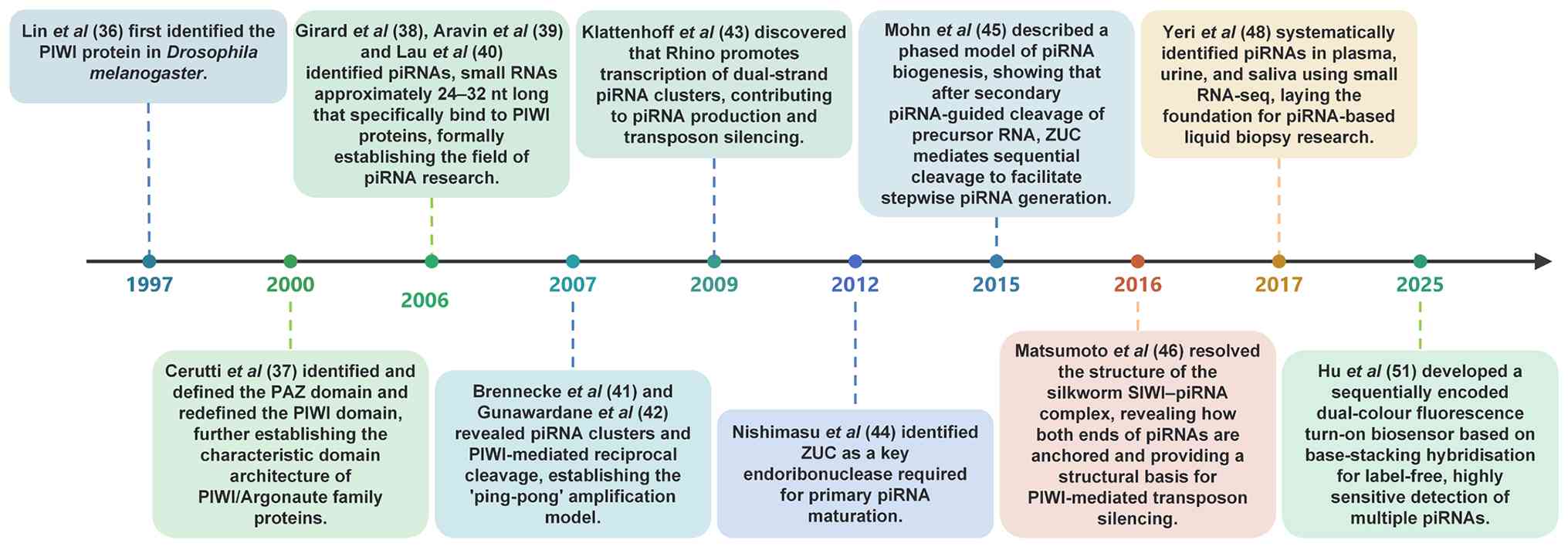
In 2006, several independent groups identified
piRNAs, small RNAs ~24-32 nt long that specifically bind to PIWI
proteins, formally establishing the field of piRNA research
(38-40). In 2007, Brennecke et al
(41) clarified that piRNAs are
primarily derived from specific piRNA clusters and are closely
associated with transposon sequences. That same year, Gunawardane
et al (42) demonstrated
complementarity between sense and antisense piRNAs and confirmed
PIWI Slicer activity, proposing a reciprocal cleavage-based
amplification mechanism that became central to the classic
'ping-pong' model. Subsequent studies focused on piRNA biogenesis
and processing. In 2009, Klattenhoff et al (43) discovered that Rhino promotes
transcription of dual-strand piRNA clusters, contributing to piRNA
production and transposon silencing. In 2012, Nishimasu et
al (44) identified Zucchini
(ZUC) as a key endoribonuclease required for primary piRNA
maturation. In 2015, Mohn et al (45) described a phased model of piRNA
biogenesis, showing that after secondary piRNA-guided cleavage of
precursor RNA, ZUC mediates sequential cleavage to facilitate
stepwise piRNA generation. In 2016, Matsumoto et al
(46) resolved the structure of
the silkworm SIWI-piRNA complex, revealing how both ends of piRNAs
are anchored and providing a structural basis for PIWI-mediated
transposon silencing.
With advances in high-throughput RNA sequencing
(RNA-seq) and single-cell transcriptomics, aberrant piRNA
expression has been detected in multiple cancer tissues (47). In 2017, Yeri et al
(48) systematically identified
piRNAs in plasma, urine and saliva using small RNA-seq, laying the
foundation for piRNA-based liquid biopsy research. In addition,
piRNA-PIWI complexes can mediate epigenetic events such as DNA
methylation and histone modification, broadening their functional
relevance in cancer. Continued advances in techniques including
fluorescence in situ hybridisation (FISH), RNA pull-down,
cross-linking immunoprecipitation sequencing and clustered
regularly interspaced short palindromic repeats interference have
shifted piRNA research from expression profiling to
disease-mechanism studies and potential clinical applications
(49,50). In 2025, Hu et al (51) developed a sequentially encoded
dual-colour fluorescence turn-on biosensor based on base-stacking
hybridisation for label-free, highly sensitive detection of
multiple piRNAs, offering a novel strategy for clinical piRNA
detection.
piRNA biogenesis differs markedly from that of
classical small RNAs, such as microRNAs (miRNAs) and small
interfering RNAs. Unlike these pathways, piRNA production does not
depend on Drosha or Dicer; instead, it uses a specialised
processing system. Based on mode of generation, piRNA synthesis is
divided into the primary processing pathway and the secondary
amplification pathway, also known as the ping-pong cycle (52,53). By tissue origin, piRNA biogenesis
can also be classified into germline pathways, which occur
primarily in sperm or oocytes, and somatic pathways, which occur in
ovarian somatic cells or other non-germline tissues. The primary
pathway functions in both systems, whereas the secondary pathway is
largely restricted to germline cells, constituting the main
mechanistic difference between them (54).
piRNA production begins in specific genomic regions
called piRNA clusters, often located in heterochromatic,
transposon-rich regions, as well as in intergenic or intronic
regions. After transcription, precursor piRNAs are transported to
the outer mitochondrial membrane, where the endonuclease ZUC
generates intermediates with 5' monophosphate ends. These fragments
are loaded onto PIWI family proteins, including PIWI-like protein 1
(PIWIL1) and PIWIL2 in humans; their 3' ends are then trimmed by
enzymes such as Trimmer and 2'-O-methylated by nescient
helix-loop-helix 1 (HEN1) to form mature piRNAs. Mature piRNA-PIWI
complexes subsequently act in the cytoplasm or nucleus to silence
transposons and regulate gene expression (32,45).
Primary piRNAs typically exhibit a 5'-terminal
uridine bias. In germline cells, piRNAs are amplified through the
ping-pong mechanism, which relies on coordinated activity between
two PIWI proteins: Aubergine (AUB) and argonaute RISC catalytic
component 3 (AGO3) in Drosophila, and mouse PIWI-like
protein and mouse PIWI-like 2 in mice. Antisense piRNAs loaded onto
AUB guide cleavage of target transposon mRNAs, producing sense
piRNAs that are then loaded onto AGO3 to cleave antisense precursor
RNAs. This reciprocal cleavage generates piRNAs with a
characteristic 10-nucleotide 5'overlap, the ping-pong signature.
The cycle increases piRNA diversity and abundance while
strengthening transposon repression, making it a central defence
mechanism for germline genomic stability (28,55,56).
piRNA biogenesis is a coordinated process involving
multiple regulatory factors. Beyond core processing enzymes such as
ZUC, HEN1 and Trimmer, several RNA-binding proteins help preserve
pathway integrity. For example, Mov10-like RNA helicase 1 (MOV10L1)
regulates precursor piRNA recognition and cleavage-site
positioning; MOV10L1 deficiency blocks piRNA production, disrupts
transposon control and causes germ cell failure (57). Tudor domain-containing (TDRD)
proteins, including TDRD1 and TDRD9, bind dimethylated arginine
residues on PIWI proteins and promote stable piRNA-PIWI complex
assembly (58). Proteins such as
Maelstrom, Vasa and GasZ also support the formation and maintenance
of processing sites, including Nuage or Yb bodies, thereby enabling
efficient precursor piRNA processing and export (59-62). These factors are evolutionarily
conserved, and their loss or dysfunction often leads to infertility
or increased transposon activity (57,59-62).
It is also important to distinguish authentic piRNAs
from piRNA-like candidates in somatic cells (63,64). Some small RNAs annotated as piRNAs
in human somatic tissues lack confirmed PIWI binding or evidence of
functional silencing-complex formation (63,65). Given that mature piRNAs typically
contain a 3'-terminal 2'-O-methyl group, oxidation-based assays
provide stronger support for piRNA identification than sequence
length or database annotation alone (66).
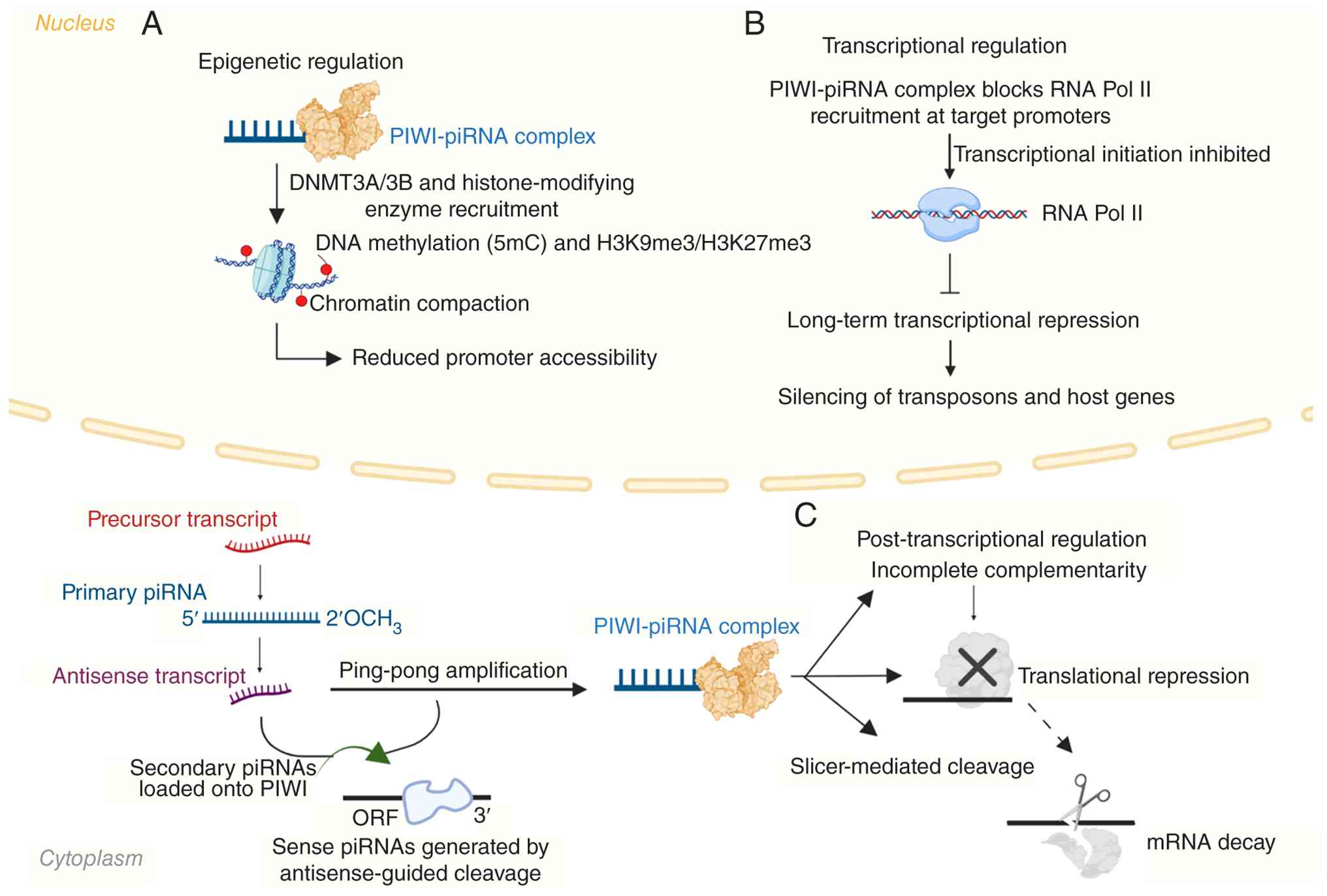
piRNAs bind PIWI proteins to form PIWI-piRNA
complexes, or PIWI-piRNA-induced silencing complexes (piRISCs),
which regulate gene expression across subcellular compartments.
Their main mechanisms include epigenetic, transcriptional and
post-transcriptional regulation (Fig.
2), with epigenetic control often operating alongside
transcriptional regulation. Together, these mechanisms help
maintain genome stability, suppress transposon activation and
provide specialised regulatory potential in selected somatic
contexts and during tumorigenesis (67-69).
The best-characterised function of piRNAs is nuclear
epigenetic silencing. After entering the nucleus, mature piRNAs
associate with PIWI proteins to form piRISCs. Through base-pairing
complementarity, these complexes are guided to nascent transposon
transcripts or RNA-chromatin complexes without direct piRNA-DNA
interaction. Once localised, piRISCs recruit DNA methyltransferases
(DNMTs), including DNMT3A and DNMT3B, and histone-modifying
enzymes, inducing DNA methylation (5-methylcytosine) and
heterochromatin marks such as histone H3 lysine 9 trimethylation
(H3K9me3) and H3K27me3 at target regions. The resulting chromatin
compaction and reduced promoter accessibility promote transposon
silencing. This mechanism is particularly critical in germline
cells, where it helps preserve hereditary genomic stability
(70,71). Emerging evidence suggests that
similar mechanisms also occur in somatic cells and tumour models,
where piRNA-PIWI complexes localise to host gene promoters and
repress transcription by increasing DNA methylation,
heterochromatin marks and local compaction (72-75).
In the cytoplasm, piRNAs primarily regulate mRNA
stability and translational efficiency through post-transcriptional
mechanisms. When piRNAs exhibit high complementarity to their
target mRNAs, PIWI proteins with endonuclease activity cleave the
target mRNAs, triggering rapid degradation. When complementarity is
insufficient for cleavage, piRISCs can inhibit ribosome loading,
repress translation and subsequently promote mRNA decay. Evidence
from multiple animal models and emerging disease studies supports
both mechanisms (76-78). For example, piR-36712 mediates
degradation of target transcripts in breast cancer cells, thereby
inhibiting cell growth and invasion (79).
Beyond epigenetic chromatin remodelling, piRNAs can
directly regulate transcription in the nucleus. PIWI-piRNA
complexes at target regions may prevent RNA polymerase II
recruitment to promoters or disrupt transcription-initiation
assembly, thereby suppressing transcription and sustaining
target-gene repression. Although the full mechanism in somatic
tissues remains elusive, growing evidence from tumour studies
indicates that piRNA-PIWI complexes can reprogram host gene
expression through direct transcriptional regulation. This
regulation may occur independently of or in coordination with
epigenetic modifications such as DNA methylation and histone
modifications, and is closely linked to oncogene activation and
tumour-suppressor silencing (80-85). Additionally, PIWI proteins can
promote tumorigenesis through piRNA-independent pathways. For
example, Shi et al (86)
reported that PIWIL1 facilitates gastric cancer progression by
interacting with the UPF1 RNA helicase and ATPase-mediated
nonsense-mediated mRNA decay pathway. These findings support an
important role for nuclear piRNA networks in cancer-associated
transcriptional dysregulation.
piRNAs may also function within multilayered RNA
networks, including indirect or competitive interactions with other
ncRNAs, such as miRNAs and long ncRNAs (lncRNAs), thereby
modulating downstream signalling pathways. However, expression
correlations, target prediction or network construction alone
cannot establish direct regulation within lncRNA-miRNA-piRNA
networks. Without evidence of direct molecular interaction, PIWI
dependence and functional validation, these networks should be
considered as potential mechanisms rather than confirmed causal
pathways (63). Overall, piRNAs
form a sophisticated regulatory system centred on PIWI-piRNA
complexes, integrating nuclear epigenetic and transcriptional
regulation with cytoplasmic post-transcriptional control. These
networks have been implicated in key biological processes,
including cell proliferation, apoptosis, migration and metabolism
(87-91).
piRNAs are present in a wide range of somatic
tissues, where they appear to participate in physiological and
pathological regulation and may influence the onset and progression
of human diseases (92-99) (Table
I). These diseases include autoimmune disorders such as
rheumatoid arthritis, neurodegenerative diseases, including
Parkinson's disease (PD) and Alzheimer's disease and type 2
diabetes with diabetic nephropathy. PiRNAs regulate immune
responses, support neural homeostasis and participate in glucose
metabolism at the somatic level, suggesting their potential as
biomarkers and therapeutic targets in these diseases (92-107). For example, in brain tissues and
patient-derived neurons from individuals with PD, piRNAs and
piRNA-like molecules exhibit widespread aberrant expression. A
subset of these differentially expressed piRNAs is consistently
detected in both sample types, suggesting possible diagnostic value
(101).
With advances in high-throughput sequencing,
multiple databases and bioinformatics tools have been developed for
piRNA sequence collection, functional annotation, target-gene
prediction and disease-association analysis. These platforms
provide systematic resources for exploring piRNA roles in diverse
biological processes and diseases (108-116) (Table II). Several tools are now used in
human disease research, particularly in oncology. For instance,
piRBase integrates piRNA sequences, expression profiles, target
information and disease annotations, and has been widely used to
screen for cancer-related piRNAs in breast, gastric,
hepatocellular, renal and colorectal cancer (CRC) (108,117).
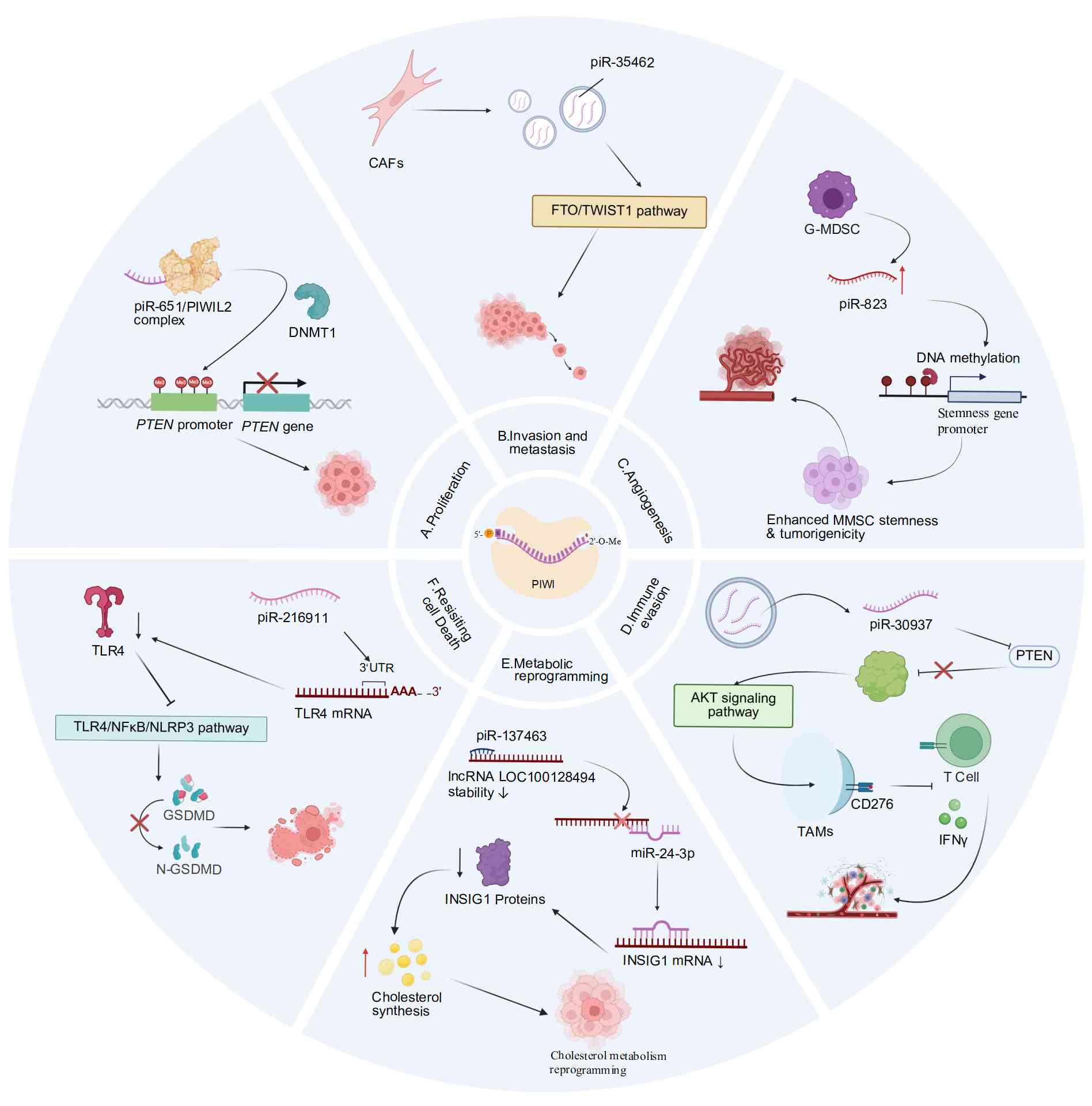
Cancer initiation and progression involve complex
biological processes that can be organised into 14 established
hallmarks (118,119). Emerging evidence shows that
piRNAs regulate tumour biology by affecting malignant
proliferation, invasion, metastasis, angiogenesis, immune evasion,
metabolic reprogramming and resistance to cell death (Fig. 3).
Malignant proliferation describes the ability of
tumour cells to acquire and sustain abnormal proliferative signals,
bypass normal cell-cycle control and proliferate uncontrollably.
piRNAs regulate the expression of cell-cycle-related genes by
forming complexes with PIWI proteins.
Complex piRNA-mediated regulatory networks have also
been reported in other malignancies. Liu et al (123) identified a
PIWIL3/piR-30188/OIP5-AS1/miR-367-3p/CCAAT enhancer binding protein
α positive-feedback axis as a critical driver of glioma progression
through coordinated regulation of TNF receptor-associated factor 4
expression; disrupting this pathway reduced tumour growth and
improved survival in mouse models, suggesting therapeutic
potential. Conversely, certain piRNAs act as tumour suppressors.
piR-MW557525 is significantly downregulated in neuroblastoma,
whereas its overexpression induces apoptosis and inhibits
proliferation, migration and invasion by activating the
P53-P21-cyclin-dependent kinase 2-Cyclin E pathway and triggering
G0/G1 arrest (124).
Together, these observations indicate that piRNAs
can either promote or suppress tumorigenesis through diverse
mechanisms that affect tumour-cell proliferation, stemness and
malignant progression.
Invasion and metastasis occur when tumour cells
breach local tissue barriers, migrate to distant organs, survive
and colonise in new microenvironments and form secondary tumours.
Growing evidence indicates that piRNAs are important regulators of
these processes.
In castration-resistant prostate cancer (CRPC),
piR-4447944 is significantly overexpressed and associated with
increased proliferation, migration and invasion, as well as reduced
apoptosis (125).
Mechanistically, piR-4447944 forms a complex with PIWIL2 and
suppresses post-transcriptional expression of the tumour-suppressor
neurofilament heavy chain (NEFH), thereby promoting
androgen-independent growth and CRPC progression. In CRC, high
piR-54265 expression activates STAT3 signalling through
PIWIL2/STAT3/phospho-SRC complex formation, thereby promoting
proliferation, metastasis and chemoresistance; inhibiting piR-54265
blocks this pathway, reducing tumour growth and metastasis
(23). Additionally, in oral
squamous cell carcinoma, cancer-associated fibroblast-derived
exosomal piR-35462 increases expression of the fat mass and
obesity-associated protein, which stabilises Twist1 mRNA by
inhibiting N6-methyladenosine (m6A) RNA
methylation, thereby promoting epithelial-mesenchymal transition
and tumour progression (126).
Overall, piRNAs may regulate tumour invasion and
metastasis by modulating signalling pathways, transcriptional
networks and tumour-stroma interactions, supporting their potential
as therapeutic targets.
Angiogenesis enables tumours to generate new blood
vessels and secure oxygen and nutrients required for sustained
growth and progression. Emerging evidence suggests that piRNAs
contribute to the regulation of tumour angiogenesis.
In multiple myeloma (MM), granulocytic
myeloidderived suppressor cells (G-MDSCs) increase piR-823
expression, promoting DNA methylation and enhancing the stemness
and tumorigenic capacity of MM stem cells (MMSCs). Ai et al
(127) reported that piR-823
knockdown weakens G-MDSC-mediated maintenance of stemness and
reduces tumour growth and angiogenesis in vivo, highlighting
the G-MDSC/piR-823/DNA methylation axis. Yan et al (26) similarly reported that piR-823
upregulates DNMT3A and DNMT3B, increases global DNA methylation,
silences the tumour suppressor gene P16 and promotes MM.
Silencing piR-823 inhibits cell proliferation and angiogenesis,
supporting its key role in the epigenetic regulation of MM. Li
et al (128) further
showed that myeloma-derived extracellular vesicles (EVs) deliver
piR-823 to endothelial cells, where it upregulates vascular
endothelial growth factor and interleukin (IL)-6, thereby promoting
endothelial proliferation, tubule formation, invasion and
angiogenesis.
Furthermore, piR-2158 is downregulated in breast
cancer and competitively interacts with the IL11 promoter
together with FOS-like 1, suppressing IL11 expression and
STAT3 signalling (129). This
reduces cancer cell stemness, angiogenesis and breast tumour
proliferation. Similarly, piR-31115 is upregulated in MDA-MB-231
triple-negative breast cancer (TNBC) cells and induces
methyltransferase 3 expression in endothelial cells (130). This increases m6A
modification and stabilises Yes1-associated transcriptional
regulator through insulin-like growth factor-2 mRNA-binding
protein, thereby promoting HMEC-1 cell proliferation, migration and
tumour angiogenesis (130).
Overall, current evidence suggests that piRNAs
regulate tumour angiogenesis through both proand anti-angiogenic
mechanisms, thereby modulating tumour progression.
Immune evasion allows tumour cells to avoid immune
clearance by reducing immune recognition or suppressing anti-tumour
effector functions. piRNAs are increasingly recognised as
regulators of tumour-immune interactions.
In high-risk myelodysplastic syndromes, increased
piRNA expression has been linked to disease progression via
suppression of transposable elements (TEs), thereby disrupting
energy metabolism, cell-cycle regulation and immune pathways.
Elevated PIWIL2 expression is also associated with poor prognosis,
suggesting an important role for the TE/piRNA axis and potential
prognostic value (131). Zhong
et al (132) showed that
small EVs (sEVs) from pancreatic neuroendocrine neoplasms (PNENs)
carry piR-30937, which activates AKT signalling by inhibiting
PTEN and upregulates CD276 in tumour-associated macrophages
(TAMs). CD276+ TAMs suppress T-cell proliferation and
interferon-γ production, promoting immune evasion and tumour
progression through the piR-30937/PTEN/AKT/ CD276 axis (132). Lu et al (133) further demonstrated that Cyclin
D1 alters ncRNA secretion by increasing miR-21, miR-93 and piRNAs
such as piR-016658 and piR-016975. This promotes stem cell
expansion and immune evasion by enhancing PIWIL2 expression and
activating Toll-like receptor 8 (TLR8)-related inflammatory
signalling in oestrogen receptor α-positive breast cancer.
Current evidence indicates that piRNAs modulate the
tumour immune microenvironment, potentially affecting immune
evasion, macrophage polarisation, and T-cell suppression, although
the underlying mechanisms warrant further clarification.
Metabolic reprogramming enables tumour cells to
adapt nutrient use and energy metabolism-including glucose,
glutamine, and lipid pathways-to support rapid proliferation under
hypoxia, nutrient limitation and other pressures within the tumour
microenvironment.
Emerging evidence suggests that piRNAs affect
tumour-cell metabolism and survival by regulating key genes within
metabolic pathways. In lung adenocarcinoma (LUAD), piR-137463
downregulates insulin-induced gene 1 (INSIG1) by
destabilising lncRNA LOC100128494 and reducing its competitive
binding to miR-24-3p, thereby disrupting cholesterol metabolism and
promoting LUAD progression. Inhibiting piR-137463 activates the
LOC100128494/miR-24-3p/INSIG1 axis, reduces PD-L1 expression,
enhances T-cell cytotoxicity, and improves responses to
anti-programmed cell death 1 (PD-1) therapy (134). In TNBC, piR-35410 is highly
expressed and promotes aerobic glycolysis by directly binding the
amino acid residues 470-780 of ATP-dependent 6-phosphofructokinase,
liver type, thereby enhancing its enzymatic activity and increasing
ATP and lactate production, thereby driving TNBC progression
(135). Conversely, Yan et
al (136) identified
piR-26441 as a potential tumour suppressor in ovarian cancer (OC),
where low expression is associated with malignant progression and
poor prognosis. piR-26441 inhibits OC growth by downregulating the
mitochondrial translation elongation factor through YTH
domain-containing protein 1-mediated m6A modification,
thereby suppressing mitochondrial oxidative phosphorylation and
activating reactive oxygen species-mediated apoptosis.
Together, these studies indicate that piRNAs
contribute to tumour metabolic reprogramming and may influence
tumour growth and therapeutic response by regulating energy
metabolism and nutrient utilisation.
Resisting cell death enables tumour cells to evade
clearance by immune surveillance or tissue homeostasis, often by
suppressing programmed cell death pathways such as apoptosis.
piRNAs have been implicated in regulating apoptosis, pyroptosis and
related survival pathways, thereby contributing to tumour
progression and therapeutic resistance.
In hepatocellular carcinoma (HCC), piR-216911 acts
as an oncogenic piRNA that promotes invasion and survival by
suppressing pyroptosis. piR-216911 binds the 3'UTR of TLR4
mRNA, silencing TLR4 and inhibiting the TLR4/nuclear factor
κB and nucleotide-binding domain and leucine-rich repeat-containing
family, pyrin domain containing 3 pathway, thereby blocking
gasdermin D-mediated pyroptosis (137). Similarly, piR-823 is highly
expressed in MM and promotes proliferation, suppresses apoptosis
and enhances chemoresistance through the TGF-β1/AKT/ERK pathway.
In vitro studies in U266 and RPMI-8226 cells have shown that
piR-823 overexpression increases proliferation and reduces
apoptosis, whereas knockdown inhibits proliferation and induces
apoptosis by decreasing BCL-2 and increasing cleaved caspase 3
(138). In CRPC, piR-4447944 is
highly and specifically expressed, forms a complex with PIWIL2 and
suppresses NEFH expression, thereby promoting proliferation,
migration and invasion under castration conditions, while
inhibiting apoptosis and driving CRPC progression (125).
Collectively, these findings suggest that piRNAs
regulate tumour-cell apoptosis and pyroptosis pathways and may
influence the therapeutic efficacy of malignancies.
Accumulating evidence demonstrates that piRNAs play
important roles in cancer initiation and progression, supported by
PIWI-binding, methylation, and in vitro and in vivo
validation studies (64,66,121,139). As components of ncRNA regulatory
networks, piRNAs are emerging as key molecules in cancer mechanism
research and precision medicine. Increasing evidence suggests that
they may serve as both diagnostic biomarkers and therapeutic
targets in cancer (140-142).
Given their high specificity, stability and close
association with tumour progression, piRNAs are considered
promising biomarkers for liquid biopsy and pathological diagnosis.
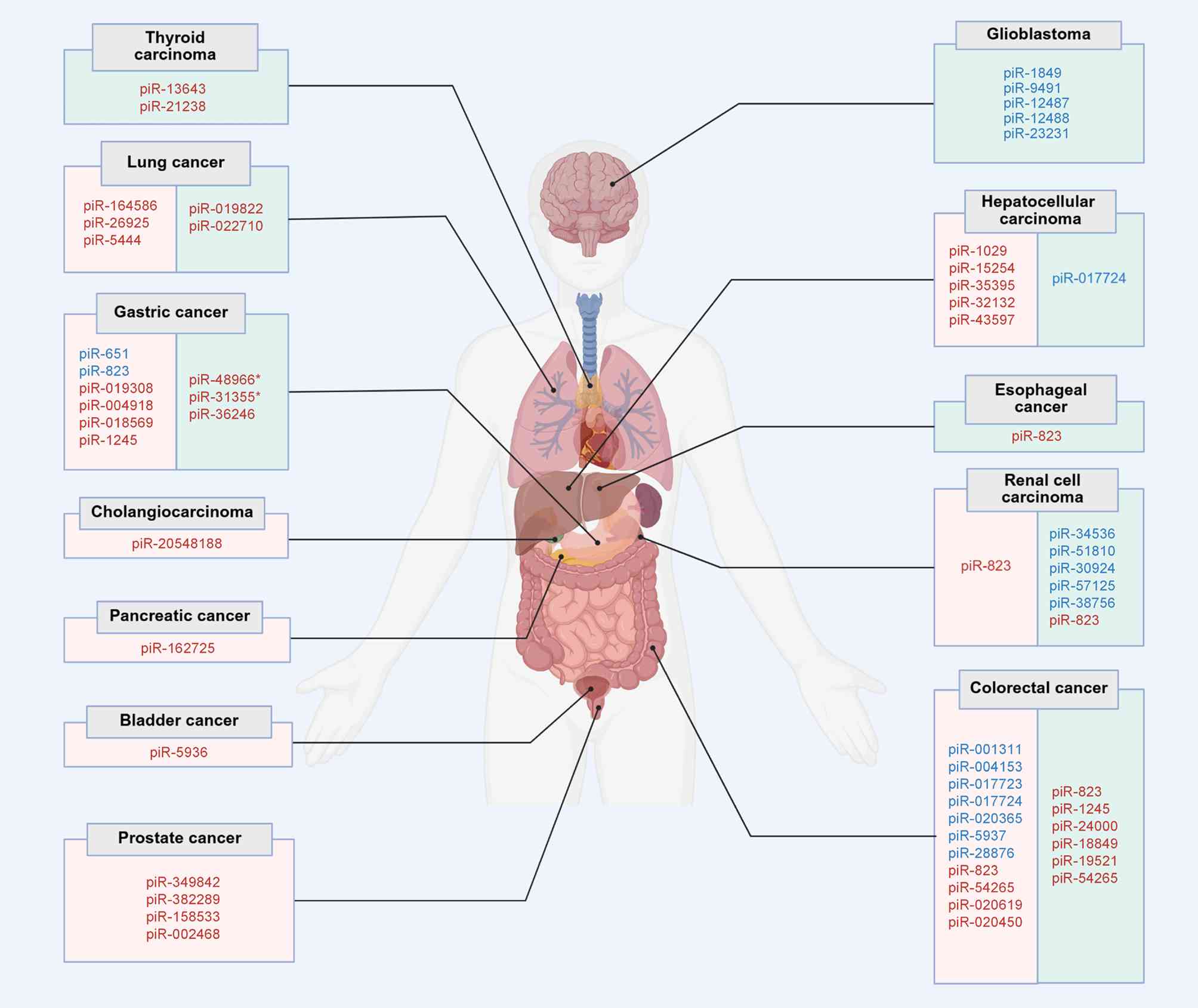
Aberrant piRNA expression has been observed in multiple cancers,
including CRC, clear cell renal cell carcinoma (ccRCC), HCC and
breast cancer (Fig. 4).
Liquid biopsy detects tumour-derived materials in
body fluids, including ctDNA, exosomes and CTCs, and has become a
powerful non-invasive approach for cancer biomarker discovery
(143). Studies have shown that
piRNAs in body fluids can achieve promising sensitivity and
specificity (122,144). Their abnormal expression in
patients with cancer supports their potential as liquid-biopsy
biomarkers for tumour diagnosis (22,23,34,35,145-157) (Table III). In CRC, Qu et al
(145) identified five serum
piRNAs-piR-001311, piR-004153, piR-017723, piR-017724 and
piR-020365-that differed between patients and healthy controls.
Serum piR-017724 was further identified as an independent
prognostic factor for overall survival (OS) and progression-free
survival (PFS), suggesting that serum piRNA profiles may aid CRC
detection and prognosis. Sabbah et al (146) similarly showed that serum
piR-823 has diagnostic value for CRC and correlates positively with
tumour stage, particularly in advanced stages (III and IV).
Additionally, serum piR-54265 is CRC-specific and may support
non-invasive screening, early detection and clinical monitoring
(22). Wang et al
(147) identified serum
piR-020619 and piR-020450 as potential biomarkers for early,
specific detection of CRC; a two-piRNA panel showed high diagnostic
accuracy and detected small lesions, early-stage CRC and colorectal
adenomas. Vychy tilova-Faltejskova et al (148) also found that piR-5937 and
piR-28876 distinguish patients with colon cancer from healthy
donors with high sensitivity and specificity and outperform
conventional markers such as CEA and CA19-9 in stage I disease.
In prostate cancer, piR-349843, piR-382289,
piR-158533 and piR-002468 are upregulated in urinary EVs,
suggesting diagnostic potential (157). Meanwhile, in non-small cell lung
cancer, piR-164586 exhibits stronger diagnostic performance than
cytokeratin-19 fragment, may have prognostic value after surgery
and correlates with clinical features, including age and TNM stage
(149).
Additional studies have identified aberrant piRNA
expression in LUAD, with serum exosomal piR-26925 and piR-5444
potentially serving as diagnostic biomarkers (150). In gastric cancer (GC), Ge et
al (155) proposed serum
exosomal piR-019308, piR-004918 and piR-018569 as robust diagnostic
biomarkers, with piR-019308 and piR-004918 also showing potential
for metastasis monitoring. Zhou et al (156) further reported that elevated
piR-1245 in gastric juice is associated with tumour size, TNM
stage, poorer OS and poorer PFS; Cox regression confirmed piR-1245
as an independent prognostic risk factor for OS, supporting its
value in GC detection and prognosis.
In cholangiocarcinoma and gallbladder cancer,
plasma exosomal piR-10506469 is significantly upregulated, whereas
piR-10506469 and piR-20548188 decrease after surgical resection,
suggesting diagnostic relevance (151). Rui et al (35) identified five serum exosomal
piRNAs-piR-1029, piR-15254, novel-piR-35395, novel-piR-32132 and
novel-piR-43597-as effective biomarkers for HCC diagnosis,
including in low-tumour-burden cases. In pancreatic ductal
adenocarcinoma, piR-162725 improves the diagnostic sensitivity of
CA19-9 when used in combination (34). In bladder cancer, piR-5936
expression increases from controls to high-risk patients and
muscle-invasive bladder cancer, indicating association with disease
severity (152). Urinary piR-823
has also demonstrated considerable diagnostic potential in RCC
(153).
piRNAs also have value as pathological diagnostic
markers across multiple cancers (23,122,153,158-168) (Table III). In CRC, piR-1245
overexpression in tumour tissues is associated with adverse
clinicopathological features, including poor differentiation and
metastasis, and serves as a robust prognostic marker for survival
(122). Similarly, elevated
piR-24000 expression is associated with aggressive CRC features,
including poor differentiation, distant metastasis and advanced
stage; receiver operating characteristic curve analysis revealed
strong performance in distinguishing patients with CRC from healthy
individuals (159). Feng et
al (158) identified tissue
piR-823 expression as an independent prognostic factor for OS in
CRC. Meanwhile, high expression of piR-18849 and piR-19521 is
associated with poor CRC differentiation, with piR-18849 also
linked to lymph node metastasis (160). piR-54265 is also significantly
upregulated in CRC tissues relative to non-tumour tissues; higher
levels in tumour or serum are significantly associated with poorer
survival (23).
Beyond CRC, tissue-derived piRNAs exhibit
prognostic potential in several malignancies. Zuo et al
(169) reported that piR-000627,
piR-005553 and piR-019346 are associated with biochemical
recurrence risk in prostate cancer, suggesting potential utility.
Similarly, Vinasco-Sandoval et al (161) identified piR-48966 clusters (*),
piR-49145 and piR-31335* as potential GC biomarkers. Meanwhile,
piR-823 exhibits high specificity for oesophageal squamous cell
carcinoma detection, with elevated levels associated with an
increased risk of lymph node metastasis (162). Wu et al (163) reported that piR-017724 is
significantly downregulated in HCC and correlates with malignant
progression and poor prognosis, supporting its potential as both a
biomarker and therapeutic target. In papillary thyroid carcinoma,
piR-13643 and piR-21238 are significantly upregulated, correlate
with clinical stage and outperform Hector Battifora mesothelial-1
in distinguishing malignant from benign thyroid nodules (164). Furthermore, piR-23231 expression
is significantly associated with OS in patients with glioblastoma
treated with the Stupp regimen (165).
In ccRCC, piR-34536 and piR-51810 represent
prognostic biomarkers, with reduced tissue expression independently
predicting shorter PFS, cancer-specific survival and OS (166). Similarly, piR-30924 and
piR-57125 are independent prognostic predictors of ccRCC (167). In lung squamous cell carcinoma,
upregulation of piR-019822 and piR-022710 is associated with
increased recurrence risk and poorer disease-free survival and OS
(168).
Overall, these candidate piRNAs may serve as
biomarkers in various cancers, but larger independent cohorts are
needed before clinical translation.
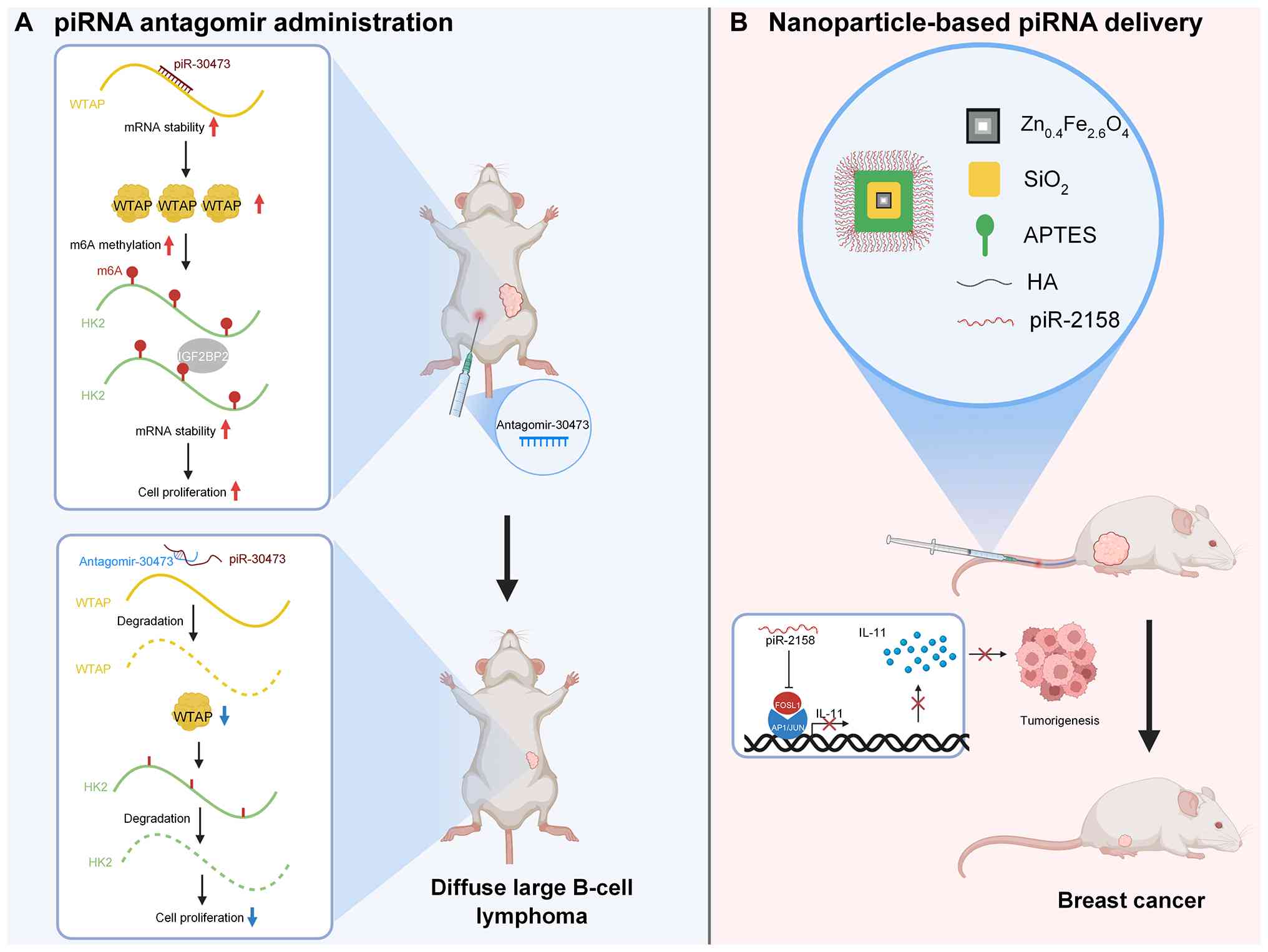
piRNAs exhibit broad therapeutic potential in
cancer. Current strategies primarily include direct delivery of
piRNA inhibitors or mimics and nanoparticle-based delivery of
piRNA-targeting agents (Fig.
5).
Nanotechnology-based systems offer a promising
approach for delivering nucleic acid therapeutics to cancer cells
(176). Nanoparticle carriers
have expanded opportunities for piRNA-based therapy. Ding et
al (121) found that
magnetic nanoparticles carrying anti-piR-823 significantly inhibit
tumour growth after tail-vein injection in MCF-7 xenograft-bearing
mice. Zhao et al (129)
reported that piR-2158-loaded nanoparticles suppress breast tumour
growth and angiogenesis in vivo. In RCC, Wang et al
(177) developed cancer cell
membrane-coated biomimetic nanoparticles to deliver piR-28489
(piR-RCC) plasmids into an orthotopic mouse model, achieving marked
tumour suppression. For HCC, Wei et al (178) engineered HCC cell
membrane-coated poly lactic-co-glycolic acid (PLGA) nanoparticles
co-encapsulating sorafenib and a piR-016975 inhibitor (in-016975/
Sora@PLGA-CM). These nanocomposites suppress HCC progression and
overcome sorafenib resistance in subcutaneous and orthotopic models
by inducing ferroptosis through the piR-016975/Maspin/GPX4 axis
(178).
Aptamer-based delivery platforms also demonstrate
potential for anticancer therapeutics. Jia et al (179) designed aptamer-functionalized
DNA tetrahedral nanoprobes for piR-36026 imaging and regulation in
breast cancer. These self-assembled probes use intrinsic aptamers
for target-cell recognition and exhibit high permeability, low
cytotoxicity and resistance to enzymatic degradation, enabling
high-fidelity imaging in MCF-7 cells. Their embedded regulatory
sequence also modulates intracellular piR-36026 through
complementary hybridisation, inducing apoptosis. Together,
aptamer-based platforms may support more precise recognition and
functional control of piRNAs in cancer therapy.
Collectively, these observations support the
therapeutic potential of piRNA-targeted interventions across
multiple cancers. Importantly, delivery strategies are evolving
from direct administration towards more precise systems based on
nanocarriers and aptamers.
Advances propelled by the Human Genome Project,
together with rapid progress in high-throughput technologies, have
characterised numerous piRNAs with previously undefined functions.
Evidence suggests that piRNAs contribute to tumour initiation and
progression by regulating key molecules and downstream signalling
pathways through epigenetic, transcriptional and
post-transcriptional mechanisms. These features make piRNAs
promising candidates for cancer biomarkers and therapeutic targets.
Furthermore, compared with conventional molecular biomarkers,
piRNAs may offer greater stability, specificity and sensitivity.
Their abundance and stability in bodily fluids further support
their use in pathological diagnosis, liquid biopsy, treatment
monitoring and prognosis assessment. Clarifying their clinical
roles and mechanisms in cancer may help advance early diagnosis and
targeted therapy.
Recent technological advances have strengthened the
potential of piRNAs in cancer diagnosis and targeted therapy. i)
Development of piRNA-related detection kits. Detection kits based
on piRNAs could support tumour pathology and liquid biopsy.
Compared with conventional protein biomarkers, certain piRNAs
demonstrate high specificity and sensitivity in distinct tumour
histotypes, positioning them as strong diagnostic candidates
(142,145,148). Current detection methods include
reverse transcription-quantitative PCR, high-throughput sequencing,
northern blotting and FISH. Paired with platforms such as digital
PCR and microfluidic chips, these methods can assess selected
piRNAs in tumour tissues or body fluids. ii) Development of
piRNA-related anticancer therapeutics. Tumour-associated piRNAs are
involved in malignant proliferation, invasion, metastasis and
metabolic reprogramming, and modulation of selected piRNAs can
suppress tumour growth and metastasis in experimental models.
Advances in molecular pharmacology, biomaterials and nanotechnology
may improve delivery of piRNA agomirs or antagomirs. Ultimately,
piRNA-targeted therapies could be combined with chemotherapy,
radiotherapy or immunotherapy to improve precision and efficacy.
iii) Combined application of high-throughput sequencing technology.
Since its introduction in 2009, single-cell transcriptome
sequencing has become a powerful tool for characterising transcript
heterogeneity across cells, cell types and tissues (180). In piRNA research, Yang et
al (181) applied
single-cell Cas9-assisted single-cell small RNA sequencing to
identify an oocyte-specific piRNA family with unique features,
creating useful resources for studying small RNAs in primate
oocytes. Further mining of single-cell datasets may reveal
clinically relevant tumour-associated piRNAs. iv) Artificial
intelligence (AI) can assist in piRNA detection and analysis. AI
can establish accurate prognostic models by integrating
differential piRNA expression profiles, clinicopathological
features and patient transcriptomic or proteomic data to provide
personalized treatment recommendations. Using machine learning
algorithms, AI can also identify piRNA molecules associated with
tumor biological characteristics from large-scale piRNA sequencing
data, further improving diagnostic accuracy and providing strong
technical support for precision and individualized medicine.
Despite growing interest in piRNAs as cancer
biomarkers and therapeutic targets, important barriers remain. i)
piRNA nomenclature has not yet been fully standardized. Given that
identification often uses high-throughput sequencing approaches
similar to those used for other small RNAs, including miRNAs,
criteria vary across laboratories. Inconsistent naming and
classification can assign multiple names to the same piRNA, making
literature review, data comparison and clinical translation
difficult. Hence, unified databases, naming rules and
identification standards are essential. ii) Lack of
well-established piRNA research systems. piRNAs are essential in
the reproductive system, particularly for maintaining germ cell
integrity. Disrupting the expression of certain piRNAs or
PIWI-related genes can cause abnormal development, fertilisation
failure, embryonic defects or lethality in mice. These constraints
make piRNA-related knockout models difficult to generate and limit
functional studies in cancer. iii) Scarce elucidation of the
biological functions of piRNAs. Although numerous tumour-associated
piRNAs have been reported, systematic evidence for their mechanisms
and roles in tumour development remains limited. Currently, piRNAs
are classified into three categories (Table SI): a) PIWI-bound and
functionally validated piRNAs, for example, piR-54265 (23,182), piR-31115 (130,183,184) and piR-137463 (134); b) partially validated piRNA-like
RNAs, for example, piR-651 (120,185), piR-823 (100,186,187), piR-36026 (179,188), piR-MW557525 (124,189); and c) database-annotated
small-RNA candidates lacking sufficient experimental validation,
for example, piR-7806 and piR-9871 (113). Furthermore, although numerous
studies suggest that piRNAs regulate targets at epigenetic,
transcriptional and post-transcriptional levels, standardised
methods for defining the functions of individual piRNAs or piRNA
clusters are lacking. Somatic small RNA annotations should also be
interpreted cautiously. Differential expression analyses and
computational target predictions indicate only putative
associations. Stronger evidence for a causal PIWI-piRNA mechanism
requires evidence of PIWI binding, maturation signatures, direct
cleavage or methylation of targets, genetic epistasis, rescue
experiments, in vivo validation and independent replication.
Given that PIWI proteins may function independently of piRNAs
(86), and because tRNA-derived
and other abundant somatic small RNAs may contribute (190), altered PIWI expression alone
does not prove that a candidate small RNA and a PIWI protein
operate in the same functional pathway. iv) Time required to
translate basic piRNA research into clinical trials. piRNA
specificity and sensitivity may vary by tumour type, and
patient-level variability may limit near-term clinical use. For
liquid biopsy and other non-invasive applications, detection
sensitivity and stability must be optimised for reliable early
diagnosis and prognosis assessment. Evidence for piRNAs as
therapeutic targets is also limited; although inhibitors and
related interventions have been tested in tumour models, most
findings remain preclinical and lack human validation. Broad
clinical and mechanistic evidence is required before piRNAs can be
widely integrated into clinical applications.
The current understanding of human piRNAs captures
only a fraction of their potential biological and clinical
importance. Numerous piRNAs with unknown functions require further
exploration and progress will depend on improved technologies,
experimental models, annotation systems and analytic frameworks. As
high-throughput sequencing, AI, biomaterials and related
technologies continue to advance, piRNAs are likely to become
increasingly important in human disease research, particularly in
cancer diagnosis, prognosis and targeted therapy.
Not applicable.
XQY, CLL, TTZ, SQS, XYH and ZYO wrote the main
manuscript. XQY, CLL and TTZ prepared the figures and tables. CLO
and NNL designed, organized and reviewed this article. Data
authentication is not applicable. All authors have read and agreed
to the published version of the manuscript.
Not applicable.
Not applicable.
The authors declare that they have no competing
interests.
Not applicable.
This study was supported by the National Natural Science
Foundation of China (grant no. 82373062), the Hunan Provincial
Natural Science Foundation of China (grant nos. 2023JJ30929 and
2025JJ80499) and the Central South University Innovation-Driven
Research Programme (grant nos. 2023CXQD075 and 2023CXQD077).
|
1
|
Bray F, Laversanne M, Sung H, Ferlay J,
Siegel RL, Soerjomataram I and Jemal A: Global cancer statistics
2022: GLOBOCAN estimates of incidence and mortality worldwide for
36 cancers in 185 countries. CA Cancer J Clin. 74:229–263.
2024.PubMed/NCBI
|
|
2
|
Jokhadze N, Das A and Dizon DS: Global
cancer statistics: A healthy population relies on population
health. CA Cancer J Clin. 74:224–226. 2024.PubMed/NCBI
|
|
3
|
Global Nutrition Target Collaborators:
Global, regional, and national progress towards the 2030 global
nutrition targets and forecasts to 2050: A systematic analysis for
the Global Burden of Disease Study 2021. Lancet. 404:2543–2583.
2025.
|
|
4
|
Geppert J and Rohm M: Cancer cachexia:
Biomarkers and the influence of age. Mol Oncol. 18:2070–2086.
2024.PubMed/NCBI
|
|
5
|
Mahadevarao Premnath S and Zubair M:
Laboratory Evaluation of Tumor Biomarkers. StatPearls StatPearls
Publishing Copyright © 2026. StatPearls Publishing, LLC.; Treasure
Island, (FL): 2026
|
|
6
|
Robbins CJ, Bates KM and Rimm DL: HER2
testing: Evolution and update for a companion diagnostic assay. Nat
Rev Clin Oncol. 22:408–423. 2025. View Article : Google Scholar : PubMed/NCBI
|
|
7
|
Koomen BM, Badrising SK, van den Heuvel MM
and Willems SM: Comparability of PD-L1 immunohistochemistry assays
for non-small-cell lung cancer: A systematic review.
Histopathology. 76:793–802. 2020. View Article : Google Scholar :
|
|
8
|
Zhou M, He X, Zhang J, Mei C, Zhong B and
Ou C: tRNA-derived small RNAs in human cancers: Roles, mechanisms,
and clinical application. Mol Cancer. 23:762024. View Article : Google Scholar : PubMed/NCBI
|
|
9
|
Nie H, Yang X, Chen Q, He X, Han Y, He Q
and Ou C: Emerging role of long non-coding RNAs in the Rho/ROCK
signaling pathway in tumor metastasis (Review). Int J Mol Med.
56:1972025. View Article : Google Scholar
|
|
10
|
Xia LY, Tang YN, Zhang J, Dong TY and Zhou
RX: Advances in the DNA nanotechnology for the cancer biomarkers
analysis: Attributes and applications. Semin Cancer Biol.
86:1105–1119. 2022. View Article : Google Scholar : PubMed/NCBI
|
|
11
|
Khan NA, Asim M, Biswas KH, Alansari AN,
Saman H, Sarwar MZ, Osmonaliev K and Uddin S: Exosome nanovesicles
as potential biomarkers and immune checkpoint signaling modulators
in lung cancer microenvironment: Recent advances and emerging
concepts. J Exp Clin Cancer Res. 42:2212023. View Article : Google Scholar : PubMed/NCBI
|
|
12
|
Liu Y and Wang H: Biomarkers and targeted
therapy for cancer stem cells. Trends Pharmacol Sci. 45:56–66.
2024. View Article : Google Scholar
|
|
13
|
Fernandez-Metzler C, Ackermann B, Garofolo
F, Arnold ME, DeSilva B, Gu H, Laterza O, Mao Y, Rose M,
Vazvaei-Smith F and Steenwyk R: Biomarker assay validation by mass
spectrometry. AAPS J. 24:662022. View Article : Google Scholar : PubMed/NCBI
|
|
14
|
Robinette SL, Bruschweiler R, Schroeder FC
and Edison AS: NMR in metabolomics and natural products research:
Two sides of the same coin. Acc Chem Res. 45:288–297. 2012.
View Article : Google Scholar :
|
|
15
|
Khan AQ, Ahmad F, Raza SS, Zarif L, Siveen
KS, Sher G, Agha MV, Rashid K, Kulinski M, Buddenkotte J, et al:
Role of non-coding RNAs in the progression and resistance of
cutaneous malignancies and autoimmune diseases. Semin Cancer Biol.
83:208–226. 2022. View Article : Google Scholar
|
|
16
|
Deng X, Liao T, Xie J, Kang D, He Y, Sun
Y, Wang Z, Jiang Y, Miao X, Yan Y, et al: The burgeoning importance
of PIWI-interacting RNAs in cancer progression. Sci China Life Sci.
67:653–662. 2024. View Article : Google Scholar : PubMed/NCBI
|
|
17
|
Bamezai S, Rawat VP and Buske C: Concise
review: The Piwi-piRNA axis: Pivotal beyond transposon silencing.
Stem Cells. 30:2603–2611. 2012. View Article : Google Scholar : PubMed/NCBI
|
|
18
|
Yu Y, Gu J, Jin Y, Kang D, He Y, Sun Y,
Wang Z, Jiang Y, Miao X, Yan Y, et al: Panoramix enforces
piRNA-dependent cotranscriptional silencing. Science. 350:339–342.
2015. View Article : Google Scholar : PubMed/NCBI
|
|
19
|
Bagijn MP, Goldstein LD, Sapetschnig A,
Weick EM, Bouasker S, Lehrbach NJ, Simard MJ and Miska EA:
Function, targets, and evolution of Caenorhabditis elegans piRNAs.
Science. 337:574–578. 2012. View Article : Google Scholar : PubMed/NCBI
|
|
20
|
Li Z, Xu Q, Zhong J, Zhang Y, Zhang T,
Ying X, Lu X, Li X, Wan L, Xue J, et al: Structural insights into
RNA cleavage by PIWI Argonaute. Nature. 639:250–259. 2025.
View Article : Google Scholar : PubMed/NCBI
|
|
21
|
Wang X, Ramat A, Simonelig M and Liu MF:
Emerging roles and functional mechanisms of PIWI-interacting RNAs.
Nat Rev Mol Cell Biol. 24:123–141. 2023. View Article : Google Scholar
|
|
22
|
Mai D, Zheng Y, Guo H, Ding P, Bai R, Li
M, Ye Y, Zhang J, Huang X, Liu D, et al: Serum piRNA-54265 is a New
Biomarker for early detection and clinical surveillance of Human
Colorectal Cancer. Theranostics. 10:8468–8478. 2020. View Article : Google Scholar : PubMed/NCBI
|
|
23
|
Mai D, Ding P, Tan L, Zhang J, Pan Z, Bai
R, Li C, Li M, Zhou Y, Tan W, et al: PIWI-interacting RNA-54265 is
oncogenic and a potential therapeutic target in colorectal
adenocarcinoma. Theranostics. 8:5213–5230. 2018. View Article : Google Scholar : PubMed/NCBI
|
|
24
|
Ramat A and Simonelig M: Functions of PIWI
proteins in gene regulation: New arrows added to the piRNA quiver.
Trends Genet. 37:188–200. 2021. View Article : Google Scholar
|
|
25
|
Tian Y, Simanshu DK, Ma JB and Patel DJ:
Structural basis for piRNA 2'-O-methylated 3'-end recognition by
Piwi PAZ (Piwi/ Argonaute/Zwille) domains. Proc Natl Acad Sci USA.
108:903–910. 2011. View Article : Google Scholar
|
|
26
|
Yan H, Wu QL, Sun CY, Ai LS, Deng J, Zhang
L, Chen L, Chu ZB, Tang B, Wang K, et al: piRNA-823 contributes to
tumorigenesis by regulating de novo DNA methylation and
angiogenesis in multiple myeloma. Leukemia. 29:196–206. 2015.
View Article : Google Scholar
|
|
27
|
De Luca C, Gupta A and Bortvin A:
Retrotransposon LINE-1 bodies in the cytoplasm of piRNA-deficient
mouse spermatocytes: Ribonucleoproteins overcoming the integrated
stress response. PLoS Genet. 19:e10107972023. View Article : Google Scholar : PubMed/NCBI
|
|
28
|
Czech B and Hannon GJ: One loop to rule
them all: The ping-pong cycle and piRNA-guided silencing. Trends
Biochem Sci. 41:324–337. 2016. View Article : Google Scholar : PubMed/NCBI
|
|
29
|
Parker JS and Barford D: Argonaute: A
scaffold for the function of short regulatory RNAs. Trends Biochem
Sci. 31:622–630. 2006. View Article : Google Scholar : PubMed/NCBI
|
|
30
|
Baptista HS, Portela LMF, Fioretto MN,
Mattos R, Ribeiro IT, Lorente ABL, Oliveira JIN and Justulin LA:
Influence of aging and maternal protein restriction on
PIWI-interacting RNA expression in the offspring rat ventral
prostate. Sci Rep. 14:303722024. View Article : Google Scholar : PubMed/NCBI
|
|
31
|
Xu Y, Liu H, Zhang Y, Luo J, Li H, Lai C,
Shi L and Heng B: piRNAs and circRNAs acting as diagnostic
biomarkers in clear cell renal cell carcinoma. Sci Rep.
15:77742025. View Article : Google Scholar : PubMed/NCBI
|
|
32
|
Martinez VD, Vucic EA, Thu KL, Hubaux R,
Enfield KS, Pikor LA, Becker-Santos DD, Brown CJ, Lam S and Lam WL:
Unique somatic and malignant expression patterns implicate
PIWI-interacting RNAs in cancer-type specific biology. Sci Rep.
5:104232015. View Article : Google Scholar : PubMed/NCBI
|
|
33
|
Li Y, Wu X, Gao H, Jin JM, Li AX, Kim YS,
Pal SK, Nelson RA, Lau CM, Guo C, et al: Piwi-interacting RNAs
(piRNAs) are dysregulated in renal cell carcinoma and associated
with tumor metastasis and cancer-specific survival. Mol Med.
21:381–388. 2015. View Article : Google Scholar : PubMed/NCBI
|
|
34
|
Li W, Gonzalez-Gonzalez M, Sanz-Criado L,
Garcia-Carbonero N, Celdran A, Villarejo-Campos P, Minguez P,
Pazo-Cid R, Garcia-Jimenez C, Orta-Ruiz A, et al: A novel PiRNA
enhances CA19-9 sensitivity for pancreatic cancer identification by
liquid biopsy. J Clin Med. 11:73102022. View Article : Google Scholar : PubMed/NCBI
|
|
35
|
Rui T, Wang K, Xiang A, Guo J, Tang N, Jin
X, Lin Y, Liu J and Zhang X: Serum exosome-derived piRNAs could be
promising biomarkers for HCC diagnosis. Int J Nanomedicine.
18:1989–2001. 2023. View Article : Google Scholar : PubMed/NCBI
|
|
36
|
Lin H and Spradling AC: A novel group of
pumilio mutations affects the asymmetric division of germline stem
cells in the Drosophila ovary. Development. 124:2463–2476. 1997.
View Article : Google Scholar : PubMed/NCBI
|
|
37
|
Cerutti L, Mian N and Bateman A: Domains
in gene silencing and cell differentiation proteins: The novel PAZ
domain and redefinition of the Piwi domain. Trends Biochem Sci.
25:481–482. 2000. View Article : Google Scholar : PubMed/NCBI
|
|
38
|
Girard A, Sachidanandam R, Hannon GJ and
Carmell MA: A germline-specific class of small RNAs binds mammalian
Piwi proteins. Nature. 442:199–202. 2006. View Article : Google Scholar : PubMed/NCBI
|
|
39
|
Aravin A, Gaidatzis D, Pfeffer S,
Lagos-Quintana M, Landgraf P, Iovino N, Morris P, Brownstein MJ,
Kuramochi-Miyagawa S, Nakano T, et al: A novel class of small RNAs
bind to MILI protein in mouse testes. Nature. 442:203–207. 2006.
View Article : Google Scholar : PubMed/NCBI
|
|
40
|
Lau NC, Seto AG, Kim J, Kuramochi-Miyagawa
S, Nakano T, Bartel DP and Kingston RE: Characterization of the
piRNA complex from rat testes. Science. 313:363–367. 2006.
View Article : Google Scholar : PubMed/NCBI
|
|
41
|
Brennecke J, Aravin AA, Stark A, Dus M,
Kellis M, Sachidanandam R and Hannon GJ: Discrete small
RNA-generating loci as master regulators of transposon activity in
Drosophila. Cell. 128:1089–1103. 2007. View Article : Google Scholar : PubMed/NCBI
|
|
42
|
Gunawardane LS, Saito K, Nishida KM,
Miyoshi K, Kawamura Y, Nagami T, Siomi H and Siomi MC: A
slicer-mediated mechanism for repeat-associated siRNA 5'end
formation in Drosophila. Science. 315:1587–1590. 2007. View Article : Google Scholar : PubMed/NCBI
|
|
43
|
Klattenhoff C, Xi H, Li C, Lee S, Xu J,
Khurana JS, Zhang F, Schultz N, Koppetsch BS, Nowosielska A, et al:
The Drosophila HP1 homolog Rhino is required for transposon
silencing and piRNA production by dual-strand clusters. Cell.
138:1137–1149. 2009. View Article : Google Scholar : PubMed/NCBI
|
|
44
|
Nishimasu H, Ishizu H, Saito K, Fukuhara
S, Kamatani MK, Bonnefond L, Matsumoto N, Nishizawa T, Nakanaga K,
Aoki J, et al: Structure and function of Zucchini endoribonuclease
in piRNA biogenesis. Nature. 491:284–287. 2012. View Article : Google Scholar : PubMed/NCBI
|
|
45
|
Mohn F, Handler D and Brennecke J:
Noncoding RNA. piRNA-guided slicing specifies transcripts for
Zucchinidependent, phased piRNA biogenesis. Science. 348:812–817.
2015. View Article : Google Scholar : PubMed/NCBI
|
|
46
|
Matsumoto N, Nishimasu H, Sakakibara K,
Nishida KM, Hirano T, Ishitani R, Siomi H, Siomi MC and Nureki O:
Crystal structure of silkworm PIWI-clade argonaute siwi bound to
piRNA. Cell. 167:484–497.e9. 2016. View Article : Google Scholar : PubMed/NCBI
|
|
47
|
Ng KW, Anderson C, Marshall EA, Minatel
BC, Enfield KS, Saprunoff HL, Lam WL and Martinez VD:
Piwi-interacting RNAs in cancer: Emerging functions and clinical
utility. Mol Cancer. 15:52016. View Article : Google Scholar : PubMed/NCBI
|
|
48
|
Yeri A, Courtright A, Reiman R, Carlson E,
Beecroft T, Janss A, Siniard A, Richholt R, Balak C, Rozowsky J, et
al: Total extracellular small RNA profiles from plasma, saliva, and
urine of healthy subjects. Sci Rep. 7:440612017. View Article : Google Scholar : PubMed/NCBI
|
|
49
|
Gu W, Lee HC, Chaves D, Youngman EM,
Pazour GJ, Conte D Jr and Mello CC: CapSeq and CIP-TAP identify Pol
II start sites and reveal capped small RNAs as C. elegans piRNA
precursors. Cell. 151:1488–1500. 2012. View Article : Google Scholar : PubMed/NCBI
|
|
50
|
Han BW, Wang W, Zamore PD and Weng Z:
piPipes: A set of pipelines for piRNA and transposon analysis via
small RNA-seq, RNA-seq, degradome- and CAGE-seq, ChIP-seq and
genomic DNA sequencing. Bioinformatics. 31:593–595. 2015.
View Article : Google Scholar :
|
|
51
|
Hu J, Zhang J, Hu J and Zhang CY:
Construction of a dual-color fluorescent light-up biosensor based
on sequential coding for label-free and sensitive detection of
multiple Piwi-interacting RNAs. Chem Commun (Camb). 61:5031–5034.
2025. View Article : Google Scholar : PubMed/NCBI
|
|
52
|
Pandey RR and Pillai RS: Primary piRNA
biogenesis: Caught up in a Maelstrom. EMBO J. 33:1979–1980. 2014.
View Article : Google Scholar : PubMed/NCBI
|
|
53
|
Wang W, Yoshikawa M, Han BW, Izumi N,
Tomari Y, Weng Z and Zamore PD: The initial uridine of primary
piRNAs does not create the tenth adenine that is the hallmark of
secondary piRNAs. Mol Cell. 56:708–716. 2014. View Article : Google Scholar : PubMed/NCBI
|
|
54
|
Theron E, Dennis C, Brasset E and Vaury C:
Distinct features of the piRNA pathway in somatic and germ cells:
From piRNA cluster transcription to piRNA processing and
amplification. Mob DNA. 5:282014. View Article : Google Scholar : PubMed/NCBI
|
|
55
|
Han BW, Wang W, Li C, Weng Z and Zamore
PD: Noncoding RNA. piRNA-guided transposon cleavage initiates
Zucchini-dependent, phased piRNA production. Science. 348:817–821.
2015. View Article : Google Scholar : PubMed/NCBI
|
|
56
|
Galton R, Fejes-Toth K and Bronner ME:
Co-option of the piRNA pathway to regulate neural crest
specification. Sci Adv. 8:eabn14412022. View Article : Google Scholar : PubMed/NCBI
|
|
57
|
Frost RJ, Hamra FK, Richardson JA, Qi X,
Bassel-Duby R and Olson EN: MOV10L1 is necessary for protection of
spermatocytes against retrotransposons by Piwi-interacting RNAs.
Proc Natl Acad Sci USA. 107:11847–11852. 2010. View Article : Google Scholar : PubMed/NCBI
|
|
58
|
Pandey RR, Tokuzawa Y, Yang Z, Hayashi E,
Ichisaka T, Kajita S, Asano Y, Kunieda T, Sachidanandam R, Chuma S,
et al: Tudor domain containing 12 (TDRD12) is essential for
secondary PIWI interacting RNA biogenesis in mice. Proc Natl Acad
Sci USA. 110:16492–16497. 2013. View Article : Google Scholar : PubMed/NCBI
|
|
59
|
Chang TH, Mattei E, Gainetdinov I, Colpan
C, Weng Z and Zamore PD: Maelstrom represses canonical Polymerase
II transcription within Bi-directional piRNA clusters in Drosophila
melanogaster. Mol Cell. 73:291–303.e6. 2019. View Article : Google Scholar
|
|
60
|
Kotov AA, Adashev VE, Godneeva BK, Ninova
M, Shatskikh AS, Bazylev SS, Aravin AA and Olenina LV: piRNA
silencing contributes to interspecies hybrid sterility and
reproductive isolation in Drosophila melanogaster. Nucleic Acids
Res. 47:4255–4271. 2019. View Article : Google Scholar : PubMed/NCBI
|
|
61
|
Handler D, Meixner K, Pizka M, Lauss K,
Schmied C, Gruber FS and Brennecke J: The genetic makeup of the
Drosophila piRNA pathway. Mol Cell. 50:762–777. 2013. View Article : Google Scholar : PubMed/NCBI
|
|
62
|
Munafo M, Manelli V, Falconio FA, Sawle A,
Kneuss E, Eastwood EL, Seah JWE, Czech B and Hannon GJ: Daedalus
and Gasz recruit Armitage to mitochondria, bringing piRNA
precursors to the biogenesis machinery. Genes Dev. 33:844–856.
2019. View Article : Google Scholar : PubMed/NCBI
|
|
63
|
Dudzik J, Czechowicz P, Wiech-Walow A,
Slawski J, Collawn JF and Bartoszewski R: PiRNAs, PiRNA-Like, and
PIWI proteins in somatic cells: From genetic regulation to disease
mechanisms. Wiley Interdiscip Rev RNA. 16:e700122025. View Article : Google Scholar : PubMed/NCBI
|
|
64
|
Garcia-Borja E, Siegl F, Mateu R, Slaby O,
Sedo A, Busek P and Sana J: Critical appraisal of the piRNA-PIWI
axis in cancer and cancer stem cells. Biomark Res. 12:152024.
View Article : Google Scholar : PubMed/NCBI
|
|
65
|
Tosar JP, Rovira C and Cayota A:
Non-coding RNA fragments account for the majority of annotated
piRNAs expressed in somatic non-gonadal tissues. Commun Biol.
1:22018. View Article : Google Scholar : PubMed/NCBI
|
|
66
|
Wang K, Perera BPU, Morgan RK,
Sala-Hamrick K, Geron V, Svoboda LK, Faulk C, Dolinoy DC and Sartor
MA: piOxi database: A web resource of germline and somatic tissue
piRNAs identified by chemical oxidation. Database (Oxford).
2024:baad0962024. View Article : Google Scholar : PubMed/NCBI
|
|
67
|
Gebert D and Rosenkranz D: RNA-based
regulation of transposon expression. Wiley Interdiscip Rev RNA.
6:687–708. 2015. View Article : Google Scholar : PubMed/NCBI
|
|
68
|
van Wolfswinkel JC: Insights in piRNA
targeting rules. Wiley Interdiscip Rev RNA. e18112023. View Article : Google Scholar : Epub ahead of
print. PubMed/NCBI
|
|
69
|
Luo Y, Tian W, Zhu X, Wei W, Ye F, Situ
MY, Yan Y, He X, Huang X, Tang J, et al: piR-1170 drives brain
metastasis and immune evasion via WTAP-mediated m6A methylation
reprogramming in triple-negative breast cancer. Mol Cancer.
25:522026. View Article : Google Scholar : PubMed/NCBI
|
|
70
|
Zoch A, Auchynnikava T, Berrens RV,
Kabayama Y, Schöpp T, Heep M, Vasiliauskaitė L, Pérez-Rico YA, Cook
AG, Shkumatava A, et al: SPOCD1 is an essential executor of
piRNA-directed de novo DNA methylation. Nature. 584:635–639. 2020.
View Article : Google Scholar : PubMed/NCBI
|
|
71
|
Du WW, Yang W, Xuan J, Gupta S, Krylov SN,
Ma X, Yang Q and Yang BB: Reciprocal regulation of miRNAs and
piRNAs in embryonic development. Cell Death Differ. 23:1458–1470.
2016. View Article : Google Scholar : PubMed/NCBI
|
|
72
|
Andersen PR, Tirian L, Vunjak M and
Brennecke J: A heterochromatin-dependent transcription machinery
drives piRNA expression. Nature. 549:54–59. 2017. View Article : Google Scholar : PubMed/NCBI
|
|
73
|
Levine MT and Malik HS: Learning to
protect your genome on the fly. Cell. 147:1440–1441. 2011.
View Article : Google Scholar : PubMed/NCBI
|
|
74
|
Liu Y, Dou M, Song X, Dong Y, Liu S, Liu
H, Tao J, Li W, Yin X and Xu W: The emerging role of the piRNA/piwi
complex in cancer. Mol Cancer. 18:1232019. View Article : Google Scholar : PubMed/NCBI
|
|
75
|
Siddiqi S and Matushansky I: Piwis and
piwi-interacting RNAs in the epigenetics of cancer. J Cell Biochem.
113:373–380. 2012. View Article : Google Scholar
|
|
76
|
Yang Z, Chen KM, Pandey RR, Homolka D,
Reuter M, Janeiro BK, Sachidanandam R, Fauvarque MO, McCarthy AA
and Pillai RS: PIWI slicing and EXD1 drive biogenesis of nuclear
piRNAs from cytosolic targets of the mouse piRNA pathway. Mol Cell.
61:138–152. 2016. View Article : Google Scholar :
|
|
77
|
Balaratnam S, West N and Basu S: A piRNA
utilizes HILI and HIWI2 mediated pathway to down-regulate ferritin
heavy chain 1 mRNA in human somatic cells. Nucleic Acids Res.
46:10635–10648. 2018.PubMed/NCBI
|
|
78
|
Hutvagner G and Simard MJ: Argonaute
proteins: Key players in RNA silencing. Nat Rev Mol Cell Biol.
9:22–32. 2008. View Article : Google Scholar
|
|
79
|
Tan L, Mai D, Zhang B, Jiang X, Zhang J,
Bai R, Ye Y, Li M, Pan L, Su J, et al: PIWI-interacting RNA-36712
restrains breast cancer progression and chemoresistance by
interaction with SEPW1 pseudogene SEPW1P RNA. Mol Cancer. 18:92019.
View Article : Google Scholar : PubMed/NCBI
|
|
80
|
ElMaghraby MF, Andersen PR, Puhringer F,
Hohmann U, Meixner K, Lendl T, Tirian L and Brennecke J: A
heterochromatin-specific RNA export pathway facilitates piRNA
production. Cell. 178:964–979.e20. 2019. View Article : Google Scholar : PubMed/NCBI
|
|
81
|
Sienski G, Donertas D and Brennecke J:
Transcriptional silencing of transposons by Piwi and maelstrom and
its impact on chromatin state and gene expression. Cell.
151:964–980. 2012. View Article : Google Scholar : PubMed/NCBI
|
|
82
|
Olovnikov I, Ryazansky S, Shpiz S, Lavrov
S, Abramov Y, Vaury C, Jensen S and Kalmykova A: De novo piRNA
cluster formation in the Drosophila germ line triggered by
transgenes containing a transcribed transposon fragment. Nucleic
Acids Res. 41:5757–5768. 2013. View Article : Google Scholar : PubMed/NCBI
|
|
83
|
Iwasaki YW, Murano K, Ishizu H, Shibuya A,
Iyoda Y, Siomi MC, Siomi H and Saito K: Piwi modulates chromatin
accessibility by regulating multiple factors including histone H1
to repress transposons. Mol Cell. 63:408–419. 2016. View Article : Google Scholar : PubMed/NCBI
|
|
84
|
Dias Mirandela M, Zoch A, Leismann J, Webb
S, Berrens RV, Valsakumar D, Kabayama Y, Auchynnikava T, Schito M,
Chowdhury T, et al: Two-factor authentication underpins the
precision of the piRNA pathway. Nature. 634:979–985. 2024.
View Article : Google Scholar : PubMed/NCBI
|
|
85
|
Liu J, Zhang S and Cheng B: Epigenetic
roles of PIWI-interacting RNAs (piRNAs) in cancer metastasis
(Review). Oncol Rep. 40:2423–2434. 2018.PubMed/NCBI
|
|
86
|
Shi S, Yang ZZ, Liu S, Yang F and Lin H:
PIWIL1 promotes gastric cancer via a piRNA-independent mechanism.
Proc Natl Acad Sci USA. 117:22390–22401. 2020. View Article : Google Scholar : PubMed/NCBI
|
|
87
|
Rearick D, Prakash A, McSweeny A, Shepard
SS, Fedorova L and Fedorov A: Critical association of ncRNA with
introns. Nucleic Acids Res. 39:2357–2366. 2011. View Article : Google Scholar :
|
|
88
|
Meng X, Peng H, Ding Y, Zhang L, Yang J
and Han X: A transcriptomic regulatory network among miRNAs,
piRNAs, circRNAs, lncRNAs and mRNAs regulates microcystin-leucine
arginine (MC-LR)-induced male reproductive toxicity. Sci Total
Environ. 667:563–577. 2019. View Article : Google Scholar : PubMed/NCBI
|
|
89
|
Larriba E and Del Mazo J: An integrative
piRNA analysis of mouse gametes and zygotes reveals new potential
origins and gene regulatory roles. Sci Rep. 8:128322018. View Article : Google Scholar : PubMed/NCBI
|
|
90
|
Liu X, Zheng J, Xue Y, Yu H, Gong W, Wang
P, Li Z and Liu Y: Erratum: PIWIL3/OIP5-AS1/miR-367-3p/CEBPA
feedback loop regulates the biological behavior of glioma cells:
Erratum. Theranostics. 12:1732–1733. 2022. View Article : Google Scholar : PubMed/NCBI
|
|
91
|
Xu L, Ma W, Huo X, Luo J, Li R, Zhu X,
Kong X, Zhao K, Jin Y, Zhang M, et al: New insights into the
function and mechanisms of piRNA PMLCPIR in promoting
PM2.5-induced lung cancer. J Adv Res. 73:659–670. 2025.
View Article : Google Scholar :
|
|
92
|
Jiang X, Zhang Y, Li Y, Li X, Yang Y and
Yu T: Comprehensive evaluation of differential expression of piRNAs
in abdominal aortic aneurysm. Cell Signal. 132:1117852025.
View Article : Google Scholar : PubMed/NCBI
|
|
93
|
Jain G, Stuendl A, Rao P, Berulava T, Pena
Centeno T, Kaurani L, Burkhardt S, Delalle I, Kornhuber J, Hüll M,
et al: A combined miRNA-piRNA signature to detect Alzheimer's
disease. Transl Psychiatry. 9:2502019. View Article : Google Scholar : PubMed/NCBI
|
|
94
|
Li X, Wang W, Wang S, Li X, Zhang B,
Stephen BE, Yu T, Wang J and Yang Y: Role and mechanism of piR-0228
targeting RIPK1 to regulate vascular remodeling and aortic
dissection. Atherosclerosis. 410:1204592025. View Article : Google Scholar : PubMed/NCBI
|
|
95
|
Jiao A, Liu H, Wang H, Yu J, Gong L, Zhang
H and Fu L: piR112710 attenuates diabetic cardiomyopathy through
inhibiting Txnip/NLRP3-mediated pyroptosis in db/db mice. Cell
Signal. 122:1113332024. View Article : Google Scholar : PubMed/NCBI
|
|
96
|
't Hart LM, de Klerk JA, Bouland GA,
Peerlings JHD, Blom MT, Cramer SJ, Bijkerk R, Beulens JWJ and
Slieker RC: Small RNA sequencing reveals snoRNAs and piRNA-019825
as novel players in diabetic kidney disease. Endocrine. 86:194–203.
2024. View Article : Google Scholar : PubMed/NCBI
|
|
97
|
Ren R, Tan H, Huang Z, Wang Y and Yang B:
Differential expression and correlation of immunoregulation related
piRNA in rheumatoid arthritis. Front Immunol. 14:11759242023.
View Article : Google Scholar : PubMed/NCBI
|
|
98
|
Feng N, Liu C, Zhu Y, Cai S, Xie Y, Wang
Z, Wang H, Xiao G, Long H and Peng S: piENOX2 regulates
ALKBH5-mediated Itga4 m6A modification to accelerate the
progression of rheumatoid arthritis. Exp Mol Med. 57:1579–1592.
2025. View Article : Google Scholar : PubMed/NCBI
|
|
99
|
Zhang W, Zheng Z, Wang K, Mao W, Li X,
Wang G, Zhang Y, Huang J, Zhang N, Wu P, et al: piRNA-1742 promotes
renal cell carcinoma malignancy by regulating USP8 stability
through binding to hnRNPU and thereby inhibiting MUC12
ubiquitination. Exp Mol Med. 55:1258–1271. 2023. View Article : Google Scholar : PubMed/NCBI
|
|
100
|
Plestilova L, Neidhart M, Russo G,
Frank-Bertoncelj M, Ospelt C, Ciurea A, Kolling C, Gay RE, Michel
BA, Vencovský J, et al: Expression and regulation of PIWIL-proteins
and PIWI-interacting RNAs in rheumatoid arthritis. PLoS One.
11:e01669202016. View Article : Google Scholar : PubMed/NCBI
|
|
101
|
Schulze M, Sommer A, Plötz S, Farrell M,
Winner B, Grosch J, Winkler J and Riemenschneider MJ: Sporadic
Parkinson's disease derived neuronal cells show disease-specific
mRNA and small RNA signatures with abundant deregulation of piRNAs.
Acta Neuropathol Commun. 6:582018. View Article : Google Scholar : PubMed/NCBI
|
|
102
|
Zhang T and Wong G: Dysregulation of human
somatic piRNA expression in Parkinson's disease subtypes and
stages. Int J Mol Sci. 23:24692022. View Article : Google Scholar : PubMed/NCBI
|
|
103
|
Wakisaka KT and Imai Y: The dawn of pirna
research in various neuronal disorders. Front Biosci (Landmark Ed).
24:1440–1451. 2019. View
Article : Google Scholar : PubMed/NCBI
|
|
104
|
Sato K, Takayama KI and Inoue S: Role of
piRNA biogenesis and its neuronal function in the development of
neurodegenerative diseases. Front Aging Neurosci. 15:11578182023.
View Article : Google Scholar : PubMed/NCBI
|
|
105
|
Zeng Q, Cai J, Wan H, Zhao S, Tan Y, Zhang
C and Qu S: PIWI-interacting RNAs and PIWI proteins in diabetes and
cardiovascular disease: Molecular pathogenesis and role as
biomarkers. Clin Chim Acta. 518:33–37. 2021. View Article : Google Scholar : PubMed/NCBI
|
|
106
|
Ali H, Malik MZ, Abu-Farha M, Abubaker J,
Cherian P, Al-Khairi I, Nizam R, Jacob S, Bahbahani Y, Al Attar A,
et al: Dysregulated urinary extracellular vesicle small RNAs in
diabetic nephropathy: Implications for diagnosis and therapy. J
Endocr Soc. 8:bvae1142024. View Article : Google Scholar : PubMed/NCBI
|
|
107
|
Henaoui IS, Jacovetti C, Guerra Mollet I,
Guay C, Sobel J, Eliasson L and Regazzi R: PIWI-interacting RNAs as
novel regulators of pancreatic beta cell function. Diabetologia.
60:1977–1986. 2017. View Article : Google Scholar : PubMed/NCBI
|
|
108
|
Wang J, Zhang P, Lu Y, Li Y, Zheng Y, Kan
Y, Chen R and He S: piRBase: A comprehensive database of piRNA
sequences. Nucleic Acids Res. 47:D175–D180. 2019. View Article : Google Scholar :
|
|
109
|
Rosenkranz D, Zischler H and Gebert D:
piRNAclusterDB 2.0: Update and expansion of the piRNA cluster
database. Nucleic Acids Res. 50:D259–D264. 2022. View Article : Google Scholar :
|
|
110
|
Gupta P, Das G, Chattopadhyay T, Ghosh Z
and Mallick B: TarpiD, a database of putative and validated targets
of piRNAs. Mol Omics. 19:706–713. 2023. View Article : Google Scholar : PubMed/NCBI
|
|
111
|
Chen Q, Zhang L, Liu Y, Qin Z and Zhao T:
PUTransGCN: Identification of piRNA-disease associations based on
attention encoding graph convolutional network and positive
unlabelled learning. Brief Bioinform. 25:bbae1442024. View Article : Google Scholar : PubMed/NCBI
|
|
112
|
Hou J, Wei H and Liu B: iPiDA-SWGCN:
Identification of piRNA-disease associations based on
supplementarily weighted graph convolutional network. PLoS Comput
Biol. 19:e10112422023. View Article : Google Scholar : PubMed/NCBI
|
|
113
|
Ghosh B, Sarkar A, Mondal S, Bhattacharya
N, Khatua S and Ghosh Z: piRNAQuest V.2: An updated resource for
searching through the piRNAome of multiple species. RNA Biol.
19:12–25. 2022. View Article : Google Scholar :
|
|
114
|
Chen CC, Chan YM and Jeong H: LSTM4piRNA:
Efficient piRNA detection in large-scale genome databases using a
deep learning-based LSTM metwork. Int J Mol Sci. 24:156812023.
View Article : Google Scholar
|
|
115
|
Sai Lakshmi S and Agrawal S: piRNABank: A
web resource on classified and clustered Piwi-interacting RNAs.
Nucleic Acids Res. 36:D173–D177. 2008. View Article : Google Scholar :
|
|
116
|
Rosenkranz D and Zischler H: proTRAC-a
software for probabilistic piRNA cluster detection, visualization
and analysis. BMC Bioinformatics. 13:52012. View Article : Google Scholar
|
|
117
|
Wang J, Shi Y, Zhou H, Zhang P, Song T,
Ying Z, Yu H, Li Y, Zhao Y, Zeng X, et al: piRBase: Integrating
piRNA annotation in all aspects. Nucleic Acids Res. 50:D265–D272.
2022. View Article : Google Scholar :
|
|
118
|
de Visser KE and Joyce JA: The evolving
tumor microenvironment: From cancer initiation to metastatic
outgrowth. Cancer Cell. 41:374–403. 2023. View Article : Google Scholar : PubMed/NCBI
|
|
119
|
Hanahan D and Monje M: Cancer hallmarks
intersect with neuroscience in the tumor microenvironment. Cancer
Cell. 41:573–580. 2023. View Article : Google Scholar : PubMed/NCBI
|
|
120
|
Liu T, Wang J, Sun L, Li M, He X, Jiang J
and Zhou Q: Piwi-interacting RNA-651 promotes cell proliferation
and migration and inhibits apoptosis in breast cancer by
facilitating DNMT1-mediated PTEN promoter methylation. Cell Cycle.
20:1603–1616. 2021. View Article : Google Scholar : PubMed/NCBI
|
|
121
|
Ding X, Li Y, Lü J, Zhao Q, Guo Y, Lu Z,
Ma W, Liu P, Pestell RG, Liang C and Yu Z: piRNA-823 is involved in
cancer stem cell regulation through altering DNA methylation in
association with luminal breast cancer. Front Cell Dev Biol.
9:6410522021. View Article : Google Scholar : PubMed/NCBI
|
|
122
|
Weng W, Liu N, Toiyama Y, Kusunoki M,
Nagasaka T, Fujiwara T, Wei Q, Qin H, Lin H, Ma Y and Goel A: Novel
evidence for a PIWI-interacting RNA (piRNA) as an oncogenic
mediator of disease progression, and a potential prognostic
biomarker in colorectal cancer. Mol Cancer. 17:162018. View Article : Google Scholar : PubMed/NCBI
|
|
123
|
Liu X, Zheng J, Xue Y, Yu H, Gong W, Wang
P, Li Z and Liu Y: PIWIL3/OIP5-AS1/miR-367-3p/CEBPA feedback loop
regulates the biological behavior of glioma cells. Theranostics.
8:1084–1105. 2018. View Article : Google Scholar : PubMed/NCBI
|
|
124
|
Mi T, Tan X, Wang Z, Zhang Z, Jin L, Wang
J, Li M, Wu X and He D: Activation of the p53 signaling pathway by
piRNA-MW557525 overexpression induces a G0/G1 phase arrest thus
inhibiting neuroblastoma growth. Eur J Med Res. 28:5032023.
View Article : Google Scholar : PubMed/NCBI
|
|
125
|
Peng Q, Chen Y, Xie T, Pu D, Ho VW, Sun J,
Liu K, Chan RC, Ding X, Teoh JY, et al: PiRNA-4447944 promotes
castration-resistant growth and metastasis of prostate cancer by
inhibiting NEFH expression through forming the
piRNA-4447944-PIWIL2-NEFH complex. Int J Biol Sci. 20:3638–3655.
2024. View Article : Google Scholar : PubMed/NCBI
|
|
126
|
Ye Y, Wu F, Li B, Ma H, Mai L, Peng Y,
Feng X, Tan X, Fu M, Tan Y, et al: Cancer-associated
fibroblasts-derived exosomal piR-35462 promotes the progression of
oral squamous cell carcinoma via FTO/Twist1 pathway. BMC Oral
Health. 25:8402025. View Article : Google Scholar : PubMed/NCBI
|
|
127
|
Ai L, Mu S, Sun C, Fan F, Yan H, Qin Y,
Cui G, Wang Y, Guo T, Mei H, et al: Myeloid-derived suppressor
cells endow stem-like qualities to multiple myeloma cells by
inducing piRNA-823 expression and DNMT3B activation. Mol Cancer.
18:882019. View Article : Google Scholar : PubMed/NCBI
|
|
128
|
Li B, Hong J, Hong M, Wang Y, Yu T, Zang S
and Wu Q: piRNA-823 delivered by multiple myeloma-derived
extracellular vesicles promoted tumorigenesis through re-educating
endothelial cells in the tumor environment. Oncogene. 38:5227–5238.
2019. View Article : Google Scholar : PubMed/NCBI
|
|
129
|
Zhao Q, Qian L, Guo Y, Lü J, Li D, Xie H,
Wang Q, Ma W, Liu P, Liu Y, et al: IL11 signaling mediates piR-2158
suppression of cell stemness and angiogenesis in breast cancer.
Theranostics. 13:2337–2349. 2023. View Article : Google Scholar : PubMed/NCBI
|
|
130
|
Du SM, Li N, Xu WJ and Liu K:
Triple-negative breast cancer cell-derived piR-31115 promotes the
proliferation and migration of endothelial cells via
METTL3-mediated m6A modification of YAP1. Oncol Rep. 53:342025.
View Article : Google Scholar
|
|
131
|
Krejcik Z, Kundrat D, Klema J, Hrustincova
A, Trsova I, Belickova M, Cermak J, Jonasova A, Dostal J and
Dostalova Merkerova M: Dysregulation of transposable elements and
PIWI-interacting RNAs in myelodysplastic neoplasms. Biomark Res.
13:132025. View Article : Google Scholar : PubMed/NCBI
|
|
132
|
Zhong Y, Tian Y, Wang Y, Bai J, Long Q,
Yan L, Gong Z, Gao W and Tang Q: Small extracellular vesicle
piR-hsa-30937 derived from pancreatic neuroendocrine neoplasms
upregulates CD276 in macrophages to promote immune evasion. Cancer
Immunol Res. 12:840–853. 2024. View Article : Google Scholar : PubMed/NCBI
|
|
133
|
Lu J, Zhao Q, Ding X, Guo Y, Li Y, Xu Z,
Li S, Wang Z, Shen L, Chen HW, et al: Cyclin D1 promotes secretion
of pro-oncogenic immuno-miRNAs and piRNAs. Clin Sci (Lond).
134:791–805. 2020. View Article : Google Scholar : PubMed/NCBI
|
|
134
|
Zhan Y, Tian F, Fan W, Li X, Wang X, Zhang
H, Hong X, Wang X, Cai L, Song Y and Xing Y: Targeting piRNA-137463
inhibits tumor progression and boosts sensitivity to immune
checkpoint blockade via de novo cholesterol biosynthesis in lung
adenocarcinoma. Adv Sci (Weinh). 12:e24141002025. View Article : Google Scholar :
|
|
135
|
Zhang X, Wang X, Lu J, Zeng L, Xu B, Wang
C, Wang Z and Zhou P: piR-hsa-35410 promotes triple-negative breast
cancer progression via enhancing PFKL mediated glycolysis. Biochem
Pharmacol. 242:1173372025. View Article : Google Scholar : PubMed/NCBI
|
|
136
|
Yuan J, Xie BM, Ji YM, Bao HJ, Wang JL,
Cheng JC, Huang XC, Zhao Y and Chen S: piR-26441 inhibits
mitochondrial oxidative phosphorylation and tumorigenesis in
ovarian cancer through m6A modification by interacting with YTHDC1.
Cell Death Dis. 16:252025. View Article : Google Scholar : PubMed/NCBI
|
|
137
|
Liao Z, Yang L, Cheng X, Huang X, Zhang Q,
Wen D, Song Z, Li Y, Wen S, Li Y, et al: pir-hsa-216911 inhibit
pyroptosis in hepatocellular carcinoma by suppressing TLR4
initiated GSDMD activation. Cell Death Discov. 11:112025.
View Article : Google Scholar : PubMed/NCBI
|
|
138
|
Wei W, Wang D, Zhou N, Chen H, Yu W, Wu L,
Peng R, Shi H and Zhou F: Piwi-interacting RNA-823 promotes cell
growth and chemoresistance by stimulating the TGF-β1-mediated AKT/
ERK pathway in multiple myeloma. Int Immunopharmacol.
166:1154052025. View Article : Google Scholar
|
|
139
|
Chen S, Ben S, Xin J, Li S, Zheng R, Wang
H, Fan L, Du M, Zhang Z and Wang M: The biogenesis and biological
function of PIWI-interacting RNA in cancer. J Hematol Oncol.
14:932021. View Article : Google Scholar : PubMed/NCBI
|
|
140
|
Weng W, Li H and Goel A: Piwi-interacting
RNAs (piRNAs) and cancer: Emerging biological concepts and
potential clinical implications. Biochim Biophys Acta Rev Cancer.
1871:160–169. 2019. View Article : Google Scholar : PubMed/NCBI
|
|
141
|
Zhou J, Xie H, Liu J, Huang R, Xiang Y,
Tian D and Bian E: PIWI-interacting RNAs: Critical roles and
therapeutic targets in cancer. Cancer Lett. 562:2161892023.
View Article : Google Scholar : PubMed/NCBI
|
|
142
|
Sohn EJ, Han ME, Park YM, Kim YH and Oh
SO: The potential of piR-823 as a diagnostic biomarker in oncology:
A systematic review. PLoS One. 18:e02946852023. View Article : Google Scholar : PubMed/NCBI
|
|
143
|
Zhou H, Zhu L, Song J, Wang G, Li P, Li W,
Luo P, Sun X, Wu J, Liu Y, et al: Liquid biopsy at the frontier of
detection, prognosis and progression monitoring in colorectal
cancer. Mol Cancer. 21:862022. View Article : Google Scholar : PubMed/NCBI
|
|
144
|
Kabzinski J, Kucharska-Lusina A and
Majsterek I: RNA-based liquid biopsy in head and neck cancer.
Cells. 12:19162023. View Article : Google Scholar : PubMed/NCBI
|
|
145
|
Qu A, Wang W, Yang Y, Zhang X, Dong Y,
Zheng G, Wu Q, Zou M, Du L, Wang Y and Wang C: A serum piRNA
signature as promising non-invasive diagnostic and prognostic
biomarkers for colorectal cancer. Cancer Manag Res. 11:3703–3720.
2019. View Article : Google Scholar : PubMed/NCBI
|
|
146
|
Sabbah NA, Abdalla WM, Mawla WA,
AbdAlMonem N, Gharib AF, Abdul-Saboor A, Abdelazem AS and Raafat N:
piRNA-823 is a unique potential diagnostic non-invasive biomarker
in colorectal cancer patients. Genes (Basel). 12:5982021.
View Article : Google Scholar : PubMed/NCBI
|
|
147
|
Wang Z, Yang H, Ma D, Mu Y, Tan X, Hao Q,
Feng L, Liang J, Xin W, Chen Y, et al: Serum PIWI-interacting RNAs
piR-020619 and piR-020450 are promising novel biomarkers for early
detection of colorectal cancer. Cancer Epidemiol Biomarkers Prev.
29:990–998. 2020. View Article : Google Scholar : PubMed/NCBI
|
|
148
|
Vychytilova-Faltejskova P, Stitkovcova K,
Radova L, Sachlova M, Kosarova Z, Slaba K, Kala Z, Svoboda M, Kiss
I, Vyzula R, et al: Circulating PIWI-interacting RNAs piR-5937 and
piR-28876 are promising diagnostic biomarkers of colon cancer.
Cancer Epidemiol Biomarkers Prev. 27:1019–1028. 2018. View Article : Google Scholar : PubMed/NCBI
|
|
149
|
Li Y, Dong Y, Zhao S, Gao J, Hao X, Wang
Z, Li M, Wang M, Liu Y, Yu X and Xu W: Serum-derived piR-hsa-164586
of extracellular vesicles as a novel biomarker for early diagnosis
of non-small cell lung cancer. Front Oncol. 12:8503632022.
View Article : Google Scholar : PubMed/NCBI
|
|
150
|
Li J, Wang N, Zhang F, Jin S, Dong Y, Dong
X, Chen Y, Kong X, Tong Y, Mi Q, et al: PIWI-interacting RNAs are
aberrantly expressed and may serve as novel biomarkers for
diagnosis of lung adenocarcinoma. Thorac Cancer. 12:2468–2477.
2021. View Article : Google Scholar : PubMed/NCBI
|
|
151
|
Gu X, Wang C, Deng H, Qing C, Liu R, Liu S
and Xue X: Exosomal piRNA profiling revealed unique circulating
piRNA signatures of cholangiocarcinoma and gallbladder carcinoma.
Acta Biochim Biophys Sin (Shanghai). 52:475–484. 2020. View Article : Google Scholar : PubMed/NCBI
|
|
152
|
Sabo AA, Birolo G, Naccarati A, Dragomir
MP, Aneli S, Allione A, Oderda M, Allasia M, Gontero P, Sacerdote
C, et al: Small non-coding RNA profiling in plasma extracellular
vesicles of bladder cancer patients by next-generation sequencing:
Expression levels of miR-126-3p and piR-5936 increase with higher
histologic grades. Cancers (Basel). 12:15072020. View Article : Google Scholar : PubMed/NCBI
|
|
153
|
Iliev R, Fedorko M, Machackova T,
Mlcochova H, Svoboda M, Pacik D, Dolezel J, Stanik M and Slaby O:
Expression levels of PIWI-interacting RNA, piR-823, are deregulated
in tumor tissue, blood serum and urine of patients with renal cell
carcinoma. Anticancer Res. 36:6419–6423. 2016. View Article : Google Scholar : PubMed/NCBI
|
|
154
|
Cui L, Lou Y, Zhang X, Zhou H, Deng H,
Song H, Yu X, Xiao B, Wang W and Guo J: Detection of circulating
tumor cells in peripheral blood from patients with gastric cancer
using piRNAs as markers. Clin Biochem. 44:1050–1057. 2011.
View Article : Google Scholar : PubMed/NCBI
|
|
155
|
Ge L, Zhang N, Li D, Wu Y, Wang H and Wang
J: Circulating exosomal small RNAs are promising non-invasive
diagnostic biomarkers for gastric cancer. J Cell Mol Med.
24:14502–14513. 2020. View Article : Google Scholar : PubMed/NCBI
|
|
156
|
Zhou X, Liu J, Meng A, Zhang L, Wang M,
Fan H, Peng W and Lu J: Gastric juice piR-1245: A promising
prognostic biomarker for gastric cancer. J Clin Lab Anal.
34:e231312020. View Article : Google Scholar :
|
|
157
|
Peng Q, Chiu PK, Wong CY, Cheng CK, Teoh
JY and Ng CF: Identification of piRNA targets in urinary
extracellular vesicles for the diagnosis of prostate cancer.
Diagnostics (Basel). 11:18282021. View Article : Google Scholar : PubMed/NCBI
|
|
158
|
Feng J, Yang M, Wei Q, Song F, Zhang Y,
Wang X, Liu B and Li J: Novel evidence for oncogenic piRNA-823 as a
promising prognostic biomarker and a potential therapeutic target
in colorectal cancer. J Cell Mol Med. 24:9028–9040. 2020.
View Article : Google Scholar : PubMed/NCBI
|
|
159
|
Iyer DN, Wan TM, Man JH, Sin RW, Li X, Lo
OS, Foo DC, Pang RW, Law WL and Ng L: Small RNA profiling of piRNAs
in colorectal cancer identifies consistent overexpression of
piR-24000 that correlates clinically with an aggressive disease
phenotype. Cancers (Basel). 12:1882020. View Article : Google Scholar : PubMed/NCBI
|
|
160
|
Yin J, Qi W, Ji CG, Zhang DX, Xie XL, Ding
Q, Jiang XY, Han J and Jiang HQ: Small RNA sequencing revealed
aberrant piRNA expression profiles in colorectal cancer. Oncol Rep.
42:263–272. 2019.PubMed/NCBI
|
|
161
|
Vinasco-Sandoval T, Moreira FC, F Vidal A,
Pinto P, Ribeiro-Dos-Santos AM, Cruz RLS, Fonseca Cabral G, Anaissi
AKM, Lopes KP, Ribeiro-Dos-Santos A, et al: Global analyses of
expressed piwi-interacting RNAs in gastric cancer. Int J Mol Sci.
21:76562020. View Article : Google Scholar : PubMed/NCBI
|
|
162
|
Su JF, Zhao F, Gao ZW, Hou YJ, Li YY, Duan
LJ, Lun SM, Yang HJ, Li JK, Dai NT, et al: piR-823 demonstrates
tumor oncogenic activity in esophageal squamous cell carcinoma
through DNA methylation induction via DNA methyltransferase 3B.
Pathol Res Pract. 216:1528482020. View Article : Google Scholar : PubMed/NCBI
|
|
163
|
Wu YJ, Wang J, Zhang P, Yuan LX, Ju LL,
Wang HX, Chen L, Cao YL, Cai WH, Ni Y and Li M: PIWIL1 interacting
RNA piR-017724 inhibits proliferation, invasion, and migration, and
inhibits the development of HCC by silencing PLIN3. Front Oncol.
13:12038212023. View Article : Google Scholar : PubMed/NCBI
|
|
164
|
Chang Z, Ji G, Huang R, Chen H, Gao Y,
Wang W, Sun X, Zhang J, Zheng J and Wei Q: PIWI-interacting RNAs
piR-13643 and piR-21238 are promising diagnostic biomarkers of
papillary thyroid carcinoma. Aging (Albany NY). 12:9292–9310. 2020.
View Article : Google Scholar : PubMed/NCBI
|
|
165
|
Bartos M, Siegl F, Kopkova A, Radova L,
Oppelt J, Vecera M, Kazda T, Jancalek R, Hendrych M, Hermanova M,
et al: Small RNA sequencing identifies PIWI-interacting RNAs
deregulated in glioblastoma-piR-9491 and piR-12488 reduce tumor
cell colonies in vitro. Front Oncol. 11:7070172021. View Article : Google Scholar : PubMed/NCBI
|
|
166
|
Zhao C, Tolkach Y, Schmidt D, Toma M,
Muders MH, Kristiansen G, Müller SC and Ellinger J: Mitochondrial
PIWI-interacting RNAs are novel biomarkers for clear cell renal
cell carcinoma. World J Urol. 37:1639–1647. 2019. View Article : Google Scholar
|
|
167
|
Busch J, Ralla B, Jung M, Wotschofsky Z,
Trujillo-Arribas E, Schwabe P, Kilic E, Fendler A and Jung K:
Piwi-interacting RNAs as novel prognostic markers in clear cell
renal cell carcinomas. J Exp Clin Cancer Res. 34:612015. View Article : Google Scholar : PubMed/NCBI
|
|
168
|
He Y, Altuna-Coy A, Acosta-Plasencia M,
Molins L, Sánchez-Lorente D, Martinez D, Díaz T, Na R, Marrades RM
and Navarro A: Diagnostic and prognostic value of hsa_piR_022710,
hsa_piR_019822, and hsa_piR_020840 in early-stage non-small-cell
lung cancer: Implications for recurrence and survival in squamous
cell carcinoma patients. Int J Mol Sci. 26:28702025. View Article : Google Scholar : PubMed/NCBI
|
|
169
|
Zuo Y, Liang Y, Zhang J, Hao Y, Li M, Wen
Z and Zhao Y: Transcriptome analysis identifies piwi-interacting
RNAs as prognostic markers for recurrence of prostate cancer. Front
Genet. 10:10182019. View Article : Google Scholar : PubMed/NCBI
|
|
170
|
Liu Y, Dong Y, He X, Gong A, Gao J, Hao X,
Wang S, Fan Y, Wang Z, Li M and Xu W: piR-hsa-211106 inhibits the
progression of lung adenocarcinoma through pyruvate carboxylase and
enhances chemotherapy sensitivity. Front Oncol. 11:6519152021.
View Article : Google Scholar : PubMed/NCBI
|
|
171
|
Han H, Fan G, Song S, Jiang Y, Qian C,
Zhang W, Su Q, Xue X, Zhuang W and Li B: piRNA-30473 contributes to
tumorigenesis and poor prognosis by regulating m6A RNA methylation
in DLBCL. Blood. 137:1603–1614. 2021. View Article : Google Scholar
|
|
172
|
Ma H, Wang H, Tian F, Zhong Y, Liu Z and
Liao A: PIWI-interacting RNA-004800 is regulated by S1P receptor
signaling pathway to keep myeloma cell survival. Front Oncol.
10:4382020. View Article : Google Scholar : PubMed/NCBI
|
|
173
|
Ding L, Wang R, Xu W, Shen D, Cheng S,
Wang H, Lu Z, Zheng Q, Wang L, Xia L and Li G: PIWI-interacting RNA
57125 restrains clear cell renal cell carcinoma metastasis by
downregulating CCL3 expression. Cell Death Discov. 7:3332021.
View Article : Google Scholar : PubMed/NCBI
|
|
174
|
Zhang L, Meng X, Li D and Han X:
piR-001773 and piR-017184 promote prostate cancer progression by
interacting with PCDH9. Cell Signal. 76:1097802020. View Article : Google Scholar : PubMed/NCBI
|
|
175
|
Wu L, Huang S, Tian W, Liu P, Xie Y, Qiu
Y, Li X, Tang Y, Zheng S, Sun Y, et al: PIWI-interacting RNA-YBX1
inhibits proliferation and metastasis by the MAPK signaling pathway
via YBX1 in triple-negative breast cancer. Cell Death Discov.
10:72024. View Article : Google Scholar : PubMed/NCBI
|
|
176
|
Charbe NB, Amnerkar ND, Ramesh B,
Tambuwala MM, Bakshi HA, Aljabali AAA, Khadse SC, Satheeshkumar R,
Satija S, Metha M, et al: Small interfering RNA for cancer
treatment: Overcoming hurdles in delivery. Acta Pharm Sin B.
10:2075–2109. 2020. View Article : Google Scholar : PubMed/NCBI
|
|
177
|
Wang R, Li F, Lin Y, Lu Z, Luo W, Xu Z,
Zhu Z, Lu Y, Mao X, Li Y, et al: piR-RCC suppresses renal cell
carcinoma progression by facilitating YBX-1 cytoplasm localization.
Adv Sci (Weinh). 12:e143982025. View Article : Google Scholar : PubMed/NCBI
|
|
178
|
Feng W, Xu J, Chen B, Liu J, Hu Y, Cao X,
Qi J, Ju L, Shao J, Dong P, et al: Hsa_piR_016975 is a novel target
of nanotherapy that boosts hepatoma progression and sorafenib
resistance by abating maspin/GPX4-mediated ferroptosis. Biomater
Res. 29:02252025. View Article : Google Scholar : PubMed/NCBI
|
|
179
|
Jia R, He X, Ma W, Lei Y, Cheng H, Sun H,
Huang J and Wang K: Aptamer-functionalized activatable DNA
tetrahedron nanoprobe for PIWI-interacting RNA imaging and
regulating in cancer cells. Anal Chem. 91:15107–15113. 2019.
View Article : Google Scholar : PubMed/NCBI
|
|
180
|
Jovic D, Liang X, Zeng H, Lin L, Xu F and
Luo Y: Single-cell RNA sequencing technologies and applications: A
brief overview. Clin Transl Med. 12:e6942022. View Article : Google Scholar : PubMed/NCBI
|
|
181
|
Yang Q, Li R, Lyu Q, Hou L, Liu Z, Sun Q,
Liu M, Shi H, Xu B, Yin M, et al: Single-cell CAS-seq reveals a
class of short PIWI-interacting RNAs in human oocytes. Nat Commun.
10:33892019. View Article : Google Scholar : PubMed/NCBI
|
|
182
|
Mai D, Ye Y, Zhuang L, Zheng J and Lin D:
Detection of piRNA-54265 in human serum: Evidence and significance.
Cancer Commun (Lond). 43:276–279. 2023. View Article : Google Scholar :
|
|
183
|
Du X, Li H, Xie X, Shi L, Wu F, Li G, Lai
C and Heng B: piRNA-31115 promotes cell proliferation and invasion
via PI3K/ AKT pathway in clear cell renal carcinoma. Dis Markers.
2021:69153292021. View Article : Google Scholar
|
|
184
|
Du S, Liu J, Ning Y, Yin M, Xu M, Liu Z
and Liu K: The piR-31115-PIWIL4 complex promotes the migration of
the triple-negative breast cancer cell lineMDA-MB-231 by
suppressing HSP90AA1 degradation. Gene. 942:1492552025. View Article : Google Scholar : PubMed/NCBI
|
|
185
|
Li D, Luo Y, Gao Y and Yang Y, Wang Y, Xu
Y, Tan S, Zhang Y, Duan J and Yang Y: piR-651 promotes tumor
formation in non-small cell lung carcinoma through the upregulation
of cyclin D1 and CDK4. Int J Mol Med. 38:927–936. 2016. View Article : Google Scholar : PubMed/NCBI
|
|
186
|
Cheng J, Deng H, Xiao B, Zhou H, Zhou F,
Shen Z and Guo J: piR-823, a novel non-coding small RNA,
demonstrates in vitro and in vivo tumor suppressive activity in
human gastric cancer cells. Cancer Lett. 315:12–17. 2012.
View Article : Google Scholar
|
|
187
|
Yin J, Jiang XY, Qi W, Ji CG, Xie XL,
Zhang DX, Cui ZJ, Wang CK, Bai Y, Wang J and Jiang HQ: piR-823
contributes to colorectal tumorigenesis by enhancing the
transcriptional activity of HSF1. Cancer Sci. 108:1746–1756. 2017.
View Article : Google Scholar : PubMed/NCBI
|
|
188
|
Lee YJ, Moon SU, Park MG, Jung WY, Park
YK, Song SK, Ryu JG, Lee YS, Heo HJ, Gu HN, et al: Multiplex
bioimaging of piRNA molecular pathway-regulated theragnostic
effects in a single breast cancer cell using a piRNA molecular
beacon. Biomaterials. 101:143–155. 2016. View Article : Google Scholar : PubMed/NCBI
|
|
189
|
Jin L, Zhang Z, Wang Z, Tan X, Wang Z,
Shen L, Long C, Wei G and He D: Novel piRNA MW557525 regulates the
growth of Piwil2-iCSCs and maintains their stem cell pluripotency.
Mol Biol Rep. 49:6957–6969. 2022. View Article : Google Scholar : PubMed/NCBI
|
|
190
|
Keam SP, Young PE, McCorkindale AL, Dang
TH, Clancy JL, Humphreys DT, Preiss T, Hutvagner G, Martin DI,
Cropley JE and Suter CM: The human Piwi protein Hiwi2 associates
with tRNA-derived piRNAs in somatic cells. Nucleic Acids Res.
42:8984–8995. 2014. View Article : Google Scholar : PubMed/NCBI
|