Introduction
Diffuse large B-cell lymphoma (DLBCL) remains the
most prevalent form of aggressive lymphoma in adults, accounting
for 30-40% of all newly diagnosed cases of non-Hodgkin lymphomas
(NHL) (1,2). DLBCL exhibits high heterogeneity in
cellular morphology, genetic subtypes, clinical manifestations,
immunophenotype, treatment response and clinical prognosis.
Initiated by gene expression profiling analysis, DLBCL was
categorized into two distinct cell-of-origin (COO) subtypes:
Germinal center B-cell-like (GCB) and activated B-cell-like (ABC),
with a subset of cases remaining unclassified (3,4).
Subsequent advances in genomic technologies have further refined
the classification of DLBCL subtypes (5,6).
The LymphGen probabilistic classification tool has identified seven
distinct genetic subtypes of DLBCL, including the MCD [myeloid
differentiation primary response 88 (MYD88) L265P and cluster of
differentiation 79B (CD79B) mutations], BN2 [B-cell lymphoma (BCL)6
fusion and notch receptor (NOTCH)2 mutations], N1 (NOTCH1
mutations) subtype, EZB (enhancer of zeste homolog 2 mutations and
BCL2 translocations)-MYC+, EZB-MYC−, A53
(aneuploid with TP53 inactivation) and ST2 (SGK1 and TET2
mutations) subtypes. However, ~40% of cases remain unclassifiable,
posing an important challenge to precision treatment in DLBCL
(7).
The rituximab, cyclophosphamide, doxorubicin,
vincristine and prednisone (R-CHOP) regimen forms the backbone of
first-line immunochemotherapy for DLBCL (8). While 60-70% of patients achieve cure
with this combination treatment, 30-40% of patients experience
early relapse or are refractory to front-line treatment, and this
relapsed or refractory (R/R) subset generally faces a worse
prognosis (9,10). From the perspective of COO
classification, R-CHOP has substantially improved outcomes for
patients with the GCB subtype. By contrast, only ~40% of those with
the ABC subtype are cured with currently available R-CHOP-based
therapy, and their survival outcomes are significantly inferior to
those of patients with the GCB subtype (11). Collectively, the conventional
non-targeted R-CHOP regimen achieves only partial efficacy, and the
remarkable heterogeneity of DLBCL poses a major barrier to further
improvements in therapeutic outcomes. Thus, there is an urgent need
to develop novel targeted strategies in an optimal manner to
address these treatment challenges, particularly for the ABC
subtype, which carries a worse prognosis.
The B-cell receptor (BCR) signaling pathway plays an
indispensable role in the proliferation, differentiation,
maturation and survival of normal B cells, as well as in adaptive
immunity (12). Dysregulation of
this pathway contributes to the pathogenesis of various B-cell
malignancies, including DLBCL (13). Bruton's tyrosine kinase (BTK) is a
key downstream component of the BCR signaling cascade; it amplifies
BCR signals and activates a complex network of downstream pathways,
including nuclear factor of activated T cells (NFAT),
mitogen-activated protein kinase/extracellular signal-regulated
kinase (MAPK/ERK), and nuclear factor-κB (NF-κB) pathways (14). The fact that BTK serves as a
central signaling node within the BCR pathway underscores the
rationale for targeting it in the treatment of multiple B-cell
malignancies.
The advent of BTK inhibitors (BTKi) has
revolutionized the treatment landscape for B-cell malignancies.
However, it must be noted that, in real-world practice, patient
responses to BTKi vary across different types of B-cell tumors
(15). As monotherapy, BTKi show
only limited clinical benefit in DLBCL and fail to induce durable
responses (16). The intrinsic
genetic heterogeneity of DLBCL has confounded BTKi application in
this disease (17). Furthermore,
with the widespread use of BTKi in clinical practice, both primary
nonresponse and progression after an initial response have been
observed in DLBCL (11). BTKi
resistance and off-target toxicity are often the main reasons that
force patients to discontinue treatment (18). To date, the mechanisms underlying
BTKi resistance in DLBCL remain to be fully elucidated.
Accordingly, the present review provided an overview of the current
understanding of BCR signaling in DLBCL, focused on delineating the
established mechanisms that drive BTKi resistance in DLBCL and
explored potential therapeutic strategies to circumvent drug
resistance and improve clinical outcomes.
For the present narrative review, PubMed (National
Library of Medicine; https://pubmed.ncbi.nlm.nih.gov/) was searched for
clinical and preclinical studies on BTKi resistance in DLBCL. The
final search was conducted in August 2026. The main search terms
included 'diffuse large B-cell lymphoma', 'DLBCL', 'Bruton tyrosine
kinase inhibitor', 'BTK inhibitor', 'BTKi', 'ibrutinib',
'acalabrutinib', 'zanubrutinib' and 'orelabrutinib', together with
resistance-related terms, including 'drug resistance',
'resistance', 'resistant', 'sensitivity', 'tolerance' and
'adaptation'. Titles and abstracts were screened first. Full texts
were reviewed when a study was considered relevant. Studies were
included if they examined resistance mechanisms or potential
strategies to address resistance in DLBCL cell lines, animal
models, tumor samples or patients. Relevant abstracts from the
American Society of Hematology (ASH) and European Hematology
Association (EHA) meetings and preprints were also included. In
addition, reference lists of reviews on BTKi resistance in other
B-cell malignancies were checked manually to identify additional
studies. The evidence was classified as clinical DLBCL data, DLBCL
preclinical data, clinical or preclinical evidence from other
B-cell malignancies, or biological hypotheses.
BCR signaling pathway and BTKi
Structure and function of BTK
The BCR complex is composed of a membrane-bound
immunoglobulin (Ig) non-covalently associated with CD79A
(Igα)-CD79B (Igβ) co-receptor heterodimers (19,20). The immunoglobulin on the cell
surface itself lacks kinase activity; rather, the BCR complex
collectively triggers downstream signal transduction upon antigen
engagement. The BCR signaling plays an indispensable role in
regulating multiple stages of B cell development and adaptive
immune responses (13). BTK
functions as a critical signaling node within the BCR pathway. It
is expressed predominantly in B cells and certain other
hematopoietic cell types, with the exception of T, natural killer
and plasma cells (21,22).
BTK is a 77-kDa cytoplasmic non-receptor tyrosine
kinase composed of 659 amino acids, belonging to the tyrosine
kinase expressed in hepatocellular carcinoma (TEC) family kinase
(23). This family also includes
interleukin (IL)-2-inducible T cell kinase, TEC, resting lymphocyte
kinase and bone marrow expressed kinase (24). Structurally, BTK contains five
functional domains arranged from the N-terminus to the C-terminus:
A pleckstrin homology (PH) domain, a proline-rich TEC homology
domain, SRC homology (SH) 3 and SH2 domains, and a carboxyl kinase
domain (Fig. 1) (25-27). The PH domain facilitates BTK
recruitment to the plasma membrane, while the protein kinase domain
carries out catalytic activity. Two key tyrosine phosphorylation
sites are essential for BTK activation: Y551 within the tyrosine
kinase domain and Y223 in the SH3 domain. Their phosphorylation is
required for full BTK enzymatic activation and conformational
stability (14,23). Given the high structural
similarity among kinases within the TEC family, BTKi often exhibit
non-specific binding to other family members, which may lead to
off-target side effects in therapeutic contexts (12).
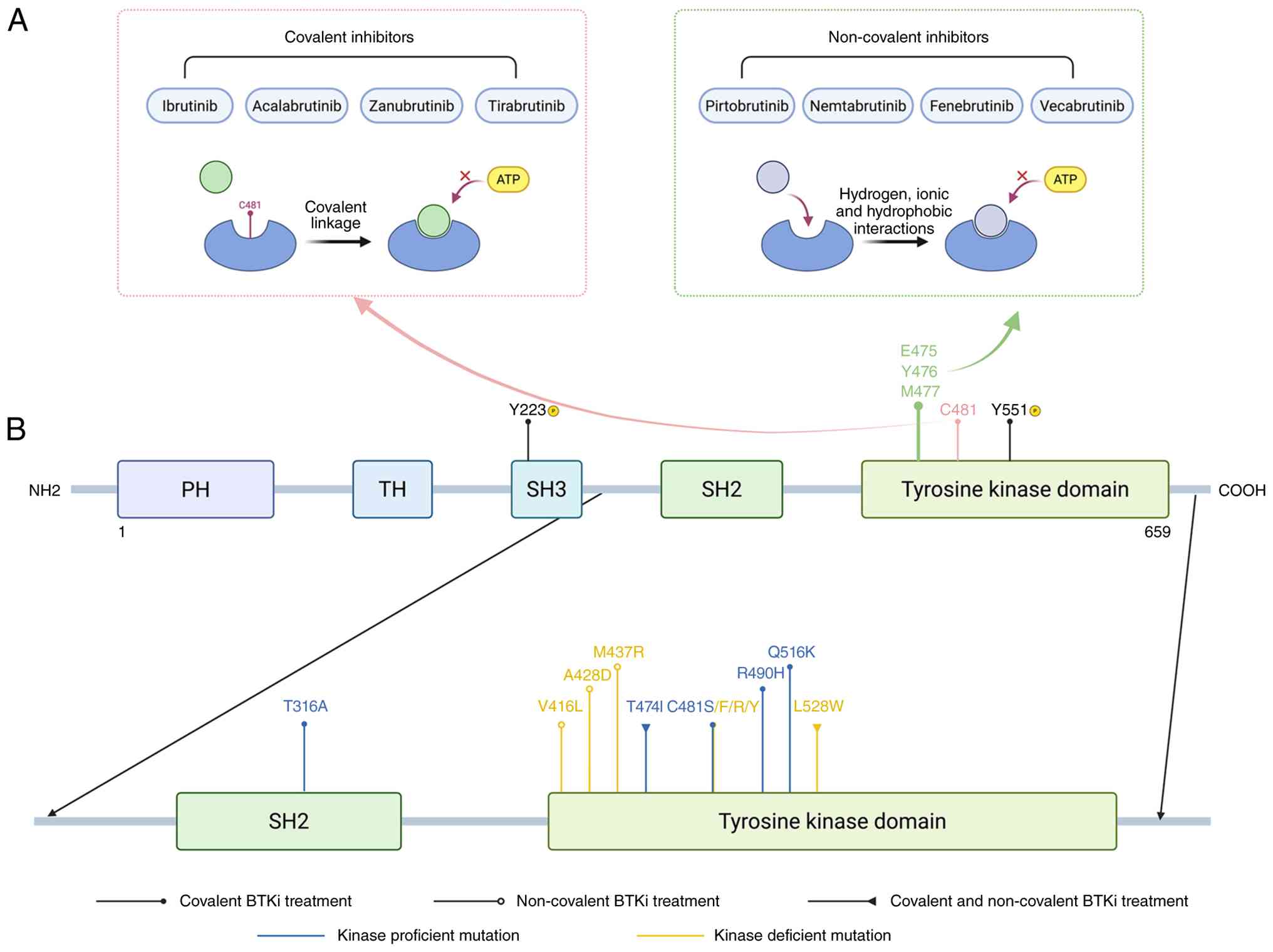 | Figure 1Schematic of BTK domain architecture
and resistance mutations. (A) BTKi are mainly grouped into covalent
and non-covalent classes according to their mechanism of action.
Covalent BTKi, with representative drugs including ibrutinib,
acalabrutinib, zanubrutinib and tirabrutinib, irreversibly bind to
C481 within the ATP-binding pocket and block ATP docking.
Non-covalent BTKi, such as pirtobrutinib, nemtabrutinib,
fenebrutinib and vecabrutinib, reversibly bind to E475, Y476 and
M477 in the ATP-binding pocket through hydrogen, ionic, and
hydrophobic interactions, thereby preventing ATP engagement. (B)
BTK is a 659-amino acid protein. From the amino to the carboxyl
terminus, it contains a PH domain, a TH domain, an SH3 domain, an
SH2 domain, and a tyrosine kinase domain. Resistance mutations are
classified as kinase-proficient (blue) or kinase-deficient (yellow)
based on the remaining catalytic activity of BTK. Created with
BioRender.com. BTK, Bruton's tyrosine kinase;
BTKi, BTK inhibitor; PH, pleckstrin homology; SH2, Src homology 2;
SH3, Src homology 3; TH, Tec homology. |
BCR signaling cascade pathway
In the absence of antigen stimulation, BCR transmits
low-level tonic signals, which depend primarily on phosphoinositide
3-kinase (PI3K) activity to sustain the survival of mature B cells.
Upon antigen engagement, however, BCR complexes undergo aggregation
and rapid phosphorylation, thereby initiating downstream signaling
cascades. A schematic representation of the BCR signaling cascade
and its key downstream effectors is provided in Fig. 2.
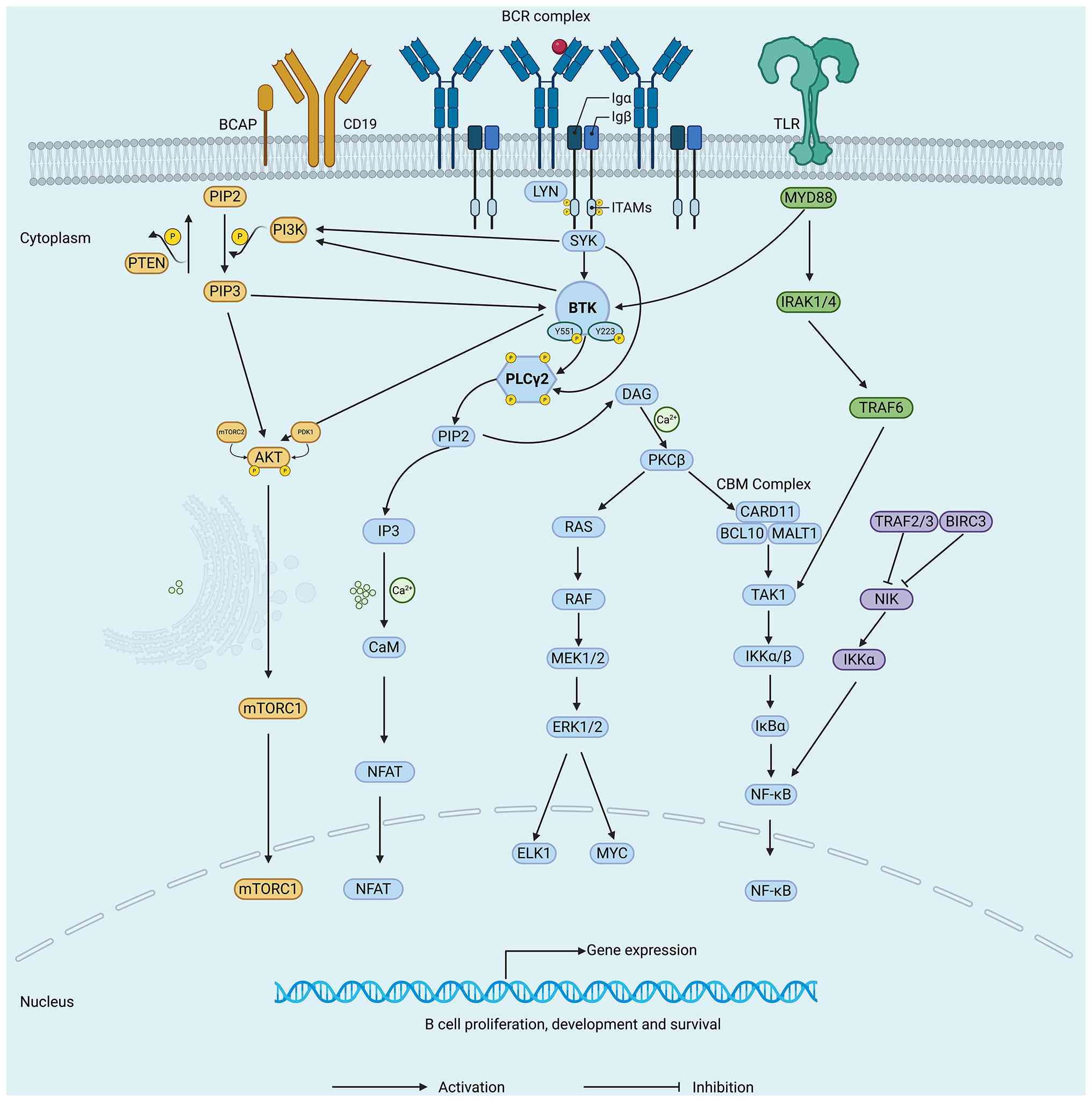 | Figure 2Schematic overview of BCR signaling
pathway. Upon antigen engagement, the BCR complex triggers
activation of LYN and SYK, which in turn activate PI3K and generate
PIP3. BTK is recruited to the membrane and fully activated,
followed by PLCγ2 activation. PLCγ2 hydrolyzes PIP2 into IP3 and
DAG. IP3 mobilizes intracellular calcium and activates NFAT through
calmodulin and calcineurin. DAG activates PKCβ and promotes
assembly of the CBM complex (CARD11-BCL10-MALT1), which drives
canonical NF-κB signaling via TAK1 and IKK. DAG also initiates the
RAS-RAF-MEK-ERK cascade. In parallel, TLR signaling through MYD88
recruits IRAK1/4 and TRAF6, which also activate TAK1 and NF-κB, and
this pathway can crosstalk with BCR signaling to amplify survival
signals. These pathways converge on transcription factors including
NFAT, NF-κB, ELK1, and MYC, which regulate B cell proliferation,
survival, and development. Created with BioRender.com. BCR, B-cell receptor; BTK, Bruton's
tyrosine kinase; CBM, CARD11-BCL10-MALT1 complex; NFAT, nuclear
factor of activated T cells; PI3K, phosphoinositide 3-kinase;
PLCγ2, phospholipase Cγ2. |
Specifically, antigen binding to the membrane-bound
Ig triggers BCR clustering and conformational changes, leading to
the activation of SRC family kinases such as Lck/Yes-related novel
protein tyrosine kinase (LYN). Activated LYN subsequently
phosphorylates tyrosine residues within the immunoreceptor
tyrosine-based activation motifs (ITAMs) of the associated CD79A/B
heterodimers. The resulting dually phosphorylated ITAMs then
function as docking sites for spleen tyrosine kinase (SYK), which
engages via its N-terminal tandem SH2 domains, ultimately
activating SYK. Activated SYK phosphorylates and thereby activates
the B-cell co-receptor CD19 and the B-cell PI3K adaptor protein.
This phosphorylation provides binding sites for the P85 subunit of
PI3K, leading to PI3K recruitment and activation (28,29). Activated PI3K then phosphorylates
phosphatidylinositol-4,5-bisphosphate (PIP2) to generate
phosphatidylinositol-3,4,5-trisphosphate.
Activation of the BCR promotes the transition of BTK
from a cytoplasmic autoinhibited state to a catalytically active
conformation and its subsequent translocation to the plasma
membrane (30). BTK then
undergoes sequential phosphorylation at residue Y551 within its
kinase domain by SYK, followed by autophosphorylation at residue
Y223 in its SH3 domain. This autophosphorylation stabilizes BTK in
its active conformation and enables full catalytic activity
(31). One of the major
downstream effectors of BTK is phospholipase Cγ2 (PLCγ2). Upon
activation, PLCγ2 hydrolyzes PIP2 to generate two second
messengers: Inositol-1,4,5-trisphosphate (IP3) and
diacylglycerol (DAG). IP3 induces intracellular calcium
mobilization, which activates the transcription factor NFAT via
calmodulin and calcineurin. NFAT subsequently translocates into the
nucleus to regulate B cell proliferation and survival. In the
presence of calcium, DAG activates protein kinase Cβ (PKCβ).
Activated PKCβ initiates the RAF/MEK/ERK1/2 signaling cascade
(23,32). Another DAG substrate is the
caspase recruitment domain family member 11 (CARD11).
Phosphorylated CARD11 assembles with mucosa-associated lymphoid
tissue lymphoma translocation protein 1 (MALT1) and B-cell
lymphoma/leukemia 10 (BCL10) to form the CBM adapter complex. This
complex then activates downstream kinases such as transforming
growth factor β activated kinase 1 and inhibitor of κB (IκB) kinase
(IKK) α/β. IKK phosphorylates IκB, triggering its
ubiquitin-dependent degradation, and ultimately facilitating the
nuclear translocation of NF-κB to regulate B cell proliferation and
adaptive immune responses (23,33).
BTKi classification
The fact that BTK is at the center of the BCR
signaling cascade, coupled with its restricted expression in other
cell types, highlights BTK as an attractive therapeutic target for
several B-cell-derived malignancies (34). The clinical introduction of BTKi
has remarkably transformed the treatment paradigms for these B-cell
malignancies. Currently, BTKi are distinguished into covalent and
non-covalent classes based on the binding mode to the BTK active
site (35). Covalent inhibitors
irreversibly bind to the C481 residue within the ATP-binding pocket
of the BTK kinase domain, disrupt autophosphorylation at Y223 and
block ATP docking, substrate phosphorylation and downstream
signaling. Non-covalent inhibitors, by contrast, reversibly bind to
the ATP-binding pocket or deeper into the H3 pocket of the
catalytic domain through hydrogen, ionic and hydrophobic
interactions, thereby interfering with phosphorylation at both Y223
and Y551 and suppressing downstream target activation and signal
propagation (36,37).
In an initial phase I/II trial, the first-generation
BTKi ibrutinib monotherapy delivered selective clinical activity in
patients with R/R ABC-subtype DLBCL, achieving an overall response
rate (ORR) of 37%. However, the median progression-free survival
(PFS) was short, with most patients experiencing rapid disease
progression, indicating that ibrutinib alone fails to produce
durable responses (11). In
addition, ibrutinib modestly inhibits other protein kinases, and
these off-target effects contribute to side effects such as atrial
fibrillation, bleeding and impairment of macrophage phagocytosis
(18,38,39). Such off-target toxicity remains a
significant clinical challenge that has limited the broader use of
ibrutinib, while also fueling the development of more selective
covalent BTKi.
Second-generation BTKi, including acalabrutinib,
zanubrutinib, tirabrutinib and orelabrutinib, offer improved BTK
target selectivity and reduced off-target activities compared with
ibrutinib (36). However, both
first- and second-generation covalent BTKi rely on forming a
covalent bond with C481 within the BTK active site and mutations at
this residue can trigger resistance and limit long-term efficacy
(40). Consequently, treatment
discontinuation due to acquired resistance or therapy-related
toxicity has accelerated the development of non-covalent BTKi,
which aim to circumvent resistance to covalent agents and minimize
adverse events to improve outcomes for patients with B-cell
malignancies. Third-generation non-covalent BTKi, represented by
pirtobrutinib, also include agents such as fenebrutinib,
nemtabrutinib and vecabrutinib, which bind non-covalently to the
BTK active site and suppress BTK kinase activity regardless of C481
mutation status (14).
However, with the widespread clinical use of BTKi,
non-C481 BTK mutations have emerged that confer resistance to
irreversible inhibitors. Furthermore, complex resistance mechanisms
may limit the clinical efficacy of non-covalent BTKi, prompting the
development of next-generation BTK-targeted strategies. These
topics are discussed in detail in the following sections.
Mechanisms of resistance to BTKi in
DLBCL
Despite the clinical success of BTKi in multiple
B-cell malignancies, their activity in DLBCL remains heterogeneous.
In patients with R/R ABC-DLBCL treated with ibrutinib monotherapy,
objective responses were observed, but the median PFS was only 6.41
months (11). This short median
PFS may partly reflect the emergence of acquired resistance, but
this endpoint alone cannot distinguish primary non-response from
progression after an initial response. For the purposes of the
present review, primary resistance refers to failure to achieve a
complete or partial response to BTKi-based treatment, whereas
acquired resistance refers to disease progression after a
documented initial response. In preclinical studies, acquired
resistance is used only when initially sensitive cells or tumors
lose sensitivity after prolonged BTKi exposure. Lack of BTK
dependency is considered a biological basis of intrinsic
insensitivity rather than acquired resistance. Treatment
intolerance refers to dose reduction, interruption or
discontinuation because of adverse events and is not considered
resistance. Disease progression without a documented prior response
is therefore not classified as acquired resistance.
Resistance to second-generation covalent and
non-covalent BTKi has been characterized mainly in chronic
lymphocytic leukemia (CLL) and other B-cell malignancies (41). In DLBCL, reduced sensitivity to
BTKi may result from an intrinsic lack of BTK dependency or from
genetic and non-genetic changes that emerge during treatment. The
following sections discussed these mechanisms, including molecular
subtype, mutations affecting BCR signaling, activation of
alternative pro-survival pathways, anti-apoptotic signaling,
epigenetic alterations, metabolic reprogramming and remodeling of
the tumor microenvironment (TME) (42). Clinical evidence for
BTK-binding-site mutations is derived mainly from other B-cell
malignancies, whereas their relevance in DLBCL remains uncertain
(15). An integrated overview is
presented in Fig. 3, and the
disease source and evidence category for each mechanism are
summarized in Table I.
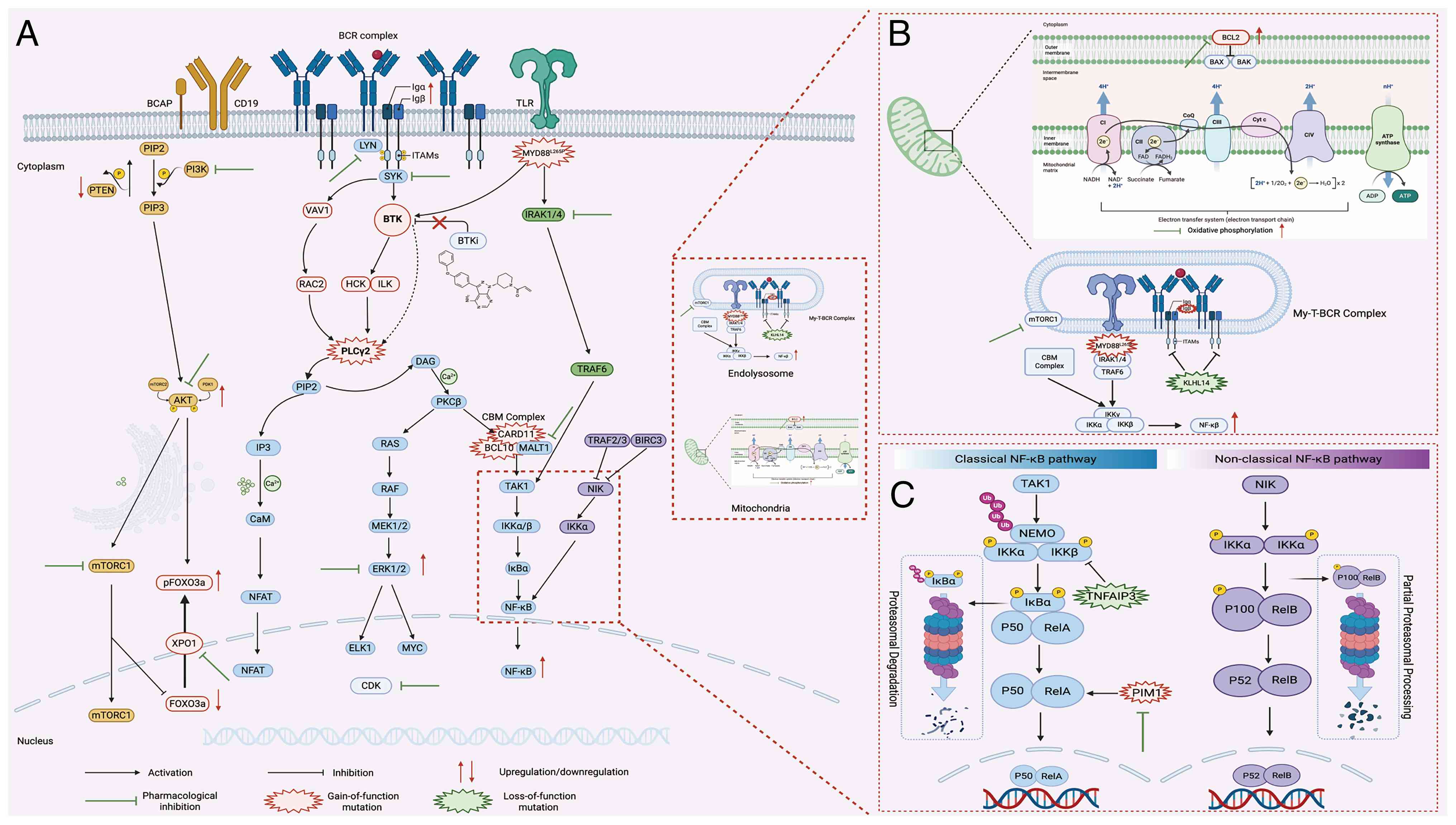 | Figure 3Overview of BTKi resistance
mechanisms in DLBCL. (A) Resistance to BTKi in DLBCL arises from
multiple interconnected alterations affecting BCR signaling hub,
survival pathways, and metabolic reprogramming. These include BTK
mutations and their acquired oncogenic scaffolding activity,
gain-of-function mutations in PLCγ2, and activating mutations in
CARD11 and BCL10 within the CBM complex. Compensatory pro-survival
pathways are upregulated, such as PI3K/AKT/mTOR, ERK1/2, canonical
NF-κB, and the TLR/MYD88 axis driven by MYD88L265P mutations.
Metabolic reprogramming further contributes to resistance. (B)
Mitochondrial events and metabolic shifts: upregulation of
anti-apoptotic BCL-2 protein sustains cell survival. Resistant
cells switch toward OXPHOS, as seen in IL4I1 downregulation and
EGR1-mediated PDP1 activation. Loss-of-function mutations in KLHL14
disrupt its tumor suppressor role, promoting assembly of the
My-T-BCR supercomplex and constitutive NF-κB activation. (C)
Mutations driving canonical NF-κB pathway activation: inactivating
mutations in TNFAIP3 relieve negative regulation of IKK, while
MYD88L265P and CD79B mutations hyperactivate NF-κB via TLR-MYD88
and chronic BCR signaling. PIM1 overexpression stabilizes RelA,
further amplifying NF-κB activity. Created with BioRender.com. BCR, B-cell receptor; BTK, Bruton's
tyrosine kinase; BTKi, BTK inhibitor; CBM, CARD11-BCL10-MALT1
complex; DLBCL, diffuse large B-cell lymphoma; My-T-BCR,
MYD88-TLR9-BCR supercomplex; OXPHOS, oxidative phosphorylation;
PLCγ2, phospholipase Cγ2. |
 | Table IMechanisms of resistance to BTK
inhibitors in diffuse large B-cell lymphoma and potential
therapeutic approaches. |
Table I
Mechanisms of resistance to BTK
inhibitors in diffuse large B-cell lymphoma and potential
therapeutic approaches.
| Key
alterations | Resistance
mechanisms | Evidence
category | Potential
therapeutic approaches |
|---|
| Subtype-driven
intrinsic resistance | | | |
| GCB subtype (tonic
BCR signaling) | PI3K and BCL2
pathway dependence | Clinical DLBCL;
preclinical DLBCL | / |
| Genetic drivers of
BTKi resistance | | | |
| BTK mutations | Disrupt
covalent/non-covalent binding; Kinase-impaired mutants acquire
neo-morphic scaffolding function | Preclinical DLBCL;
evidence from other B-cell malignancies | Non-covalent BTKi,
BTK PROTACs, BCL2 inhibitor |
| PLCγ2
gain-of-function mutations | Bypass BTK and
directly activate calcium flux, ERK, and NF-κB | Evidence from other
B-cell malignancies; biological hypothesis in DLBCL | RAC2, LYN, SYK
inhibitors |
|
MYD88L265P mutations | TLR signaling and
NF-κB dependence | Clinical DLBCL;
preclinical DLBCL | IRAK1/4
inhibitors |
| CARD11
mutations | Constitutive CBM
complex assembly leading to NF-κB activation | Single case of
primary cutaneous DLBCL; preclinical DLBCL | MALT1
inhibitor |
| BCL10
gain-of-function mutations | Reduce CARD11
dependency and drive NF-κB activation | Preclinical
DLBCL | MALT1
inhibitor |
| TNFAIP3
loss-of-function mutations | Relief of IKK
inhibition and hyperactivation of canonical NF-κB | Clinical DLBCL;
preclinical DLBCL | / |
| PIM1
mutations | Stabilize RelA and
enhance NF-κB activity | Clinical DLBCL;
preclinical DLBCL | PIM inhibitor |
| KLHL14
loss-of-function mutations | Promote My-T-BCR
super-complex assembly and sustain NF-κB signaling | Preclinical
DLBCL | mTOR inhibitor |
| Parallel survival
pathway activation | | | |
| BTK-independent
proximal BCR signaling | Maintain proximal
BCR signaling and promote MYC upregulation | Preclinical
DLBCL | Pan-SRC kinase
inhibitor |
| PI3K/AKT/mTOR
pathway activation | Bypass BTK blockade
to sustain cell survival | Preclinical
DLBCL | PI3K, mTOR, XPO1
inhibitors |
| MAPK/ERK pathway
activation | Bypass BTK
inhibition and promote cell survival | Preclinical
DLBCL | MEK, BET
inhibitors |
| BCL2
upregulation | Overexpression of
anti-apoptotic protein blocks drug-induced apoptosis | Preclinical
DLBCL | BCL2 inhibitor |
| Epigenetic
alterations | | | |
| TCF4-RAC2
axis | BTK-independent
RAC2-PLCγ2 activation | Preclinical
DLBCL | RAC1/2
inhibitor |
| YTHDF2
upregulation | m6A-dependent ACER2
mRNA stabilization | Preclinical
DLBCL | YTHDF2
suppression |
| FTO
upregulation | m6A demethylation
and MYC mRNA stabilization | Preclinical
DLBCL | FTO
suppression |
| 14q32 miRNA
cluster upregulation | PTEN suppression
and PI3K/AKT/mTOR activation | Preclinical DLBCL;
evidence from other B-cell malignancies | miR-494/miR-495
inhibition |
| Tumor
microenvironment remodeling | | | |
| M2 TAM
polarization | Immunosuppressive
signaling and tumor-cell protection | Preclinical
DLBCL | Tumor
microenvironment modulator |
| IL-16/CD9 axis
upregulation | PI3Kδ-AKT/ERK
survival signaling | Preclinical DLBCL;
evidence from other B-cell malignancies | IL-16/CD9 axis
blockade |
| Direct cell-ECM
adhesion | Reversible
AKT/mTOR-associated survival signaling | Preclinical
DLBCL | / |
| Metabolic
reprogramming | | | |
| IL4I1
downregulation and EGR1 upregulation | Metabolic shift
toward sustained OXPHOS | Preclinical
DLBCL | OXPHOS inhibitor
IACS-010759 |
| mTOR and
mitochondrial program upregulation | Metabolic
adaptation and resistant-clone expansion | Clinical DLBCL;
preclinical DLBCL | Targeted miR-28
nanoparticles |
| UPR
downregulation | ER stress | Preclinical
DLBCL | UPR activator
2-DG |
Genetic subtypes as determinants of
intrinsic resistance
As aforementioned, DLBCL represents a highly
heterogeneous B-cell malignancy. While the survival and
proliferation of DLBCL cells rely on BCR signaling activation, the
specific modes of BCR dependence vary across molecular subtypes.
This distinction is evident in the differential treatment responses
to ibrutinib among patients with distinct genetic subtypes. For
example, the ABC subtype shows an ORR of 37% compared with only 5%
in the GCB subtype. Further studies have revealed that ABC DLBCL
predominantly exhibits a 'chronic active BCR signaling' profile
(43) characterized by
constitutive activation of the pro-survival NF-κB pathway, which is
critically required for the survival and proliferation of ABC-type
cells (44). By contrast, GCB
DLBCL displays a 'tonic BCR signaling' pattern, which differs from
both the tonic signaling in normal B cells and the chronic active
signaling observed in ABC tumors (5,45).
The GCB subtype shows increased dependence on the PI3K and BCL2
signaling pathways (43,46). The differential reliance on
distinct BCR signaling cascades may provide the rationale for the
primary resistance to BTKi frequently observed in patients with the
GCB subtype.
Advances in genomic research have refined the
molecular classification of DLBCL, while further revealing
heterogeneity in the response to BTKi therapy even within the ABC
subtype. A genetically engineered DLBCL mouse model carrying
concurrent oncogenic MYD88 and CD79B mutations showed marked and
selective sensitivity to ibrutinib treatment (47). Consistently, patients with the MCD
subtype, characterized by concurrent MYD88L265P and CD79B
mutations, have been reported to achieve an ORR as high as 80% to
ibrutinib, which is substantially greater than that achieved by
patients with only single mutations. This suggests that the
dual-mutated genotype is hyper-dependent on BCR-driven NF-κB
signaling and highly sensitive to ibrutinib (11,48). A subsequent post hoc analysis of
the phase III PHOENIX trial also suggested that, among younger
patients (≤60 years) with ABC DLBCL, those with MCD or N1 subtypes
who received ibrutinib plus R-CHOP reached 3-year event-free
survival and overall survival (OS) rates of 100%, compared with
≤50% in the R-CHOP-alone arm (49). Mechanistically, the increased
responsiveness of patients with MCD-subtype to BTKi may be
attributed to the formation of a multiprotein super-complex termed
My-T-BCR, which assembles MYD88L265P, TLR9 and BCR (5,47).
My-T-BCR activates pro-survival NF-κB and mTOR signaling, while
ibrutinib interferes with its assembly and function, thereby
suppressing tumor survival (5).
Recent research has uncovered a non-canonical form of chronic
selective autophagy in MCD DLBCL. This process enables BTKi to
promote the degradation of MYD88L265P through a TBK1-dependent
autophagic pathway, which likely explains the pronounced efficacy
of ibrutinib observed in this molecular subgroup (17).
While these mechanisms may explain the high BTKi
sensitivity of the MCD phenotype, the basis for ibrutinib
responsiveness in the N1 subtype remains elusive. It has been
hypothesized that recurrent mutations involving genes such as BCL10
enhance BCR signaling and confer BTK dependency (49). Additionally, CD5+ DLBCL exhibits
transcriptional signatures of BCR activation and is enriched for
BCR-activating mutations associated with BTKi sensitivity. A
CD5-based gene-expression signature may therefore serve as a
biomarker to identify DLBCL cases likely to respond to BTKi-based
therapies. Consequently, the susceptibility of this subtype to BTKi
warrants further investigation (50). Patients with high co-expression of
BCL2 and MYC have also been identified as a subset of non-GCB DLBCL
that may show preferential responsiveness to ibrutinib (51). Thus, further extensive preclinical
and clinical research is needed to delineate genetic subgroups that
could benefit from BTKi monotherapy or BTKi-containing regimens.
Such efforts would help improve therapeutic response and survival
outcomes, ultimately advancing precision medicine in DLBCL.
Genetic drivers of BTKi resistance in
DLBCL
BTK mutations and functional
heterogeneity
The mechanisms underlying acquired resistance to
BTKi are complex, arising from recurrent mutations in several key
genes. The most frequently implicated targets are components of the
BCR signaling pathway, including BTK itself and its downstream
substrate PLCγ2 (52). However,
clinical evidence for BTK and PLCγ2 resistance mutations is derived
mainly from CLL, and their relevance in DLBCL remains
uncertain.
The most common BTK resistance mutation occurs at
the binding residue C481, with the predominant substitution being
C481S, in which serine replaces cysteine and prevents covalent BTKi
binding, ultimately driving acquired resistance (52). In a MYD88-mutant ABC-DLBCL cell
model, BTKC481S reactivated the BTK/PLCγ2/ERK1/2 axis during
ibrutinib exposure. This ERK1/2 reactivation also led to the
release of pro-survival and pro-inflammatory cytokines, including
IL-6 and IL-10, which exert paracrine protective effects on BTK
wild-type (WT) cells (53). Using
protein engineering, all possible amino acid substitutions at the
C481 residue resulting from single nucleotide changes were
generated, along with threonine, which requires two nucleotide
changes, yielding a series of C481X mutants. Among these, the C481T
substitution conferred catalytic activity comparable to that of
C481S and similarly mediated genetic resistance to ibrutinib. By
contrast, substitutions with arginine, phenylalanine, tryptophan,
tyrosine or glycine severely impaired or abolished BTK kinase
activity, though these variants have also been speculated to
contribute to ibrutinib resistance. Notably, non-C481S
substitutions are expected to occur at low frequency clinically and
have yet to be validated in large cohorts of patients with
ibrutinib-resistant DLBCL (54).
While the aforementioned study deepened the mechanistic
understanding of lymphoma resistance and provided a scientific
foundation for resistance monitoring and the development of
next-generation agents, BTK C481 substitutions have not been
established as clinical resistance drivers in longitudinal DLBCL
cohorts.
Beyond mutations at the covalent binding residue,
genetic resistance to ibrutinib can also arise from alterations at
the gatekeeper residue T474 within the BTK kinase domain. These
mutations do not always occur in isolation; compound BTK mutations
affecting both C481 and T474 have been documented, including
T474I/C481S, T474M/C481S and T474M/C481T. Estupinan et al
(55) demonstrated that these
double variants remained insensitive to irreversible BTKi at
concentrations ≥16-fold above the pharmacological serum
concentration and were therefore classified as super-resistant.
These variants were characterized in engineered systems and have
not been reported as acquired resistance mechanisms in patients
with DLBCL.
The emergence of BTKC481S as a mechanism disrupting
covalent inhibitor binding and conferring resistance to
irreversible agents accelerated the development of reversible BTKi,
which exert inhibitory activity against both C481S-mutant and WT
BTK through non-covalent binding. However, longitudinal studies in
patients with CLL treated with non-covalent BTKi identified
multiple non-C481 BTK mutations, including V416L, A428D, M437R,
T474I and L528W, all located within the BTK catalytic domain
(41,56). These non-C481 mutations confer
resistance to non-covalent BTKi. Notably, the gatekeeper residue
mutation T474I and the kinase-impaired residue mutation L528W also
induce cross-resistance to covalent BTK inhibitors. The BTKL528W
mutation confers resistance to ibrutinib and zanubrutinib, while
the BTKT474I mutation confers resistance to acalabrutinib (57). Comparable longitudinal evidence is
not available in DLBCL.
Functional studies have classified BTK resistance
variants as kinase-proficient or kinase-impaired according to their
catalytic activity relative to WT BTK (Fig. 1). Kinase-proficient mutants, such
as C481S/T, T474I and T316A, retain enzymatic function and sustain
BCR signaling. Kinase-deficient mutants, including C481F/R/Y,
V416L, A428D, M437R and L528W, exhibit partial or complete loss of
catalytic activity. Instead, these kinase-dead BTK mutant proteins
adopt non-catalytic scaffolding functions and physically interact
with alternative kinases such as hematopoietic cell kinase (HCK)
and integrin-linked kinase (ILK), thereby bypassing the requirement
for BTK autophosphorylation, and maintaining downstream PLCγ2
activation and BCR signal propagation (22,58,59). These mechanisms were defined in
engineered systems, including TMD8 DLBCL cells, rather than in
longitudinal samples from BTKi-treated patients with DLBCL.
PLCγ2 gain-of-function mutations
A less frequent genetic resistance mechanism
involves gain-of-function mutations in PLCγ2, the downstream
substrate of BTK, which confer BTK-independent resistance in DLBCL
cells. Mutated PLCγ2 exhibits enhanced functional activity and
drives BCR signaling downstream of BTK, promoting calcium flux, ERK
phosphorylation and NF-κB activation, which is likely to cause
resistance to BTK degraders (60). Isolated PLCγ2 mutations represent
a rare mechanism of ibrutinib resistance and are often found in the
context of concurrent BTK mutations (15,61). Gain-of-function PLCγ2 mutations
are established downstream escape mechanisms in CLL. However, this
possibility has not been well established in DLBCL.
Overall, clinical evidence for BTK and PLCγ2
resistance mutations comes mainly from CLL. Evidence in DLBCL is
limited to mechanistic cell models and paired pretreatment and
progression samples are scarce. The prevalence and clinical
significance of these mutations in DLBCL therefore remain unknown.
Long-term follow-up of patients with DLBCL treated with
BTKi-containing regimens is currently underway, and is expected to
enable precise interpretation of the BTK and PLCγ2 resistance
mutation spectrum in this population.
Genetic determinants of BTKi resistance
beyond BTK and PLCγ2
Beyond BTK and PLCγ2 mutations, various other
genomic alterations outside of these genes have also been
identified in DLBCL as contributors to genetic resistance. As
aforementioned, while the MCD subtype of DLBCL responds favorably
to ibrutinib, patients with solitary MYD88L265P mutations or
isolated CD79B mutations exhibit reduced response rates (11), suggesting that single mutations in
MYD88 or CD79B may contribute to primary resistance to ibrutinib
(48). MYD88L265P is the most
recurrent point mutation in the ABC subtype, occurring in ~29% of
cases. Evidence indicates a functional crosstalk between MYD88L265P
and chronic active BCR signaling. This gain-of-function mutation in
the adaptor protein MYD88 constitutively activates NF-κB via the
TLR-MYD88 pathway. Knockdown of MYD88L265P in ABC cell lines
markedly reduces NF-κB activity, while ectopic expression of the
mutant rescues cell survival and reverses the decline in NF-κB
signaling (62,63). Consequently, ABC-DLBCL harboring
the L265P mutation becomes dependent on MYD88-driven NF-κB
activation and remains insensitive to ibrutinib (11,62,64). In ABC-DLBCL cells, CD79B
upregulation mediates primary resistance to ibrutinib through the
activation of compensatory pro-survival signaling pathways.
Conversely, CD79B depletion restores sensitivity to ibrutinib in
primarily refractory ABC-DLBCL cells, supporting its potential as a
biomarker for predicting responses to BTKi in DLBCL (65), as detailed in subsequent
sections.
Oncogenic gain-of-function mutations targeting the
coiled-coil domain of the signaling adapter CARD11 were first
reported in DLBCL in 2008 (66).
These mutations drive spontaneous assembly of the CBM scaffold
complex downstream of the BCR signaling pathway, ultimately leading
to constitutive NF-κB activation and promoting resistance to BTKi
(43,66,67). Nagel et al (68) showed that MALT1 protease activity
depended on BTK in CD79-mutant ABC-DLBCL cells but remained active
independently of BTK in CARD11-mutant cells. Ectopic expression of
oncogenic CARD11 in CD79-mutant cells conferred ibrutinib
resistance. These findings provide direct preclinical evidence that
oncogenic CARD11 can sustain CBM-mediated NF-κB signaling despite
BTK inhibition. Clinical evidence remains limited. Caeser et
al (69) identified an
acquired CARD11K215T mutation in a patient with primary cutaneous
DLBCL who relapsed after 13 months of combined BTK and SYK
inhibition. The mutation was absent in pretreatment biopsies and
detected at relapse. Expression of CARD11K215T in U2932 cells
reduced the ibrutinib sensitivity by three orders of magnitude,
supporting its role in acquired resistance to BCR-pathway
inhibition. Notably, however, the signaling potency of various
CARD11 mutant isoforms differs substantially. In certain cases,
cells harboring weak CARD11 alleles may remain highly dependent on
upstream survival signals and, conversely, prove sensitive to
ibrutinib intervention. Prospective functional and clinical
evaluation of recurrent CARD11 variants is required before they can
inform BTKi selection in DLBCL (67). The scaffold protein MALT1
participates in the formation of the CBM adapter complex to
activate canonical NF-κB signaling. In addition, MALT1 physically
interacts with TRAF3, a negative regulator of NIK, thereby
modulating non-canonical NF-κB signaling (70). A previous study identified the
deubiquitinating enzyme cylindromatosis (CYLD) as a downstream
effector of MALT1 and its downregulation correlated with poor
prognosis in patients with DLBCL. Under conditions of chronic BCR
signaling, MALT1 mediates the cleavage and inactivation of CYLD,
which promotes NF-κB activation as well as the proliferation of
BCR-dependent DLBCL cells, ultimately rendering these cells less
sensitive to BTKi (71). Previous
studies revealed that gain-of-function mutations in the signaling
protein BCL10, another component of the CBM multiprotein complex,
drive resistance to BTKi (72,73). These findings underscore the
central role of the CBM complex in mediating BTKi resistance in
DLBCL and highlight the clinical potential of targeting CBM complex
constituents as an attractive therapeutic strategy to overcome such
resistance.
Activation of canonical NF-κB signaling promotes
resistance to BTKi in DLBCL. Downstream of this pathway, tumor
necrosis factor-α-induced protein 3 (TNFAIP3) negatively regulates
IKK activity. Loss-of-function mutations in TNFAIP3 (also known as
A20) provoke hyperactivation of NF-κB signaling independently of
upstream BTK activity, thereby conferring ibrutinib resistance in
ABC-DLBCL cells (11,43,63,74). Proviral insertion in murine 1
(PIM1), a serine/threonine kinase, activates NF-κB signaling by
stabilizing RelA, and regulates cellular proliferation,
differentiation, apoptosis and survival (23,75). Kuo et al (76) identified PIM1 mutations in six
patients with DLBCL, five of whom had ABC-DLBCL. In total, four of
these five patients had poor responses to ibrutinib. In
ibrutinib-resistant ABC-DLBCL cells, PIM1 was upregulated.
Expression of the L2V, P81S and S97N variants increased PIM1
protein stability and reduced ibrutinib sensitivity, while combined
PIM and BTK inhibition suppressed cell proliferation in
vitro and tumor growth in xenograft models in vivo.
These findings provide exploratory clinical and preclinical DLBCL
evidence, but do not establish PIM1 as a validated resistance
biomarker.
Platelet-derived growth factor D (PDGFD) has also
been linked to reduced ibrutinib response in DLBCL. Jin et
al (77) analyzed
gene-expression data and tumor tissues from ibrutinib-treated
patients with DLBCL and found higher PDGFD expression in samples
with reduced drug response. In acquired-resistant TMD8 and HBL1
cells, PDGFD was upregulated, whereas PDGFD silencing reduced EGFR
expression, lowered the half maximal inhibitory concentration
(IC50) of ibrutinib and increased apoptosis. These
findings provide exploratory clinical and preclinical DLBCL
evidence, but require validation in an independent clinical
cohort.
Kelch-like protein 14 (KLHL14) is a tumor suppressor
that localizes in proximity to BCR in cell line models of MCD
DLBCL, promotes the turnover of immature glycoforms of BCR subunits
and downregulates total cellular BCR levels, thereby functioning as
a negative regulator of BCR signaling. Loss-of-function mutations
in KLHL14 are frequently observed in DLBCL of the MCD molecular
subtype. Inactivation of KLHL14 facilitates the assembly of the
My-T-BCR signaling complex and the initiation and maintenance of
NF-κB signaling, thus contributing to relative resistance to
ibrutinib in MCD cells (78).
These preclinical findings identify KLHL14 loss as a candidate
determinant of reduced ibrutinib sensitivity in MCD-subtype DLBCL.
However, its predictive value has not been evaluated prospectively
in BTKi-treated patients.
Src homology 2 domain-containing phosphatase 1
(SHP1) is a cytosolic protein tyrosine phosphatase responsible for
negatively regulating the BCR signaling pathway (79). Promoter hypermethylation of SHP1
accounts for reduced SHP1 protein expression in DLBCL tumor cells.
SHP1 depletion in BCR-dependent ABC- and GCB-DLBCL cell lines
enhances proximal BCR signaling activity and sensitivity to
ibrutinib. Conversely, re-expression of SHP1 in knockout cells
restores basal BCR signaling intensity and confers ibrutinib
resistance. Pharmacological inhibition of SHP1 synergizes with
ibrutinib to suppress the proliferation of DLBCL cell lines and the
growth of patient-derived primary tumor cells. Collectively, these
preclinical findings indicate that SHP1 loss may increase ibrutinib
sensitivity in DLBCL. However, its value as a predictive biomarker
has not been assessed in BTKi-treated cohorts (80).
Despite the identification of multiple complicated
genetic mechanisms driving resistance to BTKi, emerging evidence
suggests that the clinical emergence of resistance largely results
from the competitive selection of pre-existing resistant subclones
present at treatment initiation. Current limitations in detecting
low-abundance resistant subclones and pre-existing resistance
mutations pose marked challenges to the comprehensive understanding
of BTKi resistance mechanisms. Addressing these technological and
analytical gaps represents a critical focus for future
investigations (60).
Non-genetic drivers of resistance to BTKi
in DLBCL
In B-cell malignancies, >20% of patients with
ibrutinib resistance have been reported to lack identifiable
genetic resistance alterations (81). This observation suggests that
tumor cells may exploit non-genetic mechanisms to adapt to the
inhibition of the BCR-associated kinases, thereby driving
resistance to BTKi. These non-genetic drivers of BTKi resistance
encompass compensatory activation of alternative pro-survival
pathways, epigenetic alterations, remodeling of the TME and
metabolic reprogramming, as subsequently discussed.
Lack of BTK dependency and persistent
proximal BCR signaling
Lack of BTK dependency represents an important
mechanism of intrinsic insensitivity to selective BTK inhibition in
DLBCL. Battistello et al (82) showed that ibrutinib suppressed BTK
phosphorylation in primary DLBCL samples and in both ABC- and
GCB-DLBCL cells, whereas the phosphorylation of CD19 and GSK3β was
not consistently inhibited. In ibrutinib-insensitive cells, BTK
inhibition was accompanied by MYC upregulation. A similar increase
in MYC expression was observed in a BCL6-driven lymphoma mouse
model that was insensitive to ibrutinib. Mechanistically, the
proximal SRC-family kinases LYN, FYN and BLK exhibited functional
redundancy. Neither individual kinase loss nor combined loss of LYN
and FYN impaired lymphoma cell proliferation, whereas simultaneous
disruption of all three kinases reduced cell viability. The pan-SRC
kinase inhibitor masitinib suppressed multiple BCR signaling
outputs, including the phosphorylation of BTK, CD19 and GSK3β,
reduced MYC expression and inhibited tumor growth in both
cell-line-derived and patient-derived DLBCL xenograft models.
Collectively, these preclinical findings indicate that selective
BTK inhibition may be insufficient in BTK-independent tumors, as
BTK blockade could shift tumor-cell dependency toward parallel BCR
pathways that sustain MYC expression and lymphoma-cell
survival.
BTK-independent activation of bypass
survival pathways
The PI3K/AKT/mTOR signaling pathway is known to be
dysregulated in various cancer types, where it regulates tumor cell
proliferation, survival and angiogenesis (83). This signaling cascade exhibits
crosstalk with the BCR signaling pathway. Activation of PI3K
signaling has been shown to rescue mature B cells from apoptosis in
the absence of BCR signals (84,85). Consequently, aberrant activation
of this pathway has been found to bypass BTK and overcome
BTKi-mediated inhibition in B-cell malignancies. Zhang et al
(86) observed that PI3K
signaling pathway members were upregulated in patient-derived
xenograft models of DLBCL with acquired resistance to ibrutinib.
Additionally, Jain et al (87) reported that enhanced PI3K/AKT/mTOR
signaling was a hallmark of ibrutinib-resistant DLBCL cells.
Compensatory upregulation of the PI3K/AKT axis drives acquired
ibrutinib resistance in DLBCL and targeting the upregulated
activity of PI3K in ABC-DLBCL cells has been shown to reduce
tumorigenicity and survival while reversing resistance.
Mechanistically, Paul et al (88) identified reciprocal feedback
between the BTK and PI3K/AKT pathways in ABC-DLBCL cells and
patient-derived xenograft models. PI3K inhibition increased BTK
phosphorylation, whereas BTK inhibition induced rebound AKT
phosphorylation. Dual PI3Kα/δ inhibition suppressed AKT and NF-κB
signaling, and induced tumor regression in a CD79B WT/MYD88 mutant
ABC-DLBCL xenograft model that was unresponsive to ibrutinib.
Similarly, Kapoor et al (89) reported that ABC-DLBCL cells
refractory to ibrutinib were characterized by reduced nuclear
levels of forkhead box O 3a (FOXO3a) and phosphatase and tensin
homolog (PTEN), along with hyperactivation of PI3K/AKT/mTOR
signaling. AKT serves as a key upstream regulator of tumor
suppressor FOXO3a, directly phosphorylating it, and thereby
promoting its cytoplasmic retention and subsequent degradation.
Consequently, less unphosphorylated FOXO3a translocates into the
nucleus to activate transcription of apoptosis-related genes
(90). Inhibition of
hyperactivated PI3K and AKT attenuates pathway activity, restores
nuclear FOXO3a abundance and sensitizes resistant cells to
ibrutinib-induced apoptosis. The aforementioned study further
highlights that dysregulated nuclear/cytoplasmic subcellular
localization of FOXO3a contributes to BTKi resistance in DLBCL.
Enhancing nuclear accumulation of FOXO3a to reactivate its
transcriptional functions holds promise for improving BTKi efficacy
and represents a potential strategy to restore ibrutinib
sensitivity. Notably, exportin 1 inhibitors have demonstrated
synergistic antitumor effects with ibrutinib in preclinical studies
and are being actively investigated in clinical trials as rational
combination regimens for treating BTKi-resistant B-cell
malignancies (89).
The MAPK pathway, particularly the ERK branch,
functions downstream of the BCR/BTK/PLCγ2 axis to regulate lymphoma
cell proliferation and survival. Compensatory upregulation of the
ERK MAPK signaling cascade has been shown to bypass BTK inhibition
and promote resistance to BTKi in DLBCL. Specifically, as
aforementioned, CD79B overexpression activates both AKT and MAPK
signaling in ABC-DLBCL, thus contributing to ibrutinib resistance.
Knockdown of CD79B in ABC-DLBCL cells reduces phosphorylated MAPK
levels and sensitizes primary refractory cells to ibrutinib.
Furthermore, pharmacological inhibition of MAPK in combination with
ibrutinib may represent a strategy to address ibrutinib resistance
in DLBCL cells (65). Further
studies have uncovered a mechanism by which the MAPK/ERK signaling
pathway protects tumor cells lacking genetic alterations from
adapting to BTK inhibition through a paracrine effect.
Specifically, cells harboring BTK mutations activate ERK1/2
signaling and release pro-survival chemokines, thereby shielding
their non-mutated counterparts (53). Most recently, ubiquitin-specific
peptidase 13 (USP13)-mediated ERK activation has been identified as
a post-translational regulatory mechanism driving ibrutinib
resistance in DLBCL. USP13 expression is elevated in
ibrutinib-resistant cells and further upregulated upon drug
exposure. Mechanistically, USP13 stabilizes four and a half LIM
domains 1 through deubiquitination, leading to sustained ERK1/2
phosphorylation, downregulation of the pro-apoptotic protein Bax
and upregulation of the anti-apoptotic protein Bcl-xL, thereby
promoting cell survival and reducing ibrutinib sensitivity
(91). Upon phosphorylation, ERK
translocates to the nucleus and regulates the transcriptional
activation of targets such as MYC and ELK1. DLBCL-specific evidence
linking MYC upregulation to reduced ibrutinib sensitivity is
discussed in the present review.
Furthermore, mutations in multiple core genes that
initiate the activation of the canonical NF-κB signaling pathway
have been implicated in resistance to BTKi in DLBCL, as
aforementioned. In addition, resistance to apoptosis induced by
BTKi represents a fundamental mechanism underlying acquired
resistance to BTK inhibition in DLBCL. This process is
characterized by upregulation of anti-apoptotic BCL2 family
members, including BCL2 itself. Increased BCL2 expression was
detected in patients with ABC-DLBCL exhibiting poor response to
ibrutinib. Notably, ibrutinib-resistant TMD8 cells harboring
elevated BCL2 gene expression exhibited enhanced sensitivity to
BCL2 inhibition. Combination of a BCL2 inhibitor with ibrutinib
demonstrated synergistic effects both in vitro and in
vivo, suppressing proliferation and inducing apoptosis in
resistant cells, regardless of whether resistance arose from
genetic mutations or drug-induced adaptation. These findings
position BCL2 inhibition as a plausible therapeutic combination
strategy to circumvent BTKi resistance (92).
Epigenetic alterations contributing to
BTKi resistance
Epigenetic dysregulation has recently emerged as a
key contributor to treatment resistance in cancer, prompting
renewed interest in therapeutic strategies targeting epigenetic
modifiers (93). Shaffer et
al (16) elucidated a
mechanism by which epigenetic rewiring of BCR signaling underlies a
novel BTKi resistance mode in ABC DLBCL. The aforementioned study
first demonstrated that treatment with a histone deacetylase
inhibitor, alone or in combination with a DNA methylation
inhibitor, resensitized ibrutinib-resistant pools to ibrutinib,
supporting the notion that resistance in these pools was
epigenetically driven. Subsequently, the study showed that the
transcriptional regulatory network in ibrutinib-resistant pools
becomes preferentially dependent on the transcription factor TCF4
and its downstream target genes. This TCF4-driven program
upregulates genes, including RAC2, TLR9 and
BCL2, that enable cells to evade apoptosis, rewire signaling
dependencies and adapt to microenvironmental stress.
Mechanistically, increased chromatin accessibility at the enhancer
domain enables the TCF4-driven upregulation of RAC2, a Rho family
GTPase. Elevated RAC2 interacts more robustly with PLCγ2, bypassing
BTK to directly activate downstream PLCγ2 and calcium flux, thereby
re-routing BCR signals to NF-κB and conferring resistance to
ibrutinib. These findings position small-molecule RAC1/2 inhibitors
as promising therapeutic agents to address ibrutinib resistance. In
addition, ibrutinib-resistant pools (polyclonal resistant
populations) exhibit a shift in the burden of NF-κB activation from
the CBM signalosome toward the TLR9/MYD88 module, along with
increased reliance on BCL2 and nuclear regulators such as MYC and
bromodomain-containing protein 4 (BRD4), ultimately orchestrating
epigenetic resistance to ibrutinib. The study by Shaffer et
al (16) introduced a
paradigm of epigenetic reprogramming as a basis for BTKi resistance
in DLBCL. Currently, multiple agents targeting epigenetic
resistance mechanisms are under investigation for lymphoid
malignancies, offering promise for more effective, personalized
treatment strategies (16,94).
RNA modification represents an important mechanism
of epigenetic regulation. These modifications influence RNA
stability, translation efficiency and protein interactions, thereby
shaping cell fate (93). YTH
N6-methyladenosine (m6A) RNA binding protein 2 (YTHDF2) serves as a
key m6A-binding protein that facilitates the degradation or
translation of m6A-modified mRNAs. YTHDF2 is overexpressed in
DLBCL, where it acts in a pro-tumorigenic manner and correlates
with unfavorable prognosis. Inhibiting YTHDF2 enhances the
sensitivity of DLBCL cells to ibrutinib in vitro (95).
Beyond m6A recognition by YTHDF2, Fat mass and
obesity-associated protein (FTO)-mediated m6A demethylation has
been associated with reduced ibrutinib sensitivity in DLBCL. FTO
silencing increased m6A enrichment on MYC mRNA, reduced its
stability and enhanced ibrutinib sensitivity in DLBCL cells.
Conversely, FTO overexpression increased MYC expression, raised the
IC50 of ibrutinib and attenuated ibrutinib-induced
apoptosis in DLBCL cells. MYC overexpression also reduced ibrutinib
sensitivity, whereas FTO knockdown partially reversed this effect
in vitro and in xenograft models. These findings support a
role for FTO-mediated m6A demethylation and stabilization of MYC
mRNA in reducing ibrutinib sensitivity in DLBCL. However, whether
this mechanism contributes to acquired resistance remains unknown
and requires validation in acquired-resistance models and tumor
samples (96).
In addition, non-coding RNA alterations have gained
increasing recognition as epigenetic contributors to BTKi
resistance. Among these, microRNAs (miRNAs/miRs) have been found to
regulate BCR signaling and its modulators, including PTEN, SHIP-1,
ZAP-70, GAB1 and BTK, positioning them as potential predictive and
prognostic markers for clinical outcomes and treatment response
(97). In acquired
ibrutinib-resistant TMD8 and RIVA cells, Kapoor et al
(98) found coordinated
upregulation of the 14q32 miRNA cluster, including miR-494, miR-495
and miR-543, accompanied by PTEN suppression and PI3K/AKT/mTOR
activation. Inhibition of miR-494 and miR-495 restored PTEN
expression and ibrutinib sensitivity in vitro. Analyses of
BTKi-resistant patient samples in the same study were performed in
CLL rather than DLBCL. Clinical validation of this mechanism in
DLBCL is therefore still lacking. In ABC-DLBCL cell models, another
study implicated the miR-30 family and its target BCL6 in ibrutinib
resistance. Inhibition of BCL6 restored ibrutinib sensitivity in
resistant DLBCL cells, further supporting the role of
miRNA-mediated epigenetic regulation in BTKi resistance (99).
TME remodeling in BTKi resistance
The TME is defined as a complex and coordinated
ecological network consisting of cellular components, including
cancer, non-hematopoietic stromal and immune cells, as well as
non-cellular elements represented by the extracellular matrix
(ECM). The dynamic interactions among these constituents regulate
immune evasion, tumor progression and responsiveness to anticancer
therapies (100).
Among the non-cellular components of the TME,
physical contact with the ECM may reduce the response of DLBCL
cells to ibrutinib. Ceccato et al (101) cultured four DLBCL cell lines on
three-dimensional scaffolds prepared from decellularized human
bone. Ibrutinib-induced apoptosis was attenuated in ECM-adherent
OCI-LY18 and RIVA cells. In OCI-LY18 cells, this protection was
confined to the attached population, was absent on PDMS scaffolds
lacking native ECM components and was lost after the cells were
returned to two-dimensional culture. ECM adhesion was also
accompanied by increased phosphorylated AKT levels and S6
expression, consistent with an AKT/mTOR-related survival state. ECM
exposure further altered cytokine secretion and promoted
lymphoma-cell migration and scaffold colonization. Together, these
findings indicate a reversible and cell line-dependent form of
microenvironment-mediated protection from ibrutinib rather than
stable acquired resistance.
Multiple immune cell types have been identified in
close proximity to tumor cells, where they exert either positive or
negative regulatory effects on therapeutic resistance through
intricate biological interactions (102). Tumor-associated macrophages
(TAMs) represent a critical component that remodels an
immunosuppressive microenvironment, thereby driving tumor
progression and drug resistance. Macrophages can polarize into
distinct phenotypes in response to various stimuli, broadly
categorized as proinflammatory M1 macrophages and anti-inflammatory
M2 macrophages (103). In
preclinical DLBCL models, polarization of TAMs toward the M2
phenotype contributed to reduced ibrutinib sensitivity. Song et
al (104) experimentally
demonstrated that, during in vitro co-culture, DLBCL cells
drove the polarization of M0 macrophages toward a tumor-promoting
M2 phenotype. Addition of SYHA1813 to the co-culture system
reversed DLBCL-induced M2 polarization in a dose-dependent manner,
providing an explanation for the dose-dependent antitumor effects
observed in ibrutinib-resistant xenograft models, where SYHA1813
effectively overcame ibrutinib resistance.
In an acquired ibrutinib-resistant model, IL-16
expression and secretion were increased. Conditioned medium from
resistant cells reduced ibrutinib sensitivity in parental cells,
while recombinant IL-16 reproduced this phenotype. Mechanistically,
IL-16 engaged CD9-enriched membrane microdomains and activated
PI3Kδ, thereby sustaining AKT and ERK signaling, stabilizing MYC,
activating NF-κB and increasing BFL1 expression. In TMD8 ABC-DLBCL
cells, CD9 silencing blocked the IL-16-induced AKT activation and
BFL1 upregulation, and reversed IL-16-driven ibrutinib resistance.
Pharmacologically blocking IL-16 or CD9 also enhanced R-CHOP
sensitivity in ABC-DLBCL cell lines. These findings provide DLBCL
preclinical support for the IL-16/CD9 axis, although the
acquired-resistance model was derived from marginal zone lymphoma,
and no BTKi-treated DLBCL samples were examined (105).
However, the precise role of immune
microenvironment reshaping in mediating BTKi resistance in DLBCL
remains to be fully elucidated. Our recent comprehensive review
systematically examined the mechanisms by which the TME modulates
resistance to BTKi across B-cell lymphoproliferative disorders,
with an emphasis on CLL, mantle cell lymphoma and Waldenström
macroglobulinemia (106). That
review underscored that exploring immune microenvironment
alterations and their impact on BTKi efficacy in DLBCL represents
an important area for future study.
Rewiring of cellular metabolism in BTKi
resistance
Tumor cell metabolism encompasses aerobic
glycolysis, amino acid metabolism and fatty acid metabolism. It is
well established that lymphoma cells rewire their metabolic
pathways to support the increased energy demands imposed by rapid
proliferation. This adaptive metabolic reprogramming fuels tumor
growth, sustains disease progression and orchestrates resistance to
anticancer agents (42).
A hallmark of cancer cells is the Warburg effect,
defined as the preferential conversion of glucose to lactate via
glycolysis even under normoxic conditions, bypassing the more
efficient oxidative phosphorylation (OXPHOS) pathway. This
phenomenon is also referred to as aerobic glycolysis (23). DLBCL cells similarly rely on
aerobic glycolysis to fuel their energetic needs. However, in
ibrutinib-resistant ABC-DLBCL, a metabolic shift occurs toward
sustained OXPHOS. Mechanistically, multi-omics analysis revealed
downregulation of IL-4-induced 1, a key metabolic regulator,
resulting in elevated levels of tricarboxylic acid cycle enzymes
and driving the metabolic transition toward OXPHOS in
ibrutinib-resistant DLBCL cells. In line with this, resistant cells
exhibited heightened sensitivity to the OXPHOS inhibitor
IACS-010759 (107). Liu et
al (108) uncovered a new
mechanism driving the metabolic shift toward OXPHOS in DLBCL. The
authors found that the transcription factor early growth response
gene 1 (EGR1) is upregulated in ibrutinib-tolerant ABC-DLBCL cells.
Overexpression of EGR1 induces the transcriptional activation of
PDP1, which triggers a metabolic shift toward OXPHOS and ultimately
promotes the development of ibrutinib resistance. Targeting OXPHOS
suppressed the proliferation of ibrutinib-resistant lymphoma cells
both in vitro and in vivo. These findings uncover a
hallmark metabolic switch associated with BTKi resistance in DLBCL
and suggest that targeting metabolic enzymes or metabolites may
represent a promising and rational therapeutic option to circumvent
BTKi resistance.
A recent study modeled acquired ibrutinib
resistance in four ABC-DLBCL cell lines through prolonged exposure
to progressively increasing drug concentrations. In MD-901 cells,
clonal barcoding demonstrated that ibrutinib exposure progressively
selected resistant clones at the expense of clonal diversity.
Transcriptomic profiling of resistant MD-901 clones revealed
activation of mTOR and mitochondrial gene programs, including
mitochondrial translation, respiratory chain assembly and oxidative
phosphorylation-related pathways. miR-28 counteracted these
adaptive changes, reduced mitochondrial mass and, in MD-901 cells,
decreased mitochondria-derived ATP production. It also suppressed
mTORC1 activity, as reflected by reduced S6 phosphorylation, and
impaired the emergence of resistant cells in vitro.
Consistently, miR-28 expression or targeted delivery of miR-28
mimics inhibited the growth of ibrutinib-resistant ABC-DLBCL tumors
in xenograft models. In an exploratory analysis of the PHOENIX
trial, a lower miR-28-regulated ibrutinib-resistance signature
score was associated with longer overall survival among older
patients with MCD DLBCL treated with ibrutinib plus R-CHOP, whereas
such association was not observed in the R-CHOP-alone group. The
clinical relevance of this association remains to be confirmed
prospectively (109).
Additionally, altered cellular stress responses may
also contribute to BTKi resistance. The synthesis and folding of
secreted and membrane proteins take place in the endoplasmic
reticulum (ER) (110). When the
demand for secreted proteins exceeds the folding capacity of the
ER, or under conditions such as hypoxia, misfolded proteins
accumulate and trigger ER stress. Chronic ER stress promotes
chemotherapy adaptation in tumor cells through multiple mechanisms,
including inhibition of apoptosis, metabolic reprogramming,
antioxidant defense and drug efflux (111). Upon ER stress, the cell
activates the highly conserved unfolded protein response (UPR),
which enhances the folding capacity of the ER by upregulating
molecular chaperones and reducing protein translation, thereby
restoring homeostasis (110).
Zhang et al (112)
observed that UPR marker genes were markedly downregulated in
ibrutinib-resistant ABC-DLBCL cells. Combining the UPR activator
2-deoxy-D-glucose with ibrutinib resulted in enhanced growth
inhibition, increased apoptosis and stronger suppression of calcium
flux compared with either agent alone. These findings suggest that
targeting the UPR merits further evaluation in DLBCL. A
comprehensive summary of the key resistance mechanisms and their
corresponding potential therapeutic counter-strategies is presented
in Table I.
Emerging BTK-targeted strategies to address
BTKi resistance
Although non-covalent ATP-competitive BTKi were
developed to block BCR signaling driven by BTKC481 mutant proteins,
accumulating evidence reveals that multiple newly identified
non-C481 BTK mutations confer broad cross-resistance to both
covalent and non-covalent inhibitors. As a result, simply swapping
a reversible inhibitor for an irreversible one in sequential
treatment regimens may not be effective (57). Consequently, next-generation
BTK-targeted therapies are currently undergoing preclinical
development and clinical evaluation. These approaches move beyond
the binary covalent or non-covalent binding of BTK, employing more
diverse strategies including dual-mode BTK inhibition, BTK
degradation and allosteric BTK inhibition, with the aim of
achieving greater efficacy, reducing off-target side effects and
addressing resistance to traditional BTKi (34,57).
The strategies discussed below are supported by
evidence of varying strength. Preclinical evidence includes
activity in BTKi-resistant cell lines and xenograft models.
Clinical evidence consists mainly of preliminary responses in R/R
DLBCL or in mixed cohorts that included patients previously exposed
to a BTKi. The majority of clinical studies were small, single-arm
and early phase. Prior BTKi progression, resistance mutations and
response duration were not consistently reported. These findings,
therefore, support the potential of these strategies to address
BTKi resistance, but do not establish that resistance has been
overcome.
Dual-mode (covalent/non-covalent)
BTKi
Dual-binding BTKi engage BTK through both covalent
and non-covalent binding modes, thereby suppressing both WT BTK and
C481-mutant variants (113). A
representative dual-binding BTKi currently undergoing clinical
development is rocbrutinib, previously known as LP-168. Rocbrutinib
is a novel dual covalent and non-covalent BTKi that exhibits high
selectivity for BTK and favorable bioavailability. It dampens BCR
signaling, as evidenced by reduced phosphorylation of BTK and its
direct downstream substrate PLCγ2 in CLL cells. In DLBCL, previous
in vitro studies demonstrated that rocbrutinib exerts
moderate cytotoxicity in TMD8 cells harboring BTKC481S and BTKT474I
mutations (57,113). Given its preclinical activity,
this dual-binding inhibitor has advanced into clinical
investigation to evaluate its efficacy and safety. An ongoing
open-label phase I trial (NCT04993690) is evaluating rocbrutinib
monotherapy in patients with R/R B-cell NHL (B-NHL). Among 33
efficacy-evaluable patients with R/R non-GCB DLBCL, the ORR was
60.6% and the complete response (CR) rate was 33.3%. At a median
follow-up of 6.7 months, the duration of response (DOR), PFS and OS
data were not yet mature. The most common treatment-emergent
adverse events (TEAEs) included neutropenia, leukopenia,
thrombocytopenia, anemia, and petechiae, most of which were grade 1
(114,115).
Additionally, another recently registered
multi-center clinical study is underway to evaluate the efficacy
and safety of rocbrutinib as monotherapy compared with the BR
regimen (bendamustine plus rituximab) or the R2 regimen (rituximab
plus lenalidomide) in patients with non-GCB DLBCL who are
refractory or have relapsed after ≥2 prior lines of therapy
(NCT07189065), with ORR as the primary endpoint. These findings
show preliminary activity in R/R non-GCB DLBCL, but do not
establish that rocbrutinib overcomes acquired resistance to
covalent BTKi. Further studies in patients with documented
progression during prior BTKi treatment are required.
BTK proteolysis targeting chimeras
(PROTACs)
Recently, targeted protein degradation (TPD)
technologies, which aim to induce or enhance the interaction
between an E3 ubiquitin ligase and a protein of interest (POI) to
facilitate ubiquitin transfer and subsequent targeted degradation,
have garnered increasing attention. PROTACs represent one of the
two classical modalities in the TPD field. They are essentially
heterobifunctional compounds composed of a central chemical linker
with an E3 ligase-binding moiety at one end and a POI-binding
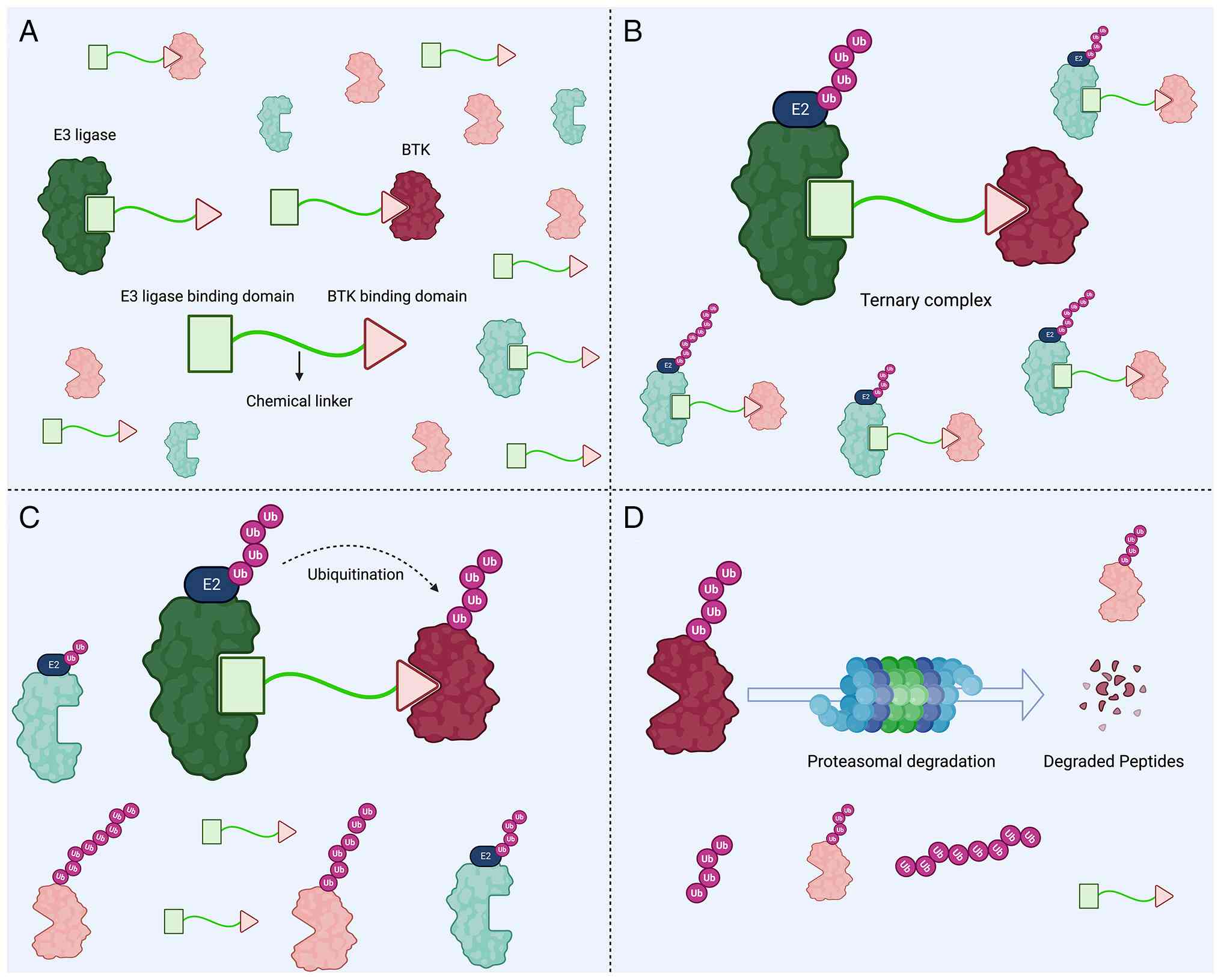
moiety at the other (116). The
molecular mechanism by which BTK PROTACs induce targeted
degradation of BTK is depicted in Fig. 4.
BTK PROTACs function by bringing the E3 ubiquitin
ligase into close proximity with BTK, forming a ternary complex
that promotes ubiquitin transfer to BTK and ultimately leads to its
precise degradation by the proteasome (116). Compared with conventional
covalent and non-covalent BTKi, BTK degraders offer several notable
advantages. First, they exploit two independent ligands to
simultaneously recruit BTK and an E3 ligase, thereby inducing
polyubiquitination of BTK and initiating its degradation via the
ubiquitin-proteasome system. As a result, BTK degraders exhibit
higher selectivity for BTK and correspondingly fewer off-target
effects than classical BTKi. Second, unlike classical BTKi, which
rely on sustained occupancy of the BTK active site for functional
effects, BTK degraders operate through a catalytic mechanism of
action, driving multiple rounds of BTK degradation at
substoichiometric doses. More importantly, preclinical studies
suggest that BTK PROTACs may address resistance mechanisms
associated with conventional BTKi. Kinase-deficient BTK mutants
acquire a neo-morphic scaffolding function that activates
alternative kinases such as HCK and ILK, which in turn
phosphorylate PLCγ2 and sustain BCR signaling, thereby driving
resistance to BTK inhibition. BTK PROTACs counteract this by
degrading the mutant BTK protein, thereby disrupting its newly
acquired kinase-independent scaffolding activity and providing a
mechanistic rationale for their evaluation in BTKi-resistant
disease (58,116,117).
Collectively, BTK PROTACs represent an emerging
therapeutic strategy that can degrade WT BTK and several
resistance-associated BTK variants in preclinical models.
Early-phase trials have also reported preliminary responses in
heterogeneous R/R B-cell malignancies.
NX-2127 is a heterobifunctional molecule composed
of a BTK-binding module and a cereblon E3 ubiquitin ligase-binding
module. It promotes ubiquitin-dependent degradation of BTK
regardless of mutant BTK functional category, while also
stimulating T cell activation through degradation of Ikaros family
transcription factors (IKZF1/3) (118,119). Elevated expression of IKZF3 has
been linked to resistance against conventional BTKi (120). NX-2127 is an orally available,
first-in-class BTK degrader with dual functionality. NX-2127
combines BTK degradation with immunomodulatory activity and
provides a mechanistic strategy for targeting both catalytic and
kinase-independent BTK functions. Preclinical studies have shown
that NX-2127 promotes the degradation of BTKC481S mutant in an
ABC-DLBCL cell line and exhibits greater potency than ibrutinib in
suppressing the proliferation of BTKC481S-mutant TMD8 cells. In a
xenograft model carrying BTKC481S-mutant TMD8 cells, NX-2127
significantly inhibited tumor growth (121). The first-in-human phase I trial
of NX-2127 in patients with R/R B-NHL (NCT04830137), in which 72%
of patients had received prior BTKi treatment, has yielded initial
results. Rapid, robust and sustained BTK degradation was observed
across all patients, independent of baseline BTK levels, tumor type
or NX-2127 dose. Among the responses, two patients achieved CR,
including one with DLBCL. The study remains ongoing. Early clinical
findings suggest that NX-2127 has a manageable safety profile and
can produce responses in R/R B-NHL. However, prior BTKi exposure,
resistance status and response duration were not reported
specifically for the DLBCL subgroup (58,122).
NX-5948 is a selective BTK degrader that induces
specific degradation of both WT and mutant BTK proteins without
affecting IKZF1/3 or other cereblon neo-substrates. In
vitro, NX-5948 suppressed the proliferation of a BTKC481S
mutant ABC-DLBCL cell line with a half-maximal effective
concentration (EC50) <10 nM, outperforming ibrutinib
with an EC50 >1 µM. In a TMD8 xenograft mouse
model harboring the BTKC481S mutation, NX-5948 achieved superior
tumor growth inhibition compared with ibrutinib (123). An ongoing first-in-human phase I
trial (trial registration no. NCT05131022) is evaluating the safety
and efficacy of NX-5948 in patients with R/R B-cell malignancies.
Early enrollment included 10 patients with B-cell NHL, four of whom
had DLBCL; half of the patients had received prior BTKi therapy.
The initial findings suggest that NX-5948 is generally well
tolerated and the most common TEAEs were purpura or contusion
(57.1%, all below grade 3), nausea (35.7%, all below grade 3), and
thrombocytopenia (35.7%, all below grade 3). Similar to NX-2127,
rapid, robust and sustained BTK degradation was observed across all
patients (124). Clinical
response data for the patients with DLBCL were not available.
BGB-16673 is another orally active BTK-targeting
chimeric degradation activation molecule. In preclinical models, it
degrades both WT BTK and multiple mutant forms linked to resistance
against conventional BTKi. Consequently, BGB-16673 exerts potent
anti-proliferative activity in TMD8 cells expressing WT BTK or
harboring C481S, T474I or L528W mutants and suppresses xenograft
tumor growth driven by these on-target resistance mutations. In
these preclinical models, BGB-16673 produced more prolonged tumor
control and fewer splenic metastases than ibrutinib or
pirtobrutinib. In a first-in-human phase I/II study, BGB-16673
monotherapy has demonstrated a tolerable safety profile and robust
antitumor responses that deepened over time in heavily pretreated
patients with R/R B-cell malignancies (NCT05006716) (125). Building on these results, an
ongoing phase I/II trial is evaluating the safety, tolerability and
clinical activity of BGB-16673 in combination with other regimens
in the R/R setting (NCT06634589). The non-GCB DLBCL substudy of
this trial aims to assess BGB-16673 plus glofitamab, a bispecific
antibody targeting both CD20 on B cells and CD3 on T cells, in
patients with R/R non-GCB DLBCL who have received ≥2 prior lines of
therapy. The study is currently recruiting participants (126). Detailed clinical trial
information for these degraders is summarized in Table II.
| Table IIClinical trials of emerging
BTK-targeted and multi-kinase agents in B-cell malignancies. |
Table II
Clinical trials of emerging
BTK-targeted and multi-kinase agents in B-cell malignancies.
| Category/mechanism
of action/representative agents | Clinical trial
identifier | Phase | Patient
Population | Regimens |
|---|
| Dual-binding BTKi;
engaging both WT and C481-mutant BTK through covalent and
non-covalent binding modes | | | | |
| Rocbrutinib
(LP-168) | NCT04993690 | I | R/R CLL/SLL, DLBCL,
MCL, MZL, FL, PMBCL | Monotherapy |
| Rocbrutinib
(LP-168) | NCT06251180 | I | TN DLBCL, MZL,
MCL | Rocbrutinib +
R-CHOP |
| Rocbrutinib
(LP-168) | NCT07189065 | II | R/R DLBCL | Monotherapy |
| Rocbrutinib
(LP-168) | NCT07570017 | I | R/R DLBCL | Rocbrutinib +
R-GemOx |
| BTK degrader;
targeted degradation of WT and mutant BTK proteins via the
ubiquitin-proteasome system | | | | |
| Zelebrudomide
(NX-2127) | NCT04830137 | I | R/R CLL/SLL, DLBCL,
FL, MCL, MZL, WM | Monotherapy |
| Bexobrutideg
(NX-5948) | NCT05131022 | I | R/R CLL/SLL, DLBCL,
MCL, MZL, FL, WM, PCNSL/SCNSL | Monotherapy |
| Catadegbrutinib
(BGB-16673) | NCT05006716 | I/II | R/R CLL/SLL, WM,
MCL, MZL, DLBCL, FL, RT | Monotherapy |
| Catadegbrutinib
(BGB-16673) | NCT05294731 | I/II | R/R CLL/SLL, MZL,
MCL, FL, WM, DLBCL, RT | Monotherapy |
| Catadegbrutinib
(BGB-16673) | NCT06634589 | I/II | R/R CLL/SLL, FL,
MZL, MCL, DLBCL, WM, RT | Catadegbrutinib +
sonrotoclax/ zanubrutinib/ mosunetuzumab/ glofitamab/
obinutuzumab |
| HSK29116 | NCT04861779 | I | R/R CLL/SLL, MCL,
DLBCL, FL, MZL, WM | Monotherapy |
| AC676 | NCT05780034 | I | R/R CLL/SLL, DLBCL,
FL, MCL, MZL, WM | Monotherapy |
| ABBV-101 | NCT05753501 | I | R/R CLL/SLL, DLBCL,
MCL, FL, MZL, WM, transformed iNHL | Monotherapy |
| UBX-303061 | NCT06590961 | I | R/R CLL/SLL, DLBCL,
FL, MCL, WM, MZL | Monotherapy |
| HZ-Q1070 | CTR20240471 | I | R/R CLL/SLL, WM,
MCL, FL, MZL, DLBCL, PCNSL | Monotherapy |
| Allosteric BTKi;
non-active site binding with kinase inhibition | No clinical studies
identified | | | |
| Dual and
Multi-Target BTKi; simultaneously blocking BTK and other
survival-driving kinases | | | | |
| Birelentinib
(DZD8586, BTK/LYN) | NCT05844956 | I | R/R CLL/SLL, DLBCL,
MCL, FL, MZL, SCNSL | Monotherapy |
| Birelentinib
(DZD8586, BTK/LYN) | NCT05824585 | I | R/R CLL/SLL, DLBCL,
MCL, FL, MZL, SCNSL | Monotherapy |
| Birelentinib
(DZD8586, BTK/LYN) | NCT06539195 | II | R/R DLBCL | Monotherapy |
| Birelentinib
(DZD8586, BTK/LYN) | NCT07059650 | II | TN and R/R
DLBCL | Birelentinib +
R-CHOP/ R-GemOx/BR |
| Luxeptinib
(CG-806, BTK/FLT3) | NCT03893682 | I | R/R CLL/SLL,
B-NHL | Monotherapy |
| Cerdulatinib
(PRT062070, SYK/JAK) | NCT01994382 | I/II | R/R CLL/SLL,
NHL | Cerdulatinib ±
rituximab |
Overall, BTK degraders have retained activity
against several resistance-associated BTK variants in preclinical
models. Early-phase studies have also reported clinical activity in
heterogeneous B-cell malignancy cohorts, but DLBCL-specific
clinical evidence remains limited. Furthermore, evidence from other
B-cell malignancies indicates that the BTKA428D mutation may confer
resistance to BGB-16673 and NX-2127 (127). BTK degraders are therefore not
universally active across resistance-associated BTK variants, and
their role in BTKi-resistant DLBCL remains to be defined.
However, Hatcher et al (128) developed DFCI-002-06, a
first-in-class HCK/BTK PROTAC for MYD88-mutated B-cell
malignancies. Liu et al (129) subsequently showed that, in DLBCL
cells expressing the BTKA428D mutation, DFCI-002-06 degrades HCK,
LYN and BTK in parallel, promoting apoptosis in cells that are
resistant to other investigational PROTACs, including BGB-16673,
NX-2127 and NX-5948. These preclinical findings support further
evaluation of DFCI-002-06 in BTK-targeted therapy resistance. In
experimental models, combining BTK degraders with venetoclax
delayed the emergence of BTKA428D-resistant clones, while NX-2127
suppressed both WT and A428D clones (130). The clinical relevance of this
combination remains unknown.
BTK degraders therefore remain investigational
strategies for addressing resistance to conventional BTKi. The
identification of BTKA428D supports prospective evaluation of
mutation profiles and treatment sequencing in future clinical
studies. These efforts may help expand the potential future
applications of these novel drugs.
Allosteric BTKi
Allosteric BTK inhibition is also being explored as
a potential approach to resistance associated with acquired BTK
mutations (131,132). Allosteric inhibitors are
designed to perturb allosteric sites on BTK rather than the ATP
binding active site within the catalytic kinase domain that
traditional inhibitors target. Through a network of coupled amino
acids, these perturbations are transmitted to the active site
(orthosteric site), causing a conformational change in BTK. This in
turn suppresses BTK kinase activity and blocks the interaction of
BTK with downstream substrates required for signal propagation
(131,133).
The mechanisms that govern allosteric regulation of
BTK are diverse. They include interdomain communication, kinase
dimerization, protein-protein interactions, post-translational
modifications and ligand binding (131). The interdomain interactions that
guide BTK through its activation cycle, from a cytosolic
autoinhibited state to membrane-associated and fully activated
conformations, have facilitated the identification and
understanding of allosteric sites on BTK (134,135). Allosteric inhibitors fall into
two major categories: Type III inhibitors, which bind adjacent to
the ATP active site without overlapping it and type IV inhibitors,
which bind a site remote from the ATP pocket (131). This mode of action provides a
mechanistic rationale for testing allosteric inhibitors against
mutations affecting the orthosteric site. In BTK, a negatively
charged side chain, D656, provides a binding interface for the SH2
domain. Engagement of the SH2 domain with the kinase domain induces
the autoinhibited conformation. Conversely, the SH2 domain can also
activate the catalytic domain by binding to the N-lobe of the
kinase domain (131). Targeting
the SH2-kinase domain interface has been established as a primary
strategy for allosteric BTK inhibition. Building on this concept, a
protein binder named rF10 has been developed in preclinical
studies. It displays high specificity for the BTK-SH2 domain over
other SH2-containing kinases, and has the ability to inhibit
activation of both WT and mutated BTK (136,137).
In parallel, Kueffer et al (132) carried out virtual screening
against non-active site pockets combined with in vitro
experiments. The authors identified a series of small molecules
that bind BTK outside the ATP active site. These proof-of-principle
data demonstrate that BTK can be targeted allosterically with small
molecules, offering an alternative to active-site-directed BTKi.
Therefore, allosteric sites on BTK deserve exploration for drug
development with the goal of achieving more specific BTK targeting
and enabling combination with active-site inhibitors. However, the
available evidence remains preclinical, and the relevance of
allosteric BTK inhibition to BTKi-resistant DLBCL requires further
investigation.
Dual and multi-target BTKi
Despite BTKi having profoundly reshaped the
treatment paradigm for B-cell malignancies, the clinical use of
single-target agents remains constrained by the emergence and
progression of acquired BTKi resistance. Recently, the development
of dual or multi-target BTKi that simultaneously block BTK and
other kinases has seen tangible progress, offering hope for
improved therapeutic outcomes and sustained tumor responses in
DLBCL. Multi-kinase inhibitors that target BTK, proximal BCR
kinases or compensatory survival pathways are currently being
investigated as potential approaches to BTKi resistance (33,138).
Birelentinib (DZD8586) is a novel oral non-covalent
dual inhibitor of LYN and BTK. Preclinical activity data show that
birelentinib selectively inhibits BTK and LYN with minimal
off-target effects against other kinases. In DLBCL cell and
xenograft models harboring BTK variants associated with resistance
to acalabrutinib and pirtobrutinib, birelentinib retained
antiproliferative and antitumor activity (139). Preliminary clinical results in
R/R DLBCL showed an ORR of 48.4% and a CRR of 35.5%; however,
outcomes according to prior BTKi exposure or resistance status were
not reported (140).
Luxeptinib (formerly CG-806) is another oral
non-covalent multi-kinase inhibitor that works in a
mutation-agnostic manner. It targets pan-BTK, pan-FMS-like tyrosine
kinase 3 and also suppresses BCR signaling at multiple nodes,
including LYN and SYK. Compared with the classical BTKi ibrutinib,
luxeptinib offers distinct advantages. Across a broad range of
malignant B cells, luxeptinib suppresses cell proliferation and
triggers apoptosis with much greater potency than ibrutinib. It
also blocks aberrantly active BCR signaling at multiple nodes,
including LYN, SYK, BTK, PLCγ2, AKT, PKC and ERK, in a cell line-,
dose- and time-dependent manner (141,142). Notably, luxeptinib reduces the
phosphorylation of LYN and SYK more effectively than ibrutinib
does, acting at steps further upstream in the BCR signaling cascade
(143).
In addition, luxeptinib drives metabolic
reprogramming in B-cell tumor cells. This is reflected by enhanced
respiratory reserve capacity, increased glycolytic activity and
induction of mitophagy in both parental and ibrutinib-resistant
cells (144). The direct and
potent killing of a wide range of malignant B cells supports the
clinical development of luxeptinib for patients with B-cell
malignancies that are insensitive, resistant or refractory to
ibrutinib. A phase I clinical trial is currently evaluating the
tolerability, antitumor activity and safety of luxeptinib as a
single agent in patients with R/R B-cell NHL, nearly 50% of whom
had prior exposure to BTKi. Early-phase results indicated a
favorable safety profile and antitumor activity in a heavily
pretreated population with multiple R/R B-NHL subtypes, including
patients previously exposed to ibrutinib (145,146). However, DLBCL-specific
enrollment, responses and outcomes after prior BTKi progression
remained unreported.
KIN-8194 is another orally available dual-action
BTK/HCK inhibitor with favorable bioavailability, pharmacokinetic
properties and minimal toxicity (147). Yang et al (148) demonstrated that KIN-8194 exerts
antitumor activity in MYD88-mutant driven B-cell lymphomas.
Furthermore, it kills ABC-DLBCL cells carrying the BTKC481S
mutation. In xenograft models of MYD88-mutant ABC DLBCL expressing
either WT or C481S mutant BTK, KIN-8194 provided significantly
improved survival benefits compared with ibrutinib. Combined with
the BCL2 inhibitor venetoclax, it showed synergistic antitumor
effects, markedly reducing tumor growth and extending survival
(149). These preclinical
findings show that dual BTK/HCK inhibition retains activity in
ibrutinib-resistant ABC-DLBCL models. Clinical activity in patients
with BTKi-resistant DLBCL has not been evaluated to date. Further
clinical development of this dual-target inhibitor is warranted to
assess its antitumor activity and tolerability in patients with
BTKi-resistant B-cell malignancies. Based on this, a first-in-class
dual-targeting PROTAC, namely DFCI-002-06, was designed to
concurrently degrade both HCK and BTK. It exerts kinase inhibitory
activity irrespective of the functional phenotype of BTK mutations,
as aforementioned. In mouse models, DFCI-002-06 achieved superior
tumor suppression and prolonged survival compared with KIN-8194
(128).
SRX3333 is a triple-action inhibitor targeting BTK,
PI3K and BRD4, which is currently under investigation. Previous
in vitro studies have demonstrated that it suppresses the
proliferation of malignant B cells while showing minimal toxicity
to healthy lymphocytes, and it outperforms ibrutinib. Furthermore,
SRX3333 triggers apoptosis in malignant B cells, and reduces
resistance to cell death by attenuating BCR signaling and lowering
MYC expression. SRX3333 reduced the proliferation of
ibrutinib-resistant malignant B cells in vitro, indicating
activity in preclinical resistance models. Its safety and efficacy
in patients with BTKi-resistant DLBCL have not been evaluated yet
(150).
Apart from the aforementioned dual or multi-target
inhibitors, cerdulatinib (PRT062070), a dual SYK/JAK inhibitor, has
shown preclinical activity in ibrutinib-resistant DLBCL (33). The preclinical findings and early
clinical data from these multi-kinase inhibitors support further
exploration as potential therapeutic strategies for addressing BTKi
resistance. However, current clinical trials remain in early
phases, and the exact efficacy and safety profile in patients with
BTKi resistance require continued observation and validation.
Ongoing clinical trials evaluating these emerging
BTK-targeted and multi-kinase agents are summarized in Table II. The aforementioned agents have
shown activity in preclinical models or early clinical studies, but
their role in BTKi-resistant DLBCL remains to be elucidated.
Despite these advantages, several key questions in the current
BTK-targeted therapy landscape remain unanswered. For example, the
optimal sequencing of covalent and non-covalent inhibitors remains
unknown. Whether resistance mutation profiles can guide treatment
sequencing requires prospective evaluation in DLBCL. Even when a
covalent BTKi is selected, head-to-head clinical evidence is
lacking to determine whether acalabrutinib or zanubrutinib should
be preferred. Available matching-adjusted indirect comparisons have
shown mixed results, and are limited by cross-trial differences in
baseline characteristics and other confounding factors. New
covalent and non-covalent BTKi continue to be designed and
developed besides the existing ones, raising the question of
whether the best-in-class covalent and non-covalent BTKi are
already available or if more are needed. Previous clinical findings
have uncovered that the pan-resistant BTKA428D mutation confers
co-resistance between a BTK inhibitor and a BTK degrader. This
suggests that a simple switch from earlier-generation drugs to
next-generation drugs may not be effective. It also prompts a
rethinking of whether the focus for overcoming BTKi resistance
should shift to combination strategies. In other B-cell
malignancies, fixed-duration combinations of BTKi and BCL2
inhibitors may delay the emergence of resistance mutations. Their
ability to prevent or overcome BTKi resistance in DLBCL remains
unproven (22,57,133). Prospective studies involving
patients with documented progression during BTKi treatment, paired
molecular samples and adequate follow-up are required.
Conclusions and future perspectives
The BCR signaling pathway plays a central role in
the development and progression of B-cell malignancies. As a core
node within this pathway, BTK has become a key therapeutic target.
BTK-directed therapies have substantially improved tumor responses
and clinical outcomes for patients with B-cell lymphomas. However,
off-target toxicities that force treatment discontinuation, along
with acquired resistance to BTKi, limit their broader clinical
application. Therefore, a deeper understanding of the resistance
mechanisms to BTKi is critically needed.
The present review summarized the mechanisms
associated with reduced sensitivity to BTKi in DLBCL, ranging from
subtype-associated intrinsic resistance to genetic and non-genetic
mechanisms that may contribute to acquired resistance. At present,
no candidate resistance biomarker discussed in the current review
has been prospectively validated to guide routine genotyping or the
sequencing of BTK-targeted therapies in DLBCL. Associations derived
from retrospective clinical analyses remain exploratory. Mechanisms
demonstrated in DLBCL cell lines or animal models, as well as those
extrapolated from other B-cell malignancies, should be regarded as
hypothesis-generating rather than clinically actionable.
Future studies should enroll molecularly
characterized DLBCL cohorts, as well as collect paired pretreatment
and progression samples for longitudinal analysis. Prospective
molecularly selected studies with adequate follow-up are needed to
determine whether resistance genotyping or specific treatment
sequences improve clinical outcomes. Until such evidence becomes
available, these mechanisms and emerging therapeutic strategies
should inform study design rather than routine treatment
decisions.
Availability of data and materials
Not applicable.
Authors' contributions
CL conceived the review and drafted the manuscript.
CL, TZ, WZ and LW performed the literature search and screening,
and contributed to evidence collection, organization and synthesis.
TZ, WZ and LW also contributed to drafting and revising the
manuscript. LW, CW, QC and LY contributed to funding acquisition.
QC and YS made contributions to the analysis and interpretation of
the literature relevant to the figures and tables, including the
organization and synthesis of mechanistic evidence, and prepared
the figures and tables. QC and YS were also involved in critically
revising the manuscript for important intellectual content. CW and
LY critically revised the manuscript and were responsible for
correspondence regarding the manuscript. Data authentication is not
applicable. All authors read and approved the final manuscript, and
agree to be accountable for all aspects of the work.
Ethics approval and consent to
participate
Not applicable.
Patient consent for publication
Not applicable.
Competing interests
The authors declare that they have no competing
interests.
Acknowledgments
Not applicable.
Funding
The present study was supported by the National Natural Science
Foundation of China (grant no. 82501042); the High-level Talent
Program of Huai'an First People's Hospital (grant nos. GQ202307,
GQ202410 and GQ202406); the Natural Science Research Project of
Huai'an Science and Technology Program (grant nos. HAB202306 and
HAB2024002); the 2024 Project of the Northern Jiangsu Clinical
Medicine Research Institute (grant no. HAKY202400324); and the
Innovation Team Project of Huai'an First People's Hospital (grant
no. YCT202306).
References
|
1
|
Swerdlow SH, Campo E, Pileri SA, Harris
NL, Stein H, Siebert R, Advani R, Ghielmini M, Salles GA, Zelenetz
AD and Jaffe ES: The 2016 revision of the World Health Organization
classification of lymphoid neoplasms. Blood. 127:2375–2390. 2016.
View Article : Google Scholar : PubMed/NCBI
|
|
2
|
Sehn LH and Salles G: Diffuse large B-cell
lymphoma. N Engl J Med. 384:842–858. 2021. View Article : Google Scholar : PubMed/NCBI
|
|
3
|
Rosenwald A, Wright G, Chan WC, Connors
JM, Campo E, Fisher RI, Gascoyne RD, Muller-Hermelink HK, Smeland
EB, Giltnane JM, et al: The use of molecular profiling to predict
survival after chemotherapy for diffuse large-B-cell lymphoma. N
Engl J Med. 346:1937–1947. 2002. View Article : Google Scholar : PubMed/NCBI
|
|
4
|
Alaggio R, Amador C, Anagnostopoulos I,
Attygalle AD, Araujo IBO, Berti E, Bhagat G, Borges AM, Boyer D,
Calaminici M, et al: The 5th edition of the World Health
Organization classification of haematolymphoid tumours: Lymphoid
neoplasms. Leukemia. 36:1720–1748. 2022. View Article : Google Scholar : PubMed/NCBI
|
|
5
|
Phelan JD, Young RM, Webster DE, Roulland
S, Wright GW, Kasbekar M, Shaffer AL III, Ceribelli M, Wang JQ,
Schmitz R, et al: A multiprotein supercomplex controlling oncogenic
signalling in lymphoma. Nature. 560:387–391. 2018. View Article : Google Scholar : PubMed/NCBI
|
|
6
|
Chapuy B, Stewart C, Dunford AJ, Kim J,
Kamburov A, Redd RA, Lawrence MS, Roemer MGM, Li AJ, Ziepert M, et
al: Molecular subtypes of diffuse large B cell lymphoma are
associated with distinct pathogenic mechanisms and outcomes. Nat
Med. 24:679–690. 2018. View Article : Google Scholar : PubMed/NCBI
|
|
7
|
Wright GW, Huang DW, Phelan JD, Coulibaly
ZA, Roulland S, Young RM, Wang JQ, Schmitz R, Morin RD, Tang J, et
al: A probabilistic classification tool for genetic subtypes of
diffuse large B cell lymphoma with therapeutic implications. Cancer
Cell. 37:551–568.e14. 2020. View Article : Google Scholar : PubMed/NCBI
|
|
8
|
Chong EA, Tomasulo EB and Barta SK: 2026
Update on the management of diffuse large B-cell lymphoma. Am J
Hematol. 101:832–863. 2026. View Article : Google Scholar : PubMed/NCBI
|
|
9
|
Bock AM and Epperla N: Therapeutic
landscape of primary refractory and relapsed diffuse large B-cell
lymphoma: Recent advances and emerging therapies. J Hematol Oncol.
18:682025. View Article : Google Scholar : PubMed/NCBI
|
|
10
|
Berendsen MR, Stevens WBC, van den Brand
M, van Krieken JH and Scheijen B: Molecular genetics of relapsed
diffuse large B-cell lymphoma: Insight into mechanisms of therapy
resistance. Cancers (Basel). 12:35532020. View Article : Google Scholar : PubMed/NCBI
|
|
11
|
Wilson WH, Young RM, Schmitz R, Yang Y,
Pittaluga S, Wright G, Lih CJ, Williams PM, Shaffer AL, Gerecitano
J, et al: Targeting B cell receptor signaling with ibrutinib in
diffuse large B cell lymphoma. Nat Med. 21:922–926. 2015.
View Article : Google Scholar : PubMed/NCBI
|
|
12
|
Pal Singh S, Dammeijer F and Hendriks RW:
Role of Bruton's tyrosine kinase in B cells and malignancies. Mol
Cancer. 17:572018. View Article : Google Scholar : PubMed/NCBI
|
|
13
|
Burger JA and Wiestner A: Targeting B cell
receptor signalling in cancer: Preclinical and clinical advances.
Nat Rev Cancer. 18:148–167. 2018. View Article : Google Scholar : PubMed/NCBI
|
|
14
|
Gu D, Tang H, Wu J, Li J and Miao Y:
Targeting Bruton tyrosine kinase using non-covalent inhibitors in B
cell malignancies. J Hematol Oncol. 14:402021. View Article : Google Scholar : PubMed/NCBI
|
|
15
|
Woyach JA, Furman RR, Liu TM, Ozer HG,
Zapatka M, Ruppert AS, Xue L, Li DH, Steggerda SM, Versele M, et
al: Resistance mechanisms for the Bruton's tyrosine kinase
inhibitor ibrutinib. N Engl J Med. 370:2286–2294. 2014. View Article : Google Scholar : PubMed/NCBI
|
|
16
|
Shaffer AL III, Phelan JD, Wang JQ, Huang
D, Wright GW, Kasbekar M, Choi J, Young RM, Webster DE, Yang Y, et
al: Overcoming acquired epigenetic resistance to BTK inhibitors.
Blood Cancer Discov. 2:630–647. 2021. View Article : Google Scholar : PubMed/NCBI
|
|
17
|
Phelan JD, Scheich S, Choi J, Wright GW,
Häupl B, Young RM, Rieke SA, Pape M, Ji Y, Urlaub H, et al:
Response to Bruton's tyrosine kinase inhibitors in aggressive
lymphomas linked to chronic selective autophagy. Cancer Cell.
42:238–252.e9. 2024. View Article : Google Scholar : PubMed/NCBI
|
|
18
|
Mato AR, Nabhan C, Thompson MC, Lamanna N,
Brander DM, Hill B, Howlett C, Skarbnik A, Cheson BD, Zent C, et
al: Toxicities and outcomes of 616 ibrutinib-treated patients in
the United States: A real-world analysis. Haematologica.
103:874–879. 2018. View Article : Google Scholar : PubMed/NCBI
|
|
19
|
Rolli V, Gallwitz M, Wossning T, Flemming
A, Schamel WW, Zürn C and Reth M: Amplification of B cell antigen
receptor signaling by a Syk/ITAM positive feedback loop. Mol Cell.
10:1057–1069. 2002. View Article : Google Scholar : PubMed/NCBI
|
|
20
|
Dal Porto JM, Gauld SB, Merrell KT, Mills
D, Pugh-Bernard AE and Cambier J: B cell antigen receptor signaling
101. Mol Immunol. 41:599–613. 2004. View Article : Google Scholar : PubMed/NCBI
|
|
21
|
Smith CI, Baskin B, Humire-Greiff P, Zhou
JN, Olsson PG, Maniar HS, Kjellén P, Lambris JD, Christensson B,
Hammarström L, et al: Expression of Bruton's agammaglobulinemia
tyrosine kinase gene, BTK, is selectively down-regulated in T
lymphocytes and plasma cells. J Immunol. 152:557–565. 1994.
View Article : Google Scholar : PubMed/NCBI
|
|
22
|
Cool A, Nong T, Montoya S and Taylor J:
BTK inhibitors: Past, present, and future. Trends Pharmacol Sci.
45:691–707. 2024. View Article : Google Scholar : PubMed/NCBI
|
|
23
|
Liu X, Lin Y, Zhuang Q, Deng H, Liu A and
Sun J: BTK inhibitors resistance in B cell malignancies: Mechanisms
and potential therapeutic strategies. Blood Rev. 71:1012732025.
View Article : Google Scholar : PubMed/NCBI
|
|
24
|
Bradshaw JM: The Src, Syk, and Tec family
kinases: Distinct types of molecular switches. Cell Signal.
22:1175–1184. 2010. View Article : Google Scholar : PubMed/NCBI
|
|
25
|
Mohamed AJ, Yu L, Bäckesjö CM, Vargas L,
Faryal R, Aints A, Christensson B, Berglöf A, Vihinen M, Nore BF
and Smith CI: Bruton's tyrosine kinase (Btk): Function, regulation,
and transformation with special emphasis on the PH domain. Immunol
Rev. 228:58–73. 2009. View Article : Google Scholar : PubMed/NCBI
|
|
26
|
Wu J, Liu C, Tsui ST and Liu D:
Second-generation inhibitors of Bruton tyrosine kinase. J Hematol
Oncol. 9:802016. View Article : Google Scholar : PubMed/NCBI
|
|
27
|
Weber ANR, Bittner Z, Liu X, Dang TM,
Radsak MP and Brunner C: Bruton's tyrosine kinase: An emerging key
player in innate immunity. Front Immunol. 8:14542017. View Article : Google Scholar : PubMed/NCBI
|
|
28
|
Okada T, Maeda A, Iwamatsu A, Gotoh K and
Kurosaki T: BCAP: The tyrosine kinase substrate that connects B
cell receptor to phosphoinositide 3-kinase activation. Immunity.
13:817–827. 2000. View Article : Google Scholar
|
|
29
|
Aiba Y, Kameyama M, Yamazaki T, Tedder TF
and Kurosaki T: Regulation of B-cell development by BCAP and CD19
through their binding to phosphoinositide 3-kinase. Blood.
111:1497–1503. 2008. View Article : Google Scholar
|
|
30
|
Li T, Rawlings DJ, Park H, Kato RM, Witte
ON and Satterthwaite AB: Constitutive membrane association
potentiates activation of Bruton tyrosine kinase. Oncogene.
15:1375–1383. 1997. View Article : Google Scholar : PubMed/NCBI
|
|
31
|
Wang Q, Pechersky Y, Sagawa S, Pan AC and
Shaw DE: Structural mechanism for Bruton's tyrosine kinase
activation at the cell membrane. Proc Natl Acad Sci USA.
116:9390–9399. 2019. View Article : Google Scholar : PubMed/NCBI
|
|
32
|
Hashimoto A, Okada H, Jiang A, Kurosaki M,
Greenberg S, Clark EA and Kurosaki T: Involvement of guanosine
triphosphatases and phospholipase C-gamma2 in extracellular
signal-regulated kinase, c-Jun NH2-terminal kinase, and p38
mitogen-activated protein kinase activation by the B cell antigen
receptor. J Exp Med. 188:1287–1295. 1998. View Article : Google Scholar : PubMed/NCBI
|
|
33
|
Yang S, Oh J, Hwang SY, Paik J and Hwang
I: Advances and resistance adaptation in BTK-targeted therapy for
B-cell malignancies. Drug Resist Updat. 86:1013832026. View Article : Google Scholar : PubMed/NCBI
|
|
34
|
Gupta S, Sharma A, Shukla A, Mishra A and
Singh A: From development to clinical success: The journey of
established and next-generation BTK inhibitors. Invest New Drugs.
43:377–393. 2025. View Article : Google Scholar : PubMed/NCBI
|
|
35
|
Kim HO: Development of BTK inhibitors for
the treatment of B-cell malignancies. Arch Pharm Res. 42:171–181.
2019. View Article : Google Scholar : PubMed/NCBI
|
|
36
|
Zain R and Vihinen M: Structure-function
relationships of covalent and non-covalent BTK inhibitors. Front
Immunol. 12:6948532021. View Article : Google Scholar : PubMed/NCBI
|
|
37
|
Mouhssine S, Maher N, Matti BF, Alwan AF
and Gaidano G: Targeting BTK in B cell malignancies: From mode of
action to resistance mechanisms. Int J Mol Sci. 25:32342024.
View Article : Google Scholar : PubMed/NCBI
|
|
38
|
Ganatra S, Sharma A, Shah S, Chaudhry GM,
Martin DT, Neilan TG, Mahmood SS, Barac A, Groarke JD, Hayek SS, et
al: Ibrutinib-associated atrial fibrillation. JACC Clin
Electrophysiol. 4:1491–1500. 2018. View Article : Google Scholar : PubMed/NCBI
|
|
39
|
Estupiñán HY, Berglöf A, Zain R and Smith
CIE: Comparative analysis of BTK inhibitors and mechanisms
underlying adverse effects. Front Cell Dev Biol. 9:6309422021.
View Article : Google Scholar : PubMed/NCBI
|
|
40
|
Wen T, Wang J, Shi Y, Qian H and Liu P:
Inhibitors targeting Bruton's tyrosine kinase in cancers: Drug
development advances. Leukemia. 35:312–332. 2021. View Article : Google Scholar :
|
|
41
|
Wang E, Mi X, Thompson MC, Montoya S,
Notti RQ, Afaghani J, Durham BH, Penson A, Witkowski MT, Lu SX, et
al: Mechanisms of resistance to noncovalent Bruton's tyrosine
kinase inhibitors. N Engl J Med. 386:735–743. 2022. View Article : Google Scholar : PubMed/NCBI
|
|
42
|
Pi M, Kuang H, Yue C, Yang Q, Wu A, Li Y,
Assaraf YG, Yang DH and Wu S: Targeting metabolism to overcome
cancer drug resistance: A promising therapeutic strategy for
diffuse large B cell lymphoma. Drug Resist Updat. 61:1008222022.
View Article : Google Scholar : PubMed/NCBI
|
|
43
|
Davis RE, Ngo VN, Lenz G, Tolar P, Young
RM, Romesser PB, Kohlhammer H, Lamy L, Zhao H, Yang Y, et al:
Chronic active B-cell-receptor signalling in diffuse large B-cell
lymphoma. Nature. 463:88–92. 2010. View Article : Google Scholar : PubMed/NCBI
|
|
44
|
Davis RE, Brown KD, Siebenlist U and
Staudt LM: Constitutive nuclear factor kappaB activity is required
for survival of activated B cell-like diffuse large B cell lymphoma
cells. J Exp Med. 194:1861–1874. 2001. View Article : Google Scholar : PubMed/NCBI
|
|
45
|
Young RM, Phelan JD, Wilson WH and Staudt
LM: Pathogenic B-cell receptor signaling in lymphoid malignancies:
New insights to improve treatment. Immunol Rev. 291:190–213. 2019.
View Article : Google Scholar : PubMed/NCBI
|
|
46
|
Lenz G, Wright G, Dave SS, Xiao W, Powell
J, Zhao H, Xu W, Tan B, Goldschmidt N, Iqbal J, et al: Stromal gene
signatures in large-B-cell lymphomas. N Engl J Med. 359:2313–2323.
2008. View Article : Google Scholar : PubMed/NCBI
|
|
47
|
Flümann R, Hansen J, Meinel J, Pfeiffer P,
Goldfarb Wittkopf H, Lütz A, Wirtz J, Möllmann M, Zhou T, Tabatabai
A, et al: An inducible Cd79b mutation confers ibrutinib sensitivity
in mouse models of Myd88-driven diffuse large B-cell lymphoma.
Blood Adv. 8:1063–1074. 2024. View Article : Google Scholar :
|
|
48
|
George B, Chowdhury SM, Hart A, Sircar A,
Singh SK, Nath UK, Mamgain M, Singhal NK, Sehgal L and Jain N:
Ibrutinib resistance mechanisms and treatment strategies for B-cell
lymphomas. Cancers (Basel). 12:13282020. View Article : Google Scholar : PubMed/NCBI
|
|
49
|
Wilson WH, Wright GW, Huang DW, Hodkinson
B, Balasubramanian S, Fan Y, Vermeulen J, Shreeve M and Staudt LM:
Effect of ibrutinib with R-CHOP chemotherapy in genetic subtypes of
DLBCL. Cancer Cell. 39:1643–1653.e3. 2021. View Article : Google Scholar : PubMed/NCBI
|
|
50
|
Cooper A, Tumuluru S, Kissick K,
Venkataraman G, Song JY, Lytle A, Duns G, Yu J, Kotlov N, Bagaev A,
et al: CD5 gene signature identifies diffuse large B-cell lymphomas
sensitive to Bruton's tyrosine kinase inhibition. J Clin Oncol.
42:467–480. 2024. View Article : Google Scholar
|
|
51
|
Johnson PWM, Balasubramanian S, Hodkinson
B, Shreeve SM, Sun S, Srinivasan S, Steele AJ, Vermeulen J, Sehn LH
and Wilson WH: Clinical impact of ibrutinib plus R-CHOP in
untreated DLBCL coexpressing BCL2 and MYC in the phase 3 PHOENIX
trial. Blood Adv. 7:2008–2017. 2023. View Article : Google Scholar : PubMed/NCBI
|
|
52
|
Scherer F, Kurtz DM, Newman AM, Stehr H,
Craig AF, Esfahani MS, Lovejoy AF, Chabon JJ, Klass DM, Liu CL, et
al: Distinct biological subtypes and patterns of genome evolution
in lymphoma revealed by circulating tumor DNA. Sci Transl Med.
8:364ra1552016. View Article : Google Scholar : PubMed/NCBI
|
|
53
|
Chen JG, Liu X, Munshi M, Xu L, Tsakmaklis
N, Demos MG, Kofides A, Guerrera ML, Chan GG, Patterson CJ, et al:
BTKCys481Ser drives ibrutinib resistance via ERK1/2 and
protects BTKwild−type MYD88-mutated cells by a paracrine
mechanism. Blood. 131:2047–2059. 2018. View Article : Google Scholar : PubMed/NCBI
|
|
54
|
Hamasy A, Wang Q, Blomberg KE, Mohammad
DK, Yu L, Vihinen M, Berglöf A and Smith CI: Substitution scanning
identifies a novel, catalytically active ibrutinib-resistant BTK
cysteine 481 to threonine (C481T) variant. Leukemia. 31:177–185.
2017. View Article : Google Scholar :
|
|
55
|
Estupiñán HY, Wang Q, Berglöf A, Schaafsma
GCP, Shi Y, Zhou L, Mohammad DK, Yu L, Vihinen M, Zain R and Smith
CIE: BTK gatekeeper residue variation combined with cysteine 481
substitution causes super-resistance to irreversible inhibitors
acalabrutinib, ibrutinib and zanubrutinib. Leukemia. 35:1317–1329.
2021. View Article : Google Scholar : PubMed/NCBI
|
|
56
|
Qi J, Endres S, Yosifov DY, Tausch E,
Dheenadayalan RP, Gao X, Müller A, Schneider C, Mertens D,
Gierschik P, et al: Acquired BTK mutations associated with
resistance to noncovalent BTK inhibitors. Blood Adv. 7:5698–5702.
2023. View Article : Google Scholar : PubMed/NCBI
|
|
57
|
Kim HO: BTK inhibitors and next-generation
BTK-targeted therapeutics for B-cell malignancies. Arch Pharm Res.
48:426–449. 2025. View Article : Google Scholar : PubMed/NCBI
|
|
58
|
Montoya S, Bourcier J, Noviski M, Lu H,
Thompson MC, Chirino A, Jahn J, Sondhi AK, Gajewski S, Tan YSM, et
al: Kinase-impaired BTK mutations are susceptible to clinical-stage
BTK and IKZF1/3 degrader NX-2127. Science. 383:eadi57982024.
View Article : Google Scholar : PubMed/NCBI
|
|
59
|
Dhami K, Chakraborty A, Gururaja TL,
Cheung LW, Sun C, DeAnda F and Huang X: Kinase-deficient BTK
mutants confer ibrutinib resistance through activation of the
kinase HCK. Sci Signal. 15:eabg52162022. View Article : Google Scholar : PubMed/NCBI
|
|
60
|
Stanchina MD, Montoya S, Danilov AV,
Castillo JJ, Alencar AJ, Chavez JC, Cheah CY, Chiattone C, Wang Y,
Thompson M, et al: Navigating the changing landscape of
BTK-targeted therapies for B cell lymphomas and chronic lymphocytic
leukaemia. Nat Rev Clin Oncol. 21:867–887. 2024. View Article : Google Scholar : PubMed/NCBI
|
|
61
|
Tam CS, Balendran S and Blombery P: Novel
mechanisms of resistance in CLL: Variant BTK mutations in
second-generation and noncovalent BTK inhibitors. Blood.
145:1005–1009. 2025. View Article : Google Scholar : PubMed/NCBI
|
|
62
|
Ngo VN, Young RM, Schmitz R, Jhavar S,
Xiao W, Lim KH, Kohlhammer H, Xu W, Yang Y, Zhao H, et al:
Oncogenically active MYD88 mutations in human lymphoma. Nature.
470:115–119. 2011. View Article : Google Scholar
|
|
63
|
Compagno M, Lim WK, Grunn A, Nandula SV,
Brahmachary M, Shen Q, Bertoni F, Ponzoni M, Scandurra M, Califano
A, et al: Mutations of multiple genes cause deregulation of
NF-kappaB in diffuse large B-cell lymphoma. Nature. 459:717–721.
2009. View Article : Google Scholar : PubMed/NCBI
|
|
64
|
Zhang SQ, Smith SM, Zhang SY and Lynn Wang
Y: Mechanisms of ibrutinib resistance in chronic lymphocytic
leukaemia and non-Hodgkin lymphoma. Br J Haematol. 170:445–456.
2015. View Article : Google Scholar : PubMed/NCBI
|
|
65
|
Kim JH, Kim WS, Ryu K, Kim SJ and Park C:
CD79B limits response of diffuse large B cell lymphoma to
ibrutinib. Leuk Lymphoma. 57:1413–1422. 2016. View Article : Google Scholar
|
|
66
|
Lenz G, Wright GW, Emre NC, Kohlhammer H,
Dave SS, Davis RE, Carty S, Lam LT, Shaffer AL, Xiao W, et al:
Molecular subtypes of diffuse large B-cell lymphoma arise by
distinct genetic pathways. Proc Natl Acad Sci USA. 105:13520–13525.
2008. View Article : Google Scholar : PubMed/NCBI
|
|
67
|
Lenz G, Davis RE, Ngo VN, Lam L, George
TC, Wright GW, Dave SS, Zhao H, Xu W, Rosenwald A, et al: Oncogenic
CARD11 mutations in human diffuse large B cell lymphoma. Science.
319:1676–1679. 2008. View Article : Google Scholar : PubMed/NCBI
|
|
68
|
Nagel D, Bognar M, Eitelhuber AC, Kutzner
K, Vincendeau M and Krappmann D: Combinatorial BTK and MALT1
inhibition augments killing of CD79 mutant diffuse large B cell
lymphoma. Oncotarget. 6:42232–42242. 2015. View Article : Google Scholar : PubMed/NCBI
|
|
69
|
Caeser R, Walker I, Gao J, Shah N,
Rasso-Barnett L, Anand S, Martin JE and Hodson DJ: Acquired CARD11
mutation promotes BCR independence in diffuse large B cell
lymphoma. JCO Precis Oncol. 5:145–152. 2021. View Article : Google Scholar : PubMed/NCBI
|
|
70
|
Vallabhapurapu S, Matsuzawa A, Zhang W,
Tseng PH, Keats JJ, Wang H, Vignali DA, Bergsagel PL and Karin M:
Nonredundant and complementary functions of TRAF2 and TRAF3 in a
ubiquitination cascade that activates NIK-dependent alternative
NF-kappaB signaling. Nat Immunol. 9:1364–1370. 2008. View Article : Google Scholar : PubMed/NCBI
|
|
71
|
Minderman M, Lantermans HC, Grüneberg LJ,
Cillessen SAGM, Bende RJ, van Noesel CJM, Kersten MJ, Pals ST and
Spaargaren M: MALT1-dependent cleavage of CYLD promotes NF-κB
signaling and growth of aggressive B-cell receptor-dependent
lymphomas. Blood Cancer J. 13:372023. View Article : Google Scholar
|
|
72
|
Xia M, David L, Teater M, Gutierrez J,
Wang X, Meydan C, Lytle A, Slack GW, Scott DW, Morin RD, et al:
BCL10 mutations define distinct dependencies guiding precision
therapy for DLBCL. Cancer Discov. 12:1922–1941. 2022.PubMed/NCBI
|
|
73
|
Coughlin CA, Chahar D, Lekakis M, Youssfi
AA, Li L, Roberts E, Gallego NC, Volmar CH, Landgren O, Brothers S,
et al: Bruton's tyrosine kinase inhibition re-sensitizes
multidrug-resistant DLBCL tumors driven by BCL10 gain-of-function
mutants to venetoclax. Blood Cancer J. 15:92025. View Article : Google Scholar : PubMed/NCBI
|
|
74
|
Nakhoda S, Vistarop A and Wang YL:
Resistance to Bruton tyrosine kinase inhibition in chronic
lymphocytic leukaemia and non-Hodgkin lymphoma. Br J Haematol.
200:137–149. 2023. View Article : Google Scholar :
|
|
75
|
Yang J, Liu K, Yang J, Jin B, Chen H, Zhan
X, Li Z, Wang L, Shen X, Li M, et al: PIM1 induces cellular
senescence through phosphorylation of UHRF1 at Ser311. Oncogene.
36:4828–4842. 2017. View Article : Google Scholar : PubMed/NCBI
|
|
76
|
Kuo HP, Ezell SA, Hsieh S, Schweighofer
KJ, Cheung LW, Wu S, Apatira M, Sirisawad M, Eckert K, Liang Y, et
al: The role of PIM1 in the ibrutinib-resistant ABC subtype of
diffuse large B-cell lymphoma. Am J Cancer Res. 6:2489–2501.
2016.PubMed/NCBI
|
|
77
|
Jin J, Wang L, Tao Z, Zhang J, Lv F, Cao J
and Hu X: PDGFD induces ibrutinib resistance of diffuse large
B-cell lymphoma through activation of EGFR. Mol Med Rep.
21:2209–2219. 2020.PubMed/NCBI
|
|
78
|
Choi J, Phelan JD, Wright GW, Häupl B,
Huang DW, Shaffer AL III, Young RM, Wang Z, Zhao H, Yu X, et al:
Regulation of B cell receptor-dependent NF-κB signaling by the
tumor suppressor KLHL14. Proc Natl Acad Sci USA. 117:6092–6102.
2020. View Article : Google Scholar
|
|
79
|
Stebbing J, Lit LC, Zhang H, Darrington
RS, Melaiu O, Rudraraju B and Giamas G: The regulatory roles of
phosphatases in cancer. Oncogene. 33:939–953. 2014. View Article : Google Scholar
|
|
80
|
Wu W, Lu P, Patel P, Ma J, Cai KQ,
Mallikarjuna VS, Poureghbali S, Nakhoda SR, Nejati R and Lynn Wang
Y: SHP1 loss augments DLBCL cellular response to ibrutinib: A
candidate predictive biomarker. Oncogene. 42:409–420. 2023.
View Article : Google Scholar
|
|
81
|
Wang H, Zhang W, Yang J and Zhou K: The
resistance mechanisms and treatment strategies of BTK inhibitors in
B-cell lymphoma. Hematol Oncol. 39:605–615. 2021. View Article : Google Scholar : PubMed/NCBI
|
|
82
|
Battistello E, Katanayeva N, Dheilly E,
Tavernari D, Donaldson MC, Bonsignore L, Thome M, Christie AL,
Murakami MA, Michielin O, et al: Pan-SRC kinase inhibition blocks
B-cell receptor oncogenic signaling in non-Hodgkin lymphoma. Blood.
131:2345–2356. 2018. View Article : Google Scholar : PubMed/NCBI
|
|
83
|
Thorpe LM, Yuzugullu H and Zhao JJ: PI3K
in cancer: Divergent roles of isoforms, modes of activation and
therapeutic targeting. Nat Rev Cancer. 15:7–24. 2015. View Article : Google Scholar :
|
|
84
|
Lam KP, Kühn R and Rajewsky K: In vivo
ablation of surface immunoglobulin on mature B cells by inducible
gene targeting results in rapid cell death. Cell. 90:1073–1083.
1997. View Article : Google Scholar : PubMed/NCBI
|
|
85
|
Srinivasan L, Sasaki Y, Calado DP, Zhang
B, Paik JH, DePinho RA, Kutok JL, Kearney JF, Otipoby KL and
Rajewsky K: PI3 kinase signals BCR-dependent mature B cell
survival. Cell. 139:573–586. 2009. View Article : Google Scholar : PubMed/NCBI
|
|
86
|
Zhang L, Nomie K, Zhang H, Bell T, Pham L,
Kadri S, Segal J, Li S, Zhou S, Santos D, et al: B-cell lymphoma
patient-derived xenograft models enable drug discovery and are a
platform for personalized therapy. Clin Cancer Res. 23:4212–4223.
2017. View Article : Google Scholar : PubMed/NCBI
|
|
87
|
Jain N, Singh S, Laliotis G, Hart A,
Muhowski E, Kupcova K, Chrbolkova T, Khashab T, Chowdhury SM,
Sircar A, et al: Targeting phosphatidylinositol 3 kinase-β and -δ
for Bruton tyrosine kinase resistance in diffuse large B-cell
lymphoma. Blood Adv. 4:4382–4392. 2020. View Article : Google Scholar : PubMed/NCBI
|
|
88
|
Paul J, Soujon M, Wengner AM,
Zitzmann-Kolbe S, Sturz A, Haike K, Keng Magdalene KH, Tan SH,
Lange M, Tan SY, et al: Simultaneous inhibition of PI3Kδ and PI3Kα
induces ABC-DLBCL regression by blocking BCR-dependent and
-independent activation of NF-κB and AKT. Cancer Cell. 31:64–78.
2017. View Article : Google Scholar : PubMed/NCBI
|
|
89
|
Kapoor I, Li Y, Sharma A, Zhu H, Bodo J,
Xu W, Hsi ED, Hill BT and Almasan A: Resistance to BTK inhibition
by ibrutinib can be overcome by preventing FOXO3a nuclear export
and PI3K/AKT activation in B-cell lymphoid malignancies. Cell Death
Dis. 10:9242019. View Article : Google Scholar : PubMed/NCBI
|
|
90
|
Xie M, Yang A, Ma J, Wu M, Xu H, Wu K, Jin
Y and Xie Y: Akt2 mediates glucocorticoid resistance in lymphoid
malignancies through FoxO3a/Bim axis and serves as a direct target
for resistance reversal. Cell Death Dis. 9:10132019. View Article : Google Scholar : PubMed/NCBI
|
|
91
|
Tao Y, Yin H, Shen R, He S and Miao X:
USP13 mediates resistance to Ibrutinib in diffuse large B-cell
lymphoma via augmenting FHL1 stabilization. Am J Cancer Res.
15:2932–2948. 2025. View Article : Google Scholar : PubMed/NCBI
|
|
92
|
Kuo HP, Ezell SA, Schweighofer KJ, Cheung
LWK, Hsieh S, Apatira M, Sirisawad M, Eckert K, Hsu SJ, Chen CT, et
al: Combination of ibrutinib and ABT-199 in diffuse large B-cell
lymphoma and follicular lymphoma. Mol Cancer Ther. 16:1246–1256.
2017. View Article : Google Scholar : PubMed/NCBI
|
|
93
|
Song J, Yang P, Chen C, Ding W, Tillement
O, Bai H and Zhang S: Targeting epigenetic regulators as a
promising avenue to overcome cancer therapy resistance. Signal
Transduct Target Ther. 10:2192025. View Article : Google Scholar : PubMed/NCBI
|
|
94
|
Pasqualucci L: Epigenetic rewiring of BCR
signaling as a novel mechanism of ibrutinib resistance in
ABC-DLBCL. Blood Cancer Discov. 2:555–558. 2021. View Article : Google Scholar
|
|
95
|
Chen X, Lu T, Ding M, Cai Y, Yu Z, Zhou X
and Wang X: Targeting YTHDF2 inhibits tumorigenesis of diffuse
large B-cell lymphoma through ACER2-mediated ceramide catabolism. J
Adv Res. 63:17–33. 2024. View Article : Google Scholar :
|
|
96
|
Lu TT, Chen JH, Wang YF, Wu X, Ni HY and
Zhang QR: Fat mass and obesity-associated protein contributes to
tumorigenesis and drug resistance of diffuse large B-cell lymphoma
by suppressing N6-methyladenosine methylation of Myc. Kaohsiung J
Med Sci. 42:e701582026. View Article : Google Scholar : PubMed/NCBI
|
|
97
|
Musilova K and Mraz M: MicroRNAs in B-cell
lymphomas: How a complex biology gets more complex. Leukemia.
29:1004–1017. 2015. View Article : Google Scholar
|
|
98
|
Kapoor I, Bodo J, Hill BT and Almasan A:
Cooperative miRNA-dependent PTEN regulation drives resistance to
BTK inhibition in B-cell lymphoid malignancies. Cell Death Dis.
12:10612021. View Article : Google Scholar : PubMed/NCBI
|
|
99
|
Li J, Huang Y, Zhang Y, Wen J, Chen Y,
Wang L, Jiang P and Hu J: Identification BCL6 and miR-30 family
associating with Ibrutinib resistance in activated B-cell-like
diffuse large B-cell lymphoma. Med Oncol. 38:332021. View Article : Google Scholar : PubMed/NCBI
|
|
100
|
Lamplugh ZL, Wellhausen N, June CH and Fan
Y: Microenvironmental regulation of solid tumour resistance to CAR
T cell therapy. Nat Rev Immunol. 26:230–248. 2026. View Article : Google Scholar
|
|
101
|
Ceccato J, Piazza M, Gualtiero G, Carraro
S, Cinetto F, Biz C, Manni S, Pizzi M, Pianalto S, Zoletto S, et
al: DLBCL-microenvironment interactions: Cytokine profiling and
ECM-mediated ibrutinib resistance in a 3D bone-based model. Med
Oncol. 43:2202026. View Article : Google Scholar : PubMed/NCBI
|
|
102
|
Lin Z, Li G, Jiang K, Li Z and Liu T:
Cancer therapy resistance mediated by cancer-associated
fibroblast-derived extracellular vesicles: Biological mechanisms to
clinical significance and implications. Mol Cancer. 23:1912024.
View Article : Google Scholar : PubMed/NCBI
|
|
103
|
Li M, Yang Y, Xiong L, Jiang P, Wang J and
Li C: Metabolism, metabolites, and macrophages in cancer. J Hematol
Oncol. 16:802023. View Article : Google Scholar : PubMed/NCBI
|
|
104
|
Song PR, Wan ZP, Huang GG, Song ZL, Zhang
T, Tong LJ, Fang Y, Tang HT, Xue Y, Zhan ZS, et al: Discovery of a
novel BTK inhibitor S-016 and identification of a new strategy for
the treatment of lymphomas including BTK inhibitor-resistant
lymphomas. Acta Pharmacol Sin. 45:2163–2173. 2024. View Article : Google Scholar : PubMed/NCBI
|
|
105
|
Arribas AJ, Cannas E, Sartori G, Guidetti
F, Cascione L, Napoli S, Forestieri G, Fuzio F, Pesenti E,
Tarantelli C, et al: IL-16 production is a mechanism of resistance
to BTK inhibitors and R-CHOP in lymphomas. Blood. 148:1312–1327.
2026. View Article : Google Scholar : PubMed/NCBI
|
|
106
|
Dong X, Tang S, Chen M, Chen Q, Wang Y,
Shi Y, Deng Y, Chen Y, He Z, Yu L and Wang C: Mechanisms of
resistance to bruton's tyrosine kinase inhibitors: Synergistic
effects of tumor microenvironment regulation and signaling
pathways. Ann Hematol. 105:1322026. View Article : Google Scholar : PubMed/NCBI
|
|
107
|
Choueiry F, Singh S, Sircar A, Laliotis G,
Sun X, Chavdoula E, Zhang S, Helmig-Mason J, Hart A, Epperla N, et
al: Integration of metabolomics and gene expression profiling
elucidates IL4I1 as modulator of ibrutinib resistance in
ABC-diffuse large B cell lymphoma. Cancers (Basel). 13:21462021.
View Article : Google Scholar : PubMed/NCBI
|
|
108
|
Liu Y, Kimpara S, Hoang NM,
Daenthanasanmak A, Li Y, Lu L, Ngo VN, Bates PD, Song L, Gao X, et
al: EGR1-mediated metabolic reprogramming to oxidative
phosphorylation contributes to ibrutinib resistance in B-cell
lymphoma. Blood. 142:1879–1894. 2023. View Article : Google Scholar : PubMed/NCBI
|
|
109
|
Álvarez-Corrales E, Moreno-Palomares R,
Gómez-Escolar C, Martínez M, Moral-Pérez U, Laguna-Herrero M,
Fuertes T, Estrada BS, Mur S, de Bonis A, et al: Targeting of
ibrutinib resistance-driving pathways by miR-28 in ABC-DLBCL.
Leukemia. 40:894–905. 2026. View Article : Google Scholar : PubMed/NCBI
|
|
110
|
Singh J: ERASing endoplasmic reticulum
stress: The faster, the better. Trends Cell Biol. 33:179–181. 2023.
View Article : Google Scholar : PubMed/NCBI
|
|
111
|
Akman M, Belisario DC, Salaroglio IC,
Kopecka J, Donadelli M, De Smaele E and Riganti C: Hypoxia,
endoplasmic reticulum stress and chemoresistance: Dangerous
liaisons. J Exp Clin Cancer Res. 40:282021. View Article : Google Scholar : PubMed/NCBI
|
|
112
|
Zhang XT, Hu XB, Wang HL, Kan WJ, Xu L,
Wang ZJ, Xiang YQ, Wu WB, Feng B, Li JN, et al: Activation of
unfolded protein response overcomes Ibrutinib resistance in diffuse
large B-cell lymphoma. Acta Pharmacol Sin. 42:814–823. 2021.
View Article : Google Scholar
|
|
113
|
Gordon B, Muhowski E, Ravikrishnan J,
Benrashid S, Mitchell A, He A, Misra S, Lai TH, Thangavadivel S,
Marr A, et al: Targeting covalent and non-covalent btki-resistant
CLL using the dual irreversible/reversible 4th generation BTK
inhibitor LP-168. Blood. 142(Suppl 1): S4162023. View Article : Google Scholar
|
|
114
|
Song Y, Cai Q, Jiang M, Zhou K, Zhang L,
Sun X, Jin Z, Li L, Jing H, Peng Z, et al: A novel dual covalent
and non-covalent next generation inhibitor of Bruton's Tyrosine
kinase LP-168 in patients with relapsed/refractory B cell
non-Hodgkin lymphoma: Safety and efficacy results from a phase 1
study. Blood. 142(Suppl 1): S44002023. View Article : Google Scholar
|
|
115
|
Song Y, Cai Q, Zhou K, Jiang M, Jin Z,
Zhang L, Sun X, Yang H, Li L, Ding K, et al: Rocbrutinib, a
new-generation BTK inhibitor, demonstrates safety and efficacy in
relapsed/refractory Non-GCB diffuse large B cell lymphoma. Blood.
144(Suppl 1): S31192024. View Article : Google Scholar
|
|
116
|
Hinterndorfer M, Spiteri VA, Ciulli A and
Winter GE: Targeted protein degradation for cancer therapy. Nat Rev
Cancer. 25:493–516. 2025. View Article : Google Scholar : PubMed/NCBI
|
|
117
|
Robbins DW, Noviski MA, Tan YS, Konst ZA,
Kelly A, Auger P, Brathaban N, Cass R, Chan ML, Cherala G, et al:
Discovery and preclinical pharmacology of NX-2127, an orally
bioavailable degrader of bruton's tyrosine kinase with
immunomodulatory activity for the treatment of patients with B cell
malignancies. J Med Chem. 67:2321–2336. 2024. View Article : Google Scholar : PubMed/NCBI
|
|
118
|
Mehra S, Nicholls M and Taylor J: The
evolving role of Bruton's tyrosine kinase inhibitors in B cell
lymphomas. Int J Mol Sci. 25:75162024. View Article : Google Scholar : PubMed/NCBI
|
|
119
|
Li X and Song Y: Proteolysis-targeting
chimera (PROTAC) for targeted protein degradation and cancer
therapy. J Hematol Oncol. 13:502020. View Article : Google Scholar : PubMed/NCBI
|
|
120
|
Mato AR, Wierda WG, Ai WZ, Flinn IW, Tees
M, Patel MR, Patel K, O'Brien S, Bond DA, Roeker LE, et al:
NX-2127-001, a first-in-human trial of NX-2127, a Bruton's tyrosine
kinase-targeted protein degrader, in patients with relapsed or
refractory chronic lymphocytic leukemia and B-cell malignancies.
Blood. 140(Suppl 1): S23292022. View Article : Google Scholar
|
|
121
|
Robbins DW, Kelly A, Tan M, McIntosh J, Wu
J, Konst Z, Kato D, Peng G, Mihalic J, Weiss D, et al: Nx-2127, a
degrader of BTK and IMiD neosubstrates, for the treatment of B-cell
malignancies. Blood. 136(Suppl 1): S342020. View Article : Google Scholar
|
|
122
|
Danilov A, Tees MT, Patel K, Wierda WG,
Patel M, Flinn IW, Latif T, Ai W, Thompson MC, Wang ML, et al: A
first-in-human phase 1 trial of NX-2127, a first-in-class Bruton's
tyrosine kinase (BTK) dual-targeted protein degrader with
immunomodulatory activity, in patients with relapsed/refractory B
cell malignancies. Blood. 142(Suppl 1): S44632023. View Article : Google Scholar
|
|
123
|
Robbins DW, Noviski M, Rountree R, Tan M,
Brathaban N, Ingallinera T, Karr DE, Kelly A, Konst Z, Ma J, et al:
Nx-5948, a selective degrader of BTK with activity in preclinical
models of hematologic and brain malignancies. Blood. 138(Suppl 1):
S22512021. View Article : Google Scholar
|
|
124
|
Searle E, Forconi F, Linton K, Danilov A,
McKay P, Lewis D, El-Sharkawi D, Gleeson M, Riches J, Injac SG, et
al: Initial findings from a first-in-human phase 1a/b trial of
NX-5948, a selective bruton's tyrosine kinase (BTK) degrader, in
patients with relapsed/refractory B cell malignancies. Blood.
142(Suppl 1): S44732023. View Article : Google Scholar
|
|
125
|
Seymour JF, Cheah CY, Parrondo R, Thompson
MC, Stevens DA, Lasica M, Wang ML, Kumar A, Trotman J, Alwan M, et
al: First results from a phase 1, first-in-human study of the
Bruton's tyrosine kinase (BTK) degrader Bgb-16673 in patients (Pts)
with relapsed or refractory (R/R) B-cell malignancies
(BGB-16673-101. Blood. 142(Suppl 1): S44012023. View Article : Google Scholar
|
|
126
|
Cheah C, Shanavas M, Chavez J, Tong Y, Li
X, Kumar P, Agarwal A and Anderson MA: CaDAnCe-104, an ongoing,
open-label, phase 1b/2 master protocol study of Bruton tyrosine
kinase degrader BGB-16673 in combination with other agents in
patients with relapsed/refractory B-cell malignancies. Blood.
146(Suppl 1): S18392025. View Article : Google Scholar
|
|
127
|
Wong RL, Choi MY, Wang HY and Kipps TJ:
Mutation in bruton tyrosine kinase (BTK) A428D confers resistance
to BTK-degrader therapy in chronic lymphocytic leukemia. Leukemia.
38:1818–1821. 2024. View Article : Google Scholar : PubMed/NCBI
|
|
128
|
Hatcher JM, Liu S, Kofides A, Canning A,
Pizzarella D, Liu X, Tsakmaklis N, Guerrera M, Patterson C, Guijosa
A, et al: Discovery and characterization of a first-in-class
HCK/BTK PROTAC DFCI-002-06 for the treatment of MYD88 mutated B
cell malignancies. J Med Chem. 69:1119–1134. 2026. View Article : Google Scholar : PubMed/NCBI
|
|
129
|
Liu S, Liu X, Kofides A, Hatcher J,
Tsakmaklis N, Peachey A, Pizzarella D, Guijosa A, Wang J, Guerrera
ML, et al: Diverse signaling and vulnerabilities accompany distinct
BTK mutations associated with clinical resistance to COVALENT,
non-COVALENT and protacs targeting BTK in MYD88 mutated lymphomas.
Blood. 146(Suppl 1): S21712025. View Article : Google Scholar
|
|
130
|
Sievers Q, Lu H, Cool A, Gajewski S, Kong
T, Noviski M, Ficici E, Mukerji R, Iuliano J, Ye J, et al:
Molecular and structural basis of pan-resistance to BTK targeting
therapies via BTK A428D mutation. Blood. 146(Suppl 1): S21022025.
View Article : Google Scholar
|
|
131
|
Mingione VR, Paung Y, Outhwaite IR and
Seeliger MA: Allosteric regulation and inhibition of protein
kinases. Biochem Soc Trans. 51:373–385. 2023. View Article : Google Scholar : PubMed/NCBI
|
|
132
|
Kueffer LE, Lin DY, Amatya N, Serrenho J,
Joseph RE, Courtney AH and Andreotti AH: Screening and
characterization of allosteric small molecules targeting Bruton's
tyrosine kinase. Biochemistry. 63:94–106. 2024. View Article : Google Scholar
|
|
133
|
Nawaratne V, Sondhi AK, Abdel-Wahab O and
Taylor J: New means and challenges in the targeting of BTK. Clin
Cancer Res. 30:2333–2341. 2024. View Article : Google Scholar : PubMed/NCBI
|
|
134
|
Wang Q, Vogan EM, Nocka LM, Rosen CE, Zorn
JA, Harrison SC and Kuriyan J: Autoinhibition of Bruton's tyrosine
kinase (Btk) and activation by soluble inositol hexakisphosphate.
Elife. 4:e060742015. View Article : Google Scholar : PubMed/NCBI
|
|
135
|
Kueffer LE, Joseph RE and Andreotti AH:
Reining in BTK: Interdomain interactions and their importance in
the regulatory control of BTK. Front Cell Dev Biol. 9:6554892021.
View Article : Google Scholar : PubMed/NCBI
|
|
136
|
Duarte DP, Lamontanara AJ, La Sala G,
Jeong S, Sohn YK, Panjkovich A, Georgeon S, Kükenshöner T, Marcaida
MJ, Pojer F, et al: Btk SH2-kinase interface is critical for
allosteric kinase activation and its targeting inhibits B-cell
neoplasms. Nat Commun. 11:23192020. View Article : Google Scholar : PubMed/NCBI
|
|
137
|
Jeong S, Sohn YK, Choi Y, Park J and Kim
HS: A regulatory SH2 domain-targeting protein binder effectively
inhibits the activity of Bruton's tyrosine kinase and its
drug-resistant variants. Biochem Biophys Res Commun. 526:8–13.
2020. View Article : Google Scholar : PubMed/NCBI
|
|
138
|
Sun SL, Wu SH, Kang JB, Ma YY, Chen L, Cao
P, Chang L, Ding N, Xue X, Li NG and Shi ZH: Medicinal chemistry
strategies for the development of Bruton's tyrosine kinase
inhibitors against resistance. J Med Chem. 65:7415–7437. 2022.
View Article : Google Scholar : PubMed/NCBI
|
|
139
|
Bai Y, Wu T, Hu M, Han S, Liu Y, Zheng J,
Qin J, Zhang L and Yang Z: Preclinical study of DZD8586, a
non-covalent LYN/BTK dual inhibitor with excellent BBB penetration,
for the treatment of B-cell non-hodgkin lymphoma (B-NHL). Blood.
142(Suppl 1): S28222023. View Article : Google Scholar
|
|
140
|
Huang H, Li W, Zou L, Li Y, Zhu F, Zhou K,
Liang Y, Zheng M, Li Z, Jing H, et al: Trial in progress: A phase
II, multicentre study to evaluate the efficacy and safety of
birelentinib (DZD8586) combination therapy in diffuse large B-cell
lymphoma (TAI-SHAN12). Blood. 146(Suppl 1): S82382025. View Article : Google Scholar
|
|
141
|
Zhang H, Local A, Benbatoul K, Folger P,
Sheng S, McLaughlin T, Danilov AV, Kurtz E, Tyner JW, Howell S, et
al: CG'806, a first-in-class pan-FLT3/Pan-BTK inhibitor, exhibits
broader and greater potency than ibrutinib against primary and
cultured malignant B cells. Blood. 132(Suppl 1): S35032018.
View Article : Google Scholar
|
|
142
|
Thieme E, Liu T, Bruss N, Roleder C, Lam
V, Wang X, Nechiporuk T, Shouse G, Danilova OV, Bottomly D, et al:
Dual BTK/SYK inhibition with CG-806 (luxeptinib) disrupts B-cell
receptor and Bcl-2 signaling networks in mantle cell lymphoma. Cell
Death Dis. 13:2462022. View Article : Google Scholar : PubMed/NCBI
|
|
143
|
Sonowal H, Rice WG and Howell SB:
Luxeptinib interferes with LYN-mediated activation of SYK and
modulates BCR signaling in lymphoma. PLoS One. 18:e02770032023.
View Article : Google Scholar : PubMed/NCBI
|
|
144
|
Thieme E, Lam V, Bruss N, Xu F, Kurtz SE,
Tyner JW, Danilov A and Liu T: Pharmacologic inhibition of B
cell-receptor-associated kinases with CG-806 induces apoptosis and
metabolic reprogramming in aggressive non-Hodgkin lymphoma (NHL)
models. Blood. 136(Suppl 1): S292020. View Article : Google Scholar
|
|
145
|
Howell SB, Zhang H and Rice WG: A Phase 1
a/b dose escalation trial to evaluate the safety and tolerability
of CG-806 in patients with relapsed or refractory CLL/SLL or
non-Hodgkin's lymphomas. Blood. 134(Suppl 1): S54772019. View Article : Google Scholar
|
|
146
|
Goldberg AD, Samaniego F, Ohanian M,
Koller PB, Chandhok NS, Sadiq AA, Mahadevan D, Cherry MA, Altman
JK, Burke JM, et al: A phase 1a/b trial of luxeptinib (CG-806) in
patients with relapsed/refractory B-cell malignancies or acute
myeloid leukemia and evaluation of new G3 formulation. Blood.
142(Suppl 1): S59532023. View Article : Google Scholar
|
|
147
|
Elamin G, Aljoundi A, Alahmdi MI, Abo-Dya
NE and Soliman MES: Revealing the role of the arg and lys in
shifting paradigm from BTK selective inhibition to the BTK/HCK dual
inhibition-delving into the inhibitory activity of KIN-8194 against
BTK, and HCK in the treatment of mutated BTKCys481
waldenstrom macroglobulinemia: A computational approach. Anticancer
Agents Med Chem. 24:813–825. 2024. View Article : Google Scholar
|
|
148
|
Yang G, Wang J, Tan L, Munshi M, Liu X,
Kofides A, Chen JG, Tsakmaklis N, Demos MG, Guerrera ML, et al: The
HCK/BTK inhibitor KIN-8194 is active in MYD88-driven lymphomas and
overcomes mutated BTKCys481 ibrutinib resistance. Blood.
138:1966–1979. 2021. View Article : Google Scholar : PubMed/NCBI
|
|
149
|
Lantermans HC, Ma F, Kuil A, van Kesteren
S, Yasinoglu S, Yang G, Buhrlage SJ, Wang J, Gray NS, Kersten MJ,
et al: The dual HCK/BTK inhibitor KIN-8194 impairs growth and
integrin-mediated adhesion of BTKi-resistant mantle cell lymphoma.
Leukemia. 38:1570–1580. 2024. View Article : Google Scholar : PubMed/NCBI
|
|
150
|
Smith AL, Pal D, Martinez-Rico R, Eiken
AP, Durden DL, Kutateladze TG and El-Gamal D: Preclinical activity
of a novel multi-axis inhibitor in aggressive and indolent B-cell
malignancies. Leuk Lymphoma. 64:2333–2337. 2023. View Article : Google Scholar : PubMed/NCBI
|