Spandidos Publications Logo
  • About
    • About Spandidos
    • Aims and Scopes
    • Abstracting and Indexing
    • Editorial Policies
    • Reprints and Permissions
    • Job Opportunities
    • Terms and Conditions
    • Contact
  • Journals
    • All Journals
    • Oncology Letters
      • Oncology Letters
      • Information for Authors
      • Editorial Policies
      • Editorial Board
      • Aims and Scope
      • Abstracting and Indexing
      • Bibliographic Information
      • Archive
    • International Journal of Oncology
      • International Journal of Oncology
      • Information for Authors
      • Editorial Policies
      • Editorial Board
      • Aims and Scope
      • Abstracting and Indexing
      • Bibliographic Information
      • Archive
    • Molecular and Clinical Oncology
      • Molecular and Clinical Oncology
      • Information for Authors
      • Editorial Policies
      • Editorial Board
      • Aims and Scope
      • Abstracting and Indexing
      • Bibliographic Information
      • Archive
    • Experimental and Therapeutic Medicine
      • Experimental and Therapeutic Medicine
      • Information for Authors
      • Editorial Policies
      • Editorial Board
      • Aims and Scope
      • Abstracting and Indexing
      • Bibliographic Information
      • Archive
    • International Journal of Molecular Medicine
      • International Journal of Molecular Medicine
      • Information for Authors
      • Editorial Policies
      • Editorial Board
      • Aims and Scope
      • Abstracting and Indexing
      • Bibliographic Information
      • Archive
    • Biomedical Reports
      • Biomedical Reports
      • Information for Authors
      • Editorial Policies
      • Editorial Board
      • Aims and Scope
      • Abstracting and Indexing
      • Bibliographic Information
      • Archive
    • Oncology Reports
      • Oncology Reports
      • Information for Authors
      • Editorial Policies
      • Editorial Board
      • Aims and Scope
      • Abstracting and Indexing
      • Bibliographic Information
      • Archive
    • Molecular Medicine Reports
      • Molecular Medicine Reports
      • Information for Authors
      • Editorial Policies
      • Editorial Board
      • Aims and Scope
      • Abstracting and Indexing
      • Bibliographic Information
      • Archive
    • World Academy of Sciences Journal
      • World Academy of Sciences Journal
      • Information for Authors
      • Editorial Policies
      • Editorial Board
      • Aims and Scope
      • Abstracting and Indexing
      • Bibliographic Information
      • Archive
    • International Journal of Functional Nutrition
      • International Journal of Functional Nutrition
      • Information for Authors
      • Editorial Policies
      • Editorial Board
      • Aims and Scope
      • Abstracting and Indexing
      • Bibliographic Information
      • Archive
    • International Journal of Epigenetics
      • International Journal of Epigenetics
      • Information for Authors
      • Editorial Policies
      • Editorial Board
      • Aims and Scope
      • Abstracting and Indexing
      • Bibliographic Information
      • Archive
    • Medicine International
      • Medicine International
      • Information for Authors
      • Editorial Policies
      • Editorial Board
      • Aims and Scope
      • Abstracting and Indexing
      • Bibliographic Information
      • Archive
  • Articles
  • Information
    • Information for Authors
    • Information for Reviewers
    • Information for Librarians
    • Information for Advertisers
    • Conferences
  • Language Editing
Spandidos Publications Logo
  • About
    • About Spandidos
    • Aims and Scopes
    • Abstracting and Indexing
    • Editorial Policies
    • Reprints and Permissions
    • Job Opportunities
    • Terms and Conditions
    • Contact
  • Journals
    • All Journals
    • Biomedical Reports
      • Information for Authors
      • Editorial Policies
      • Editorial Board
      • Aims and Scope
      • Abstracting and Indexing
      • Bibliographic Information
      • Archive
    • Experimental and Therapeutic Medicine
      • Information for Authors
      • Editorial Policies
      • Editorial Board
      • Aims and Scope
      • Abstracting and Indexing
      • Bibliographic Information
      • Archive
    • International Journal of Epigenetics
      • Information for Authors
      • Editorial Policies
      • Editorial Board
      • Aims and Scope
      • Abstracting and Indexing
      • Bibliographic Information
      • Archive
    • International Journal of Functional Nutrition
      • Information for Authors
      • Editorial Policies
      • Editorial Board
      • Aims and Scope
      • Abstracting and Indexing
      • Bibliographic Information
      • Archive
    • International Journal of Molecular Medicine
      • Information for Authors
      • Editorial Policies
      • Editorial Board
      • Aims and Scope
      • Abstracting and Indexing
      • Bibliographic Information
      • Archive
    • International Journal of Oncology
      • Information for Authors
      • Editorial Policies
      • Editorial Board
      • Aims and Scope
      • Abstracting and Indexing
      • Bibliographic Information
      • Archive
    • Medicine International
      • Information for Authors
      • Editorial Policies
      • Editorial Board
      • Aims and Scope
      • Abstracting and Indexing
      • Bibliographic Information
      • Archive
    • Molecular and Clinical Oncology
      • Information for Authors
      • Editorial Policies
      • Editorial Board
      • Aims and Scope
      • Abstracting and Indexing
      • Bibliographic Information
      • Archive
    • Molecular Medicine Reports
      • Information for Authors
      • Editorial Policies
      • Editorial Board
      • Aims and Scope
      • Abstracting and Indexing
      • Bibliographic Information
      • Archive
    • Oncology Letters
      • Information for Authors
      • Editorial Policies
      • Editorial Board
      • Aims and Scope
      • Abstracting and Indexing
      • Bibliographic Information
      • Archive
    • Oncology Reports
      • Information for Authors
      • Editorial Policies
      • Editorial Board
      • Aims and Scope
      • Abstracting and Indexing
      • Bibliographic Information
      • Archive
    • World Academy of Sciences Journal
      • Information for Authors
      • Editorial Policies
      • Editorial Board
      • Aims and Scope
      • Abstracting and Indexing
      • Bibliographic Information
      • Archive
  • Articles
  • Information
    • For Authors
    • For Reviewers
    • For Librarians
    • For Advertisers
    • Conferences
  • Language Editing
Login Register Submit
  • This site uses cookies
  • You can change your cookie settings at any time by following the instructions in our Cookie Policy. To find out more, you may read our Privacy Policy.

    I agree
Search articles by DOI, keyword, author or affiliation
Search
Advanced Search
presentation
Molecular and Clinical Oncology
Join Editorial Board Propose a Special Issue
Print ISSN: 2049-9450 Online ISSN: 2049-9469
Journal Cover
July-August 2014 Volume 2 Issue 4

Full Size Image

Sign up for eToc alerts
Recommend to Library

Journals

International Journal of Molecular Medicine

International Journal of Molecular Medicine

International Journal of Molecular Medicine is an international journal devoted to molecular mechanisms of human disease.

International Journal of Oncology

International Journal of Oncology

International Journal of Oncology is an international journal devoted to oncology research and cancer treatment.

Molecular Medicine Reports

Molecular Medicine Reports

Covers molecular medicine topics such as pharmacology, pathology, genetics, neuroscience, infectious diseases, molecular cardiology, and molecular surgery.

Oncology Reports

Oncology Reports

Oncology Reports is an international journal devoted to fundamental and applied research in Oncology.

Experimental and Therapeutic Medicine

Experimental and Therapeutic Medicine

Experimental and Therapeutic Medicine is an international journal devoted to laboratory and clinical medicine.

Oncology Letters

Oncology Letters

Oncology Letters is an international journal devoted to Experimental and Clinical Oncology.

Biomedical Reports

Biomedical Reports

Explores a wide range of biological and medical fields, including pharmacology, genetics, microbiology, neuroscience, and molecular cardiology.

Molecular and Clinical Oncology

Molecular and Clinical Oncology

International journal addressing all aspects of oncology research, from tumorigenesis and oncogenes to chemotherapy and metastasis.

World Academy of Sciences Journal

World Academy of Sciences Journal

Multidisciplinary open-access journal spanning biochemistry, genetics, neuroscience, environmental health, and synthetic biology.

International Journal of Functional Nutrition

International Journal of Functional Nutrition

Open-access journal combining biochemistry, pharmacology, immunology, and genetics to advance health through functional nutrition.

International Journal of Epigenetics

International Journal of Epigenetics

Publishes open-access research on using epigenetics to advance understanding and treatment of human disease.

Medicine International

Medicine International

An International Open Access Journal Devoted to General Medicine.

Journal Cover
July-August 2014 Volume 2 Issue 4

Full Size Image

Sign up for eToc alerts
Recommend to Library

  • Article
  • Citations
    • Cite This Article
    • Download Citation
    • Create Citation Alert
    • Remove Citation Alert
    • Cited By
  • Similar Articles
    • Related Articles (in Spandidos Publications)
    • Similar Articles (Google Scholar)
    • Similar Articles (PubMed)
  • Download PDF
  • Download XML
  • View XML
Article

Misjudgement of gefitinib efficacy in patients with central non-small‑cell lung cancer due to obstructive atelectasis caused by stereotactic radiotherapy

  • Authors:
    • Xueqin Yang
    • Yanli Xiong
    • Huan Huang
    • Bo Peng
    • Zejun Zhou
    • Mingfang Xu
    • Yi Yang
    • Dong Wang
  • View Affiliations / Copyright

    Affiliations: Cancer Center, Daping Hospital, Third Military Medical University, Daping, Yuzhong, Chongqing 400042, P.R. China
  • Pages: 535-538
    |
    Published online on: April 30, 2014
       https://doi.org/10.3892/mco.2014.284
  • Expand metrics +
Metrics: Total Views: 0 (Spandidos Publications: | PMC Statistics: )
Metrics: Total PDF Downloads: 0 (Spandidos Publications: | PMC Statistics: )
Cited By (CrossRef): 0 citations Loading Articles...

This article is mentioned in:


Abstract

Stereotactic body radiation therapy (SBRT) has been reported to be safe and effective for the treatment of central lung cancer, with mostly tolerable early complications. In this study, we report the development of severe obstructive atelectasis as a late complication in two patients with central lung cancer who received SBRT. This obstructive atelectasis interrupted the evaluation of efficacy of the subsequent gefitinib treatment for non-small‑cell lung cancer (NSCLC). The two patients received a total dose of 40 Gy encompassing the planning target volume in 10 fractions (5 fractions̸week) at 4 Gy per fraction at the central lesions. Obstructive atelectasis occurred when the patients received subsequent gefitinib treatment. Follow-up reviews or positron emission tomography-computed tomography examination of the two patients confirmed that obstructive atelectasis was actually caused by radiotherapy rather than disease progression. Misjudgement of the cause of ostructive atelectasis in one of the cases resulted in premature termination of gefitinib. Therefore, it is crucial to accurately determine the cause of late complications in NSCLC patients receiving sequential SBRT and gefitinib.

Introduction

Lung cancer is one of the most common and lethal types of cancer, accounting for 17% of the total new cancer cases and approximately one-fourth of the total cancer-related deaths worldwide (1). Non-small-cell lung cancer (NSCLC) includes adenocarcinoma, squamous cell carcinoma and large-cell carcinoma and is responsible for ~85% of newly diagnosed lung cancer cases (2). Approximately 80% of lung cancer cases have already advanced at the time of diagnosis, thus eliminating surgery as a treatment option. Multidisciplinary treatment is currently the main therapeutic approach for advanced NSCLC. The main method to quickly and effectively control tumor growth is a combination of local treatment and systemic therapy (3). However, the clinical outcomes for radiotherapy combined with chemotherapy, the main therapeutic regimen for advanced NSCLC under the traditional multidisciplinary approach, have been disappointing, with a 5-year survival rate of <20% (4–6).

With the increase of the application of targeted therapy for lung cancer, the combination of targeted therapy and radiotherapy has also become a popular therapeutic modality. Theoretically, due to its low toxicity, the combination regimen may be an effective approach, particularly suitable for elderly patients and those with additional underlying diseases (7,8).

However, certain specifications that have been traditionally used for chemotherapy may not be applicable to targeted therapy. Unless disease progresses significantly during the course of targeted therapy, the general recommendation is to continue medication without interruption, as treatment termination is likely to result in rapid disease progression (9). Nishie et al (9) reported a statistically significant difference in the median survival of NSCLC patients who continued epidermal growth factor receptor tyrosine kinase inhibitors (EGFR-TKIs) and those who discontinued such therapy after disease progression, indicating that the management strategy of targeted therapy should be differentiated from that of radiotherapy or chemotherapy.

Stereotactic body radiation therapy (SBRT) delivers high doses of radiation to the involved target field and diminishes the radiation fields by reducing the effects of tumor motion for accuracy and precision, thus contributing to a reduction in the volume of irradiation of normal tissues and an increase in the dose delivered to the target field (10). SBRT was recently used for lung cancer in patients for whom surgery is not a suitable option, with an efficacy comparable to that of surgery for early lung cancer (11). Rowe et al (12) expanded SBRT to central lung cancer and reported that the approach was safe and effective, with mostly tolerable early complications. However, late complications were not addressed in that study. In this study, we report the development of severe obstructive atelectasis as a late complication in two patients with central lung cancer who received SBRT. The obstructive atelectasis interrupted the evaluation of the efficacy of the subsequent gefitinib treatment for NSCLC. Informed consent was obtained from the two patients prior to the study. This study was approved by the Ethics Committee of Daping Hospital [(2012)NO.10].

Case reports

Case 1

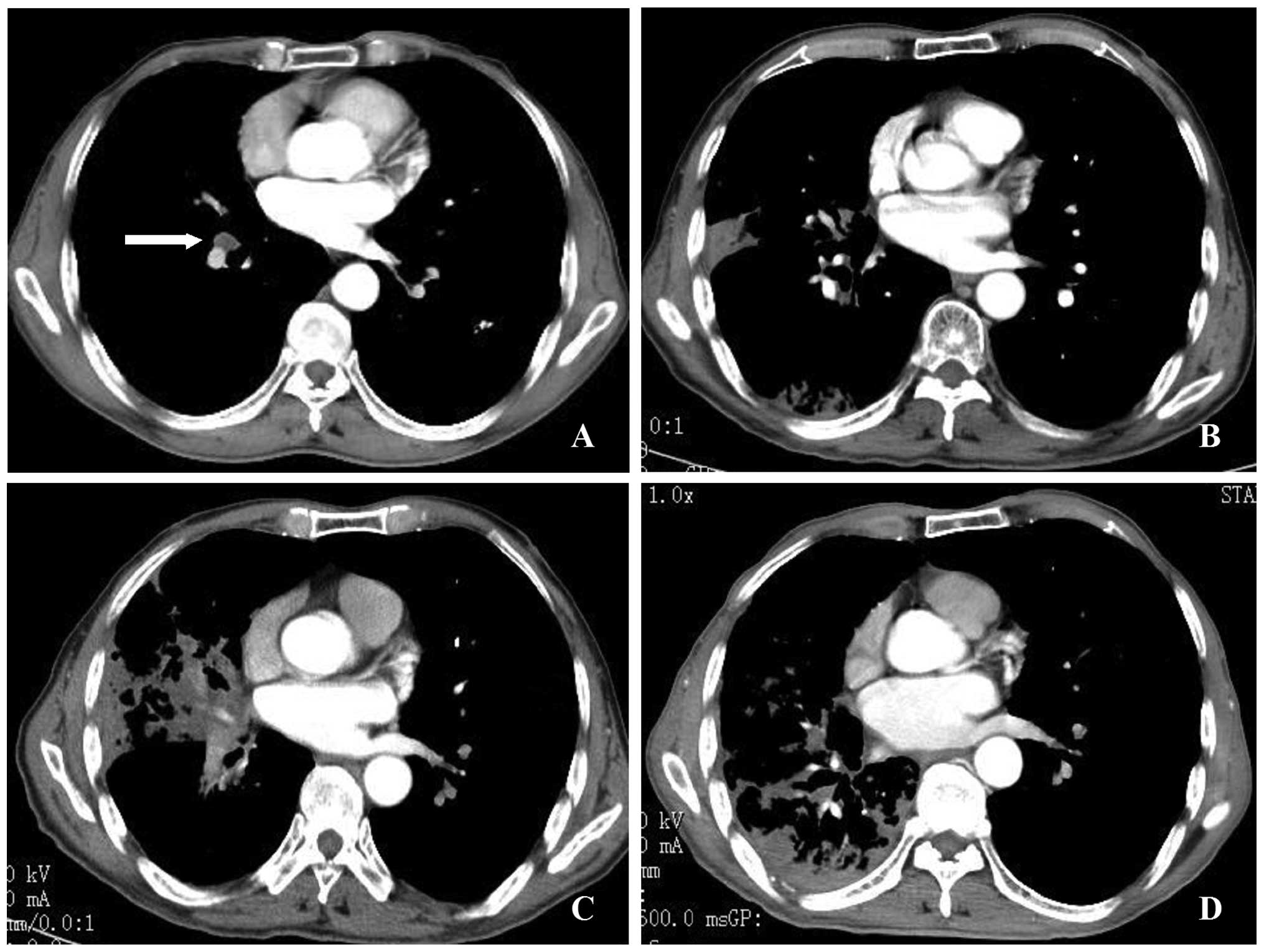
An 83-year-old man was diagnosed with stage T2N1M1 adenocarcinoma of the right lung (Fig. 1A). Palliative γ-ray SBRT was administered to the lesions in the right lower lung, right hilum and left lower lung at doses and fractions as previously described (13). Briefly, computed tomography (CT)-guided simulation was available for delineation of the gross tumor volume (GTV). The planning target volume (PTV) was generated with an additional 0.5 cm to the GTV in the axial plane and 1.0 cm in the longitudinal plane. The γ-SBRT plan included a 50% isodose line covering >95% of the PTV and a 70% isodose line covering >90% of the GTV. A total dose of 40 Gy was prescribed encompassing the PTV in 10 fractions (5 fractions per week) at 4 Gy per fraction and the corresponding dose of 56 Gy was prescribed encompassing the GTV (5.6 Gy/fraction).

Figure 1

Thoracic computed tomography scan of an 83-year-old man with adenocarcinoma of the right lung. (A) Prior to radiotherapy; (B) 6 months after radiotherapy (mild obstructive pneumonia); (C) 9 months after radiotherapy and 2 weeks after gefitinib initiation (severe obstructive pneumonia in the middle lobe of the right lung); (D) 14 months after radiotherapy (obstructive pneumonia in the middle lobe of the right lung is relieved and obstructive pneumonia in the inferior lobe of the right lung is aggravated). White arrow, location of tumor.

Considering the patient’s age, pemetrexed monotherapy was administered 4 times intermittently after radiotherapy. A review conducted at 6 months indicated mild radioactive inflammation of the right lung on CT scan (Fig. 1B). Oral gefitinib was initiated at 9 months post-radiotherapy. Two weeks later, the cough of the patient was exacerbated. A second CT scan revealed obstructive atelectasis in the lateral segment of the right middle lobe (Fig. 1C). The atelectasis was attributed to disease progression and gefitinib was terminated. Given the patient’s age, no further treatment options (chemotherapy, radiotherapy, or surgery) were contemplated. A CT scan at 14 months post-radiotherapy revealed that the obstructive atelectasis was mitigated in the lateral segment of the right middle lobe (Fig. 1D). However, the obstructive atelectasis in the posterior segment of the right upper lobe, the dorsal segment and the basal segment was aggravated. Metastasis to the contralateral lung was identified 6 months later, indicating disease progression.

Case 2

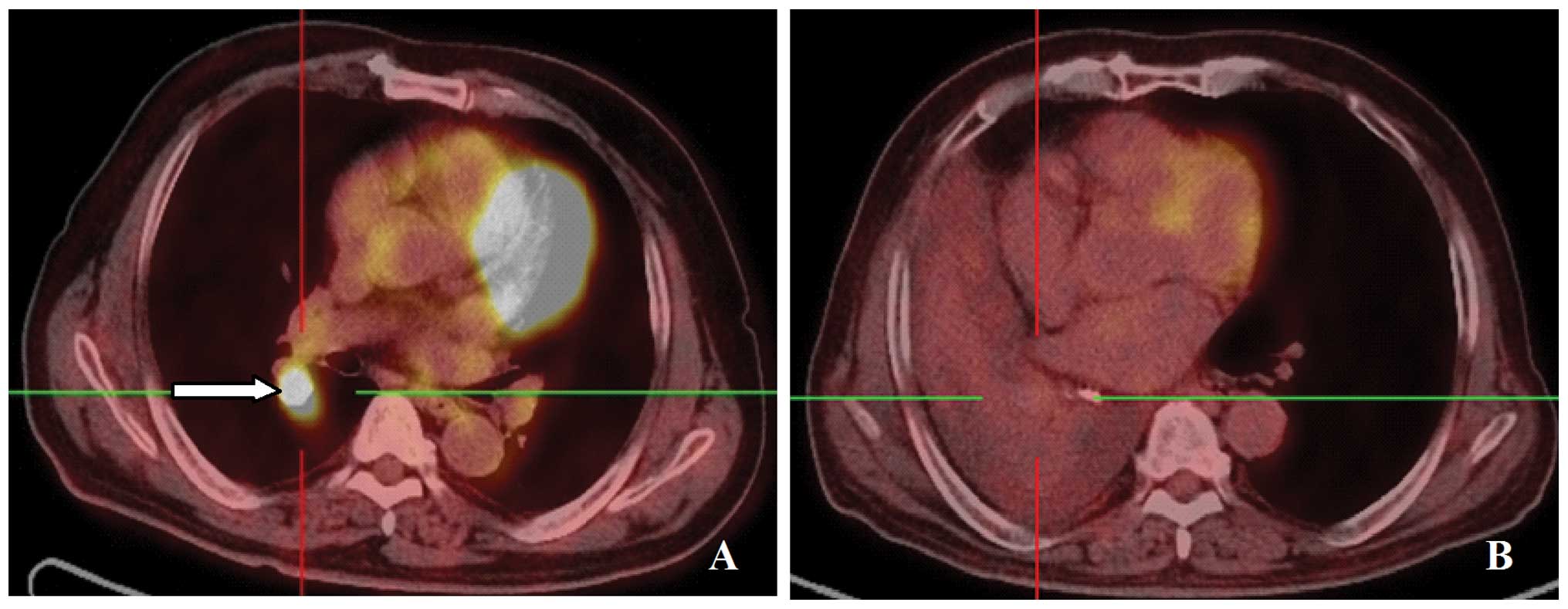
A 77-year-old man was diagnosed with stage T2N3M0 adenocarcinoma of the right lung. Positron emission tomography (PET)-CT examination revealed nodules in the right lower lobe, enlargement of the lymph nodes at the right hilum and above the left supraclavicular fossa, with increased standardized uptake values (SUV) of fluorodeoxyglucose (Fig. 2A). Palliative γ-ray SBRT was administered to the right hilum, right lower lobe and lymph nodes on the left supraclavicular fossa with a similar dose schedule to that of Case 1. Following radiotherapy, the patient received bevacizumab, pemetrexed, and nedaplatin. At the 1-month review, the CT scan revealed multiple small nodules in the right middle lobe and disease progression was considered. The patient declined further chemotherapy. Second-line oral gefitinib was initiated, with a decrease in the number of nodules in the right middle lobe 1 month after gefitinib treatment initiation. Partial regression was achieved. Gefitinib was continued for a further 7 months, when the patient experienced worsened post-exertional shortness of breath. A CT scan review revealed obstructive atelectasis in the right lung (Fig. 2B). Progressive disease was contemplated by an outpatient respiratory physician, who recommended terminating gefitinib. However, the PET-CT revealed a mass in the right lower lobe and enlargement of the lymph nodes in the right hilum and left supraclavicular fossa. No increase in SUV was observed in either area, indicating that the activity of the lesions was inhibited. Thus we recommended continuing gefitinib treatment.

Figure 2

Thoracic PET-CT scan of a 77-year-old man with adenocarcinoma of the right lung. (A) Prior to radiotherapy; (B) 7 months after radiotherapy and 6 months after gefitinib initiation (obstructive atelectasis in the right lobe with no FDG metabolism). White arrow, location of tumor. PET-CT, Positron emission tomography computed tomography; FDG, fluorodeoxyglucose.

Discussion

As interstitial pneumonia is one of the most severe side effects of EGFR-TKIs and radiotherapy, EGFR-TKIs and concurrent radiotherapy have been used with caution in clinical practice. Wang et al (13) reported only a low incidence rate (4%) of third-degree radiation pneumonitis in NSCLC patients receiving EGFR-TKI treatment plus radiotherapy. Okamoto et al (6), however, reported radiation pneumonitis in 2 of 7 stage III unresectable NSCLC patients. Onal et al (14) also reported on a patient who received erlotinib after radiotherapy, which induced radiation pneumonitis. Due to the aforementioned reasons, combination therapy was not prescribed for our two patients. Rather, additional EGFR-TKI treatment was administered sequentially after the completion of radiotherapy.

The main advantage of SBRT is its short radiation time and less damage to the surrounding tissues, resulting in a decreased risk of radiation pneumonitis in lung cancer. Wang et al (15) reported that in 14 patients with advanced NSCLC, SBRT combined with gefitinib resulted in a disease remission rate of up to 57.1%. The median time of disease remission was 8 months, while the 1-year survival rate was 69.6%, suggesting that this regimen may improve local control and disease remission rates with few side effects. Compared to 3D-RT or intensity-modulated radiotherapy, SBRT in combination with EGFR-TKIs may be a more suitable treatment option for elderly patients or those with diseases that are a contraindication to radiotherapy, such as chronic obstructive pulmonary disease (16).

However, our two patients with central lung lesions developed severe obstructive atelectasis while on gefitinib after undergoing SBRT, which interrupted our evaluation of gefitinib efficacy. Our analysis indicated that the occurrence of obstructive atelectasis mainly resulted from SBRT for lesions located in the hilum of the lung, which caused the late complication of radioactive bronchial fibrosis, in turn leading to bronchial stenosis. However, such severe obstructive atelectasis cannot exclude the synergistic role of gefitinib. Due to the misjudgement of obstructive atelectasis as a result of disease progression in Case 1, gefitinib was wrongly terminated after 2 weeks, depriving the patient of the opportunity to receive effective treatment. Case 2 was slightly more complicated. The patient did not undergo any gene mutation detection tests. The clinical trial from IPASS (17), suggested that the majority of the patients developed drug resistance within 6–8 months of taking the medication. This patient developed atelectasis exactly 7 months after gefitinib initiation. A PET-CT examination confirmed that there was no progression of the original lesions. Hence, we did not adopt the suggestion by outpatient physicians to discontinue the medication. In fact, Takeda et al (18) reported that, for patients with NSCLC after SBRT, the SUV from PET-CT are of higher diagnostic value regarding local recurrence compared to those from CT.

Our experience with patients who have recently undergone radiotherapy suggests that, if disease progression occurs at the site of radiotherapy during the course of EGFR-TKI treatment, the decision to discontinue the medication should be based on PET-CT rather than CT alone. Furthermore, radioactive atelectasis differs from radiation pneumonitis. If the patient is able to tolerate the condition without severe breathing difficulties, the recommendation is to continue medication. However, our empirical findings must be substantiated and confirmed through further clinical trials.

Acknowledgements

This study was supported by a grant from the National Natural Science Foundation of China (no. 81272599).

References

1 

Jemal A, Bray F, Center MM, Ferlay J, Ward E and Forman D: Global cancer statistics. CA Cancer J Clin. 61:69–90. 2011. View Article : Google Scholar

2 

Moran C: Importance of molecular features of non-small cell lung cancer for choice of treatment. Am J Pathol. 178:1940–1948. 2011. View Article : Google Scholar : PubMed/NCBI

3 

Salama JK and Vokes EE: New radiotherapy and chemoradiotherapy approaches for non-small-cell lung cancer. J Clin Oncol. 31:1029–1038. 2013. View Article : Google Scholar : PubMed/NCBI

4 

Pfister DG, Johnson DH, Azzoli CG, et al; American Society of Clinical Oncology. American Society of Clinical Oncology treatment of unresectable non-small-cell lung cancer guideline: update 2003. J Clin Oncol. 22:330–353. 2004. View Article : Google Scholar : PubMed/NCBI

5 

Furuse K, Fukuoka M, Kawahara M, et al: Phase III study of concurrent versus sequential thoracic radiotherapy in combination with mitomycin, vindesine, and cisplatin in unresectable stage III non-small-cell lung cancer. J Clin Oncol. 17:2692–2699. 1999.PubMed/NCBI

6 

Okamoto I: Overview of chemoradiation clinical trials for locally advanced non-small cell lung cancer in Japan. Int J Clin Oncol. 13:112–116. 2008. View Article : Google Scholar : PubMed/NCBI

7 

Chang CC, Chi KH, Kao SJ, et al: Upfront gefitinib/erlotinib treatment followed by concomitant radiotherapy for advanced lung cancer: a mono-institutional experience. Lung Cancer. 73:189–194. 2011. View Article : Google Scholar

8 

Sato Y, Ebara T, Sunaga N, Takahashi T and Nakano T: Interaction of radiation and gefitinib on a human lung cancer cell line with mutant EGFR gene in vitro. Anticancer Res. 32:4877–4881. 2012.PubMed/NCBI

9 

Nishie K, Kawaguchi T, Tamiya A, et al: Epidermal growth factor receptor tyrosine kinase inhibitors beyond progressive disease: a retrospective analysis for Japanese patients with activating EGFR mutations. J Thorac Oncol. 7:1722–1727. 2012. View Article : Google Scholar

10 

Graham JD, Nahum AE and Brada M: A comparison of techniques for stereotactic radiotherapy by linear accelerator based on 3-dimensional dose distributions. Radiother Oncol. 22:29–35. 1991. View Article : Google Scholar : PubMed/NCBI

11 

Senan S: Surgery versus stereotactic radiotherapy for patients with early-stage non-small cell lung cancer: More data from observational studies and growing clinical equipoise. Cancer. 119:2668–2270. 2013. View Article : Google Scholar

12 

Rowe BP, Boffa DJ, Wilson LD, Kim AW, Detterbeck FC and Decker RH: Stereotactic body radiotherapy for central lung tumors. J Thorac Oncol. 7:1394–1399. 2012. View Article : Google Scholar : PubMed/NCBI

13 

Wang J, Xia TY, Wang YJ, et al: Prospective study of epidermal growth factor receptor tyrosine kinase inhibitors concurrent with individualized radiotherapy for patients with locally advanced or metastatic non-small-cell lung cancer. Int J Radiat Oncol Biol Phys. 81:e59–e65. 2011. View Article : Google Scholar

14 

Onal C, Abali H, Koc Z and Kara S: Radiation recall pneumonitis caused by erlotinib after palliative definitive radiotherapy. Onkologie. 35:191–194. 2012. View Article : Google Scholar : PubMed/NCBI

15 

Wang Z, Zhu XX, Wu XH, et al: Gefitinib combined with stereotactic radiosurgery in previously treated patients with advanced non-small cell lung cancer. Am J Clin Oncol. Dec 1–2012.(Epub ahead of print).

16 

Yoshitake T, Nakamura K, Shioyama Y, et al: Stereotactic body radiation therapy for stage I non-small cell lung cancer patients with chronic respiratory insufficiency requiring domiciliary oxygen therapy. Anticancer Res. 32:4041–4044. 2012.

17 

Fukuoka M, Wu YL, Thongprasert S, et al: Biomarker analyses and final overall survival results from a phase III, randomized, open-label, first-line study of gefitinib versus carboplatin/paclitaxel in clinically selected patients with advanced non-small-cell lung cancer in Asia (IPASS). J Clin Oncol. 29:2866–2874. 2011. View Article : Google Scholar

18 

Takeda A, Kunieda E, Fujii H, et al: Evaluation for local failure by 18F-FDG PET/CT in comparison with CT findings after stereotactic body radiotherapy (SBRT) for localized non-small-cell lung cancer. Lung Cancer. 79:248–253. 2013. View Article : Google Scholar : PubMed/NCBI

Related Articles

  • Abstract
  • View
  • Download
  • Twitter
Copy and paste a formatted citation
Spandidos Publications style
Yang X, Xiong Y, Huang H, Peng B, Zhou Z, Xu M, Yang Y and Wang D: Misjudgement of gefitinib efficacy in patients with central non-small‑cell lung cancer due to obstructive atelectasis caused by stereotactic radiotherapy. Mol Clin Oncol 2: 535-538, 2014.
APA
Yang, X., Xiong, Y., Huang, H., Peng, B., Zhou, Z., Xu, M. ... Wang, D. (2014). Misjudgement of gefitinib efficacy in patients with central non-small‑cell lung cancer due to obstructive atelectasis caused by stereotactic radiotherapy. Molecular and Clinical Oncology, 2, 535-538. https://doi.org/10.3892/mco.2014.284
MLA
Yang, X., Xiong, Y., Huang, H., Peng, B., Zhou, Z., Xu, M., Yang, Y., Wang, D."Misjudgement of gefitinib efficacy in patients with central non-small‑cell lung cancer due to obstructive atelectasis caused by stereotactic radiotherapy". Molecular and Clinical Oncology 2.4 (2014): 535-538.
Chicago
Yang, X., Xiong, Y., Huang, H., Peng, B., Zhou, Z., Xu, M., Yang, Y., Wang, D."Misjudgement of gefitinib efficacy in patients with central non-small‑cell lung cancer due to obstructive atelectasis caused by stereotactic radiotherapy". Molecular and Clinical Oncology 2, no. 4 (2014): 535-538. https://doi.org/10.3892/mco.2014.284
Copy and paste a formatted citation
x
Spandidos Publications style
Yang X, Xiong Y, Huang H, Peng B, Zhou Z, Xu M, Yang Y and Wang D: Misjudgement of gefitinib efficacy in patients with central non-small‑cell lung cancer due to obstructive atelectasis caused by stereotactic radiotherapy. Mol Clin Oncol 2: 535-538, 2014.
APA
Yang, X., Xiong, Y., Huang, H., Peng, B., Zhou, Z., Xu, M. ... Wang, D. (2014). Misjudgement of gefitinib efficacy in patients with central non-small‑cell lung cancer due to obstructive atelectasis caused by stereotactic radiotherapy. Molecular and Clinical Oncology, 2, 535-538. https://doi.org/10.3892/mco.2014.284
MLA
Yang, X., Xiong, Y., Huang, H., Peng, B., Zhou, Z., Xu, M., Yang, Y., Wang, D."Misjudgement of gefitinib efficacy in patients with central non-small‑cell lung cancer due to obstructive atelectasis caused by stereotactic radiotherapy". Molecular and Clinical Oncology 2.4 (2014): 535-538.
Chicago
Yang, X., Xiong, Y., Huang, H., Peng, B., Zhou, Z., Xu, M., Yang, Y., Wang, D."Misjudgement of gefitinib efficacy in patients with central non-small‑cell lung cancer due to obstructive atelectasis caused by stereotactic radiotherapy". Molecular and Clinical Oncology 2, no. 4 (2014): 535-538. https://doi.org/10.3892/mco.2014.284
Follow us
  • Twitter
  • LinkedIn
  • Facebook
About
  • Spandidos Publications
  • Careers
  • Cookie Policy
  • Privacy Policy
How can we help?
  • Help
  • Live Chat
  • Contact
  • Email to our Support Team