Spandidos Publications Logo
  • About
    • About Spandidos
    • Aims and Scopes
    • Abstracting and Indexing
    • Editorial Policies
    • Reprints and Permissions
    • Job Opportunities
    • Terms and Conditions
    • Contact
  • Journals
    • All Journals
    • Oncology Letters
      • Oncology Letters
      • Information for Authors
      • Editorial Policies
      • Editorial Board
      • Aims and Scope
      • Abstracting and Indexing
      • Bibliographic Information
      • Archive
    • International Journal of Oncology
      • International Journal of Oncology
      • Information for Authors
      • Editorial Policies
      • Editorial Board
      • Aims and Scope
      • Abstracting and Indexing
      • Bibliographic Information
      • Archive
    • Molecular and Clinical Oncology
      • Molecular and Clinical Oncology
      • Information for Authors
      • Editorial Policies
      • Editorial Board
      • Aims and Scope
      • Abstracting and Indexing
      • Bibliographic Information
      • Archive
    • Experimental and Therapeutic Medicine
      • Experimental and Therapeutic Medicine
      • Information for Authors
      • Editorial Policies
      • Editorial Board
      • Aims and Scope
      • Abstracting and Indexing
      • Bibliographic Information
      • Archive
    • International Journal of Molecular Medicine
      • International Journal of Molecular Medicine
      • Information for Authors
      • Editorial Policies
      • Editorial Board
      • Aims and Scope
      • Abstracting and Indexing
      • Bibliographic Information
      • Archive
    • Biomedical Reports
      • Biomedical Reports
      • Information for Authors
      • Editorial Policies
      • Editorial Board
      • Aims and Scope
      • Abstracting and Indexing
      • Bibliographic Information
      • Archive
    • Oncology Reports
      • Oncology Reports
      • Information for Authors
      • Editorial Policies
      • Editorial Board
      • Aims and Scope
      • Abstracting and Indexing
      • Bibliographic Information
      • Archive
    • Molecular Medicine Reports
      • Molecular Medicine Reports
      • Information for Authors
      • Editorial Policies
      • Editorial Board
      • Aims and Scope
      • Abstracting and Indexing
      • Bibliographic Information
      • Archive
    • World Academy of Sciences Journal
      • World Academy of Sciences Journal
      • Information for Authors
      • Editorial Policies
      • Editorial Board
      • Aims and Scope
      • Abstracting and Indexing
      • Bibliographic Information
      • Archive
    • International Journal of Functional Nutrition
      • International Journal of Functional Nutrition
      • Information for Authors
      • Editorial Policies
      • Editorial Board
      • Aims and Scope
      • Abstracting and Indexing
      • Bibliographic Information
      • Archive
    • International Journal of Epigenetics
      • International Journal of Epigenetics
      • Information for Authors
      • Editorial Policies
      • Editorial Board
      • Aims and Scope
      • Abstracting and Indexing
      • Bibliographic Information
      • Archive
    • Medicine International
      • Medicine International
      • Information for Authors
      • Editorial Policies
      • Editorial Board
      • Aims and Scope
      • Abstracting and Indexing
      • Bibliographic Information
      • Archive
  • Articles
  • Information
    • Information for Authors
    • Information for Reviewers
    • Information for Librarians
    • Information for Advertisers
    • Conferences
  • Language Editing
Spandidos Publications Logo
  • About
    • About Spandidos
    • Aims and Scopes
    • Abstracting and Indexing
    • Editorial Policies
    • Reprints and Permissions
    • Job Opportunities
    • Terms and Conditions
    • Contact
  • Journals
    • All Journals
    • Biomedical Reports
      • Information for Authors
      • Editorial Policies
      • Editorial Board
      • Aims and Scope
      • Abstracting and Indexing
      • Bibliographic Information
      • Archive
    • Experimental and Therapeutic Medicine
      • Information for Authors
      • Editorial Policies
      • Editorial Board
      • Aims and Scope
      • Abstracting and Indexing
      • Bibliographic Information
      • Archive
    • International Journal of Epigenetics
      • Information for Authors
      • Editorial Policies
      • Editorial Board
      • Aims and Scope
      • Abstracting and Indexing
      • Bibliographic Information
      • Archive
    • International Journal of Functional Nutrition
      • Information for Authors
      • Editorial Policies
      • Editorial Board
      • Aims and Scope
      • Abstracting and Indexing
      • Bibliographic Information
      • Archive
    • International Journal of Molecular Medicine
      • Information for Authors
      • Editorial Policies
      • Editorial Board
      • Aims and Scope
      • Abstracting and Indexing
      • Bibliographic Information
      • Archive
    • International Journal of Oncology
      • Information for Authors
      • Editorial Policies
      • Editorial Board
      • Aims and Scope
      • Abstracting and Indexing
      • Bibliographic Information
      • Archive
    • Medicine International
      • Information for Authors
      • Editorial Policies
      • Editorial Board
      • Aims and Scope
      • Abstracting and Indexing
      • Bibliographic Information
      • Archive
    • Molecular and Clinical Oncology
      • Information for Authors
      • Editorial Policies
      • Editorial Board
      • Aims and Scope
      • Abstracting and Indexing
      • Bibliographic Information
      • Archive
    • Molecular Medicine Reports
      • Information for Authors
      • Editorial Policies
      • Editorial Board
      • Aims and Scope
      • Abstracting and Indexing
      • Bibliographic Information
      • Archive
    • Oncology Letters
      • Information for Authors
      • Editorial Policies
      • Editorial Board
      • Aims and Scope
      • Abstracting and Indexing
      • Bibliographic Information
      • Archive
    • Oncology Reports
      • Information for Authors
      • Editorial Policies
      • Editorial Board
      • Aims and Scope
      • Abstracting and Indexing
      • Bibliographic Information
      • Archive
    • World Academy of Sciences Journal
      • Information for Authors
      • Editorial Policies
      • Editorial Board
      • Aims and Scope
      • Abstracting and Indexing
      • Bibliographic Information
      • Archive
  • Articles
  • Information
    • For Authors
    • For Reviewers
    • For Librarians
    • For Advertisers
    • Conferences
  • Language Editing
Login Register Submit
  • This site uses cookies
  • You can change your cookie settings at any time by following the instructions in our Cookie Policy. To find out more, you may read our Privacy Policy.

    I agree
Search articles by DOI, keyword, author or affiliation
Search
Advanced Search
presentation
Molecular and Clinical Oncology
Join Editorial Board Propose a Special Issue
Print ISSN: 2049-9450 Online ISSN: 2049-9469
Journal Cover
January-February 2015 Volume 3 Issue 1

Full Size Image

Sign up for eToc alerts
Recommend to Library

Journals

International Journal of Molecular Medicine

International Journal of Molecular Medicine

International Journal of Molecular Medicine is an international journal devoted to molecular mechanisms of human disease.

International Journal of Oncology

International Journal of Oncology

International Journal of Oncology is an international journal devoted to oncology research and cancer treatment.

Molecular Medicine Reports

Molecular Medicine Reports

Covers molecular medicine topics such as pharmacology, pathology, genetics, neuroscience, infectious diseases, molecular cardiology, and molecular surgery.

Oncology Reports

Oncology Reports

Oncology Reports is an international journal devoted to fundamental and applied research in Oncology.

Experimental and Therapeutic Medicine

Experimental and Therapeutic Medicine

Experimental and Therapeutic Medicine is an international journal devoted to laboratory and clinical medicine.

Oncology Letters

Oncology Letters

Oncology Letters is an international journal devoted to Experimental and Clinical Oncology.

Biomedical Reports

Biomedical Reports

Explores a wide range of biological and medical fields, including pharmacology, genetics, microbiology, neuroscience, and molecular cardiology.

Molecular and Clinical Oncology

Molecular and Clinical Oncology

International journal addressing all aspects of oncology research, from tumorigenesis and oncogenes to chemotherapy and metastasis.

World Academy of Sciences Journal

World Academy of Sciences Journal

Multidisciplinary open-access journal spanning biochemistry, genetics, neuroscience, environmental health, and synthetic biology.

International Journal of Functional Nutrition

International Journal of Functional Nutrition

Open-access journal combining biochemistry, pharmacology, immunology, and genetics to advance health through functional nutrition.

International Journal of Epigenetics

International Journal of Epigenetics

Publishes open-access research on using epigenetics to advance understanding and treatment of human disease.

Medicine International

Medicine International

An International Open Access Journal Devoted to General Medicine.

Journal Cover
January-February 2015 Volume 3 Issue 1

Full Size Image

Sign up for eToc alerts
Recommend to Library

  • Article
  • Citations
    • Cite This Article
    • Download Citation
    • Create Citation Alert
    • Remove Citation Alert
    • Cited By
  • Similar Articles
    • Related Articles (in Spandidos Publications)
    • Similar Articles (Google Scholar)
    • Similar Articles (PubMed)
  • Download PDF
  • Download XML
  • View XML
Article

Radiation effects on DNA content of cervical cancer cells: A rapid evaluation of radiation sensitivity by laser scanning cytometry

  • Authors:
    • Naoki Fujiyoshi
    • Kimio Ushijima
    • Kouichiro Kawano
    • Keizo Fujiyoshi
    • Tomohiko Yamaguchi
    • Yuko Araki
    • Tatsuyuki Kakuma
    • Sumiko Watanabe
    • Tsunehisa Kaku
    • Takashi Nishida
    • Toshiharu Kamura
  • View Affiliations / Copyright

    Affiliations: Department of Obstetrics and Gynecology, School of Medicine, Kurume University, Kurume, Fukuoka, Japan, Department of Diagnostic Pathology, Kurume University Hospital, Kurume University, Kurume, Japan, Department of Biostatistics, School of Medicine, Kurume University, Kurume, Japan, Department of Health Science, Faculty of Medicine, Kyushu University, Higashi‑ku, Fukuoka, Japan, Department of Gynecology, Oita Prefecture Saiseikai Hita Hospital, Hita, Oita, Japan
  • Pages: 51-54
    |
    Published online on: September 9, 2014
       https://doi.org/10.3892/mco.2014.413
  • Expand metrics +
Metrics: Total Views: 0 (Spandidos Publications: | PMC Statistics: )
Metrics: Total PDF Downloads: 0 (Spandidos Publications: | PMC Statistics: )
Cited By (CrossRef): 0 citations Loading Articles...

This article is mentioned in:


Abstract

Since uterine cervical cancer is regarded as a radiosensive tumor, ionizing radiation is the most frequently used treatment modality against the disease. Although the crucial end‑point is radiation‑induced cell death, the tumors are not equally sensitive to radiation. Determining the criteria that may be used to predict tumor radiosensitivity is of importance; however, little success has been achieved thus far. In radioresistant cases the therapeutic strategy should be changed, thereby avoiding ineffective or unnecessary treatment. Furthermore, identification of the underlying molecular processes leading to radioresistance may lead to novel radiosensitising strategies. Cervical smears were obtained from seven patients with locally advanced cervical cancer following each radiotherapy, and the radiation‑induced damage of cancer tissue was examined by routine cytology. Since the formation of DNA double‑strand breaks is considered critical for the cytocidal effect of radiation therapy, the molecular changes of the neoplastic cells were also assessed by laser scanning cytometry (LSC). Radiation‑induced morphological changes of cancer cells were evident at a dose of 7.2 Gy, whereas increased DNA content (or DNA index) was observed prior to the onset of morphological changes. Molecular change was detected earlier than the morphological change of the irradiated cancer cells, indicating the feasibility of LSC in predicting the radiosensitivity of cervical cancer tissue.

Introduction

Uterine cervical cancer is the second most common type of cancer in females globally (1). According to the Globocan project, the disease has one of the greatest incidences of female mortalities, despite the effective screening system (2). Since cervical cancer is accepted as a radiosensitive tumor, ionizing radiation is the most frequently used treatment modality against the disease. Therefore, cellular radiosensitivity is a long-term research focus in the field of radiation oncology and biology as it has a clear effect on the outcome of therapy (3). The tumors, however, are not equally sensitive to radiation (4).

Traditionally, radioresistant tumors have been mainly designated from the histopathological viewpoint (5). Glassy cell carcinoma and small cell carcinoma, including neuroendocrine tumors of the cervix, are generally regarded as radioresistant tumors. These specific histological types, however, are rather rare in cervical neoplasms. Furthermore, there may be significant variation in radiosensitivity even within the same histological type. Thus, tumor histology may not be a crucial determinant of radiosensitivity.

The initial damage should be a major determinant of cell radiosensitivity (6). By contrast, flow cytometry (FC) is a technique for the rapid analysis of DNA content, phenotype expression and the sorting of cells for further studies. FC allows quantitative measurements on single cells or cellular constituents at an extremely high speed rate. It is also feasible to monitor the effects of radiation on the cell cycle distribution following DNA staining of mammalian cells (7, 8). Since the formation of DNA double-strand breaks is considered to be critical for the cytocidal effect of radiation therapy (9–12), identifying the underlying molecular processes that results in radioresistance may lead to novel radiosensitising strategies.

A newly developed microscope-based laser scanning cytometer (LSC) offers a number of advantages over FC (13, 14). LSC can assess the DNA index (DI) in hypocellular materials, even on cytological smear slides (15).

Cell necrobiology incorporates the life processes associated with morphological, biochemical and molecular changes that predispose, precede and accompany cell death, and assess the consequences and tissue response to cell death (16). The aim of the present study was to discern the radiation-induced initial damage that leads to cancer cell death by necrobiological observation, including cytological morphology and LSC.

Materials and methods

Patients

Seven patients with locally advanced uterine cervical carcinoma were treated in the Kurume University Hospital (Kurume, Fukuoka, Japan) between June 2008 and June 2009. The patient characteristics are shown in Table I. Subsequent to obtaining informed consent, two patients received external beam radiotherapy alone at a dose of 1.8 Gy per day by linac 10 MeV X-ray, and the remaining five patients underwent concurrent chemo-radiotherapy consisting of 5 mg/body of cisplatin prior to the same dose of radiation therapy. A total dose of 50 Gy was administered. The patient age ranged from 38 to 74 years (mean, 58 years), and their tumors were classified as six stage IIIb diseases and one stage IVa cancer, according to the International Federation of Gynecology and Obstetrics staging criteria (17). The tumor histologies were equally non-keratinizing squamous cell carcinoma.

Table I

Characteristics of seven patients with inoperable cervical cancer.

Table I

Characteristics of seven patients with inoperable cervical cancer.

PatientsAge, yearsFIGO stageTumor size, mmTreatmentsClinical responsePrognosisPFS, months
138IIIb59RTPRDOD7
248IIIb68CCRTCRAWD24
357IIIb59CCRTPRNED–
453IIIb52CCRTCRNED–
545IIIb32CCRTPRNED–
670IIIb74CCRTCRDOD3
774IVa50RTCRAWD24

[i] FIGO, International Federation of Gynecology and Obstetrics; RT, radiation therapy; CCRT, concurrent chemoradiation therapy; CR, complete response; PR, partial response; DOD, died of disease; NED, no evidence of disease; AWD, alive with disease; PFS, progression-free survival.

Preparation for the Papanicolau staining and DNA index

To exhibit the therapeutic responses, the response criteria offered by the UICC (Union Internationale Contre le Cancer) were used for the evaluable lesions (18). To assess the effects of radiation on tumor cells, cervical smears were obtained following each radiation therapy using a cotton-tipped stick, rinsed into serum-free medium (RPMI-1640) and fixed in 95% ethanol prior to Papanicolau (Pap) staining. The radiation-induced morphological changes were evaluated by routine cytological examination.

For the cytometric observation, the Pap smear specimens were decolorized and dipped in propidium iodine (PI) solution, which was composed of 25 µg/ml PI in phosphate-buffered saline containing 0.1% RNase (Sigma-Aldrich, St. Louis, MO, USA), and stained again with fluorochrome and PI. For the cellular DNA content analysis, a laser scanning cytometer (LSC 101; Olympus Co., Tokyo, Japan) was used. At least 500 cancer cells were measured per sample.

To determine the DI, human leucocytes from freshly collected blood were used as a standard. A DI of 3.0 indicates DNA tetraploid. In the present study, tumors that were 3.0 < DI < 30 were classified as near-tetraploid cases and distinguished from DNA aneuploid tumors (DI>3.0). P<0.05 was considered to indicate a statistically significant difference. All the patients provided written informed consent according to the institutional regulations. The study was approved by the Ethics Committee of the Department of Gynecology, Oita Prefecture Saiseikai Hita Hospital (Hita, Oita, Japan).

Results

Patient characteristics

Clinical responses to the radiation therapy are demonstrated in Table I, showing a response rate of 100% [four complete responses (CRs) and three partial responses (PRs)]. Three CR cases remained with no evidence of disease, and two PR cases remained with disease, showing a disease-free survival rate of 42.7%.

Radiation-induced morphological damage of cancer cells with cytoplasmic vacuolization

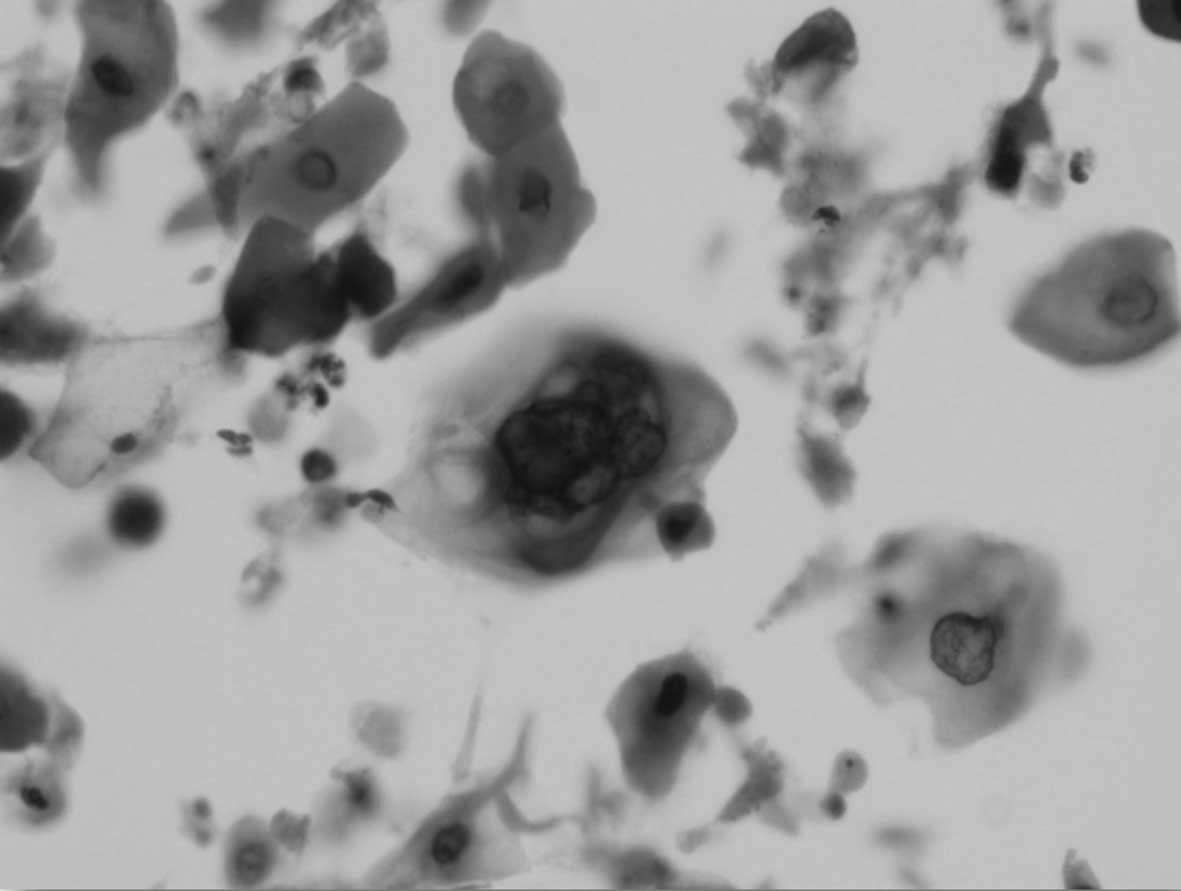
In the cytology of all cases, a characteristic feature of the radiation effect was observed, exhibiting intracytoplasmic vacuolization (Fig. 1). These morphological changes emerged at cumulative doses between 7.2 and 14.4 Gy. Evidently, radiation that was <7.2 Gy did not cause any discernible changes in cancer cell cytology.

Figure 1

Radiation-induced morphological damage of cancer cells with cytoplasmic vacuolization (center). PAP stain; magnification, x400.

DNA content analysis

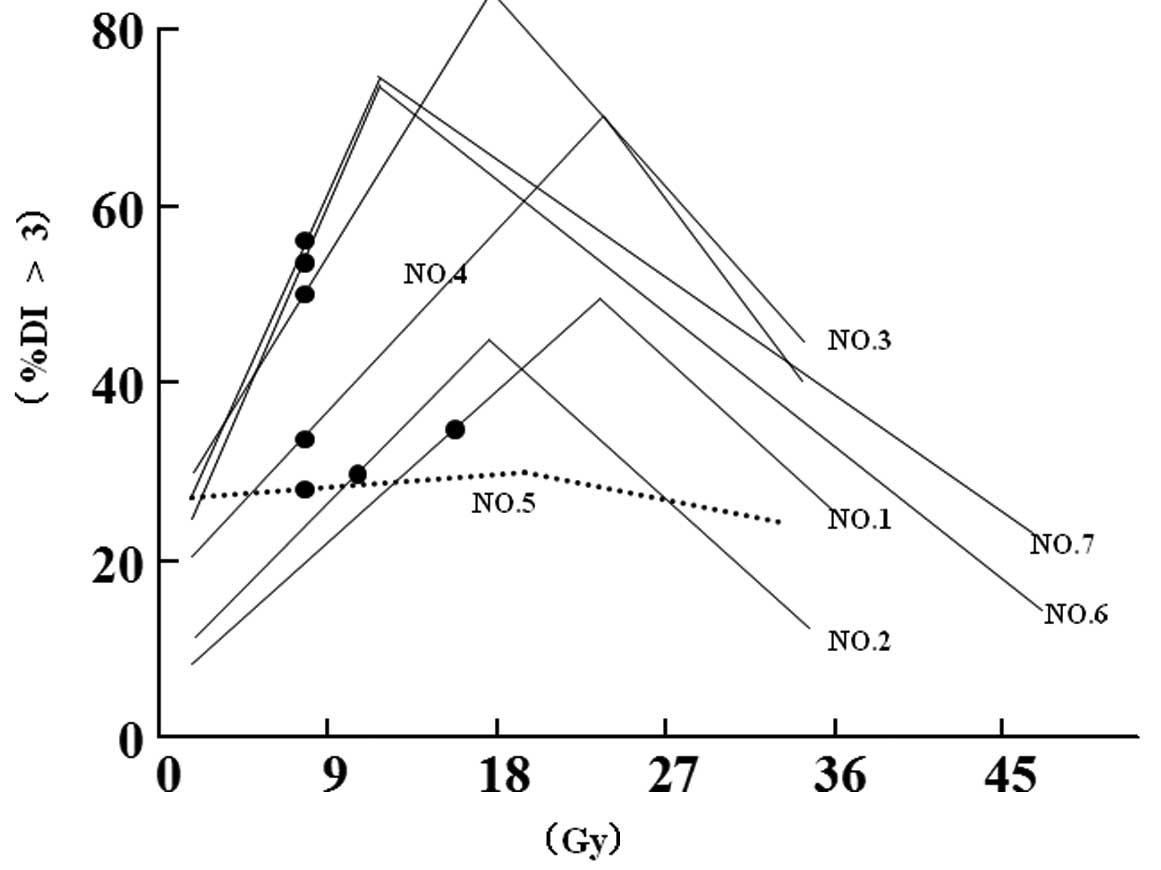
The DNA content analysis by LSC revealed six out of seven cases (85.7%, P<0.05), showing the percentage of cells having a DI value >3. The increase in DNA content was observed immediately following the start of radiation therapy, although the values were varied in each case (Fig. 2).

Figure 2

Linear spline graph of the change in DNA content, with the percentage of cells with a DI value >3 (y-axis) against the total radiation dose (x-axis). Other than the dotted line representing case No.5, a significant increase in DNA concentration was observed immediately following the start of irradiation. ●, onset of morphological changes in cervical cancer cells. DI, DNA index.

Discussion

Although ionizing radiotherapy is a key strategy and has >80 years history in the treatment of cervical cancer, the crucial determinant of radiosensitivity of the tumor remains unknown (3, 4, 19). Thus, understanding how to identify the treatment-induced initial damage of cancer cells is essential for further therapeutic plans in cancer therapy. An assay with the ability to predict the radiosensitivity of tumors may provide a useful tool for the further individualization of radiotherapy of cancer patients (20). The prognostic significance of the fraction of survival following 2 Gy of radiation (SF2) is crucial in the treatment of head and neck cancer (21). However, the methods to determine SF2 can take ≤4 weeks and are therefore not clinically practical.

To improve the treatment strategy, the early evaluation of therapeutic responses should be performed. The current response criteria, including that of the UICC, are only used for the evaluation of the treatment results. Radiation damages can be observed as cellular degeneration by cytology. However, these are late events in the treatment course. The importance of a more prompt evaluation is critical with regards to clinical decision making.

The impacts of radiation on cervical cancer cells resulted in a significant elevation of the DNA content level in six out of seven cases. Radiation causes a division delay dominated by G2 arrest in the cell cycle. The delay is likely a mechanism allowing the cell to repair its DNA damage. Ionizing radiation can also induce polyploidization in a cancer cell line (22). Furthermore, radiation-induced apoptosis is morphologically identified by an increase in cytoplasmic granularity, chromatin condensation, membrane blebbing, cell shrinkage and the formation of distinctive nuclear bodies. These radiation effects should attribute to the change of DNA content.

Currently, there are a number of studies reporting on the concern of the radiation impacts on the molecular structure of cancer cells by novel techniques, including cytometry and LSC, revealing the precise mechanism involved in radiation effects. Despite the notable technical advance in elucidation of the molecular mechanism of the radiation effects, the results obtained remain to be utilized in clinical decision making. Rapid analyses of radiation-induced molecular changes by LSC are promising, although certain changes remain to be resolved, and this can lead to the ‘real-time judgement’ of the radiosensitivity of the tumor, and aid in making a treatment decision in the clinical practice.

Acknowledgements

The present study was supported by the Supporting Fund of Obstetrics and Gynecology of the Kurume University. The authors would like to thank C.T. Kazuko Eguchi for her technical support of Pap and PI staining.

References

1 

Waqqoner SE: Cervical cancer. Lancet. 361:2217–2225. 2003. View Article : Google Scholar

2 

Parkin DM, Bray F, Ferlay J and Pisani P: Estimating the world cancer burden: Globocan 2000. Int J Cancer. 94:153–156. 2001. View Article : Google Scholar : PubMed/NCBI

3 

Hu Q and Hill RP: Radiosensitivity, apoptosis and repair of DNA double-strand breaks in radiation-sensitive Chinese hamster ovary cell mutants treated at different dose rates. Radiat Res. 146:636–645. 1996. View Article : Google Scholar

4 

Weichselbaum RR, Dahleberg W and Little JB: Inherently radioresistant cells exist in some human tumors. Proc Natl Acad Sci USA. 82:4732–4735. 1985. View Article : Google Scholar : PubMed/NCBI

5 

Steel GG, McMillan TJ and Peacock JH: The radiobiology of human cells and tissues. In vitro radiosensitivity. The picture has changed in the 1980s. Int J Radiat Biol. 56:525–537. 1989.

6 

Ruiz de Almodóvar JM, Núñez MI, McMillan TJ, Olea C, Mort C, Villalobos M, Pedraza V and Steel GG: Initial radiation-induced DNA damage in human tumour cell lines: a correlation with intrinsic cellular radiosensitivity. Br J Cancer. 69:457–462. 1994.PubMed/NCBI

7 

Kamentsky LA and Melamed MR: Spectrophotometer cell sorter. Science. 156:1364–1365. 1967. View Article : Google Scholar : PubMed/NCBI

8 

Baatout S and Derradji H: Cytometric methods to analyze radiation effects. J Biol Regul Homeost Agents. 18:101–105. 2004.PubMed/NCBI

9 

Ward JF: The yield of DNA double-strand breaks produced intracellulary by ionizing radiation: a review. Int J Radiat Biol. 57:1141–1150. 1990. View Article : Google Scholar : PubMed/NCBI

10 

Brenner DJ and Ward JF: Constraints on energy deposition and target size of multiply damaged sites associated with DNA double-strand breaks. Int J Radiat Biol. 61:737–748. 1992. View Article : Google Scholar : PubMed/NCBI

11 

Nikjoo H, O'Neill P, Wilson WE and Goodhead DT: Computational approach for determining the spectrum of DNA damage induced by ionizing radiation. Radiat Res. 156:577–583. 2001. View Article : Google Scholar : PubMed/NCBI

12 

Datta K, Jaruga P, Dizdarglu M, Neumann RD and Winters TA: Molecular analysis of base damage clustering associated with a site-specific radiation-induced DNA double-strand break. Radiat Res. 166:767–781. 2006.

13 

Kamentsky LA and Kamentsky LD: Microscope-based multiparameter laser scanning cytometer yielding data comparable to flow cytometry data. Cytometry. 12:381–387. 1991. View Article : Google Scholar : PubMed/NCBI

14 

Kamentsky LA, Burger DE, Gershman RJ, Kamentsky LD and Luther E: Slide-based laser scanning cytometry. Acta Cytol. 41:123–143. 1997.PubMed/NCBI

15 

Martin-Reay DG, Kamentsky LA, Weinberg DS, Hollister KA and Cibas ES: Evaluation of a new slide-based laser scanning cytometer for DNA analysis of tumors. Comparison with flow cytometry and image analysis. Am J Clin Pathol. 102:432–438. 1994.PubMed/NCBI

16 

Darzynkiewicz Z, Juan G, Li X, Gorczyca W, Murakami T and Traganos F: Cytometry in cell necrobiology: analysis of apoptosis and accidental cell death (necrosis). Cytometry. 27:1–20. 1997. View Article : Google Scholar : PubMed/NCBI

17 

Petignat P and Roy M: Diagnosis and management of cervical cancer. BMJ. 335:765–768. 2007. View Article : Google Scholar

18 

Monfardini S, Brunner K, Crowther D, Olive D, MacDonald J, Eckhardt S and Whitehouse J: Manua. of Cancer Chemotherapy3rd. Union Internationale Contre le Cancer; Geneva: 1981

19 

Gao Y, Ma JL and Song LP: The evaluation of older patients with cervical cancer. Clin Interv Aging. 8:783–788. 2013. View Article : Google Scholar : PubMed/NCBI

20 

Bentzen SM and Hendry JH: Variability in the radiosensitivity of normal cells and tissues. Report from a workshop organised by the European Society for Therapeuic Radiology and Oncology in Edinburgh, UK, 19 September 1998. Int J Radiat Biol. 75:513–517. 1999. View Article : Google Scholar

21 

Björk-Eriksson T, West C, Karlsson E and Mercke C: Tumor radiosensitivity (SF2) is a prognostic factor local control in head and neck cancers. Int J Radiat Oncol Biol Phys. 46:13–19. 2000.PubMed/NCBI

22 

Baatout S, Derradji H, Jacquet P, Ooms D, Michaux A and Mergeay M: Enhanced radiation-induced apoptosis of cancer cell lines after treatment with resveratrol. Int J Mol Med. 13:895–902. 2004.PubMed/NCBI

Related Articles

  • Abstract
  • View
  • Download
  • Twitter
Copy and paste a formatted citation
Spandidos Publications style
Fujiyoshi N, Ushijima K, Kawano K, Fujiyoshi K, Yamaguchi T, Araki Y, Kakuma T, Watanabe S, Kaku T, Nishida T, Nishida T, et al: Radiation effects on DNA content of cervical cancer cells: A rapid evaluation of radiation sensitivity by laser scanning cytometry. Mol Clin Oncol 3: 51-54, 2015.
APA
Fujiyoshi, N., Ushijima, K., Kawano, K., Fujiyoshi, K., Yamaguchi, T., Araki, Y. ... Kamura, T. (2015). Radiation effects on DNA content of cervical cancer cells: A rapid evaluation of radiation sensitivity by laser scanning cytometry. Molecular and Clinical Oncology, 3, 51-54. https://doi.org/10.3892/mco.2014.413
MLA
Fujiyoshi, N., Ushijima, K., Kawano, K., Fujiyoshi, K., Yamaguchi, T., Araki, Y., Kakuma, T., Watanabe, S., Kaku, T., Nishida, T., Kamura, T."Radiation effects on DNA content of cervical cancer cells: A rapid evaluation of radiation sensitivity by laser scanning cytometry". Molecular and Clinical Oncology 3.1 (2015): 51-54.
Chicago
Fujiyoshi, N., Ushijima, K., Kawano, K., Fujiyoshi, K., Yamaguchi, T., Araki, Y., Kakuma, T., Watanabe, S., Kaku, T., Nishida, T., Kamura, T."Radiation effects on DNA content of cervical cancer cells: A rapid evaluation of radiation sensitivity by laser scanning cytometry". Molecular and Clinical Oncology 3, no. 1 (2015): 51-54. https://doi.org/10.3892/mco.2014.413
Copy and paste a formatted citation
x
Spandidos Publications style
Fujiyoshi N, Ushijima K, Kawano K, Fujiyoshi K, Yamaguchi T, Araki Y, Kakuma T, Watanabe S, Kaku T, Nishida T, Nishida T, et al: Radiation effects on DNA content of cervical cancer cells: A rapid evaluation of radiation sensitivity by laser scanning cytometry. Mol Clin Oncol 3: 51-54, 2015.
APA
Fujiyoshi, N., Ushijima, K., Kawano, K., Fujiyoshi, K., Yamaguchi, T., Araki, Y. ... Kamura, T. (2015). Radiation effects on DNA content of cervical cancer cells: A rapid evaluation of radiation sensitivity by laser scanning cytometry. Molecular and Clinical Oncology, 3, 51-54. https://doi.org/10.3892/mco.2014.413
MLA
Fujiyoshi, N., Ushijima, K., Kawano, K., Fujiyoshi, K., Yamaguchi, T., Araki, Y., Kakuma, T., Watanabe, S., Kaku, T., Nishida, T., Kamura, T."Radiation effects on DNA content of cervical cancer cells: A rapid evaluation of radiation sensitivity by laser scanning cytometry". Molecular and Clinical Oncology 3.1 (2015): 51-54.
Chicago
Fujiyoshi, N., Ushijima, K., Kawano, K., Fujiyoshi, K., Yamaguchi, T., Araki, Y., Kakuma, T., Watanabe, S., Kaku, T., Nishida, T., Kamura, T."Radiation effects on DNA content of cervical cancer cells: A rapid evaluation of radiation sensitivity by laser scanning cytometry". Molecular and Clinical Oncology 3, no. 1 (2015): 51-54. https://doi.org/10.3892/mco.2014.413
Follow us
  • Twitter
  • LinkedIn
  • Facebook
About
  • Spandidos Publications
  • Careers
  • Cookie Policy
  • Privacy Policy
How can we help?
  • Help
  • Live Chat
  • Contact
  • Email to our Support Team