Spandidos Publications Logo
  • About
    • About Spandidos
    • Aims and Scopes
    • Abstracting and Indexing
    • Editorial Policies
    • Reprints and Permissions
    • Job Opportunities
    • Terms and Conditions
    • Contact
  • Journals
    • All Journals
    • Oncology Letters
      • Oncology Letters
      • Information for Authors
      • Editorial Policies
      • Editorial Board
      • Aims and Scope
      • Abstracting and Indexing
      • Bibliographic Information
      • Archive
    • International Journal of Oncology
      • International Journal of Oncology
      • Information for Authors
      • Editorial Policies
      • Editorial Board
      • Aims and Scope
      • Abstracting and Indexing
      • Bibliographic Information
      • Archive
    • Molecular and Clinical Oncology
      • Molecular and Clinical Oncology
      • Information for Authors
      • Editorial Policies
      • Editorial Board
      • Aims and Scope
      • Abstracting and Indexing
      • Bibliographic Information
      • Archive
    • Experimental and Therapeutic Medicine
      • Experimental and Therapeutic Medicine
      • Information for Authors
      • Editorial Policies
      • Editorial Board
      • Aims and Scope
      • Abstracting and Indexing
      • Bibliographic Information
      • Archive
    • International Journal of Molecular Medicine
      • International Journal of Molecular Medicine
      • Information for Authors
      • Editorial Policies
      • Editorial Board
      • Aims and Scope
      • Abstracting and Indexing
      • Bibliographic Information
      • Archive
    • Biomedical Reports
      • Biomedical Reports
      • Information for Authors
      • Editorial Policies
      • Editorial Board
      • Aims and Scope
      • Abstracting and Indexing
      • Bibliographic Information
      • Archive
    • Oncology Reports
      • Oncology Reports
      • Information for Authors
      • Editorial Policies
      • Editorial Board
      • Aims and Scope
      • Abstracting and Indexing
      • Bibliographic Information
      • Archive
    • Molecular Medicine Reports
      • Molecular Medicine Reports
      • Information for Authors
      • Editorial Policies
      • Editorial Board
      • Aims and Scope
      • Abstracting and Indexing
      • Bibliographic Information
      • Archive
    • World Academy of Sciences Journal
      • World Academy of Sciences Journal
      • Information for Authors
      • Editorial Policies
      • Editorial Board
      • Aims and Scope
      • Abstracting and Indexing
      • Bibliographic Information
      • Archive
    • International Journal of Functional Nutrition
      • International Journal of Functional Nutrition
      • Information for Authors
      • Editorial Policies
      • Editorial Board
      • Aims and Scope
      • Abstracting and Indexing
      • Bibliographic Information
      • Archive
    • International Journal of Epigenetics
      • International Journal of Epigenetics
      • Information for Authors
      • Editorial Policies
      • Editorial Board
      • Aims and Scope
      • Abstracting and Indexing
      • Bibliographic Information
      • Archive
    • Medicine International
      • Medicine International
      • Information for Authors
      • Editorial Policies
      • Editorial Board
      • Aims and Scope
      • Abstracting and Indexing
      • Bibliographic Information
      • Archive
  • Articles
  • Information
    • Information for Authors
    • Information for Reviewers
    • Information for Librarians
    • Information for Advertisers
    • Conferences
  • Language Editing
Spandidos Publications Logo
  • About
    • About Spandidos
    • Aims and Scopes
    • Abstracting and Indexing
    • Editorial Policies
    • Reprints and Permissions
    • Job Opportunities
    • Terms and Conditions
    • Contact
  • Journals
    • All Journals
    • Biomedical Reports
      • Information for Authors
      • Editorial Policies
      • Editorial Board
      • Aims and Scope
      • Abstracting and Indexing
      • Bibliographic Information
      • Archive
    • Experimental and Therapeutic Medicine
      • Information for Authors
      • Editorial Policies
      • Editorial Board
      • Aims and Scope
      • Abstracting and Indexing
      • Bibliographic Information
      • Archive
    • International Journal of Epigenetics
      • Information for Authors
      • Editorial Policies
      • Editorial Board
      • Aims and Scope
      • Abstracting and Indexing
      • Bibliographic Information
      • Archive
    • International Journal of Functional Nutrition
      • Information for Authors
      • Editorial Policies
      • Editorial Board
      • Aims and Scope
      • Abstracting and Indexing
      • Bibliographic Information
      • Archive
    • International Journal of Molecular Medicine
      • Information for Authors
      • Editorial Policies
      • Editorial Board
      • Aims and Scope
      • Abstracting and Indexing
      • Bibliographic Information
      • Archive
    • International Journal of Oncology
      • Information for Authors
      • Editorial Policies
      • Editorial Board
      • Aims and Scope
      • Abstracting and Indexing
      • Bibliographic Information
      • Archive
    • Medicine International
      • Information for Authors
      • Editorial Policies
      • Editorial Board
      • Aims and Scope
      • Abstracting and Indexing
      • Bibliographic Information
      • Archive
    • Molecular and Clinical Oncology
      • Information for Authors
      • Editorial Policies
      • Editorial Board
      • Aims and Scope
      • Abstracting and Indexing
      • Bibliographic Information
      • Archive
    • Molecular Medicine Reports
      • Information for Authors
      • Editorial Policies
      • Editorial Board
      • Aims and Scope
      • Abstracting and Indexing
      • Bibliographic Information
      • Archive
    • Oncology Letters
      • Information for Authors
      • Editorial Policies
      • Editorial Board
      • Aims and Scope
      • Abstracting and Indexing
      • Bibliographic Information
      • Archive
    • Oncology Reports
      • Information for Authors
      • Editorial Policies
      • Editorial Board
      • Aims and Scope
      • Abstracting and Indexing
      • Bibliographic Information
      • Archive
    • World Academy of Sciences Journal
      • Information for Authors
      • Editorial Policies
      • Editorial Board
      • Aims and Scope
      • Abstracting and Indexing
      • Bibliographic Information
      • Archive
  • Articles
  • Information
    • For Authors
    • For Reviewers
    • For Librarians
    • For Advertisers
    • Conferences
  • Language Editing
Login Register Submit
  • This site uses cookies
  • You can change your cookie settings at any time by following the instructions in our Cookie Policy. To find out more, you may read our Privacy Policy.

    I agree
Search articles by DOI, keyword, author or affiliation
Search
Advanced Search
presentation
Molecular and Clinical Oncology
Join Editorial Board Propose a Special Issue
Print ISSN: 2049-9450 Online ISSN: 2049-9469
Journal Cover
September-2015 Volume 3 Issue 5

Full Size Image

Sign up for eToc alerts
Recommend to Library

Journals

International Journal of Molecular Medicine

International Journal of Molecular Medicine

International Journal of Molecular Medicine is an international journal devoted to molecular mechanisms of human disease.

International Journal of Oncology

International Journal of Oncology

International Journal of Oncology is an international journal devoted to oncology research and cancer treatment.

Molecular Medicine Reports

Molecular Medicine Reports

Covers molecular medicine topics such as pharmacology, pathology, genetics, neuroscience, infectious diseases, molecular cardiology, and molecular surgery.

Oncology Reports

Oncology Reports

Oncology Reports is an international journal devoted to fundamental and applied research in Oncology.

Experimental and Therapeutic Medicine

Experimental and Therapeutic Medicine

Experimental and Therapeutic Medicine is an international journal devoted to laboratory and clinical medicine.

Oncology Letters

Oncology Letters

Oncology Letters is an international journal devoted to Experimental and Clinical Oncology.

Biomedical Reports

Biomedical Reports

Explores a wide range of biological and medical fields, including pharmacology, genetics, microbiology, neuroscience, and molecular cardiology.

Molecular and Clinical Oncology

Molecular and Clinical Oncology

International journal addressing all aspects of oncology research, from tumorigenesis and oncogenes to chemotherapy and metastasis.

World Academy of Sciences Journal

World Academy of Sciences Journal

Multidisciplinary open-access journal spanning biochemistry, genetics, neuroscience, environmental health, and synthetic biology.

International Journal of Functional Nutrition

International Journal of Functional Nutrition

Open-access journal combining biochemistry, pharmacology, immunology, and genetics to advance health through functional nutrition.

International Journal of Epigenetics

International Journal of Epigenetics

Publishes open-access research on using epigenetics to advance understanding and treatment of human disease.

Medicine International

Medicine International

An International Open Access Journal Devoted to General Medicine.

Journal Cover
September-2015 Volume 3 Issue 5

Full Size Image

Sign up for eToc alerts
Recommend to Library

  • Article
  • Citations
    • Cite This Article
    • Download Citation
    • Create Citation Alert
    • Remove Citation Alert
    • Cited By
  • Similar Articles
    • Related Articles (in Spandidos Publications)
    • Similar Articles (Google Scholar)
    • Similar Articles (PubMed)
  • Download PDF
  • Download XML
  • View XML
Article

Comparison of semi‑extended and standard lymph node dissection in radical prostatectomy: A single‑institute experience

  • Authors:
    • Senji Hoshi
    • Natuho Hayashi
    • Yuuta Kurota
    • Kiyotsugu Hoshi
    • Akinori Muto
    • Osamu Sugano
    • Kenji Numahata
    • Vladimir Bilim
    • Isoji Sasagawa
    • Shoichiro Ohta
  • View Affiliations / Copyright

    Affiliations: Department of Urology, Yamagata Prefectural Central Hospital, Yamagata, Yamagata 990‑2292, Japan, Department of Urology, Yamagata Tokushukai Hospital, Yamagata, Yamagata 990‑0834, Japan, Department of Urology, Niigata Cancer Center Hospital, Niigata, Niigata 951‑8566, Japan, Clinical Pathophysiology, Faculty of Pharmaceutical Science, Josai University, Sakado, Saitama 350‑0295, Japan
  • Pages: 1085-1087
    |
    Published online on: July 8, 2015
       https://doi.org/10.3892/mco.2015.601
  • Expand metrics +
Metrics: Total Views: 0 (Spandidos Publications: | PMC Statistics: )
Metrics: Total PDF Downloads: 0 (Spandidos Publications: | PMC Statistics: )
Cited By (CrossRef): 0 citations Loading Articles...

This article is mentioned in:


Abstract

Standard lymphadenectomy for prostate cancer is limited to the obturator lymph nodes (LNs), although the internal and external iliac LNs represent the primary landing zone for prostatic lymphatic drainage. We performed anatomically semi‑extended pelvic lymph node dissection (PLND) to assess the incidence of LN metastasis in cases of clinically localized prostate cancer. A total of 730 consecutive patients underwent radical prostatectomy with either semi‑extended PLND, comprising 6 selective fields, namely the external iliac, internal iliac and obturator LNs bilaterally, or standard LND (obturator LNs alone). A total of 131 patients undergoing semi‑extended PLND were compared with 599 patients undergoing standard LND. The patients were stratified into high‑risk [prostate‑specific antigen (PSA)>20 ng̸ml, Gleason score (GS)≥8], intermediate‑risk (PSA 10-20 ng̸ml, GS=4+3) and low‑risk (PSA<10 ng̸ml, GS≤3+4) subgroups. Following semi‑extended LND, positive LNs were detected in 12/61 (20%) of the high‑risk, 1/30 (3%) of the intermediate‑risk and 0/40 (0%) of the low‑risk cases. Following standard LND, positive LNs were detected in 13/182 (7%) of the high‑risk, 1/164 (0.6%) of the intermediate‑risk and 0/253 (0%) of the low‑risk cases. In high‑risk patients, the detection rate of LN metastasis was significantly higher following extended LND compared with standard LND (P<0.01). In 9 of 13 patients (69%), metastases were identified in the internal and external iliac regions, despite negative obturator LNs. There were no significant differences regarding intraoperative and postoperative complications or blood loss in the two groups. There was no lymphocele formation in patients undergoing either standard or semi‑extended LND. Extended pelvic LND (PLND) is associated with a high rate of LN metastasis detection outside the fields of standard LND in cases with clinically localized prostate cancer. Therefore, LND including the internal and external iliac LNs should be performed in all patients with high‑risk prostate cancer; however, in the low‑risk group, PLND may be omitted.

Introduction

Pelvic lymph node dissection (PLND) at the time of radical prostatectomy (RP) is currently the most reliable method for detecting lymph node (LN) metastases in patients with prostate cancer (1–4). Conventionally, only the obturator LNs are included in LND for prostate cancer; such a narrow dissection range may be associated with the low number of node-positive cases. Indeed, Miyake et al (5) demonstrated that localized LND in RP was insufficient. Extended LND (ELND) has been recommended, as it increases the node-positive rate in localized prostate cancer. However, an increased risk of complications associated with ELND has also been reported (6,7).

To verify whether the node-positive rate is increased by widening the dissection range and whether ELND may be safely performed on a routine basis, we conducted a comparative study between a group of patients treated with the ELND proposed by Bader et al (8), where the obturator foramen LNs were excised along with the internal and external iliac LNs, and another group treated with conventional obturator LND alone.

Standard LND for prostate cancer is limited to obturator LNs, although the internal and external LNs represent the primary landing zone for prostatic lymphatic drainage. Heidenreich et al (9) reported that, considering their data, dissection of the presacral and common iliac lymphatics does not appear to be necessary, since only 3 of 95 patients (3.1%) had LN metastasis in that region. Heidenreich et al (9) and Zincke (10) have also demonstrated the high diagnostic accuracy of pelvic staging LND limited to the internal and external iliac and the obturator fossa LNs. We referred to LND limited to the internal and external iliac and obturator fossa LNs as ‘semi-extended’ LND and compared it to standard LND (obturator fossa LNs alone).

An anatomically semi-extended PLND and a conventional limited PLND were performed, in order to assess the incidence of LN metastasis in cases of clinically localized prostate cancer and evaluate the cases with metastases to the LNs.

Patients and methods

Patient stratification by treatment

We retrospectively queried our database for patients who underwent open RP between 1988 and 2013 in Yamagata Prefectural Central Hospital (Yamagata, Japan). Ethics approval was obtained from the Institutional Review Board of the Yamagata Prefectural Central Hospital (approval no. 2013-0003). Patients who received neoadjuvant or immediate adjuvant therapy were included in the study. A total of 730 consecutive patients underwent RP. The patients were divided into two groups, the group undergoing semi-extended PLND, comprising 6 selective fields, namely the bilateral external iliac, internal iliac and obturator fields, and the group undergoing standard LND (obturator LNs alone).

Patient stratification by risk

A total of 131 patients who underwent semi-extended PLND were compared with 599 standard LND patients (Table I). The patients were stratified into high-risk [prostate-specific antigen (PSA)>20 ng/ml, Gleason score (GS)≥8], intermediate-risk (PSA 10–20 ng/ml, GS=4+3) and low-risk (PSA<10 ng/ml, GS≤3+4) subgroups. The patients were followed up for a median of 40 months (range, 1–261 months).

Table I.

Number of positive lymph nodes (LNs) stratified by risk group and extent of LN dissection (LND).

Table I.

Number of positive lymph nodes (LNs) stratified by risk group and extent of LN dissection (LND).

LND type

RiskStandardSemi-extended
Low (%)0/253 (0.0)0/40 (0.0)
Intermediate (%)1/164 (0.6)1/30 (3.3)
Higha (%)13/182 (7.1)12/61 (19.6)b

a LN positivity rate in high-risk patients: standard vs. semi-extended LND; Fisher's exact test, P<0.05; Chi-square, 7.771.

b LN positivity rate in semi-extended LND: high-risk vs. intermediate-/low-risk patients; Fisher's exact test, P<0.001; Chi-square, 10.181.

Results

Positive LN detection by treatment and risk group

Following semi-extended LND, positive LNs were detected in 12/61 (20%) of the high-risk, 1/30 (3%) of the intermediate-risk and 0/40 (0%) of the low-risk cases. Standard LND identified positive LNs in 13/182 (7%) of the high-risk, 1/164 (0.6%) of the intermediate-risk and 0/253 (0%) of the low-risk cases. In the high-risk group, the detection rate of LN metastasis was significantly higher following extended LND compared with that following standard LND (Table I, P<0.01).

In 9 of 13 patients (69%), metastases were identified in the internal and external iliac regions, despite negative obturator LNs. The range, mean and median number of harvested LNs were 0–24, 6.7 and 6, respectively, with standard LND and 0–34, 10.8 and 9, respectively, with semi-extended LND (P<0.01). The PSA of patients with LN metastasis ranged between 3.3 and 252.7 ng/ml (mean, 49.7 and median, 38 ng/ml). All the patients with a single obturator LN metastasis underwent standard LND.

In the 2 intermediate-risk patients exhibiting LN metastasis, the serum PSA level (GS) was 6.7 ng/ml (4+3) and 16.1 ng/ml (4+3), respectively.

Complications and outcome

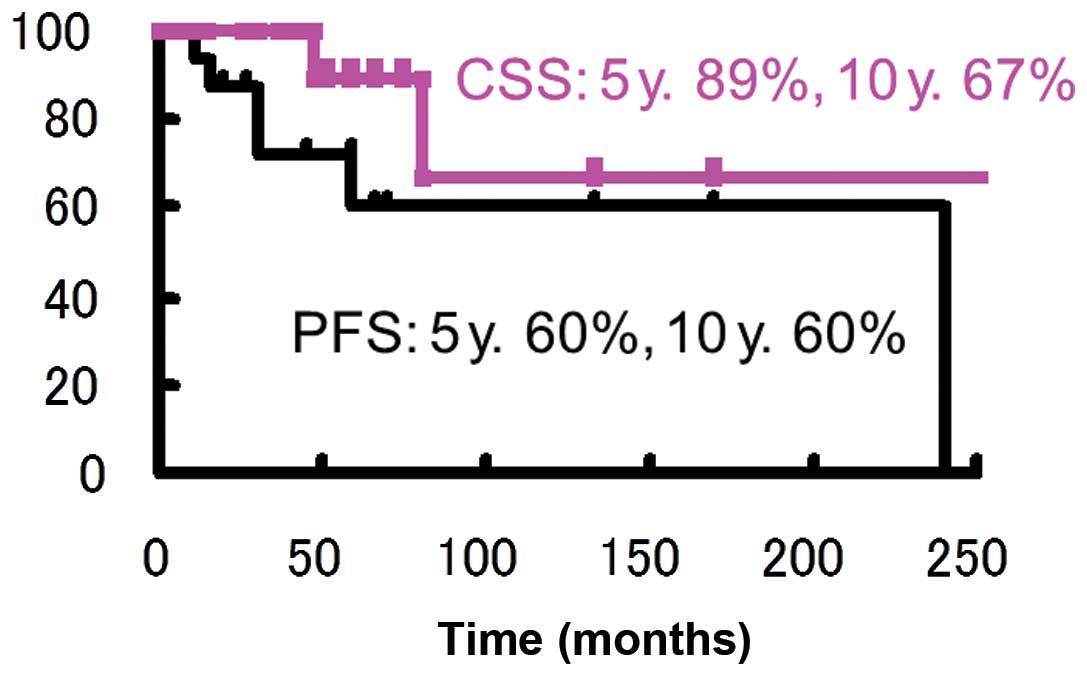
There were no significant differences regarding intraoperative and postoperative complications or blood loss between the two groups. There was no lymphocele formation in patients undergoing either standard or semi-extended LND. The Kaplan-Meier curves for the oncological outcomes of progression-free survival (PFS) and cause-specific survival (CSS) are shown in Fig. 1.

Figure 1.

Kaplan-Meier curves for oncological outcomes, namely progression-free survival (PFS) and cause-specific survival (CSS) of N1 cases.

Discussion

LND in RP is considered to be of diagnostic value; however, its curative significance is limited. The detection rate of LN metastasis may be increased by widening the dissection range, although the extent of the dissection remains controversial. Clark et al (11) performed a prospective comparative study on extended and localized LND and observed no difference in the node-positive rate; in addition, ELND was associated with a higher complication rate. Kroepfl et al (12) included obturator and internal iliac LNs, as well as the LNs along the hypogastric vein, in the range of ELND. Heidenreich et al (9) suggested it was unnecessary to dissect the presacral and common iliac lymphatics, since only 3 of their 95 patients (3.1%) had LN metastasis in that region. Heidenreich et al (9) and Zincke (10) demonstrated the high diagnostic accuracy of staging PLND limited to the internal and external iliac and obturator fossa LNs. An autopsy study by Weingärtner et al (13) suggested that 20 LNs must be retrieved for an adequate PLND. In the present study, the cancer-specific 5-year survival rate of pN1 patients was 89%, which supports the curative significance of LND.

Retrospective analyses demonstrated that the number of positive LNs may affect survival. Certain studies have suggested that RP may be curative for a proportion of patients with LN-positive prostate cancer. Sterinberg et al (14) followed 64 patients with positive nodes, of whom 83 and 68% remained free of detectable tumor at 60 and 80 months following RP, respectively, and identified the tumor burden of the diseased LNs as an independent prognostic factor.

Our data suggest a delay in disease progression for prostate cancer patients with minimal LN involvement when radical surgery is performed. The follow-up duration is insufficient to reach a definitive decision in terms of possible curative effect. However, depending on the tumor burden or the number of diseased LNs, radical surgical treatment appears to improve the outcome in a not precisely defined but significant percentage of patients. Thus, meticulous pelvic LND to remove all diseased nodes and ensure accurate staging, combined with RP, is recommended for clinically organ-confined prostate cancer. The promising survival rate of patients with minimal nodal disease makes the value of routine immediate androgen ablation in all patients with positive LNs at least questionable, particularly when considering the side effects of hormone therapy.

In conclusion, semi-extended PLND was associated with a high rate of LN metastasis detection outside the fields of standard LND in patients with clinically localized prostate cancer. LND including the internal and external iliac LNs should be performed in all patients with high risk-prostate cancer. However, in the low-risk group, PLND may be omitted.

The results of the present study demonstrated that semi-extended PLND, as performed in our institution, was associated with greater nodal yields and may result in improved oncological outcomes in patients with LN-positive prostate cancer. Although a prospective trial is required to confirm our results, we currently recommend considering semi-extended LND at the time of RP for high-risk prostate cancer patients, whereas, in the low-risk group, PLND may be omitted.

References

1 

Walsh PC, Partin AW and Epstein JI: Cancer control and quality of life following anatomical radical retropubic prostatectomy: Results at 10 years. J Urol. 152:1831–1836. 1994.PubMed/NCBI

2 

Catalona WJ and Smith DS: Cancer recurrence and survival rates after anatomic radical retropubic prostatectomy for prostate cancer: Intermediate-term results. J Urol. 160:2428–2434. 1998. View Article : Google Scholar : PubMed/NCBI

3 

Gervasi LA, Mata J, Easley JD, et al: Prognostic significance of lymph nodal metastases in prostate cancer. J Urol. 142:332–336. 1989.PubMed/NCBI

4 

Hull GW, Rabbani F, Abbas F, Wheeler TM, Kattan MW and Scardino PT: Cancer control with radical prostatectomy alone in 1,000 consecutive patients. J Urol. 167:528–534. 2002. View Article : Google Scholar : PubMed/NCBI

5 

Miyake H, Fujimoto H, Komiyama M and Fujisawa M: Development of ‘extended radical retropubic prostatectomy’: A surgical technique for improving margin positive rates in prostate cancer. Eur J Surg Oncol. 36:281–286. 2010. View Article : Google Scholar : PubMed/NCBI

6 

Withrow DR, DeGroot JM, Siemens DR and Groome PA: Therapeutic value of lymph node dissection at radical prostatectomy: A population-based case-cohort study. BJU Int. 108:209–216. 2011. View Article : Google Scholar : PubMed/NCBI

7 

Schumacher MC, Burkhard FC, Thalmann GN, Fleischmann A and Studer UE: Good outcome for patients with few lymph node metastases after radical retropubic prostatectomy. Eur Urol. 54:344–352. 2008. View Article : Google Scholar : PubMed/NCBI

8 

Bader P, Burkhard FC, Markwalder R and Studer UE: Disease progression and survival of patients with positive lymph nodes after radical prostatectomy. Is there a chance of cure? J Urol. 169:849–854. 2003. View Article : Google Scholar : PubMed/NCBI

9 

Heidenreich A, Aus G, Bolla M, et al: European Association of Urology: EAU guidelines on prostate cancer. Eur Urol. 53:68–80. 2008. View Article : Google Scholar : PubMed/NCBI

10 

Zincke H: Extended experience with surgical treatment of stage D1 adenocarcinoma of prostate. Significant influences of immediate adjuvant hormonal treatment (orchiectomy) on outcome. Urology. 33 (Supp 1):S27–S36. 1989. View Article : Google Scholar

11 

Clark T, Parekh DJ, Cookson MS, et al: Randomized prospective evaluation of extended versus limited lymph node dissection in patients with clinically localized prostate cancer. J Urol. 169:145–147; discussion 147–148. 2003. View Article : Google Scholar : PubMed/NCBI

12 

Kroepfl D, Loewen H, Roggenbuck U, Musch M and Klevecka V: Disease progression and survival in patients with prostate carcinoma and positive lymph nodes after radical retropubic prostatectomy. BJU Int. 97:985–991. 2006. View Article : Google Scholar : PubMed/NCBI

13 

Weingärtner K, Ramaswamy A, Bittinger A, Gerharz EW, Vöge D and Riedmiller H: Anatomical basis for pelvic lymphadenectomy in prostate cancer: Results of an autopsy study and implications for the clinic. J Urol. 156:1969–1971. 1996. View Article : Google Scholar : PubMed/NCBI

14 

Steinberg GD, Epstein JI, Piantadosi S and Walsh PC: Management of stage D1 adenocarcinoma of the prostate: The Johns Hopkins experience 1974 to 1987. J Urol. 144:1425–1432. 1990.PubMed/NCBI

Related Articles

  • Abstract
  • View
  • Download
  • Twitter
Copy and paste a formatted citation
Spandidos Publications style
Hoshi S, Hayashi N, Kurota Y, Hoshi K, Muto A, Sugano O, Numahata K, Bilim V, Sasagawa I, Ohta S, Ohta S, et al: Comparison of semi‑extended and standard lymph node dissection in radical prostatectomy: A single‑institute experience. Mol Clin Oncol 3: 1085-1087, 2015.
APA
Hoshi, S., Hayashi, N., Kurota, Y., Hoshi, K., Muto, A., Sugano, O. ... Ohta, S. (2015). Comparison of semi‑extended and standard lymph node dissection in radical prostatectomy: A single‑institute experience. Molecular and Clinical Oncology, 3, 1085-1087. https://doi.org/10.3892/mco.2015.601
MLA
Hoshi, S., Hayashi, N., Kurota, Y., Hoshi, K., Muto, A., Sugano, O., Numahata, K., Bilim, V., Sasagawa, I., Ohta, S."Comparison of semi‑extended and standard lymph node dissection in radical prostatectomy: A single‑institute experience". Molecular and Clinical Oncology 3.5 (2015): 1085-1087.
Chicago
Hoshi, S., Hayashi, N., Kurota, Y., Hoshi, K., Muto, A., Sugano, O., Numahata, K., Bilim, V., Sasagawa, I., Ohta, S."Comparison of semi‑extended and standard lymph node dissection in radical prostatectomy: A single‑institute experience". Molecular and Clinical Oncology 3, no. 5 (2015): 1085-1087. https://doi.org/10.3892/mco.2015.601
Copy and paste a formatted citation
x
Spandidos Publications style
Hoshi S, Hayashi N, Kurota Y, Hoshi K, Muto A, Sugano O, Numahata K, Bilim V, Sasagawa I, Ohta S, Ohta S, et al: Comparison of semi‑extended and standard lymph node dissection in radical prostatectomy: A single‑institute experience. Mol Clin Oncol 3: 1085-1087, 2015.
APA
Hoshi, S., Hayashi, N., Kurota, Y., Hoshi, K., Muto, A., Sugano, O. ... Ohta, S. (2015). Comparison of semi‑extended and standard lymph node dissection in radical prostatectomy: A single‑institute experience. Molecular and Clinical Oncology, 3, 1085-1087. https://doi.org/10.3892/mco.2015.601
MLA
Hoshi, S., Hayashi, N., Kurota, Y., Hoshi, K., Muto, A., Sugano, O., Numahata, K., Bilim, V., Sasagawa, I., Ohta, S."Comparison of semi‑extended and standard lymph node dissection in radical prostatectomy: A single‑institute experience". Molecular and Clinical Oncology 3.5 (2015): 1085-1087.
Chicago
Hoshi, S., Hayashi, N., Kurota, Y., Hoshi, K., Muto, A., Sugano, O., Numahata, K., Bilim, V., Sasagawa, I., Ohta, S."Comparison of semi‑extended and standard lymph node dissection in radical prostatectomy: A single‑institute experience". Molecular and Clinical Oncology 3, no. 5 (2015): 1085-1087. https://doi.org/10.3892/mco.2015.601
Follow us
  • Twitter
  • LinkedIn
  • Facebook
About
  • Spandidos Publications
  • Careers
  • Cookie Policy
  • Privacy Policy
How can we help?
  • Help
  • Live Chat
  • Contact
  • Email to our Support Team