Spandidos Publications Logo
  • About
    • About Spandidos
    • Aims and Scopes
    • Abstracting and Indexing
    • Editorial Policies
    • Reprints and Permissions
    • Job Opportunities
    • Terms and Conditions
    • Contact
  • Journals
    • All Journals
    • Oncology Letters
      • Oncology Letters
      • Information for Authors
      • Editorial Policies
      • Editorial Board
      • Aims and Scope
      • Abstracting and Indexing
      • Bibliographic Information
      • Archive
    • International Journal of Oncology
      • International Journal of Oncology
      • Information for Authors
      • Editorial Policies
      • Editorial Board
      • Aims and Scope
      • Abstracting and Indexing
      • Bibliographic Information
      • Archive
    • Molecular and Clinical Oncology
      • Molecular and Clinical Oncology
      • Information for Authors
      • Editorial Policies
      • Editorial Board
      • Aims and Scope
      • Abstracting and Indexing
      • Bibliographic Information
      • Archive
    • Experimental and Therapeutic Medicine
      • Experimental and Therapeutic Medicine
      • Information for Authors
      • Editorial Policies
      • Editorial Board
      • Aims and Scope
      • Abstracting and Indexing
      • Bibliographic Information
      • Archive
    • International Journal of Molecular Medicine
      • International Journal of Molecular Medicine
      • Information for Authors
      • Editorial Policies
      • Editorial Board
      • Aims and Scope
      • Abstracting and Indexing
      • Bibliographic Information
      • Archive
    • Biomedical Reports
      • Biomedical Reports
      • Information for Authors
      • Editorial Policies
      • Editorial Board
      • Aims and Scope
      • Abstracting and Indexing
      • Bibliographic Information
      • Archive
    • Oncology Reports
      • Oncology Reports
      • Information for Authors
      • Editorial Policies
      • Editorial Board
      • Aims and Scope
      • Abstracting and Indexing
      • Bibliographic Information
      • Archive
    • Molecular Medicine Reports
      • Molecular Medicine Reports
      • Information for Authors
      • Editorial Policies
      • Editorial Board
      • Aims and Scope
      • Abstracting and Indexing
      • Bibliographic Information
      • Archive
    • World Academy of Sciences Journal
      • World Academy of Sciences Journal
      • Information for Authors
      • Editorial Policies
      • Editorial Board
      • Aims and Scope
      • Abstracting and Indexing
      • Bibliographic Information
      • Archive
    • International Journal of Functional Nutrition
      • International Journal of Functional Nutrition
      • Information for Authors
      • Editorial Policies
      • Editorial Board
      • Aims and Scope
      • Abstracting and Indexing
      • Bibliographic Information
      • Archive
    • International Journal of Epigenetics
      • International Journal of Epigenetics
      • Information for Authors
      • Editorial Policies
      • Editorial Board
      • Aims and Scope
      • Abstracting and Indexing
      • Bibliographic Information
      • Archive
    • Medicine International
      • Medicine International
      • Information for Authors
      • Editorial Policies
      • Editorial Board
      • Aims and Scope
      • Abstracting and Indexing
      • Bibliographic Information
      • Archive
  • Articles
  • Information
    • Information for Authors
    • Information for Reviewers
    • Information for Librarians
    • Information for Advertisers
    • Conferences
  • Language Editing
Spandidos Publications Logo
  • About
    • About Spandidos
    • Aims and Scopes
    • Abstracting and Indexing
    • Editorial Policies
    • Reprints and Permissions
    • Job Opportunities
    • Terms and Conditions
    • Contact
  • Journals
    • All Journals
    • Biomedical Reports
      • Information for Authors
      • Editorial Policies
      • Editorial Board
      • Aims and Scope
      • Abstracting and Indexing
      • Bibliographic Information
      • Archive
    • Experimental and Therapeutic Medicine
      • Information for Authors
      • Editorial Policies
      • Editorial Board
      • Aims and Scope
      • Abstracting and Indexing
      • Bibliographic Information
      • Archive
    • International Journal of Epigenetics
      • Information for Authors
      • Editorial Policies
      • Editorial Board
      • Aims and Scope
      • Abstracting and Indexing
      • Bibliographic Information
      • Archive
    • International Journal of Functional Nutrition
      • Information for Authors
      • Editorial Policies
      • Editorial Board
      • Aims and Scope
      • Abstracting and Indexing
      • Bibliographic Information
      • Archive
    • International Journal of Molecular Medicine
      • Information for Authors
      • Editorial Policies
      • Editorial Board
      • Aims and Scope
      • Abstracting and Indexing
      • Bibliographic Information
      • Archive
    • International Journal of Oncology
      • Information for Authors
      • Editorial Policies
      • Editorial Board
      • Aims and Scope
      • Abstracting and Indexing
      • Bibliographic Information
      • Archive
    • Medicine International
      • Information for Authors
      • Editorial Policies
      • Editorial Board
      • Aims and Scope
      • Abstracting and Indexing
      • Bibliographic Information
      • Archive
    • Molecular and Clinical Oncology
      • Information for Authors
      • Editorial Policies
      • Editorial Board
      • Aims and Scope
      • Abstracting and Indexing
      • Bibliographic Information
      • Archive
    • Molecular Medicine Reports
      • Information for Authors
      • Editorial Policies
      • Editorial Board
      • Aims and Scope
      • Abstracting and Indexing
      • Bibliographic Information
      • Archive
    • Oncology Letters
      • Information for Authors
      • Editorial Policies
      • Editorial Board
      • Aims and Scope
      • Abstracting and Indexing
      • Bibliographic Information
      • Archive
    • Oncology Reports
      • Information for Authors
      • Editorial Policies
      • Editorial Board
      • Aims and Scope
      • Abstracting and Indexing
      • Bibliographic Information
      • Archive
    • World Academy of Sciences Journal
      • Information for Authors
      • Editorial Policies
      • Editorial Board
      • Aims and Scope
      • Abstracting and Indexing
      • Bibliographic Information
      • Archive
  • Articles
  • Information
    • For Authors
    • For Reviewers
    • For Librarians
    • For Advertisers
    • Conferences
  • Language Editing
Login Register Submit
  • This site uses cookies
  • You can change your cookie settings at any time by following the instructions in our Cookie Policy. To find out more, you may read our Privacy Policy.

    I agree
Search articles by DOI, keyword, author or affiliation
Search
Advanced Search
presentation
Molecular and Clinical Oncology
Join Editorial Board Propose a Special Issue
Print ISSN: 2049-9450 Online ISSN: 2049-9469
Journal Cover
November-2015 Volume 3 Issue 6

Full Size Image

Sign up for eToc alerts
Recommend to Library

Journals

International Journal of Molecular Medicine

International Journal of Molecular Medicine

International Journal of Molecular Medicine is an international journal devoted to molecular mechanisms of human disease.

International Journal of Oncology

International Journal of Oncology

International Journal of Oncology is an international journal devoted to oncology research and cancer treatment.

Molecular Medicine Reports

Molecular Medicine Reports

Covers molecular medicine topics such as pharmacology, pathology, genetics, neuroscience, infectious diseases, molecular cardiology, and molecular surgery.

Oncology Reports

Oncology Reports

Oncology Reports is an international journal devoted to fundamental and applied research in Oncology.

Experimental and Therapeutic Medicine

Experimental and Therapeutic Medicine

Experimental and Therapeutic Medicine is an international journal devoted to laboratory and clinical medicine.

Oncology Letters

Oncology Letters

Oncology Letters is an international journal devoted to Experimental and Clinical Oncology.

Biomedical Reports

Biomedical Reports

Explores a wide range of biological and medical fields, including pharmacology, genetics, microbiology, neuroscience, and molecular cardiology.

Molecular and Clinical Oncology

Molecular and Clinical Oncology

International journal addressing all aspects of oncology research, from tumorigenesis and oncogenes to chemotherapy and metastasis.

World Academy of Sciences Journal

World Academy of Sciences Journal

Multidisciplinary open-access journal spanning biochemistry, genetics, neuroscience, environmental health, and synthetic biology.

International Journal of Functional Nutrition

International Journal of Functional Nutrition

Open-access journal combining biochemistry, pharmacology, immunology, and genetics to advance health through functional nutrition.

International Journal of Epigenetics

International Journal of Epigenetics

Publishes open-access research on using epigenetics to advance understanding and treatment of human disease.

Medicine International

Medicine International

An International Open Access Journal Devoted to General Medicine.

Journal Cover
November-2015 Volume 3 Issue 6

Full Size Image

Sign up for eToc alerts
Recommend to Library

  • Article
  • Citations
    • Cite This Article
    • Download Citation
    • Create Citation Alert
    • Remove Citation Alert
    • Cited By
  • Similar Articles
    • Related Articles (in Spandidos Publications)
    • Similar Articles (Google Scholar)
    • Similar Articles (PubMed)
  • Download PDF
  • Download XML
  • View XML
Article

Computed tomography imaging characteristics of synchronous gastrointestinal stromal tumors in patients with gastric cancer and correlation with clinicopathological findings

  • Authors:
    • Zhenshan Shi
    • Qian Zhuang
  • View Affiliations / Copyright

    Affiliations: Department of Radiology, The First Affiliated Hospital of Fujian Medical University, P.R. China, Department of Pharmacy, Union Hospital of Fujian Medical University, Fuzhou, Fujian 350005, P.R. China
  • Pages: 1311-1314
    |
    Published online on: August 13, 2015
       https://doi.org/10.3892/mco.2015.621
  • Expand metrics +
Metrics: Total Views: 0 (Spandidos Publications: | PMC Statistics: )
Metrics: Total PDF Downloads: 0 (Spandidos Publications: | PMC Statistics: )
Cited By (CrossRef): 0 citations Loading Articles...

This article is mentioned in:


Abstract

This study was conducted to analyze the computed tomography (CT) imaging and clinicopathological characteristics of synchronous gastrointestinal stromal tumors (GISTs) in patients with gastric cancer. We retrospectively reviewed the CT images in 18 cases of immunohistochemically confirmed synchronous GISTs in patients with primary gastric cancer. Relevant histology and clinical data were also obtained. Multi‑slice CT (MSCT) identified suspected synchronous GISTs in 26 patients, of which 18 were finally confirmed. Of the 18 patients, 12 were male and 6 female, with a mean age of 69.2 years. All 18 lesions were discovered as a solitary mass, ranging in size from 1.0 to 6.5 cm (mean, 2.2 cm). The lesions were predominantly located in the gastric fundus and were characterized by an ovoid shape, well-defined margins and isodensity, with slight to moderate gradual enhancement on MSCT. There was no evidence of necrosis, hemorrhage or cystic degeneration, irrespective of the tumor size. Synchronous GISTs exhibited spindle cell morphological characteristics and specific immunohistochemical properties, and were classified as being of low or very low malignant potential. In conclusion, since gastric cancer patients with a synchronous GIST are rare, a solitary, ovoid and well-defined mass with slight to moderate gradual enhancement following contrast agent injection may be suggestive of this diagnosis, although detection of synchronous GISTs does not appear to significantly affect therapy and outcome.

Introduction

Gastrointestinal stromal tumor (GIST), the most common type of non-epithelial tumors, is a term used to describe a unique group of mesenchymal neoplasms that typically arise in the muscularis propria of the gastrointestinal tract wall, accounting for 0.1–3% of all gastrointestinal tumors (1). GISTs may develop synchronously with tumors originating from different cell layers, such as cancer, carcinoid and lymphadenoma (2–4). The synchronous development of a gastric GIST and adenocarcinoma is relatively rare. The aim of this study was to conduct a retrospective review of the computed tomography (CT) imaging characteristics of 18 cases of synchronous GIST and primary gastric cancer and evaluate the clinicopathological characteristics of GISTs.

Patients and methods

Patients

The database of the First Affiliated Hospital of Fujian Medical University was searched and patients who were treated at our hospital between January, 2006 and April, 2013 were identified. A total of 26 patients with histologically proven synchronous GISTs and gastric cancer were investigated. Of these patients, 8 with GISTs sized <1.0 cm were excluded, as the preoperative CT images were difficult to characterize with confidence. Therefore, the study cohort consisted of 18 patients (12 men and 6 women; mean age, 69.2 years; and age range, 47–82 years). An Institutional Review Board (IRB) exemption and a waiver of the requirement for written informed consent were obtained to perform this retrospective study. The patient characteristics are summarized in Table I.

Table I.

Characteristics of patients with GISTs (n=18).

Table I.

Characteristics of patients with GISTs (n=18).

CharacteristicsNo.
Gender
  Female6
  Male12
Age, years
  Mean69.2
  Range47–82
Location of GISTs
  Gastric fundus9
  Body3
  Cardia2
  Antrum2
  Pylorus1
Tumor size, cm
  Mean2.2
  Range1.0–6.5
Stage of primary gastric cancer
  I or II5
  III13

[i] GIST, gastrointestinal stromal tumor.

CT imaging and pathological analysis

CT imaging was performed using a Toshiba Aquilion 16-slice CT scanner. A total of 18 patients underwent contrast-enhanced CT within 1 week of the operation. After an overnight fast, oral contrast, 750–1,000 ml water, or 2% oral diatrizoate meglumine was administered to all the patients 30 min prior to scanning. The scan range was determined depending on the size of the tumor and the distance from the diaphragmatic dome to the inferior border of the liver. Scanning was performed with 5- or 10-mm slice thickness and interval. The CT parameters were 120 kVp and 350 mAs. Iopamidol (80–100 ml, 370 mgI/ml) was injected intravenously at a rate of 3 ml/sec and imaging was performed with a dual-phase technique. The technique was performed with a late arterial (portal inflow) phase scan at 32 sec and a hepatic venous phase scan at 102 sec. Section widths of 2 mm and reconstruction intervals of 1.25 mm were used. Two radiologists retrospectively reviewed all radiological studies, with final interpretations by consensus. Each tumor was assessed for location, density, presence of calcifications, size, margin, cyst formation, hemorrhage, necrosis and presence of a tumor capsule. The adjacent organs, fat planes and stomach wall were assessed for evidence of invasion, which was suspected when there was focal enlargement of the organ or anatomic structure in direct continuity with the tumor mass. The tumors were also assessed for the pattern of attenuation during the administration of the contrast material.

The medical records were subsequently reviewed to determine the clinical presentation, therapy and patient course. The pathology records were also reviewed to determine the histological and immunohistochemical characteristics of the lesions, including CD117, CD34, smooth muscle actin (SMA), S-100, Ki-67, desmin (DES), discovered on GIST-1 (DOG1) and platelet-derived growth factor receptor α (PDGFRA) mutation status, when available.

Results

Clinical presentation

The demographic characteristics of 18 patients with synchronous GISTs are presented in Table I. The major symptoms at presentation included abdominal pain (n=10), abdominal distention (n=9), sour regurgitation (n=7), melena (n=7), nausea and vomiting (n=3), hematemesis (n=3), weight loss (n=6) or unexplained anemia (n=2). Certain patients presented with ≥1 of these symptoms. Each patient had a preoperative histological diagnosis of gastric adenocarcinoma established by gastroscopy and biopsy. Preoperative gastroscopy revealed a cancerous ulcer (n=10), soft tissue mass (n=5), pyloric stenosis and stiffness of the stomach wall (n=3). Five patients had early and 13 patients advanced gastric cancer. Early gastric cancer is defined as tumor confined to the mucosa or submucosa, independent of regional lymph node (LN) metastases, irrespective of the tumor size.

CT findings

Of the 18 synchronous GISTs, 9 were found in the gastric fundus (50%), 4 in the body (22%), 2 in the cardia (11%), 2 in the antrum (11%) and 1 in the pylorus (6%) (Table I). The median size ± standard deviation of the GISTs was 2.2 ± 1.2 cm (range, 1.0–6.5 cm).

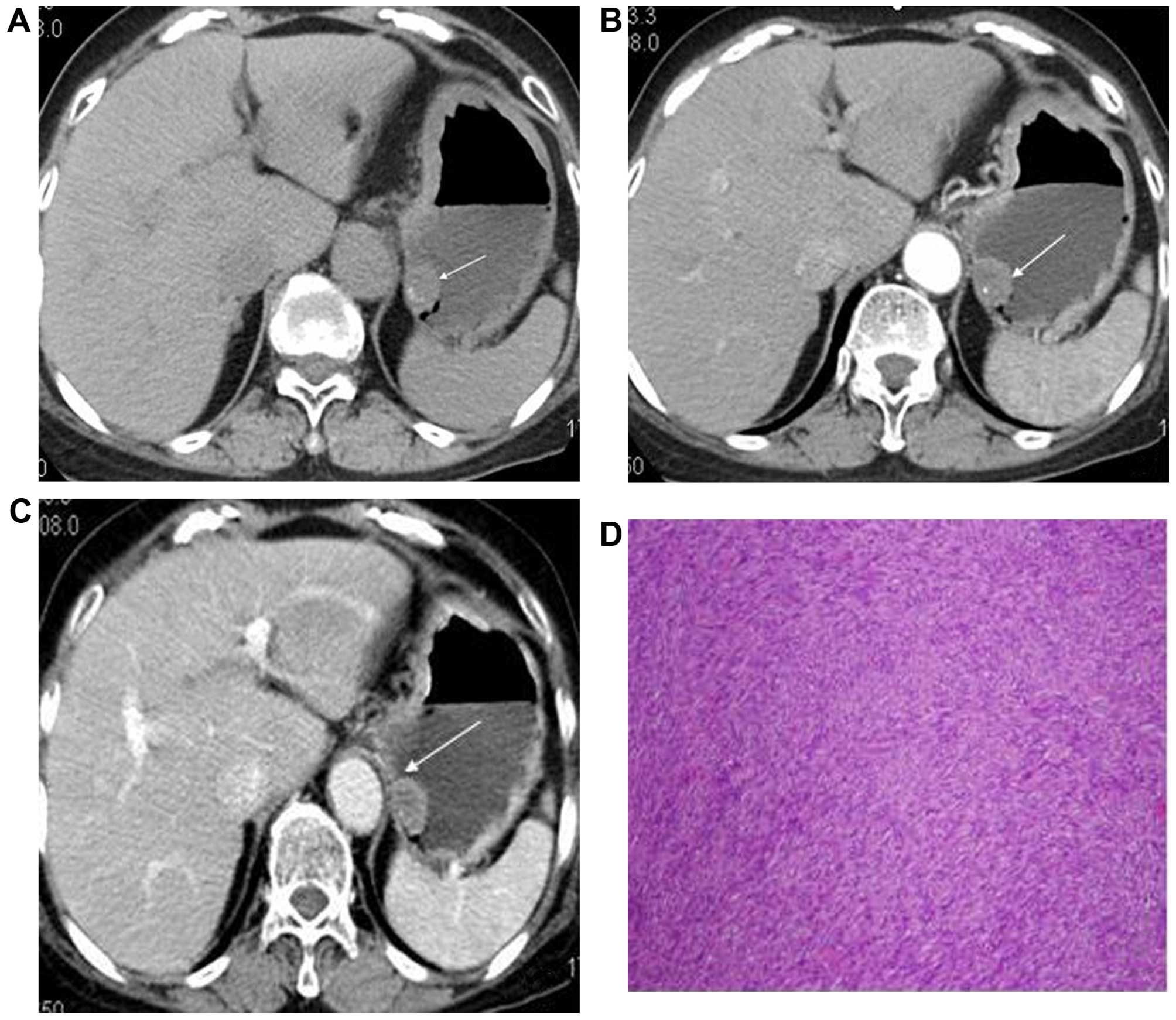
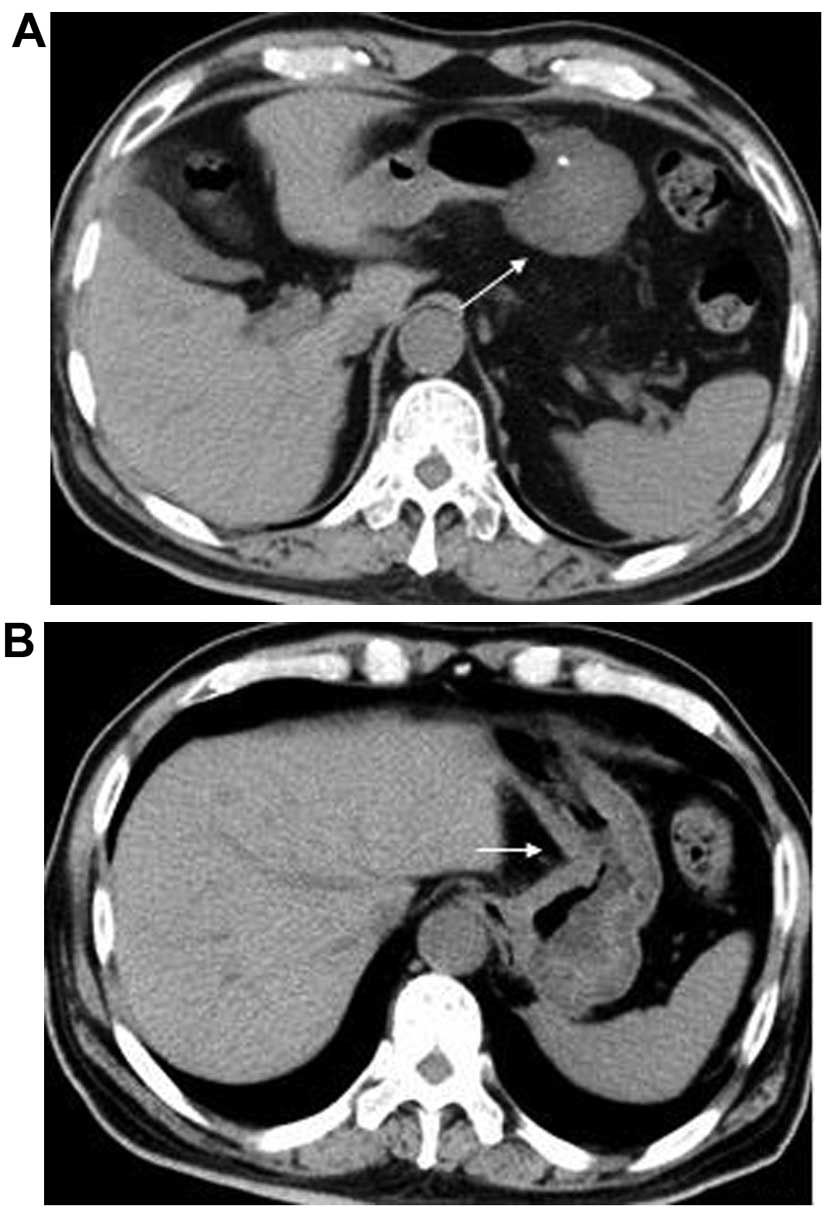
All 18 CT scans revealed a solitary, well-marginated, isodense mass with an ovoid shape that was inseparable from the adjacent stomach; the contrast-enhanced CT scans revealed slight to moderate gradual enhancement of these lesions (Fig. 1A–C). The mean unenhanced value was 36 HU (range, 23–45 HU; n=18) and the mean contrast-enhanced value was 54 HU (range, 30–68 HU) in the late arterial (portal inflow) phase; the calculated mean enhancement was 22 HU. The mean contrast-enhanced value was 61 HU (range, 37–77 HU) in the hepatic venous phase; the calculated mean enhancement was 12 HU. Two GISTs displayed punctate calcifications (Figs. 1A and 2A); the other GISTs were invariably homogeneous, irrespective of the tumor size. No evidence of necrosis, cystic degeneration or hemorrhage was observed in any of the tumors.

Figure 1.

Gastric gastrointestinal stromal tumor (GIST). (A) Computed tomography (CT) of the abdomen in a 51-year-old man complaining of epigastric pain shows an incidental homogeneous ovoid mass with a small punctate calcification in the gastric fundus (arrow). (B and C) Contrast-enhanced CT scan showing slight enhancement of the tumor (arrows). (D) The submucosal nodule was diagnosed as low-risk GIST on histopathological examination. The tumor was composed of cytologically bland spindle cells (hematoxylin and eosin staining; magnification, x100).

Figure 2.

(A) Gastrointestinal stromal tumor arising from the gastric antrum in a 78-year-old man. Computed tomography (CT) scan showing a highly homogeneous mass with punctate calcification (arrow). (B) Gastric cancer. CT scan showing a thickening of the posterior wall of the lesser curvature of the stomach (arrow).

Histopathology

All the GISTs exhibited a spindle cell pattern, without necrosis or cystic changes on histological examination (Fig. 1D). The histopathological examination revealed mitotic rates ranging from 0 to 5 mitoses/50 high-power fields (hpf). All 18 tumors were considered of low or very low malignant potential (Table II). On immunohistochemical examination, all the tumors expressed CD34 and the c-kit protein (CD117, + to +++), which is a type III tyrosine kinase receptor encoded by the c-kit proto-ongogene. Five synchronous GISTs (28%) exhibited weak focal SMA positivity, but the remaining 13 (72%) were SMA-negative. No GISTs were S-100-positive; 4 GISTs were DOG1-positive and only 1 GIST exhibited DES positivity. The Ki-67 expression varied from 0.01 to 0.05 in 16 patients. Three of the resected specimens underwent molecular genotyping and two PDGFRA mutations were identified.

Table II.

Immunohistochemistry and risk stratification of GISTs.

Table II.

Immunohistochemistry and risk stratification of GISTs.

CaseSize (cm)Mitoses (/50 hpf)CD117CD34DOG1PDGFRASMAS-100DesKi-67 (%)Risk
  11.81++++––+1Very low
  21.00+++–+1Very low
  32.7<5+++–––+2Very low
  41.20–+–––Low
  53.50+++++++++––+2–3Very low
  61.21++++–+2Very low
  71.95++––––Very low
  84.20–++–++2Very low
  91.0<5++––––+2Low
106.5<5+++–+1Low
111.9<5+++––+1Low
121.50+++++++–+1Very low
131.0<5++–––+5Low
141.3Rare++–––+1Very low
152.80++–––+2Very low
161.00++––+1Very low
171.0<5++––+1Very low
184.03++––+2Low

[i] GIST, gastrointestinal stromal tumor; hpf, high-power field; DOG1, discovered on GIST-1; PDGFRA, platelet-derived growth factor receptor α; SMA, smooth muscle actin; Des, desmin.

Discussion

The coexistence of gastric cancer and GIST is relatively rare, and GISTs are occasionally detected in the gastric serosa or mucosa during surgery (3,5–7). Gastric adenocarcinoma (Fig. 2B) and GISTs are different neoplasms, originating from different cell layers; an accurate pre- and postoperative diagnosis is important. However, when the GIST is subserosal or submucosal, the gastric mucosa has not yet been invaded and endoscopic biopsies may come back as normal.

In the available literature, no case of coexistence of adenocarcinoma and GIST has been detected preoperatively (2,3,7), and there has been no report of CT imaging characteristics of the simultaneous development of adenocarcinoma and GIST in the stomach. In fact, in our cases, the preoperative gastroscopy biopsy fragments only showed adenocarcinoma, and most GISTs were detected in the resected stomach. Only in 18 patients (18/26, 69%) were the GISTs identified on preoperative CT.

GISTs <1.0 cm could not be detected on preoperative CT, as the tumors are difficult to differentiated from perigastric metastatic LNs and may only confirmed on histopathological examination. The individual CT characteristics of GISTs and regional LN enlargement, which is a significantly more common finding, overlap; therefore, CT cannot reliably differentiate between the two based on the size or pattern of their contour alone. Imaging characteristics that may be associated with LN metastases include multiple lesions, strong enhancement and hypodense areas.

No evidence of necrosis, hemorrhage, or cystic degeneration was found in any of the patients, irrespective of the tumor size (>5 or <5 cm). These CT imaging characteristics were different from those of conventional GISTs (8). The tumor exhibited homogeneous slight or moderate enhancement and it was clinically more common in men compared with women; the median age at the time of diagnosis was 69.2 years in our patients, as previously reported by Fletcher et al (9).

Immunostaining for CD34, c-kit, SMA and S-100 may be diagnostically useful. Rabin et al (1) reported that 40–70% of GISTs were positive for CD34, 20–30% were positive for SMA, and 10% were positive for S-100 protein; In our study, 100% of the tumors were positive for CD34 and CD117, and 28% were positive for SMA. The positivity for CD34 and CD117 markers was higher compared with what was previously reported.

The biological behavior of GISTs is often difficult to predict on MSCT. Tumor size and mitotic rate are most frequently used to predict malignant behavior (10). However, as benign-appearing GISTs (small size and absent mitoses or low mitotic rate) may recur or metastasize, a recently published consensus statement suggests classifying GISTs as very low-, low-, intermediate- and high-risk, rather than as benign or malignant (9). All the tumors in our study exhibited ≤5 mitoses/50 hpf and were classified as being of low or very low malignant potential.

In summary, the synchronous occurrence of GISTs and other primary tumors may be more common than what was previously considered and they are usually discovered incidentally during surgery performed for the primary malignancy. Simple coincidence appears to be the most likely explanation, although gene mutations or neighboring gastric tissues affected by the same carcinogen are other hypotheses reported in the literature (2,11,12). A combined genetic deregulation appears to be involved in the pathogenesis of these two entities. Further studies are required to elucidate the molecular and genetic mechanisms underlying carcinogenesis and cancer progression associating GIST and other synchronous tumors.

Acknowledgements

This study was supported by a grant from the scientific research programs of Fujian provincial Health and Family Planning Commission for young scholars (2014-01-45). We are particularly grateful to Dr Shi Sumeng, for her advice and support at various stages of the project.

References

1 

Rabin I, Chikman B, Lavy R, Sandbank J, Maklakovsky M, GoldDeutch R, Halpren Z, Wassermann I and Halevy A: Gastrointestinal stromal tumors: A 19 year experience. Isr Med Assoc J. 11:98–102. 2009.PubMed/NCBI

2 

Maiorana A, Fante R, Maria Cesinaro A and Adriana Fano R: Synchronous occurrence of epithelial and stromal tumors in the stomach: A report of 6 cases. Arch Pathol Lab Med. 124:682–686. 2000.PubMed/NCBI

3 

Rauf F, Ahmad Z, Muzzafar S and Hussaini AS: Synchronous occurrence of gastrointestinal stromal tumor and gastric adenocarcinoma: A case report. J Pak Med Assoc. 56:184–186. 2006.PubMed/NCBI

4 

Al Brahim N, Radhi J and Gately J: Synchronous epithelioid stromal tumour and lipoma in the stomach. Can J Gastroenterol. 17:374–375. 2003.PubMed/NCBI

5 

Bircan S, Candir O, Aydin S, Başpinar S, Bülbül M, Kapucuoğlu N, Karahan N and Ciriş M: Synchronous primary adenocarcinoma and gastrointestinal stromal tumor in the stomach: A report of two cases. Turk J Gastroenterol. 15:187–191. 2004.PubMed/NCBI

6 

Liu SW, Chen GH and Hsieh PP: Collision tumor of the stomach: a case report of mixed gastrointestinal stromal tumor and adenocarcinoma. J Clin Gastroenterol. 35:332–334. 2002. View Article : Google Scholar : PubMed/NCBI

7 

Yamamoto D, Hamada Y, Tsubota Y, Kawakami K, Yamamoto C and Yamamoto M: Simultaneous development of adenocarcinoma and gastrointestinal stromal tumor (GIST) in the stomach: Case report. World J Surg Oncol. 10:62012. View Article : Google Scholar : PubMed/NCBI

8 

Ulusan S, Koc Z and Kayaselcuk F: Gastrointestinal stromal tumours: CT findings. Br J Radiol. 81:618–623. 2008. View Article : Google Scholar : PubMed/NCBI

9 

Fletcher CD, Berman JJ, Corless C, Gorstein F, Lasota J, Longley BJ, Miettinen M, OLeary TJ, Remotti H, Rubin BP, et al: Diagnosis of gastrointestinal stromal tumors: A consensus approach. Int J Surg Pathol. 10:81–89. 2002. View Article : Google Scholar : PubMed/NCBI

10 

Miettinen M, El Rifai WHL, Sobin L and Lasota J: Evaluation of malignancy and prognosis of gastrointestinal stromal tumors: A review. Hum Pathol. 33:478–483. 2002. View Article : Google Scholar : PubMed/NCBI

11 

Lin YL, Tzeng JE, Wei CK and Lin CW: Small gastrointestinal stromal tumor concomitant with early gastric cancer: A case report. World J Gastroenterol. 12:815–817. 2006.PubMed/NCBI

12 

Andea AA, Lucas C, Cheng JD and Adsay NV: Synchronous occurrence of epithelial and stromal tumors in the stomach. Arch Pathol Lab Med. 125:318–319. 2001.PubMed/NCBI

Related Articles

  • Abstract
  • View
  • Download
  • Twitter
Copy and paste a formatted citation
Spandidos Publications style
Shi Z and Zhuang Q: Computed tomography imaging characteristics of synchronous gastrointestinal stromal tumors in patients with gastric cancer and correlation with clinicopathological findings. Mol Clin Oncol 3: 1311-1314, 2015.
APA
Shi, Z., & Zhuang, Q. (2015). Computed tomography imaging characteristics of synchronous gastrointestinal stromal tumors in patients with gastric cancer and correlation with clinicopathological findings. Molecular and Clinical Oncology, 3, 1311-1314. https://doi.org/10.3892/mco.2015.621
MLA
Shi, Z., Zhuang, Q."Computed tomography imaging characteristics of synchronous gastrointestinal stromal tumors in patients with gastric cancer and correlation with clinicopathological findings". Molecular and Clinical Oncology 3.6 (2015): 1311-1314.
Chicago
Shi, Z., Zhuang, Q."Computed tomography imaging characteristics of synchronous gastrointestinal stromal tumors in patients with gastric cancer and correlation with clinicopathological findings". Molecular and Clinical Oncology 3, no. 6 (2015): 1311-1314. https://doi.org/10.3892/mco.2015.621
Copy and paste a formatted citation
x
Spandidos Publications style
Shi Z and Zhuang Q: Computed tomography imaging characteristics of synchronous gastrointestinal stromal tumors in patients with gastric cancer and correlation with clinicopathological findings. Mol Clin Oncol 3: 1311-1314, 2015.
APA
Shi, Z., & Zhuang, Q. (2015). Computed tomography imaging characteristics of synchronous gastrointestinal stromal tumors in patients with gastric cancer and correlation with clinicopathological findings. Molecular and Clinical Oncology, 3, 1311-1314. https://doi.org/10.3892/mco.2015.621
MLA
Shi, Z., Zhuang, Q."Computed tomography imaging characteristics of synchronous gastrointestinal stromal tumors in patients with gastric cancer and correlation with clinicopathological findings". Molecular and Clinical Oncology 3.6 (2015): 1311-1314.
Chicago
Shi, Z., Zhuang, Q."Computed tomography imaging characteristics of synchronous gastrointestinal stromal tumors in patients with gastric cancer and correlation with clinicopathological findings". Molecular and Clinical Oncology 3, no. 6 (2015): 1311-1314. https://doi.org/10.3892/mco.2015.621
Follow us
  • Twitter
  • LinkedIn
  • Facebook
About
  • Spandidos Publications
  • Careers
  • Cookie Policy
  • Privacy Policy
How can we help?
  • Help
  • Live Chat
  • Contact
  • Email to our Support Team