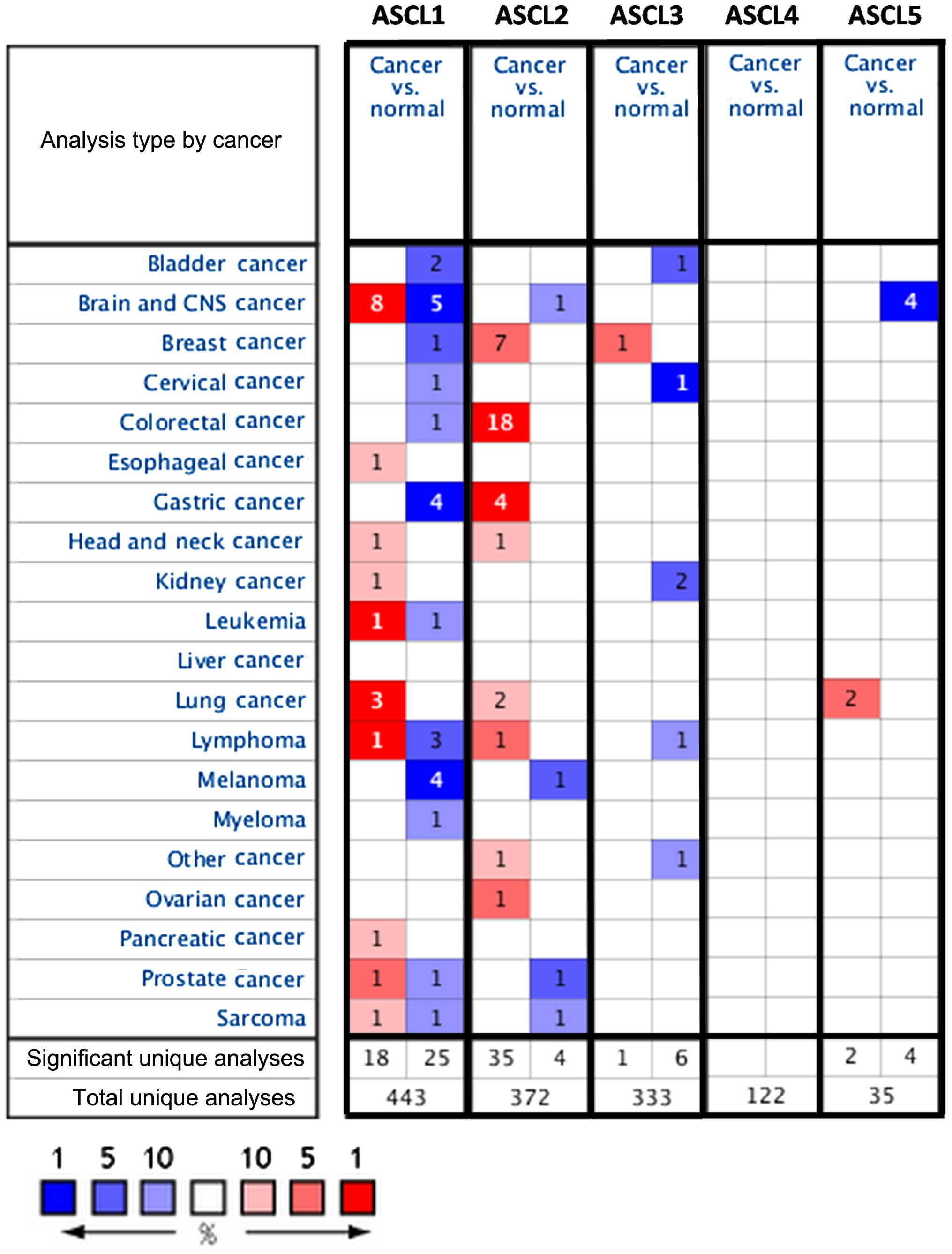
|
1
|
Forman D, Ferlay J, Stewart B and Wild C:
The global and regional burden of cancer. World cancer report.
64–185. 2014.
|
|
2
|
Hanahan D and Weinberg RA: Hallmarks of
cancer: The next generation. Cell. 144:646–674. 2011. View Article : Google Scholar : PubMed/NCBI
|
|
3
|
Guillemot F, Lo LC, Johnson JE, Auerbach
A, Anderson DJ and Joyner AL: Mammalian achaete-scute homolog-1 is
required for the early development of olfactory and autonomic
neurons. Cell. 75:463–476. 1993. View Article : Google Scholar : PubMed/NCBI
|
|
4
|
Gestblom C, Grynfeld A, Ora I, Ortoft E,
Larsson C, Axelson H, Sandstedt B, Cserjesi P, Olson EN and Påhlman
S: The basic helix-loop-helix transcription factor dHAND, a marker
gene for the developing human sympathetic nervous system, is
expressed in both high- and low-stage neuroblastomas. Lab Invest.
79:67–79. 1999.PubMed/NCBI
|
|
5
|
Mizuguchi R, Kriks S, Cordes R, Gossler A,
Ma QF and Goulding M: ASCL1 and GSH1/2 control inhibitory and
excitatory cell fate in spinal sensory interneurons. Nat Neurosci.
9:770–778. 2006. View
Article : Google Scholar : PubMed/NCBI
|
|
6
|
Pattyn A, Simplicio N, van Doorninck JH,
Goridis C, Guillemot F and Brunet JF: ASCL1/MASH1 is required for
the development of central serotonergic neurons. Nat Neurosci.
7:589–595. 2004. View
Article : Google Scholar : PubMed/NCBI
|
|
7
|
Ge WH, He F, Kim KJ, Blanchi B, Coskun V,
Nguyen L, Wu X, Zhao J, Heng JI, Martinowich K, et al: Coupling of
cell migration with neurogenesis by proneural bHLH factors. Proc
Natl Acad Sci USA. 103:1319–1324. 2006. View Article : Google Scholar : PubMed/NCBI
|
|
8
|
Borges M, Linnoila RI, van de Velde HJ,
Chen H, Nelkin BD, Mabry M, Baylin SB and Ball DW: An achaete-scute
homologue essential for neuroendocrine differentiation in the lung.
Nature. 386:852–855. 1997. View
Article : Google Scholar : PubMed/NCBI
|
|
9
|
Ball DW, Azzoli CG, Baylin SB, Chi D, Dou
S, Donis-Keller H, Cumaraswamy A, Borges M and Nelkin BD:
Identification of a human achaete-scute homolog highly expressed in
neuroendocrine tumors. Proc Natl Acad Sci USA. 90:5648–5652. 1993.
View Article : Google Scholar : PubMed/NCBI
|
|
10
|
Guillemot F, Nagy A, Auerbach A, Rossant J
and Joyner AL: Essential role of MASH-2 in extraembryonic
development. Nature. 371:333–336. 1994. View Article : Google Scholar : PubMed/NCBI
|
|
11
|
Schuijers J, Junker JP, Mokry M, Hatzis P,
Koo BK, Sasselli V, van der Flier LG, Cuppen E, van Oudenaarden A
and Clevers H: ASCL2 acts as an R-spondin/WNT-responsive switch to
control stemness in intestinal crypts. Cell Stem Cell. 16:158–170.
2015. View Article : Google Scholar : PubMed/NCBI
|
|
12
|
van der Flier LG, van Gijn ME, Hatzis P,
Kujala P, Haegebarth A, Stange DE, Begthel H, van den Born M,
Guryev V, Oving I, et al: Transcription factor achaete scute-like 2
controls intestinal stem cell fate. Cell. 136:903–912. 2009.
View Article : Google Scholar : PubMed/NCBI
|
|
13
|
Tian Y, Pan Q, Shang Y, Zhu R, Ye J, Liu
Y, Zhong X, Li S, He Y, Chen L, et al: MicroRNA-200 (miR-200)
cluster regulation by achaete scute-like 2 (ASCL2): Impact on the
epithelial-mesenchymal transition in colon cancer cells. J Biol
Chem. 289:36101–36115. 2014. View Article : Google Scholar : PubMed/NCBI
|
|
14
|
Rugel-Stahl A, Elliott ME and Ovitt CE:
Ascl3 marks adult progenitor cells of the mouse salivary gland.
Stem Cell Res. 8:379–387. 2012. View Article : Google Scholar : PubMed/NCBI
|
|
15
|
Jonsson M, Björntorp Mark E, Brantsing C,
Brandner JM, Lindahl A and Asp J: HASH4, a novel human
achaete-scute homologue found in fetal skin. Genomics. 84:859–866.
2004. View Article : Google Scholar : PubMed/NCBI
|
|
16
|
Rhodes DR, Kalyana-Sundaram S, Mahavisno
V, Varambally R, Yu J, Briggs BB, Barrette TR, Anstet MJ,
Kincead-Beal C, Kulkarni P, et al: Oncomine 3.0: Genes, pathways,
and networks in a collection of 18,000 cancer gene expression
profiles. Neoplasia. 9:166–180. 2007. View Article : Google Scholar : PubMed/NCBI
|
|
17
|
Ewald JA, Downs TM, Cetnar JP and Ricke
WA: Expression microarray meta-analysis identifies genes associated
with Ras/MAPK and related pathways in progression of
muscle-invasive bladder transition cell carcinoma. PLoS One.
8:e554142013. View Article : Google Scholar : PubMed/NCBI
|
|
18
|
Moher D, Liberati A, Tetzlaff J and Altman
DG: PRISMA Group: Preferred reporting items for systematic reviews
and meta-analyses: The PRISMA statement. BMJ. 339:b25352009.
View Article : Google Scholar : PubMed/NCBI
|
|
19
|
Rhodes DR and Chinnaiyan AM: Integrative
analysis of the cancer transcriptome. Nat Genet. 37:S31–S37. 2005.
View Article : Google Scholar : PubMed/NCBI
|
|
20
|
Rhodes DR, Yu JJ, Shanker K, Deshpande N,
Varambally R, Ghosh D, Barrette T, Pandey A and Chinnaiyan AM:
ONCOMINE: A cancer microarray database and integrated data-mining
platform. Neoplasia. 6:1–6. 2004. View Article : Google Scholar : PubMed/NCBI
|
|
21
|
Casarosa S, Fode C and Guillemot F: MASH1
regulates neurogenesis in the ventral telencephalon. Development.
126:525–534. 1999.PubMed/NCBI
|
|
22
|
Pacary E, Heng JL, Azzarelli R, Riou P,
Castro D, Lebel-Potter M, Parras C, Bell DM, Ridley AJ, Parsons M
and Guillemot F: Proneural transcription factors regulate different
steps of cortical neuron migration through Rnd-mediated inhibition
of RhoA signaling. Neuron. 69:1069–1084. 2011. View Article : Google Scholar : PubMed/NCBI
|
|
23
|
Augustyn A, Borromeo M, Wang T, Fujimoto
J, Shao C, Dospoy PD, Lee V, Tan C, Sullivan JP, Larsen JE, et al:
ASCL1 is a lineage oncogene providing therapeutic targets for
high-grade neuroendocrine lung cancers. Proc Natl Acad Sci USA.
111:14788–14793. 2014. View Article : Google Scholar : PubMed/NCBI
|
|
24
|
Martino-Echarri E, Fernández-Rodríguez R,
Rodríguez-Baena FJ, Barrientos-Durán A, Torres-Collado AX,
Plaza-Calonge Mdel C, Amador-Cubero S, Cortés J, Reynolds LE,
Hodivala-Dilke KM, et al: Contribution of ADAMTS1 as a tumor
suppressor gene in human breast carcinoma. Linking its tumor
inhibitory properties to its proteolytic activity on nidogen-1 and
nidogen-2. Int J Cancer. 133:2315–2324. 2013. View Article : Google Scholar : PubMed/NCBI
|
|
25
|
Kim HS, Patel K, Muldoon-Jacobs K, Bisht
KS, Aykin-Burns N, Pennington JD, van der Meer R, Nguyen P, Savage
J, Owens KM, et al: SIRT3 is a mitochondria-localized tumor
suppressor required for maintenance of mitochondrial integrity and
metabolism during stress. Cancer Cell. 17:41–52. 2010. View Article : Google Scholar : PubMed/NCBI
|
|
26
|
Johnson JE, Birren SJ and Anderson DJ: Two
rat homologues of drosophila achaete-scute specifically expressed
in neuronal precursors. Nature. 346:858–861. 1990. View Article : Google Scholar : PubMed/NCBI
|
|
27
|
Yan KS and Kuo CJ: ASCL2 reinforces
intestinal stem cell identity. Cell Stem Cell. 16:105–106. 2015.
View Article : Google Scholar : PubMed/NCBI
|
|
28
|
Liu XD, Chen X, Zhong B, Wang A, Wang X,
Chu F, Nurieva RI, Yan X, Chen P, van der Flier LG, et al:
Transcription factor achaete-scute homologue 2 initiates follicular
T-helper-cell development. Nature. 507:513–518. 2014. View Article : Google Scholar : PubMed/NCBI
|
|
29
|
Zhu R, Yang YT, Tian Y, Bai J, Zhang X, Li
X, Peng Z, He Y, Chen L, Pan Q, et al: ASCL2 knockdown results in
tumor growth arrest by miRNAs-302b-related inhibition of colon
cancer progenitor cells. Plos One. 7:e321702012. View Article : Google Scholar : PubMed/NCBI
|
|
30
|
Ziskin JL, Dunlap D, Yaylaoglu M, Fodor
IK, Forrest WF, Patel R, Ge N, Hutchins GG, Pine JK, Quirke P, et
al: In situ validation of an intestinal stem cell signature in
colorectal cancer. Gut. 62:1012–1023. 2013. View Article : Google Scholar : PubMed/NCBI
|
|
31
|
Bullard T, Koek L, Roztocil E, Kingsley
PD, Mirels L and Ovitt CE: ASCL3 expression marks a progenitor
population of both acinar and ductal cells in mouse salivary
glands. Dev Biol. 320:72–78. 2008. View Article : Google Scholar : PubMed/NCBI
|
|
32
|
Amid C, Bahr A, Mujica A, Sampson N, Bikar
SE, Winterpacht A, Zabel B, Hankeln T and Schmidt ER: Comparative
genomic sequencing reveals a strikingly similar architecture of a
conserved syntenic region on human chromosome 11p15.3 (including
gene ST5) and mouse chromosome 7. Cytogenet Cell Genet. 93:284–290.
2001. View Article : Google Scholar : PubMed/NCBI
|
|
33
|
Ashburner M, Ball CA, Blake JA, Botstein
D, Butler H, Cherry JM, Davis AP, Dolinski K, Dwight SS, Eppig JT,
et al: Gene Ontology: Tool for the unification of biology. The Gene
Ontology Consortium. Nat Genet. 25:25–29. 2000. View Article : Google Scholar : PubMed/NCBI
|
|
34
|
Lenhart R, Kirov S, Desilva H, Cao J, Lei
M, Johnston K, Peterson R, Schweizer L, Purandare A, Ross-Macdonald
P, et al: Sensitivity of small cell lung cancer to BET inhibition
is mediated by regulation of ASCL1 gene expression. Mol Cancer
Ther. 14:2167–2174. 2015. View Article : Google Scholar : PubMed/NCBI
|
|
35
|
Hu XG, Chen L, Wang QL, Zhao XL, Tan J,
Cui YH, Liu XD, Zhang X and Bian XW: Elevated expression of ASCL2
is an independent prognostic indicator in lung squamous cell
carcinoma. J Clin Pathol. 69:313–318. 2016. View Article : Google Scholar : PubMed/NCBI
|
|
36
|
Sureban SM, Qu D and Houchen CW:
Regulation of miRNAs by agents targeting the tumor stem cell
markers DCLK1, MSI1, LGR5, and BMI1. Curr Pharmacol Rep. 1:217–222.
2015. View Article : Google Scholar : PubMed/NCBI
|
|
37
|
López-Carballo G, Moreno L, Masia S, Pérez
P and Barettino D: Activation of the phosphatidylinositol
3-kinase/Akt signaling pathway by retinoic acid is required for
neural differentiation of SH-SY5Y human neuroblastoma cells. J Biol
Chem. 277:25297–25304. 2002. View Article : Google Scholar : PubMed/NCBI
|
|
38
|
Letinic K, Zoncu R and Rakic P: Origin of
GABAergic neurons in the human neocortex. Nature. 417:645–649.
2002. View Article : Google Scholar : PubMed/NCBI
|
|
39
|
Persson P, Jögi A, Grynfeld A, Påhlman S
and Axelson H: HASH-1 and E2-2 are expressed in human neuroblastoma
cells and form a functional complex. Biochem Biophys Res Commun.
274:22–31. 2000. View Article : Google Scholar : PubMed/NCBI
|
|
40
|
Wang XY, el H Dakir, Naizhen X,
Jensen-Taubman SM, DeMayo FJ and Linnoila RI: Achaete-scute
homolog-1 linked to remodeling and preneoplasia of pulmonary
epithelium. Lab Invest. 87:527–539. 2007. View Article : Google Scholar : PubMed/NCBI
|
|
41
|
de Pontual L, Népote V, Attié-Bitach T, Al
Halabiah H, Trang H, Elghouzzi V, Levacher B, Benihoud K, Augé J,
Faure C, et al: Noradrenergic neuronal development is impaired by
mutation of the proneural HASH-1 gene in congenital central
hypoventilation syndrome (Ondine's curse). Hum Mol Genet.
12:3173–3180. 2003. View Article : Google Scholar : PubMed/NCBI
|
|
42
|
Ito T, Udaka N, Okudela K, Yazawa T and
Kitamura H: Mechanisms of neuroendocrine differentiation in
pulmonary neuroendocrine cells and small cell carcinoma. Endocr
Pathol. 14:133–139. 2003. View Article : Google Scholar : PubMed/NCBI
|
|
43
|
Kunnimalaiyaan M, Traeger K and Chen H:
Conservation of the NOTCH1 signaling pathway in gastrointestinal
carcinoid cells. Am J Physiol Gastrointest Liver Physiol.
289:G636–G642. 2005.PubMed/NCBI
|
|
44
|
Kim HJ, McMillan E, Han F and Svendsen CN:
Regionally specified human neural progenitor cells derived from the
mesencephalon and forebrain undergo increased neurogenesis
following overexpression of ASCL1. Stem cells. 27:390–398. 2009.
View Article : Google Scholar : PubMed/NCBI
|
|
45
|
Nakayama H, Scott IC and Cross JC: The
transition to endoreduplication in trophoblast giant cells is
regulated by the mSNA zinc finger transcription factor. Dev Biol.
199:150–163. 1998. View Article : Google Scholar : PubMed/NCBI
|
|
46
|
Nishiyama A, Xin L, Sharov AA, Thomas M,
Mowrer G, Meyers E, Piao Y, Mehta S, Yee S, Nakatake Y, et al:
Uncovering early response of gene regulatory networks in ESCs by
systematic induction of transcription factors. Cell Stem Cell.
5:420–433. 2009. View Article : Google Scholar : PubMed/NCBI
|
|
47
|
Tanaka M, Gertsenstein M, Rossant J and
Nagy A: Mash2 acts cell autonomously in mouse spongiotrophoblast
development. Dev Biol. 190:55–65. 1997. View Article : Google Scholar : PubMed/NCBI
|
|
48
|
Oh-McGinnis R, Bogutz AB and Lefebvre L:
Partial loss of ASCL2 function affects all three layers of the
mature placenta and causes intrauterine growth restriction. Dev
Biol. 351:277–286. 2011. View Article : Google Scholar : PubMed/NCBI
|
|
49
|
Yoshida S, Ohbo K, Takakura A, Takebayashi
H, Okada T, Abe K and Nabeshima Y: SGN1, a basic helix-loop-helix
transcription factor delineates the salivary gland duct cell
lineage in mice. Dev Biol. 240:517–530. 2001. View Article : Google Scholar : PubMed/NCBI
|
|
50
|
Rolland T, Tasan M, Charloteaux B, Pevzner
SJ, Zhong Q, Sahni N, Yi S, Lemmens I, Fontanillo C, Mosca R, et
al: A proteome-scale map of the human interactome network. Cell.
159:1212–1226. 2014. View Article : Google Scholar : PubMed/NCBI
|
|
51
|
Sun LX, Hui AM, Su Q, Vortmeyer A,
Kotliarov Y, Pastorino S, Passaniti A, Menon J, Walling J, Bailey
R, et al: Neuronal and glioma-derived stem cell factor induces
angiogenesis within the brain. Cancer Cell. 9:287–300. 2006.
View Article : Google Scholar : PubMed/NCBI
|
|
52
|
Bredel M, Bredel C, Juric D, Harsh GR,
Vogel H, Recht LD and Sikic BI: Functional network analysis reveals
extended gliomagenesis pathway maps and three novel MYC-interacting
genes in human gliomas. Cancer Res. 65:8679–8689. 2005. View Article : Google Scholar : PubMed/NCBI
|
|
53
|
Liang Y, Diehn M, Watson N, Bollen AW,
Aldape KD, Nicholas MK, Lamborn KR, Berger MS, Botstein D, Brown PO
and Israel MA: Gene expression profiling reveals molecularly and
clinically distinct subtypes of glioblastoma multiforme. Proc Natl
Acad Sci USA. 102:5814–5819. 2005. View Article : Google Scholar : PubMed/NCBI
|
|
54
|
Lee J, Kotliarova S, Kotliarov Y, Li A, Su
Q, Donin NM, Pastorino S, Purow BW, Christopher N, Zhang W, et al:
Tumor stem cells derived from glioblastomas cultured in bFGF and
EGF more closely mirror the phenotype and genotype of primary
tumors than do serum-cultured cell lines. Cancer Cell. 9:391–403.
2006. View Article : Google Scholar : PubMed/NCBI
|
|
55
|
Murat A, Migliavacca E, Gorlia T, Lambiv
WL, Shay T, Hamou MF, de Tribolet N, Regli L, Wick W, Kouwenhoven
MC, et al: Stem cell-related ‘self-renewal’ signature and high
epidermal growth factor receptor expression associated with
resistance to concomitant chemoradiotherapy in glioblastoma. J Clin
Oncol. 26:3015–3024. 2008. View Article : Google Scholar : PubMed/NCBI
|
|
56
|
French PJ, Swagemakers SM, Nagel JH,
Kouwenhoven MC, Brouwer E, van der Spek P, Luider TM, Kros JM, van
den Bent MJ and Smitt PA Sillevis: Gene expression profiles
associated with treatment response in oligodendrogliomas. Cancer
Res. 65:11335–11344. 2005. View Article : Google Scholar : PubMed/NCBI
|
|
57
|
Cancer Genome Atlas Research Network, .
Comprehensive genomic characterization defines human glioblastoma
genes and core pathways. Nature. 455:1061–1068. 2008. View Article : Google Scholar : PubMed/NCBI
|
|
58
|
Shai R, Shi T, Kremen TJ, Horvath S, Liau
LM, Cloughesy TF, Mischel PS and Nelson SF: Gene expression
profiling identifies molecular subtypes of gliomas. Oncogene.
22:4918–4923. 2003. View Article : Google Scholar : PubMed/NCBI
|
|
59
|
Bhattacharjee A, Richards WG, Staunton J,
Li C, Monti S, Vasa P, Ladd C, Beheshti J, Bueno R, Gillette M, et
al: Classification of human lung carcinomas by mRNA expression
profiling reveals distinct adenocarcinoma subclasses. Proc Natl
Acad Sci USA. 98:13790–13795. 2001. View Article : Google Scholar : PubMed/NCBI
|
|
60
|
Garber ME, Troyanskaya OG, Schluens K,
Petersen S, Thaesler Z, Pacyna-Gengelbach M, van de Rijn M, Rosen
GD, Perou CM, Whyte RI, et al: Diversity of gene expression in
adenocarcinoma of the lung. Proc Natl Acad Sci USA. 98:13784–13789.
2001. View Article : Google Scholar : PubMed/NCBI
|
|
61
|
Choi YL, Tsukasaki K, O'Neill MC, Yamada
Y, Onimaru Y, Matsumoto K, Ohashi J, Yamashita Y, Tsutsumi S,
Kaneda R, et al: A genomic analysis of adult T-cell leukemia.
Oncogene. 26:1245–1255. 2007. View Article : Google Scholar : PubMed/NCBI
|
|
62
|
Zhan FH, Barlogie B, Arzoumanian V, Huang
Y, Williams DR, Hollmig K, Pineda-Roman M, Tricot G, van Rhee F,
Zangari M, et al: A gene expression signature of benign monoclonal
gammopathy evident in multiple myeloma is linked to good prognosis.
Blood. 109:1692–1700. 2006. View Article : Google Scholar : PubMed/NCBI
|
|
63
|
Basso K, Margolin AA, Stolovitzky G, Klein
U, Dalla-Favera R and Califano A: Reverse engineering of regulatory
networks in human B cells. Nat Genet. 37:382–390. 2005. View Article : Google Scholar : PubMed/NCBI
|
|
64
|
Frierson HF Jr, El-Naggar AK, Welsh JB,
Sapinoso LM, Su AI, Cheng J, Saku T, Moskaluk CA and Hampton GM:
Large scale molecular analysis identifies genes with altered
expression in salivary adenoid cystic carcinoma. Am J Pathol.
161:1315–1323. 2002. View Article : Google Scholar : PubMed/NCBI
|
|
65
|
Detwiller KY, Fernando NT, Segal NH, Ryeom
SW, D'Amore PA and Yoon SS: Analysis of hypoxia-related gene
expression in sarcomas and effect of hypoxia on RNA interference of
vascular endothelial cell growth factor A. Cancer Res.
65:5881–5889. 2005. View Article : Google Scholar : PubMed/NCBI
|
|
66
|
Cho JY, Lim JY, Cheong JH, Park YY, Yoon
SL, Kim SM, Kim SB, Kim H, Hong SW, Park YN, et al: Gene expression
signature-based prognostic risk score in gastric cancer. Clin
Cancer Res. 17:1850–1857. 2011. View Article : Google Scholar : PubMed/NCBI
|
|
67
|
LaTulippe E, Satagopan J, Smith A, Scher
H, Scardino P, Reuter V and Gerald WL: Comprehensive gene
expression analysis of prostate cancer reveals distinct
transcriptional programs associated with metastatic disease. Cancer
Res. 62:4499–4506. 2002.PubMed/NCBI
|
|
68
|
Grasso CS, Wu YM, Robinson DR, Cao X,
Dhanasekaran SM, Khan AP, Quist MJ, Jing X, Lonigro RJ, Brenner JC,
et al: The mutational landscape of lethal castration-resistant
prostate cancer. Nature. 487:239–243. 2012. View Article : Google Scholar : PubMed/NCBI
|
|
69
|
Iacobuzio-Donahue CA, Maitra A, Olsen M,
Lowe AW, van Heek NT, Rosty C, Walter K, Sato N, Parker A, Ashfaq
R, et al: Exploration of global gene expression patterns in
pancreatic adenocarcinoma using cDNA microarrays. Am J Pathol.
162:1151–1162. 2003. View Article : Google Scholar : PubMed/NCBI
|
|
70
|
Yusenko MV, Kuiper RP, Boethe T, Ljungberg
B, van Kessel AG and Kovacs G: High-resolution DNA copy number and
gene expression analyses distinguish chromophobe renal cell
carcinomas and renal oncocytomas. BMC Cancer. 9:1522009. View Article : Google Scholar : PubMed/NCBI
|
|
71
|
Hao Y, Triadafilopoulos G, Sahbaie P,
Young HS, Omary MB and Lowe AW: Gene expression profiling reveals
stromal genes expressed in common between Barrett's esophagus and
adenocarcinoma. Gastroenterology. 131:925–933. 2006. View Article : Google Scholar : PubMed/NCBI
|
|
72
|
D'Errico M, de Rinaldis E, Blasi MF, Viti
V, Falchetti M, Calcagnile A, Sera F, Saieva C, Ottini L, Palli D,
et al: Genome-wide expression profile of sporadic gastric cancers
with microsatellite instability. Eur J Cancer. 45:461–469. 2009.
View Article : Google Scholar
|
|
73
|
Wang Q, Wen YG, Li DP, Xia J, Zhou CZ, Yan
DW, Tang HM and Peng ZH: Upregulated INHBA expression is associated
with poor survival in gastric cancer. Med Oncol. 29:77–83. 2012.
View Article : Google Scholar : PubMed/NCBI
|
|
74
|
Cui JA, Chen YB, Chou WC, Sun L, Chen L,
Suo J, Ni Z, Zhang M, Kong X, Hoffman LL, et al: An integrated
transcriptomic and computational analysis for biomarker
identification in gastric cancer. Nucleic Acids Res. 39:1197–1207.
2011. View Article : Google Scholar : PubMed/NCBI
|
|
75
|
Dyrskjøt L, Kruhøffer M, Thykjaer T,
Marcussen N, Jensen JL, Møller K and Ørntoft TF: Gene expression in
the urinary bladder: A common carcinoma in situ gene expression
signature exists disregarding histopathological classification.
Cancer Res. 64:4040–4048. 2004. View Article : Google Scholar : PubMed/NCBI
|
|
76
|
Zhao H, Langerød A, Ji Y, Nowels KW,
Nesland JM, Tibshirani R, Bukholm IK, Kåresen R, Botstein D,
Børresen-Dale AL and Jeffrey SS: Different gene expression patterns
in invasive lobular and ductal carcinomas of the breast. Mol Biol
Cell. 15:2523–2536. 2004. View Article : Google Scholar : PubMed/NCBI
|
|
77
|
Sabates-Bellver J, Van der Flier LG, de
Palo M, Cattaneo E, Maake C, Rehrauer H, Laczko E, Kurowski MA,
Bujnicki JM, Menigatti M, et al: Transcriptome profile of human
colorectal adenomas. Mol Cancer Res. 5:1263–1275. 2007. View Article : Google Scholar : PubMed/NCBI
|
|
78
|
Haqq C, Nosrati M, Sudilovsky D, Crothers
J, Khodabakhsh D, Pulliam BL, Federman S, Miller JR III, Allen RE,
Singer MI, et al: The gene expression signatures of melanoma
progression. Proc Natl Acad Sci USA. 102:6092–6097. 2005.
View Article : Google Scholar : PubMed/NCBI
|
|
79
|
Talantov D, Mazumder A, Yu JX, Briggs T,
Jiang Y, Backus J, Atkins D and Wang Y: Novel genes associated with
malignant melanoma but not benign melanocytic lesions. Clin Cancer
Res. 11:7234–7242. 2005. View Article : Google Scholar : PubMed/NCBI
|
|
80
|
Riker AI, Enkemann SA, Fodstad O, Liu S,
Ren S, Morris C, Xi Y, Howell P, Metge B, Samant RS, et al: The
gene expression profiles of primary and metastatic melanoma yields
a transition point of tumor progression and metastasis. Bmc Med
Genomics. 1:132008. View Article : Google Scholar : PubMed/NCBI
|
|
81
|
Curtis C, Shah SP, Chin SF, Turashvili G,
Rueda OM, Dunning MJ, Speed D, Lynch AG, Samarajiwa S, Yuan Y, et
al: The genomic and transcriptomic architecture of 2,000 breast
tumours reveals novel subgroups. Nature. 486:346–352.
2012.PubMed/NCBI
|
|
82
|
Finak G, Bertos N, Pepin F, Sadekova S,
Souleimanova M, Zhao H, Chen H, Omeroglu G, Meterissian S, Omeroglu
A, et al: Stromal gene expression predicts clinical outcome in
breast cancer. Nat Med. 14:518–527. 2008. View Article : Google Scholar : PubMed/NCBI
|
|
83
|
Radvanyi L, Singh-Sandhu D, Gallichan S,
Lovitt C, Pedyczak A, Mallo G, Gish K, Kwok K, Hanna W, Zubovits J,
et al: The gene associated with trichorhinophalangeal syndrome in
humans is overexpressed in breast cancer. Proc Natl Acad Sci USA.
102:11005–11010. 2005. View Article : Google Scholar : PubMed/NCBI
|
|
84
|
Gaedcke J, Grade M, Jung K, Camps J, Jo P,
Emons G, Gehoff A, Sax U, Schirmer M, Becker H, et al: Mutated KRAS
results in overexpression of DUSP4, a MAP-kinase phosphatase and
SMYD3, a histone methyltransferase, in rectal carcinomas. Genes
Chrom Cancer. 49:1024–1034. 2010. View Article : Google Scholar : PubMed/NCBI
|
|
85
|
Kaiser S, Park YK, Franklin JL, Halberg
RB, Yu M, Jessen WJ, Freudenberg J, Chen X, Haigis K, Jegga AG, et
al: Transcriptional recapitulation and subversion of embryonic
colon development by mouse colon tumor models and human colon
cancer. Genome Biol. 8:R1312007. View Article : Google Scholar : PubMed/NCBI
|
|
86
|
Hong Y, Downey T, Eu KW, Koh PK and Cheah
PY: A ‘metastasis-prone’ signature for early-stage mismatch-repair
proficient sporadic colorectal cancer patients and its implications
for possible therapeutics. Clin Exp Metastasis. 27:83–90. 2010.
View Article : Google Scholar : PubMed/NCBI
|
|
87
|
Skrzypczak M, Goryca K, Rubel T, Paziewska
A, Mikula M, Jarosz D, Pachlewski J, Oledzki J and Ostrowski J:
Modeling oncogenic signaling in colon tumors by multidirectional
analyses of microarray data directed for maximization of analytical
reliability. PLoS One. 5:e130912010. View Article : Google Scholar : PubMed/NCBI
|
|
88
|
Hou J, Aerts J, den Hamer B, van Ijcken W,
den Bakker M, Riegman P, van der Leest C, van der Spek P, Foekens
JA, Hoogsteden HC, et al: Gene expression-based classification of
non-small cell lung carcinomas and survival prediction. Plos One.
5:e103122010. View Article : Google Scholar : PubMed/NCBI
|
|
89
|
Brune V, Tiacci E, Pfeil I, Döring C,
Eckerle S, van Noesel CJ, Klapper W, Falini B, von Heydebreck A,
Metzler D, et al: Origin and pathogenesis of nodular
lymphocyte-predominant Hodgkin lymphoma as revealed by global gene
expression analysis. J Exp Med. 205:2251–2268. 2008. View Article : Google Scholar : PubMed/NCBI
|
|
90
|
Sengupta S, den Boon JA, Chen IH, Newton
MA, Dahl DB, Chen M, Cheng YJ, Westra WH, Chen CJ, Hildesheim A, et
al: Genome-wide expression profiling reveals EBV-associated
inhibition of MHC class I expression in nasopharyngeal carcinoma.
Cancer Res. 66:7999–8006. 2006. View Article : Google Scholar : PubMed/NCBI
|
|
91
|
Lu KH, Patterson AP, Wang L, Marquez RT,
Atkinson EN, Baggerly KA, Ramoth LR, Rosen DG, Liu J, Hellstrom I,
et al: Selection of potential markers for epithelial ovarian cancer
with gene expression arrays and recursive descent partition
analysis. Clin Cancer Res. 10:3291–3300. 2004. View Article : Google Scholar : PubMed/NCBI
|
|
92
|
Skotheim RI, Lind GE, Monni O, Nesland JM,
Abeler VM, Fosså SD, Duale N, Brunborg G, Kallioniemi O, Andrews PW
and Lothe RA: Differentiation of human embryonal carcinomas in
vitro and in vivo reveals expression profiles relevant to normal
development. Cancer Res. 65:5588–5598. 2005. View Article : Google Scholar : PubMed/NCBI
|
|
93
|
Arredouani MS, Lu B, Bhasin M, Eljanne M,
Yue W, Mosquera JM, Bubley GJ, Li V, Rubin MA, Libermann TA and
Sanda MG: Identification of the transcription factor single-minded
homologue 2 as a potential biomarker and immunotherapy target in
prostate cancer. Clin Cancer Res. 15:5794–5802. 2009. View Article : Google Scholar : PubMed/NCBI
|
|
94
|
Turashvili G, Bouchal J, Baumforth K, Wei
W, Dziechciarkova M, Ehrmann J, Klein J, Fridman E, Skarda J,
Srovnal J, et al: Novel markers for differentiation of lobular and
ductal invasive breast carcinomas by laser microdissection and
microarray analysis. BMC Cancer. 7:552007. View Article : Google Scholar : PubMed/NCBI
|
|
95
|
Jones J, Otu H, Spentzos D, Kolia S, Inan
M, Beecken WD, Fellbaum C, Gu X, Joseph M, Pantuck AJ, et al: Gene
signatures of progression and metastasis in renal cell cancer. Clin
Cancer Res. 11:5730–5739. 2005. View Article : Google Scholar : PubMed/NCBI
|
|
96
|
Pyeon D, Newton NA, Lambert PF, den Boon
JA, Sengupta S, Marsit CJ, Woodworth CD, Connor JP, Haugen TH,
Smith EM, et al: Fundamental differences in cell cycle deregulation
in human papillomavirus-positive and human papillomavirus-negative
head/neck and cervical cancers. Cancer Res. 67:4605–4619. 2007.
View Article : Google Scholar : PubMed/NCBI
|
|
97
|
Piccaluga PP, Agostinelli C, Califano A,
Rossi M, Basso K, Zupo S, Went P, Klein U, Zinzani PL, Baccarani M,
et al: Gene expression analysis of peripheral T cell lymphoma,
unspecified, reveals distinct profiles and new potential
therapeutic targets. J Clin Invest. 117:823–834. 2007. View Article : Google Scholar : PubMed/NCBI
|
|
98
|
Cancer Genome Atlas Network, .
Comprehensive molecular characterization of human colon and rectal
cancer. Nature. 487:330–337. 2012. View Article : Google Scholar : PubMed/NCBI
|