Spandidos Publications Logo
  • About
    • About Spandidos
    • Aims and Scopes
    • Abstracting and Indexing
    • Editorial Policies
    • Reprints and Permissions
    • Job Opportunities
    • Terms and Conditions
    • Contact
  • Journals
    • All Journals
    • Oncology Letters
      • Oncology Letters
      • Information for Authors
      • Editorial Policies
      • Editorial Board
      • Aims and Scope
      • Abstracting and Indexing
      • Bibliographic Information
      • Archive
    • International Journal of Oncology
      • International Journal of Oncology
      • Information for Authors
      • Editorial Policies
      • Editorial Board
      • Aims and Scope
      • Abstracting and Indexing
      • Bibliographic Information
      • Archive
    • Molecular and Clinical Oncology
      • Molecular and Clinical Oncology
      • Information for Authors
      • Editorial Policies
      • Editorial Board
      • Aims and Scope
      • Abstracting and Indexing
      • Bibliographic Information
      • Archive
    • Experimental and Therapeutic Medicine
      • Experimental and Therapeutic Medicine
      • Information for Authors
      • Editorial Policies
      • Editorial Board
      • Aims and Scope
      • Abstracting and Indexing
      • Bibliographic Information
      • Archive
    • International Journal of Molecular Medicine
      • International Journal of Molecular Medicine
      • Information for Authors
      • Editorial Policies
      • Editorial Board
      • Aims and Scope
      • Abstracting and Indexing
      • Bibliographic Information
      • Archive
    • Biomedical Reports
      • Biomedical Reports
      • Information for Authors
      • Editorial Policies
      • Editorial Board
      • Aims and Scope
      • Abstracting and Indexing
      • Bibliographic Information
      • Archive
    • Oncology Reports
      • Oncology Reports
      • Information for Authors
      • Editorial Policies
      • Editorial Board
      • Aims and Scope
      • Abstracting and Indexing
      • Bibliographic Information
      • Archive
    • Molecular Medicine Reports
      • Molecular Medicine Reports
      • Information for Authors
      • Editorial Policies
      • Editorial Board
      • Aims and Scope
      • Abstracting and Indexing
      • Bibliographic Information
      • Archive
    • World Academy of Sciences Journal
      • World Academy of Sciences Journal
      • Information for Authors
      • Editorial Policies
      • Editorial Board
      • Aims and Scope
      • Abstracting and Indexing
      • Bibliographic Information
      • Archive
    • International Journal of Functional Nutrition
      • International Journal of Functional Nutrition
      • Information for Authors
      • Editorial Policies
      • Editorial Board
      • Aims and Scope
      • Abstracting and Indexing
      • Bibliographic Information
      • Archive
    • International Journal of Epigenetics
      • International Journal of Epigenetics
      • Information for Authors
      • Editorial Policies
      • Editorial Board
      • Aims and Scope
      • Abstracting and Indexing
      • Bibliographic Information
      • Archive
    • Medicine International
      • Medicine International
      • Information for Authors
      • Editorial Policies
      • Editorial Board
      • Aims and Scope
      • Abstracting and Indexing
      • Bibliographic Information
      • Archive
  • Articles
  • Information
    • Information for Authors
    • Information for Reviewers
    • Information for Librarians
    • Information for Advertisers
    • Conferences
  • Language Editing
Spandidos Publications Logo
  • About
    • About Spandidos
    • Aims and Scopes
    • Abstracting and Indexing
    • Editorial Policies
    • Reprints and Permissions
    • Job Opportunities
    • Terms and Conditions
    • Contact
  • Journals
    • All Journals
    • Biomedical Reports
      • Information for Authors
      • Editorial Policies
      • Editorial Board
      • Aims and Scope
      • Abstracting and Indexing
      • Bibliographic Information
      • Archive
    • Experimental and Therapeutic Medicine
      • Information for Authors
      • Editorial Policies
      • Editorial Board
      • Aims and Scope
      • Abstracting and Indexing
      • Bibliographic Information
      • Archive
    • International Journal of Epigenetics
      • Information for Authors
      • Editorial Policies
      • Editorial Board
      • Aims and Scope
      • Abstracting and Indexing
      • Bibliographic Information
      • Archive
    • International Journal of Functional Nutrition
      • Information for Authors
      • Editorial Policies
      • Editorial Board
      • Aims and Scope
      • Abstracting and Indexing
      • Bibliographic Information
      • Archive
    • International Journal of Molecular Medicine
      • Information for Authors
      • Editorial Policies
      • Editorial Board
      • Aims and Scope
      • Abstracting and Indexing
      • Bibliographic Information
      • Archive
    • International Journal of Oncology
      • Information for Authors
      • Editorial Policies
      • Editorial Board
      • Aims and Scope
      • Abstracting and Indexing
      • Bibliographic Information
      • Archive
    • Medicine International
      • Information for Authors
      • Editorial Policies
      • Editorial Board
      • Aims and Scope
      • Abstracting and Indexing
      • Bibliographic Information
      • Archive
    • Molecular and Clinical Oncology
      • Information for Authors
      • Editorial Policies
      • Editorial Board
      • Aims and Scope
      • Abstracting and Indexing
      • Bibliographic Information
      • Archive
    • Molecular Medicine Reports
      • Information for Authors
      • Editorial Policies
      • Editorial Board
      • Aims and Scope
      • Abstracting and Indexing
      • Bibliographic Information
      • Archive
    • Oncology Letters
      • Information for Authors
      • Editorial Policies
      • Editorial Board
      • Aims and Scope
      • Abstracting and Indexing
      • Bibliographic Information
      • Archive
    • Oncology Reports
      • Information for Authors
      • Editorial Policies
      • Editorial Board
      • Aims and Scope
      • Abstracting and Indexing
      • Bibliographic Information
      • Archive
    • World Academy of Sciences Journal
      • Information for Authors
      • Editorial Policies
      • Editorial Board
      • Aims and Scope
      • Abstracting and Indexing
      • Bibliographic Information
      • Archive
  • Articles
  • Information
    • For Authors
    • For Reviewers
    • For Librarians
    • For Advertisers
    • Conferences
  • Language Editing
Login Register Submit
  • This site uses cookies
  • You can change your cookie settings at any time by following the instructions in our Cookie Policy. To find out more, you may read our Privacy Policy.

    I agree
Search articles by DOI, keyword, author or affiliation
Search
Advanced Search
presentation
Molecular and Clinical Oncology
Join Editorial Board Propose a Special Issue
Print ISSN: 2049-9450 Online ISSN: 2049-9469
Journal Cover
April-2016 Volume 4 Issue 4

Full Size Image

Sign up for eToc alerts
Recommend to Library

Journals

International Journal of Molecular Medicine

International Journal of Molecular Medicine

International Journal of Molecular Medicine is an international journal devoted to molecular mechanisms of human disease.

International Journal of Oncology

International Journal of Oncology

International Journal of Oncology is an international journal devoted to oncology research and cancer treatment.

Molecular Medicine Reports

Molecular Medicine Reports

Covers molecular medicine topics such as pharmacology, pathology, genetics, neuroscience, infectious diseases, molecular cardiology, and molecular surgery.

Oncology Reports

Oncology Reports

Oncology Reports is an international journal devoted to fundamental and applied research in Oncology.

Experimental and Therapeutic Medicine

Experimental and Therapeutic Medicine

Experimental and Therapeutic Medicine is an international journal devoted to laboratory and clinical medicine.

Oncology Letters

Oncology Letters

Oncology Letters is an international journal devoted to Experimental and Clinical Oncology.

Biomedical Reports

Biomedical Reports

Explores a wide range of biological and medical fields, including pharmacology, genetics, microbiology, neuroscience, and molecular cardiology.

Molecular and Clinical Oncology

Molecular and Clinical Oncology

International journal addressing all aspects of oncology research, from tumorigenesis and oncogenes to chemotherapy and metastasis.

World Academy of Sciences Journal

World Academy of Sciences Journal

Multidisciplinary open-access journal spanning biochemistry, genetics, neuroscience, environmental health, and synthetic biology.

International Journal of Functional Nutrition

International Journal of Functional Nutrition

Open-access journal combining biochemistry, pharmacology, immunology, and genetics to advance health through functional nutrition.

International Journal of Epigenetics

International Journal of Epigenetics

Publishes open-access research on using epigenetics to advance understanding and treatment of human disease.

Medicine International

Medicine International

An International Open Access Journal Devoted to General Medicine.

Journal Cover
April-2016 Volume 4 Issue 4

Full Size Image

Sign up for eToc alerts
Recommend to Library

  • Article
  • Citations
    • Cite This Article
    • Download Citation
    • Create Citation Alert
    • Remove Citation Alert
    • Cited By
  • Similar Articles
    • Related Articles (in Spandidos Publications)
    • Similar Articles (Google Scholar)
    • Similar Articles (PubMed)
  • Download PDF
  • Download XML
  • View XML
Article

Bilateral recurrent external obturator muscle hematoma: An unusual cause of pelvic pain in hemophilia

  • Authors:
    • Taner Arpaci
    • Ilgen Sasmaz
    • Tugana Akbas
    • Alper Eken
    • Anil Ozgur
    • Bulent Antmen
  • View Affiliations / Copyright

    Affiliations: Department of Radiology, Acibadem Adana Hospital, Acibadem University, 01130 Adana, Turkey, Department of Pediatric Haematology, Cukurova University, 01330 Adana, Turkey, Department of Urology, Acibadem Adana Hospital, Acibadem University, 01130 Adana, Turkey, Department of Radiology, Mersin University, 33110 Mersin, Turkey, Department of Pediatric Haematology, Acibadem Adana Hospital, 01130 Adana, Turkey
  • Pages: 622-624
    |
    Published online on: January 22, 2016
       https://doi.org/10.3892/mco.2016.736
  • Expand metrics +
Metrics: Total Views: 0 (Spandidos Publications: | PMC Statistics: )
Metrics: Total PDF Downloads: 0 (Spandidos Publications: | PMC Statistics: )
Cited By (CrossRef): 0 citations Loading Articles...

This article is mentioned in:


Abstract

Following joint hemorrhages, intramuscular hemorrhages are the second most prevalent bleeding pattern in hemophiliac patients. hematomas of the iliopsoas muscle are a well‑known complication of hemophilia; however, obturator muscle hematomas are rare. We herein report a case of spontaneous bleeding of the bilateral external obturator muscles, which occured three times within a period of 9 months in a hemophilia patient with factor VIII inhibitors. To the best of our knowledge, this is the first published case of an obturator externus muscle hematoma in hemophilia. In addition to hip hemarthrosis, iliopsoas hematomas and acute appendicitis, obturator muscle hematoma should be considered as one of the diagnostic alternatives for pelvic pain in hemophiliaψ patients. Magnetic resonance imaging enables rapid diagnosis of obturator muscle hematoma.

Introduction

Intramuscular hematomas represent 10–25% of all hemorrhagic complications in patients with hemophilia (1). Factor VIII (FVIII) replacement therapy is crucial to the therapeutic and conservative treatment of hemorrhagic complications. However, the emergence of FVIII inhibitors is a major complication in haemophilia. Upon the occurrence of a hemorrhagic event, subsequent events may become unpredictable and their management becomes more demanding in hemophiliac patients with factor VIII inhibitors.

The diagnosis of pelvic pain may also be challenging in patients with hemophilia. Under such conditions, evaluation should be based on three main pathological findings: hip hemarthrosis, iliopsoas hematoma and acute digestive tract illness, such as appendicitis or diverticulitis. However, rare diagnoses must be considered. Obturator muscle hematomas are very rarely encountered. Aouba et al reported two cases of spontaneous obturator internus muscle hematoma in hemophilia, which is the only publication regarding obturator muscle hematomas in the literature (2). To the best of our knowledge, cases of obturator externus muscle hematoma in the context of hemophilia have not been published to date. We herein report a case of spontaneous bleeding of the bilateral obturator externus muscles, which occurred three times within a period of 9 months in a hemophilia patient with factor VIII inhibitors. The most frequently published cases involving the obturator muscles are primary pyomyositis or intramuscular abscess (3–6). We also underline the possibility of underdiagnosing obturator muscle hematoma with ultrasonography, which requires more advanced imaging modalities, such as magnetic resonance imaging (MRI) or computed tomography (CT).

Case report

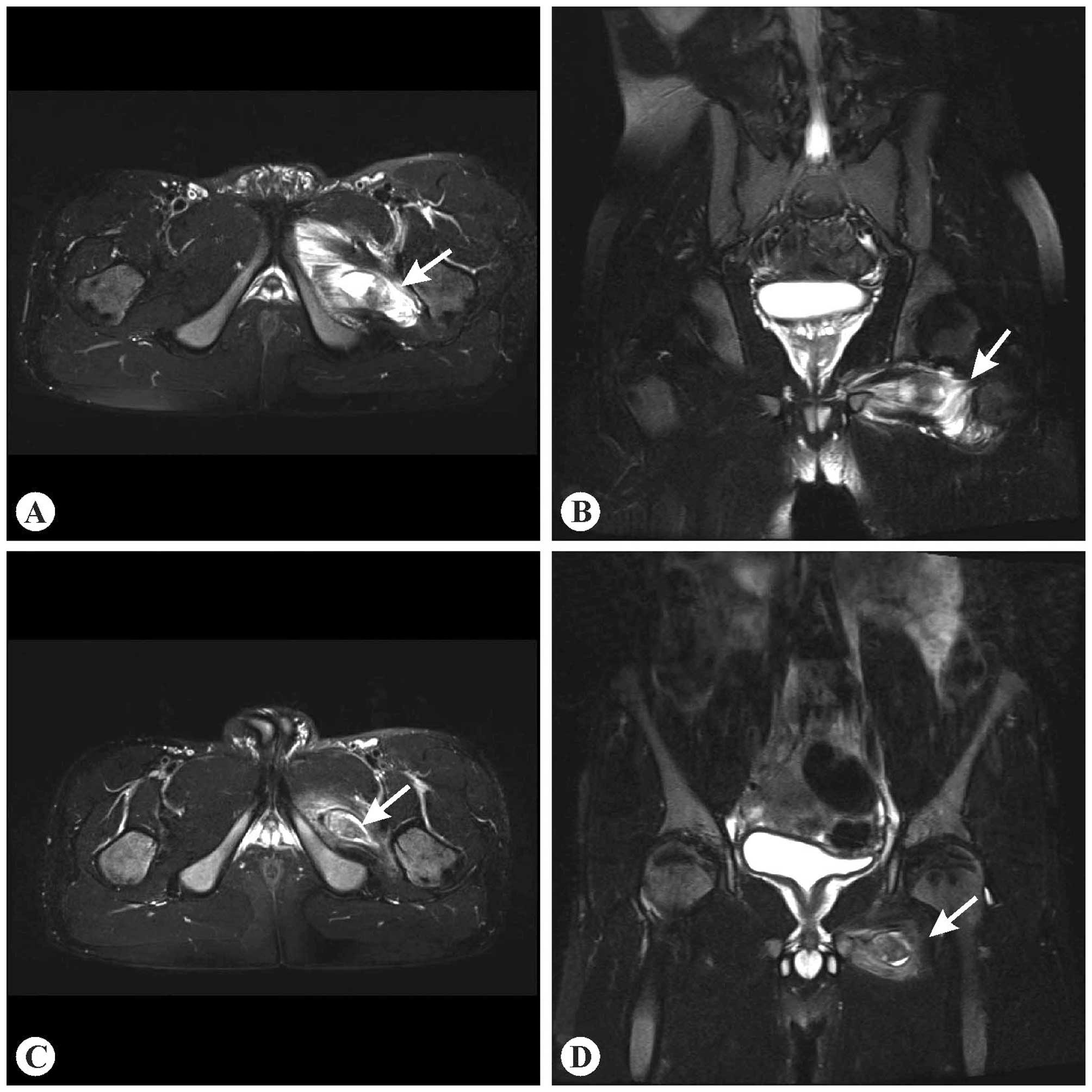
A 22-year-old male patient diagnosed with haemophilia A (FVIII <1%) with high responding inhibitors (6.4 BU) for 2 years, was admitted to our emergency department with left hip, groin and thigh pain, extending to the pubic area. At rest, the patient maintained his hip in mild flexion, whereas movement resulted in pain and muscular spasm. The psoas test was within normal limits. The findings on examination of other joints, cardiovascular and respiratory systems were normal. Routine radiographs and ultrasonography of the pelvis and hips revealed no abnormalities. A pelvic MRI revealed extensive bleeding and edema in the left obturator externus muscle (Fig. 1A and B). The clinical findings subsided following initiation of treatment with recombinant activated FVII (rFVIIa). The treatment included 90 mcg kg−1 every 3 h for 3 days. The control MRI performed 3 weeks after the first hemorrhagic event revealed regression of the intramuscular hematoma and edema (Fig. 1C and D).

Figure 1.

Fat-supressed T2-weighted (A) axial and (B) coronal magnetic resonance images of the pelvis, demonstrating a hematoma and peripheral edema in the left obturator externus muscle. Fat-supressed T2-weighted (C) axial and (D) coronal magnetic resonance images obtained 3 weeks after the first bleeding event revealed regression of the intamuscular hematoma and edema.

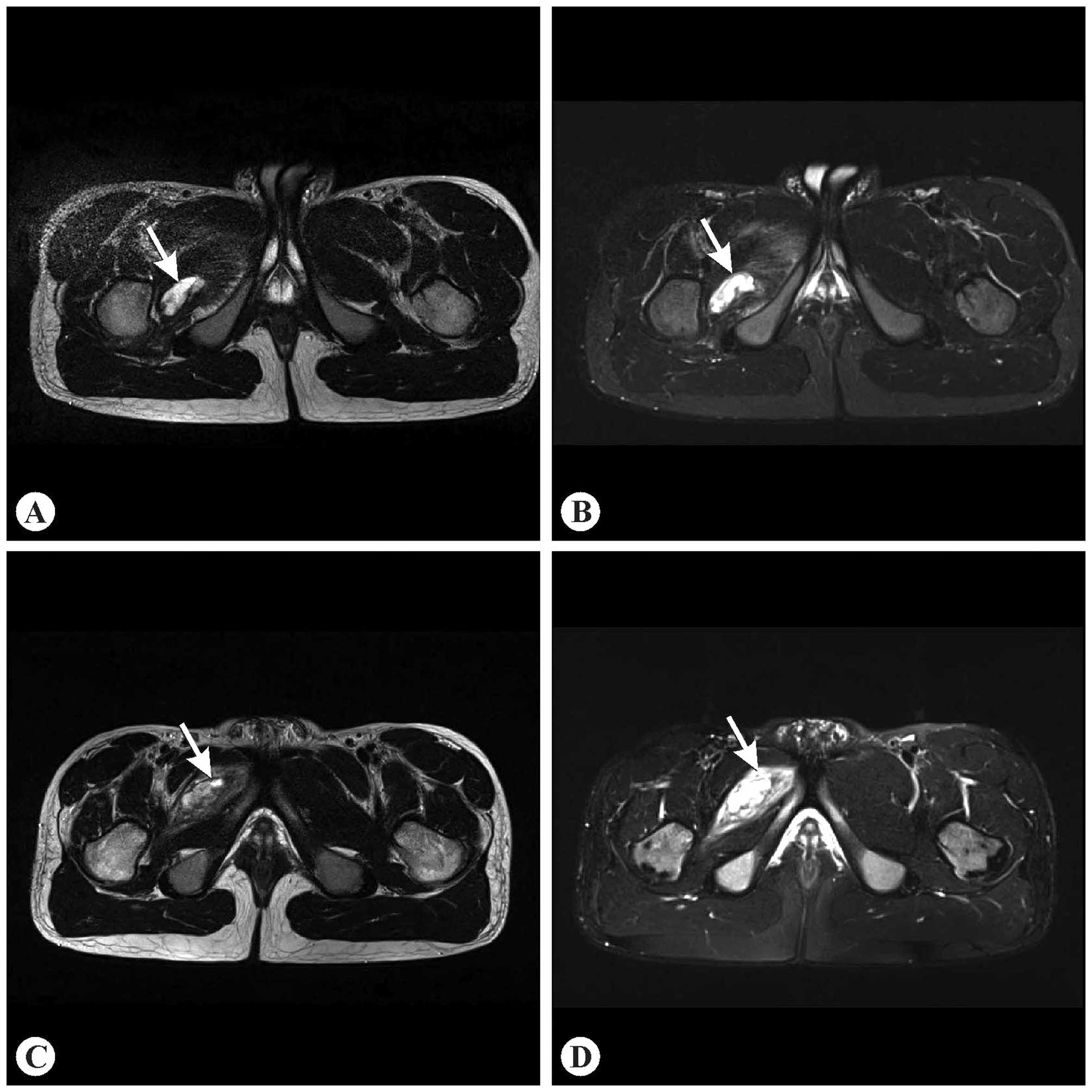
The patient was admitted to the emergency department with right hip, groin and thigh pain 5 months after the first event. The musculoskeletal findings were nearly identical to the first presentation, when the patient was admitted to the hospital. An MRI revealed a focal hematoma and mild peripheral edema in the right obturator externus muscle (Fig. 2A–B). The symptoms were relieved following treatment with rVIIa (90 mcg kg−1 every 3 h for 4 days).

Figure 2.

(A) T2-weighted axial and (B) fat-supressed T2-weighted axial magnetic resonance (MR) images obtained 5 months after the first bleeding event revealed a focal hematoma and mild peripheral edema in the right obturator externus muscle. (C) T2-weighted axial and (D) fat-supressed T2-weighted axial MR images obtained 4 months after the second bleeding event demonstrated a larger hematoma and prominent peripheral edema in the same muscle.

The patient was again admitted to the emergency department with right iliopelvic pain and identical musculoskeletal findings 4 months after the second event. An MRI revealed a larger hematoma and prominent edema in the right obturator externus muscle (Fig. 2C and D). The clinical findings were alleviated following treatment with rFVIIa (90 mcg kg−1 every 3 h for 4 days).

Τhe patient provided written informed consent for the publication of the details of this case.

Discussion

The majority of the hemorrhagic complications in hemophiliac patients occur within the musculoskeletal system. Following joint hemorrhages, intramuscular hemorrhages are the second most prevalent bleeding pattern in haemophilia. Hemorrhaging generally occurs following trauma, although it may also occur spontaneously (7). The clinical findings are based on the affected muscle, its dimensions and the extent of the coagulation defect. Bleeding causes a soft swelling in the muscle, quickly progressing into defensive spasm and leading to flexion of the adjacent joint, with limitation of movement and intense pain. A limited number of studies have been conducted on the pathology of the mentioned muscle hematomas. It is considered that muscle necrosis happens quickly due to ischemia of the fibres as the developing hematoma damages the neurovascular bundles (8).

A significant location of hematoma occurrence is the iliopsoas muscle; this is a well-known complication of hemophilia and is considered as a possibly life-threatening complication, significantly associated with morbidity. Iliopsoas haematoma leads to compression of the femoral nerve due to the developing lesion in the muscle; there is generally no traumatic etiology and the first occurrence is sudden, with intense lower abdominal or groin pain (9).

The obturators are the pelvi-trochanteric muscles originating from the posterior (obturator internus) and the anterior (obtutrator externus) walls of the obturator foramen. These two muscles attach to the greater trochanter of the femur and they are involved in thigh external rotation and abduction, or external rotation and adduction respectively. The differential diagnosis of the obturator externus muscle hematoma should also include primary pyomyositis or abscess. However, only two cases of isolated obturator externus muscle abscess have been reported in the literature to date (5–6). In intramuscular abscesses, fever and elevation of the erythrocyte sedimentation rate or C-reactive protein levels are likely to occur. An MRI with intravenous gadolinium administration achieves a rapid diagnosis of muscle inflammation and rim-enhancing abscess formation; it also enables the detection of additional local pathologies (5).

Ultrasonography is generally of little value in the diagnosis of obturator muscle hematomas, contrary to pelvic MRI, as mentioned in the present case. The CT findings of the intramuscular hematoma are non-spesific asymmetric muscular hypertrophy and possible blood attenuation in the muscle (2). MRI demonstrates hemorrhagic signal abnormality and edema in the affected muscle (10).

As a result, in addition to hip hemarthrosis, iliopsoas hematomas and acute appendicitis, obturator muscle hematoma must be considered as one of the diagnostic alternatives for pelvic pain in patients with hemophilia.

References

1 

Beyer R, Ingerslev J and Sørensen B: Current practice in the management of muscle haematomas in patients with severe haemophilia. Haemophilia. 16:926–931. 2010. View Article : Google Scholar : PubMed/NCBI

2 

Aouba A, Breton S, Harroche A, Sy-Bah D, Torchet MF, Frenzel L, Lasne D, Padovani JP, Odent T and Rothschild C: Spontaneous obturator internus muscle haematoma: A new unpublished cause of iliopelvic pain in haemophilia. Haemophilia. 19:157–160. 2013. View Article : Google Scholar : PubMed/NCBI

3 

Nikolopoulos DD, Apostolopoulos A, Polyzois I, Liarokapis S and Michos I: Obturator internus pyomyositis in a young adult: A case report and review of the literature. Cases J. 2:85882009. View Article : Google Scholar : PubMed/NCBI

4 

King RJ, Laugharne D, Kerslake RW and Holdsworth BJ: Primary obturator pyomyositis: A diagnostic challenge. J Bone Joint Surg Br. 85:895–898. 2003.PubMed/NCBI

5 

Kumar A and Anderson D: Primary obturator externus pyomyositis in a child presenting as hip pain: A case report. Pediatr Emerg Care. 24:97–98. 2008. View Article : Google Scholar : PubMed/NCBI

6 

Fowler T and Strote J: Isolated obturator externus muscle abscess presenting as hip pain. J Emerg Med. 30:137–139. 2006. View Article : Google Scholar : PubMed/NCBI

7 

Duthie RB: Muscle bleeds and consequences. The Management of Musculoskeletal Problems in the Hemophilias. Duthie R, Rizza C, Giangrande P and Dodd C: (2nd). (Oxford). Oxford University Press. 104–117. 1994.

8 

Forbes CD: Clinical aspects of the genetic disorders of coagulation. Disorders of Hemostasis. Ratnoff OD and Forbes CD: (3rd). (Philadelphia). WB Saunders Company. 138–185. 1996.

9 

Fernandez-Palazzi F, Hernandez SR, DeBosch NB and De Saez AR: Hematomas within the iliopsoas muscles in hemophilic patients: The Latin American experience. Clin Orthop Relat Res. 19–24. 1996. View Article : Google Scholar : PubMed/NCBI

10 

Yuh WT, Schreiber AE, Montgomery WJ and Ehara S: Magnetic resonance imaging of pyomyositis. Skeletal Radiol. 17:190–193. 1988. View Article : Google Scholar : PubMed/NCBI

Related Articles

  • Abstract
  • View
  • Download
  • Twitter
Copy and paste a formatted citation
Spandidos Publications style
Arpaci T, Sasmaz I, Akbas T, Eken A, Ozgur A and Antmen B: Bilateral recurrent external obturator muscle hematoma: An unusual cause of pelvic pain in hemophilia. Mol Clin Oncol 4: 622-624, 2016.
APA
Arpaci, T., Sasmaz, I., Akbas, T., Eken, A., Ozgur, A., & Antmen, B. (2016). Bilateral recurrent external obturator muscle hematoma: An unusual cause of pelvic pain in hemophilia. Molecular and Clinical Oncology, 4, 622-624. https://doi.org/10.3892/mco.2016.736
MLA
Arpaci, T., Sasmaz, I., Akbas, T., Eken, A., Ozgur, A., Antmen, B."Bilateral recurrent external obturator muscle hematoma: An unusual cause of pelvic pain in hemophilia". Molecular and Clinical Oncology 4.4 (2016): 622-624.
Chicago
Arpaci, T., Sasmaz, I., Akbas, T., Eken, A., Ozgur, A., Antmen, B."Bilateral recurrent external obturator muscle hematoma: An unusual cause of pelvic pain in hemophilia". Molecular and Clinical Oncology 4, no. 4 (2016): 622-624. https://doi.org/10.3892/mco.2016.736
Copy and paste a formatted citation
x
Spandidos Publications style
Arpaci T, Sasmaz I, Akbas T, Eken A, Ozgur A and Antmen B: Bilateral recurrent external obturator muscle hematoma: An unusual cause of pelvic pain in hemophilia. Mol Clin Oncol 4: 622-624, 2016.
APA
Arpaci, T., Sasmaz, I., Akbas, T., Eken, A., Ozgur, A., & Antmen, B. (2016). Bilateral recurrent external obturator muscle hematoma: An unusual cause of pelvic pain in hemophilia. Molecular and Clinical Oncology, 4, 622-624. https://doi.org/10.3892/mco.2016.736
MLA
Arpaci, T., Sasmaz, I., Akbas, T., Eken, A., Ozgur, A., Antmen, B."Bilateral recurrent external obturator muscle hematoma: An unusual cause of pelvic pain in hemophilia". Molecular and Clinical Oncology 4.4 (2016): 622-624.
Chicago
Arpaci, T., Sasmaz, I., Akbas, T., Eken, A., Ozgur, A., Antmen, B."Bilateral recurrent external obturator muscle hematoma: An unusual cause of pelvic pain in hemophilia". Molecular and Clinical Oncology 4, no. 4 (2016): 622-624. https://doi.org/10.3892/mco.2016.736
Follow us
  • Twitter
  • LinkedIn
  • Facebook
About
  • Spandidos Publications
  • Careers
  • Cookie Policy
  • Privacy Policy
How can we help?
  • Help
  • Live Chat
  • Contact
  • Email to our Support Team