Spandidos Publications Logo
  • About
    • About Spandidos
    • Aims and Scopes
    • Abstracting and Indexing
    • Editorial Policies
    • Reprints and Permissions
    • Job Opportunities
    • Terms and Conditions
    • Contact
  • Journals
    • All Journals
    • Oncology Letters
      • Oncology Letters
      • Information for Authors
      • Editorial Policies
      • Editorial Board
      • Aims and Scope
      • Abstracting and Indexing
      • Bibliographic Information
      • Archive
    • International Journal of Oncology
      • International Journal of Oncology
      • Information for Authors
      • Editorial Policies
      • Editorial Board
      • Aims and Scope
      • Abstracting and Indexing
      • Bibliographic Information
      • Archive
    • Molecular and Clinical Oncology
      • Molecular and Clinical Oncology
      • Information for Authors
      • Editorial Policies
      • Editorial Board
      • Aims and Scope
      • Abstracting and Indexing
      • Bibliographic Information
      • Archive
    • Experimental and Therapeutic Medicine
      • Experimental and Therapeutic Medicine
      • Information for Authors
      • Editorial Policies
      • Editorial Board
      • Aims and Scope
      • Abstracting and Indexing
      • Bibliographic Information
      • Archive
    • International Journal of Molecular Medicine
      • International Journal of Molecular Medicine
      • Information for Authors
      • Editorial Policies
      • Editorial Board
      • Aims and Scope
      • Abstracting and Indexing
      • Bibliographic Information
      • Archive
    • Biomedical Reports
      • Biomedical Reports
      • Information for Authors
      • Editorial Policies
      • Editorial Board
      • Aims and Scope
      • Abstracting and Indexing
      • Bibliographic Information
      • Archive
    • Oncology Reports
      • Oncology Reports
      • Information for Authors
      • Editorial Policies
      • Editorial Board
      • Aims and Scope
      • Abstracting and Indexing
      • Bibliographic Information
      • Archive
    • Molecular Medicine Reports
      • Molecular Medicine Reports
      • Information for Authors
      • Editorial Policies
      • Editorial Board
      • Aims and Scope
      • Abstracting and Indexing
      • Bibliographic Information
      • Archive
    • World Academy of Sciences Journal
      • World Academy of Sciences Journal
      • Information for Authors
      • Editorial Policies
      • Editorial Board
      • Aims and Scope
      • Abstracting and Indexing
      • Bibliographic Information
      • Archive
    • International Journal of Functional Nutrition
      • International Journal of Functional Nutrition
      • Information for Authors
      • Editorial Policies
      • Editorial Board
      • Aims and Scope
      • Abstracting and Indexing
      • Bibliographic Information
      • Archive
    • International Journal of Epigenetics
      • International Journal of Epigenetics
      • Information for Authors
      • Editorial Policies
      • Editorial Board
      • Aims and Scope
      • Abstracting and Indexing
      • Bibliographic Information
      • Archive
    • Medicine International
      • Medicine International
      • Information for Authors
      • Editorial Policies
      • Editorial Board
      • Aims and Scope
      • Abstracting and Indexing
      • Bibliographic Information
      • Archive
  • Articles
  • Information
    • Information for Authors
    • Information for Reviewers
    • Information for Librarians
    • Information for Advertisers
    • Conferences
  • Language Editing
Spandidos Publications Logo
  • About
    • About Spandidos
    • Aims and Scopes
    • Abstracting and Indexing
    • Editorial Policies
    • Reprints and Permissions
    • Job Opportunities
    • Terms and Conditions
    • Contact
  • Journals
    • All Journals
    • Biomedical Reports
      • Information for Authors
      • Editorial Policies
      • Editorial Board
      • Aims and Scope
      • Abstracting and Indexing
      • Bibliographic Information
      • Archive
    • Experimental and Therapeutic Medicine
      • Information for Authors
      • Editorial Policies
      • Editorial Board
      • Aims and Scope
      • Abstracting and Indexing
      • Bibliographic Information
      • Archive
    • International Journal of Epigenetics
      • Information for Authors
      • Editorial Policies
      • Editorial Board
      • Aims and Scope
      • Abstracting and Indexing
      • Bibliographic Information
      • Archive
    • International Journal of Functional Nutrition
      • Information for Authors
      • Editorial Policies
      • Editorial Board
      • Aims and Scope
      • Abstracting and Indexing
      • Bibliographic Information
      • Archive
    • International Journal of Molecular Medicine
      • Information for Authors
      • Editorial Policies
      • Editorial Board
      • Aims and Scope
      • Abstracting and Indexing
      • Bibliographic Information
      • Archive
    • International Journal of Oncology
      • Information for Authors
      • Editorial Policies
      • Editorial Board
      • Aims and Scope
      • Abstracting and Indexing
      • Bibliographic Information
      • Archive
    • Medicine International
      • Information for Authors
      • Editorial Policies
      • Editorial Board
      • Aims and Scope
      • Abstracting and Indexing
      • Bibliographic Information
      • Archive
    • Molecular and Clinical Oncology
      • Information for Authors
      • Editorial Policies
      • Editorial Board
      • Aims and Scope
      • Abstracting and Indexing
      • Bibliographic Information
      • Archive
    • Molecular Medicine Reports
      • Information for Authors
      • Editorial Policies
      • Editorial Board
      • Aims and Scope
      • Abstracting and Indexing
      • Bibliographic Information
      • Archive
    • Oncology Letters
      • Information for Authors
      • Editorial Policies
      • Editorial Board
      • Aims and Scope
      • Abstracting and Indexing
      • Bibliographic Information
      • Archive
    • Oncology Reports
      • Information for Authors
      • Editorial Policies
      • Editorial Board
      • Aims and Scope
      • Abstracting and Indexing
      • Bibliographic Information
      • Archive
    • World Academy of Sciences Journal
      • Information for Authors
      • Editorial Policies
      • Editorial Board
      • Aims and Scope
      • Abstracting and Indexing
      • Bibliographic Information
      • Archive
  • Articles
  • Information
    • For Authors
    • For Reviewers
    • For Librarians
    • For Advertisers
    • Conferences
  • Language Editing
Login Register Submit
  • This site uses cookies
  • You can change your cookie settings at any time by following the instructions in our Cookie Policy. To find out more, you may read our Privacy Policy.

    I agree
Search articles by DOI, keyword, author or affiliation
Search
Advanced Search
presentation
Molecular and Clinical Oncology
Join Editorial Board Propose a Special Issue
Print ISSN: 2049-9450 Online ISSN: 2049-9469
Journal Cover
July-2016 Volume 5 Issue 1

Full Size Image

Sign up for eToc alerts
Recommend to Library

Journals

International Journal of Molecular Medicine

International Journal of Molecular Medicine

International Journal of Molecular Medicine is an international journal devoted to molecular mechanisms of human disease.

International Journal of Oncology

International Journal of Oncology

International Journal of Oncology is an international journal devoted to oncology research and cancer treatment.

Molecular Medicine Reports

Molecular Medicine Reports

Covers molecular medicine topics such as pharmacology, pathology, genetics, neuroscience, infectious diseases, molecular cardiology, and molecular surgery.

Oncology Reports

Oncology Reports

Oncology Reports is an international journal devoted to fundamental and applied research in Oncology.

Experimental and Therapeutic Medicine

Experimental and Therapeutic Medicine

Experimental and Therapeutic Medicine is an international journal devoted to laboratory and clinical medicine.

Oncology Letters

Oncology Letters

Oncology Letters is an international journal devoted to Experimental and Clinical Oncology.

Biomedical Reports

Biomedical Reports

Explores a wide range of biological and medical fields, including pharmacology, genetics, microbiology, neuroscience, and molecular cardiology.

Molecular and Clinical Oncology

Molecular and Clinical Oncology

International journal addressing all aspects of oncology research, from tumorigenesis and oncogenes to chemotherapy and metastasis.

World Academy of Sciences Journal

World Academy of Sciences Journal

Multidisciplinary open-access journal spanning biochemistry, genetics, neuroscience, environmental health, and synthetic biology.

International Journal of Functional Nutrition

International Journal of Functional Nutrition

Open-access journal combining biochemistry, pharmacology, immunology, and genetics to advance health through functional nutrition.

International Journal of Epigenetics

International Journal of Epigenetics

Publishes open-access research on using epigenetics to advance understanding and treatment of human disease.

Medicine International

Medicine International

An International Open Access Journal Devoted to General Medicine.

Journal Cover
July-2016 Volume 5 Issue 1

Full Size Image

Sign up for eToc alerts
Recommend to Library

  • Article
  • Citations
    • Cite This Article
    • Download Citation
    • Create Citation Alert
    • Remove Citation Alert
    • Cited By
  • Similar Articles
    • Related Articles (in Spandidos Publications)
    • Similar Articles (Google Scholar)
    • Similar Articles (PubMed)
  • Download PDF
  • Download XML
  • View XML
Case Report

Usefulness of selective renal artery embolization for urinary fistula following partial nephrectomy: Two case reports

  • Authors:
    • Takahiro Nohara
    • Satoko Matsuyama
    • Shohei Kawaguchi
    • Tohru Miyagi
    • Chikashi Seto
    • Kentaro Mochizuki
  • View Affiliations / Copyright

    Affiliations: Department of Urology, Toyama Prefectural Central Hospital, Toyama 930‑8550, Japan, Department of Radiology, Toyama Prefectural Central Hospital, Toyama 930‑8550, Japan
  • Pages: 158-160
    |
    Published online on: May 4, 2016
       https://doi.org/10.3892/mco.2016.885
  • Expand metrics +
Metrics: Total Views: 0 (Spandidos Publications: | PMC Statistics: )
Metrics: Total PDF Downloads: 0 (Spandidos Publications: | PMC Statistics: )
Cited By (CrossRef): 0 citations Loading Articles...

This article is mentioned in:


Abstract

The present study reported two cases in which selective artery embolization were identified to assist in resolving urinary fistulae following partial nephrectomies. The first case involved a 51‑year‑old male who received a mini‑incision partial nephrectomy with renorrhaphy. Following the operation, urine continued to discharge from the retroperitoneal drain. Selective renal artery embolization of the upper calyx at post‑operation day 20 was highly effective and urine output from the drain stopped immediately. Case 2 involved a 66‑year‑old male, who also suffered from a urinary fistula following a partial nephrectomy. Selective renal artery embolization performed at post-operation day 21 was again effective. In each case, the upper calyx was separated from the renal pelvis. These cases demonstrated that suturing of the collecting system and renal parenchyma may result in the separation of the urine pathway, and that selective renal artery embolization appears to be a highly effective treatment in such cases.

Introduction

Partial nephrectomy (PN) is the most commonly used procedure for the treatment of clinical stage T1a renal cancer. Furthermore, evidence reveals that patients undergoing radical nephrectomy have a higher overall mortality and cardiovascular morbidity rate compared with those undergoing PN, even though their effectiveness in cancer control is equivalent (1,2).

However, PN results in urinary fistula (UF) in 1–6% of patients (3,4). The majority of these patients are forced to undergo lengthy hospital stays, since perinephric drains cannot be removed due to of persistent urine drainage. An effective management strategy for UF remains to be established.

The present study reported two cases in which selective artery embolization was useful for the treatment of UF following PN.

Case reports

Case 1

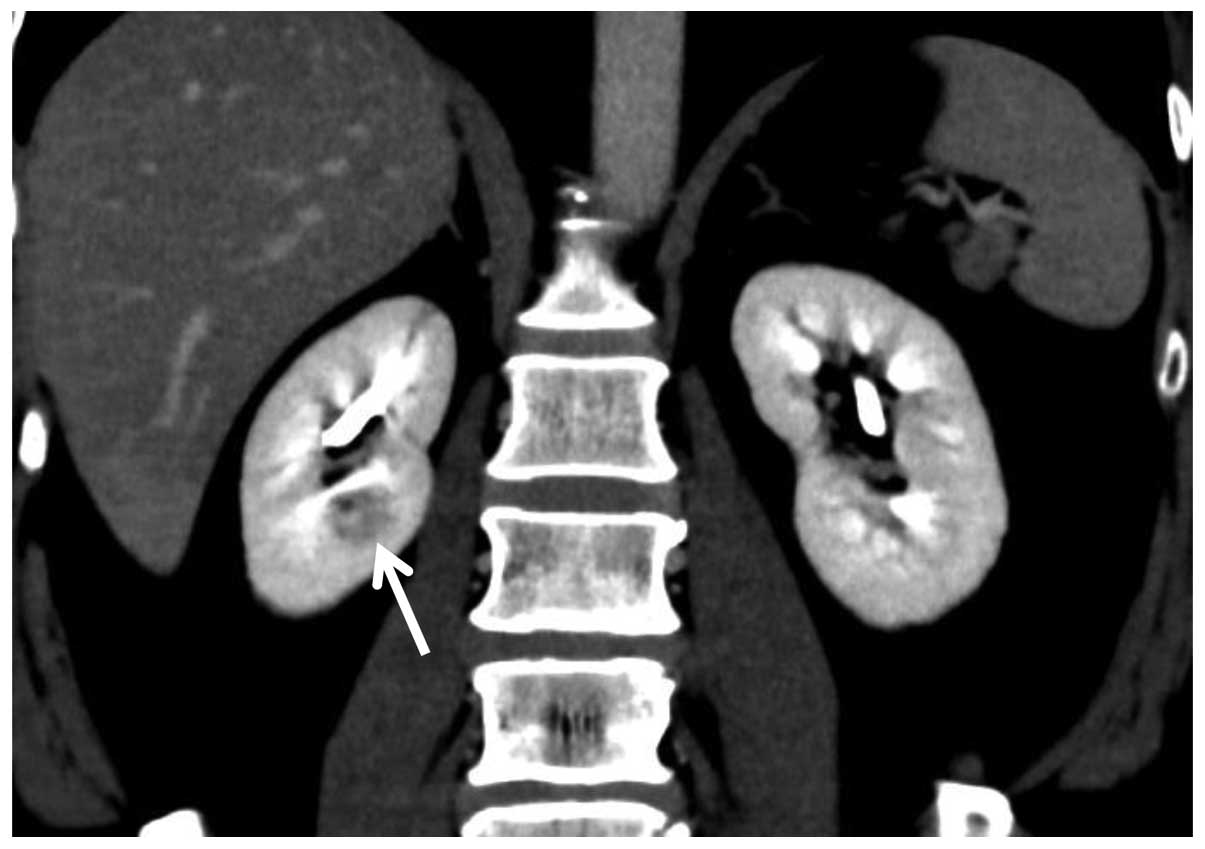
A 51-year-old male, diagnosed with renal cell carcinoma (RCC) in the right kidney (Fig. 1), received mini-incision PN with renorrhaphy at Toyama Prefectural Central Hospital (Toyama, Japan). Following the operation, urine discharge of ~100 ml per day continued from the retroperitoneal drain. Although ureteral stenting was performed at post-operation day (POD) 6, the quantity of drainage did not decrease. A computed tomography (CT) at POD 13 revealed urine leakage in the upper part of the kidney. Furthermore, the upper calyx was completely separated from the middle/lower calyx and the renal pelvis. The upper calyx was not enlarged and it was considered unlikely that percutaneous drainage could be successfully performed. Since the UF could not be treated unless effective urine drainage was obtained, it was unavoidable to perform an alternative approach, including nephrectomy or transarterial embolization (TAE) of the entire kidney. However, the decision was made to perform selective TAE of the upper calyx at POD 20. Following this procedure, urine output from the drain stopped immediately. Although fever was observed for a few days, the patient was able to leave Toyama Prefectural Central Hospital at POD 29. The serum creatinine level was slightly increased (1.12 to 1.21 mg/dl). Since discharge, no further complications or RCC recurrences have occurred for 3 years.

Figure 1.

Pre-operative computed tomography of case 1. A small renal tumor is shown in the middle part of the right kidney (arrow).

Case 2

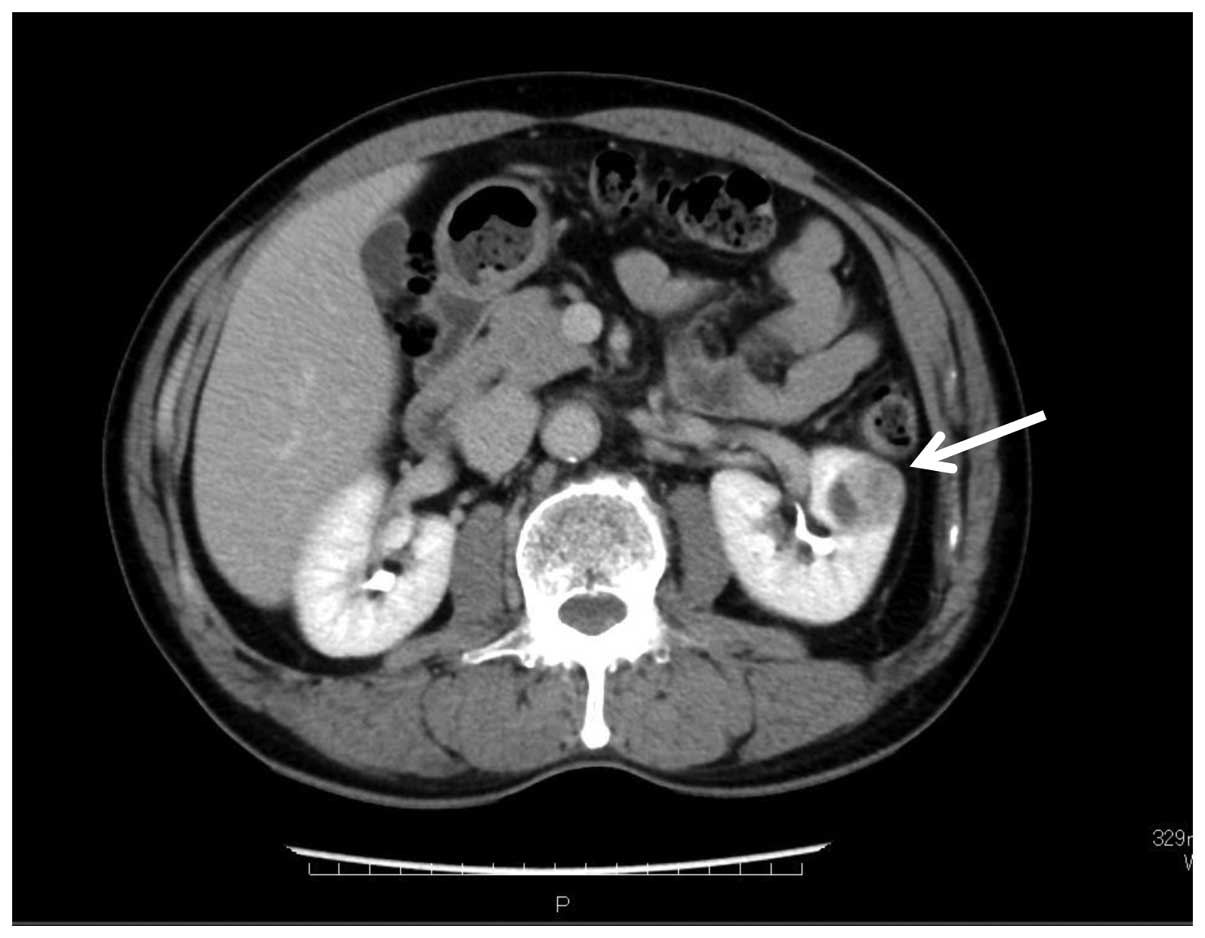
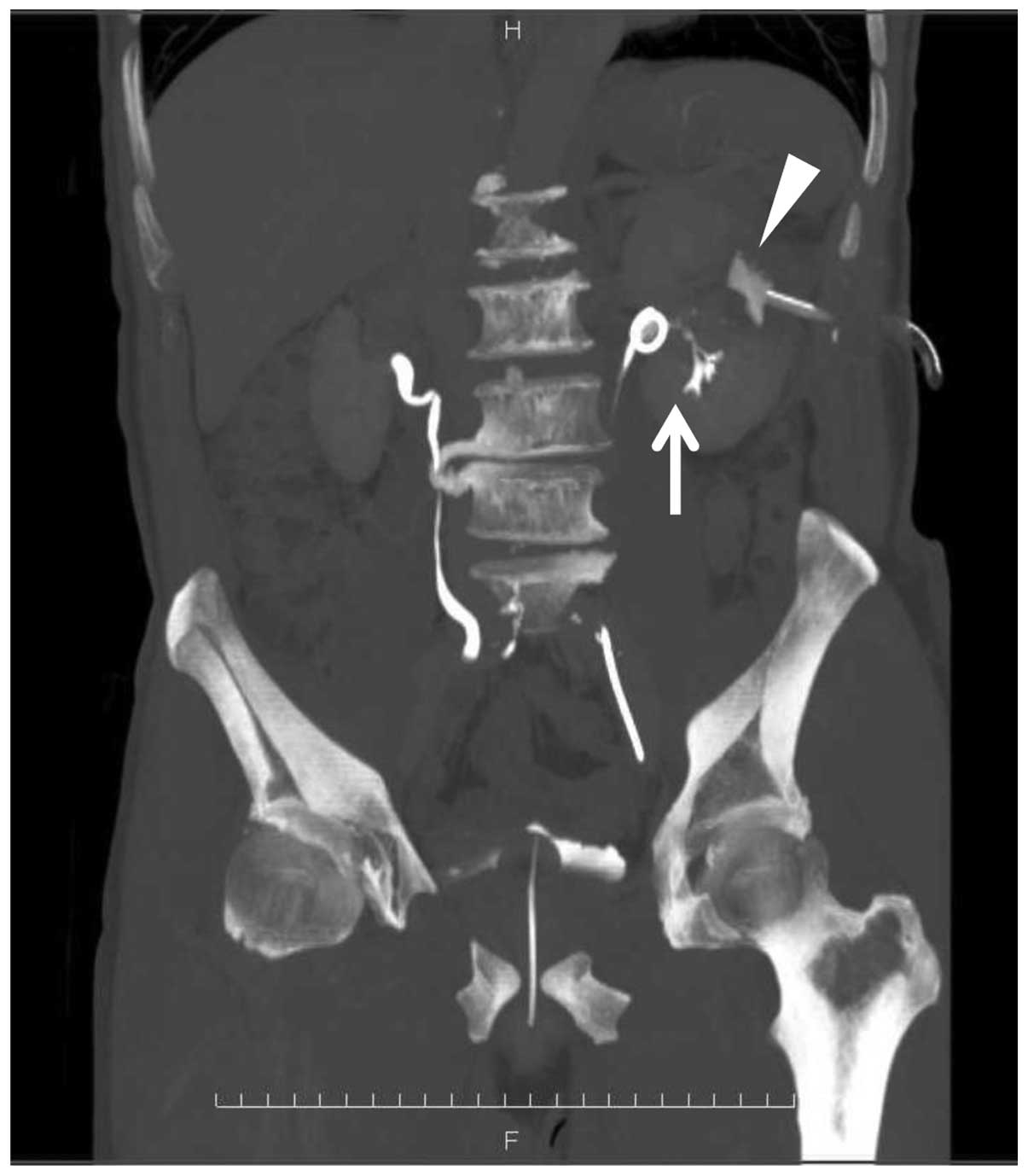
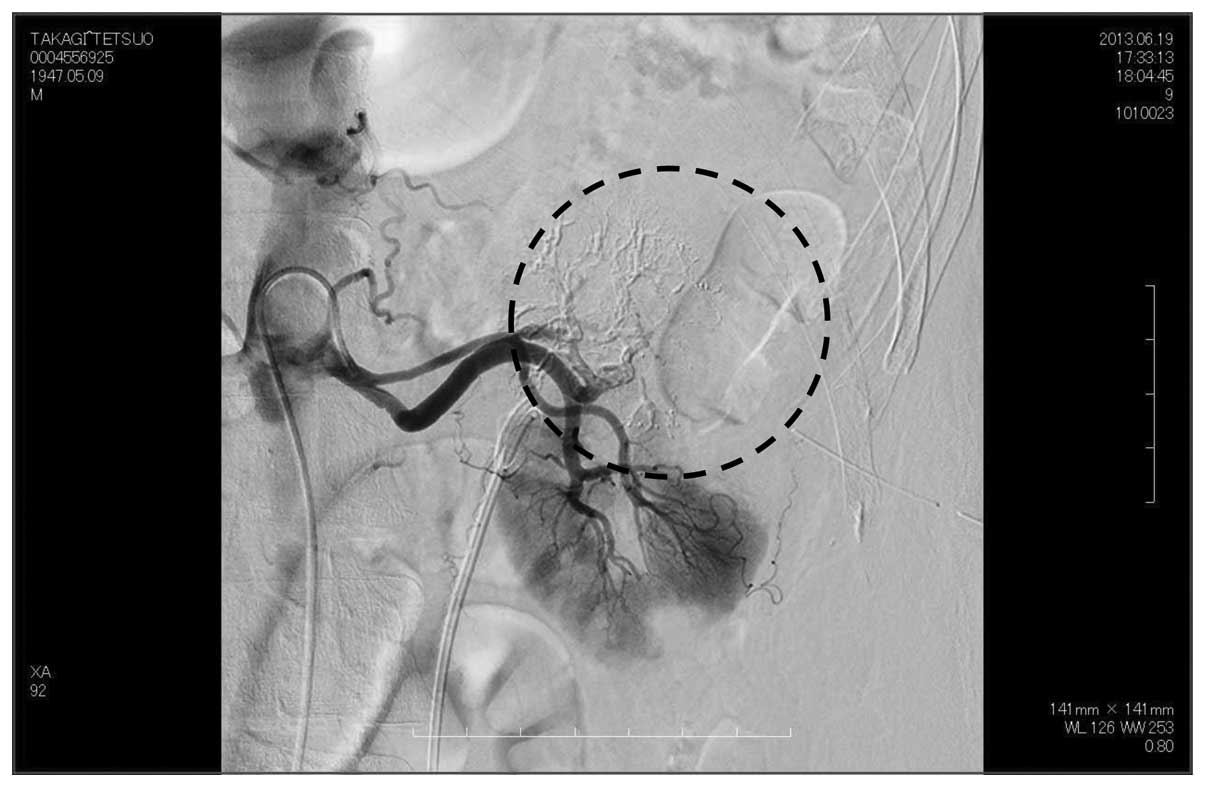
A 66-year-old male, with a diagnosis of RCC in the left kidney (Fig. 2), received mini-incision PN with renorrhaphy at Toyama Prefectural Central Hospital. Following the operation, urine discharge of ~50–100 ml per day continued from the retroperitoneal drain. Although ureteral stenting was performed at POD 7, the quantity of drainage did not decrease. A CT at POD 12 revealed urine leakage in an upper part of the kidney. Furthermore, the upper calyx was completely separated from the middle/lower calyx and the renal pelvis (Fig. 3), and it was slightly enlarged. This suggested that percutaneous drainage would be difficult to achieve, and therefore, we considered that selective TAE of the upper section of the kidney, as previously described in case 1, may be effective. This procedure was performed at POD 21 (Fig. 4) and resulted in the immediate cessation of urine output from the drain. Although fever was observed for a few days, the patient was able to leave Toyama Prefectural Central Hospital on POD 26. The serum creatinine level was slightly increased (0.99 to 1.06 mg/dl). Since discharge, no complications and RCC recurrence have occurred for 2 years.

Figure 2.

Pre-operative computed tomography of case 2. A small renal tumor is shown in the middle part of the right kidney (arrow).

Figure 3.

Post-operative computed tomography of case 2. A urinary fistula was recognized in the upper calyx of the kidney (triangle), which was completely separated from the middle/lower calyx and the renal pelvis (arrow).

Figure 4.

Renal angiography just after selective transarterial embolization of the apical branch of the left kidney. Vascular perfusion in the upper part of the kidney (the area in the black circle) was completely blocked.

Discussion

Management of UF following PN can present serious difficulties. Textbooks state that most UF cases will resolve with several weeks of conservative therapy unless there is distal obstruction to the site of leakage (5), and medical literature demonstrates that many cases of UF are cured only by observation (3). Meeks et al (6) described 21 cases of UF, where a long mean duration of leakage of 53 days was noted. This previous study demonstrates that once UF occurs, patients are often confined to hospital for lengthy time periods.

In the two cases described in the present study, the upper calyx was completely separated from the middle/lower calyx, and therefore, prevented successful drainage of the upper calyx. It was suspected that deep suture of the renal parenchyma and/or the collecting system during PN resulted in the upper calyx separating from the renal pelvis in each case. For the treatment of UF, nephrectomy or TAE of the entire kidney was considererd. However, selective TAE was attempted in order to resolve UF and to preserve renal function, and was successful in stopping urine discharge from the retroperitoneal drain.

To the best of our knowledge, only 4 cases of selective TAE in the treatment of UF have been previously reported (7,8). In one of these cases, urinary drainage persisted from the remnant of the lower collecting system following hemi-nephrectomy of the lower-half of a duplex kidney (7). The other three cases involved horseshoe kidneys, which received half-side nephrectomies with incisions of the isthmus, and urinary drainage continued from the residual parenchyma that had originally drained into the renal pelvis of the resected side (8). In all four cases, no drainage pathways from the site of UF were observed and selective TAE was successful.

Therefore, it was observed that UF is unable to spontaneously resolve if good drainage pathways do not exist. Finally, from the two cases presented in the present study, the following was concluded: i) Suture of the collecting system and renal parenchyma in PN may result in the separation of the renal calyx from the renal pelvis; ii) Selective TAE of the renal parenchyma in UF sites appeared to be a highly effective treatment in such cases.

Glossary

Abbreviations

Abbreviations:

PN

partial nephrectomy

POD

post-operation day

RCC

renal cell carcinoma

TAE

transarterial embolization

UF

urinary fistula

References

1. 

Thompson RH, Boorjian SA, Lohse CM, Leibovich BC, Kwon ED, Cheville JC and Blute ML: Radical nephrectomy for pT1a renal masses may be associated with decreased overall survival compared with partial nephrectomy. J Urol. 179:468–471; discussion 472–473. 2008. View Article : Google Scholar : PubMed/NCBI

2. 

Huang WC, Elkin EB, Levey AS, Jang TL and Russo P: Partial nephrectomy versus radical nephrectomy in patients with small renal tumors-is there a difference in mortality and cardiovascular outcomes? J Urol. 181:55–61; discussion 61–62. 2009. View Article : Google Scholar : PubMed/NCBI

3. 

Kundu SD, Thompson RH, Kallingal GJ, Cambareri G and Russo P: Urinary fistulae after partial nephrectomy. BJU Int. 106:1042–1044. 2010. View Article : Google Scholar : PubMed/NCBI

4. 

Minervini A, Vittori G, Antonelli A, Celia A, Crivellaro S, Dente D, Di Santo V, Frea B, Gacci M, Gritti A, et al: Open versus robotic-assisted partial nephrectomy: A multicenter comparison study of perioperative results and complications. World J Urol. 32:287–293. 2014. View Article : Google Scholar : PubMed/NCBI

5. 

Kavoussi LR, Schwartz MJ and Gill IS: Laparoscopic surgery of the kidney. Kavoussi LR, Novick AC, Partin AW and Peters CA: Campbell's Urology (10th). (Philadelphia). Elsevier Saunders. 16682012.

6. 

Meeks JJ, Zhao LC, Navai N, Perry KT Jr, Nadler RB and Smith ND: Risk factors and management of urine leaks after partial nephrectomy. J Urol. 180:2375–2378. 2008. View Article : Google Scholar : PubMed/NCBI

7. 

Mitty HA, Dan SJ, Goldman HJ and Glickman SI: Urinary fistulas after partial nephrectomy: Treatment by segmental renal embolization. AJR Am J Roentgenol. 141:101–103. 1983. View Article : Google Scholar : PubMed/NCBI

8. 

Stefani P, Selli C, Nicita G, Lapini A and Dami A: Treatment of urinary fistulas after resection of horseshoe kidneys by selective arterial embolization. Cardiovasc Intervent Radiol. 12:18–21. 1989. View Article : Google Scholar : PubMed/NCBI

Related Articles

  • Abstract
  • View
  • Download
  • Twitter
Copy and paste a formatted citation
Spandidos Publications style
Nohara T, Matsuyama S, Kawaguchi S, Miyagi T, Seto C and Mochizuki K: Usefulness of selective renal artery embolization for urinary fistula following partial nephrectomy: Two case reports. Mol Clin Oncol 5: 158-160, 2016.
APA
Nohara, T., Matsuyama, S., Kawaguchi, S., Miyagi, T., Seto, C., & Mochizuki, K. (2016). Usefulness of selective renal artery embolization for urinary fistula following partial nephrectomy: Two case reports. Molecular and Clinical Oncology, 5, 158-160. https://doi.org/10.3892/mco.2016.885
MLA
Nohara, T., Matsuyama, S., Kawaguchi, S., Miyagi, T., Seto, C., Mochizuki, K."Usefulness of selective renal artery embolization for urinary fistula following partial nephrectomy: Two case reports". Molecular and Clinical Oncology 5.1 (2016): 158-160.
Chicago
Nohara, T., Matsuyama, S., Kawaguchi, S., Miyagi, T., Seto, C., Mochizuki, K."Usefulness of selective renal artery embolization for urinary fistula following partial nephrectomy: Two case reports". Molecular and Clinical Oncology 5, no. 1 (2016): 158-160. https://doi.org/10.3892/mco.2016.885
Copy and paste a formatted citation
x
Spandidos Publications style
Nohara T, Matsuyama S, Kawaguchi S, Miyagi T, Seto C and Mochizuki K: Usefulness of selective renal artery embolization for urinary fistula following partial nephrectomy: Two case reports. Mol Clin Oncol 5: 158-160, 2016.
APA
Nohara, T., Matsuyama, S., Kawaguchi, S., Miyagi, T., Seto, C., & Mochizuki, K. (2016). Usefulness of selective renal artery embolization for urinary fistula following partial nephrectomy: Two case reports. Molecular and Clinical Oncology, 5, 158-160. https://doi.org/10.3892/mco.2016.885
MLA
Nohara, T., Matsuyama, S., Kawaguchi, S., Miyagi, T., Seto, C., Mochizuki, K."Usefulness of selective renal artery embolization for urinary fistula following partial nephrectomy: Two case reports". Molecular and Clinical Oncology 5.1 (2016): 158-160.
Chicago
Nohara, T., Matsuyama, S., Kawaguchi, S., Miyagi, T., Seto, C., Mochizuki, K."Usefulness of selective renal artery embolization for urinary fistula following partial nephrectomy: Two case reports". Molecular and Clinical Oncology 5, no. 1 (2016): 158-160. https://doi.org/10.3892/mco.2016.885
Follow us
  • Twitter
  • LinkedIn
  • Facebook
About
  • Spandidos Publications
  • Careers
  • Cookie Policy
  • Privacy Policy
How can we help?
  • Help
  • Live Chat
  • Contact
  • Email to our Support Team