Spandidos Publications Logo
  • About
    • About Spandidos
    • Aims and Scopes
    • Abstracting and Indexing
    • Editorial Policies
    • Reprints and Permissions
    • Job Opportunities
    • Terms and Conditions
    • Contact
  • Journals
    • All Journals
    • Oncology Letters
      • Oncology Letters
      • Information for Authors
      • Editorial Policies
      • Editorial Board
      • Aims and Scope
      • Abstracting and Indexing
      • Bibliographic Information
      • Archive
    • International Journal of Oncology
      • International Journal of Oncology
      • Information for Authors
      • Editorial Policies
      • Editorial Board
      • Aims and Scope
      • Abstracting and Indexing
      • Bibliographic Information
      • Archive
    • Molecular and Clinical Oncology
      • Molecular and Clinical Oncology
      • Information for Authors
      • Editorial Policies
      • Editorial Board
      • Aims and Scope
      • Abstracting and Indexing
      • Bibliographic Information
      • Archive
    • Experimental and Therapeutic Medicine
      • Experimental and Therapeutic Medicine
      • Information for Authors
      • Editorial Policies
      • Editorial Board
      • Aims and Scope
      • Abstracting and Indexing
      • Bibliographic Information
      • Archive
    • International Journal of Molecular Medicine
      • International Journal of Molecular Medicine
      • Information for Authors
      • Editorial Policies
      • Editorial Board
      • Aims and Scope
      • Abstracting and Indexing
      • Bibliographic Information
      • Archive
    • Biomedical Reports
      • Biomedical Reports
      • Information for Authors
      • Editorial Policies
      • Editorial Board
      • Aims and Scope
      • Abstracting and Indexing
      • Bibliographic Information
      • Archive
    • Oncology Reports
      • Oncology Reports
      • Information for Authors
      • Editorial Policies
      • Editorial Board
      • Aims and Scope
      • Abstracting and Indexing
      • Bibliographic Information
      • Archive
    • Molecular Medicine Reports
      • Molecular Medicine Reports
      • Information for Authors
      • Editorial Policies
      • Editorial Board
      • Aims and Scope
      • Abstracting and Indexing
      • Bibliographic Information
      • Archive
    • World Academy of Sciences Journal
      • World Academy of Sciences Journal
      • Information for Authors
      • Editorial Policies
      • Editorial Board
      • Aims and Scope
      • Abstracting and Indexing
      • Bibliographic Information
      • Archive
    • International Journal of Functional Nutrition
      • International Journal of Functional Nutrition
      • Information for Authors
      • Editorial Policies
      • Editorial Board
      • Aims and Scope
      • Abstracting and Indexing
      • Bibliographic Information
      • Archive
    • International Journal of Epigenetics
      • International Journal of Epigenetics
      • Information for Authors
      • Editorial Policies
      • Editorial Board
      • Aims and Scope
      • Abstracting and Indexing
      • Bibliographic Information
      • Archive
    • Medicine International
      • Medicine International
      • Information for Authors
      • Editorial Policies
      • Editorial Board
      • Aims and Scope
      • Abstracting and Indexing
      • Bibliographic Information
      • Archive
  • Articles
  • Information
    • Information for Authors
    • Information for Reviewers
    • Information for Librarians
    • Information for Advertisers
    • Conferences
  • Language Editing
Spandidos Publications Logo
  • About
    • About Spandidos
    • Aims and Scopes
    • Abstracting and Indexing
    • Editorial Policies
    • Reprints and Permissions
    • Job Opportunities
    • Terms and Conditions
    • Contact
  • Journals
    • All Journals
    • Biomedical Reports
      • Information for Authors
      • Editorial Policies
      • Editorial Board
      • Aims and Scope
      • Abstracting and Indexing
      • Bibliographic Information
      • Archive
    • Experimental and Therapeutic Medicine
      • Information for Authors
      • Editorial Policies
      • Editorial Board
      • Aims and Scope
      • Abstracting and Indexing
      • Bibliographic Information
      • Archive
    • International Journal of Epigenetics
      • Information for Authors
      • Editorial Policies
      • Editorial Board
      • Aims and Scope
      • Abstracting and Indexing
      • Bibliographic Information
      • Archive
    • International Journal of Functional Nutrition
      • Information for Authors
      • Editorial Policies
      • Editorial Board
      • Aims and Scope
      • Abstracting and Indexing
      • Bibliographic Information
      • Archive
    • International Journal of Molecular Medicine
      • Information for Authors
      • Editorial Policies
      • Editorial Board
      • Aims and Scope
      • Abstracting and Indexing
      • Bibliographic Information
      • Archive
    • International Journal of Oncology
      • Information for Authors
      • Editorial Policies
      • Editorial Board
      • Aims and Scope
      • Abstracting and Indexing
      • Bibliographic Information
      • Archive
    • Medicine International
      • Information for Authors
      • Editorial Policies
      • Editorial Board
      • Aims and Scope
      • Abstracting and Indexing
      • Bibliographic Information
      • Archive
    • Molecular and Clinical Oncology
      • Information for Authors
      • Editorial Policies
      • Editorial Board
      • Aims and Scope
      • Abstracting and Indexing
      • Bibliographic Information
      • Archive
    • Molecular Medicine Reports
      • Information for Authors
      • Editorial Policies
      • Editorial Board
      • Aims and Scope
      • Abstracting and Indexing
      • Bibliographic Information
      • Archive
    • Oncology Letters
      • Information for Authors
      • Editorial Policies
      • Editorial Board
      • Aims and Scope
      • Abstracting and Indexing
      • Bibliographic Information
      • Archive
    • Oncology Reports
      • Information for Authors
      • Editorial Policies
      • Editorial Board
      • Aims and Scope
      • Abstracting and Indexing
      • Bibliographic Information
      • Archive
    • World Academy of Sciences Journal
      • Information for Authors
      • Editorial Policies
      • Editorial Board
      • Aims and Scope
      • Abstracting and Indexing
      • Bibliographic Information
      • Archive
  • Articles
  • Information
    • For Authors
    • For Reviewers
    • For Librarians
    • For Advertisers
    • Conferences
  • Language Editing
Login Register Submit
  • This site uses cookies
  • You can change your cookie settings at any time by following the instructions in our Cookie Policy. To find out more, you may read our Privacy Policy.

    I agree
Search articles by DOI, keyword, author or affiliation
Search
Advanced Search
presentation
Molecular and Clinical Oncology
Join Editorial Board Propose a Special Issue
Print ISSN: 2049-9450 Online ISSN: 2049-9469
Journal Cover
September-2016 Volume 5 Issue 3

Full Size Image

Sign up for eToc alerts
Recommend to Library

Journals

International Journal of Molecular Medicine

International Journal of Molecular Medicine

International Journal of Molecular Medicine is an international journal devoted to molecular mechanisms of human disease.

International Journal of Oncology

International Journal of Oncology

International Journal of Oncology is an international journal devoted to oncology research and cancer treatment.

Molecular Medicine Reports

Molecular Medicine Reports

Covers molecular medicine topics such as pharmacology, pathology, genetics, neuroscience, infectious diseases, molecular cardiology, and molecular surgery.

Oncology Reports

Oncology Reports

Oncology Reports is an international journal devoted to fundamental and applied research in Oncology.

Experimental and Therapeutic Medicine

Experimental and Therapeutic Medicine

Experimental and Therapeutic Medicine is an international journal devoted to laboratory and clinical medicine.

Oncology Letters

Oncology Letters

Oncology Letters is an international journal devoted to Experimental and Clinical Oncology.

Biomedical Reports

Biomedical Reports

Explores a wide range of biological and medical fields, including pharmacology, genetics, microbiology, neuroscience, and molecular cardiology.

Molecular and Clinical Oncology

Molecular and Clinical Oncology

International journal addressing all aspects of oncology research, from tumorigenesis and oncogenes to chemotherapy and metastasis.

World Academy of Sciences Journal

World Academy of Sciences Journal

Multidisciplinary open-access journal spanning biochemistry, genetics, neuroscience, environmental health, and synthetic biology.

International Journal of Functional Nutrition

International Journal of Functional Nutrition

Open-access journal combining biochemistry, pharmacology, immunology, and genetics to advance health through functional nutrition.

International Journal of Epigenetics

International Journal of Epigenetics

Publishes open-access research on using epigenetics to advance understanding and treatment of human disease.

Medicine International

Medicine International

An International Open Access Journal Devoted to General Medicine.

Journal Cover
September-2016 Volume 5 Issue 3

Full Size Image

Sign up for eToc alerts
Recommend to Library

  • Article
  • Citations
    • Cite This Article
    • Download Citation
    • Create Citation Alert
    • Remove Citation Alert
    • Cited By
  • Similar Articles
    • Related Articles (in Spandidos Publications)
    • Similar Articles (Google Scholar)
    • Similar Articles (PubMed)
  • Download PDF
  • Download XML
  • View XML
Case Report Open Access

Long-term complete response of antiandrogen withdrawal syndrome in a patient with metastatic prostate cancer: A case report

  • Authors:
    • Masayuki Sano
    • Shinya Yamamoto
    • Sho Uehara
    • Takeshi Yuasa
    • Hitoshi Masuda
    • Iwao Fukui
    • Junji Yonese
  • View Affiliations / Copyright

    Affiliations: Department of Urology, Cancer Institute Hospital, Japanese Foundation for Cancer Research, Tokyo 135‑8550, Japan
    Copyright: © Sano et al. This is an open access article distributed under the terms of Creative Commons Attribution License.
  • Pages: 208-210
    |
    Published online on: July 1, 2016
       https://doi.org/10.3892/mco.2016.946
  • Expand metrics +
Metrics: Total Views: 0 (Spandidos Publications: | PMC Statistics: )
Metrics: Total PDF Downloads: 0 (Spandidos Publications: | PMC Statistics: )
Cited By (CrossRef): 0 citations Loading Articles...

This article is mentioned in:


Abstract

Antiandrogen withdrawal syndrome (AWS) is a well-established phenomenon in prostate cancer treated with combined androgen blockade (CAB). AWS is generally defined as subjective and/or objective improvement following discontinuation of an antiandrogen. However, the duration of the AWS response is usually limited. In addition, a complete response is quite rare. We herein present the case of a patient who achieved complete response from AWS, with the duration of this response lasting for >6 years. A 72‑year‑old man with metastatic prostate cancer received CAB with a luteinizing hormone‑releasing hormone analog and bicalutamide. In addition, for local cancer control, external beam radiation therapy (70 Gy) to the prostate was performed. Subsequently, the serum prostate‑specific antigen (PSA) level reached a nadir (undetectable level). Four years later, the patient's serum PSA level started to rise, and bicalutamide was discontinued to confirm AWS at a serum PSA level of 0.34 ng/ml. The PSA level immediately decreased again to an undetectable level (0.00 ng/ml), where it has been remained for 6 years. Bone scintigraphy and computed tomography scans have shown no evidence of bone or other metastases since the introduction of AWS. To the best of our knowledge, there have been no reports of such a long duration of complete response from AWS. Therefore, this phenomenon should always be considered, even in patients with advanced disease.

Introduction

Progressive prostate cancer that has been treated with androgen-deprivation therapy using an antiandrogen, such as bicalutamide, occasionally causes antiandrogen withdrawal syndrome (AWS), which results in a response involving a significant decline in prostate-specific antigen (PSA) levels.

AWS is generally defined as subjective and/or objective improvement following discontinuation of an antiandrogen in patients with elevated PSA levels who are treated with combined androgen blockade (CAB) using steroidal or non-steroidal antiandrogens (1).

The duration of AWS varies considerably (1) and only a limited number of cases exhibiting a complete response, in terms of PSA level decline, have been reported.

We herein report the case of a patient with metastatic prostate cancer who received CAB, with the longest duration of a complete response reported to date.

Case report

A 72-year-old man visited the Cancer Institute Hospital (Tokyo, Japan) on June 9, 2004, complaining of right hip joint pain. Laboratory examination revealed a PSA level of 588.8 ng/ml and an elevated alkaline phosphatase level 539 IU/l (normal range, 100–325 IU/l). Prostate biopsy revealed adenocarcinoma, with a Gleason score of 4+3=7. Computed tomography (CT) and bone scintigraphy scans revealed metastases to the right pelvis and right femoral head (extent of disease I).

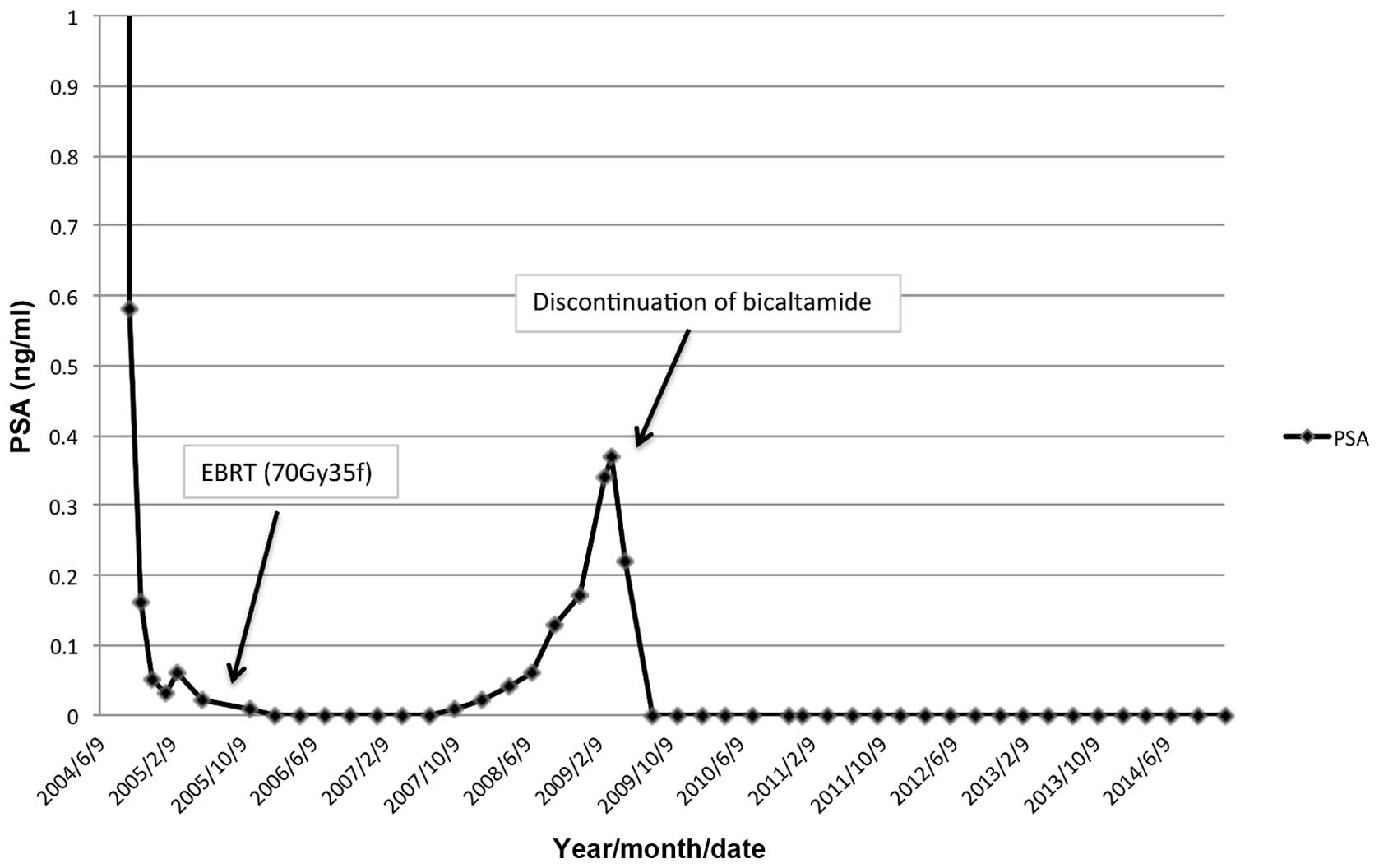
CAB consisting of a luteinizing hormone-releasing hormone analog and bicalutamide 80 mg/day was immediately administered. The serum PSA level promptly decreased to 0.16 ng/m in 3 months and had reached a nadir of 0.02 ng/m by May 26, 2005. External beam radiation therapy (70 Gy) to the prostate was then performed for local cancer control. The PSA level had decreased to 0.00 ng/ml by January 31, 2006. In addition, no bone metastases were detected on bone scintigraphy.

The PSA level gradually increased to 0.34 ng/m by March 3, 2009; however, no new lesions of distant metastasis were detected by CT or bone scintigraphy. Bicalutamide was discontinued to confirm AWS. The PSA level again decreased to 0.00 ng/ml by August 18, 2009. To date, this undetectable PSA level has been maintained, and no recurrence has been detected by bone scintigraphy or CT for the past 6 years since the introduction of AWS. The clinical course and change in serum PSA levels are shown in Fig. 1.

Figure 1.

Change in serum PSA concentration in the patient treated with combined androgen blockade and after cessation of the non-steroidal antiandrogen bicalutamide. EBRT, external beam radiation therapy; PSA, prostate-specific antigen.

Written informed consent was obtained from the patient regarding the publication of the details of this case.

Discussion

AWS is a well-established phenomenon in prostate cancer (1). Kelly and Sher first reported AWS with the non-steroidal antiandrogen flutamide (2); they reported a decrease of ≥50% in the PSA level following discontinuation of flutamide in 10 of their 35 patients (29%) (3).

Small et al first reported AWS with bicalutamide in 1994 (4). The association between antiandrogen withdrawal and a change in PSA level is a general phenomenon observed for all antiandrogens. The differences in the binding affinity of various antiandrogens are unrelated. The response rate previously reported by Suzuki et al was 15.5% for bicalutamide and 12.8% for flutamide, with no significant difference between the two antiandrogens (5) and a reported mean response duration of 5.8±3.8 months. Noguchi et al reported the case of a patient who exhibited a complete PSA decline for >2 years after the discontinuation of a steroidal antiandrogen (6). Compared to these previously reported studies, the response duration of the present case is the longest reported to date.

The duration of antiandrogen use prior to withdrawal was identified as an AWS predictor by Sator et al (7), who reported that only the duration of prior antiandrogen exposure was a significant predictor of PSA response after withdrawal. Additionally, a higher frequency of AWS was observed in the group of patients who received antiandrogen for a longer duration (>32 months prior to withdrawal). In the present case, consistent with Sator's report, the patient received bicalutamide for ~48 months prior to withdrawal.

The molecular mechanisms underlying AWS have not been fully elucidated. Mutation of androgen receptors (ARs) is the most supported hypothesis (8). In this hypothesis, bicalutamide acts as an agonist for mutant ARs. In the present case, a luteinizing hormone-releasing agonist was used for >4 years, and external beam radiation (70 Gy/35 fx) was performed prior to the discontinuation of bicalutamide. It is suggested that, during this period, androgen-dependent and hormone-sensitive tumor cells were eliminated, whereas a moderate number of AR-mutated cells survived.

Takeshita et al reported a case in which AWS and radiotherapy of the prostate contributed to the disappearance of metastatic lymph nodes and a decline in PSA level to below the detection limit for a long period (9). Culp et al recently reported that local therapy for the prostate may confer a survival advantage to selected patients with metastatic disease (10). Therefore, in the present case, AWS combined with local treatment to the prostate (radiation therapy) may achieve good cancer control.

The median overall survival following antiandrogen withdrawal was 22 months (7). Small et al reported that there was no significant difference between the median survival times of AWS responders and non-responders (11). However, despite advanced disease, the patient in the present case has survived for >10 years since the diagnosis. It is thus considered that AWS has contributed to the prolongation of the patient's life expectancy and has improved his quality of life.

In conclusion, although the long response duration seen in the present case is rare, the AWS phenomenon should be considered, even in patients with advanced disease.

Acknowledgements

The authors would like to thank Enago (www.enago.jp) for the English language review.

Glossary

Abbreviations

Abbreviations:

AWS

antiandrogen withdrawal syndrome

PSA

prostate-specific antigen

CAB

combined androgen blockade

CT

computed tomography

AR

androgen receptor

References

1 

Paul R and Breul J: Antiandrogen withdrawal syndrome associated with prostate cancer therapies: Incidence and clinical significance. Drug Saf. 23:381–390. 2000. View Article : Google Scholar : PubMed/NCBI

2 

Kelly WK and Scher HI: Prostate-specific antigen decline after antiandrogen withdrawal: The flutamide withdrawal syndrome. J Urol. 149:607–609. 1993.PubMed/NCBI

3 

Scher HI and Kelly WK: Flutamide withdrawal syndrome: Its impact on clinical trials in hormone-refractory prostate cancer. J Clin Oncol. 11:1566–1572. 1993.PubMed/NCBI

4 

Small EJ and Carroll PR: Prostate-specific antigen decline after casodex withdrawal: Evidence for an antiandrogen withdrawal syndrome. Urology. 43:408–410. 1994. View Article : Google Scholar : PubMed/NCBI

5 

Suzuki H, Okihara K, Miyake H, Fujisawa M, Miyoshi S, Matsumoto T, Fujii M, Takihana Y, Usui T, Matsuda T, et al: Alternative nonsteroidal antiandrogen therapy for advanced prostate cancer that relapsed after initial maximum androgen blockade. J Urol. 180:921–927. 2008. View Article : Google Scholar : PubMed/NCBI

6 

Noguchi K, Teranishi J, Uemura H, Fujikawa N, Saito K and Murai T: Complete response, as determined by prostate-specific antigen level, to chlormadinone acetate withdrawal persisting longer than 2 years in patients with advanced prostate cancer: Two case reports. Int J Urol. 13:1259–1261. 2006. View Article : Google Scholar : PubMed/NCBI

7 

Sartor AO, Tangen CM, Hussain MH, Eisenberger MA, Parab M, Fontana JA, Chapman RA, Mills GM, Raghavan D and Crawford ED: Southwest Oncology Group: Antiandrogen withdrawal in castrate-refractory prostate cancer: A Southwest oncology group trial (SWOG 9426). Cancer. 112:2393–2400. 2008. View Article : Google Scholar : PubMed/NCBI

8 

Hara T, Miyazaki J, Araki H, Yamaoka M, Kanzaki N, Kusaka M and Miyamoto M: Novel mutations of androgen receptor: A possible mechanism of bicalutamide withdrawal syndrome. Cancer Res. 63:149–153. 2003.PubMed/NCBI

9 

Takeshita H, Kawakami S and Fukui I: Profound bicalutamide withdrawal syndrome in a hormone-refractory T4N1 prostate cancer permitting both salvage radiotherapy and cessation of hormonal therapy. Int J Urol. 16:337–338. 2009. View Article : Google Scholar : PubMed/NCBI

10 

Culp SH, Schelhammer PF and Williams MB: Might men diagnosed with metastatic prostate cancer benefit from definitive treatment of the primary tumor? A SEED-based study. Eur Urol. 65:1058–1066. 2014. View Article : Google Scholar : PubMed/NCBI

11 

Small EJ and Srinivas S: The antiandrogen withdrawal syndrome. Experience in a large cohort of unselected patience with advanced prostate cancer. Cancer. 76:1428–1434. 1995. View Article : Google Scholar : PubMed/NCBI

Related Articles

  • Abstract
  • View
  • Download
  • Twitter
Copy and paste a formatted citation
Spandidos Publications style
Sano M, Yamamoto S, Uehara S, Yuasa T, Masuda H, Fukui I and Yonese J: Long-term complete response of antiandrogen withdrawal syndrome in a patient with metastatic prostate cancer: A case report. Mol Clin Oncol 5: 208-210, 2016.
APA
Sano, M., Yamamoto, S., Uehara, S., Yuasa, T., Masuda, H., Fukui, I., & Yonese, J. (2016). Long-term complete response of antiandrogen withdrawal syndrome in a patient with metastatic prostate cancer: A case report. Molecular and Clinical Oncology, 5, 208-210. https://doi.org/10.3892/mco.2016.946
MLA
Sano, M., Yamamoto, S., Uehara, S., Yuasa, T., Masuda, H., Fukui, I., Yonese, J."Long-term complete response of antiandrogen withdrawal syndrome in a patient with metastatic prostate cancer: A case report". Molecular and Clinical Oncology 5.3 (2016): 208-210.
Chicago
Sano, M., Yamamoto, S., Uehara, S., Yuasa, T., Masuda, H., Fukui, I., Yonese, J."Long-term complete response of antiandrogen withdrawal syndrome in a patient with metastatic prostate cancer: A case report". Molecular and Clinical Oncology 5, no. 3 (2016): 208-210. https://doi.org/10.3892/mco.2016.946
Copy and paste a formatted citation
x
Spandidos Publications style
Sano M, Yamamoto S, Uehara S, Yuasa T, Masuda H, Fukui I and Yonese J: Long-term complete response of antiandrogen withdrawal syndrome in a patient with metastatic prostate cancer: A case report. Mol Clin Oncol 5: 208-210, 2016.
APA
Sano, M., Yamamoto, S., Uehara, S., Yuasa, T., Masuda, H., Fukui, I., & Yonese, J. (2016). Long-term complete response of antiandrogen withdrawal syndrome in a patient with metastatic prostate cancer: A case report. Molecular and Clinical Oncology, 5, 208-210. https://doi.org/10.3892/mco.2016.946
MLA
Sano, M., Yamamoto, S., Uehara, S., Yuasa, T., Masuda, H., Fukui, I., Yonese, J."Long-term complete response of antiandrogen withdrawal syndrome in a patient with metastatic prostate cancer: A case report". Molecular and Clinical Oncology 5.3 (2016): 208-210.
Chicago
Sano, M., Yamamoto, S., Uehara, S., Yuasa, T., Masuda, H., Fukui, I., Yonese, J."Long-term complete response of antiandrogen withdrawal syndrome in a patient with metastatic prostate cancer: A case report". Molecular and Clinical Oncology 5, no. 3 (2016): 208-210. https://doi.org/10.3892/mco.2016.946
Follow us
  • Twitter
  • LinkedIn
  • Facebook
About
  • Spandidos Publications
  • Careers
  • Cookie Policy
  • Privacy Policy
How can we help?
  • Help
  • Live Chat
  • Contact
  • Email to our Support Team