Spandidos Publications Logo
  • About
    • About Spandidos
    • Aims and Scopes
    • Abstracting and Indexing
    • Editorial Policies
    • Reprints and Permissions
    • Job Opportunities
    • Terms and Conditions
    • Contact
  • Journals
    • All Journals
    • Oncology Letters
      • Oncology Letters
      • Information for Authors
      • Editorial Policies
      • Editorial Board
      • Aims and Scope
      • Abstracting and Indexing
      • Bibliographic Information
      • Archive
    • International Journal of Oncology
      • International Journal of Oncology
      • Information for Authors
      • Editorial Policies
      • Editorial Board
      • Aims and Scope
      • Abstracting and Indexing
      • Bibliographic Information
      • Archive
    • Molecular and Clinical Oncology
      • Molecular and Clinical Oncology
      • Information for Authors
      • Editorial Policies
      • Editorial Board
      • Aims and Scope
      • Abstracting and Indexing
      • Bibliographic Information
      • Archive
    • Experimental and Therapeutic Medicine
      • Experimental and Therapeutic Medicine
      • Information for Authors
      • Editorial Policies
      • Editorial Board
      • Aims and Scope
      • Abstracting and Indexing
      • Bibliographic Information
      • Archive
    • International Journal of Molecular Medicine
      • International Journal of Molecular Medicine
      • Information for Authors
      • Editorial Policies
      • Editorial Board
      • Aims and Scope
      • Abstracting and Indexing
      • Bibliographic Information
      • Archive
    • Biomedical Reports
      • Biomedical Reports
      • Information for Authors
      • Editorial Policies
      • Editorial Board
      • Aims and Scope
      • Abstracting and Indexing
      • Bibliographic Information
      • Archive
    • Oncology Reports
      • Oncology Reports
      • Information for Authors
      • Editorial Policies
      • Editorial Board
      • Aims and Scope
      • Abstracting and Indexing
      • Bibliographic Information
      • Archive
    • Molecular Medicine Reports
      • Molecular Medicine Reports
      • Information for Authors
      • Editorial Policies
      • Editorial Board
      • Aims and Scope
      • Abstracting and Indexing
      • Bibliographic Information
      • Archive
    • World Academy of Sciences Journal
      • World Academy of Sciences Journal
      • Information for Authors
      • Editorial Policies
      • Editorial Board
      • Aims and Scope
      • Abstracting and Indexing
      • Bibliographic Information
      • Archive
    • International Journal of Functional Nutrition
      • International Journal of Functional Nutrition
      • Information for Authors
      • Editorial Policies
      • Editorial Board
      • Aims and Scope
      • Abstracting and Indexing
      • Bibliographic Information
      • Archive
    • International Journal of Epigenetics
      • International Journal of Epigenetics
      • Information for Authors
      • Editorial Policies
      • Editorial Board
      • Aims and Scope
      • Abstracting and Indexing
      • Bibliographic Information
      • Archive
    • Medicine International
      • Medicine International
      • Information for Authors
      • Editorial Policies
      • Editorial Board
      • Aims and Scope
      • Abstracting and Indexing
      • Bibliographic Information
      • Archive
  • Articles
  • Information
    • Information for Authors
    • Information for Reviewers
    • Information for Librarians
    • Information for Advertisers
    • Conferences
  • Language Editing
Spandidos Publications Logo
  • About
    • About Spandidos
    • Aims and Scopes
    • Abstracting and Indexing
    • Editorial Policies
    • Reprints and Permissions
    • Job Opportunities
    • Terms and Conditions
    • Contact
  • Journals
    • All Journals
    • Biomedical Reports
      • Information for Authors
      • Editorial Policies
      • Editorial Board
      • Aims and Scope
      • Abstracting and Indexing
      • Bibliographic Information
      • Archive
    • Experimental and Therapeutic Medicine
      • Information for Authors
      • Editorial Policies
      • Editorial Board
      • Aims and Scope
      • Abstracting and Indexing
      • Bibliographic Information
      • Archive
    • International Journal of Epigenetics
      • Information for Authors
      • Editorial Policies
      • Editorial Board
      • Aims and Scope
      • Abstracting and Indexing
      • Bibliographic Information
      • Archive
    • International Journal of Functional Nutrition
      • Information for Authors
      • Editorial Policies
      • Editorial Board
      • Aims and Scope
      • Abstracting and Indexing
      • Bibliographic Information
      • Archive
    • International Journal of Molecular Medicine
      • Information for Authors
      • Editorial Policies
      • Editorial Board
      • Aims and Scope
      • Abstracting and Indexing
      • Bibliographic Information
      • Archive
    • International Journal of Oncology
      • Information for Authors
      • Editorial Policies
      • Editorial Board
      • Aims and Scope
      • Abstracting and Indexing
      • Bibliographic Information
      • Archive
    • Medicine International
      • Information for Authors
      • Editorial Policies
      • Editorial Board
      • Aims and Scope
      • Abstracting and Indexing
      • Bibliographic Information
      • Archive
    • Molecular and Clinical Oncology
      • Information for Authors
      • Editorial Policies
      • Editorial Board
      • Aims and Scope
      • Abstracting and Indexing
      • Bibliographic Information
      • Archive
    • Molecular Medicine Reports
      • Information for Authors
      • Editorial Policies
      • Editorial Board
      • Aims and Scope
      • Abstracting and Indexing
      • Bibliographic Information
      • Archive
    • Oncology Letters
      • Information for Authors
      • Editorial Policies
      • Editorial Board
      • Aims and Scope
      • Abstracting and Indexing
      • Bibliographic Information
      • Archive
    • Oncology Reports
      • Information for Authors
      • Editorial Policies
      • Editorial Board
      • Aims and Scope
      • Abstracting and Indexing
      • Bibliographic Information
      • Archive
    • World Academy of Sciences Journal
      • Information for Authors
      • Editorial Policies
      • Editorial Board
      • Aims and Scope
      • Abstracting and Indexing
      • Bibliographic Information
      • Archive
  • Articles
  • Information
    • For Authors
    • For Reviewers
    • For Librarians
    • For Advertisers
    • Conferences
  • Language Editing
Login Register Submit
  • This site uses cookies
  • You can change your cookie settings at any time by following the instructions in our Cookie Policy. To find out more, you may read our Privacy Policy.

    I agree
Search articles by DOI, keyword, author or affiliation
Search
Advanced Search
presentation
Molecular and Clinical Oncology
Join Editorial Board Propose a Special Issue
Print ISSN: 2049-9450 Online ISSN: 2049-9469
Journal Cover
February-2017 Volume 6 Issue 2

Full Size Image

Sign up for eToc alerts
Recommend to Library

Journals

International Journal of Molecular Medicine

International Journal of Molecular Medicine

International Journal of Molecular Medicine is an international journal devoted to molecular mechanisms of human disease.

International Journal of Oncology

International Journal of Oncology

International Journal of Oncology is an international journal devoted to oncology research and cancer treatment.

Molecular Medicine Reports

Molecular Medicine Reports

Covers molecular medicine topics such as pharmacology, pathology, genetics, neuroscience, infectious diseases, molecular cardiology, and molecular surgery.

Oncology Reports

Oncology Reports

Oncology Reports is an international journal devoted to fundamental and applied research in Oncology.

Experimental and Therapeutic Medicine

Experimental and Therapeutic Medicine

Experimental and Therapeutic Medicine is an international journal devoted to laboratory and clinical medicine.

Oncology Letters

Oncology Letters

Oncology Letters is an international journal devoted to Experimental and Clinical Oncology.

Biomedical Reports

Biomedical Reports

Explores a wide range of biological and medical fields, including pharmacology, genetics, microbiology, neuroscience, and molecular cardiology.

Molecular and Clinical Oncology

Molecular and Clinical Oncology

International journal addressing all aspects of oncology research, from tumorigenesis and oncogenes to chemotherapy and metastasis.

World Academy of Sciences Journal

World Academy of Sciences Journal

Multidisciplinary open-access journal spanning biochemistry, genetics, neuroscience, environmental health, and synthetic biology.

International Journal of Functional Nutrition

International Journal of Functional Nutrition

Open-access journal combining biochemistry, pharmacology, immunology, and genetics to advance health through functional nutrition.

International Journal of Epigenetics

International Journal of Epigenetics

Publishes open-access research on using epigenetics to advance understanding and treatment of human disease.

Medicine International

Medicine International

An International Open Access Journal Devoted to General Medicine.

Journal Cover
February-2017 Volume 6 Issue 2

Full Size Image

Sign up for eToc alerts
Recommend to Library

  • Article
  • Citations
    • Cite This Article
    • Download Citation
    • Create Citation Alert
    • Remove Citation Alert
    • Cited By
  • Similar Articles
    • Related Articles (in Spandidos Publications)
    • Similar Articles (Google Scholar)
    • Similar Articles (PubMed)
  • Download PDF
  • Download XML
  • View XML
Case Report

Persistent arthralgia, vomiting and hypercalcemia as the initial manifestations of hyperthyroidism: A case report

  • Authors:
    • Jingfang Liu
    • Xulei Tang
    • Jianguo Cheng
    • Xiaomei Yang
    • Yan Wang
  • View Affiliations / Copyright

    Affiliations: Department of Endocrinology, The First Hospital of Lanzhou University, Lanzhou, Gansu 730000, P.R. China
  • Pages: 258-260
    |
    Published online on: January 10, 2017
       https://doi.org/10.3892/mco.2017.1127
  • Expand metrics +
Metrics: Total Views: 0 (Spandidos Publications: | PMC Statistics: )
Metrics: Total PDF Downloads: 0 (Spandidos Publications: | PMC Statistics: )
Cited By (CrossRef): 0 citations Loading Articles...

This article is mentioned in:


Abstract

A 53-year-old woman presented with persistent edema and pain of the metacarpophalangeal and proximal interphalangeal joints and the wrist, knee and ankle joints, with more recent intermittent nausea and vomiting. Treatment for rheumatoid arthritis and osteoarthritis was ineffective. No clinical manifestations typical of hyperthyroidism were observed. The results of the thyroid function tests were as follows: Thyroid‑stimulating hormone, 0.003 µIU/ml; triiodothyronine (T3), 4.44 ng/ml;, thyroxine (T4) >30 µg/dl; free T3, 14.03 pg/ml; and free T4, 8.84 ng/dl. The laboratory tests revealed an elevated serum calcium level (2.96 mmol/l); moderate hypophosphatemia (0.84 mmol/l); significantly reduced serum intact parathyroid hormone (4.8 pg/ml); normal 25-hydroxy vitamin D (52.13 nmol/l) and bone-specific alkaline phosphatase (22.1 ng/ml); and elevated osteocalcin (128.8 ng/ml). X-ray and quantitative ultrasound examinations revealed extensive osteoporosis of the hands, skull, knees and pelvis, with a bone mineral density of 0.254 g/cm2 (T-score, -3.2). Anti-thyroid therapy (methimazole, 30 mg/day; salmon calcitonin, 50 IU/day; and alendronate, 70 mg/week) was initiated. After 2 weeks, the serum calcium and phosphate levels were normalized (2.44 and 1.19 mmol/l, respectively) and calcitonin was discontinued. After 3 months, the patient had no nausea, vomiting or joint pain, and her appetite was normal, with a weight gain of ~10 kg. Euthyroidism was achieved and the serum calcium and phosphate levels were normalized (2.31 and 1.12 mmol/l, respectively) and maintained for 6 months, by which time the osteocalcin level had diminished (80.40 ng/ml). This rare case of arthralgia, hypercalcemia and extensive osteoporosis as the first manifestations of hyperthyroidism suggests that, even without typical symptoms, hyperthyroidism should be considered in the differential diagnosis of patients with persistent arthralgia.

Introduction

Hyperthyroidism is associated with accelerated bone remodeling, reduced bone density and osteoporosis (1). These changes in bone metabolism are associated with a negative calcium balance, hypercalciuria and, rarely, hypercalcemia, which occurs in hyperthyroidism alone or due to concurrent hyperparathyroidism. Asymptomatic serum calcium elevation has been documented in ≤20% of patients with hyperthyroidism and is associated with increased bone resorption (2). Symptomatic hypercalcemia has been reported as an uncommon occurrence in hyperthyroidism, with calcium levels rarely exceeding 12 mg/dl (3). We herein report the case of a patient with hyperthyroidism, who presented with persistent arthralgia, hypercalcemia and vomiting as the initial manifestations.

Case presentation

A 53-year-old post-menopausal woman (menopause at 46 years of age) presented with a 6-year history of joint pain and edema, with intermittent nausea and vomiting over the past 6 months. Initially, the patient had experienced edema and pain of the metacarpophalangeal and proximal interphalangeal joints, and the wrist, knee and ankle joints, accompanied by periods of stiffness in the morning, lasting ~20 min. The patient was diagnosed with rheumatoid arthritis and was prescribed appropriate medication at a local hospital; however, the symptoms did not subside with the treatment. Three years later, the patient was diagnosed with osteoarthritis by the orthopedist in our hospital and treated with topical diclofenac (Voltaren) and intra-articular injection of betamethasone, without significant benefit. The patient's general condition gradually deteriorated, with intermittent nausea and vomiting developing over the previous 6 months; she was referred to another hospital, where the diagnosis of rheumatoid arthritis was again considered. Prednisone (15 mg/day) was initiated and after ~10 days, the patient was discharged. Prednisone treatment was continued at a lower dosage (5 mg/day); however, the symptoms of nausea and vomiting reappeared. After 1 month, thyroid function tests showed a thyroid-stimulating hormone (TSH) level of 0.001 µIU/ml (normal range, 0.55–4.78 µIU/ml); triiodothyronine (T3) 6.07 ng/ml (normal range, 0.60–1.81 ng/ml) and thyroxine (T4) 30 µg/dl (normal range, 4.50–10.90 µg/dl), consistent with a diagnosis of hyperthyroidism. Therapy with methimazole (10 mg three times a day) and propranolol (10 mg three times a day) was initiated. However, the symptoms of nausea and vomiting persisted and after 2 weeks the patient was referred to our hospital.

At first appearance, the patient looked wasted and chronically ill. The findings of the physical examination at the time of admission were as follows: Temperature, 36.8°C; pulse, 100 beats/min; respiration, 20 breaths/min; and blood pressure, 120/80 mmHg. No ophthalmopathy, lymphadenopathy or jaundice were observed, although there was mild anemia. The thyroid gland was enlarged, without an audible bruit. The heart and lungs were normal. No fine finger tremor was observed, the extremities appeared normal and the neurological examination was negative.

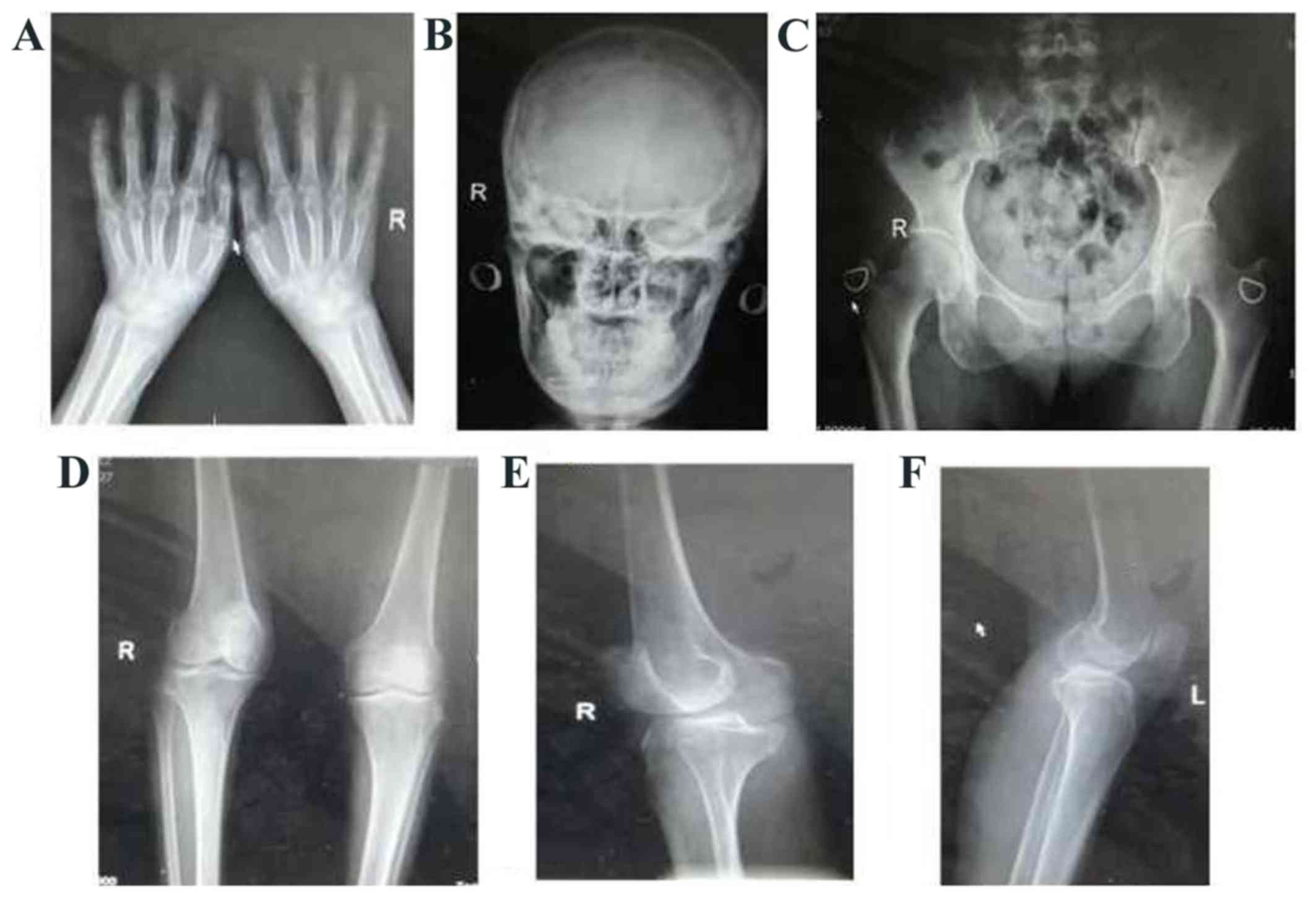
The laboratory tests revealed a TSH level of 0.003 µIU/ml, a T3 level of 4.44 ng/ml, a T4 level of >30 µg/dl, a free T3 level of 14.03 pg/ml (normal range, 2.3–4.2 pg/ml), and a free T4 level of 8.84 ng/dl (normal range, 0.89–1.76 ng/dl). The TSH receptor antibodies, thyroid peroxidase antibodies and thyroglobulin antibodies were negative. The hemoglobin level was 90 g/l and the white blood cell count was 5.54×10⁹/l, with a normal differential count. The liver and renal function tests were normal. The serum calcium was 2.96 mmol/l (normal range, 2.10–2.80 mmol/l), with a normal albumin level and a serum phosphate level of 0.84 mmol/l (normal, 0.97–1.60 mmol/l). The serum intact parathyroid hormone level was 4.8 pg/ml (normal range, 14–72 pg/ml), the 25-hydroxy vitamin D was 52.13 nmol/l (normal range, 47.7–144 nmol/l), osteocalcin was 128.8 ng/ml (normal range, 12.8–55 ng/ml) and bone-specific alkaline phosphatase was 22.1 ng/ml (normal range, 7.3–22.4 ng/ml). The urine calcium was 11.29 mmol/24 h (normal range, 2.5–7.5 mmol/24 h), and the urine phosphate was 9.55 mmol/24 h (normal range, 23–48 mmol/24 h). The serum immunoglobulin (Ig) A, IgG and IgM levels were normal. The urine was negative for Bence-Jones protein. The erythrocyte sedimentation rate, components 3, 4, and rheumatoid factor were normal. Parathyroid scintigraphy revealed no abnormalities. X-ray examination of the skeleton revealed mildly narrowed hand and knee joint gaps as a result of degenerative changes, and osteoporosis in the joints of the hand, skull, knees and pelvis (Fig. 1). The bone mineral density, as assessed by quantitative ultrasound, was 0.254 g/cm2 (T-score, −3.2).

Figure 1.

X-ray images of the (A) joints of the hand; (B) skull; and (C) pelvis; (D) anteroposterior image of both knees; (E) lateral image of the right knee; and (F) lateral image of the left knee, showing extensive osteoporotic changes.

Hypercalcemia was considered to be secondary to hyperthyroidism and methimazole therapy (10 mg three times a day) was continued. The patient was also managed with hydration by intravenous infusion of isotonic saline for 3 days, after which time the serum calcium level remained at 3.0 mmol/l and serum phosphate at 1.25 mmol/l. Therefore, therapy with salmon calcitonin (50 IU once a day) and alendronate (70 mg once a week) was initiated. After 1 week, the serum calcium and phosphate levels had decreased to 2.71 and 1.26 mmol/l, respectively, and were normalized to 2.44 and 1.19 mmol/l, respectively, after 2 weeks. The thyroid function tests revealed a TSH level of 0.001 µIU/ml, T3 of 1.87 ng/ml and a T4 of 13.90 µg/dl. The patient's appetite gradually improved and she started to gain weight. Calcitonin was then discontinued, while therapy with methimazole (30 mg/day) and alendronate (70 mg/week) was continued.

Three months after the start of anti-thyroid treatment, the patient had no nausea, vomiting or joint pain and had recovered a normal appetite, with a weight gain of ~10 kg. Euthyroidism was achieved and the serum calcium and phosphate levels returned to normal (2.31 and 1.12 mmol/l, respectively); therefore, the dose of methimazole was reduced (5 mg three times a day) and alendronate was discontinued. Six months later, the patient's serum calcium and phosphate levels remained normal, and her osteocalcin levels had diminished compared with the previously measured level (80.40 ng/ml).

Discussion

The most common cause of hypercalcemia in hyperthyroidism is concurrent primary hyperparathyroidism; however, in 15–20% of the cases, alterations in calcium metabolism are related solely to hyperthyroidism (2). A linear correlation exists between serum calcium levels and the parameters of thyroid function; this effect is more pronounced in the >60 age group (4).

Hypercalcemia secondary to hyperthyroidism is non-PTH dependent, with enhanced bone resorption and calcium mobilization proposed as the underlying mechanism. The high circulating levels of interleukin (IL)-6 associated with hyperthyroidism stimulate bone osteoclastic activity and alter osteoblast-osteoclast coupling (5). Furthermore, T3 increases the sensitivity of the bone to IL-6 (6). Elevated serum calcium levels may inhibit antidiuretic hormone and PTH secretion (7), increase urine output and promote calcium and phosphate excretion from the renal tubules by interaction with the calcium-sensing receptors in the loops of Henle (8). Additionally, the intestinal absorption of calcium is reduced as a result of the reduced PTH secretion, as well as thyroid hormone inhibition of 1,25-dihydroxyvitamin D synthesis and interference with vitamin D metabolism.

The incidence of osteoporosis in patients with hyperthyroidism is ~20–50%. Despite a diagnosis of hyperthyroidism, our patient presented with extensive osteoporosis and significantly increased osteocalcin levels, indicative of increased osteoblastic activity and bone formation. Following treatment for hyperthyroidism, the osteocalcin levels were reduced, but remained higher than normal; these observations are consistent with a previous report by Nagasaka et al, who reported that bone resorption occurs in untreated patients with Graves' thyrotoxicosis and is rapidly ameliorated following normalization of thyroid hormone levels. However, the accelerated bone formation persists for at least 4–8 months (9). With regard to the patient described herein, further follow-up is required to determine whether her osteoporosis was secondary to hyperthyroidism or also due to menopause.

Control of hyperthyroidism is the main treatment for hypercalcemia and osteoporosis secondary to hyperthyroidism, with anti-thyroid drug therapy as the first choice. However, in the initial stages, when anti-thyroid treatment has not achieved full efficacy, prompt reduction in serum calcium may be required, particularly if hypercalcemia or other symptoms are severe. In resistant cases, other modalities of treatment, such as calcitonin or diphosphate, may be required in addition to general management with saline hydration or diuretics. However, 131Iodine treatment may lead to the destruction of thyroid follicular cells and increased thyroid hormone release, which may even induce a hypercalcemic crisis; therefore, this treatment should be avoided in hyperthyroid patients with hypercalcemia (10).

The patient in the present case did not exhibit clinical manifestations typical of hyperthyroidism; as a result, she was misdiagnosed with rheumatoid arthritis and osteoarthritis for several years, with poor efficacy of the prescribed treatment. The hypercalcemia was confirmed to be secondary to hyperthyroidism, as supported by the relief of her symptoms and resolution of hypercalcemia with treatment of the underlying thyroid condition. Therefore, clinicians should include hyperthyroidism in the differential diagnosis of persistent arthralgia, even if the patients do not present with the typical symptoms of hyperthyroidism.

References

1 

Reddy PA, Harinarayan CV, Sachan A, Suresh V and Rajagopal G: Bone disease in thyrotoxicosis. Indian J Med Res. 135:277–286. 2012.PubMed/NCBI

2 

Baxter JD and Bondy PK: Hypercalcemia of thyrotoxicosis. Ann Intern Med. 65:429–442. 1966. View Article : Google Scholar : PubMed/NCBI

3 

Alikhan Z and Singh A: Hyperthyroidism manifested as hypercalcemia. South Med J. 89:997–998. 1996. View Article : Google Scholar : PubMed/NCBI

4 

Szabó ZS and Ritzl F: Hypercalcemia in hyperthyroidism. Role of age and goiter type. Klin Wochenschr. 59:275–279. 1981. View Article : Google Scholar : PubMed/NCBI

5 

Akalin A, Colak O, Alatas O and Efe B: Bone remodelling markers and serum cytokines in patients with hyperthyroidism. Clin Endocrinol (Oxf). 57:125–129. 2002. View Article : Google Scholar : PubMed/NCBI

6 

Iqbal AA, Burgess EH, Gallina DL, Nanes MS and Cook CB: Hypercalcemia in hyperthyroidism: Patterns of serum calcium, parathyroid hormone, and 1,25-dihydroxyvitamin D3 levels during management of thyrotoxicosis. Endocr Pract. 9:517–521. 2003. View Article : Google Scholar : PubMed/NCBI

7 

Mosekilde L, Eriksen EF and Charles P: Effects of thyroid hormones on bone and mineral metabolism. Endocrinol Metab Clin North Am. 19:35–63. 1990.PubMed/NCBI

8 

Marx SJ, Sharp ME, Krudy A, Rosenblatt M and Mallette LE: Radioimmunoassay for the middle region of human parathyroid hormone: Studies with a radioiodinated synthetic peptide. J Clin Endocrinol Metab. 53:76–84. 1981. View Article : Google Scholar : PubMed/NCBI

9 

Nagasaka S, Sugimoto H, Nakamura T, Kusaka I, Fujisawa G, Sakuma N, Tsuboi Y, Fukuda S, Honda K, Okada K, et al: Antithyroid therapy improves bony manifestations and bone metabolic markers in patients with Graves' thyrotoxicosis. Clin Endocrinol (Oxf). 47:215–221. 1997. View Article : Google Scholar : PubMed/NCBI

10 

Du W, Cuige L, Liu X, et al: A case of calcium crisis after 131I therapy of Graves' disease. Chin J Integr Med. 51:315–316. 2012.

Related Articles

  • Abstract
  • View
  • Download
  • Twitter
Copy and paste a formatted citation
Spandidos Publications style
Liu J, Tang X, Cheng J, Yang X and Wang Y: Persistent arthralgia, vomiting and hypercalcemia as the initial manifestations of hyperthyroidism: A case report. Mol Clin Oncol 6: 258-260, 2017.
APA
Liu, J., Tang, X., Cheng, J., Yang, X., & Wang, Y. (2017). Persistent arthralgia, vomiting and hypercalcemia as the initial manifestations of hyperthyroidism: A case report. Molecular and Clinical Oncology, 6, 258-260. https://doi.org/10.3892/mco.2017.1127
MLA
Liu, J., Tang, X., Cheng, J., Yang, X., Wang, Y."Persistent arthralgia, vomiting and hypercalcemia as the initial manifestations of hyperthyroidism: A case report". Molecular and Clinical Oncology 6.2 (2017): 258-260.
Chicago
Liu, J., Tang, X., Cheng, J., Yang, X., Wang, Y."Persistent arthralgia, vomiting and hypercalcemia as the initial manifestations of hyperthyroidism: A case report". Molecular and Clinical Oncology 6, no. 2 (2017): 258-260. https://doi.org/10.3892/mco.2017.1127
Copy and paste a formatted citation
x
Spandidos Publications style
Liu J, Tang X, Cheng J, Yang X and Wang Y: Persistent arthralgia, vomiting and hypercalcemia as the initial manifestations of hyperthyroidism: A case report. Mol Clin Oncol 6: 258-260, 2017.
APA
Liu, J., Tang, X., Cheng, J., Yang, X., & Wang, Y. (2017). Persistent arthralgia, vomiting and hypercalcemia as the initial manifestations of hyperthyroidism: A case report. Molecular and Clinical Oncology, 6, 258-260. https://doi.org/10.3892/mco.2017.1127
MLA
Liu, J., Tang, X., Cheng, J., Yang, X., Wang, Y."Persistent arthralgia, vomiting and hypercalcemia as the initial manifestations of hyperthyroidism: A case report". Molecular and Clinical Oncology 6.2 (2017): 258-260.
Chicago
Liu, J., Tang, X., Cheng, J., Yang, X., Wang, Y."Persistent arthralgia, vomiting and hypercalcemia as the initial manifestations of hyperthyroidism: A case report". Molecular and Clinical Oncology 6, no. 2 (2017): 258-260. https://doi.org/10.3892/mco.2017.1127
Follow us
  • Twitter
  • LinkedIn
  • Facebook
About
  • Spandidos Publications
  • Careers
  • Cookie Policy
  • Privacy Policy
How can we help?
  • Help
  • Live Chat
  • Contact
  • Email to our Support Team