Spandidos Publications Logo
  • About
    • About Spandidos
    • Aims and Scopes
    • Abstracting and Indexing
    • Editorial Policies
    • Reprints and Permissions
    • Job Opportunities
    • Terms and Conditions
    • Contact
  • Journals
    • All Journals
    • Oncology Letters
      • Oncology Letters
      • Information for Authors
      • Editorial Policies
      • Editorial Board
      • Aims and Scope
      • Abstracting and Indexing
      • Bibliographic Information
      • Archive
    • International Journal of Oncology
      • International Journal of Oncology
      • Information for Authors
      • Editorial Policies
      • Editorial Board
      • Aims and Scope
      • Abstracting and Indexing
      • Bibliographic Information
      • Archive
    • Molecular and Clinical Oncology
      • Molecular and Clinical Oncology
      • Information for Authors
      • Editorial Policies
      • Editorial Board
      • Aims and Scope
      • Abstracting and Indexing
      • Bibliographic Information
      • Archive
    • Experimental and Therapeutic Medicine
      • Experimental and Therapeutic Medicine
      • Information for Authors
      • Editorial Policies
      • Editorial Board
      • Aims and Scope
      • Abstracting and Indexing
      • Bibliographic Information
      • Archive
    • International Journal of Molecular Medicine
      • International Journal of Molecular Medicine
      • Information for Authors
      • Editorial Policies
      • Editorial Board
      • Aims and Scope
      • Abstracting and Indexing
      • Bibliographic Information
      • Archive
    • Biomedical Reports
      • Biomedical Reports
      • Information for Authors
      • Editorial Policies
      • Editorial Board
      • Aims and Scope
      • Abstracting and Indexing
      • Bibliographic Information
      • Archive
    • Oncology Reports
      • Oncology Reports
      • Information for Authors
      • Editorial Policies
      • Editorial Board
      • Aims and Scope
      • Abstracting and Indexing
      • Bibliographic Information
      • Archive
    • Molecular Medicine Reports
      • Molecular Medicine Reports
      • Information for Authors
      • Editorial Policies
      • Editorial Board
      • Aims and Scope
      • Abstracting and Indexing
      • Bibliographic Information
      • Archive
    • World Academy of Sciences Journal
      • World Academy of Sciences Journal
      • Information for Authors
      • Editorial Policies
      • Editorial Board
      • Aims and Scope
      • Abstracting and Indexing
      • Bibliographic Information
      • Archive
    • International Journal of Functional Nutrition
      • International Journal of Functional Nutrition
      • Information for Authors
      • Editorial Policies
      • Editorial Board
      • Aims and Scope
      • Abstracting and Indexing
      • Bibliographic Information
      • Archive
    • International Journal of Epigenetics
      • International Journal of Epigenetics
      • Information for Authors
      • Editorial Policies
      • Editorial Board
      • Aims and Scope
      • Abstracting and Indexing
      • Bibliographic Information
      • Archive
    • Medicine International
      • Medicine International
      • Information for Authors
      • Editorial Policies
      • Editorial Board
      • Aims and Scope
      • Abstracting and Indexing
      • Bibliographic Information
      • Archive
  • Articles
  • Information
    • Information for Authors
    • Information for Reviewers
    • Information for Librarians
    • Information for Advertisers
    • Conferences
  • Language Editing
Spandidos Publications Logo
  • About
    • About Spandidos
    • Aims and Scopes
    • Abstracting and Indexing
    • Editorial Policies
    • Reprints and Permissions
    • Job Opportunities
    • Terms and Conditions
    • Contact
  • Journals
    • All Journals
    • Biomedical Reports
      • Information for Authors
      • Editorial Policies
      • Editorial Board
      • Aims and Scope
      • Abstracting and Indexing
      • Bibliographic Information
      • Archive
    • Experimental and Therapeutic Medicine
      • Information for Authors
      • Editorial Policies
      • Editorial Board
      • Aims and Scope
      • Abstracting and Indexing
      • Bibliographic Information
      • Archive
    • International Journal of Epigenetics
      • Information for Authors
      • Editorial Policies
      • Editorial Board
      • Aims and Scope
      • Abstracting and Indexing
      • Bibliographic Information
      • Archive
    • International Journal of Functional Nutrition
      • Information for Authors
      • Editorial Policies
      • Editorial Board
      • Aims and Scope
      • Abstracting and Indexing
      • Bibliographic Information
      • Archive
    • International Journal of Molecular Medicine
      • Information for Authors
      • Editorial Policies
      • Editorial Board
      • Aims and Scope
      • Abstracting and Indexing
      • Bibliographic Information
      • Archive
    • International Journal of Oncology
      • Information for Authors
      • Editorial Policies
      • Editorial Board
      • Aims and Scope
      • Abstracting and Indexing
      • Bibliographic Information
      • Archive
    • Medicine International
      • Information for Authors
      • Editorial Policies
      • Editorial Board
      • Aims and Scope
      • Abstracting and Indexing
      • Bibliographic Information
      • Archive
    • Molecular and Clinical Oncology
      • Information for Authors
      • Editorial Policies
      • Editorial Board
      • Aims and Scope
      • Abstracting and Indexing
      • Bibliographic Information
      • Archive
    • Molecular Medicine Reports
      • Information for Authors
      • Editorial Policies
      • Editorial Board
      • Aims and Scope
      • Abstracting and Indexing
      • Bibliographic Information
      • Archive
    • Oncology Letters
      • Information for Authors
      • Editorial Policies
      • Editorial Board
      • Aims and Scope
      • Abstracting and Indexing
      • Bibliographic Information
      • Archive
    • Oncology Reports
      • Information for Authors
      • Editorial Policies
      • Editorial Board
      • Aims and Scope
      • Abstracting and Indexing
      • Bibliographic Information
      • Archive
    • World Academy of Sciences Journal
      • Information for Authors
      • Editorial Policies
      • Editorial Board
      • Aims and Scope
      • Abstracting and Indexing
      • Bibliographic Information
      • Archive
  • Articles
  • Information
    • For Authors
    • For Reviewers
    • For Librarians
    • For Advertisers
    • Conferences
  • Language Editing
Login Register Submit
  • This site uses cookies
  • You can change your cookie settings at any time by following the instructions in our Cookie Policy. To find out more, you may read our Privacy Policy.

    I agree
Search articles by DOI, keyword, author or affiliation
Search
Advanced Search
presentation
Molecular and Clinical Oncology
Join Editorial Board Propose a Special Issue
Print ISSN: 2049-9450 Online ISSN: 2049-9469
Journal Cover
March-2018 Volume 8 Issue 3

Full Size Image

Sign up for eToc alerts
Recommend to Library

Journals

International Journal of Molecular Medicine

International Journal of Molecular Medicine

International Journal of Molecular Medicine is an international journal devoted to molecular mechanisms of human disease.

International Journal of Oncology

International Journal of Oncology

International Journal of Oncology is an international journal devoted to oncology research and cancer treatment.

Molecular Medicine Reports

Molecular Medicine Reports

Covers molecular medicine topics such as pharmacology, pathology, genetics, neuroscience, infectious diseases, molecular cardiology, and molecular surgery.

Oncology Reports

Oncology Reports

Oncology Reports is an international journal devoted to fundamental and applied research in Oncology.

Experimental and Therapeutic Medicine

Experimental and Therapeutic Medicine

Experimental and Therapeutic Medicine is an international journal devoted to laboratory and clinical medicine.

Oncology Letters

Oncology Letters

Oncology Letters is an international journal devoted to Experimental and Clinical Oncology.

Biomedical Reports

Biomedical Reports

Explores a wide range of biological and medical fields, including pharmacology, genetics, microbiology, neuroscience, and molecular cardiology.

Molecular and Clinical Oncology

Molecular and Clinical Oncology

International journal addressing all aspects of oncology research, from tumorigenesis and oncogenes to chemotherapy and metastasis.

World Academy of Sciences Journal

World Academy of Sciences Journal

Multidisciplinary open-access journal spanning biochemistry, genetics, neuroscience, environmental health, and synthetic biology.

International Journal of Functional Nutrition

International Journal of Functional Nutrition

Open-access journal combining biochemistry, pharmacology, immunology, and genetics to advance health through functional nutrition.

International Journal of Epigenetics

International Journal of Epigenetics

Publishes open-access research on using epigenetics to advance understanding and treatment of human disease.

Medicine International

Medicine International

An International Open Access Journal Devoted to General Medicine.

Journal Cover
March-2018 Volume 8 Issue 3

Full Size Image

Sign up for eToc alerts
Recommend to Library

  • Article
  • Citations
    • Cite This Article
    • Download Citation
    • Create Citation Alert
    • Remove Citation Alert
    • Cited By
  • Similar Articles
    • Related Articles (in Spandidos Publications)
    • Similar Articles (Google Scholar)
    • Similar Articles (PubMed)
  • Download PDF
  • Download XML
  • View XML
Case Report Open Access

Curative resection of pancreatic ductal adenocarcinoma developing in the remnant pancreas 13 years after distal pancreatectomy for intraductal papillary mucinous neoplasms: A case report

  • Authors:
    • Takahiro Einama
    • Hirofumi Kamachi
    • Toshihiro Sakata
    • Kengo Shibata
    • Kazuki Wakizaka
    • Ko Sugiyama
    • Kazuaki Shibuya
    • Shingo Shimada
    • Kenji Wakayama
    • Tatsuya Orimo
    • Hideki Yokoo
    • Toshiya Kamiyama
    • Tomoko Mitsuhashi
    • Akinobu Taketomi
  • View Affiliations / Copyright

    Affiliations: Department of Gastroenterological Surgery I, Hokkaido University Graduate School of Medicine, Sapporo, Hokkaido 060‑8638, Japan, Department of Surgical Pathology, Hokkaido University Hospital, Sapporo, Hokkaido 060‑8638, Japan
    Copyright: © Einama et al. This is an open access article distributed under the terms of Creative Commons Attribution License.
  • Pages: 417-420
    |
    Published online on: January 16, 2018
       https://doi.org/10.3892/mco.2018.1556
  • Expand metrics +
Metrics: Total Views: 0 (Spandidos Publications: | PMC Statistics: )
Metrics: Total PDF Downloads: 0 (Spandidos Publications: | PMC Statistics: )
Cited By (CrossRef): 0 citations Loading Articles...

This article is mentioned in:


Abstract

Intraductal papillary mucinous neoplasms (IPMNs) are characterized by the papillary proliferation of atypical mucinous epithelial cells in the pancreatic ductal system. There are two recurrence patterns following resection of IPMNs: Metachronous multifocal occurrence of IPMNs, and distinct pancreatic ductal adenocarcinoma (PDAC) in the remnant pancreas. Several recent studies investigated the development of distinct PDAC during follow‑up evaluation of IPMNs and the incidence rate ranged from 4.5 to 8%. Thus, IMPNs may be a good predictor for the early detection of PDAC during observation or after the resection of IPMNs. We herein report the rare case of a patient who underwent resection of PDAC that developed in the remnant pancreas 13 years after distal pancreatectomy with splenectomy for IPMNs. PDAC may develop in the remnant pancreas after pancreatectomy for IPMNs; thus, careful long‑term follow‑up with periodic surveillance, at least every 6 months, is warranted.

Introduction

Intraductal papillary mucinous neoplasms (IPMNs) are characterized by the papillary proliferation of atypical mucinous epithelial cells in the pancreatic ductal system, and the affected pancreatic ducts are often cystically dilated. IPMNs comprise a spectrum of diseases ranging from adenoma, through in situ carcinoma, to invasive carcinoma (minimally invasive carcinoma and invasive carcinoma derived from IPMNs) (1).

There are two recurrence patterns following resection of IPMNs: Metachronous multifocal occurrence of IPMNs and distinct pancreatic ductal adenocarcinoma (PDAC) in the remnant pancreas. Recent reports have demonstrated that distinct PDAC occurs synchronously or metachronously during the management of IPMNs, with a frequency of ~10%; thus, IPMNs were recently recognized as one of the predictors of PDAC (2–5).

We herein report the rare case of a patient who underwent resection of PDAC that developed in the remnant pancreas 13 years after distal pancreatectomy with splenectomy for IPMNs.

Case report

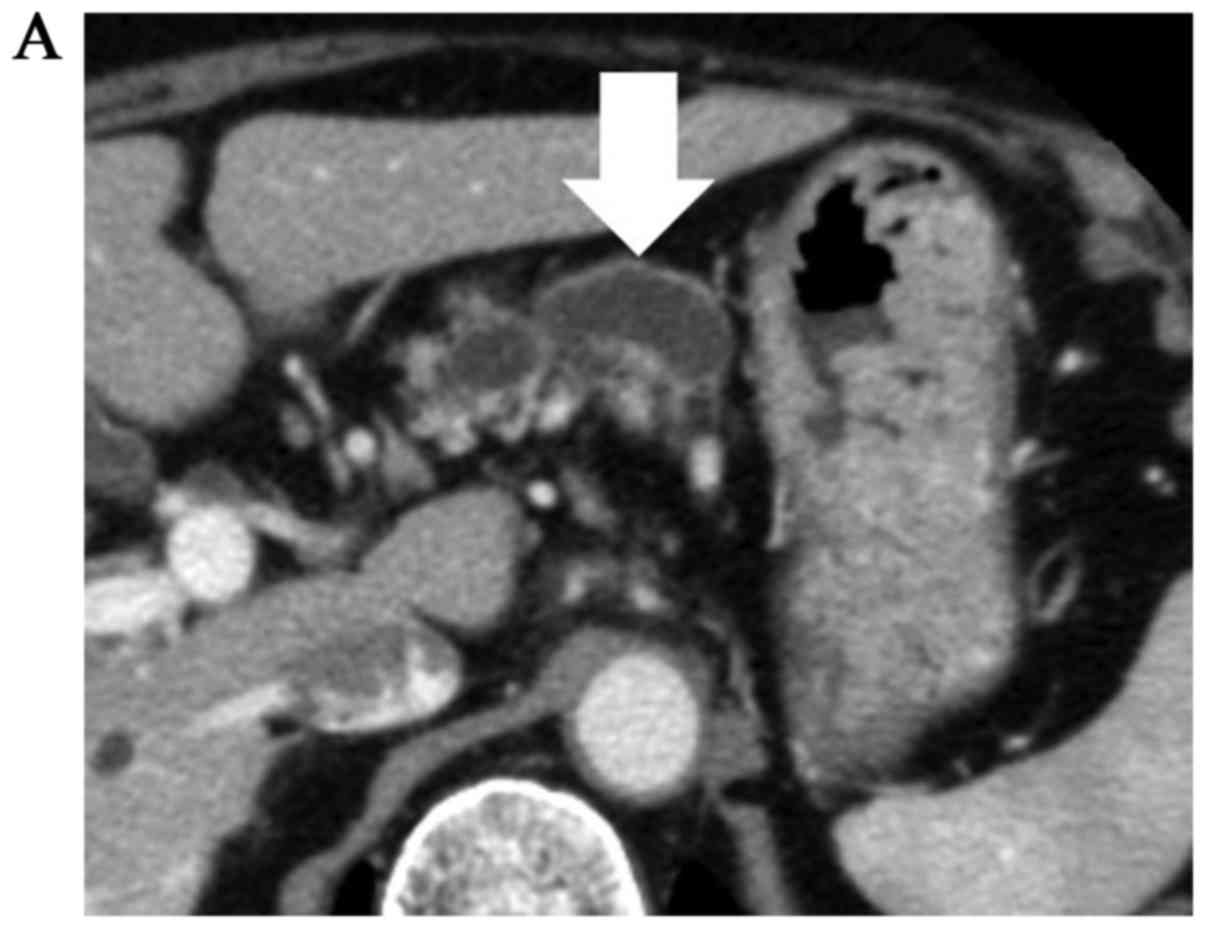
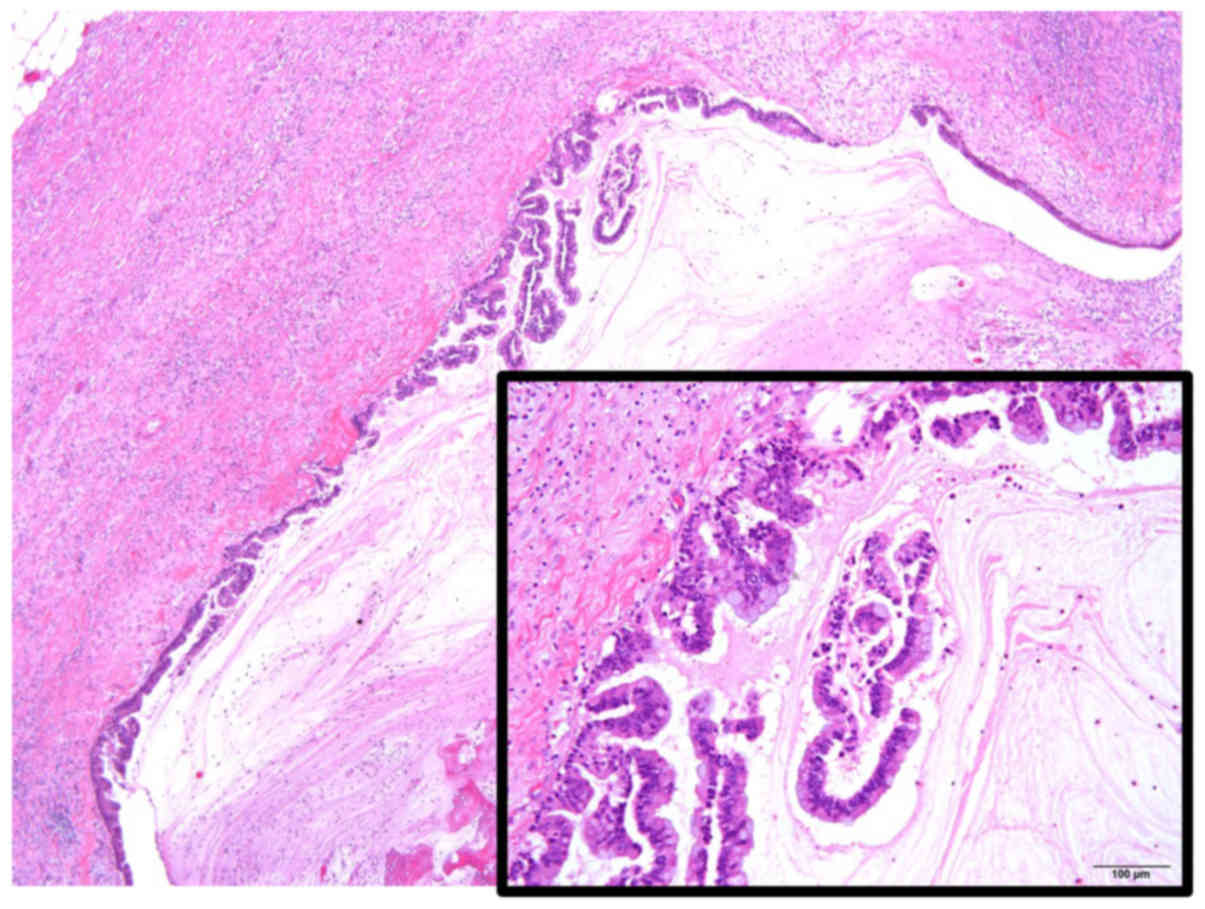
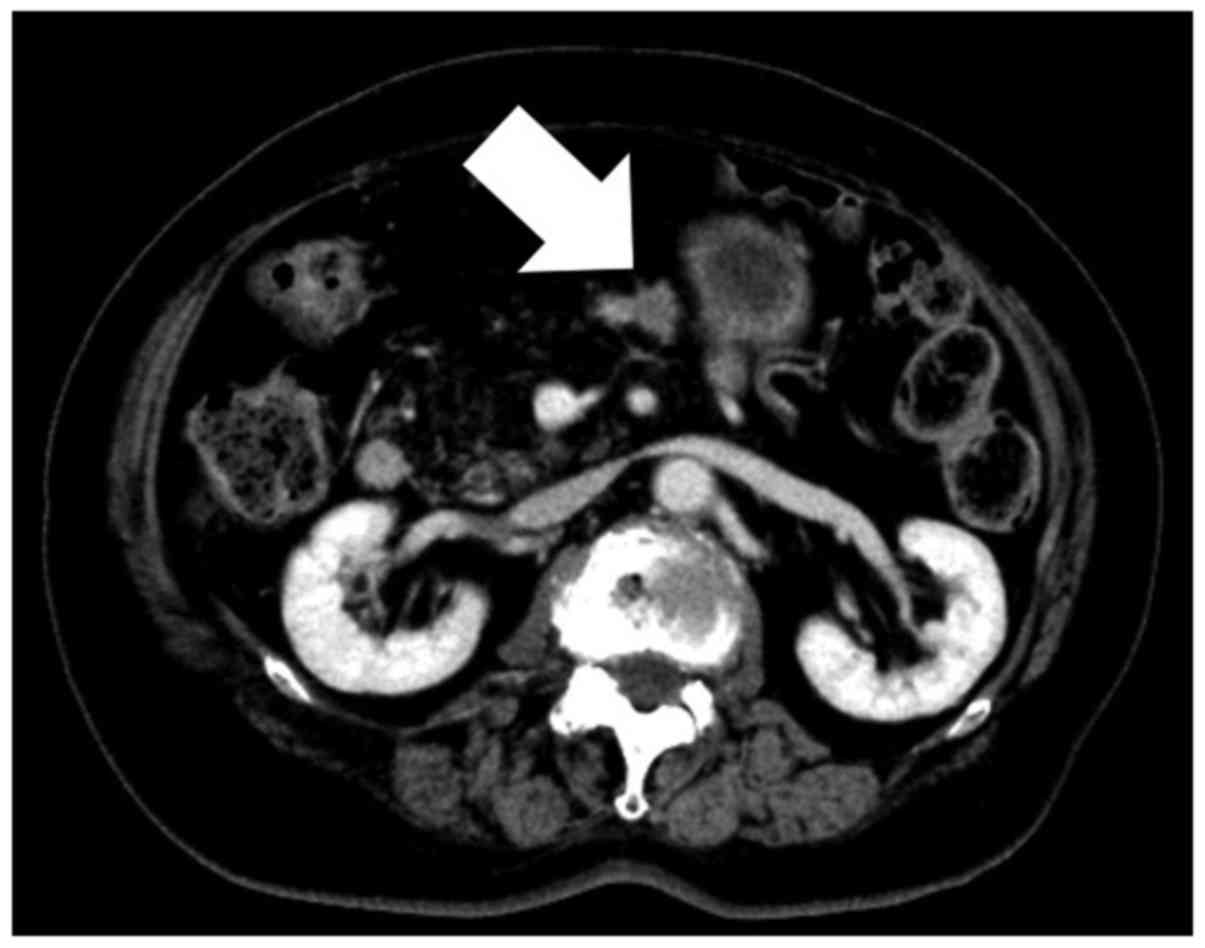
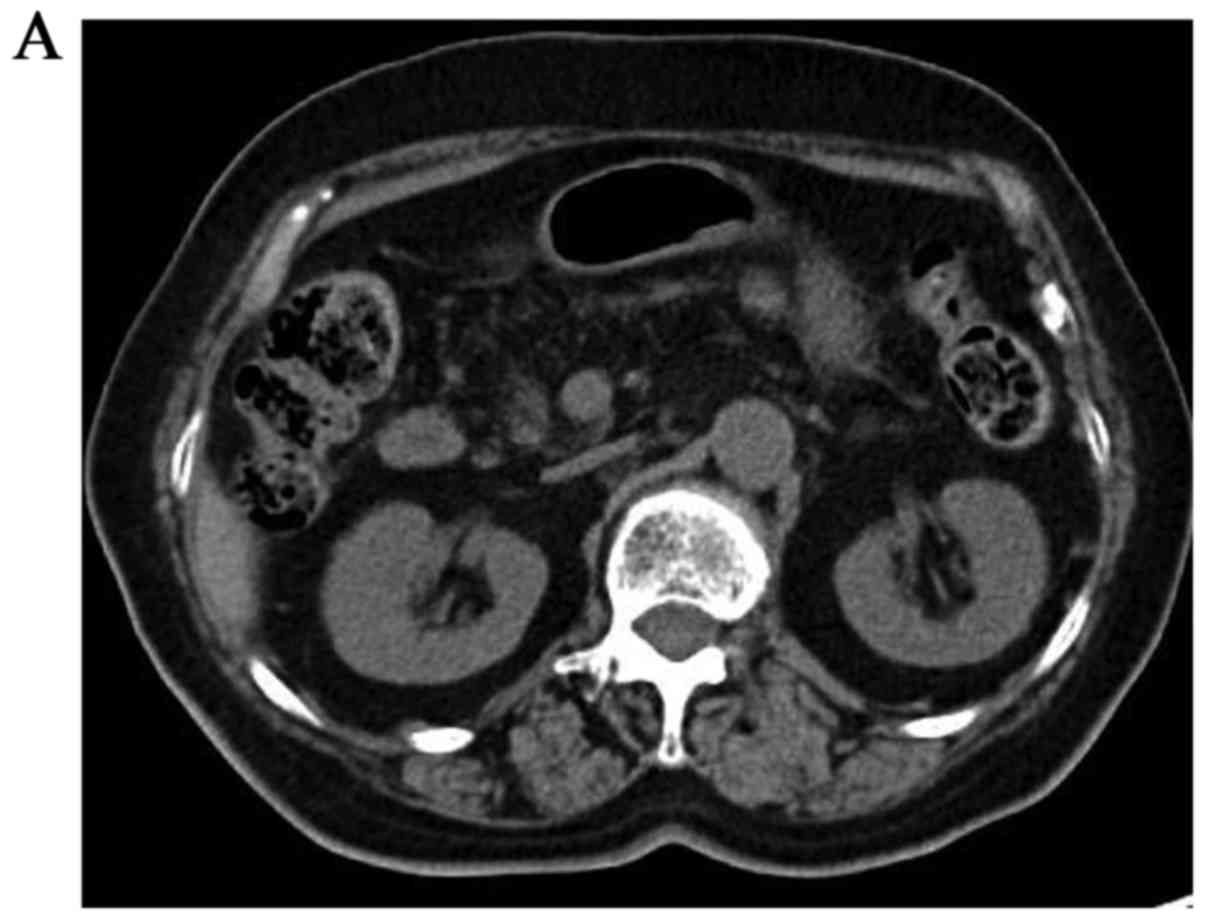
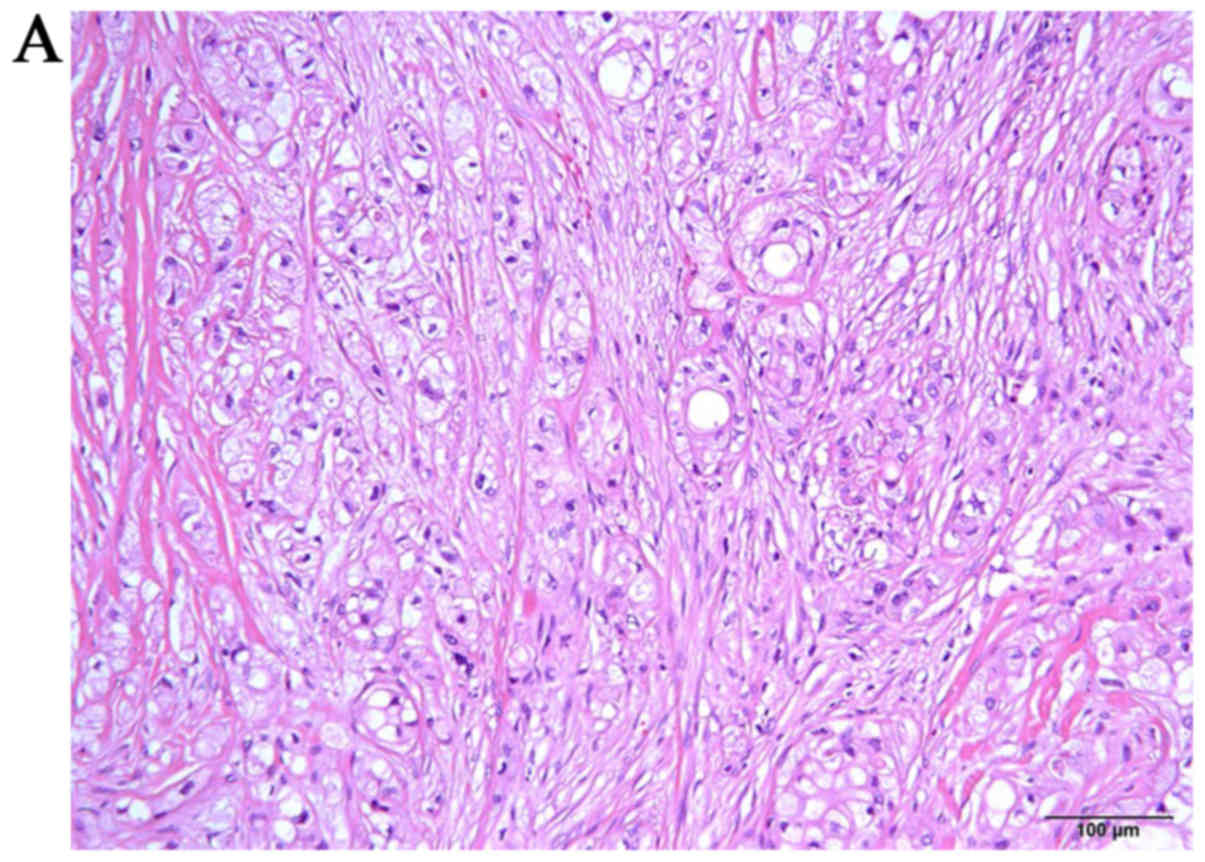
A 72-year-old female patient presented to the Department of Gastroenterological Surgery I, Hokkaido University Hospital (Sapporo, Japan) for a routine follow-up examination following distal pancreatectomy with splenectomy ~13 years prior. Abdominal computed tomography (CT) revealed a 5.5-cm cystic lesion in the tail of the pancreas with a mural nodule, and dilation of the main pancreatic duct (Fig. 1), with another small cystic lesion in the uncus of the pancreas. Histopathologically, IPMN with high-grade dysplasia had been diagnosed after the initial surgery, with negative surgical margins (Fig. 2). Regular medical follow-up visits with imaging examinations were performed every 6 months. At 152 months after the initial operation, CT revealed a 2-cm tumor at the resection margin of the pancreas (Fig. 3). Tumor marker level examination revealed that the carcinoembryonic antigen and Duke pancreatic monoclonal antigen type-2 levels were within the reference limits, whereas carbohydrate antigen 19-9 had increased to 109.7 U/ml (reference range: 0–36 U/ml) and Span-1 has increased to 60.1 U/ml (reference range: 0–30 U/ml) (Table I). The lesion at the resection margin appeared as a hot spot on fluorodeoxyglucose-positron emission tomography (Fig. 4). Remnant proximal partial pancreatectomy and partial gastrectomy were performed due to the patient's age and the presence of comorbidities (diabetes). Histopathological examination of the lesion at the resection margin confirmed a poorly to moderately differentiated adenocarcinoma, which was not derived from the IPMNs (Fig. 5): A metachronous PDAC with vascular and stomach invasion (T3N0M0; R0; stage IIA). The patient received S-1 for 6 months after surgery and remained alive without recurrence at the last follow-up, 17 months after the second operation.

Figure 1.

(A) Dilation of the main pancreatic duct was detected (arrow). (B) Computed tomography revealed a cystic lesion in the branch duct in the pancreatic tail (arrow).

Figure 2.

First surgery for intraductal papillary mucinous neoplasm (IPMN) 13 yeas prior. IPMN with high-grade dysplasia was detected in the dilated branches (hematoxylin and eosin staining). The entire mural nodule exhibited moderate dysplasia (magnification, ×40). Inset: Mild atypical cells with a slightly swollen nucleus formed a papillary lesion (magnification, ×200).

Figure 3.

Computed tomography revealed a 2-cm tumor at the resection margin of the pancreas (arrow). The tumor invaded the stomach wall. Most of the pancreatic parenchyma had been replaced by adipose tissue.

Figure 4.

(A) A hot spot on fluorodeoxyglucose-positron emission tomography (arrow) corresponded to (B) the tumor location on computed tomography.

Figure 5.

Histopathological examination of the second neoplasm confirmed a poorly to moderately differentiated adenocarcinoma, which was not derived from the intraductal papillary mucinous neoplasm: A metachronous pancreatic ductal adenocarcinoma. (A) Mild atypical cells with slightly swollen nuclei were arranged in irregular ductal structures (magnification, ×200) and (B) invaded the parenchyma (magnification, ×100).

Table I.

Laboratory results prior to the second operation.

Table I.

Laboratory results prior to the second operation.

Laboratory parametersValues
White blood cells6,800/µl
Red blood cell count 408×104/µl
Hemoglobin level11.3 g/dl
Hematocrit34.5%
Platelet count 17.0×10⁴/µl
HbA1C6.1%
Total bilirubin0.8 mg/dl
AST34 U/l
ALT25 U/l
BUN15 mg/dl
Creatinine0.58 mg/l
Amylase54 U/l
CEA6.1 ng/ml
CA19–9109.7 U/ml
DUPAN-2143 U/ml
Span-160.1 U/ml
Elastase 1<80 ng/dl

[i] AST, aspartate transaminase; ALT, alanine transaminase; BUN, blood urea nitrogen; CEA, carcinoembryonic antigen; CA19-9, carbohydrate antigen 19-9; DUPAN-2, Duke pancreatic monoclonal antigen type-2; HbA1C, glycated hemoglobin.

The patient consented to the publication of the case details and associated images.

Discussion

We herein present the case of a patient who underwent resection of PDAC that developed in the remnant pancreas 13 years after distal pancreatectomy with splenectomy for IPMNs. A cystic lesion was also detected in the uncus of the remnant pancreas, which was diagnosed as IPMN. This patient had been followed up every 6 months after the first operation to detect new lesions in the remnant pancreas. According to consensus guidelines and recent reports on IPMNs, branch duct (BD)-IPMNs are less aggressive compared with main duct (MD)-IPMNs (6,7); therefore, BD-IPMNs that cause no symptoms and have cysts <30 mm and no mural nodules, may be followed up with periodic imaging examinations (1,8). Several recent studies investigated the development of distinct PDAC during follow-up evaluation of BD-IPMNs, and the incidence rate ranged from 4.5 to 8% (5,8,9). Thus, BD-IMPNs may be a good predictor for the early detection of PDACs during observation of BD-IPMNs or after the resection of IPMNs.

The 2012 international consensus guidelines recommend that, if patients with multifocal BD-IPMNs have known IPMNs in the remnant pancreas following IPMN resection, these patients should be followed up for a short period (3–6 months) by pancreatic magnetic resonance imaging (MRI)/magnetic resonance cholangiopancreatography (MRCP) or CT, to establish stability (1). The patient presented herein was followed up every 6 months due to the relatively high incidence of PDAC. By contrast, Ohtsuka et al reported that some metachronous PDACs were unresectable at diagnosis >10 years after initial surgery for IPMNs, and performed surveillance every 6 months for the first 2 years after surgery and every 12 months thereafter. They concluded that, based on their experience, annual examination was not sufficient to detect all the cases of resectable PDACs (10). Yogi et al reported that the main pancreatic duct dilates after surgery, and that IPMNs in the remnant pancreas after pancreatectomy for IPMNs were risk factors for recurrence. In that study, half of the patients (5/10) who had IPMNs in the remnant pancreas developed recurrence (11). Hirono et al found that remnant pancreatic recurrence may occur >5 years after surgical resection, and a second resection may improve survival for patients with IPMNs or PDAC recurrence in its early stages; to improve survival, they proposed continual surveillance of the remnant pancreas every 6 months after the initial operation to detect remnant pancreatic recurrence in its early stages (12). Our patient also presented with an IPMN in the uncus of the pancreas. Based on the abovementioned reports, it is recommended that patients who have IPMNs in the remnant pancreas undergo CT, MRI, or MRCP every 6 months. A follow-up examination schedule for IPMNs should be established, so that PDAC may be detected while it is resectable.

In summary, PDAC may develop in the remnant pancreas following pancreatectomy for IPMNs; therefore, careful long-term follow-up with periodic surveillance, at least every 6 months, is warranted.

Competing interests

The authors declare that they have no competing interests.

References

1 

Tanaka M, Fernández-del Castillo C, Adsay V, Chari S, Falconi M, Jang JY, Kimura W, Levy P, Pitman MB, Schmidt CM, et al: International consensus guidelines 2012 for the management of IPMN and MCN of the pancreas. Pancreatology. 12:183–197. 2012. View Article : Google Scholar : PubMed/NCBI

2 

Yamaguchi K, Kanemitsu S, Hatori T, Maguchi H, Shimizu Y, Tada M, Nakagohri T, Hanada K, Osanai M, Noda Y, et al: Pancreatic ductal adenocarcinoma derived from IPMN and pancreatic ductal adenocarcinoma concomitant with IPMN. Pancreas. 40:571–580. 2011. View Article : Google Scholar : PubMed/NCBI

3 

Uehara H, Nakaizumi A, Ishikawa O, Iishi H, Tatsumi K, Takakura R, Ishida T, Takano Y, Tanaka S and Takenaka A: Development of ductal carcinoma of the pancreas during follow-up of branch duct intraductal papillary mucinous neoplasm of the pancreas. Gut. 57:1561–1565. 2008. View Article : Google Scholar : PubMed/NCBI

4 

Ingkakul T, Sadakari Y, Ienaga J, Satoh N, Takahata S and Tanaka M: Predictors of the presence of concomitant invasive ductal carcinoma in intraductal papillary mucinous neoplasm of the pancreas. Ann Surg. 251:70–75. 2010. View Article : Google Scholar : PubMed/NCBI

5 

Tanno S, Nakano Y, Sugiyama Y, Nakamura K, Sasajima J, Koizumi K, Yamazaki M, Nishikawa T, Mizukami Y, Yanagawa N, et al: Incidence of synchronous and metachronous pancreatic carcinoma in 168 patients with branch duct intraductal papillary mucinous neoplasm. Pancreatology. 10:173–178. 2010. View Article : Google Scholar : PubMed/NCBI

6 

Sugiyama M, Izumisato Y, Abe N, Masaki T, Mori T and Atomi Y: Predictive factors for malignancy in intraductal papillary-mucinous tumours of the pancreas. Br J Surg. 90:1244–1249. 2003. View Article : Google Scholar : PubMed/NCBI

7 

Terris B, Ponsot P, Paye F, Hammel P, Sauvanet A, Molas G, Bernades P, Belghiti J, Ruszniewski P and Fléjou JF: Intraductal papillary mucinous tumors of the pancreas confined to secondary ducts show less aggressive pathologic features as compared with those involving the main pancreatic duct. Am J Surg Pathol. 24:1372–1377. 2000. View Article : Google Scholar : PubMed/NCBI

8 

Tanno S, Nakano Y, Nishikawa T, Nakamura K, Sasajima J, Minoguchi M, Mizukami Y, Yanagawa N, Fujii T, Obara T, et al: Natural history of branch duct intraductal papillary-mucinous neoplasms of the pancreas without mural nodules: Long-term follow-up results. Gut. 57:339–343. 2008. View Article : Google Scholar : PubMed/NCBI

9 

Sawai Y, Yamao K, Bhatia V, Chiba T, Mizuno N, Sawaki A, Takahashi K, Tajika M, Shimizu Y, Yatabe Y and Yanagisawa A: Development of pancreatic cancers during long-term follow-up of side-branch intraductal papillary mucinous neoplasms. Endoscopy. 42:1077–1084. 2010. View Article : Google Scholar : PubMed/NCBI

10 

Ohtsuka T, Kono H, Tanabe R, Nagayoshi Y, Mori Y, Sadakari Y, Takahata S, Oda Y, Aishima S, Igarashi H, et al: Follow-up study after resection of intraductal papillary mucinous neoplasm of the pancreas; special references to the multifocal lesions and development of ductal carcinoma in the remnant pancreas. Am J Surg. 204:44–48. 2012. View Article : Google Scholar : PubMed/NCBI

11 

Yogi T, Hijioka S, Imaoka H, Mizuno N, Hara K, Tajika M, Tanaka T, Ishihara M, Shimizu Y, Hosoda W, et al: Risk factors for postoperative recurrence of intraductal papillary mucinous neoplasms of the pancreas based on a long-term follow-up study: Proposals for follow-up strategies. J Hepatobiliary Pancreat Sci. 22:757–765. 2015. View Article : Google Scholar : PubMed/NCBI

12 

Hirono S, Kawai M, Okada K, Miyazawa M, Shimizu A, Kitahata Y, Ueno M, Yanagisawa A and Yamaue H: Long-term surveillance is necessary after operative resection for intraductal papillary mucinous neoplasm of the pancreas. Surgery. 160:306–317. 2016. View Article : Google Scholar : PubMed/NCBI

Related Articles

  • Abstract
  • View
  • Download
  • Twitter
Copy and paste a formatted citation
Spandidos Publications style
Einama T, Kamachi H, Sakata T, Shibata K, Wakizaka K, Sugiyama K, Shibuya K, Shimada S, Wakayama K, Orimo T, Orimo T, et al: Curative resection of pancreatic ductal adenocarcinoma developing in the remnant pancreas 13 years after distal pancreatectomy for intraductal papillary mucinous neoplasms: A case report. Mol Clin Oncol 8: 417-420, 2018.
APA
Einama, T., Kamachi, H., Sakata, T., Shibata, K., Wakizaka, K., Sugiyama, K. ... Taketomi, A. (2018). Curative resection of pancreatic ductal adenocarcinoma developing in the remnant pancreas 13 years after distal pancreatectomy for intraductal papillary mucinous neoplasms: A case report. Molecular and Clinical Oncology, 8, 417-420. https://doi.org/10.3892/mco.2018.1556
MLA
Einama, T., Kamachi, H., Sakata, T., Shibata, K., Wakizaka, K., Sugiyama, K., Shibuya, K., Shimada, S., Wakayama, K., Orimo, T., Yokoo, H., Kamiyama, T., Mitsuhashi, T., Taketomi, A."Curative resection of pancreatic ductal adenocarcinoma developing in the remnant pancreas 13 years after distal pancreatectomy for intraductal papillary mucinous neoplasms: A case report". Molecular and Clinical Oncology 8.3 (2018): 417-420.
Chicago
Einama, T., Kamachi, H., Sakata, T., Shibata, K., Wakizaka, K., Sugiyama, K., Shibuya, K., Shimada, S., Wakayama, K., Orimo, T., Yokoo, H., Kamiyama, T., Mitsuhashi, T., Taketomi, A."Curative resection of pancreatic ductal adenocarcinoma developing in the remnant pancreas 13 years after distal pancreatectomy for intraductal papillary mucinous neoplasms: A case report". Molecular and Clinical Oncology 8, no. 3 (2018): 417-420. https://doi.org/10.3892/mco.2018.1556
Copy and paste a formatted citation
x
Spandidos Publications style
Einama T, Kamachi H, Sakata T, Shibata K, Wakizaka K, Sugiyama K, Shibuya K, Shimada S, Wakayama K, Orimo T, Orimo T, et al: Curative resection of pancreatic ductal adenocarcinoma developing in the remnant pancreas 13 years after distal pancreatectomy for intraductal papillary mucinous neoplasms: A case report. Mol Clin Oncol 8: 417-420, 2018.
APA
Einama, T., Kamachi, H., Sakata, T., Shibata, K., Wakizaka, K., Sugiyama, K. ... Taketomi, A. (2018). Curative resection of pancreatic ductal adenocarcinoma developing in the remnant pancreas 13 years after distal pancreatectomy for intraductal papillary mucinous neoplasms: A case report. Molecular and Clinical Oncology, 8, 417-420. https://doi.org/10.3892/mco.2018.1556
MLA
Einama, T., Kamachi, H., Sakata, T., Shibata, K., Wakizaka, K., Sugiyama, K., Shibuya, K., Shimada, S., Wakayama, K., Orimo, T., Yokoo, H., Kamiyama, T., Mitsuhashi, T., Taketomi, A."Curative resection of pancreatic ductal adenocarcinoma developing in the remnant pancreas 13 years after distal pancreatectomy for intraductal papillary mucinous neoplasms: A case report". Molecular and Clinical Oncology 8.3 (2018): 417-420.
Chicago
Einama, T., Kamachi, H., Sakata, T., Shibata, K., Wakizaka, K., Sugiyama, K., Shibuya, K., Shimada, S., Wakayama, K., Orimo, T., Yokoo, H., Kamiyama, T., Mitsuhashi, T., Taketomi, A."Curative resection of pancreatic ductal adenocarcinoma developing in the remnant pancreas 13 years after distal pancreatectomy for intraductal papillary mucinous neoplasms: A case report". Molecular and Clinical Oncology 8, no. 3 (2018): 417-420. https://doi.org/10.3892/mco.2018.1556
Follow us
  • Twitter
  • LinkedIn
  • Facebook
About
  • Spandidos Publications
  • Careers
  • Cookie Policy
  • Privacy Policy
How can we help?
  • Help
  • Live Chat
  • Contact
  • Email to our Support Team