Spandidos Publications Logo
  • About
    • About Spandidos
    • Aims and Scopes
    • Abstracting and Indexing
    • Editorial Policies
    • Reprints and Permissions
    • Job Opportunities
    • Terms and Conditions
    • Contact
  • Journals
    • All Journals
    • Oncology Letters
      • Oncology Letters
      • Information for Authors
      • Editorial Policies
      • Editorial Board
      • Aims and Scope
      • Abstracting and Indexing
      • Bibliographic Information
      • Archive
    • International Journal of Oncology
      • International Journal of Oncology
      • Information for Authors
      • Editorial Policies
      • Editorial Board
      • Aims and Scope
      • Abstracting and Indexing
      • Bibliographic Information
      • Archive
    • Molecular and Clinical Oncology
      • Molecular and Clinical Oncology
      • Information for Authors
      • Editorial Policies
      • Editorial Board
      • Aims and Scope
      • Abstracting and Indexing
      • Bibliographic Information
      • Archive
    • Experimental and Therapeutic Medicine
      • Experimental and Therapeutic Medicine
      • Information for Authors
      • Editorial Policies
      • Editorial Board
      • Aims and Scope
      • Abstracting and Indexing
      • Bibliographic Information
      • Archive
    • International Journal of Molecular Medicine
      • International Journal of Molecular Medicine
      • Information for Authors
      • Editorial Policies
      • Editorial Board
      • Aims and Scope
      • Abstracting and Indexing
      • Bibliographic Information
      • Archive
    • Biomedical Reports
      • Biomedical Reports
      • Information for Authors
      • Editorial Policies
      • Editorial Board
      • Aims and Scope
      • Abstracting and Indexing
      • Bibliographic Information
      • Archive
    • Oncology Reports
      • Oncology Reports
      • Information for Authors
      • Editorial Policies
      • Editorial Board
      • Aims and Scope
      • Abstracting and Indexing
      • Bibliographic Information
      • Archive
    • Molecular Medicine Reports
      • Molecular Medicine Reports
      • Information for Authors
      • Editorial Policies
      • Editorial Board
      • Aims and Scope
      • Abstracting and Indexing
      • Bibliographic Information
      • Archive
    • World Academy of Sciences Journal
      • World Academy of Sciences Journal
      • Information for Authors
      • Editorial Policies
      • Editorial Board
      • Aims and Scope
      • Abstracting and Indexing
      • Bibliographic Information
      • Archive
    • International Journal of Functional Nutrition
      • International Journal of Functional Nutrition
      • Information for Authors
      • Editorial Policies
      • Editorial Board
      • Aims and Scope
      • Abstracting and Indexing
      • Bibliographic Information
      • Archive
    • International Journal of Epigenetics
      • International Journal of Epigenetics
      • Information for Authors
      • Editorial Policies
      • Editorial Board
      • Aims and Scope
      • Abstracting and Indexing
      • Bibliographic Information
      • Archive
    • Medicine International
      • Medicine International
      • Information for Authors
      • Editorial Policies
      • Editorial Board
      • Aims and Scope
      • Abstracting and Indexing
      • Bibliographic Information
      • Archive
  • Articles
  • Information
    • Information for Authors
    • Information for Reviewers
    • Information for Librarians
    • Information for Advertisers
    • Conferences
  • Language Editing
Spandidos Publications Logo
  • About
    • About Spandidos
    • Aims and Scopes
    • Abstracting and Indexing
    • Editorial Policies
    • Reprints and Permissions
    • Job Opportunities
    • Terms and Conditions
    • Contact
  • Journals
    • All Journals
    • Biomedical Reports
      • Information for Authors
      • Editorial Policies
      • Editorial Board
      • Aims and Scope
      • Abstracting and Indexing
      • Bibliographic Information
      • Archive
    • Experimental and Therapeutic Medicine
      • Information for Authors
      • Editorial Policies
      • Editorial Board
      • Aims and Scope
      • Abstracting and Indexing
      • Bibliographic Information
      • Archive
    • International Journal of Epigenetics
      • Information for Authors
      • Editorial Policies
      • Editorial Board
      • Aims and Scope
      • Abstracting and Indexing
      • Bibliographic Information
      • Archive
    • International Journal of Functional Nutrition
      • Information for Authors
      • Editorial Policies
      • Editorial Board
      • Aims and Scope
      • Abstracting and Indexing
      • Bibliographic Information
      • Archive
    • International Journal of Molecular Medicine
      • Information for Authors
      • Editorial Policies
      • Editorial Board
      • Aims and Scope
      • Abstracting and Indexing
      • Bibliographic Information
      • Archive
    • International Journal of Oncology
      • Information for Authors
      • Editorial Policies
      • Editorial Board
      • Aims and Scope
      • Abstracting and Indexing
      • Bibliographic Information
      • Archive
    • Medicine International
      • Information for Authors
      • Editorial Policies
      • Editorial Board
      • Aims and Scope
      • Abstracting and Indexing
      • Bibliographic Information
      • Archive
    • Molecular and Clinical Oncology
      • Information for Authors
      • Editorial Policies
      • Editorial Board
      • Aims and Scope
      • Abstracting and Indexing
      • Bibliographic Information
      • Archive
    • Molecular Medicine Reports
      • Information for Authors
      • Editorial Policies
      • Editorial Board
      • Aims and Scope
      • Abstracting and Indexing
      • Bibliographic Information
      • Archive
    • Oncology Letters
      • Information for Authors
      • Editorial Policies
      • Editorial Board
      • Aims and Scope
      • Abstracting and Indexing
      • Bibliographic Information
      • Archive
    • Oncology Reports
      • Information for Authors
      • Editorial Policies
      • Editorial Board
      • Aims and Scope
      • Abstracting and Indexing
      • Bibliographic Information
      • Archive
    • World Academy of Sciences Journal
      • Information for Authors
      • Editorial Policies
      • Editorial Board
      • Aims and Scope
      • Abstracting and Indexing
      • Bibliographic Information
      • Archive
  • Articles
  • Information
    • For Authors
    • For Reviewers
    • For Librarians
    • For Advertisers
    • Conferences
  • Language Editing
Login Register Submit
  • This site uses cookies
  • You can change your cookie settings at any time by following the instructions in our Cookie Policy. To find out more, you may read our Privacy Policy.

    I agree
Search articles by DOI, keyword, author or affiliation
Search
Advanced Search
presentation
Molecular and Clinical Oncology
Join Editorial Board Propose a Special Issue
Print ISSN: 2049-9450 Online ISSN: 2049-9469
Journal Cover
April-2018 Volume 8 Issue 4

Full Size Image

Sign up for eToc alerts
Recommend to Library

Journals

International Journal of Molecular Medicine

International Journal of Molecular Medicine

International Journal of Molecular Medicine is an international journal devoted to molecular mechanisms of human disease.

International Journal of Oncology

International Journal of Oncology

International Journal of Oncology is an international journal devoted to oncology research and cancer treatment.

Molecular Medicine Reports

Molecular Medicine Reports

Covers molecular medicine topics such as pharmacology, pathology, genetics, neuroscience, infectious diseases, molecular cardiology, and molecular surgery.

Oncology Reports

Oncology Reports

Oncology Reports is an international journal devoted to fundamental and applied research in Oncology.

Experimental and Therapeutic Medicine

Experimental and Therapeutic Medicine

Experimental and Therapeutic Medicine is an international journal devoted to laboratory and clinical medicine.

Oncology Letters

Oncology Letters

Oncology Letters is an international journal devoted to Experimental and Clinical Oncology.

Biomedical Reports

Biomedical Reports

Explores a wide range of biological and medical fields, including pharmacology, genetics, microbiology, neuroscience, and molecular cardiology.

Molecular and Clinical Oncology

Molecular and Clinical Oncology

International journal addressing all aspects of oncology research, from tumorigenesis and oncogenes to chemotherapy and metastasis.

World Academy of Sciences Journal

World Academy of Sciences Journal

Multidisciplinary open-access journal spanning biochemistry, genetics, neuroscience, environmental health, and synthetic biology.

International Journal of Functional Nutrition

International Journal of Functional Nutrition

Open-access journal combining biochemistry, pharmacology, immunology, and genetics to advance health through functional nutrition.

International Journal of Epigenetics

International Journal of Epigenetics

Publishes open-access research on using epigenetics to advance understanding and treatment of human disease.

Medicine International

Medicine International

An International Open Access Journal Devoted to General Medicine.

Journal Cover
April-2018 Volume 8 Issue 4

Full Size Image

Sign up for eToc alerts
Recommend to Library

  • Article
  • Citations
    • Cite This Article
    • Download Citation
    • Create Citation Alert
    • Remove Citation Alert
    • Cited By
  • Similar Articles
    • Related Articles (in Spandidos Publications)
    • Similar Articles (Google Scholar)
    • Similar Articles (PubMed)
  • Download PDF
  • Download XML
  • View XML
Case Report

Late duodenal metastasis from renal cell carcinoma with newly developed malignant lymphoma: A case report

  • Authors:
    • Makoto Saito
    • Hajime Senjo
    • Minoru Kanaya
    • Koh Izumiyama
    • Akio Mori
    • Masanori Tanaka
    • Masanobu Morioka
    • Kencho Miyashita
    • Yusuke Ishida
  • View Affiliations / Copyright

    Affiliations: Department of Internal Medicine and Hematology, Aiiku Hospital, Sapporo 064‑0804, Japan, Department of Gastroenterology, Aiiku Hospital, Sapporo 064‑0804, Japan, Department of Cancer Pathology, Hokkaido University Graduate School of Medicine, Sapporo 064‑0804, Japan
  • Pages: 549-552
    |
    Published online on: January 31, 2018
       https://doi.org/10.3892/mco.2018.1563
  • Expand metrics +
Metrics: Total Views: 0 (Spandidos Publications: | PMC Statistics: )
Metrics: Total PDF Downloads: 0 (Spandidos Publications: | PMC Statistics: )
Cited By (CrossRef): 0 citations Loading Articles...

This article is mentioned in:


Abstract

Duodenal metastasis from renal cell carcinoma (RCC) is rare. The current case report presents a very rare case of late duodenal metastasis from RCC with newly developed malignant lymphoma (diffuse large B‑cell lymphoma: DLBCL) at the same time. A 64‑year‑old man with systemic lymph nodes swelling who had undergone left nephrectomy for RCC 25 years previously, was admitted to the present hospital. Inguinal lymph node biopsy was performed, leading to a diagnosis of DLBCL. fluorine‑18‑fluorodeoxy‑glucose (18F‑FDG)‑positron emission tomography (PET)/computed tomography (CT) revealed multiple lymph nodes, spleen, and ileocecal lesions. CT revealed an obvious hypervascular tumor involving the duodenum/pancreatic head. The tumor was false‑negative on 18F‑FDG‑PET/CT. On esophagogastroduodenoscopy, the tumor was detected in the descending portion of the duodenum and was observed to be consistent with the submucosal tumor with a central ulcer, resembling those of ulcer‑forming DLBCL. A biopsy was then performed carefully, and a clear cell RCC‑derived metastatic cancer was diagnosed. Ileocolonoscopy revealed mucosal thickening of the terminal ileum, and led to a diagnosis of DLBCL infiltration with biopsy. To the best of the author's knowledge, this is the first case report of the coexistence of metastatic cancer from RCC and malignant lymphoma in the small intestine simultaneously. It was necessary to make a careful differential diagnosis in the imaging studies.

Introduction

Renal cell carcinoma (RCC) is clinically characterized by late recurrence and metastasis, and McNichols et al defined late RCC recurrence as occurrence more than 10 years after nephrectomy (1). Duodenal metastasis from RCC is rare (2,3). Herein, we report a very rare case of RCC in a man for whom we performed imaging studies to evaluate the clinical stage of newly developed diffuse large B-cell lymphoma (DLBCL), and were incidentally able to find the ectopic recurrence of RCC in the duodenum/pancreatic head 25 years after its curative resection. Two different malignancies occurred simultaneously in the small intestine (duodenum and ileum), highlighting the need for careful differential diagnosis.

Case report

A 64-year-old Japanese man with systemic lymph nodes swelling who had undergone left nephrectomy for RCC 25 years previously was admitted to our hospital. The patient complained of abdominal pain, night-time fever, anorexia, and weight loss (−7 kg in 2 months), and the performance status was 1. Blood test examinations on admission revealed mild anemia (hemoglobin 12.4: normal range 14.0–18.0 g/dl), decreased total protein (6.2: 6.7–8.3 g/dl) and albumin (3.4: 3.8–5.3 g/dl), and increased lactate dehydrogenase (LDH 798: 120–245 U/l) and C-reactive protein (CRP 4.16: <0.30 mg/dl). The soluble interleukin-2 receptor level had risen to 7,597 (sIL-2R: 121–613 U/ml) and it further increased to 9,300 within 2 weeks. Inguinal lymph nodes biopsy was performed, leading to a diagnosis of DLBCL. The Ki-67 labeling (MIB1) index was approximately 70%.

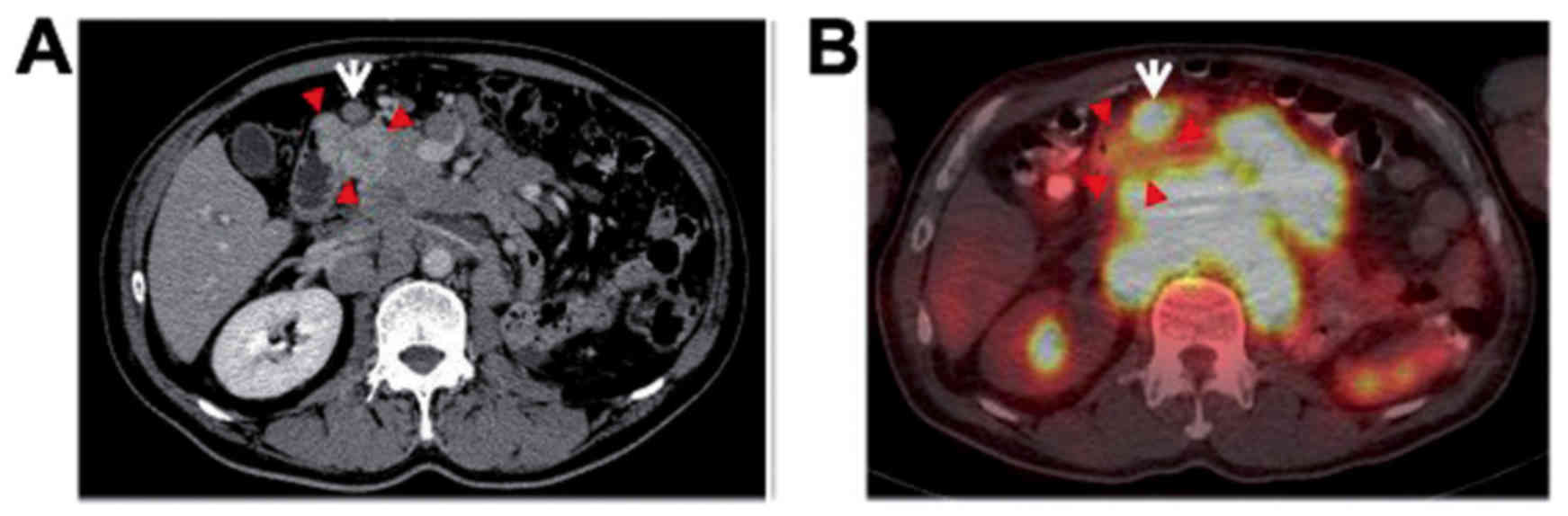
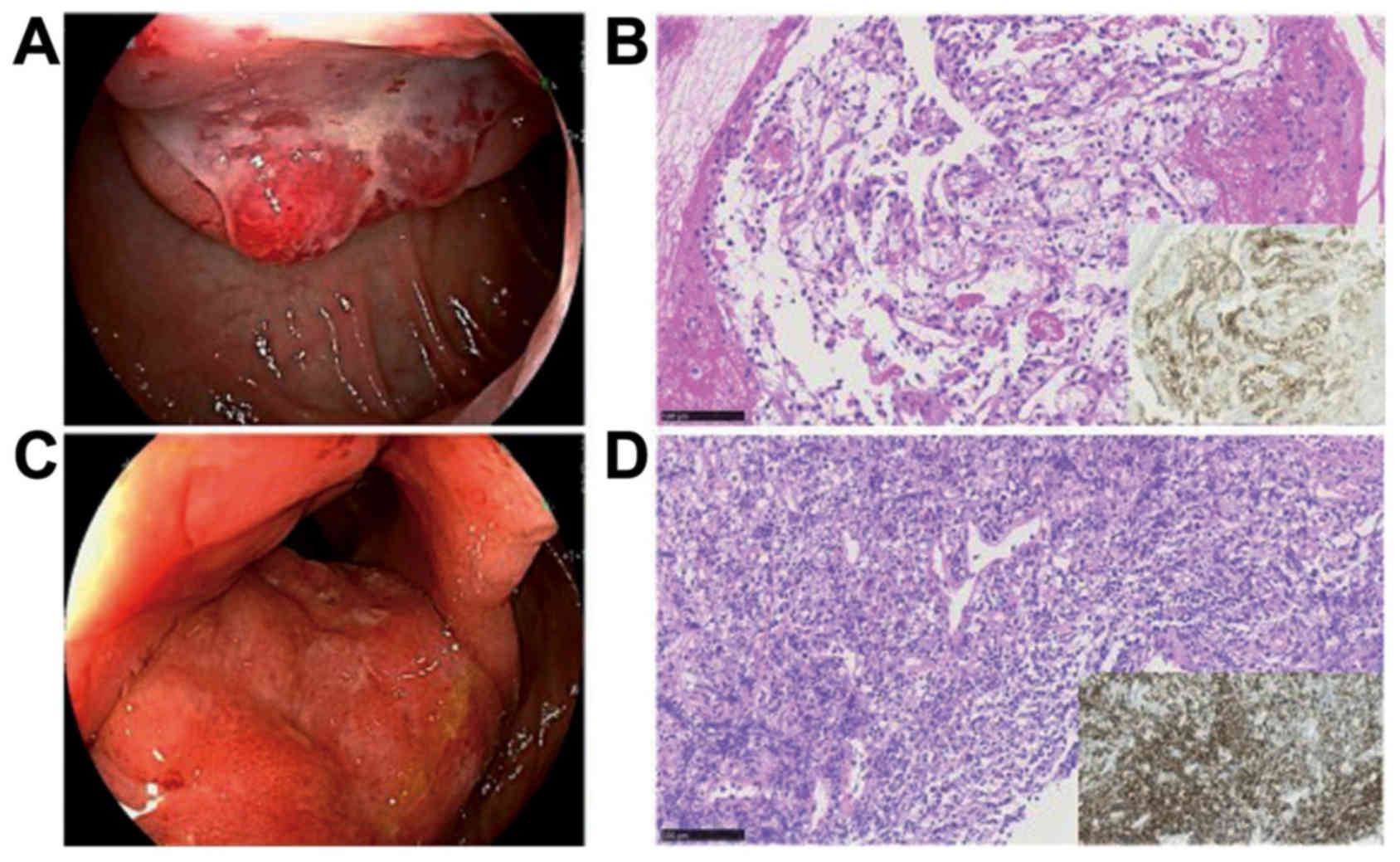
We performed imaging studies to evaluate the clinical stage. fluorine-18-fluorodeoxy-glucose (18F-FDG)-positron emission tomography (PET)/computed tomography (CT) showed multiple lymph nodes involving the cervical region, an abdominal bulky mass, spleen, and ileocecal lesions. CT revealed an obvious hypervascular tumor involving the duodenum/pancreatic head (Fig. 1A), and small nodules up to 1 cm in diameter were scattered throughout both lung fields, but these tumors demonstrated no uptake on 18F-FDG-PET/CT (Fig. 1B). The right kidney exhibited no abnormalities. On esophagogastroduodenoscopy (EGD), blood refluxed from the duodenum was seen retained in the stomach. The tumor was detected in the descending portion of the duodenum apart from the periampullary region, and was seen consistent with submucosal tumor with central ulcer resembled those of ulcer-forming DLBCL (Fig. 2A). Biopsy was performed carefully, and this tumor was pathologically diagnosed with a clear cell RCC-derived metastatic cancer immunohistochemically positive for CD10 (Fig. 2B). Ileocolonoscopy showed mucosal thickening of the terminal ileum including ileocecal valve (Fig. 2C), and biopsy led to a diagnosis of DLBCL infiltration immunohistochemically positive for CD20 (Fig. 2D).

Figure 1.

(A) CT imaging. A tumor with hypervascularity compared with the surrounding bulky mass was present in the duodenum/pancreatic head (red arrowhead). On the ventral side of the hypervascular tumor, a lymph node lesion that was enhanced similarly to the bulky mass was present (white arrow). (B) fluorine-18-fluorodeoxy-glucose (18F-FDG)-positron emission tomography (PET)/computed tomography (CT). Marked uptake was noted in the bulky abdominal mass and the lymph nodes lesion described above (white arrow) [maximum standard uptake value (SUVmax), 30.6]. In contrast, no uptake was noted in the tumor present in the duodenum/pancreatic head (red arrowhead) (false-negative).

Figure 2.

(A) EGD imaging. A submucosal tumor with the ulcer floor covered by white moss like ulcer-forming DLBCL was seen on the descending portion of the duodenum apart from the periampullary region. (B) Histopathologic finding of the duodenal lesion. A biopsy specimen revealed infiltration of cancer cells showing consistent with clear cell renal carcinoma (H&E staining), and these cells were positive for CD10 immunostaining (inset). Magnification, ×200. (C) Ileocolonoscopy imaging. Mucosal thickening was seen on the ileocecal valve. (D) Histopathologic finding of the ileal lesion. A biopsy specimen revealed large lymphoid cells infiltrating the lamina propria (H&E staining), and these cells were positive for CD20 immunostaining (inset). Magnification, ×200. EGD, esophagogastroduodenoscopy; DLBCL, diffuse large B-cell lymphoma.

Based on imaging studies and pathological findings, the patient was diagnosed with coexistence of metastatic duodenal/pancreatic cancer from RCC and DLBCL (Ann Arbor stage IV), and the latter was classified as high-intermediate risk with the international prognostic index (IPI). We then began treatment for DLBCL because of its tumor volume. The patient received five courses of chemotherapy, including rituximab (RTX) + EPOCH regimen (etoposide, prednisone, vincristine, cyclophosphamide, and doxorubicin) and RTX + GDP regimen (gemcitabine, cisplatin, and dexamethasone). As a result, the sIL-2R level decreased to 903 U/ml, and the patient achieved complete remission (assessed by PET). Although the tumor in the duodenum/pancreatic head slightly decreased in size (from 3.6 to 3.0 cm) in the past 4 months, a tumor of about 1 cm in diameter appeared in the pancreatic body, and some of the nodules scattered in both lung fields grew and increased slightly. As these findings suggested that the metastatic cancer from RCC had started to grow mainly in the pancreas and lungs, the patient was transferred to a designated cancer hospital to receive treatment for these lesions. Subsequent oral pazopanib treatment was successful for this patient, and the treatment is being continued as the outpatient. Written informed consent was obtained from the patient for publication of this case report.

Discussion

RCC has a potential to metastasize to almost any site. The most common sites of metastasis are the lung, liver, and bones (4). Clinically evident gastrointestinal involvement of RCC, especially solitary duodenal metastasis from RCC is rare and most frequently involves the periampullary region or the duodenal bulb (5,6). According to recent report (7), of the 3637 patients diagnosed with RCC, 15 patients (0.4%) with 19 gastrointestinal lesions were identified, and duodenum involvement was 6 lesions.

Because coexistence of two different malignancies, metastatic cancer from RCC and malignant lymphoma (DLBCL), in the small intestine simultaneously is extremely rare, it was necessary to make a differential diagnosis carefully with imaging studies. Metastatic RCC is frequently hypervascular as with primary tumors (8). In gastrointestinal metastasis from RCC, intraluminal polypoid masses (63.2%) with hyperenhancement (78.9%) and heterogeneous enhancement (63.2%) were the most common CT findings (7), especially, than in lymphoma, lymphadenopathy has been reported to be much less prominent, the involved bowel segment shorter, and multi-focality less common (9). RCC (especially clear cell carcinoma) commonly exhibits a low 18F-FDG uptake, and FDG-PET has a high false-negative rate (68.5%) for detecting primary lesions (10). Aide et al reported that the sensitivity of FDG-PET for RCC was 47% (11). Comparing the sensitivity and specificity of FDG-PET and CT for primary and metastatic lesions in 66 patients with RCC, Kang et al also reported that although the sensitivity of FDG-PET (primary 60%, metastasis 75.0–77.3%) was lower than that of CT (primary 91.7%, metastasis 91.1–93.8%), the specificity of FDG-PET (primary 100%, metastasis 97.1–100%) was higher than that of CT (primary 100%, metastasis 73.1–98.1%) (12). Thus, the role of 18F-FDG-PET in the detection of RCC is limited by low sensitivity (10–12). On the other hand, FDG-PET has emerged as a powerful functional imaging tool for staging, restaging, and is essential for the post-treatment assessment of DLBCL (13). On endoscopy, the metastatic duodenal cancer can be seen as a submucosal mass with ulceration of the tip, multiple nodules of varying sizes or raised plaques (14). Endoscopic findings of ulcer-forming lymphoma are the submucosal tumor with central ulcer (15), and resemble those of metastatic intestinal cancer. In our case, FDG-PET/CT revealed a high uptake in DLBCL lesions, whereas it was false-negative for the metastatic duodenal RCC lesion. In addition, on CT, the metastatic duodenal RCC lesion demonstrated hyper-enhancement more clearly than the DLBCL lesions. These findings led to a differential diagnosis by imaging, and endoscopic biopsy confirmed the diagnosis. CD10 immunostaining is helpful in separating metastatic RCC from other cancers (16).

According to the review of Rustagi et al (17), the mean duration post nephrectomy to diagnosis of solitary duodenal metastases was 7.9±4.7 years (median 8 years). RCC can metastasize for a long period of disease latency after nephrectomy, via the lymphatic or hematogenous route, as well as by peritoneal dissemination or direct invasion into adjacent anatomic structures (18). Our case is rare in that ‘late’-recurring RCC, so long 25 years after nephrectomy, metastasized to the duodenum/pancreatic head. This tumor was thought to be a slow-growing and direct duodenal invasion from an adjacent recurrent/metastatic lesion of the pancreatic head. On the other hand, DLBCL is considered to progress monthly (19). In our patient, the tumor volume of DLBCL observed on imaging was much greater than that of the metastatic cancer from RCC. IL-2R sharply increased in this patient, revealing that progression was rapid and the current pathology may have been completed within 0.5–1 year after the newly development. As DLBCL was considered to determine the prognosis of this patient, we prioritized its treatment, and the patient achieved CR. However, during the treatment period, the metastatic cancer from RCC spread, mainly to the pancreas and lungs. Generally, an immune cell-inhibiting mechanism is present in the microcirculatory environment of tumors (20). A trace number of cancer cells of RCC were latently present under the control of the immunological surveillance mechanism, but it may have manifested because the DLBCL tumor volume rapidly increased and inhibited immunity, and the subsequent growth of metastatic cancer cells from RCC may have been slightly rapid, unlike the slow growth previously reported (1,6,17).

To the best of our knowledge, this is the first case report of the coexistence of metastatic cancer from RCC and malignant lymphoma in the small intestine simultaneously. It was necessary to make a careful differential diagnosis in the imaging studies.

References

1 

McNichols DW, Segura JW and DeWeerd JH: Renal cell carcinoma: Long-term survival and late recurrence. J Urol. 126:17–23. 1981. View Article : Google Scholar : PubMed/NCBI

2 

Bhatia A, Das A, Kumar Y and Kochhar R: Renal cell carcinoma metastasizing to duodenum: A rare occurrence. Diagn Pathol. 1:292006. View Article : Google Scholar : PubMed/NCBI

3 

Brener ZZ, Zhuravenko I, Jacob CE and Bergman M: An unusual presentation of renal cell carcinoma with late metastases to the small intestine, thyroid gland, nose and skull base. Nephrol Dial Transplant. 22:930–932. 2007. View Article : Google Scholar : PubMed/NCBI

4 

Murphy WM, Beckwith JB and Farrow GM: Atlas of tumor pathology, 3rd series, fascicle 11. Tumors of the kidney, bladder and related urinary structures. Armed Forces Institute of Pathology, Washington. p128–1994

5 

Pavlakis GM, Sakorafas GH and Anagnostopoulos GK: Intestinal metastases from renal cell carcinoma: A rare cause of intestinal obstruction and bleeding. Mt Sinai J Med. 71:127–130. 2004.PubMed/NCBI

6 

Featherstone JM, Bass P, Cumming J and Smart CJ: Solitary, late metastatic recurrence of renal cell carcinoma: Two extraordinary cases. Int J Urol. 13:1525–1527. 2006. View Article : Google Scholar : PubMed/NCBI

7 

Park HJ, Kim HJ, Park SH, Lee JS, Kim AY and Ha HK: Gastrointestinal involvement of recurrent renal cell carcinoma: CT findings and clinicopathologic features. Korean J Radiol. 18:452–460. 2017. View Article : Google Scholar : PubMed/NCBI

8 

Sheth S, Scatarige JC, Horton KM, Corl FM and Fishman EK: Current concepts in the diagnosis and management of renal cell carcinoma: Role of multidetector ct and three-dimensional CT. Radiographics. 21:S237–S254. 2001. View Article : Google Scholar : PubMed/NCBI

9 

Byun JH, Ha HK, Kim AY, Kim TK, Ko EY, Lee JK, Yu ES, Myung SJ, Yang SK, Jung HY, et al: CT findings in peripheral T-cell lymphoma involving the gastrointestinal tract. Radiology. 227:59–67. 2003. View Article : Google Scholar : PubMed/NCBI

10 

Miyakita H, Tokunaga M, Onda H, Usui Y, Kinoshita H, Kawamura N and Yasuda S: Significance of 18F-fluorodeoxyglucose positron emission tomography (FDG-PET) for detection of renal cell carcinoma and immunohistochemical glucose transporter 1 (GLUT-1) expression in the cancer. Int J Urol. 9:15–18. 2002. View Article : Google Scholar : PubMed/NCBI

11 

Aide N, Cappele O, Bottet P, Bensadoun H, Regeasse A, Comoz F, Sobrio F, Bouvard G and Agostini D: Efficiency of [(18)F]FDG PET in characterising renal cancer and detecting distant metastases: A comparison with CT. Eur J Nucl Med Mol Imaging. 30:1236–1245. 2003. View Article : Google Scholar : PubMed/NCBI

12 

Kang DE, White RL Jr, Zuger JH, Sasser HC and Teigland CM: Clinical use of fluorodeoxyglucose F 18 positron emission tomography for detection of renal cell carcinoma. J Urol. 171:1806–1809. 2004. View Article : Google Scholar : PubMed/NCBI

13 

Cheson BD, Pfistner B, Juweid ME, Gascoyne RD, Specht L, Horning SJ, Coiffier B, Fisher RI, Hagenbeek A, Zucca E, et al: Revised response criteria for malignant lymphoma. J Clin Oncol. 25:579–586. 2007. View Article : Google Scholar : PubMed/NCBI

14 

Hsu CC, Chen JJ and Changchien CS: Endoscopic features of metastatic tumors in the upper gastrointestinal tract. Endoscopy. 28:249–253. 1996. View Article : Google Scholar : PubMed/NCBI

15 

al Mofleh IA: Endoscopic features of primary upper gastrointestinal lymphoma. J Clin Gastroenterol. 19:69–74. 1994. View Article : Google Scholar

16 

Avery AK, Beckstead J, Renshaw AA and Corless CL: Use of antibodies to RCC and CD10 in the differential diagnosis of renal neoplasms. Am J Surg Pathol. 24:203–210. 2000. View Article : Google Scholar : PubMed/NCBI

17 

Rustagi T, Rangasamy P and Versland M: Duodenal bleeding from metastatic renal cell carcinoma. Case Rep Gastroenterol. 5:249–257. 2011. View Article : Google Scholar : PubMed/NCBI

18 

Chang WT, Chai CY and Lee KT: Unusual upper gastrointestinal bleeding due to late metastasis from renal cell carcinoma: A case report. Kaohsiung J Med Sci. 20:137–141. 2004. View Article : Google Scholar : PubMed/NCBI

19 

Armitage JO and Weisenburger DD: New approach to classifying non-Hodgkin's lymphomas: Clinical features of the major histologic subtypes. Non-Hodgkin's lymphoma classification project. J Clin Oncol. 16:2780–2795. 1998. View Article : Google Scholar : PubMed/NCBI

20 

Mailloux AW and Young MR: Regulatory T-cell trafficking: From thymic development to tumor-induced immune suppression. Crit Rev Immunol. 30:435–447. 2010. View Article : Google Scholar : PubMed/NCBI

Related Articles

  • Abstract
  • View
  • Download
  • Twitter
Copy and paste a formatted citation
Spandidos Publications style
Saito M, Senjo H, Kanaya M, Izumiyama K, Mori A, Tanaka M, Morioka M, Miyashita K and Ishida Y: Late duodenal metastasis from renal cell carcinoma with newly developed malignant lymphoma: A case report. Mol Clin Oncol 8: 549-552, 2018.
APA
Saito, M., Senjo, H., Kanaya, M., Izumiyama, K., Mori, A., Tanaka, M. ... Ishida, Y. (2018). Late duodenal metastasis from renal cell carcinoma with newly developed malignant lymphoma: A case report. Molecular and Clinical Oncology, 8, 549-552. https://doi.org/10.3892/mco.2018.1563
MLA
Saito, M., Senjo, H., Kanaya, M., Izumiyama, K., Mori, A., Tanaka, M., Morioka, M., Miyashita, K., Ishida, Y."Late duodenal metastasis from renal cell carcinoma with newly developed malignant lymphoma: A case report". Molecular and Clinical Oncology 8.4 (2018): 549-552.
Chicago
Saito, M., Senjo, H., Kanaya, M., Izumiyama, K., Mori, A., Tanaka, M., Morioka, M., Miyashita, K., Ishida, Y."Late duodenal metastasis from renal cell carcinoma with newly developed malignant lymphoma: A case report". Molecular and Clinical Oncology 8, no. 4 (2018): 549-552. https://doi.org/10.3892/mco.2018.1563
Copy and paste a formatted citation
x
Spandidos Publications style
Saito M, Senjo H, Kanaya M, Izumiyama K, Mori A, Tanaka M, Morioka M, Miyashita K and Ishida Y: Late duodenal metastasis from renal cell carcinoma with newly developed malignant lymphoma: A case report. Mol Clin Oncol 8: 549-552, 2018.
APA
Saito, M., Senjo, H., Kanaya, M., Izumiyama, K., Mori, A., Tanaka, M. ... Ishida, Y. (2018). Late duodenal metastasis from renal cell carcinoma with newly developed malignant lymphoma: A case report. Molecular and Clinical Oncology, 8, 549-552. https://doi.org/10.3892/mco.2018.1563
MLA
Saito, M., Senjo, H., Kanaya, M., Izumiyama, K., Mori, A., Tanaka, M., Morioka, M., Miyashita, K., Ishida, Y."Late duodenal metastasis from renal cell carcinoma with newly developed malignant lymphoma: A case report". Molecular and Clinical Oncology 8.4 (2018): 549-552.
Chicago
Saito, M., Senjo, H., Kanaya, M., Izumiyama, K., Mori, A., Tanaka, M., Morioka, M., Miyashita, K., Ishida, Y."Late duodenal metastasis from renal cell carcinoma with newly developed malignant lymphoma: A case report". Molecular and Clinical Oncology 8, no. 4 (2018): 549-552. https://doi.org/10.3892/mco.2018.1563
Follow us
  • Twitter
  • LinkedIn
  • Facebook
About
  • Spandidos Publications
  • Careers
  • Cookie Policy
  • Privacy Policy
How can we help?
  • Help
  • Live Chat
  • Contact
  • Email to our Support Team