Spandidos Publications Logo
  • About
    • About Spandidos
    • Aims and Scopes
    • Abstracting and Indexing
    • Editorial Policies
    • Reprints and Permissions
    • Job Opportunities
    • Terms and Conditions
    • Contact
  • Journals
    • All Journals
    • Oncology Letters
      • Oncology Letters
      • Information for Authors
      • Editorial Policies
      • Editorial Board
      • Aims and Scope
      • Abstracting and Indexing
      • Bibliographic Information
      • Archive
    • International Journal of Oncology
      • International Journal of Oncology
      • Information for Authors
      • Editorial Policies
      • Editorial Board
      • Aims and Scope
      • Abstracting and Indexing
      • Bibliographic Information
      • Archive
    • Molecular and Clinical Oncology
      • Molecular and Clinical Oncology
      • Information for Authors
      • Editorial Policies
      • Editorial Board
      • Aims and Scope
      • Abstracting and Indexing
      • Bibliographic Information
      • Archive
    • Experimental and Therapeutic Medicine
      • Experimental and Therapeutic Medicine
      • Information for Authors
      • Editorial Policies
      • Editorial Board
      • Aims and Scope
      • Abstracting and Indexing
      • Bibliographic Information
      • Archive
    • International Journal of Molecular Medicine
      • International Journal of Molecular Medicine
      • Information for Authors
      • Editorial Policies
      • Editorial Board
      • Aims and Scope
      • Abstracting and Indexing
      • Bibliographic Information
      • Archive
    • Biomedical Reports
      • Biomedical Reports
      • Information for Authors
      • Editorial Policies
      • Editorial Board
      • Aims and Scope
      • Abstracting and Indexing
      • Bibliographic Information
      • Archive
    • Oncology Reports
      • Oncology Reports
      • Information for Authors
      • Editorial Policies
      • Editorial Board
      • Aims and Scope
      • Abstracting and Indexing
      • Bibliographic Information
      • Archive
    • Molecular Medicine Reports
      • Molecular Medicine Reports
      • Information for Authors
      • Editorial Policies
      • Editorial Board
      • Aims and Scope
      • Abstracting and Indexing
      • Bibliographic Information
      • Archive
    • World Academy of Sciences Journal
      • World Academy of Sciences Journal
      • Information for Authors
      • Editorial Policies
      • Editorial Board
      • Aims and Scope
      • Abstracting and Indexing
      • Bibliographic Information
      • Archive
    • International Journal of Functional Nutrition
      • International Journal of Functional Nutrition
      • Information for Authors
      • Editorial Policies
      • Editorial Board
      • Aims and Scope
      • Abstracting and Indexing
      • Bibliographic Information
      • Archive
    • International Journal of Epigenetics
      • International Journal of Epigenetics
      • Information for Authors
      • Editorial Policies
      • Editorial Board
      • Aims and Scope
      • Abstracting and Indexing
      • Bibliographic Information
      • Archive
    • Medicine International
      • Medicine International
      • Information for Authors
      • Editorial Policies
      • Editorial Board
      • Aims and Scope
      • Abstracting and Indexing
      • Bibliographic Information
      • Archive
  • Articles
  • Information
    • Information for Authors
    • Information for Reviewers
    • Information for Librarians
    • Information for Advertisers
    • Conferences
  • Language Editing
Spandidos Publications Logo
  • About
    • About Spandidos
    • Aims and Scopes
    • Abstracting and Indexing
    • Editorial Policies
    • Reprints and Permissions
    • Job Opportunities
    • Terms and Conditions
    • Contact
  • Journals
    • All Journals
    • Biomedical Reports
      • Information for Authors
      • Editorial Policies
      • Editorial Board
      • Aims and Scope
      • Abstracting and Indexing
      • Bibliographic Information
      • Archive
    • Experimental and Therapeutic Medicine
      • Information for Authors
      • Editorial Policies
      • Editorial Board
      • Aims and Scope
      • Abstracting and Indexing
      • Bibliographic Information
      • Archive
    • International Journal of Epigenetics
      • Information for Authors
      • Editorial Policies
      • Editorial Board
      • Aims and Scope
      • Abstracting and Indexing
      • Bibliographic Information
      • Archive
    • International Journal of Functional Nutrition
      • Information for Authors
      • Editorial Policies
      • Editorial Board
      • Aims and Scope
      • Abstracting and Indexing
      • Bibliographic Information
      • Archive
    • International Journal of Molecular Medicine
      • Information for Authors
      • Editorial Policies
      • Editorial Board
      • Aims and Scope
      • Abstracting and Indexing
      • Bibliographic Information
      • Archive
    • International Journal of Oncology
      • Information for Authors
      • Editorial Policies
      • Editorial Board
      • Aims and Scope
      • Abstracting and Indexing
      • Bibliographic Information
      • Archive
    • Medicine International
      • Information for Authors
      • Editorial Policies
      • Editorial Board
      • Aims and Scope
      • Abstracting and Indexing
      • Bibliographic Information
      • Archive
    • Molecular and Clinical Oncology
      • Information for Authors
      • Editorial Policies
      • Editorial Board
      • Aims and Scope
      • Abstracting and Indexing
      • Bibliographic Information
      • Archive
    • Molecular Medicine Reports
      • Information for Authors
      • Editorial Policies
      • Editorial Board
      • Aims and Scope
      • Abstracting and Indexing
      • Bibliographic Information
      • Archive
    • Oncology Letters
      • Information for Authors
      • Editorial Policies
      • Editorial Board
      • Aims and Scope
      • Abstracting and Indexing
      • Bibliographic Information
      • Archive
    • Oncology Reports
      • Information for Authors
      • Editorial Policies
      • Editorial Board
      • Aims and Scope
      • Abstracting and Indexing
      • Bibliographic Information
      • Archive
    • World Academy of Sciences Journal
      • Information for Authors
      • Editorial Policies
      • Editorial Board
      • Aims and Scope
      • Abstracting and Indexing
      • Bibliographic Information
      • Archive
  • Articles
  • Information
    • For Authors
    • For Reviewers
    • For Librarians
    • For Advertisers
    • Conferences
  • Language Editing
Login Register Submit
  • This site uses cookies
  • You can change your cookie settings at any time by following the instructions in our Cookie Policy. To find out more, you may read our Privacy Policy.

    I agree
Search articles by DOI, keyword, author or affiliation
Search
Advanced Search
presentation
Molecular and Clinical Oncology
Join Editorial Board Propose a Special Issue
Print ISSN: 2049-9450 Online ISSN: 2049-9469
Journal Cover
April-2018 Volume 8 Issue 4

Full Size Image

Sign up for eToc alerts
Recommend to Library

Journals

International Journal of Molecular Medicine

International Journal of Molecular Medicine

International Journal of Molecular Medicine is an international journal devoted to molecular mechanisms of human disease.

International Journal of Oncology

International Journal of Oncology

International Journal of Oncology is an international journal devoted to oncology research and cancer treatment.

Molecular Medicine Reports

Molecular Medicine Reports

Covers molecular medicine topics such as pharmacology, pathology, genetics, neuroscience, infectious diseases, molecular cardiology, and molecular surgery.

Oncology Reports

Oncology Reports

Oncology Reports is an international journal devoted to fundamental and applied research in Oncology.

Experimental and Therapeutic Medicine

Experimental and Therapeutic Medicine

Experimental and Therapeutic Medicine is an international journal devoted to laboratory and clinical medicine.

Oncology Letters

Oncology Letters

Oncology Letters is an international journal devoted to Experimental and Clinical Oncology.

Biomedical Reports

Biomedical Reports

Explores a wide range of biological and medical fields, including pharmacology, genetics, microbiology, neuroscience, and molecular cardiology.

Molecular and Clinical Oncology

Molecular and Clinical Oncology

International journal addressing all aspects of oncology research, from tumorigenesis and oncogenes to chemotherapy and metastasis.

World Academy of Sciences Journal

World Academy of Sciences Journal

Multidisciplinary open-access journal spanning biochemistry, genetics, neuroscience, environmental health, and synthetic biology.

International Journal of Functional Nutrition

International Journal of Functional Nutrition

Open-access journal combining biochemistry, pharmacology, immunology, and genetics to advance health through functional nutrition.

International Journal of Epigenetics

International Journal of Epigenetics

Publishes open-access research on using epigenetics to advance understanding and treatment of human disease.

Medicine International

Medicine International

An International Open Access Journal Devoted to General Medicine.

Journal Cover
April-2018 Volume 8 Issue 4

Full Size Image

Sign up for eToc alerts
Recommend to Library

  • Article
  • Citations
    • Cite This Article
    • Download Citation
    • Create Citation Alert
    • Remove Citation Alert
    • Cited By
  • Similar Articles
    • Related Articles (in Spandidos Publications)
    • Similar Articles (Google Scholar)
    • Similar Articles (PubMed)
  • Download PDF
  • Download XML
  • View XML
Case Report

Giant paratesticular liposarcoma: A case report and review of the literature

  • Authors:
    • Zuwei Li
    • Liang Zhou
    • Liwen Zhao
    • Peijie Chen
    • Yifeng Liu
    • Yu Ding
    • Shuolei Sun
    • Shangqi Yang
    • Yongqing Lai
  • View Affiliations / Copyright

    Affiliations: Department of Urology, Peking University Shenzhen Hospital, Shenzhen 518036, P.R. China
  • Pages: 613-616
    |
    Published online on: February 15, 2018
       https://doi.org/10.3892/mco.2018.1577
  • Expand metrics +
Metrics: Total Views: 0 (Spandidos Publications: | PMC Statistics: )
Metrics: Total PDF Downloads: 0 (Spandidos Publications: | PMC Statistics: )
Cited By (CrossRef): 0 citations Loading Articles...

This article is mentioned in:


Abstract

Paratesticular liposarcoma is an infrequent tumor characterized by a growing, painless, inguinal or scrotal mass. Only about 200 cases have been reported as of yet in literature, however there are a few cases regarding giant paratesticular liposarcoma measuring over 10 cm. The disease may be commonly misdiagnosed prior to operation. Improper treatment tends to lead to local recurrence and distant metastasis. The current report presents a case of a 51‑year‑old patient with a large, painless right scrotum. Magnetic resonance imaging revealed a 7.8x5.8x10.4 cm nonhomogeneous space‑occupying lesion of the right testis, which was firstly diagnosed as a spermatocytoma. Following this, a radical orchiectomy of the right testis was performed, however, it appeared to be a dedifferentiated liposarcoma, following histopathological examination and immunohistochemistry. Due to the large size of the tumor, it is significant to report the characteristics, diagnosis and treatment of the similar cases. The current study additionally presents a supplementary review of previously published cases in literature and focuses on discussion regarding the clinical characteristics, diagnosis, histopathology and immunohistochemical features and treatment of this disease.

Introduction

Cholestatic jaundice associated with malignancy typically occurs as a result of obstruction of the bile ducts or widespread liver metastases. Reversible cholestasis without evidence of biliary obstruction has been reported to occur in association with a variety of malignancies, most notably Stauffer's Syndrome in renal cell carcinoma. Intrahepatic cholestasis occurring in the setting of advanced prostate adenocarcinoma has less commonly been described with the first case reported in 1977 (1). Furthermore, the pathogenesis of this syndrome remains poorly understood. We present a case of patient with newly diagnosed metastatic prostate adenocarcinoma associated with severe liver failure secondary to intrahepatic cholestasis.

Case report

A 67 year old man with no significant past medical history presented to his primary care physician with several weeks of progressive jaundice, pruritus, dark urine, and unintentional weight loss. Laboratory workup revealed AST of 216 U/l (normal, 15–37), ALT 234 U/l (normal, 16–63), Alkaline phosphatase 988 U/l (normal 38–126), and total bilirubin of 26.3 mg/dl (0.1–1.2) with direct bilirubin of 22.5 (0.0–0.3).

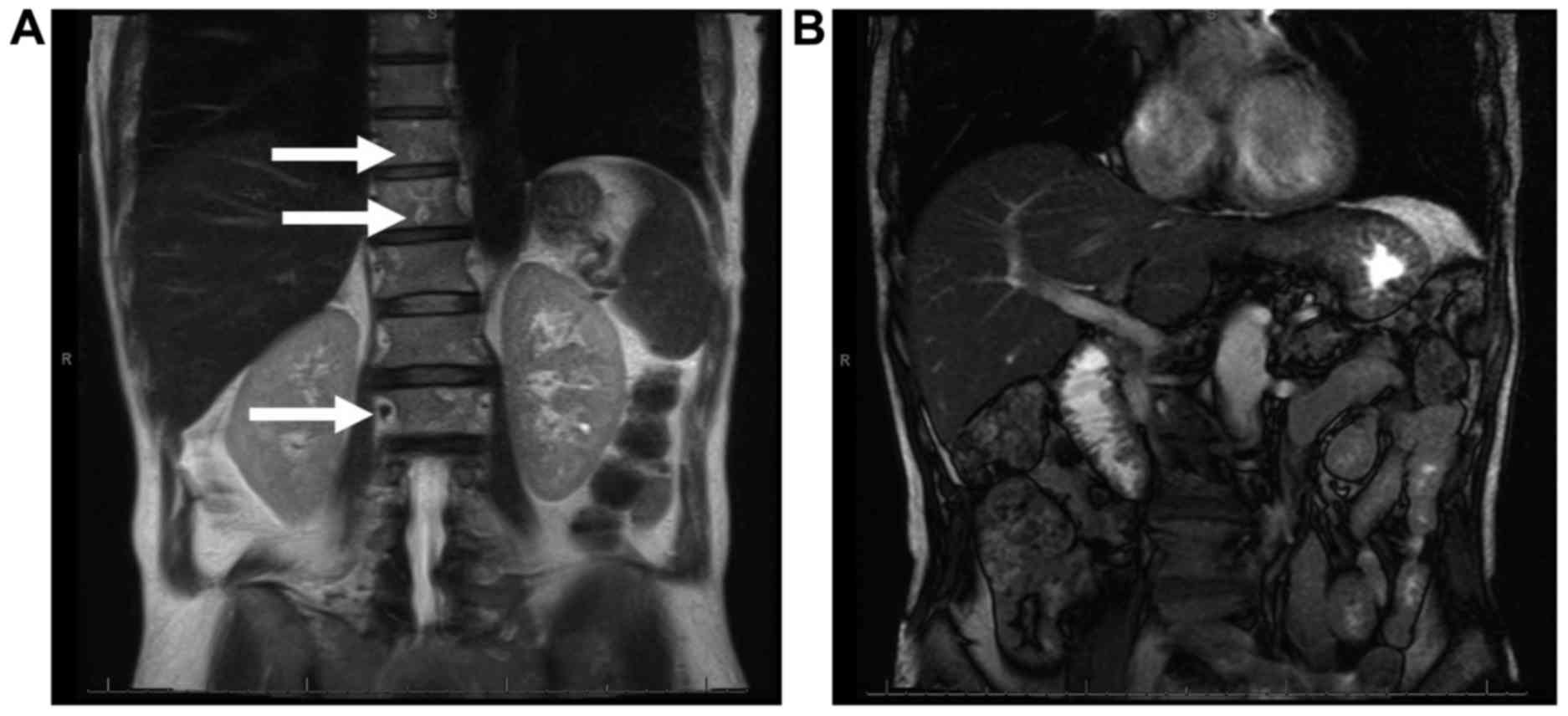
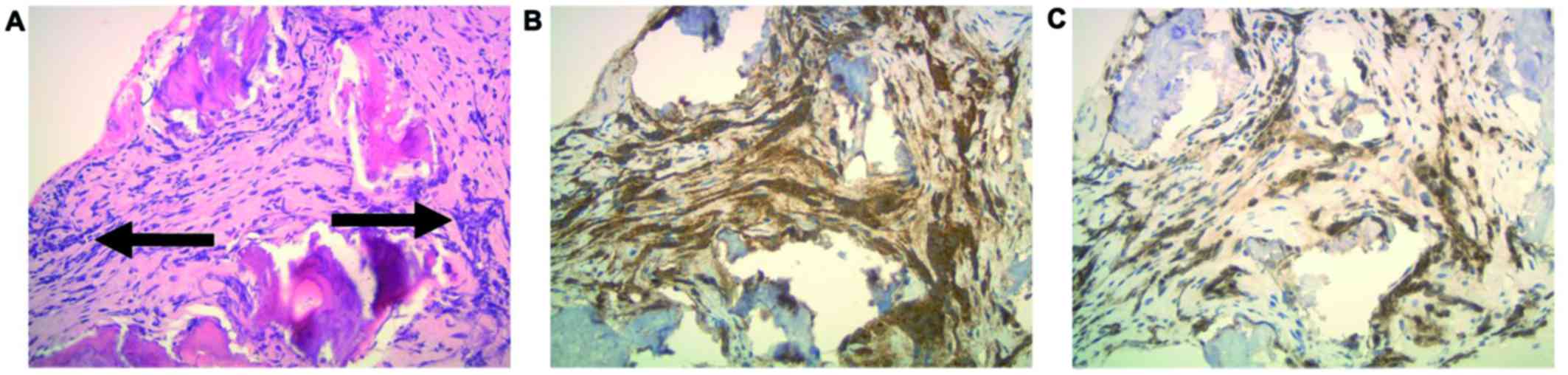
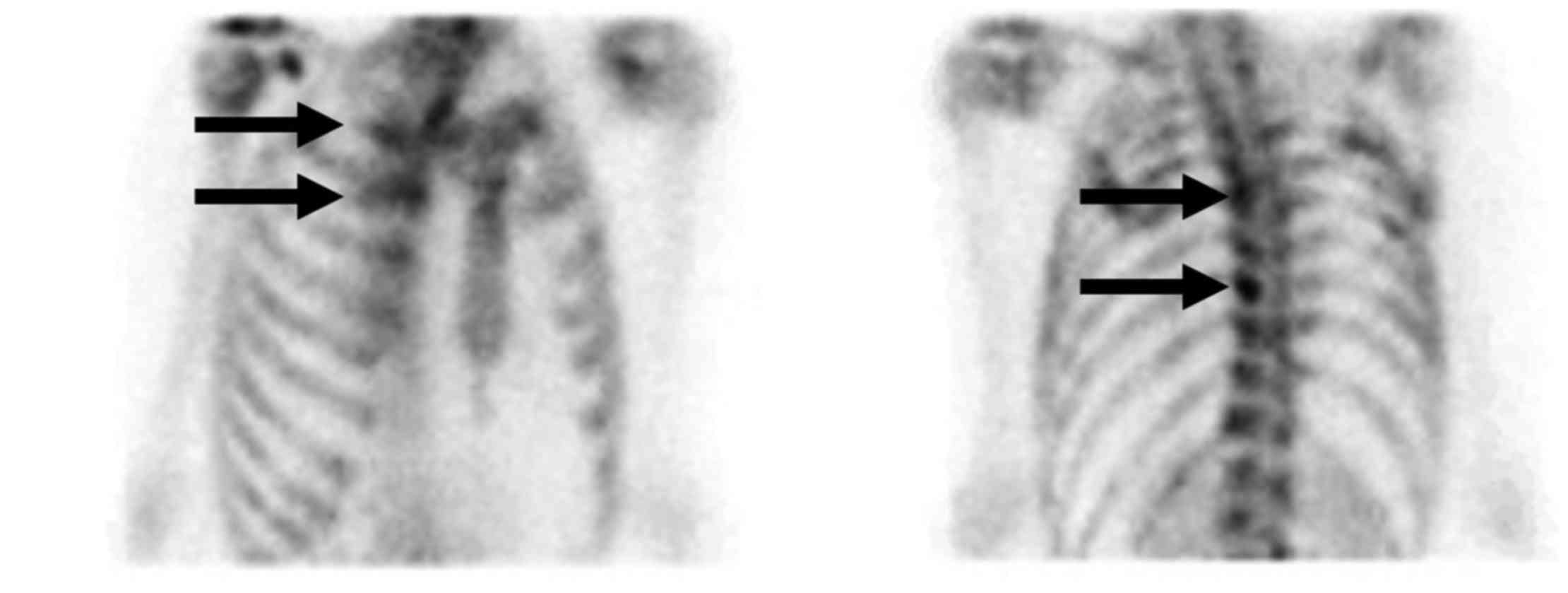
Given these abnormalities a magnetic resonance imaging (MRI)-cholangiopancreatography (MRCP) of the abdomen (Fig. 1) was ordered which revealed a normal liver without any evidence biliary obstruction. Several lytic lesions of the bone were incidentally discovered concerning for metastatic disease. Given the unexplained osseous abnormalities, a PSA was ordered which was significantly elevated at 4,130 ng/ml (normal 0–4.5). CT-guided core needle biopsy of one of the bony lesions confirmed metastatic adenocarcinoma strongly positive for PSA and NKX3.1 (Fig. 2). The clinical presentation, laboratory abnormalities, and pathology findings were consistent with metastatic prostate carcinoma. Bone scan (Fig. 3) confirmed the presence of widespread osseous metastatic disease.

Figure 1.

MRI of Abdomen demonstrating (A) diffuse skeletal metastasis, (B) normal liver without evidence of biliary obstruction.

Figure 2.

Pathologic findings from bone biopsy. Photomicrograph demonstrating tumor cells within fibrotic medullary space of bone (hematoxylin and eosin stain), ×40 magnification (A). Immunohistochemical staining revealing positive expression for PSA (B) and NKX3.1 (C) consistent with prostatic adenocarcinoma.

Figure 3.

Bone scan consistent with widespread osseous metastatic disease.

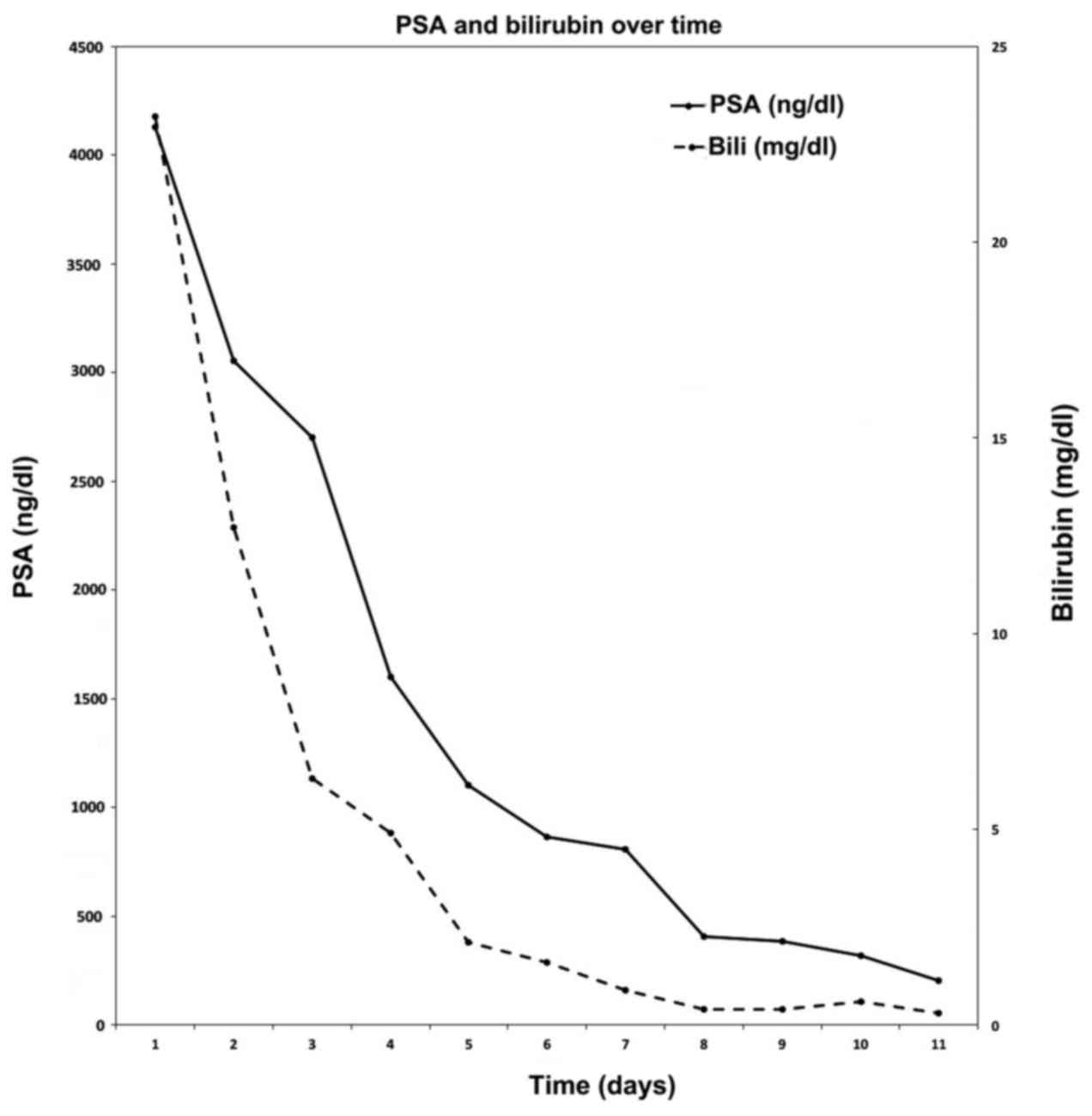
The patient was started on combined androgen deprivation therapy with LupronDepot (Leuprolide acetate for depot suspension, AbbVie Inc., North Chicago, IL, USA) 22.5 mg subcutaneously once every three months and Casodex (Bicalutamide, Wilmington, DE, USA) 50 mg orally once daily. The patient clinically responded rapidly soon after initiation of therapy. His PSA declined to 863 ng/ml four weeks after therapy initiation and subsequently 408 ng/ml by eight weeks (Fig. 4). Conjugated bilirubin and liver function abnormalities normalized completely after four weeks of androgen deprivation. The patient is maintained on depo-leuprolide therapy six months after diagnosis and remains asymptomatic from the standpoint of his cancer. Informed consent for this report was obtained from the patient.

Figure 4.

Associated reduction in cholestasis following hormone blockade treatment in metastatic prostate cancer. After initiation of treatment (black arrow), the patient's PSA and Bilirubin were both reduced in a linear fashion after 7 weeks of leuprolide and bicalutamide therapy.

Discussion

Cholestasis in the setting of malignancy occurs from a variety of mechanisms including external compression of the biliary system, widespread hepatic infiltration, or metastatic disease. Less commonly, reversible cholestasis in the absence of biliary obstruction has been well-described as a paraneoplastic syndrome. In this case, the possibility of extrinsic compression causing cholestasis was excluded by multiple imaging techniques (ultrasound, CT scan, as well as MRI/MRCP). Furthermore, systemic conditions causing intrahepatic cholestasis such drug toxicity, infections (viral hepatitis, HIV), primary biliary cirrhosis, primary sclerosing cholangitis were entertained. These possibilities were excluded by a careful clinical history and broad laboratory workup. Given the incidental finding of diffuse osseous metastasis that was confirmed to be prostate adenocarcinoma on biopsy, patient was started on anti-androgen therapy and GnRH agonist for treatment. Ultimately, the temporal association between the treatment of prostate cancer and resolution of the patient's liver dysfunction argues strongly for a diagnosis of a paraneoplastic syndrome.

Paraneoplastic syndromes constitute a heterogeneous group of disorders that occur as a result of malignancy independent of mass effect or direct invasion (2). These disorders are felt to occur as a result of humoral factors (e.g., cytokines or hormones) elaborated by tumors. An additional mechanism involves activation of the immune system against tumor antigens (3).

The first report of paraneoplastic liver dysfunction associated with malignancy was described in association with renal cell carcinoma (4). This syndrome is characterized by elevated LFTs in a cholestatic pattern in the absence of external compression or widespread liver metastases. Liver pathology review may range from normal histologic findings to varying degrees of reactive hepatitis (5).

Paraneoplastic intrahepatic cholestasis has been described in several other malignancies including soft tissue sarcoma, medullary thyroid cancer, renal sarcoma, T-cell lymphoma, chronic lymphocytic leukemia, Hodgkin's disease (6–12). Although uncommon, reversible hepatic dysfunction in prostate cancer has been described in nine published cases (Table I) (1,13–20). All reported cases occurred in patients with metastatic disease. Including the patient reported here, 90% of patients experienced improvement in liver dysfunction and jaundice with treatment of the prostate cancer. Patients presenting with intrahepatic cholestasis appear to do as well as other patients diagnosed with metastatic prostate cancer. In fact, 70% of reported cases presenting with intrahepatic cholestasis were alive at one year compared with 71% of patients diagnosed with metastatic prostate adenocarcinoma per SEER analysis (21). This suggests that hepatic dysfunction as a presenting sign may not necessarily be a poor prognostic feature.

Table I.

Cases reviewed from literature detailing cholestasis reversal with prostate cancer treatment. Ten cases were analyzed from the literature and compared in terms of patient clinical characteristics, laboratory data, and outcome over a 42 year period of time.

Table I.

Cases reviewed from literature detailing cholestasis reversal with prostate cancer treatment. Ten cases were analyzed from the literature and compared in terms of patient clinical characteristics, laboratory data, and outcome over a 42 year period of time.

First authorAgeStagePSA (ng/ml)Total bilirubin (mg/dl)ManagementLiver function test outcomeClinical followup (Mos.)(Refs.)
Bhangoo, 201767Metastatic4,13026.3Leuprolide, bicalutamideImprovedRemission (6)Present study
Reddy, 197757Metastatic 6.2Radiation, diethylstilbestrolTransiently improvedDeceased (32)(1)
Karakolios 200372Metastatic15018.1Flutamide, leuprolideResolvedRemission (9)(13)
Bloch, 199269Metastatic 10.6ADT, bilateral orchiectomyResolvedDeceased (48)(14)
Cole, 200078Metastatic9,9966.56Leuprolide, bicalutamideResolvedRemission (3)(15)
Nguyen, 201151Metastatic55619Goserelin, bicalutamideImprovedRemission (6)(16)
Kuramoto, 201375Metastatic9,86217Leuprolide, bicalutamideResolvedRemission (12)(17)
Ben-Ishay, 197558Metastatic 13Stilbestrol, bilateral orchiectomyResolvedRemission (24)(18)
Koruk, 200477Metastatic10010Goserelin, bicalutamideResolvedRemission (6)(19)
Shah, 200664Metastatic956132Goserelin, cyproteroneNo responseDeceased (6)(20)

The precise mechanism of disease is not well understood. One putative explanation involves interleukin 6 (IL-6) which appears to be involved in paraneoplastic cholestasis associated with renal cell carcinoma. In a study of 119 patient with metastatic renal cell carcinoma, patients with intrahepatic cholestasis were found to have significantly elevated IL-6 levels compared with patients without this syndrome (22). The association of IL-6 and cholestasis may be mediated by a systemic inflammation as laboratory markers including C-reactive protein (CRP) and haptoglobin which are commonly elevated (22). Pro-inflammatory cytokines inhibit expression of the hepatobiliary transporter gene expression possibly accounting for impaired biliary outflow (23). The association of this condition with IL-6 remains speculative and other humoral mediators have also been proposed (18). Increased levels of IL-6 have similarly been reported among prostate cancer patients with liver dysfunction suggesting a potential association in this paraneoplastic syndrome (16,17). Future directions to elucidate the molecular mechanisms driving this paraneoplastic syndrome includes cytokine profiling of serum from affected patients. Whether or not increased levels of IL-6 correlate with liver dysfunction in prostate cancer is unknown and warrants further investigation.

The case described above is one of few documented cases where cholestasis occurred as a result of paraneoplastic syndrome from prostate cancer without evidence of hepatic infiltration, metastatic disease, or tumor compression. Our patient's cholestasis resolved with the treatment of his prostate cancer, which is consistent clinical feature of this disease.

References

1 

Reddy A, Grosberg SJ and Wpanick S: Intermittent cholestatic jaundice and nonmetastatic prostatic carcinoma. Arch Intern Med. 137:1616–1618. 1977. View Article : Google Scholar : PubMed/NCBI

2 

Darnell RB and Posner JB: Paraneoplastic syndromes. Oxford Uni Press; pp. 4822011

3 

Pelosof LC and Gerber DE: Paraneoplastic syndromes: An approach to diagnosis and treatment. Mayo Clin Proc. 85:pp. 838–854. 2010; View Article : Google Scholar : PubMed/NCBI

4 

Stauffer M: Nephrogenic hepatomegaly. Gastroenterol. 40:6941961.

5 

Dancygier H: Clinical hepatology: Principles and practice of hepatobiliary diseases. 2. Springer; 2010, View Article : Google Scholar

6 

Perisic VN, Howard ER, Mihailovic T, Vujanic G, Milovanovic D and Ivanovski P: Cholestasis caused by biliary botryoid sarcoma. Eur J Pediatr Surg. 1:242–243. 1991. View Article : Google Scholar : PubMed/NCBI

7 

Tiede DJ, Tefferi A, Kochhar R, Thompson GB and Hay ID: Paraneoplastic cholestasis and hypercoagulability associated with medullary thyroid carcinoma. Resolution with tumor debulking. Cancer. 73:702–705. 1994. View Article : Google Scholar : PubMed/NCBI

8 

Patel KJ, Latif SU and de Calaca WM: An unusual presentation of precursor T cell lymphoblastic leukemia/lymphoma with cholestatic jaundice: Case report. J Hematol Oncol. 2:122009. View Article : Google Scholar : PubMed/NCBI

9 

Alirhayim Z, Dyal H, Alarhayem A and Donthireddy V: Non-Hodgkin's lymphoma: A cause of paraneoplastic cholestasis. BMJ Case Rep. 2013(pii): bcr20130097142013.PubMed/NCBI

10 

Fraisse TC, Damigny A, di Castri A, de Wazières B and Fourcade J: Leiomyosarcoma and Stauffer syndrome. Rev Med Interne. 22:1116–1118. 2001.(In French). View Article : Google Scholar : PubMed/NCBI

11 

Barta SK, Yahalom J, Shia J and Hamlin PA: Idiopathic cholestasis as a paraneoplastic phenomenon in Hodgkin's lymphoma. Clin Lymphoma Myeloma. 7:77–82. 2006. View Article : Google Scholar : PubMed/NCBI

12 

Pandey J and Bhowmik KT: Chronic lymphocytic leukemia presenting as jaundice. Indian J Gastroenterol. 17:281998.PubMed/NCBI

13 

Karakolios A, Kasapis C, Kallinikidis T, Kalpidis P and Grigoriadis N: Cholestatic jaundice as a paraneoplastic manifestation of prostate adenocarcinoma. Clin Gastroenterol Hepatol. 1:480–483. 2003. View Article : Google Scholar : PubMed/NCBI

14 

Bloch WE and Block NL: Metastatic prostate cancer presenting as obstructive jaundice. Urology. 40:456–457. 1992. View Article : Google Scholar : PubMed/NCBI

15 

Cole A, Mendelblatt D, Aguayo J, Mathew A, Martin E and Vesely DL: Metastatic prostate cancer (with prostate-specific antigen of 9996) presenting as obstructive jaundice. Am J Med Sci. 319:118–122. 2000. View Article : Google Scholar : PubMed/NCBI

16 

Nguyen V, Gurney H and van der Poorten D: Paraneoplastic hepatic dysfunction in metastatic prostate cancer: The role of cytokine dysregulation. J Clin Oncol. 29:e21–e23. 2011. View Article : Google Scholar : PubMed/NCBI

17 

Kuramoto T, Senzaki H, Koike H, Yamagiwa K, Tamura S, Fujimoto T and Inagaki T: Cholestatic jaundice as a paraneoplastic manifestation of prostate cancer. Case Rep Urol. 2013:3037272013.PubMed/NCBI

18 

Ben-Ishay D, Slavin S, Levij IS and Eliakim M: Obstructive jaundice associated with carcinoma of the prostate. Isr J Med Sci. 11:838–844. 1975.PubMed/NCBI

19 

Koruk M, Büyükberber M, Savaş C and Kadayifçi A: Paraneoplastic cholestasis associated with prostate carcinoma. Turkish J Gastroenterol. 15:53–55. 2004.

20 

Shah SH: Paraneoplastic liver dysfunction in prostate cancer. J Pain Symptom Manage. 32:511–513. 2006. View Article : Google Scholar : PubMed/NCBI

21 

National Cancer Institute, . Cancer of the prostate-SEER stat fact sheets. 2016.

22 

Blay JY, Rossi JF, Wijdenes J, Menetrier-Caux C, Schemann S, Négrier S, Philip T and Favrot M: Role of interleukin-6 in the paraneoplastic inflammatory syndrome associated with renal-cell carcinoma. Int J Cancer. 72:424–430. 1997. View Article : Google Scholar : PubMed/NCBI

23 

Trauner M, Fickert P and Stauber RE: Inflammation-induced cholestasis. J Gastroenterol Hepatol. 14:946–959. 1999. View Article : Google Scholar : PubMed/NCBI

Related Articles

  • Abstract
  • View
  • Download
  • Twitter
Copy and paste a formatted citation
Spandidos Publications style
Li Z, Zhou L, Zhao L, Chen P, Liu Y, Ding Y, Sun S, Yang S and Lai Y: Giant paratesticular liposarcoma: A case report and review of the literature. Mol Clin Oncol 8: 613-616, 2018.
APA
Li, Z., Zhou, L., Zhao, L., Chen, P., Liu, Y., Ding, Y. ... Lai, Y. (2018). Giant paratesticular liposarcoma: A case report and review of the literature. Molecular and Clinical Oncology, 8, 613-616. https://doi.org/10.3892/mco.2018.1577
MLA
Li, Z., Zhou, L., Zhao, L., Chen, P., Liu, Y., Ding, Y., Sun, S., Yang, S., Lai, Y."Giant paratesticular liposarcoma: A case report and review of the literature". Molecular and Clinical Oncology 8.4 (2018): 613-616.
Chicago
Li, Z., Zhou, L., Zhao, L., Chen, P., Liu, Y., Ding, Y., Sun, S., Yang, S., Lai, Y."Giant paratesticular liposarcoma: A case report and review of the literature". Molecular and Clinical Oncology 8, no. 4 (2018): 613-616. https://doi.org/10.3892/mco.2018.1577
Copy and paste a formatted citation
x
Spandidos Publications style
Li Z, Zhou L, Zhao L, Chen P, Liu Y, Ding Y, Sun S, Yang S and Lai Y: Giant paratesticular liposarcoma: A case report and review of the literature. Mol Clin Oncol 8: 613-616, 2018.
APA
Li, Z., Zhou, L., Zhao, L., Chen, P., Liu, Y., Ding, Y. ... Lai, Y. (2018). Giant paratesticular liposarcoma: A case report and review of the literature. Molecular and Clinical Oncology, 8, 613-616. https://doi.org/10.3892/mco.2018.1577
MLA
Li, Z., Zhou, L., Zhao, L., Chen, P., Liu, Y., Ding, Y., Sun, S., Yang, S., Lai, Y."Giant paratesticular liposarcoma: A case report and review of the literature". Molecular and Clinical Oncology 8.4 (2018): 613-616.
Chicago
Li, Z., Zhou, L., Zhao, L., Chen, P., Liu, Y., Ding, Y., Sun, S., Yang, S., Lai, Y."Giant paratesticular liposarcoma: A case report and review of the literature". Molecular and Clinical Oncology 8, no. 4 (2018): 613-616. https://doi.org/10.3892/mco.2018.1577
Follow us
  • Twitter
  • LinkedIn
  • Facebook
About
  • Spandidos Publications
  • Careers
  • Cookie Policy
  • Privacy Policy
How can we help?
  • Help
  • Live Chat
  • Contact
  • Email to our Support Team