Spandidos Publications Logo
  • About
    • About Spandidos
    • Aims and Scopes
    • Abstracting and Indexing
    • Editorial Policies
    • Reprints and Permissions
    • Job Opportunities
    • Terms and Conditions
    • Contact
  • Journals
    • All Journals
    • Oncology Letters
      • Oncology Letters
      • Information for Authors
      • Editorial Policies
      • Editorial Board
      • Aims and Scope
      • Abstracting and Indexing
      • Bibliographic Information
      • Archive
    • International Journal of Oncology
      • International Journal of Oncology
      • Information for Authors
      • Editorial Policies
      • Editorial Board
      • Aims and Scope
      • Abstracting and Indexing
      • Bibliographic Information
      • Archive
    • Molecular and Clinical Oncology
      • Molecular and Clinical Oncology
      • Information for Authors
      • Editorial Policies
      • Editorial Board
      • Aims and Scope
      • Abstracting and Indexing
      • Bibliographic Information
      • Archive
    • Experimental and Therapeutic Medicine
      • Experimental and Therapeutic Medicine
      • Information for Authors
      • Editorial Policies
      • Editorial Board
      • Aims and Scope
      • Abstracting and Indexing
      • Bibliographic Information
      • Archive
    • International Journal of Molecular Medicine
      • International Journal of Molecular Medicine
      • Information for Authors
      • Editorial Policies
      • Editorial Board
      • Aims and Scope
      • Abstracting and Indexing
      • Bibliographic Information
      • Archive
    • Biomedical Reports
      • Biomedical Reports
      • Information for Authors
      • Editorial Policies
      • Editorial Board
      • Aims and Scope
      • Abstracting and Indexing
      • Bibliographic Information
      • Archive
    • Oncology Reports
      • Oncology Reports
      • Information for Authors
      • Editorial Policies
      • Editorial Board
      • Aims and Scope
      • Abstracting and Indexing
      • Bibliographic Information
      • Archive
    • Molecular Medicine Reports
      • Molecular Medicine Reports
      • Information for Authors
      • Editorial Policies
      • Editorial Board
      • Aims and Scope
      • Abstracting and Indexing
      • Bibliographic Information
      • Archive
    • World Academy of Sciences Journal
      • World Academy of Sciences Journal
      • Information for Authors
      • Editorial Policies
      • Editorial Board
      • Aims and Scope
      • Abstracting and Indexing
      • Bibliographic Information
      • Archive
    • International Journal of Functional Nutrition
      • International Journal of Functional Nutrition
      • Information for Authors
      • Editorial Policies
      • Editorial Board
      • Aims and Scope
      • Abstracting and Indexing
      • Bibliographic Information
      • Archive
    • International Journal of Epigenetics
      • International Journal of Epigenetics
      • Information for Authors
      • Editorial Policies
      • Editorial Board
      • Aims and Scope
      • Abstracting and Indexing
      • Bibliographic Information
      • Archive
    • Medicine International
      • Medicine International
      • Information for Authors
      • Editorial Policies
      • Editorial Board
      • Aims and Scope
      • Abstracting and Indexing
      • Bibliographic Information
      • Archive
  • Articles
  • Information
    • Information for Authors
    • Information for Reviewers
    • Information for Librarians
    • Information for Advertisers
    • Conferences
  • Language Editing
Spandidos Publications Logo
  • About
    • About Spandidos
    • Aims and Scopes
    • Abstracting and Indexing
    • Editorial Policies
    • Reprints and Permissions
    • Job Opportunities
    • Terms and Conditions
    • Contact
  • Journals
    • All Journals
    • Biomedical Reports
      • Information for Authors
      • Editorial Policies
      • Editorial Board
      • Aims and Scope
      • Abstracting and Indexing
      • Bibliographic Information
      • Archive
    • Experimental and Therapeutic Medicine
      • Information for Authors
      • Editorial Policies
      • Editorial Board
      • Aims and Scope
      • Abstracting and Indexing
      • Bibliographic Information
      • Archive
    • International Journal of Epigenetics
      • Information for Authors
      • Editorial Policies
      • Editorial Board
      • Aims and Scope
      • Abstracting and Indexing
      • Bibliographic Information
      • Archive
    • International Journal of Functional Nutrition
      • Information for Authors
      • Editorial Policies
      • Editorial Board
      • Aims and Scope
      • Abstracting and Indexing
      • Bibliographic Information
      • Archive
    • International Journal of Molecular Medicine
      • Information for Authors
      • Editorial Policies
      • Editorial Board
      • Aims and Scope
      • Abstracting and Indexing
      • Bibliographic Information
      • Archive
    • International Journal of Oncology
      • Information for Authors
      • Editorial Policies
      • Editorial Board
      • Aims and Scope
      • Abstracting and Indexing
      • Bibliographic Information
      • Archive
    • Medicine International
      • Information for Authors
      • Editorial Policies
      • Editorial Board
      • Aims and Scope
      • Abstracting and Indexing
      • Bibliographic Information
      • Archive
    • Molecular and Clinical Oncology
      • Information for Authors
      • Editorial Policies
      • Editorial Board
      • Aims and Scope
      • Abstracting and Indexing
      • Bibliographic Information
      • Archive
    • Molecular Medicine Reports
      • Information for Authors
      • Editorial Policies
      • Editorial Board
      • Aims and Scope
      • Abstracting and Indexing
      • Bibliographic Information
      • Archive
    • Oncology Letters
      • Information for Authors
      • Editorial Policies
      • Editorial Board
      • Aims and Scope
      • Abstracting and Indexing
      • Bibliographic Information
      • Archive
    • Oncology Reports
      • Information for Authors
      • Editorial Policies
      • Editorial Board
      • Aims and Scope
      • Abstracting and Indexing
      • Bibliographic Information
      • Archive
    • World Academy of Sciences Journal
      • Information for Authors
      • Editorial Policies
      • Editorial Board
      • Aims and Scope
      • Abstracting and Indexing
      • Bibliographic Information
      • Archive
  • Articles
  • Information
    • For Authors
    • For Reviewers
    • For Librarians
    • For Advertisers
    • Conferences
  • Language Editing
Login Register Submit
  • This site uses cookies
  • You can change your cookie settings at any time by following the instructions in our Cookie Policy. To find out more, you may read our Privacy Policy.

    I agree
Search articles by DOI, keyword, author or affiliation
Search
Advanced Search
presentation
Molecular and Clinical Oncology
Join Editorial Board Propose a Special Issue
Print ISSN: 2049-9450 Online ISSN: 2049-9469
Journal Cover
May-2018 Volume 8 Issue 5

Full Size Image

Sign up for eToc alerts
Recommend to Library

Journals

International Journal of Molecular Medicine

International Journal of Molecular Medicine

International Journal of Molecular Medicine is an international journal devoted to molecular mechanisms of human disease.

International Journal of Oncology

International Journal of Oncology

International Journal of Oncology is an international journal devoted to oncology research and cancer treatment.

Molecular Medicine Reports

Molecular Medicine Reports

Covers molecular medicine topics such as pharmacology, pathology, genetics, neuroscience, infectious diseases, molecular cardiology, and molecular surgery.

Oncology Reports

Oncology Reports

Oncology Reports is an international journal devoted to fundamental and applied research in Oncology.

Experimental and Therapeutic Medicine

Experimental and Therapeutic Medicine

Experimental and Therapeutic Medicine is an international journal devoted to laboratory and clinical medicine.

Oncology Letters

Oncology Letters

Oncology Letters is an international journal devoted to Experimental and Clinical Oncology.

Biomedical Reports

Biomedical Reports

Explores a wide range of biological and medical fields, including pharmacology, genetics, microbiology, neuroscience, and molecular cardiology.

Molecular and Clinical Oncology

Molecular and Clinical Oncology

International journal addressing all aspects of oncology research, from tumorigenesis and oncogenes to chemotherapy and metastasis.

World Academy of Sciences Journal

World Academy of Sciences Journal

Multidisciplinary open-access journal spanning biochemistry, genetics, neuroscience, environmental health, and synthetic biology.

International Journal of Functional Nutrition

International Journal of Functional Nutrition

Open-access journal combining biochemistry, pharmacology, immunology, and genetics to advance health through functional nutrition.

International Journal of Epigenetics

International Journal of Epigenetics

Publishes open-access research on using epigenetics to advance understanding and treatment of human disease.

Medicine International

Medicine International

An International Open Access Journal Devoted to General Medicine.

Journal Cover
May-2018 Volume 8 Issue 5

Full Size Image

Sign up for eToc alerts
Recommend to Library

  • Article
  • Citations
    • Cite This Article
    • Download Citation
    • Create Citation Alert
    • Remove Citation Alert
    • Cited By
  • Similar Articles
    • Related Articles (in Spandidos Publications)
    • Similar Articles (Google Scholar)
    • Similar Articles (PubMed)
  • Download PDF
  • Download XML
  • View XML
Case Report

Ulcerated gastric leiomyoma causing massive upper gastrointestinal bleeding: A case report

  • Authors:
    • Daryl Ramai
    • Qiuxue T. Tan
    • Sofia Nigar
    • Emmanuel Ofori
    • Denzil Etienne
    • Madhavi Reddy
  • View Affiliations / Copyright

    Affiliations: Division of Gastroenterology and Hepatology, The Brooklyn Hospital Center, Academic Affiliate of The Icahn School of Medicine at Mount Sinai, Clinical Affiliate of The Mount Sinai Hospital, Brooklyn, New York, NY 11201, USA, Department of Anatomical Sciences, St. George's University School of Medicine, True Blue, Grenada, West Indies
  • Pages: 671-674
    |
    Published online on: March 26, 2018
       https://doi.org/10.3892/mco.2018.1597
  • Expand metrics +
Metrics: Total Views: 0 (Spandidos Publications: | PMC Statistics: )
Metrics: Total PDF Downloads: 0 (Spandidos Publications: | PMC Statistics: )
Cited By (CrossRef): 0 citations Loading Articles...

This article is mentioned in:


Abstract

Leiomyomas are rare, benign submucosal tumors originating from smooth muscle cells. The clinical presentation is usually asymptomatic, with excellent prognosis. We herein report the case of a 68‑year‑old female with a solitary leiomyoma found during esophagogastroduodenoscopy for hematemesis. Histopathological examination revealed smooth muscle proliferation supported by positive staining for smooth muscle myosin heavy chain and negative staining for CD117 and S‑100, consistent with the marker expression pattern of leiomyoma. We report on the clinical presentation of this case, and discuss the origin, epidemiology, treatment and management of leiomyomas.

Introduction

Extrauterine manifestations of leiomyomas are rare. Within the gastrointestinal tract, leiomyomas predominately occur in the esophagus (1). Gastric leiomyomas are benign submucosal tumors composed of smooth muscle cells, and account for 2.5% of all gastric neoplasms (2,3). Leiomyomas are most frequently encountered in patients aged 50–70 years and bear no gender predilection (4). These tumors are slow-growing and usually asymptomatic; however, they may become clinically evident when the overlying gastric mucosa ulcerates with ensuing hemorrhage. Herein, we describe the case of a 68-year-old female patient presenting with hematemesis and found to have a gastric submucosal lesion on esophagogastroduodenoscopy (EGD), which was diagnosed as a gastric leiomyoma following histopathological examination.

Case report

A 68-year-old female patient with a medical history of chronic gastritis, hypertension, hyperlipidemia, atrial fibrillation (not on anticoagulation), a cerebral vascular event with residual left-sided weakness, seizure disorder, iron deficiency anemia, and anemia of chronic disease, presented with a complaint of hematemesis. On physical examination, the abdomen was soft, non-tender and non-distended. The heart rate was 85 beats/min, the blood pressure was 123/80 mmHg, the respiratory rate was 20 breaths/min, with an oxygen saturation of 95% on room air and a temperature of 97.6°F. The laboratory findings were as follows: Sodium 143 mmol/l, potassium 3.6 mmol/l, albumin 2.7 g/dl, alkaline phosphatase 47 U/l, aspartate aminotransferase 13 U/l, alanine aminotransferase 10 U/l, hemoglobin 5.1 g/dl, hematocrit 17%, white blood cell count 16.1 K/cmm, and platelet count 262 K/cmm.

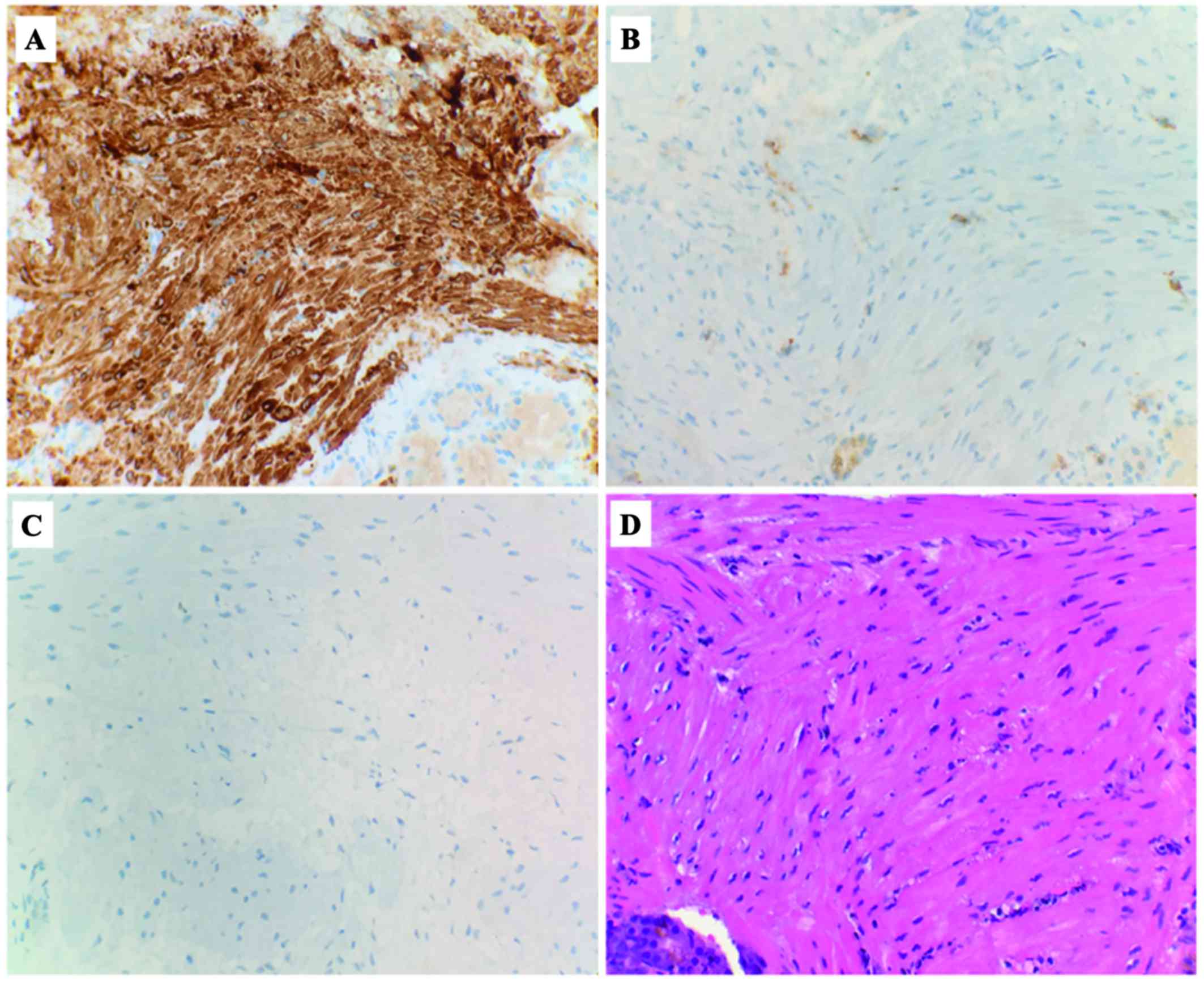
An abdominal computed tomography (CT) scan revealed a mass lesion seen protruding from the gastric lesser curvature into the lumen, measuring ~4.1×2.6 cm (Fig. 1). There was no evidence of extension of the mass outside the walls of the stomach. During esophagogastroduodenoscopy (EGD), a 4-cm submucosal lesion was identified along the lesser curvature of the stomach near the cardia (Fig. 2). Two umbilicated areas of ulceration were seen over the lesion, with no active bleeding. The lesion was biopsied without excision. To histologically process the biopsied specimen, a section ≤3-mm thick was used. The section was fixed using 10% neutral buffered formalin. Next, the section slide was left in a 65°C oven to melt the paraffin. Finally, staining protocol for hematoxylin and eosin staining were performed at room temperature for 45 min. Following histopathological processing, light microscopy revealed that the lesion was composed of bundles of elongated cells with oblong nuclei, and a submucosa with smooth muscle cell proliferation. On immunohistochemical examination, the cells of the lesion were positive for smooth muscle myosin heavy chain and negative for CD117 (c-kit) and S-100; the proliferation index (Ki-67) was <10% (Fig. 3). These findings were consistent with the diagnosis of gastric leiomyoma. Following the procedure, the same day, the patient made a good recovery. Consent was obtained from the patient regarding the publication of the case details and associated images.

Figure 1.

Computed tomography scan showing a gastric leiomyoma (arrow) protruding from the lesser curvature into the gastric lumen, measuring ~4.1×2.6 cm.

Figure 2.

(A) Gastric submucosal lesion (leiomyoma) identified during endoscopy. (B) Central umbilication of the gastric leiomyoma.

Figure 3.

Cells of the lesion were (A) positive for smooth muscle myosin heavy chain and (B) negative for CD117. (C) Proliferation index (Ki-67) was low. (D) Lesion was composed of bundles of elongated cells with oblong nuclei (hematoxylin and eosin staining). All magnifications, ×40.

Discussion

Leiomyomas of the gastric cardia appear as homogeneous, low-attenuation masses with an endoluminal growth pattern, often ranging from 1.3 to 4.7 cm in diameter (5,6). These tumors may also be found in the corpus and antrum of the stomach. When the tumors grow to >2 cm, they are more likely to present with central ulceration (6). The differential diagnosis of leiomyomas includes gastrointestinal stromal tumors (GISTs) and schwannomas. Histologically, they appear as round, solitary lesions arising from the muscularis mucosae, muscularis propriae, and possibly from smooth muscle of the vessel wall in the bowel (3). Their benign nature is evidenced by the microscopic appearance of abundant hyperplastic smooth muscle cells with minimal mitotic activity and low c-kit expression (7). However, the pathogenesis of gastric leiomyomas remains largely unclear.

In the past, leiomyomas and GISTs were referred to interchangeably. However, it is clinically important to distinguish these two entities, as leiomyomas are benign, while GISTs may display malignant potential (8). True leiomyomas are strongly and diffusely positive for desmin and smooth muscle actin (7). Additionally, true leiomyomas and schwannomas stain negative for CD117 and CD34, while GISTs are positive for these markers (9,10). Leiomyomas tend to occur in younger patients compared with GISTs (7). Leiomyosarcomas are far less common and can be differentiated from leiomyomas by their very high mitotic rate (11).

The clinical presentation of leiomyomas depends on their size and location. The majority of gastric leiomyomas are slow-growing and asymptomatic; therefore, they are usually found incidentally on EGD, surgical exploration, or at autopsy (12). When symptomatic, leiomyomas manifest with upper gastrointestinal bleeding, atypical epigastric pain or non-specific dyspepsia, generally due to mucosal ulceration (13). The predisposing factors associated with gastric leiomyoma bleeding include treatment with anticoagulants, non-steroidal anti-inflammatory drugs and corticosteroids (14–16). Endoscopically, leiomyomas appear as smooth, well-defined tumors, with stretched and effaced mucosal folds overlying the lesions, also referred to as the Schindler's sign (17).

According to the American Gastrointestinal Association (AGA), patients with submucosal tumors <3 cm may be followed up by periodic EGD or endoscopic ultrasound examinations, while lesions >3 cm, in which the malignant potential cannot be determined by less invasive means, require surgical or endoscopic excision for diagnosis (18,19). If the tumor is not removed, it may invade surrounding tissue. In conclusion, gastric leiomyoma is a rare, benign submucosal tumor originating from smooth muscle cells, most commonly found in the gastric cardia. It bears no predilection for gender and is most frequently found in patients aged 50–70 years. It is important to differentiate leiomyoma from leiomyosarcoma, which is a malignant tumor, and from GISTs, which possess malignant potential. Furthermore, according to AGA practice guidelines, surgical or endoscopic resection is recommended for tumors sized >3 cm. The patients with surgically resected tumors have a favorable clinical outcome.

Acknowledgements

Not applicable.

Funding

No funding was received.

Authors' contributions

DR, QTT and SN conceived and designed the study. DR and QTT drafted the manuscript. EO, SN, DE and MR critically revised the manuscript for intellectual content. All authors approved the manuscript for submission.

Availability of data and materials

Not applicable.

Ethics approval

This manuscript was acknowledged and approved by The Brooklyn Hospital Center Institutional Review Board on June 22, 2017 (no. 1082889-1).

Consent for publication

The patient provided written informed consent for the publication of the case details and associated images.

Competing interests

The authors declare that they have no competing interests.

References

1 

Wang ZQ, Wang S, Ye YJ, Kang YL, Sun KK and Zheng HF: Gastrointestinal mesenchymal tumors: A clinical pathologic and immunohistochemical study of 210 cases. Zhonghua Wei Chang Wai Ke Za Zhi. 10:11–16. 2007.(In Chinese). PubMed/NCBI

2 

Morgan BK, Compton C, Talbert M, Gallagher WJ and Wood WC: Benign smooth muscle tumors of the gastrointestinal tract. A 24 year experience. Ann Surg. 211:63–66. 1990. View Article : Google Scholar : PubMed/NCBI

3 

Agaimy A and Wünsch PH: True smooth muscle neoplasms of the gastrointestinal tract: Morphological spectrum and classification in a series of 85 cases from a single institute. Langenbecks Arch Surg. 392:75–81. 2007. View Article : Google Scholar : PubMed/NCBI

4 

Gupta AK, Berry M and Mitra DK: Ossified gastric leiomyoma in a child: A case report. Pediatr Radiol. 25:48–49. 1995. View Article : Google Scholar : PubMed/NCBI

5 

Hur BY, Kim SH, Choi JY, Rha SE, Lee MW, Kim SY, Han JK and Choi BI: Gastroduodenal glomus tumors: Differentiation from other subepithelial lesions based on dynamic contrast-enhanced CT findings. AJR Am J Roentgenol. 197:1351–1359. 2011. View Article : Google Scholar : PubMed/NCBI

6 

Lee MJ, Lim JS, Kwon JE, Kim H, Hyung WJ, Park MS, Kim MJ and Kim KW: Gastric true leiomyoma: Computed tomographic findings and pathological correlation. J Comput Assist Tomogr. 31:204–208. 2007. View Article : Google Scholar : PubMed/NCBI

7 

Miettinen M, Sobin LH and Sarlomo-Rikala M: Immunohistochemical spectrum of GISTs at different sites and their differential diagnosis with a reference to CD117 (KIT). Mod Pathol. 13:1134–1142. 2000. View Article : Google Scholar : PubMed/NCBI

8 

Kang HC, Menias CO, Gaballah AH, Shroff S, Taggart MW, Garg N and Elsayes KM: Beyond the GIST: Mesenchymal tumors of the stomach. Radiographics. 33:1673–1690. 2013. View Article : Google Scholar : PubMed/NCBI

9 

Greenson JK: Gastrointestinal stromal tumors and other mesenchymal lesions of the gut. Mod Pathol. 16:366–375. 2003. View Article : Google Scholar : PubMed/NCBI

10 

Ramai D, Lai J, Changela K, Reddy M and Shahzad G: Transverse colon schwannoma treated by endoscopic mucosal resection: A case report. Mol Clin Oncol. 7:830–832. 2017. View Article : Google Scholar : PubMed/NCBI

11 

Miettinen M: Smooth muscle tumors of soft tissue and non-uterine viscera: Biology and prognosis. Mod Pathol. 27 Suppl 1:S17–S29. 2014. View Article : Google Scholar : PubMed/NCBI

12 

Payne WG, Murphy CG and Grossbard LJ: Combined laparoscopic and endoscopic approach to resection of gastric leiomyoma. J Laparoendosc Surg. 5:119–122. 1995. View Article : Google Scholar : PubMed/NCBI

13 

Matsuda M, Watanabe Y, Tonosu N, Nabeya Y, Arima H, Matsuzaki H, Ohira G, Sato H, Mizushima T and Uehara T: Hemoperitoneum secondary to exophytic leiomyoma: report of a case. Surg Today. 30:448–450. 2000. View Article : Google Scholar : PubMed/NCBI

14 

Stalnikowicz R, Eliakim R, Ligumsky M and Rachmilewitz D: Drug-induced bleeding of gastric leiomyoma. Am J Gastroenterol. 82:419–420. 1987.PubMed/NCBI

15 

Saxton NL: Hemorrhage from a gastric leiomyoma during anticoagulant therapy. Report of a case. J Iowa State Med Soc. 51:717–721. 1961.PubMed/NCBI

16 

Din NA: Aspirin-induced haemorrhage in gastric leiomyoma. J R Coll Surg Edinb. 18:246–248. 1973.PubMed/NCBI

17 

Apostolopoulos P, Zalonis A, Karamoutzos A, Mavrogiannis P, Vlachou E, Tsibouris P and Alexandrakis G: Endoscopic submucosal dissection for the diagnosis and treatment of a gastric submucosal tumor: Initial experience in Greece. Ann Gastroenterol. 25:358–360. 2012.PubMed/NCBI

18 

Schindler R, Blomquist OA, et al: Leiomyosarcoma of the stomach; its roentgenologic and gastroscopic diagnosis and its possible relationship to pernicious anemia. Surg Gynecol Obstet. 82:239–252. 1946.PubMed/NCBI

19 

Hwang JH, Rulyak SD and Kimmey MB: American Gastroenterological Association Institute: American gastroenterological association institute technical review on the management of gastric subepithelial masses. Gastroenterology. 130:2217–2228. 2006. View Article : Google Scholar : PubMed/NCBI

Related Articles

  • Abstract
  • View
  • Download
  • Twitter
Copy and paste a formatted citation
Spandidos Publications style
Ramai D, Tan QT, Nigar S, Ofori E, Etienne D and Reddy M: Ulcerated gastric leiomyoma causing massive upper gastrointestinal bleeding: A case report. Mol Clin Oncol 8: 671-674, 2018.
APA
Ramai, D., Tan, Q.T., Nigar, S., Ofori, E., Etienne, D., & Reddy, M. (2018). Ulcerated gastric leiomyoma causing massive upper gastrointestinal bleeding: A case report. Molecular and Clinical Oncology, 8, 671-674. https://doi.org/10.3892/mco.2018.1597
MLA
Ramai, D., Tan, Q. T., Nigar, S., Ofori, E., Etienne, D., Reddy, M."Ulcerated gastric leiomyoma causing massive upper gastrointestinal bleeding: A case report". Molecular and Clinical Oncology 8.5 (2018): 671-674.
Chicago
Ramai, D., Tan, Q. T., Nigar, S., Ofori, E., Etienne, D., Reddy, M."Ulcerated gastric leiomyoma causing massive upper gastrointestinal bleeding: A case report". Molecular and Clinical Oncology 8, no. 5 (2018): 671-674. https://doi.org/10.3892/mco.2018.1597
Copy and paste a formatted citation
x
Spandidos Publications style
Ramai D, Tan QT, Nigar S, Ofori E, Etienne D and Reddy M: Ulcerated gastric leiomyoma causing massive upper gastrointestinal bleeding: A case report. Mol Clin Oncol 8: 671-674, 2018.
APA
Ramai, D., Tan, Q.T., Nigar, S., Ofori, E., Etienne, D., & Reddy, M. (2018). Ulcerated gastric leiomyoma causing massive upper gastrointestinal bleeding: A case report. Molecular and Clinical Oncology, 8, 671-674. https://doi.org/10.3892/mco.2018.1597
MLA
Ramai, D., Tan, Q. T., Nigar, S., Ofori, E., Etienne, D., Reddy, M."Ulcerated gastric leiomyoma causing massive upper gastrointestinal bleeding: A case report". Molecular and Clinical Oncology 8.5 (2018): 671-674.
Chicago
Ramai, D., Tan, Q. T., Nigar, S., Ofori, E., Etienne, D., Reddy, M."Ulcerated gastric leiomyoma causing massive upper gastrointestinal bleeding: A case report". Molecular and Clinical Oncology 8, no. 5 (2018): 671-674. https://doi.org/10.3892/mco.2018.1597
Follow us
  • Twitter
  • LinkedIn
  • Facebook
About
  • Spandidos Publications
  • Careers
  • Cookie Policy
  • Privacy Policy
How can we help?
  • Help
  • Live Chat
  • Contact
  • Email to our Support Team