Introduction
Paraneoplastic neurological syndromes (PNS) are
defined as remote effects of cancer involving the nervous system
that are unrelated to the direct effects of the tumor and its
metastasis, infection, ischemia or metabolic disturbance (1). PNS are fairly rare, affecting <1% of
patients with cancer, but may be severely debilitating due to the
impairment of neurological functions (2). The diagnosis of PNS may be challenging,
as they may affect any part of the nervous system and may mimic any
other neurological disorder. Clinicians should consider PNS in the
differential diagnosis of neurological disorders.
The occurrence of antibodies directed against
onconeural antigens expressed by both the tumor cells and the
nervous systems indicates that the disorders may be mediated by
immunological mechanisms (3,4). The possibility of the presence of an
underlying tumor is highly associated with the type of antibodies
identified (5). Detection of the
characterized onconeural antibodies may suggest the diagnosis of a
neurological disorder as paraneoplastic and guide the investigation
of the underlying tumor before it is clinically overt.
Paraneoplastic cerebellar degeneration (PCD) usually
presents with an acute or a subacute onset of limb and trunk
ataxia, dysarthria, dysphagia, diplopia and vertigo, and progresses
rapidly within 3 months (6). A
variety of malignancies are commonly associated with PCD, including
small-cell lung cancer, Hodgkin's lymphoma, breast cancer and
gynecological malignancies.
We herein report the case of a female patient with
PCD caused by breast cancer and present a review of the literature
on the mechanisms, clinical characteristics, diagnosis and
management of this disorder.
Case report
A 67-year-old woman was admitted to the Department
of Neurology of the First Affiliated Hospital of Nanjing Medical
University (Nanjing, China) with a 6-month history of progressively
worsening dizziness and unsteadiness while walking, accompanied by
nausea and vomiting. The patient's past medical history was
unremarkable. Cerebrospinal fluid (CSF) analysis revealed slightly
elevated protein concentration with a normal cell count. A
neurological workup at a different institution initially suggested
a possible diagnosis of Miller Fisher syndrome. The patient was
treated with immunoglobulins intravenously, with no significant
neurological improvement. The patient gradually developed
psychiatric symptoms, such as irritability and personality changes,
followed by double vision over the next few months.
During hospitalization in our department, the
patient's vital signs, including body temperature, heart rate,
respiratory rate, blood pressure and oxygen saturation, were within
normal limits. General physical examination, including breast
examination, was normal. Neurological examination displayed
dysarthria, bilateral gaze-evoked nystagmus, bilateral finger-nose
ataxia, bilateral heel-shin ataxia, gait ataxia and positive
bilateral Babinski sign. The results of routine laboratory tests
were unremarkable and the serum tumor markers were within the
normal range. Magnetic resonance imaging (MRI) of the brain did not
reveal any remarkable abnormalities, apart from mild lacunar
infarctions. The CSF analysis revealed slightly increased protein
level, without oligoclonal bands. Electroencephalography revealed
mild background slowing activity.
The initial diagnostic hypothesis was Wernicke's
encephalopathy; however, there was no clinical improvement of the
cerebellar symptoms despite the administration of thiamine. After
excluding other potential causes of the neurological symptoms, a
suspicion of PCD was raised. The serum was tested for characterized
onconeural antibodies, including anti-Yo, anti-Hu, anti-Ri,
anti-CV2, anti-Ma2 and anti-amphiphysin. A high titer of anti-Yo
antibodies (1:1,000) was detected by indirect immunofluorescence
assay and western blot analysis in the serum of the patient, which
raised a high suspicion of breast and/or gynecological malignancy.
Immunofluorescence assay and western blot analysis was conducted by
EUROIMMUN Medical Diagnostics (China) Co., Ltd., (Beijing, China).
Membrane strips containing electrophoretically-separated antigen
extracts served as the solid phase. In the first incubation step,
the specific antibodies in the diluted serum sample attach to the
antigens coupled to the solid phase at room temperature for 30 min.
In the second incubation step, the bound antibodies were incubated
with AP-labelled anti-human antibodies (ab97162; 1:10,000; Abcam
Cambridge, UK) at room temperature for 30 min. In a third step, the
bound antibodies were stained with a chromogen/substrate solution
capable of inducing a chromogenic reaction. An intense dark band at
the line of the corresponding antigen appears if the serum sample
contains specific antibodies. The intensity of the bands was
automatically evaluated by the EUROLineScan program [EUROIMMUN
Medical Diagnostics (China) Co., Ltd.]. Immunofluorescence was
conducted using primate cerebellum and gut substrate [EUROIMMUN
Medical Diagnostics (China) Co., Ltd.] as antigen substrates.
Physically- or chemically-activated cover glasses coated with
antigens were used as a solid phase. The specific antibodies in the
diluted serum samples were incubated with the antigens coupled to a
solid phase at room temperature for 30 min. Subsequently, the
samples were incubated with fluorescein-labelled anti-human IgG
secondary antibodies (ab6584; 1:500, Abcam) at room temperature for
30 min and visualized under a fluorescent microscope with an
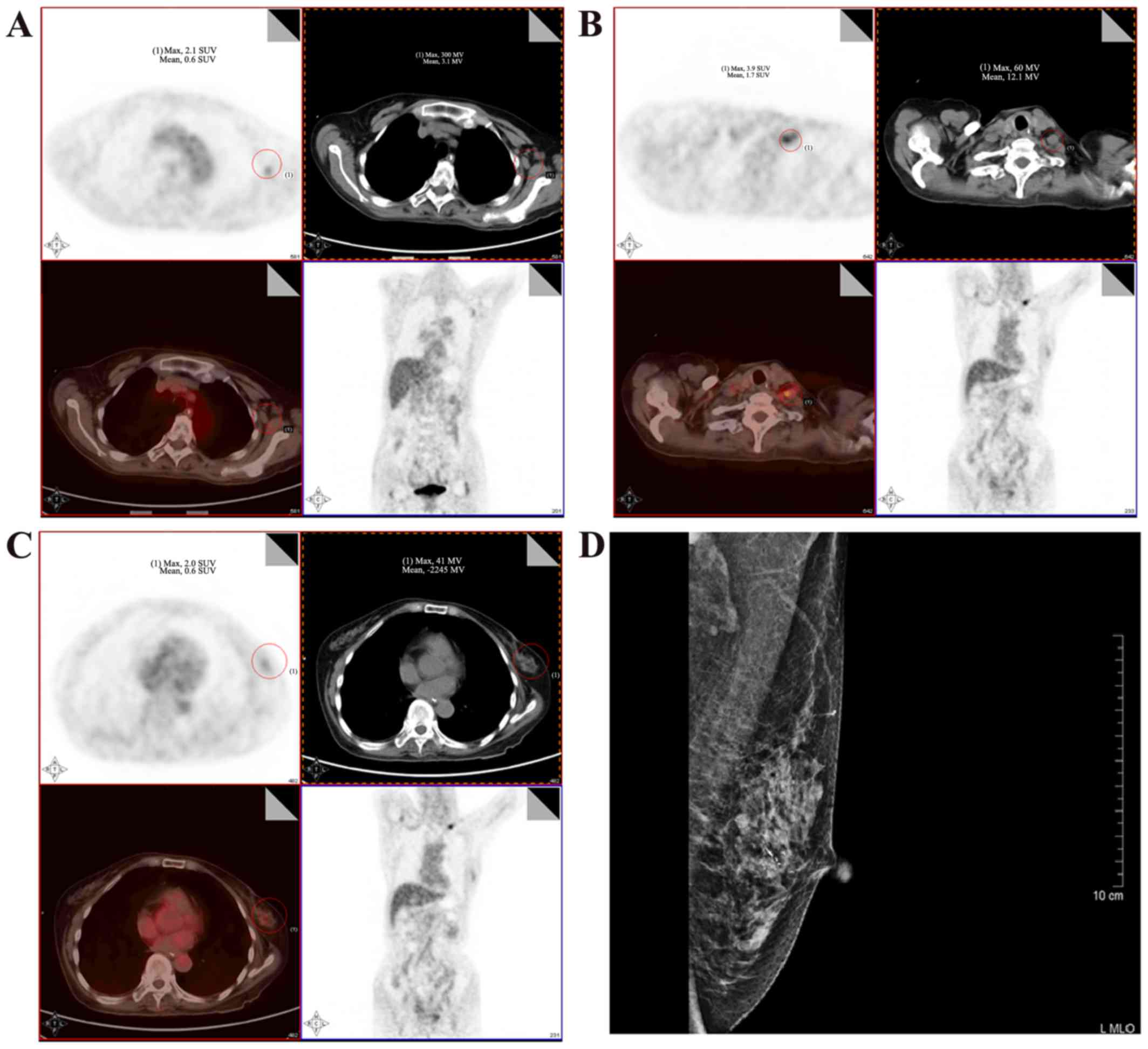
excitation wavelength of 493 nm. A whole-body positron emission
tomography/computed tomography (PET/CT) scan revealed a 2.4×1.3-cm
lesion in the lower outer quadrant of the left breast with slightly
increased 18F-fluorodeoxyglucose (FDG) uptake, as well
as enlarged axillary and subclavian lymph nodes with mild FDG
accumulation. Mammography revealed a lobulated high-density mass in
the left breast (Fig. 1).
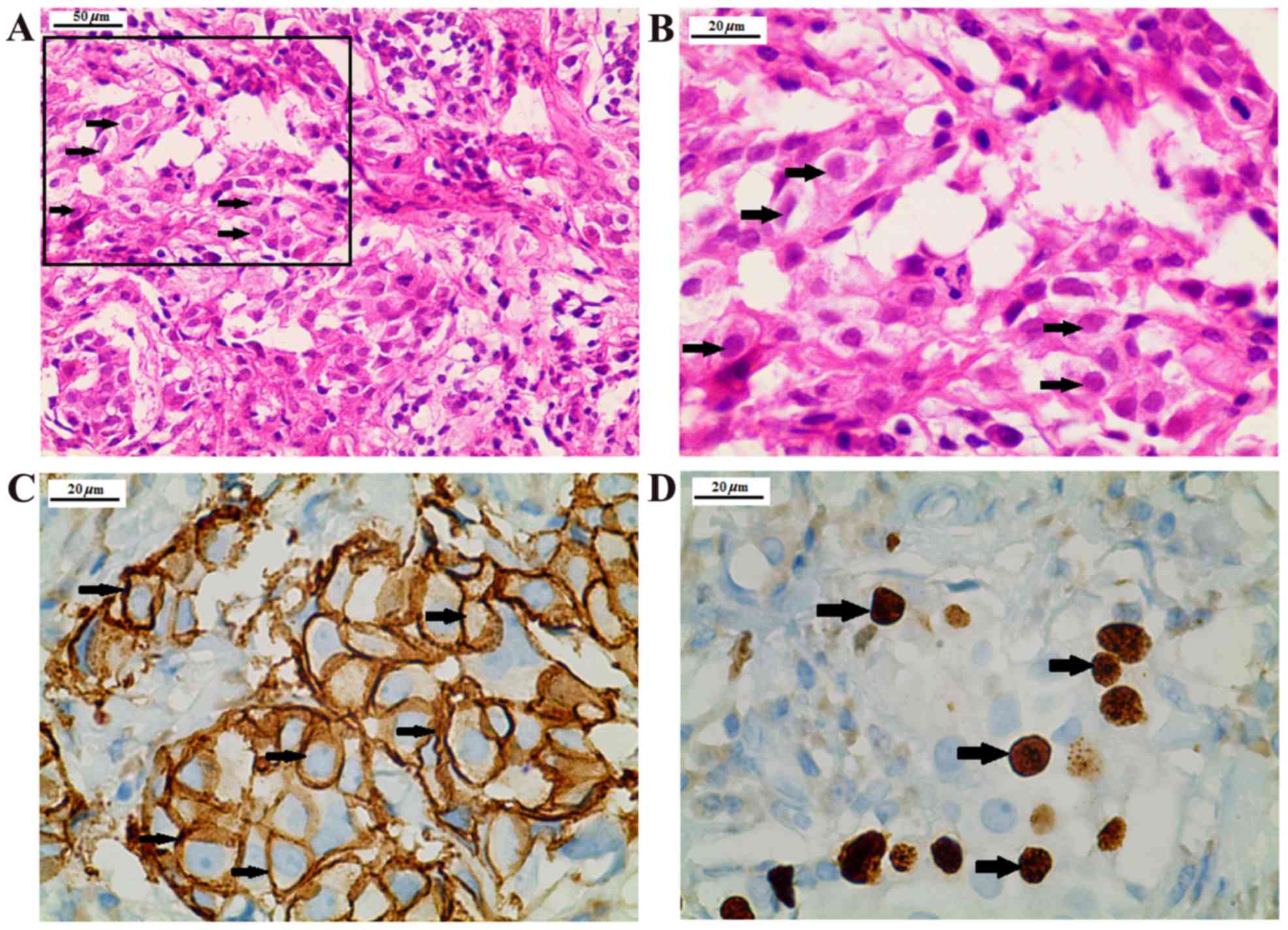
Subsequently, an ultrasound-guided breast biopsy was performed and
the results of the histopathological examination revealed a ductal
carcinoma. The patient underwent left breast lumpectomy, and the
diagnosis following immunohistological examination was grade II
invasive ductal carcinoma, negative for estrogen and progesterone
receptor, and positive for HER-2 and Ki-67 (Fig. 2). Pathologically, the tumor was
classified as T2N0M0, stage IIA. After breast surgery, the
psychiatric symptoms had improved at the 3-month follow-up, and the
cerebellar symptoms, including dizziness and unsteadiness while
walking, exhibited marked improvement at the 6- and 12-month
follow-up visits. Overall, the patient exhibited a marked
neurological improvement at the 12-month follow-up.
Discussion
PCD is one of the most common subtypes of PNS
(3). Severe cerebellar symptoms with
ataxia, dysarthria, dysphagia, vertigo, diplopia and nystagmus may
appear abruptly or subacutely. The neurological syndrome progresses
over weeks to months and then stabilizes on a very poor functional
level, with patients unable to walk or perform fine motor
movements.
In the early stages of the disease, the findings on
brain MRI are usually normal, but cerebellar atrophy may develop
later during the course of the disease (7). FDG-PET may reveal either hypometabolism
or hypermetabolism, which represent cerebellar neuronal cell loss
or an associated inflammatory response, respectively (8). CSF analysis usually shows mild
lymphocytic pleocytosis and increased protein content, along with
other signs of inflammatory or autoimmune disease (7). Autopsy reports show cerebellar atrophy
with extensive loss of Purkinje cells in the cerebellar cortex,
gliosis and inflammatory infiltrates (9).
Several autoantibodies associated with PCD have been
reported, including anti-Yo, anti-Hu, anti-Tr, anti-voltage-gated
calcium channel, anti-Ri and antiCV2 (10). Anti-Yo antibodies are most frequently
detected in patients with cerebellar degeneration and breast or
gynecological cancers (7). A total
of 62 cases of PCD were eventually identified and fully
characterized between 1966 and 1990, of which 19 patients were
anti-Yo-positive (11). Recently,
several PCD cases with positive anti-Yo antibody have been reported
(12). Anti-Yo antibodies target the
Purkinje cells of the cerebellum, resulting in extensive Purkinje
cell death. The underlying mechanism is generally considered to be
an immunological response to cerebellar degeneration-related
protein 2, which is ectopically expressed by tumor cells (13). The presence of the autoantibodies in
the serum of our patient raised a high suspicion of a breast and/or
gynecological malignancy. The diagnostic studies, including
radiological evaluation and histological examination, confirmed the
presence of breast cancer and allowed for early clinical management
of the patient.
According to the diagnostic criteria for PNS
proposed by an international panel of neurologists in 2004, two
levels of evidence are suggested to define such a neurological
syndrome: ‘Definite’ and ‘possible’ (14). The diagnostic criteria for definite
PNS include a classical syndrome with well-characterized onconeural
antibodies (anti-Yo, Hu, Ri, CV2, Ma2, or amphiphysin), or cancer
that occurs within 5 years of the diagnosis of neurological
symptoms. The term ‘classic’ syndromes refers to those neurological
syndromes that are often associated with cancer. A clinical
analysis of 55 anti-Yo antibody-positive patients demonstrated
that, in the majority of the patients, the onset of PCD precedes
the tumor diagnosis by months or even years (7); occasionally, carcinomas remain occult
and are only detected on autopsy. The identification of a classic
syndrome should prompt the screening for an underlying tumor. The
panel defines the cerebellar syndrome as a classic syndrome based
on the following criteria: Development of a severe cerebellar
syndrome within 12 weeks, with no evidence of cerebellar atrophy on
neuroradiological imaging, other than what would be expected by the
patient's age. After excluding other known causes of the
neurological syndrome, PNS should be considered in the differential
diagnosis by the clinicians. Paraneoplastic antibodies should be
detected in the serum or CSF, followed by a search for a primary
tumor. PET/CT scans play a key role in the screening for the
underlying cancer (15). Our patient
exhibited characteristics of a classic cerebellar syndrome. Along
with the identification of anti-Yo antibodies and breast cancer,
the present case meets the diagnostic criteria for definite
PCD.
The limited clinical trials for treatment strategies
have made it difficult to establish evidence-based therapeutic
guidelines. Currently, the mainstream principles of treatment
include oncological therapy and immunotherapy, which are
empirically based on reports from cases series and cohort studies
(16). Early identification of the
tumor and timely intervention enables stabilization or improvement
of the neurological disorders. Patients receiving oncological
therapy live significantly longer, regardless of the use of
immunotherapy (10).
Immunosuppression or immunomodulation are crucial components of the
treatment of PNS. Initial treatment options often include
corticosteroids, intravenous immunoglobulin (IVIG) and plasma
exchange. Second-line immunosuppression, including
cyclophosphamide, cyclosporine and rituximab, may be used when
there is no apparent improvement with initial treatments. It has
been suggested that high doses of IVIG and steroids may be helpful
when used in the early stage of PCD (17). Another case series reported that a
combination of IVIG, cyclophosphamide and methylprednisolone may
stabilize the neurological condition in a minority of patients who
are not severely disabled (18). Our
patient exhibited marked clinical and neurological improvement
after the treatment of breast cancer.
In summary, PCD is a rare neurological complication
of cancer and often precedes the diagnosis of the underlying tumor.
We herein report the case of a patient with PCD who had been
misdiagnosed prior to the detection of the anti-Yo autoantibodies,
and was eventually diagnosed with breast cancer. The presence of
characterized anti-onconeural antibodies in the serum or CSF can
provide guidance in the search for an underlying tumor. Prompt
identification and treatment of the tumor may help stabilize or
improve the neurological disorder.
Acknowledgements
Not applicable.
Funding
The present study was supported by the National
Natural Science Foundation of China (grant no. 81600970) and the
Project Funded by the Priority Academic Program Development of
Jiangsu Higher Education Institutions (PAPD).
Availability of data and materials
Not applicable.
Authors' contributions
LY, HX, JH and WW analyzed and interpreted the
patient data. XD was a major contributor in writing the manuscript.
LH, QW were involved in revising the manuscript critically for
important intellectual content. JG gave final approval of the
version to be published. The final version of the manuscript has
been read and approved by all authors.
Ethics approval and consent to
participate
The present study was approved by the Ethics
Committee of the First Affiliated Hospital of Nanjing Medical
University, Nanjing, China.
Consent for publication
Written informed consent was obtained from the
patient for the publication of this case report and accompanying
images.
Competing interests
The authors declare that they have no competing
interests.
Glossary
Abbreviations
Abbreviations:
|
PNS
|
paraneoplastic neurological
syndromes
|
|
PCD
|
paraneoplastic cerebellar
degeneration
|
|
CSF
|
cerebrospinal fluid
|
|
MRI
|
magnetic resonance imaging
|
|
PET/CT
|
positron emission tomography/computed
tomography
|
|
FDG
|
fluorodeoxyglucose
|
|
SUVmax
|
maximum standardized uptake value
|
References
|
1
|
Höftberger R, Rosenfeld MR and Dalmau J:
Update on neurological paraneoplastic syndromes. Curr Opin Oncol.
27:489–495. 2015. View Article : Google Scholar : PubMed/NCBI
|
|
2
|
Braik T, Evans AT, Telfer M and McDunn S:
Paraneoplastic neurological syndromes: Unusual presentations of
cancer. A practical review. Am J Med Sci. 340:301–308. 2010.
View Article : Google Scholar
|
|
3
|
Giometto B, Grisold W, Vitaliani R, Graus
F, Honnorat J and Bertolini G; PNS Euronetwork: Paraneoplastic
neurologic syndrome in the PNS Euronetwork database: A European
study from 20 centers. Arch Neurol. 67:330–335. 2010. View Article : Google Scholar : PubMed/NCBI
|
|
4
|
Graus F, Saiz A and Dalmau J: Antibodies
and neuronal autoimmune disorders of the CNS. J Neurol.
257:509–517. 2010. View Article : Google Scholar : PubMed/NCBI
|
|
5
|
Titulaer MJ, Soffietti R, Dalmau J, Gilhus
NE, Giometto B, Graus F, Grisold W, Honnorat J, Sillevis Smitt PA,
Tanasescu R, et al: Screening for tumours in paraneoplastic
syndromes: Report of an EFNS task force. Eur J Neurol. 18:19–e23.
2011. View Article : Google Scholar : PubMed/NCBI
|
|
6
|
Venkatraman A and Opal P: Paraneoplastic
cerebellar degeneration with anti-Yo antibodies: a review. Ann Clin
Transl Neurol. 3:655–663. 2016. View
Article : Google Scholar : PubMed/NCBI
|
|
7
|
Peterson K, Rosenblum MK, Kotanides H and
Posner JB: Paraneoplastic cerebellar degeneration. I. A clinical
analysis of 55 anti-Yo antibody-positive patients. Neurology.
42:1931–1937. 1992.
|
|
8
|
Mascalchi M and Vella A: Magnetic
resonance and nuclear medicine imaging in ataxias. Handb Clin
Neurol. 103:85–110. 2012. View Article : Google Scholar : PubMed/NCBI
|
|
9
|
Verschuuren J, Chuang L, Rosenblum MK,
Lieberman F, Pryor A, Posner JB and Dalmau J: Inflammatory
infiltrates and complete absence of Purkinje cells in
anti-Yo-associated paraneoplastic cerebellar degeneration. Acta
Neuropathol. 91:519–525. 1996. View Article : Google Scholar : PubMed/NCBI
|
|
10
|
Shams'ili S, Grefkens J, de Leeuw B, van
den Bent M, Hooijkaas H, van der Holt B, Vecht C and Sillevis Smitt
P: Paraneoplastic cerebellar degeneration associated with
antineuronal antibodies: Analysis of 50 patients. Brain.
126:1409–1418. 2003. View Article : Google Scholar : PubMed/NCBI
|
|
11
|
Fanous I and Dillon P: Paraneoplastic
neurological complications of breast cancer. Exp Hematol Oncol.
5:292016. View Article : Google Scholar : PubMed/NCBI
|
|
12
|
Adama D, Moussa B, Emmanuel M and Dennis
U: Breast cancer revealed by a paraneoplastic cerebellar syndrome:
About one case and literature review. Pan Afr Med J. 22:252015.
View Article : Google Scholar : PubMed/NCBI
|
|
13
|
Jarius S and Wildemann B: ‘Medusa head
ataxia’: The expanding spectrum of Purkinje cell antibodies in
autoimmune cerebellar ataxia. Part 3: Anti-Yo/CDR2, anti-Nb/AP3B2,
PCA-2, anti-Tr/DNER, other antibodies, diagnostic pitfalls, summary
and outlook. J Neuroinflammation. 12:1682015. View Article : Google Scholar : PubMed/NCBI
|
|
14
|
Greenlee JE: Recommended diagnostic
criteria for paraneoplastic neurological syndromes. J Neurol
Neurosurg Psychiatry. 75:10902004. View Article : Google Scholar : PubMed/NCBI
|
|
15
|
Pena Pardo FJ, García Vicente AM,
Amo-Salas M, López-Fidalgo JF, Garrido Robles JA, de Ayala
Fernández JÁ, Del Saz Saucedo P, Muñoz Pasadas M and Soriano
Castrejón A: Utility of 18F-FDG-PET/CT in patients suspected of
paraneoplastic neurological syndrome: importance of risk
classification. Clin Transl Oncol. 19:111–118. 2017. View Article : Google Scholar : PubMed/NCBI
|
|
16
|
Vedeler CA, Antoine JC, Giometto B, Graus
F, Grisold W, Hart IK, Honnorat J, Sillevis Smitt PA, Verschuuren
JJ and Voltz R; Paraneoplastic Neurological Syndrome Euronetwork:
Management of paraneoplastic neurological syndromes: Report of an
EFNS Task Force. Eur J Neurol. 13:682–690. 2006. View Article : Google Scholar : PubMed/NCBI
|
|
17
|
Widdess-Walsh P, Tavee JO, Schuele S and
Stevens GH: Response to intravenous immunoglobulin in anti-Yo
associated paraneoplastic cerebellar degeneration: Case report and
review of the literature. J Neurooncol. 63:187–190. 2003.
View Article : Google Scholar : PubMed/NCBI
|
|
18
|
Keime-Guibert F, Graus F, Fleury A, René
R, Honnorat J, Broet P and Delattre JY: Treatment of paraneoplastic
neurological syndromes with antineuronal antibodies (Anti-Hu,
anti-Yo) with a combination of immunoglobulins, cyclophosphamide,
and methylprednisolone. J Neurol Neurosurg Psychiatry. 68:479–482.
2000. View Article : Google Scholar : PubMed/NCBI
|