Spandidos Publications Logo
  • About
    • About Spandidos
    • Aims and Scopes
    • Abstracting and Indexing
    • Editorial Policies
    • Reprints and Permissions
    • Job Opportunities
    • Terms and Conditions
    • Contact
  • Journals
    • All Journals
    • Oncology Letters
      • Oncology Letters
      • Information for Authors
      • Editorial Policies
      • Editorial Board
      • Aims and Scope
      • Abstracting and Indexing
      • Bibliographic Information
      • Archive
    • International Journal of Oncology
      • International Journal of Oncology
      • Information for Authors
      • Editorial Policies
      • Editorial Board
      • Aims and Scope
      • Abstracting and Indexing
      • Bibliographic Information
      • Archive
    • Molecular and Clinical Oncology
      • Molecular and Clinical Oncology
      • Information for Authors
      • Editorial Policies
      • Editorial Board
      • Aims and Scope
      • Abstracting and Indexing
      • Bibliographic Information
      • Archive
    • Experimental and Therapeutic Medicine
      • Experimental and Therapeutic Medicine
      • Information for Authors
      • Editorial Policies
      • Editorial Board
      • Aims and Scope
      • Abstracting and Indexing
      • Bibliographic Information
      • Archive
    • International Journal of Molecular Medicine
      • International Journal of Molecular Medicine
      • Information for Authors
      • Editorial Policies
      • Editorial Board
      • Aims and Scope
      • Abstracting and Indexing
      • Bibliographic Information
      • Archive
    • Biomedical Reports
      • Biomedical Reports
      • Information for Authors
      • Editorial Policies
      • Editorial Board
      • Aims and Scope
      • Abstracting and Indexing
      • Bibliographic Information
      • Archive
    • Oncology Reports
      • Oncology Reports
      • Information for Authors
      • Editorial Policies
      • Editorial Board
      • Aims and Scope
      • Abstracting and Indexing
      • Bibliographic Information
      • Archive
    • Molecular Medicine Reports
      • Molecular Medicine Reports
      • Information for Authors
      • Editorial Policies
      • Editorial Board
      • Aims and Scope
      • Abstracting and Indexing
      • Bibliographic Information
      • Archive
    • World Academy of Sciences Journal
      • World Academy of Sciences Journal
      • Information for Authors
      • Editorial Policies
      • Editorial Board
      • Aims and Scope
      • Abstracting and Indexing
      • Bibliographic Information
      • Archive
    • International Journal of Functional Nutrition
      • International Journal of Functional Nutrition
      • Information for Authors
      • Editorial Policies
      • Editorial Board
      • Aims and Scope
      • Abstracting and Indexing
      • Bibliographic Information
      • Archive
    • International Journal of Epigenetics
      • International Journal of Epigenetics
      • Information for Authors
      • Editorial Policies
      • Editorial Board
      • Aims and Scope
      • Abstracting and Indexing
      • Bibliographic Information
      • Archive
    • Medicine International
      • Medicine International
      • Information for Authors
      • Editorial Policies
      • Editorial Board
      • Aims and Scope
      • Abstracting and Indexing
      • Bibliographic Information
      • Archive
  • Articles
  • Information
    • Information for Authors
    • Information for Reviewers
    • Information for Librarians
    • Information for Advertisers
    • Conferences
  • Language Editing
Spandidos Publications Logo
  • About
    • About Spandidos
    • Aims and Scopes
    • Abstracting and Indexing
    • Editorial Policies
    • Reprints and Permissions
    • Job Opportunities
    • Terms and Conditions
    • Contact
  • Journals
    • All Journals
    • Biomedical Reports
      • Information for Authors
      • Editorial Policies
      • Editorial Board
      • Aims and Scope
      • Abstracting and Indexing
      • Bibliographic Information
      • Archive
    • Experimental and Therapeutic Medicine
      • Information for Authors
      • Editorial Policies
      • Editorial Board
      • Aims and Scope
      • Abstracting and Indexing
      • Bibliographic Information
      • Archive
    • International Journal of Epigenetics
      • Information for Authors
      • Editorial Policies
      • Editorial Board
      • Aims and Scope
      • Abstracting and Indexing
      • Bibliographic Information
      • Archive
    • International Journal of Functional Nutrition
      • Information for Authors
      • Editorial Policies
      • Editorial Board
      • Aims and Scope
      • Abstracting and Indexing
      • Bibliographic Information
      • Archive
    • International Journal of Molecular Medicine
      • Information for Authors
      • Editorial Policies
      • Editorial Board
      • Aims and Scope
      • Abstracting and Indexing
      • Bibliographic Information
      • Archive
    • International Journal of Oncology
      • Information for Authors
      • Editorial Policies
      • Editorial Board
      • Aims and Scope
      • Abstracting and Indexing
      • Bibliographic Information
      • Archive
    • Medicine International
      • Information for Authors
      • Editorial Policies
      • Editorial Board
      • Aims and Scope
      • Abstracting and Indexing
      • Bibliographic Information
      • Archive
    • Molecular and Clinical Oncology
      • Information for Authors
      • Editorial Policies
      • Editorial Board
      • Aims and Scope
      • Abstracting and Indexing
      • Bibliographic Information
      • Archive
    • Molecular Medicine Reports
      • Information for Authors
      • Editorial Policies
      • Editorial Board
      • Aims and Scope
      • Abstracting and Indexing
      • Bibliographic Information
      • Archive
    • Oncology Letters
      • Information for Authors
      • Editorial Policies
      • Editorial Board
      • Aims and Scope
      • Abstracting and Indexing
      • Bibliographic Information
      • Archive
    • Oncology Reports
      • Information for Authors
      • Editorial Policies
      • Editorial Board
      • Aims and Scope
      • Abstracting and Indexing
      • Bibliographic Information
      • Archive
    • World Academy of Sciences Journal
      • Information for Authors
      • Editorial Policies
      • Editorial Board
      • Aims and Scope
      • Abstracting and Indexing
      • Bibliographic Information
      • Archive
  • Articles
  • Information
    • For Authors
    • For Reviewers
    • For Librarians
    • For Advertisers
    • Conferences
  • Language Editing
Login Register Submit
  • This site uses cookies
  • You can change your cookie settings at any time by following the instructions in our Cookie Policy. To find out more, you may read our Privacy Policy.

    I agree
Search articles by DOI, keyword, author or affiliation
Search
Advanced Search
presentation
Molecular and Clinical Oncology
Join Editorial Board Propose a Special Issue
Print ISSN: 2049-9450 Online ISSN: 2049-9469
Journal Cover
August-2018 Volume 9 Issue 2

Full Size Image

Sign up for eToc alerts
Recommend to Library

Journals

International Journal of Molecular Medicine

International Journal of Molecular Medicine

International Journal of Molecular Medicine is an international journal devoted to molecular mechanisms of human disease.

International Journal of Oncology

International Journal of Oncology

International Journal of Oncology is an international journal devoted to oncology research and cancer treatment.

Molecular Medicine Reports

Molecular Medicine Reports

Covers molecular medicine topics such as pharmacology, pathology, genetics, neuroscience, infectious diseases, molecular cardiology, and molecular surgery.

Oncology Reports

Oncology Reports

Oncology Reports is an international journal devoted to fundamental and applied research in Oncology.

Experimental and Therapeutic Medicine

Experimental and Therapeutic Medicine

Experimental and Therapeutic Medicine is an international journal devoted to laboratory and clinical medicine.

Oncology Letters

Oncology Letters

Oncology Letters is an international journal devoted to Experimental and Clinical Oncology.

Biomedical Reports

Biomedical Reports

Explores a wide range of biological and medical fields, including pharmacology, genetics, microbiology, neuroscience, and molecular cardiology.

Molecular and Clinical Oncology

Molecular and Clinical Oncology

International journal addressing all aspects of oncology research, from tumorigenesis and oncogenes to chemotherapy and metastasis.

World Academy of Sciences Journal

World Academy of Sciences Journal

Multidisciplinary open-access journal spanning biochemistry, genetics, neuroscience, environmental health, and synthetic biology.

International Journal of Functional Nutrition

International Journal of Functional Nutrition

Open-access journal combining biochemistry, pharmacology, immunology, and genetics to advance health through functional nutrition.

International Journal of Epigenetics

International Journal of Epigenetics

Publishes open-access research on using epigenetics to advance understanding and treatment of human disease.

Medicine International

Medicine International

An International Open Access Journal Devoted to General Medicine.

Journal Cover
August-2018 Volume 9 Issue 2

Full Size Image

Sign up for eToc alerts
Recommend to Library

  • Article
  • Citations
    • Cite This Article
    • Download Citation
    • Create Citation Alert
    • Remove Citation Alert
    • Cited By
  • Similar Articles
    • Related Articles (in Spandidos Publications)
    • Similar Articles (Google Scholar)
    • Similar Articles (PubMed)
  • Download PDF
  • Download XML
  • View XML
Case Report Open Access

Ultrasound-guided intranodal lymphangiography with lipiodol for treatment of chylous ascites following surgery for ovarian cancer: A case report

  • Authors:
    • Kohei Nakamura
    • Kentaro Nakayama
    • Toshiko Minamoto
    • Tomoka Ishibashi
    • Kaori Ohnishi
    • Hitomi Yamashita
    • Ruriko Ono
    • Hiroki Sasamori
    • Sultana Razia
    • Shanta Kamrunnahar
    • Masako Ishikawa
    • Satoru Kyo
  • View Affiliations / Copyright

    Affiliations: Department of Obstetrics and Gynecology, Shimane University School of Medicine, Izumo, Shimane 693-8501, Japan
    Copyright: © Nakamura et al. This is an open access article distributed under the terms of Creative Commons Attribution License.
  • Pages: 178-180
    |
    Published online on: June 8, 2018
       https://doi.org/10.3892/mco.2018.1647
  • Expand metrics +
Metrics: Total Views: 0 (Spandidos Publications: | PMC Statistics: )
Metrics: Total PDF Downloads: 0 (Spandidos Publications: | PMC Statistics: )
Cited By (CrossRef): 0 citations Loading Articles...

This article is mentioned in:


Abstract

Although lymphadenectomy for gynecological cancer is often associated with chylous leakage, the proper management of this complication remains a matter of debate. In the present study a case of chylous leakage successfully treated with lipiodol lymphangiography is described. A 33-year-old patient with ovarian cancer experienced chylous leakage following total abdominal hysterectomy, bilateral salpingo-oophorectomy, omentectomy, and pelvic and para-aortic lymphadenectomy. The volume of fluid in the abdominal drainage tube increased to 800-1,000 ml/day on postoperative day (POD)3. The patient was started on a fat-restricted diet on POD3 and octreotide on POD21, but the volume of the discharge remained unchanged. Lipiodol lymphangiography was performed on POD62, which reduced the leakage, and the patient was discharged on POD95. Therefore, lipiodol lymphangiography effectively resolved chylous leakage following surgery for gynecological cancer. The aim of the present study was to report the clinical effectiveness of lipiodol lymphangiography in resolving chylous leakage in such cases, and to summarize the methods used and complications encountered.

Introduction

Chylous ascites is the build-up of lymphatic fluid in the peritoneal cavity. Chylous ascites occurring following surgery is uncommon, but may result from injury to lymphatic vessels during retroperitoneal surgery. Treatment mainly includes conservative measures aimed at decreasing chyle formation. Treatment methods may involve introducing a low-fat diet with medium-chain triglycerides, total parenteral nutrition, administration of octreotide and paracentesis. For patients who are refractory to these methods, lymphangiography is a proven beneficial diagnostic tool, and may also be used as a therapeutic intervention for lymphatic leakage to help avoid extensive surgery (1–3).

We herein describe the case of a patient with ovarian cancer who developed severe chylous ascites following pelvic and para-aortic lymph node dissection and was effectively managed by ultrasound-guided intranodal lymphangiography.

Case report

A 33-year-old pregnant woman (gravida 2, para 2) presented with a small left ovarian tumor that started to increase in size after delivery. The patient's medical and surgical history was unremarkable and the findings on general physical examination were normal. The hemoglobin level was 11.6 g/dl, the carbohydrate antigen 19–9 level was markedly elevated at 107.4 U/ml (normal, <37.0 U/ml), the cancer antigen 125 level was mildly elevated at 39.8 U/ml (normal, <35.0 U/ml), and the carcinoembryonic antigen level was within the normal range.

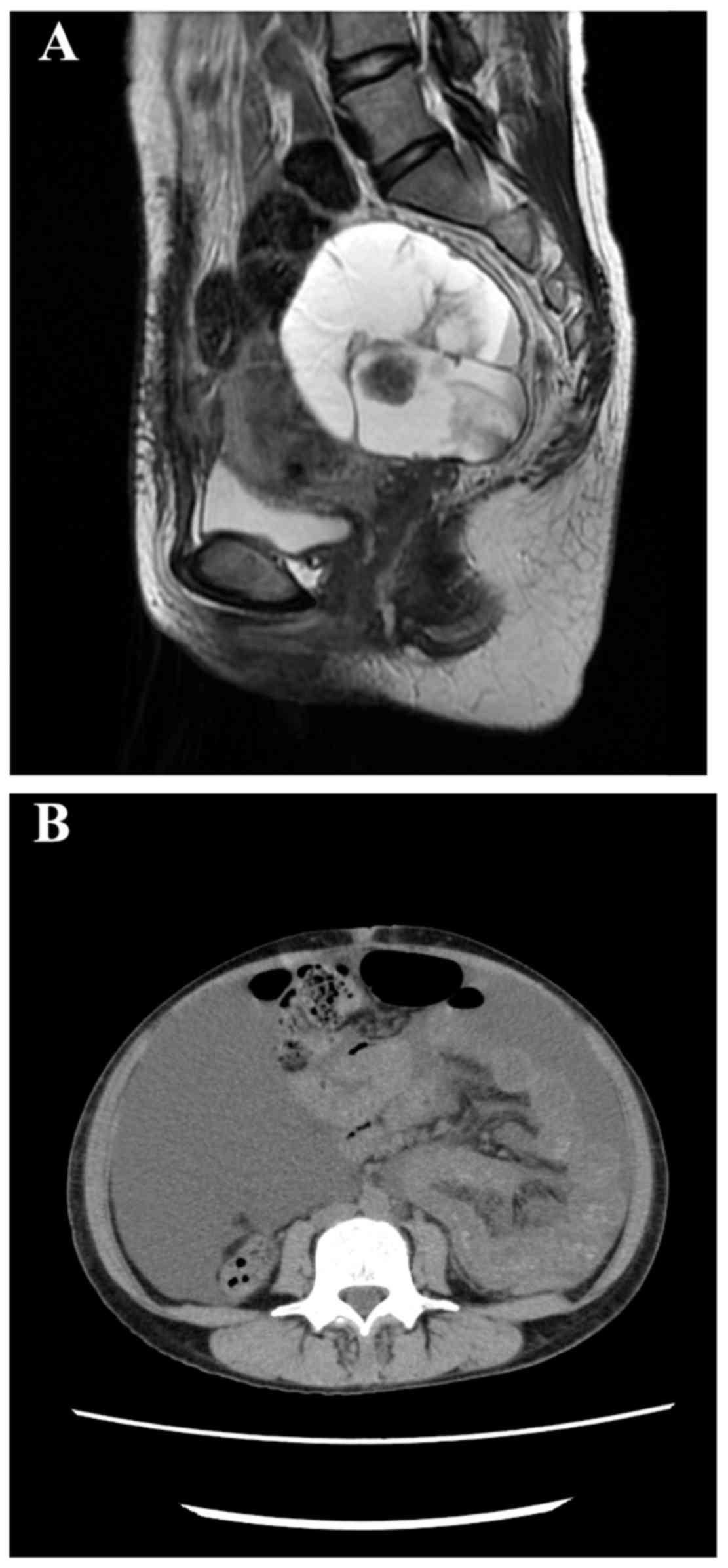
Pelvic magnetic resonance imaging (MRI) revealed a mass sized 57×84×84 mm3 with multilocular cysts, including small solid parts in the left adnexal region (Fig. 1A). MRI revealed no evidence of peritonitis carcinomatosa, ascites, dissemination nodules, or metastasis to the omentum. Contrast-enhanced computed tomography (CT) revealed no lymphadenopathy or distant metastasis.

Figure 1.

(A) Pelvic magnetic resonance imaging revealed a left ovarian tumor. (B) Abdominal computed tomography scan showing massive ascites.

As the intraoperative rapid diagnosis based on a right ovarian specimen was ovarian carcinoma, total abdominal hysterectomy, bilateral salpingo-oophorectomy, omentectomy, and pelvic and para-aortic lymphadenectomy were performed. Upon completion of the primary debulking surgery, no residual tumor was identified. The resected specimens were examined by a pathologist and the final diagnosis was seromucinous ovarian cancer (pT1c1N0M0, stage IC1).

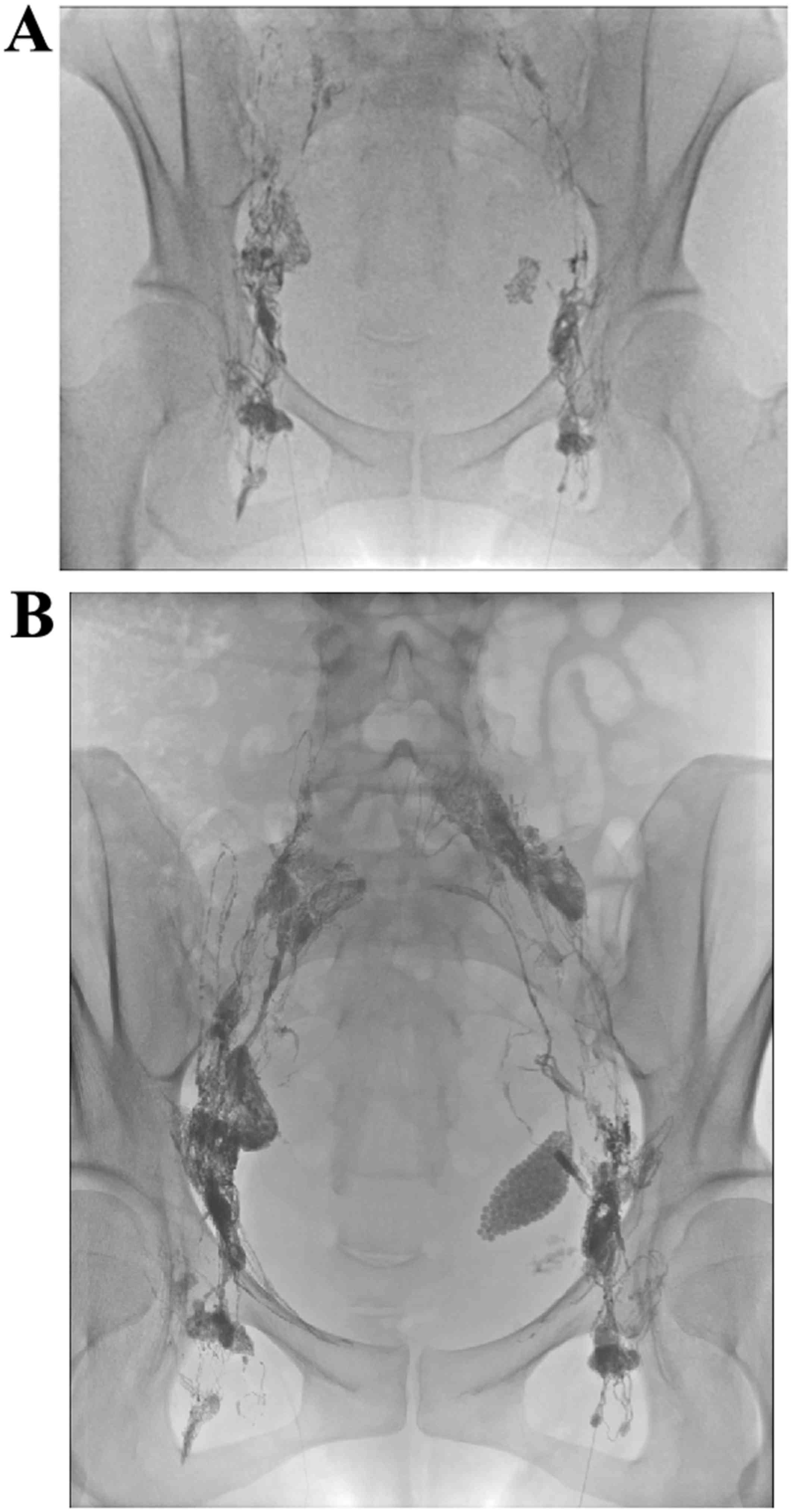
On postoperative day (POD)3, milky appearance of the drainage fluid (800–1,000 ml/day) was continuously observed from the abdominal drainage tube. Although a fat-restricted diet was initiated, the volume of the discharge did not decrease. Following removal of the drainage tube, the patient developed increasing abdominal distention due to the large volume of chylous ascites. Thus, a daily subcutaneous injection of 100 µg octreotide was administered, in addition to total parental nutrition starting on POD21. However, the amount of chylous ascites gradually increased (Fig. 1B), and ascites drainage was required several times during treatment. As no improvement was observed on POD60, lipiodol lymphangiography was conducted on POD62 following a consultation with an in-house radiologist. Ultrasound-guided access to the inguinal lymph nodes bilaterally was achieved using a 27G needle, and lipiodol was slowly administered to the lymph nodes at ~6 ml/h under fluoroscopic guidance to ensure proper access (Fig. 2A). Following injection of ~12 ml of lipiodol, fluoroscopic imaging demonstrated accumulation of lipiodol at the left pelvis (Fig. 2B).

Figure 2.

(A) Fluoroscopic imaging showing injection of lipiodol through the bilateral inguinal lymph nodes. (B) Fluoroscopic imaging revealed accumulation of lipiodol at the ductus thoracicus.

Following lymphangiography, the volume of discharge slowly decreased, and the abdominal distention gradually improved. On POD90 (28 days after lymphangiography) the patient resumed normal oral nutrition and on POD95 (33 days after lymphangiography) she was discharged from the hospital without recurrence of the ascites. The patient has remained asymptomatic and progression-free for 1 year.

Discussion

Postoperative chylous leakage is an uncommon but established complication that occurs following general surgery. Chylous ascites may occur due to conditions such as filariasis, tuberculosis, trauma, hepatic cirrhosis and complications associated with surgery. The reported incidence ranges from 1.3 to 3.4% following procedures involving the thorax and neck (4,5). Prophylactic ligation of the lymphatic duct is commonly conducted at the time of lymphadenectomy for gynecological cancer to prevent chylous leakage. Chylous leakage is potentially fatal due to the large amount of fluid, plasma protein, fat and immunoregulatory lymphocyte loss. Furthermore, affected patients exhibit clinical symptoms of severe malnutrition, hyponatremia, acidosis, hypocalcemia and susceptibility to infection. Therefore, uncontrolled chylous leakage is associated with a high mortality rate (3,6).

Initial treatment for chylous leakage generally comprises conservative methods, such as fasting, introducing a modified diet (low-fat with medium-chain triglycerides, parenteral nutrition and supplementation), drainage of the effusion, and administration of octreotide (7,8) and etilefrine (9). If conservative therapy is unsuccessful, surgical interventions, such as thoracic duct ligation, may be considered. However, it may not be easy to locate the thoracic duct or the site of chylous leakage at reoperation. Furthermore, surgical intervention is considered to increase the risk of complications, necessitating extreme care during the procedure.

Lipiodol lymphangiography has traditionally been used as a method for diagnosing chylous leakage and enables the identification of the leakage point for surgical intervention (3,10). However, lipiodol lymphangiography may also be applied as a treatment method. A previous study demonstrated that lipiodol lymphangiography was efficacious in 35% of patients with chylothorax, even when the volume of pleural drainage fluid was >500 ml/day. The procedure is also reportedly successful in 51% of patients who are refractory to non-surgical treatments (2). A study by Matsumoto et al (3) demonstrated that no surgical reintervention was required in 89% of patients with postoperative chylous leakage, and that chylous leakage may resolve following lipiodol lymphangiography in the remaining patients. Chylous leakage cessation following lipiodol lymphangiography is hypothesized to occur due to accumulation of lipiodol at the leakage point, which activates an inflammatory reaction and acts as an embolic agent (2).

The lymphangiography procedure traditionally includes subcutaneous injection of an oily contrast medium, such as lipiodol, into each foot. However, this procedure is associated with various problems. First, it is invasive, due to the need for dorsal incisions, thereby posing an infection risk. Second, it is technically difficult due to the need to isolate and cannulate the fine lymphatic vessels on the feet. Even following successful placement of the lymphangiogram needles, small movements by the patient may cause needle displacement. By contrast, intranodal lymphangiography using ultrasound has reduced the invasiveness of the procedure compared with the traditional method, as it does not require an incision. Instead, ultrasound-guided access to the inguinal nodes is achieved using a 23-26G spinal needle under local anesthesia, making intranodal lymphangiography a simpler and easier procedure.

Lipiodol lymphangiography was performed by gaining direct access to the bilateral inguinal lymph nodes using ultrasound guidance. This procedure was effective for treating this patient, who developed severe chylous leakage following surgery for ovarian cancer. This shows that lipiodol lymphangiography is an efficacious conservative treatment method for chylous leakage.

This single case report has obvious limitations. While lipiodol lymphangiography using bilateral inguinal lymph node puncture suggests the usefulness of thoracic duct embolization, additional prospective studies are required to determine the safety and efficacy of such methods.

Severe chylous leakage is uncommon, and the optimal management methods remain controversial. However, the outcome of the present case suggests that lipiodol lymphangiography is clinically effective for resolving chylous leakage following surgery for ovarian cancer.

Acknowledgements

Not applicable.

Funding

No funding was received.

Availability of data and materials

The datasets used and/or analyzed during the current study are available from the corresponding author on reasonable request.

Authors' contributions

KN has been involved in drafting the manuscript and participated in the experiment design and patient treatment. MI, TM, TI, KO, HY, RO, HS, SR and SKa carried out the treatment. KeN participated in the design of the study. SKy conceived of the study, and participated in its design and coordination and helped to draft the manuscript. All authors read and approved the final manuscript.

Ethics approval and consent to participate

The study protocol was approved by the Ethics Committee of Shimane University School of Medicine (Izumo, Japan; approval no. 960). The research was conducted in accordance with the Declaration of Helsinki and Title 45, US Code of Federal Regulations, Part 46, Protection of Human Subjects, effective December 13, 2001.

Consent for publication

The patient provided written informed consent for the publication of the case details and associated images.

Competing interests

The authors declare that they have no competing interests.

Glossary

Abbreviations

Abbreviations:

MRI

magnetic resonance imaging

CT

computed tomography

POD

postoperative day

References

1 

Kos S, Haueisen H, Lachmund U and Roeren T: Lymphangiography: forgotten tool or rising star in the diagnosis and therapy of postoperative lymphatic vessel leakage. Cardiovasc Intervent Radiol. 30:968–973. 2007. View Article : Google Scholar : PubMed/NCBI

2 

Alejandre-Lafont E, Krompiec C, Rau WS and Krombach GA: Effectiveness of therapeutic lymphography on lymphatic leakage. Acta Radiol. 52:305–311. 2011. View Article : Google Scholar : PubMed/NCBI

3 

Matsumoto T, Yamagami T, Kato T, Hirota T, Yoshimatsu R, Masunami T and Nishimura T: The effectiveness of lymphangiography as a treatment method for various chyle leakages. Br J Radiol. 82:286–290. 2009. View Article : Google Scholar : PubMed/NCBI

4 

Kaburagi T, Takeuchi H, Oyama T, Nakamura R, Takahashi T, Wada N, Saikawa Y, Kamiya S, Tanaka M, et al: Intraoperative fluorescence lymphography using indocyanine green in a patient with chylothorax after esophagectomy: report of a case. Surg Today. 43:206–210. 2013. View Article : Google Scholar : PubMed/NCBI

5 

Paul S, Altorki NK, Port JL, Stiles BM and Lee PC: Surgical management of chylothorax. Thorac Cardiovasc Surg. 57:226–228. 2009. View Article : Google Scholar : PubMed/NCBI

6 

Parvinian A, Mohan GC, Gaba RC, Saldanha DF, Knuttinen MG, Bui JT and Minocha J: Ultrasound-guided intranodal lymphangiography followed by thoracic duct embolization for treatment of postoperative bilateral chylothorax. Head Neck. 36:E21–E24. 2014. View Article : Google Scholar : PubMed/NCBI

7 

Epaud R, Dubern B, Larroquet M, Tamalet A, Guillemot N, Maurage C, Clement A and Fauroux B: Therapeutic strategies for idiopathic chylothorax. J Pediatr Surg. 43:461–465. 2008. View Article : Google Scholar : PubMed/NCBI

8 

Snow AL, Uller W, Kim HB and Alomari AI: Percutaneous embolization of a chylous leak from thoracic duct injury in a child. Cardiovasc Intervent Radiol. 37:1111–1113. 2014. View Article : Google Scholar : PubMed/NCBI

9 

Ohkura Y, Ueno M, Iizuka T, Haruta S, Tanaka T and Udagawa H: New combined medical treatment with etilefrine and octreotide for chylothorax after esophagectomy: a case report and review of the literature. Medicine. 94:e22142015. View Article : Google Scholar : PubMed/NCBI

10 

Ngan H, Fok M and Wong J: The role of lymphography in chylothorax following thoracic surgery. Br J Radiol. 61:1032–1036. 1988. View Article : Google Scholar : PubMed/NCBI

Related Articles

  • Abstract
  • View
  • Download
  • Twitter
Copy and paste a formatted citation
Spandidos Publications style
Nakamura K, Nakayama K, Minamoto T, Ishibashi T, Ohnishi K, Yamashita H, Ono R, Sasamori H, Razia S, Kamrunnahar S, Kamrunnahar S, et al: Ultrasound-guided intranodal lymphangiography with lipiodol for treatment of chylous ascites following surgery for ovarian cancer: A case report. Mol Clin Oncol 9: 178-180, 2018.
APA
Nakamura, K., Nakayama, K., Minamoto, T., Ishibashi, T., Ohnishi, K., Yamashita, H. ... Kyo, S. (2018). Ultrasound-guided intranodal lymphangiography with lipiodol for treatment of chylous ascites following surgery for ovarian cancer: A case report. Molecular and Clinical Oncology, 9, 178-180. https://doi.org/10.3892/mco.2018.1647
MLA
Nakamura, K., Nakayama, K., Minamoto, T., Ishibashi, T., Ohnishi, K., Yamashita, H., Ono, R., Sasamori, H., Razia, S., Kamrunnahar, S., Ishikawa, M., Kyo, S."Ultrasound-guided intranodal lymphangiography with lipiodol for treatment of chylous ascites following surgery for ovarian cancer: A case report". Molecular and Clinical Oncology 9.2 (2018): 178-180.
Chicago
Nakamura, K., Nakayama, K., Minamoto, T., Ishibashi, T., Ohnishi, K., Yamashita, H., Ono, R., Sasamori, H., Razia, S., Kamrunnahar, S., Ishikawa, M., Kyo, S."Ultrasound-guided intranodal lymphangiography with lipiodol for treatment of chylous ascites following surgery for ovarian cancer: A case report". Molecular and Clinical Oncology 9, no. 2 (2018): 178-180. https://doi.org/10.3892/mco.2018.1647
Copy and paste a formatted citation
x
Spandidos Publications style
Nakamura K, Nakayama K, Minamoto T, Ishibashi T, Ohnishi K, Yamashita H, Ono R, Sasamori H, Razia S, Kamrunnahar S, Kamrunnahar S, et al: Ultrasound-guided intranodal lymphangiography with lipiodol for treatment of chylous ascites following surgery for ovarian cancer: A case report. Mol Clin Oncol 9: 178-180, 2018.
APA
Nakamura, K., Nakayama, K., Minamoto, T., Ishibashi, T., Ohnishi, K., Yamashita, H. ... Kyo, S. (2018). Ultrasound-guided intranodal lymphangiography with lipiodol for treatment of chylous ascites following surgery for ovarian cancer: A case report. Molecular and Clinical Oncology, 9, 178-180. https://doi.org/10.3892/mco.2018.1647
MLA
Nakamura, K., Nakayama, K., Minamoto, T., Ishibashi, T., Ohnishi, K., Yamashita, H., Ono, R., Sasamori, H., Razia, S., Kamrunnahar, S., Ishikawa, M., Kyo, S."Ultrasound-guided intranodal lymphangiography with lipiodol for treatment of chylous ascites following surgery for ovarian cancer: A case report". Molecular and Clinical Oncology 9.2 (2018): 178-180.
Chicago
Nakamura, K., Nakayama, K., Minamoto, T., Ishibashi, T., Ohnishi, K., Yamashita, H., Ono, R., Sasamori, H., Razia, S., Kamrunnahar, S., Ishikawa, M., Kyo, S."Ultrasound-guided intranodal lymphangiography with lipiodol for treatment of chylous ascites following surgery for ovarian cancer: A case report". Molecular and Clinical Oncology 9, no. 2 (2018): 178-180. https://doi.org/10.3892/mco.2018.1647
Follow us
  • Twitter
  • LinkedIn
  • Facebook
About
  • Spandidos Publications
  • Careers
  • Cookie Policy
  • Privacy Policy
How can we help?
  • Help
  • Live Chat
  • Contact
  • Email to our Support Team