Spandidos Publications Logo
  • About
    • About Spandidos
    • Aims and Scopes
    • Abstracting and Indexing
    • Editorial Policies
    • Reprints and Permissions
    • Job Opportunities
    • Terms and Conditions
    • Contact
  • Journals
    • All Journals
    • Oncology Letters
      • Oncology Letters
      • Information for Authors
      • Editorial Policies
      • Editorial Board
      • Aims and Scope
      • Abstracting and Indexing
      • Bibliographic Information
      • Archive
    • International Journal of Oncology
      • International Journal of Oncology
      • Information for Authors
      • Editorial Policies
      • Editorial Board
      • Aims and Scope
      • Abstracting and Indexing
      • Bibliographic Information
      • Archive
    • Molecular and Clinical Oncology
      • Molecular and Clinical Oncology
      • Information for Authors
      • Editorial Policies
      • Editorial Board
      • Aims and Scope
      • Abstracting and Indexing
      • Bibliographic Information
      • Archive
    • Experimental and Therapeutic Medicine
      • Experimental and Therapeutic Medicine
      • Information for Authors
      • Editorial Policies
      • Editorial Board
      • Aims and Scope
      • Abstracting and Indexing
      • Bibliographic Information
      • Archive
    • International Journal of Molecular Medicine
      • International Journal of Molecular Medicine
      • Information for Authors
      • Editorial Policies
      • Editorial Board
      • Aims and Scope
      • Abstracting and Indexing
      • Bibliographic Information
      • Archive
    • Biomedical Reports
      • Biomedical Reports
      • Information for Authors
      • Editorial Policies
      • Editorial Board
      • Aims and Scope
      • Abstracting and Indexing
      • Bibliographic Information
      • Archive
    • Oncology Reports
      • Oncology Reports
      • Information for Authors
      • Editorial Policies
      • Editorial Board
      • Aims and Scope
      • Abstracting and Indexing
      • Bibliographic Information
      • Archive
    • Molecular Medicine Reports
      • Molecular Medicine Reports
      • Information for Authors
      • Editorial Policies
      • Editorial Board
      • Aims and Scope
      • Abstracting and Indexing
      • Bibliographic Information
      • Archive
    • World Academy of Sciences Journal
      • World Academy of Sciences Journal
      • Information for Authors
      • Editorial Policies
      • Editorial Board
      • Aims and Scope
      • Abstracting and Indexing
      • Bibliographic Information
      • Archive
    • International Journal of Functional Nutrition
      • International Journal of Functional Nutrition
      • Information for Authors
      • Editorial Policies
      • Editorial Board
      • Aims and Scope
      • Abstracting and Indexing
      • Bibliographic Information
      • Archive
    • International Journal of Epigenetics
      • International Journal of Epigenetics
      • Information for Authors
      • Editorial Policies
      • Editorial Board
      • Aims and Scope
      • Abstracting and Indexing
      • Bibliographic Information
      • Archive
    • Medicine International
      • Medicine International
      • Information for Authors
      • Editorial Policies
      • Editorial Board
      • Aims and Scope
      • Abstracting and Indexing
      • Bibliographic Information
      • Archive
  • Articles
  • Information
    • Information for Authors
    • Information for Reviewers
    • Information for Librarians
    • Information for Advertisers
    • Conferences
  • Language Editing
Spandidos Publications Logo
  • About
    • About Spandidos
    • Aims and Scopes
    • Abstracting and Indexing
    • Editorial Policies
    • Reprints and Permissions
    • Job Opportunities
    • Terms and Conditions
    • Contact
  • Journals
    • All Journals
    • Biomedical Reports
      • Information for Authors
      • Editorial Policies
      • Editorial Board
      • Aims and Scope
      • Abstracting and Indexing
      • Bibliographic Information
      • Archive
    • Experimental and Therapeutic Medicine
      • Information for Authors
      • Editorial Policies
      • Editorial Board
      • Aims and Scope
      • Abstracting and Indexing
      • Bibliographic Information
      • Archive
    • International Journal of Epigenetics
      • Information for Authors
      • Editorial Policies
      • Editorial Board
      • Aims and Scope
      • Abstracting and Indexing
      • Bibliographic Information
      • Archive
    • International Journal of Functional Nutrition
      • Information for Authors
      • Editorial Policies
      • Editorial Board
      • Aims and Scope
      • Abstracting and Indexing
      • Bibliographic Information
      • Archive
    • International Journal of Molecular Medicine
      • Information for Authors
      • Editorial Policies
      • Editorial Board
      • Aims and Scope
      • Abstracting and Indexing
      • Bibliographic Information
      • Archive
    • International Journal of Oncology
      • Information for Authors
      • Editorial Policies
      • Editorial Board
      • Aims and Scope
      • Abstracting and Indexing
      • Bibliographic Information
      • Archive
    • Medicine International
      • Information for Authors
      • Editorial Policies
      • Editorial Board
      • Aims and Scope
      • Abstracting and Indexing
      • Bibliographic Information
      • Archive
    • Molecular and Clinical Oncology
      • Information for Authors
      • Editorial Policies
      • Editorial Board
      • Aims and Scope
      • Abstracting and Indexing
      • Bibliographic Information
      • Archive
    • Molecular Medicine Reports
      • Information for Authors
      • Editorial Policies
      • Editorial Board
      • Aims and Scope
      • Abstracting and Indexing
      • Bibliographic Information
      • Archive
    • Oncology Letters
      • Information for Authors
      • Editorial Policies
      • Editorial Board
      • Aims and Scope
      • Abstracting and Indexing
      • Bibliographic Information
      • Archive
    • Oncology Reports
      • Information for Authors
      • Editorial Policies
      • Editorial Board
      • Aims and Scope
      • Abstracting and Indexing
      • Bibliographic Information
      • Archive
    • World Academy of Sciences Journal
      • Information for Authors
      • Editorial Policies
      • Editorial Board
      • Aims and Scope
      • Abstracting and Indexing
      • Bibliographic Information
      • Archive
  • Articles
  • Information
    • For Authors
    • For Reviewers
    • For Librarians
    • For Advertisers
    • Conferences
  • Language Editing
Login Register Submit
  • This site uses cookies
  • You can change your cookie settings at any time by following the instructions in our Cookie Policy. To find out more, you may read our Privacy Policy.

    I agree
Search articles by DOI, keyword, author or affiliation
Search
Advanced Search
presentation
Molecular and Clinical Oncology
Join Editorial Board Propose a Special Issue
Print ISSN: 2049-9450 Online ISSN: 2049-9469
Journal Cover
October-2018 Volume 9 Issue 4

Full Size Image

Sign up for eToc alerts
Recommend to Library

Journals

International Journal of Molecular Medicine

International Journal of Molecular Medicine

International Journal of Molecular Medicine is an international journal devoted to molecular mechanisms of human disease.

International Journal of Oncology

International Journal of Oncology

International Journal of Oncology is an international journal devoted to oncology research and cancer treatment.

Molecular Medicine Reports

Molecular Medicine Reports

Covers molecular medicine topics such as pharmacology, pathology, genetics, neuroscience, infectious diseases, molecular cardiology, and molecular surgery.

Oncology Reports

Oncology Reports

Oncology Reports is an international journal devoted to fundamental and applied research in Oncology.

Experimental and Therapeutic Medicine

Experimental and Therapeutic Medicine

Experimental and Therapeutic Medicine is an international journal devoted to laboratory and clinical medicine.

Oncology Letters

Oncology Letters

Oncology Letters is an international journal devoted to Experimental and Clinical Oncology.

Biomedical Reports

Biomedical Reports

Explores a wide range of biological and medical fields, including pharmacology, genetics, microbiology, neuroscience, and molecular cardiology.

Molecular and Clinical Oncology

Molecular and Clinical Oncology

International journal addressing all aspects of oncology research, from tumorigenesis and oncogenes to chemotherapy and metastasis.

World Academy of Sciences Journal

World Academy of Sciences Journal

Multidisciplinary open-access journal spanning biochemistry, genetics, neuroscience, environmental health, and synthetic biology.

International Journal of Functional Nutrition

International Journal of Functional Nutrition

Open-access journal combining biochemistry, pharmacology, immunology, and genetics to advance health through functional nutrition.

International Journal of Epigenetics

International Journal of Epigenetics

Publishes open-access research on using epigenetics to advance understanding and treatment of human disease.

Medicine International

Medicine International

An International Open Access Journal Devoted to General Medicine.

Journal Cover
October-2018 Volume 9 Issue 4

Full Size Image

Sign up for eToc alerts
Recommend to Library

  • Article
  • Citations
    • Cite This Article
    • Download Citation
    • Create Citation Alert
    • Remove Citation Alert
    • Cited By
  • Similar Articles
    • Related Articles (in Spandidos Publications)
    • Similar Articles (Google Scholar)
    • Similar Articles (PubMed)
  • Download PDF
  • Download XML
  • View XML
Article

Efficacy and safety of Nivolumab in non‑small cell lung cancer patients in Tel‑Aviv tertiary medical center: Facing the reality

  • Authors:
    • Sivan Shamai
    • Ofer Merimsky
  • View Affiliations / Copyright

    Affiliations: Unit of Bone and Soft Tissue Oncology, Division of Oncology, Tel‑Aviv Sourasky Medical Center, Affiliated with Sackler School of Medicine, Tel‑Aviv University, Tel‑Aviv 64239, Israel
  • Pages: 419-422
    |
    Published online on: August 6, 2018
       https://doi.org/10.3892/mco.2018.1693
  • Expand metrics +
Metrics: Total Views: 0 (Spandidos Publications: | PMC Statistics: )
Metrics: Total PDF Downloads: 0 (Spandidos Publications: | PMC Statistics: )
Cited By (CrossRef): 0 citations Loading Articles...

This article is mentioned in:


Abstract

Nivolumab is a human IgG4 programmed death (PD)‑1 immune checkpoint inhibitor antibody, which is approved in Israel for the treatment of patients with advanced non‑small cell lung cancer (NSCLC). It is also administered to individuals with disease progression during or after platinum‑based chemotherapy, without a need to determine the level of PD‑L1 expression in the tumor. The present study aimed to evaluate the survival and efficacy of Nivolumab treatment. A retrospective analysis was performed at a thoracic oncology service in a tertiary referral center (Tel‑Aviv Sourasky Medical Center), on patients with NSCLC (squamous and non‑squamous). All patients were treated with Nivolumab 3 mg/kg, administered intravenously every 2 weeks as part of a compassionate use program. The survival data was analyzed after 22 months. The overall survival (OS) was 34.9%, while the progression free survival (PFS) was 19.3%. The median PFS from the first dose of Nivolumab to treatment discontinuation was 4 months. A response assessment was performed in the 62 patients who received at least four cycles of Nivolumab, out of the 77 patient cohort. There was a complete response in 1 patient, a partial response in 11 patients, stable disease in 25 patients and progressive disease in 25 patients. The observed response rate of Nivolumab as a service treatment in unselected patients with unknown PD‑L1 status NSCLC was 19%. The disease control rate was 60%. In the present study Nivolumab was given to a cohort of patients representing those seen in daily clinical practice, as opposed to a clinical trial setting. Survival and efficacy results strongly support the continued use of Nivolumab as a treatment for NSCLC.

Introduction

Prior to Programmed Death 1 (PD1) and Programmed Death Ligand 1 (PDL1) immune checkpoint inhibitors development, Non Small Cell Lung Cancer (NSCLC) stage IV patients faced a grim prognosis following resistance to platinum based chemotherapy. Standard second line treatment options included Docetaxel (1), Pemetrexed (2) or Epidermal growth factor tyrosine kinase inhibitors (3,4) and median overall survival did not exceed 8 months, at the expense of significant toxicity.

PD1 and PDL1 inhibitors changed all of that in several pivotal trials. Nivolumab, a human IgG4 programmed death 1 immune checkpoint inhibitor antibody, is now approved in Israel as well as other parts of the world, for the treatment of patients with advanced NSCLC and disease progression despite platinum-based chemotherapy, without a need to determine the level of PD-L1 expression in the tumor. The CheckMate 057 trial enrolled 582 patients who were randomized to receive Nivolumab or Docetaxel. Nivolumab demonstrated improved overall survival (OS) compared with Docetaxel with a hazard ratio (HR) of 0.73 (P=.0015), and a median OS of 12.2 months in patients treated with Nivolumab compared with 9.4 months in patients treated with Docetaxel (5,6).

In this article, we retrospectively analyzed the results of treating NSCLC patients with Nivolumab. This real lifedata represents, the outcome of a compassionate use program, utilizing broad inclusion criteria.

Patients and methods

Patients

A retrospective analysis was carried out in a thoracic oncology service in a tertiary referral center (Tel-Aviv Sourasky Medical Center), on patients with NSCLC, both squamous and non-squamous subtypes. All patients were treated with Nivolumab as part of a generous compassionate use program supported by BMS.

Inclusion criteria were patients with documented NSCLC, and a performance status of Eastern Cooperative Oncology Group (ECOG) 0–4. The cohort included both positive and negative pdl1 tumors, as well as any EGFR/ALK/ROS1 mutation status. Patients were previously treated with platinum based combination chemotherapy with documented clinical and radiological disease progression. They had adequate organ functions as reflected by blood count and biochemical serum analysis (creatinine, ALT, AST). Exclusion criteria were active autoimmune diseases, treatment with systemic steroids (>10 mg/day prednisone equivalents), uncontrolled brain metastases, prior treatment with an anti-CTLA-4 agent or any known infection with HIV, Hepatitis B or C. The trial was approved by the local Institutional Review Board (IRB, Sourasky medical center Helsinky committee) and the Israeli Ministry of Health.

Methods

All patients eligible for participation in the compassionate use program signed a written informed consent. Patients were allocated to one single arm of Nivolumab 3 mg/kg administered intravenously every 2 weeks. Patients were staged by a whole-body CT scan or by PET-CT. Re-staging studies were carried out every four Nivolumab cycles. Patients with disease progression or symptomatic deterioration were excluded from the program, while those with controlled disease and clinical benefit continued treatment. The use of bisphosphonates or Denosumab was allowed in patisents with skeletal metastases. Data was assessed in order to find real-life response rate and time to progression.

Statistical analysis

We have used GraphPad Prism 4 software (GraphPad Software, Inc., La Jolla, CA, USA) for Survival and progression free survival analyses and curve preparation.

Results

Patient characteristics

A total of 77 patients (females, 34; males, 43) with age range of 33–99 years (median, 68 years) were enrolled into this cohort from June 2015 through December 2016. All patients had documented NSCLC: 13 (16.9%) with squamous cell carcinoma and 64 (83.1%) with non-squamous carcinoma (58 adenocarcinoma, 1 adeno-squamous, 1 large cell, and 4 not otherwise specified). Patients' characteristics are depicted in Table I. 44 (57.1%) patients were non-smokers, 31 (40.3%) current or former smokers and two (2.6%) refused to supply smoking data. EGFR mutation analysis yielded mutations (mainly 19del and L858R) in 10/77 (13%) of the patients. Metastatic involvement sites were lung in 64 patients, liver in 12, adrenal in 10, bone in 34, and lymph nodes in 28. Controlled brain metastases were documented in 11 patients. ECOG performance status was 1 in 52, 2 in 45, and 3 in 3% of patients.

Table I.

Patient clinical characteristics (n=77).

Table I.

Patient clinical characteristics (n=77).

CharacteristicTotal (%)
Age
  Median (range)68 (33–99)
Sex
  Male43 (55.85)
  Female34 (44.15)
Histology
  Squamous13 (16.89)
  Non-squamous  64 (83.11)
  Smoking status
  Current smoking31 (40.25)
  Never or former smoking44 (57.15)
  Missing2 (2.59)
Treatment line of nivolumab
  First3 (4)
  Second43 (56)
  Third14 (18)
  Fourth13 (17)
  Fifth4 (5)
ECOG performance status at cycle 1
  00 (0)
  152 (52)
  22 (45)
  33 (3)
Treatment by nivolumab

A total number of 838 Nivolumab doses were administered (range: 1–41, median 7). Treatment was discontinued due to progressive disease (PD) in 46 (59.7%) patients, toxicity in 5 (6.5%), complete response (CR) in 1 (1.3%), death in 15 (19.5%), serious adverse events in 2 (2.6% stroke in one, sepsis in one) and consent withdrawal in one (1.3%). Seven patients remain on the drug. Nivolumab was given as the 1st line of treatment in 4% (elderly patients with good performance status, in whom chemotherapy was not an option), second line in 56%, third line in 18%, fourth in 17%, and fifth in 5% of the patients.

Toxicity of nivolumab

Reported side effects were fatigue, rash, arthralgia, pruritus, diarrhea, nausea, loss of appetite, abdominal pain and pneumonitis. The most common was fatigue, documented in 52 patients. Side effects requiring steroids were diarrhea (10/15 patients) and pneumonitis (5/5 patients), only one pneumonitis patient had to stop treatment. Endocrinopathy, mostly hypothyroidism, was observed in 10 patients.

Response to nivolumab

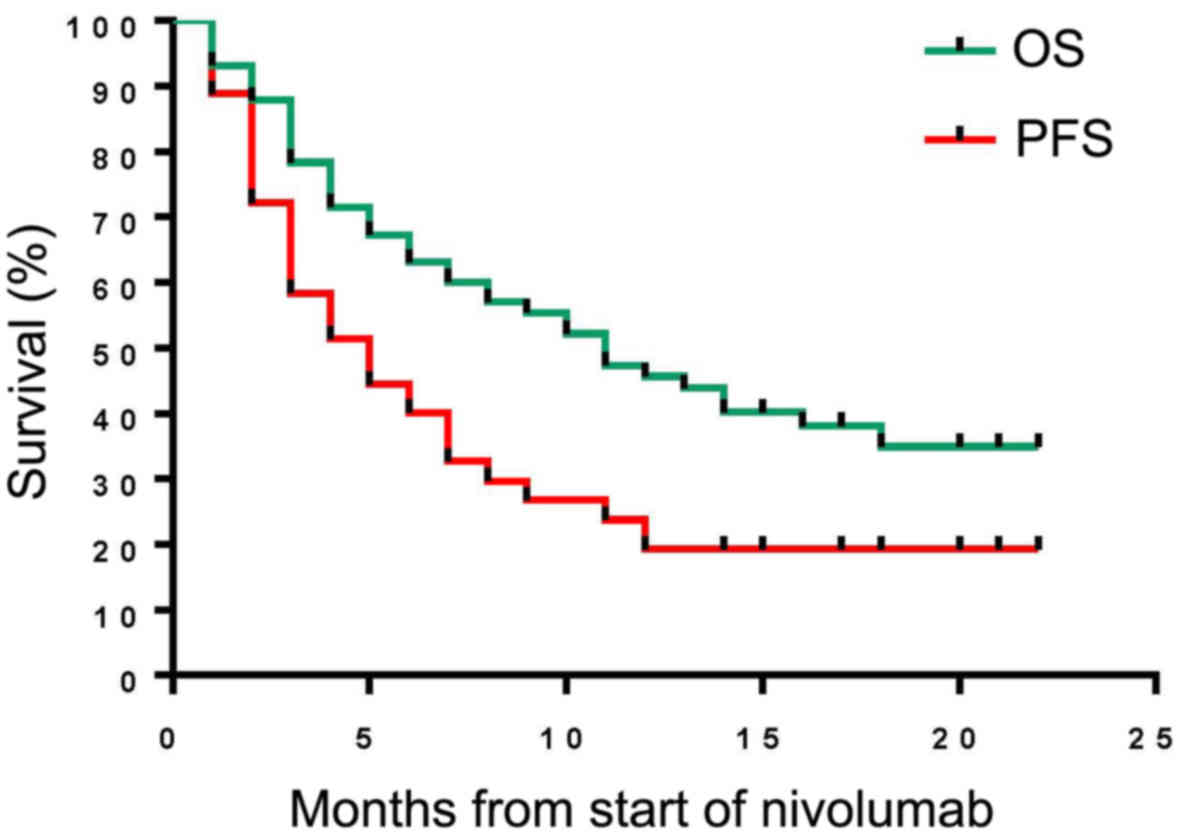
Response assessment was performed in the 62 patients who got at least four cycles of Nivolumab. There was CR in 1 patient, partial response in 11, stable disease in 25 and PD in 25. The observed response rate was 19%. The disease control rate was 60%. Median progression free survival (mPFS) from the first dose to treatment interruption was 4 months. The PFS curve is depicted in Fig. 1. Survival data was analyzed after 22 months of follow-up. The overall survival was 34.9%, while PFS was 19.3%. Median overall survival from the first dose given and until patient's death or last follow up is 8 months. The OS curve is shown in Fig. 1. PFS and OS were similar for elderly vs. young patients (cut-off age 65), female vs. male sex, ECOG 1 vs. higher and early (1–2) vs. late line of treatment. All failures of Nivolumab occurred within the first 12 months of administration.

Figure 1.

PFS and OS of patients treated with Nivolumab (programmed death-L1 unknown). PFS, progression free survival; OS, overall survival.

Discussion

Our results reflect real-life data on non-selected, PDL1 status unknown patients, including 48% patients with ECOG PS of 2 and 3, and including 41% heavily pretreated patients. Yet, the results are similar to and even better than those seen in the already published RCT's, with ORR of 19% and median 22-months-survival of 34.9%. We could not isolate any characteristics that can predict who will benefit from immunotherapy. Side effects were almost always mild, and required discontinuation of treatment in less than 4% of patients.

Nivolumab was superior to Docetaxel in OS as well as side-effects profile, regardless of PDL1 status, in two RCT's. Checkmate 017 (7) was conducted on 272 patients with squamous cell histology, and showed mOS to be 9.2 months with Nivolumab, compared to 6 months with Docetaxel (HR, 0.59). Checkmate 057 (5) was performed on 582 patients with non-squamous histology, and again demonstrated superior OS of Nivolumab vs. Docetaxel (12.2 vs. 9.4 months; HR, 0.73).

Another PD1 inhibitor antibody, Pembrolizumab, was also superior to Docetaxel in a phase III trial. Keynote-010 (8) randomized 1,034 patients with NSCLC (all histology types) and at least 1% PDL1 expression, into either Pembrolizumab or Docetaxel treatment. The antibody resulted in significantly better OS (10.4 months and 12.7 months for both Pembrolizumab groups vs. 8.5 months, HR 0.71 and 0.61 respectively). Among patients with pdl1 expression above 50% OS reached an unprecedented 17.3 months.

PDL1 antibodies showed superiority over Docetaxel as well. Atezolizumab was tested in OAK trial (9), which randomized 1,225 patients with NSCLC (all histology types). OS was prolonged regardless of PDL1 expression (13.8 vs. 9.6 months, HR 0.73), while patients with ≥1% expression reached mOS of 15.7 months.

All immune checkpoint inhibitors were found to be less toxic than chemotherapy. All exhibited ORR of 14–20% with a median duration response of 16–20 months. Evidence is beginning to emerge regarding efficacy after longer follow-up. Gettinger et al described median 2-year-OS of 24% and median 3-year-OS of 18% in Nivolumab phase I expansion cohort (10). Brahmer et al presented as yet unpublished results of phase I Nivolumab in NSCLC, with an impressive median 5-year-OS of 16% (11). Unpublished results were also presented of 2-year-OS of 29 and 23% from Checkmate 057 and Checkmate 017, respectively (12).

In conclusion, Nivolumab is active and well tolerated in patients with NSCLC. This is based on highly selected population accrued for clinical trials and on non-selected cohorts reflecting daily service in thoracic oncology units. Our real-life data supports the results achieved in clinical trials, and supply a solid ground for continuing the use of Nivolumab in chemotherapy-pretreated patients with advanced disease.

Acknowledgements

Not applicable.

Funding

No funding was received.

Availability of data and materials

All data generated or analyzed during this study are included in this published article.

Authors' contributions

SS and OM performed the data analysis and wrote the paper.

Ethics approval and consent to participate

Not applicable.

Patient consent for publication

Not applicable.

Competing interests

The authors declare that they have no competing interests.

References

1 

Shepherd FA, Dancey J, Ramlau R, Mattson K, Gralla R, O'Rourke M, Levitan N, Gressot L, Vincent M, Burkes R, et al: Prospective randomized trial of docetaxel versus best supportive care in patients with non-small-cell lung cancer previously treated with platinum-based chemotherapy. J Clin Oncol. 18:2095–2103. 2000. View Article : Google Scholar : PubMed/NCBI

2 

Hanna N, Shepherd FA, Fossella FV, Pereira JR, De Marinis F, von Pawel J, Gatzemeier U, Tsao TC, Pless M, Muller T, et al: Randomized phase III trial of pemetrexed versus docetaxel in patients with non-small-cell lung cancer previously treated with chemotherapy. J Clin Oncol. 22:1589–1597. 2004. View Article : Google Scholar : PubMed/NCBI

3 

Kim ES, Hirsh V, Mok T, Socinski MA, Gervais R, Wu YL, Li LY, Watkins CL, Sellers MV, Lowe ES, et al: Gefitinib versus docetaxel in previously treated non-small-cell lung cancer (INTEREST): A randomised phase III trial. Lancet. 372:1809–1818. 2008. View Article : Google Scholar : PubMed/NCBI

4 

Shepherd FA, Pereira Rodrigues J, Ciuleanu T, Tan EH, Hirsh V, Thongprasert S, Campos D, Maoleekoonpiroj S, Smylie M, Martins R, et al: Erlotinib in previously treated non-small-cell lung cancer. N Engl J Med. 353:123–132. 2005. View Article : Google Scholar : PubMed/NCBI

5 

Borghaei H, Paz-Ares L, Horn L, Spigel DR, Steins M, Ready NE, Chow LQ, Vokes EE, Felip E, Holgado E, et al: Nivolumab versus docetaxel in advanced nonsquamous non-small-cell lung cancer. N Engl J Med. 373:1627–1639. 2015. View Article : Google Scholar : PubMed/NCBI

6 

Kazandjian D, Suzman DL, Blumenthal G, Mushti S, He K, Libeg M, Keegan P and Pazdur R: FDA approval summary: Nivolumab for the treatment of metastatic non-small cell lung cancer with progression on or after platinum-based chemotherapy. Oncologist. 21:634–642. 2016. View Article : Google Scholar : PubMed/NCBI

7 

Brahmer J, Reckamp KL, Baas P, Crinò L, Eberhardt WE, Poddubskaya E, Antonia S, Pluzanski A, Vokes EE, Holgado E, et al: Nivolumab versus docetaxel in advanced squamous-cell non-small-cell lung cancer. N Engl J Med. 373:123–135. 2015. View Article : Google Scholar : PubMed/NCBI

8 

Herbst RS, Baas P, Kim DW, Felip E, Pérez-Gracia JL, Han JY, Molina J, Kim JH, Arvis CD, Ahn MJ, et al: Pembrolizumab versus docetaxel for previously treated, PD-L1-positive, advanced non-small-cell lung cancer (KEYNOTE-010): A randomised controlled trial. Lancet. 387:1540–1550. 2016. View Article : Google Scholar : PubMed/NCBI

9 

Rittmeyer A, Barlesi F, Waterkamp D, Park K, Ciardiello F, von Pawel J, Gadgeel SM, Hida T, Kowalski DM, Dols MC, et al: Atezolizumab versus docetaxel in patients with previously treated non-small-cell lung cancer (OAK): A phase 3, open-label, multicentre randomised controlled trial. Lancet. 389:255–265. 2017. View Article : Google Scholar : PubMed/NCBI

10 

Gettinger SN, Horn L, Gandhi L, Spigel DR, Antonia SJ, Rizvi NA, Powderly JD, Heist RS, Carvajal RD, Jackman DM, et al: Overall survival and long-term safety of nivolumab (Anti-Programmed Death 1 Antibody, BMS-936558, ONO-4538) in patients with previously treated advanced non-small-cell lung cancer. J Clin Oncol. 33:2004–2012. 2015. View Article : Google Scholar : PubMed/NCBI

11 

Brahmer JR, Horn L, Jackman D, Spigel D, Antonia S, Hellmann M, Powderly J, Heist R, Sequist L, Smith DC, et al: Abstract CT077: Five-year follow-up from the CA209-003 study of nivolumab in previously treated advanced non-small cell lung cancer: Clinical characteristics of long-term survivorsWashington, DC: AACR Annual Meeting 77. April 1–5–2017

12 

Borghaei H, Brahmer JR, Horn L, Ready N, Steins M, Felip E, Paz-Ares LG, Arrieta O, Barlesi F, Antonia SJ, et al: Nivolumab (nivo) vs docetaxel (doc) in patients (pts) with advanced NSCLC: CheckMate 017/057 2-y update and exploratory cytokine profile analyses. J Clin Oncol. 34:90252016.

Related Articles

  • Abstract
  • View
  • Download
  • Twitter
Copy and paste a formatted citation
Spandidos Publications style
Shamai S and Merimsky O: Efficacy and safety of Nivolumab in non‑small cell lung cancer patients in Tel‑Aviv tertiary medical center: Facing the reality. Mol Clin Oncol 9: 419-422, 2018.
APA
Shamai, S., & Merimsky, O. (2018). Efficacy and safety of Nivolumab in non‑small cell lung cancer patients in Tel‑Aviv tertiary medical center: Facing the reality. Molecular and Clinical Oncology, 9, 419-422. https://doi.org/10.3892/mco.2018.1693
MLA
Shamai, S., Merimsky, O."Efficacy and safety of Nivolumab in non‑small cell lung cancer patients in Tel‑Aviv tertiary medical center: Facing the reality". Molecular and Clinical Oncology 9.4 (2018): 419-422.
Chicago
Shamai, S., Merimsky, O."Efficacy and safety of Nivolumab in non‑small cell lung cancer patients in Tel‑Aviv tertiary medical center: Facing the reality". Molecular and Clinical Oncology 9, no. 4 (2018): 419-422. https://doi.org/10.3892/mco.2018.1693
Copy and paste a formatted citation
x
Spandidos Publications style
Shamai S and Merimsky O: Efficacy and safety of Nivolumab in non‑small cell lung cancer patients in Tel‑Aviv tertiary medical center: Facing the reality. Mol Clin Oncol 9: 419-422, 2018.
APA
Shamai, S., & Merimsky, O. (2018). Efficacy and safety of Nivolumab in non‑small cell lung cancer patients in Tel‑Aviv tertiary medical center: Facing the reality. Molecular and Clinical Oncology, 9, 419-422. https://doi.org/10.3892/mco.2018.1693
MLA
Shamai, S., Merimsky, O."Efficacy and safety of Nivolumab in non‑small cell lung cancer patients in Tel‑Aviv tertiary medical center: Facing the reality". Molecular and Clinical Oncology 9.4 (2018): 419-422.
Chicago
Shamai, S., Merimsky, O."Efficacy and safety of Nivolumab in non‑small cell lung cancer patients in Tel‑Aviv tertiary medical center: Facing the reality". Molecular and Clinical Oncology 9, no. 4 (2018): 419-422. https://doi.org/10.3892/mco.2018.1693
Follow us
  • Twitter
  • LinkedIn
  • Facebook
About
  • Spandidos Publications
  • Careers
  • Cookie Policy
  • Privacy Policy
How can we help?
  • Help
  • Live Chat
  • Contact
  • Email to our Support Team