Spandidos Publications Logo
  • About
    • About Spandidos
    • Aims and Scopes
    • Abstracting and Indexing
    • Editorial Policies
    • Reprints and Permissions
    • Job Opportunities
    • Terms and Conditions
    • Contact
  • Journals
    • All Journals
    • Oncology Letters
      • Oncology Letters
      • Information for Authors
      • Editorial Policies
      • Editorial Board
      • Aims and Scope
      • Abstracting and Indexing
      • Bibliographic Information
      • Archive
    • International Journal of Oncology
      • International Journal of Oncology
      • Information for Authors
      • Editorial Policies
      • Editorial Board
      • Aims and Scope
      • Abstracting and Indexing
      • Bibliographic Information
      • Archive
    • Molecular and Clinical Oncology
      • Molecular and Clinical Oncology
      • Information for Authors
      • Editorial Policies
      • Editorial Board
      • Aims and Scope
      • Abstracting and Indexing
      • Bibliographic Information
      • Archive
    • Experimental and Therapeutic Medicine
      • Experimental and Therapeutic Medicine
      • Information for Authors
      • Editorial Policies
      • Editorial Board
      • Aims and Scope
      • Abstracting and Indexing
      • Bibliographic Information
      • Archive
    • International Journal of Molecular Medicine
      • International Journal of Molecular Medicine
      • Information for Authors
      • Editorial Policies
      • Editorial Board
      • Aims and Scope
      • Abstracting and Indexing
      • Bibliographic Information
      • Archive
    • Biomedical Reports
      • Biomedical Reports
      • Information for Authors
      • Editorial Policies
      • Editorial Board
      • Aims and Scope
      • Abstracting and Indexing
      • Bibliographic Information
      • Archive
    • Oncology Reports
      • Oncology Reports
      • Information for Authors
      • Editorial Policies
      • Editorial Board
      • Aims and Scope
      • Abstracting and Indexing
      • Bibliographic Information
      • Archive
    • Molecular Medicine Reports
      • Molecular Medicine Reports
      • Information for Authors
      • Editorial Policies
      • Editorial Board
      • Aims and Scope
      • Abstracting and Indexing
      • Bibliographic Information
      • Archive
    • World Academy of Sciences Journal
      • World Academy of Sciences Journal
      • Information for Authors
      • Editorial Policies
      • Editorial Board
      • Aims and Scope
      • Abstracting and Indexing
      • Bibliographic Information
      • Archive
    • International Journal of Functional Nutrition
      • International Journal of Functional Nutrition
      • Information for Authors
      • Editorial Policies
      • Editorial Board
      • Aims and Scope
      • Abstracting and Indexing
      • Bibliographic Information
      • Archive
    • International Journal of Epigenetics
      • International Journal of Epigenetics
      • Information for Authors
      • Editorial Policies
      • Editorial Board
      • Aims and Scope
      • Abstracting and Indexing
      • Bibliographic Information
      • Archive
    • Medicine International
      • Medicine International
      • Information for Authors
      • Editorial Policies
      • Editorial Board
      • Aims and Scope
      • Abstracting and Indexing
      • Bibliographic Information
      • Archive
  • Articles
  • Information
    • Information for Authors
    • Information for Reviewers
    • Information for Librarians
    • Information for Advertisers
    • Conferences
  • Language Editing
Spandidos Publications Logo
  • About
    • About Spandidos
    • Aims and Scopes
    • Abstracting and Indexing
    • Editorial Policies
    • Reprints and Permissions
    • Job Opportunities
    • Terms and Conditions
    • Contact
  • Journals
    • All Journals
    • Biomedical Reports
      • Information for Authors
      • Editorial Policies
      • Editorial Board
      • Aims and Scope
      • Abstracting and Indexing
      • Bibliographic Information
      • Archive
    • Experimental and Therapeutic Medicine
      • Information for Authors
      • Editorial Policies
      • Editorial Board
      • Aims and Scope
      • Abstracting and Indexing
      • Bibliographic Information
      • Archive
    • International Journal of Epigenetics
      • Information for Authors
      • Editorial Policies
      • Editorial Board
      • Aims and Scope
      • Abstracting and Indexing
      • Bibliographic Information
      • Archive
    • International Journal of Functional Nutrition
      • Information for Authors
      • Editorial Policies
      • Editorial Board
      • Aims and Scope
      • Abstracting and Indexing
      • Bibliographic Information
      • Archive
    • International Journal of Molecular Medicine
      • Information for Authors
      • Editorial Policies
      • Editorial Board
      • Aims and Scope
      • Abstracting and Indexing
      • Bibliographic Information
      • Archive
    • International Journal of Oncology
      • Information for Authors
      • Editorial Policies
      • Editorial Board
      • Aims and Scope
      • Abstracting and Indexing
      • Bibliographic Information
      • Archive
    • Medicine International
      • Information for Authors
      • Editorial Policies
      • Editorial Board
      • Aims and Scope
      • Abstracting and Indexing
      • Bibliographic Information
      • Archive
    • Molecular and Clinical Oncology
      • Information for Authors
      • Editorial Policies
      • Editorial Board
      • Aims and Scope
      • Abstracting and Indexing
      • Bibliographic Information
      • Archive
    • Molecular Medicine Reports
      • Information for Authors
      • Editorial Policies
      • Editorial Board
      • Aims and Scope
      • Abstracting and Indexing
      • Bibliographic Information
      • Archive
    • Oncology Letters
      • Information for Authors
      • Editorial Policies
      • Editorial Board
      • Aims and Scope
      • Abstracting and Indexing
      • Bibliographic Information
      • Archive
    • Oncology Reports
      • Information for Authors
      • Editorial Policies
      • Editorial Board
      • Aims and Scope
      • Abstracting and Indexing
      • Bibliographic Information
      • Archive
    • World Academy of Sciences Journal
      • Information for Authors
      • Editorial Policies
      • Editorial Board
      • Aims and Scope
      • Abstracting and Indexing
      • Bibliographic Information
      • Archive
  • Articles
  • Information
    • For Authors
    • For Reviewers
    • For Librarians
    • For Advertisers
    • Conferences
  • Language Editing
Login Register Submit
  • This site uses cookies
  • You can change your cookie settings at any time by following the instructions in our Cookie Policy. To find out more, you may read our Privacy Policy.

    I agree
Search articles by DOI, keyword, author or affiliation
Search
Advanced Search
presentation
Molecular and Clinical Oncology
Join Editorial Board Propose a Special Issue
Print ISSN: 2049-9450 Online ISSN: 2049-9469
Journal Cover
November-2018 Volume 9 Issue 5

Full Size Image

Sign up for eToc alerts
Recommend to Library

Journals

International Journal of Molecular Medicine

International Journal of Molecular Medicine

International Journal of Molecular Medicine is an international journal devoted to molecular mechanisms of human disease.

International Journal of Oncology

International Journal of Oncology

International Journal of Oncology is an international journal devoted to oncology research and cancer treatment.

Molecular Medicine Reports

Molecular Medicine Reports

Covers molecular medicine topics such as pharmacology, pathology, genetics, neuroscience, infectious diseases, molecular cardiology, and molecular surgery.

Oncology Reports

Oncology Reports

Oncology Reports is an international journal devoted to fundamental and applied research in Oncology.

Experimental and Therapeutic Medicine

Experimental and Therapeutic Medicine

Experimental and Therapeutic Medicine is an international journal devoted to laboratory and clinical medicine.

Oncology Letters

Oncology Letters

Oncology Letters is an international journal devoted to Experimental and Clinical Oncology.

Biomedical Reports

Biomedical Reports

Explores a wide range of biological and medical fields, including pharmacology, genetics, microbiology, neuroscience, and molecular cardiology.

Molecular and Clinical Oncology

Molecular and Clinical Oncology

International journal addressing all aspects of oncology research, from tumorigenesis and oncogenes to chemotherapy and metastasis.

World Academy of Sciences Journal

World Academy of Sciences Journal

Multidisciplinary open-access journal spanning biochemistry, genetics, neuroscience, environmental health, and synthetic biology.

International Journal of Functional Nutrition

International Journal of Functional Nutrition

Open-access journal combining biochemistry, pharmacology, immunology, and genetics to advance health through functional nutrition.

International Journal of Epigenetics

International Journal of Epigenetics

Publishes open-access research on using epigenetics to advance understanding and treatment of human disease.

Medicine International

Medicine International

An International Open Access Journal Devoted to General Medicine.

Journal Cover
November-2018 Volume 9 Issue 5

Full Size Image

Sign up for eToc alerts
Recommend to Library

  • Article
  • Citations
    • Cite This Article
    • Download Citation
    • Create Citation Alert
    • Remove Citation Alert
    • Cited By
  • Similar Articles
    • Related Articles (in Spandidos Publications)
    • Similar Articles (Google Scholar)
    • Similar Articles (PubMed)
  • Download PDF
  • Download XML
  • View XML
Case Report

Gastric outlet obstruction caused by metastatic tumor of the stomach originating from primary breast cancer: A case report

  • Authors:
    • Maho Ogawa
    • Tsutomu Namikawa
    • Toyokazu Oki
    • Jun Iwabu
    • Masaya Munekage
    • Hiromichi Maeda
    • Takahiko Tamura
    • Tomoaki Yatabe
    • Hiroyuki Kitagawa
    • Ken Dabanaka
    • Takeki Sugimoto
    • Michiya Kobayashi
    • Kazuhiro Hanazaki
  • View Affiliations / Copyright

    Affiliations: Department of Surgery, Kochi Medical School, Nankoku, Kochi 783-8505, Japan, Cancer Treatment Center, Kochi Medical School Hospital, Nankoku, Kochi 783-8505, Japan, Department of Anesthesiology and Intensive Care Medicine, Kochi Medical School, Nankoku, Kochi 783-8505, Japan
  • Pages: 523-526
    |
    Published online on: September 17, 2018
       https://doi.org/10.3892/mco.2018.1722
  • Expand metrics +
Metrics: Total Views: 0 (Spandidos Publications: | PMC Statistics: )
Metrics: Total PDF Downloads: 0 (Spandidos Publications: | PMC Statistics: )
Cited By (CrossRef): 0 citations Loading Articles...

This article is mentioned in:


Abstract

The most common sites of breast cancer metastasis are the bone, liver, lung and brain, while gastrointestinal metastasis from breast cancer is rare. We herein present the case of a 68-year-old woman who was admitted to our department with nausea and appetite loss. The patient's medical history included right mastectomy with sentinel lymph node biopsy 5 years earlier for invasive lobular carcinoma, measuring 6.2 cm in greatest diameter, without lymphovascular invasion. Two years after the surgery, the patient developed brain metastasis and underwent metastasectomy to control the neurological symptoms, including unsteadiness and asthenia. After the second surgery, the patient received systemic chemotherapy using S-1, followed by bevacizumab plus paclitaxel. However, due to bevacizumab-related cardiotoxicity, the treatment was switched to eribulin. On esophagogastroduodenoscopy, an elevated lesion was identified in the antrum, causing severe narrowing of the gastric outlet. Biopsy and histological examination of the tumor revealed infiltration of the gastric wall by undifferentiated neoplastic cells with poor adhesion, morphologically similar to invasive lobular carcinoma, and immunohistochemical staining was positive for estrogen receptor, mammaglobin and GATA3. Finally, 18F-2-deoxy-2-fluoro-D‑glucose (FDG) positron emission tomography combined with computed tomography imaging revealed FDG uptake across the thickness of the antral wall. The patient was diagnosed with gastric metastasis from the original breast cancer and subsequently underwent endoscopic self-expandable metallic stent (SEMS) placement. There were no procedure-related adverse events, and the patient remained alive under best supportive care 4 months after SEMS placement. To the best of our knowledge, this is the first reported case of gastric outlet obstruction caused by metastatic breast carcinoma managed by SEMS placement. While such a diagnosis is rare, clinicians treating patients with gastric metastases should be aware of possible gastric outlet obstruction and SEMS placement as an effective palliative intervention.

Introduction

Breast cancer is the most common malignancy among women worldwide. Among breast cancer subtypes, invasive ductal carcinoma is the one most commonly associated with metastasis (1). Invasive lobular cancer is the second most common invasive type of breast cancer, and is associated with a heterogeneous group of histologically different types of metastatic spread and potentially uncommon patterns of metastatic site involvement (1,2). The most common sites for breast cancer metastases are the bone, liver, lung and brain, while gastrointestinal metastasis from breast cancer is rare. However, acknowledging this entity is important for accurate and timely diagnosis and treatment (2,3).

We herein report the case of a patient with a metastatic gastric tumor arising from invasive lobular carcinoma of the breast, complicated by gastric outlet obstruction (GOO), which was managed by metallic stent placement.

Case report

A 68-year-old female patient presented to the Kochi Medical School Hospital (Nankoku, Japan) in March 2018 with nausea and appetite loss. The patient's medical history included right mastectomy with sentinel lymph node biopsy for right breast cancer 5 years earlier. The pathological diagnosis was invasive lobular carcinoma, 6.2 cm in greatest diameter, without lymphovascular invasion. Immunohistochemical examination of the tumor revealed 40% estrogen receptor positivity, 1% progesterone receptor positivity and negative staining for human epidermal growth factor receptor 2 (HER2), with a Ki-67 index of 15%. Two years after the surgery, the patient developed brain metastasis and underwent metastasectomy to control neurological symptoms such as unsteadiness and asthenia. Postoperatively, the patient received systemic chemotherapy using S-1, followed by bevacizumab plus paclitaxel, although the treatment was subsequently changed to eribulin due to bevacizumab-related cardiotoxicity.

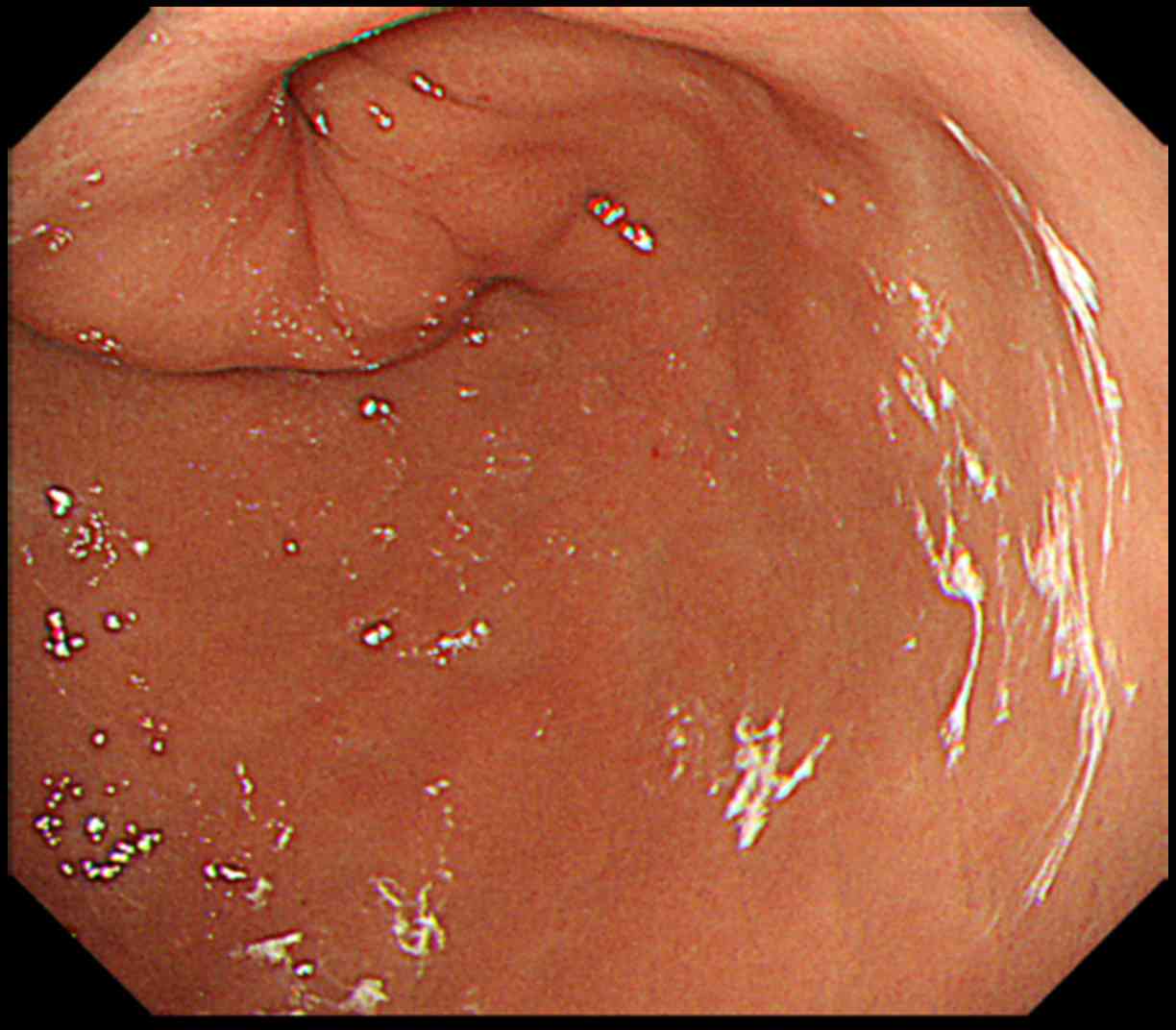
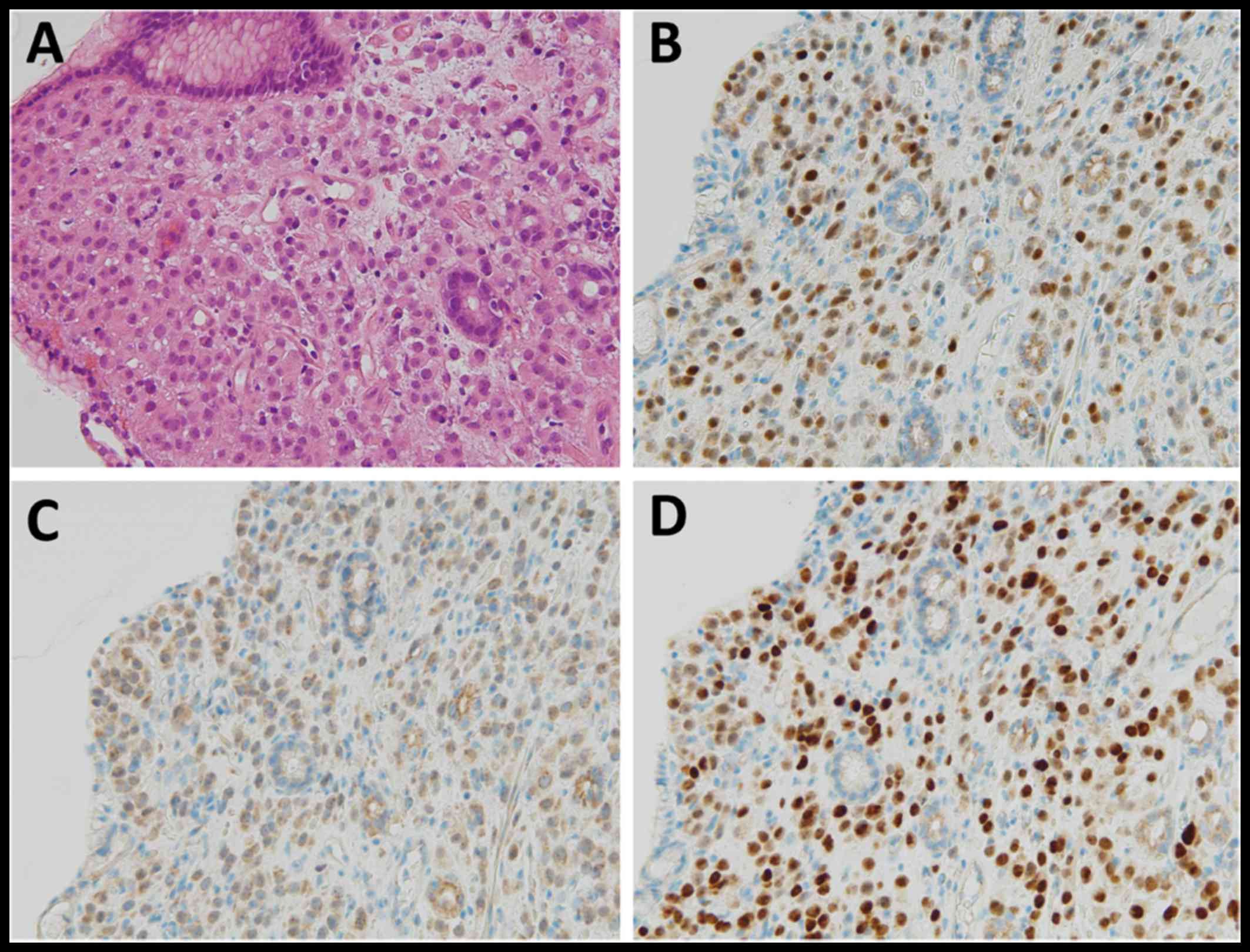
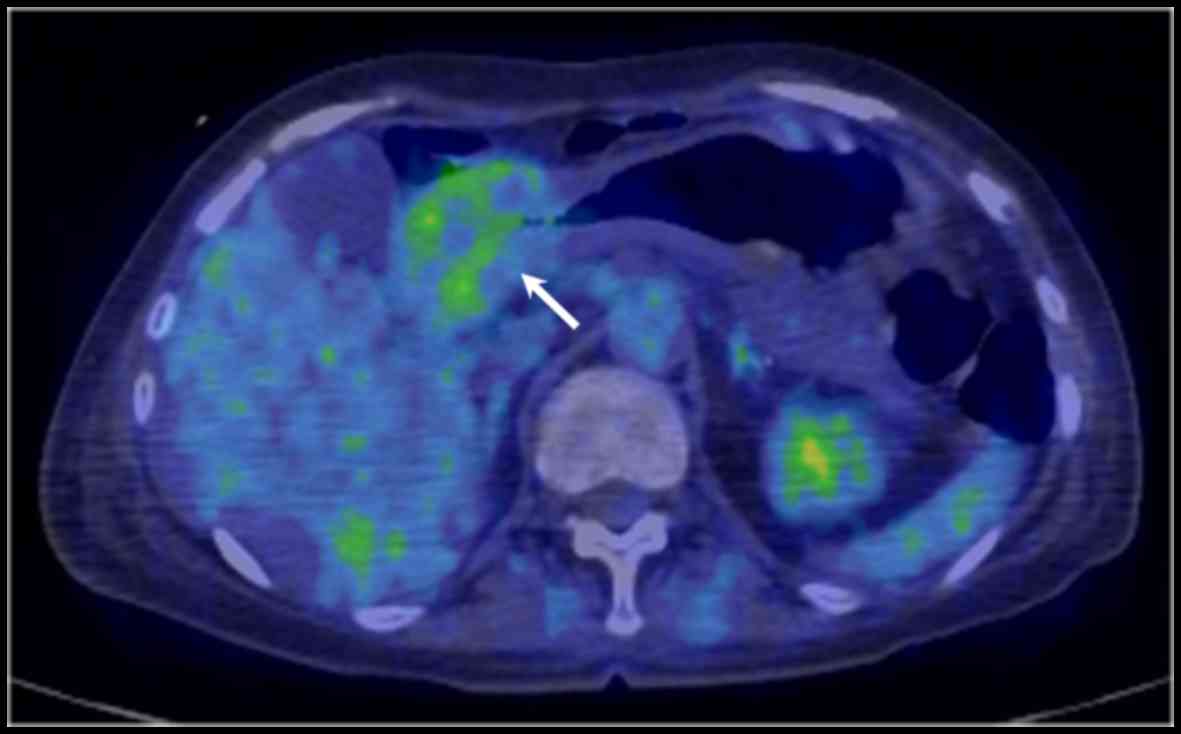
The laboratory findings on admission were as follows: Decreased red blood cell count (296×104/mm3; normal range, 386–492×104/mm3), decreased white blood cell count (1.0×10³/mm3; normal range, 3.3–8.6×10³/mm3) and increased C-reactive protein levels (34.21 mg/dl; normal values <0.14 mg/dl). On esophagogastroduodenoscopy, an elevated lesion was identified occupying the entire circumference of the antrum and causing a narrowing of the gastric outlet (Fig. 1). Biopsy of the tumor followed by histological examination revealed infiltration of the wall of the antrum by undifferentiated neoplastic cells with poor adhesion, resembling invasive lobular carcinoma (Fig. 2A); immunohistochemical staining revealed positivity for estrogen receptor (Fig. 2B), mammaglobin (Fig. 2C) and GATA3 (Fig. 2D). Imaging by 18F-2-deoxy-2-fluoro-D-glucose (FDG) positron emission tomography combined with computed tomography revealed FDG uptake across the full thickness of the antral wall (Fig. 3). These findings indicated a clinical diagnosis of gastric metastasis from the primary breast cancer.

Figure 1.

Esophagogastroduodenoscopy showing a circumferential elevated lesion in the antrum with superficial erosions and narrowing of the gastric outlet.

Figure 2.

Histological findings from the gastric biopsy specimen. (A) Hematoxylin and eosin staining revealed infiltration by poorly differentiated adenocarcinoma cells. Immunohistochemical examination demonstrated positivity for (B) estrogen receptor, (C) mammaglobin and (D) GATA3. Hematoxylin and eosin staining; magnification, ×100.

Figure 3.

18F-2-deoxy-2-fluoro-D-glucose (FDG) positron emission tomography combined with computed tomography imaging revealed thickening of the entire gastric antrum wall with FDG uptake (arrow).

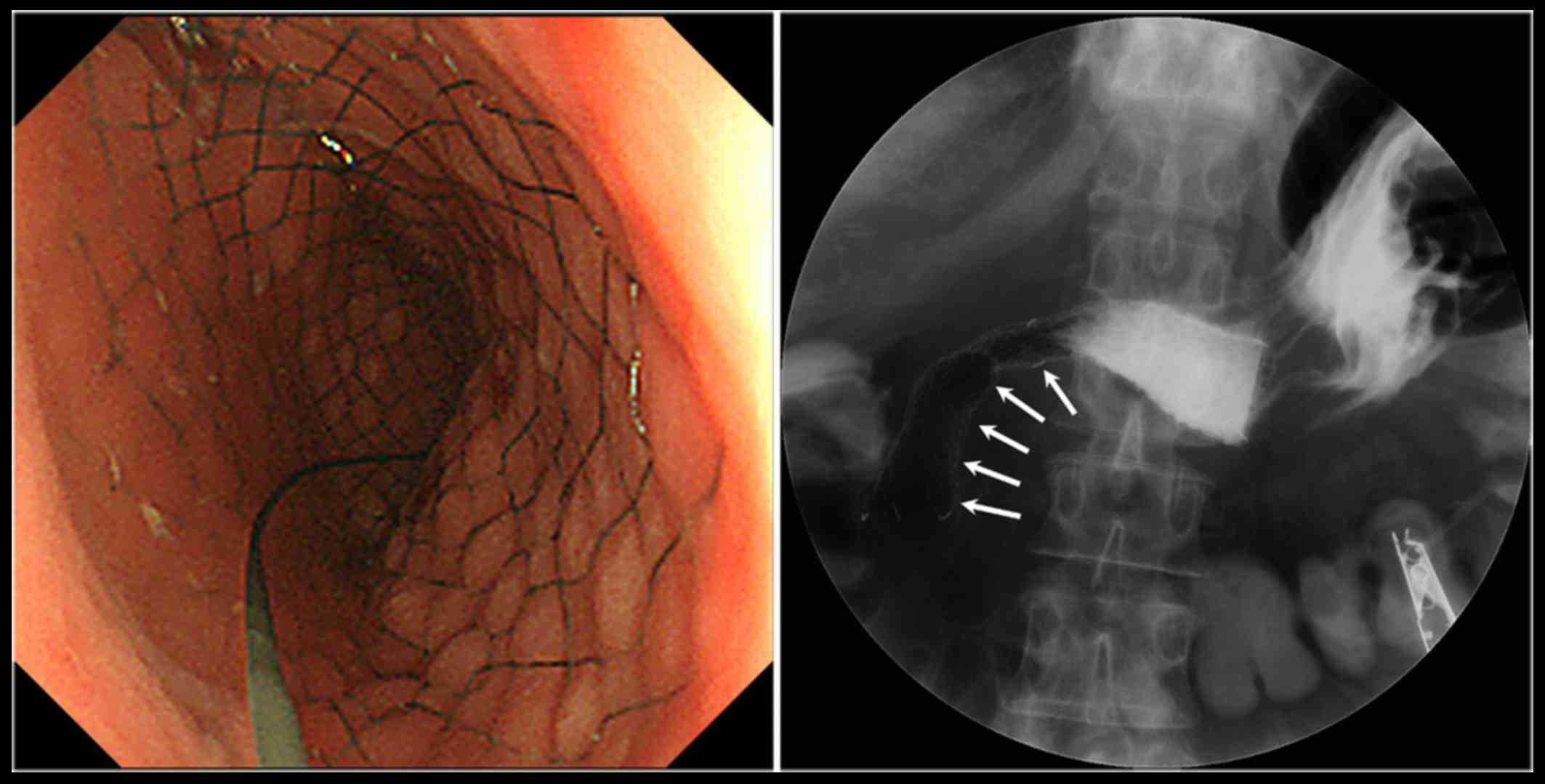
The patient eventually developed GOO that markedly worsened her quality of life; thus, placement of an endoscopic self-expandable metallic stent (SEMS) was performed to resolve the obstruction-induced clinical symptoms (Fig. 4). There were no procedure-related adverse events. The date of last contact was August 2018, and the patient remained alive under best supportive care 5 months after the procedure.

Figure 4.

Endoscopic and fluoroscopic images following self-expandable metallic stent placement. (A) A self-expandable metallic stent was placed under guide-wire assisted endoscopy. (B) Fluoroscopy using water-soluble contrast medium showed opening of the gastric outlet obstruction (arrows).

Discussion

We herein present a case of GOO caused by a metastatic tumor of the stomach originating from an invasive lobular carcinoma of the breast that was resected 5 years earlier. SEMS placement was used to relieve the obstruction, as it is an effective and safe procedure for maintaining the quality of life of patients under best supportive care. To the best of our knowledge, this is the first reported case of GOO caused by metastatic gastric tumor managed by SEMS placement.

Gastric involvement by metastatic breast cancer is a rare clinical diagnosis. Furthermore, invasive lobular breast carcinoma is less likely to involve the gastrointestinal tract compared with invasive ductal carcinoma, with the most frequent metastatic sites being the bone, gynecological organs, peritoneum and retroperitoneum (3–5). In this respect, the present case highlights the importance of considering metastatic tumor of the stomach secondary to invasive lobular carcinoma of the breast, and the importance of immunohistochemical analysis, such as staining for estrogen and progesterone receptors (2,3,5,6).

GATA3 is a multifunctional transcription factor that is important for the development and function of ductal epithelial cells, including those of breast, urothelia, epidermis and skin adnexa, wherein specific nuclear proteins recognize G-A-T-A nucleotide sequences in target gene promoters (7). As the majority of primary and metastatic mammary tumors express GATA3 (positive rate of 80–90%), it is a potentially useful addition to hormonal markers, such as estrogen and progesterone receptors, for identifying metastatic cells of mammary origin (8). In the present case, positive immunohistochemical staining of these three markers was observed.

The endoscopic and radiological appearance resemble linitis plastica due to the diffuse infiltration of the submucosa and muscularis propria, with circumferential thickening and narrowing of the lumen, as metastatic lobular carcinoma infiltrates within the serosal, muscular and submucosal layers, with cord-like projections of small cells (6). The treatment generally recommended for gastric metastases from breast cancer is systemic chemotherapy and/or hormonal therapy (3,4,6). When an unusual lesion is detected in a patient with invasive lobular carcinoma, metastatic disease should be considered in the differential diagnosis, and immunohistochemical analysis is recommended for accurate diagnosis.

Patients with malignant GOO tend to develop undesirable clinical symptoms that are detrimental to the quality of life of the patients, such as nausea, vomiting, abdominal pain and difficulty eating (9). Fluoroscopic or/and endoscopic SEMS placement as palliative treatment for malignant GOO is generally safe, easily performed and effective, and is associated with higher clinical success rates and lower morbidity and mortality rates compared with palliative surgery (9,10). By contrast, Jang et al (11) reported that palliative gastrojejunostomy was significantly associated with longer overall survival and lower risk of re-intervention compared with SEMS placement in patients with malignant GOO caused by unresectable gastric cancer using a propensity score matching analysis. Overall, the choice of systemic treatment, such as chemotherapy and/or hormonal therapy, for breast cancer metastasis is based upon presenting symptoms, age and general performance status, and surgical palliation should be considered only under emergency conditions to bypass the obstruction (3). The bone marrow of the patient in the present case was exhausted due to long-term systemic chemotherapy; thus, we selected SEMS placement to avoid unfavorable complications associated with the bypass procedure.

In conclusion, this case indicates that SEMS placement may be a promising approach to the management of patients with GOO caused by unresectable advanced gastric cancer as well as metastatic gastric tumors, and may contribute to improved quality of life for these patients. Further investigations with a larger accumulation of cases and/or prospective studies are required to establish the optimal treatment for GOO caused by metastatic tumors to the stomach originating from other primary malignancies.

Acknowledgements

Not applicable.

Funding

No funding was received

Availability of data and materials

Not applicable.

Authors' contributions

MO and TN contributed to the writing of the manuscript. MK and KH supervised the study. MO, TN, TO, JI, HM, TT, TY, HK, KD and TS served as the attending physicians for the presented patient. All the authors have read and approved that final version of this manuscript.

Ethics approval and consent to participate

Not applicable.

Patient consent for publication

The patient has given consent for the publication of the case details and associated images.

Competing interests

The authors declare that they have no competing interests to disclose.

References

1 

Arpino G, Bardou VJ, Clark GM and Elledge RM: Infiltrating lobular carcinoma of the breast: Tumor characteristics and clinical outcome. Breast Cancer Res. 6:R149–R156. 2004. View Article : Google Scholar : PubMed/NCBI

2 

Namikawa T, Kobayashi M and Hanazaki K: An unusual giant duodenal mass lesion. Gastroenterology. 148:e5–e6. 2015. View Article : Google Scholar : PubMed/NCBI

3 

Namikawa T and Hanazaki K: Clinicopathological features and treatment outcomes of metastatic tumors in the stomach. Surg Today. 44:1392–1399. 2014. View Article : Google Scholar : PubMed/NCBI

4 

Borst MJ and Ingold JA: Metastatic patterns of invasive lobular versus invasive ductal carcinoma of the breast. Surgery. 114:637–641; discussion 641–642. 1993.PubMed/NCBI

5 

Namikawa T, Munekage E, Ogawa M, Oki T, Munekage M, Maeda H, Kitagawa H, Sugimoto T, Kobayashi M and Hanazaki K: Clinical presentation and treatment of gastric metastasis from other malignancies of solid organs. Biomed Rep. 7:159–162. 2017. View Article : Google Scholar : PubMed/NCBI

6 

Taal BG, Peterse H and Boot H: Clinical presentation, endoscopic features, and treatment of gastric metastases from breast carcinoma. Cancer. 89:2214–2221. 2000. View Article : Google Scholar : PubMed/NCBI

7 

Miettinen M, McCue PA, Sarlomo-Rikala M, Rys J, Czapiewski P, Wazny K, Langfort R, Waloszczyk P, Biernat W, Lasota J, et al: GATA3: a multispecific but potentially useful marker in surgical pathology: a systematic analysis of 2500 epithelial and nonepithelial tumors. Am J Surg Pathol. 38:13–22. 2014. View Article : Google Scholar : PubMed/NCBI

8 

Liu H, Shi J, Wilkerson ML and Lin F: Immunohistochemical evaluation of GATA3 expression in tumors and normal tissues: A useful immunomarker for breast and urothelial carcinomas. Am J Clin Pathol. 138:57–64. 2012. View Article : Google Scholar : PubMed/NCBI

9 

Yukimoto T, Morisaki T, Komukai S, Yoshida H, Yamaguchi D, Tsuruoka N, Miyahara K, Sakata Y, Shibasaki S, Tsunada S, et al: The palliative effect of endoscopic uncovered self-expandable metallic stent placement versus gastrojejunostomy on malignant gastric outlet obstruction: A pilot study with a retrospective chart review in Saga, Japan. Intern Med. 57:1517–1521. 2018. View Article : Google Scholar : PubMed/NCBI

10 

Shi D, Bao YS and Liu YP: Individualization of metal stents for management of gastric outlet obstruction caused by distal stomach cancer: A prospective study. Gastrointest Endosc. 78:277–284. 2013. View Article : Google Scholar : PubMed/NCBI

11 

Jang SH, Lee H, Min BH, Kim SM, Kim HS, Carriere KC, Min YW, Lee JH and Kim JJ: Palliative gastrojejunostomy versus endoscopic stent placement for gastric outlet obstruction in patients with unresectable gastric cancer: A propensity score-matched analysis. Surg Endosc. 31:4217–4223. 2017. View Article : Google Scholar : PubMed/NCBI

Related Articles

  • Abstract
  • View
  • Download
  • Twitter
Copy and paste a formatted citation
Spandidos Publications style
Ogawa M, Namikawa T, Oki T, Iwabu J, Munekage M, Maeda H, Tamura T, Yatabe T, Kitagawa H, Dabanaka K, Dabanaka K, et al: Gastric outlet obstruction caused by metastatic tumor of the stomach originating from primary breast cancer: A case report. Mol Clin Oncol 9: 523-526, 2018.
APA
Ogawa, M., Namikawa, T., Oki, T., Iwabu, J., Munekage, M., Maeda, H. ... Hanazaki, K. (2018). Gastric outlet obstruction caused by metastatic tumor of the stomach originating from primary breast cancer: A case report. Molecular and Clinical Oncology, 9, 523-526. https://doi.org/10.3892/mco.2018.1722
MLA
Ogawa, M., Namikawa, T., Oki, T., Iwabu, J., Munekage, M., Maeda, H., Tamura, T., Yatabe, T., Kitagawa, H., Dabanaka, K., Sugimoto, T., Kobayashi, M., Hanazaki, K."Gastric outlet obstruction caused by metastatic tumor of the stomach originating from primary breast cancer: A case report". Molecular and Clinical Oncology 9.5 (2018): 523-526.
Chicago
Ogawa, M., Namikawa, T., Oki, T., Iwabu, J., Munekage, M., Maeda, H., Tamura, T., Yatabe, T., Kitagawa, H., Dabanaka, K., Sugimoto, T., Kobayashi, M., Hanazaki, K."Gastric outlet obstruction caused by metastatic tumor of the stomach originating from primary breast cancer: A case report". Molecular and Clinical Oncology 9, no. 5 (2018): 523-526. https://doi.org/10.3892/mco.2018.1722
Copy and paste a formatted citation
x
Spandidos Publications style
Ogawa M, Namikawa T, Oki T, Iwabu J, Munekage M, Maeda H, Tamura T, Yatabe T, Kitagawa H, Dabanaka K, Dabanaka K, et al: Gastric outlet obstruction caused by metastatic tumor of the stomach originating from primary breast cancer: A case report. Mol Clin Oncol 9: 523-526, 2018.
APA
Ogawa, M., Namikawa, T., Oki, T., Iwabu, J., Munekage, M., Maeda, H. ... Hanazaki, K. (2018). Gastric outlet obstruction caused by metastatic tumor of the stomach originating from primary breast cancer: A case report. Molecular and Clinical Oncology, 9, 523-526. https://doi.org/10.3892/mco.2018.1722
MLA
Ogawa, M., Namikawa, T., Oki, T., Iwabu, J., Munekage, M., Maeda, H., Tamura, T., Yatabe, T., Kitagawa, H., Dabanaka, K., Sugimoto, T., Kobayashi, M., Hanazaki, K."Gastric outlet obstruction caused by metastatic tumor of the stomach originating from primary breast cancer: A case report". Molecular and Clinical Oncology 9.5 (2018): 523-526.
Chicago
Ogawa, M., Namikawa, T., Oki, T., Iwabu, J., Munekage, M., Maeda, H., Tamura, T., Yatabe, T., Kitagawa, H., Dabanaka, K., Sugimoto, T., Kobayashi, M., Hanazaki, K."Gastric outlet obstruction caused by metastatic tumor of the stomach originating from primary breast cancer: A case report". Molecular and Clinical Oncology 9, no. 5 (2018): 523-526. https://doi.org/10.3892/mco.2018.1722
Follow us
  • Twitter
  • LinkedIn
  • Facebook
About
  • Spandidos Publications
  • Careers
  • Cookie Policy
  • Privacy Policy
How can we help?
  • Help
  • Live Chat
  • Contact
  • Email to our Support Team