Introduction
Worldwide, breast cancer (BC) is the most frequently
diagnosed cancer and it is the primary cause of cancer-deaths among
females (1). In Egypt, BC is the
prevalent female cancer with a percentage of about 38.8% of all
cancers types in women, with increasing mortality rates (up to 1.3%
in the years from 2000 to 2011 (2,3). The
risk for developing BC has been reported to be associated with many
susceptible single nucleotide polymorphisms (SNPs) (4,5).
Therefore, deep insights into the mechanisms underlying the
involvement of SNPs in cancer susceptibility may lead to better
understanding of the molecular pathogenesis of the disease.
Moreover, SNPs can be implicated as powerful biomarkers in the
prediction and therapy of various cancer diseases (6).
Two integral members of matrix metalloproteinase
(MMPs', family MMP3, and MMP9) have a crucial role in the
development and metastasis of cancer. MMP3 is a 54 kDa enzyme
synthesized in the connective tissue, leading, subsequently; to the
activation of other MMPs such as gelatins B and the release of some
cell surface molecules including E cadherin. Furthermore, it is
implicated in the degradation of many extra cellular components
such as collagen III and IV, which may render it as an effective
tumor promoter (7). MMP9 is the most
complex enzyme of MMPs family with 92 kDa (8), where, under physiological conditions,
it binds to gelatin, collagen and laminin of matrix leading to
their degradation. However, in pathologic conditions, this function
mediates tumor invasion (9).
The role of MMP genes functional polymorphisms in
cancer susceptibility has been previously investigated. However,
better understanding of the association between MMPs SNPs and BC
pre-disposition and prognosis still needs further studies (10). Actually, some of promoter-located
SNPs may lead to allele-specific effects on the expression of MMPs
such as-1562 C>T substitution in MMP9 promoter (11), and adenosine-insertion/deletion-at
position-1171 in the MMP3 promoter sequence (12). Consequently, these two SNPs attracted
researchers to study their possible roles in the progression of BC.
However, to the best of our knowledge, the published results,
regarding the association between both SNPs and BC risk is still
inconclusive and controversial as it had been reported that they
vary greatly from one population to another, along with the lack of
previous studies investigating such association in the Egyptian
population, which urged us to investigate the possible association
between both MMP3-1171 5A/6A and MMP9-1562 C/T SNPs with BC
susceptibility among a sample of Egyptian females.
Materials and methods
This case-control study enrolled 162 BC patients and
146age-matched cancer-free women. Patients were recruited from
Cancer Management and Research Department, Medical Research
Institute and Ayadi Al-Mostakbal Hospital (Alexandria-Egypt). In
addition, research methodology and sampling in this work were
approved by the Research Ethic Committee, Medical Research
Institute/Alexandria University. Prior to sample collection, an
informed consent was obtained from each participant enrolled in the
study. Clinicopathological data of patients including age,
pathological type, grade, lymph node status, ER, PR and Her-2
status were also collected. A blood sample from each participant
was withdrawn on EDTA-coated tube and stored at -80˚C till time of
investigations.
DNA extraction
Extraction of genomic DNA was performed using
Invitrogen Pure Link Genomic DNA mini kit (Thermo Fischer
Scientific, Inc.) following manufacturer instructions. Assessment
of DNA purity and concentration were performed by measuring sample
absorbance at 260/280 nm with Nano Drop® ND-1000
UV-Visible Spectrophotometer (Thermo Fischer Scientific, Inc.). The
extracted DNA was stored at -20˚C till genotyping.
Genotyping of MMP3-1171 5A/6A SNP
Restriction fragment length polymerase chain
reaction was performed for genotyping of MMP3. DNA was amplified by
PCR using BIO-RAD T100 Thermal-cycler (Thermo Fischer Scientific,
Inc.). The reaction was carried-out in a final volume of 25 µl
consisting of 12.5 µl of 2x Dream Taq green master mix with dual
dye (Thermo Fischer Scientific, Inc.), 100 ng DNA template and 0.5
µmol of forward/reverse primer (13)
(Table I). The thermal profile was
as follows: 3 min initial denaturation at 94˚C, followed by 35
cycles of denaturation for 30 sec at 95˚C, annealing at 56.1˚C for
30 sec, and extension at 72˚C 30 sec, then a final extension at
72˚C for 10 min. For digestion; 10 µl of PCR products were
incubated with 5 U of the enzyme PsyI (Promega Corporation) for 2 h
at 37˚C. After digestion, the different genotypes of MMP3 were
visualized on 3% agarose gel, the homozygous 6A/6A genotype
produced a large fragment at 129 bp whereas the homozygous 5A/5A
genotype had shorter fragments at 97 and 32 bp. Heterozygote 5A/6A
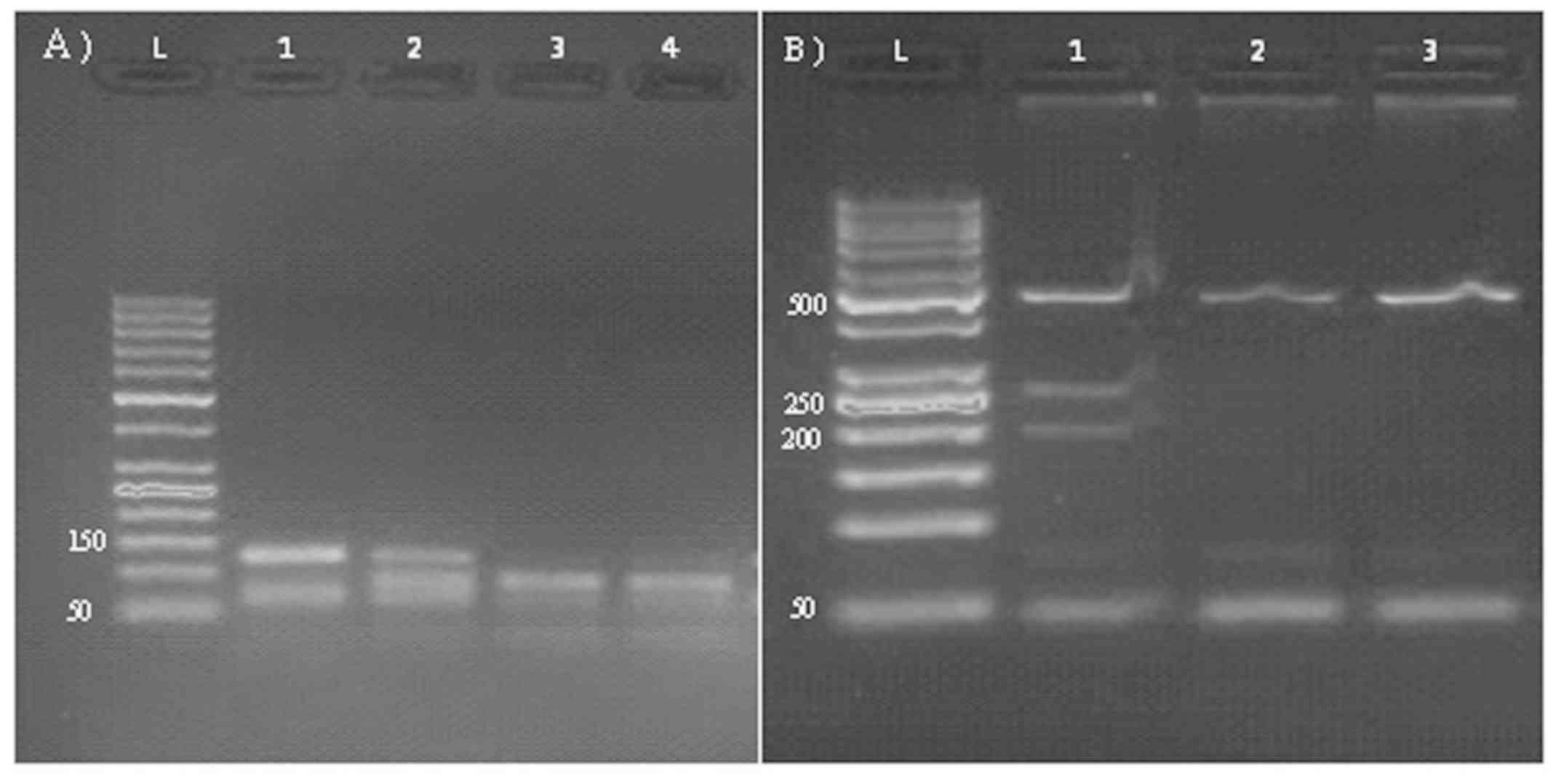
genotype generated three bands at 129, 97 and 32 bp (Fig. 1A).
 | Table IRFLP-PCR and reverse
transcription-quantitative PCR primers for MMP3, MMP9 and
GAPDH. |
Table I
RFLP-PCR and reverse
transcription-quantitative PCR primers for MMP3, MMP9 and
GAPDH.
| Genes | RFLP-PCR primers
(5'-3') (13,14)a | Reverse
transcription-quantitative PCR primers (5'-3') (15)a |
|---|
| MMP3 | F:
CTTCCTGGAATTCACATCACTGCCACCACT | F:
GTCTCTTTCACTCAGCCAAC |
| R:
GGTTCTCCATTCCTTTGATGGGGGGAAAGA | R:
ATCAGGATTTCTCCCCTCAG |
| MMP9 | F:
GCCTGGCACATAGTAGGCCC | F:
CCTTCCTTATCGCCGACAAG |
| R:
CTTCCTAGCCAGCCGGCATC | R:
TGAACAGCAGCATCTTCCCC |
| GAPDH | - | F:
GACCTGCCGTCTAGAAAAAC |
| - | R:
TTGAAGTCAGAGGAGACCAC |
Genotyping of MMP9-1562 C/T
For the analysis of MMP9-1562C/T polymorphism, PCR
was carried out in 25 µl reaction volume as described previously
using the suitable primers pair (14). The PCR cycling conditions were as
follows: 3 min of initial denaturation at 95˚C, then 35 cycles of
denaturation for 30 sec at 95˚C, then annealing for 30 sec at 58˚C
and extension for 30 sec at 72˚C, followed by 10 min at 72˚C as
final extension. For digestion, 10 µl the PCR product were
incubated with 5 U of the restriction enzyme Sph1 (Promega
Corporation) at 37˚C for 2 h. Upon digestion, The CC genotype
produces single large fragment at 460 bp, whereas TT genotypes
produces shorter fragment at 202 bp, and the heterozygote genotype
CT generates a combination of three fragments (460 bp, 202 bp and
258 bp bands).
MMP3 and MMP9 gene expression
MMP3 and MMP9 gene expression was investigated in 50
patients and 50 cancer-free control subjects. Total RNA was
extracted from the whole blood using Invitrogen PureLink RNA mini
kit, following the manufacturer's instructions. Purity of the
extracted RNA was assessed via NanoDrop® ND-1000
UV-Visible Spectrophotometer (both from Thermo Fischer Scientific).
Reverse transcription-quantitative PCR was performed using Top real
TM one step RT-qPCR kit (SYBR-Green with low ROX.RT qPCR). PCR was
performed using 10 µl reaction mix, 2 µl of RNA, 1 µl of each
appropriate primer (15) (Table I), 1 µl 2x enzyme mix and 5 µl of
water. The thermal profile was as follows: Hold 30 min at 50˚C,
initial denaturation 10 min 95˚C, followed by 45 cycles of a
denaturation step at 95˚C for 5 sec and an annealing step at 50˚C
for 30 sec. qPCR reactions were carried out in duplicates for each
sample, then the relative expression of MMP3 and MMP9 was
normalized to GAPDH as a house keeping gene and fold-change was
calculated with the 2-ΔΔCq method
(16).
Statistical analysis
Statistical analyses were carried out using SPSS
22.0 software. Hardy Weinberg equation (HWE) was performed to
compare the frequencies of observed to expected genotype in the
studied groups, Chi Square (χ2) test used to compare
genotypes distribution between the two study groups. The
association between different genotypes and cancer risk was
assessed by calculating odd ratio (OR) at corresponding 95%
confidence interval (95% CI). Kruskal Wallis test was used to
analyze the variation of gene expression among different genotypes
of MMP3 and MMP9. The associations between both of different
genotypes of MMP3, MMP9 and gene expression with the
clinicopathological characteristics were analyzed using Chi Square
(χ2) test. Kaplan-Meier analysis was used to study the
associations between the different genotypes of MMP3 and MMP9 and
disease-free and overall survival rates. P<0.05, was
statistically considered significant.
Results
Clinicopathological characteristics of
patients
The clinicopathological parameters of all patients
are represented in Table II.
Concerning the histological grade, about three quarters of patients
were of grade II, whereas one quarter of them were of grade III.
With respect to pathology type, invasive ductal carcinoma was found
in more than 95% of patients. More than half of patients had
positive axillary lymph nodes. With regarding to receptors' status,
positive ER and PR were found in more than half of patients,
whereas almost two third of patients were negative to HER-2
expression, and no triple negative BC patients were found among
enrolled patients.
| Table IIClinicopathological parameters of
patients with BC. |
Table II
Clinicopathological parameters of
patients with BC.
| Clinicopathological
parameters and characteristics | Patients, n
(%) |
|---|
| Histological
grade |
|
II | 121 (74.7) |
|
III | 41 (25.3) |
| Involved axillary
lymph nodes |
|
Negative | 67 (41.4) |
|
Positive | 95 (58.6) |
| Pathological
type |
|
Invasive
ductal carcinoma | 157 (96.9) |
|
Invasive
lobular carcinoma | 5 (3.1) |
| ER status |
|
Negative | 54 (33.3) |
|
Positive | 108 (66.7) |
| PR status |
|
Negative | 65 (40.1) |
|
Positive | 97 (59.9) |
| HER-2 status |
|
Negative | 117 (72.2) |
|
Positive | 45 (27.8) |
Distribution of genotypes and allelic
frequencies of MMP3-1171 5A/6A SNP
The genotypes distributions in the healthy females
did not significantly differ from those predicted by HWE (P=0.164),
in BC patients the distribution deviated from that expected by HWE
(P=0.005). The distributions of MMP3 genotypes and allele
frequencies are presented in Table
III. Our results indicated a significant difference in
distribution of 5A/6A, 6A/6A, and 5A/5A genotypes between BC
patients and the healthy females groups (P=0.006, 0.003, and 0.011,
respectively). Furthermore, results also indicated that both 5A/6A
and 5A/5A genotypes are associated with higher BC risk (OR=2.545,
95% CI=1.379-4.695, P=0.0028, OR=5.760, 95% CI=1.267-26.187,
P=0.0234, respectively) as compared with 6A/6A genotype. The odds
ratio for 5A allele indicated that it is associated with 3.021-fold
increased BC risk as compared with the 6A allele.
| Table IIIDistribution of MMP3 and MMP9
genotypes and alleles frequency in patients with BC and healthy
females. |
Table III
Distribution of MMP3 and MMP9
genotypes and alleles frequency in patients with BC and healthy
females.
| Genes | Genotype | Patients, n (%)
(n=162) | Controls, n (%)
(n=146) | χ2 | P-value | OR | 95% CI |
|---|
| MMP3 | 6A/6A | 110 (67.901) | 126 (86.301) | 14.516 | 0.003a | Reference (1) | |
| 5A/6A | 40 (24.691) | 18 (12.321) | 7.678 | 0.006a | 2.545a | 1.379-4.695 |
| 5A/5A | 12 (7.407) | 2 (0.69) | 6.452 | 0.011a | 5.760 | 1.267-26.187 |
| Alleles | 5A | 64 (19.753) | 22 (7.534) | 19.089 |
<0.001a | 3.021a | 1.808-5.048 |
| 6A | 260 (80.246) | 270 (92.465) | | | 0.331 | 0.198-0.553 |
| MMP9 | CC | 137 (84.567) | 130 (89.042) | 1.332 | 0.249 | Reference (1) | |
| CT | 25 (15.432) | 16 (10.958) | | | 1.483 | 0.7573-2.9028 |
| TT | 0 (0) | 0 (0) | | | | |
| Alleles | C | 299 (92.284) | 276 (94.521) | 1.237 | 0.266 | 0.693 | 0.363-1.326 |
| T | 25 (7.716) | 16 (5.479) | | | 1.442 | 0.754-2.759 |
Distribution of genotype and allelic
frequencies of MMP9-1562 C> T SNP
Fig. 1B shows only
two genotypes of-1562 C>TMMP9 polymorphism, where no homozygote
TT genotype was found among the enrolled subjects in the study. The
distribution of MMP9 genotypes did not deviate from those expected
by HWE in both patients and control groups (P=0.287, P=0.484
respectively). The results represented in Table III indicated that the distribution
of CC and CT genotypes did not significantly differ when comparing
cancer patients and healthy women groups (P=0.249), the
distribution of C and T alleles did not show any significant
difference between cancer and control group (P=0.266). Furthermore,
the results of this study also indicate that MMP9 polymorphism is
not associated with BC risk, however, the T allele may be a weak
risk factor for progression of the disease (OR=1.442, 95%
CI=0.754-2.759).
Gene expression of MMP3 and MMP9
The gene expression of MMP3 showed an insignificant
up regulation in patients as compared to the healthy subjects,
however, the expression in patients with 5A/5A genotype was about
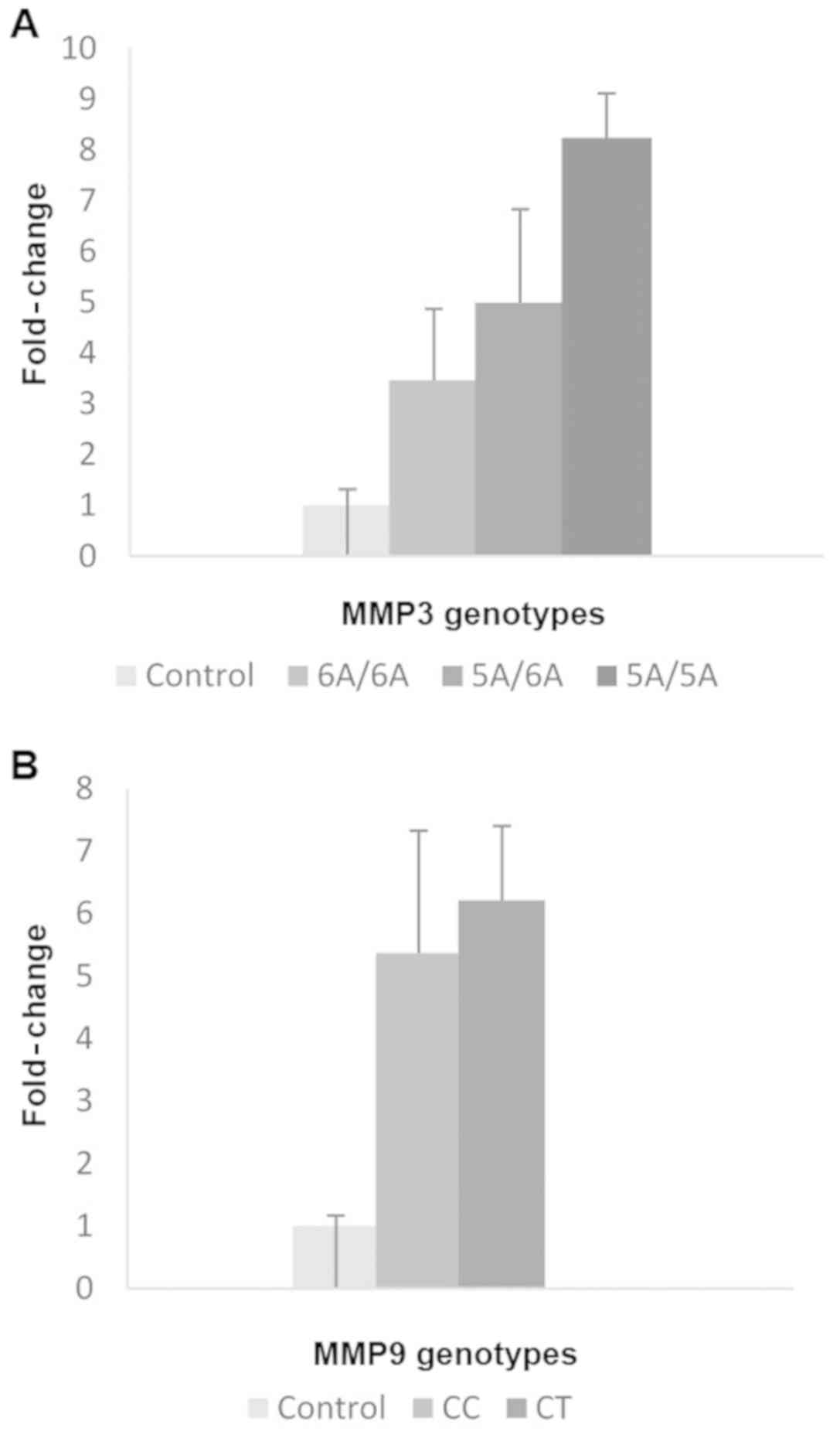
two times higher than6A/6A genotype patients (Fig. 2A). The expression of MMP9 in patients
was significantly up regulated in patients (P=0.021). Moreover, the
expression in CT genotype patients was found to be higher as
compared to patients suffering from CC genotype (Fig. 2B).
Association of MMP3 and MMP9 gene
polymorphisms and gene expression with clinicopathological
features
Genotypes distribution of MMP3 and MMP9
polymorphisms with respect to patient's clinical characteristics
are represented in Table IV. With
regard to MMP3, 6A/6A genotype was associated with grade II. But,
regarding lymph nodes (LNs) status, about half of patients with
negative LNs were of 6A/6A genotype, and it was noted that 6A/6A
genotype was associated with the expression of ER, PR, and more
than 50% of patients with positive Her-2 had 6A/6A genotype. With
respect to MMP9, CC genotype was associated with the less
aggressive pathological type grade II. Furthermore, the majority of
patients with negative LNs had CC genotype, concerning the
receptors status CC genotype associated with the presence of ER and
PR.
| Table IVAssociations of MMP3 and MMP9
genotypes with clinicopathological parameters of patients with
BC. |
Table IV
Associations of MMP3 and MMP9
genotypes with clinicopathological parameters of patients with
BC.
|
Characteristics | MMP3 genotypes | MMP9 genotypes |
|---|
| 5A/6A | 6A/6A | 5A/5A | CC | CT |
|---|
| Grade |
|
II | 28 | 84 | 9 | 108 | 13 |
|
III | 16 | 22 | 3 | 29 | 12 |
|
χ2 | 3.905 | 3.364 | 0.001 | 8.05 | |
|
P-value | 0.049 | 0.061 | 0.980 | 0.005a | |
| Axillary lymph node
status |
|
Negative | 28 | 35 | 4 | 59 | 8 |
|
Positive | 14 | 73 | 8 | 78 | 17 |
|
χ2 | 14.975 | 10.702 | 0.344 | 1.067 | |
|
P-value |
<0.001a | 0.001a | 0.557 | 0.302 | |
| ER status |
|
Negative | 17 | 33 | 4 | 42 | 12 |
|
Positive | 27 | 73 | 8 | 95 | 13 |
|
χ2 | 0.764 | 0.669 | ≥0.999 | 2.682 | |
|
P-value | 0.382 | 0.414 | ≤0.001a | 0.091 | |
| PR status |
|
Negative | 23 | 37 | 5 | 51 | 14 |
|
Positive | 21 | 69 | 7 | 86 | 11 |
|
χ2 | 3.711 | 3.475 | 0.013 | 3.102 | |
|
P-value | 0.052 | 0.063 | 0.910 | 0.078 | |
| Her-2 status |
|
Negative | 31 | 76 | 10 | 96 | 21 |
|
Positive | 18 | 25 | 2 | 40 | 5 |
|
χ2 | 2.809 | 1.224 | 0.798 | 1.218 | |
|
P-value | 0.089 | 0.271 | 0.370 | 0.288 | |
Table V illustrates the correlation between both of
MMP3 and MMP9 gene expression and patient's clinical
characteristics. Regarding MMP3, the expression was significantly
associated with positive PR and Her-2 (P=0.032, P=0.034
respectively). However, no significant link was found with the
other characteristics. On the other hand, MMP9 was significantly
associated with Her-2 receptor, but no other significant
association between its expression and the other
clinicoplathological parameters was noted.
Survival analysis
The median of disease-free and overall survival
rates showed no significant difference between the different
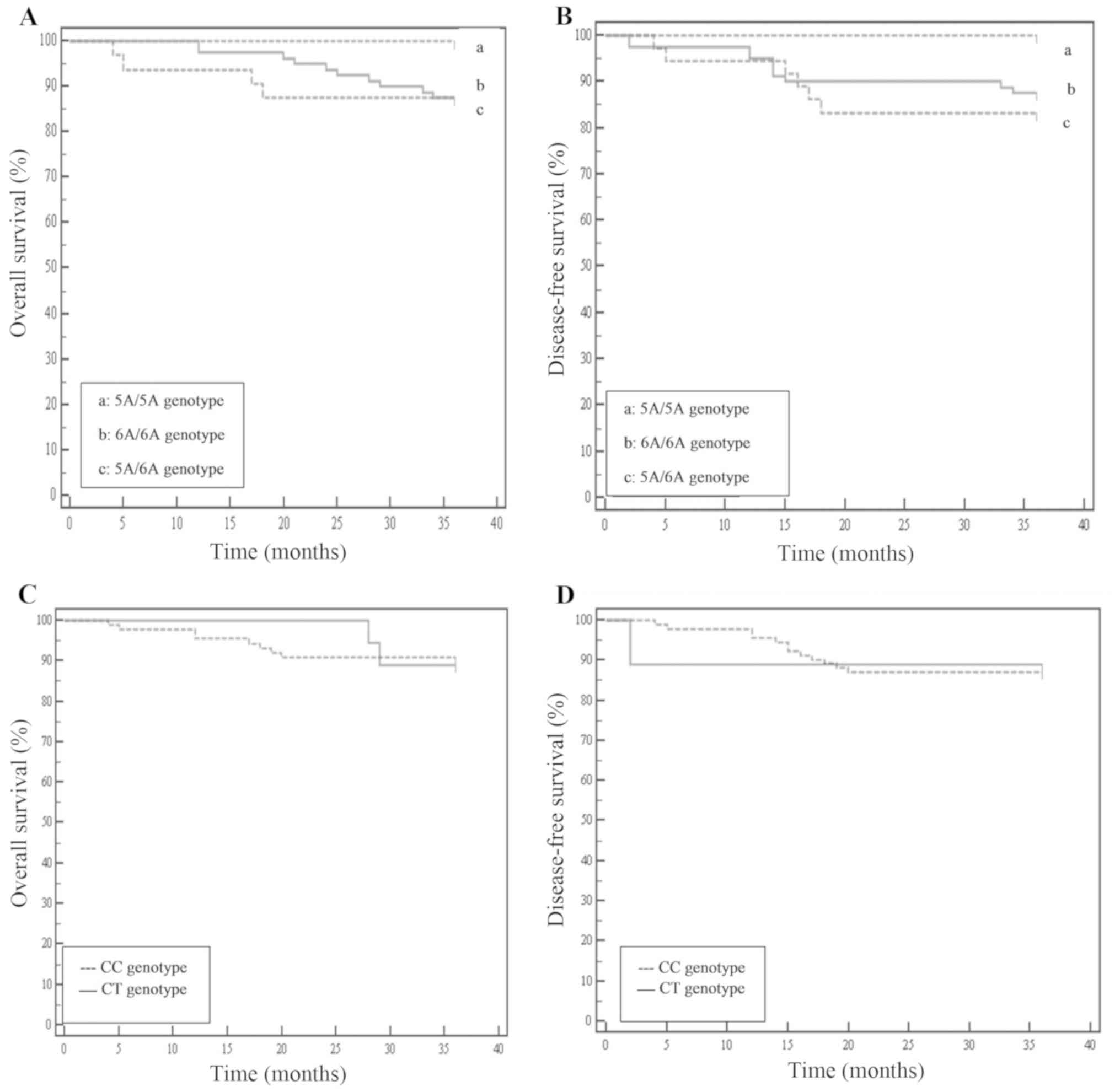
genotypes of MMP3-1171 5A/6A and MMP9-1562 C> T SNPs (Fig. 3).
Discussion
Compared to western females, BC in Egyptian females
may show some different characteristics, where the disease may have
different clinical, pathological and molecular profiling (17). A suitable explanation of such
inter-individuals variations of tumor characteristics may be
obtained through analysis of different SNPs, which may also
facilitate the prediction the patient's prognosis (8). Furthermore, and along with
investigating the variations in gene expression, SNPs analysis may
be promising predictive and prognostic markers, which may lead to
better management of the disease (18).
Most of the reported SNPs in MMPs genes are
functionally implicated in the progression of BC (19-21)
particularly; those found in the promoter region and alter gene
expression, which may result in imbalance in the MMP system, which,
in turn, leads to excessive degradation of ECM and deregulation of
ECM dynamics in cancer development (22).
The present study indicates that 5A/6A and 5A/5A
genotypes of MMP3 are associated with an increased risk for
developing BC. These results are in line with previous findings of
AbdRaboh in 2016, who reported that 5A allele is associated with
increased risk of BC in a sample of BC patients in UAE (23). In addition, Padala in 2017, reported
that 5A/6A genotype increased the risk of BC development among
Indian population (22).
With regard to MMP9, the present results are
consistent with that of Toroghi and his co-workers in 2017, who
reported that MMP-9 polymorphism [-1562 C>T] is not associated
with the BC incidence in the Iranian population (9). Many studies investigated the links
connecting the MMP-9 promoter polymorphism [-1562 C>T] with
cancers. However, the published results are inadequate and
inconclusive to confirm the relation of this SNP with the increased
risk of cancer (24,25). Lei et al (20) found a moderate increase in BC risk in
TT homozygote genotype, whereas Przybylowska et al 2006
negated the association between T allele and cancer development
(26). However, MMP9 polymorphism
was found to act as genetic modifiers for the prognosis of BC in
the Chinese population (27).
The present study reveals an insignificant
upregulation of MMP3 expression but a significant upregulation of
MMP9 expression in the BC patients. Such upregulation of both genes
may be attributed to the fact saying that MMPs are greatly
implicated in the cancer development and progression (28). Aberrant MMP expression is related to
elevated risk of different types of cancers (29,30). In
addition, gene expression of MMP3 and MMP9 is reported to be
up-regulated and to be implicated as prognostic marker in different
types of cancers such as gastric, melanoma, lung, colorectal, and
BC (24,31,32).
The 5A allele is associated with elevated
transcriptional activity (33).
However, insertion of an adenosine at the-1171 position in promoter
region reduces its transcriptional activity to about half, as such
insertion at the polymorphic site increases the binding affinity of
the promoter for the repressor ZBP-89, which is one of the
transcription factor that regulate the activity of the MMP3 gene
expression (34). Moreover, the
levels of both MMP3 mRNA and protein were reported to be
significantly elevated in the skin tissue of individuals with 5A/5A
genotype than 6A/6A individuals, and intermediate in 5A/6A
heterozygotes individuals (35).
On the other side, several cis elements in the
promoter region of MMP9 have been reported to regulate its
expression at the transcription level. These include 2 AP-1 sites
(2533, and 279, bound by transcription factors c-Fos and c-Jun), a
PEA3 motif (2540, recognized by transcription factor Ets), and a
consensus sequence (2600) for binding of nuclear factor-kB. C-1562T
polymorphic site is also an important regulatory element through
acting as a binding site for transcription repressor proteins
(36). Where, The C to T
substitution at position-1562 in MMP-9 promoter region increases
its transcriptional activity as T-allele lacks the ability of
binding to the repressor protein (26). The T allele promotes BC progression
through its enhancing effects on the MMP9 expression and activity,
which, in turn, increases ECM degradation and invasion (14,24).
Additionally, a direct association between increased
expression of MMP9 protein and bad prognosis among BC patients
(37) was reported. Furthermore,
differential MMP9 expression modulates the degree of cellular
differentiation and results in the increased aggressiveness of BC
(38). This may be attributed to the
fact saying that the-1562 C/T and -1171 6A/5A SNPs in the MMP9 and
MMP3 can modify the binding affinity of some transcription factors,
leading, in turn, to alteration in their gene expression (39,40).
Moreover, the up regulation of MMP3 and MMP9 expression resulting
from high transcriptional activity of either 5A allele or T allele
may promote the development and growth of various malignancies
(31,41).
The results of survival analysis are in accordance
with the finding of Padala et al (22), who reported decreased survival rate
associated with risk genotypes of MMP3 and MMP9 SNPs, while
statistically, it is insignificant. In addition Song et al
(42) reported a positive
association between the expression of MMP9, the increased risk of
cancer recurrence and the reduced the survival rates of BC
patients.
To the best of our knowledge, this is the first
study to investigate the association of MMP-3 promoter-1171
5A/6A, MMP-9 promoter-1562C>T SNPs and the risk of BC
among Egyptians. It was found that 1171-5A/6A MMP3 SNP is
associated with an increased risk of BC. However, polymorphism in
MMP9 is not associated with the risk. In addition, the absence of
homozygous TT genotype among the study population may indicate the
importance of studying SNPs among different populations as the
genetic composition was reported to be greatly varied from one
population to another.
Acknowledgements
Not applicable.
Funding
No funding was received.
Availability of data and materials
The datasets used and/or analyzed during the present
study are available from the corresponding author on reasonable
request.
Authors' contributions
FAERI designed the study and wrote the protocol with
the assistance of MH and NAAEM. NAEI collected the samples and
participated in the laboratory investigations. NAAEM and ME
interpreted the clinical data of patients. FAERI and SEE
contributed to laboratory investigations and statistical analysis.
MAE provided the laboratory equipment and consultation as well as
interpretation of results. FAERI wrote the manuscript and NAAEM and
MH proofread it. All authors provided advice and approved the final
manuscript.
Ethics approval and consent to
participate
The research methodology in the present work was
approved by Research Ethical Committee of the Medical Research
Institute, Alexandria University (10RG #:10RG0008812; Alexandria,
Egypt) and written informed consent was obtained from each
participant enrolled in the study prior to sample collection.
Experimental procedures and sampling followed the international and
national regulations in accordance with the Declaration of
Helsinki.
Patient consent for publication
Not applicable.
Competing interests
The authors declare that they have no competing
interests.
References
|
1
|
Bray F, Ferlay J, Soerjomataram I, Siegel
RL, Torre LA and Jemal A: Global cancer statistics 2018: GLOBOCAN
estimates of incidence and mortality worldwide for 36 cancers in
185 countries. CA Cancer J Clin. 68:394–424. 2018.PubMed/NCBI View Article : Google Scholar
|
|
2
|
DeSantis CE, Bray F, Ferlay J,
Lortet-Tieulent J, Anderson BO and Jemal A: International variation
in female breast cancer incidence and mortality rates. Cancer
Epidemiol Biomarkers Prev. 24:1495–1506. 2015.PubMed/NCBI View Article : Google Scholar
|
|
3
|
Ibrahim AS, Khaled HM, Mikhail NN, Baraka
H and Kamel H: Cancer incidence in Egypt: Results of the national
population-based cancer registry program. J Cancer Epidemiol.
2014(437971)2014.PubMed/NCBI View Article : Google Scholar
|
|
4
|
Michailidou K, Hall P, Gonzalez-Neira A,
Ghoussaini M, Dennis J, Milne RL, Schmidt MK, Chang-Claude J,
Bojesen SE, Bolla MK, et al: Large-scale genotyping identifies 41
new loci associated with breast cancer risk. Nat Genet. 45353–361.
(361e1-e2)2013.PubMed/NCBI View
Article : Google Scholar
|
|
5
|
Garcia-Closas M, Couch FJ, Lindstrom S,
Michailidou K, Schmidt MK, Brook MN, Orr N, Rhie SK, Riboli E,
Feigelson HS, et al: Genome-wide association studies identify four
ER negative-specific breast cancer risk loci. Nat Genet. 45392–398.
(398e1-e2)2013.PubMed/NCBI View
Article : Google Scholar
|
|
6
|
Deng N, Zhou H, Fan H and Yuan Y: Single
nucleotide polymorphisms and cancer susceptibility. Oncotarget.
8:110635–110649. 2017.PubMed/NCBI View Article : Google Scholar
|
|
7
|
Sternlicht MD, Bissell MJ and Werb Z: The
matrix metalloproteinase stromelysin-1 acts as a natural mammary
tumor promoter. Oncogene. 19:1102–1113. 2000.PubMed/NCBI View Article : Google Scholar
|
|
8
|
Verma S, Kesh K, Gupta A and Swarnakar S:
An overview of matrix metalloproteinase 9 polymorphism and gastric
cancer risk. Asian Pac J Cancer Prev. 16:7393–7400. 2015.PubMed/NCBI View Article : Google Scholar
|
|
9
|
Toroghi F, Mashayekhi F, Montazeri V,
Saedi HS and Zivar S: Association of MMP-9 promoter polymorphism
and breast cancer among Iranian patients. Eur J Oncol. 22:38–42.
2017.
|
|
10
|
Liu D, Guo H, Li Y, Xu X, Yang K and Bai
Y: Association between polymorphisms in the promoter regions of
matrix metalloproteinases (MMPs) and risk of cancer metastasis: A
meta-analysis. PLoS One. 7(e31251)2012.PubMed/NCBI View Article : Google Scholar
|
|
11
|
Li X, Qu L, Zhong Y, Zhao Y, Chen H and
Daru L: Association between promoters polymorphisms of matrix
metalloproteinases and risk of digestive cancers: A meta-analysis.
J Cancer Res Clin Oncol. 139:1433–1447. 2013.PubMed/NCBI View Article : Google Scholar
|
|
12
|
Okamoto K, Ishida C, Ikebuchi Y, Mandai M,
Mimura K, Murawaki Y and Yuasa I: The genotypes of IL-1 beta and
MMP-3 are associated with the prognosis of HCV-related
hepatocellular carcinoma. Intern Med. 49:887–895. 2010.PubMed/NCBI View Article : Google Scholar
|
|
13
|
Motovali-Bashi M, Hojati Z and Hajihoseiny
S: The role of matrix metalloproteinase-3 functional 5A/6A promoter
polymorphism in tumor cell progression and metastasis of breast
cancer. Iran J Biotechnol. 6:45–9. 2008.
|
|
14
|
Sadeghi M, Motovali-bashi M and Hojati Z:
MMP-9 promoter polymorphism associated with tumor progression of
breast cancer in Iranian population. Int J Integrat Biol. 6:33–37.
2009.PubMed/NCBI View Article : Google Scholar
|
|
15
|
Gencer S, Cebeci A and Irmak-Yazicioglu
MB: Matrix metalloproteinase gene expressions might be oxidative
stress targets in gastric cancer cell lines. Chin J Cancer Res.
25:322–333. 2013.PubMed/NCBI View Article : Google Scholar
|
|
16
|
Livak KJ and Schmittgen TD: Analysis of
relative gene expression data using real-time quantitative PCR and
the 2(-Delta Delta C(T)) method. Methods. 25:402–408.
2001.PubMed/NCBI View Article : Google Scholar
|
|
17
|
Chouchane L, Boussen H and Sastry KS:
Breast cancer in Arab populations: Molecular characteristics and
disease management implications. Lancet Oncol.
14(e417-e424)2013.PubMed/NCBI View Article : Google Scholar
|
|
18
|
Blons H, Gad S, Zinzindohoué F, Manière I,
Beauregard J, Tregouet D, Brasnu D, Beaune P, Laccourreye O and
Laurent-Puig P: Matrix metalloproteinase 3 polymorphism: A
predictive factor of response to neoadjuvant chemotherapy in head
and neck squamous cell carcinoma. Clin Cancer Res. 10:2594–2599.
2004.PubMed/NCBI View Article : Google Scholar
|
|
19
|
Ding C, Chen X, Zhang PT, Huang JP, Xu Y,
Chen N and Zhong LJ: Matrix Metalloproteinase-3-1171 5A/6A
Polymorphism (rs35068180) is Associated with Risk of Periodontitis.
Sci Rep. 5(11667)2015.PubMed/NCBI View Article : Google Scholar
|
|
20
|
Lei H, Hemminki K, Altieri A, Johansson R,
Enquist K, Hallmans G, Lenner P and Försti A: Promoter
polymorphisms in matrix metalloproteinases and their inhibitors:
Few associations with breast cancer susceptibility and progression.
Breast Cancer Res Treat. 103:61–69. 2007.PubMed/NCBI View Article : Google Scholar
|
|
21
|
Srivastava P, Gangwar R, Kapoor R and
Mittal RD: Bladder cancer risk associated with genotypic
polymorphism of the matrix metalloproteinase-1 and 7 in North
Indian population. Dis Markers. 29:37–46. 2010.PubMed/NCBI View Article : Google Scholar
|
|
22
|
Padala C, Tupurani MA, Puranam K, Gantala
S, Shyamala N, Kondapalli MS, Gundapaneni KK, Mudigonda S, Galimudi
RK, Kupsal K, et al: Synergistic effect of collagenase-1 (MMP1),
stromelysin-1 (MMP3) and gelatinase-B (MMP9) gene polymorphisms in
breast cancer. PLoS One. 12(e0184448)2017.PubMed/NCBI View Article : Google Scholar
|
|
23
|
Abdraboh NR and Bayoumi FA: Gene
polymorphism of matrix metalloproteinases 3 and 9 in breast cancer.
Gene Rep. 5:151–156. 2016. View Article : Google Scholar
|
|
24
|
Chiranjeevi P, Spurthi KM, Rani NS, Kumar
GR, Aiyengar TM, Saraswati M, Srilatha G, Kumar GK, Sinha S, Kumari
CS, et al: Gelatinase B (-1562C/T) polymorphism in tumor
progression and invasion of breast cancer. Tumour Biol.
35:1351–1356. 2014.PubMed/NCBI View Article : Google Scholar
|
|
25
|
Chaudhary AK, Pandya S, Mehrotra R and
Singh M and Singh M: Role of functional polymorphism of matrix
metalloproteinase-2 (-1306 C/T and -168 G/T) and MMP-9 (-1562 C/T)
promoter in oral submucous fibrosis and head and neck squamous cell
carcinoma in an Indian population. Biomarkers. 16:577–586.
2011.
|
|
26
|
Przybylowska K, Kluczna A, Zadrozny M,
Krawczyk T, Kulig A, Rykala J, Kolacinska A, Morawiec Z, Drzewoski
J and Blasiak J: Polymorphisms of the promoter regions of matrix
metalloproteinases genes MMP-1 and MMP-9 in breast cancer. Breast
Cancer Res Treat. 95:65–72. 2006.PubMed/NCBI View Article : Google Scholar
|
|
27
|
Fu F, Wang C, Chen LM, Huang M and Huang
HG: The influence of functional polymorphisms in matrix
metalloproteinase 9 on survival of breast cancer patients in a
Chinese population. DNA Cell Biol. 32:274–282. 2013.PubMed/NCBI View Article : Google Scholar
|
|
28
|
Amălinei C, Căruntu ID, Giuşcă SE and
Bălan RA: Matrix metalloproteinases involvement in pathologic
conditions. Rom J Morphol Embryol. 51:215–228. 2010.PubMed/NCBI
|
|
29
|
Fan SH, Wang YY, Lu J, Zheng YL, Wu DM,
Zhang ZF, Shan Q, Hu B, Li MQ and Cheng W: CERS2 suppresses tumor
cell invasion and is associated with decreased V-ATPase and
MMP-2/MMP-9 activities in breast cancer. J Cell Biochem.
116:502–513. 2015.PubMed/NCBI View Article : Google Scholar
|
|
30
|
Tabouret E, Bertucci F, Pierga JY, Petit
T, Levy C, Ferrero JM, Campone M, Gligorov J, Lerebours F, Roché H,
et al: MMP2 and MMP9 serum levels are associated with favorable
outcome in patients with inflammatory breast cancer treated with
bevacizumab-based neoadjuvant chemotherapy in the BEVERLY-2 study.
Oncotarget. 7:18531–18540. 2016.PubMed/NCBI View Article : Google Scholar
|
|
31
|
Jafari M, Pirouzi A, Mohsenzadeh M, Kusari
AA and Hajihosseini S: Association of MMP 9-1562C/T single
nucleotide polymorphism with the susceptibility to lung cancer
disease in South Iranian population. J Med Med Res. 4:2494–2502.
2014.PubMed/NCBI View Article : Google Scholar
|
|
32
|
McColgan P and Sharma P: Polymorphisms of
matrix metalloproteinases 1, 2, 3 and 9 and susceptibility to lung,
breast and colorectal cancer in over 30,000 subjects. Int J Cancer.
125:1473–1478. 2009.PubMed/NCBI View Article : Google Scholar
|
|
33
|
Yang X, Hu JW, Qiu MT, Li M, Yin R, Wang
J, Xu L and Zhang Q: Association of matrix metalloproteinase-3-1171
(5A>6A) polymorphism with cancer risk: A meta-analysis of 41
studies. PLoS One. 9(e87562)2014.PubMed/NCBI View Article : Google Scholar
|
|
34
|
Fanjul-Fernández M, Folgueras AR, Cabrera
S and López-Otín C: Matrix metalloproteinases: Evolution, gene
regulation and functional analysis in mouse models. Biochim Biophys
Acta. 1803:3–19. 2010.PubMed/NCBI View Article : Google Scholar
|
|
35
|
Medley TL, Kingwell BA, Gatzka CD, Pillay
P and Cole TJ: Matrix metalloproteinase-3 genotype contributes to
age-related aortic stiffening through modulation of gene and
protein expression. Circ Res. 92:1254–1261. 2003.PubMed/NCBI View Article : Google Scholar
|
|
36
|
Zhang B, Ye S, Herrmann SM, Eriksson P, de
Maat M, Evans A, Arveiler D, Luc G, Cambien F, Hamsten A, et al:
Functional polymorphism in the regulatory region of gelatinase B
gene in relation to severity of coronary atherosclerosis.
Circulation. 99:1788–1794. 1999.PubMed/NCBI View Article : Google Scholar
|
|
37
|
Youssef NS and Hakim SA: Association of
Fascin and matrix metalloproteinase-9 expression with poor
prognostic parameters in breast carcinoma of Egyptian women. Diagn
Pathol. 9(136)2014.PubMed/NCBI View Article : Google Scholar
|
|
38
|
Yousef EM, Tahir MR, St-Pierre Y and
Gaboury LA: MMP-9 expression varies according to molecular subtypes
of breast cancer. BMC Cancer. 14(609)2014.
|
|
39
|
Jormsjö S, Whatling C, Walter DH, Zeiher
AM, Hamsten A and Eriksson P: Allele-specific regulation of matrix
metalloproteinase-7 promoter activity is associated with coronary
artery luminal dimensions among hypercholesterolemic patients.
Arterioscler Thromb Vasc Biol. 21:1834–1839. 2001.PubMed/NCBI View Article : Google Scholar
|
|
40
|
Rahimi Z, Yari K and Rahimi Z: Matrix
metalloproteinase-9-1562T allele and its combination with MMP-2-735
C allele are risk factors for breast cancer. Asian Pac J Cancer
Prev. 16:1175–1179. 2015.PubMed/NCBI View Article : Google Scholar
|
|
41
|
Sugimoto M, Yoshida S, Kennedy S, Deguchi
M, Ohara N and Maruo T: Matrix metalloproteinase-1 and -9 promoter
polymorphisms and endometrial carcinoma risk in a Japanese
population. J Soc Gynecol Investig. 13:523–529. 2006.PubMed/NCBI View Article : Google Scholar
|
|
42
|
Song J, Su H, Zhou YY and Guo LL:
Prognostic value of matrix metalloproteinase 9 expression in breast
cancer patients: A meta-analysis. Asian Pac J Cancer Prev.
14:1615–1621. 2013.PubMed/NCBI View Article : Google Scholar
|