Spandidos Publications Logo
  • About
    • About Spandidos
    • Aims and Scopes
    • Abstracting and Indexing
    • Editorial Policies
    • Reprints and Permissions
    • Job Opportunities
    • Terms and Conditions
    • Contact
  • Journals
    • All Journals
    • Oncology Letters
      • Oncology Letters
      • Information for Authors
      • Editorial Policies
      • Editorial Board
      • Aims and Scope
      • Abstracting and Indexing
      • Bibliographic Information
      • Archive
    • International Journal of Oncology
      • International Journal of Oncology
      • Information for Authors
      • Editorial Policies
      • Editorial Board
      • Aims and Scope
      • Abstracting and Indexing
      • Bibliographic Information
      • Archive
    • Molecular and Clinical Oncology
      • Molecular and Clinical Oncology
      • Information for Authors
      • Editorial Policies
      • Editorial Board
      • Aims and Scope
      • Abstracting and Indexing
      • Bibliographic Information
      • Archive
    • Experimental and Therapeutic Medicine
      • Experimental and Therapeutic Medicine
      • Information for Authors
      • Editorial Policies
      • Editorial Board
      • Aims and Scope
      • Abstracting and Indexing
      • Bibliographic Information
      • Archive
    • International Journal of Molecular Medicine
      • International Journal of Molecular Medicine
      • Information for Authors
      • Editorial Policies
      • Editorial Board
      • Aims and Scope
      • Abstracting and Indexing
      • Bibliographic Information
      • Archive
    • Biomedical Reports
      • Biomedical Reports
      • Information for Authors
      • Editorial Policies
      • Editorial Board
      • Aims and Scope
      • Abstracting and Indexing
      • Bibliographic Information
      • Archive
    • Oncology Reports
      • Oncology Reports
      • Information for Authors
      • Editorial Policies
      • Editorial Board
      • Aims and Scope
      • Abstracting and Indexing
      • Bibliographic Information
      • Archive
    • Molecular Medicine Reports
      • Molecular Medicine Reports
      • Information for Authors
      • Editorial Policies
      • Editorial Board
      • Aims and Scope
      • Abstracting and Indexing
      • Bibliographic Information
      • Archive
    • World Academy of Sciences Journal
      • World Academy of Sciences Journal
      • Information for Authors
      • Editorial Policies
      • Editorial Board
      • Aims and Scope
      • Abstracting and Indexing
      • Bibliographic Information
      • Archive
    • International Journal of Functional Nutrition
      • International Journal of Functional Nutrition
      • Information for Authors
      • Editorial Policies
      • Editorial Board
      • Aims and Scope
      • Abstracting and Indexing
      • Bibliographic Information
      • Archive
    • International Journal of Epigenetics
      • International Journal of Epigenetics
      • Information for Authors
      • Editorial Policies
      • Editorial Board
      • Aims and Scope
      • Abstracting and Indexing
      • Bibliographic Information
      • Archive
    • Medicine International
      • Medicine International
      • Information for Authors
      • Editorial Policies
      • Editorial Board
      • Aims and Scope
      • Abstracting and Indexing
      • Bibliographic Information
      • Archive
  • Articles
  • Information
    • Information for Authors
    • Information for Reviewers
    • Information for Librarians
    • Information for Advertisers
    • Conferences
  • Language Editing
Spandidos Publications Logo
  • About
    • About Spandidos
    • Aims and Scopes
    • Abstracting and Indexing
    • Editorial Policies
    • Reprints and Permissions
    • Job Opportunities
    • Terms and Conditions
    • Contact
  • Journals
    • All Journals
    • Biomedical Reports
      • Information for Authors
      • Editorial Policies
      • Editorial Board
      • Aims and Scope
      • Abstracting and Indexing
      • Bibliographic Information
      • Archive
    • Experimental and Therapeutic Medicine
      • Information for Authors
      • Editorial Policies
      • Editorial Board
      • Aims and Scope
      • Abstracting and Indexing
      • Bibliographic Information
      • Archive
    • International Journal of Epigenetics
      • Information for Authors
      • Editorial Policies
      • Editorial Board
      • Aims and Scope
      • Abstracting and Indexing
      • Bibliographic Information
      • Archive
    • International Journal of Functional Nutrition
      • Information for Authors
      • Editorial Policies
      • Editorial Board
      • Aims and Scope
      • Abstracting and Indexing
      • Bibliographic Information
      • Archive
    • International Journal of Molecular Medicine
      • Information for Authors
      • Editorial Policies
      • Editorial Board
      • Aims and Scope
      • Abstracting and Indexing
      • Bibliographic Information
      • Archive
    • International Journal of Oncology
      • Information for Authors
      • Editorial Policies
      • Editorial Board
      • Aims and Scope
      • Abstracting and Indexing
      • Bibliographic Information
      • Archive
    • Medicine International
      • Information for Authors
      • Editorial Policies
      • Editorial Board
      • Aims and Scope
      • Abstracting and Indexing
      • Bibliographic Information
      • Archive
    • Molecular and Clinical Oncology
      • Information for Authors
      • Editorial Policies
      • Editorial Board
      • Aims and Scope
      • Abstracting and Indexing
      • Bibliographic Information
      • Archive
    • Molecular Medicine Reports
      • Information for Authors
      • Editorial Policies
      • Editorial Board
      • Aims and Scope
      • Abstracting and Indexing
      • Bibliographic Information
      • Archive
    • Oncology Letters
      • Information for Authors
      • Editorial Policies
      • Editorial Board
      • Aims and Scope
      • Abstracting and Indexing
      • Bibliographic Information
      • Archive
    • Oncology Reports
      • Information for Authors
      • Editorial Policies
      • Editorial Board
      • Aims and Scope
      • Abstracting and Indexing
      • Bibliographic Information
      • Archive
    • World Academy of Sciences Journal
      • Information for Authors
      • Editorial Policies
      • Editorial Board
      • Aims and Scope
      • Abstracting and Indexing
      • Bibliographic Information
      • Archive
  • Articles
  • Information
    • For Authors
    • For Reviewers
    • For Librarians
    • For Advertisers
    • Conferences
  • Language Editing
Login Register Submit
  • This site uses cookies
  • You can change your cookie settings at any time by following the instructions in our Cookie Policy. To find out more, you may read our Privacy Policy.

    I agree
Search articles by DOI, keyword, author or affiliation
Search
Advanced Search
presentation
Molecular and Clinical Oncology
Join Editorial Board Propose a Special Issue
Print ISSN: 2049-9450 Online ISSN: 2049-9469
Journal Cover
December-2020 Volume 13 Issue 6

Full Size Image

Sign up for eToc alerts
Recommend to Library

Journals

International Journal of Molecular Medicine

International Journal of Molecular Medicine

International Journal of Molecular Medicine is an international journal devoted to molecular mechanisms of human disease.

International Journal of Oncology

International Journal of Oncology

International Journal of Oncology is an international journal devoted to oncology research and cancer treatment.

Molecular Medicine Reports

Molecular Medicine Reports

Covers molecular medicine topics such as pharmacology, pathology, genetics, neuroscience, infectious diseases, molecular cardiology, and molecular surgery.

Oncology Reports

Oncology Reports

Oncology Reports is an international journal devoted to fundamental and applied research in Oncology.

Experimental and Therapeutic Medicine

Experimental and Therapeutic Medicine

Experimental and Therapeutic Medicine is an international journal devoted to laboratory and clinical medicine.

Oncology Letters

Oncology Letters

Oncology Letters is an international journal devoted to Experimental and Clinical Oncology.

Biomedical Reports

Biomedical Reports

Explores a wide range of biological and medical fields, including pharmacology, genetics, microbiology, neuroscience, and molecular cardiology.

Molecular and Clinical Oncology

Molecular and Clinical Oncology

International journal addressing all aspects of oncology research, from tumorigenesis and oncogenes to chemotherapy and metastasis.

World Academy of Sciences Journal

World Academy of Sciences Journal

Multidisciplinary open-access journal spanning biochemistry, genetics, neuroscience, environmental health, and synthetic biology.

International Journal of Functional Nutrition

International Journal of Functional Nutrition

Open-access journal combining biochemistry, pharmacology, immunology, and genetics to advance health through functional nutrition.

International Journal of Epigenetics

International Journal of Epigenetics

Publishes open-access research on using epigenetics to advance understanding and treatment of human disease.

Medicine International

Medicine International

An International Open Access Journal Devoted to General Medicine.

Journal Cover
December-2020 Volume 13 Issue 6

Full Size Image

Sign up for eToc alerts
Recommend to Library

  • Article
  • Citations
    • Cite This Article
    • Download Citation
    • Create Citation Alert
    • Remove Citation Alert
    • Cited By
  • Similar Articles
    • Related Articles (in Spandidos Publications)
    • Similar Articles (Google Scholar)
    • Similar Articles (PubMed)
  • Download PDF
  • Download XML
  • View XML
Article

Effect of carboplatin when administered after dacarbazine failure: Clinical benefit of sequential therapy

  • Authors:
    • Eve Merry
    • Maria Marples
    • Sarah Danson
    • David Harding
    • James Denny
    • Ignacio Vazquez
    • Louise Chesshire
    • Fiona Taylor
    • Alberto Fusi
    • Angus G. Dalgleish
  • View Affiliations / Copyright

    Affiliations: Department of Medical Oncology, St. George's Hospital NHS Trust, London SW17 0QT, UK, Institute of Oncology, St. James's University Hospital, Leeds LS9 7TF, UK, Weston Park Cancer Centre, Weston Park Hospital, University of Sheffield, Sheffield S10 2SJ, UK, Academic Unit of Clinical Oncology, The University of Sheffield, Sheffield S10 2TN, UK
  • Article Number: 73
    |
    Published online on: September 21, 2020
       https://doi.org/10.3892/mco.2020.2144
  • Expand metrics +
Metrics: Total Views: 0 (Spandidos Publications: | PMC Statistics: )
Metrics: Total PDF Downloads: 0 (Spandidos Publications: | PMC Statistics: )
Cited By (CrossRef): 0 citations Loading Articles...

This article is mentioned in:


Abstract

Dacarbazine chemotherapy has been the mainstay of melanoma treatment for >30 years. In the early 2000s, carboplatin (with or without other agents, such as paclitaxel) was the most commonly used second‑line therapy in the UK. The aim of the present study was to report a significant response rate to second‑line carboplatin in patients from three UK institutions who had been previously treated and failed to respond to dacarbazine, and investigate whether sequential therapy may be more effective compared with combination therapy. A total of 104 patients were identified, the majority of whom were treated with carboplatin (area under the curve 5‑6) every 3 weeks for a maximum of 6 cycles. A total of 102 patients were evaluable for response, among whom 11 patients had an objective response (1 complete response and 10 partial responses) and 15 had stable disease, giving an overall response rate of 11% and disease control rate of 26%. The median progression‑free survival was 1.8 months (range, 0.2‑36+ months) and the median overall survival was 4.6 months (range, 0.2‑36+ months). Surprisingly, the majority of the patients who benefited from second‑line carboplatin therapy were those with visceral metastases, the survival of whom would not be expected to exceed 6 months after first‑line treatment.

Introduction

The outlook for patients with metastatic melanoma has been transformed in the last few years, with >40% of patients treated with combination checkpoint inhibitor therapy or combination targeted therapy, in case of BRAF-mutated melanoma, in clinical trials remaining alive after 5 years (1). Novel therapies may hold promise in terms of durable remissions, but the majority of the patients with melanoma experience progression, and some require chemotherapy.

Dacarbazine chemotherapy has been the mainstay of melanoma treatment for >30 years. However, the objective response (OR) rate was in the order of 10-20%, and median survival was not prolonged (2,3), although some patients experienced symptomatic relief, albeit at the cost of limited toxicity. There was no standard second-line therapy, and the recommended approach was clinical trials. Patients who were unable or unwilling to enter a trial, were considered as possible candidates for chemotherapy. In the early 2000s, carboplatin (with or without other agents, such as paclitaxel) was the most commonly used second-line agent in the UK (4). The aim of the present study was to report the response rate to second-line carboplatin in patients with melanoma from three UK institutions who were previously treated and failed to respond to dacarbazine, and examine whether sequential therapy may be more effective compared with combination therapy. This may apply to the incorporation of the newer targeted and immunotherapy treatments available since this study was commenced.

Patients and methods

Patients and approval

Lists of patients treated with carboplatin for metastatic melanoma were obtained from chemotherapy electronic databases at three tertiary referral cancer centres, namely St. George's Hospital (London), St. James's University Hospital (Leeds) and Weston Park Hospital (Sheffield). The periods covered by the analysis were October 2005-January 2011 for Leeds and Sheffield, and November 2009-September 2015 for St. George's Hospital in London. Permission to perform the analysis was granted by the local committees of all three hospitals.

Statistical analysis

Demographic disease-related and treatment data were extracted from electronic patient records and entered into an Excel spreadsheet. Data were analysed using Graph Pad Prism software, version 8.0 (GraphPad Software, Inc.).

Results

Patients and treatment

A total of 104 patients were identified (49 from St. George's Hospital, 35 from St. James's Hospital and 20 from Weston Park Hospital). The patient characteristics are summarised in Table I. The majority of the patients were treated with carboplatin (area under the curve 5-6) every 3 weeks for a maximum of 6 cycles. Carboplatin was administered as second-line treatment after documented disease progression (no planned switch).

Table I

Patient demographics prior to commencing treatment with carboplatin (n=104).

Table I

Patient demographics prior to commencing treatment with carboplatin (n=104).

VariablesNo.
Median age, years (range)61 (23-89)
Eastern Cooperative Oncology 
Group performance status 
     048
     128
     213
     33
     Unknown12
Primary melanoma location 
     Skin91
     Mucosal2
     Ocular9
     Unknown2
American Joint Committee on Cancer stage (version 7) 
     III16
     IV88
Baseline lactate dehydrogenase 
     Normal48
     Elevated52
     Not recorded4
First-line regimen 
     Single-agent dacarbazine85
     Temozolomide4
     Dacarbazine in combination with other agents15
Best response to first-line treatment 
     Complete response0
     Partial response12
     Stable disease14
     Progressive disease76
     Not recorded2
Response to treatment

A total of 102 patients were evaluable for response; 11 patients had an OR [complete response (CR), n=1; partial response (PR), n=10], and 15 had stable disease (SD), with an OR of 11% and disease control rate (CR + PR + SD) of 26%. Treatment was generally well-tolerated, with 31 patients requiring at least one dose reduction, and 8 patients discontinuing treatment due to side effects.

Survival

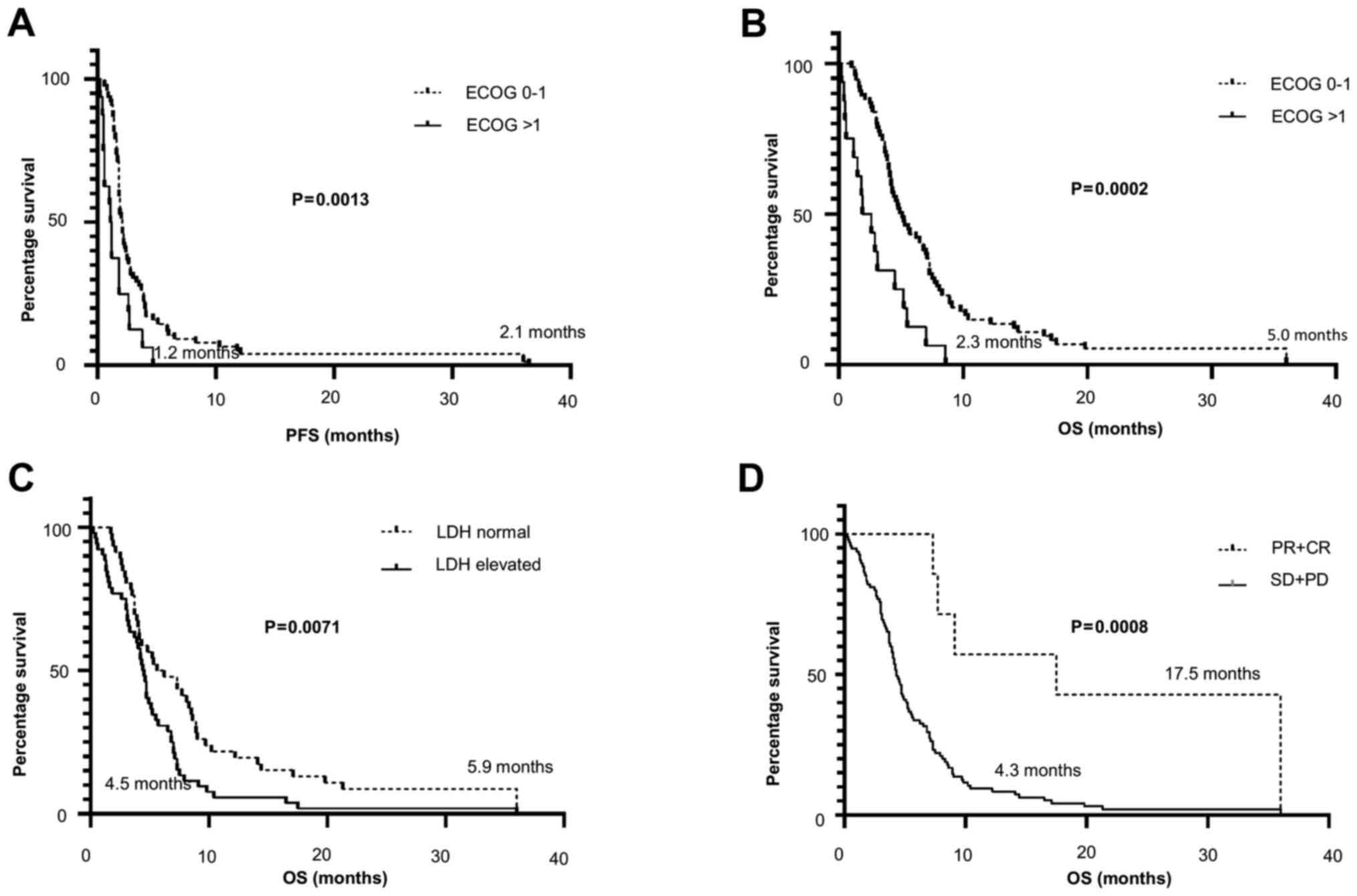
Progression-free-survival (PFS) data were available for all the patients. Overall survival (OS) data were available for 102 patients. All data were censored at 36 months. A total of 3 patients remained alive at the time of analysis. The median PFS was 1.8 months (range, 0.2-36+ months) and the median OS was 4.6 months (range, 0.2-36+ months). Patients with an Eastern Cooperative Oncology Group (ECOG) performance status of 0-1 had a longer PFS (2.1 vs. 1.2 months; P=0.0013 log-rank test; Fig. 1A) and extended median OS (5.0 vs. 2.3 months; P=0.0002; Fig. 1B). Patients with normal lactate dehydrogenase (LDH) levels prior to commencing treatment with carboplatin also had a longer median OS (5.9 vs. 4.5 months; P<0.0071; Fig. 1C). Patients who achieved an OR to treatment had a longer median OS (4.3 vs. 17.5 months; P=0.0008; Fig. 1D) compared with non-responders.

Figure 1

(A and B) PFS and OS in patients treated with carboplatin according to ECOG performance status score (0-1 vs. >1). OS according to (C) the levels of LDH (normal vs. elevated) and (D) the objective response to treatment (PR + CR vs. SD + PD). OS, overall survival; PFS, progression-free survival; ECOG, Eastern Cooperative Oncology Group; LDH, lactate dehydrogenase; PR, partial response; CR, complete response; D, stable disease; PD, progressive disease.

Discussion

The outlook for patients with metastatic melanoma has improved greatly in the last decade. The anti-CTLA-4 monoclonal antibody ipilimumab was the first drug to achieve prolongation of survival in patients with metastatic melanoma (5). Further improvements have been observed with the introduction of the anti-programmed cell death protein 1 (PD1) antibodies pembrolizumab and nivolumab, which are more effective and less toxic compared with ipilimumab, and with the combination of ipilimumab and nivolumab, which achieved an OR rate of 58% (6). Patients whose melanomas harbour BRAF mutations also have the option of treatment with BRAF inhibitors (vemurafenib or dabrafenib), or with combinations of BRAF and MEK inhibitors (dabrafenib with trametinib, or encorafenib with binimetinib). The OR with single-agent BRAF inhibitor was ~55%, compared with 68% in patients on combination therapy (7). Over half of the patients treated with combination therapies remained alive at 3 years (6,7).

Despite these advances, it is likely that most patients with metastatic melanoma will relapse. A number of patients are not suitable for combination therapy, others are unable to receive immunotherapy due to pre-existing autoimmune conditions, and 60% of melanomas are wild-type for BRAF (8). These patients may still require treatment, and it is therefore important to assess pre-existing therapies and evaluate previous experience. To the best of our knowledge, the present review of 104 consecutive patients in three centres who were treated with carboplatin for metastatic melanoma is the largest such series to date. In our cohorts of patients, response and disease stabilisation were observed, with no unexpected complications. Patients with an ECOG performance status of 0-1, normal levels of LDH, and those who achieved an OR, exhibited a significantly longer OS, in keeping with the data in the literature (9,10). Surprisingly, the majority of the patients who benefited from second-line carboplatin therapy were those with visceral distant metastases, the survival of whom would not be expected to exceed 6 months after first-line treatment. Dacarbazine plus cisplatin or carboplatin, when given together, appear to have no synergistic benefit (11), and it is unclear whether dacarbazine exerts any significant effect on the susceptibility of tumour cells to carboplatin, or whether there is an indirect effect on the microenvironment or the immune response. It is therefore of great interest that a small but true benefit was observed with the sequential use of these agents, where the overall clinical benefit of 26% is notably higher compared with that reported by several first-line studies (2,3). It is particularly important, given that there appears to be a concern that multiple drug combinations may achieve better response rates, but do not affect the overall outcome or survival. Of the 3 patients who remain alive and who had an OR to treatment, 2 also received a course of low-dose interleukin-2 post-carboplatin, which may also suggest a type of synergy of the sequential treatment (12).

In conclusion, the observations of the present study may provide a rationale for exploring the potential of carboplatin in patients with failure of targeted treatment and immunotherapy, and for other treatments to be used sequentially rather than concurrently, where the only definitive outcome that can be expected is enhanced toxicity.

Acknowledgements

Not applicable.

Funding

The work of AF is funded by the Institute for Cancer Vaccines and Immunotherapy-ICVI (Registered Charity no. 1080343).

Availability of data and materials

The dataset used and analysed during the present study is available from the corresponding author on reasonable request.

Authors' contributions

MM and AGD conceived the original idea for the manuscript. DH, LC, JD, EM, FT, SD and IV collected the data. AF analysed the data. AGD and AF wrote the manuscript. All the authors have read and approved the final manuscript.

Ethics approval and consent to participate

Permission to perform the analysis was granted by the Hospitals' Local Ethics Committees.

Patient consent for publication

Not applicable.

Competing interests

The authors declare that they have no competing interests.

References

1 

Mario S: Long-term survival outcomes with new treatments for advanced melanoma: Questions still in need of answers (ASCO post) Available from: https://ascopost.com/issues/october-25-2019/long-term-survival-outcomes-with-new-treatments-for-advanced-melanoma/. Accessed June 30, 2020.

2 

Chapman PB, Einhorn LH, Meyers ML, Saxman S, Destro AN, Panageas KS, Begg CB, Agarwala SS, Schuchter LM, Ernstoff MS, et al: Phase III multicenter randomized trial of the Dartmouth regimen versus dacarbazine in patients with metastatic melanoma. J Clin Oncol. 17:2745–2751. 1999.PubMed/NCBI View Article : Google Scholar

3 

Middleton MR, Grob JJ, Aaronson N, Fierlbeck G, Tilgen W, Seiter S, Gore M, Aamdal S, Cebon J, Coates A, et al: Randomized phase III study of temozolomide versus dacarbazine in the treatment of patients with advanced metastatic malignant melanoma. J Clin Oncol. 18:158–166. 2000.PubMed/NCBI View Article : Google Scholar

4 

Lorigan P, Marples M, Harries M, Wagstaff J, Dalgleish AG, Osborne R, Maraveyas A, Nicholson S, Davidson N, Wang Q, et al: Treatment patterns, outcomes, and resource utilization of patients with metastatic melanoma in the U.K: The MELODY study. Br J Dermatol. 170:87–95. 2014.PubMed/NCBI View Article : Google Scholar

5 

Hodi FS, O'Day SJ, McDermott DF, Weber RW, Sosman JA, Haanen JB, Gonzalez R, Robert C, Schadendorf D, Hassel JC, et al: Improved survival with ipilimumab in patients with metastatic melanoma. N Engl J Med. 363:711–723. 2010.PubMed/NCBI View Article : Google Scholar

6 

Wolchok JD, Chiarion-Sileni V, Gonzalez R, Rutkowski P, Grob JJ, Cowey CL, Lao CD, Wagstaff J, Schadendorf D, Ferrucci PF, et al: Overall survival with combined nivolumab and ipilimumab in advanced melanoma. N Engl J Med. 377:1345–1356. 2017.PubMed/NCBI View Article : Google Scholar

7 

Long GV, Stroyakovskiy D, Gogas H, Levchenko E, de Braud F, Larkin J, Garbe C, Jouary T, Hauschild A, Grob JJ, et al: Dabrafenib and trametinib versus dabrafenib and placebo for Val600 BRAF-mutant melanoma: A multicentre, double-blind, phase 3 randomised controlled trial. Lancet. 386:444–451. 2015.PubMed/NCBI View Article : Google Scholar

8 

Kong BY, Carlino MS and Menzies AM: Biology and treatment of BRAF mutant metastatic melanoma. Melanoma Manag. 3:33–45. 2016.PubMed/NCBI View Article : Google Scholar

9 

Minor DR, Moore D, Kim C, Kashani Sabet M, Venna SS, Wang W, Boasberg P and O'Day S: Prognostic factors in metastatic melanoma patients treated with biochemotherapy and maintenance immunotherapy. Oncologist. 14:995–1002. 2009.PubMed/NCBI View Article : Google Scholar

10 

Hauschild A, Larkin J, Ribas A, Dréno B, Flaherty KT, Ascierto PA, Lewis KD, McKenna E, Zhu Q, Mun Y and McArthur GA: Modelled prognostic subgroups for survival and treatment outcomes in BRAF V600-Mutated metastatic melanoma: Pooled analysis of 4 randomized clinical trials. JAMA Oncol. 4:1382–1388. 2018.PubMed/NCBI View Article : Google Scholar

11 

Jungnelius U, Ringborg U, Aamdal S, Mattsson J, Stierner U, Ingvar C, Malmström P, Andersson R, Karlsson M, Willman K, et al: Dacarbazine-vindesine versus dacarbazine-vindesine-cisplatin in disseminated malignant melanoma. A randomised phase III trial. Eur J Cancer. 34:1368–1374. 1998.PubMed/NCBI View Article : Google Scholar

12 

Legha SS, Ring S, Bedikian A, Plager C, Eton O, Buzaid AC and Papadopulos N: Treatment of metastatic melanoma with combined chemotherapy containing cisplatin, vinblastine and dacarbazine (CVD) and biotherapy using interleukin-2 and interferon-alpha. Ann Oncol. 7:827–835. 1996.PubMed/NCBI View Article : Google Scholar

Related Articles

  • Abstract
  • View
  • Download
  • Twitter
Copy and paste a formatted citation
Spandidos Publications style
Merry E, Marples M, Danson S, Harding D, Denny J, Vazquez I, Chesshire L, Taylor F, Fusi A, Dalgleish AG, Dalgleish AG, et al: Effect of carboplatin when administered after dacarbazine failure: Clinical benefit of sequential therapy. Mol Clin Oncol 13: 73, 2020.
APA
Merry, E., Marples, M., Danson, S., Harding, D., Denny, J., Vazquez, I. ... Dalgleish, A.G. (2020). Effect of carboplatin when administered after dacarbazine failure: Clinical benefit of sequential therapy. Molecular and Clinical Oncology, 13, 73. https://doi.org/10.3892/mco.2020.2144
MLA
Merry, E., Marples, M., Danson, S., Harding, D., Denny, J., Vazquez, I., Chesshire, L., Taylor, F., Fusi, A., Dalgleish, A. G."Effect of carboplatin when administered after dacarbazine failure: Clinical benefit of sequential therapy". Molecular and Clinical Oncology 13.6 (2020): 73.
Chicago
Merry, E., Marples, M., Danson, S., Harding, D., Denny, J., Vazquez, I., Chesshire, L., Taylor, F., Fusi, A., Dalgleish, A. G."Effect of carboplatin when administered after dacarbazine failure: Clinical benefit of sequential therapy". Molecular and Clinical Oncology 13, no. 6 (2020): 73. https://doi.org/10.3892/mco.2020.2144
Copy and paste a formatted citation
x
Spandidos Publications style
Merry E, Marples M, Danson S, Harding D, Denny J, Vazquez I, Chesshire L, Taylor F, Fusi A, Dalgleish AG, Dalgleish AG, et al: Effect of carboplatin when administered after dacarbazine failure: Clinical benefit of sequential therapy. Mol Clin Oncol 13: 73, 2020.
APA
Merry, E., Marples, M., Danson, S., Harding, D., Denny, J., Vazquez, I. ... Dalgleish, A.G. (2020). Effect of carboplatin when administered after dacarbazine failure: Clinical benefit of sequential therapy. Molecular and Clinical Oncology, 13, 73. https://doi.org/10.3892/mco.2020.2144
MLA
Merry, E., Marples, M., Danson, S., Harding, D., Denny, J., Vazquez, I., Chesshire, L., Taylor, F., Fusi, A., Dalgleish, A. G."Effect of carboplatin when administered after dacarbazine failure: Clinical benefit of sequential therapy". Molecular and Clinical Oncology 13.6 (2020): 73.
Chicago
Merry, E., Marples, M., Danson, S., Harding, D., Denny, J., Vazquez, I., Chesshire, L., Taylor, F., Fusi, A., Dalgleish, A. G."Effect of carboplatin when administered after dacarbazine failure: Clinical benefit of sequential therapy". Molecular and Clinical Oncology 13, no. 6 (2020): 73. https://doi.org/10.3892/mco.2020.2144
Follow us
  • Twitter
  • LinkedIn
  • Facebook
About
  • Spandidos Publications
  • Careers
  • Cookie Policy
  • Privacy Policy
How can we help?
  • Help
  • Live Chat
  • Contact
  • Email to our Support Team