Spandidos Publications Logo
  • About
    • About Spandidos
    • Aims and Scopes
    • Abstracting and Indexing
    • Editorial Policies
    • Reprints and Permissions
    • Job Opportunities
    • Terms and Conditions
    • Contact
  • Journals
    • All Journals
    • Oncology Letters
      • Oncology Letters
      • Information for Authors
      • Editorial Policies
      • Editorial Board
      • Aims and Scope
      • Abstracting and Indexing
      • Bibliographic Information
      • Archive
    • International Journal of Oncology
      • International Journal of Oncology
      • Information for Authors
      • Editorial Policies
      • Editorial Board
      • Aims and Scope
      • Abstracting and Indexing
      • Bibliographic Information
      • Archive
    • Molecular and Clinical Oncology
      • Molecular and Clinical Oncology
      • Information for Authors
      • Editorial Policies
      • Editorial Board
      • Aims and Scope
      • Abstracting and Indexing
      • Bibliographic Information
      • Archive
    • Experimental and Therapeutic Medicine
      • Experimental and Therapeutic Medicine
      • Information for Authors
      • Editorial Policies
      • Editorial Board
      • Aims and Scope
      • Abstracting and Indexing
      • Bibliographic Information
      • Archive
    • International Journal of Molecular Medicine
      • International Journal of Molecular Medicine
      • Information for Authors
      • Editorial Policies
      • Editorial Board
      • Aims and Scope
      • Abstracting and Indexing
      • Bibliographic Information
      • Archive
    • Biomedical Reports
      • Biomedical Reports
      • Information for Authors
      • Editorial Policies
      • Editorial Board
      • Aims and Scope
      • Abstracting and Indexing
      • Bibliographic Information
      • Archive
    • Oncology Reports
      • Oncology Reports
      • Information for Authors
      • Editorial Policies
      • Editorial Board
      • Aims and Scope
      • Abstracting and Indexing
      • Bibliographic Information
      • Archive
    • Molecular Medicine Reports
      • Molecular Medicine Reports
      • Information for Authors
      • Editorial Policies
      • Editorial Board
      • Aims and Scope
      • Abstracting and Indexing
      • Bibliographic Information
      • Archive
    • World Academy of Sciences Journal
      • World Academy of Sciences Journal
      • Information for Authors
      • Editorial Policies
      • Editorial Board
      • Aims and Scope
      • Abstracting and Indexing
      • Bibliographic Information
      • Archive
    • International Journal of Functional Nutrition
      • International Journal of Functional Nutrition
      • Information for Authors
      • Editorial Policies
      • Editorial Board
      • Aims and Scope
      • Abstracting and Indexing
      • Bibliographic Information
      • Archive
    • International Journal of Epigenetics
      • International Journal of Epigenetics
      • Information for Authors
      • Editorial Policies
      • Editorial Board
      • Aims and Scope
      • Abstracting and Indexing
      • Bibliographic Information
      • Archive
    • Medicine International
      • Medicine International
      • Information for Authors
      • Editorial Policies
      • Editorial Board
      • Aims and Scope
      • Abstracting and Indexing
      • Bibliographic Information
      • Archive
  • Articles
  • Information
    • Information for Authors
    • Information for Reviewers
    • Information for Librarians
    • Information for Advertisers
    • Conferences
  • Language Editing
Spandidos Publications Logo
  • About
    • About Spandidos
    • Aims and Scopes
    • Abstracting and Indexing
    • Editorial Policies
    • Reprints and Permissions
    • Job Opportunities
    • Terms and Conditions
    • Contact
  • Journals
    • All Journals
    • Biomedical Reports
      • Information for Authors
      • Editorial Policies
      • Editorial Board
      • Aims and Scope
      • Abstracting and Indexing
      • Bibliographic Information
      • Archive
    • Experimental and Therapeutic Medicine
      • Information for Authors
      • Editorial Policies
      • Editorial Board
      • Aims and Scope
      • Abstracting and Indexing
      • Bibliographic Information
      • Archive
    • International Journal of Epigenetics
      • Information for Authors
      • Editorial Policies
      • Editorial Board
      • Aims and Scope
      • Abstracting and Indexing
      • Bibliographic Information
      • Archive
    • International Journal of Functional Nutrition
      • Information for Authors
      • Editorial Policies
      • Editorial Board
      • Aims and Scope
      • Abstracting and Indexing
      • Bibliographic Information
      • Archive
    • International Journal of Molecular Medicine
      • Information for Authors
      • Editorial Policies
      • Editorial Board
      • Aims and Scope
      • Abstracting and Indexing
      • Bibliographic Information
      • Archive
    • International Journal of Oncology
      • Information for Authors
      • Editorial Policies
      • Editorial Board
      • Aims and Scope
      • Abstracting and Indexing
      • Bibliographic Information
      • Archive
    • Medicine International
      • Information for Authors
      • Editorial Policies
      • Editorial Board
      • Aims and Scope
      • Abstracting and Indexing
      • Bibliographic Information
      • Archive
    • Molecular and Clinical Oncology
      • Information for Authors
      • Editorial Policies
      • Editorial Board
      • Aims and Scope
      • Abstracting and Indexing
      • Bibliographic Information
      • Archive
    • Molecular Medicine Reports
      • Information for Authors
      • Editorial Policies
      • Editorial Board
      • Aims and Scope
      • Abstracting and Indexing
      • Bibliographic Information
      • Archive
    • Oncology Letters
      • Information for Authors
      • Editorial Policies
      • Editorial Board
      • Aims and Scope
      • Abstracting and Indexing
      • Bibliographic Information
      • Archive
    • Oncology Reports
      • Information for Authors
      • Editorial Policies
      • Editorial Board
      • Aims and Scope
      • Abstracting and Indexing
      • Bibliographic Information
      • Archive
    • World Academy of Sciences Journal
      • Information for Authors
      • Editorial Policies
      • Editorial Board
      • Aims and Scope
      • Abstracting and Indexing
      • Bibliographic Information
      • Archive
  • Articles
  • Information
    • For Authors
    • For Reviewers
    • For Librarians
    • For Advertisers
    • Conferences
  • Language Editing
Login Register Submit
  • This site uses cookies
  • You can change your cookie settings at any time by following the instructions in our Cookie Policy. To find out more, you may read our Privacy Policy.

    I agree
Search articles by DOI, keyword, author or affiliation
Search
Advanced Search
presentation
Molecular and Clinical Oncology
Join Editorial Board Propose a Special Issue
Print ISSN: 2049-9450 Online ISSN: 2049-9469
Journal Cover
February-2021 Volume 14 Issue 2

Full Size Image

Sign up for eToc alerts
Recommend to Library

Journals

International Journal of Molecular Medicine

International Journal of Molecular Medicine

International Journal of Molecular Medicine is an international journal devoted to molecular mechanisms of human disease.

International Journal of Oncology

International Journal of Oncology

International Journal of Oncology is an international journal devoted to oncology research and cancer treatment.

Molecular Medicine Reports

Molecular Medicine Reports

Covers molecular medicine topics such as pharmacology, pathology, genetics, neuroscience, infectious diseases, molecular cardiology, and molecular surgery.

Oncology Reports

Oncology Reports

Oncology Reports is an international journal devoted to fundamental and applied research in Oncology.

Experimental and Therapeutic Medicine

Experimental and Therapeutic Medicine

Experimental and Therapeutic Medicine is an international journal devoted to laboratory and clinical medicine.

Oncology Letters

Oncology Letters

Oncology Letters is an international journal devoted to Experimental and Clinical Oncology.

Biomedical Reports

Biomedical Reports

Explores a wide range of biological and medical fields, including pharmacology, genetics, microbiology, neuroscience, and molecular cardiology.

Molecular and Clinical Oncology

Molecular and Clinical Oncology

International journal addressing all aspects of oncology research, from tumorigenesis and oncogenes to chemotherapy and metastasis.

World Academy of Sciences Journal

World Academy of Sciences Journal

Multidisciplinary open-access journal spanning biochemistry, genetics, neuroscience, environmental health, and synthetic biology.

International Journal of Functional Nutrition

International Journal of Functional Nutrition

Open-access journal combining biochemistry, pharmacology, immunology, and genetics to advance health through functional nutrition.

International Journal of Epigenetics

International Journal of Epigenetics

Publishes open-access research on using epigenetics to advance understanding and treatment of human disease.

Medicine International

Medicine International

An International Open Access Journal Devoted to General Medicine.

Journal Cover
February-2021 Volume 14 Issue 2

Full Size Image

Sign up for eToc alerts
Recommend to Library

  • Article
  • Citations
    • Cite This Article
    • Download Citation
    • Create Citation Alert
    • Remove Citation Alert
    • Cited By
  • Similar Articles
    • Related Articles (in Spandidos Publications)
    • Similar Articles (Google Scholar)
    • Similar Articles (PubMed)
  • Download PDF
  • Download XML
  • View XML
Case Report Open Access

Regorafenib‑induced exacerbation of chronic immune thrombocytopenic purpura in remission: A case report

  • Authors:
    • Shiro Kimbara
    • Yoshinori Imamura
    • Kimikazu Yakushijin
    • Ako Higashime
    • Taiji Koyama
    • Yoshimi Fujishima
    • Yohei Funakoshi
    • Masanori Toyoda
    • Naomi Kiyota
    • Hiroshi Matsuoka
    • Hironobu Minami
  • View Affiliations / Copyright

    Affiliations: Department of Medical Oncology/Hematology, Kobe University Hospital, Kobe, Hyogo 650‑0017, Japan
    Copyright: © Kimbara et al. This is an open access article distributed under the terms of Creative Commons Attribution License.
  • Article Number: 30
    |
    Published online on: December 16, 2020
       https://doi.org/10.3892/mco.2020.2192
  • Expand metrics +
Metrics: Total Views: 0 (Spandidos Publications: | PMC Statistics: )
Metrics: Total PDF Downloads: 0 (Spandidos Publications: | PMC Statistics: )
Cited By (CrossRef): 0 citations Loading Articles...

This article is mentioned in:


Abstract

Regorafenib is an oral multi‑kinase inhibitor which targets tumor angiogenesis, the tumor microenvironment and oncogenesis. Based on this mode of action, regorafenib has a broad spectrum of toxicities. However, at present, few reports have focused on autoimmune adverse events. We report a first case of regorafenib‑induced exacerbation of chronic immune thrombocytopenic purpura in remission during treatment for the patients with heavily treated advanced colorectal cancer. This case report highlights the need for caution with regard to regorafenib treatment in patients with cancer with concomitant immune thrombocytopenic purpura.

Introduction

Regorafenib is an oral multi-kinase inhibitor which targets tumor angiogenesis [vascular endothelial growth factor receptor (VEGFR)1-3 and TIE2], tumor microenvironment (platelet-derived growth factor receptor β (PDGFRβ) and fibroblast growth factor receptor-1), and oncogenesis (c-KIT, RET, RAF-1 and B-RAF) (1). Based on this mode of action, regorafenib has a broad spectrum of toxicities (2). To date, however, few reports have focused on autoimmune adverse events.

Case report

The patient was a Japanese woman who had a past medical history of chronic immune thrombocytopenic purpura (ITP) which developed at the age of 38 years and was treated with steroid therapy, which resulted in remission for more than 20 years without medication. She was diagnosed with recurrent colon cancer at age 66 years, after primary surgery and adjuvant chemotherapy with capecitabine plus oxaliplatin. She had received three lines of palliative chemotherapy including fluorouracil, leucovorin, and irinotecan (FOLFIRI) plus bevacizumab, panitumumab monotherapy and trifluridine/tipiracil. Platelet-associated IgG (PAIgG) was not detected when FOLFIRI plus bevacizumab was initiated. High-grade thrombocytopenia was not observed during treatment for recurrent colon cancer.

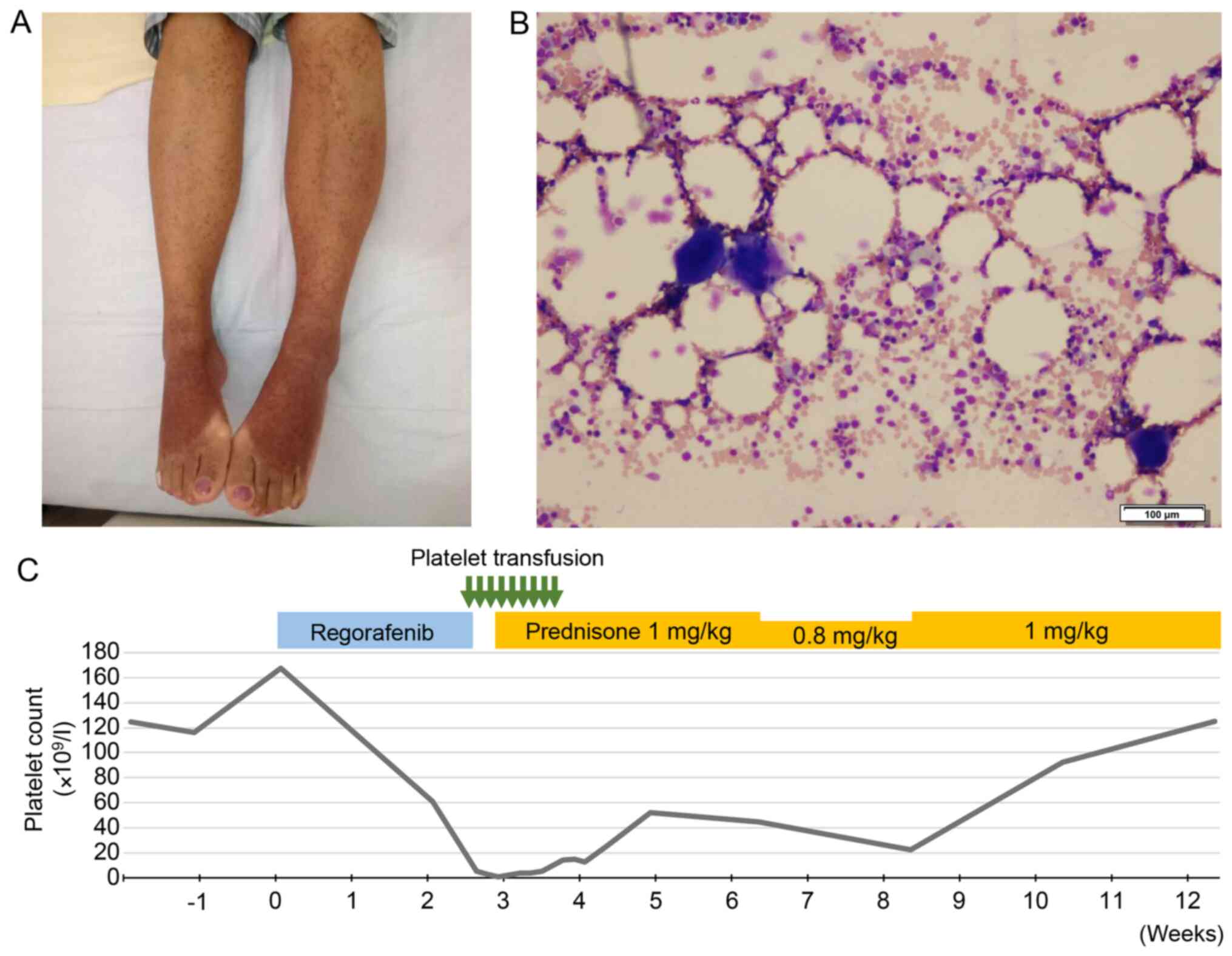
As a standard therapy in the late-line setting for recurrent/metastatic colorectal cancer (3,4), treatment with regorafenib 160 mg orally once daily for 21 days on/7-days off in a 28-day cycle was initiated at the age of 68 years. Platelet count was 167x109/l on day 1 but dropped to 61x109/l on day 15, and regorafenib was continued. On day 18, she vomited blood and presented at the emergency department. Laboratory examination showed severe thrombocytopenia with a platelet count of 5x10⁹/l (Table I). Petechiae and purpura in the extremities and hemorrhagic blisters in the oral mucosa were also observed (Fig. 1A). Multiple platelet transfusions were given, but the response was poor. Further laboratory examination showed increased PAIgG of 176 ng (normal range <27.6 ng) and negative IgG for H. pylori and heparin-induced thrombocytopenia antibody (Table I). There were no clinical manifestations suggested systemic lupus erythematosus (SLE), such as arthritis, mucocutaneous involvement or Raynaud's phenomenon. Diagnostic criteria of SLE were not met. Bone marrow examination revealed normal hematopoiesis, slightly increased megakaryocytes and no myelodysplasia or tumor metastasis (Fig. 1B). There was no evidence of other risk factors for exacerbation of ITP, including a history of taking any dietary supplements or medications, or viral infections. Taken together, these findings strongly suggested regorafenib exacerbated ITP. Regorafenib was permanently discontinued, and prednisone 1 mg/kg/day was administrated on day 21. The hemorrhagic diathesis resolved one week later, and the severe thrombocytopenia gradually recovered (Fig. 1C).

Figure 1

Clinical and pathological findings. (A) Petechiae and purpura in the extremities on day 21. (B) Histopathologic findings of bone marrow examination. Trilineage hematopoiesis was maintained. The megakaryocyte count was slightly increased. Myelodysplasia or tumor metastasis were not observed. Scale bar, 100 µm. (C) Clinical course of treatment with regorafenib and immune thrombocytopenic purpura. Green arrows indicate 10 units of platelet transfusion. Prednisone (1 mg/kg/day) was administered from day 21 and reduced to 0.8 mg/kg/day on day 45. As the platelet count decreased, prednisone was again increased to 1 mg/kg/day on day 59.

Table I

Laboratory data.

Table I

Laboratory data.

VariableReference rangeResult
White blood cell count, 100/µl33-8650
Red blood cell count, 106/µl3.86-4.922.90
Hemoglobin, g/dl11.6-14.89.3
Hematocrit, %35.1-44.428.4
Platelet count, 109/l158-3485
Immature platelet fraction, %1-4.816.3
APTT, sec25.0-38.031.6
PT, %70.0-130.094.0
Fibrinogen, mg/dl200-400298
D dimer, µg/ml<14.1
Lactate dehydrogenase, U/l124-222615
Aspartate transaminase, U/l13-3032
Alanine aminotransferase, U/l7-2317
Total bilirubin, mg/ml0.4-1.51.6
Creatinine, mg/dl0.46-0.790.87
Blood urea nitrogen, mg/dl8-2026.8
C-reactive protein, mg/dl0.00-0.141.55
PA IgG, ng/107 cells<27.6176.8
50% complement hemolysis, U/ml25-5130.2
Complement C3, mg/dl73-13872
Complement C4, mg/dl11-3111
Antinuclear antibody, IF<40320x
Antinuclear antibody pattern Centromere pattern
HIT antibody, U/ml<1<0.6
IgG antibody for H. pylori, U/ml<103
Hepatitis B surface antigen, IU/ml<0.0049<0.003
Hepatitis C virus antibodies, COI<0.990.04
HIV antibody/antigen combo assay, S/CO<0.990.12

[i] APTT, activated partial thromboplastin time; COI, cutoff index; HIT, heparin-induced thrombocytopenia; HIV, human immunodeficiency virus; IF, indirect immunofluorescence; MCH, mean corpuscular hemoglobin; MCHC, mean corpuscular hemoglobin concentration; MCV, mean corpuscular volume; PA IgG, platelet-associated IgG; PT, prothrombin time; S/CO, signal-to-cutoff.

Discussion

Thrombocytopenia associated with regorafenib is not rare. A meta-analysis reported incidences of all-grade and high-grade thrombocytopenia 22 and 3%, respectively (5). Inhibition of VEGFR is a potential mechanism of regorafenib-induced myelosuppression (6,7). Conventional thrombocytopenia is associated with bone marrow hypoplasia and responds to blood transfusion. In the present case, in contrast, normal hematopoiesis was maintained, and thrombocytopenia was refractory to platelet transfusion, which is likely explained by an autoimmune mechanism.

Diagnosis of ITP requires exclusion of a variety of potential causes for thrombocytopenia. Many conditions which cause decreased platelet production such as bone marrow damage, infiltration and replacement of the bone marrow due to malignancies and myelodysplastic syndromes were excluded by findings form the bone marrow biopsy in the present case. Drug-induced thrombocytopenia (DITP) is difficult to be distinguished from ITP. However, a history of ITP and unrecovered thrombocytopenia after discontinuation of regorafenib suggested more likely ITP than DITP (8). Moreover, a very low platelet count nadir less than 20x109/l, response to steroid and a positive anti-platelet autoantibody test are supposed to help precise diagnosis of ITP from expert opinions (9,10). Based on the above, the diagnosis of ITP was very likely.

ITP is an autoimmune disease which is characterized by platelet destruction associated with antibodies to platelets and megakaryocyte dysfunction (11). The pathogenesis of ITP is complicated and has not been fully clarified. Recent findings suggest that dysfunction of mesenchymal stem cells (MSCs) plays an important role (12,13). MSCs derived from ITP patients (MSCs-ITP) showed impaired self-proliferative capacity and the loss of immunosuppressive function. Interestingly, treatment of MSCs-ITP with PDGF-BB, a ligand of PDGFRβ, could reverse the defect of MSC-ITP in vitro (13). In this basis, regorafenib-induced inhibition of PDGF-BB/PDGFRβ signaling might trigger dysfunction of MSCs, resulting in the exacerbation of ITP. VEGF/VEGFR signaling is another important target of regorafenib, however, exacerbation of ITP had not occurred during bevacizumab containing treatment in the first-line setting at age of 66 years, which supports the hypothesis above.

Several multi-kinase inhibitors other than regorafenib also inhibit PDGF/PDGFR signaling, which may exacerbate ITP. Imatinib and sunitinib have been reported to induce immune thrombocytopenia (14,15), albeit that these studies did not investigate the possibility of pre-existing MSC dysfunction.

In conclusion, we report the first case of regorafenib-induced exacerbation of ITP in remission. This case report highlights the need for caution with regard to regorafenib treatment in cancer patients with concomitant ITP.

Acknowledgements

The authors would like to thank Dr Maki Kanzawa (Department of Diagnostic Pathology, Kobe University Graduate School of Medicine, Kobe, Japan) for pathological diagnosis.

Funding

No funding was received.

Availability of data and materials

The datasets used and/or analyzed during the current study are available from the corresponding author on reasonable request.

Authors' contributions

SK and YI made substantial contributions to the conception and design of the study. SK, YI, KY, AH and NK made substantial contributions to the acquisition of the data. SK, YI and KY drafted the manuscript. AH, TK, YFuj, YFun, MT, NK, HMa and HMi made substantial contributions to the analysis and interpretation of the data and were involved in revising the manuscript critically for important intellectual content. All authors read and approved the final manuscript.

Ethics approval and consent to participate

Not applicable.

Patient consent for publication

Written informed consent was obtained from the patient for publication of the clinical data and images.

Competing interests

The authors declare that they have no competing interests.

References

1 

Wilhelm SM, Dumas J, Adnane L, Lynch M, Carter CA, Schütz G, Thierauch KH and Zopf D: Regorafenib (BAY 73-4506): A new oral multikinase inhibitor of angiogenic, stromal and oncogenic receptor tyrosine kinases with potent preclinical antitumor activity. Int J Cancer. 129:245–255. 2011.PubMed/NCBI View Article : Google Scholar

2 

Krishnamoorthy SK, Relias V, Sebastian S, Jayaraman V and Saif MW: Management of regorafenib-related toxicities: A review. Therap Adv Gastroenterol. 8:285–297. 2015.PubMed/NCBI View Article : Google Scholar

3 

Grothey A, Van Cutsem E, Sobrero A, Siena S, Falcone A, Ychou M, Humblet Y, Bouché O, Mineur L, Barone C, et al: Regorafenib monotherapy for previously treated metastatic colorectal cancer (CORRECT): An international, multicentre, randomised, placebo-controlled, phase 3 trial. Lancet. 381:303–312. 2013.PubMed/NCBI View Article : Google Scholar

4 

Li J, Qin S, Xu R, Yau TC, Ma B, Pan H, Xu J, Bai Y, Chi Y, Wang L, et al: Regorafenib plus best supportive care versus placebo plus best supportive care in Asian patients with previously treated metastatic colorectal cancer (CONCUR): A randomised, double-blind, placebo-controlled, phase 3 trial. Lancet Oncol. 16:619–629. 2015.PubMed/NCBI View Article : Google Scholar

5 

Zhao B and Zhao H: Incidence and risk of hematologic toxicities in cancer patients treated with regorafenib. Oncotarget. 8:93813–93824. 2017.PubMed/NCBI View Article : Google Scholar

6 

Gerber HP, Malik AK, Solar GP, Sherman D, Liang XH, Meng G, Hong K, Marsters JC and Ferrara N: VEGF regulates haematopoietic stem cell survival by an internal autocrine loop mechanism. Nature. 417:954–958. 2002.PubMed/NCBI View Article : Google Scholar

7 

Hattori K, Heissig B, Wu Y, Dias S, Tejada R, Ferris B, Hicklin DJ, Zhu Z, Bohlen P, Witte L, et al: Placental growth factor reconstitutes hematopoiesis by recruiting VEGFR1(+) stem cells from bone-marrow microenvironment. Nat Med. 8:841–849. 2002.PubMed/NCBI View Article : Google Scholar

8 

George JN and Aster RH: Drug-induced thrombocytopenia: Pathogenesis, evaluation, and management. Hematology Am Soc Hematol Educ Program 153-158, 2009.

9 

Salib M, Clayden R, Clare R, Wang G, Warkentin TE, Crowther MA, Lim W, Nazi I, Kelton JG and Arnold DM: Difficulties in establishing the diagnosis of immune thrombocytopenia: An agreement study. Am J Hematol. 91:E327–E329. 2016.PubMed/NCBI View Article : Google Scholar

10 

Kelton JG, Vrbensky JR and Arnold DM: How do we diagnose immune thrombocytopenia in 2018? Hematology Am Soc Hematol Educ Program. 2018:561–567. 2018.PubMed/NCBI View Article : Google Scholar

11 

McMillan R, Wang L, Tomer A, Nichol J and Pistillo J: Suppression of in vitro megakaryocyte production by antiplatelet autoantibodies from adult patients with chronic ITP. Blood. 103:1364–1369. 2004.PubMed/NCBI View Article : Google Scholar

12 

Zhang D, Li H, Ma L, Zhang X, Xue F, Zhou Z, Chi Y, Liu X, Huang Y, Yang Y and Yang R: The defective bone marrow-derived mesenchymal stem cells in patients with chronic immune thrombocytopenia. Autoimmunity. 47:519–529. 2014.PubMed/NCBI View Article : Google Scholar

13 

Zhang JM, Feng FE, Wang QM, Zhu XL, Fu HX, Xu LP, Liu KY, Huang XJ and Zhang XH: Platelet-derived growth factor-BB protects mesenchymal stem cells (MSCs) derived from immune thrombocytopenia patients against apoptosis and senescence and maintains MSC-mediated immunosuppression. Stem Cells Transl Med. 5:1631–1643. 2016.PubMed/NCBI View Article : Google Scholar

14 

Radwi M and Cserti-Gazdewich C: Drug-induced immune thrombocytopenia associated with use of tyrosine kinase inhibitor imatinib. J Taibah University Med Sci. 10:365–368. 2015.

15 

Ansari Z and George MK: Drug-induced immune-mediated thrombocytopenia secondary to sunitinib in a patient with metastatic renal cell carcinoma: A case report. J Med Case Rep. 7(54)2013.PubMed/NCBI View Article : Google Scholar

Related Articles

  • Abstract
  • View
  • Download
  • Twitter
Copy and paste a formatted citation
Spandidos Publications style
Kimbara S, Imamura Y, Yakushijin K, Higashime A, Koyama T, Fujishima Y, Funakoshi Y, Toyoda M, Kiyota N, Matsuoka H, Matsuoka H, et al: Regorafenib‑induced exacerbation of chronic immune thrombocytopenic purpura in remission: A case report. Mol Clin Oncol 14: 30, 2021.
APA
Kimbara, S., Imamura, Y., Yakushijin, K., Higashime, A., Koyama, T., Fujishima, Y. ... Minami, H. (2021). Regorafenib‑induced exacerbation of chronic immune thrombocytopenic purpura in remission: A case report. Molecular and Clinical Oncology, 14, 30. https://doi.org/10.3892/mco.2020.2192
MLA
Kimbara, S., Imamura, Y., Yakushijin, K., Higashime, A., Koyama, T., Fujishima, Y., Funakoshi, Y., Toyoda, M., Kiyota, N., Matsuoka, H., Minami, H."Regorafenib‑induced exacerbation of chronic immune thrombocytopenic purpura in remission: A case report". Molecular and Clinical Oncology 14.2 (2021): 30.
Chicago
Kimbara, S., Imamura, Y., Yakushijin, K., Higashime, A., Koyama, T., Fujishima, Y., Funakoshi, Y., Toyoda, M., Kiyota, N., Matsuoka, H., Minami, H."Regorafenib‑induced exacerbation of chronic immune thrombocytopenic purpura in remission: A case report". Molecular and Clinical Oncology 14, no. 2 (2021): 30. https://doi.org/10.3892/mco.2020.2192
Copy and paste a formatted citation
x
Spandidos Publications style
Kimbara S, Imamura Y, Yakushijin K, Higashime A, Koyama T, Fujishima Y, Funakoshi Y, Toyoda M, Kiyota N, Matsuoka H, Matsuoka H, et al: Regorafenib‑induced exacerbation of chronic immune thrombocytopenic purpura in remission: A case report. Mol Clin Oncol 14: 30, 2021.
APA
Kimbara, S., Imamura, Y., Yakushijin, K., Higashime, A., Koyama, T., Fujishima, Y. ... Minami, H. (2021). Regorafenib‑induced exacerbation of chronic immune thrombocytopenic purpura in remission: A case report. Molecular and Clinical Oncology, 14, 30. https://doi.org/10.3892/mco.2020.2192
MLA
Kimbara, S., Imamura, Y., Yakushijin, K., Higashime, A., Koyama, T., Fujishima, Y., Funakoshi, Y., Toyoda, M., Kiyota, N., Matsuoka, H., Minami, H."Regorafenib‑induced exacerbation of chronic immune thrombocytopenic purpura in remission: A case report". Molecular and Clinical Oncology 14.2 (2021): 30.
Chicago
Kimbara, S., Imamura, Y., Yakushijin, K., Higashime, A., Koyama, T., Fujishima, Y., Funakoshi, Y., Toyoda, M., Kiyota, N., Matsuoka, H., Minami, H."Regorafenib‑induced exacerbation of chronic immune thrombocytopenic purpura in remission: A case report". Molecular and Clinical Oncology 14, no. 2 (2021): 30. https://doi.org/10.3892/mco.2020.2192
Follow us
  • Twitter
  • LinkedIn
  • Facebook
About
  • Spandidos Publications
  • Careers
  • Cookie Policy
  • Privacy Policy
How can we help?
  • Help
  • Live Chat
  • Contact
  • Email to our Support Team